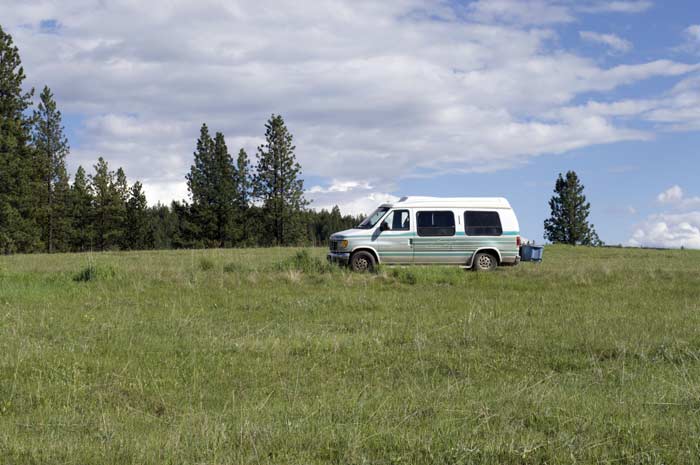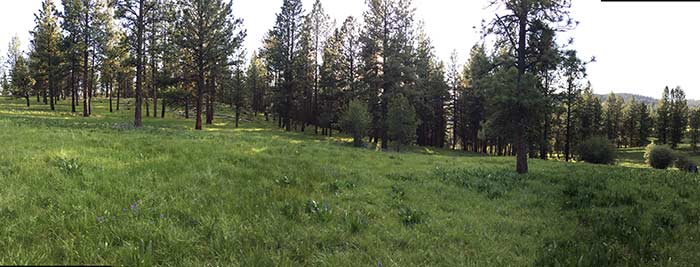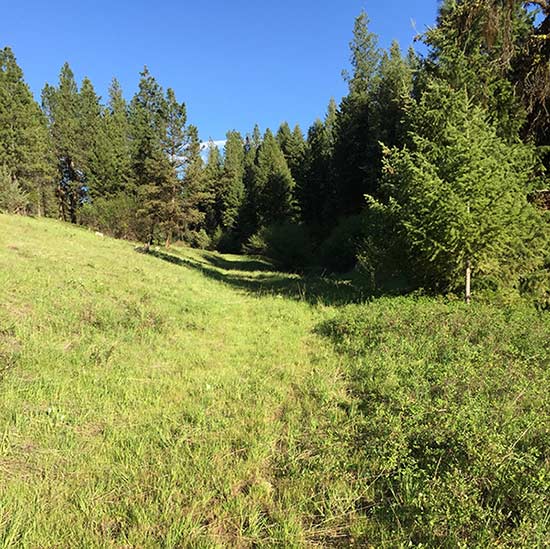
Two Chaosbunnies in the desert: Now we’re getting somewhere!

Part 1 of this saga is here. Part 7 of this saga is here.
Part 2 of this saga is here. Part 8 of this saga is here.
Part 3 of this saga is here. Part 9 of this saga is here.
Part 4 of this saga is here. Part 10 of this saga is here.
Part 5 of this saga is here. Part 11 of this saga is here.
Part 6 of this saga is here. Part 12 of this saga is here.

Our journey to Sparta presaged the lowest point in our travels, a long barren stretch of time (by which I mean about a day) during which we failed to locate any ghost towns of note, or indeed even any zombie towns, vampire towns, or other even approximately dead or undead towns.

But be assurred, Gentle Reader, for things did turn around, and amazement and wonder lay in our future.

We drove aimlessly for a while, chasing the ghosts of ghost towns whispered of in rumor and myth on Web sites of dubious provenance.

There is a lesson here, dear reader, which I hope that with this tale I might impart to you, so that you may avoid some of the travails which bedeviled Bunny and I on your journey. These words may, I think, impart to you a wisdom we lacked. This may be upsetting to those of you with more delicate sensibilities, so if this describes your constitution, you may wish to ensure you are seated before continuing.

Much of the information you will find on the Internet is rubbish.

Pure, unadulterated rubbish. Bunkum. Baloney. Poppycock, even.

So it was with the next ghost town we arrived at, the town of Cornucopia. An amazing ghost town, they said. Now completely abandoned, they said. No population, they said. A great example of an 1800s mining town, they said.

So we naively plotted a route, past the “Road Closed” sign, around the “No Access Turn Back” sign, up a winding dirt road and through steep and treacherous cliffs into the ancient mining town of Cornucopia.

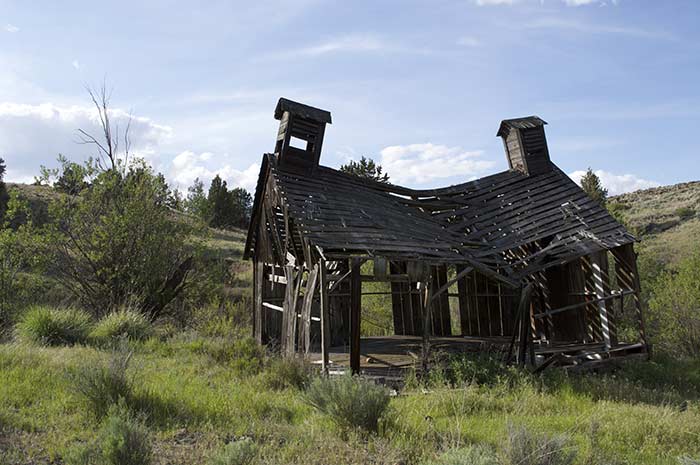
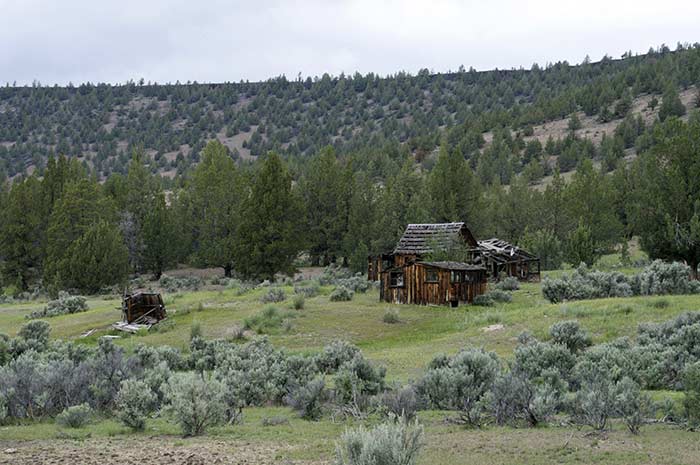
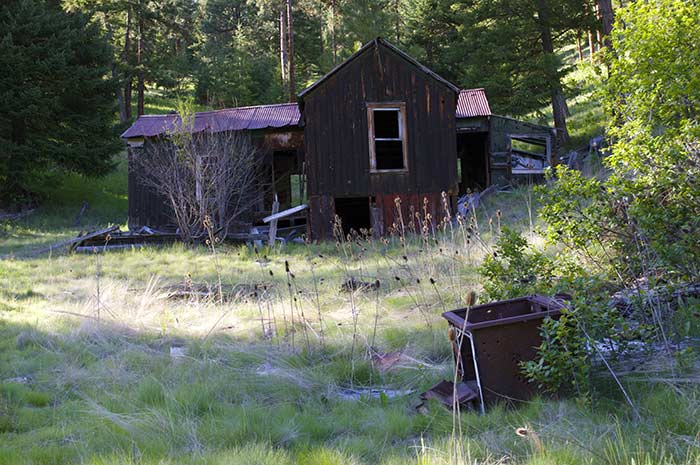
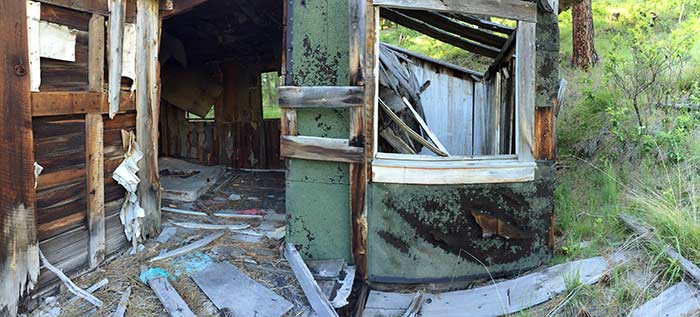
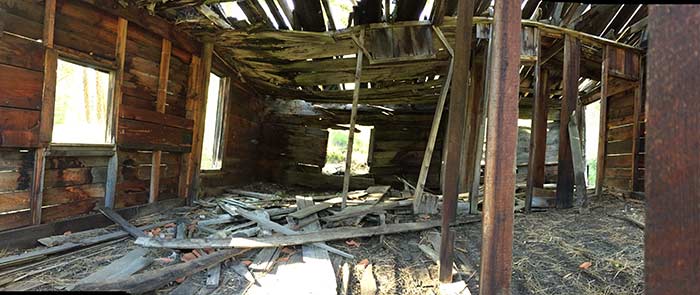
What we found, I’m afraif, was not what we were promised. A stream, a couple of foundations, a scattered handful of modern houses with satellite dishes, a sign advertising WiFi(!), and one shell of an abandoned house. This, after many hours of driving, was all we had to show for our adventure.

It’s a very cool ruined house, mind, but still not quite what we were led to expect.

It turns out that Cornucopia is now entirely privately owned. Someone bought the town. I didn’t even know you could just buy a town, but apparently that is a thing that you can in fact do, and someone did it here.

Someone who didn’t much cotton to city folk, from the sound of it.

The sign reads “Warning! Cornucopia township, land and buildings are all private property. No shooting allowed. No trespassing without permission. Baker co. sheriff.” It also says “we don’t much fancy your kind ’round here,” but that’s more the subtext than the text.
Our spirits low, we wound our way back down steep (and nominally closed, though that’s never much deterred us) winding roads, heading off toward the next stop on our agenda, about which we had, I must report, some nontrivial degree of skepticism. Sparta and Cornucopia had been almost enough to make us despair of finding a really good, solid ghost town of the kind Hollywood movies had led us to expect. That cinematic ghost town experience felt beyond our reach.

And it was in this dark hour, when hope seemed naught but a flickering candle in a howling maelstrom, that Bunny said, “Hey, Franklin, pull over!”

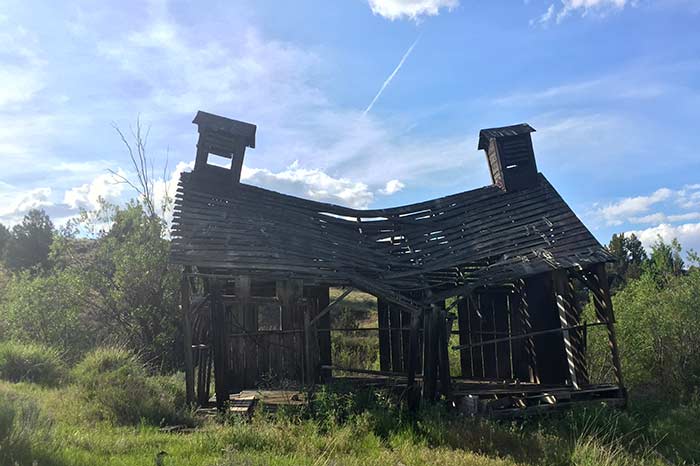
Just like that, the storm ended and the candle roared into life, no longer a flicker but a towering column of flame, a flame to lead the lost tribes of Israel through the trackless wilderness. A flame that shed a clear, bright light on: Whitney, Oregon.

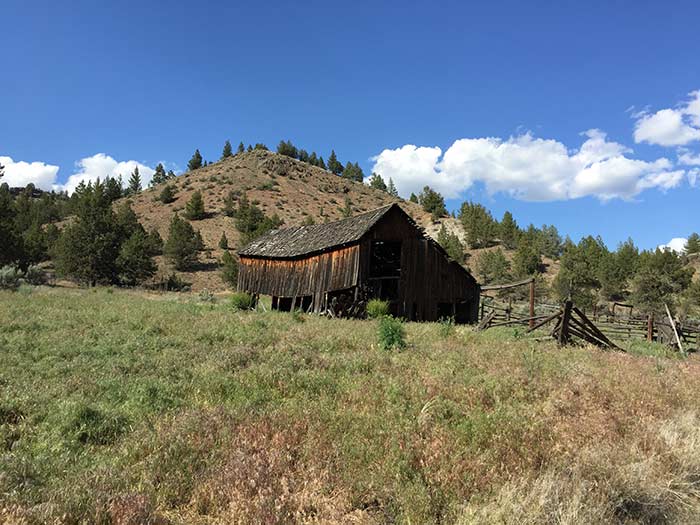
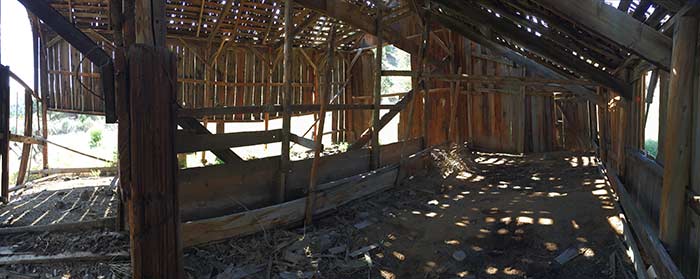
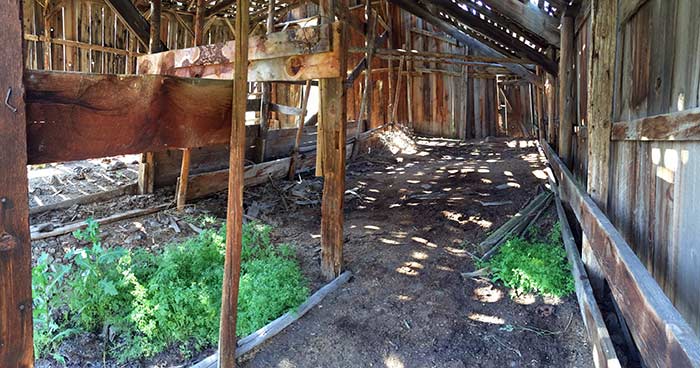
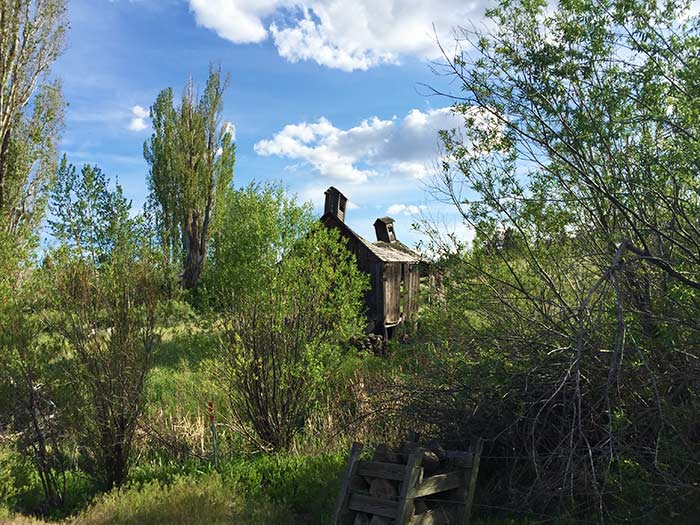
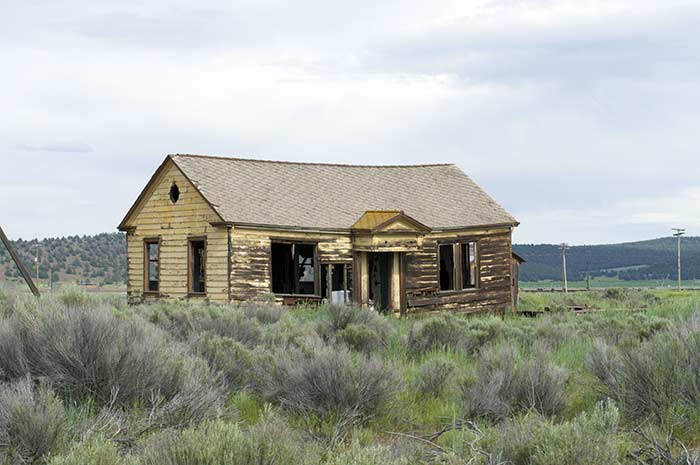
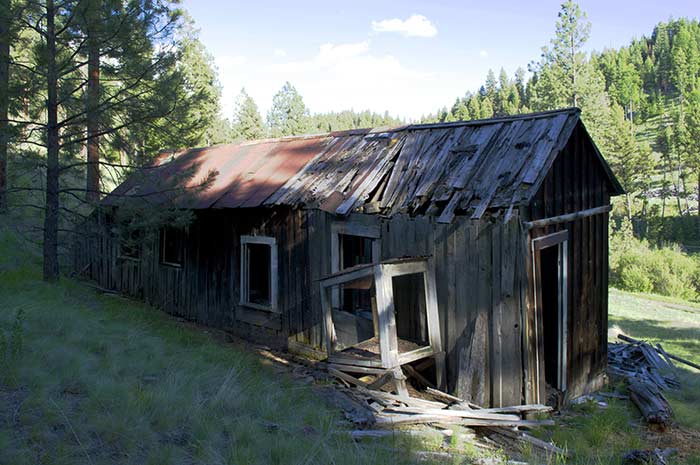
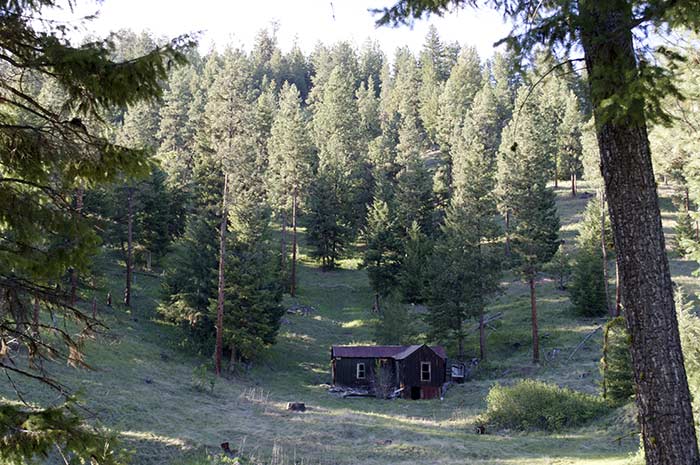
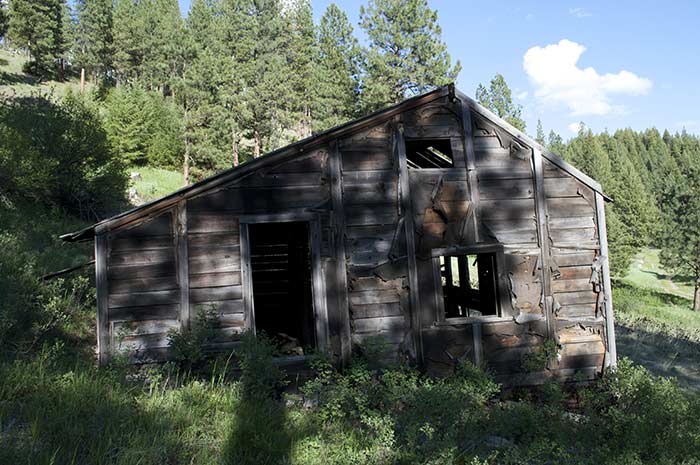
Without even planning to, we had stumbled upon a real ghost town.

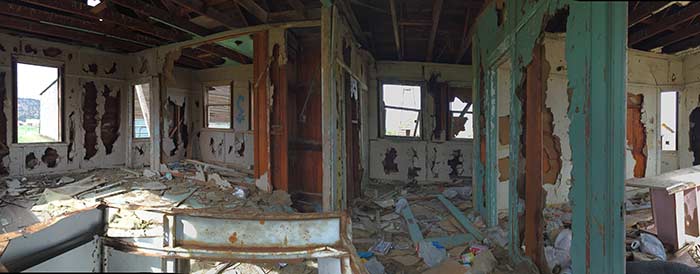
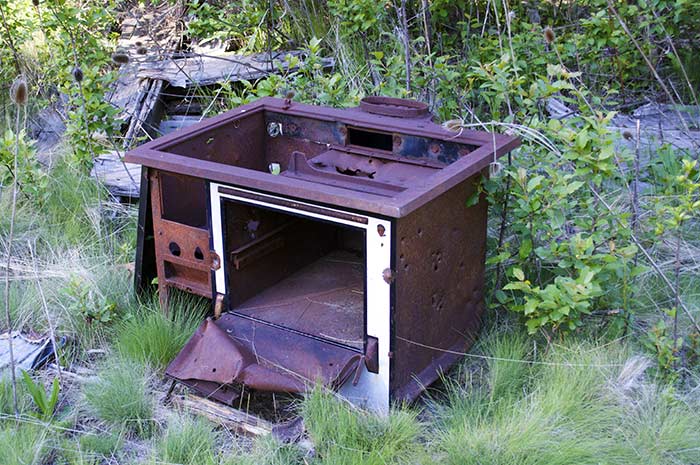
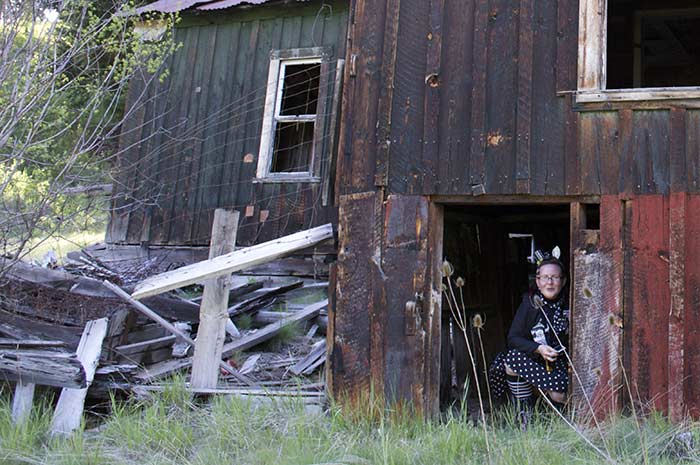
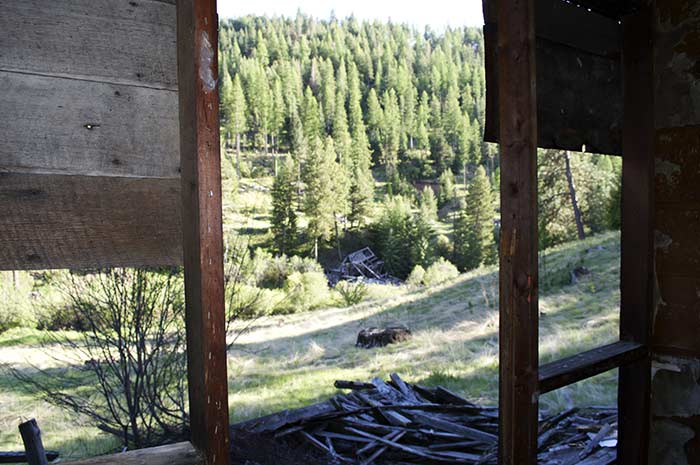
Whitney provided plenty of photo opportunities to keep both of us busy for the next while.

And, astonishingly, the town of Whitney also is not uninhabited. It is home to someone who no doubt wanted to get away from the bustle and the hurly-burly of life in a big city like Cornucopia, and settle down somewhere a bit less crowded where he could relax in the shade and, I don’t know, shoot chipmunks (of which there were many) with a high-powered rifle (of which there was much sign).

Yes, someone lives here.

Alas, a real storm was fast approaching, preserving a metaphysical symmetry now that the metaphorical storm had departed, and all too soon we were forced once again to pile into the Adventure Van and be on our way.

Once more the miles sped beneath our wheels, and we were on our way to still more serendipitous discoveries…but that must wait for the next installment.

Movie Review: Live and Let Spectre Die Hard with a Vengeance

The life of a sociopathic British secret agent isn’t what it used to be. Time was when you could expect that evil supervillains bent on making doomsday weapons from their space lab in space could be counted on to invite you in for dinner, explain the entirety of their sinister plan to you, and then concoct some ridiculously over-the-top way to kill you while they conveniently absented themselves from the room to deal with pressing matters elsewhere.

Alas, times change, and even the most dense of today’s modern supervillain has become wise to the various flaws in this otherwise cunning course of action. Previous James Bonds have had the luxury of knowing that the supervillains they faced, while no doubt quite super and unparalleled in their villainy, were perhaps a few bricks short of a deck in the “dealing with British secret agents” department.

And so a new James Bond was needed. A tougher James Bond. A more resourceful James Bond. A James Bond with a steely gaze.

And that James Bond is back for another romp through the gardens of man’s inhumanity to man in the delightful little movie Spectre, featuring car chases, explosions, sinister villains, fluffy Persian cats, acting, plot, and dialogue.

The movie goes something like this:

RANDOM HOT WOMAN: Oh, James, ravish me! Ravish me now!
DANIEL CRAIG: Hm.

DANIEL CRAIG takes off his SKELETAL COSTUME and goes out the WINDOW onto the ROOF OF THE BUILDING in pursuit of a MAN IN A DIFFERENT SKELETAL COSTUME that is NOT THE SAME as DANIEL CRAIG’S SKELETAL COSTUME

MAN IN THE DIFFERENT SKELETAL COSTUME: Let us blow up the stadium and then go see the Pale King, because we are villains in a James Bond movie and so we can not assume that our co-conspirators know what we’re conspiring about and we need lots of exposition to establish that we’re the bad guys.
RANDOM BODYGUARD: There is a man listening to us from the top of the roof outside our window. I think he may be James Bond.
MAN IN THE DIFFERENT SKELETAL COSTUME: Well, shoot at him, then! Isn’t that what I pay you for?

A bunch of people shoot at DANIEL CRAIG

DANIEL CRAIG: Hm.

DANIEL CRAIG shoots the BOMB they wanted to use to BLOW UP THE STADIUM. The entire building CRACKS and then FALLS OVER onto DANIEL CRAIG, who fixes the crumbling building with a STEELY GAZE

DANIEL CRAIG: Hm.

DANIEL CRAIG slides through the CRUMBLING WRECKAGE and lands on a CHAIR, then pursues the MAN IN A DIFFERENT SKELETAL COSTUME through the streets of MEXICO CITY

MAN IN THE DIFFERENT SKELETAL COSTUME: James Bond is chasing me! Meet me in the square!

A HELICOPTER lands in the SQUARE and picks up the MAN IN THE DIFFERENT SKELETAL COSTUME. DANIEL CRAIG fixes the HELICOPTER with a STEELY GAZE and then HOPS ABOARD. They have a WILD FIGHT. The helicopter goes UPSIDE DOWN

DANIEL CRAIG: Hm.

DANIEL CRAIG steals a RING, throws everyone else OUT of the HELICOPTER to their GRUESOME DEATHS, and then FLIES AWAY into the SUNSET

The rest is down here! Beware, here be spoilers.

Update #4 on the sex toy you can feel

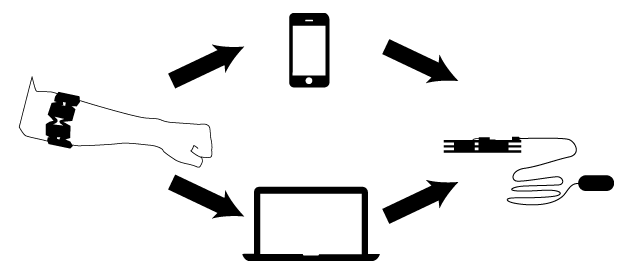
As regular readers of this blog know, my partner Eve Rickert and I are hard at work on a whole new type of sex toy: a strapon dildo covered with sensors that use direct neural stimulation so that the person wearing the strapon can actually feel the device. The idea is that it exploits the brain’s plasticity to become a part of the wearer, so it feels like something you are rather than something you’re wearing.

We have a prototype and I’m currently working on a far more sophisticated second-generation prototype. We’re also doing market research to try to refine our design approach and get a sense of who would be most interested in this device and what their needs are.

We just presented about the device at Arse Elektronika, to great interest:

Here’s where you come in!

We’ve put together a survey to ask people about themselves and their interest in this device. The results of this survey are kept confidential and will be used to help us figure out how many people find this device appealing and who you guys are.

It takes about 10 minutes to do, and people who do the survey can optionally enter a giveaway for one of two $50 Amazon gift cards. (The giveaway is only good for users in the US and Canada, sorry.)

If you know anyone else who’s interested, please feel free to share this survey far and wide. Tell your friends! Post in mailing lists! Help us spread the word!

Want to keep up with developments? Here’s a handy list of blog posts about it:
First post
Update 1
Update 2
Update 3
Update 4

Two Chaosbunnies in the desert: This is Sparta!

Part 1 of this saga is here. Part 7 of this saga is here.
Part 2 of this saga is here. Part 8 of this saga is here.
Part 3 of this saga is here. Part 9 of this saga is here.
Part 4 of this saga is here. Part 10 of this saga is here.
Part 5 of this saga is here. Part 11 of this saga is here.
Part 6 of this saga is here. Part 12 of this saga is here.

And so it was, Gentle Reader, that emanix, having recently called upon her Aspect and bodily shoved a 22-year-old camper van from a deep ditch, calmly returned to the front seat and said “do you fancy some tea?” We drank tea, for all the world like nothing had happened. She fixed the broken clasp in her bra nonchalantly, as if popping out of clothing while performing impossible feats of force were an everyday occurrence with her (which, in all fairness, it might just be), and we were off.

I am not, Dear Reader, much of a planner. I would like to say I chose a route for us that was breathtaking in its efficiency and military precision, but that would be a lie.

Our next destination was the Oregon town of Sumpter, a town whose status as the incorporeal essence of the deceased is vastly overstated. It’s described as a ghost town on the Web, sure, but in reality, it has a population larger than many of the Midwestern towns I grew up in as a child. In fact, we arrived to discover the allegedly late town of Sumpter was having a street festival.

It was not a total wash. Sumpter does boast a tiny collection of ruined buildings from antiquity (by US standards, which means anything prior to 1950 or so). There was the old brick safe from the old bank that burned down during the old fire of 1917, for example.

We also found the remnants of a long-abandoned gas station, now completely overgrown and with trees sprouting from what was doubtless once a nexus of commerce for the town.

Something about this place kinda reminds me of a location from the video game Portal 2. I kept expecting to hear a synthesized voice say “Sorry about the mess. I’ve really let the place go since you killed me. By the way, thanks for that.”

The outskirts of Sumpter is home to an open-air museum of sorts given over to the study of the various ways in which large old pieces of machinery can gather rust. I recognized this mining dredge from my time in Nome, Alaska; it’s a smaller version of the dredges they used there.

I like this old tractor. They don’t make ’em like this any more.

Probably a good thing, really. This machine looks like it runs on leaded gas and the fingers of the careless.

One of the vendors at the festival was selling corn dogs. Corn dogs, for those of you who are not acquainted with this peculiarly and quintessentially American gastronomic innovation, are hot dogs breaded with cornmeal, deep fried, and served on a wooden stick.

Bunny found the notion quite intriguing, having grown up in a land where things like black pudding (which is neither black nor pudding–it’s actually fried congealed horror) is more conventionally served. She had one, pronounced it delightful, and we stopped for the night, resuming our journey the next morning toward Sparta.

Sparta is not really a town. Sparta is a wide spot on a long dirt road that is more a suggestion of a town. It’s like one of those places in an open-world video game where you get the feeling that the game designers weren’t really trying, or couldn’t think of anything to put there.

One reaches Sparta, if one is of a mind to reach Sparta, by spending a very long time traveling a very narrow dirt road through arid desert. And believe me when I say “long” and “narrow.” This is the real reason people were reluctant to invade Sparta: it’s just too much of a pain in the ass to get there.

One travels along this road until one finds, first, a crumbling foundation, and then, a few miles past it, a crumbling stone cottage.

One then drives past these things, interesting but not really a proper ghost town, until one arrives at the center of town.

Ladies and gentlemen, this is Sparta!!!

Seriously. This is it. This is Sparta.

We were, as you can probably imagine, distinctly underwhelmed. No crumbling old buildings quietly decaying into the desert sands, no burly spear-armed men thrashing about in ways that are no not even the least bit homoerotic not ever so don’t you even think that.

But fear not, Gentle Reader, for though our tale reaches a low point here, we were soon to discover ghost towns quite marvelous in their essential ghost-towniness, despite the lack of not-homoerotic burly spear-armed men.

Update #3 on the sex toy you can feel

A while ago, I had an idea on how to create a strapon that the wearer can actually feel, as though it were part of your body. The idea took off, so I started a company and commissioned an engineering firm to do a design proposal. I recently tested a first-generation prototype, and discovered that not only does the tech work, it works far better than we expected.

Things have gone a bit crazy since then. I’ve received an avalanche of support and interest, and I’ve been talking to folks from all over the place who want to see this device become a reality.

I’m working on a second generation prototype that’s a lot more sophisticated than the first-generation prototype. It’s an interesting bit of engineering, for sure.

Still quite crude, but I’m refining it very rapidly. Right now, the main area I’m concentrating on is sensor design. The second prototype will have much more sophisticated sensors and will actually be usable for fucking (the first prototype wasn’t really suitable for penetration).

We’ve also been doing tons of market research, and the results have helped steer us toward a design that will work well for a lot of people.

If you’re interested in keeping up with this project, we’ve set up a Mailchimp email list. Feel free to add your email to the list! You can find it here:

Sign up for email list: http://eepurl.com/bP8m4f

Feel free to publicize this link to anyone you think might be interested!

We’re hoping to present the second-generation prototype at this year’s Arse Elektronica convention in San Francisco in October. Stay tuned!

Want to keep up with developments? Here’s a handy list of blog posts about it:
First post
Update 1
Update 2
Update 3
Update 4

Threesomes and intrigue and kink, oh my!

As some of you may know, Gentle Readers, among all the other things I do, I write porn. Well, erotica, I guess. I’ve never been entirely clear on the distinction. Sex stuff. I write sex stuff. Novels about people having kinky sex.

Long novels about people having kinky sex.

These novels are published under a pseudonym, and I’ve just released a new one. It’s called Nineteen Weeks.

The premise of Nineteen Weeks is straightforward: Amy, a suburban housewife married to a successful man, discovers that her husband is having an affair. But after she catches him red-handed with his mistress, she decides to deal with his infidelity in an unusual way; since her husband and his mistress had been sleeping with each other behind her back for nineteen weeks, she demands that they give her back that time, and pledge themselves to her to do anything she asks for nineteen weeks.

I deliberately tried, in this book, to take every one of the tropes of a conventional romance and flip them all on their heads. The powerful man takes control of the shy and inexperienced woman? Nope. The torrid affair ends with them settling down? Not quite. The–well, you’ll have to read it and see.

Plus it might be the only porn novel that quotes Ovid.

Anyway, check it out! You can find it here. If you despise the romance genre and you like kinky sex, this book might be exactly what scratches your itch.

Now through the end of September, you can get it for $2.00 off using the coupon code XQ68N. And patrons who support me on Patreon get a coupon code to download it free!

Update #2 on the sex toy you can feel

A while ago, I had an idea on how to create a strapon that you can actually feel, as though it were part of your body. The idea went crazy, a lot of people expressed overwhelming support, so I started a company and commissioned an engineering firm to do a design proposal.

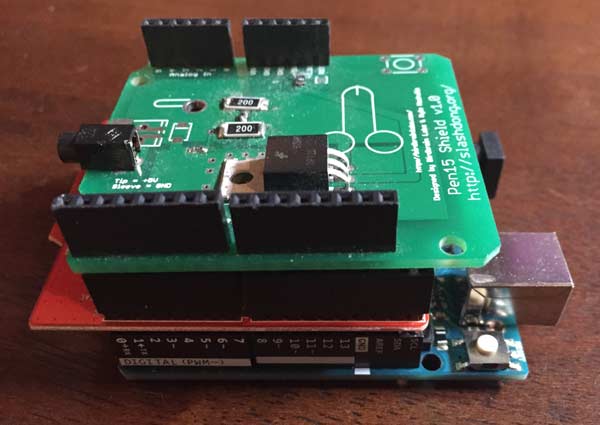
In the meantime, I’ve also been working on the idea independently of the engineering firm, so last week I put on my Mad Scientist hat1 and built a simple proof of concept.

Then I went to my friend Emily and said “hey, I have this prototype of a computerized strapon with sensors and a wearable computer and stuff, do you want to help me test it?”

“Sure!” she said, because my friends rock. (I love my life.)

So two days ago, I showed up at her house bearing the crude prototype. “Okay,” I said when we were safely in her bedroom, “this bit goes here, and that bit goes up in front like so…”

There were some design flaws in the first version–the wires leading from the computer to the electrode weren’t quiiiiiite long enough, so she ended up doing this one-legged dance trying to put it on. When it was all powered up and running (which looked quite odd–the sensors mounted to the big purple dildo all have little red lights that come on to show the sensor is working, so the overall effect looked a bit like a prop from a 70s science fiction porn flick), we spent some time adjusting the signal generator and making sure everything was working, and then got to it. I touched the sensors and had her describe what she felt. At one point, as I knelt in front of her stroking her cock, it suddenly struck me exactly what I was doing. “Man,” I said, looking up at her, “this is really obscene.”

“But Franklin,” I hear you ask, “how did it work?

Emily wrote a really good writeup from her perspective on her blog, appropriately titled “Brains, Bunnies and Boners.” Here’s an excerpt:

I stood sporting a sizable electrode-covered, purple erection as this man knelt before me stroking the blinking phallus. Looking dreamily into space, I concentrated on this new sensation and how to communicate it. He asked questions that had nothing to do with arousal and everything to do with programming or nerve density. It crossed my mind briefly that this was a strange situation. Covered in wires, half naked in front of a man I’m not intimately connected to, waxing poetically about the sensation of him passively stimulating my g-spot. Meanwhile he educates me on the corresponding connections between penis and vagina, sensitivity wise. […]

I see him touching the wirey and weird strap on, the sensation of that cock hitting my pubic bone becoming enough to fully trick my mind. The arousal of the plug flitting electrical currents over my internal nerves quickly translates into a thought of, “wow if he keeps doing that I’m going to get a hard on during science and that will be embarrassing.” Except logically I know I already have a hard on. A big purple one that he brought along for me to borrow. My brain has already made the adjustment in the five minutes we’ve been testing this to believing in the new genitals.

So the answer is it works really, really well. Far better than I expected, given how primitive the prototype was. Within minutes, it seemed her brain had internalized the dildo as part of her body; she said that touching the dildo felt like touching her. Which was amazing. I’d expected just to validate that the device could be made to work; I didn’t expect it to work that well.

I am actively pursuing making this device a reality. We’re currently enrolled in a venture accelerator program in Vancouver and we’re doing market research to validate the market for this device. Interested in being interviewed as part of that market research! Hit me up in email! franklin (at) franklinveaux (dot) com.

1 By which I mean my Mad Engineering hat. Well, technically, my Mad Engineering Magnifiers for Precision Soldering.

Want to keep up with developments? Here’s a handy list of blog posts about it:
First post
Update 1
Update 2
Update 3

Two Chaosbunnies in the Desert: On the taxonomy of ghost towns

Part 1 of this saga is here. Part 7 of this saga is here.
Part 2 of this saga is here. Part 8 of this saga is here.
Part 3 of this saga is here. Part 9 of this saga is here.
Part 4 of this saga is here. Part 10 of this saga is here.
Part 5 of this saga is here. Part 11 of this saga is here.
Part 6 of this saga is here. Part 12 of this saga is here.

As our journey around the Pacific Northwest unfolded, emanix and I slowly gained an awareness that not all ghost towns are the same. There is, in fact, an entire taxonomic classification of ghost towns–a phylogenic tree, if you will, of abandoned places.

The classic, Scooby Doo variety of ghost town–an entire town whose members have left behind, leaving empty buildings in their wake, is relatively rare. Ghost towns like that don’t usually last very long, unless they’re in high desert. The artifice of human hands is surprisingly fragile and crumbles quickly without human tending. Some of the ghost towns that had formerly be on our list, before we started validating them with Google Earth, are nothing but foundations scattered about in otherwise unremarkable landscape.

Some ghost towns are what Bunny calls “zombie towns.” They’re towns that were mostly or completely dead, then came back to life when the economic conditions changed. One ghost town we had planned to visit but then removed from our list is a classic example, an old mining town settled in the 1800s that became nearly deserted in the 1940s when the mine played out, then saw new life in 2011 when new mining technology made it possible to reopen the mine.

More common are ghost towns that aren’t really ghost towns. People still live in them; there are inhabited houses and ongoing business enterprises set in amongst abandoned houses. The town of Venango, Nebraska where I grew up is a semi-ghost town. Some of these ghost towns reinvent themselves as tourist destinations, playing up the “ghost town” mystique for the benefit of visitors.

Granite is a tourist ghost town. Being there is a bit like being on a very realistic movie set. There are still people living there–quite a few of them, in fact–and many of the abandoned buildings have little signs telling you what they once were.

Granite wasn’t all that impressive at first glance.

I have often been told not to judge a book by its cover. It’s advice that never made a whole lot of sense to me; if the cover didn’t matter, why not just put a blank cover with the book’s title on the front? Today, as co-owner of a publishing company, it makes even less sense to me. But the idea behind it has a small grain of truth. You can’t always tell from a first glance at something what you’ll get. First impressions can be deceptive. Something that doesn’t seem impressive at first might be far more impressive once you delve a bit deeper.

Sometimes, though, you can judge a book by its cover…and Granite was one such book. We hopped out of the Adventure Van and poked around for a while, waiting to be blown away by something amazing. Amazing things failed to happen.

We did both like this old dance hall, to be fair.

We knew it was a dance hall because a sign told us so.

That sign was probably old when mammoths walked the earth. Oh, the stories that sign could tell–skies filled with the leathery wings of great flying pterosaurs, the discovery of the western reaches of the New World by a strange species of hairless ape, Richard Nixon’s Southern Strategy.

The building is for sale, if you want it.

The same style of sign identified the old fire station and the old church. (It’s hard not to put “the old” in front of the remnants of abandoned places–the old Miller place, the old asylum, the old space shuttle Vehicle Assembly Building, the old Detroit.)

But we soon found ourselves bored and in search of wifi. There was a small combination convenience store/winter sports staging and supply area/restaurant at the edge of town, where we wandered in search of food and Internet access. They had wifi but told us guests weren’t allowed to use it, on account of the considerable expense involved in airlifting data packets to such a remote place.

They also seemed flummoxed by Bunny’s English accent and even more befuddled by her request for tea. It took a while, but they finally sorted out what “tea” was an a loose approximation of how to make it, and delivered, after considerable fussing, a beverage which was more like tea than you might expect from, say, a Sirius Cybernetics Corporation beverage dispenser.

We headed out of town, pausing only long enough to photograph this rather fetching ruin of the old car, located just a short distance from the old lodge right next to the old tree.

We headed out to our next destination, which we hoped would be less semi-ghost town and more authentic ghost town than Granite, and we–

“Hey! Pull over!” Bunny said. “What’s that?”

“That” turned out to be a cluster of ruins–not a town, precisely, but more a gathering, or perhaps clump, of old houses long since abandoned.

And it was awesome.

I stopped the Adventure Van off the road, a narrow and straight strip of highway that cut through the desert like a length of electrical tape placed by some unknown hand over an otherwise innocuous birthday cake, or something.

We hopped out, cameras in hand, and explored.

That’s an enormous mound of old tin cans, now rusting, behind that house.

This lovely, lovely old stove was slowly turning to dust beside the collapsed wall of one of the houses. At least I think it’s an old stove. I’m not entirely sure. That’s an old stove, right?

We cautiously poked our noses into one of the houses. The floor was littered with decades of detritus. There were some magazines from the 1940s lying scattered amongst the refuse and rubble.

The building next to it was in slightly better repair–but only slightly.

This was our first real jackpot–a completely serendipitous find that was absolutely magnificent in its decay.

We wandered around for a time. Eventually, a car pulled up next to the van. “Hey!” a woman said to Bunny. “I think you’re trespassing.”

“Okay!” Bunny said. That seemed to be enough for her, and she drove away.

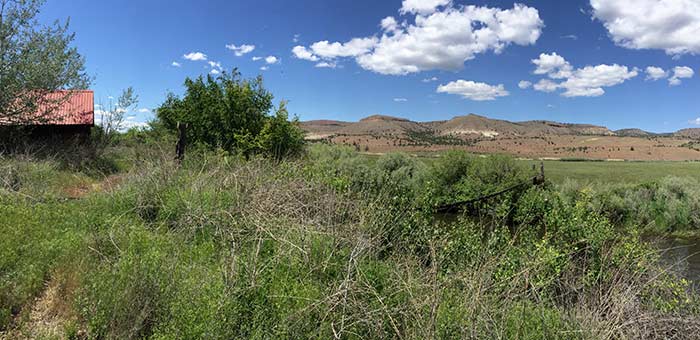
I paused to get one last panorama of the scene before we left.

We hopped into the van. I put the transmission in Drive, and approximately two hundred milliseconds later had dropped the front of the van into a ditch.

We got back out. Bunny shook her head.

A car traveling the strip of electrical tape stopped and a lovely young couple got out. “Need a hand?”

I pointed to the van. “Yep. We’re in a ditch.”

I got back in. Bunny and the couple put their backs against the nose of the van. The wheels spun.

I wish I could tell you, gentle reader, what happened next. I feel that I can’t quite properly comprehend it myself. It seemed as if Bunny turned green and…swelled somehow. And roared a mighty roar, a roar to make the heavens tremble and brave men weep. The nose came up out of the ditch and the van lurched backward as though tossed like a Dixie cup in the mighty fist of Hulk Hogan, who was perhaps at a picnic with friends and no longer needed it, having consumed the combination of Kool-Aid and Pabst Blue Ribbon it once contained.

The couple waved cheerfully and drove away. Bunny climbed into the front seat, once again her normal size and color. “I think I popped the clasp on my bra strap,” she said. I stared at her, thankful that time and circumstances have never conspired to cause me to be in a fistfight with her, as she would without question crush me like a bug.

And we were off once again, heading down the electrical tape highway across the great frosted birthday cake of life, destined for more adventures which I shall relate in the next chapter of this tale.

eBook Design Illuminated

A short time ago, I was hired by Talk Science To Me to do the eBook version of Tantra Illuminated, a very lengthy academic work on the history of Tantrick religious traditions in India.

The book was large and beautifully designed, with a great deal of content from original Sanskrit sources. The design used a number of different, complex elements, including copious margin notes.

I’m in the process of blogging about the complexities of eBook design with non-English alphabets and complex layouts. Part 1 of the series is up on the Talk Science To Me blog. Here’s a teaser:

The project turned out to be far more daunting than I’d imagined, even knowing from the outset that it would likely be more complex than it first appeared. I could easily write a book on the various technical, layout and rendering challenges I encountered creating this e-book (in fact, that might be a good future project!), but we’ll just look at a few of the interesting potholes we encountered on the road to creating the e-book.

A tale of two diacritics

The text in Tantra Illuminated contains significant lengths of transliterated Sanskrit. Sanskrit uses a non-Latin alphabet for which a standard transliteration system called the International Alphabet of Sanskrit Transliteration (IAST) exists. This is the system employed by the transliterations in Tantra Illuminated.
The IAST relies heavily on Latin characters with diacritic marks. Most of these marks are supported by the majority of e-book readers, so I didn’t anticipate difficulty with the transliterations.

I was wrong.

You can comment here or over there.

GMohno! Part 3: “Because Monsanto”

It’s an article of faith among certain people that Monsanto, Inc, the American seed company, is inherently and intrinsically evil. And not just evil in the way that you might say any large corporation is “evil,” in that it’s an organization of people with a vested interest in the organization’s survival, but maliciously evil–deliberately and vindictively harmful to others and to society as a whole.

So pervasive is this attitude that it’s accepted even by folks who don’t have a particular problem with GM food or agricultural biotechnology.

I can’t really complain about the folks who accept this idea. I used to be one of them. For many years, my conversations about GM food took the form “I think that genetic modification is a valuable tool for feeding a world of billions, and there is not the slightest evidence whatsoever that GM foods are in any way harmful or dangerous, even though I think Monsanto is evil.”

I couldn’t really put my finger on why I thought they were evil. I just knew they were. It was an idea I’d heard so often and was so pervasive I accepted it as true. (There is a quote that runs “If you repeat a lie often enough, people will believe it.” It’s often erroneously attributed to propagandist Joseph Goebbels, though there’s no documentation that he ever said it; the idea appears to have been around for quite a while.) I consider myself a skeptic and a rationalist, but I am still not immune to accepting things without evidence merely because I have heard them often enough.

In fact, it was during an effort to prove how evil Monsanto is that I started to realize many of the things I’d believed about the company were wrong. Someone in an online debate had challenged me to support the idea that Monsanto is an evil company, and I’m rarely one to turn away from a challenge to what I believe. “Piece of cake,” I thought. “A few minutes and a half-dozen links ought to be enough. This ought to be about as hard as proving that Moscow is a city in Russia.”

If you Google “Monsanto evil,” you’ll find a vast river of hysterical Web sites that scream Monsanto’s vileness to the heavens, usually accompanied by ridiculous and emotionally manipulative pictures like this:

But this river of Google effluent is about as persuasive as a Flat Earth Society page, and I reasoned that if I wouldn’t find the source credible myself, it would be disingenuous to try to use it to support my argument. Besides, I thought, I didn’t need to cite crap sources like that–there was plenty of legitimate support for Monsanto’s encyclopedic catalog of evil from reputable sources.

So I kept going, past the Googlerrhea of sites like NaturalNews and GMOwatch, looking for the clear and obvious evidence I knew would be there. I had heard all the standard arguments, naturally, and was quite confident they would be easy to support.

It turned out to be not so simple after all. In fact, the deeper I got, the more Monsanto’s supposed “evil” started to look like smoke and mirrors–propaganda fabricated from the flimsiest of cloth by people frightened of agricultural technology.

First, I thought Monsanto was enormous. It’s not. As corporations go, it’s actually not all that big. It’s about the same size as Whole Foods. It’s smaller than Starbucks and The Gap. It’s way smaller than UPS and 7-11. (In fact, I wrote a blog post about that last year.) As of the middle of 2014, Monsanto’s size compared to other corporations looked like this:

In fact, this graph is now out of date; as of the last quarter of 2014, Whole Foods is significantly larger in terms of revenue than Monsanto. (People who believe that little guys like Whole Foods are sticking it to the big bad megacorps like Monsanto likely don’t realize what they’re doing is merely supporting one giant megacorp over another.)

Then I read the company’s history, and learned that when people talk about things like how Monsanto made Agent Orange, they’re showing ignorance of a simple fact I also used to be ignorant of: there are, in a real sense, two Monsantos.

A Tale of Two Companies

The first Monsanto was Monsanto Chemical, a company that manufactured food additives, industrial chemicals, and plastics. This Monsanto no longer exists. In the late 1990s, it developed the drug Celebrex. Pfizer, the pharmaceutical company, bought Monsanto in 2002 because they wanted to capture Celebrex, a profitable and popular drug for treating arthritis.

Pfizer is a pharmaceutical company. As a pharmaceutical company, it’s not especially interested in being in agribusiness. In 1996, Monsanto (the chemical company) had bought an agricultural company, but Pfizer didn’t want to keep the agricultural business. So after the purchase of Monsanto, Pfizer spun off the agricultural business as a new company, which kept the old name Monsanto. This new Monsanto was entirely distinct from the old: new board, new directors, new business model, new bylaws, new incorporation. In what would prove an ill-fated decision, it kept the name “Monsanto,” which Pfizer also wasn’t interested in, to avoid having to rebrand itself. Changing the name, they estimated, would cost $40 million.

Was the old Monsanto evil? A case can be made that Monsanto (the chemical company) was a ruthless competitor. But a lot of the charges levied against it by the “Monsanto is evil” crowd turn out not to be true.

Monsanto invented saccharin? Not so fast

One of the claims I’ve heard many, many times is that Monsanto invented saccharin, the artificial sweetener. This is so far from true it’s “not even wrong,” as the saying goes. Saccharin was invented in 1879 by chemist Constantin Fahlberg of Johns Hopkins University. It was first manufactured in Magdeburg, Germany. Monsanto was one of many saccharin producers until 1972, but the claim they “invented” it is absolutely false.

In fact, these days, “Monsanto invented saccharin” is a litmus test I use in conversations with anti-Monsanto activists. If someone trots out this chestnut, I know he’s a person who can’t be arsed to do even a simple Wikipedia search to support his ideas. He is the sort of person who blindly accepts anything that supports his existing beliefs, and I stop talking to him.

Monsanto and Agent Orange

This is another factoid routinely trotted out to prove Monsanto’s despicable evil. Only an evil company could invent and manufacture so foul a substance as Agent Orange, right?

Well, Monsanto didn’t invent Agent Orange. It was invented by the US Army in 1943–the notion that Monsanto created it is another of those litmus tests I use to determine whether someone is interested in doing even the most rudimentary fact-checking or not.

During the Vietnam War, Monsanto wasn’t even the main contractor that manufactured Agent Orange–that dubious honor belongs to Dow. Monsanto was one of many overflow suppliers the government used when Dow couldn’t make it fast enough; the others included Uniroyal (the tire manufacturer), Thompson-Hayward Chemicals (now Harcros Chemical Co), Hercules (now Ashland Inc), the Diamond Shamrock Corporation (now Valero Energy Corporation), and Thomson Chemical Company.

It’s interesting that folks will tell you “Monsanto is evil because Agent Orange,” but not “don’t buy tires from Uniroyal; they’re evil because Agent Orange.” It is, sadly, a truism that we will use an argument to support a position we already believe even when that argument applies equally well to a premise we aren’t invested in.

Monsanto and glyphosate

The notion that glyphosate is bad is accepted as self-evident by many folks who oppose GMOs, and I’ve often heard a circular argument used in discussions about glyphosate resistance: Monsanto is evil because they make glyphosate, and glyphosate is evil because it’s made by Monsanto.

Monsanto (the chemical company) was only incidentally interested in agribusiness. Monsanto (the chemical company) developed the herbicide glyphosate in 1970. The patent on glyphosate expired in 2000, two years before Pfizer bought Monsanto (the chemical company). Pfizer wasn’t interested in making herbicides, so Monsanto (the seed company) kept the glyphosate business. They still make glyphosate today, but they’re not a huge manufacturer–because the patent has expired, most glyphosate manufacture these days is by other companies in China.

Old Monsanto aside, the new Monsanto is still evil!

So what about Monsanto (the seed company)? I keep reading tons of stories about how evil it is, but when I go to validate those stories, they tend to turn out not to be true.

A lot of folks fear GMOs, for the same reasons a lot of folks fear vaccines–there’s a lot of bad info out there. Some of it (like “GMOs aren’t tested” or “GMOs cause cancer”) is demonstrably false.

Monsanto gets a lot of its bad reputation on the basis that it makes GMOs and people are frightened of GMOs. A lot of other companies also make GMOs, but Monsanto is singled out for special hate, even though it’s not the biggest company in the GMO business (Syngenta, for instance, is bigger).

Another common argument on the “Monsanto is evil” side of the fence is that Monsanto patents seeds. If a corporation can control our seeds they can control our food! That’s clearly evil, right?

I touched on plant patents briefly in part 1 of this series. A lot of folks don’t understand plant patents, but many foods–including organic and conventional produce–is patented. (Yes, you read that right. The 100% organic, all-natural kale you buy at Whole Foods is patented.) Any kind of new seedline–whether GMO, hybrid, conventional, or organic, can be patented. The first plant patents in the world were issued in the 1800s; the first plant patents in the United States were issued in the 1930s…long before GM technology existed.

And not all GM food is patented.

If you want to argue that patenting plants is a bad idea, by all means, make your argument. But don’t get confused. That argument has nothing to do with Monsanto and nothing to do with GM food.

Saving Seeds and Monsanto Lawsuits

Once you get through the clearly false claims about saccharin and Agent Orange and patents, you start encountering the second wave of arguments for Monsanto’s evil evilness of evil, which usually ride into battle under one of two banners: “Monsanto doesn’t let farmers save seeds!” and “Monsanto sues farmers for accidental contamination!”

Here is where I believed I would find some real meat–some genuine, clear-cut evidence that Monsanto is bad news.

That evidence turned out to be a mirage–I saw it glittering on the horizon, but when I got close, there was nothing there but sand.

Now, it is true that farmers can’t save seeds from patented crops. This isn’t a GM issue; farmers also can’t save seeds from patented organic or conventional crops either. They also can’t save seeds from hybrid crops (seeds from hybrid crops don’t tend to breed the desired traits reliably, as I talked about in part 1). But I grew up in a farm town, and I’ve never met a farmer who wants to save seeds. It’s bad for business. Seeds are one of the cheapest parts of running a farm. Farmers who save seeds have to dry, process, and store them. Farmers who buy seeds get a guarantee that the seeds will grow; if they don’t, the seed company will pay them.

As for the idea that Monsanto is evil because they sue farmers for accidental contamination of their fields. I looked, but I couldn’t find any court cases of this. I did find court cases where farmers denied stealing seeds and said it must be contamination, but in all those cases, a jury or the court found they were lying. (Protip: If someone inspects your field and 98% of the plants growing on it are a patented variety, that’s not accidental contamination.)

Monsanto neonicotinoid GMO dead bees!

There is a lot of confusion and misinformation about GM plants. And, unfortunately, that confusion tends to lead to a lot of conflation about entirely unrelated issues.

One complaint I’ve heard many times, including in the comments on an earlier part of this series, is Monsanto is evil because their GMO seeds are coated in neonicotinoid insecticides that kill bees.

It’s hard, at first glance, to tell where to begin to untangle this snarl, because it confuses entirely unrelated things into a tangled mess of misinformation and error.

I mean, yes, neonics might be harmful to bees, possibly, but…er, um…

…that technology was developed by Bayer, not Monsanto.

And it has nothing to do with GMOs. Neonics are insecticides, not herbicides. They are not poisonous to plants; you don’t need to engineer plants to resist them. (In fact, they are derived from nicotine, a natural insecticide made by plants. The name “neonicotinoid” literally means “new nicotine.”) Neonicotinoids are seed coatings–they’re applied to seeds after the seeds are collected, not produced by the seeds themselves.

Of course, all this information is irrelevant in the face of the final, last-ditch argument put forward by Monsanto’s detractors…

It’s all a conspiracy, man

The conspiracy theory is the final sanctuary of the person with no arguments. It’s an attempt to discredit an argument without looking at the argument directly, and also poison the well, by claiming that anyone who supports the dies of some debate you don’t support is in league with a sinister and all-encompassing evil.

I’ve received emails–many emails–from my blog posts about GM foods, asking me how much money Monsanto is paying me to write them.

The idea Monsanto has paid off all the world’s scientists to engage in a vast conspiracy to say GMOs are safe when they’re really not is so absurd as to be farcical. Look, ExxonMobil is enormous compared to Monsanto, and with their vast piles of money they can’t pay off all the world’s scientists to say global warming isn’t a thing! If ExxonMobil can’t afford to pay off scientists, how can a company that makes less money than Whole Foods?

So after looking into it, I was forced to change my mind and conclude that Monsanto (the seed company) isn’t particularly evil, at least not in a way that other corporations aren’t. ConAgra might be more evil, if you look at biotech companies. But Monsanto (the seed company)? Not so much.

Now if you’ll excise me, I’m off to buy another Lamborghini with the shill bucks Monsanto just paid me.

Note: This blog post is part of a series.
Part 0 is here.
Part 0.5 is here.
Part 1 is here.
Part 2 is here.
Part 3 is here.