The Hookup

There we were, me, my wife, my wife’s boyfriend, in Atlanta for a long weekend. “Hey, my contact is supposed to be here,” my wife’s boyfriend said. “If I can get hold of him, he can really hook you up. He always has the best shit, like, you wouldn’t believe.”

I will admit to some skepticism. I’ve been promised the best shit before, only to be disappointed; there’s a lot of product out there on the street that’s just not what it’s cracked up to be. But my wife’s boyfriend insisted that his man always came through. “You’ll see,” he said. “I just need to get ahold of him. He can be a little difficult to reach sometimes. Kinda goes with the territory. Once you sample his product, you’ll see. He only deals the good stuff.”

A few days and several phone calls later, he finally managed to make contact with his dude. We set up a meet that afternoon in an Atlanta hotel. “I gotta get some cash, man,” my wife’s boyfriend said. “We need to hurry, he doesn’t like to be kept waiting.”

Now, you would think that two people armed with an ATM-finding app in the heart of a city the size of Atlanta would have no difficulty with this. You’d think that, and you’d be so very, very wrong.

We found the first ATM tucked in a small atrium behind locked doors that would not open. The second was out of order. With increasing desperation, we roamed the harsh streets of Atlanta in search of a magic machine that might turn bits of data into rectangles of linen paper, painfully aware of every long minute that ticked by, separating us from the promise of the good stuff.

At last, on our third try, he hit pay…um. Not paydirt, exactly. Pay machine? An ATM that functioned as it should? Anyway, we succeeded in our first objective and, refreshed from the slings and arrows of outrageous fortune by this small taste of victory, we made for the hotel where his connection allegedly awaited, no doubt with growing impatience.

I will confess, Gentle Reader, to a certain degree of nervousness when at last we arrived at a nondescript hotel door beyond which my wife’s boyfriend’s dealer allegedly awaited. The door opened instantly at his knock, to reveal a rather burly bearded man who looks like the prototype of every deranged character ever to appear in Hollywood:

Like this, but with a vaguely Scottish beard and an even more maniacal laugh

He escorted us in, still laughing in a way that distinctly said “too late now.” A woman sat on the bed, from which she said “Sit! Sit! I don’t bite, unless you want me to.”

My wife’s boyfriend sat, shrugged, and offered her his arm, which she bit. Beside him, a tuft of brilliantly colored hair extended from beneath the covers. “Don’t mind her,” the man said, ”that’s my girlfriend.”

Ah yes, the man. The man with the good stuff. The man so reliably able to hook one up with the best of the best that my wife’s boyfriend makes an effort to connect with him whenever he’s in Atlanta.

I have not yet mentioned the man.

The man sat beside the small table you always find in hotel rooms, the little wee thing that you never see anywhere except hotels, the table that somehow screams “I belong in a hotel room and nowhere else on earth” even though you can’t quite put your finger on why.

He sat there amidst a huge pile of small vials and little plastic bottles full of precursors, carefully mixing and pouring. I watched with, I must admit, no small measure of fascination, because while I do have a passing familiarity with armchair chemistry, I’ve never seen the synthesis process before. “Come in, come in!” he boomed. “I have some samples if you want a taste.”

By this point, Gentle Reader, I wanted a taste very much indeed, oh yes I did.

He handed me a tiny plastic cup and oh, if I live to be a thousand years old, practicing the craft of writing for all that time, I will come to the end of my existence with perhaps one one-hundredth of the eloquence I would need to express to you how exemplary, how blissful, how euphoric that little taste was.

The man laughed. “That expression, right there, that is why I do what I do,” he said.

Never have I tasted before, and never do I hope to taste again, such a magnificent, such a heavenly small-batch artesinal spiced rum.

I have sampled spiced rums all across this globe, from Colorado to Belgium to Iceland to the United Kingdom (the place so known for its rums that they were once used as a medium of exchange, because if there’s one thing that history teaches us, it’s that if you have something that tastes good, the United Kingdom will build a slave empire to get it), and never have I ever tasted anything that danced upon my taste buds like a half-dressed woman in black fishnets at a goth club in so divine a fashion.

Let’s Dance! Some Thoughts on Being Embodied

If you could move inside my head, you’d…well, honestly, you’d probably find the experience a little disconcerting, because who does that? Moving into someone else would likely be unsettling no matter who you did it to, unless they were, like, an identical twin or something.

But if you could move inside my head, you’d probably find it especially unsettling, because I don’t live in my body. People assume that a body is something you live in, but actually, from an entirely subjective viewpoint, my sense of self is more a big ball of wibbly-wobbly…stuff. I am, most of the time, a ball that floats behind my eyes and operates my body like one of those mecha things in a certain genre of Japanese science fiction. A meat mecha. A meat mecha made of flesh and bone and bizarre squishy biology.
But this isn’t an essay about that. It’s an essay about dancing.

I like dancing. I enjoy dancing. Some years ago, I started getting into partner dancing. My wife and my crush are both avid, skilled, talented dancers, so they were, as oyu might imagine, thrilled at the idea I might extend my repertoir beyond goth/industrial dancing at a certain flavor of loud, frenetic nightclub.

There is, however, as you might imagine, a difficulty that comes from not living in one’s body. Learning to dance is a bit like learning to make a marionette dance; when you’re operating a meat mecha made of biology and fluids, getting it to do exactly what you want it to do is a bit of a challenge.

I learned through a rather strange set of circumstances some time ago that psilocybin mushrooms can, for brief moments, make me inhabit my body. The first time that happened, it was…um, startling. When you’re accustomed to living life as an invisible ball floating somewhere behind your eyes, operating a meat mecha by remote control, the sensation that you reach alllll the way to the ground is jarring.

Then, when I burned my foot and learned that opiate painkillers do nothing but make me puke profusely and exuberantly, but cannabis edibles actually work for pain management, I discovered that edibles also put me into my body, which was wonderful because, you know, inhabiting one’s body without hallucinating is a marvelous thing.

So it came to pass that Joreth offered to take me swing dancing a few nights back, and I thought, hey, I wonder if it will be easier to learn a new dance if I’m inhabiting my body?

Morgan Freeman voice: “It was, in fact, easier to learn a new dance when he was inhabiting his body.

The entire experience was, for lack of a better word, extraordinary. It’s far easier, as it turns out, to learn how to move one’s feet when one’s sense of self extends all the way to the floor. I don’t think I’ve ever caught on to something new in…well, in ever.

I mean, don’t get me wrong, it helps that Joreth is the best teacher I’ve ever had. But still, never underestimate the power of living entirely within your body, rather than operating your body the way you might a particularly fiddly meat-robot.

Interestingly, when the edible started to wear off and I shrunk back into that ball behind my eyes, she could tell immediately. (Her, mid-dance: “You’re becoming a ball again, aren’t you?”)

Anyway, the whole experiment turned out to be a resounding success, one I definitely hope to continue exploring again in the future.

The Borg Queen awakens

Okay, so sit back, and ima tell you a story. It’s a story of kink, and depravity, and surprise serendipity.

So. I’m in Florida, helping my wife Joreth get the RV ready for a cross-country trip, during which we plan to do a photo tour of the abandoned amusement parks that litter the American Midwest like so many broken dreams of a bygone era. (We’ll likely do a coffee table photo book sometime in the next couple of years.)

Anyway, the day after I arrived, the local dungeon hosted a party, so your humble scribe and his beautiful wife showed up, of course, for an evening of kink and Killer Klowns from Outer Space.

The dungeon had electronic consent forms to be filled out on an iPad. On the consent form there was a profile, and on the profile there was a place to pick one’s favorite kink from a dropdown list.

Me: “I guarantee my fvorite kink is not on this list.”

Cheerful Woman Behind the Desk: “It cannot possibly be any weirder than this kink I just learned about!”

Whereupon CWBTD pulled out her phone and showed us…

…The Picture.

You know the one. The Picture that broke the Internet. The Picture that, every now and then, undergoes a new wave of virality. The Picture that, I’m told, ended up briefly on the official Sigorney Weaver fan site until a moderator took it down.

There are two things to know about The Picture:

  1. That’s a photo of Joreth;
  2. Wearing a xenomorph hiphugger strapon designed and made by your humble scribe.

In other words, CWBTD was right. My kink isn’t weirder than the thing she’d just discovered, it’s exactly as weird as the thing she’d just discovered.

Anyway, she was thrilled, and asked us to come back in yesterday for a bit of show and tell.

Which we did. The Borg Queen xenomorph parasite has been in storage since Barcelona, but it required surprisingly little repair, and we were soon on our way.

It was marvelous. They let us use the dungeon for a photo shoot!

The bad: I didn’t have my real camera, and we couldn’t lay hands on the Borg mask, so we did the best we could.

The good: There’s a photo night coming up next week, for which we will be better prepared.

The better: We met a lovely couple who were all like “ooh, Borg Queen parasitized by an alien xenomorph? That’s exactly my kink![1] Victimize us, please?”

Innocent victim: Mittyrin (image by author, reproduced by permission)

Fantastic fun, if that’s the sort of thing you consider fun. (Tautalogical cat is tautalogical.)

We drove home beneath the symbol of God’s divine blessing, or, you know, non-traditional relationships, which is almost the same thing, so truly I feel like Divine Providence smailed upon a fantastic evening.

[1] When I first started working on the xenomorph hiphugger, I remember saying “I don’t know what the point is, there are only three people in the world with this taste and I’m dating two of them.”

Oh, how wrong I was.

An Unexpected Journey

A couple weeks ago, I ended up on an unexpected last-minute trip to Dublin, Ireland (my client literally emailed me on Thursday evening to say “hey, can you be at the airport on Sunday?”). On the way back from Dublin, I spent a week or so in London visiting Eunice, my lovely co-author.

Our novel London Under Veil, about a young British infosec worker in Shoreditch who ends up drawn into a secret underground war between an ancient guild of spellcasting sex workers and a society of Tory rage mages, is (rather unexpectedly) turning out to be the most popular thing we’ve written so far.

Whilst I was in London, we spent a couple of days visiting some of the important places in the novel. All of the locations in the novel except the headquarters of the Guild are real; we wanted the novel to be as grounded as we possibly could.

We had a blast touring and taking photos of the key places in London where the story unfolds.

The first key location, where May takes refuge from the people trying to kidnap her, learns that magic is real, and finds herself drawn into the Guild of the Women of Saint Thais Under Royal Charter of Her Majesty Catherine Parr, Queen Consort of England and Ireland, founded in anno Domini nostri Jesu Christi 1544, is the Lalit, a tiny luxury hotel and restaurant:

We had high tea in the dining room, the very place where May meets Serene, the leader of the Guild and a powerful spellcaster.

The table on the right hand side of the photo, on the balcony, is where May has her first introduction to Serene.

“So, okay, just so we’re clear.” May folded her arms. “You’re telling me you can cast magic spells. Something like that.”

Serene smiled benevolently. “Something like that.”

“And the people who were after me? Can they…cast magic too?”

“They can, though they use a different system. A different way of seeing the world. A different programming language, if you like.”

“And you expect me to believe this, just by a sleight of hand trick with ID badges and some tea.” Even as she said it, May thought of the metal badge, hard and smooth beneath her fingers, a visceral memory that still lingered in her fingertips.

“What do you think?”

“I think you’re crazy. I think you’re trying to manipulate me. I think you’re trying to trick me for—for—for reasons of your own. I think you’ve arranged to drag me here so you can mess with my mind. You…you put something in the tea.”

“You haven’t had any of your tea.”

“Even so, this can’t be real!”

“All of those are sane, rational, and reasonable responses,” Serene said. “Offered a choice between accepting that which is by its very nature impossible, and accepting that someone is trying to fool you, the smart money is on someone trying to fool you every time. Normally I would suggest you go home and sleep on it, get adjusted to it a little, then come back with your questions, but this situation is not normal.”

“Because people are trying to grab me.”

“Because people are trying to grab you.” Serene sipped daintily at her tea.

“You seem quite blasé about all this.”

“Would you like to finish your tea before we go?”

“I’m fine.”

“I expect you’re not, but you are doing well considering. And you have a healthy degree of suspicion that will serve you in what is to come, I think. Still, time for us to be going.”

The Lalit is gorgeous, and we ended up staying there until well into the night.


Next up, the Barbican, that sprawling marvel of Brutalist architecture. Not many people know this, but the pools in the Barbican are part of a sophisticated magical warding system.

Toward the end of the novel, the Guild seeks shelter at the Barbican:

May finally broke the silence as they neared their destination, the sprawling Brutalist retro-dystopian complex of the Barbican, with its pools and gardens giving rise to slablike concrete buildings like strange plants. “I keep thinking nothing else can surprise me, and I keep being wrong. I suppose you’re going to tell me the Guild owns a flat here?”

“Several,” Janet said.

“Of course you do. We do. Whatever.”

“Why wouldn’t we? On hindsight, perhaps we shouldn’t have abandoned it for our new headquarters. It seemed a sound decision at the time, but this is a far more defensible position, magically and practically speaking. The pools—”

“Forget I asked,” May said.

She helped Janet slide the stretcher from the back of the van. Spencer’s tail whipped back and forth, back and forth. Serene’s expression didn’t change as the wheels hit the pavement. “Where are we taking her?”

“The flat to the left,” Janet said.

May guided the stretcher through the door into a posh, beautifully-furnished flat with large windows overlooking the reflecting pool in the plaza. “Nice digs,” she said.

“It’s maintained by a small corporation owned by a holding company that’s a subsidiary of a concern operated by the Crown,” Janet said.

“Seriously? I kinda thought, with the Tories being all Them—”

“The Adversary’s takeover of the Tories is a recent development, historically speaking. Our special relationship with the Crown has endured for longer than any of us have been alive. I see no reason that won’t continue for as long as the Guild exists.” She looked down at Serene’s placid face. “Which I fear might not be much longer. We need to prepare a response.”


The Shard doesn’t occur in the story directly, but there is a version of the Shard in the weird surreal magical alternate London, and it tears a hole in the sky.

Which, honestly, it kinda looks like it’s trying to do anyway.

When her stomach quit spinning, May walked to the edge of the roof and looked around. London spread out below her…not her London, but a bizarre, fantasy London, a storybook London from one of those stories spun of equal parts wonder and dread.

The buildings sprawled in classic London chaos, dark and forbidding, an urban canyon of twisting passages, all alike. A bit south of her, along the Thames, the grand clock tower rose hundreds of metres from the Tower of Westminster, its glossy obsidian sides black and brooding, tipped by a yellow crystalline spire that blazed with incandescence. Beyond it, the Shard thrust upward from the ground, transparent as glass, its peak piercing the heavens, creating a jagged rip in the bowl of the sky through which the stars gleamed like hard pinholes in the black velvet of night. She turned her gaze across the bridge, to where the London Eye spun madly, a glowing blur of red atop a tall monolith of grey steel and white concrete. What she had taken as boats floating along the river were actually scribbles, charcoal impressions of boats hastily sketched by the hand of an impatient artist, each identical, each with a gleaming lantern in its prow. Static fuzz rippled just beneath the water, as if the river itself were a television signal badly degraded.


The story’s climactic showdown takes place in the Guildhall, which is a stronghold of magic if ever there was one. The door they enter through is on the right, behind the group of people standing there.

“Ah. Right. Just so I’m clear, it’s us, the people in this room right now, breaking into the Guildhall, which is also not coincidentally the stronghold of a fantastically powerful band of, and I say this with some reservation, evil spellcasting wizards, without any idea what we’re walking into.”

“That’s about the long and short of it, yeah,” Claire said. “I might feel better if I knew exactly how you plan to keep the Adversary’s prying eyes off us.”

“No way,” Claire said. “That’s a terrible idea, from an opsec perspective. Compartmentalization of information. If you’re caught, you can’t compromise the rest of us.”
“You don’t know, do you?”

“There is a certain…improvisational element to the plan, I will grant.” She turned to Zoe. “All-Girl Nude Beach 2014?”

“Got it in my pocket,” Zoe said.

“I’m sorry, what?” Lillian said. Zoe pulled a small thumb drive from her pocket and handed it to Lillian. The thing, badly scuffed and scratched, had a strip of masking tape stuck to it with “All-Girl Nude Beach 2014” scribbled on it in felt-tip pen.
“I don’t get it,” Lillian said.

“Loaded with all the best malware money can buy,” Zoe said. “When it falls out of my pocket in front of some mark, I guarantee he’ll race to his office just as fast as he can to plug it into his computer.”

“And then?”

Claire grinned. “And then we root his system. Hasn’t failed yet.”


We also spent quite a lot of time at the British Library, in the member’s room since Eunice is a member (because of course she is).

Some libraries have rare books rooms. The British Library has four immense walls of rare books, visible through the charming round porthole by these cozy chairs.

Donating Cycles, Making the World Better

One of the things I generally try to do is leave the world in a slightly better state than I found it. Of course, I’m not always perfect at that, but on the whole I think it’s a good goal to shoot for.

To that end, I recently started participating in BOINC again.

If you haven’t heard of it, BOINC is a system where nonprofit science research teams can solve computationally complex problems without having to build or buy time on horrifically expensive supercomputers, by using all the spare idle computation time of ordinary people who leave their computers on even when they aren’t using them. BOINC detects when your computer is idle, and donates CPU cycles to researchers, basically making your computer part of an enormous ad-hoc supercomputer. You can choose what research projects you want to participate in.

Back when I lived in Canada, I joined BOINC and allowed them to use my laptop to look for new treatments for diseases by studying protein folding.

I dropped out of BOINC when I came back to the US from Canada, but I’ve just re-joined again.

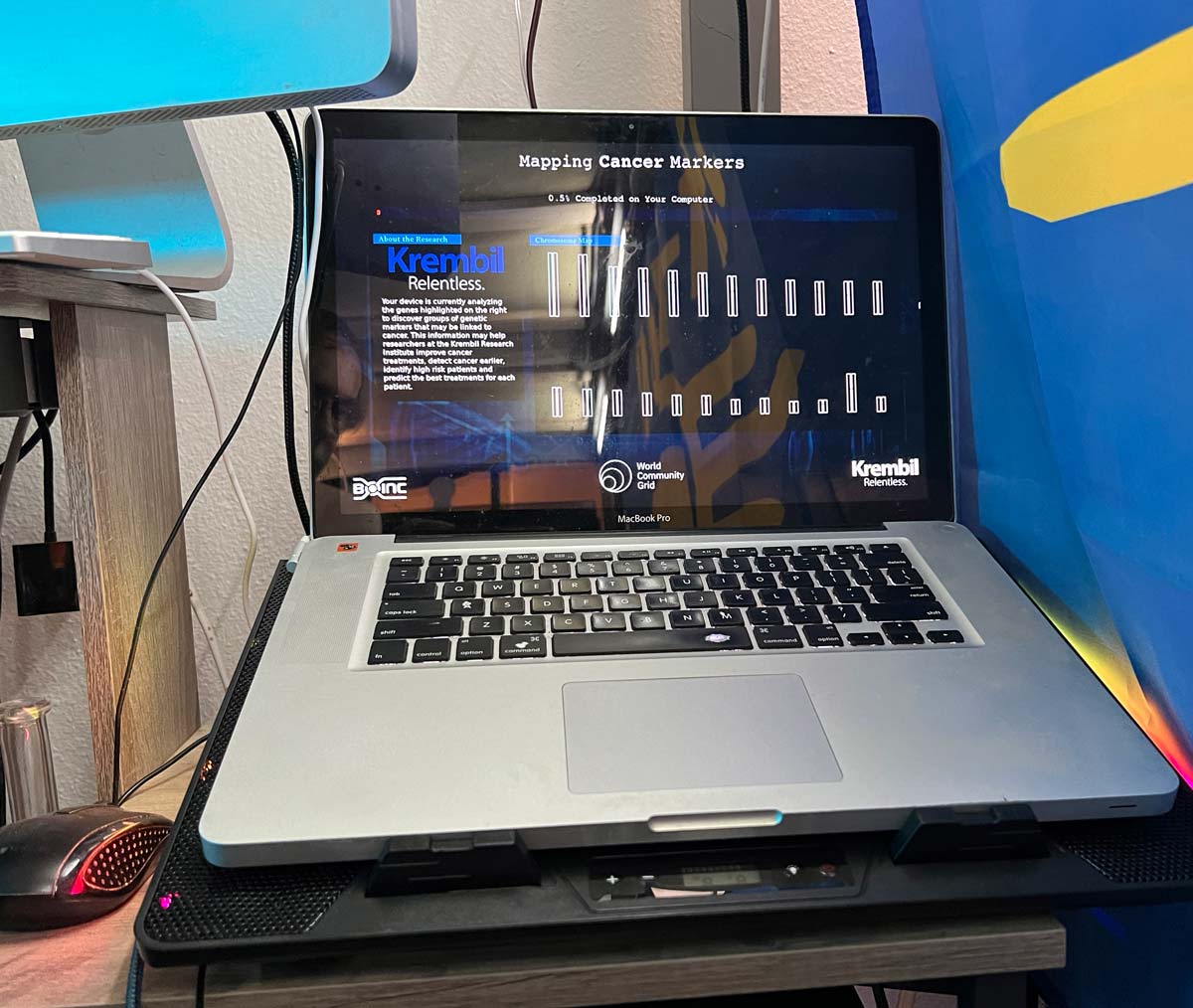
This is my old 2012 laptop, which now does nothing but BOINC. I’ve joined two research projects, Rosetta@Home (which does research on protein folding to look for new drugs and disease treatments) and World Community Grid (which looks for genetic markers for cancer and searches for cures for diseases that are too uncommon or appear in parts of the world too impoverished to be worthwhile for conventional for-profit pharmaceutical companies).

I have a computer that is essentially a backup Time Machine server and Web server, and I may run BOINC on that as well.

I would encourage anyone out there who wants to help solve real problems by donating idle computer time to join.

Basically, you just install the BOINC software, choose a research project from a list, and that’s it.

BOINC stops running whenever you use your computer, so it won’t slow you down, but it means your computer time isn’t being wasted whenever your computer is turned on but you aren’t sitting in front of it.

Visions of Barcelona: Incomprehensible Beauty

Her name was Wendy.

I met her my first year of university in Sarasota, Florida, at a tiny college that is now at war with Ron Desantis called New College. It wasn’t my first year of uni—I’d been to two other universities by that point already, and would ultimately end up getting my degree from yet another—but it was my first year there.

She played a song for me. Well, she played several songs for me, really—she’s the reason I still love the Indigo Girls—but she played a particular song for me, Gaudì, by the Alan Parsons Project.

That opened up a rabbit hole. It was 1990, just before the Internet as we know it started to become a thing, and I wanted to find out everything I could about Antoni Gaudì, the completely bonkers architect, and the Sagrada Familia, his most famous work.

I resolved then that one day I would visit Barcelona and see the Sagrada Familia myself.

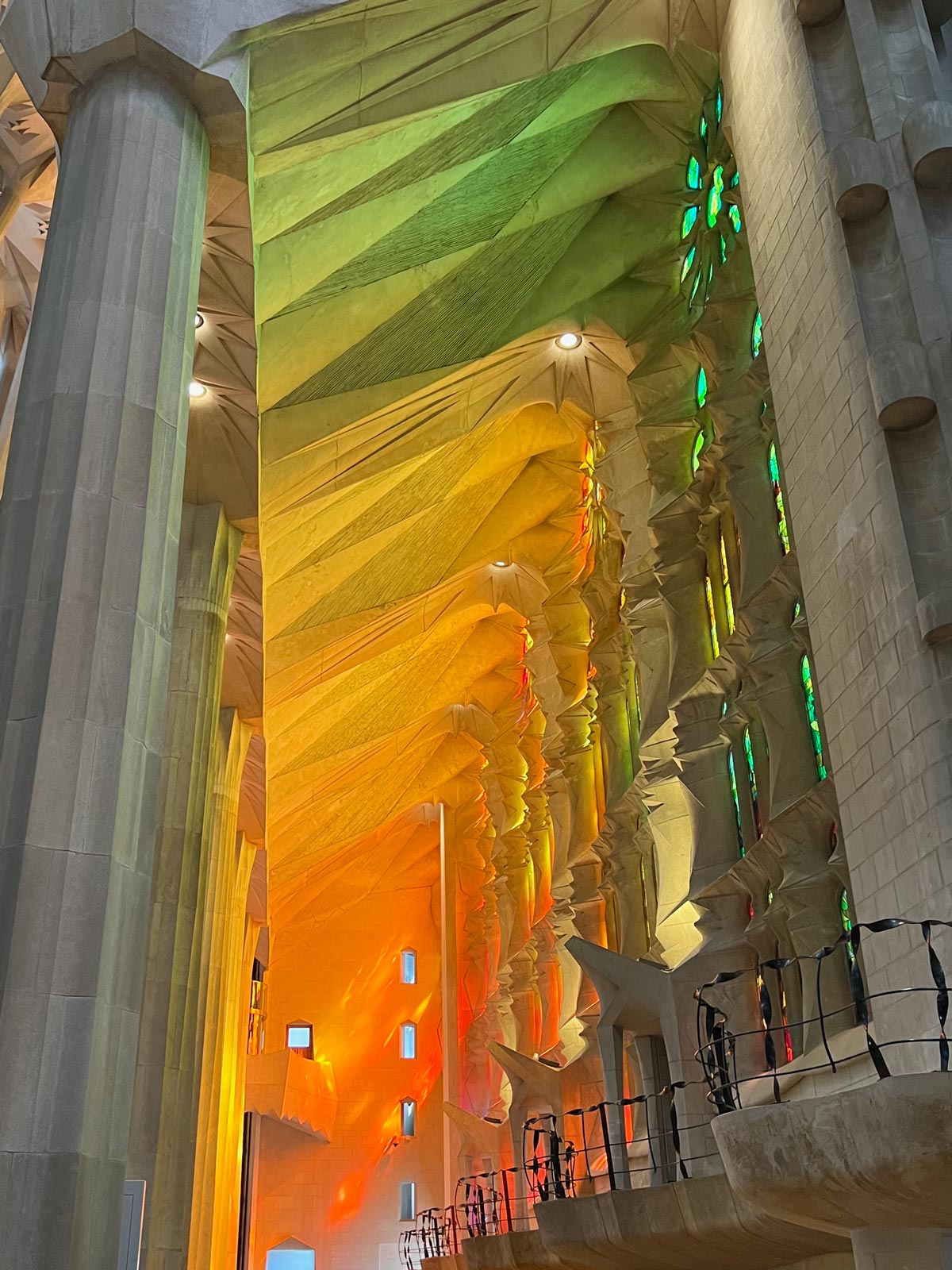
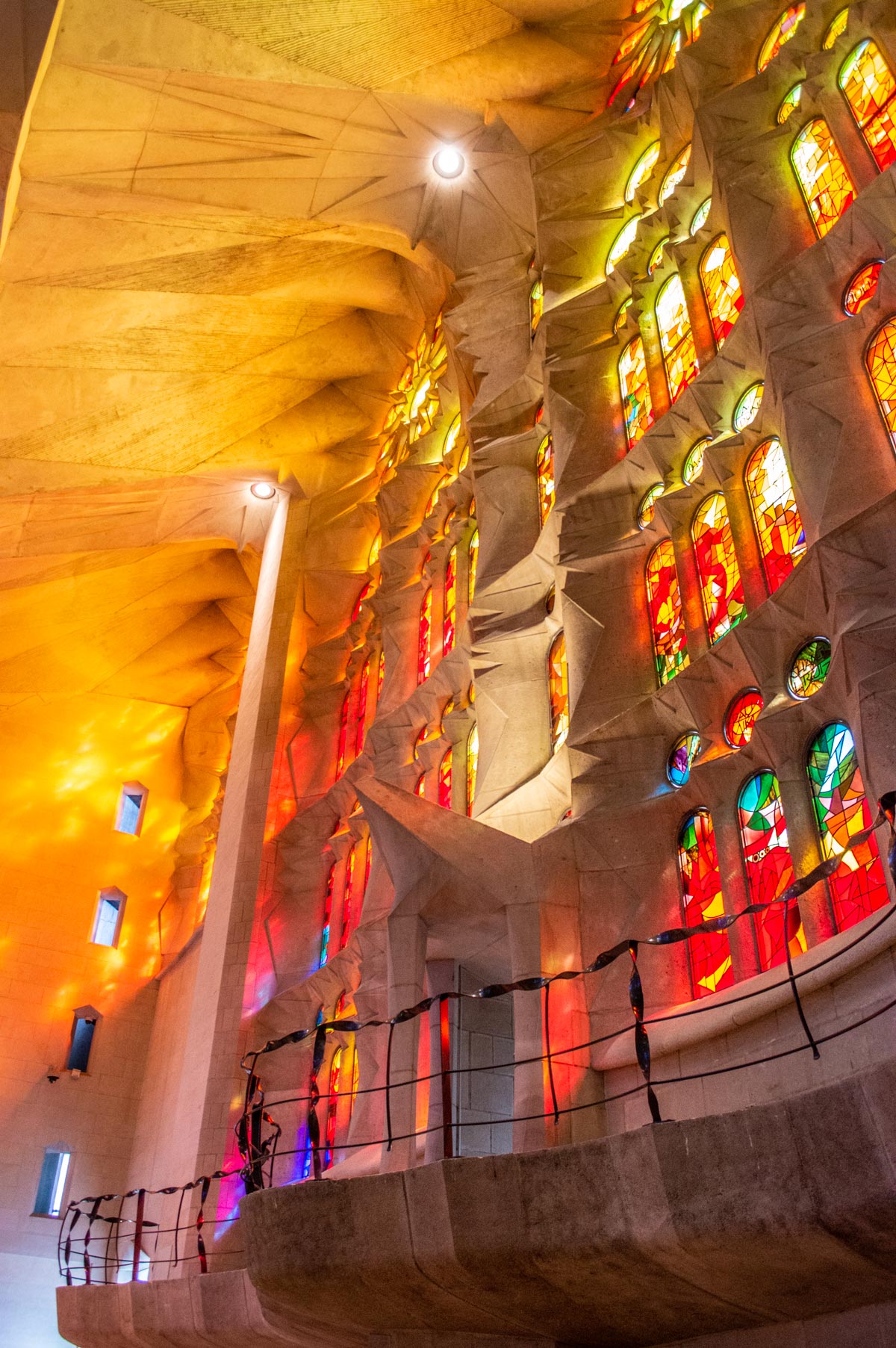
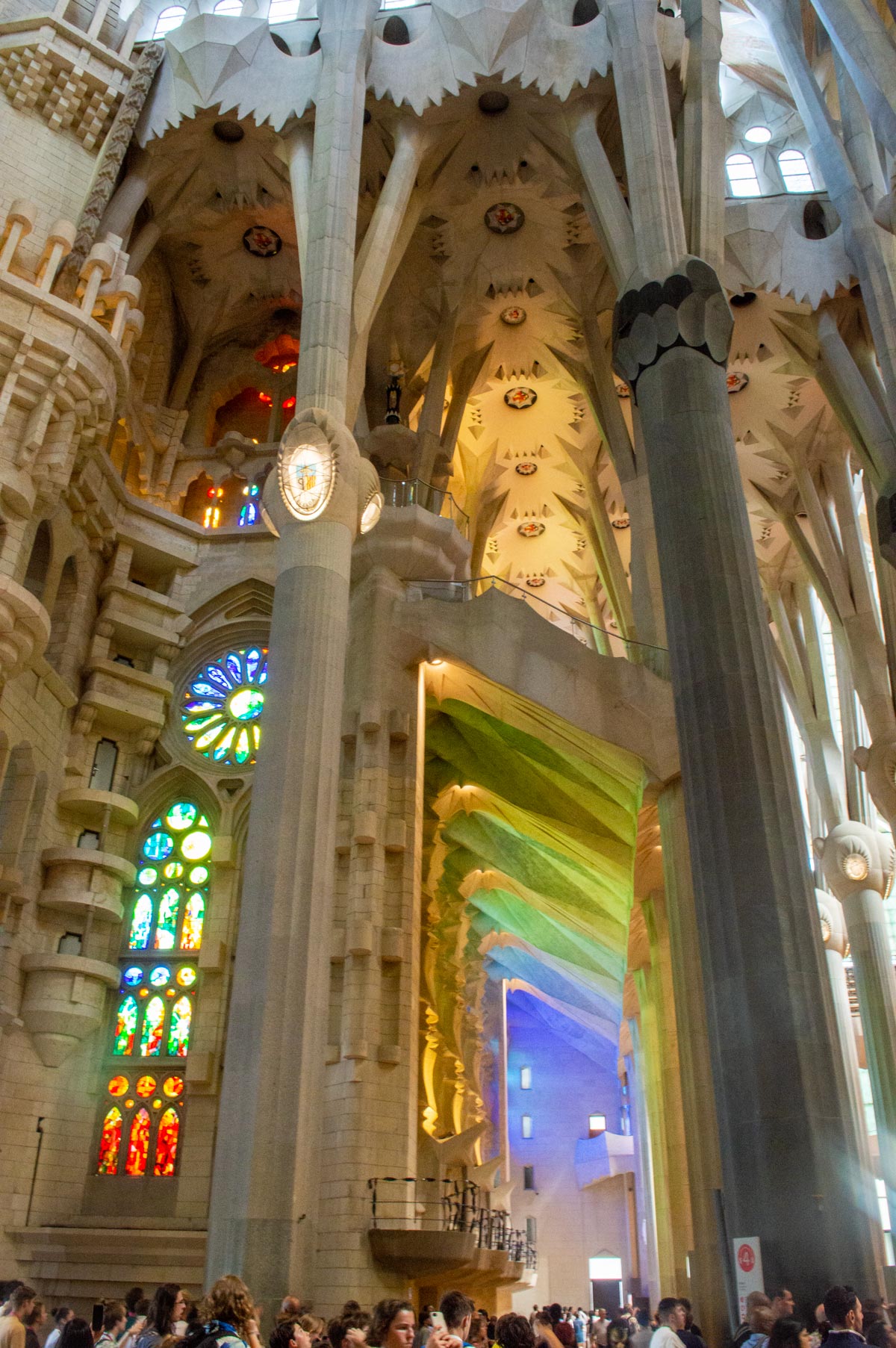
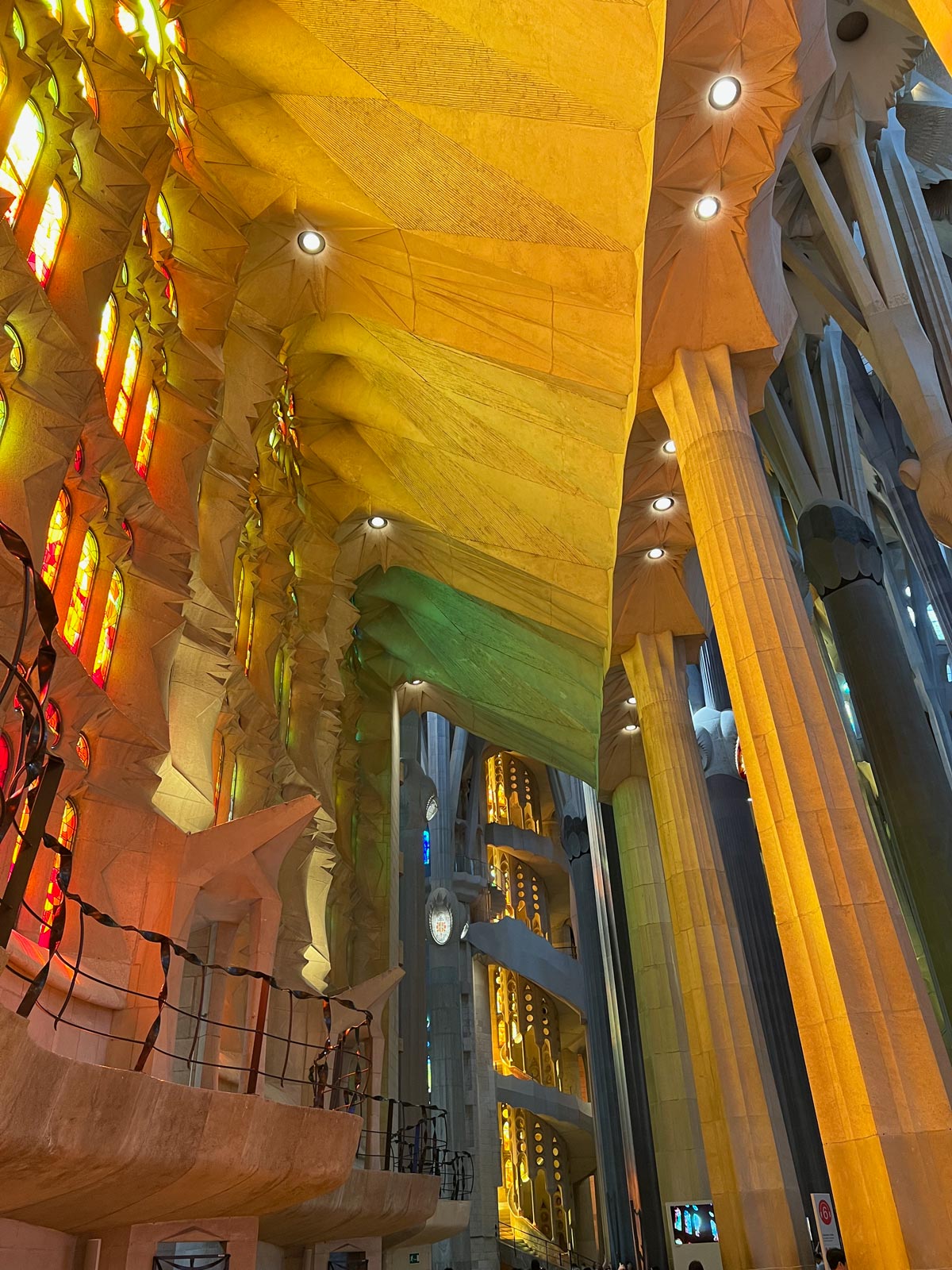
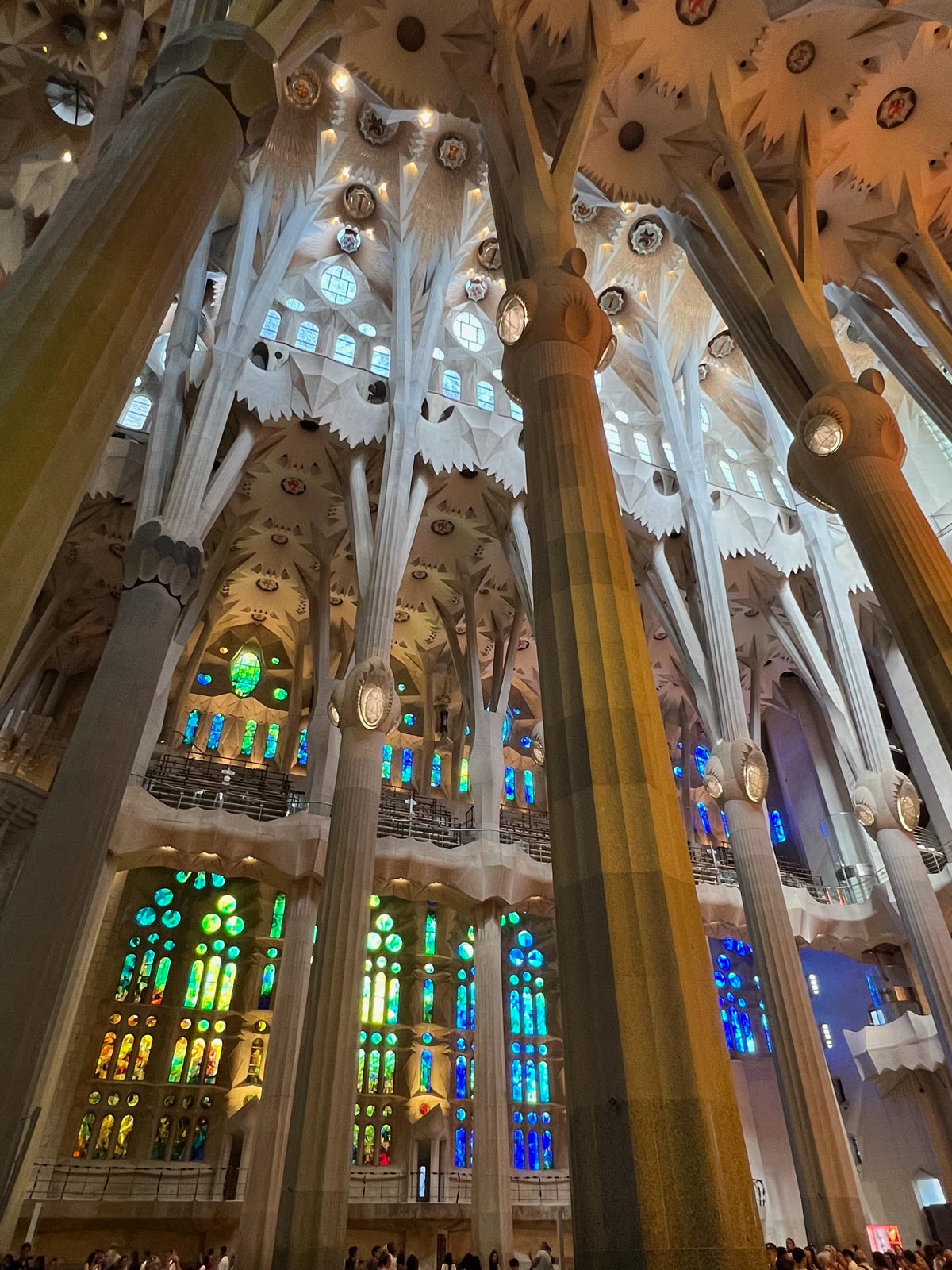
Last month, I did. It was, by a large margin, more magnificent than I could have imagined.

Mad scientists get all the media limelight. Not enough people truly appreciate mad architects.

The Sagrada Familia is deliriously, exuberantly bonkers, a brash monument to defiance of conventional ideas about working stone.

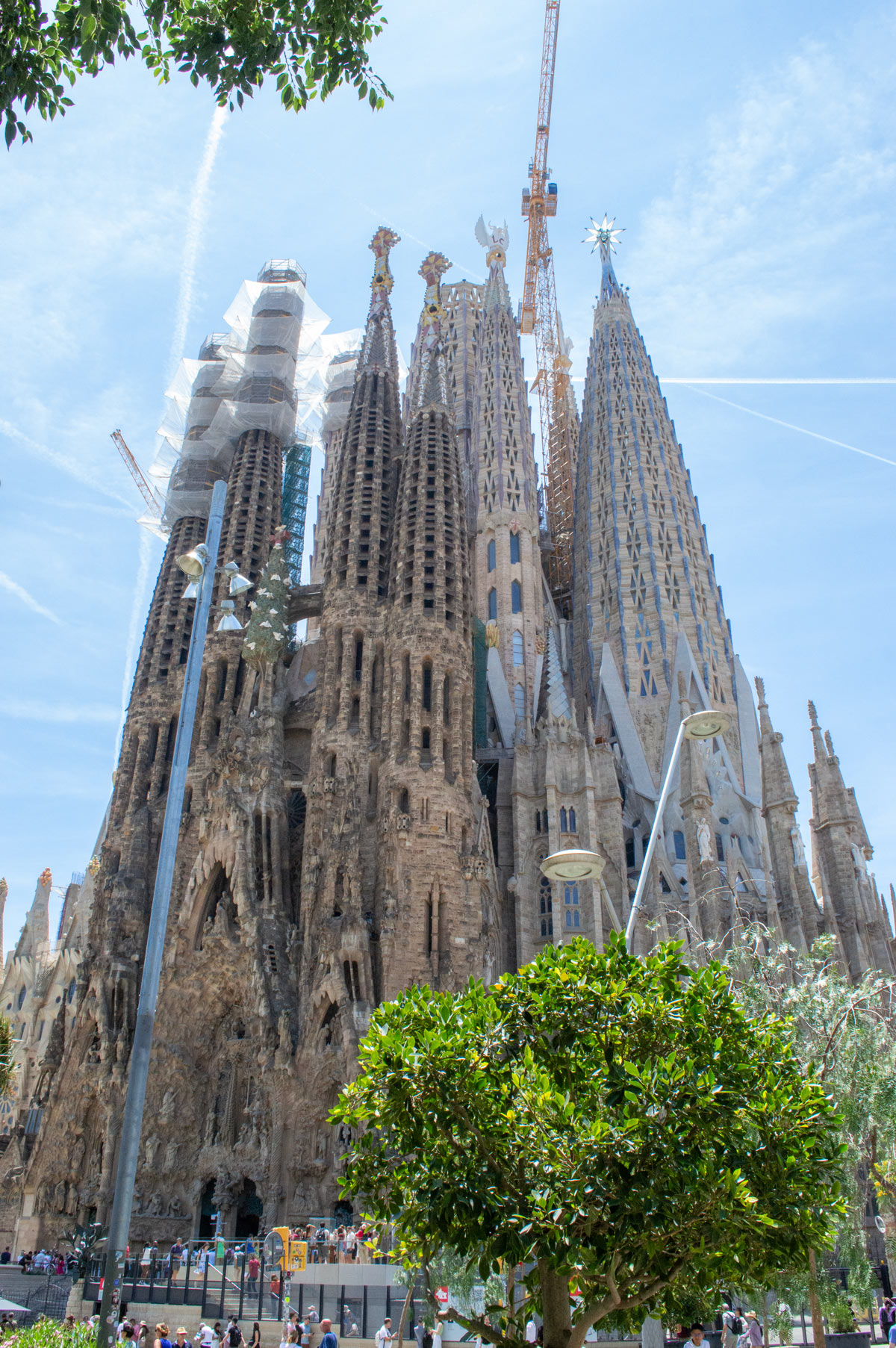
A lot of folks are familiar with it, at least in passing. If you see a photo of the exterior, odds are good you’ll recognize Gaudì’s weird, still-under-construction cotton-candy masterpiece.

Apologies in advance, this post is about to get really image-heavy. All bandwidth abandon, ye who enter here.

We were in Barcelona last month to spend some quality time together, and to do a photo shoot of the Borg Queen xenomorph hiphugger parasite strapon, about which more later.

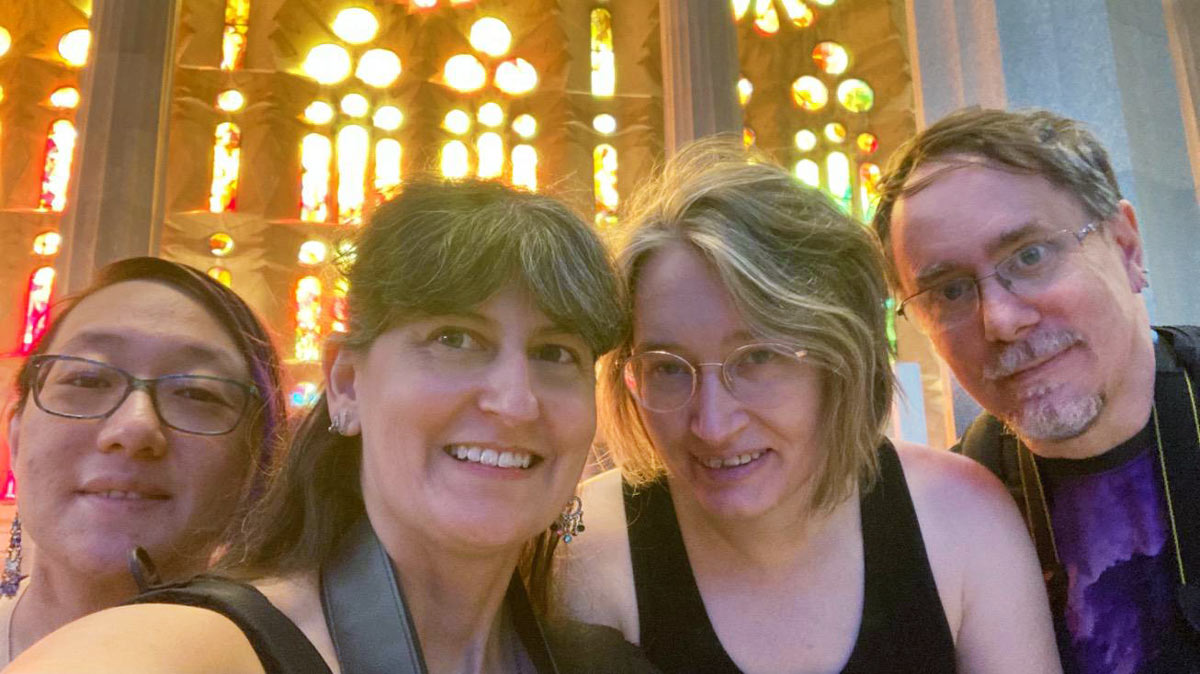
Our first full day in Barcelona (or was it our second? The days blurred together), some of us headed out into the Spain summer heat to see the gloriously insane architectural wonder of the Basilica of the Sacred Family.

(They did not, of course, allow bunny ears inside the church.)

The place was…words fail. Brilliant. Grand. Magnificent beyond anything I expected. I cried when we got there.

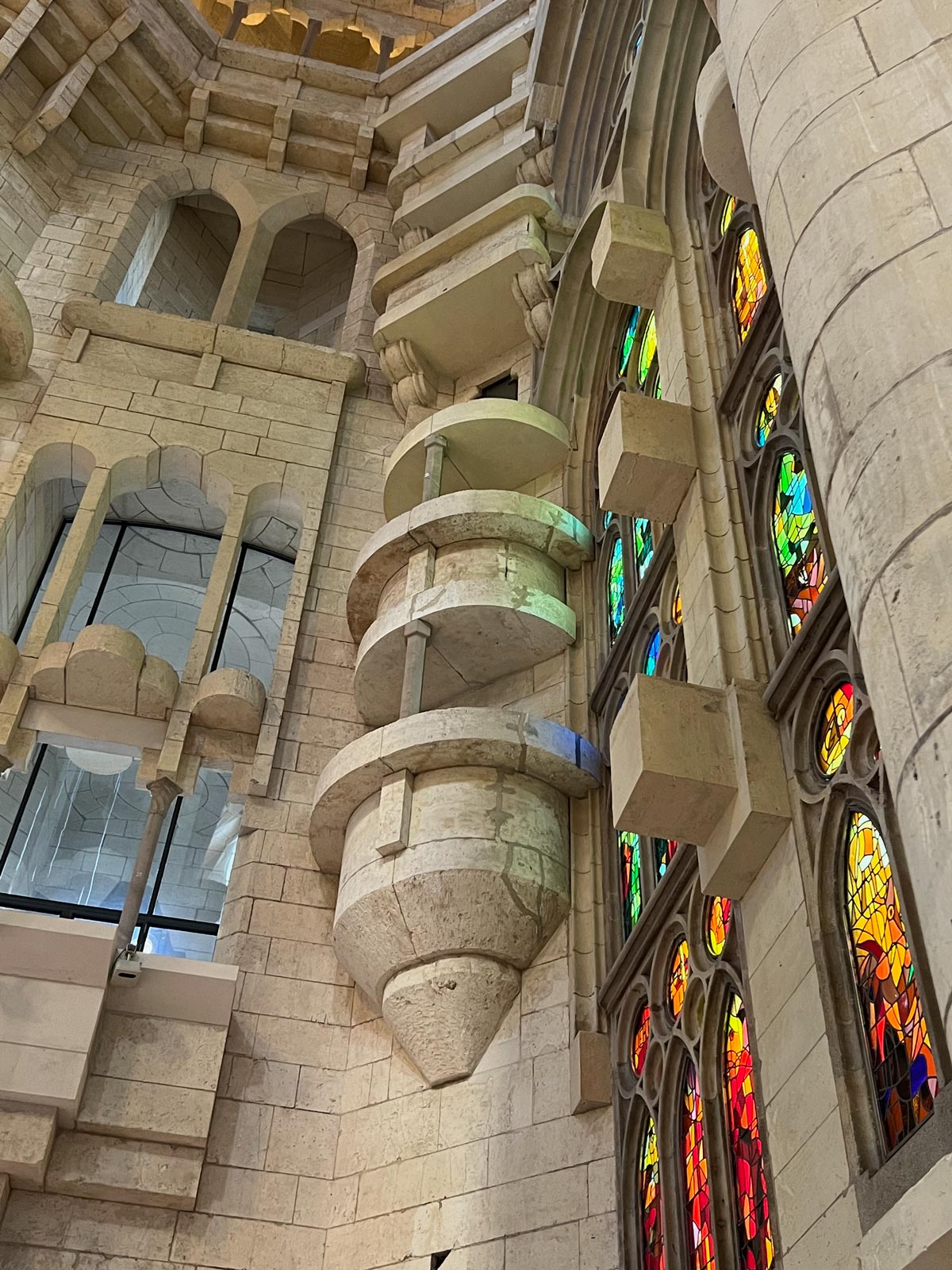
I’ve seen photos, of course. But no pictures, not even the ones I’m posting here, can do any justice to the scale of the place. Even standing outside doesn’t give you a sense of the enormity of this monument to a strange man’s strange vision.

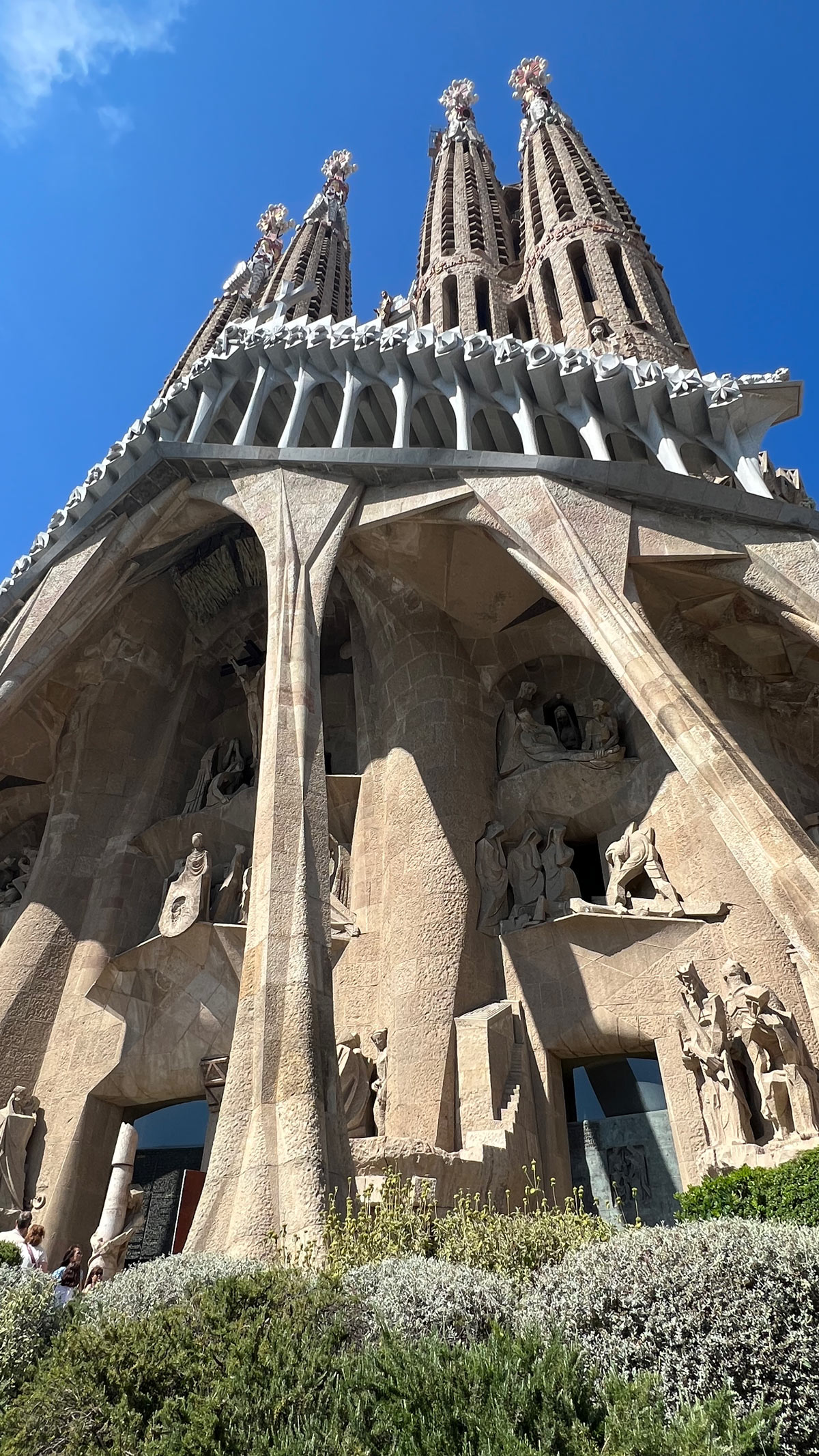
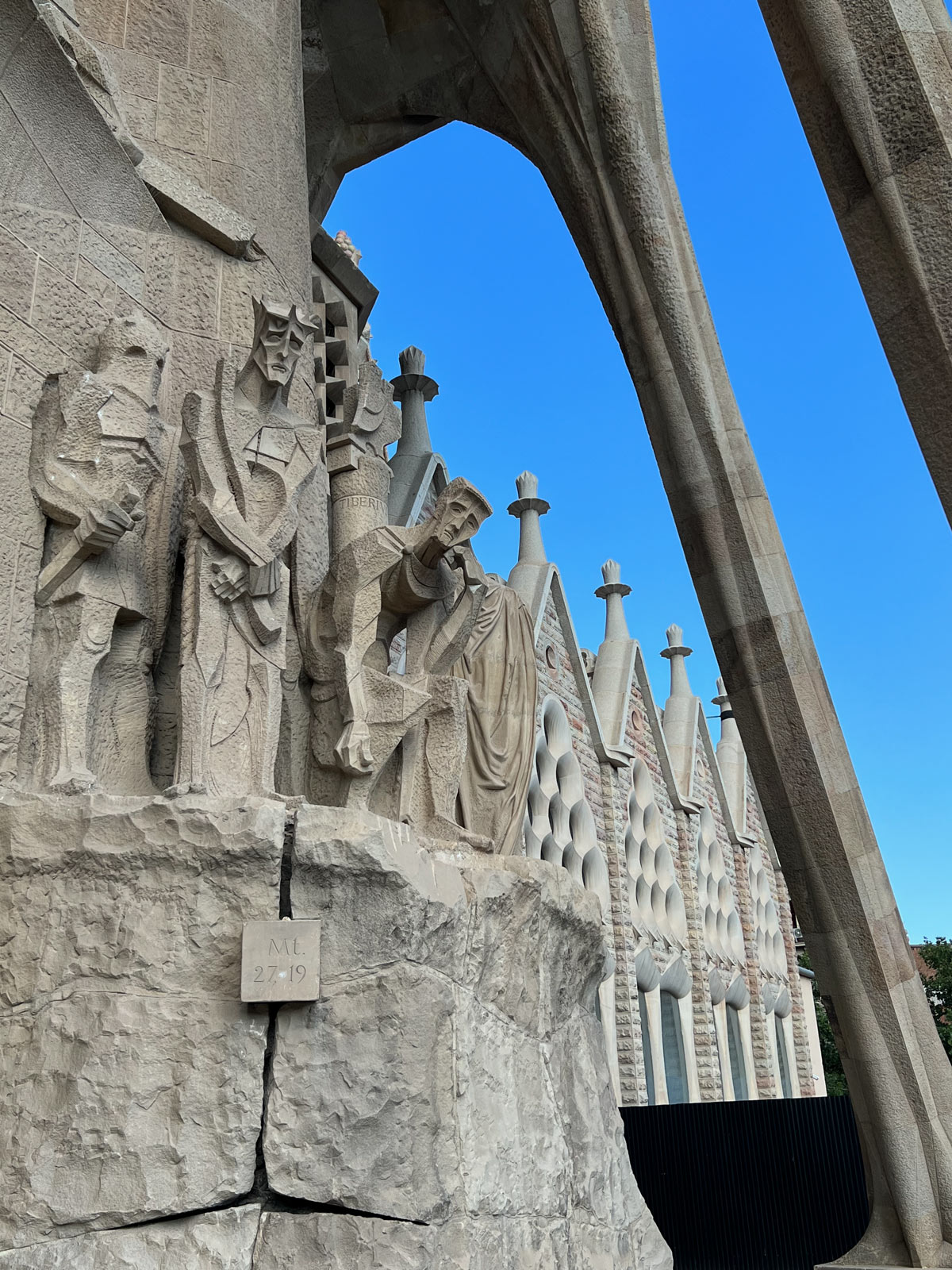
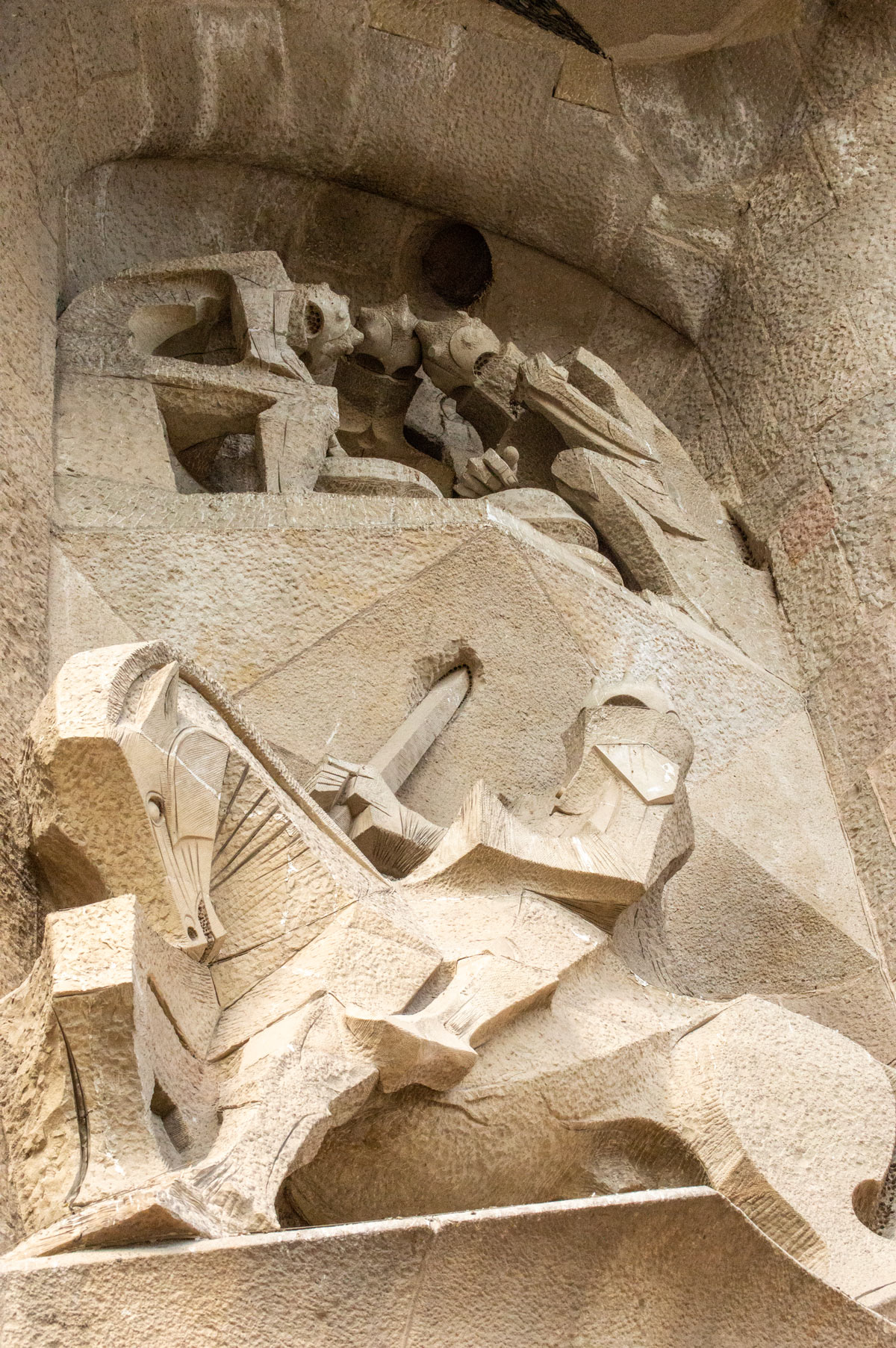
These oddly angular figures are much larger than life-sized, with a Cubist vibe I really dig.

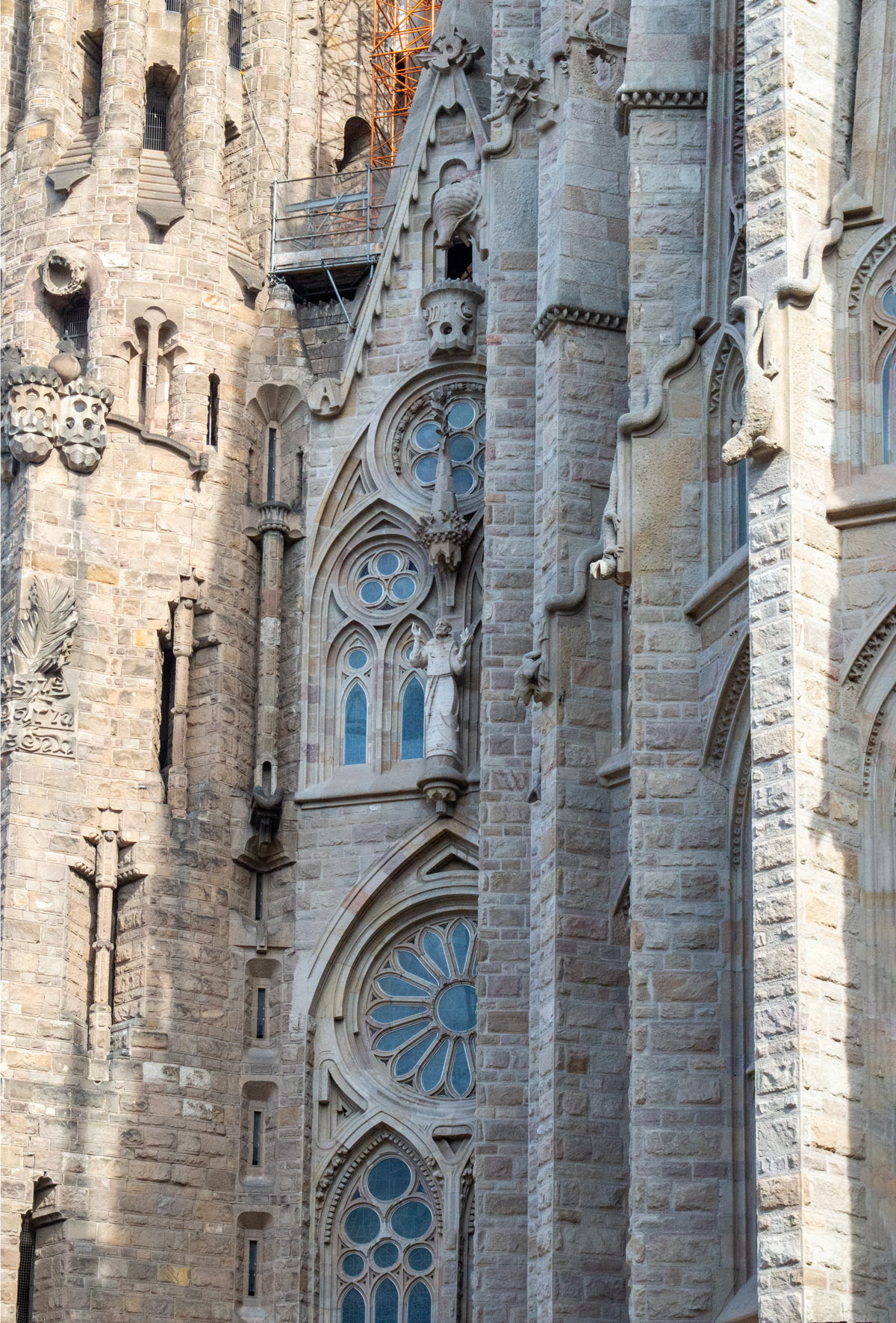
The level of detail absolutely everywhere, inside and out, is just breathtaking. Gaudì was obsessed with animal motifs, that decorate the walls and doors all around the church.

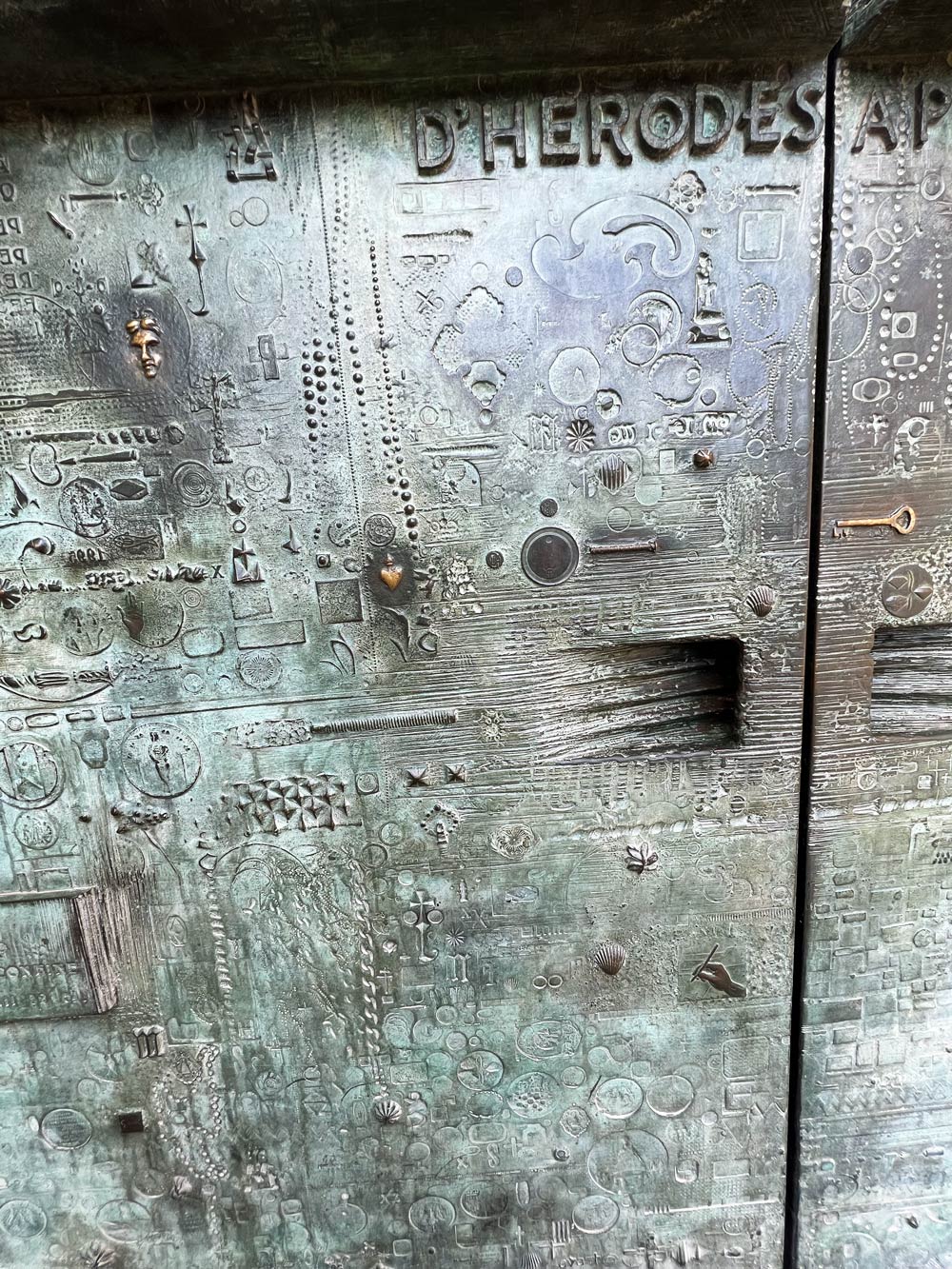
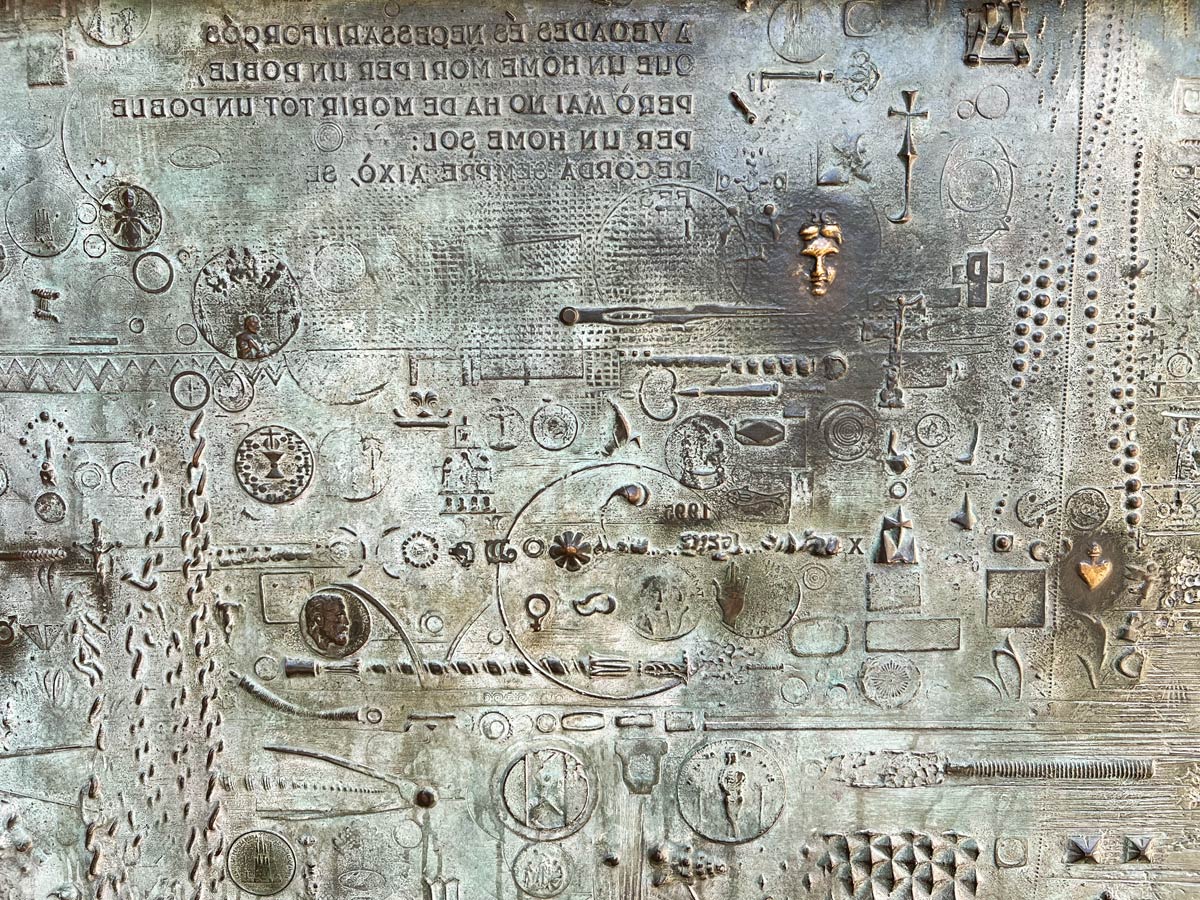
One of the many doors is this enormous heavy thing of bronze, designed by Josep Maria Subirachs. (And yes, the text is backward on the door.)

I love that you can tell which symbols resonate with people by which symbols visitors touch.

Oh, but the inside…

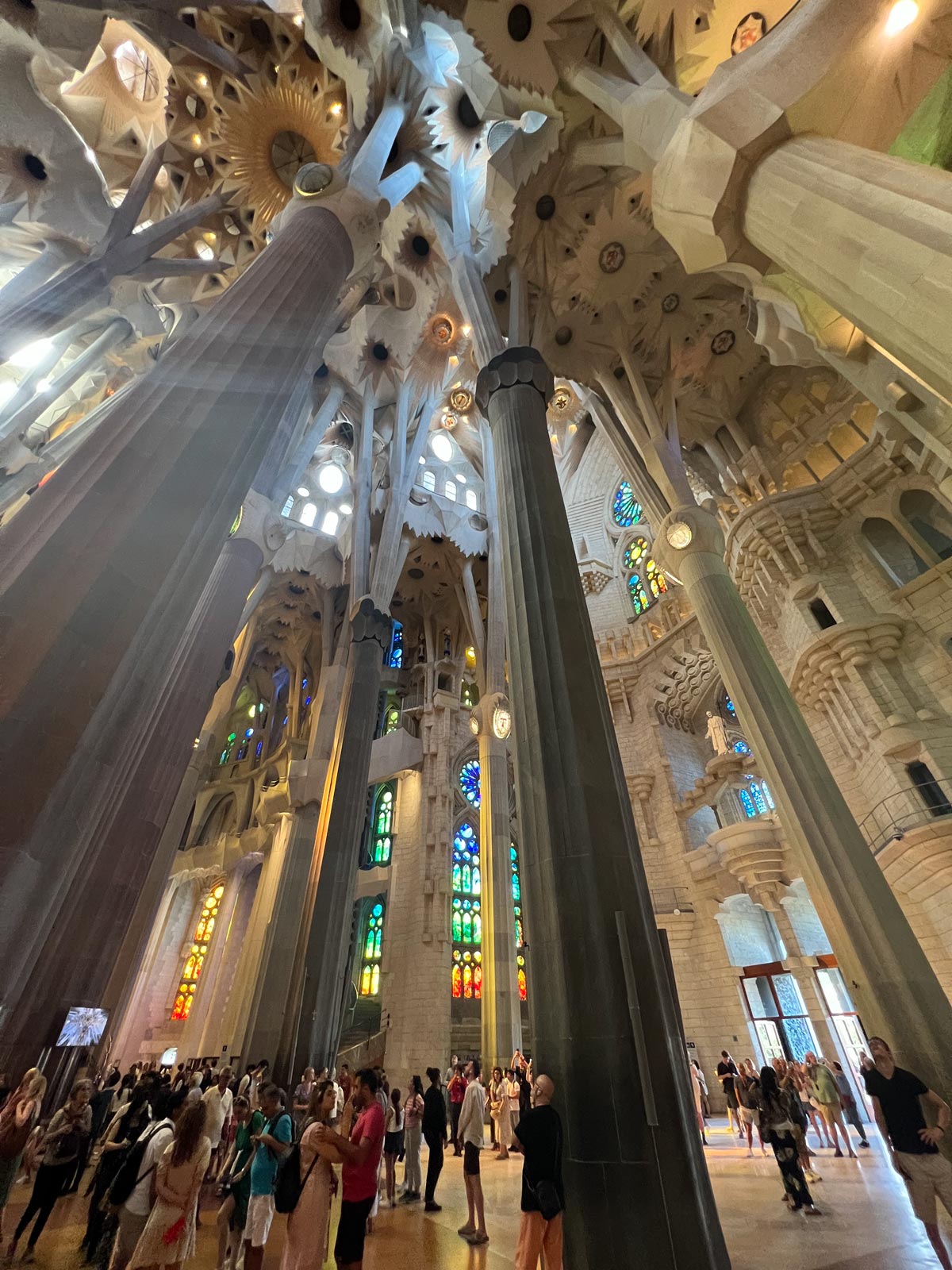
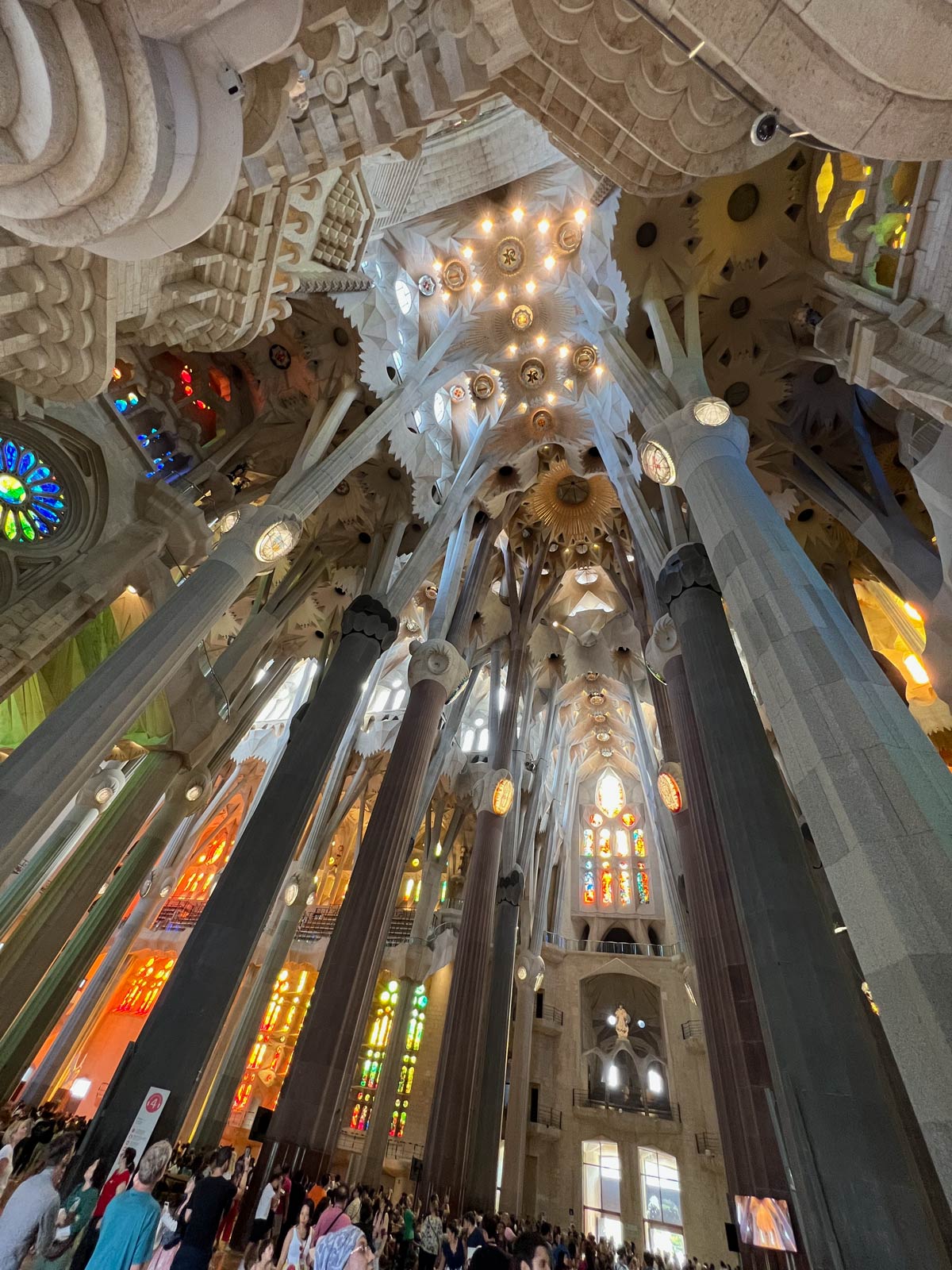
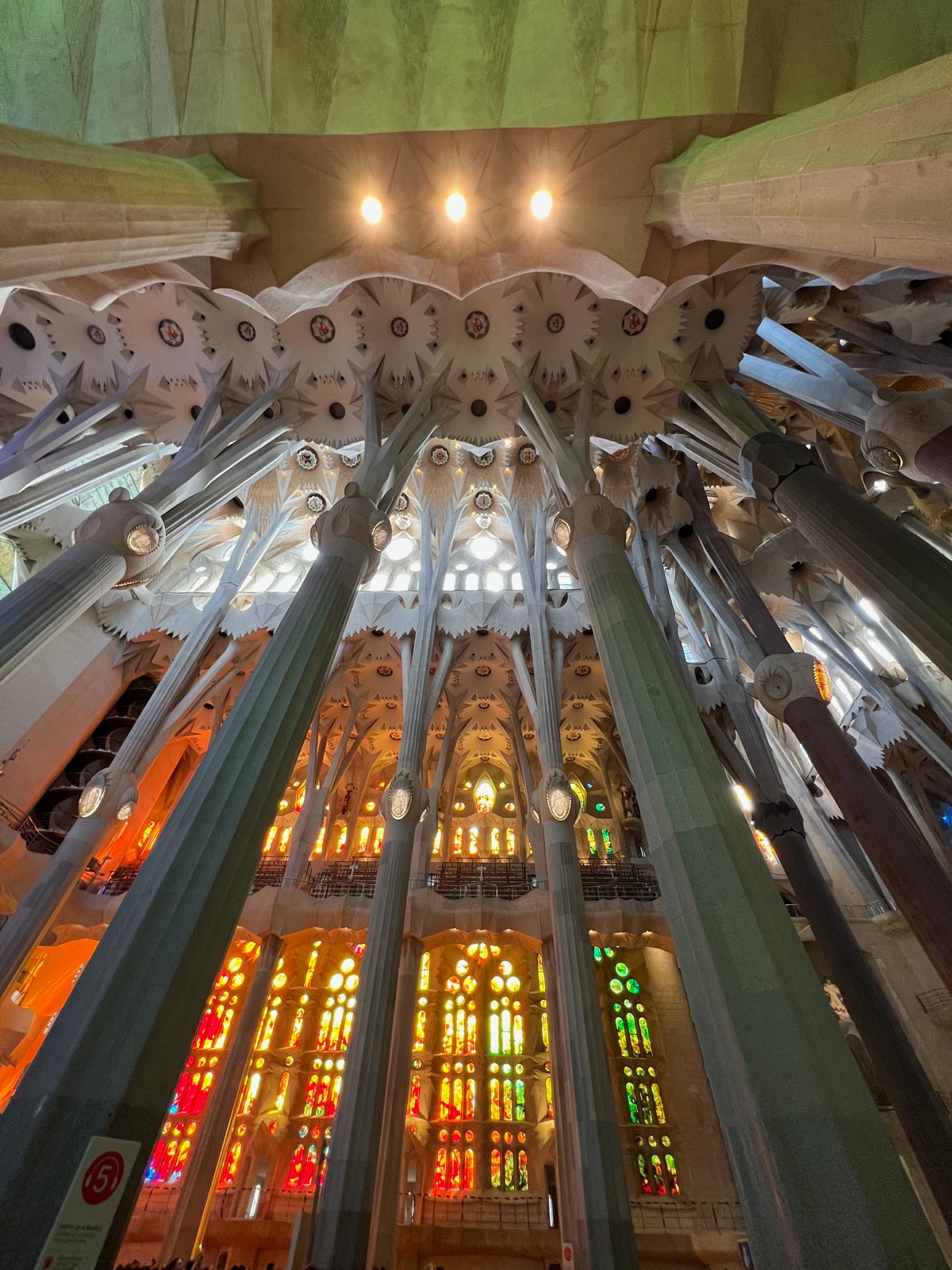
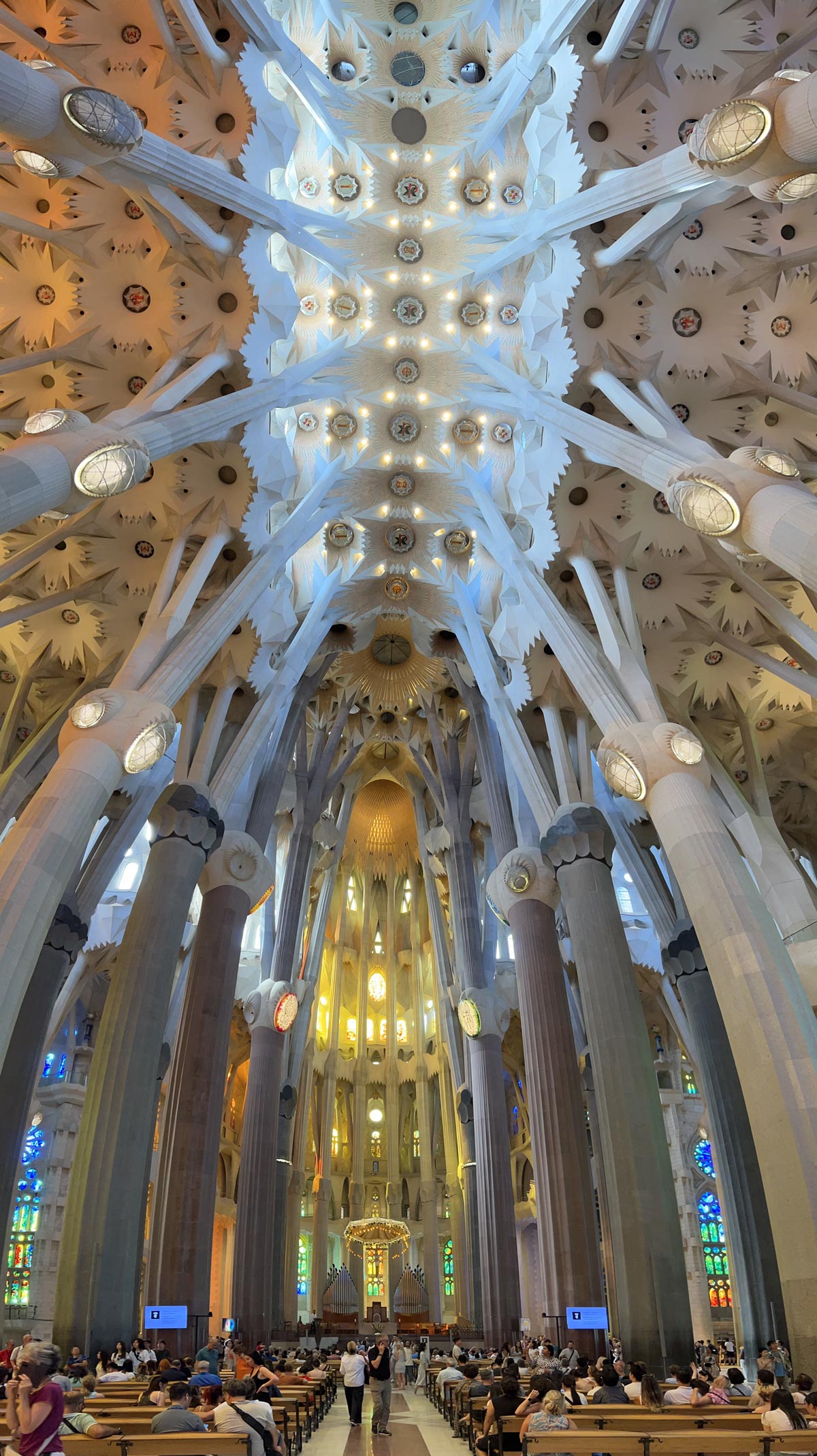
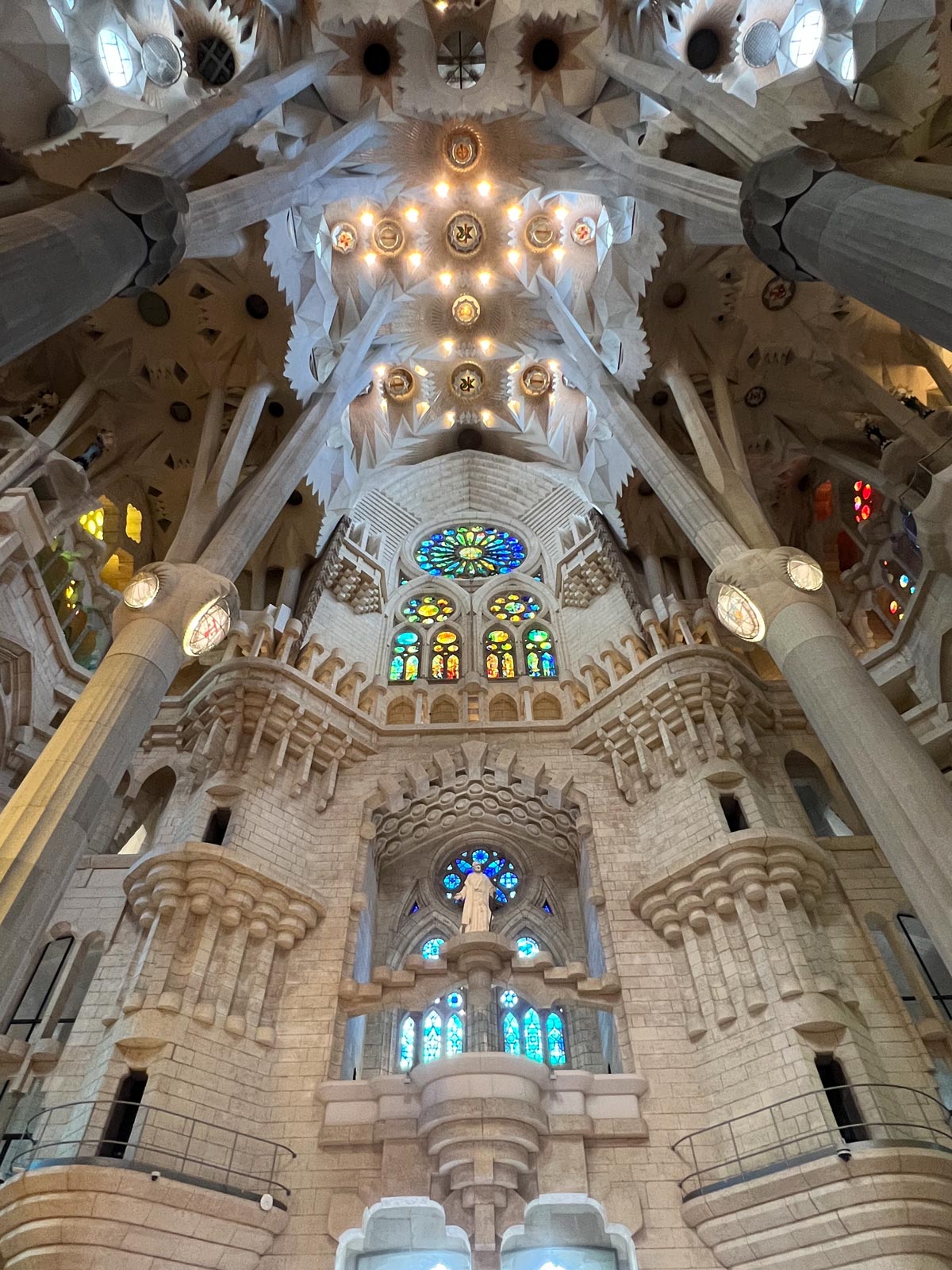
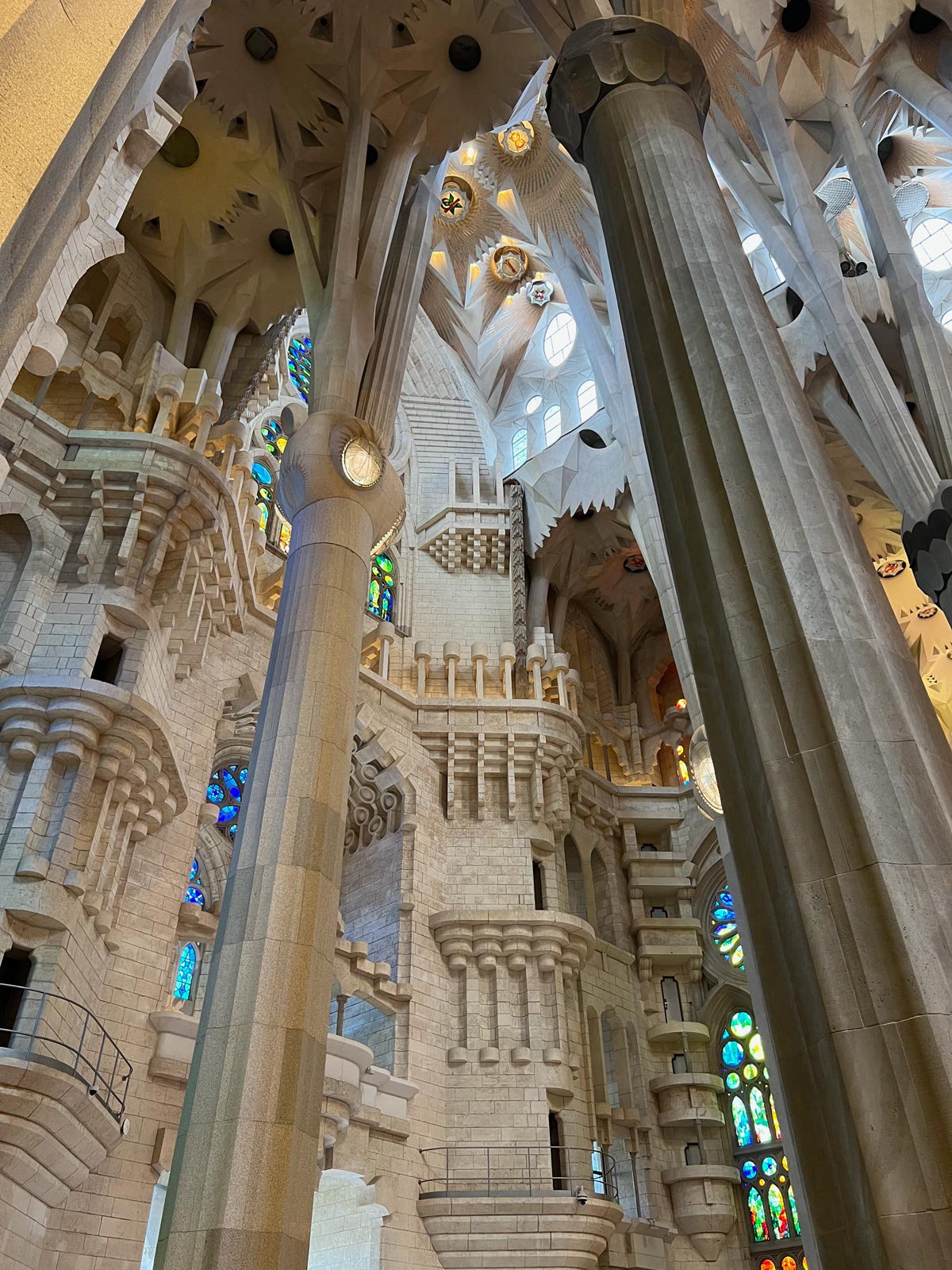
The inside is where you truly get a sense of just how enormous, how vast this space truly is.

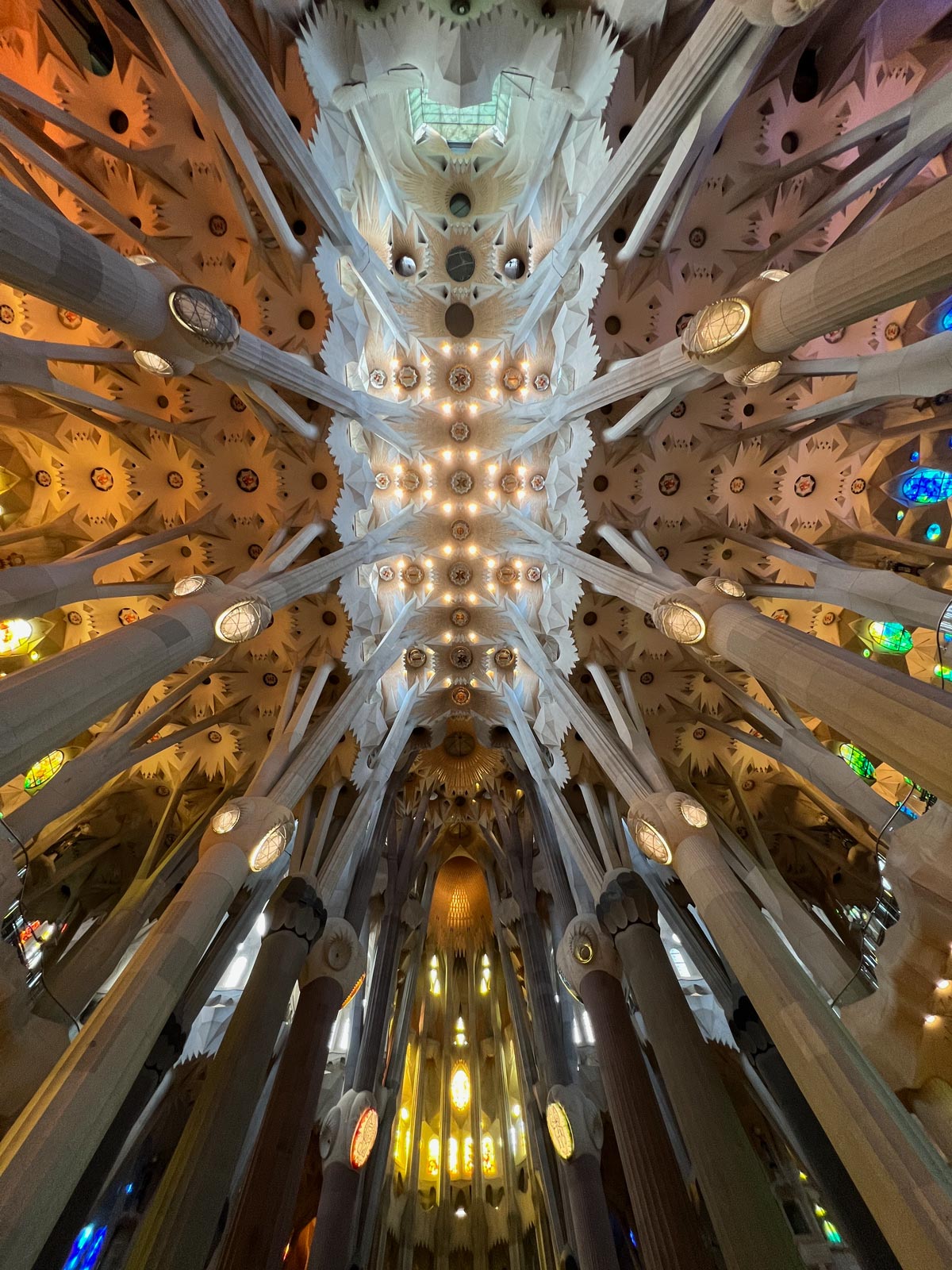
These photos don’t do it justice. No photos do it justice. The sheer overwhelming magnitude of this vast space inspires awe.

Just standing in this vaulted space, just existing here, is a deeply, profoundly awe-inspiring sensation.

We got here after a long (and honestly rather tedious) guided tour of the outside, which I recommend you skip if you ever visit—it was almost enough to suck one’s soul through one’s ears, so incredibly bland and boring it was.

I don’t rightly comprehend how it’s possible to make Gaudì or his grand creation boring, but somehow, the tour guide did it.

But all that was burned away in the avalanche of wonderment at stepping through the door into the church and really appreciating, for the first time, such incomprehensible beauty.

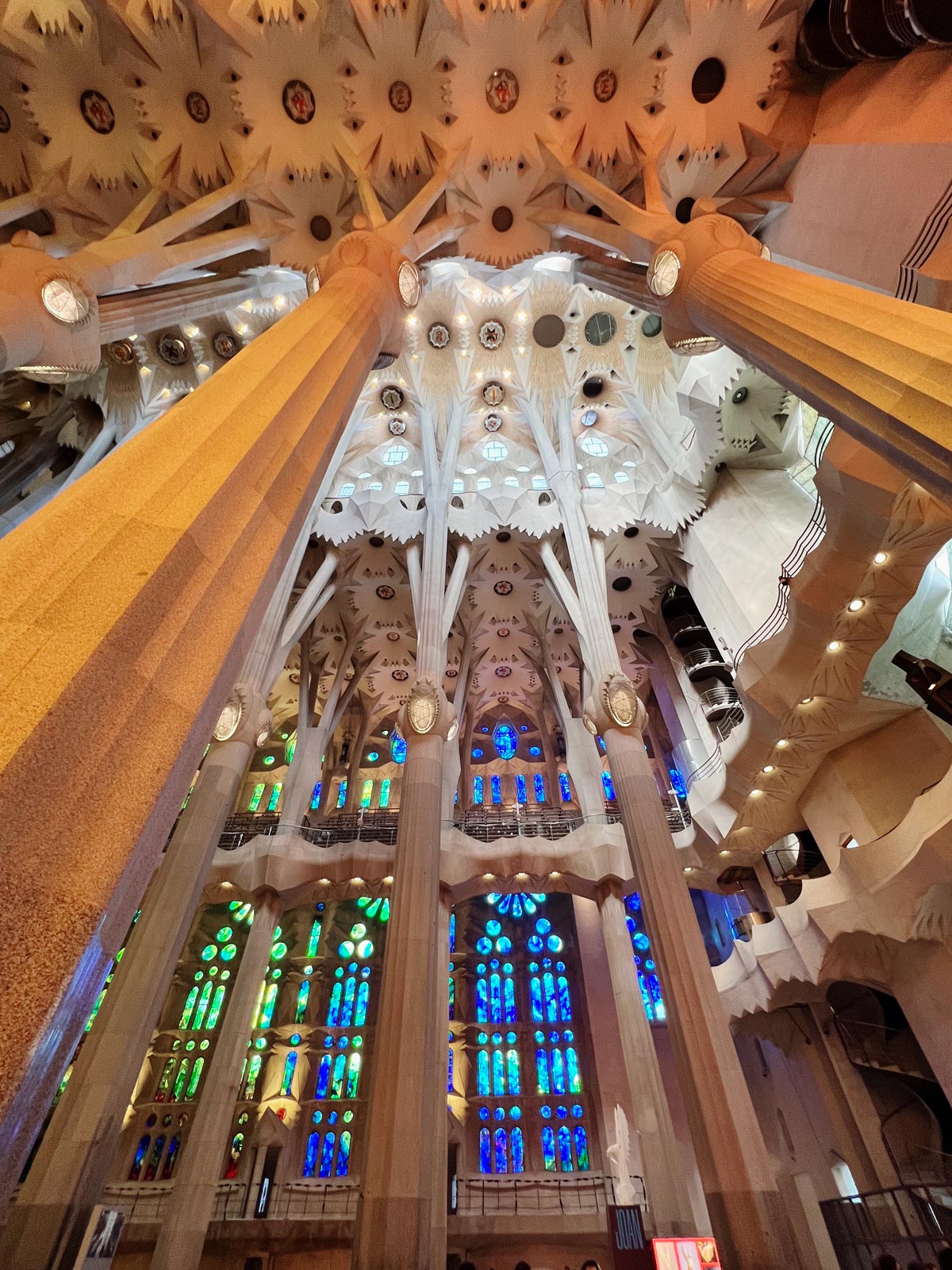
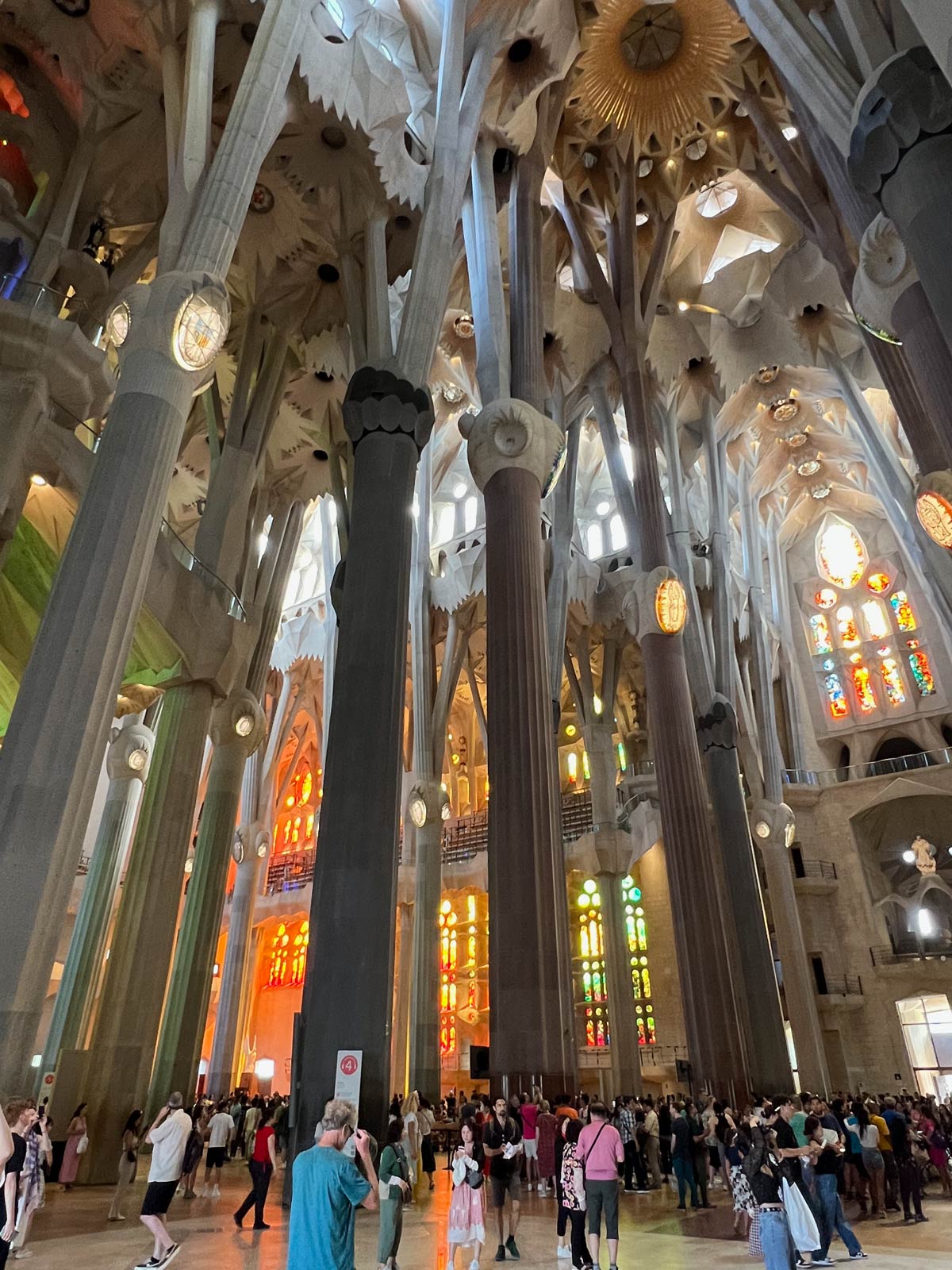
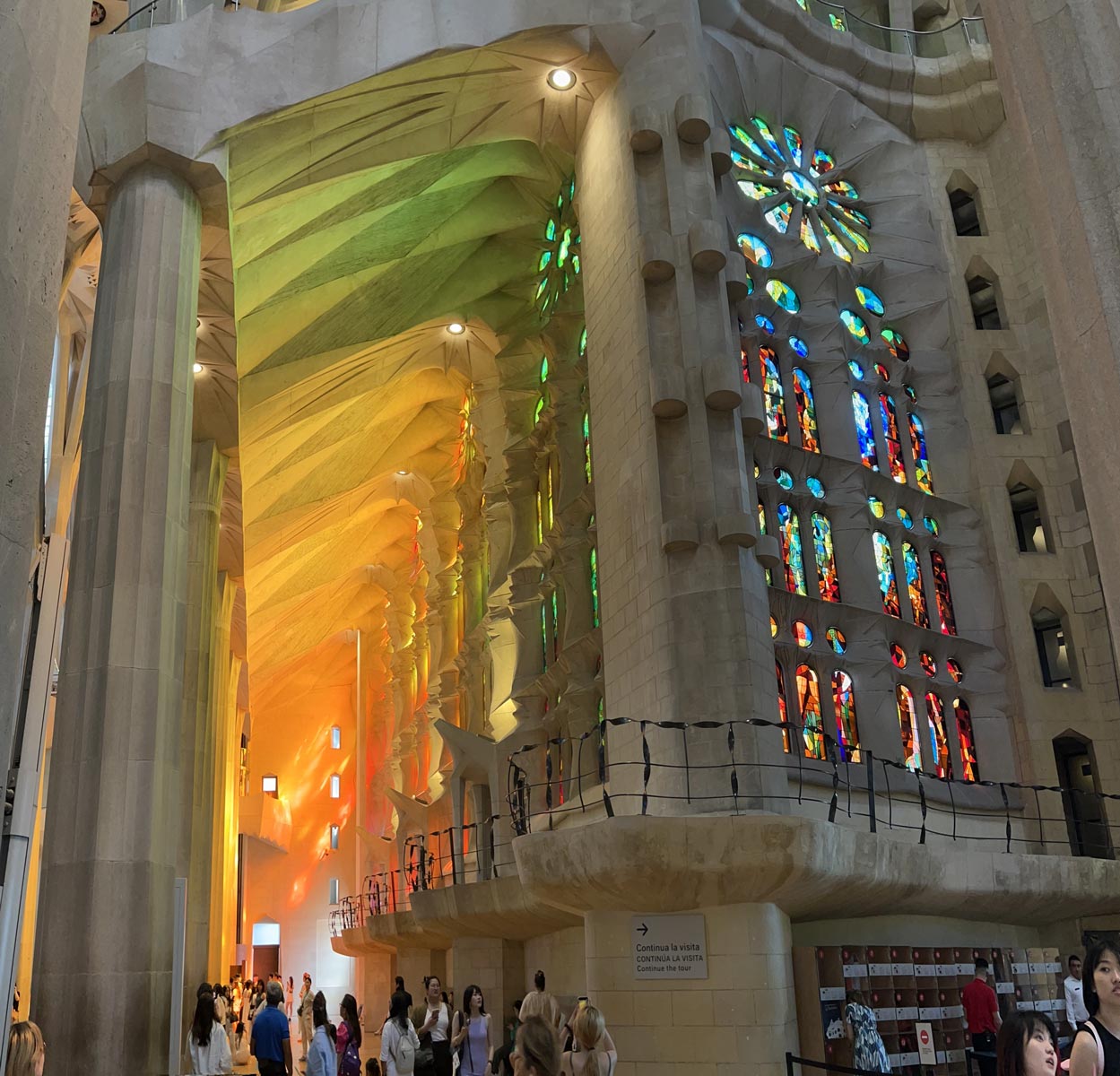
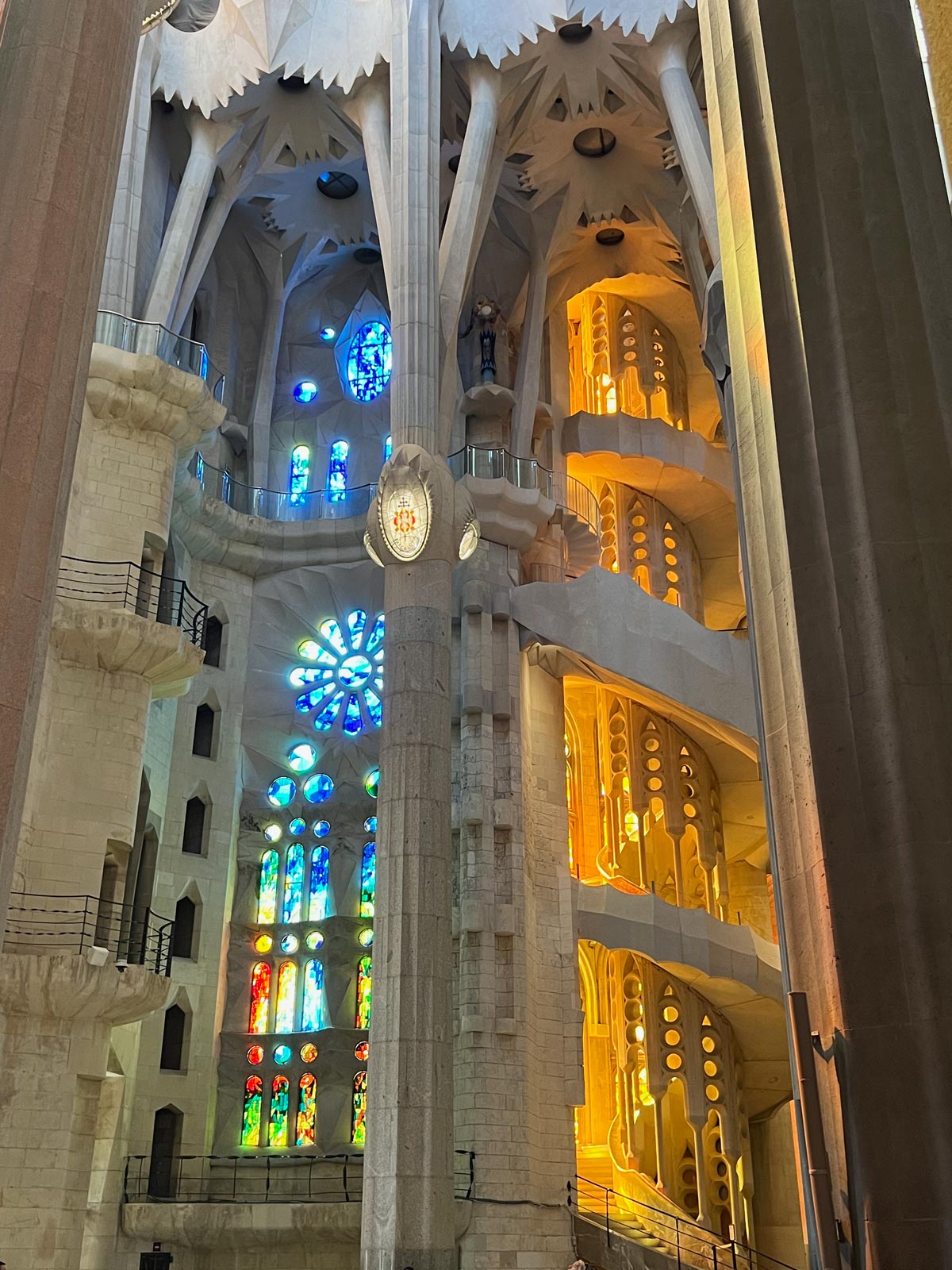
Standing there bathed in ethereal light, it’s hard not to feel like you’re within some living thing.

Even the light itself is alive, as much a part of the architecture as the stone and the glass. This space flows with light, in a way no picture can ever show. The light moves constantly, always changing, brilliant, flowing along the walls as the earth spins and the sun moves across the sky, never the same from moment to moment..

Every time you look up, it’s different, the light, the color, bringing even more life to what always feels alive.

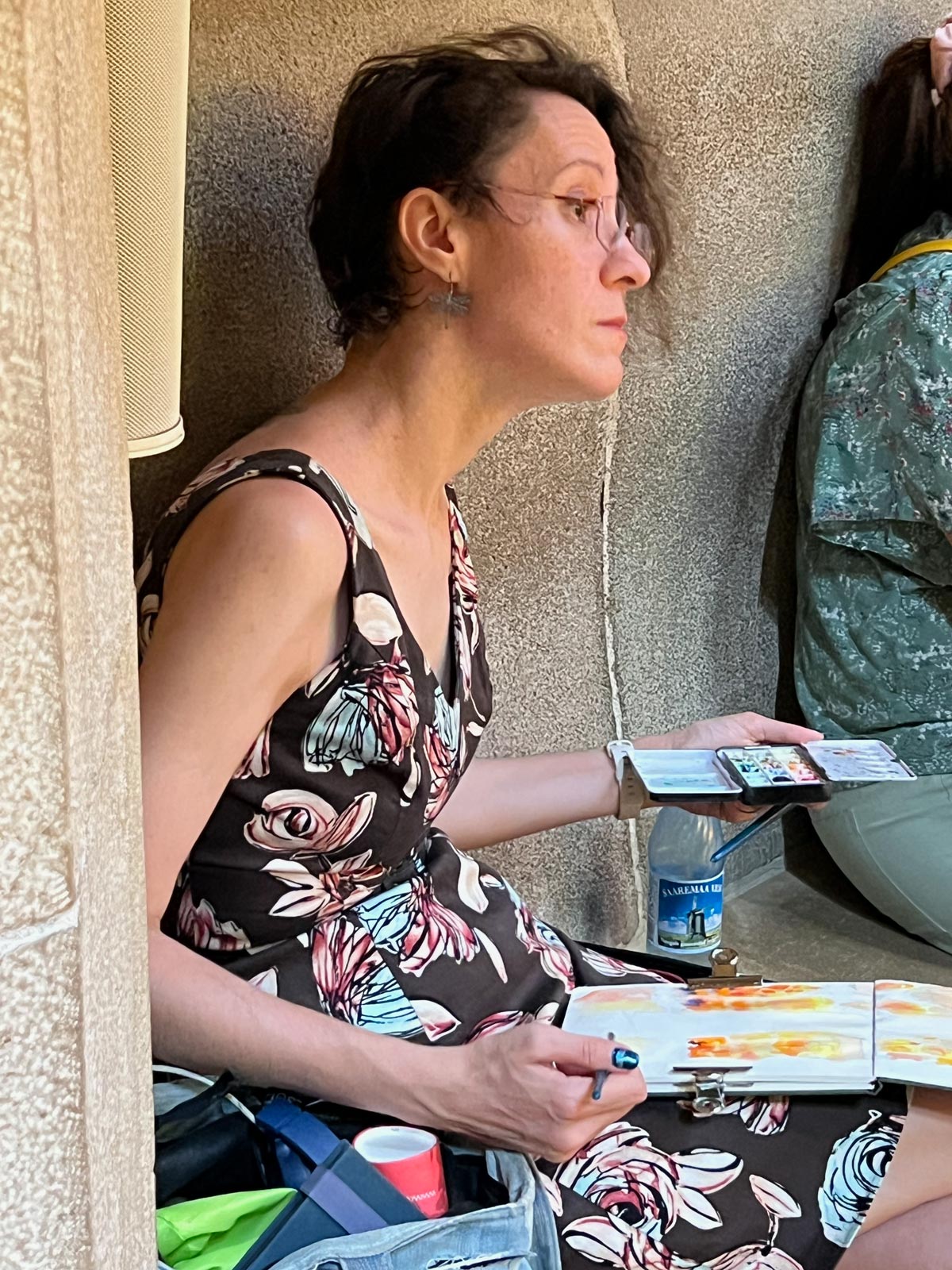
My friend Alice, who I met in Tallinn some years ago, was able to join us in Barcelona. She found a quiet place from which to try to capture the extraordinary play of light and stone in watercolor.

When I visited St. Paul’s in the Vatican, I saw a monument to tedious human greed, every pope trying to outdo the one before, inscribing their names in gold above each new wing. Here…this place is the opposite of that, beauty rather than hubris, inspiration instead of braggadocio.

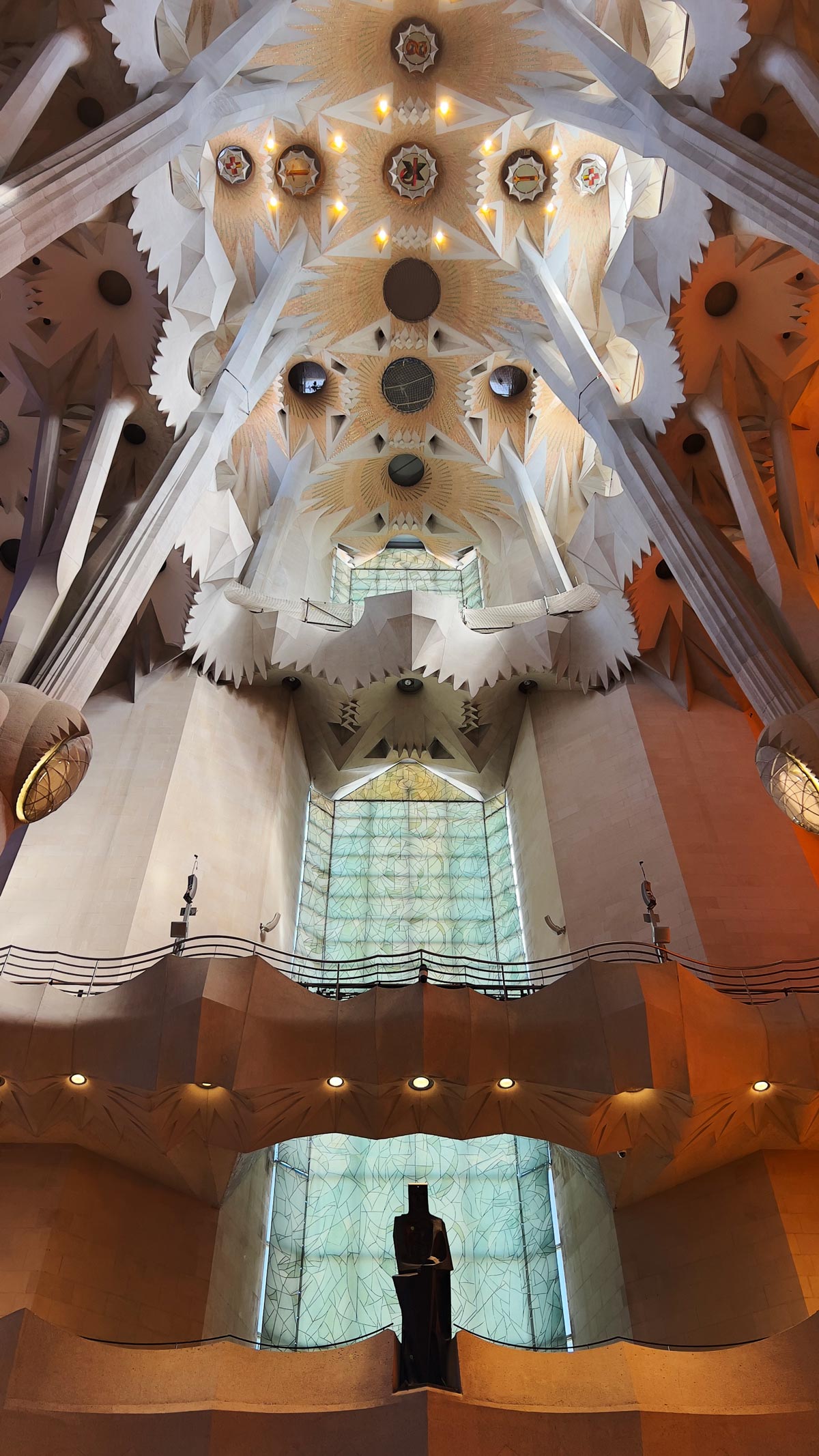
Everywhere your eye turns, there’s more to see, more to discover, more to explore. The breathtaking level of detail that fills every part of this space is hard to take in, yet it all works together exquisitely.

Even the essential infrastructure, utilitarian things like staircases, become objects of beauty.

Backing up to take the whole thing in, it’s hard not to feel overwhelmed and humbled. I visited the Sagrada Familia twice, and it made me cry both times.

It still isn’t finished, and won’t be for decades. Antoni Gaudì envisioned a cathedral in the old style, a work of generations finished a century more after it began, touched by the hands of many architects.

Some of the more modern elements include design philosophies that Gaudì might not have chosen, like this strangely abstract Jesus re-envisioned as a Sith Lord, but that’s part of the point.

He saw the Sagrada Familia as a sort of paper boat set adrift into the future, something he would never live to see completed, a project that would be guided by future generations long after his time was over.

It’s a heady and powerful thing to touch those walls and feel the way it has become not one person’s project, but a project by humanity. No words or images I am capable of can ever truly express even one percent of the incredible experience of being alive to witness such a magnificent undertaking.

Nome, Alaska: Simultaneous Sunrise and Sunset

The sun rises in the east and sets in the west, as every fule know.

What we don’t often think about is this is really true only at the equator, and even there it’s only entirely true during the solstices. For people anywhere else, or at any other time, the sun actually rises in the northeast and sets in the northwest (if you’re in the southern hemisphere) or rises in the southeast and sets in the southwest (if you’re in the southern hemisphere). Or at least it would, if the earth weren’t tilted on its axis.

Since the earth is tilted, not only does the sun generally not rise and set at locations 180 degrees apart from each other, the location of sunrise and sunset wobbles as the year goes on.

When you’re north of the Arctic Circle, things get really weird.

At the summer solstice, the sun doesn’t set at all, and during the winter solstice, it never rises. The rest of the time, it makes circles in the sky. The circles wobble as the year goes by…during the summer, most of the circle is above the horizon, and as winter comes, the circle sinks below the horizon. (So, if you plot the path of the sun in the sky–when it is in the sky–over the course of time, it actually does a spiral.)

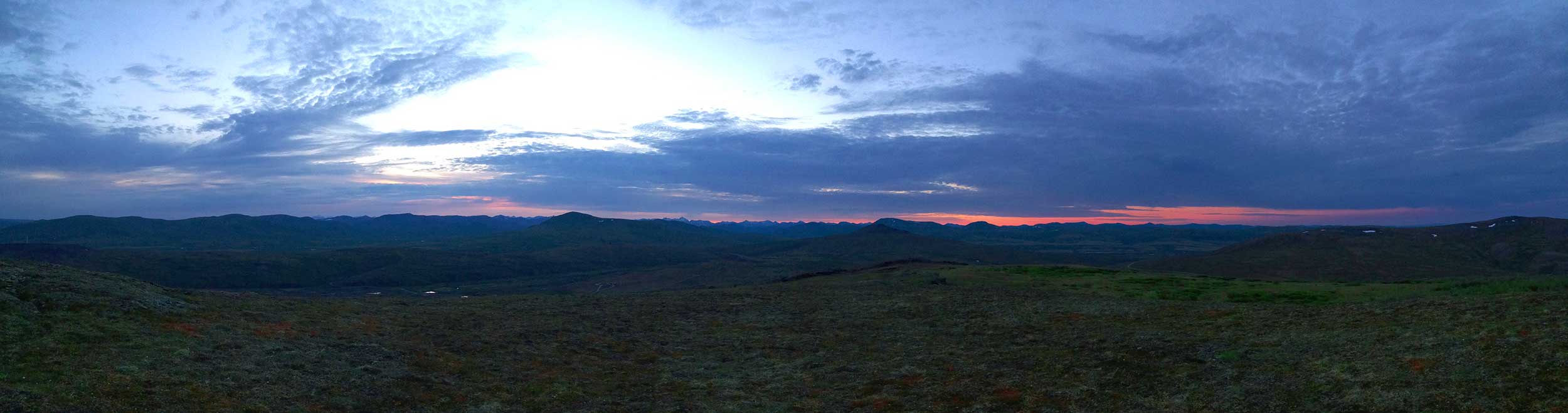
Last night,  I climbed to the top of Anvil Mountain just outside Nome, Alaska (which is near enough to the Arctic Circle to see some of the weirdness) at 2 o’clock in the morning to watch the “sunset.” I say “sunset” because it’s still pretty much full daylight out. The sun dips just barely below the edge of the horizon, but it doesn’t stay there, and it comes up again shortly thereafter…meaning we saw a simultaneous sunset and sunrise.

The red in the sky on the left of this panorama is the sunset. The red in the sky on the right is sunrise. The sun is traveling in a shallow arc that just barely dips beneath the horizon.

Click on the picture to embiggen!

Nome, Alaska: The Last Train to Nowhere

As the result of a lengthy and somewhat improbable series of events, I’m in Nome, Alaska, working on another book.

A few days back, we took a drive on the one road that goes through Nome. Nome is inaccessible by car; the only road links it to the nearby towns of Council and Teller.

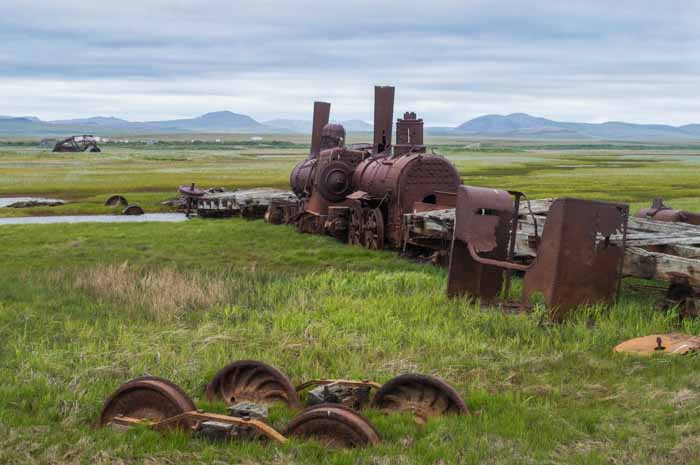
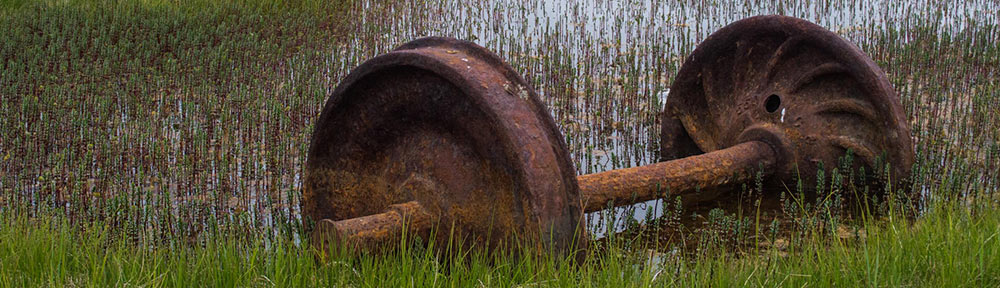
If you drive out toward Council, a trip I recommend only during the summer and then only in a large 4WD vehicle, about twenty miles from Nome you’ll come across the long-deserted ghost town of Solomon, a leftover from the gold rush in the early 1900s. Near Solomon, you’ll find what’s left of a failed attempt to bring rail service to Nome.

In 1903, an enterprising group of people formed a company to build a railroad to serve the gold mines near Solomon. They bought a bunch of secondhand elevated railway engines from New York City and hauled them up to Nome by barge.

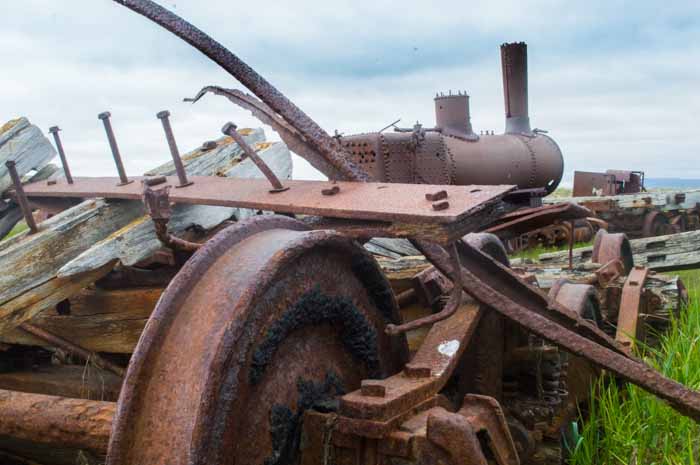
In 1907, a storm washed out the one rail bridge between Solomon and Nome, leaving the trains stranded on the edge of the water. The company folded and simply walked away, leaving the trains where they were, to quietly rust away into the tundra.

That seems to be a common theme in Alaska. The landscape is dotted with abandoned mining equipment, wrecked construction vehicles, and huge pieces of machinery simply left where they were when they became inoperable.

The locals call this steam engine graveyard “The Last Train to Nowhere.”

Even during the summer, it’s cold and windy here. The train never was reliable under the best of circumstances, so it’s no surprise there was no effort to replace it.

Science is cool!

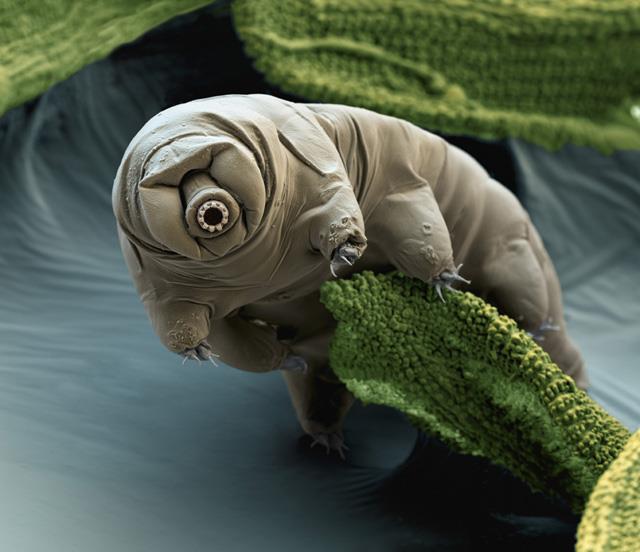
This…is a real animal. It’s called a Tardigrade, and it’s a (barely) macroscopic animal about half a millimeter long. It has eight legs and can survive exposure to hard vacuum. It belongs to a sister phylum to arthropods, though these guys technically aren’t arthropods.

This particular image comes from The Scientist, where it’s a finalist in their annual science image contest.

The next time you’re watching Star Trek and you see a supposedly ‘alien’ species that’s really just a white 21st-century human with a wrinkly nose, think about the amazing diversity of body plans right here on Earth, and then think about how profoundly unlikely that would be.

“But why aren’t we spending it on CHILDREN? Think of the CHILDREN!”

So for those of you who’ve been living under a rock for the last couple of days: Yesterday, something amazing happened.

No, I don’t mean the US soccer Olympic team beating Canada by one point in a dramatic overtime goal. I mean something really amazing. Something mind-blowing.

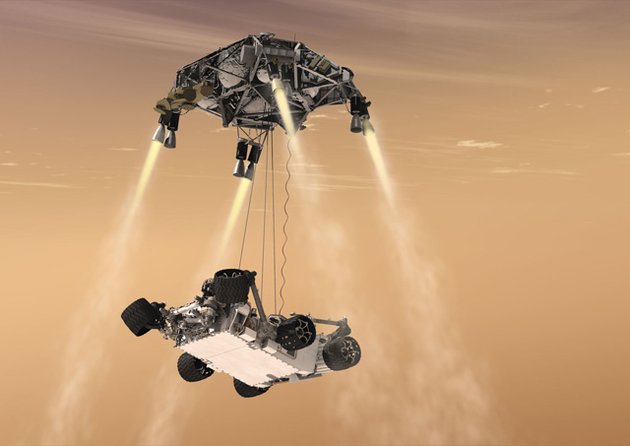
We took a one-ton nuclear-powered robot rover and threw it 350,000,000 miles, then landed it on the surface of another planet using cables from a flying rocket-powered robot crane.

And it worked. That’s the cool thing about science: It works whether you “believe” in it or not.

However, as always happens whenever NASA does something amazing, a bunch of people have trotted out all sorts of nonsense about how we shouldn’t be spending money on space exploration when there are so many problems back here on earth. I went to a Curiosity landing party at the local museum of science and industry, and sure enough, someone posted something on the Facebook page for the event something to the extent of “I wonder how many children will die from lack of clean water while we land a probe on Mars” or something.

Now, I have been told that it’s technically illegal to beat these folks. And I’m sure their hearts are in the right place; they’re not trying to be anti-intellectual, they just have little sense of the size and scope of the economy, nor how much money gets spent on space exploration, nor how much money we spend every year on things that we really could do without. And they seem to have an either/or mindset as well, as if to say that every dollar that goes to space exploration is a dollar that is taken away from needy children as opposed to being taken from, say, the Pentagon’s budget for paper clips.

Now, I think that doing things like, oh, finding out if there is life on other planets in our solar system represents a better investment of money than, for instance, buying T-shirts with pictures of NFL logos on them–something we typically spend about four times more per year on than we do on trying to learn about the universe.

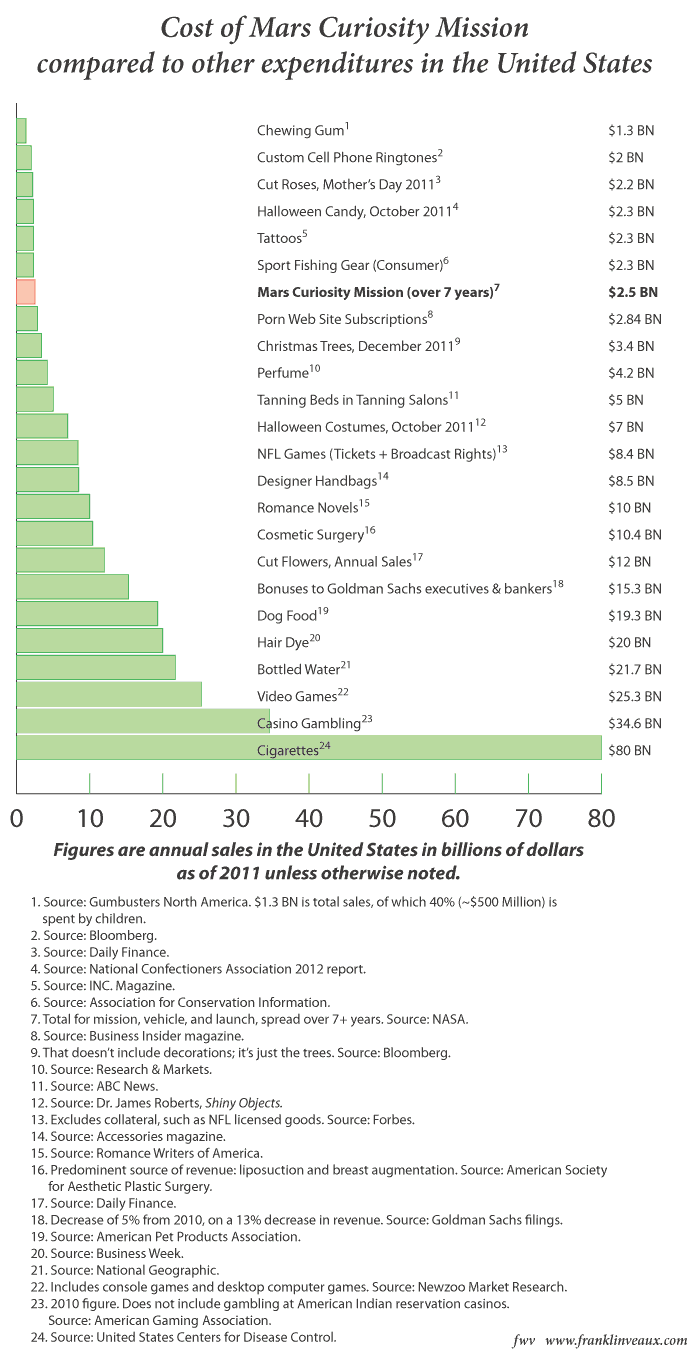
So I spent some time doing a bit of research, and I’ve put together a handy-dandy chart that shows the cost of the Mars Curiosity mission, compared to the cost of some other things we might be acquainted with. The chart is a little lopsided, in that it shows how much we spend per year on other things, and the cost of the Curiosity mission so far represents seven years’ investment; to make things more representative, the bar for the Curiosity mission should be 1/7th as long as it is here.

Since we aren’t technically allowed to beat folks who complain about the cost of space exploration, hitting them over the head with this chart will have to do instead. (Figuratively! Figuratively! You can’t literally hit folks with it unless you, I don’t know, print it out and wrap it around something first. Which, as I mentioned, is technically illegal.)

So now when someone says “Why are we wasting money on space exploration instead of fixing problems here at home?” you can say “Why are we wasting even more money on Halloween candy, Christmas trees, or perfume, or football games?” I don’t think I’ve ever heard anyone say “We shouldn’t spend money on perfume when there are so many problems here at home.”

Because, you know, spending money on perfume is way more important than finding out whether or not there is life not on this world.