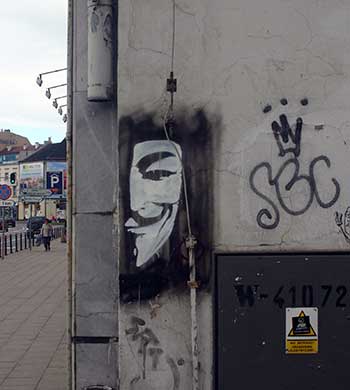
Adventures in Europe, Chapter 25: What a big eye you have, London!

London is a much more considerate city than St. Petersburg.

After we said our goodbyes to Franklin D. Roosevelt in Oslo, the ship headed back to Copenhagen, which marked the end of the cruise. My parents and my sister piled off the ship to head back to the US, the land of opportunity and lousy health care.

But not me, oh no. I had other plans.

I had opted, with rather a lot of thrashing about and some last-minute scheduling changes made with a very patient travel agent, to extend my stay in Europe so that I could visit a couple of my sweeties there. My family headed back to the US, but I traveled to London instead, via Germany, where the airports are appallingly primitive. (Seriously, they lack the decadent terminal jetways of the imperialist bourgeoise West, opting instead to park the jets in these enormous parking lots and then sending out buses to transport people to the terminal. It’s a little freaky.)

I sat in a magic chair that flew through the sky and brought me to London, where I was met by the lovely seinneann_ceoil, who brings sexy back in a forty-pound rucksack.

Wait, that didn’t sound right. I mean that she’s so sexy that she carries a lot of sexiness around with her…you know, so much of it that she needs a rucksack to carry…never mind.

I was met by the lovely and very sexy seinneann_ceoil, a day early as I opted to spend a bit of extra time in her arms rather than spending it sleeping in the Copenhagen airport, which had been the original plan. It’s complicated. But it was twenty kinds of awesome, and y’all wish you were me.

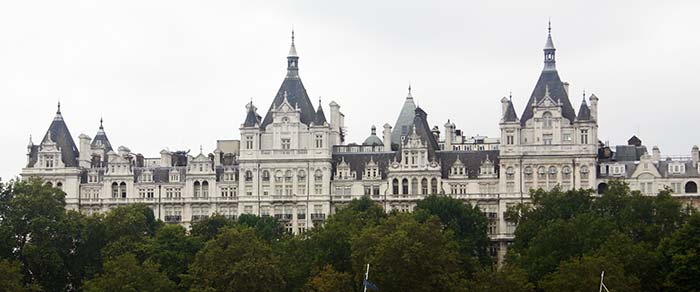
Owing to the issues around last-minute scheduling changes, seinneann_ceoil brought me downtown, where she had a meeting that couldn’t be postponed. So she disappeared into her meeting, and I wandered around downtown London for a while.

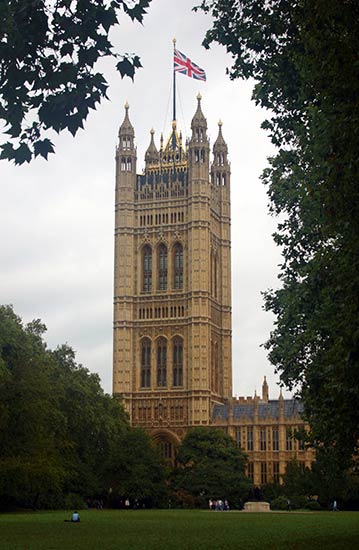
London is a much more considerate city than St. Petersburg. All the neat tourist bits are located right next to each other, which makes things far more convenient for visiting Americans. A tourist can hit most of them in a couple of hours, without relying on a guy named Igor to drive him around in a Ford SUV.

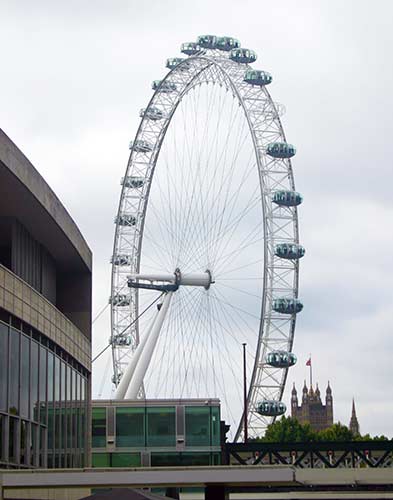
This is where her meeting was. Seriously. In the building right next to the London Eye, which is what they call that ginormous Ferris wheel on the big cantilever right next to the Thames.

I didn’t actually go on the Eye. They charge about 25 or 30 pounds to ride it, which at the prevailing exchange rates was somewhere around seven hundred dollars or something.

The Eye is cool. First, the support structure that holds it up is a cantilever; it’s only supported on one side. Second, the ring is held in place by a series of cables that work like the spokes of a bike, rather than by a rigid structure. It’s an interesting structure from a mechanical engineering perspective, and the little pods you ride in are held onto the wheel by a sort of cagelike structure that…

You know, I want something like this in my dungeon. Smaller, of course, and perhaps black, but…ahem.

The Eye is, as I mentioned, right on the Thames. There’s a big public courtyard all ’round, where people dress up like robots and make money standing really still. I hear it’s good work if you can get it.

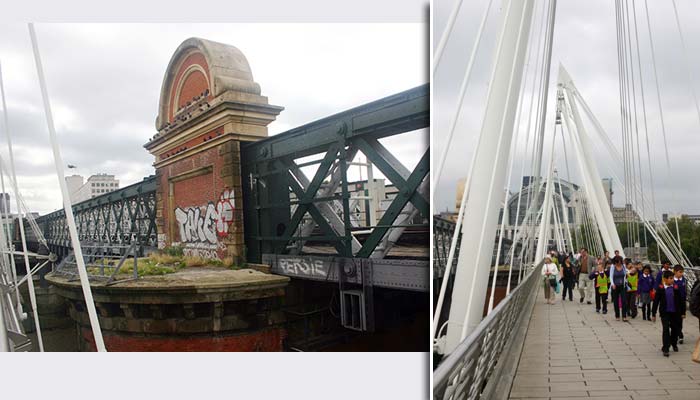
There’s a nice shiny pedestrian bridge across the river, with lots of soaring bits and cables and stuff. It runs alongside a distinctly less shiny rail bridge, utterly lacking in soaring bits but instead made of lots and lots of brick and concrete.

I’m sure it seemed to make sense at the time, but putting the two bridges so close together that you can touch one from the other was perhaps a poor decision from a social perspective…at least if you don’t want folks leaping from the pedestrian bridge to the train bridge. Especially given the nice appealing columns supporting the train bridge, which are convenient places to paint graffiti or drink booze or engage in acts of soccer hooliganism, which I hear is quite popular in London-town.

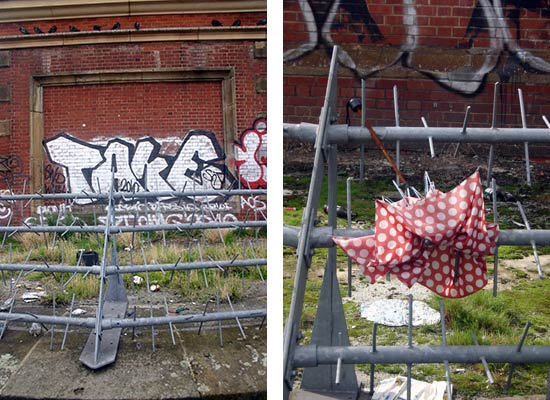
Fortunately, as it turned out there was a ready answer in the form of the UK’s huge stockpiles of strategic tank traps left over from the War. Properly situated, they discourage graffiti-painting, booze-drinking hooligans with the same brutal efficiency as France’s Maginot Line. And I offer that endorsement with all the gravity it is due.

Such awesome defenses are not to be trifled with. Their effectiveness speaks for itself, really. And they are even more effective against umbrellas, judging from all appearances, than they are against booze-drinking, spray-painting British hooligans!

Graffiti still looks the same pretty much everywhere in the world. How did that happen?

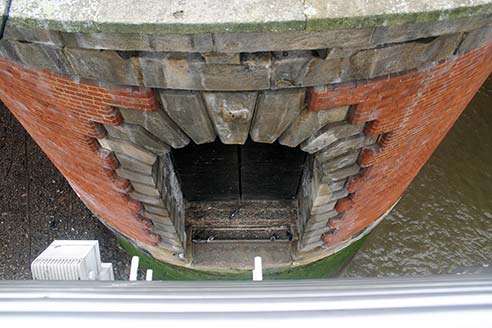
The old train bridge is, as I remarked before, supported by massive pillars of concrete and brick. The pillars seem to be hollow, with doorways leading into them at sea level.

The reason for this curious fact of civil engineering dates back to Iron Age antiquity. Present-day London began as a Roman settlement, of relatively minor trade importance. Around 60 AD, the settlement was attacked and overrun by barbarian hordes led by the queen Boudica, a warrior-priestess who raided Roman strongholds and generally made a pest of herself against the Roman Empire.

It was then, in that dark hour, that the citizens of Londinium, as it was called back then, hatched a daring plan. Besieged, with the city burned to the ground, the desperate Londoners made a pact with the race of naga whose empire beneath the waves of the Thames stretched far and wide, even into the English channel, an enormous and ancient civilization hidden from all but the wisest seers by the murky depths.

The naga, led by their queen Lady Vashj, rose against the barbarians in the dead of night during the bitter cold of winter and routed the barbarian hordes. In gratitude, the citizens of Londinium agreed that from then on, all civil structures built in the Thames would have these doors, leading into secret chambers where the naga could rest and take shelter.

The Roman emperor Nero, impressed by the strength of the naga, dispatched a legion to the newly-rebuilt city, where he killed them all, pausing along the way to wipe out two or three Celtic civilizations that happened to be nearby. To this day, though, Londoners still remember their promise, and build these strange doorways into the bridges and landings around the Thames.

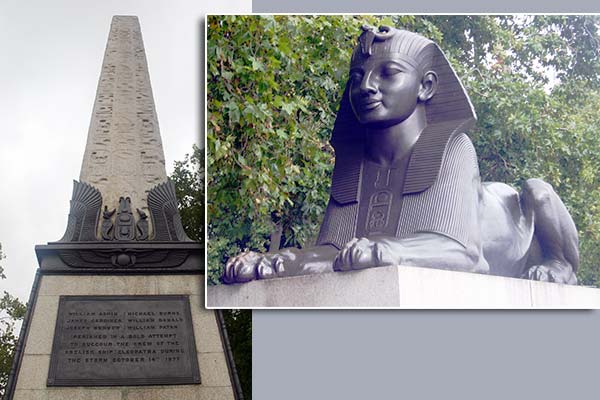
I walked across the bridge, then turned toward London’s downtown, following the path of the river. Along the way, I kept my eyes out for the crystalline spires jutting up from the water, now broken and worn smooth by the passage of time, which are all that remain of the naga civilization. I did not expect to come across an Egyptian obelisk and sculpture.

The weird and unexpected appearance of Egyptian monuments so far from the Middle East stand as a tribute to the sorts of things that folks will do for spices and tea.

I mean, don’t get me wrong, everybody loves spices and tea. You’re not really a civilization unless you love spices and tea. But the British take the ordinary human love of spices and tea to whole new levels. Tea, especially. Tea and also spices, sure, but mostly tea.

Whereas other, less inspired societies are content to trade for these things, or perhaps just grow them, the British built an entire empire based on the acquisition of spices and tea by force. In support of this empire, they invaded distant lands and engaged in slavery and made amazing progress in the invention of whole new kinds of atrocities, just to keep the spice, and the tea, flowing. They were so obsessed with the spice and the tea that the East India Trading Company and its navigators, who the tea had mutated over four thousand years, soon gained an iron grip on interstellar travel, which they defended with ruthless fanaticism.

It’s quite good tea, by the way. seinneann_ceoil made some for me. It’s good enough that Im actually considering investing in a teakettle myself.

Adventures in Europe, Chapter 24: Franklin D. Roosevelt wants to free your mind, Citizen

There’s nothing like being held for ransom and then squabbled over like the white meat on Thanksgiving’s turkey that focuses the mind. There is also, it must be said, little good that can come of having one’s mind focused on Knight Rider. There is a dirty little secret of Knight Rider, and I don’t mean the one about how it jumped the shark with the Cylonesque talking car’s evil twin. No, the dirty little secret of Knight Rider was that it was a children’s show that nevertheless managed to run ads aimed at grown men.

But again I digress.

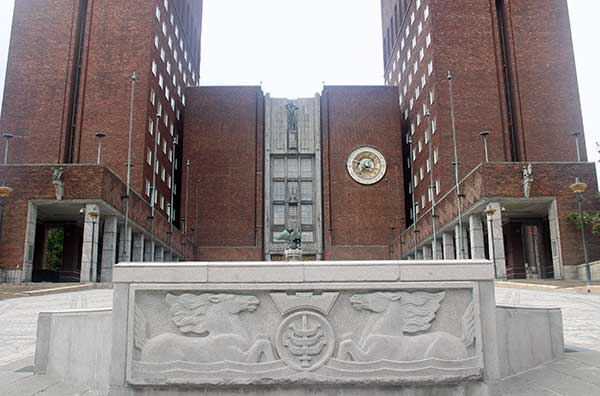
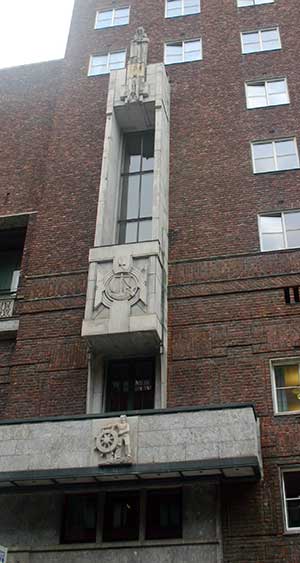
Crisis averted and safe passage assured, I ventured farther into Oslo, and soon stumbled upon the magnificent town hall near the center of town.

It is a brooding and majestic place, a fit center from which to rule a vast empire. You can tell by the horses. Horses engraved in stone always mean business.

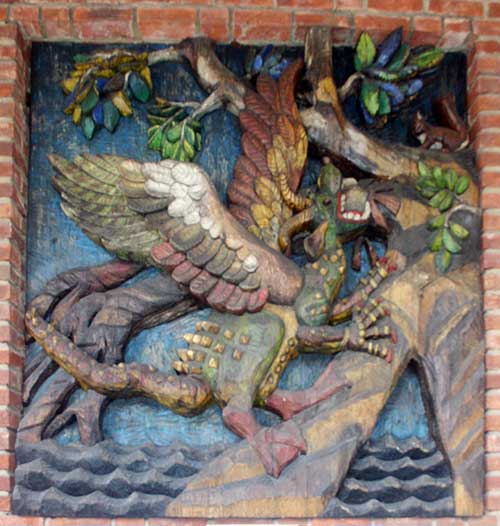
Along the column-flanked overhangs to the left and the right, rows of wood carvings remind us of what is to come during the Final Days, when a great darkness shall descend upon the earth.

This particular carving shows the winged serpent-beast Nidhogg gnawing one of the roots of Yggdrasil, the World-Tree. In his malice and evil, he tears perpetually at the root of all things, hoping to strike oil. Some say that if he succeeds, there will be a great calamity, with the lifeblood of Yggdrasil gushing out uncontained during three long months of wailing and suffering, with much hand-wringing and the fall of many tears, before finally being staunched by a combination of a gigantic cap positioned by remotely-controlled robotic servants and a relief well being drilled alongside the gashes of Nidhogg’s enormous fangs. Afterward will come a Tribulation, in which a great king will be forced to give up his idyllic life of yacht racing and abdicate his throne in disgrace.

Others, of course, say that this is merely a fanciful tale told for the entertainment of children, and that nothing like this can ever really happen.

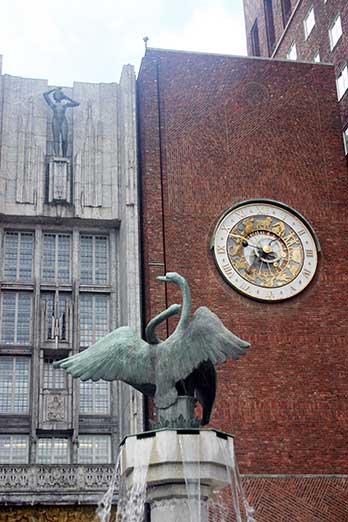
The Oslo town hall is richly decorated with statues and carvings. Im not sure of these geese are wrestling or having sex, but then, there have been times in my life when I was not sure if I was wrestling or having sex. When I was in high school, I had this crush on the girl next door, see, and she and I would often wrestle with one another…but I digress.

Or are they swans? The ornithology of waterfowl, like the distinction between wrestling and sex, is not one of my areas of expertise.

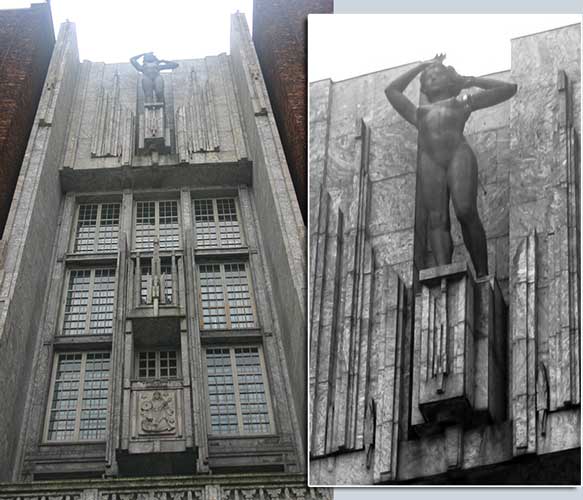
I do quite like the statue atop the building’s facade, though.

The whole thing has a vaguely Stalinesque feel to it, or it would if Joseph Stalin hadn’t been such a cob-faced prude.

The balcony is just lovely. From here, the Grammaton Clerics issue their edicts to the city’s citizens, and it is to here that any citizen suspected of either emotion or artistic expression is taken in order to stand trial. And by “stand trial,” I mean “get shot a whole bunch of times in dramatic slow motion by Christian Bale, but, y’know, back when he was cool, before he became a mincing, emotionally volatile momma’s boy like he is now.”

One day, my secret lair will have a balcony that looks just like this.

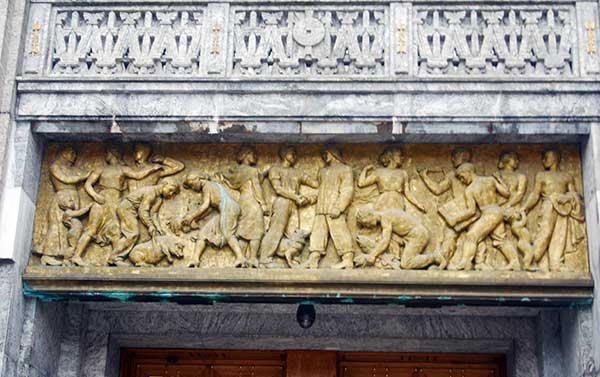
The main door to the town hall is decorated with this mural on its lintel.

It depicts, as near as I can puzzle out, two Masters of Capitalism, perhaps John Galt and Ragnar Danneskjöld, shaking hands to cement a deal, while all about them the machinery of commerce hums, guided by Adam Smith’s hand toward a Utopian Worker’s Paradise under the wise and benevolent rule of Kim Jong Il…though I may have my fairy tales mixed up. Whatever, I’m sure that whenever two guys shake hands, it’s always good news for everyone else.

The door itself is also adorned with artwork, though done in a radically different style.

Here we see a brave knight, who represents the Tetragrammaton Council, battling with a great serpent, who represents the rapacious oil-seeking Nidhogg, while clad in a fetching military hat, which represents the wisdom of Ayn Rand shining like a beacon over Her disciples at Enron and Goldman-Sachs, with his sword, which represents his penis.

The town hall was closed the day I was in Oslo, which was very sad; I really wanted to see the machinery of Norse justice in action. As I ran around taking pictures, though, a woman cracked the door and watched me from the inside. I have no idea if she was armed or not.

The Norse love their severe, narrow balconies almost as much as they love their cannon.

One day, my secret lair will have…

No, screw that. One day, my secret lair will be this place. Only with, like, lasers and stuff. Because lasers are cool.

On the way back from the town hall, I found a curious bit of graffiti on the wall. I don’t understand Norse graffiti.

It appears to my eyes to have been written by someone whose passion was as great as his grasp of English spelling and grammar was tenuous. Though to be fair, it’s a bit surprising to see graffiti in any English, broken or no, in a city whose dominant language is nothing like English.

The strangest discovery in Oslo awaited my return to the ship. Nestled beneath a tree right on the edge of the port one finds, most unexpectedly, a giant stone statue of American president Franklin Delano Roosevelt.

I didn’t expect to see him sitting here, so far from home. It seems that, like many Americans, I am underinformed about our own glorious history, and about the role our past leaders have played in many other nations during their time upon the world stage.

But the Norse have not forgotten, oh no. They remember. They remember President Roosevelt’s service to their nation, when he led the Norwegian Air Force against the armies of Napoleon during the Battle of the Bulge. They remember how he brought light on that dark day, using his powers to turn the tide of battle at the moment when all hope seemed lost.

And they remember, too, his promise to them and to all mankind, that he will return again, when the final battle of Ragnarök has begin and Odin has been slain by the great wolf Fenrir. They remember his pledge to rise once more, to take Odin’s seat at the head of the gods and to battle the forces of evil for the salvation of all of us.

Oh yes, they remember.

Adventures in Europe, Chapter 23: Give me Hasselhoff or give me death

With the Bridge of Dreams behind us, we made port in Oslo, Norway, the Most Expensive City on Earth. Prior to winning that dubious distinction, it was a Viking capital, widely known as being Home of the Most Hats With Pointed Horns on Earth. Early in its history, it was also launching point for the Most Savage Coastal Raiders On Earth, winners of the coveted World Cup of Rape, Pillage, and Murder forty-three times between 799 AD and 1023 AD.

One might expect such a colorful history to make for an interesting city, and one would be right.

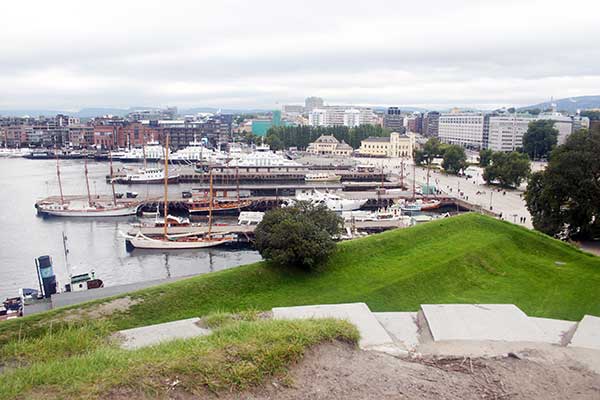
The early Vikings were masters of the sailing ship, and modern-day Osloians, or whatever it is you call natives of Oslo, are reluctant to give that tradition up. The harbor was crammed quite full of wooden sailing ships when we arrived.

I’m not quite sure what they made of our strange vessel of painted metal, and its lack of sailing-masts and oars and any other visible means of propulsion. I half expected to be greeted as some sort of strange seaborne god, arriving on the shores of the city in a magical floating hotel and casino that moved under its own power and levitated on water with the power of elfin magic alone.

What actually greeted me was this…oddly proportioned statue.

The sculptors of Norway have it all over the sculptors of Russia in that, it would seem, they have actually seen a real human breast up close, and are reasonably familiar with its general overall shape, size, position, and disposition.

What they would seem less acquainted with, however, is other particulars of human anatomy, in regards especially to things like hands and feet. Good Lord, I have not seen hands and feet that big since World of Warcraft. And I have a dwarf paladin, so I know disproportionate extremities when I see them.

She can crack walnuts with those toes, I reckon.

Right on the edge of the port is Akershus Castle, built on the edge of the water in the 1200s as defense against roving bands of maritime raiders. Quite why Norway, the source of the world’s roving bands of maritime raiders, felt the need to defend against them is a detail that escapes your humble scribe.

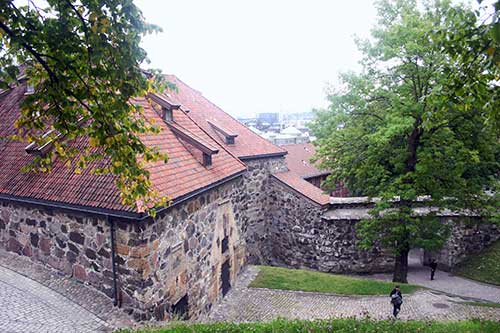
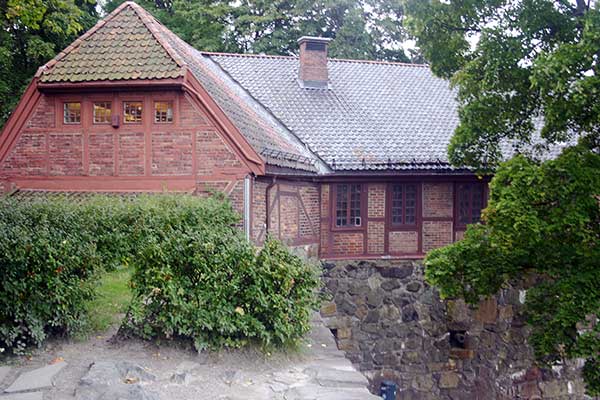
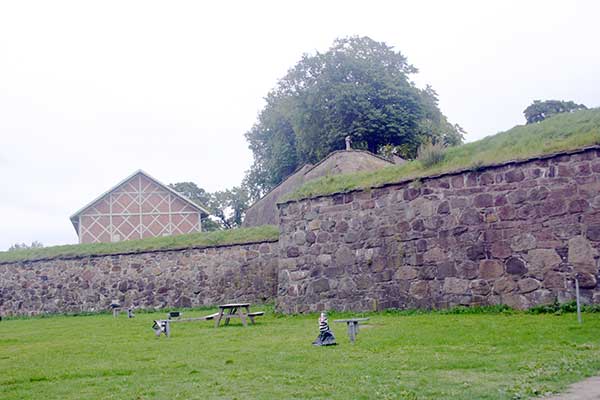
The castle proper was under significant renovation when we arrived, and so looked nothing like its Wikipedia entry. I was able to visit part of the castle complex, though, which to my eye looked largely like a collection of stone houses behind a wall.

One of the main buildings of the fortress complex featured a stone wall bristling with a rather startling array of cannon, the better to…err, I don’t know. I’d say “beat back ravening hordes of invading Vikings,” but, well, you know.

And speaking of walls, the Norse were rather good at them, I must say.

This formidable twelve-foot wall of stone entirely surrounds the fort. It rendered the entire castle complex, and the city that the castle protected, virtually impregnable to attack from the time of its completion in the late 1200s all the way up through 1982, when advances in military technology led to the invention of the stepladder. Overnight, this once-awesome defensive structure was made obsolete. World powers shifted in the blink of an eye, as often happens with new, disruptive technologies, and the golden age of the Norwegian empire was irrevocably behind it.

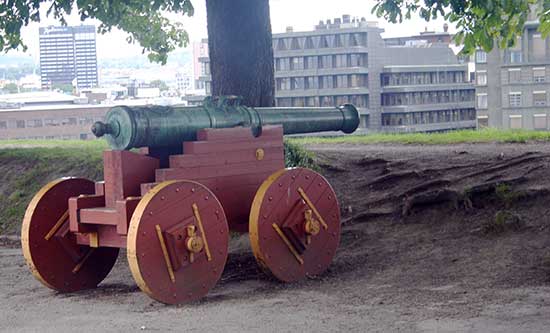
The Norwegians do love their cannon, though. This one looks out over the wall toward the busy urban center of Oslo’s downtown district.

If that office building ever declares war, man, Oslo will be ready.

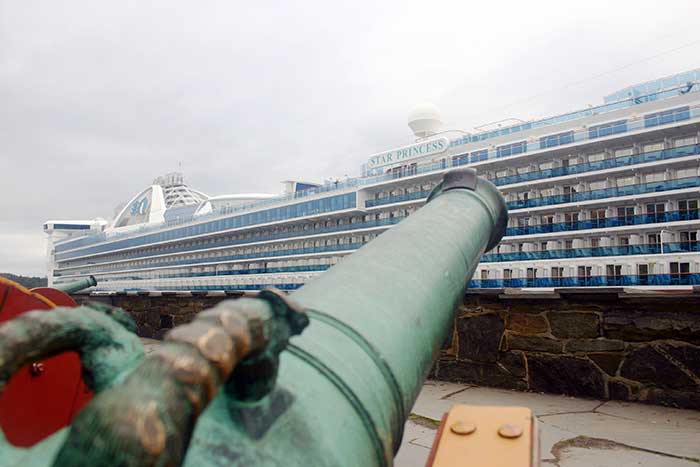
The city reacted with more shock and less awe to our arrival than I might have preferred; it wasn’t long, in fact, before those fearsome cannon swung ’round our way.

Initially, they demanded a million dollars and the head of Dick Cheney as ransom for our safe release. Hours of tense negotiations ensued, during which compromises were made on all sides. They finally agreed to accept a dozen old VHS tapes of “Knight Rider” episodes and a signed photograph of David Hasselhoff, which at the current exchange rates were worth approximately the same amount as their original demand. During our stay, the American dollar was so far in the crapper that a minute of Internet time in an Oslo internet cafe cost about $842.67, or a two-pence coin in British pounds sterling.

This is, it might be argued, not the right time for an American to be vacationing abroad. Seeing as how our itinerary included several stops behind the old iron curtain, though, one could say that there’s a tradeoff between visiting during a time when the dollar’s in the toilet but Americans are warmly welcomed with open arms, or a time when the dollar is invincible but Americans are warmly welcomed with firing squads. One takes what one can get.

Adventures in Europe, Chapter 22: Sliding Under a Big Bridge

Throughout my life, there have been several recurring themes in my dreams.

I’m not talking about the one where I become despotic ruler of the earth and crush dissent in my iron fist; that’s really more of an ambition than a dream. I also don’t mean the one where I suddenly realize to my horror that I have been enrolled in some university all year but I totally forgot about it and don’t know my class schedule, and I’ve only just become aware that today is finals day and I can’t even find any of the classrooms…which, annoying as it is, is pretty much a run-of-the-mill stress dream. Any of you who don’t have that dream, be happy.

Nor do I mean the one where I see myself standing in sort of sun-god robes on a pyramid with a thousand naked women screaming and throwing little pickles at me–that’s actually Val Kilmer, not me.

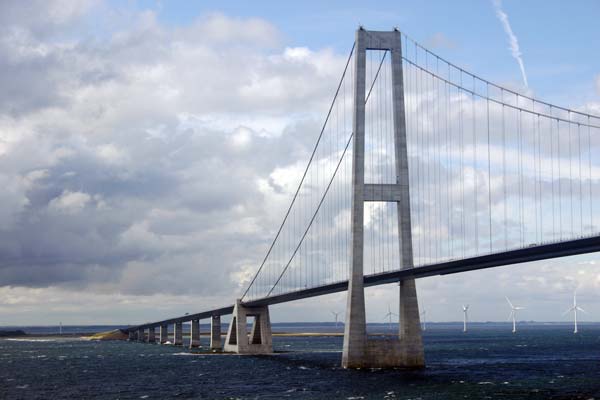
The dream that I have is about a bridge. And really, in some ways, I think it might be this bridge.

You can, if you want, click on the pic for a much, much bigger version (nearly four thousand pixels wide!).

This is a hand-stitched panorama of the Østbroen Bridge, or the Great Belt Bridge, in Denmark, which we passed beneath (by inches) on the way from Gdańsk to Oslo. I put it together in Photoshop from a half-dozen pics I took by setting my camera on a rail on the front of the ship and holding the shutter down while I rotated the camera by hand, on account of ’cause I don’t have a modern DSLR capable of doing panoramic shots by the power of Science and elfin magic.

Which, as a side note, if anyone out there wants to contribute to me getting a better digital camera than my first-generation EOS digital, I’d be most appreciative.

My dreams have often been illed with impossible bridges. In some versions of the dream, I’m on a flat, two-lane bridge, completely lacking guardrails, that extends five or six hundred miles into the water and then slowly dips below the waves, leaving me stranded without enough room to turn around and go back the way I came.

In others, the bridge is more like this one, only in the center it starts to rise more and more steeply until finally I have to stop the car, get out, and climb. There’s usually a narrow catwalk, or sometimes just a tightrope, that makes up the center of the bridge; I walk across it, climb back down on the other side, and somehow my car is waiting for me to get in and finish the drive.

In yet other versions, it’s a long, high suspension bridge that ends on the far side on the roof of a skyscraper or other tall building. I drive across, and then find myself on the roof, with no way to get off the building onto the street below.

So when I saw this bridge, which is impossibly long (it’s apparently the largest bridge outside Asia and the third largest in the world, or so the ship’s captain said), it felt kind of like a weird homecoming. In, y’know, my head. When I’m asleep. But only sometimes, and not during the times when I’m Val Kilmer and it’s the thing with the pickles.

We passed beneath it with, as I mentioned, only inches to spare. I really wanted a photo of that, but my camera battery chose that precise moment to die, which I thought was absolute dog’s bollocks, but there it is.

I particularly like the windmills on one end, and the way it touches down on a little spit of land and then promptly dives into an underground tunnel and disappears on the other, which you can’t quite see in this panorama.

I have no idea what this bridge means, nor why it’s been a central fixture in my dreams for so many years. I have noticed that I haven’t dreamt about it since we passed beneath the Østbroen Bridge, for reasons that entirely escape your humble scribe.

Adventures in Europe, Chapter 21: Up, up, up, up, up, up, and away!

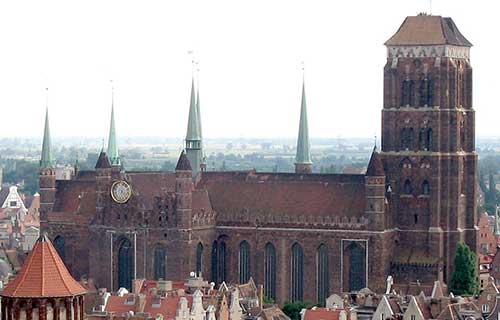
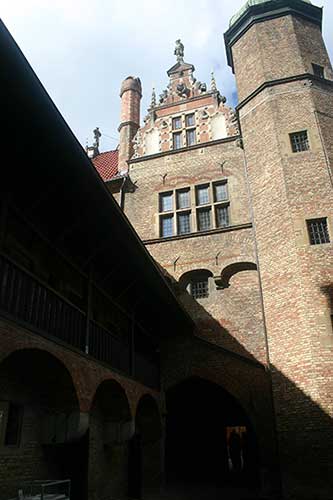
Just a stone’s throw from the torture chamber and amber museum in Gdańsk is the Church of St. Mary, the largest brick Gothic church in the world.

I’m sure their geometric proximity vis-à-vis hurled rocks is probably no accident, as churches and stones seem to go together like whiskey and hunting. It is, even by the scale of St. Petersburg religious edifices, altogether a grand structure, towering hundreds of feet over the faux Old Town like Godzilla over a small Japanese seaport on Tokyo Bay.

I couldn’t get a decent picture of the church proper, as it’s crowded so closely by neighboring buildings that the only way to do it seems to be helicopter, so I grabbed this one from Wikimedia Commons.

I will admit, when we arrived in Gdańsk I didn’t expect to find myself looking down at the spires rather than up at the spires.

The church started out as Lutheran and then eventually went Catholic, in a reverse of the normal order of things ’round the Baltic. I’ve never been quite sure about all the doctrinal differences ‘twixt the two, except that Catholics follow the Pope and Lutherans follow Lex Luthor, the archvillain who nailed a list of ninety-five complaints to the door of the Fortress of Solitude, protesting among other things the sale of indulgences, the role of confession in the forgiveness of sin, and the prescription-only status of Rogaine.

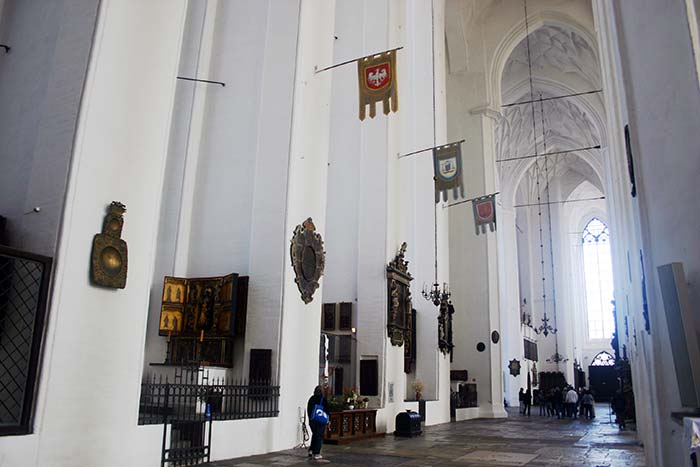
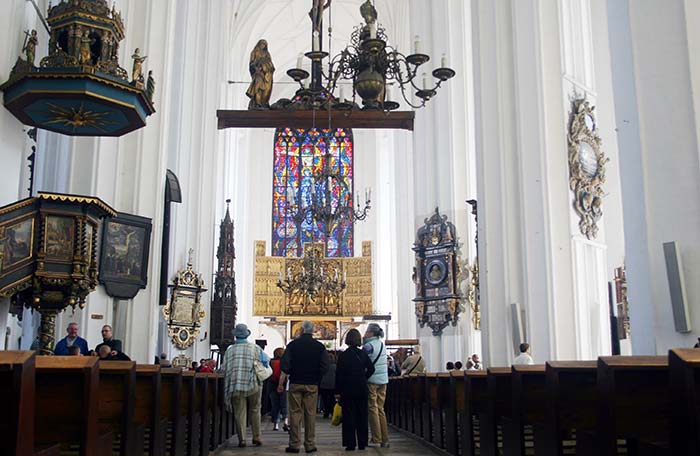
As a currently Catholic church, St. Mary’s lacks some of the more exuberant display of not-idols-no-really that many of the other churches in Eastern Europe boast. It is nevertheless still quite a magnificent structure, its soaring white interior carefully calculated to produce a maximum sense of shock and awe in the psyche of an illiterate serf.

There are a few not-idols available for the faithful to not-worship, but for the most part it’s all towering arches and huge naves and such.

This church has seating for 25,000 worshippers inside. Yep, you read that right. That’s three zeros after the comma, meaning the Blessed Mother can still kick some ecclesiastical ass and show those so-called “megachurches” in Texas how it’s done, yo.

The Church of St. Mary was, once upon a time, home to a large number of artistic treasures. That was before the Thirteen Years’ War, the War of 1569, the Prussian War, World War I, World War II, and the Soviet occupation. It’s been looted by a Who’s Who of historical world superpowers: the Teutons, the Prussians, the Nazis, the Red Army, you name it, all of whom have pretty much treated it like a drunk eighteen-year-old girl backstage at a hair metal concert.

It does still have a few treasures that haven’t been carried off or melted down, though, like this bit of sculpture,

I don’t know what it’s actually called, but I mentally dubbed it “Jesus Does a Facepalm.”

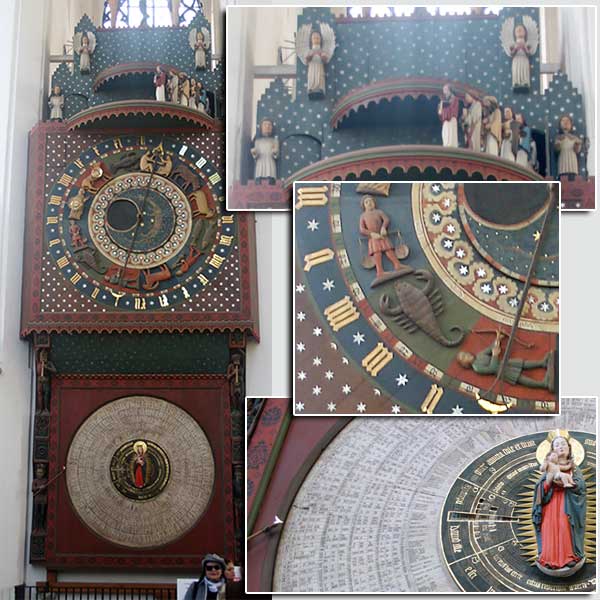
It’s also home to this enormous two-story-tall astrological clock:

This thing tracks the astrological constellations and about eleven thousand and two important dates in the lives of the hundreds and hundreds of sacred figures of Catholic monotheistic tradition, and–get this–it even has clockwork saints who chase each other around the top of it like Punch and Judy after a free and vigorous exchange of ideas over the issue of whether or not the essence of the Trinity can be divined wholly by the carnal senses without the direct intervention of the Holy Spirit.

Some believers claim that the world will end in 2012, when this astrological clock finally winds down. Others await the triumphal coming of the Great Savior, who with the Golden Winding Key of the Epoch will once again set the clock into motion and usher in a new Golden Age under the Sun of Precious Stones, once thought by the Aztecs to have been destroyed by jaguars but now known to have been under the couch with the TV remote this whole time.

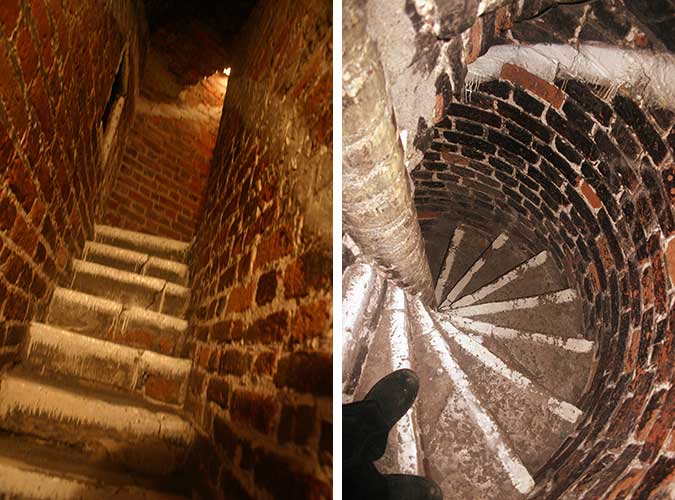
Near the entryway to the church, a guy was sitting behind a card table with a sign in English advertising climbs up the tower for five zloty, which is something like a buck fifty or so. Behind him was a narrow wood door with a small flight of stone steps leading up.

My sister and I opted for the climb. Now, what I expected for my buck fifty (or, more accurately, for my sister’s buck fifty) was a climb up one of the turrets to a place where we could look out a window or something. What I actually got was an episode of television’s Fear Factory, only with 70% less First World obsessive-compulsive concern over safety and avoiding gross bodily harm.

The steps start out deceptively, sort of like giant alien killer robots do.

They go up straight for a distance, then turn into a spiral nightmare where each step may be narrower than your foot, but at least it’s about three feet high.

But, as with giant alien killer robots, they’re more than meets the eye. I figured the spiral bit would go up for a while and come out into a room where we could look out the windows and say “Oooh!” and “Aah!”. Then again, I also figured that Sarah Palin would have gone away by now, so that shows what I know.

The main vault of the church got bombed out in WWII, and has never been restored. Instead, they just kinda stuck a big concrete stairway around the inside of the shell and called it good.

What the photo on the left fails to convey, aside from the stark raving terror of this place, is the darkness. That’s somewhere around a ten-second exposure you’re seeing there.

Imagine climbing up a dozen stories on a crude concrete stairway in near-pitch-blackness, and you’ll start to get the general idea. Now picture that while being chased by giant killer robots from space and you’ll have the plot, or what passes for the plot, of a Michael Bay movie…but I digress.

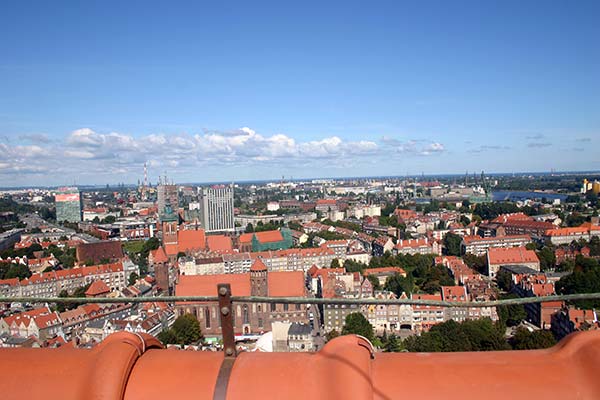
The stairway did not lead out into a room where we could look out the windows and go “Oooh!” and “Aah!” Instead, it led outside, onto a three-foot by four-foot metal platform bolted to the very top of the church. They hacked a hole in the roof and put a doorway there, with a few metal steps leading up to the platform. All in all, there were 406 steps, not including the five metal steps up to the platform.

A guy was sitting on a folding chair on the platform, reading a book. For five more zloty, you could borrow the binoculars he had hanging around his neck.

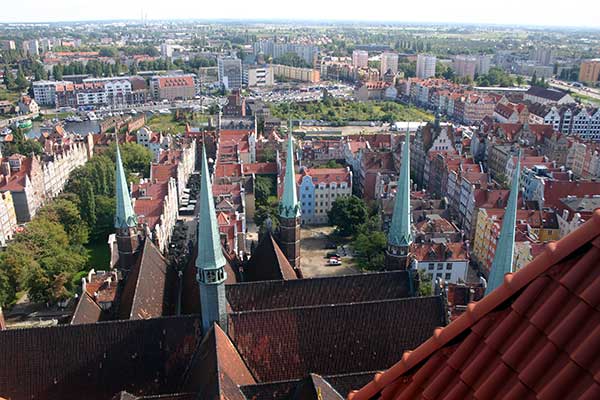
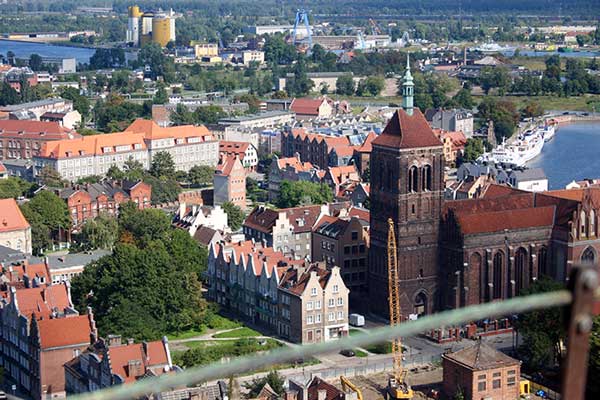
Not that you needed them. The view was amazing–enough to make the scary climb up hundreds of steps in near-total darkness and the giant alien killer robots totally worth it.

When I said I didn’t expect to end up looking down at the church’s spires rather than up at them, I meant that literally.

Gdańsk is one of those towns that always made me pull my hair out whenever I worked on the Saudi version of the Royal Caribbean cruise catalog; it has a lot of churches. All of which are probably bigger than a Texas megachurch, and most of which look downright tiny when looked down on from up atop St. Mary’s.

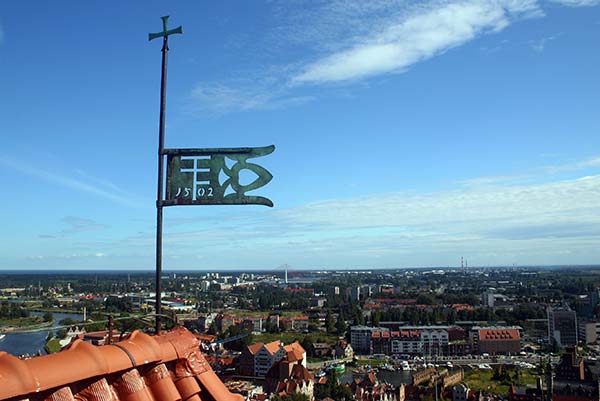
Each corner of the topmost section of the church is protected by a lightning rod, and each lightning rod has a small metal flag embossed with a year (possibly important years in the church’s history, perhaps?).

Now, personally, I’ve always thought that putting a lightning rod on a church is a profound vote of no confidence in the divine power and mercy of the Lord, myself.

The lightning rods atop St. Mary’s feed into thick cables that serve double duty in helping prevent hapless tourists from plummeting to an unfortunate death many stories below upon the storied streets of Gdańsk, which is perhaps a dubious double duty were it not for the fact that, presumably, they don’t let people up here in the middle of a thunderstorm.

The gentleman with the book and the binoculars mostly ignored us while we took in the sights and mostly tried not to think about the 406 steps, not including the five metal steps up to the platform, that loomed in our future.

The trip down was, if anything, even scarier than the trip up, in no small measure because on the way down you can sort of see, dimly, the vast distances that one could travel feet over teacups if one were to make a misstep. My sister has a mild phobia of stairs as it is, so yeah. Terrifying up, twice as terrifying down.

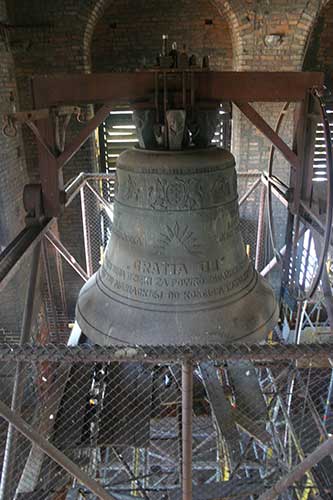
About midway down, I paused to take a picture of a bell.

It’s a big bell, just kind of hanging there, with no way to ring it or anything; mostly, I photographed it to distract myself from the horrifying fear of imminent and sudden death.

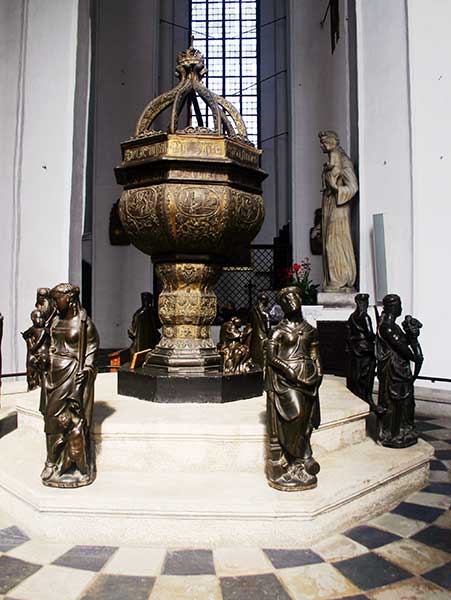
We eventually made it down, and left through a different door than the one we entered through. We came out near this…this… Well, I’m not really sure what it is.

It looks kind of like a fountain, sort of, only there’s no water, which might in its own way be a fitting icon of religion in general. The women clustered around it are obviously pious; you can tell by the generally unhappy expressions that you always see in carvings of the pious people. In the annals of religious tradition, the intersection of “pious people” and “happy people” is almost always a null set, which may have been what inspired Friedrich Nietzsche, himself a profoundly unhappy person, it seems (but in an entirely impious way) to observe “The Christian resolution to find the world ugly and bad has made the world ugly and bad.”

There’s a statue behind the notafountain fountain thing, of some dude carrying a child. Don’t blink! Don’t turn your back. Don’t look away. And don’t blink. Good luck!

Adventures in Europe, Chapter 20: It’s a small world after all…

Gdańsk is known mostly for its amber and torture chambers. It’s also known for being a cosmic billiard ball in the great international game of pool, with various nation-states and empires and suchlike seeking control of it for various reasons. It’s changed hands more often than a counterfeit dollar bill in a brothel in Saudi Arabia, and has even at various times been a “free and independent city-state under the control of Poland,” whatever the hell that means. It sounds to me like the political equivalent of house arrest, but my grasp of Polish history is, sadly, insufficient to reach the finer points of you’re-independent-but-not-reallydom.

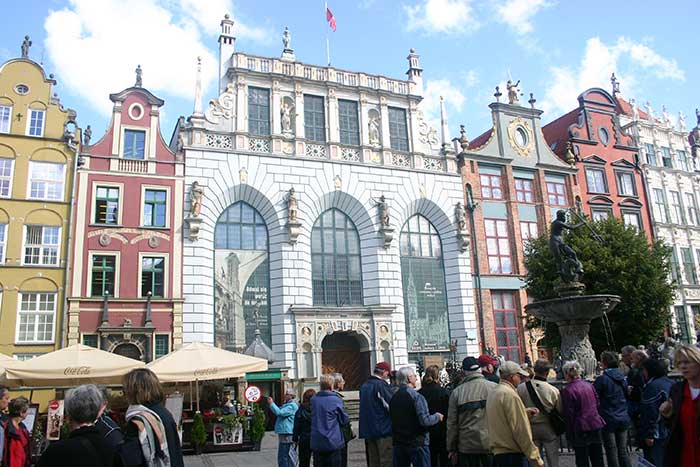
Just beyond the torture chamber and amber museum lies the Gdańsk Old Town, which is prettier but a lot less interesting than Tallinn’s Old Town district.

The Old Town streets are wide, spacious, and straight, which immediately makes anyone who’s ever been to any ancient city suspicious, and rightly so. If there are three things that any legitimately old city’s streets are not, they are wide, spacious, and straight.

The suspicions were confirmed when we ventured down that suspiciously wide, spacious, and straight street.

For an ancient Medieval city that traces its roots back to around 900 AD or so, those buildings look awfully clean and bright. I went around behind them–on a route that took me down along the canal district–and sure enough, from the rear those lovely buildings are unpainted, new, and mostly vacant. The whole thing is about like Disney’s Main Street USA, only with fewer rodents of the dancing variety and more of the Black-Death-carrying variety.

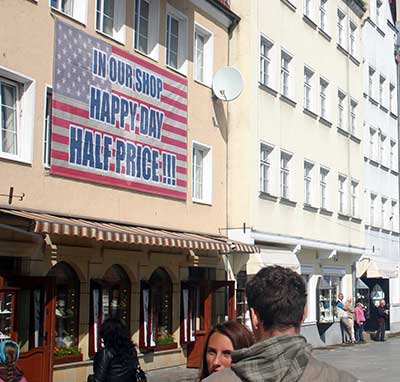
In my trek down the canal district, I found this place advertising “In Our Shop Happy Day Half Price.”

To paraphrase Samuel L. Jackson in his seminal opus “Pulp Fiction,” and with a tip o’ the hat to zaiah: “Engrish, motherfucker! Do you speak it?”

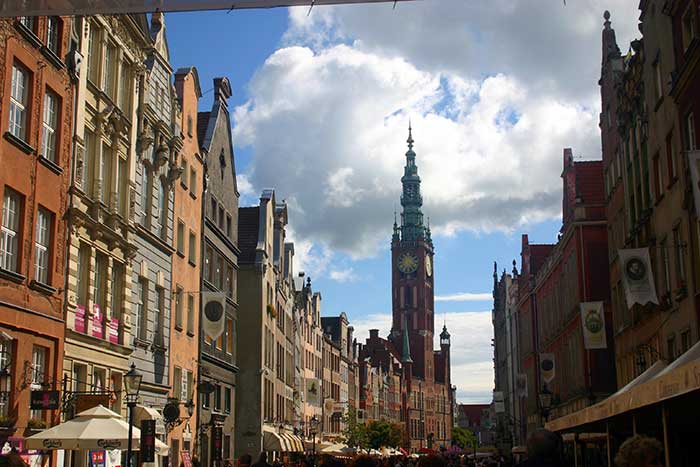
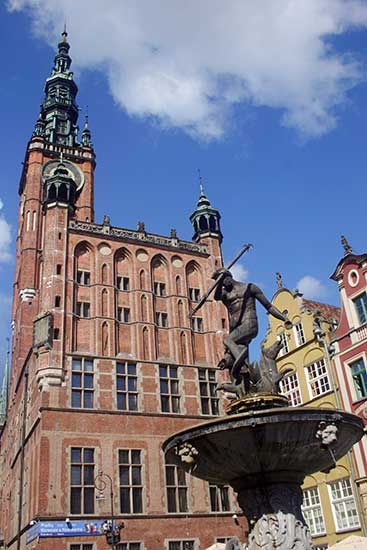
There’s really only one part of the Gdańsk old town that seems genuinely old, the rest having been blown to Hell and gone in the War of 1308, the Thirteen Years’ War, the War of 1569, the Prussian War, World War I, World War II, and the Soviet occupation, and that’s the town hall.

Which, as town halls go, is pretty cool.

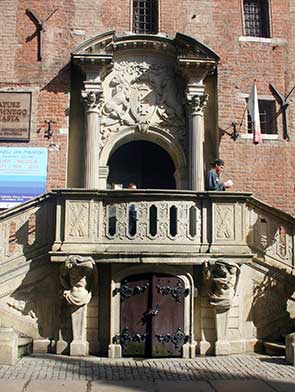
I don’t quite understand the over/under door, but it’d be a cool theme for a BDSM play space. Doms in the top door, subs in the bottom door, perhaps?

When I rule the earth with my iron fist, my secret lair will have a double-decker arrangement like this. Each door will be guarded by a sentry. One door will lead to the main control center of my lair, and the other to Certain Doom. One sentry will always lie, and the other will always tell the–

Oh, who am I kidding? Both doors will lead to Certain Doom. The actual entrance will be via a long secret tunnel, which comes up in the back storeroom closet of a nondescript Motel 6 a few miles down the road.

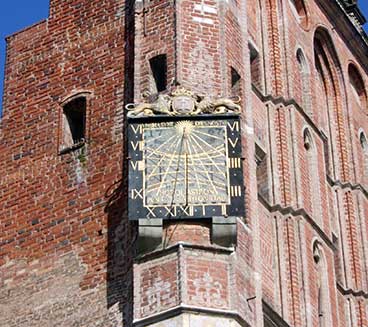
Like most town halls, the town hall in Gdańsk features a clock. Or, really, an exuberance of clocks. That’s not the cool part, though. The cool part is that the Gdańsk town hall, unlike lesser town halls in certain OTHER ancient Eastern European cities, is proof against the vagaries of the Clock Keepers and Tinkerers Union, well-known throughout history for holding many a town clock-tower hostage until their unreasoned demands are met. We modern folks with our wearable chronographs and digital time-keeping instruments that sometimes double as miraculous distance-speaking box and scrying oracle sometimes forget how it used to be, but in ancient times, he who controlled the clock in the tower controlled the universe. Without accurate timekeeping, early peasants had no way to know when it was Planting Time, Hymn-Singing Time, Witch-Stoning Time, Running From the Tax Collector Time, or Bending Over to Get Reamed By The Nobles Again Time.

That’s why the architects of Gdansk saw fit to include…

…a motherfucking sundial. On the side of the building. How freaking cool is that?

My secret lair will definitely include a sundial. With lasers or something.

(Footnote: In the interests of full disclosure, I was totally joking about Medieval serfs not knowing what time it was without a clock, by the way. Every time was Bending Over to Get Reamed By The Nobles Again time.)

Adventures in Europe, Chapter 19: Torture and amber, living in perfect harm-oh-NEE!

Gdańsk, Poland, is one part working city and one part tourist city. As a tourist city, though, it lacks any obvious draw that other tourist cities have. Orlando, Florida has awesome weather and Disney World. Cozumel, Mexico, has awesome weather and Mayan ruins. Paris has the Eiffel Tower. Niagara Falls, Ontario has…well, you know.

Gdańsk has industrial decay, a frightening history, and fossilized tree resin.

If the key to success is in making the best of what you’ve got, Gdańsk is brilliantly successful. They have, in fact, built their entire tourist trade, as near as I can tell, out of their frightening history and fossilized tree resin.

Shortly beyond the bronze statue of the dude trampling a cannon while holding a long, hard staff with a knob at the end, we located some street signs in English, always a good sign when you’re looking for a tourist attraction. The signs advertised the Torture Chamber and Amber Museum.

Now, I have often seen a torture chamber without an amber museum, and I have even once or twice seen an amber museum without a torture chamber, so I can be forgiven, I think, for not realizing that these two things naturally belong together.

The Poles are, unquestionably, historical leaders in the fields of both torture and amber, so if they say that a torture chamber and an amber museum belong together, I’m inclined to believe them. In fact, when the dungeon here at home is finally finished, I think it may be necessary to include a display of amber of some kind, or perhaps to put someone named Amber on display in it.

I find it interesting that in Polish, “torture chamber” appears to be one word. Score one for linguistic efficiency!

On any vacation, you really can’t get enough torture chambers for my entertainment dollar, so the offer of a torture chamber and an amber museum was too good to pass up. We headed off in the indicated direction, and soon found the promised torture chamber.

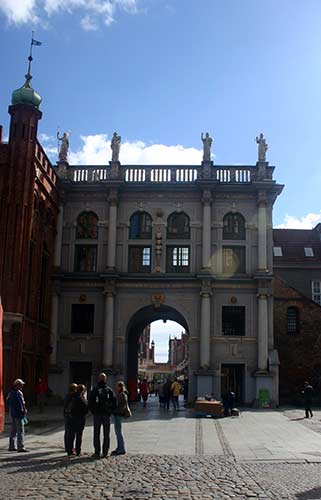
The archway, through which Im sure many a soul was dragged kicking and screaming, marks the entrance to both the torture chamber and to the Old Town district of Gdańsk. I’m not entirely convinced their spacial proximity is completely by accident.

We tried to hit up the torture chamber first, but it was closed until later in the afternoon. The courtyard seemed designed for maximum oppressive effect:

I like a thoughtful, carefully-designed torture chamber, myself. One that shows the designers were really focused on detail. It shows a level of commitment to the craft that’s becoming more and more rare in our modern era. Today, the CIA might torture a suspected insurgent in an abandoned warehouse in Cairo, but back in the day, the people of Gdańsk paid a great deal of attention to the artistry of interrogation.

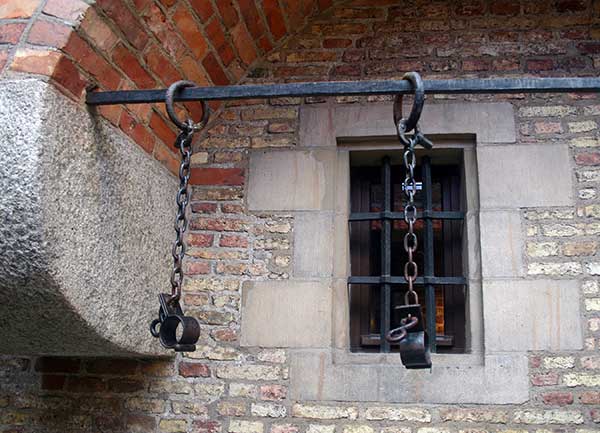
Little touches, like these iron shackles attached to a bar in the courtyard, count for a lot in a torture chamber.

I especially like that the shackles can slide along the iron bar, giving the person chained here the illusion that freedom might be at hand. I might just lift this idea for my own dungeon, once the remodeling is complete.

And what torture chamber can really be said to be complete without an oubliette?

Some folks might say that using both an iron grate over the shaft leading down into the oubliette AND a heavy oak door that can be barred shut is overkill, but I think it shows commitment. This detail-focused, spare-no-expense approach to torture chamber architecture is something we could all learn from.

While we waited for the torture chamber to open, a couple of guys tried, in broken English, to rent us a golf cart. I’m not quite sure what the idea behind that was, nor why they felt that a golf cart was what we needed to make our day complete, though I’m sure that successfully renting it to us might’ve helped to make their day complete. Perhaps that’s all there was to it.

When the torture chamber did finally open to the general public–which is a statistically improbable phrase if ever there was one–we climbed a narrow, steep flight of steps up the tower into the amber museum. The narrow, steep flight of steps turned out to be something of a theme in Gdańsk, about more of which I will write later.

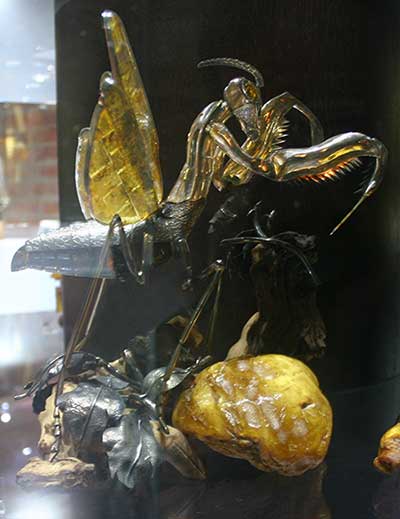
Gdańsk is, or so it’s claimed, one of the world’s leading producers and exporters of Baltic amber. And they make the most amazing things from it.

By “amazing,” I actually mean “creepy.”

The guy in the lamp on the left looks like he came from a Roger Zelazny book by way of a World of Warcraft boss in Icecrown Citadel.

I’m not actually sure the thing on the right is really a sculpture. It looks more like a homage to our new insectile space alien overlords, with the digital counter in the background counting down the days until they arrive to sweep the world clean of the unworthy and elevate the worthy to new heights of wickedness, or perhaps plant their eggs within the bodies of the unwary, or something. I won’t claim to be an expert on the subject of alien invasion, but my study of Hollywood movies has led me to believe that those are generally what one can expect after the arrival of insectile alien overlords.

The insectile theme is a popular one with the amber artisans of Gdańsk. According to various display signs posted throughout the torture chamber, the early Polish apothecaries believed amber to be infused with all sorts of magical properties, which careful research and the application of various potions to the raw essence of amber could bring out.

I actually suspect, looking at this thing, that it’s no accident amber and torture are so intimately entwined in the annals of Polish lore. It is my belief that the prisoners brought to this place were made, under the exhortation of scourge and chain, to craft small sculptures like this very one. Then, by the application of the alchemical processes, these sculptures would be brought to a kind of hideous life, whereupon they would be applied to the bare flesh of the condemned, to feast upon it in a ritual of agony until the prisoner broke and revealed all he knew. It was thought that by crafting the instrument of his own affliction, the prisoner could more readily be brought to reason, where “reason” was loosely defined as “saying whatever we want him to say.”

These apothecaries of amber are now all long gone, and the unholy secrets they coaxed from the brittle tree resin have gone with them.

Some believe, though, that they have not departed forever, but have merely perfected their dark arts to such an extent that they were able to preserve themselves perfectly within sarcophagi of mystically-charged amber, and so sleep a dreamless slumber, awaiting the day when they may return to welcome the arrival of our new insectile overlords, brought to us not from the stars but from the cunning craft of amber and metals, our destinies wrought with our own hands.

Adventures in Europe, Chapter 18: Gdańsk? Train? No, train! Train? Yes!

Back in the days when I used to work in pre-press professionally, there was one job I used to do every year that’d consume a month or two of my life, which was the cruise catalog for Royal Caribbean. The catalog was gorgeously produced–printed in CMYK plus two spot colors plus two metallic colors, with hundreds of pictures (all massively retouched).

The text for the catalog was printed separately from the rest of the catalog, so that they could print up a bunch of them and then decide how many to produce in each of the dozen or so languages they’re available in. US English, UK English, French, German, Greek, Hebrew, Arabic…

The Arabic versions were the trickiest.

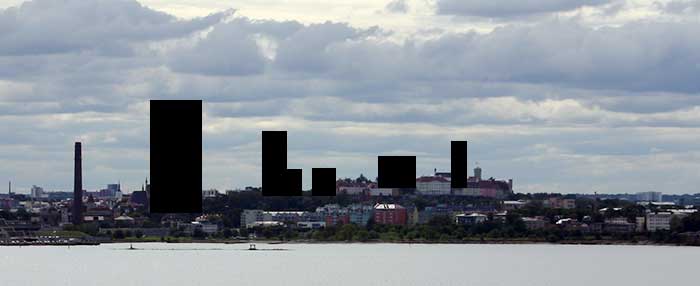
For the Arabic version, Royal Caribbean would run the book through the press again and print black squares over anything that the Middle Easterners would find upsetting. It was my job to go through every photo in the catalog and put little black squares over every building or object that represented any non-Muslim religion–church steeples, crosses, you name it. I also was required to draw a black outline over any woman shown in any photograph and fill her in as a solid black silhouette, and to black out any part of any picture that showed an alcoholic beverage or any form of gambling.

Now, there are a LOT of churches in the world, especially in Eastern Europe and the Mediterranean.

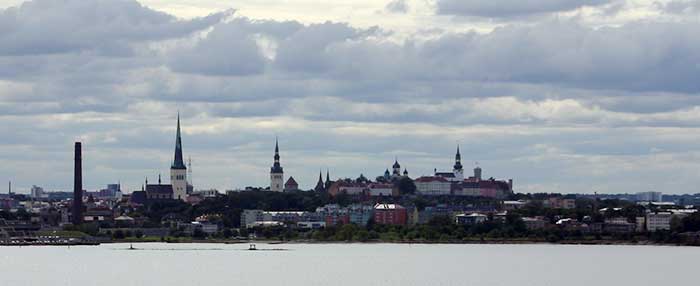
After Tallinn, our next port of call was Poland, which seems, in the overall scope of history, to be a largely fictional country. We dropped anchor in the town of Gdynia, adjacent to Gdańsk in Gdańsk Bay and apparently the only port that could accommodate a hotel of our size.

This is the skyline of Gdynia, as seen from the port.

And here is the skyline as it would appear in the Arabic version of the Royal Caribbean cruise catalog.

There’s a lot of non-Muslim stuff in the world, and it seems there are folks for whom that’s most definitely not OK. I have great confidence, though, that right here in the US, Christian groups are working hard to become just as easily offended and sensitive as Saudi Arabia, and so to close the Sensitivity Gap that exists between our nations.

Gdynia is both a working town and a military port. Now, I know what you’re thinking: “Poland has a military?” I thought the same thing myself. Like, when did that happen? Does the rest of the world know? Is it made of Legos?

As we were making harbor at Gdynia, I saw at least a dozen military ships, including destroyers (who uses those any more?), transports, and even a missile launcher.

Now, just one first-world aircraft carrier and its battle group could probably wipe out Poland’s navy in about…oh, fifteen minutes or so, but hey, if 1942 ever invades them, by golly, they’ll be ready!

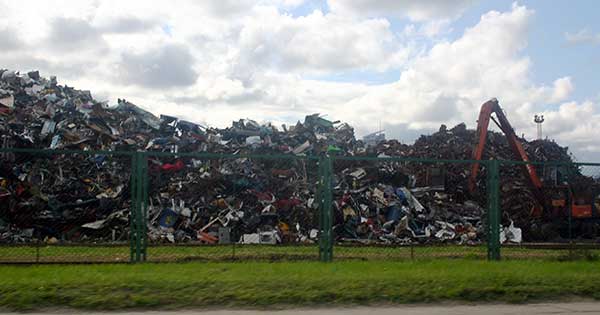
The port of Gdynia offers the casual tourist much more of what we all have come to expect of Eastern Europe than most of the rest of Eastern Europe does: big machinery clawing its way over twisted scrap metal, surrounded by the ruins of civilization. There’s actually a scrapyard right there in the port!

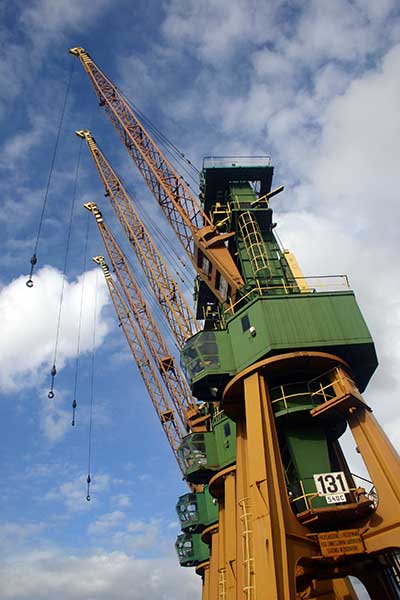
And I love these cranes. Big industrial equipment is beautiful. I can just picture these things rising from their moorings and rampaging across the countryside, destroying all fleshy life in their path with their swinging steel balls. I know which side I’ll be on when the Rise fo the machines comes to pass…

We actually wanted to visit the town of Gdańsk, which is about 40 minutes by taxi or train from Gdynia. A line of taxis waited at the port, but none of the cab drivers actually spoke English, which led to an amusing misunderstanding that could easily have been taken straight from an episode of Friends:

Father: We want to go to the train station to take a train to Gdańsk.
Cabbie: Train? Gdańsk?
Father: Yes. We want to take the train to Gdańsk.
Cabbie: Oh! You want to go to Gdańsk! Okay.
Father: Yes. We want to take a train to Gdańsk.
Cabbie: Okay. Gdańsk.
Father: Train.
Sister: Train.
Cabbie: Gdańsk?
Father: Yes.
Sister: No.
Cabbie: Gdańsk?
Father: Yes.
Sister: No.
Cabbie: Gdańsk?
Father: Yes. We want to take a train to Gdańsk.
Sister: Train. Gdańsk.
Cabbie: Oh! You want to go to Gdańsk! Okay.
Sister: Take us to the train station.
Cabbie: Train station! Gdańsk! Okay.

The astute reader can probably figure out what happened next. It came as a bit of a surprise to the rest of my family, though.

He did exactly as he’d been told, or at least exactly as he thought he’d been told, which was to take us to the train station in Gdańsk. The trip itself, through the suburbs of Gdynia and the surrounding countryside was (I though) a lot of fun and (my father thought) was absolutely terrifying. Polish cabbies have, it seems, only an abstract and theoretical grasp of the traffic laws, and indeed of universal laws of physics, which worked out to our advantage, as he was able to hurtle through time and space at least twelve times faster than any reasonable person might have thought prudent, or even possible, for that matter.

Later, my father would say that he’d never been so terrified in all his life. Now, me, I’ve had scarier experiences in bed, and I’ll be talking about those later, when I get to the France portion of this travelogue…but I digress.

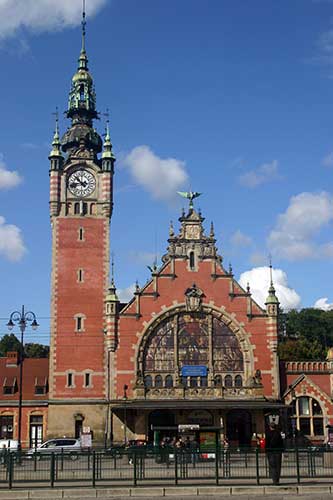
The train station in Gdańsk is quite lovely.

There were, however, no people anywhere about who spoke English. It was quite uncanny; you’d almost think we were in a foreign country or something. This caused no small amount of consternation when it came to mapping a route to explore the city, though we were eventually able to muddle it through by resorting to the “find something that looks interesting and head in that direction” technique.

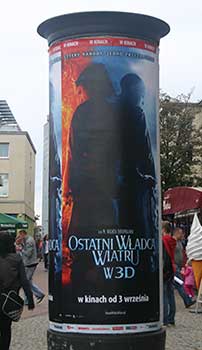
Gdańsk was blanketed in movie posters for The Last Airbender:

I wonder if the movie sucks any less in Polish.

I have often heard that travel to foreign lands is a great way to learn about the various traditions and customs that differ from those in one’s homeland. Travel, they say, broadens the mind.

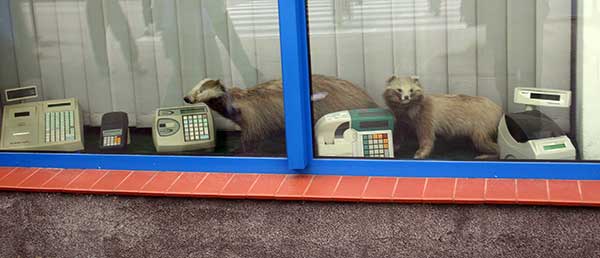
Take commerce, for example. Now, if you’re going to engage in commerce, there are certain tools that you need for the job. Cash registers are useful, for instance. If you want to zap documents around instantly, as if by magic, a fax machine is good to have.

But within these common necessities lie significant cultural differences. Whereas an American office might have a neon “Open” sign or a portable PIN reader for debit cards, businesses in Poland, apparently, might find it useful to have a weasel or a badger on the counter. And fear not! You can, it would seem, get these things at any office supply store in Gdańsk.

I hear you can get the badgers with BlueTooth.

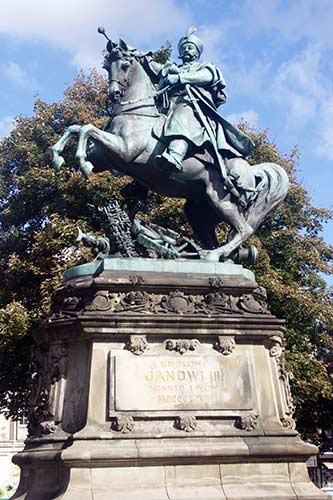
On our way toward the Old Town district of Gdańsk, about which I shall write more later, we passed this statue:

It shows a man astride a horse, which represents Truth and Reason, trampling a cannon, which represents Darkness and Ignorance, while in his hand he holds a scepter with a knob on the end of it, which represents…

No. I can’t. I just can’t. I mean, c’mon. It has a knob on the end of it!

One of the more interesting things about Gdańsk is its British influences, most likely the result of its close cultural ties with the United Kingdom. Why, you can even see it in the graffiti!

Not very many people know the central role that Poland played in the Gunpowder Plot. When Guy Fawkes decided that blowing hundreds of people sky-high with a gigantic bomb in remembrance of God’s Divine Mercy was a legitimate form of religious expression–an idea he wasn’t the first to conceive, and which remains in considerable vogue among people of all stripes today–he first traveled to Poland, where he attempted to buy enriched uranium from a shadowy Iranian figure whose name is not recorded in the annals of history.

When this attempt failed, thanks to the meddling of a bunch of teenagers and a dog in a van, he was forced as a last resort to use gunpowder, which he ordered in bulk from several mail-order houses under an assumed name. This proved his undoing, as we all well know, as the invoices were provided to His Majesty King James the Psychotic Bastard by the houses in question.

Nevertheless, to this very day, Poland’s support of Guy Fawkes’ noble services to the Catholic church is still remembered, which is why when the time came to choose a new Pope in 1978, the Catholic College of Cardinals finally saw fit to recognize Poland’s service, failed though it was, by elevating one of her citizens to Pontiff.

Or, er, something like that.

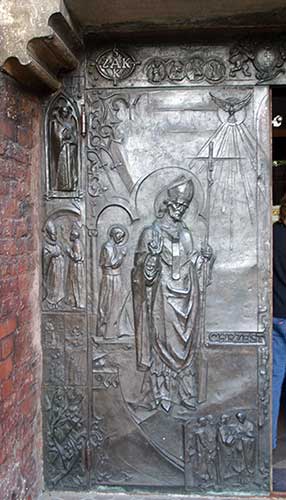
And speaking of the Catholic Church in Rome, we walked by a cathedral with this rather magnificent door in downtown Gdańsk.

Most people know that the Catholic Church is actually comprised of several different, but affiliated, branches of religious orthodoxy. The two best-known of these are the Latin Rite, which makes up most of the churches in the West, and the affiliated Eastern Catholic Churches, which make up many of the remainder in, naturally, the East.

This particular church belongs to the Congregation of the Han, whose sacred traditions extend back to 1977. Catholic churches belonging to this particular twig of knowledge on the Tree of Truth hold as sacred the Passion of Han Solo, which they believe parallels the passion of the Christ, especially as he was frozen in carbonite by the forces of evil and then, later, was resurrected to lead the people to grace. Churches in this tradition often construct the cathedral doors from solid carbonite, into which they place the bishop of the local synod and several assorted village children, in the hopes that one day they, too, will follow in the footsteps of Saint Solo.

A significant rift has occurred within the various churches of this tradition, following a new revelation in which, some say, Han Solo would never be the one to fire the first shot in any disagreement. This idea is branded as heresy by others among the pious, and it represents a thorny theological issue in which your humble scribe is reluctant to venture an opinion, lest I too be blown sky-high by a gigantic gunpowder bomb.

Adventures in Europe, Chapter 17: The Palace of Culture and Sport

On the way back from Old Town to the cruise ship, I got distracted, as I often do. Just before the Port And Livestock Ranch of Tallinn, about a block away from the ultramodern naked lady sculptures gracing the Tallink Spa and Conference Hotel, I found a wide, decaying flight of stairs climbing up to what looked like a cross between a stadium and a fallout shelter, combined with the post-apocalyptic future nightmare in that one scene from the future in Terminator 2, all in that peculiar type of concrete that seems to start crumbling about fifteen minutes after it’s poured. (As P. J. O’Rourke famously observed, “Commies love concrete, but they don’t know how to make it.”)
Urban decay is my Kryptonite. Well, that and redheaded lesbians. And bacon. And kittens. And goth girls. But urban decay is up there, definitely, and even though my feet were sore and the ship was due to leave soon, I could no more resist checking it out than I can eat just one potato chip. Mmm, potato chips.

From street level, it looks a bit like this.

The thing that you can’t tell from this picture, though, is the scale of the size of the bigness of it. It just keeps going and going, on and on, in huge terraces and steps rising far above the landscape and jutting a startling distance into the water.

Commies really, really love concrete.

Above the flight of stairs you see here is a second long landing, this one adorned with rows of steel posts painted in peeling cyan paint, with white balls on top–a sort of Communist tribute to tall, erect poles with knobs on top, all thrusting skyward to commemorate the victory of the working man over the bourgeois elite, or something like that.

In the background, the spire of the Old Town cathedral rises behind the chimney of an abandoned factory or rock-crushing plant or something that’s slowly crumbling away outside the wall.

This is what I wanted to see in Eastern Europe. Acres of gray concrete surrounding the disintegrating ruins of industrial buildings. You can’t get enough of that for my entertainment dollar.

The Plateau of the Rods and Knobs, which I had mentally taken to calling on it, continues to another level of stairs and another plateau rising ziggurat-like into the air:

The whole structure is filled with these cutouts that plunge into unexpected rows of doors. Standing at the front edge of the Plateau of Rods and Knobs, atop the stars rising from the street, one finds this:

I went down and tried all the doors (they were locked) and looked inside (it was dark). By this point in my tour of Tallinn, I had exhausted my camera’s first battery and the second was nearly spent as well, so I didn’t want to try to use the flash to get a picture of the gloom beyond the doors, for fear that I would not be able to chronicle the rest of this magnificent, exuberant tribute to Soviet-era concrete.

Proceding along toward the other end of the Plateau of Rods and Knobs, and whistling the Terry Pratchett song “A Wizard’s Staff has a Knob on the End” to myself, I encountered another bank of these enigmatic doors.

Peering inside, through a second row of doors just within, I saw a faded round desk with the word “Information” above it in several languages. At least I believe it was the word “Information” in several languages; it may have said “Information” in English and “We welcome our stony, silicon-based space monster overlords” in Russian. At least if you can say all that in just one word in Russian. Which, for all I know, you can.

Beneath this row of doors, an unexpected stairwell plunges to a SECOND row of doors into the cavernous ziggurat.

The view from the weed-choked ground surrounding the Rods of the Soviet Worker with their Knobs of Triumph over the Bourgeoise is really striking.

Atop the next flight of steps runs a low concrete wall that has in the years since its erection been decorated with the most amazing graffiti. What’s most amazing about it to me is how graffiti everywhere in the world, even behind the rusted hulk of the former Iron Curtain, looks like it all belongs in New York City.

The structure continues out into the water, projecting toward the port like a great gray Stalinist finger of aquatic accusation at the imperious West.

Across from the wall with its Eastern European interpretation of thug-life gangsta art, the view gave a magnificent portrait of our cruise ship, the Star Princess, dwarfing a far lesser cruise ship from Germany.

When I got back home, I turned to Google Earth to try to get a sense of what this place was. There’s a great overhead shot of it, that shows the Spa and Convention Hotel just below and to the right, and the berthing for the cruise ships next to the flat grassland that kina sorta makes up the Port of Tallinn.

According to Wikipedia, the place is the Tallinn Linnahall, formerly the Vladimir Ilyich Lenin Palace of Culture and Sport, which was built in 1980 to host the Olympic yacht races and renamed some years later after everyone realized what a douchenozzle Lenin was.

I found another Web site that claimed this place was used as a venue for concerts as recently as two years ago. Nowadays, it’d be the perfect place to film movies about the space monster zombie apocalypse.

Apparently, the CEO of Estèe Lauder has been trying for some years to get financing to renovate this place and turn it into, I don’t know, a secret fortified lair or a home for anorexic runway models or a Center For Kids Who Can’t Read Good And Wanna Learn To Do Other Stuff Good Too or some such thing. There was talk about getting the US government to underwrite a loan to do the renovation, on the grounds that the United States has a strategic interest in Soviet-era concrete ziggurats or something, but apparently the government said “Umm, no,” and that was that.

Which is too bad. If I were an evil villain or the CEO of Estèe Lauder, I would totally make this place my lair. It even has a helipad on the end!

Adventures in Europe, Chapter 16: First, press the Ancient Monument key…

Tallinn, as I said once before, is a city of contrast.

Now, I’m not dissing on all those other cities that come up when you do a Google search for “city of contrast.” I’m sure Scottsdale, Arizona, has lovely contrast. Why, I hear they have commercial buildings and residential buildings there!

But if you want some serious, mainline-quality, high-grade, industrial-strength contrast, Tallinn is the place to be.

As soon as we left the ship and made our way past the sheep, we found ourselves on one of Tallinn’s main streets. Following the road in one direction leads to the walled Old Town district, which its Medieval gateway and ancient town center. The other direction looks like this.

At the midway point on that road, right where the curious tourist comes out onto the main street from the port/sheep ranch/massage parlor, is the ultramodern Tallink Spa and Conference Hotel. It’s not “ultramodern” in that “nanotech and self-modifying metamaterials” sort of way, but in that stainless steel and brushed aluminum way that was popular, like, I dunno, ten years ago or something.

Why, yes, they are that magnificent, and thank you very much.

This is one thing I admire about Eastern Europe; they don’t have this weird and kind of freaky notion that the sight of a nipple will scar the brains of children for life, forever dooming them to a meager existence as a cackling, drooling pervert, trolling Chatroulette with an oversized trenchcoat with which to display undersized wares.

And ultramodern, stainless steel and brushed aluminum design brought with it, apparently, a knowledge of female anatomy entirely lacking in the day of Peter the Great, back when nobody had ever actually seen a human female up close.

The archway to the Old City is guarded by this place:

Unlike the Port of Tallinn Shack-o-Massage, this place actually did tempt me. I thought about it, really I did. In the end, two things stopped me: I am still not entirely sure that Eastern Europe is current with the hip new ideas regarding invisible things called “bacteria” and “viruses,” and I also wasn’t quite sure that Tallinn has the notion of money, as in things other than sheep or goats that you can exchange for goods and services.

The streets of Tallinn outside the wall look, and sound, pretty much like the streets anywhere else. Inside the wall, it’s a completely different world.

The first thing that really struck me in the Old Town part of Tallinn is how quiet it is. The thick stone walls are extraordinarily effective at blocking sound, so that the howling of the ice weasels and the clamoring of the barbarian hordes wouldn’t distract the ancient Guildmasters from the task of counting their money. (See? I kid, I do. I know Tallinn gets the concept of money. Hell, I wouldn’t be surprised if they invented it.)

Stepping between the Old Town and the modern part of the city is jarring. Even the air feels different; the walls block the wind, so the Old Town has a stillness to it that’s quite peaceful and lovely.

There are cars in the Old Town area, but they’re few and far between, and when one drives by you become acutely aware of how noisy and clanky they are, in a way that you don’t when you’re surrounded by them all the time.

What you do hear in the Old Town is the sound of people. People talking, people laughing, people calling out to other people. Cities like New York and Chicago have a lot of people, but the human noises are, day and night, almost entirely drowned out by the noise of traffic and machinery. In Tallinn, you are aware of the presence of human beings all around you. It’s a very interesting, and for me unusual, experience.

The Old Town district is home to an old cathedral that is to the exuberant, over-the-top excess of the Russian Orthodox houses of worship what Alanis Morisette is to Lady Gaga: they both do basically the same thing, but in such different ways you have to wonder if they came from the same planet.

The clock on the side of this church is made of wood. I think that’s pretty damn cool.

The inside is, when compared to the Church of Alexander II Was a Fucking Idiot, downright Spartan in its simplicity.

The door to the church is marked with this little round symbol. You see them all over parts of Eastern And Northern Europe; the symbol indicates a point of historical interest.

If it looks familiar to some of the folks reading this, it should. You know who you are.

It’s the same symbol Apple uses on the Command key for their keyboards. And that’s intentional; Apple actually copied the Command key symbol from this very marker. Which is also kind of cool. (According to Wikipedia, some Swedish Mac users refer to the Command key as the “Fornminne,” or Ancient Monument, key. Now, normally, I personally don’t trust Wikipedia to tell me the sky is blue, and this story sounds highly apocryphal to me, but it’s a fun tale anyway.)

But I digress.

The cathedral is just a stone’s throw from the town center, which I’m sure is no coincidence. Given the shackles adorning the pillars around the town hall, I have no doubt but that the folks who attended services here could, on a fair and sunny Sunday afternoon, get a bit of exercise and indulge in a little sport by flinging rocks and other small, dense objects at the faithless unbelievers shackled to the town center, in the interests of camaraderie and good spirit.

This is an ancient tradition almost entirely ruined by the invention of television; nowadays, folks would prefer to get their amusement by watching reruns of “Friends” on TV, and another custom falls by the wayside, neglected and ignored by the modern age.