Oh, Joss: “Morality doesn’t exist without the fear of death”

A couple of years ago, during a lackadaisical time in my life when I was only running two businesses and wasn’t on tour to support a book I’d just coauthored, I sat down with my sweetie Zaiah and we watched all the episodes of the Joss Whedon television show Dollhouse over the course of a week or so.

The premise of the show, which isn’t really important to what I want to write about, concerns a technology that allows personalities, identities, and skills to be constructed in a computer (much as one might write a computer program) and then implanted in a person’s brain, such that that person takes on that identity and personality and has those skills. The television show followed a company that rented out custom-designed people, constructed in a bespoke fashion for clients’ jobs and then erased once those jobs were over. Need a master assassin, a perfect lover, a simulation of your dead wife, a jewel thief? No problem! Rent that exact person by the hour!

Anyway, in Episode 10 of the short-lived series, one of the characters objects to the idea of using personality transplants as a kind of immortality, telling another character, “morality doesn’t exist without the fear of death.” I cringed when I heard it.

And that’s the bit I want to talk about.


The New York Times has an article about research which purports to show that when reminded of their own mortality, people tend to cling to their ethical and moral values tightly. The article hypothesizes,

Researchers see in these findings implications that go far beyond the psychology of moralistic judgments. They propose a sweeping theory that gives the fear of death a central and often unsuspected role in psychological life. The theory holds, for instance, that a culture’s very concept of reality, its model of “the good life,” and its moral codes are all intended to protect people from the terror of death.

This seems plausible to me. Religious value systems–indeed, religions in general–provide a powerful defense against the fear of death. I remember when I first came nose to nose with the idea of my own mortality back when I was 12 or 13, how the knowledge that one day I would die filled me with stark terror, and how comforting religion was in protecting me from it. Now that I no longer have religious belief, the knowledge of the Void is a regular part of my psychological landscape. There is literally not a day that goes by I am not aware of my own mortality.

But the idea that fear of death reminds people of their values, and causes them to cling more tightly to them, doesn’t show that there are no values without the fear of death.

As near as I can understand it, the statement “morality doesn’t exist without the fear of death” appears to be saying that without fear of punishment, we can’t be moral. (I’m inferring here that the fear of death is actually the fear of some kind of divine judgment post-death, which seems plausible given the full context of the statement: “That’s the beginning of the end. Life everlasting. It’s…it’s the ultimate quest. Christianity, most religion, morality….doesn’t exist, without the fear of death.”) This is a popular idea among some theists, but does it hold water?

The notion that there is no morality without the fear of death seems to me to rest on two foundational premises:

1. Morality is extrinsic, not intrinsic. It is given to us by an outside authority; without that outside authority, no human-derived idea about morality, no human-conceived set of values is any better than any other.

2. We behave in accordance with moral strictures because we fear being punished if we do not.

Premise 1 is a very common one. “There is no morality without God” is a notion those of us who aren’t religious never cease to be tired of hearing. There are a number of significant problems with this idea (whose God? Which set of moral values? What if those moral values–“thou shalt not suffer a witch to live,” say, or “if a man also lie with mankind, as he lieth with a woman, both of them have committed an abomination: they shall surely be put to death,” or “whatsoever hath no fins nor scales in the waters, that shall be an abomination unto you”–cause you to behave reprehensibly to other people? What is the purpose of morality, if not to tell us how to be more excellent to one another rather than less?), but its chief difficulty lies in what it says about the nature of humankind.

It says that we are not capable of moral action, or even of recognizing moral values, on our own; we must be given morals from an outside authority, which becomes the definition of morality. I have spoken to self-identified Christians who say that without religion, nothing would prevent them from committing rape and murder at will; it is only the strictures of their religion that prevent them from doing so. I have spoken to self-identified Christians who say if they believed the Bible commanded them to murder children or shoot people from a clock tower, they would do it. (There is, unsurprisingly, considerable overlap between these two sets of self-identified Christian.) If it takes the edict of an outside force to tell you why it’s wrong to steal or rape or kill, I am unlikely to trust you with my silverware, much less my life. Folks who say either of these things seldom get invited back to my house.

The notion that the fear of death is a necessary component of moral behavior because without punishment, we will not be moral is, if anything, even more problematic. If the only thing making you behave morally is fear of punishment, I submit you’re not actually a moral person at all, no matter which rules of moral behavior you follow.

Morality properly flows from empathy, from compassion, from the recognition that other people are just as real as you are and just as worthy of dignity and respect. Reducing morality to a list of edicts we’ll be punished if we disobey means there is no need for empathy, compassion, charity, or respect–we aren’t moral people by exercising these traits, we’re moral by following the list of rules. If the list of rules tells us to stone gays, then by God, that’s what we’ll do.

An argument I hear all the time (and in these kinds of conversations, I do mean all the time) is “well, if there’s no God and no fear of Hell, who’s to say the Nazis were wrong in what they did?” It boggles me every single time I hear it. I cannot rightly apprehend the thought process that would lead to such a statement, in no small part because it seems to betray a boggling inability to allow empathy and compassion be one’s moral signposts.

What it all comes down to, when you get to brass tacks, is internal moral values vs. external moral values. When we can empathize with other human beings, even those who are different from us, and allow ourselves to fully appreciate their essential humanness, treating them ethically becomes easy. When we do not–and often, religious prescriptions on behavior explicitly tell us not to–it becomes impossible. An intrinsic set of moral values is predicated on that foundation of reciprocal recognition of one another’s humanness, worth, and dignity.

Those who say without God or without fear of punishment there can be no morality seem blind to that reciprocal recognition of one another’s humanness, worth, and dignity. And those folks scare me.

Some thoughts on the Seven Virtues

A while ago, I started talking about the Seven Deadly Sins.

I am not terribly good at them; in fact, it took a while to remember what they were (greed, envy, sloth, lust, gluttony, pride, and wrath). Of the seven, the only one at which I have any skill is lust; in fact, I’ve put so many character points into lust I’m still forced to make default rolls for all six others.

I got to thinking about the Seven Deadly Sins, and wondering if there were Seven Virtues to go along with them. Apparently, there are; a few hundred years after the list of vices caught hold, someone decided there should be a similar list of virtues, and made such a list by negating the vices. The virtue Chastity was proposed as the opposite of Lust, for example, and the virtue Humility as the opposite of Pride. (Some of the others don’t really make a lot of sense; proposing Kindness as Envy’s opposite ignores the fact that people can simultaneously feel envious and behave kindly. But no matter.)

The negative version of the Seven Deadly Sins didn’t really seem to catch on, so Catholic doctrine has embraced a different set of virtues: prudence, justice, temperance, courage, faith, hope, and charity.

I look at that list, and find it a bit…underwhelming. We’ve given Christianity two thousand years to come up with a cardinal list of virtues in human thought and deed, and that’s the best it can do? It’s almost as disappointing as the list of Ten Commandments, which forbids working on Saturday and being disrespectful to your parents but not, say, slavery or rape, as I talked about here.

Now, don’t get me wrong, some of the things on the list of virtues I heartily endorse. Courage, that’s a good one. Justice is another good one, though as often as not people have an unfortunate tendency to perpetrate the most horrifying atrocities in its name. (Handy hint for the confused: “justice” and “vengeance” aren’t the same thing, and in fact aren’t on speaking terms with one another.) Temperance in opposing injustice is not a virtue, hope is that thing at the bottom of Pandora’s jar of evils, and faith…well, the Catholic catechism says that faith means “we believe in God and believe all that he has said and revealed to us,” and furthermore that we believe all “that Holy Church proposes for our belief.” In this sense, to quote Mark Twain, faith is believing what you know ain’t so. (On the subject of hope, though, it should be mentioned that Hesiod’s epic poem about Pandora says of women, “From her is the race of women and female kind: of her is the deadly race and tribe of women who live amongst mortal men to their great trouble, no helpmates in hateful poverty, but only in wealth.” So it is without an exuberance of cynicism that I might suggest there is perhaps a synchronicity between the ancient Greek and modern Catholic thinkings on the subject of the fairer sex.)

In any event, it seems that, once again, the traditional institutions charged with the prescription of human morality have proven insufficient to the task. In my musings on the Ten Commandments, I proposed a set of ten commandments that might, all things considered, prove a better moral guideline than the ten we already have, and it is with the same spirit I’d like to propose a revised set of Seven Cardinal Virtues.

Courage. I quite like this one. In fact, to quote Maya Angelou, “Courage is the most important of all the virtues, because without courage you can’t practice any other virtue consistently. You can practice any virtue erratically, but nothing consistently without courage.” So this one stays; in fact, I think it moves to the head of the list.

Prudence is a bit of an odd duck. Most simply, it means something like “foresight,” or perhaps “right thinking.” The Catholic Education Site defines prudence as the intellectual virtue which rightly directs particular human acts, through rectitude of the appetite, toward a good end. But that seems a bit tail-recursive to me; a virtue is that which directs you to do good, and doing good means having these virtues…yes, yes, that’s fine and all, but what is good? You can’t define a thing in terms of a quality a person has and then define that quality in terms of that thing!

So perhaps it might be better to speak of Beneficence, which is the principle of making choices that, first, do no harm to others, and, second, seek to prevent harm to others. The principle of harm reduction seems a better foundation for an ethical framework than the principle of “right action” without any context for the “right” bit. (I’m aware that a great deal of theology attempts to provide context for the virtue of prudence, but I remain unconvinced; I would find, for example, it is more prudent to deny belonging to a religion than to be hanged for it, simply on the logic that it is difficult for dead Utopians to build Utopia…)

Justice is another virtue I like, though in implementation it can be a bit tricky. Justice, when it’s reduced to the notion of an eye for an eye, becomes mere retribution. If it is to be a virtue, it must be the sort of justice that seeks the elevation of all humankind, rather than a list of rules about which forms of retaliation are endorsed against whom; formal systems of justice, being invented and maintained by corruptible humans, all too easily become corrupt. A system which does not protect the weakest and most vulnerable people is not a just system.

Temperance needs to go. Moderation in the pursuit of virtue is no virtue, and passion in the pursuit of things which improve the lot of people everywhere is no vice. And this virtue too easily becomes a blanket prohibition; the Women’s Christian Temperance Union, who were anything but temperate in their zeal to eradicate alcohol, failed to acknowledge that drinking is not necessarily, of and by itself, intemperate; and their intemperance helped create organized crime in the US, a scourge we have still been unable to eradicate.

In its place, I would propose Compassion, and particularly, the variety of compassion that allows us to see the struggles of others, and to treat others with kindness wherever and whenever possible, to the greatest extent we are able. It is a virtue arising from the difficult realization that other people are actually real, and so deserve to be treated the way we would have them treat us.

Faith and Hope seem, to be frank, like poor virtues to me, at least as they are defined by Catholicism. (There is a broader definition of “faith,” used by mainline Protestant denominations, that has less to do with accepting the inerrancy of the Church in receiving divine revelation and more to do with an assurance that, even in the face of the unknown, it’s possible to believe that one will be okay; this kind of faith, I can get behind.) Indeed, an excess of faith of the dogmatic variety leads to all sorts of nasty problems, as folks who have faith their god wants them to bomb a busy subway might illustrate. And hope (in the Catholic sense of “desiring the kingdom of heaven and eternal life as our happiness, placing our trust in Christ’s promises and relying not on our own strength, but on the help of the grace of the Holy Spirit”) can lead to inaction in the face of real-world obstacles–if we believe that once we get past the grave, nothing can go wrong, we might be disinclined to pursue happiness or oppose injustice in the here and now.

I would suggest that better virtues might be Integrity and Empathy. Integrity as a virtue means acting in accordance with one’s own stated moral precepts; but there’s more to it than that. As a virtue, integrity also means acknowledging when others are right; being intellectually rigorous, and mindful of the traps of confirmation bias and anti-intellectualism; and being clear about what we know and what we hope. (When, for example, we state something we want to be true but don’t know is true as a fact, we are not behaving with integrity.)

Empathy in this context means, first and foremost, not treating other people as things. It is related to compassion, in that it recognizes the essential humanity of others. As a moral principle, it means acknowledging the agency and rights of others, as we would have them acknowledge our agency and our rights.

Charity is, I think, a consequence arising from the applications of justice, compassion, and empathy, rather than a foundational virtue itself. In its place, I propose Sovereignty, the assumption that the autonomy and self-determinism of others is worthy of respect, and must not be infringed insofar as is possible without compromising one’s own self.

So bottom line, that gives us the following list of Seven Virtues: Courage, Beneficence, Justice, Compassion, Integrity, Empathy, and Sovereignty. I like this draft better than the one put forth by Catholicism. But coming up with a consistent, coherent framework of moral behavior is hard! What say you, O Interwebs?


Some thoughts on happiness

I am a happy person. By some accident of genetics or privileged brain chemistry, my default state is incredibly happy, and it always has been. Seriously, if you could bottle up the way I feel as my normal background state and distribute it among the world, there’d never be war or strife again.

That doesn’t mean I’m euphoric 100% of the time, of course. But just as things like depression can be a matter of brain chemistry, so, I think, can general background happiness.

And yet…and yet…

Whenever I see, or hear, conversations about happiness, it seems that many people are taught to profoundly fear and distrust the state of being happy. Contemporary American society teaches us a lot of incredibly destructive myths about happiness, some of which I see over and over again. For example:

Myth #1: If you are happy, you don’t accomplish anything.

I am happy…and I have just released my first book. I own two businesses. I am getting set to start a tour across Canada and the US with my coauthor, Eve Rickert, where we will be lecturing and giving workshops on relationships, polyamory, and ethics. I have traveled Eastern and Western Europe. My life is rich and filled with accomplishment. In fact, I have the kind of life some folks pay money to see on the Internet.

Myth #2: Generally happy people don’t experience the full range of human emotions.

I hear this one all the time. “I don’t want to be happy because it would dull me to pain and suffering, and I couldn’t experience the full range of life.” “If I were happy all the time, I would be blind to the sadness in the world.” “I wouldn’t want to be happy, because if I were happy, I couldn’t experience pain and suffering.”

Emotions are complex, and it is possible to feel more than one at the same time. I am a happy person, but that doesn’t mean there are never times when I feel sad, fearful, angry, or other things. It just means those emotions don’t stick. (One of my girlfriends says things like anger, frustration, and sadness bounce off me; when I feel them, they are transitory, and don’t weigh me down.) My baseline of happiness makes me emotionally resilient.

Myth #3: Happiness and euphoria are the same thing.

There are pills that make people feel euphoric, or intoxicated, but being euphoric isn’t the same thing as being happy. Happiness is more a generalized feeling of positive, pleasant satisfaction than it is a rush or a thrill; it’s the feeling of being able to live one’s life on one’s terms and feel that you’re flourishing, that every day brings new awe and wonder, that the universe you live in is an amazing place to be and the more you experience of it the more amazing it becomes.

Yet all the time, I hear folks say things like “If I were happy, I’d never get things done.” “If I were happy, I would just want to sit on the couch all day.” (No, dude, that’s not happiness, it’s a heroin fix you’re thinking of.)

Myth #4: Happiness is the enemy of productivity.

This isn’t really quite the same thing as myth #1–it’s possible to be productive without accomplishment. (Doing the dishes is productive, but doesn’t directly lead to finishing a book.) But they are related, in that it’s hard to be accomplished without being productive.

For me, creating things, writing, co-creating with partners, making things that didn’t exist until I worked my will on the world and caused them to exist–these are expressions of my happiness. The more I do them, the happier I am…and the happier I am, the more I do them. In fact, depression and unhappiness are much more corrosive to productivity than happiness is…ask anyone who suffers from depression how difficult it is to do anything when you’re in its grip!

Myth #5: Happiness is meaningless to a person who is always happy. We can’t appreciate happiness without sadness, life without death, joy without sorrow, light without darkness, Albert Einstein without Deepak Chopra, Mozart without Justin Bieber, word processors without cuneiform, blah blah blah.

I realize this notion that you can’t enjoy X without its dark and sinister anti-X evil twin is deeply embedded in Western cultural consciousness, but it still makes me scratch my head every single time I hear it. Folks actually appear to believe this is true, and I just don’t get it. I appreciate the fact that I can see, yet I’ve never been blind.

In fact, happiness is exactly what lets me appreciate the awe-inspiring beauty and wonder of the natural universe. You don’t have to be sad in order to enjoy and appreciate happiness; being happy is, of and by itself, a happy experience! That’s kind of what it says on the tin.

I know this sounds like a radical notion, but I would like to propose that happiness is not something to fear, it’s something to embrace, for the simple reason that it makes our lives better. We have inherited our distrust of happiness from our Puritan forefathers, I suspect, but you know what? Fuck them. They said we should sacrifice our happiness in our worldly lives so that we would be happy in the afterlife, with nary a thought to the contradiction inherent in the notion of pursuing happiness by denying happiness.

The idea that we should fear happiness is, I would argue one of the most singular causes of the many evils bedeviling humankind. And I can not rightly understand why this fear has such great currency.

1984: How George Orwell Got it Wrong

When I was in high school, one of the many books on our required reading list in my AP English class was George Orwell’s 1984. As a naive, inexperienced teenager, I was deeply affected by it, in much the same way many other naive, inexperienced teens are deeply affected by Atlas Shrugged. I wrote a glowing book report, which, if memory serves, got me an A+.

1984 was a crude attempt at dystopian fiction, partly because it was more a hysterical anti-Communist screed than a serious effort at literature. Indeed, had it not been written at exactly the point in history it was written, near the dawn of the Cold War and just prior to the rise of McCarthyist anti-communist hysteria, it probably would not have become nearly the cultural touchstone it is now.

From the vantage point of 2014, parts of it seem prescient, particularly the overwhelming government surveillance of every aspect of the citizen’s lives. 1984 describes a society in which everyone is watched, all the time; there’s a minor plot hole (who’s watching all these video feeds?), but it escaped my notice back then.

But something happened on the way to dystopia–something Orwell didn’t predict. We tend to see surveillance as a tool of oppressive government; in a sense, we have all been trained to see it that way. But it is just as powerful a tool in the hands of the citizens, when they use it to watch the government.


As I write this, the town of Ferguson, Missouri has been wracked for over a week now because of the killing of an unarmed black teenager at the hands of an aggressive and overzealous police officer. When the people of Ferguson protested, the police escalated, and escalated, and escalated, responding with tear gas, arrests, and curfews.

Being a middle-aged white dude gives me certain advantages. I don’t smoke pot, but if I did and a police officer found me with a bag of weed in my pocket, the odds I’d ever go to prison are very, very small. Indeed, the odds I’d even be arrested are small. If I were to jaywalk in front of a police officer, or be seen by a police officer walking at night along a suburban sidewalk, the odds of a violent confrontation are vanishingly tiny. So it’s impossible for me, or real;y for most white dudes, to appreciate or even understand what it’s like to be black in the United States.

This is nothing new. The hand of government weighs most heavily on those who are least enfranchised, and it has always been so. All social structures, official and unofficial, slant toward the benefit of those on top, and in the United States, that means the male and pale.

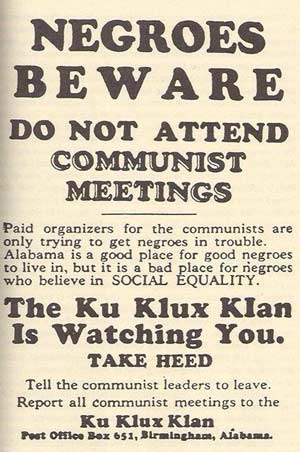
And there’s long been a strong connection between casual, systemic racism and the kind of anti-Commie agitprop that made Orwell famous.

It is ironic, though not unexpected, that the Invisible Empire of the Knights of the Ku Klux Klan is raising a “reward” for the police officer who “did his job against the negro criminal”.

So far, so normal. This is as it has been since before the founding of this country. But now, something is different…and not in the way Orwell predicted. Surveillance changes things.


What Orwell didn’t see, and couldn’t have seen, is a time in which nearly every citizen carries a tiny movie camera everywhere. The rise of cell phones has made citizen surveillance nearly universal, with results that empower citizens against abuses of government, rather than the other way around.

Today, it’s becoming difficult for police to stop, question, arrest, beat, or shoot someone without cell phone footage ending up on YouTube within hours. And that is, I think, as it should be. Over and over again, police have attempted to prevent peopel from recording them in public places…and over and over again, the courts have ruled that citizens have the right to record the police.

It’s telling that in Ferguson, the protestors, who’ve been labeled “looters” and “thugs” by police, have been the ones who want video and journalism there…and it’s been the police who are trying to keep video recording away. That neatly sums up everything you need to know about the politics of Ferguson, seems to me.

Cell phone technology puts the shoe on the other foot. And, unsurprisingly, when the institutions of authority–the ones who say “if you have nothing to hide, you have nothing to fear from surveillance”–find themselves on the receiving end rather than the recording end of surveillance, they become very uncomfortable. In the past, abuses of power were almost impossible to prosecute; they happened in dark places, away from the disinfecting eye of public scrutiny. But now, that’s changing. Now, it’s harder and harder to find those dark places where abuse thrives.

In fact, the ACLU has released a smartphone app called Police Tape, which you can start running as soon as you find yourself confronted by police. It silently (and invisibly) records everything that happens, and uploads the file to a remote server.

If those in power truly had nothing to hide, they would welcome surveillance. New measures are being proposed in many jurisdictions that would require police officers to wear cameras wherever they go. The video from these cameras could corroborate officers’ accounts of their actions whenever misconduct was alleged, if–and this is the critical part–the officers tell the truth. When I hear people object to such cameras, then, the only conclusion I can draw is they don’t want a record of their activities, and I wonder why.

William Gibson, in the dystopian book Neuromancer (published, as fate would have it, in 1984) proposed that the greatest threats to personal liberty come, not from a government, but from corporations that assume de facto control over government. His vision seems more like 1984 than 1984. He was less jaundiced than Orwell, though. In the short story Burning Chrome, Gibson wrote, “The street finds its own uses for things.” The explosion of citizen surveillance proves how remarkably apt that sentiment is.

The famous first TV commercial for the Apple Macintosh includes the line “why 1984 won’t be like 1984.” The success of the iPhone and other camera-equipped smartphones, shows how technology can turn the tables on authority.

The police commissioners and state governors and others in the halls of political power haven’t quite figured out the implications yet. Technology moves fast, and the machinery of authority moves slowly. But the times, they are a-changin’. Orwell got it exactly wrong; it is the government, not the citizens, who have the most to fear from a surveillance society.

And that is a good thing.

Wrong in the age of Google: Memes as social identity

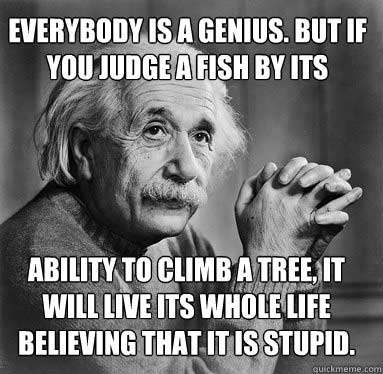
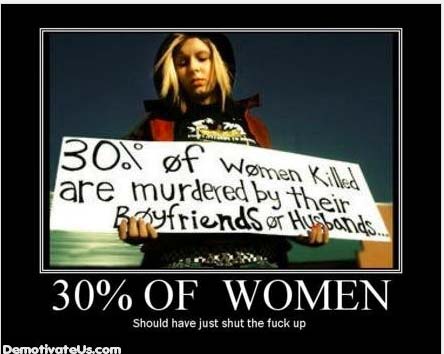
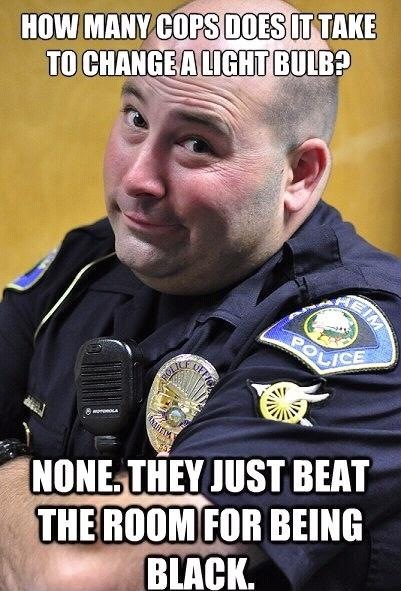
A short while ago, I published a tweet on my Twitter timeline that was occasioned by a pair of memes I saw posted on Facebook:

The memes in question have both been circulating for a while, which is terribly disappointing now that we live in the Golden Age of Google. They’re being distributed over an online network of billions of globally-connected devices…an online network of billions of globally-connected devices which lets people discover in just a few seconds that they aren’t actually true.

A quick Google search shows both of these memes, which have been spread across social media countless times, are absolute rubbish.

The quote attributed to Albert Einstein appears to have originated with a self-help writer named Matthew Kelly, who falsely attributed it to Einstein in what was probably an attempt to make it sound more legitimate. It doesn’t even sound like something he would have said.

The second is common on conservative blogs and decries the fact that Obamacare (or, sometimes, Medicaid) offer free health coverage to undocumented immigrants. In fact, Federal law bars undocumented immigrants from receiving Federal health care services or subsidies for health insurance, with just one exception: Medicaid will pay hospitals to deliver babies of undocumented mothers (children born in the United States are legal US citizens regardless of the status of their parents).

Total time to verify both of these memes on Google: less than thirty seconds.

So why, given how fast and easy it is to verify a meme before reposting it, does nobody ever do it? Why do memes that can be demonstrated to be true in less time than it takes to order a hamburger at McDonald’s still get so much currency?

The answer, I think, is that it doesn’t matter whether a meme is true. It doesn’t matter to the people who post memes and it doesn’t matter to the people who read them. Memes aren’t about communication, at least not communication of facts and ideas. They are about social identity.


Viewed through the lens of social identity, memes suddenly make sense. The folks who spread them aren’t trying to educate, inform, or communicate ideas. Memes are like sigils on a Medieval lord’s banner: they indicate identity and allegiance.

These are all memes I’ve seen online in the last six weeks. What inferences can we make about the people who posted them? These memes speak volumes about the political identities of the people who spread them; their truthfulness doesn’t matter. We can talk about the absurdity of Oprah Winfrey’s reluctance to pay taxes or the huge multinational banks that launder money for the drug cartels, and both of those are conversations worth having…but they aren’t what the memes are about.

It’s tempting to see memes as arguments,especially because they often repeat talking points of arguments. But I submit that’s the wrong way to view them. They may contain an argument, but their purpose is not to try to argue; they are not a collective debate on the merits of a position.

Instead, memes are about identifying the affiliations of the folks who post them. They’re a way of signaling in-group and out-group status. That makes them distinct from, say, the political commentary in Banksy’s graffiti, which I think is more a method of making an argument. Memes are a mechanism for validating social identity. Unlike graffiti, there’s no presupposition the memes will be seen by everyone; instead, they’re seen by the poster’s followers on social media–a self-selecting group likely to already identify with the poster.

Even when they’re ridiculously, hilariously wrong. Consider this meme, for example. It shows a photograph of President Barack Obama receiving a medal from the king of Saudi Arabia.

The image is accurate, thought the caption is not. The photo shows Barack Obama receiving the King Abdul Aziz Order of Merit from King Abdullah. It’s not unconstitutional for those in political office to receive gifts from foreign entities, provided those gifts are not kept personally, but are turned over to the General Services Administration or the National Archives.

But the nuances, like I said, don’t matter. It doesn’t even matter that President George W. Bush received the exact same award while he was in office:

If we interpret memes as a way to distribute facts, the anti-Obama meme is deeply hypocritical, since the political conservatives who spread it aren’t bothered that a President on “their” side received the same award. If we see memes as a way to flag political affiliation, like the handkerchiefs some folks in the BDSM community wear in their pockets to signal their interests, it’s not. By posting it, people are signaling their political in-group.

Memes don’t have to be self-consistent. The same groups that post this meme:

also tend by and large to support employment-at-will policies giving employers the right to fire employees for any reason, including reasons that have nothing to do with on-the-job performance…like, for instance, being gay, or posting things on Facebook the employer doesn’t like.

Memes do more than advertise religious affiliation; they signal social affiliation as well.

Any axis along which a sharp social division exists will, I suspect, generate memes. I also suspect, though I think the phenomenon is probably too new to be sure, that times of greater social partisanship will be marked by wider and more frequent distribution of memes, and issues that create sharper divides will likewise lead to more memes.

There are many ideas that are “identity politics”–ideas that are held not because they’re supported by evidence, but simply because they are a cost of entry to certain groups. These ideas form part of the backbone of a group; they serve as a quick litmus test of whether a person is part of the out-group or the in-group.

For example, many religious conservatives reflexively oppose birth control for women, even if the majority of its members, like the majority of women in the US at large, use it. Liberals reflexively oppose nuclear power, even though it is by far the safest source of power on the basis of lives lost per terawatt hour of electricity produced. The arguments used to support these ideas (“birth control pills cause abortions,” “nuclear waste is too dangerous to deal with”) are almost always empirically, demonstrably false, but that’s irrelevant. These ideas are part of a core set of values that define the group; holding them is about communicating shared values, not about true and false.

Unfortunately, these core identity ideas often lead directly not only to misinformation and a distorted worldview, but to actual human suffering. Opposition to vaccination and genetically modified foods are identity ideas among many liberals; conservatives oppose environmental regulation and deny human involvement in climate change as part of their identity ideas. These ideas have already led to human suffering and death, and are likely to lead to more.

Human beings are social animals capable of abstract reasoning, which perhaps makes it inevitable that abstract ideas are so firmly entrenched in our social structures. Ideas help define our social structures, identify in-group and out-group members, and signal social allegiances. The ideas we present, even when they take the form of arguments, are often not attempts at dialog so much as flags that let others know which lord we march for. Social media memes are, in that way, more accurately seen as house sigils than social discourse.

Some thoughts on love and sacrifice

I recently encountered, during the normal course of my regular trawling across the width of this thing we call the Internet, an essay posted on the Psychology Today Web site. The article is a rejection of the notion that adultery is okay (an argument made by a different essay on a different site) and, as far as that goes, I have no quarrel with it. If you’re going to make a promise of sexual fidelity, keep it. If you can’t,renegotiate the relationship or end it.

But the problem comes near the essay’s end, where the author says:

More generally, the author doesn’t seem to appreciate that the value of commitment is based in part on the value of what is given up for it. Of course, sexual desire has a unique pull on most of us. But promises of fidelity would mean much less if we were promising to give up something we didn’t want! The fact that most of us want sex so much is why it means so much when we promise it to just one person…

And I find this argument to be very problematic indeed.

I reject this premise wholeheartedly. I do not–I cannot–buy the notion that in order for something to be valuable, we have to sacrifice something in order to have it.

This idea is one of the malignant gifts bequeathed on us by our Puritan ancestors, who believed it so passionately they never saw the hypocritical self-contradiction in it (they yearned for an afterlife in which there is no want, no suffering, and everything is perfect forever, and they thought the way to get there was by rejecting what you want, by suffering, and by working against basic human happiness…something they regarded with suspicion at best and hostility at worst.)

I think, rather, that the value of a thing is not what we give up in order to have it, but instead whether that thing is an authentic expression of who we truly are.

There is nothing noble in denying who you are in order to get something you want. Just the opposite: that is the most craven sort of commerce, exchanging truth for gain. We rightly deride dishonesty in politicians and businesses; we understand that pretending to be something you’re not in order to get votes or money is a perfidious act. Why don’t we understand the same thing about love?

There is no virtue in exchanging your true self for the affections of someone else. Love admits no such cynical transaction. Love is most meaningful when those who love us know who we truly are and love us anyway. It is not about what we can make those we love give up; it is about how we can help those we love be the most genuine, the most honest versions of themselves.

We do not make an act of fidelity meaningful because we don’t want to do it. We make an act–any act–meaningful when it most truly represents who we are, when it most honestly shares what we actually desire. Believing that sex is valuable because we pledge it to one person when we really want to do just the opposite is the most crass kind of commoditization of both sex and love. Matters of the heart are not about artificial scarcity and transactional gain.

“I’m not a feminist. I love men!”

If you’ve been reading my blog for any length of time, you’ll know I hold very little in common with the Religious Right. I do not, for example, believe that homosexuality is a sin, or that Teh Gayz are all destined for the fires of Hell. I don’t much cotton to the notion that the government of the United States should be replaced with a Christian theocracy. Nor do I believe there is a hidden secret agenda of the Godless to drive this great nation into the ground–I think the anti-intellectualism displayed by so many on the Right is doing that job well enough, thanks.

But there is one thing I admire about the Right, and that is their fearsome, epic ability to frame discussion about any topic they care about by crafting a point and then keeping tenaciously, ferociously on point.

“I’m not a feminist. I love men!”

One of the ways the Right has been brilliantly successful at framing the public discourse is in the way they’ve controlled how we think about women. And by “we” I don’t mean “people on the right,” I mean everyone.

Even folks who ought to know better.

“I’m not a feminist. I love men!”

The areas of the Internet I frequent are not areas where the Right often appear. I tend to spend my time online in forums that talk about non-traditional relationships, progressive social issues, technical and scientific subjects, and skepticism.

And there’s something really striking about all these places. The Right may not be present there, but the ideas of the Right are. Even, interestingly, in people who claim to despise the Right.

“I’m not a feminist. I love men!”

There’s no place this is more obvious than in conversations about the Dread F Word. No, not that Dread F Word, the other Dread F Word.

Find yourself a progressive, generally respectful, tolerant, otherwise with-it person. Man or woman, it doesn’t make much difference. Just find someone who thinks there’s room for a multiplicity of views in the public ideosphere. Someone who, if he or she is religious, doesn’t think God commands converting the heathens at the point of a sword. Someone who thinks that people ought generally to be treated well,and that religion isn’t the basis for the formation of a Western representative government. Someone who will agree that racism is a bad thing, even if it’s not entirely clear what we should do to get rid of it.

Now ask that person a simple question: “What is feminism?”

See that? Something very strange happens. For a brief moment, when that otherwise progressive, generally agreeable person starts talking, it’s as if Rush Limbaugh or Sean Hannity stuck his hand up your interlocutor’s ass and made his or her lips move. For that brief instant, that person, that otherwise agreeable and not at all racist or sexist person, becomes a meat puppet for Mr. Limbaugh, Mr. Hannity, and his ilk.

Even if that person would be horrified at the thought of listening to their shows.

“I’m not a feminist. I love men!”

Think about what goes through your mind, dear reader, at the word “feminist.” Do you think “shrill”? “Strident”? “Misandrist”? “Humorless”? “Man-hater”? “Feminazi”? Does an image pop into your head of a woman who wants to get ahead by tearing down men, a woman who blames men for her own shortcomings, a woman who wants to cause trouble because she can’t succeed on her own? Do you picture someone who, even if she perhaps has the right intentions, has totally gone overboard, accusing all men of being sexist (or worse, of being rapists)?

Guess where those ideas come from? I’ll give you a hint: Not from actual feminists.

Now, don’t get me wrong: any sufficiently large group of people is going to contain extremists, bad apples, and destructive folks. If you look at doctors in general, you’ll find the occasional cynical lying fraud like Andrew Wakefield–but we don’t say all doctors are frauds who deliberately publish articles they know to be fabricated. There are probably a small number of extremists out there somewhere who hold something that might reasonably be within spitting distance of some of the stereotypes about feminism.

But the idea that this is what most or all feminism is about? Sheer, brilliant, amazing PR by the Right. Where did you get those ideas? You got them from the Right, even if you don’t know it.

You probably think you didn’t get them “from” everywhere. You simply know them to be true. Everyone knows them to be true, right? And that’s the crux of the brilliance: if you repeat an idea often enough, everyone, even folks who ideologically despise you, will come to accept it as just true.

Feminists hate men. Everyone knows it. Because we’ve all heard it, even if we don’t exactly remember where we’ve heard it from.

Are there women who are angry? Oh, yeah, you bet. What’s amazing is not that women are angry, but that more women aren’t more angry. All the dudebros I’ve personally met get a whole lot angrier about things a whole lot more trivial–for instance, the notion that they shouldn’t grope those hot somethingsomethings at that con without, you know, asking them first. (Scientist Hope Jahren actually had a colleague ejaculate in an envelope and leave it in her mailbox when she dared to think that she might be worthy of a spot on a serious scientific research team…and this isn’t even an isolated or extreme example of the kind of shit women deal with every day. And men say women are angry? Seriously, what would we say about women if they thought it was appropriate to protest the presence of a man on a research team by shoving a used tampon into a mailbox? Seriously, it amazes me that every woman on earth does not, at some point, climb a clock tower with a rifle. I guaranfuckingtee you that if the roles of men and women were reversed tomorrow, we’d see a whole lot of dudebros doing exactly that.)

“I’m not a feminist. I love men!”

The idea that feminism means hating men has been so skillfully inserted into the public discourse that it’s accepted as a premise in almost any dialog about men and women. And it’s a corrosive idea. It distorts conversation. If you accept this premise, a whole lot of things that would otherwise seem unreasonable–indeed, even offensive–start to sound reasonable.

What is feminism?

It’s the idea that men and women are both people, equally deserving of agency. That’s it. That’s the whole package.

What separates feminism from humanism, then? Centuries of institutional, systematic inequality, that’s what. Saying “I think men and women are equal” is all fine and dandy, but if you ignore the fact that we live under a system that treats, in a thousand ways, men and women as decidedly unequal, congratulations! You’ve just won a Nobel Prize in Missing The Point, which you will be sharing with approximately two and a half billion other luminaries in point-missing.

If you think women are people, congratulations, you’re a feminist! And if you don’t, well…the alternative, it seems to me, is “asshole.”

If you reject this notion of feminism, because everyone knows it means something else, ask yourself: How do you know? Do you know from actually talking to women, or because you’ve heard of this one person who said this feminist this one time said all men are rapists and should die? And if it’s the latter, ask yourself…how did he know that? And more to the point, who benefits from this particular notion of feminism? (I’ll give you a hint, bro: it ain’t women.)

End note: At this point, I know, I just know, that some of you have fingers already all a-tingle to send me a private email telling me pretending to be a feminist is a great strategt for getting laid. Seriously, don’t bother.

What my cat teaches me about divine love

This is Beryl.

Beryl is a solid blue Tonkinese cat. He shares a home with (I would say he belongs to, but the reverse may be true) zaiah and I, and spends a good deal of each day perched on my shoulder. I write from home, and whenever I’m writing, there’s a pretty good chance he’s on my shoulder, nuzzling my ear and purring.

He’s a sweetheart–one of the sweetest cats I’ve ever known, and believe me when I say I’ve known a lot of cats.

Whenever we’re in the bedroom, Beryl likes to sit on a pillow atop the tall set of shelves we have on the wall next to the bed. It didn’t take him long to learn that the bed is soft, so rather than climbing down off the top of the shelves, he will often simply leap, legs all outstretched like a flying squirrel’s, onto the bed.

Now, if I wanted to, I could get a sheet of plywood, put it on top of the bed, then put the blanket over top of it. That way, when Beryl leapt off the shelves, he’d be quite astonished to have his worldview abruptly and unpleasantly upended.

But I wouldn’t do that. I wouldn’t do that for two reasons: (1) I love my cat, and (2) it would be an astonishingly dick thing to do.

That brings us to God.

This is a fossil.

More specifically, it’s a fossil of Macrocranion tupaiodon, an extinct early mammal that lived somewhere between 56 and 34 million years ago and went extinct during the Eocene–Oligocene extinction event.

Now, there are very, very few things in this world that conservative Orthodox Jews, Fundamentalist Muslims, and Evangelical Christians will agree on, but one thing that some of these folks do have in common is the notion that fossils like this one do not actually represent the remains of long-vanished animals, because the world is much younger than what such fossils suggest. Most conservative Muslims are more reasonable on this point than their other Abrahamic fellows, though apparently the notion of an earth only a few thousand years old is beginning to take hold in some parts of the Islamic ideosphere.

That presents a challenge; if the world is very young, whence the fossils? And one of the many explanations put forth to answer the conundrum is the idea that these fossils were placed by a trickster God (or, in some versions of the story, allowed by God to be placed by the devil) for the purpose of testing our faith.

And this, I find profoundly weird.

The one other thing all these various religious traditions agree on is God loves us* (*some exclusions and limitations apply; offer valid only for certain select groups and/or certain types of people; offer void for heretics, unbelievers, heathens, idolators, infidels, skeptics, blasphemers, or the faithless).

And I can’t quite wrap my head around the notion of deliberately playing this sort of trick on the folks one loves.

Yes, I could put a sheet of plywood on my bed and cover it with a blanket. But to what possible end? I fear I lack the ability to rightly apprehend what kind of love that would show to my cat.

Which leads me to the inescapable conclusion that a god that would deliberately plant, or allow to be planted, fake evidence contradicting the approved account of creation would be a god that loved mankind rather less than I love my cat.

It seems axiomic to me that loving someone means having their interests and their happiness at heart. Apparently, however, the believers have a rather more unorthodox idea of love. And that is why, I think, one should perhaps not trust this variety of believer who says “I love you.” Invite such a person for dinner, but count the silverware after.

An Open Letter to Brogrammers

Computer programming is a tough job. It’s not for the faint of heart or the fair of sex. It’s grueling, high-stress work, demanding that you sit on a comfortable chair in an air-conditioned office for hours on end, typing on a keyboard while looking at a monitor. Women just aren’t rugged enough for that.

Plus, as everyone knows, women can’t code. At best, they can maybe contribute in their small way to large open-source projects, but really, they’re much better suited for accessorizing PowerPoint presentations written by real coders. Manly coders.

If this is the world you live in, bro, I’m afraid I have some really bad news for you.

I’d like to introduce you to someone. This is Augusta Ada King, Countess of Lovelace. She was a lady’s lady, an aristocrat who lived in the 1800s and who did all of the things young women of noble birth did back then–danced, wrote poetry, and penned long flowery letters to her tutor.

She also wrote the world’s first computer program in 1842, in the margins of a technical document she was translating from Italian into English.

Yes, you read that right. Ada was so fucking baller she wrote code before computers had even been invented. You think you’re hardcore because you can use agile development strategies to link a big data repository to a high-performance querying front end without SQL? Pfaff. This woman invented coding before there was anything to code on.

And then there’s this woman, who could kick your ass sideways, steal your lunch, and then fart out code better than anything you’ll ever be capable of if you live to be a thousand years old.

This is “Amazing” Grace Hopper. She took leave from Vassar to join the Navy, where she invented or helped invent the entirety of all modern computer science, including nearly every wimpy-ass tool your wimpy ass laughingly refers to as “coding.” Compared to her, you’re nothing but a little kid playing with Tinker toys. Tinker toys she invented, by the way.

Yeah, I know, I know. You think you’re all badass and shit because you can get your hands right down there and compile a custom Linux kernel with your own task scheduler that reduces overhead for context changes by 16%, and…

Ha, ha, ha, ha, you are just so cute! It’s absolutely precious how you think that’s hardcore. That kind of shit is duck soup. Seriously, no-brains-required duck fucking soup compared to what she did. That C compiler you love so much? Grace Hopper invented the whole idea of writing code in a language that isn’t machine code and then compiling it to something that is. She was the one who came up with the notion of a “compiler” (and wrote the very first one ever), pausing along the way to invent code testing and profiling.

Thanks to her, you’re living in the lap of luxury. you can write code without having to know the exact DRAM timing. You have conditional branches and loops–neither of which existed when she started programming the Harvard Mark 1. (She made loops by taking long strips of paper tape and, no shit, taping their ends together to get the computer to execute the same code again.)

You want to see hardcore programming? I’ll show you hardcore programming:

This is what real hardcore coders do. No compilers, no syntax checkers, just a teletype machine and a bunch of fucking switches that change the computer’s memory and registers directly.

And you know what? For her, that was luxury. She and all the other early computer programmers–almost all of whom were women, by the way–started out programming by plugging patch cords into plugboards, because that’s how they rolled, motherfucker. Fuck keyboards, fuck front-panel switches…those things were soft. If you wanted to code back then, you needed a postgraduate degree in mathematics, an intimate understanding of every single component inside the computer, and the ability to route data with your bare fucking hands.

Grace Hopper was so badass that when she retired from the military, Congress passed a special act to bring her back. Twice. And then when she retired for real (for the third time), the Navy named a guided missile destroyer after her.

Trust me when I say you will never be this badass, bro.

So the next time you see something like this:

and you think that girls can’t code, just remember girls invented coding. And invented the tools that finally let softies like you play at being programmers. They did the heavy lifting so programming could be easy enough for noobs like you.

Rant Part II: How Not To Be a Dick To Women

With all the pushback on (and off) the Internet to any suggestion that perhaps men could maybe refrain from treating women poorly, one might get the impression that we were talking about, say, taking all the money the NFL normally makes in a year and investing it in fusion power research or something equally unreasonable. How, the thinking seems to be, can men reasonably be expected to act like decent human beings toward women when we have all these throbbing biological urges? I mean, what if we see a woman, who’s, like, totally hot? Surely acting like a decent human being doesn’t have to apply to women who are totally hot, does it? If we treat a totally hot woman like a human being, how will she know we want to put our pee-pee in her sex burrow? And what about women who don’t make Mister Happy happy…if we treat them like human beings, how will they know we don’t find them attractive?

It’s madness! I mean, really. Treat women as people? All of them? Without constantly getting all up in their faces about whether we want to sex them or not? That’s just…it’s just…it…

…well, it turns out it’s really not that hard to do.

Listen, guys, here it is. You just…think of her like she’s a person. Someone who’s a friend, even. And then you act accordingly.

Listen, I know it sounds totes whack. It goes against everything we’re taught to believe about maximizing our chances of getting to do that thing with our pee-pees. But bear with me. All it takes is a little practice, and then you, too, might be a guy who’s a decent human being and totally not a complete shitcamel.

Let me walk you through some scenarios, so you can get a feel for how this works.

Scenario 1: You’re approaching a door. There are people behind you.

If you hold the door open for people, congratulations! You’re a decent person.

If you hold the door open for women, but not for men, danger! You’re probably a misogynist.

If you hold the door only for women you want to put your pee-pee on, guess what? You’re a shitcamel.

Scenario 2: You’re on an online dating site. You spend six hours pouring your heart out in a carefully crafted message to this cute little something something whose soulful eyes make you think she could be the light of your life, and whose big bazoongas make you want to do that thing with your pee-pee. After you send it, she doesn’t email you back.

If you just go about the rest of your life, go you! You’re a decent person.

If you write her a follow-up email telling her that she owes you a response, uh-oh. Misogyny ho!

If you send her a follow-up email filled with (a) every swear word at your disposal, (b) vivid descriptions of what a bitch she is for wounding you so grievously, (3) angry rants about what unpleasant fate should befall her, or (4) pictures of your junk, I’m afraid the prognosis is: shitcamel.

Scenario 3: You see a woman talking about how creepy it is to hit on women in elevators.

If you listen respectfully and adjust your behavior and expectations accordingly, woohoo! You’re a decent person.

If you respond with a defensive lecture about how you’re totally not one of those guys and she’s just trying to say that all men are rapists, I’m sorry to have to tell you this, but that that’s your misogyny.

If you go on a rant about how she’s totally saying all men are rapists and she deserves to be raped for it…well, there’s only one mathematical equation that accurately models your reaction. You = shit + camel.

Scenario 4: Women are talking about how linking birth control to employment insurance policies basically means their boss gets to tell them how to have sex. You:

…listen to what they’re saying, think about it, and realize that, actually, it is pretty messed up that the person who hires you gets to tell you how the insurance benefits you earn as part of your labor should be used, and having an employer making your decisions in the bedroom is kind of creepy. Go you! Decent person!

…say “well, you know, the employer is paying for this insurance, so the employer controls how it’s used.” Wait, what? The employer is paying a salary too, does that mean the employer gets a vote on what you buy on Amazon.com? Bzzt. Your misogyny is showing.

…say “well, you know, that slut can just pay for it herself if she wants to go slutting around.” Hello, shitcamel! One hump or two?

Scenario 5: You’re out chilling with the boys, and someone tells this absolutely hysterical rape joke. It’s funny because she is violated against her will! Get it? Get it?

You put on your best blank “no, I don’t get it” face, turn to your friend, and say “No, I don’t get it. What’s funny about women being violated again?” Score one for being a decent person! Extra special decent person points if you deliberately construct a social group of people who already get why that shit ain’t funny.

You don’t say anything. After all, if you don’t laugh, that means you’re not like those guys, right? Bzzt! Wrong. If you just sit there, they might assume you’re a little slow, but hey, you’re still just like they are. Sorry, your misogyny (and privilege) are showing.

You laugh, because nothing is as absolutely hysterical as talking about women getting violated! Plus, when those feminist harpies start shrieking about how uncool it is, you get exasperated because clearly they just don’t get it. For God’s sake, it’s only a joke! Free speech! Free speech! Heigh-ho, shitcamel! What’s your camel-made-of-shit encore, putting on blackface and joking about Negroes wanting the vote or something? They’re all just jokes, right? Free speech!