Some thoughts on privilege: Look, it isn’t about your guilt.

I participate in a lot of online forums about polyamory. It’s almost impossible to talk about polyamory without eventually talking about OK Cupid, which is arguably one of the best places online for poly folks to meet each other (I met my live-in partner zaiah there). And it’s almost impossible to talk about OK Cupid without talking about how often women tend to get harassed on online dating sites. Any online dating sites.

And, it’s almost impossible to talk about how often women get harassed, on dating sites or anywhere else, without a whole succession of men trotting up to say “well, I personally don’t harass women! Women act like all men are harassers! I’m totally not like that, and I don’t understand why women don’t talk to me online! I totally deserve to have women talk to me online! If I spend my time writing an email to some woman online I am entitled to a response, even if she doesn’t want to date me!”

And, of course, from there it’s just a short hop to talking about male privilege, and as soon as that happens, inevitably those same men trot up again to say “this talk of privilege is just a way to try to make me feel guilty!”

And I gotta say: Guilt? Seriously? You think it’s about guilt?

Guilt is for things you can control. Feeling guilty over things you can’t control, like the race or sex you were born with, is silly.

If you think talking about privilege is about making people feel guilty, you’re completely missing the point.

It’s about being a decent person.

People who are privileged may still struggle, may not always get what they want, but the whole point is they have a lot of advantages over other people. Advantages they can’t see. Advantages they don’t know about.

Talking about privilege is about awareness, not guilt. When people don’t know about the advantages they have, they act in messed-up ways that show insensitivity to others. Like, for example, telling women who experience harassment on a scale that men can’t even understand how they should feel about it, what they should do about it, and why they should, like, totes respond to ME because I’M not like that! I’M not one of those entitled jerks, and therefore I DESERVE a reply!

The purpose of understanding your privilege isn’t to make you feel something. Not guilt, not shame, not anything else. It’s to help you understand that you have a set of things you take for granted that other people don’t have, so that you can change the way you act.

Got nothing to do with feelings at all.

Change the way you act in small ways. Like, not telling women how they should feel about sexual harassment. Like, not telling inner-city blacks that the police are their friends. Like, listening when women talk abut harassment, instead of just saying “oh, you’re saying all men are harassers.” (Hint: No, they’re not.) Or saying something like “well, I just don’t see color.” (Hint: Not seeing color is something you can only do if you happen to be the privileged color. When you belong to an oppressed minority, you don’t get the luxury of not seeing your status.)

Change the way you act in medium ways. Like, if you are a man with a normal social circle, statistically you probably know at least three harassers and at least one rapist. Seriously. So, when you’re with a group of your friends and someone makes a racial joke or a rape joke or talks about how women are bitches or whatever, speak up. Remember, if you don’t say anything, those harassers and that rapist in your social circle–and yes, they are there, even if you don’t know who they are–assume you’re on their side and think the way they do.

When people make cracks about sending a woman into the kitchen to make a sandwich, or talk about how they’d sure like to get that hot chick drunk and bend her over the table, speak up. Say it isn’t cool.

Yeah, it’s uncomfortable to speak up when all your friends are yee-hawing and back-slapping about how absolutely hysterical that rape joke was. Deal with it. The discomfort you face speaking up ain’t nothing on the discomfort women face just walking down the goddamn street.

Change the way you act in large ways. Don’t vote for political candidates who talk about how only lazy blacks are on welfare or blab about “legitimate rape.”

People aren’t telling you you’re privileged to make you feel guilty. People are telling you you’re privileged because privilege is a system and an institution that benefits you and that you participate in without even knowing it. When you know about it, maybe you can stop participating in it. Maybe, if you’re brave and willing to pull on your big-boy pants, you can even put yourself on the map against it when the folks around you are participating in it.

On Feminism and Getting Laid

A little while ago, I wrote a blog post called Some Thoughts on Rape Culture.

Every time I write a blog post like this, as sure as night follows day, the same thing happens. Invariably, I will get at least one, and sometimes several, private emails in my inbox. The content of these emails is always the same, and they’re rarely stated in the blog comments. Every time, they’re some variant on the same theme:

That must be working pretty good for you, huh? Pretending to be a feminist must really get you laid.

This has happened for years, and this last blog post was no exception.

I’m not quite sure what to make of the assumption that a man who espouses feminist values must be using it as a ploy to get sex. The first time I encountered this, it was quite a head-scratcher, I must confess. Really? I thought. That’s your take-away? I am pretending to support values and ideals about women’s agency because I’m trying to score sex from feminists? Seriously?

Now, in all fairness, if you look at all my partners, it’s very unlikely I would be involved with them if I weren’t a “feminist man,” or, as I like to call it, “a man who thinks women are people.” I have simple tastes; I prefer strong, smart, confident women, and those tend–surprise!–to be women who like being treated as people.

But here’s the thing.

The fact that these women would only be likely to get involved with a man who respects the ideals of feminism doesn’t mean that they’d get involved with every guy who respects those ideals. Treating women as people is necessary but not sufficient; if you treat women as people, that doesn’t guarantee you’ll be involved with them, but if you don’t, you won’t. Yes, in order to have sex with my partners, you have to be a dude who’s a feminist. You also have to be a dude who they think is worth having sex with, and you can’t fake your way into that.

So as a strategy for getting laid, adopting feminist ideals is, by itself, kinda rubbish.

And pretending to adopt feminist ideals is even more rubbish.

I don’t quite get what’s going on in the head of some guy who thinks pretending to be feminist is a ploy to get laid, but I have to assume that a guy who thinks that, probably doesn’t think women are very smart. If someone pretends to think women are people, but doesn’t actually think women are people, I suspect the ploy would be revealed rather quickly. Probably some time between appetizers and the main course, and certainly well before any clothes come off. I really don’t think it’s possible to pretend to be feminist, at least not for any length of time longer than a dinner conversation.

I don’t say that rape culture is a thing because I’m hoping to get laid by women who say that rape culture is a thing. I don’t think women deserve agency and personal autonomy as a tactic to try to get them to use their agency and personal autonomy to fuck me. I mean, seriously, what the fuck? How is it that someone might seriously think that being nice to feminists is a strategy for getting laid? Is it because he thinks feminists are so well-known for…um, having sex with any guy who’s nice to them?

If I were to advocate some kind of duplicitous scheme to get more sex, I would definitely recommend “learn to swing dance” over “pretend to be a feminist.” It certainly seems far more likely to succeed. Pretending to be a feminist when you really don’t think of women as real people, just to try to get in the pants of women who want to be treated like real people, is just…it…I just…what is this I don’t even.

More Than Two: Moving toward and moving away

I’ve just written a blog post in the More Than Two book blog about building polyamorous relationships where we move toward something rather than moving away from something. Here’s the teaser:

I was recently asked to do a media interview about polyamory. This happens from time to time, and most of the questions I’m asked tend to be fairly predictable: How do you deal with jealousy? What do you tell your parents or your kids? Do you think polyamory is the next cultural revolution?

This interview was quite different, and one of the questions I was asked helped crystallize for me some of the guiding ideals about the relationships I choose.

The question concerned dealing with fears, and while I was answering it, it suddenly occurred to me: throughout my life, the relationships I have found most rewarding have been those that are guided toward something rather than away from something.

You can read the whole thing; feel free to respond there or here.

Some thoughts on rape culture

A couple of days ago, someone on a (closed) Facebook group I belong to posted a link to a blog post about rape culture.

And, predictably, one of the first comments to that link was along the lines of “this is just another attempt to say that male sexuality is bad.”

It doesn’t even really matter where the linked blog post is (though if you’re interested, it’s here); the “you’re just demonizing men” reaction comes up on any conversation I’ve ever seen about rape culture, as sure as night follows day. And it’s annoying.

It seems to me that if that’s your take-away from discussions about rape culture, you aren’t paying attention.

Male sexuality is not inherently evil, and acknowledging that rape culture is a thing isn’t the same as “demonizing male sexuality.” This seems obvious to me, yet it’s a persistent trope: saying that we have a culture that normalizes, trivializes, and to a large extent even excuses sexual violence is conflated with demonizing male sexuality, as if, I don’t know, male sexuality were somehow inextricably tied to rape or something.


I personally have never met any women who believe that male sexuality is tied to rape, though I keep hearing from other men about that’s what “feminists think”.

When I see a trope become that deeply embedded in a conversation about something, I tend to wonder who it benefits. I definitely think there are men who benefit from this trope. There are some men who want to conflate “discussing the cultural component of sexual violence” with “demonizing all male sexuality.” These men want you to read articles like the blog post that led to all this and respond with “you’re saying men are evil! You’re saying all men are rapists!” That’s the interpretation they want you to have.

There are two kinds of men who want you to have that response: rapists, and men who want power over women.


Not all men are rapists.

There is, for some people, a knee-jerk response to any conversation about rape culture that goes “You just think all men are rapists!” That isn’t what this (and articles like it) say. What they say is that women have to act like all men are potentially rapists, because rapists don’t wear a special hat or have a special handshake or anything.

A strange man is probably not a rapist, but he might be. Since there’s no telltale signal that lets you tell a rapist from a not-rapist, women have to assume that a stranger could potentially be a rapist, simply out of self-preservation. A common analogy here is that not every strange dog will bite you, but it’s usually a good idea not to approach every strange dog you see with reckless abandon–because some of them might bite you, and you have no way of telling which.

Rapists and men who want power over women are quite pleased when people deflect conversations about rape culture with “you’re just saying male sexuality is evil,” because it shuts down conversation about the reality of rape culture…and that suits them just fine. It allows things to continue on exactly as they are–which is to say, allows society to continue blaming victims of rape for their own attacks (“did you see what she was wearing??!), allows rape victims who come forward to continue being disbelieved, allows the courts to continue under-prosecuting rape.

All of this serves the needs of men who rape and men who want to control women, and the only side effect (other than the fact that, y’know, women are marginalized) is that some men are treated like they might possibly be a rapist.

You’re a guy, and you don’t like it? You don’t like the idea that women who don’t know you might respond as though you are a potential rapist, even though that’s something you would never, ever, do? Do something about it! Do something to make our society less welcoming to rapists. Don’t trivialize rape. Don’t whine “but what about false accusations?” when women talk about how claims of rape are rarely taken seriously. Don’t treat tape as a punch line.

Look, this is not rocket science. If you’re a guy, you have a disproportionate amount of power, even if you personally don’t feel like it’s true. It’s not enough to say “Well, I’m not a rapist, and I don’t trivialize rape, so I don’t like it when women treat me like I might be a rapist!” You have to do more. You have to stand up to the people around you who do trivialize rape. You have to stand up to people who are rapists–yes, I’m talking to you, and yes, statistically, unless you live as a hermit in a one-room cabin in Montana you probably know at least one rapist in your social circle. Even if you don’t know who he is.

You don’t like the implications of discussing rape culture? Don’t dismiss those discussions; that doesn’t serve anyone except rapists. Do something about it.

Movie Review: Star Trek Into Plot Holes

J J Abrams, the visionary director who brought you such cinematic masterpieces as Jimmy Kimmel Live! and Star Trek: A New Hope Reboot, returns to his director’s seat for Star Trek: Into Plot Holes.

The movie goes something like this:

CAPTAIN JAMES T. KIRK and BONES are RUNNING ACROSS A FIELD OF WEIRD RED TREES being CHASED BY PRIMITIVE ALIENS

BONES: Why are these aliens chasing us?
CAPTAIN JAMES T. KIRK: Because I stole their sacred scroll.
BONES: Why did you steal their sacred scroll?
CAPTAIN JAMES T. KIRK: To distract them from looking up at the shuttle we are sending into the volcano.
BONES: Oh, right.
BONES: Wait, what? If they were in the temple when you stole the scroll, which we know because they all came swarming out of it, they wouldn’t have been able to see the shuttle we’re sending into the volcano. So you got them all outside to chase us, where they would be more likely to see it.
CAPTAIN JAMES T. KIRK:
CAPTAIN JAMES T. KIRK: Jump off this cliff now.
BONES: Okay.

Clicky here to see more! Caution: Spoilers and bad plot choices beneath.

The world’s first 3D printed gun: Ho hum.

Today, a landmark in improvised engineering was reached. Plans for an (almost) entirely 3D printable firearm went up on the Internet, able to be freely downloaded by anyone.

The reactions around the Net are predictable. Libertarians and gun nuts are ecstatic, gushing all over themselves about how this will be the “end of gun control” and usher in some kind of “new age of freedom” or something.

Law and order types, gun control advocates, and the government are wetting themselves with the prospect of legions of terrorists printing up virtually undetectable firearms and taking over airplanes or something.

And it’s all completely ridiculous. Neither a new age of freedom nor a new age of terror are in the works; in fact, I’m quite confident in predicting the total impact of this technology will be statistically undetectable. Self-congratulatory (on the one side) and paranoid (on the other) ravings aside, this thing simply does not make any meaningful difference whatsoever.

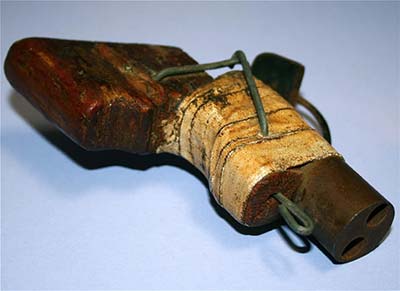
First, let’s see this harbinger of freedom end of civilization toy for rich white kids:

It’s printed from ABS plastic on an $8,000 3D printer. Almost everything is plastic, including the barrel; the only non-plastic parts are an ordinary nail (for the firing pin) and the bullet itself (in this case, a .380 caliber).

Now, I’ve owned firearms and shot recreationally for most of my life,1 and the first thing I can say upon seeing this thing is that I wouldn’t want to fire it. My instinct is that it’s probably about as dangerous to whoever’s on the trigger end as whoever’s on the business end.

The one shown here was test-fired three times. The first time, it misfired. The second time, it successfully fired a .380 round without destroying itself. The third time, when the .380 was replaced with a 5.7×28 cartridge, it exploded.

Could it survive multiple shots with the smaller round? I don’t know. Maybe. I wouldn’t bet my life on it. Doesn’t really matter. Not only is this thing not a game changer, I reckon it’s about as significant in terms of its overall impact on society as whatever toy they choose to put into a box of Cracker Jacks next week.


For starters, what you’re looking at here is not only a shoddy firearm of dubious reliability and ruggedness; it’s an $8,050 $9,000 shoddy firearm of dubious reliability and ruggedness. This prototype was printed on an $8,000 3D printer with about $50 worth of materials, making it arguably the single most expensive zip gun that’s ever been fabricated. A person looking for cheap, untraceable guns would be able to buy an arsenal on the street for less than the cost of the printer that produced this thing. (Edit: It turns out that this gun actually requires $1,000 worth of plastic toner to print, making it arguably the most expensive zip gun ever made even if the cost of the 3D printer isn’t factored in.)

Now, I already know what you’re going to say. The cost of 3D printers is dropping quickly. People can rent one or use one at a school. Companies will 3D print parts for you.

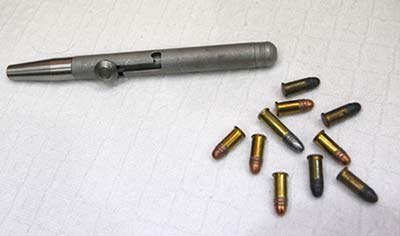
All of which is true, but irrelevant; the ability to make crude, cheap firearms for a lot less than just the cost of the plastic alone for this thing has existed…well, for about as long as firearms have existed. Prisoners have been known to build guns from parts available in prisons.

It has never been lack of availability that has kept people from using small single-shot firearms like this. The reason every criminal in town isn’t sticking up convenience stores with zip guns isn’t that they have been languishing in wait for a Libertarian college student to design one that can be 3D printed and put on the Internet; it’s that these things are virtually worthless as weapons. They tend to be used in prisons but few places besides, because they’re unreliable, prone to failure, inaccurate, and dangerous to the operator.

Just like, ahem, the 3D printed version.

Seriously. Even when they work, you have to be at point-blank range (or better yet, in contact with your intended target) for them to be terribly effective.

Which leads to the next hand-wringing objection: OMG this is made of PLASTIC you can take it onto an AIRPLANE through a METAL DETECTOR!

Which is, err, only kind of true. It’s a bit bulky to hide on your person, and there’s still the fact that the firing pin and ammunition are metal. Now, you might be able to get a nail through security on some pretext or other, but I doubt many folks will let you carry ammunition onto a plane.

If they notice it, which is a different matter; I’ve had friends who’ve carried brass knuckles and switchblades onto planes without difficulty. The reality is that few people actually want to, and have the means to, attack an airplane; nearly all of what happens at the airport is security theater, not security.

But let’s assume just for amusement that you can get one of these onto a plane. So what? What of it?

If I wanted to attack an airplane with a weapon I made on a 3D printer, it wouldn’t be this gun. Even if it works, it only works once, and I doubt the other passengers would sit around idle while I reloaded it and prepared to fire again. Assuming that the first shot actually did any good anyway.

The guy who designed this says “You can print a lethal device. It’s kind of scary, but that’s what we’re aiming to show,” as if this is the first time that’s been possible. Sorry, kid, but you’re a ridiculous wanker; a 3D printed knife or spear is actually a lot more lethal than this toy gun. (There’s a reason shivs rather than zip guns are the preferred weapon in places like prisons, and it’s not all down to scarcity of ammunition; given how easily drugs flow into American prisons, ammo isn’t that much of a stretch if there were a demand for it.) The 9/11 hijackers, who were well-funded, used…box cutters.

But I wouldn’t carry a 3D printed knife, or even a cheaper and better ceramic knife, onto a plane with mischief in mind either, because I’m not suicidal. Post 9/11, one thing has actually made air travel safer: the fact that the other passengers aren’t about to sit quietly by and hope for the best if someone tries to take a plane. All the other security changes that have happened since then have paled in effectiveness next to passenger attitude.

So, here’s the million-dollar question. You take a plastic gun onto an airplane, and…what, exactly? What in the name of the seven holy fucks and the twelve lesser fucks do you do then? What’s your plan?

If your goal is to destroy the plane, you can’t do that with this thing. If your goal is to take over the plane, well…good luck with that. You might survive what the other passengers do to you, maybe, if you’re lucky. Everybody is shrieking about how this thing can defeat airline security…and then what?


In fact, that million-dollar question can be extended to just about any possible use for this thing. You’ve bought yourself an eight-grand 3D printer, or somehow got access to it. You download the plans like an eager little hacker and you print this out, and then you…um, what do you do then? Go online and brag to your Maker friends?

You aren’t going to use this for home defense. I mean, seriously. A baseball bat or a tire iron makes a better home defense weapon, and the baseball bat probably has a longer effective range.

You’re not going to use it to outfit your secret militia that’s pining for anticipating the day that the Federal government starts rolling the tanks down Main Street. You aren’t even going to use an AR-15 for that, because, listen, seriously? The government has drones. They can blow your ass to hell and gone and you’ll never even see someone to shoot at.

You aren’t going to take it down to the range and pop off a few rounds in the general direction of paper cutouts of zombies or Trayvon Martin. No gun range is going to let you anywhere near the firing line with this; it’s too dangerous to the other shooters.

And please, please tell me you think you can go hunting with this thing. Bring a video camera and let me know when the video is up on YouTube. You can’t get enough of that for my entertainment dollar.

So you’re going to print it out, you’re going to put it together, and then…what, exactly? I’m still not clear on that.

Now, if you designed it, what you’ll do is obvious: you’ll get media exposure for congratulating yourself on what a clever Libertarian you are. And as near as I can tell, that’s really this thing’s only usefulness.


1 Full disclosure: I’ve been a private firearm owner on and off since 1988. I like guns, I like target shooting, and I’m neither opposed to nor afraid of guns. All that being said, I still won’t fire one of these.

New essay on Promiscuity Keepers: Ending Rape

I’ve just posted an essay over on Promiscuity Keepers, Some Thoughts on Ending Rape. Here’s a teaser:

Recently, I started noticing references in my Twitter feed to a Twitter account called @EndingRape. The account belongs to a man named Richard Hart, who has a Web site and book called Keep Your Daughter Safe.

Now, I don’t think Richard Hart is a bad guy. I don’t think he’s evil or malicious. I think he probably sincerely believes that rape is a Bad Thing and he probably genuinely wants a world with less of it.

But his approach is deeply troubling, and in some cases even destructive, for a number of reasons.

Feel free to respond here or over there.

Some thoughts on poly identity

As I write this, I’m in Olympia, Washington. Alas, thanks to a signficant user interface misfeature in the program (Caron Copy Cloner) I use to sync my laptop with my desktop, I don’t have my laptop with me. I’m posting from an iPad. Which has a keyboard quite poorly suited to typing long bits of text (anyone who has a BlueTooth keyboard you’re willing to donate to the cause, see me after class). And I suspect this might get long. In other words, buckle up, it’s going to be a bumpy ride!

A short time ago, I discovered an essay over on the Boldly Go blog called Why I’m No Longer Poly. It’s about seven or eight months old as I type this, but if you haven’t read it yet, it’s worth the read. It’s a critique of the poly community, and there’s quite a bit in it I want to respond to. (This blog post started as a comment over there but quickly overran what can reasonaly go into a comment.)

The critique as I read it breaks down into four main points:

  • Poly is a form of privilege. The time, resources, and attention necessary to find and maintain multiple romantic relationships are most available to middle and upper class people; hence, the poly community tends (unsurprisingly) to be very middle-class and very white.
  • The poly community, possibly because of point 1 above, is guilty of a great deal of appropriation. Some poly folks consider themselves ‘queer’ just based on having non-traditional relationships, which does a disservice to LGBT folks. Gay, bi, and trans* people have been murdered for who they are; to date, that hasn’t happened to anyone for being poly (at least not as far as I know; if you’ve heard of this happening, I’d love to hear about it in the comments). This appropriation is cultural, too, with some poly folk integrating a wishy-washy, Westernized, wildly inaccurate understanding of things like Tantra into the fold of polyamory.
  • The poly community shelters abusers. Whether intentionally or unintentionally, the poly community has failed to create a robust culture of compassion and consent. Serial abusers operate with impunity within the organized poly community.
  • People in the poly commmunity tend to see polyamory as a superior alternatve to monogamy, and therefore (accordng to the Transitive Property of Smugness1) polyamorous people as superior to monogamous people.

The author is talking primarily about the UK poly scene, which I do have some familiarity with, though I’m more grounded in the US poly community.

I think this critique of the poly community has some important points, so I’d like to examine it more closely. Ready? Here we go!


Part 1: Poly Is Privileged

This is an easy claim to make. Look around the poly community in a lot of cities and you’ll see a whole lot of folks who are econmically and racially homogenous. The essay also makes the point:

I’m wondering if non-monogamy is seriously possible for people who are economically disenfranchised or people who blatantly don’t have the time to devote away from work, children, and other social responsibilities to give to other partners. And I wonder now, as I try and create a balance between work, blogging, writing fiction, working out, and all of the other things I have to do if, when I do decide to adopt children, I’ll have the time to devote to more romantic partners.

For a certain model of polyamory, this is true. Maintaining multiple dating-type relationships requires financial and time resources that a lot of folks don’t have. It’s also true that polyamory, as much as it may not be mainstream, is still a hell of a lot more accepted than LGB relationships or relationships with or between trans* people. I know poly folks who have lost custody of their children for being poly, but like I said, I’ve never heard of anyone being killed over it.

But these points, while they are valid, don’t tell the whole story.

One thing it’s important to remember is the poly community is not the same thing as polyamory. The poly ommunity is largely made up of racially and economically privileged folks, but it’s dangerous to infer that polyamory is mostly practiced by that demographic. I’ve met people who are polyamorous who don’t belong to or identify with the organized poly community (particularly when I was living in Florida and Georgia), and there’s quite a lot more variety in socioeconomic class than a look ’round the poly community might suggest.

Likewise, the notion that poly requires a certain level of disposable income and time is true for some models of poly, particularly the I’m-dating-a-bunch-of-people flavor of poly, but it doesn’t necessarily follow that polyamory is therefore limited to the economically privileged. I’ve known–and been involved with!–poly folks who are financially quite poorly off, and who discover in a more communal model of polyamory a way to increase their standard of living.

Indeed, many of the folks in my own poly network have a level of income that’s perilously close to, or in some cases below, the Federal poverty line. Poly people have discovered something that roommates have known for a long time: two can live almost as cheaply as one, and three can live almost as cheaply as two.

The same calculus works for time. A person who’s working two part-time jobs may not have the time to go out on several dates a week, but that’s not the only way to do poly! Both long-distance relationships and communal relationships require much less investment in free time to maintain.

Why is the organized polycommunity so homogenous? That question has a complicated answer. Even the simple version is probably outside the scope of this particular blog post. (That’s not an attempt to handwave away the question; it’s just a really, really complicated subject.) Is the organized poly community a showcase of privilege? You bet. Does that mean polyamory is only for privileged people? Well, that’s a tougher argument to make. The organized poly community does not necessarily reflect the diversity of people who practice polyamory, and identifying as polyamorous does not necessarily mean identifying as part of the poly community.


Part 2: Poly as Cultural Appropriation

This critique breaks down into a couple of broad categories: poly appropriation of the spiritual beliefs of other cultures, usually in a highly adulterated (and somewhat confused) form; and poly appropriation of LGBT identity. As to the first part, from the essay:

I get sick to death of seeing white people in polyamory communities reference a tribe or a culture outside their own, putting white names to their practices, and using them to validate their relationship style or choice. I get sick and tired of the “Ooh”ing and “Aah”ing over appropriated concepts of tantra, chakras, chi, and whatever I’ve seen white people mix together in a fruit salad of whatever cultures they want to build their ignorant burrito out of to try and make their polyamory practice more “exotic” and “sacred”. You shouldn’t have to justify your relationship choice via bigotry. When you act like your polyamory is valid because it’s made of “tiny bubbles of imperfections as proof that it was crafted by the simple, hard-working, indigenous peoples of wherever” you’re being a colonialist jerk.

This gets no disagreement from me. In fact, the urge to validate having multiple romantic partners by mashing together assorted bits of poorly-understood religious traditions from a number of different cultures and wrapping the whole thing up in a ribbon of chakra-expanding tantric sex is one of the more annoying facets of (part of) the poly community.

Does this happen? You bet. I don’t think blame for this rests on the doorstep of polyamory, though. First, most of the offenders I’ve personally seen did it before they became polyamory; they started out involved in alternative New Age spirituality and then, when they started exploring polyamory in the mid to late 90s, they brought their garbled mishmash of other cultures’ spiritual ideas with them.

At least here in the US. I can’t speak for the Tantric/New Age part of the poly community in the UK, because it’s not the bit I interacted with, which brings up a second point:

Not all of the poly community does this. In fact, the poly community is quite diverse in this regard. Most of the community I was part of in Florida, for instance, is made up of rationalists and skeptics with about as much interest in New Age tantric appropriation as they have in six-day-old potato salad.

There’s a polyamory meetup group in Portland for fundamentalist Christians. There’s a group in Vancouver that’s essentially entirely secular. The poly community is not monolithic; to accuse it of cultural appropriation is to miss big chunks that aren’t spiritual at all. Do some poly people do this? You bet. Do most? Not in my experience.

Which brings up the second kind of appropriation. Again from the essay:

I’m sick to death of “allies” telling me that they have a right to call themselves queer just because they date more than one person, especially when they have lipstick parties in middle class suburbia while queer kids are forced into homelessness, nonconsensual sex work, and death. I’ll feel more sympathy for Poly Patriarch not being able to marry all of his concubines when trans* people can get married without having to worry about going to jail for fraud.

I can definitely understand being pretty fed up with this sort of behavior. I personally am not sick to death of it, because so far I personally have not seen it. I certainly would never consider calling myself “queer” because I’m poly; as a cisgendered straight white guy, that would be profoundly nonsensical of me2.

This might be something that’s more common in the UK than the US; I don’t know. I do know that the poly communities I’ve been ppart of have had members who are gay, members who are bi, and members who are trans…all of whm have a reasonable claim to “queerness,” but no because they’re poly.


Part 3: Abusers In the Poly Community

This is the most head-scratching part of the essay to me.

Yes, the poly community has abusers. I don’t see it as a poly problem; I see it as a problem of minority sexual subcultures in general. Ironically, the essay’s author still identifies as kinky, whereas I’ve seen abuse happen a lot more in the BDSM community, as I’ve written about here (trigger warning: rape), here, and here. But saying it isn’t a “poly problem” doesn’t mean it’s not a problem in the poly community. It absolutely is.

And it pisses me off.

A couple of months ago, my partner zaiah and I hosted the first of what’s likely to be a bimonthly poly get-together, whose purpose is to create white papers–papers that an be used by other poly organizers. The very first one? Creating poly communities that are safe and do not shelter abusers. Last month, we hosted the Portland West Side Poy Discussion Group. The topic? Preventing abuse in the poly community.

When I say this is the most head-scratching part of the essay, it’s not because I believe the poly community is a beautific assemblage of saints. It’s because the claims of abuse sound a bit…strange to me. The essay contains this bit…

If I’m dating Tom and Tom is treating his boyfriend Phil like dirt, I can’t possibly tell Tom that I’ll break up with him or I can’t sit by and watch him treating Phil like dirt. Because then I’m being controlling, jealous, and manipulative. I’m stuck in a trap where I have to put up with abusive shit all for the sake of not exercising the dreaded veto. […] Until poly people stop demonising things like “veto power” and start talking and taking seriously how polyamory can work well for abusers, I have a hard time taking on the label…

…which I find a little odd. I’m not sure I get the connection between “opposing veto” and “sheltering abusers.” I am an outspoken opponent of veto3 in poly relationships, because in my experience vetoes are often used as tools of abuse. I almost always see them wielded with indifference of–even contempt for–the needs of the people against whom they are used (people who, most often, are on the short end of a significant power imbalance to begin with).

What I also tend to see in conversations aout veto is a strange sort of either/or, all-or-nothing mentality: if you don’t have veto, that means you have no say at all, and you just have to lie down and take whatever your partner does. You can’t express an opinion or an objection of any sort; to do so is the same as veto.

And don’t psychologists tell us that one of the defining characteristics of many abusers is the fact that they seek to control their partners and particularly control their partners’ interactions with others, cutting their victims off from other sources of love and support?

Frankly, I find the discussion of veto with regards to abuse bizarre. If I were dating Sally and I saw her mistreating Bob, telling Sally I’ll break up with her if her behavior doesn’t improve isn’t veto. Telling Sally “I demand that you break up with Bob”–that is veto.

I don’t do veto, nor get involveed with those who have it. Yet if I’m dating someone who is treating another partner like dirt, or who is being treated like dirt, I’m going to say so. And if someone says that’s “controlling, jealous, and manipulatiive,” that says more about that person than it does about me, I reckon.

Conflating “doesn’t do veto” with “supports abuse” seems…well, I’m not really sure what’s going on there, but in my experience if someone is being abused and won’t leave the abusive relationship if you say “hey, this is abuse,” they aren’t too likely to leave if you say “hey, veto” either.

Just sayin’.


Part 4: Smug

From the essay:

While many poly people acknowledge that “Relationship broke, add people” probably isn’t the best solution, just as many people act like polyamory is the solution for anyone’s relationship problems, or they look down on silly monogamous people who feel things like jealousy and fear (because, you know, non-monogamous people never feel that).

I’ve met this guy. Once. On a Facebook forum. He was roundly (and loudly) ridiculed.

This may be a regional thing. I totally get that there are folks who act this way, but in my expeience there aren’t “just as many” folks who say this as who say exactly the opposite. In fact, the poly groups I’ve belonged to in Florida, Georgia, and Portland, and the poly folks I’ve met in Boston and Chicago, actively frown on the notion that polyamory is more evolved, more enlightened, and/or good for what ails those poor Neanderthal mono folks.

If I were to meet a lot of people proclaiming how backward monogamy iis, I suspect it’d get right up my noose, too. So I’m willing to give this critique a pass; it’s not my experience, but different poly communities, as I mentioned in art 2 up there, have very different attitudes. Perhaps there’s a poly community over across the pond where this idea is prevalent; if so, I can certainly understand opting out of it.

Opting out of a community, though, isn’t the same thing as opting out of an identity. I’ve disassociated myself with the BDSM community, because it has a lot of behaviors and practices I find toxic. I still do BDSM. Distancing myself from others who do some of the same things I do doesn’t, at least for me, change my identity. If it did, the way I see it, I’d be letting folks I don’t like dictate my identity, and that seems an odd choice to me.


1 The Transitive Property of Smugness is what I call the propensity of some folks to talk about how doing some thing like having multiple partners) or being part of some group (like people who practice BDSM) requires skill at a particular thing, and then to assume that because they do that thing, they have that skill. For example: “It takes good communication to be polyamorous. I am polyamorous. Ergo, I have good communication skills. Yay! Go me!” There are variants of this in almost every subculture I’ve ever belonged to; its kink equivalent is “Consent is an important part of BDSM. I am part of BDSM culture. Therefore, I am awesome about consent! Woohoo!”

2 Not to mention insensitive. Rude, too. And kinda stupid.

3 Defined here as a right or agreement by which one person can tell another person “I require you to end your relationship with so-and-so” and have an expectation that the other person will break up with so-and-so. I’ve spoken to some folks who use the term “veto” to mean “I have the right to give you my opinion about whether I like so-and-so.” I don’t think that’s the most common usage of the word “veto,” and it’s not the one I use here.


The Cucumbers of Wrath: “Fairness” in Poly Relationships

This video, which was presented in a TED talk about moral reasoning in animals, shows two monkeys who have each been trained to perform a simple task (handing a researcher a rock) in exchange for a reward (a bit of food).

In the experiment, the researcher could give the monkey a bit of cucumber or a grape as a reward. Monkeys given cucumber rewards were quite happy…unless they saw another monkey being given a grape for the same task. When that happens…well, see below.

The things these monkeys are feeling translate directly into the things that can trip us up as human beings when we’re involved in non-monogamous relationships of all sorts.


OF GRAPES AND CUCUMBERS

The notion that relationships have “cucumbers” (things that help feed the relationship, but aren’t necessarily fun or thrilling) and “grapes” (exciting things that are fun to do) seems straightforward.

The problem, naturally, is that what constitutes a “cucumber” and what constitutes a “grape” can be highly subjective, and can change depending on where you happen to be in the relationship configuration.

For instance, to me some of the most delicious grapes of life are also some of life’s most mundane things: the day-in, day-out living with a partner, doing all the tasks and chores that add up to shared intimacy and a shared life together. I’ve had relationships where I live with my partner and we spend our time doing dishes, watching Netflix, and snuggling on lazy Saturday mornings, and relationships where I see a partner perhaps once a year for a wild frenzy of hot kinky group sex in a French castle.

Don’t get me wrong, the hot kinky sex in a French castle is a grape, no doubt about it. But for me, relationships where I spend time just quietly sharing a life with a partner are incredibly rewarding, and it’s far easier to build intimacy with that kind of shared life than with one week a year spent together. No matter how much fun that week happens to be. With a partner I see seldom, the time spent with that partner can look like an intense whirlwind of nonstop fun, because we have to pack all our relationship time into a very small space. It doesn’t account for the long periods of time spent apart, when the relationship is barely fed at all, with grapes or cucumbers. (I am a person whose love language is touch; it is harder to meet that need long distance.)

To a person who has that day-in, day-out living together, the weekend trips to a faraway land can look like grapes, and the doing of dishes and moving of furniture looks like a dull and unappetizing cucumber. On the other hand, to the partner who only gets my time in small dribs and drabs, the shared experiences of a life spent together looks like a plump, sweet, delicious grape. And so each person sees nothing but cucumbers in front of them, while the other person has an entire plateful of grapes.

GRAPES AND HIERARCHY

When you look at your own plate and see nothing but cucumbers, while it seems like someone else gets entirely 100% grape,it’s reasonable to feel like the monkey in the video up there. And when we feel like that, often our first impulse is to want all the grapes for ourselves.

It gets worse if we feel that we’re entitled to all the grapes, or that someone else might steal our stash of grapes.

Since I’ve been thinking about polyamory in terms of grapes and cucumbers, it has occurred to me that often, the rules and hierarchies imposed in prescriptive relationships, particularly prescriptive primary/secondary relationships, seem calculated to make sure that all the grapes belong to one partner and other partners are metered out nothing but cucumbers.

This can sometimes even go so far as “grape hoarding”–fencing off particularly tasty grapes to make sure nobody else comes near them. (Examples of grape hoarding might be forbidding a partner to go to a certain restaurant with another partner, say, or forbidding a partner to spend any holiday or vacation time with another partner.) Even sharing a grape with someone else can make us feel like that poor monkey on the left, if we feel that grape belongs to us by right. When our monkey emotions get monkey going, someone’s likely to get things flung at them.

The impulse to want to keep our grapes and make sure nobody else takes them isn’t just a human thing, or even a primate thing. Dogs do the same thing; a dog trained to do a trick to get a reward who sees the other dog get that reward for nothing may stop doing the trick.

SEPARATING THE GRAPES FROM THE CHAFF

What are the grapes in a relationship? I’ve been thinking about that ever since my sweetie showed me this video.

Kinky group sex in a Medieval castle is definitely a grape, don’t get me wrong. Intense experiences that form lifelong memories are very tasty indeed.

But focusing on those kinds of grapes, I think, makes me lose sight of the grapes I get every day–the grapes that it’s easy to disregard because I have so many of them. I’ve resolved to be more conscientious about valuing the grapes that I have, the ones I might otherwise take for granted.

If I were to make a list of the grapes I’m blessed with, it would include kinky sex in castles and trips to exotic places, no doubt. But it would also include:

  • Being able to wake up nearly every morning with my partner.
  • Having my partner close enough to touch, almost all the time.
  • Curling up on a rainy afternoon with my partner, snuggling beneath warm covers.
  • Building a private language from a shared history of experience.
  • Having someone next to me while I deal with all the various ways I have to hold back entropy.
  • Being able to plan with someone
  • Working on projects with a partner.
  • Creating with a partner.
  • Having a partner who sees me, who really get me and understands me.

So I do very much like the trips to see my distant sweeties, but I wish they were closer. I enjoy vacation time spent with far-flung lovers, but I would not trade those experiences for living with a partner. At the end of the day, if I had to choose, I would give up the vacations for having the people I love close to me all the time.

And that might be the real test of what’s a grape and what’s a cucumber: Would you choose to trade places with the person you see getting all the grapes? If the vacation experiences seem like such tasty grapes,would you trade a life spent together for a distant, vacation relationship?

How about you, O readers? What are your grapes and what are your cucumbers?

The Apocalypse Is Coming! (…again)

In less than three weeks, the end of the world will happen.

Or, rather, in less than three weeks, a bunch of Mayan-prophesy doomsdayers will wake up and, if they have any grace at all, feel slightly sheepish.

The Mayan epic calendar is set to expire on December 21, or so it seems, and a lot of folks think this will signal the end of the world. They really, truly, sincerely believe it; some of them have even written to NASA with their concerns that a mysterious Planet X will smash into Earth on the designated date. (There seems to be some muddling of New Age thought here, as the existence of this “planet X,” sometimes called Nibiru, is a fixture amongst certain segments of the New Age population, its existence allegedly described in ancient Sumarian texts.)

It’s easy to dismiss these people as gullible crackpots, uneducated and foolish, unable to see how profoundly stupid their fears are. But I’m not so sure it’s that simple.

Apocalyptic fears are a fixture of the human condition. The Mayan doomsday nonsense is not the first such fearful prediction; it’s not even the first one to grab recent public attention. Harold Camping, an Evangelical Christian, predicted the end of the world on October 21, 2011…and also on May 21, 2011, September 7, 1994, and May 21, 1988. He got enough folks worked up about his 2011 predictions that many of his followers sold their belongings and caravanned across the country warning people of the impending Apocalypse.

These kinds of predictions have existed for, as near as I can tell, as long as human beings have had language. Pat Robertson has been in on the action, predicting the Great Tribulation and the coming of Jesus in 2007. These fears are so common that a number of conservative politicians, including Sarah Palin, believe that the current generation is the last one the world will see.

Given how deeply-woven these apocalyptic fears are in the human psyche, it seems to me they speak to something important. I believe that, at least for some people, such fears of impending doomsday actually offer protection against an even deeper fear: the fear of irrelevance.


My readership being what it is, I bet the percentage of you who recognize this picture is probably higher than the percentage of the population as a whole who recognize it.

This is part of the Standard of Ur, an artifact recovered from archaeological digs from the site of Ur, one of the world’s oldest cities, in what is now present-day Iraq.

Ur was likely first settled somewhere around 3800 BC, or roughly six thousand years ago, give or take. That puts its earliest settlement at about the start of the Bronze Age, plus or minus a century or so. The Agrarian Revolution was already well-established, but metallurgy was fairly new. When it was built, it was a coastal city; that was so long ago that the land itself has changed, and the ruins of Ur are now well inland.

You’ve probably at least heard of Ur; most public schools mention it in passing in history classes, at least back when I was a schoolkid. Unless you’re a history major, you probably don’t know much about it, and certainly don’t know a whole lot about life there. Unless you’re a history major, you probably don’t think about it a whole lot, either.

Think about that for a minute. Ur was a major center of civilization–arguably, the center of civilization–for centuries. History records it as an independent, powerful city-state in the 26th century BC, more than a thousand years after it was founded. People were born, lived, loved, struggled, rejoiced, plotted, schemed, invented, wrote, sang, prayed, fished, labored, experienced triumph and heartbreak, and died there for longer than many modern countries have even existed, and you and I, for the most part, don’t care. Most of us know more about Luke Skywalker than any of the past rulers of Ur, and that’s okay with us. We have only the vaguest of ideas that this place kinda existed at some vague point a long time ago, even though it was among the most important places in all the world for a total of more than three thousand years, if you consider its history right up to the end of the Babylonians.

And that, I think, can tell us a lot about the amazing persistence of apocalyptic doomsday fears.


When I was a kid, I was fascinated by astronomy. I wanted to grow up to be an astronomer, and even used a little Dymo labelmaker to make a label that said “Franklin Veaux, Astrophysicist” that I stuck on my bedroom door.

Then I found out that some day, the sun would burn out and the earth would become a lifeless lump of rock orbiting a small, cold cinder. And that all the other stars in the sky would burn out. And that all the stars that would come after them would one day burn out, too.

The sense of despair I felt when I learned that permanently changed me.

Think about everything you know. Think about everything you’ve ever said or done, every cause you believe in, every hero and villain you’ve ever encounter, every accomplishment you’ve ever made.

Now think about all of that mattering as much to the world as the life of an apprentice pot-maker in Ur means to you.

It’s one thing to know we are going to die; we all have to deal with that, and we construct all kinds of myths and fables, all sorts of afterlives where we are rewarded with eternal bliss while people we don’t like are forever punished for doing the things we don’t think they should do. But to die, and then to become irrelevant? To die and to know that everything we dreamed of, did, or stood for was completely forgotten, and humanity just went along without us, not even caring that we existed at all? It’s reasonable, I think, for people to experience a sense of despair about that.

But, ah! What if this is the End of Days? What if the world will cease to be in our lifetimes? Now we will never experience that particular fate. Now we no longer have to deal with the idea that everything we know will fade away. There will be no more generations a thousand or ten thousand years hence to have forgotten us; we’re it.


Just think of all the advantages of living in the End Days. We don’t have to face the notion that not only ourselves, but our ideas, our values, our morality, our customs, our traditions, all will fade away and people will get along just fine without us.

And think of the glory! There is a certain reflected glory just in being a person who witnesses an epic thing, even if it’s only from the sidelines. Imagine being in the Afterlife, and having Socrates and Einstein and Buddha saying to us, “Wow, you were there when the Final Seal was broken? That’s so cool! Tell us what it was like?”

Human nature being what it is, there’s also that satisfaction that comes from watching all the world just burn down around you. That will teach them, all those smug bastards who disagreed with us and lived their lives differently from the way we did! As fucked-up as it may be, there’s comfort in that.

Most of us, I suspect, aren’t really equipped to deal with the notion that everything we believe is important will probably turn out not to be. If we were to find ourselves transported a thousand, two thousand, ten thousand years from now, assuming human beings still exist, they will no doubt be very alien to us–as alien as Chicago would be to an ancient Sumerian.

They won’t speak our language, or anything like it; human languages rarely last more than six hundred years or more. Everything we know will be not only gone, but barely even recognized…if there’s anything left of, say, New York City, it will likely not exist much beyond an archaeological dig and some dry scholarly papers full of conjecture and misinformation. For people who live believing in tradition and hierarchy and authority and continuity, the slow and steady evaporation of all those things is worse than the idea of death. Belief in the End Times is a powerful salve to all of that.

Given the transience of all human endeavor, it makes a certain kind of sense. The alternative, after all, is…what? Cynicism? Nihilism? If everything that we see, do, think, feel, believe, fight for, and sacrifice for is going to mean as much to future generations as the lives of the citizens of Ur four thousand years ago mean to us, what’s the point of any of it? Why believe in anything?

Which, I think, misses the point.

We live in a world of seven billion people, and in all that throng, each of us is unique. We have all spent tens of billions of years not existing. We wake up in the light, alive and aware, for a brief time, and then we return to non-existence. But what matters is that we are alive. It’s not important if that matters a thousand years from now, any more than it matters that it wasn’t important a thousand years ago; it does matter to us, right here, right now. It matters because the things we believe and the things we do have the power to shape our happiness, right here, and if we can not be happy, then what is the point of this brief flicker of existence?

Why should we fight or sacrifice for anything? Because this life is all we have, and these people we share this world with are our only companions. Why should we care about causes like, say, gay rights–causes which in a thousand years will mean as much as campaigns to allow women to appear on stage in Shakespeare’s time? Because these are the moments we have, and this is the only life that we have, and for one group of people to deprive another group of people the opportunity to live it as best suits them harms all of us. If we are to share this world for this brief instant, if this is all we have, then mutual compassion is required to make this flicker of awareness worthwhile. This, ultimately, is the antidote to the never-ending stream of apocalyptic prophesy.