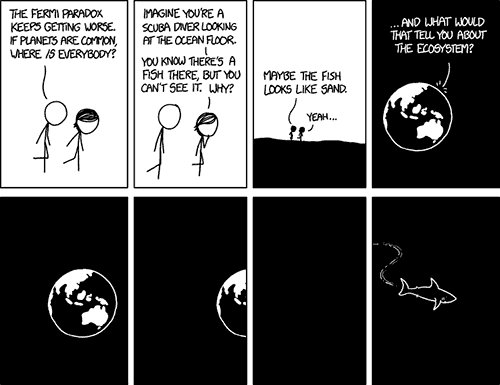
So you Want to Have a Threesome…

Group sex. It’s arguably one of the most common sexual fantasies that exists, right up there with the one about your French teacher, a paddle, and a giant pot of honey. It’s also one of the most fraught: How do I find people who want to have a threesome? What happens if I’m with a partner who’s more into the third person than into me? What if I get jealous? What if my partner gets jealous? What if there’s Drama? What if I feel left out?

I’m a huge fan of group sex. I lost my virginity in an MFM threesome (something I talk about in my memoir The Game Changer), and in the time since I’ve had far too many threesomes (and quite a lot of foursomes, and a few fivesomes, and some elevensomes, and at least one fifteensome) to count.

Group sex is hella fun, though like any kind of sexual activity it’s not everyone’s cup of tea, and that’s okay. If group sex is something that interests you, it can be hard to know where to get started and how to stack the deck in favor of a good experience for everyone. That’s what this guide is for.

What is group sex like? Fun. I’ve consistently found it to be amazing. First, though, I’ll talk about what it’s not like.

What group sex isn’t

It’s not (usually) like what you see in porn flicks or Hollywood movies. The other folks involved are people; unless you’ve hired a pair of sex workers, they’re not there just to be part of a male wank fantasy.

I’m afraid I have some bad news for the straight dudes in the audience: When you’re having sex with two (or more) women, they’re not there just for you. It’s not all about you and your pleasure. A typical threesome wank fantasy is about two women who make out or have sex with each other just to get the dude hot, but secretly they both need the D.

That’s not likely to be how it happens. Maybe they’re both straight. Maybe they’re both bi and more into each other than him. Like I said, I’ve had a threesome with a bi woman and her lesbian girlfriend; we both paid attention to the bi woman, but her girlfriend and I had no contact at all. It was all about the bi woman, not all about me.

In fact, threesomes with two men are about as common as threesomes with two women–and no, you don’t need to be bisexual to have a threesome. Three men can have a threesome, as can three women. If you’re a straight guy, you also need not feel threatened by the presence of another penis in the room. As many women as men fantasize about threesomes, and often, women quite fancy the notion of two men paying attention to her as much as men like the idea of two women paying attention to him.

Which brings up another point: unless you’ve explicitly negotiated otherwise, you can’t assume it’s a free-for-all. You don’t get to do whatever you want with both of the other folks involved. Everyone is going to come to group sex with their own limits and boundaries. If you ever want to have a second threesome, pay attention to those boundaries! Yes, people are getting naked and sweaty. No, that doesn’t (necessarily) mean you get to have sex, or perform any particular act, with either or both of them. They have the right to say what you may or may not do with their bodies. (And so do you, by the way. You are never obligated to have sex with someone just because they’re involved in sex with someone else. I am straight, so when I have threesomes involving another guy, he and I don’t touch. That’s fine. Your body, your rules.)

Finally, a lot of folks naively assume “if I’m with someone and we both have sex with the same third person, we won’t feel jealous because we’re both there!” Wrong. Jealousy is about insecurity, and it’s possible to feel insecure even when you and your partner are having sex with the same lover. The best time to get a handle on that is before you invite someone else into your bed, not after.

What group sex is

Fun. Lots and lots of fun. Threesomes can happen in a wide range of configurations with a wide range of activities that go way beyond the stereotypical porn shoot or wank fantasy. They offer virtually unlimited ways for three people to come together and explore.

There’s something delicious about having two sets of hands and lips and tongues on your body that’s just amazing. It’s fun to be the one receiving that attention, but it’s also fun to be participating in giving someone else that kind of pleasure.

It’s cozy. Three people all wrapped up together is really nice. It’s incredibly intimate, both physically and emotionally. I remember a situation where I, one of my girlfriends, and my FWB all spent the night together. We had lots of sex and fell asleep all tangled up together, but you know what the most fun part was? The next morning when we woke up and showered together. The three of us barely fit in the shower stall, and all of us were still sleepy and a bit giddy from the night before, and it was incredibly warm and cozy and intimate.

The sex is amazing. There are a lot of sensations and activities that are not possible with two people that are possible with three.

If you’re a straight dude in an FMF threesome, for instance, it’s not necessarily a question of having ordinary PIV intercourse with two women, though of course that can be part of it (and it’s hella fun when it is). I’m a big fan of pegging (having a woman use a strapon on me), and in threesomes, there are all kinds of fun combinations available. I’ve been on top of one lover having PIV sex with her while another lover is behind me pegging me…that was fun! (We broke the bed.) I’ve been lying on my side spooning a lover and penetrating her while another lover is spooning me and pegging me. There are all kinds of varieties in any kind of threesome, and a little imagination goes a long way.

It’s a lot of fun when bondage is involved, too. The night before my girlfriend and my FWB and I ended up in the shower together, my girlfriend and I tied my FWB to the bed and we both took turns playing with her. On another occasion, I was tied to the bed on my back while one lover straddled me and rode me, and another lover sat on my face. The two of them made out with each other while they both took pleasure from me. As you can imagine, both experiences were really hot.

So how do you make it work? What are the rules for group sex?

In my experience, the most important rules for threesomes (or foursomes or orgies or any other group sex) are not that different from the most important rules for two-person sex. Sex is sex, after all, and it doesn’t turn into something qualitatively different for n>2. As with any sex:

  • The folks involved are people, not sex toys or objects for your pleasure. Their needs and desires matter just as much as yours.
  • Consent matters. This means do not do things without someone else’s consent. Do not, for example, assume you have sexual access to everyone else involved. (I have had threesomes with two women where one of the women involved self-identified as lesbian. I have had threesomes with two women where one of the women was the girlfriend of my partner. In neither case did I assume that just because there were two women there, that meant I got to have sex with both of them.)
  • Set and respect boundaries. Talk about what access you will and will not allow to you. You don’t have to have sex with all the other folks just because your orientations and/or wibbly bits line up!
  • Talk about and plan for sexual health. Use barriers, exchange sexual histories, or do whatever else you need to do to protect your health.
  • I have found that sex of all sorts usually goes better with friends than with strangers. It is common for people new to group sex to want to try it with strangers, because they fear that having sex with people they know will make things “awkward” or induce jealousy. In my experience, though, inviting a random person into your bed goes along with inviting random communication skill, random sets of expectations, random STI risk profile, and random risk of Drama into your bed. With friends, you’ve already established a baseline, I hope, of communication and trust. Those things make sex better.
  • Communication matters. If you’re feeling something you didn’t expect, communicate! If you want (or don’t want) something to happen, communicate!
  • Treat the other people with respect and compassion. They are people too, remember? Treating people well is the key to having everyone have a good experience. When you treat other people well, you might get to play again!
  • If you do have an unexpected response, try to deal with it with grace. It’s okay to feel unexpected things when you try something new. If you need to stop, stop, but do so calmly and without shame, blame, or drama.
  • Don’t spend all your time trying to script exactly what happens or how it goes, unless scripting sex is your particular kink. Sometimes people are tempted to try to avoid jealousy by using a script. That’s unlikely to work. Jealousy is caused by insecurity and it’s hard to navigate around insecurity with rules or scripts.

Special considerations for safer sex

Group sex poses special challenges for safer sex that you might not have to think about when you’re accustomed to the more one-on-one variety. In addition to being aware of transmitting potential pathogens to your partner or receiving them from your partner, you also have to be aware of transmitting them between participants.

Some of these guidelines are common sense. If you use barriers like condoms, for instance, don’t use the same barrier with two different partners. Change condoms when moving between partners.

The same goes for use of sex toys or fingers. Be aware of who you’ve touched and with what. Cover toys and change the coverings between partners, or use toys with only one partner. Don’t put your fingers in one person’s wibbly bits and then put them in another person’s bits, if those people aren’t fluid-bonded.

Oral sex requires particular care. We don’t necessarily think of it as a vector between two folks who aren’t directly intimate with each other, but it can be. Use dental dams or condoms if you’re offering oral sex to two partners, or use mouthwash between partners. Be aware of where your bits have been, where your fingers have been, and yes, where your tongue has been.

Finding partners

Having group sex doesn’t take magic superpowers or arcane pickup secrets you learn from the seedier corners of the Internet. It does, however, help to let go of conventional attitudes about sex. We are all, throughout our lives, inculcated with a lot of baggage around sex, and some of that baggage makes it really hard to have threesomes.

In my experience, there are three approaches to trying to find group sex.

A lot of folks start out with a conventional relationship, then search for someone who will basically be an expendable fantasy fulfillment object. That can feel nice and safe. The third person is barely even a person. In fact, a lot of folks set strict rules on what that third person can and can’t do, or even set rules that it has to be an anonymous stranger from Craigslist rather than a friend or acquaintance, in the belief that this will avoid jealousy or awkwardness.

There are several problems with this approach. First, in my experience, the couples who do it are often trying to outsmart jealousy by planning and scripting a scenario they think will keep it at bay. But jealousy doesn’t come from sex. Jealousy comes from insecurity. If you see your partner enjoying someone else, and you’re sexually insecure, you will likely feel threatened and jealous even if the other person is a stranger, even if you’re having sex with that person at the same time, and even if you’re following a script. Second, sex with a stranger can feel less threatening than sex with a friend, but the problem is a random stranger brings random STI profile, random integrity or lack thereof, random baggage, and random drama to the table. Third, it encourages thinking of that person as a thing, not as a person with needs and desires.

It’s easier to take this approach than to build good tools for self-confidence, security, communication, and respect. A lot of folks take this approach because they don’t want to (or don’t know how to) build those tools, and the results are mixed. It is possible to have a good threesome with this approach, but it’s surprisingly hard. I think every threesome horror story I’ve ever heard (and I’ve heard quite a lot of them) started with this approach.

The second approach is to join a swing club or lifestyle community. This approach is really intimidating to a lot of people. There are all kinds of stereotypes about swingers, it can be hard to admit to other people what you want, and a lot of folks will say things like “sure, I want to have group sex, but that doesn’t mean I’m like all those perverts!” (Seriously, I’ve heard people say just that.)

The advantages to this approach are that it’s safe–the lifestyle community tends to have zero tolerance for abusive or disrespectful behavior, there is a strong culture of not disrupting other people’s relationships, there are meet and greets where you can get to know folks in the community in a low-pressure social setting without sex, and you’ll meet people who are on the same page about what you want. The disadvantage is that it’s intimidating at first, and if you’re still carrying around a bunch of baggage like sexual insecurity, sex negativity, or poor communication skills, you’re going to have to address those. It also can tend, depending on where you are, to favor people who are conventionally attractive. But the lifestyle community offers a structural way to get what you want on your terms.

My approach is different. I’ve never “found” a partner for a threesome by going out and looking. All the threesomes I’ve ever had have involved people I already knew. I’ve always had a social circle who are open and sex-positive, so I’ve never had to go out searching; it’s always been more like “hey, I like you, I’d like to explore bring more physically intimate with you, whaddya say?”

I’ve tried to work on myself to build strong self-esteem and security, to confront my fears and insecurities, to develop the qualities of integrity and transparency, to be able to talk about sex without fear or shame, and to let go of the idea that if my lover digs sex involving another person that means I’m not good enough or whatever.

I’ve also worked hard to understand three principles that sound obvious but aren’t:

  • I can’t expect to have what I want if I don’t ask for what I want
  • If I feel something bad or unpleasant that doesn’t necessarily mean someone else is doing something wrong
  • Other people are real, which means their needs and desires are just as valid as mine.

Having done that, I deliberately built a social circle of open, sex-positive people. I got over feeling intimidated about going to kink or lifestyle social groups. I sought out people who have positive, healthy attitudes about sex. I worked on my own integrity.

And it really paid off. And because my social circle is made up of folks with good communication skills and positive attitudes about sex, it’s remarkably drama-free.

This approach takes the most work of the three, but it’s work you do on yourself. Being confident and secure, being open, having good communication skills, being willing to face down your fears and insecurities help you find partners, sure, but they also help you live a better, happier life.

Some thoughts on social issues in video games

Unless you’ve spent the last year living entirely under a rock, far from the hustle and bustle of normal life, and entirely without any sort of Internet connection, you’re probably aware to some extent of a rather lengthy fuss about the heart and soul of computer gaming. This fuss, spearheaded by a diverse group of people loosely gathered under a name whose initials are similar to GargleGoose, is concerned about the future of comic book and video game entertainment. They believe that a sinister, shadowy cabal of “social justice warriors”–folks who are on a mission to, you know, right wrongs and uplift the oppressed, kind of the way Batman or Superman do only without the fabulous threads. This cabal, they fear, is coming for their video games. The social justice warriors, if we are to believe GameteGoose, are so obsessed with political correctness that they wish to make every game in the world a sanitized, sterile sandbox where not the slightest whisper of sex or violence may be seen.

Okay, so granted that’s not likely the characterization GrizzleGoose would put to their aims, though I think the general gist is there.

And they’re not entirely wrong, though they’re pretty far from right. There is a battle going on for the heart and soul of entertainment. For decades, comic books and video games have catered to straight white middle-class guys, who overwhelmingly make up the demographic that bought the games, read the comics, and to whom writers, artists, and developers catered with laser focus.

But times have changed, comics and games have gone mainstream, and they’re attracting more and more people who aren’t straight white dudes any more. And as other folks have come into the scene, they have started pointing out that some of the tropes that’ve long been taken for granted in these media are, well, a little problematic.

And merely by pointing that out, the folks talking about these problematic things have provoked pushback. When you live in a world where everyone caters to your exact tastes, the idea that some people might start making some things that aren’t to your liking feels like a betrayal. And the suggestion that there might be something about your taste that isn’t quite right? Well, that can quickly turn into an existential threat.

GooeyGoose has effectively capitalized on that existential threat, rallying straight white dudes into believing they’re the Rebel Alliance who are under attach from the forces of social justice while adroitly handwaving away the reality that when it comes to popular taste in entertainment media, straight white middle-class dudes are and have always been the hegemonizing Empire.

But here’s the thing. You can point out that popular entertainment media is problematic without saying the people who like it are bad people.


I play Skyrim.

Skyrim is an open-world role-playing game where the player takes on the persona of a mythic hero trying to save a world plagued by dragons, a civil war, and the restless undead. It’s almost entirely unstructured, with players having the ability to choose to do just about Anything. Non-player characters the player interacts with offer advice and provide quests, which the player can choose whether or not to do.

It’s a lot of fun to play. I’ve lost quite a number of hours of my life to it, fighting dragons, deciding which side of the civil war to support, participating in political intrigue, exploring creepy dungeons, and exploring a lush and richly detailed world.

It also has some problematic issues.

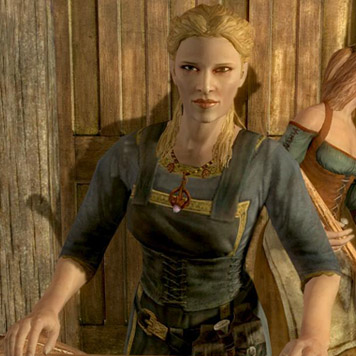
This is Haelga, one of the characters in the game. The player can be given a minor side quest in the game by her niece, who works for Haelga but doesn’t like her very much. Haelga’s niece, Svana Far-Shield, tells the player that Haelga is having sex with several different men, and wants the player to get proof in order to shame and humiliate Haelga.

The way the quest is written, it’s sex-negative as hell. It plays to just about every derogatory trope out there: open female sexuality is shameful, women who are perceived as sexual are “sluts,” and pouncing on a woman with evidence of her sexual attitude is a sure way to humiliate (and therefore control) her.

You might argue that Skyrim is set in a time that is not as enlightened as the modern-day West, but that ignores a very important reality: Skyrim is set in a time and place that never existed. There’s no compelling reason to write sex-negativity into the script. The game works well without it. It’s there not because the distant faux-medieval past was sex-negative, but because modern-day America is.

But that, too, misses a point, and it misses the same point the GiggleGoose folks miss:

It is possible to recognize problematic elements of a game and still enjoy the game.

I recognize that this quest in Skyrim is sex-negative, and that’s a problem. I still like the game.

The people who play these games and read these comic books are not bad people for doing so. The content of the games and comics is troubling to anyone who cares about people other than straight white middle-class men, sure, and it’s certainly reasonable to point these things out when they occur (though they happen so damn often that one could easily make a full-time career of pointing them out). That doesn’t make the people who like them Bad And Wrong simply because they enjoy them.

GiddyGoose believes that saying video games are a problem is the same thing as saying people who enjoy video games are a problem. And if you identify with comic books and video games so strongly that you can not separate your entertainment media from your sense of self, they might be on to something.

But most folks, I think, are able to take a deep breath, step back a half pace, and recognize that the writers and developers have done some really cool, fun stuff, but they can still do better. It would not kill anyone if the quest in Skyrim were rewritten (how about have Haelga’s character replaced by a man? There’s a thought…), or even dropped entirely. Nobody suffers from recognizing that it’s not cool to make fun of people who aren’t like you.

Nobody’s saying that Skyrim shouldn’t exist, or that people who play it are terrible people. I would like to think, on my optimistic days, that that’s an idea anyone smart enough to work a computer can recognize.

Some thoughts on little white lies

It’s probably no surprise to anyone who’s read my writings for any length of time that I’m not a fan of dishonesty in relationships–of any sort, big or small. I have always championed the cause of open, honest communication, especially in romantic relationships. A great deal of human misery and suffering in relationships can, it seems to me, be addressed by the simple but nevertheless radical idea that communication is good.

That doesn’t mean I embrace the idea of Radical Honesty™, at least not as it often shakes out in the real world. I’ve written about that before.

But I am no fan of intentional dishonesty, even in small ways. The little white lie? It has effects that are farther reaching and more insidious than I think most folks realize.

People who advocate for the little white lie often argue–indeed, seem to believe–that they are being compassionate. The function of the little white lie is to save someone from hurt or embarrassment, the reasoning goes. What is the harm in that? Isn’t it cruel to tell a hurtful truth, if there is no purpose to it?

I have oft observed a very strange thing in romantic relationships, and that is good things our partners say to us tend to bounce off as though our self-conception were made of Teflon, whereas bad things have amazing power to stick. If our partner tells us “I think you’re beautiful; I am totally attracted to you,” it is easy to say “well, he doesn’t really mean it,” and not to internalize it. But a partner saying “I don’t think you look good in that dress” sticks tenaciously, and can haunt us for weeks.

Why is that?

There might be a lot of reasons, but I think one of them is the little white lie.

We live in a society where there are certain things we are “supposed” to say. There are certain lies that we are encouraged to tell–little soothing words that we set up like fences around anything that might potentially be hurtful to hear.

Each of them might, in and of itself, not be that big a deal. Who cares, really, if your partner’s butt looks big in that skirt? You’re not with your partner because of the size of their butt, after all; it doesn’t matter to your relationship.

But here’s the thing.

When you tell little white lies, however harmless they may seem, you are telling your partner, Don’t believe me. Don’t believe me. I will lie to you. I will tell you what you want to hear. Don’t believe me.

Is it any wonder, then, that positive stuff bounces off but negative stuff sticks? You are establishing a precedent that communicates to your partner, straight up, do not trust positive things I say. They are empty words. They do not reflect the reality of what I believe. So how, given that, can we really expect our partners to trust it when we give them affirmation?

Little white lies are corrosive. They communicate a very important truth: I will be dishonest to you to save your feelings.

When we make a habit of telling the truth all the time, something wonderful happens. We tell our partners, You can believe me. I will not say what you want to hear; I will say what I actually believe. That means when I tell you positive things, I mean them.

Lies, however innocuous, breed insecurity. They cause your partner to second-guess everything you say: does he really think this is true, or is he just trying to placate me? Is he genuine, or is he just trying to avoid saying something I might not want to hear?

A question I hear often is “When I tell my partner things I like about them, why don’t they believe me?” And the answer, of course, is that we live in a society that cherishes comfort above truth. We are taught from the time we are children that we should tell white lies, and expect others to lie to us, rather than say anything uncomfortable. That leaves us in a tricky position, because we don’t have any way of telling whether the positive words we hear are lies.

Oh, we know we can believe the negative words, because those aren’t little white lies–the purpose of a white lie is to avoid discomfort, and negative things are uncomfortable. We trust the bad stuff implicitly. But the good stuff? We have no reason to trust that! We don’t know if it’s real or if it’s a white lie.

So here’s a thought. If you want your lover to believe you about the good stuff, give them a reason to. Let them know it’s honest. How? By embracing honesty as a core value. What’s the harm in little white lies? They create an environment where we suspect dishonesty from everyone. We can never quite be comfortable that anything positive we hear is the truth; there is always–there must always be–that niggling little doubt.

It is very difficult to develop positive self-esteem when we can not trust the good things people say about us. And yet, taking away our trust to believe the good is exactly what little white lies do.

Don’t do that. Be compassionate in your truth–but be truthful.

Some thoughts on porn, coercion, and the Fundamental Reconstruction Error

If you spend any time in any forums where people talk about sex, it is a truth as inevitable as night following day that, sooner or later, someone is going to talk about porn.

And as soon as someone starts to talk about porn, a certain predictable conversation will come up.

“Porn performers are coerced and trafficked,” someone will say. “Porn is bad because women are forced into it. It is a terrible meat-grinder industry. We need to rescue all the victims of porn.”

The same narrative comes up around sex work as well. Sex workers, according to a certain kind of person, are victims, people there because they have been forced, threatened, or tricked into it.

The people who make these arguments, in my experience, almost certainly don’t know any porn performers or sex workers. They will cite “studies” they read on the Internet, like the rather dreadful study that claims legal prostitution in the Netherlands has resulted in a huge increase in trafficking in that country. (I’ve read that study. Buried in the fine print: the study’s authors define a “traffick victim” as any person who for any reason crosses national boundaries and then ends up working in any capacity in the sex trade. So a person who immigrates legally and voluntarily goes to work as a sex worker is a “trafficking victim” according to the study.)

A particularly pernicious variant on this “women-as-victims” narrative is circulating amongst folks who are generally politically liberal and see themselves as allies of women, but still face discomfort about porn and sex work: Well, yes, women can and do freely choose to go into porn or sex work, but, you see, not abuse porn like what you see at Kink.com. Those women go into normal mainstream porn, and then they get “groomed” to do abusive porn.

I’ve seen variants on this narrative turning up in places where people are otherwise open to the notion that not all sex workers or performers are victims–sure, “mainstream” porn (whatever that is–I would say there really isn’t any such thing as “mainstream” porn; porn is, by its nature, niche) isn’t inherently exploitive, but that kinky stuff? Man, just look at it! Sometimes the performers cry! That’s clearly abuse!–and for a long time, I’ve simply chalked it up to standard, ordinary squicks about exchanging money for sex, cultural taboos about sex, ideas about what is “normal” or “not normal” around sex. You know, the ordinary soup of preconceptions, emotions, and cultural norms that oozes through the public discourse on sex.

But lately, I’ve started thinking there’s something else at work, too. Something that lies rooted in a tacit assumption that those who hold these ideas about porn and sex work hold, but don’t directly articulate, and an assumption that sex-positive folks who support the right of people to choose porn and sex work don’t directly address: the starvation model of sex work.


The starvation model of sex work starts with the assumption that it is hard to find people who want to do porn or sex work. A reasonable person wouldn’t make that choice, except through coercion or the most dire of necessity. Therefore, to feed the demand for sex workers and porn performers, there must be coercion and abuse.

In places where porn and sex work are criminalized, that makes sense. Production of porn and sex work becomes a criminal enterprise. The pool of people willing to work in criminal enterprises is small.

In places where these things are not criminalized, the equation is different. I personally know many porn performers and sex workers (yes, including performers for Kink.com). They report they enjoy what they do and choose to do it freely. I have no reason to doubt them.

And yet, whenever I ask the folks who criticize the porn and sex work industries, or cast sex workers as victims, if they’ve ever talked to sex workers, the answer is almost always “no.” And when I say the people I know choose what they do, the response is almost always incredulity.

If we assume that it is true nobody would voluntarily choose to do porn or sex work, then it makes sense to think the folks who are doing it, aren’t there by choice, and to look for coercion. If we assume there are lots of people who are willing to do porn or sex work, but nobody would choose to do “abusive” sex work, then the same thing holds–the folks who appear in Kink photo shoots must be being groomed, tricked, manipulated, or coerced.

If, on the other hand, we assume that there are actually quite a lot of folks who are totally okay with porn and sex work, the narrative falls apart. Why would I, as a porn producer, risk my business (and prison) forcing women to perform when I can simply put out a call that I’m looking for performers, and people will come to me voluntarily? Why would we assume that every sex worker is a trafficking victim, given that there are people who like the idea of doing sex work?

For the women-as-victims narrative to hold true, a necessary prerequisite is women wouldn’t choose to do this voluntarily. But that premise is rarely stated explicitly.

So why would people make that assumption?

I spent some time asking questions of people who promote the sex-worker-as-victim narrative, and discovered something interesting.


Psychologists often talk about a quirk of human psychology called the fundamental attribution error. It’s a bug in our firmware; we, as human beings, are prone to explaining our own actions in terms of our circumstance, but the actions of other people in terms of their character. The standard go-to example of the fundamental attribution error I use is the traffic example: “That guy just cut me off because he’s a reckless, inconsiderate asshole who doesn’t know how to drive. I just cut that car off because the sun was in my eyes and there was so much glare on the windshield I didn’t see it.”

We do this All. The. Time. We do it without being aware we’re doing it. We do it countless times per day, in ways large and small.

The penny dropped for me that something similar was going on in discussions about sex work during a different conversation–not about sex work but about polyamory. There was a guy who was railing, and I mean railing, about polyamory. Nobody, he said, would ever truly be okay with it–not really. No guy would ever willingly share a woman with another guy. Sure, poly folks say they are okay with it, but that’s just because they think it’s the only way they can keep the one they love. You give any poly person the magical power to have absolutely anything they wanted, he declared, and nobody would choose to share a partner.

Now, this is a load of bollocks, of course. I would, in a perfect world, still be poly, and still not have any desire to have my partners be sexually fidelitous to me.

When I told him that, he flipped out. That’s disgusting, he said. No man–no man, no man ever–would be okay with it. No man. If someone says otherwise, there’s something wrong with him.

We see the same line of reasoning used in other arenas. No man would be okay with having sex with another man–if a guy fancies other men, there must be some kind of damage or trauma, as one example.

And then it clicked.

I would like to propose that there is another bug in the operating firmware of humanity, similar to the fundamental attribution error. Call it the fundamental construction error, if you will. We as human beings re-construct the world in our own image, assigning our own values, ideas, squicks, taboos, likes, and dislikes to the great mass of humanity as a whole. “Nobody likes,” “everybody wants,” “nobody would,” “everybody thinks”–all statements of this class can most properly be understood to mean “I don’t like,” “I want,” “I wouldn’t,” and “I think.”

“You must be damaged in order to be gay” really means “nobody would want to be gay,” which really means “I wouldn’t want to be gay.”

“All sex workers are victims” really means “nobody would want to be a sex worker,” which really means “I wouldn’t want to be a sex worker.”

The fundamental reconstruction error makes it extremely difficult to realize that other people can be, on a very deep level, not like us. We assume that others are like us. This tacit assumption is the foundation of most of the models we build of the social world around us. It doesn’t get explicitly mentioned because it’s wired so deep it doesn’t even get noticed.

Why are porn performers and sex workers victims? Because nobody would do these things voluntarily. Why would nobody do these things voluntarily? Because I wouldn’t do these things voluntarily. Ergo, it must be–it follows inevitably that it has to be–that people who do these things are damaged, broken, victimized, or have no other choice.

And since it follows that these people are damaged, broken, victimized, or have no other choice, then the stories of people who work in the sex industry voluntarily can be discarded–because they are the words of someone who is damaged, broken, victimized, or has no other choice.


I would like, therefore, to propose a radical idea:

The world is made of lots of people. Some of those people are different from you, and have different ideas about what they want, what turns them on, what is and is not acceptable for them, and what they would like to do.

Some of those ideas are alien, maybe even incomprehensible, to you.

Accept that it is true. Start from the assumption that even if something sounds weird, distasteful, or even disgusting to you, it may not be so to others–and that fact alone does not prove those other folks have something wrong with them. If someone tells you they like something, and you have no compelling evidence that they’re lying, believe them–even if you don’t understand why.

How do you do it?

Awareness of the fact that your cognitive impulses are buggy is a good place to start. I started looking at myself any time I caught myself saying “oh, that driver is an asshole” or “oh, that person is obviously an inconsiderate jerkoff”–I would stop and say “huh. Have I ever done that? Is this an example of the fundamental attribution error?”

Doing the same thing when you find yourself assuming that all X are Y, especially if it’s “all X are victims” or “all X are damaged goods,” is probably a good mechanism for sorting out the fundamental reconstruction error. Is that really true, or are you just re-creating the world in your own image?

#WLAMF no. 19: Kinky sex

A while back, I was participating in a conversation about sex, and the subject of kink came up. A guy was saying his girlfriend had approached him with the idea of some sort of non-specific kink, and he was reluctant to engage in it for fear that “nice guys” don’t do that sort of thing with their partners. What, he wondered, would it be like if the sexes were reversed? A guy who asked his girlfriend for kinky sex was clearly not a nice guy; nice guys would never do such a thing! So why should it be okay for a woman to ask her boyfriend for kink? Didn’t it show a double standard–women can do something bad but guys aren’t allowed to? Someone else said that he shouldn’t be a nice guy, because women don’t want nice guys–nice guys, he explained, are emasculated, and women actually want strong, alpha guys, guys who will control them.

And listening to it, I felt despair.

I’ve always been suspicious of framing things in terms of “nice guy” vs. “bad boy;” I think, to be blunt, it’s childish and stupid. Modern social expectations do not “emasculate” men, being a “soft male,” or “losing your center.” That’s a load of rubbish. Modern social expectations are about treating women as human beings rather than need-fulfillment machines. That’s it. You don’t have to be “emasculated” or any of that other silly stuff to do that. You simply have to look at women as full human beings, deserving the same levels of respect and consideration you’d give any other person.

At the end of the day, it’s about consent, not disempowerment. It’s messed up to see relationships in terms of who’s empowered and who’s disempowered; in a good relationship, it’s possible for two (or more!) people to all be empowered.

Likewise, being a “nice guy” or treating women with “respect” does not mean holding doors open, always being soft and gentle, or always having sex in candlelight on a bed strewn with roses. REAL respect, as I’ve said many thousands of times, means talking to women about what THEY want, and then treating them the way they want to be treated.

Are you seeing the Matrix yet?

The “nice guy” who refuses to try anything kinky because he thinks it’s disrespectful isn’t really a nice guy. He’s not listening to his partner, because he knows what’s best for her.

And the “bad guy” who talks to his lover about what she wants, talks about what he wants, and then works with his lover to explore their mutual fantasies together? He isn’t really a bad guy…even if those fantasies involve kinky sex.

It seems to me the world might be a happier place if we all stop trying to figure out the rules about how to treat women “properly,” and instead just talk to women like human beings and treat each individual the way she wants to be treated. A lot of men say they just don’t understand women. A lot of women say they don’t understand men. I respectfully submit that perhaps, if we listen to each other, that might change.


I’m writing one blog post for every contribution to our crowdfunding we receive between now and the end of the campaign. Help support indie publishing! We’re publishing five new books on polyamory in 2015: https://www.indiegogo.com/projects/thorntree-press-three-new-polyamory-books-in-2015/x/1603977

#WLAMF no. 15: “Government should fear the people”

When I was living in Atlanta, I used to see a bumper sticker all over the place: “People shouldn’t fear the government, the government should fear the people.”

This sentiment is quite popular in conservative parts of the US, and it or variations on it (such as “When government fears the people, there is liberty; when the people fear the government, there is tyranny”) are often attributed to Thomas Jefferson. Wrongly, as it turns out–Jefferson never said this.

Now, on some level, there’s a grain of truth here, in the sense that a government ideally represents the will of the people and should be held accountable to them. To some extent, anyway. In some cases, the will of the people is a deeply troublesome and evil thing; the will of the people in the pre-Civil-War Deep South, for instance, held that some people aren’t people at all but rather property, and that’s a will I don’t think a civil society should respect.

But what it misses is that when the government fears the people, the result is tyranny, just as surely as when the people fear the government.

Governments have power. They have police forces and jails. They have standing armies. A person with a gun and a heart full of fear is a dangerous person indeed.

Why do tyrannies exist? They exist because people in power fear losing that power. They fear what happens if the people express their will. Tyrannical governments restrict what they fear. They restrict speech because they fear the power of speech. They restrict demonstrations because they fear the power of demonstrations. A government that fears the people, attacks the people. It handles that fear through force and control. When it sees something it fears, it acts ruthlessly to eliminate it. When a government fears the people, the people become the enemies of the state.

The same holds true for civilian police. A police force that fears the people, treats the people as threats. It shoots the people, even if they’re unarmed. It labels the people “thugs” and “looters.”

The idea that the government should fear the people creates–in fact, it can not help but to create–totalitarianism. The greater the fear, the greater the response to it. A government that sees the enemy around every corner, treats every person as an enemy.

“People shouldn’t fear the government, the government should fear the people.” This idea is a blueprint for evil.

People are people. Governments are made of people. I would like to propose a different bumper sticker: “The government and the people should hold one another accountable. Let them treat one another with respect, so that we may have a civilized society in which all are respected.”


I’m writing one blog post for every contribution to our crowdfunding we receive between now and the end of the campaign. Help support indie publishing! We’re publishing five new books on polyamory in 2015: https://www.indiegogo.com/projects/thorntree-press-three-new-polyamory-books-in-2015/x/1603977

#WLAMF no. 9: Fusion

A lot of the world’s social, economic, and resource problems are, when you come down to it, power problems. I don’t mean political power; I mean energy. Electricity.

Take fresh water, for instance. Three-quarters of the planet’s surface is covered by the stuff, yet much of the world doesn’t have reliable access to safe, clean water. 780 million people don’t have regular access to clean water. Nearly four million people die a year from water-bourne illness.

If we had unlimited quantities of cheap, clean energy, water would stop being a problem overnight. It’s easy to desalinate seawater…easy, but not cheap. The process requires enormous inputs of energy, and energy is expensive.

The holy grail of energy is, and has always been, fusion power. Fusion power offers vast quantities of energy from seawater…if we can make it work. And we’ve been chasing it for a while, though never with any serious determination; the world’s annual budget for fusion research is about 1/18th the annual revenue of the National Football League. (In the US, the annual budget for fusion research is less than what the Government Accountability Office spends on paperwork.) Fusion power promises one-stop shopping for reversing global carbon emissions, improving access to fresh water all over the world, raising the standard of living for developing nations, moving toward non-polluting transportation…

…if we can make it work.

It’s been a long road. A lot of engineers thought we’d have the problem licked by the mid-1960s. Here we are in 2014, and it’s only been in the last two years that teams at MIT and Lawrence Livermore have actually made fusion reactors that produce net positive energy…for short periods of time. It’s a very, very difficult nut to crack.

Enter Lockheed Martin.

Lockheed Martin recently announced that their Skunkworks team has been quietly, and secretly, working on fusion power for a while. And they claim to be within 5 years of an operating prototype of a compact fusion reactor.

Now, I am of two minds about this.

Pros:

– It’s the fucking Lockheed Martin fucking Skunkworks. These are not a bunch of cranks, kooks, or pie-in-the-sky dreamers. These guys built the SR-71 in the early 1960s, and the F-117 Stealth fighter back when the Radio Shack TRS-80 was the state of the art for personal computers.
– Lockheed doesn’t seem the kind of company to stake their reputation on a claim unless they’re really, really sure.
– They’re exploring deuterium-tritium fusion, which is a lot easier than ordinary hydrogen-hydrogen fusion of the sort that happens in the sun.
– Did I mention it’s the fucking Lockheed Martin fucking Skunkworks? They have money, engineering expertise, and problem-solving experience by the metric ton. They are accustomed to solving hard engineering problems 20 years before anyone else in the world even knows they can be solved.

Cons:

– Fusion is hard. The pursuit of fusion has left a lot of broken dreams in its wake.
– The design they propose encloses a set of superconducting magnets inside the fusion chamber. That’s clever, and solves a lot of problems with magnetic containment, but superconducting magnets are fragile things and the inside of a fusion chamber is as close as we can get to hell on earth.
– Fusion creates fast neutrons. Those fast neutrons tend to run into stuff and knock it all out of whack. Solving the problem of the reactor vessel degrading under intense neutron flux is non-trivial; in fact, that’s one of the key objectives of the multibillion-dollar International Thermonuclear Experimental Reactor being built by a consortium of countries in France.

Fusion power, if we can make it work, would likely (and without hyperbole) be one of the most significant achievements of the human race. It could and very likely would have farther-reaching impacts than the development of agriculture or the invention of iron, and would improve the standard of living for billions of people to a greater extent than any other single invention.

For that reason alone, I think it’s worth pursuing. I’d like to see it better funded…say, maybe even on the same scale as the NFL. I’m not sure of Lockheed can deliver what they’re promising, but I am very, very happy they’re in the race.


I’m writing one blog post for every contribution to our crowdfunding we receive between now and the end of the campaign. Help support indie publishing! We’re publishing five new books on polyamory in 2015: https://www.indiegogo.com/projects/thorntree-press-three-new-polyamory-books-in-2015/x/1603977

Intermission: Some thoughts on love

In the midst of all the writing I’ve been doing about GMO food lately, I thought I’d take a brief digression into an entirely different subject: love.

Recently, someone online pointed to the writings about love by Francesco Alberoni, an Italian sociologist who has this to say on the matter:

No one can fall in love if he is even partially satisfied with what he has or who he is.The experience of falling in love originates in an extreme depression, an inability to find something that has value in everyday life. The “symptom” of the predisposition to fall in love is not the conscious desire to do so,the intense desire to enrich our lives; it is the profound sense of being worthless and of having nothing that is valuable and the shame of not having it. […] For this reason, falling in love occurs more frequently among young people, since they are profoundly uncertain, unsure of their worth,and often ashamed of themselves. The same thing applies to people of other ages when they lose something in their lives-—when their youth ends or when they start to grow old.

Now, I am not a sociologist, but when I read this, I rolled my eyes so hard I feared they would fall from my head onto my keyboard.

I am a deeply, profoundly happy person. My normal baseline emotional state is almost overwhelming joy almost all the time. I am constantly awestruck by the wonder and beauty of the natural world, as I’ve blogged about here.

In other words, I am about as far from “the profound sense of being worthless and of having nothing that is valuable and the shame of not having it” as it’s possible to be.

I fall in love deeply, unhesitantly, and with abandon, without fear or reservation. Love is an amazing thing. It is the profound sharing of myself with those I love, and through it, the sharing of joy. Life is filled with wonder and beauty, all of which is amplified by love. I create with the people I love. I explore with the people I love. Love is a fantastic thing, a process for multiplying joy and dividing sorrow.

It’s easy to be cynical about love, because love is not for the cowardly. It lets us share ourselves with those around us, and that makes us vulnerable. Like anything worth doing, love carries risks. It’s easy to get tangled up in our own egos and fears–what if we get hurt? What if the person we love doesn’t love us back?–and so to believe, mistakenly, that those we love owe us something simply because we love them. Nothing could be further from the truth. Love cannot be coerced. It exists only when it is given freely. It’s not for wimps. To risk loving is to risk exposing yourself in the most profound way possible. Love requires courage.

But that is precisely what makes it so valuable.

I do not entirely understand the depth of cynicism that would lead Mr. Alberoni to the conclusions he has reached. But I am very, very happy he’s wrong.

Musings on being fucked: Christian millennialism and the Fermi paradox

When all the world’s armies are assembled in the valley that surrounds Mount Megiddo they will be staging a resistance front against the advancing armies of the Chinese. It will be the world’s worst nightmare – nuclear holocaust at its worst. A full-out nuclear bombardment between the armies of the Antichrist’s and the Kings of the East.

It is during this nuclear confrontation that a strange sight from the sky will catch their attention. The Antichrist’s armies will begin their defense in the Jezreel Valley in which the hill of Megiddo is located. […] At the height of their nuclear assault on the advancing armies something strange will happen.

Jesus predicted the suddenness of His return. He said, “For just as lightening comes from the east, and flashes even to the west, so shall the coming of the Son of Man be” (Matt. 24:27). And again He said, “…and then the sign of the Son of Man will appear in the sky, and then all the tribes of the earth shall mourn, and they will see the Son of Man coming in the clouds of heaven with power and great glory” (Matt. 24:30).
–Sherry Shriner Live

Believers must be active in helping to fulfill certain biblical conditions necessary to usher in the return of Christ. Key to this plan is for Gentiles to help accomplish God’s purpose for the Jews. […] Jesus is saying that His Second Coming will not take place until there is a Jewish population in Jerusalem who will welcome Him with all of their hearts.
— Johannes Facius, Hastening the Coming of the Messiah: Your Role in Fulfilling Prophecy

There is a problem in astronomy, commonly referred to as the Fermi paradox. In a nutshell, the problem is, where is everyone?

Life seems to be tenacious and ubiquitous. Wherever we look here on earth, we see life–even in the most inhospitable of places. The stuff seems downright determined to exist. When combined with the observation that the number of planetary systems throughout the universe seems much greater than even the most optimistic projections of, say, thirty years ago, it really seems quite likely that life exists out there somewhere. In fact, it seems quite likely that life exists everywhere out there. And given that sapient, tool-using life evolved here, it seems quite probable that sapient, tool-using life evolved somewhere else as well…indeed, quite often. (Given that our local galactic supercluster contains literally quadrillions of stars, if sapient life exists in only one one-hundredth of one percent of the places life evolved and if life evolves in only one one-hundredth of one percent of the places that have planets, the universe should be positively teeming with sapience.)
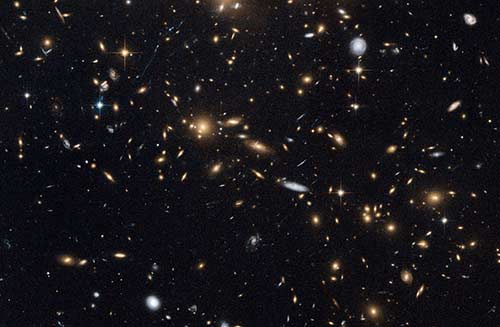

These aren’t stars. They’re galaxies. Where is everyone? (Image: Hubble Space Telescope)

When you’re sapient and tool-using, radio waves are obvious. It’s difficult to imagine getting much beyond the steam engine without discovering them. Electromagnetic radiation bathes the universe, and most any tool-using sapience will, sooner or later, stumble across it. All kinds of technologies create, use, and radiate electromagnetic radiation. So if there are sapient civilizations out there, we should see evidence of it–even if they aren’t intentionally attempting to communicate with anyone.

But we don’t.

So the question is, why not?

This is Fermi’s paradox, and researchers have proposed three answers: we’re first, we’re rare, or we’re fucked. I have, until now, been leaning toward the “we’re rare” answer, but more and more, I think the answer might be “we’re fucked.”


Let’s talk about the “first” or “rare” possibilities.

The “first” possibility posits that our planet is exceptionally rare, perhaps even unique–of all the planets around all the stars everywhere in the universe, no other place has the combination of ingredients (liquid water and so on) necessary for complex life. Alternately, life is common but sapient life is not. It’s possible; there’s nothing especially inevitable about sapience. Evolution is not goal-directed, and big brains aren’t necessarily a survival strategy more common or more compelling than any other. After all, we’re newbies. There was no sapient life on earth for most of its history.

Assuming we are that unique, though, seems to underestimate the number of planets that exist, and overestimate the specialness of our particular corner of existence. There’s nothing about our star, our solar system, or even our galaxy that sets it apart in any way we can see from any of a zillion others out there. And even if sapience isn’t inevitable–a reasonable assumption–if life evolved elsewhere, surely some fraction of it must have evolved toward sapience! With quadrillions of opportunities, you’d expect to see it somewhere else.

The “we’re rare” hypothesis posits that life is common, but life like what we see here is orders of magnitude less common, because something happened here that’s very unlikely even on galactic or universal scales. Perhaps it’s the jump from prokaryotes (cells without a nucleus) to eukaryotes (cells with a nucleus, which are capable of forming complex multicellular animals). For almost the entire history of life on earth, only single-celled life existed, after all; multicellular life is a recent innovation. Maybe the universe is teeming with life, but none of it is more complex than bacteria.


Depressing thought: The universe has us and these guys in it, and that’s it.

The third hypothesis is “we’re fucked,” and that’s the one I’m most concerned about.

The “we’re fucked” hypothesis suggests that sapient life isn’t everywhere we look because wherever it emerges, it gets wiped out. It might be that it gets wiped out by a spacefaring civilization, a la Fred Saberhagen’s Berserker science fiction stories.

But maybe…just maybe…it won’t be an evil extraterrestrial what does us in. Maybe tool-using sapience intrinsically contains the seeds of its own annihilation.


K. Eric Drexler wrote a book called Engines of Creation, in which he posited a coming age of nanotechnology that would offer the ability to manipulate, disassemble, and assemble matter at a molecular level.

It’s not as farfetched as it seems. You and I, after all, are vastly complex entities constructed from the level of molecules by programmable molecular machinery able to assemble large-scale, fine-grained structures from the ground up.

All the fabrication technologies we use now are, in essence, merely evolutionary refinements on stone knives and bearskins. When we want to make something, we take raw materials and hack at, carve, heat, forge, or mold them into what we want.


Even the Large Hadron Collider is basically just incremental small improvements on this

The ability to create things from the atomic level up, instead from big masses of materials down, promises to be more revolutionary than the invention of agriculture, the Iron Age, and the invention of the steam engine combined. Many of the things we take for granted–resources will always be scarce, resources must always be distributed unequally, it is not possible for a world of billions of people to have the standard of living of North America–will fade like a bad dream. Nanotech assembly offers the possibility of a post-scarcity society1.

It also promises to turn another deeply-held belief into a myth: Nuclear weapons are the scariest weapons we will ever face.

Molecular-level assembly implies molecular-level disassembly as well. And that…well, that opens the door to weapons of mass destruction on a scale as unimaginable to us as the H-bomb is to a Roman Centurion.


Cute little popgun you got there, son. Did your mom give you that?

Miracle nanotechnology notwithstanding, the course of human advancement has meant the distribution of greater and greater destructive power across wider and wider numbers of people. An average citizen today can go down to Wal-Mart and buy weapon technology that could have turned the tide of some of the world’s most significant historical battles. Even without nanotech, there’s no reason to think weapons technology and distribution just suddenly stopped in, say, 2006, and will not continue to increase from here on.


And that takes us to millennialist zealotry.

There are, in the world today, people who believe they have a sacred duty, given them by omnipotent supernatural entities, to usher in the Final Conflict between good and evil that will annihilate all the wicked with righteous fire, purging them from God’s creation. These millennialists don’t just believe the End is coming–they believe God has charged them with the task of bringing it about.

Christian millennialists long for nuclear war, which they believe will trigger the Second Coming. Some Hindus believe they must help bring about the end of days, so that the final avatar of Vishnu will return on a white horse to bring about the end of the current cycle and its corruption. In Japan, the Aum Shinrikyo sect believed it to be their duty to create the conditions for nuclear Armageddon, which they believed would trigger the ascendancy of the sect’s leader Shoko Asahara to his full divine status as the Lamb of God. Judaism, Islam, and nearly all other religious traditions have at least some adherents who likewise embrace the idea of global warfare that will cleanse the world of evil.

The notion of the purification of the world through violence is not unique to any culture or age–the ancient Israelites, for example, were enthusiastic fans of the notion–but it has particularly deep roots in American civic culture, and we export that idea all over the world. (The notion of the mythic superhero, for instance, is an embodiment of the idea of purifying violence, as the book Captain America and the Crusade Against Evil explains in some depth.)

I’m not suggesting that religious zealots have a patent on inventive destructiveness. From Chairman Mao to Josef Stalin, the 20th century is replete with examples of secular governments that are as gleefully, viciously bonkers as the most passionate of religious extremists.

But religious extremism does seem unique in one regard: we don’t generally see secularists embracing the fiery destruction of the entire world in order to cleanse os of evil. Violent secular institutions might want resources, or land, or good old-fashioned power, but they don’t usually seem to want to destroy the whole of creation in order to invoke a supernatural force to save it.

Putting it all together, we can expect that as time goes on, the trend toward making increasingly destructive technology available to increasingly large numbers of people will likely continue. Which means that, one day, we will likely arrive at the point where a sufficiently determined individual or small group of people can, in fact, literally unleash destruction on a global scale.

Imagine that, say, any reasonably motivated group of 100 or more people anywhere in the world could actually start a nuclear war. Given that millennialist end-times ideology is a thing, how safe would you feel?

It is possible, just possible, that we don’t see a ubniverse teeming with sapient, tool-using, radio-broadcasting, exploring-the-cosmos life because sapient tool-using species eventually reach the point where any single individual has the ability to wipe out the whole species, and very shortly after that happens, someone wipes out the whole species.

“But Franklin,” I hear you say, “even if there are human beings who can and will do that, given the chance, that doesn’t mean space aliens would! They’re not going to be anything like us!”

Well, right. Sure. Other sapient species wouldn’t be like us.

But here’s the thing: We are, it seems, pretty unremarkable. We live on an unremarkable planet orbiting an unremarkable star in an unremarkable corner of an unremarkable galaxy. We’re probably not special snowflakes; statistically, the odds are good that the trajectory we have taken is, um, unremarkable.


Yes, yes, they’re all unique and special…but they all have six arms, too.
(Image: National Science Foundation.)

Sure, sapient aliens might be, overall, less warlike and aggressive (or more warlike and aggressive!) than we are, but does that mean every single individual is? If we take millions of sapient tool-using intelligent species and give every individual of every one of those races the ability to push a button and destroy the whole species, how many species do you think would survive?

Perhaps the solution to the Fermi paradox is not that we’re first or we’re rare; perhaps we’re fucked. Perhaps we are rolling down a well-traveled groove, worn deep by millions of sapient species before us, a groove that ends in a predictable place.

I sincerely hope that’s not the case. But it seems possible it might be. Maybe, just maybe, our best hope to last as long as we can is to counter millennial thinking as vigorously as possible–not to save us, ultimately, but to buy as much time as we possibly can.


1Post-scarcity society of the sort that a lot of transhumanists talk about may never really be a thing, given there will always be something that is scarce, even if that “something” is intangible. Creativity, for instance, can’t be mass-produced. But a looser kind of post-scarcity society, in which material resources are abundant, does have some plausibility.


Astonishing Beauty

The world around us is fractally beautiful. Not only is it filled with the most extraordinary, breathtaking beauty, but that beauty exists no matter what level you set your gaze upon. At any scale, at any magnification, beauty persists.

Look at a flower.

It’s beautiful–the colors, the symmetry, the shape. These things are all pleasing in their own right.

But look closer. Much, much closer. What will you find? An enormous array of tiny cells, in a proliferation of shapes and functions, each working with the ones around it to give the flower its form and color, all of them filled with activity. Inside every cell, an array of bogglingly complex molecular machines, running all the time, consuming energy, producing still more molecular machines, and always, always striving to survive and make more of themselves.

Now look up, from the microscopic to the macroscopic.


Image: NASA/Hubble Space Telescope team

This is NGC 2818, a magnificent planetary nebula in the southern constellation Pyxis. This and other planetary nebulae are the remnants of violent explosions, the result of a star that has fused all its available hydrogen fuel and is no longer able to support itself against gravity. In the last few seconds of the star’s life, it explodes, leaving behind a glowing ember called a white dwarf and throwing off a shockwave of expanding gas.

These stellar remnants are beautiful, but like that flower, they are fractally beautiful. In fact, they are connected with that flower. Most of the elements necessary for life, all the molecules with an atomic weight greater than iron, are forged in these fiery explosions, when the unimaginable forces of a nova or supernova fuse lighter elements into heavier ones. The atoms in this flower, and in you and me, were birthed in fire and sent out into the universe, to eventually coalesce into this sun, this solar system, this planet, at this place and this time, and became us and kittens and chocolate and motorcycles and ice cream sundaes.

The universe is both incomprehensibly huge and incomprehensibly fine-grained, and it’s beauty all the way down.

Even when we look at the same scale over time, we see beauty. Beauty is enduring. It emerges, over and over again, wherever there is the possibility of change.

Indeed, there is quite literally more beauty around us than we are capable of seeing. White flowers are richly colored, to eyes that can see in ultraviolet. The sky above our heads is a tapestry whose richness we could not recognize until we built machines to augment our feeble vision.

But it isn’t just the grandeur of the natural world. Beauty lurks in every corner. It hides in a tumbler filled with colored glass stones on a restaurant table.

Color is a myth, of course. It’s a perceptual invention, created by the sorting of light of different frequencies into neural impulses by our visual system, with sensors tuned to respond best to different wavelengths of light. It’s a crude approximation of the diversity of photons filling the air around us. These photons chart extraordinarily complex paths through the tumbler, reflecting and refracting, sometimes being absorbed or scattered, and we glance at this intricate mathematical dance of physics for a moment and then look away.

The complexity and beauty of the physical world is both breathtaking and ordinary. Breathtaking because it exists on scales we can scarcely begin to understand; ordinary because it surrounds us all the time, beauty so abundant we forget it’s even there.

Every moment of our lives is spent in a world so beautiful, so incredibly filled with marvels, that we are blessed with abundance beyond measure. I can not help but feel that, should we become more mindful of it, the dull and ugly parts of the world will lift, just a bit. And perhaps, just perhaps, we will be that much less inclined to manufacture more of that dullness and ugliness.

We are here for only a brief time. Let us never forget how beautiful it is to be so privileged to exist in this place.