Because sex is a lot like astrophysics…

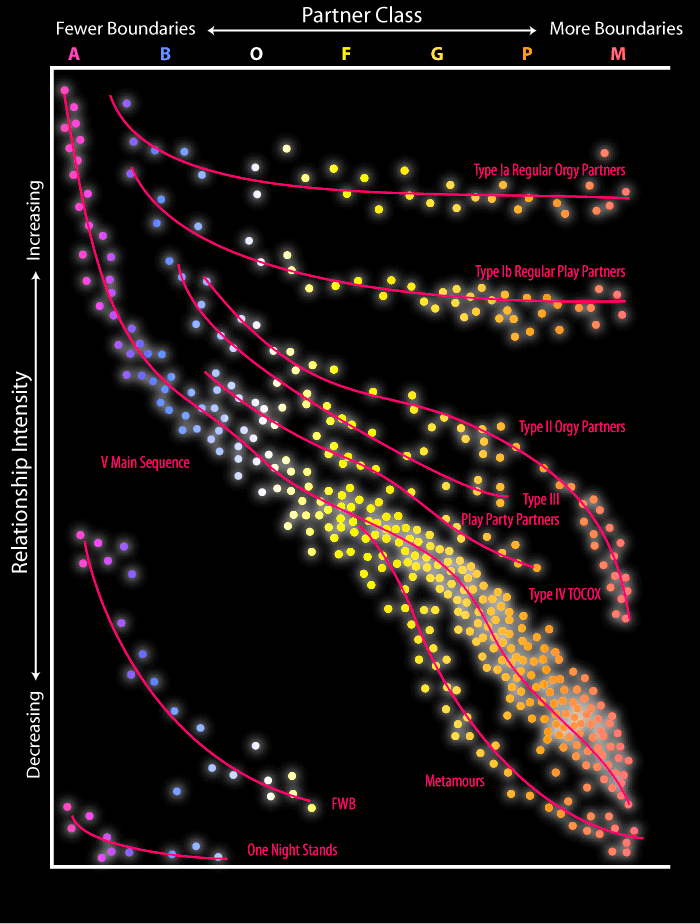
In the study of stellar evolution, there is this concept called the main sequence, a well-defined band that you see whenever you survey all the stars in the sky and plot their color on one axis and their brightness on the other. Not all stars fall into the main sequence, but the vast majority do; there’s even a lovely image of the graph here.

It seems the same is true of relationships. Stellar evolution and stellar nucleosynthesis map with remarkable fidelity onto relationships, I’ve observed, with a plot of “intensity of relationship” (as a function of emotional investment and expectation of continuity) vs. “sexual boundaries” showing patterns startlingly similar to the main sequence. At least to me.

So for example if you plot sexual boundaries horizontally and relationship intensity vertically, you might see something like this:

The sexual boundaries increase from left to right, with the classifications as:

A: Anything goes. Unbarriered, unprotected, full-on squishy fluid-bonded sex.
B: Barriers for anal and PIV sex
O: Unbarriered oral; no penetrative sex.
F: Fisting and/or fingering without barriers; barriers for anything else.
G: Gloves for fingering; no wet and squishy contact, even manual, without them.
P: Pants stay on; above-the-pants contact allows.
M: Makeout partners–no removing of clothing.

Now, not all the partners one can have fall in the main sequence. Along the top of the graph, we see partners distributed in Type Ia and Type Ib classifications: these are people you will schedule regular orgies with or a regular BDSM play relationship with, which may or may not involve sex (directly) but do involve a high level of emotional investment and commitment. Some of these folks might even be considered “family.”

If you’re part of the sex-positive community, you might go to orgies or play parties on a regular basis, and see the same folks over and over. These are folks you don’t necessarily have squishy sex with, but you might have some sort of irregular or semi-regular play/makeout relationship with. There’s not necessarily a high level of emotional investment, but you notice when you show up to a party and they aren’t there.

Type IV partners are most commonly found in poly relationships. These are the “Too Complicated To Explain” partners–they’re not necessarily partner partners, and they’re not necessarily part of the family, but they’re not not partners either…

A branch from the main sequence sometimes occurs for metamours, who a person might have some sort of sexual relationship with, but might not continue if that person’s partner breaks up with that person, but then again, sometimes these relationships do continue on their own, and…yeah, it’s complicated. Past a certain point, it’s not always clear from a single partner whether that person is main sequence or metamour.

A scattering of partners exist with a high level of sexual contact but a low level of relationship investment. These partners tend to scatter along the Friends with Benefits and One-Night Stand axes.

File under “should be obvious”…

From an email I just made on a polyamory-related list:

I’ve found that a lot of my relationship fears vanish and my relationships become a lot stronger and more healthy when I start with certain assumptions: namely, that my partners want to be with me, that they see value in me, that when given the opportunity they will seek to make choices that honor our commitments and cherish the relationship we’re in, that they are honest and can be counted on to behave with integrity, and that when they say they love me, it’s because they do.

Often it seems to me that people base relationship rules on the assumption that their partners can not be trusted, that if given free action their partners will not choose to honor and nurture their relationships, and that their partners are harboring secret agendas involving dumping them when someone ‘better’ (whatever that means) comes along. I can’t quite fathom building a relationship on those assumptions, nor why someone would want to remain in a relationship where they were true.

Ahh, the mysteries of life.

Epiphany and George Sodini

“You’re polyamorous? That’s so greedy!”

I’ve heard that about a zillion and eleventy-four times, and it’s totally baffled me every single time I’ve heard it. I hae never, ever once quite understood how the notion that my partners are free to form attachments to and relationships with anyone they choose, and how I am free to form attachments to and relationships with, anyone we choose so long as we all choose to treat one another with reciprocal respect and kindness, is “greedy.”

Quite the opposite, in fact. To me, “you are my partner, and therefore I forbid you to make your own choices about relationship and I forbid you to have certain kinds of relationships with anyone except me” seems more than a little greedy.

It took an asshole with a gun to make me understand where “You’re polyamorous? That’s so greedy!” comes from.


This is George. George is, or was, an asshole. In the unlikely event that you’re not aware of him, George spent many, many years unable to get any woman to go out with him, so George decided to solve the problem by walking into a women’s fitness center, shooting the place up, killing a bunch of women and injuring a bunch more, and then shooting himself.
So, yeah, asshole.

This particular asshole kept a long, rambling online journal just stuffed full of the most boggling array of misunderstandings and misapprehensions one could ever expect to see outside of a Creation Science seminar. His site is currently offline (which I think is a shame; the insight it offers into the mind of a profoundly fucked-up person is worth preservation), but bits of it have been picked up and scattered all over the Net. Those barely coherent noodlings on misogyny and racism are, paradoxically, what gave me the insight into what a person who says “You’re polyamorous? That’s so greedy!” is actually saying.


George’s Web site is kaput, but nothing on the Internet ever really dies. There are Web sites all over the place which have picked up and preserved some of his journal entries, and it’s quite a sewer of racism and misogyny…but what struck me is how ordinary his particular flavor of misogyny is. what’s really scary is that George’s rants are not too far from the sort of stuff you see in places like LiveJournal, OK Cupid, and other blogs and dating sites every day.

Take this, for instance:

Moving into Christmas again. No girlfriend since 1984, last Christmas with Pam was in 1983. Who knows why. I am not ugly or too weird. No sex since July 1990 either (I was 29). No shit! Over eighteen years ago. And did it maybe only 50-75 times in my life.

Or this:

Just got back from tanning, been doing this for a while. No gym today, my elbow is sore again. I actually look good. I dress good, am clean-shaven, bathe, touch of cologne – yet 30 million women rejected me – over an 18 or 25-year period. That is how I see it. Thirty million is my rough guesstimate of how many desirable single women there are. A man needs a woman for confidence. He gets a boost on the job, career, with other men, and everywhere else when he knows inside he has someone to spend the night with and who is also a friend. This type of life I see is a closed world with me specifically and totally excluded. Every other guy does this successfully to a degree.

Or this little gem:

I was reading several posts on different forums and it seems many teenage girls have sex frequently. One 16 year old does it usually three times a day with her boyfriend. So, err, after a month of that, this little hoe has had more sex than ME in my LIFE, and I am 48. One more reason. Thanks for nada, bitches! Bye.

I spent quite a bit of time talking with my sweetie figmentj about George; these journal quotes got me to thinking about the nature of interpersonal relationships and expectations, and she’s an awesome sounding board for that sort of cognitive noodling.

The things he wrote reek to me of…well, not objectification, precisely, but certainly of a sense of entitlement. There’s also a very deep sense of disconnect; I don’t know if he ever really thought of women as being quite fully human.

And I don’t think he’s alone in that.


There are two things in particular that jumped out at me, reading these journal entries. The first is the idea that “getting” a woman is a bit like getting a car: it’s a quantifiable process. To get a car, you go into the dealership, the dealer looks at your credit rating, you pick a car that matches the amount of money you have available for a down payment, and as long as you have enough money and your credit rating is OK, you leave with a car. It’s an easy, defined process.

A lot of men seem to think the same thing is true of getting a woman. As long as you are not “ugly or too weird” and you have enough money, you can get a woman. You pick out someone who you can afford and are attractive enough to have; she looks to make sure you’re not too weird, and as long as there’s nothing wrong with you, you go home with her.

This might not be objectification per se, but it’s awfully close–it seems, I think, to see women as an undifferentiated mass, rather than as a group of individuals, each of whom has her own ideas about what she wants.

The second part that struck me is “A man needs a woman for confidence. He gets a boost on the job, career, with other men, and everywhere else when he knows inside he has someone to spend the night with and who is also a friend.” It reeks of an entitlement perspective; I need you for the things you do for me, and I deserve to have those things. A man needs a toaster to make toast, a coffee maker to make coffee, a computer to get connected to the Internet, and a woman for confidence. As long as he has money and is not too weird, he deserves to be able to have these things.

And seriously, I see this kind of thinking just about everywhere. “How can I get a woman to have sex with me?” is a popular refrain on the Internet. (To a person who thinks it’s a question of “getting” a woman to do what he wants her to do, I suspect the answer is likely to be incomprehensible; you don’t “get” a woman to sleep with you, you become a person who is interesting to other people, and those other people will then…er, find you interesting.)


“You’re polyamorous? That’s so greedy!” The statement is loaded down with exactly the same sort of world view that I see clearly in George’s writing. There’s an entire world of preconceptions and assumptions bundled up in those five words.

It starts, I think, with a group conception of women that sees the world’s females as an undifferentiated mass resource; there are about as many women as men, and women expect certain things in exchange for companionship and sex–it’s simply a question of giving women what they expect and you, too, can walk off the lot with a woman of your own, whose attractiveness depends on how much currency you have to spend. Each man is entitled to a woman by right.

Polyamory upsets the balance. People with multiple women are somehow walking into a dealership with no cash and no credit but still driving off the lot with a bunch of cars; they’ve discovered some kind of way to hack the system, to upset the economic exchange, leaving fewer women for the other men who deserve them.

And men shouldn’t be allowed to have a woman if they are too weird. You accept social norms and adopt normative behaviors in exchange for having a woman. That’s the way the system works. (In a very literal sense. I actually had a person tell me recently that he couldn’t figure out how a weird, creepy-looking guy like me could even “get” one woman to sleep with him, much less several. How do you “get” a dealer to give you a car when you don’t have credit? What manner of black magic could persuade a woman to have sex with a man who is too weird?)

Okay, so maybe there’s a bit of “well, duh” going on here. But seriously, I was so busy being baffled by the “WTF is selfish about allowing a partner to make her own choices about her lovers?” to see the “women are a rationed commodity and if you keep taking all of them that leaves fewer for me; I’m not too ugly or too weird, so you’re taking away something I am entitled to have a share of myself.”

Honestly, I do think there has to be just a pinch of objectification and more than a little sense of entitlement to make a statement like “polyamory is selfish.” It would never occur to someone who doesn’t see women as some kind of amorphous group; a person who sees women as a collection of individuals would be more inclined to say “A woman who wants a polyamorous relationship would be a poor match for me, so a polyamorous person isn’t taking anything away from me; I wouldn’t choose these women even if they were single, because we have different relationship goals.”

George believed that he was entitled to have a woman, because he wasn’t too weird and because every man needs a woman for confidence. I imagine that the smell of misogyny probably oozed off of him; he wasn’t rejected by women as a group, he was rejected by each individual woman unlucky enough to cross paths with him.

So thank you, George Sodini. You’re an asshole who exemplifies a certain kind of misogyny so clearly that you make other misogynists more comprehensible.

But you’re still an asshole.

Writer’s Block: There Can Be Only One

What a strange question.

Does monogamy exist? Of course it does. Am I monogamous? Absolutely not.

I believe that choices in life are most meaningful when they are choices, consciously made rather than accepted as defaults. I believe there are a great many people who have thought about it and decided that monogamy is what’s best for them, a great many other people who have thought about it and concluded that non-monogamy in one form or another works best for them, and some folks who don’t much think about it at all and are monogamous because they think that’s the only option available.

Life is one of those things that gets better when it’s lived consciously.

Tracking the Unicorn

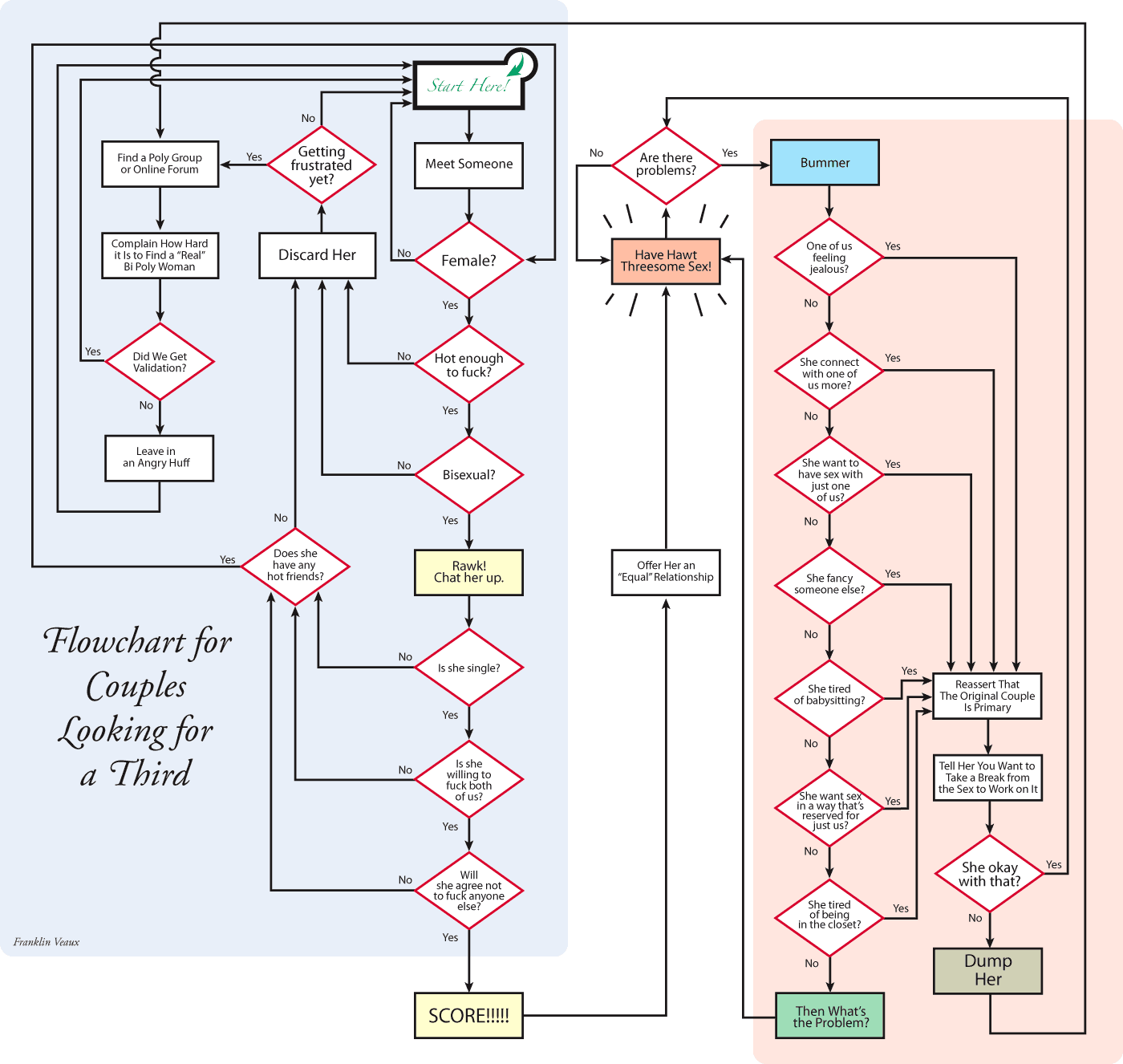
Anyone who’s been around in the poly community has met, on at least 724 occasions, a married couple looking for a hot bisexual woman to come be their “third.”

In the interests of presenting a public service, I’ve prepared this handy guide to unicorn hunting–a flowchart for people looking for that hot bi babe. You can all thank me later.

This actually popped into my head while I was in the shower this morning, and refused to quit bugging me ’til I did something about it. Clicky on the picture to embiggen.

Some thoughts on fairness, polyamory, and relationships

“It’s not fair!”

Below a certain age, we hear people say this all the time. Past a certain age, people rarely say it any more. It’s not just because it gets beaten out with the litany of “life’s not fair” that almost always follows “it’s not fair!” (and in truth, I’ve always thought “life’s not fair” is a pretty lame way to follow up a complaint of unfairness anyway); rather, as we get older, and our vision gets longer, we learn that fairness operates best on a global, not a local, scale. Sure, if you did the dishes last night and it’s your sister’s turn to do the dishes tonight, but she isn’t doing the dishes because she just got back from the dentist, it may seem unfair to you from a purely selfish perspective…but really, would you want to trade places with her? And if you were the one who’d just been through the root canal, wouldn’t you appreciate it if you could give the dishes a miss tonight yourself? These things tend to even out in the end; sometimes, compassion dictates that the rigid schedule of dishwashing responsibility should change.

By the time we’re adults, we’ve all pretty much figured this out. That, or we’ve just given in to exhaustion and stopped worrying quite so much about what’s “fair” on such a granular level.

Yet in relationships, and especially in polyamorous relationships, the little whisperings of our five-year-old selves sometimes poke through our consciousness and say “It’s not fair!” when things don’t go the way we expect them to go.

Even when we don’t talk about our expectations. Even when we know our expectations are silly. Hell, sometimes even when what’s happening is not only fair, but most excellent as well.


When you’re dealing with human beings, issues of ‘fairness’ sometimes go right out the window. People change, needs change, but often our notions about what is ‘fair’ remain static. Sometimes, our notions of what’s ‘fair’ become so deeply buried that we’re not always even aware of them, or aware of the expectations we carry around with is in regards to what’s fair and what’s not fair.

It pays to remember this, especially when your inner five-year-old starts saying “It’s not fair!” in your ear. Most especially when you’re polyamorous.

I’m not even talking about the obvious situations that make people say “It’s not fair!”, such as situations where one person is an extrovert who finds it easy to meet new people and one person’s an introvert who finds it difficult to meet new people, though I’ve certainly heard many folks cry “It’s not fair!” in situations like that. (“It’s not fair that he seems to have prospective partners lining up around the block and I can’t meet anyone!”) It’s certainly true that some folks find it easier to go out and interact with people than other folks do, but that’s something we all have a measure of control over, after all. At the end of te day, wht would be more fair? Forbidding one’s extroverted partner from being an extrovert?

Nor am I talking about situations where a person who is perhaps of a more monogamous bent says of a polyamorous partner, “It’s not fair that she gets to have two lovers and I only have one!” If you want more than one lover, that’s up to you; if you don’t want more than one lover, then it’s hard to cry “unfair” when you’re involved with someone who does; and in the end, it pays to start relationships with people whose goal in relationship is similar to your own.

I’m talking about the “It’s not fair!” monster that’s far more subtle, and wriggles its way deep into the murk of your default, unexamined assumptions and unvoiced expectations.


This sense of fairness can sneak up on you when you don’t really expect it, during times when you feel that you’ve gone above and beyond the call of duty for a relationship partner and you think that either your own efforts aren’t being rewarded the way you expect (even if you might think you don’t have any expectation of reward at all!) or that someone else is somehow benefitting from your work in ways you didn’t expect.

By way of one real-world example, many years ago I met a lovely young woman with whom I became close friends…eventually.

I say “eventually” because when I first met her, she was extremely introverted, had difficulty opening up to others, and had a lot of trouble communicating or trusting folks around her. She was unpartnered at the time, largely because of this. There were a lot of things about her I liked and admired, so I spent a considerable amount of time and effort in getting to know her and encouraging her to open up to me–a nontrivial investment in a relationship with a person who was never even a lover.

Some time later, at least partly because of the experiences she had with me, she found it much easier to talk to people and to extend herself to others, and she ended up finding a boyfriend. Would it have been reasonable for me to be upset, and to say “Hey, look, I put in all the work here, and now someone else gets the benefit?” No, but I do know people who seemed to feel that I should have responded that way.

Another real-world example: Some people I’ve spoken to online were part of a polyamorous triad that included a woman who was facing major upheaval in her life. She’d just come out of a bitter divorce, and was feeling emotionally and financially vulnerable. She needed, and asked for, a great deal of support from her partners, which they offered without question. Later, when she found herself on more solid footing and felt emotionally ready to engage the world again, she began exploring a new relationship, which made her partners feel put out; they felt that since they had supported her through her divorce, they should have some more input in how quickly and to what extent any new partnerships formed.


The common thread in these examples is the idea “I have done something for someone, and I should be the person who benefits from that work.” Or, perhaps more simply, “It’s not fair! Look at what I had to go through to get what I got; why should other people get it more easily? How come I had to do all this work and the next person to come down the pike didn’t?”

And the answer, of course, is “nobody owes you for the experiences that you have had. In fact, you have done something wonderful; you have helped to bring down barriers in someone’s heart, and helped that person find a place where they can now experience the world more fully and engage others in a way that they couldn’t before. Go you!”

In other words, you’ve made a positive difference in someone’s life…and you’re now upset because you feel it’s not fair that other folks get to benefit from that? Well, that’s what happens when you make someone’s life better; the whole world gets just a little bit brighter. Why would anyone want to be stingy about that?

I think, when feelings like this arise (and they do in lots of little ways, all the time), the key thing to keep in mind is this: “Have I done what I did because I expected something in return? Would I go back in time and tell the other person, ‘I will only help you if you give me something I want’?” If the answer is “no,” then let it go.

It’s sneaky, sometimes, how the things we do can come attached to expectations we might not even realize that we have until they’re not met. And it’s important to guard carefully against these unspoken, unacknowledged expectations.


I’m not saying that issues of fairness have no place in relationships, mind you. The fairness that is important in relationships isn’t the tit-for-tat “I did the dishes last night, and we’re supposed to take turns, so it isn’t fair that I have to do them tonight too!” or the “I worked hard to carry Sally through a difficult emotional time, so it should be hard for anyone else to get close to her too!” variety.

In fact, sometimes a tit-for-tat approach to fairness creates a situation that’s decidedly unfair. Another real-world example, which I’ve used before: Many years ago, I knew a married couple that was exploring polyamory. The wife had a girlfriend for many years, but when he finally found a girlfriend, the wife became overwhelmingly, irrationally jealous. After dealing with this jealousy in the typical fashion for a while (you know, passive-aggressive acting out, that sort of thing), she finally went to him and told him, look, I want you to dump your girlfriend. I’ll dump my other partner too, so it’ll be fair.

Three broken hearts for the price of one is a peculiar definition of the word “fair” in my book; which illustrates yet another important point: symmetry is not the same thing as fairness.

Personally, the kind of fairness that really counts is the kind that begins with compassion. Doing the dishes two days in a row because your sister has just had a root canal is compassionate (I’ve had a root canal, and believe me, the last thing you want to be doing when the anaesthetic starts to wear off is standing upright). On the other hand, saying “I’ll dump my partner of many years just to get you to dump yours” is hardly compassionate.

Fairness matters. Symmetry is not the same thing as fairness; fairness means saying things like “I realize that my own insecurity belongs to me, so I will not use it as a blunt instrument on you, nor expect you to plot your life around it. I may, however, ask you to talk to me while I’m dealing with it.”

This isn’t the kind of fairness our mental five-year-old understands. Our inner five-year-old is far more likely to be worried about someone else getting something that we don’t have, or getting something for a lower “price” than we paid for it. At the end of the day, though, our mental five-year-old isn’t really likely to make our lives better, no matter how much of a fuss he puts up.

Some thoughts on bringing down barriers

On another forum I read, a person had asked for help with a poly situation he was confronting.

Seems that his wife of many years had just started exploring the notion of having a partner outside their marriage (with his knowledge and blessing), and her new lover had managed to do some things with her sexually that totally blew her out of the water and circumvented some barriers that had always been present in their marriage.

The person posting about this was very distressed and upset about it, to the point where he was considering asking his wife to cut things off with her new lover.

And I think that’s really interesting. Because upon reading his post, my first thought was “Dude! ROCK! You just hit the poly lotto jackpot! This is exactly one of the best things that can happen in a poly relationship!”


See, here’s the deal. If one of my partners has an amazing, mind-blowing, life-altering sexual experience with some other guy, particularly an mind-blowing, life-altering sexual experience that brings down some barrier or opens some new door (and yes, this has happened), I’m all like, awesome!

For me, one of the many (many!) benefits to polyamory is that it improves my sex life.

And I don’t mean “improves my sex life” in the sense of “lets me sleep with a bunch of women,” but rather “improves my sex life” in the sense of “offers new avenues of exploration and new ways to find intimacy with my lover.”

See, no matter how many things you can think of to do sexually (and as a seasoned, veteran pervert, I can think of quite a few), and no matter what you explore with your lover, the fact is that there will always be things that didn’t occur to you and there will always be things that you don’t explore. That’s the way it goes; as human beings, we can not possibly ever do it all–not even if we live to be a thousand years old.

Because of that, there will always be doorways that we don’t see.

This is especially true in relationships where some kind of barrier exists between the people involved. These barriers might take many forms–perhaps issues with relaxing and letting go during sex, perhaps problems with sexual communication or expectations, whatever.

When some new lover arrives on the scene, and explores something new or finds some way to bypass those boundaries, everyone wins. If one of my partners has a lover who gives her this awesome experience, then she has something she can take back into her relationship with me–“Hey Franklin! Check this out! If you do this, and then this and then this over here, then my body does this amazing thing! Isn’t that cool?”

But more importantly, if someone is able to communicate with one of my lovers on a level that I never have, or finds a way around some kind of barrier that’s always existed between us, then that person has just offered a gift of incalculable value. He’s just created a roadmap to greater intimacy with my partner, by showing both of us that this barrier can be circumvented, and showing us how.

Now, it’s true that some issues between people might be specific and unique to them. Even so, sometimes all it takes to begin to work on them anew is the feeling that it is possible to have a sexual relationship in which this whatever-it-is problem doesn’t exist; funny thing about people is that when you show them something’s possible, often that’s all it takes for them to find a way to do it.

Plus, y’know, I really dig my partners, and I like when they’re happy.

So to me, when a lover has some amazing, mind-blowing experience with someone else, that’s a cause for celebration, rather than fear and angst. That seems to be a minority opinion, though–and that’s a damn shame. Seems to me life is just a whole lot better when you’re not all like “I have to be the best lover my partner has ever had or OMFG FAIL and I’m now worthless as a human being and she doesn’t need me any more and brain weasel brain weasel brain weasel.”

Yet Another List o’ Linky-Links

Once again my Web browser is devouring half of my system’s available RAM and more swap space than you can shake a stick at, so it’s time once again for a long list of links.

Including naturally enough, some Watchmen-related links.

I’ve got several real posts brewing, none of which I’ve actually had time to write (just got home from the office, if that’s any indication), so without further ado, here we go!

Science

Obama to lift restrictions on stem-cell research

Obama Science Memo Goes Beyond Stem Cells

If Obama accomplishes absolutely nothing else in his entire term in office, if he does nothing to stop the pointless and expensive war in Iraq or right the capsizing economy, then his presidency will still be an epic win. Abandoning religious ideology in favor of actual, genuine science is one of the most important things this nation can do. First World superpowers keep their position only by dint of their technological and scientific basis, yet in the past eight years under anti-intellectual Republican rule, the US slipped to #22 in the world in terms of financial support for basic scientific research.

Rewiring the Brain: Inside the New Science of Neuroengineering

This is an incredibly exciting time to live in. We’re closing in on being able to understand and manipulate the stuff of the universe on the smallest scale possible, and we’re also closing in on the ability to understand in ways never before possible the most fundamental things that make us who we are. These areas of exploration bring incredible promise.

New Scientist: Humans may be primed to believe in creation

I’ve written before about how the brain is not an organ of thought so much as an organ for generating beliefs–a “belief engine,” if you will–and this research shows that a predisposition belief in purpose is a very strong component of that belief engine.

Missing Link Between Fructose, Insulin Resistance Found

For the first time, a concrete, documented mechanism between fructose and fructose-containing sweeteners and diabetes is uncovered.

Sociology

Catholic Church excommunicates doctors who perform lifesaving emergency abortion on 9-year-old rape victim; take no action against her rapist

The Vatican uses the line “life must always be protected” to justify the excommunication, in apparent ignorance of the irony that without the abortion, the young rape victim, and the babies, would have died.

Bush: ‘Sanctity of Human Life Day’

In the last days of his Administration, former President Bush declared Jan. 18 to be “National Sanctity of Human Life Day.” Apparently, the sanctity of human life doesn’t apply to the citizens of Middle Eastern nations that happen to be geographically close to other nations that were responsible for terrorist attacks on us.

Steve Pavlina: 2009 Focus – Intimate Relationships

So there’s this guy who is…well, I’m not exactly sure what he is. He seems to be a motivational coach (or “personal development” coach, whatever that is). Anyway, he writes a blog, and in his blog he says that 2009 is the year he’s going to explore polyamory. And he linked to my site on his list of resources.

Bizarre

Photos of abandoned Russian ships frozen in ice

I really, really, really, really want to visit this place. The Russians have always been amazing at taking urban decay to the next level, and this place is just beautiful.

The Most Amazing Star Trek Collectible of All Time

If by “amazing” you mean “horrifying beyond all human reason.” The commentary is priceless.

Watchmen condoms: We’re society’s only protection

If you want your schlong to look just like Dr. Manhattan’s, now’s your chance! These blue condoms come in a flip-top case with the smiley face on the front, and …yeah. I have nothing else to add.

Long List o Linky-Links

Since my Web browser currently has a zillion pages open (and is consuming mass quantities of RAM as a result), and since I can’t use the browser on my iPhone because the maximum possible number of pages is open, it’s time once again to share the wealth and post another Grand List of Linky-Links.

In today’s assortment, we have a wide variety of links for your edification and viewing pleasure.

Ready? Here we go!

Society & Politics

New Scientist: Conservatives are biggest consumers of porn

Not that it’s really a surprise to anyone. I’ve long suspected that many social conservatives fall into one of two broad camps: closeted self-loathers, and people who are really only concerned with the appearance of propriety rather than with actual propriety.

Business Week: Portland, Oregon is America’s unhappiest city

Uh-oh. And I’m planning to move there shortly!

Lesbian Nation: Chronicles of the Lesbian Separatist Movement

In the seventies, a movement arose among lesbians who believed that the key to sexual and social freedom lay in withdrawing entirely from American society–including, in many cases, refusing to interact with or even speak to men. Battle too long, and you become the thing you’re fighting against.

Science

Will You Perceive the Event that Kills You?

My favorite link on the list. Will you even be aware of the thing that ends your life? The human sensory apparatus and nervious system are so slow that we are constantly living in the past–about 300-500 milliseconds in the past, to be exact. Many of the things that can kill you do so in less time than that. Interesting stuff, including a rundown of the sequence of events in a car crash, and how far behind your awareness of those events will lag.

Researchers solve mystery of deep-sea fish

Meet the barreleye–a fish with nostrils that look like eyes, a transparent head, and tubular eyes that swivel up and down entirely inside its head. Man, there is some seriously weird stuff in the deep ocean.

Natural selection: Darwin’s God-killer

Two centuries after Origin of Species and people STILL don’t actually know what evolution is. (Hint: If you’re thinking “survival of the fittest,” you ain’t really got it.) Is this idea really a “god-killer”? Of course not. But it does demolish one very specific notion of god–the idea that the world was created in six literal 24-hour days exactly six thousand, four hundred and some odd years ago.

Junkfood Science: Why we think overeating causes obesity

There are many things we all know are true that actually aren’t. Turns out that the notion that people are overweight simply because they eat too much is one of them. The history of a fascinating study on food and food deprivation, which probably would not be possible today ’cause it would violate ethical guidelines on human research.

Globe and Mail: Canadian researchers turn skin cells into stem cells

The new technique is easier and safer than previous techniques to coax mature cells back into becoming stem cells.

Mermaid Dream Comes True Thanks to Weta

Weta Digital, the company that did the special effects for the Lord of the Rings movies, has a lot of experience with advanced prosthetic effects. So when a girl with no legs approached them with the idea of making her a functional mermaid prosthetic, they said “Sure!”

2009: Shaping up to be a bad year for anti-vaccinationists

Everything under the sun has its conspiracy theorists. Terrorism has its 9/11 “truthers.” The space program has its moon hoax conspiracy nutters. Geologists have the flat-earthers and the young-earthers to contend with. And the medical community has, among others, the anti-vaccination nutters. Difference is, the moon hoaxers and flat-earthers don’t put other people’s lives at risk. 2009 looks to be a bad year for this particular breed of nutter.

Sex and Relationships

The Single Best Working Assumption for Drama-Free Relationships

Sometimes it’s the simple things that are most effective.

Control Tower: The Hot Bi Babe

Yes, I know it’s an old article, but Mistress Matisse lays it on the line about why those zillions of married poly-in-theory couples will not likely find that hot bisexual woman they’re looking for.

And finally, here’s an old video circulating YouTube about the evils of pornography, though it has an interesting historical footnote:

The footnote? The person who made this video is none other than Charles Keating.

Keating, for those who don’t remember him, was an anti-sex, anti-porn moral crusader for many years, and joined President Reagan’s Meese Commission on Pornography in an attempt to lobby for tough anti-porn laws.

He later went on to embezzle about $1.2 billion from Lincoln Savings and Loan, singlehandedly triggering the collapse of the entire S&L industry. To Keating, you see, porn = immoral, stealing the life savings from working families = perfectly moral.

On Re-Evaluating Dating and Relationships

My sweetie figmentj has just posted what I think is an awesome essay on the nature of dating and the implications of a conventional model of dating in an unconventional relationship world. Here’s a teaser:

In our generally monogamous culture, standard dating is viewed as a series of auditions. If you pass the first, then you get a second date. If you pass that one, you get a third date (and possibly sex, if we really want to go with the cliched model). Eventually you pass enough auditions to have a relationship, and if that goes well, you get married and win the game. Most of the poly people I know, myself included, started out being inundated with the standard model, and eventually became poly later. We learned to let go of the idea that there is One Magical Person for everyone, and the purpose of dating is to find them. But the feelings of being evaluated and passing or failing and internalizing what that means seemed to hang around.

Go read the rest. It’s good stuff.