Web projects ahoy!

Occasionally, visitors to the polyamory section of my Web site at www.xeromag.com ask me if I can move the poly information to a new domain, so they can share it with friends or family members who might not be comfortable with the rest of the content on the site.

I am pleased to announce the creation of a new Web site dedicated only to polyamory, More Than Two. The More Than Two site contains all the pages from the polyamory section of xeromag.com, rearranged in a more logical order, and several new pages as well. The existing pages on the Xeromag site can be found in both places, but new articles and essays about polyamory will be found only on More Than Two.


In kink news, JT’s Stockroom is having a sale on violet wands; just $110 for a complete set, which is an amazing price. I’ve placed a link to the sale, as well as a $6 off coupon for my sex game Onyx, on the Special Offers page of my site Symtoys.com.

And speaking of Symtoys, I’ve finally created an eBook of the first part of the porn story I talked about in my Analysis of User-Generated Replies to Porn Stories of Non-Consensual Sex blog post. The story, which is rather longer than I remembered, has been extensively broken into two full-length novels, the second of which has an all-new ending. The first part is available in PDF and as a Kindle and Nook eBook, and the second (and more stories besides) will be available soon.


And finally, just a reminder: zaiah and I are still looking for artists to work with us on our tentacle monster hentai Tarot deck. If this sounds like a project you or someone you like might be interested in, let me know!

Secondary relationships

In polyamorous circles, there are many people who want only “secondary” relationships outside of their existing “primary” relationship.

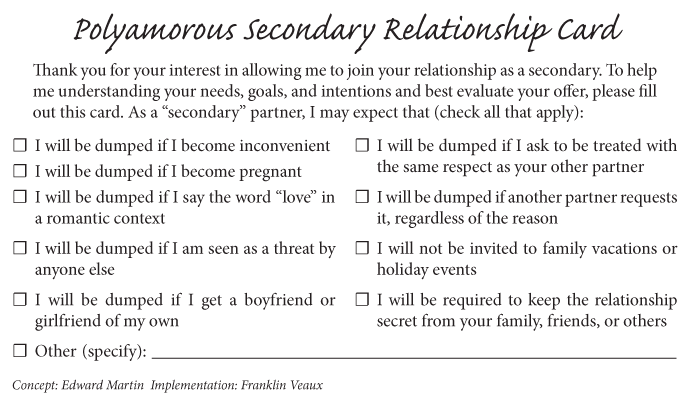
However, the term “secondary” is confusing and often means different things to different people. In the interests of helping clarify some of that confusion, my friend Edward recently proposed a short questionnaire that might be useful to help get everyone on the same page about what exactly is meant by the term “secondary.” I’ve taken his idea and turned it into a handy 3×5 index card, which you can print out and hand to prospective suitors. You can even download a PDF version of the card here.

Map of Non-Monogamy Re-Revisited

[Edit] There is yet another update to the map here. You can also find my book on non-monogamy here.

Because my brain is totally broken…

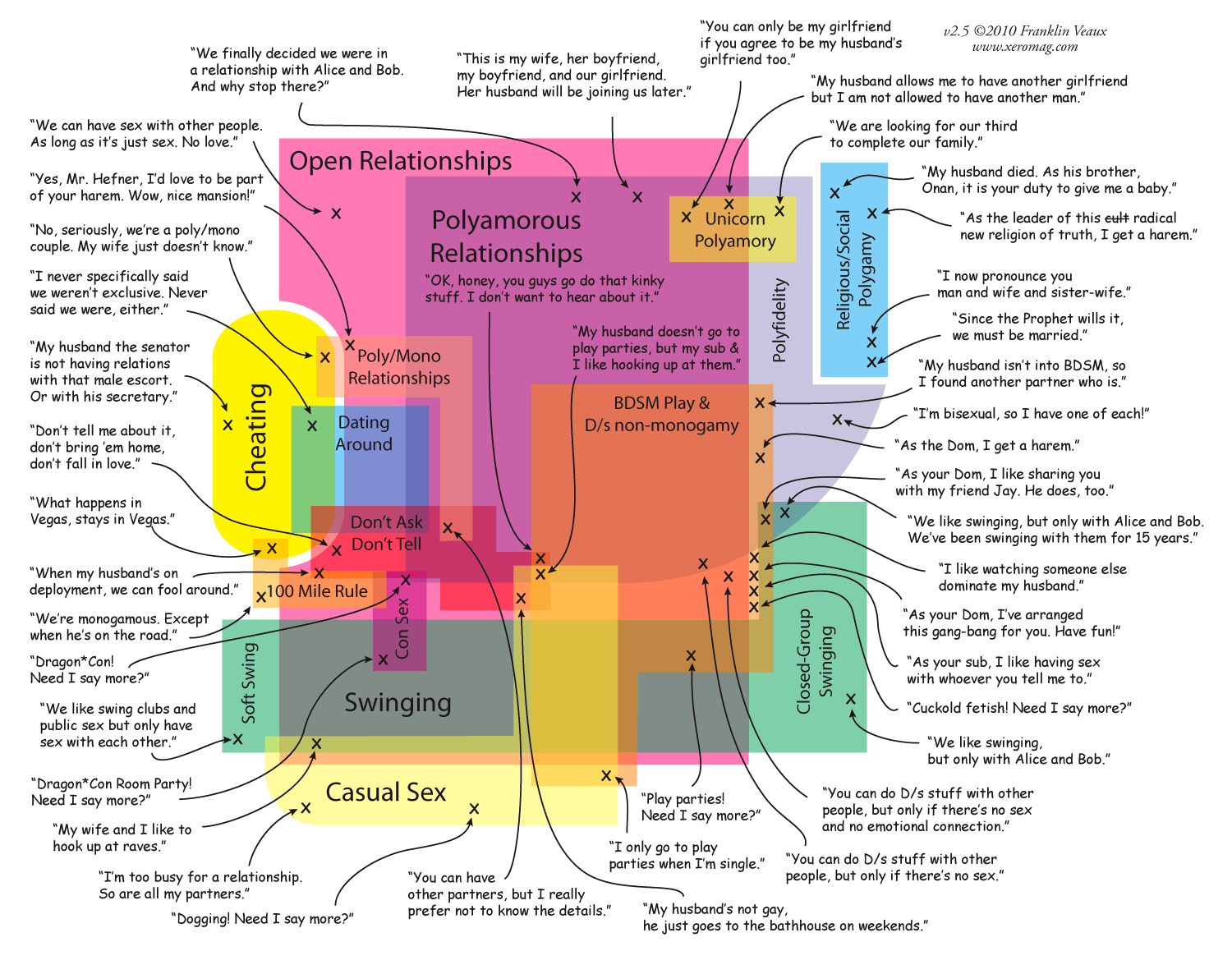
I woke up very, very early this morning and couldn’t get back to sleep, because it suddenly occurred to me that entire classes of non-monogamy were missing from the last version I did. Plus, I thought of a lot more edge cases. And since the only way I can get this stuff out of my head is to put it on the Interwebs, here it is!

As before, click for a bigger version. A much, much bigger version, that will pulverize your bandwidth the way Chuck Norris pulverizes your pelvis. Or something. I don’t know.

Sexual Informatics: Non-Monogamy Revisited

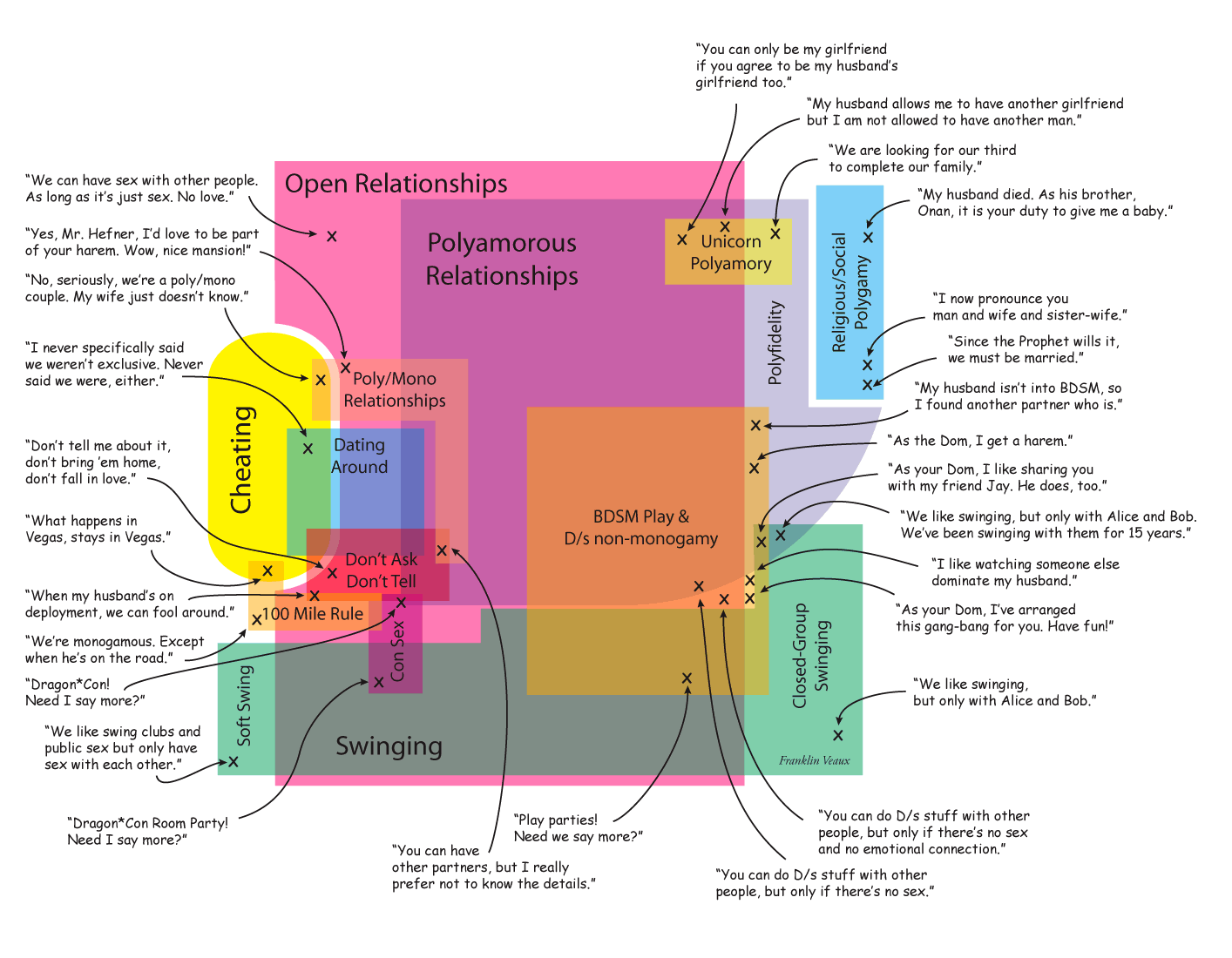
A while back, I did a graphic of the various overlapping types of non-monogamous relationships. I’ve re-visited that chart, with some revisions and additions, and at zaiah‘s suggestion I’ve added some specific tags to various parts of the graph.

Click for a bigger version. A much, much bigger version.

Some thoughts about assumptions in relationships

A friend of mine on a different forum remarked recently that we live in a society that doesn’t teach us how to end romantic relationships.

I’ve been chewing on that for a while, and I think it’s true but doesn’t go far enough. We live in a society that doesn’t teach us how to nurture relationships OR end relationships. In fact, it doesn’t even teach us how to START relationships. We seem to hold this notion, as a society, that if you are single and you meet someone you share a connection with, that means you’re supposed to start dating, without any regard as to whether or not you might be remotely compatible. In fact, I’ve even encountered folks who sneer at the notion of “compatibility,” saying that if you REALLY love each other, you should be able to work out any difference you have.

This is, I think, a very toxic idea.

That started me down the path of thinking about the sorts of assumptions we make about our partners, which is something I’ve written about a few times before. I definitely think that many folks carry around with them some pretty poisonous assumptions about their partners, without even thinking about it, so that’s started me setting out some of the productive and non-productive premises on which to build a relationship.

Destructive assumptions to make in a relationship

– My partner doesn’t REALLY love me–not really.

– Given the choice, if someone ‘better’ comes along, my partner would prefer that person over me, and would rather be with that person.

– My partner says things like “I like being with you,” “I find you sexy,” “I am attracted to you,” and “I value our relationship” because those are the things you’re supposed to say. They don’t really mean anything.

– My partner’s exes are dangerous to me because I believe that my partner would secretly prefer to be with them than with me. Anyone my partner finds attractive is dangerous to me because my patner would secretly prefer to be with that person rather than me.

– If I want to preserve my relationship with my partner, I need to keep him or her on a short leash. If given free rein to do whatever he or she wants, my partner would leave me.

– I am not pretty enough/not smart enough/not sexy enough/whatever for my partner. If someone prettier/sexier/whatever comes along, I’m screwed.

– I can not talk openly to my partner about things like my own sexual desires, especially if I think they’re weird or unusual, because if my partner thinks I’m too weird he or she will dump me.

– If my partner masturbates or watches porn, it means I am not enough. I am a failure; I have not done my job in pleasing my partner.

– If my partner talks to someone of the same sex I am, it means he or she is trying to replace me.

– My partner is with me because I tricked him or her, or because I was convenient at the time, or because I was the only thing available, or whatever.

Constructive assumptions to make in a relationship

– My partner loves and cherishes me, and wants to be with me.

– My partner has chosen to be with me because he or she wants to be with me. I offer value to my partner, and given a choice, my partner would still choose to be with me.

– My partner says things like “I like being with you,” “I find you sexy,” “I am attracted to you,” and “I value our relationship” because those things are true.

– My partner is with me because I add value to his or her life. Given a choice, my partner would still choose to be with me.

– Given free rein to make any choice he or she wanted, my partner would choose to be with me. In reality, my partner HAS free rein; he or she could find a way to leave me, if that’s what he or she wanted to do. The fact that my partner is still here should tell me something!

– My partner finds me attractive and worthwhile. I add value to my partner’s life which nobody else can replace.

– A healthy sex life depends on open communication. My partner values me and wants to have a healthy relationship with me; I can count on my partner to listen to what I have to say with respect and compassion.

– Not everything my partner does is about me. The things my partner does are not always a reflection on me. If my partner looks at porn or masturbates, that has nothing to do with me at all.

– Not everything is about sex. My partner can talk to someone of the appropriate sex, or even be friends with someone of the appropriate sex, without it being about sex or about replacing me.

– My partner is with me because he or she wants to be with me, because I add value to his or her life.

Now, it is true that the things I’ve listed as “constructive assumptions” aren’t always valid. There are assholes, liars, manipulators, abusers, cheats, and sneaks of all stripes; and many of them will gladly stomp all over any or all of those basic premises.

So underlying all of these premises is a sort of zeroth premise, which is this:

– I am worth, and deserve, to be treated with a certain basic minimum of respect and love. It is better to have no relationship at all than a relationship in which these things are not true. By starting with these positive assumptions, I can build healthy relationships; partners for whom these assumptions are not true are not worthy of being my partner.

Comments? Suggestions? Got any more?

Some thoughts on choosing relationships

One of my sweeties has a policy never to get involved with someone who has never had his heart broken. She believes quite strongly that there are certain things about yourself that you can only learn when your heart is broken, and that having your heart broken is the only way to discover whether or not you’re the sort of person who can pick himself up, put himself back together, and move on with courage and joy, or if you’re the sort of person who is destroyed by it.

I think there’s some value to that notion, and I’ve written about it in my journal before, though I don’t use it as a rule.

A few years back, I had a really painful breakup with a woman I fell very hard for and then, after investing a great deal in the relationship, discovered was a very poor partner for me. That relationship really brought home for me a lesson that I knew intellectually but didn’t know emotionally, which is this:

It is possible to deeply, sincerely love someone and still not be a good partner for that person.

That relationship also caused some nontrivial damage to one of my other relationships, and ended up changing the course of my life in ways that I still feel. I can’t say that if I had to do it over, I would never have gotten involved with that person at all, though I can say that I would have made different choices about what to do with that connection. But I digress.

There’s a socially sanctioned myth that says that love conquers all. It’s a deeply and profoundly silly thing to believe; love is a feeling, and a feeling can no more solve problems than it can refinish the sofa or put a new circuit breaker box in the attic. A feeling can impel action, can influence the way you make choices, but it can’t, of and by itself, do anything on its own. And making a relationship work requires more than just a feeling. It requires that the people involved make choices that are compatible and work toward a common end–which is extraordinarily difficult to do when those people have different goals, different priorities, different expectations, or even different internal templates about what they want their lives to look like. No matter what they feel.

And the feeling of love isn’t the only thing that influences our decisions. Other feelings, like fear or anxiety or anger, have a vote, too, and it’s not always the feeling of love that casts the deciding vote–even when that love is genuine.


The lesson that I can really, deeply love someone and we can still not be good partners for each other was probably the most expensive relationship lesson I’ve ever learned, and it’s completely rearranged my approach to choosing partners.

The approach I used to use, and I suspect the approach that many people use, was to keep a sort of internal list of “dealbreakers” that I’d refer to whenever I met someone who seemed interesting to me and who seemed interested in me. I’d kind of run down the list–Is she monogamous? Nope. Is she giving me the psycho vibe? Nope. Does she hold conservative religious ideas? Nope. All the way down the list, and if I didn’t hit a dealbreaker the answer would be “Cool! We should totally start dating!”

That isn’t the way I work any more. The dealbreaker approach “fails closed;” it assumes that if no dealbreakers are hit, then we should start a relationship, so if something later comes up that I didn’t know was a problem…well, I find out about it after I’ve already started to invest in a relationship with this person.

The approach I use now isn’t to keep a list of dealbreakers. Oh, there are some, to be sure; I’m not likely to date someone with a history of violence against her past partners, for example. But instead of keeping a list of dealbreakers these days, I keep a list of things that I actively look for–things that light me up in another person.

If I meet someone who seems interesting, and seems interested in me, I am more likely to ask the question “Does this person really light me up inside and bring out joy in me?” than “Does this person have some disagreeable trait that I don’t like?” That approach tends to “fail open”–the default is *not* to start a relationship unless there’s something very special about the person, rather than to start a relationship unless there’s something disagreeable about her.

That approach takes care of a lot of “dealbreakers” on its own, because a person who has the qualities that really shine isn’t likely to have the qualities that would be dealbreakers for me. For instance, a person who has demonstrated to me that she favors choices that demonstrate courage and integrity isn’t likely to be a liar.

It’s more than just taking the dealbreakers and flipping them on their heads, though. There are a lot of qualities on my “must have” list that wouldn’t have been reflected on my “dealbreaker” list.

So all of this is kind of a longwinded way to get to the qualities that DO light me up about someone. The things that really attract me to a person, without which I’m unlikely to want to start a relationship with her, include things like:

– Has she done something that shows me she is likely, when faced with a difficult decision, to choose the path of greatest courage?

– Has she done something that shows me that, when faced by a personal fear or insecurity, she is dedicated to dealing with it with grace, and to invest in the effort it takes to confront, understand, and seek to grow beyond it?

– Does she show the traits of intellectual curiosity, intellectual rigor, and intellectual growth?

– Has she dealt with past relationships, including relationships that have failed, with dignity and compassion?

– Is she a joyful person? Does she value personal happiness? Does she make me feel joy?

– Does she seem to be a person who has a continuing commitment to understanding herself?

– Does she seem to be a person who values self-determinism?

– Does she approach the things that light her up, whatever those things may be, with energy and enthusiasm? Does she engage the world and the parts of it that make her happy?

– Does she seem to demonstrate personal integrity?

– Is she open, honest, enthusiastic, and exploratory about sex?

– Does she communicate openly, even when it’s uncomfortable to do so?

There are probably more; the things that attract me to a person are in some ways a lot more nebulous than my old list of dealbreakers used to be.

In some ways, the approach I use now is an approach that relies on a model of relationship that’s based on abundance, not on starvation. A person who holds a starvation model of relationship, in which relationships seem to be rare and difficult to find, is not likely going to want to use an approach that fails open, on the fear that if he doesn’t take a relationship opportunity that presents itself, who knows when another person might express interest? If relationships seem rare, then why not jump at an opportunity if there seem to be no dealbreakers standing in the way?

The approach of seeking positive reasons to start a relationship, rather than looking for reasons NOT to start a relationship, means that I say “no” to opportunities that come by more often than I say “yes.” I have found that, for whatever reason, I tend to have a lot of opportunity for relationship, so there may be something to the notion that I have adopted this model of relationship because I can afford it.

But I do believe that holding an abundance model of relationship tends to make it true. I think that people who hold a starvation model of relationship often seem to be always searching for a partner, and that can really be off-putting; whereas in an abundance model, if you simply live your life with enthusiasm and joy and instead of seeking partners you seek to develop in yourself the qualities that you desire in a partner, then other people will tend to be drawn to you and relationships will be abundant.

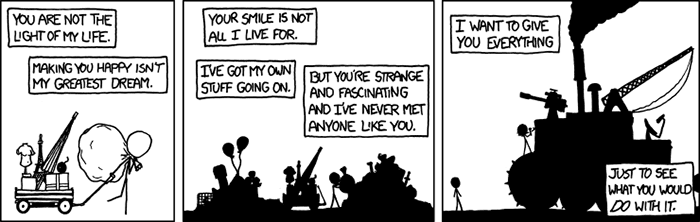
Sexual Informatics: Non-Monogamy

I’ve been told, many times, that the word “polyamory” is not really necessary, as it’s simply a synonym for “open relationship” or “swinging” (or, depending on the person talking to me, “cheating”). This idea seems to assume that there’s really only one kind of non-monogamy, which is kind of silly.

I started thinking lately about the various ways in which a relationship can be non-monogamous, and the intersections between different sorts of non-monogamy, and after tinkering around with the notion for a while I’ve come up with this diagram.

A relationship can be non-monogamous without being open; cheating relationships, polyfidelitous relationships, and religious polygyny are all examples. I’ve made polyamory and swinging separate and nonoverlapping here, though of course a person can be polyamorous and also be a swinger (they’re two different behaviors engaged in by the same person, just as a person can be a swinger and also be a cheater, and so on).

BDSM throws a monkeywrench into the issue because there are so many ways that people involved in BDSM can be non-monogamous. I’ve seen people who play at play parties with other folks but don’t do so outside play parties and don’t form relationships; that sort of arrangement overlaps with swinging. I’ve seen various flavors of polyamorous and polyfi BDSM relationships. I’ve seen closed-group non-monogamy that isn’t quite polyamory and looks more like closed-group swinging, though God knows there’s some overlap between closed-group swinging and polyfi; I’ve known closed group swingers whose groups stay stable for longer than most marriages do. And there’s a sliver of non-monogamous BDSM relationships that don’t intersect with anything else; “I’ll arrange a gang bang for you and you’ll LIKE IT,” ferinstance.

And then there’s con sex, which overlaps with a whole lot of other stuff. But someone could probably write an entire book about con sex. And now that I think about it, I’d probably read it.

Some thoughts on game-changers

In the poly community, there are many folks who hold on very tightly to the notion of a prescriptive hierarchy, in which one relationship is designated as being The Primary One, to which all other relationships must be subordinate.

I think there are a lot of reasons that people might want to do this–insecurity, fear of losing a partner’s time or attention, a sense of entitlement, even a good old-fashioned idea that a person can “really” only love one other person, so if someone falls in love with a new partner, that must mean the old relationship suffers.

And, I’ve made no bones about the fact that I am highly skeptical and deeply suspicious of such arrangements, I don’t think they tend to work in the real world, and I think they’re often unnecessarily and pointlessly cruel to third parties entering such an arrangement.

But today I’d like to take a slightly different tack, and talk about the game changer.

The game changer is the relationship that comes along and turns everything upside down. It’s the relationship that changes the familiar landscape of life, rearranging the furniture in new and unexpected ways. Game changing relationships are rare, but when they happen, they happen like tornados, leaving a trail of upset applecarts in their wake. (Damn, did I really just type that? Ahem.)

Game changing relationships cause people to pull up stakes and move to the other side of the country. They make people do things they never thought they’d do: die-hard opponents of marriage might find themselves in wedlock, otherwise reasonable men could end up watching chick movies starring Sandra Bullock. They are unpredictable and chaotic, and when they happen things change.

Any relationship brings the possibility of a game changing event. Even small things can become game changers; my sweetie zaiah says, rightly, that if Shelly or joreth were to move to Portland, that would almost certainly become a game changer for me.

And game changers are scary.

A game-changing relationship is a very uncomfortable thing, if you are happy with the way things are now and you like your life the way it is. The prospect that your partner might meet someone and start a relationship that changes all that can seem upsetting at best, and downright destructive at worst…and just to make matters even more uncomfortable, it can change things for you in ways you can neither predict nor control and you might not even benefit from. Something that changes your partner’s life in wonderful and amazing ways might change your life in ways that are rather less wonderful and amazing.

Every relationship your partner starts could create change that is wonderful for him but disruptive for you; you might end up dealing with all of the fallout but none of the reward. That’s a very real possibility, and it’s reasonable to be concerned about it.

So it might feel very compelling to seek reassurances that things won’t change when your partner starts new relationships, or at least won’t change in ways that you don’t like. It can feel very reassuring to extract a pledge from your partner that you will always have some measure of control, by being able to tell him to end any new relationship that he starts or by being told that you will always come before anyone else.

The psychological security that these agreements give is powerful, no doubt about it. But is it real? I believe that it is not; it’s an illusion, and not even a very good one.

Game changers change things. That’s kind of the definition. They upset existing arrangements. People confronted with a game-changing relationship will not be likely to abide by old rules and agreements; the whole point of a game-changing relationship is that it reshuffles priorities and rearranges lives.

They can happen even in monogamous relationships. Few people get married with an idea “You know, I think it’d be really cool to cheat on my partner and be unfaithful in this relationship. As soon as we get back from our honeymoon, I think I’ll start hitting up the bars.”

They can happen in ways that have nothing to do with romantic relationships. A promotion at work, a pregnancy, a car accident, someone getting fired, a death in the family–all these things can be game-changers that permanently and irrevocably alter lives in ways that can’t be predicted. (I’ve read that financial stress is the single most common reason for divorce, even more common than infidelity, and I can believe it. Nobody wants to say “Hey, I’ll marry you as long as we don’t have problems with money,” but financial problems are far more potent game-changers than most folks realize.)

We don’t usually hear about people saying “I want veto power over any job you take or promotion you get.” People talk about things like career changes or job relocations with their partners, and if they’re reasonable they listen to their partners’ feedback, but it’s a bit rare to hear someone say “I have the right to veto any job my partner has unilaterally and without discussion,” and we might scratch our heads a bit if someone insisted on that kind of veto power.

We all implicitly understand, at least on some level, that life is full of change, and sometimes that change isn’t what we asked for. We all understand that no promises of “forever” can really stand up to the #39 bus with bad brakes that careens through the front of the house and puts someone in a coma. These are the risks we take when we open our hearts to someone else; anyone who can’t take the risk shouldn’t play the game. Relationships aren’t for cowards or sissies.

Yet when it comes to other relationships, the emotional calculous changes. Whether it’s insecurities that whisper about how everyone in the world is prettier, smarter, and more deserving than we are, or the social fable that says romantic love connects us to only one other person at a time, or the idea that every new connection our partner makes is something that takes away our specialness (as though specialness were a currency sitting in a bank account somewhere, available in limited quantities with substantial penalties for early withdrawal), relationships seem uniquely able to push our buttons and create a fear of loss.

So we try to insulate ourselves from that fear by creating the illusion that no matter what happens, we will be in control. This idea of control is powerfully seductive. It’s one of the reasons that people are often more afraid of flying than of driving, even though driving is far more dangerous; we feel more in control in a car, even though if someone runs a red light and broadsides us, our real control over that situation is pretty much nonexistent.

“Yes, you will always be #1” is true until it isn’t, and there is no rule that can change that. If someone comes along who your partner genuinely does love more than he loves you, whatever that means…well, his priorities are unlikely to remain with abiding by the agreements he’s made with you.Game-changing relationships change things; that’s what they do. They change priorities, and that means they change rules. Expecting an agreement to protect you from a game changer is about like expecting a river to obey a law against flooding.

I can understand the desire not to lose what you have because your partner meets someone new; that’s rational and reasonable. What is neither rational nor reasonable, though, is attempting to build structures such that your partner can have other relationships but they will change nothing for you. In fact, it has been my experience that the more rigidly you try to box up relationships to prevent them from changing anything, the more likely things are to break.

There is a different approach, but it requires courage. At the very least, it requires the courage to tell yourself “My relationships can change, and that is OK; my partner and I can still build things that will make us both happy even if they don’t look exactly the way they do now.”

That’s the starting point. From that point, the next step is to say “Even if things change, I have worth; my partner will seek wherever possible to make choices that honor and cherish our connection, whatever changes may come, because I add value to his life. My goal is to build a connection with my partner that is resilient enough to last through change, flexible enough to accommodate change, and supportive enough to create a foundation that welcomes change, without fear or doubt. Change is the one essential feature of life; what I have now I will cherish, and what we build tomorrow I will also cherish, and I will do so without fear.”

Like I said, it takes courage. Letting go of the idea that the way things are now is the way they should always be is gutsy.

But then, life rewards courage. The game-changer that turns everything upside down might just leave you in a better place than you are now; you might find that rearranging the furniture makes the room even more appealing to you. The illusion of control that rules give you is false; the real control you have is the control you exercise as a partner, not a dictator. It comes from working together to express the things you need even while change is happening all around you, not by trying to prevent change at all.

Some thoughts on expectations, assumptions, and expressing a crush

So apparently, the vast, slowly capsizing shambles that is the Yahoo online empire has a dating and personals section.

I suppose I should have guessed that Yahoo has a dating and personals section. Everyone has a dating and personals section. The Onion has a dating and personals section. Hell, the Web site for the Southern Baptist Convention probably has a dating and personals section, though frankly I can’t be arsed to look, and it’d probably make my eyes bleed if it does.

The Yahoo dating and personals site recently ran an article that’s totally a testament to Yahoo as a whole, in a gruesome kind of way. The article is 10 things a good boyfriend won’t ask you to do, and boy, is it a doozy.

Among the gems on this list of things you must never ask your girlfriend to do are things like #4, “Make him a sandwich,” or #5, “Change your relationship status on Facebook,” or my own personal favorite, #10, “Grow our hair long.”

And it seems to me that if these are the worst trials you ever face in your relationship life, then you’re doing pretty damn well.

I am firmly of the belief that it’s always OK to ask your partner for anything you want; indeed, I think that a whole lot of people might be a whole lot happier, and a whole lot of unnecessary suffering and angst might be avoided, if folks actually spent more time asking for the things they wanted and wouldn’t be so damn scared of doing it.

But I can kinda see where the article is coming from. The people who wrote it are making an assumption, and I bet it’s probably a fairly common one, that poisons and distorts their perceptions of what it is and is not OK to ask for.

It’s perfectly OK to ask your partner to make you a sandwich, or cut your hair, or even have a mad passionate kinky threesome with the captain of the Brazilian women’s volleyball team, provided that you don’t have an expectation that the answer must be “yes.”

And that is an important distinction, i think.


Expectation will fuck you up.

If the Yahoo article had been titled “10 Things Your Boyfriend Shouldn’t Expect You To Do Just Because He Wants You To Do Them,” I wouldn’t have any complaints about it.

Now, before I keep going, I want to pause a minute and say that I don’t think that all expectations are necessarily wrong. There are many expectations that seem reasonable and healthy to me. I expect that my friends won’t punch me in the nose without provocation, steal my car, pee on my cat, or set fire to my sofa. I have an expectation that my romantic partners won’t drain my bank account and spend all the money on Mexican hookers and cheap booze.

And in a more general level, I find that life is a lot happier when I keep my expectations positive. I expect to be surrounded by love and intimacy; I expect the world to be filled with joy and abundance; I expect to be able to succeed at things I apply myself to.

So not all expectation is bad.

But still…


A couple of weeks ago, I was talking with a friend at a poly get-together about what factors make someone successful in finding relationship partners.

His approach, he said, was not to approach anyone he found interesting, out of concern for how she might interpret it. He was worried about coming across as that creepy guy…you know the one I mean, the overbearing guy who stomps all over boundaries with heavy cast-iron boots, the guy who at best makes women cringe when he’s around and at worst radiates off stalker vibes for forty aces around him wherever he goes.

And that got me to thinking. Because when I find someone interesting and shiny, when someone catches my eye (or, occasionally, the back part of my brain) and makes me sit up and take notice, I generally say so. Even if that person is, say, a cute, smart server at a Pizza Hut who, when asked to define the word “orgy,” thinks about it for a while and then says that while an orgy in its simplest form is just a bunch of people all having sex in the same room, for her it carries connotations of cross-couple sex.

But I digress.

Anyway, I tend to be very open with people I find interesting; if I have a bit of a crush on someone, I’ll say “Hey, you’re pretty cool! I think I have a bit of a crush on you.” And I can’t really recall having a bad response to that.

So that got me to thinking about why it is that some people who do this seem to come across as creepy, and get negative reactions; and some people who do this don’t come across as creepy, and get positive reactions. I’ve been chewing on this for weeks, and talking to people about it, and I think that a lot of it comes down to expectation.


Now, not ALL of it is about expectation. I was talking about this with seinneann-ceoil while she was in Portland visiting me last week, and her take on it is that a lot of how people react comes down to matters of attitude and confidence.

I actually met seinneann-ceoil in person for the first time when I was in Orlando after DragonCon/ We’d been talking online, and joreth and I had an opportunity to meet up with her in a coffee shop at a bookstore for a while. We talked for an hour or two, and about twenty minutes in I realized that she had that certain spark I really look for–smart, strong-willed, eloquent, able to take a position on something important to her and talk about it passionately. So as we were leaving, I told her, “You know, I think I have a crush on you. I really dig you and I’d love to stay in touch if that’s something you might like.” We stayed in touch, it was something both of us liked very much indeed (oh, yes, we did), and she came up to visit last week.

I believe that had I not said anything, we might have had an interesting couple of hours, talked for a while, gone our separate ways, and that would’ve been it. There is something to the idea that confidence is important; in fact, I talk about that so often in this journal that it’s nothing you all haven’t heard before.

Attitude is important too, no doubt about it. seinneann-ceoil says that there’s a huge difference between a person who feels attracted to someone and responds with joy (“Hey, here’s a cool person I feel I connect with, isn’t that awesome? I can’t wait to see if that person feels the same way about me, and we can see if there’s something the two of us can explore!”) versus someone who responds with trepidation (“I feel this connection with this person…what do I do? What if she doesn’t like me? What do I say? Should I say anything? Man, this really sucks!”). Treating other people as a source of wonder and opportunity is likely to be more successful than treating other people with fear and hesitancy.

And I totally, 100% agree with all of that. But it still seems like there’s a piece missing, and I think that piece is in the expectations we attach to other people when we tell them we fancy them.


Shelly feels, and I agree, that people who say things like “I like you” or “I have a crush on you” often attach an implicit, unspoken expectation to the end of it: “…and I want you to do something about that, and I’ll be upset if my expectation isn’t met.” Even though it’s not said, that tacit expectation hangs in the air, tangible to the person hearing the “I have a crush on you,” and it creates discomfort.

She also says that that expectation gives no room for reciprocal interest; the expectation is that the person who hears “I have a crush on you” will return the feeling, regardless of whether or not it’s true.

And, most interestingly I think, she believes that when a person is attracted to someone because of some trait (beauty, say) that doesn’t make it easy to gauge reciprocity, the tacit expectation becomes even more uncomfortable. If two people talk for a couple of hours, it’s usually pretty simple to tell whether or not there’s any reciprocal interest at all; when one person spots a pretty young something something from across the room, it’s not.

Regardless of how the connection forms or whether or not it’s reciprocated, though, it seems that there is a clear difference between someone who says “I have a crush on you” with an unspoken “…and now I expect you to do something about it” and someone who doesn’t. As Zen as it sounds, if that expectation is there, it leaks out.

People don’t much cotton to having expectations imposed on them without their consent, it seems.

So a key ingredient to approaching people and expressing interest is to do it without the assumption that interest on your part constitutes an obligation on their part. I don’t know any way to fake that; in fact, I’m not even entirely sure exactly how unspoken expectations get communicated, but they do.


So, going back to the subject of reasonable and unreasonable expectations, it seems to me that expectations fall into one of three broad camps. There’s expectations we place on other people, expectations we place on the world at large, and expectations we place on ourselves. Any of the three can be positive or destructive.

For example, placing expectations on people simply because we like them is probably not cool, though expecting other people to treat us with a certain measure of respect as reasonable adults seems healthy and positive to me. “I expect that you will be fairly decent to me and not punch me in the nose without provocation” is probably good; “I expect that you will go out with me because I think your pretty” is probably bad.

Similarly, “I expect that I will be surrounded with opportunities for joy” is probably a healthy way to engage the world, at least for those of us not born in North Korean forced labor camps. (If that sounds like it’s coming from a place of privilege, it probably is, but not necessarily in the ways that you might think; studies have shown that people living in poor Third World countries like Nigeria are often happier than people living in First World countries, so the opportunities for joy are not necessarily available only to the wealthiest. That’s probably a topic for its own essay, though.) “I expect that I will have everything I want” is probably not so good.

When it comes to the expectations we place on ourselves, “I expect to be able to do well at the things that I work at” is, it seems to me, a positive and healthy thing. “I expect to be able to understand my own emotions and to be able to behave reasonably even when i am experiencing stress” also seems reasonable to me. “I expect to fail at everything I do” is probably not so good; and, on the flip side of the same coin, “I expect to succeed at everything I try the first time I try it” is probably not so good either. “I expect that I will never feel any negative emotion, and that if I do, I am a failure” is a particularly insidious and toxic one.

I’ve written before about why I am not a Buddhist, in that I think detaching one’s self from all desire and all expectation can make for passivity. But I think there’s something to the notion of detachment from expectation, at least from expectation that is unrealistic, imposes an unasked-for and non-consensual burden on others, or both.

And I think that once you’ve done that, telling someone you fancy “hey, I fancy you” has entirely different results.