Intermission: How Not to be a Dumbass on the Internet

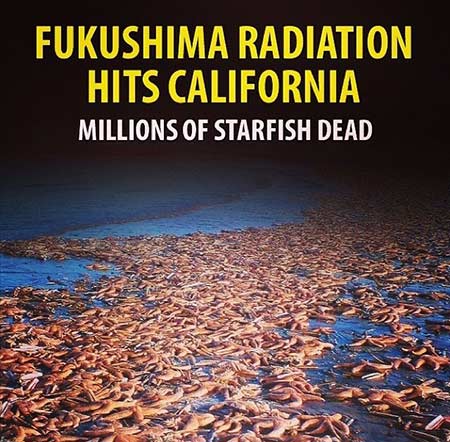
A few days ago, on my various wanderings through the wretched hive of scum and villainy known as the Internet, I came across an image that made a…rather startling claim. This image showed a beach full of dead starfish accompanied by the headline “Fukushima radiation hits California, millions of starfish dead.”

I found that wildly improbable, for a number of reasons (the radiation from Fukushima was not great enough to cause mass die-offs–indeed, the scientists who installed monitoring equipment to measure it didn’t even bother to wear protective gear; the radiation was so dilute by the time it crossed the ocean it’s a testament to how exquisitely sensitive modern radiation detection gear is that it was even measurable at all; and most of the radionucleotides, like iodine-131, have very short half-lives measured in days), so I did some research. It turns out that–surprise!–the image meme is a hoax.

So in the spirit of public service, I’d like to present to you:

Franklin’s Guide to Not Being a Dumbass on the Internet

It’s my hope that by following a simple 2-minute procedure, you can help prevent yourself from looking like a fool when you venture online. Ready, kids? Here we go!


Okay, so here’s the image:

It turns out that this is not a mass starfish die-off caused by radiation, the photo dates from nearly two years before the Fukushima accident, and on top of that, it’s not in California. The actual photo shows a mass of starfish on Holkham Beach in Norfolk, Britain.

Here’s the real image:

So what magical wizardry did I use to research the actual source of the image? What deep magic uncovered the fraud? Well, it took about 35 seconds with Google.

You see, Google has this feature that lets you search for images rather than words. If you use Google Chrome as your Web browser, this feature is built right in! Simply right-click on any image on any site, Mac or PC, and you’ll see this popup menu item:

If you don’t use Chrome, fear not! Just surf to https://images.google.com/imghp and you can drag an image from just about anywhere (your hard drive, another Web site, whatever) onto the Search bar to search for that image.

Seriously, it’s that easy. When you do this to image memes, especially alarmist memes that try to scare you, it’s astonishing how often they turn out to be frauds.

Let’s look at another example from Fukushima. This image was making the rounds a while ago, with the claim that it shows how “radioactive contamination” from the Fukushima power plants has crossed the ocean.

A Google image search for this image turns up this Snopes page. This image doesn’t show radiation. It doesn’t have anything to do with radiation. It shows the wave height of the tsunami that hit Japan after the earthquake, with red areas corresponding to higher ocean levels.

Of course, a close look at the image should clue in a wise person that something’s amiss if this is a radiation map, because radiation isn’t normally measured in centimeters:

Derp.

It’s not just Fukushima. All kinds of images can be subject to this in-depth, detailed, 30-second scrutiny. For instance, right after police officer Darren Wilson shot black teen Michael Brown, an image purporting to show a badly-beaten Wilson in the hospital was getting shares and favorites all over conservative parts of the Internet.

Problem is, the image wasn’t Darren Wilson. It wasn’t even close. A Google image search quickly revealed it was a 2006 photo of motocross rider Jim McNeil who had been hospitalized following a motorcycle accident.

So there you have it. This one weird trick called “fact checking” can save you from countless hours of embarrassment online. The next time you want to share that image that, like, totally proves some political feeling you have, stop and check! Google is your friend, folks.

Here endeth the lesson.

Sharks and Loathing in Las Vegas

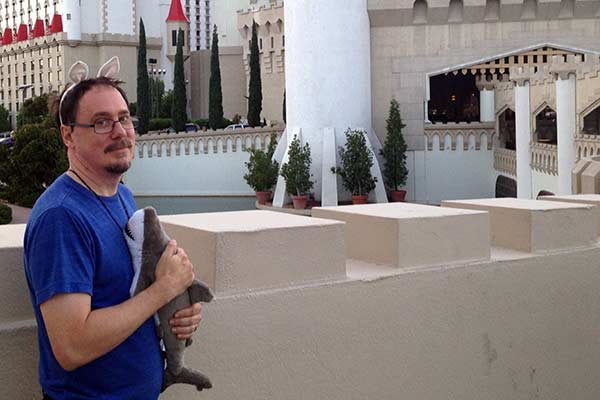
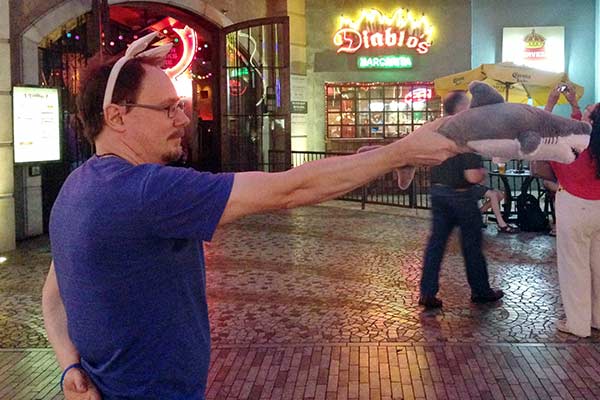
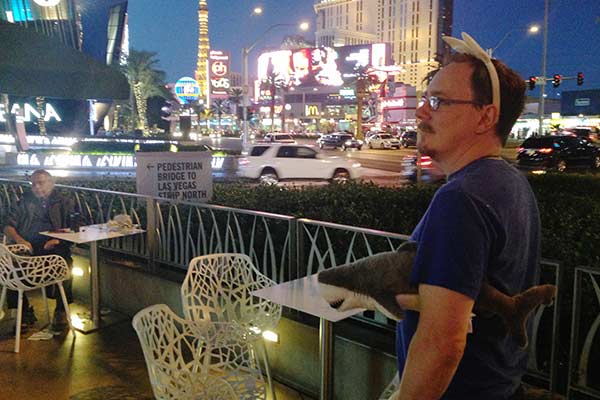
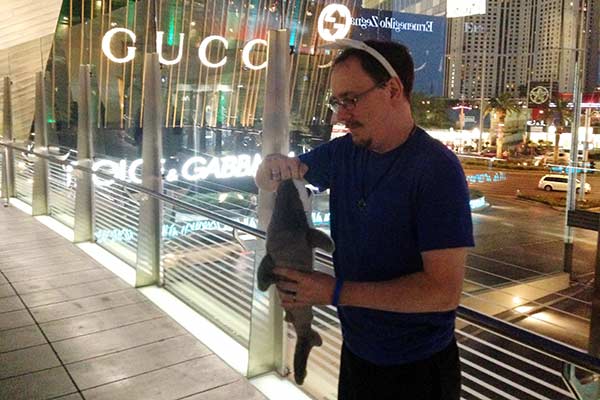
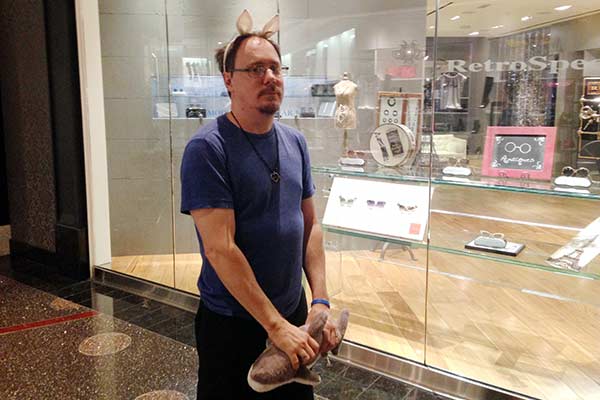
I am a man who wears bunny ears.

As I write this, I am on the last leg of the book tour–six events over the next four days and I am finally done. Part of the tour took me through Las Vegas. And Vegas…Vegas is not what I expected.

Close your eyes. Imagine Las Vegas, that epicenter of sin and decadence in the desert. What do you picture? Giant neons. Slot machines. Organized crime. Women in huge feather headdresses. Not, you might think, the sort of place where a man in bunny ears would exactly stand out…

…and you’d be wrong.

Vegas is, it seems, not prepared for a man in bunny ears, oh no. The hostility with which the Las Vegas culture1 responds to the sudden appearance of a man in bunny ears in its collective midst is remarkable.

But let me backtrack for a moment.

As I have traveled the country talking about polyamory and ethics and such, I’ve brought a stuffed shark with us. The shark, who joined our team2 in Atlanta, has made appearances all over North America, solely for the purpose of being exploited.

It started as a lark, you see. There is person is a marine biologist who studies sharks. He also writes angry blog entries in response to phony stories on the Discovery Channel, stories with lurid titles about how mermaids might be real (spoiler: they aren’t) and speculating whether Megalodon, the enormous prehistoric dinosaur-shark, might still be alive (hint: it isn’t).

There are trolls on the Internet, and some of these trolls want to believe in mermaids and Megalodon. So they follow this person about online, posting pictures of him and diatribes about him with the Twitter hashtag “#nerdsexploitingsharks“.

Which is, thought I, absolutely begging for hijacking.

So, half an hour before I was scheduled to do a lecture in Atlanta, I darted out in frantic search of a stuffed shark to exploit. I found one at the Atlanta Aquarium, and it’s been accompanying us ever since, being photographed in exploitative situations and posted to social media under #nerdsexploitingsharks.

So. Back to Las Vegas.

Las Vegas doesn’t like a man in bunny ears. Las Vegas especially doesn’t like a man in bunny ears carrying a stuffed shark.

Now, there are many ways to carry a stuffed shark. If you ever find yourself in Las Vegas wearing bunny ears and carrying a stuffed shark, you might try one or more of these carry techniques. I present this information in the name of Science!3


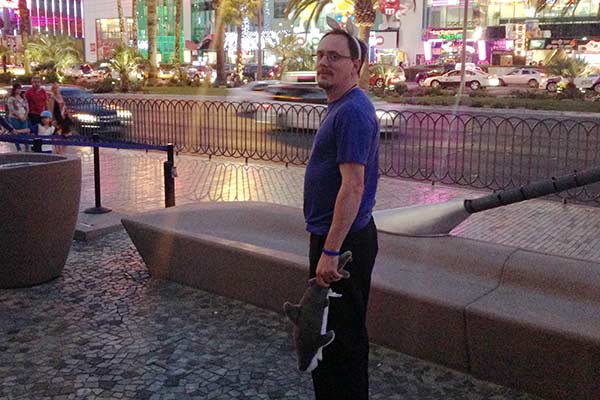
The Security Blanket

An attitude that says “Yes, I have a stuffed shark, and what of it? I need my shark if I am to face a cold, cruel world.” Advantages: Few people will approach a person who uses a shark as a security blanket. Disadvantages: Few people will approach a person who uses a shark as a security blanket.


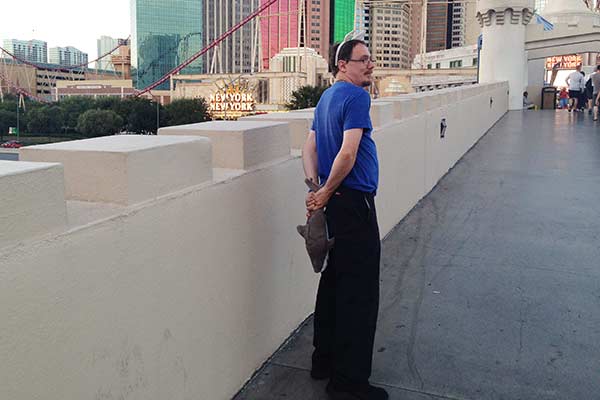
The ‘Shark? What shark?’

Who, me? I’m not carrying a stuffed shark! Oh, this? How did this get there? Advantages: From the front, you simply look like a man in bunny ears, not a man in bunny ears with a stuffed shark. Disadvantages: Las Vegas loves guns. The sight of a man in bunny ears with his hands out of sight might upset some folks with delicate sensibilities, and some of those folks with delicate sensibilities might be armed.


The Casual Carry

This technique challenges the observer: “Yeah, I’m carrying a stuffed shark, and how do you like THEM apples?” Advantages: People might assume you’re a famous performer, or, failing that, an eccentric Mob hitman with a pistol inside the shark like that one scene in Hudson Hawk, only with a shark instead of a teddy bear. Disadvantages: People might assume you’re barking mad.


The en garde!

Yeah, I have bunny ears. And a shark. Which might or might not contain a concealed pistol. Don’t fuck with me. Advantages: People give you a wide berth on the sidewalk. Disadvantages: You might get shot.


The Binky

Similar to the Security Blanket, but less neurotic, the Binky tells the world that, yes, the world is cold and cruel, and yes, your shark helps you navigate the rivers of cruelty all around you, but you don’t really need the shark. You just like the shark, okay? Advantages: More relaxed and casual than the Security Blanket; this attitude tells the world you really can stand on your own two feet. You know, if you want to. Disadvantages: Small children point at you.


The Bromance

“I love you, man!” This attitude tells the world you and your shark have a special friendship…but, like, totally in a heterosexual way. Advantages: It’s totally, like, a heterosexual thing. Not, like, that other thing. Disadvantages: You may be mistaken for a dudebro. Who wears bunny ears. And carries a stuffed shark.


The Two-Handed Casual

“I’m just carrying a stuffed shark from one place to another place. Nothing to see here. Move along.” Advantages: Very workmanlike. People won’t get the impression that you’re, y’know, attached to the shark or anything. Disadvantages: It’s still pretty weird to see a guy in bunny ears carrying a stuffed shark, no matter how workmanlike he may be. Plus you don’t have a hand free to drink alcohol, play slots, and convince yourself that this thing you’re having is fun.


The Secure in my Masculinity

This pose shows the world that you’re absolutely certain of your manhood and you’re not too threatened to express your true feelings, even if you happen to be in the middle of one of the world’s largest casinos. Advantages: People will stay far, far away from you. Disadvantages: Unless they’re security.


1 Insofar as Las Vegas can be said to have a “culture.” My observations of Las Vegas culture suggests it is made up primarily of people who have no idea how to have fun desperately trying to have fun and convincing themselves the thing they are having is, indeed, fun. And alcohol.

2 Was purchased and exploited.

3 I am frequently asked “are you a scientist?” I usually say “no.” I think I am probably going to have to start saying “yes,” so when people ask “what kind of scientist? Chemist? Biologist?” I can say “Mad.”

Astonishing Beauty

The world around us is fractally beautiful. Not only is it filled with the most extraordinary, breathtaking beauty, but that beauty exists no matter what level you set your gaze upon. At any scale, at any magnification, beauty persists.

Look at a flower.

It’s beautiful–the colors, the symmetry, the shape. These things are all pleasing in their own right.

But look closer. Much, much closer. What will you find? An enormous array of tiny cells, in a proliferation of shapes and functions, each working with the ones around it to give the flower its form and color, all of them filled with activity. Inside every cell, an array of bogglingly complex molecular machines, running all the time, consuming energy, producing still more molecular machines, and always, always striving to survive and make more of themselves.

Now look up, from the microscopic to the macroscopic.


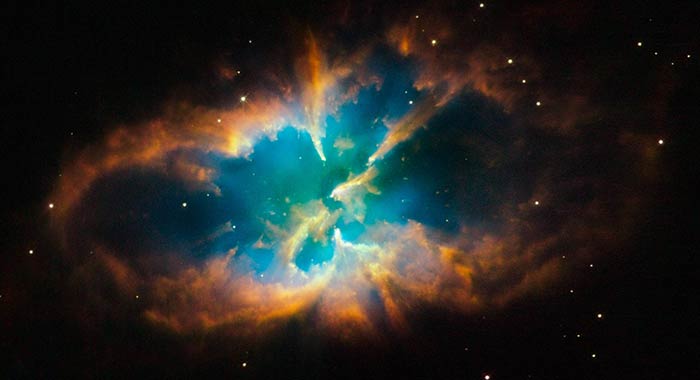
Image: NASA/Hubble Space Telescope team

This is NGC 2818, a magnificent planetary nebula in the southern constellation Pyxis. This and other planetary nebulae are the remnants of violent explosions, the result of a star that has fused all its available hydrogen fuel and is no longer able to support itself against gravity. In the last few seconds of the star’s life, it explodes, leaving behind a glowing ember called a white dwarf and throwing off a shockwave of expanding gas.

These stellar remnants are beautiful, but like that flower, they are fractally beautiful. In fact, they are connected with that flower. Most of the elements necessary for life, all the molecules with an atomic weight greater than iron, are forged in these fiery explosions, when the unimaginable forces of a nova or supernova fuse lighter elements into heavier ones. The atoms in this flower, and in you and me, were birthed in fire and sent out into the universe, to eventually coalesce into this sun, this solar system, this planet, at this place and this time, and became us and kittens and chocolate and motorcycles and ice cream sundaes.

The universe is both incomprehensibly huge and incomprehensibly fine-grained, and it’s beauty all the way down.

Even when we look at the same scale over time, we see beauty. Beauty is enduring. It emerges, over and over again, wherever there is the possibility of change.

Indeed, there is quite literally more beauty around us than we are capable of seeing. White flowers are richly colored, to eyes that can see in ultraviolet. The sky above our heads is a tapestry whose richness we could not recognize until we built machines to augment our feeble vision.

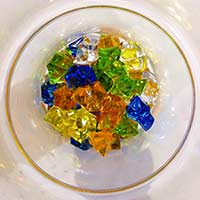
But it isn’t just the grandeur of the natural world. Beauty lurks in every corner. It hides in a tumbler filled with colored glass stones on a restaurant table.

Color is a myth, of course. It’s a perceptual invention, created by the sorting of light of different frequencies into neural impulses by our visual system, with sensors tuned to respond best to different wavelengths of light. It’s a crude approximation of the diversity of photons filling the air around us. These photons chart extraordinarily complex paths through the tumbler, reflecting and refracting, sometimes being absorbed or scattered, and we glance at this intricate mathematical dance of physics for a moment and then look away.

The complexity and beauty of the physical world is both breathtaking and ordinary. Breathtaking because it exists on scales we can scarcely begin to understand; ordinary because it surrounds us all the time, beauty so abundant we forget it’s even there.

Every moment of our lives is spent in a world so beautiful, so incredibly filled with marvels, that we are blessed with abundance beyond measure. I can not help but feel that, should we become more mindful of it, the dull and ugly parts of the world will lift, just a bit. And perhaps, just perhaps, we will be that much less inclined to manufacture more of that dullness and ugliness.

We are here for only a brief time. Let us never forget how beautiful it is to be so privileged to exist in this place.

Conversations with a kitty

This is our cat Beryl. He’s a blue solid Tonkinese, a cat breed that’s made of one part kitty, three parts fearlessness, and sixteen parts love. Tonks are absolutely amazing kitties, with all of the cute adorableness of your standard-issue cat without any of the surly sociopathy.

A couple days ago, I received a package in the mail. On the same day, I went out to buy new printer ink cartridges and came home with a new black and white laser printer, which was cheaper than a set of replacement ink cartridges because capitalism and market efficiencies and invisible guiding hand and Adam Smith LOL.

Anyway, Beryl and I had a conversation that went something like this:

Me: Hey, kitty! Look! I brought you a present! It’s an empty box!

Beryl: OMG you are the BEST. A box! This is amazing! Thank you! Thank you so much! From here I can hide and pounce on Liam all unawares and stuff.

Me: And check this out! I got a new printer, so here’s another empty box.

Beryl: TWO empty boxes? Truly, my cup runneth over. I don’t think I’ve been this happy since…since…since ever! Now I can hop from one box to another. The cunning box-ambush strategies I can devise with TWO boxes will make me the undisputed champion of my domain. You are the greatest. Truly, I mean that. And it’s not just the boxes, it’s also the food preparation. I will remember you in the long years of my reign.

Me: Okay, I need some more space to set up this printer. Here, let me just put this box inside the other box…

Beryl:

Beryl: The hell?

Beryl: You…you just…

Beryl: There is an empty box inside another empty box!

Beryl: You…I…it…

Beryl: How is this even possible? I can hop into a box, and when I get there, there is..another box! Another box, that I can ALSO hop into!

Beryl: I can be inside TWO BOXES AT THE SAME TIME.

Beryl: How did you make this happen?

Beryl: You are like a god. Like. A. God. A god of boxes. You…I never even…it’s just so beautiful!

Beryl: Never in all my life have I imagined such a thing. You have opened my eyes to the Possible, and truly is it more amazing than I had ever dared to hope.

Beryl: Two boxes. TWO boxes. One box inside…inside the other…I’m having a moment.

Me: I’m glad I could make you happy, little buddy.

Beryl: Happy? Happy? Happy is getting the squishy food. Happy is having ONE box to play with. Happy is sitting on your shoulder while you do that thing where you sit in front of that glowing thing and you pretend like you’re a mage and you press buttons and throw frostbolts around and you swear at the goddamn hunter who always pulls aggro and is never where he’s supposed to be and…

Me: You mean play World of Warcraft?

Beryl: Yes, that. Happy is sitting on your shoulder while you do that. But this…this is…

Beryl: If Voluptas, the goddess of bliss born of the union between Cupid and Psyche, had been capable of feeling what I’m feeling right now, the entire story of the world would be rewritten. Temples in her name would stand still as the greatest of all human accomplishments. If you could package what I’m feeling and distribute it, wars would end, ancient rivalries would be forgotten, petty jealousy would be as extinct as the Stegosaurus.

Me: I’m just glad you like your boxes.

Me: Wait, how the hell do you know about Roman mythology? You’re a cat!

Beryl: Can’t talk. Busy playing. In boxes.

Nome, Alaska: There’s gold on that ther beach!

Nome, Alaska was incorporated as a town in 1901, because of a gold rush. In the late 1800s, gold was discovered in the mountains around Nome; in the early 1900s, more gold was discovered in the sand on the edge of the Bering Sea.

There’s still lots of gold in Nome. While there’s no longer a full-on gold rush, there’s still considerable gold mining around Nome, and some of its beaches are designated for “recreational mining.”

For three months out of the year, Nome’s beaches are home to the strangest temporary communities you will find outside Burning Man. But these are not well-off techie hipsters who take drugs and dance around a giant fire. They’re folks from Canada and the United States who head up to Nome, where they set up tents and build makeshift houses from reclaimed materials (shipping pallets, old signs, and whatever else they can find) to spend the summer months sifting the beach sand for gold.

There are all kinds of rules on recreational gold mining. Each “claim” is at most 75 feet wide; claims are temporary and evaporate at the end of the season or when you move off the beach; there’s a limit of 40 ounces of gold per person or group per year, which is about $52,000 worth at current market prices. There are limits on the equipment that can be used.

The people who do this are a really interesting bunch. We talked to several folks on the beach, most of whom come up year after year to look for gold. The people we met were friendly and outgoing, willing to show us their equipment and talk about their favorite techniques. Most were cagey about the amount of gold they find every year, but my impression was they generally tend to get about the 40-ounce limit.

Or at least that’s what they declare at the end of the season.

There’s industrial-scale mining as well, but to me, the hobbyist mining is absolutely fascinating.

Summer in Nome is strange: the sun barely ever sets (it’s a little freaky to go outside at midnight and see the sun still high in the sky), so the beach miners tend to work whenever they are awake and sleep whenever they’re tired–there seems to be little in the way of set schedules. The temperature was pleasant while we were there, though apparently near-constant light rain and occasional storms are normal during parts of the summer. It is still Alaska, which means the environment is still hostile enough to produce the occasional odd survival event without warning; as a result, the community tends to be close-knit, with everyone watching out for everyone else…interesting to see in folks who are prone to say they enjoy doing this every year at least partly to get away from other people.

The sand on the beach looks like this. The red color apparently indicates rich gold-bearing sand.

I’m actually considering going up there next year and spending the summer living on the beach panning for gold. Not because I expect to find any or to strike it rich, mind, but simply for the experience of it. It would make one hell of a “how I spent my summer vacation” story! (There are rumors the state will not be permitting hobbyist mining on the beach next year, though these rumors seem to have been circulating for years–one person we talked to said he heard the same thing several years back when he did it for the first time.)

Back when the 1940s and 1950s, it was common to mine for gold using enormous dredging machines like this one, now in ruins and slowly crumbling into the tundra:

These gigantic hulks are dotted all over the landscape around Nome. They were expensive to build and ship, and woefully inefficient–at best, they might recover 40% of the gold from the sand. In fact, the tailings left behind by these old machines are being mined again with more efficient techniques, and the amount of gold left in them is quite high.

I’m not sure I want to be doing this, but I am very sure I want to have done it. The book that would come out of this experience would be amazing.

Nome, Alaska: Ruins of the White Alice facility

There’s a mountain overlooking Nome. It’s called Anvil Mountain, and on that mountain is a kind of monument to the Cold War. You can see it from just about anywhere in town. These four enormous antennas squat over the landscape, a silent testament to the money and lives squandered on endless political bickering.

When I saw them, I had to check them out.

These four antennas are part of the old “White Alice” system, a communication system that was part of the old Distant Early Warning radar installation all along Alaska, constantly searching the sky for signs of Russian bombers sneaking over the Arctic and heading across Canada toward the United States.

The system was designed in the 1950s, when fear of the Commies was really starting to gain traction. The Distant Early Warning line was a set of remote high-powered radar facilities all along Alaska, but the designers had a problem. Alaska is huge. If you count the string of islands that extends from its western edge, many of which were home to DEW radar, Alaska is about the same distance stem to stern as the distance from California to New York.

And there are no roads, no telephone lines, and no power lines. Even today, there is no way to get to Nome by road; roads linking it to the rest of Alaska simply do not exist. You get in and out by air or barge, and that’s it.

The radar stations along the DEW line needed to be able to talk to command and control centers. Normal radio wouldn’t work; Alaska is so large that the curve of the earth renders line-of-sight radio unworkable.

So the Air Force came up with an idea: troposphere scattering. Basically, they decided to use enormous antennas pointed at the horizon to blast an immensely powerful radio signal, so strong it would bounce and scatter from the upper layers of the atmosphere, reaching stations beyond the curve of the earth.

The system was code-named “White Alice” and was built at enormous cost in the 1950s and operated through the 1970s, when satellite communication made it obsolete. By the time it was decommissioned, there were 71 of these stations, including the one on Anvil Mountain.

I borrowed a 4×4 and drove up the mountain. The facility is surrounded by a chain-link fence that has long since been pulled down and yanked apart in places. An ancient, battered sign warns trespassers that it’s a restricted area; the locals seem to use it for target practice.

The White Alice installations were powered by enormous diesel generators. Each of the four antennas at a facility consumed up to 10 KW of power; the generators provided power for the transmitters, the living quarters, and small line-of-site microwave dishes that provided short-range communication.

Most of the White Alice facilities have been completely dismantled. Several of them are toxic waste sites, as diesel fuel and other contaminants have been dumped all over the place.

When the Anvil Mountain White Alice facility was decommissioned, the residents of Nome asked the Corps of Engineers to leave the four big antennas. Everything else is gone.

These antennas are huge–about five stories tall.

Cost overruns, under-engineered specifications, and overly optimistic maintenance projections made the White Alice project run ten times over budget. Most of the materials to build the installations–hundreds of tons of equipment for each one–were shipped to remote mountain peaks by dogsled. Airbases were constructed at many of the sites to get fuel, people, and supplies in and out. Technicians worked at these sites year round, facing minus 30 degree weather or worse during the winter.

We went up twice, once during the afternoon and once at 1:30 in the morning to watch the simultaneous sunrise and sunset. I can only imagine how miserable it must have been to work here; in the middle of one of the warmest summers on record, when Nome was facing over-70-degree weather, it was cold and windy on top of the mountain. Winter, when the sun hardly comes up, must have been brutal.

I used my smartphone to take a panorama showing the whole installation from the very peak of Anvil Mountain. Click to embiggen!

Nome, Alaska: Simultaneous Sunrise and Sunset

The sun rises in the east and sets in the west, as every fule know.

What we don’t often think about is this is really true only at the equator, and even there it’s only entirely true during the solstices. For people anywhere else, or at any other time, the sun actually rises in the northeast and sets in the northwest (if you’re in the southern hemisphere) or rises in the southeast and sets in the southwest (if you’re in the southern hemisphere). Or at least it would, if the earth weren’t tilted on its axis.

Since the earth is tilted, not only does the sun generally not rise and set at locations 180 degrees apart from each other, the location of sunrise and sunset wobbles as the year goes on.

When you’re north of the Arctic Circle, things get really weird.

At the summer solstice, the sun doesn’t set at all, and during the winter solstice, it never rises. The rest of the time, it makes circles in the sky. The circles wobble as the year goes by…during the summer, most of the circle is above the horizon, and as winter comes, the circle sinks below the horizon. (So, if you plot the path of the sun in the sky–when it is in the sky–over the course of time, it actually does a spiral.)

Last night,  I climbed to the top of Anvil Mountain just outside Nome, Alaska (which is near enough to the Arctic Circle to see some of the weirdness) at 2 o’clock in the morning to watch the “sunset.” I say “sunset” because it’s still pretty much full daylight out. The sun dips just barely below the edge of the horizon, but it doesn’t stay there, and it comes up again shortly thereafter…meaning we saw a simultaneous sunset and sunrise.

The red in the sky on the left of this panorama is the sunset. The red in the sky on the right is sunrise. The sun is traveling in a shallow arc that just barely dips beneath the horizon.

Click on the picture to embiggen!

Nome, Alaska: The Last Train to Nowhere

As the result of a lengthy and somewhat improbable series of events, I’m in Nome, Alaska, working on another book.

A few days back, we took a drive on the one road that goes through Nome. Nome is inaccessible by car; the only road links it to the nearby towns of Council and Teller.

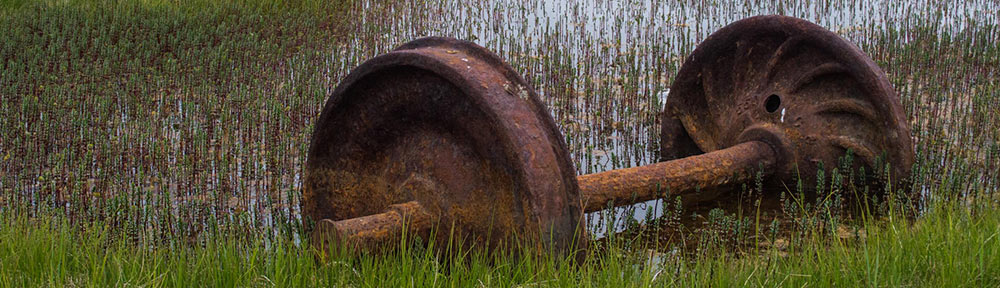
If you drive out toward Council, a trip I recommend only during the summer and then only in a large 4WD vehicle, about twenty miles from Nome you’ll come across the long-deserted ghost town of Solomon, a leftover from the gold rush in the early 1900s. Near Solomon, you’ll find what’s left of a failed attempt to bring rail service to Nome.

In 1903, an enterprising group of people formed a company to build a railroad to serve the gold mines near Solomon. They bought a bunch of secondhand elevated railway engines from New York City and hauled them up to Nome by barge.

In 1907, a storm washed out the one rail bridge between Solomon and Nome, leaving the trains stranded on the edge of the water. The company folded and simply walked away, leaving the trains where they were, to quietly rust away into the tundra.

That seems to be a common theme in Alaska. The landscape is dotted with abandoned mining equipment, wrecked construction vehicles, and huge pieces of machinery simply left where they were when they became inoperable.

The locals call this steam engine graveyard “The Last Train to Nowhere.”

Even during the summer, it’s cold and windy here. The train never was reliable under the best of circumstances, so it’s no surprise there was no effort to replace it.

Staring Into the Abyss and Blinking: Why I’m Not Watching Dr. Who

I was sold a bill of goods.

We all were, really. It was a bill of goods we’d been promised for years, with the reboot of the popular BBC TV show Dr. Who.

I loved Dr. Who as a kid. I had a secondhand television set in my bedroom when we lived in rural Nebraska. We didn’t have cable, and we were way out in the middle of nowhere, so we only got two stations: PBS and something I don’t remember (because if you have PBS, what else do you need?). I’d watch Tom Baker romp around the universe with his sidekick Louise Jameson (my second celebrity crush) in cheesy low-budget glory.

The new Dr. Who promised to be something darker, something more complex, something less campy and more menacing. And, for a time, it delivered.

Oh, sure, it had problems. Russell T. Davies’ epic misogyny was tiresome and sad, like that one relative who overstays his welcome at every family get-together, the loser who drinks too much and starts rambling about how in his day, women didn’t run for political office before he ends up passed out on the table with all the leftovers scattered around him and his head in the plate of mashed potatoes.

Eventually, the show realized it was actually Mr. Davies’ bigotry that looked tired, and Steven Moffatt took over the reins. His sexism is still there, to be sure, though it’s a more covert sexism, a sexism that sees female characters as “strong” provided they don’t, you know, talk too much or stray from gender roles. But that, perhaps, is a topic for another essay.

Ah, Steven Moffat. The man who blinks at the edge of the Abyss. The man who promises but can’t deliver.


The Promise

When you think of the new Dr. Who, what comes to mind? The character of the Doctor has been re-imagined in a much darker way than the original. This is not the Tom Baker Doctor; this is a doctor much more complex, much less cartooney. This is the Doctor who is always running–but not necessarily from Daleks or Cybermen as much as from himself. This is the Oncoming Storm, the Doctor capable of atrocity, the Doctor who disowned his own name after he destroyed his entire species. This is the Doctor driven by remorse, grief, and a vast, aching ocean of loneliness. This is a Doctor at war with himself.

That’s what the new series offered, and, for the first several years, delivered. In the re-imagined Dr. Who, we were introduced to a character made up of equal parts whimsey and rage, hope and regret. This was a Doctor of contradiction, a Doctor capable on the one hand of rejoicing “Just this once, everybody lives!” and on the other of inflicting infinite punishment on those who anger him. “He never raised his voice. That was the worst thing, the fury of the Time Lord… And then we discovered why.” This is a Doctor capable of acts of almost inconceivable fury. This is a Doctor who, while deriding genocide, is altogether comfortable with it.

Where did this psychological complexity come from? According to Steven Moffat, from his own past, from his own decision some countless number of centuries ago to destroy his own kind and the Daleks in order to prevent their war from swallowing up everyone else. He looked into the Abyss, and he chose atrocity. He made the choice, consciously and with awareness of the outcome, to commit genocide. Living with the consequence of that choice has defined his character since.

This is the grownup Doctor, the Doctor for adults. The Destroyer of Worlds, the Oncoming Storm, the Bringer of Darkness, with a goofy grin and a Fez and an irrepressible sense of optimism that flies in the face of everything he’s seen. This is the new Doctor.

Or so we were told.


The problem

Many heroes have darkness in their pasts. It’s a rather pedestrian storytelling technique. The most simplistic versions of it, repeated in nearly every comic book since the dawn of time, involves a traumatic event inflicted on the protagonist by an outside party, which becomes the protagonist’s reason to become a hero. Spider-Man and Bruce Wayne had people close to them murdered by bad guys. It’s a cheap trick, a quick way to jump-start a hero without having to work too hard.

Sometimes, storytellers will go a more ambitious route, and make the Dark Tragedy that compels the protagonist forward an atrocity of the character’s own making. This is the strategy employed in my all-time favorite novel, Use of Weapons. When it succeeds, it succeeds well.

It’s a difficult thing to do, though. Presenting a character the audience is expected to see as sympathetic and to be able to identify with, and who is also capable of acts of atrocity the audience finds repugnant, requires considerable finesse in the craft of storytelling.

There’s a problem that one faces, when one is a storyteller dealing with a protagonist who, we are told, is capable of atrocity. At some point, we, the audience, must see the atrocity, or else it becomes a gimmick. If we are told the protagonist is capable of this repugnant thing, but we are never shown it, it’s simply another cheap trick, too easily ignored. Eventually, the TV show was going to have to come to a point where we, the audience, would have to be taken to the abyss. We were going to have to see the act, if we were to continue to take it seriously.

That moment came in a Dr. Who show called The Day of the Doctor, and Steven Moffat almost–almost–pulled it off.

The Day of the Doctor could have been one of the best hours of television filmed in a long time. Instead, it made me utterly abandon any interest in continuing to watch the show, and totally undermined any confidence I have in Moffat’s ability to tell a story.

It should have worked. It really should have. I mean, for Chrissakes, they got John Hurt to play the zeroth Doctor, the Doctor whose act of atrocity laid the groundwork for everything that came after.

The Blink

Dr. Who has always been a corny show, with the degree of corniness waxing and waning as different writers tried their hand at the character. (The Titanic ramming through the TARDIS walls in one particularly atrocious and best-forgotten episode, for instance, will not exactly ring down through the ages as television’s highest moment of artistic achievement.) There is, naturally, a bit of corniness in The Day of the Doctor,, and the episodes leading up to it. That’s to be expected. It’s the characters and not the situations that matter most, right?

So we are introduced to the War Doctor, the Doctor before he renounced his name, the Doctor who was the person all the other Doctors would spend their lives running away from, the Doctor who made an unthinkable choice for which he and all his future incarnations would be driven by remorse. We saw, by the device of time-travel and simultaneous presence, the revulsion and contempt his future selves hold for him. We saw, starkly, the Doctor’s self-loathing put on display. We, the audience, were walked through the events that led to this unthinkable choice, the anguish, the despair, the cold moral calculus that justified it and the emotional response to what it implied. We saw all that.

And then, we saw those future Doctors, the ones who had spent centuries running from that choice, the ones who held the man who made them in such contempt, join him at that hour. Wait, the later versions said. You were the Doctor on the day it wasn’t possible to get it right. But this time, you don’t have to do it alone. The past Doctor and the future Doctors, reaffirming that this act was the right–the only–thing to do.

This was a gutsy, brilliant piece of storytelling. This was the storyteller leading us to the edge of the Abyss and saying, see, this character you love, he is capable of atrocity, and he would do it again. This was the Doctor saying, all these centuries I have lived with this guilt and this remorse and this shame and this self-loathing, and I would do it again. From here, from the vantage point of all these centuries, with all that has happened, it was still the right thing to do. This was the twin irreconcilable pillars of the character’s psychology, the essential paradox of his makeup, the Doctor’s compassion and the Doctor’s capacity for genocide, reconciled. This, maybe, was the beginning of the Doctor’s coming to terms with himself, the path away from self-loathing and grief.

And Moffat blinked.

But he’s the Doctor! Everybody loves the Doctor! He wears a fez! He’s nice to puppies! He helps little old ladies cross the street! We can’t show the Doctor doing this!

And so, in a ridiculous last-minute deus ex bigger-on-the-inside-machina, he blinked. No, we won’t make him do this! We will paint ourselves out of the corner we’ve painted ourselves into because…the TARDIS is magic! Alternate dimensions! But we won’t actually change the Doctor’s character because…because, um…time loop! Memories! He’ll still believe he did this terrible thing even though he didn’t! Nobody actually has to make hard choices, not for real! Retcon! Retcon!


I can forgive a lot of things.

I can forgive uneven writing. I can forgive lapses in continuity (“Even a Time Lord’s body can be dangerous, so we have to burn it…no, wait, Time Lords don’t leave behind bodies when they die, they leave a special effect instead!”) I can pretend that episode about the Titanic didn’t happen.

But I can’t forgive cowardice.

What happened in The Day of the Doctor was cowardice. It was a storyteller making a promise he didn’t have the guts to deliver on. It was not crediting us, the audience, enough to believe that we could take you seriously about the genocide thing and still want to keep traveling with this character. It was the easy way out–I promised you this…oh, no, only kidding! The Doctor would not really do that. Not for serious.

I can’t forgive cowardice, and the television show no longer interests me in the slightest. I simply don’t care enough to follow it any more.

We were sold a bill of goods. The box is empty. The Emperor has no clothes. Steven Moffat can keep his robotic bad guys with their plunger arms and little flashy lights. I want stories that aren’t afraid to go where they promise. Now, where’s that Culture book?