Nome, Alaska: Simultaneous Sunrise and Sunset

The sun rises in the east and sets in the west, as every fule know.

What we don’t often think about is this is really true only at the equator, and even there it’s only entirely true during the solstices. For people anywhere else, or at any other time, the sun actually rises in the northeast and sets in the northwest (if you’re in the southern hemisphere) or rises in the southeast and sets in the southwest (if you’re in the southern hemisphere). Or at least it would, if the earth weren’t tilted on its axis.

Since the earth is tilted, not only does the sun generally not rise and set at locations 180 degrees apart from each other, the location of sunrise and sunset wobbles as the year goes on.

When you’re north of the Arctic Circle, things get really weird.

At the summer solstice, the sun doesn’t set at all, and during the winter solstice, it never rises. The rest of the time, it makes circles in the sky. The circles wobble as the year goes by…during the summer, most of the circle is above the horizon, and as winter comes, the circle sinks below the horizon. (So, if you plot the path of the sun in the sky–when it is in the sky–over the course of time, it actually does a spiral.)

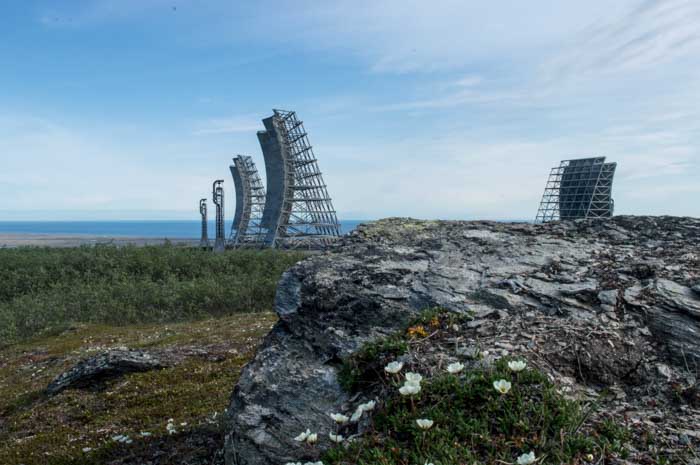
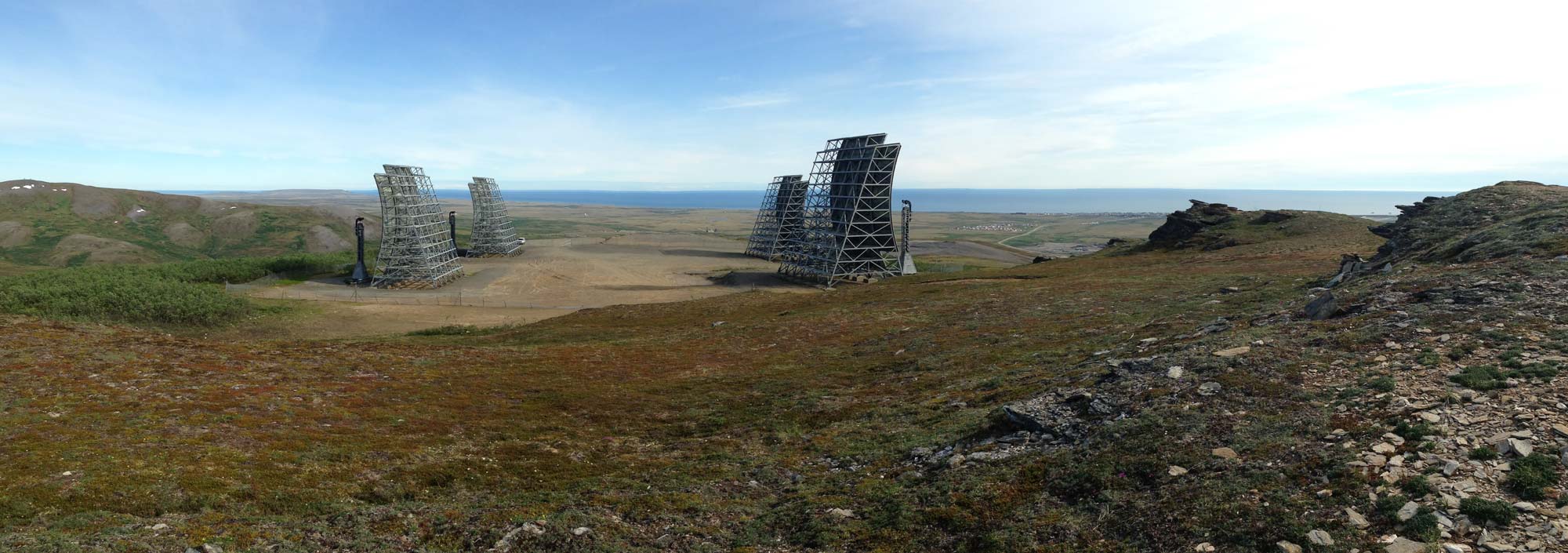
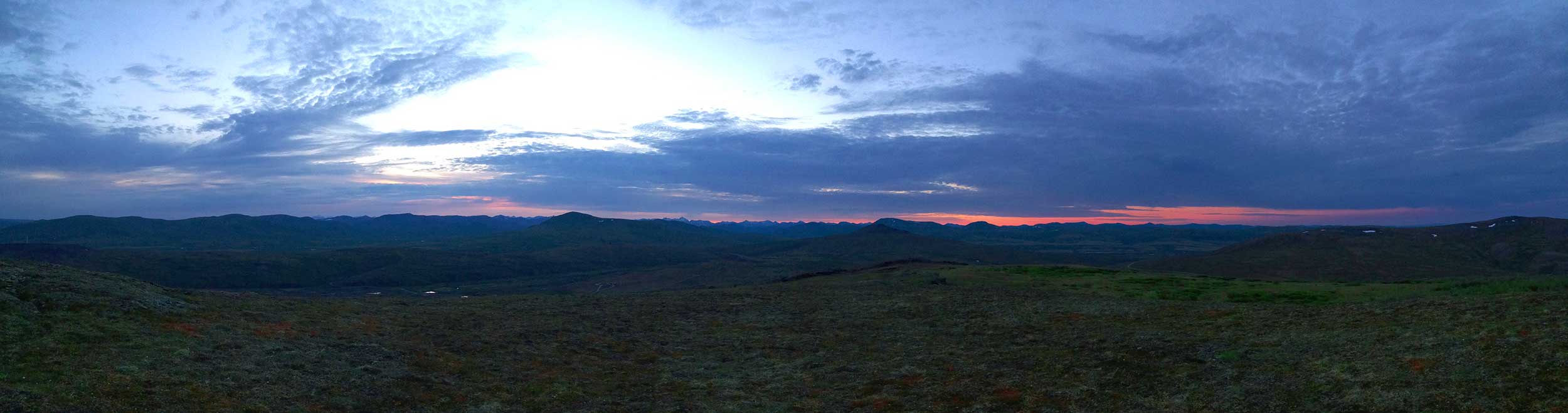
Last night,  I climbed to the top of Anvil Mountain just outside Nome, Alaska (which is near enough to the Arctic Circle to see some of the weirdness) at 2 o’clock in the morning to watch the “sunset.” I say “sunset” because it’s still pretty much full daylight out. The sun dips just barely below the edge of the horizon, but it doesn’t stay there, and it comes up again shortly thereafter…meaning we saw a simultaneous sunset and sunrise.

The red in the sky on the left of this panorama is the sunset. The red in the sky on the right is sunrise. The sun is traveling in a shallow arc that just barely dips beneath the horizon.

Click on the picture to embiggen!

Nome, Alaska: The Last Train to Nowhere

As the result of a lengthy and somewhat improbable series of events, I’m in Nome, Alaska, working on another book.

A few days back, we took a drive on the one road that goes through Nome. Nome is inaccessible by car; the only road links it to the nearby towns of Council and Teller.

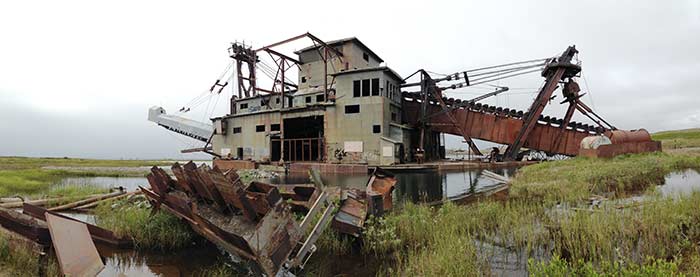
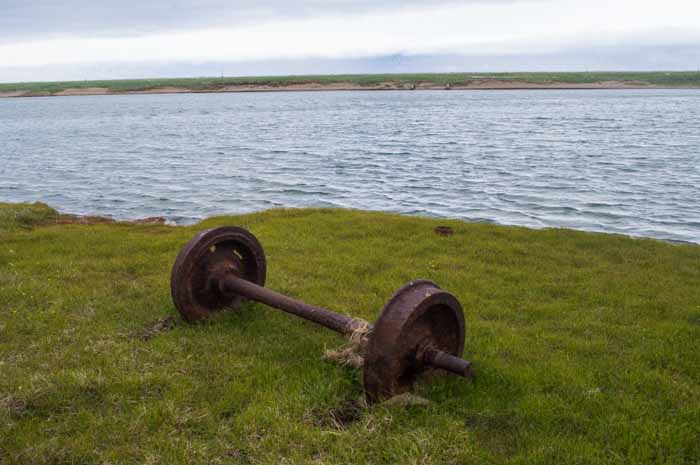
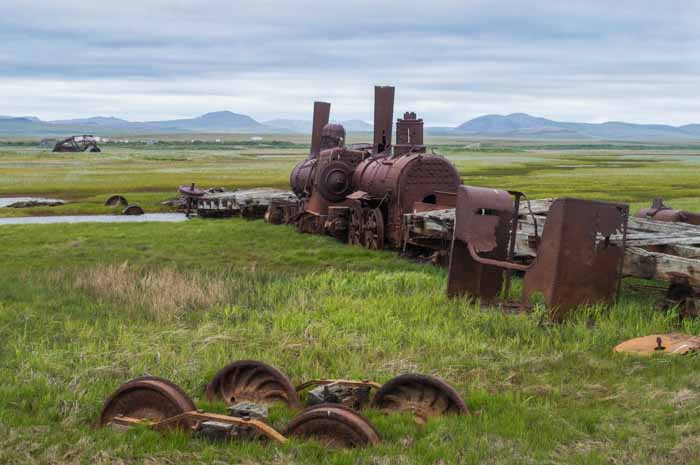
If you drive out toward Council, a trip I recommend only during the summer and then only in a large 4WD vehicle, about twenty miles from Nome you’ll come across the long-deserted ghost town of Solomon, a leftover from the gold rush in the early 1900s. Near Solomon, you’ll find what’s left of a failed attempt to bring rail service to Nome.

In 1903, an enterprising group of people formed a company to build a railroad to serve the gold mines near Solomon. They bought a bunch of secondhand elevated railway engines from New York City and hauled them up to Nome by barge.

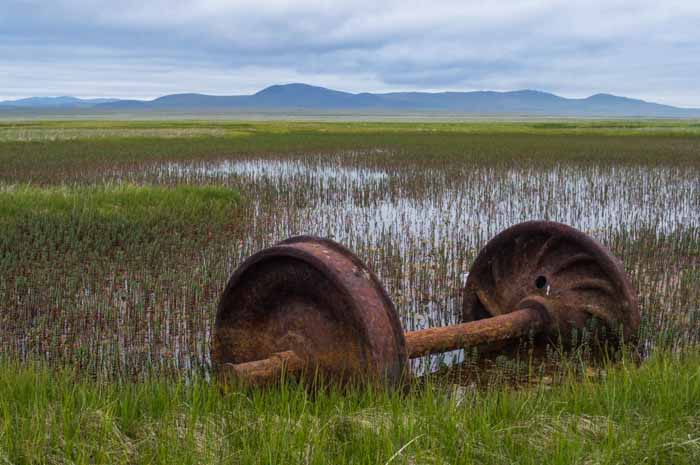
In 1907, a storm washed out the one rail bridge between Solomon and Nome, leaving the trains stranded on the edge of the water. The company folded and simply walked away, leaving the trains where they were, to quietly rust away into the tundra.

That seems to be a common theme in Alaska. The landscape is dotted with abandoned mining equipment, wrecked construction vehicles, and huge pieces of machinery simply left where they were when they became inoperable.

The locals call this steam engine graveyard “The Last Train to Nowhere.”

Even during the summer, it’s cold and windy here. The train never was reliable under the best of circumstances, so it’s no surprise there was no effort to replace it.

Staring Into the Abyss and Blinking: Why I’m Not Watching Dr. Who

I was sold a bill of goods.

We all were, really. It was a bill of goods we’d been promised for years, with the reboot of the popular BBC TV show Dr. Who.

I loved Dr. Who as a kid. I had a secondhand television set in my bedroom when we lived in rural Nebraska. We didn’t have cable, and we were way out in the middle of nowhere, so we only got two stations: PBS and something I don’t remember (because if you have PBS, what else do you need?). I’d watch Tom Baker romp around the universe with his sidekick Louise Jameson (my second celebrity crush) in cheesy low-budget glory.

The new Dr. Who promised to be something darker, something more complex, something less campy and more menacing. And, for a time, it delivered.

Oh, sure, it had problems. Russell T. Davies’ epic misogyny was tiresome and sad, like that one relative who overstays his welcome at every family get-together, the loser who drinks too much and starts rambling about how in his day, women didn’t run for political office before he ends up passed out on the table with all the leftovers scattered around him and his head in the plate of mashed potatoes.

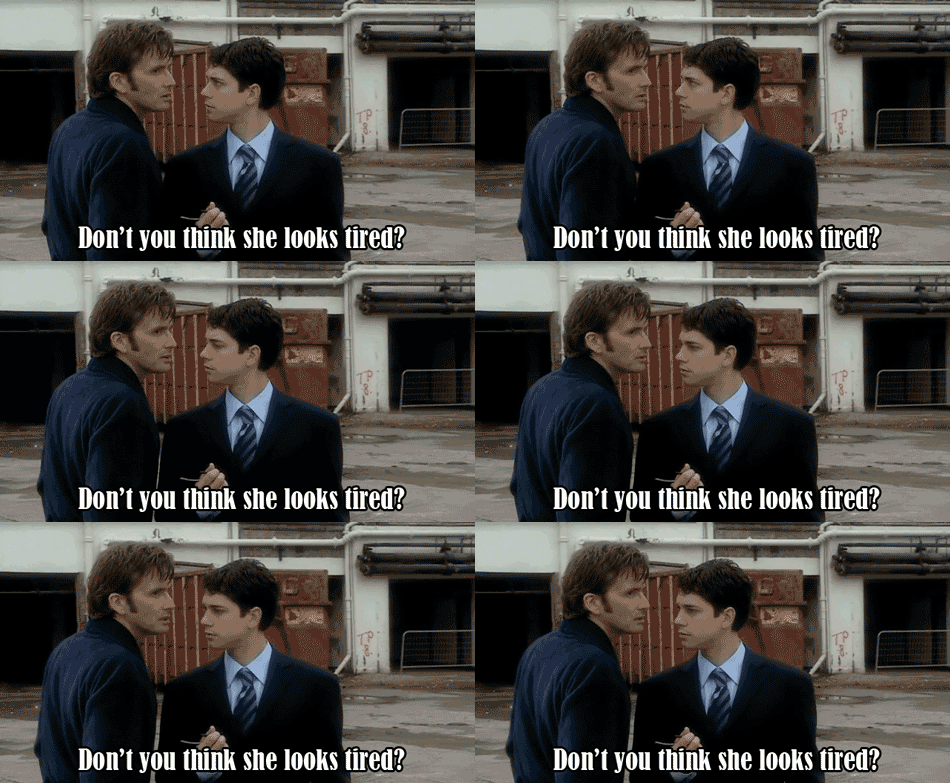
Eventually, the show realized it was actually Mr. Davies’ bigotry that looked tired, and Steven Moffatt took over the reins. His sexism is still there, to be sure, though it’s a more covert sexism, a sexism that sees female characters as “strong” provided they don’t, you know, talk too much or stray from gender roles. But that, perhaps, is a topic for another essay.

Ah, Steven Moffat. The man who blinks at the edge of the Abyss. The man who promises but can’t deliver.


The Promise

When you think of the new Dr. Who, what comes to mind? The character of the Doctor has been re-imagined in a much darker way than the original. This is not the Tom Baker Doctor; this is a doctor much more complex, much less cartooney. This is the Doctor who is always running–but not necessarily from Daleks or Cybermen as much as from himself. This is the Oncoming Storm, the Doctor capable of atrocity, the Doctor who disowned his own name after he destroyed his entire species. This is the Doctor driven by remorse, grief, and a vast, aching ocean of loneliness. This is a Doctor at war with himself.

That’s what the new series offered, and, for the first several years, delivered. In the re-imagined Dr. Who, we were introduced to a character made up of equal parts whimsey and rage, hope and regret. This was a Doctor of contradiction, a Doctor capable on the one hand of rejoicing “Just this once, everybody lives!” and on the other of inflicting infinite punishment on those who anger him. “He never raised his voice. That was the worst thing, the fury of the Time Lord… And then we discovered why.” This is a Doctor capable of acts of almost inconceivable fury. This is a Doctor who, while deriding genocide, is altogether comfortable with it.
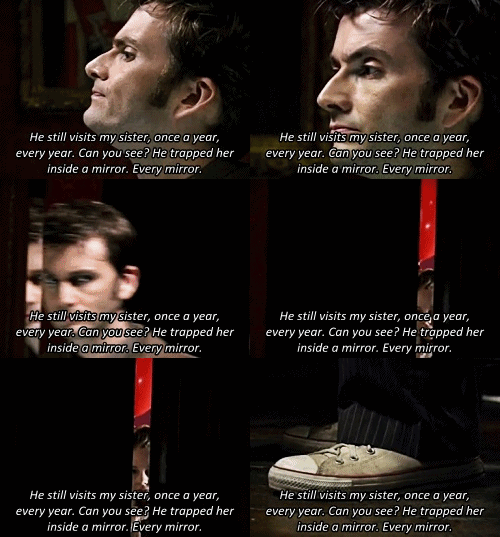
Where did this psychological complexity come from? According to Steven Moffat, from his own past, from his own decision some countless number of centuries ago to destroy his own kind and the Daleks in order to prevent their war from swallowing up everyone else. He looked into the Abyss, and he chose atrocity. He made the choice, consciously and with awareness of the outcome, to commit genocide. Living with the consequence of that choice has defined his character since.

This is the grownup Doctor, the Doctor for adults. The Destroyer of Worlds, the Oncoming Storm, the Bringer of Darkness, with a goofy grin and a Fez and an irrepressible sense of optimism that flies in the face of everything he’s seen. This is the new Doctor.

Or so we were told.


The problem

Many heroes have darkness in their pasts. It’s a rather pedestrian storytelling technique. The most simplistic versions of it, repeated in nearly every comic book since the dawn of time, involves a traumatic event inflicted on the protagonist by an outside party, which becomes the protagonist’s reason to become a hero. Spider-Man and Bruce Wayne had people close to them murdered by bad guys. It’s a cheap trick, a quick way to jump-start a hero without having to work too hard.

Sometimes, storytellers will go a more ambitious route, and make the Dark Tragedy that compels the protagonist forward an atrocity of the character’s own making. This is the strategy employed in my all-time favorite novel, Use of Weapons. When it succeeds, it succeeds well.

It’s a difficult thing to do, though. Presenting a character the audience is expected to see as sympathetic and to be able to identify with, and who is also capable of acts of atrocity the audience finds repugnant, requires considerable finesse in the craft of storytelling.

There’s a problem that one faces, when one is a storyteller dealing with a protagonist who, we are told, is capable of atrocity. At some point, we, the audience, must see the atrocity, or else it becomes a gimmick. If we are told the protagonist is capable of this repugnant thing, but we are never shown it, it’s simply another cheap trick, too easily ignored. Eventually, the TV show was going to have to come to a point where we, the audience, would have to be taken to the abyss. We were going to have to see the act, if we were to continue to take it seriously.

That moment came in a Dr. Who show called The Day of the Doctor, and Steven Moffat almost–almost–pulled it off.

The Day of the Doctor could have been one of the best hours of television filmed in a long time. Instead, it made me utterly abandon any interest in continuing to watch the show, and totally undermined any confidence I have in Moffat’s ability to tell a story.

It should have worked. It really should have. I mean, for Chrissakes, they got John Hurt to play the zeroth Doctor, the Doctor whose act of atrocity laid the groundwork for everything that came after.

The Blink

Dr. Who has always been a corny show, with the degree of corniness waxing and waning as different writers tried their hand at the character. (The Titanic ramming through the TARDIS walls in one particularly atrocious and best-forgotten episode, for instance, will not exactly ring down through the ages as television’s highest moment of artistic achievement.) There is, naturally, a bit of corniness in The Day of the Doctor,, and the episodes leading up to it. That’s to be expected. It’s the characters and not the situations that matter most, right?

So we are introduced to the War Doctor, the Doctor before he renounced his name, the Doctor who was the person all the other Doctors would spend their lives running away from, the Doctor who made an unthinkable choice for which he and all his future incarnations would be driven by remorse. We saw, by the device of time-travel and simultaneous presence, the revulsion and contempt his future selves hold for him. We saw, starkly, the Doctor’s self-loathing put on display. We, the audience, were walked through the events that led to this unthinkable choice, the anguish, the despair, the cold moral calculus that justified it and the emotional response to what it implied. We saw all that.

And then, we saw those future Doctors, the ones who had spent centuries running from that choice, the ones who held the man who made them in such contempt, join him at that hour. Wait, the later versions said. You were the Doctor on the day it wasn’t possible to get it right. But this time, you don’t have to do it alone. The past Doctor and the future Doctors, reaffirming that this act was the right–the only–thing to do.

This was a gutsy, brilliant piece of storytelling. This was the storyteller leading us to the edge of the Abyss and saying, see, this character you love, he is capable of atrocity, and he would do it again. This was the Doctor saying, all these centuries I have lived with this guilt and this remorse and this shame and this self-loathing, and I would do it again. From here, from the vantage point of all these centuries, with all that has happened, it was still the right thing to do. This was the twin irreconcilable pillars of the character’s psychology, the essential paradox of his makeup, the Doctor’s compassion and the Doctor’s capacity for genocide, reconciled. This, maybe, was the beginning of the Doctor’s coming to terms with himself, the path away from self-loathing and grief.

And Moffat blinked.

But he’s the Doctor! Everybody loves the Doctor! He wears a fez! He’s nice to puppies! He helps little old ladies cross the street! We can’t show the Doctor doing this!

And so, in a ridiculous last-minute deus ex bigger-on-the-inside-machina, he blinked. No, we won’t make him do this! We will paint ourselves out of the corner we’ve painted ourselves into because…the TARDIS is magic! Alternate dimensions! But we won’t actually change the Doctor’s character because…because, um…time loop! Memories! He’ll still believe he did this terrible thing even though he didn’t! Nobody actually has to make hard choices, not for real! Retcon! Retcon!


I can forgive a lot of things.

I can forgive uneven writing. I can forgive lapses in continuity (“Even a Time Lord’s body can be dangerous, so we have to burn it…no, wait, Time Lords don’t leave behind bodies when they die, they leave a special effect instead!”) I can pretend that episode about the Titanic didn’t happen.

But I can’t forgive cowardice.

What happened in The Day of the Doctor was cowardice. It was a storyteller making a promise he didn’t have the guts to deliver on. It was not crediting us, the audience, enough to believe that we could take you seriously about the genocide thing and still want to keep traveling with this character. It was the easy way out–I promised you this…oh, no, only kidding! The Doctor would not really do that. Not for serious.

I can’t forgive cowardice, and the television show no longer interests me in the slightest. I simply don’t care enough to follow it any more.

We were sold a bill of goods. The box is empty. The Emperor has no clothes. Steven Moffat can keep his robotic bad guys with their plunger arms and little flashy lights. I want stories that aren’t afraid to go where they promise. Now, where’s that Culture book?

What my cat teaches me about divine love

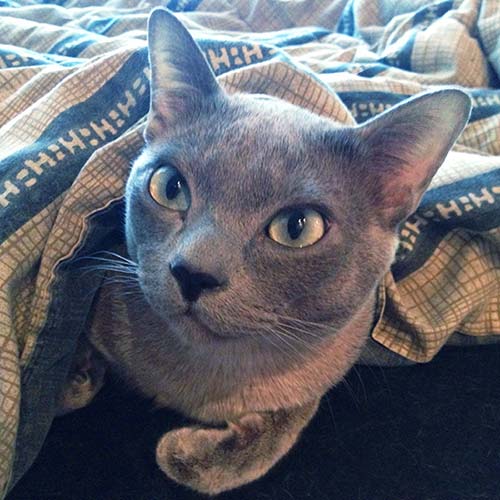
This is Beryl.

Beryl is a solid blue Tonkinese cat. He shares a home with (I would say he belongs to, but the reverse may be true) zaiah and I, and spends a good deal of each day perched on my shoulder. I write from home, and whenever I’m writing, there’s a pretty good chance he’s on my shoulder, nuzzling my ear and purring.

He’s a sweetheart–one of the sweetest cats I’ve ever known, and believe me when I say I’ve known a lot of cats.

Whenever we’re in the bedroom, Beryl likes to sit on a pillow atop the tall set of shelves we have on the wall next to the bed. It didn’t take him long to learn that the bed is soft, so rather than climbing down off the top of the shelves, he will often simply leap, legs all outstretched like a flying squirrel’s, onto the bed.

Now, if I wanted to, I could get a sheet of plywood, put it on top of the bed, then put the blanket over top of it. That way, when Beryl leapt off the shelves, he’d be quite astonished to have his worldview abruptly and unpleasantly upended.

But I wouldn’t do that. I wouldn’t do that for two reasons: (1) I love my cat, and (2) it would be an astonishingly dick thing to do.

That brings us to God.

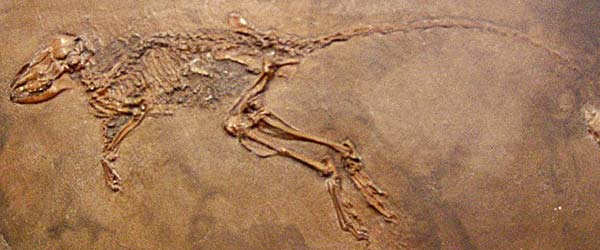
This is a fossil.

More specifically, it’s a fossil of Macrocranion tupaiodon, an extinct early mammal that lived somewhere between 56 and 34 million years ago and went extinct during the Eocene–Oligocene extinction event.

Now, there are very, very few things in this world that conservative Orthodox Jews, Fundamentalist Muslims, and Evangelical Christians will agree on, but one thing that some of these folks do have in common is the notion that fossils like this one do not actually represent the remains of long-vanished animals, because the world is much younger than what such fossils suggest. Most conservative Muslims are more reasonable on this point than their other Abrahamic fellows, though apparently the notion of an earth only a few thousand years old is beginning to take hold in some parts of the Islamic ideosphere.

That presents a challenge; if the world is very young, whence the fossils? And one of the many explanations put forth to answer the conundrum is the idea that these fossils were placed by a trickster God (or, in some versions of the story, allowed by God to be placed by the devil) for the purpose of testing our faith.
And this, I find profoundly weird.

The one other thing all these various religious traditions agree on is God loves us* (*some exclusions and limitations apply; offer valid only for certain select groups and/or certain types of people; offer void for heretics, unbelievers, heathens, idolators, infidels, skeptics, blasphemers, or the faithless).

And I can’t quite wrap my head around the notion of deliberately playing this sort of trick on the folks one loves.

Yes, I could put a sheet of plywood on my bed and cover it with a blanket. But to what possible end? I fear I lack the ability to rightly apprehend what kind of love that would show to my cat.

Which leads me to the inescapable conclusion that a god that would deliberately plant, or allow to be planted, fake evidence contradicting the approved account of creation would be a god that loved mankind rather less than I love my cat.

It seems axiomic to me that loving someone means having their interests and their happiness at heart. Apparently, however, the believers have a rather more unorthodox idea of love. And that is why, I think, one should perhaps not trust this variety of believer who says “I love you.” Invite such a person for dinner, but count the silverware after.

A treasure you cannot frame

Eve and I are in a log cabin deep in the woods, finishing our book on polyamory, More Than Two. The forest is quite lovely. I took this during one of our regular afternoon walks.

An Open Letter to Brogrammers

Computer programming is a tough job. It’s not for the faint of heart or the fair of sex. It’s grueling, high-stress work, demanding that you sit on a comfortable chair in an air-conditioned office for hours on end, typing on a keyboard while looking at a monitor. Women just aren’t rugged enough for that.

Plus, as everyone knows, women can’t code. At best, they can maybe contribute in their small way to large open-source projects, but really, they’re much better suited for accessorizing PowerPoint presentations written by real coders. Manly coders.

If this is the world you live in, bro, I’m afraid I have some really bad news for you.

I’d like to introduce you to someone. This is Augusta Ada King, Countess of Lovelace. She was a lady’s lady, an aristocrat who lived in the 1800s and who did all of the things young women of noble birth did back then–danced, wrote poetry, and penned long flowery letters to her tutor.

She also wrote the world’s first computer program in 1842, in the margins of a technical document she was translating from Italian into English.

Yes, you read that right. Ada was so fucking baller she wrote code before computers had even been invented. You think you’re hardcore because you can use agile development strategies to link a big data repository to a high-performance querying front end without SQL? Pfaff. This woman invented coding before there was anything to code on.

And then there’s this woman, who could kick your ass sideways, steal your lunch, and then fart out code better than anything you’ll ever be capable of if you live to be a thousand years old.

This is “Amazing” Grace Hopper. She took leave from Vassar to join the Navy, where she invented or helped invent the entirety of all modern computer science, including nearly every wimpy-ass tool your wimpy ass laughingly refers to as “coding.” Compared to her, you’re nothing but a little kid playing with Tinker toys. Tinker toys she invented, by the way.

Yeah, I know, I know. You think you’re all badass and shit because you can get your hands right down there and compile a custom Linux kernel with your own task scheduler that reduces overhead for context changes by 16%, and…

Ha, ha, ha, ha, you are just so cute! It’s absolutely precious how you think that’s hardcore. That kind of shit is duck soup. Seriously, no-brains-required duck fucking soup compared to what she did. That C compiler you love so much? Grace Hopper invented the whole idea of writing code in a language that isn’t machine code and then compiling it to something that is. She was the one who came up with the notion of a “compiler” (and wrote the very first one ever), pausing along the way to invent code testing and profiling.

Thanks to her, you’re living in the lap of luxury. you can write code without having to know the exact DRAM timing. You have conditional branches and loops–neither of which existed when she started programming the Harvard Mark 1. (She made loops by taking long strips of paper tape and, no shit, taping their ends together to get the computer to execute the same code again.)

You want to see hardcore programming? I’ll show you hardcore programming:

This is what real hardcore coders do. No compilers, no syntax checkers, just a teletype machine and a bunch of fucking switches that change the computer’s memory and registers directly.

And you know what? For her, that was luxury. She and all the other early computer programmers–almost all of whom were women, by the way–started out programming by plugging patch cords into plugboards, because that’s how they rolled, motherfucker. Fuck keyboards, fuck front-panel switches…those things were soft. If you wanted to code back then, you needed a postgraduate degree in mathematics, an intimate understanding of every single component inside the computer, and the ability to route data with your bare fucking hands.

Grace Hopper was so badass that when she retired from the military, Congress passed a special act to bring her back. Twice. And then when she retired for real (for the third time), the Navy named a guided missile destroyer after her.

Trust me when I say you will never be this badass, bro.

So the next time you see something like this:

and you think that girls can’t code, just remember girls invented coding. And invented the tools that finally let softies like you play at being programmers. They did the heavy lifting so programming could be easy enough for noobs like you.

Imaginary Light

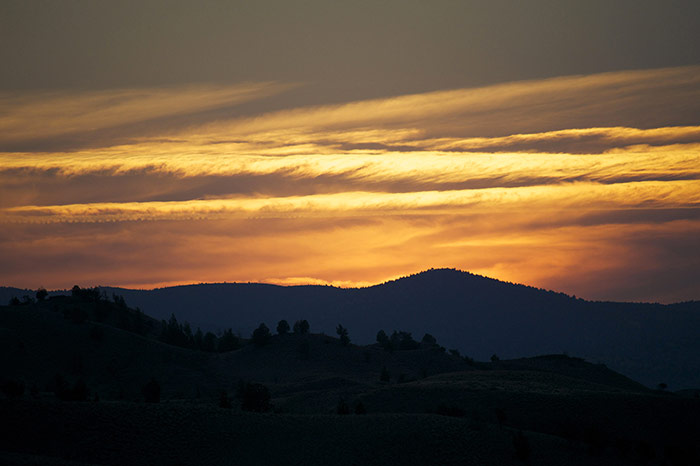
Last month, my sweetie Eve and I celebrated our one-year anniversary with a trip into Oregon’s desert. I took many pictures, which I may one day find the time to post and write about, but I particularly like this one: the sun setting over the John Day Fossil Beds.

The Adventure Van

I am a bad polyamorous person.

I’m not bad in the sense that I don’t talk to my partners, or in the sense that I want to control my partners, or in the sense that I want to have veto over who my partners have sex with. I’m bad in the sense that there lives, deep within my breast, a deep and passionate love for tiny, wildly-impractical two-seat sports cars.

I have, for many years, owned nothing but tiny, wildly-impractical two-seat sports cars. It has created problems for me on more occasions than I can remember, where I needed to go somewhere with more than one of my partners and the only car available was a two-seat sports car.

This has been the background source of much relationship stress for rather a long time. Fate, it seems, has finally conspired to get me to do something about it.

It started with a trip to a friend’s house to help her celebrate her birthday. We had the bad fortune to head out toward her place just as rush hour was starting on a Friday evening, and got to the interstate on-ramp to discover a parking lot.

Right next to the on-ramp is a used car place. In the parking lot of the used-car pace was a conversion van, with a sticker in the window advertising…

…the same Blue Book value of my Honda del Sol, a tiny, wildly-impractical two-seat sports car.

zaiah and I joked that it would make a much better poly vehicle than the del Sol. Then we joked about it again. Then we thought about it. Then we said “Hmm.” Then we said “Hmm” again.

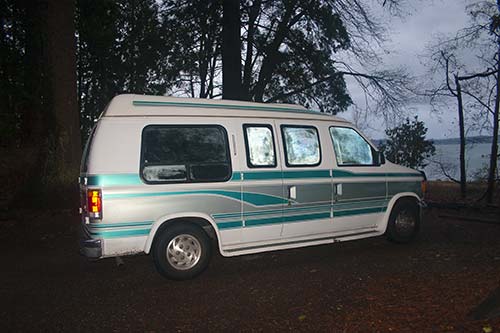
I will spare you the details, which I’m sure you can probably imagine, and cut straight to the chase: We pulled into the dealer’s lot in a tiny, wildly-impractical two-seat sports car, and pulled out in a conversion van.

Which has, I feel compelled to say, a bed in the back.

All my life, I’ve always wanted to own a vehicle with a bed in the back. They don’t make tiny, wildly-impractical two-seat sports cars with beds in them, so that deep desire has never been satisfied. Until now.


I’ve written about game-changing relationships before in this very blog. Swapping my del Sol for a conversion van has been a game-changing relationship.

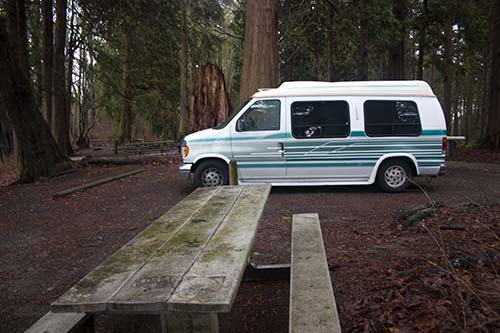
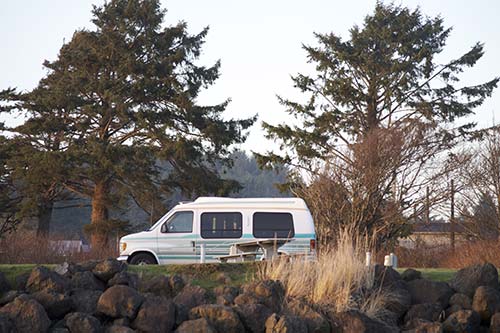
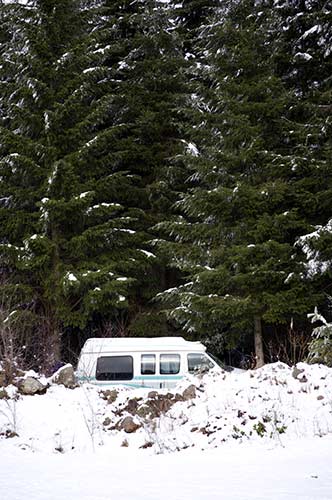
Since making this exchange, zaiah and I have taken it camping twice. In fact, it’s safe to say that owning a conversion van makes a significant difference in one’s quality of life in many ways.

Having a van makes camping a much more comfortable proposition, as it turns out. Not to diss on anyone who enjoys roughing it in the Great Outdoors, mind, but a queen-sized bed with a memory foam topper is actually a considerable step up from a sleeping bag in a tent in terms of creature comforts. Not to mention available positions for sex.

Not long after the exchange, we were invited by those very same friends whose party we were attending on that fateful evening to go sledding…or, as we call it in the language of my people, “Oh god oh god we’re all going to die.” (Kidding! I’m kidding! Nobody died. We ended the sledding with no more than a cracked rib and a mild concussion between us.) As it turns out, it’s easier to fit sleds in a van than in a tiny sports car.

As it also turns out, sledding technology has advanced in leaps and bounds since I was a child, but sled steering technology has been all but lost.

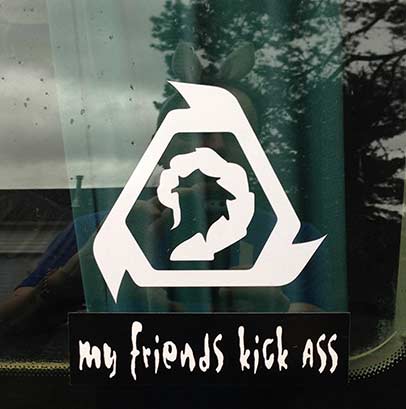
I soon started personalizing the van. My friends DO kick ass. For the Brotherhood!

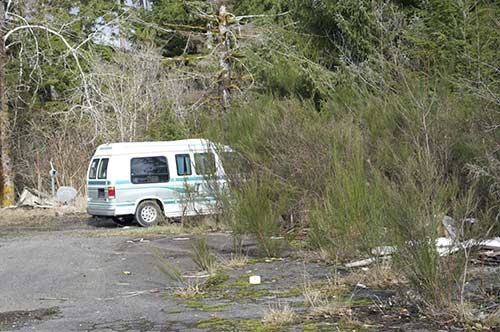
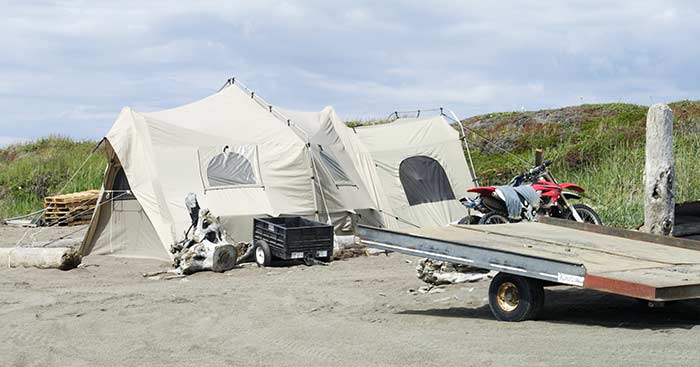
On our most recent trip, zaiah spotted the ruins of an old timber mill, long abandoned and turning to rust. We stopped, parked next to the “No Entry” sign, and I ducked under the “No Trespassing” and “Danger – Keep Out” signs to take photos photos, which I will likely be posting soon.

A lesson I’ve already learned from our adventures: Temperate coastal rainforests are soggy. Very, very soggy.

The Pacific Northwest doesn’t really understand beaches.

I grew up in Florida. I know what beaches are. Beaches are endless vistas of glittering sand, over which the surf rolls constantly. Seagulls circle overhead. The sun beats down on sand castles and little brightly-colored canopy tents.

In the Pacific Northwest, they apparently heard that “beaches” are places where the ocean meets the shore, but they were a bit hazy on details beyond that. Beaches here are rocky, with enormous boulders standing among piles of small round pebbles, while the rough surf pounds anyone who dares venture too close into oblivion. Oh, and it’s also bitterly cold.

So, not unlike the beaches I’ve seen in Great Britain, really.

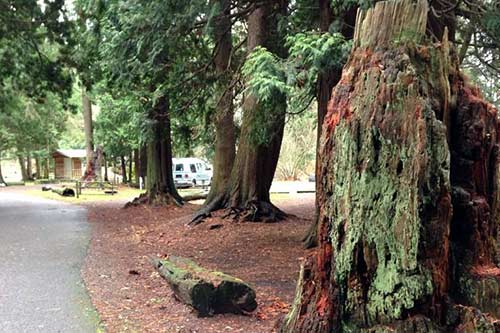
One nice thing about camping in winter: you get the whole campground to yourself. Seriously, on our first trip, we were literally the only people there. Even the park ranger had the sense to be elsewhere. I woke thinking the Second Coming had happened and we’d somehow been missed. (It’s an easy mistake to make. Angels pouring out their Seals, the armies of darkness sweeping over the land, the Final Judgment…there’s a lot going on! It’s surprising how easy it is to overlook a couple of yahoos out camping in a van in the dead of winter. Who camps in winter?)

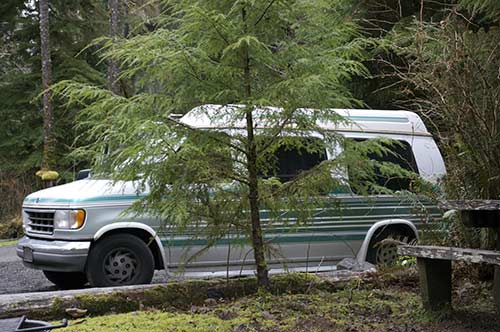
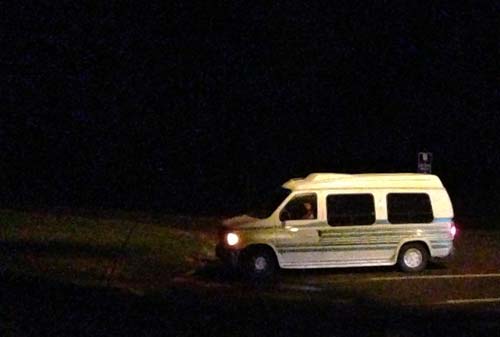
Shh! We’re hiding! Bet you can’t see us!

A rest area late at night. It looks so homey! It’s like a miniature house on wheels. A house without a bathroom. Or a kitchen. Or Internet access. But it has a bed! And that, by itself, means that when we’re camping in it, our standard of living is probably higher than most of humanity for most of human history.

A Christmas Kitten

So it came to pass that zaiah and I went camping in Puget Sound for our seventh anniversary last week.

We took the new conversion van, which I traded my 2-seat Honda del Sol for on the spur of the moment a couple of months back. I have always loved little 2-seat sports cars, and on many occasions throughout the years I’ve been informed that this particular taste perhaps isn’t the most practical for a person in polyamorous relationships. zaiah and I were driving past a used-car lot one evening, and saw the van for about the same price as the book value on my car, so we went in with a del Sol and came back with a van.

Anyway, we went camping in Puget Sound because there’s a Tonkinese breeder in that area, and we’d been talking to her about getting a male cat from her to breed with my kitten, Kyla. He was old enough to come home with us the same weekend as our anniversary, so off we went.

The Tonkinese cats she breeds are just beautiful. Anyone who’s never met a Tonk is missing out. They are beautiful, intelligent, fearless cats who are very people-focused. This was what greeted us when we arrived. Our new kitten, Beryl, is the blue solid on zaiah‘s lap.

The first night with us, Beryl insisted on sleeping in bed with us. Under the covers, snuggled up, and purring. He spent most of the night nestled on my legs, preventing me from moving.

Then he moved up to snuggle into my armpit.

When Iwoke up, he crawled onto my lap and refused to let me stand, keeping me stapled to the bed by sitting on my lap and not moving.

zaiah installed hanging cloth shoe shelves in our closet, which we use to store socks and sweaters and so forth.

I should have realized that he was a climber when this became his preferred place to sleep any time we were not in bed.

We are still in the process of finishing our room, which we have been building onto the house for the past several months. The walls have not yet been painted, and the trim and baseboards are not installed yet.

The new bedroom has a ladder up to a loft we’ve constructed, which we’re using as a home office. The ceiling in the bedroom is quite high, so the ladder into the loft (which is bolted to the wall) is twelve feet tall.

Did I mention that the cat is a climber?

zaiah and I were up in the loft one day, getting ready to watch Law & Order on the computer, when we heard a crash and a frantic scrambling down below. The cat was trying to climb the ladder.

“Oh, that’s so cute!” I said. I got my cell phone and took a picture.

Then I went back to the loft.

A second later, the cat was up there with us.

He sprang onto the computer keyboard (starting the movie playing in the process) and then sat on my lap as if to say “I’m here! Aren’t I clever?”

And he is. This is the most talkative, most athletic, most determined, most curious, and most intelligent cat I’ve ever owned. That is a very dangerous combination, as it turns out.

The next night, I woke to the sound of claws scrambling on metal. I grabbed my camera and fired off a bunch of shots as the kitten climbed up into the loft.

As I’m typing this, at this exact moment, the kitten is sitting on my lap. In the loft.

Living with him is going to be…interesting.

Stopping by the side of the road…

zaiah and I spent the last four days camping near Puget Sound to celebrate our seventh anniversary, and to pick up the new addition to the household: a tiny blue Tonkinese kitten who will be a breeding tom for my kitten Kyla.

On the drive, we passed the ruins of an old house just off the interstate and (naturally) had to pull over to take care of it. The house is located in someone’s back yard, so after we’d hopped off the interstate, we knocked on the door and asked the gentleman living there (a retired engineer) if we could take pictures of it. He agreed, and away we went.

Unfortunately, it was biting cold, so we couldn’t linger. I did get some interesting shots, though. I love this kind of ruin!

Clicky here to see more!