I sleep in a loft bed, to make more room for my computers and one of my 3D printers, which I keep under the bed.
I needed a new floor lamp, and because I’m lazy, I wanted something I could turn on and off remotely without climbing out of bed. So I found a floor lamp on Amazon that advertised remote control capability.
Imagine my surprise when I opened the box and found no remote, just a QR code to download a smartphone app.
Buckle up, because this story is about to take a turn that would make William Gibson cringe.
My first hint something was wrong came when the app forced me to create an account on the manufacturer’s server before I could pair pair with the lamp.
But hey, I wanted to see how deep the rabbit hole went, so I made an account. The answer is “pretty deep.”
Once you pair over Bluetooth, the next thing you do is download your WiFi password to the lamp. You also must enable location services, so the lamp knows your location. (The software won’t work if you don’t.)
Once the lamp knows your location, you have a choice to make. It asks if you’d rather use the microphone in your phone, or the one built into the lamp.
Yes, you read that right. The lamp connects to your WiFi and your phone, knows where you are, and has a built in microphone.
Once you’ve made that particular Hobson’s choice, the app asks you to upload a selfie, so it can—get this—run facial recognition and AI expression analysis.
Why? So it can suggest a lighting scheme based on your mood.
The Terms of Service allow the manufacturer to store your face and do both facial recognition and AI analysis.
I uploaded a photo of a cat rather than my selfie.
You’re then connected to a community of other lamp users, so you can exchange lighting patterns and such…because, of course, it is a truth universally acknowledged that a person in possession of a floor lamp must be in want of a way to exchange lighting suggestions with complete strangers.
Here’s the light it suggested based on AI analysis of a cat.
The lamp was originally slated to arrive from Amazon on Monday, but when Monday came I got an email telling me that delivery was delayed and it would arrive on Tuesday.
Were I of a paranoid bent, I might believe that the delay allowed a government three-letter agency to intercept the shipment so they could do a supply chain attack, rerouting the lamp’s connection to the host servers (which is a really weird thing to say, if you think about it) through them as well.
George Orwell believed in a future where the government constantly watched the citizens, recording every detail of their lives. George Orwell didn’t know about outsourcing.
A few months back, Elon Musk, the right-wing owner of Twitter and Grok, his pet Generative AI project, posted something I wrote on his Twitter feed, with the caption “This is the quality of humor we want from Grok.”
He even had it pinned to his profile for a short while.
I wrote this over on Quora in March of 2024. On the one hand, it’s interesting to know that Elon Musk reads my stuff. On the other, do you notice anything funny about the screenshot of his Tweet?
Yup, no credit.
The Tweet went viral, and has since been posted all over Facebook, Tumblr, Twitter, Reddit, and TikTok…all without attribution.
Right now, as I write this, OpenAI, the company behind ChatGPT, has a market cap of $157,000,000,000, making it more valuable than companies like AT&T, Lowe’s, and Siemens.
It is not a profitable company; in fact, it’s burning cash at a prodigious rate. Unlike other companies, though, which burned cash early on to achieve economies of scale, OpenAI’s costs scale directly with size, which is not at all normal for tech companies. At its current rate of growth, in four years its datacenters will consume more electricity than some entire nations.
But I’m not here to talk about whether AI is the next Apple or the next Pets dot com. Instead, let’s talk about what generative AI is, and how it represents the greatest wealth transfer of the last fifty years.
AI is not intelligent. Generative AI does not know anything. Many people imagine that it’s a huge database of all the world’s facts, and when you ask ChatGPT something, it looks up the answer in that immense library of knowledge.
No.
Generative AI is actually more like an immense, staggeringly complex autocomplete. It ingests trillions of words, and it learns “when you see these words, the most likely next words are those words.” It doesn’t understand anything; in a very real sense, it doesn’t even “understand” what words are.
As the people over at MarkTechPost discovered, many LLM models struggle to answer basic arithmetic questions.
AIs make shit up. They have no knowledge and understand nothing; when presented with text input, they produce text output that follows the basic pattern of the input plus all the text they’ve seen before. That’s it. They will cheerfully produce output that looks plausible but is absolutely wrong—and the more sophisticated they are, the more likely they are to produce incorrect output.
If you want to understand Generative AI, you must, you absolutely must understand that it is not programmed with knowledge or facts. It takes in staggering quantities of text from all over and then it “learns” that these words are correlated with those words, so when it sees these words, it should spit out something that looks like those words.
It doesn’t produce information, it produces information-shaped spaces.
To produce those information-shaped spaces, it must be trained on absolutely staggering quantities of words. Hundreds of billions at least; trillions, preferably. This is another absolutely key thing to understand: the software itself is simple and pretty much valueless. Only the training gives it value. You can download the software for free.
So where does this training data come from?
You guessed it: the Internet.
OpenAI and the other AI companies sucked in trillions of words from hundreds of millions of sites. If you’ve ever posted anything on the Internet—an Amazon review, a blog, a Reddit post, anything—what you wrote was used to train AI.
AI companies are worth hundreds of billions of dollars. All that worth, every single penny of it, comes from unpaid work by people who provided content to the AI companies without their knowledge or consent and without compensation.
This is probably the single largest wealth transfer in modern history, and it went up, not down.
There are a few dirty secrets lurking within the data centers of AI companies. One is the staggering energy requirements. Training ChatGPT 4 required 7.2 gigawatt-hours of electricity, which is about the same amount that 6,307,200 homes use in an entire year. (I laugh at conservatives who whine “eLeCtRiC cArS aRe TeRrIbLe WhErE wIlL aLl ThE eLeCtRiCiTy CoMe FrOm” while fellating Elon Musk over how awesome AI is. Training ChatGPT 4 required enough power to charge a Tesla 144,000 times. Each single ChatGPT query consumes a measurable amount of power—about 2.9 watt-hours of electricity.
All the large LLMs were trained on copyrighted data, in violation of copyright. Every now and then they spit out recognizable chunks of the copyrighted data they were trained on; pieces of New York Times articles, Web essays, Reddit posts. OpenAI has, last time I checked, something like 47 major and hundreds of smaller copyright lawsuits pending against it, all of which it is fighting. (It might be more by now; there are so many it’s hard to keep up.)
That, I think, is the defining computer science ethical problem of our time: To what extent is it okay to build value and make money from other people’s work without their knowledge or consent?
Elon Musk recognizes the value in what I write. He recognizes that it has both artistic and financial value. He posts my content as an aspirational goal. He doesn’t credit me, even as he praises my work.
That’s a problem.
Those who create things of value are rarely recognized for the value they create, if the things they create can’t immediately be liquidated for cash. That’s not new. What’s new is the scale to which other people’s creativity is commoditized and turned into wealth by those who had nothing whatsoever to do with the work, and are merely profiting from the labor of others without consent.
“Because copyright today covers virtually every sort of human expression – including blogposts, photographs, forum posts, scraps of software code, and government documents – it would be impossible to train today’s leading AI models without using copyrighted materials. […]
Limiting training data to public domain books and drawings created more than a century ago might yield an interesting experiment, but would not provide AI systems that meet the needs of today’s citizens.”
It also claims their use of other people’s work is “fair use,” even while they admit that chatbots sometimes spit out verbatim chunks of recognizable work. This is a highly dubious claim—while fair use doesn’t have a precise legal definition (the doctrine of fair use exists as an affirmative defense in court to charges of copyright infringement), one of the key components of fair use has always been commercialization of other people’s work…and with a market cap of $157,000,000,000, it’s pretty tough to argue that OpenAI is not commercializing other people’s work. It charges $20/month for full access to ChatGPT.
So at the end of the day, what we have is this: a company founded by people who are neither writers nor artists, producing hundreds of billions of dollars of wealth from the uncompensated, copyrighted work of writers and artists whilst cheerfully admitting that could not produce any value if they had to pay for their training data.
And it’s not just copyrighted data.
OpenAI Dall-e cheerfully spit this image out when I typed “Scrooge McDuck stealing money from starving artist.”
Here’s the thing:
Scrooge McDuck is trademarked. Trademark law is not the same as copyright law. Trademarks are more like patents than copyrights; in the US, trademarks are administered by the Patent and Trademark Office, not the copyright office.
In no way, shape, or form is this “fair use.”
Generative AI recognizes trademarked characters. You can ask it for renderings of Godzilla or Mickey Mouse or Spider-Man or Scrooge McDuck and it’ll cheerfully spit them out. The fact that Dall-e recognizes Scrooge and Spider-man and Godzilla demonstrates without a shadow of a doubt it was trained on trademarked properties.
So far, all the lawsuits aimed at AI infringement have been directed at the companies making AI models, but there’s no reason it has to be that way. You “write” a book with AI or you create a cover for your self-published work with AI and it turns out there’s a trademark or copyright violation in it? You can be sued. That hasn’t happened yet, but it will.
(Side note: The books I publish use covers commissioned from actual artists. Morally, ethically, and legally, this is the right thing to do.)
Why do I call OpenAI and its kin a socialist wealth transfer? Because they treat products of value as a community property. Karl Marx argued that socialism is the transition between capitalism and communism, a system where nothing is privately owned and everything belongs to the public, and that’s exactly how OpenAI and its kin see creative works: owned by nobody, belonging to the public, free to use. It’s just that “free to use” means “a vehicle for concentrating wealth.”
From creators according to their ability, to OpenAI according to its greed.
It seems to me that what we need as a society is a long, serious conversation about what it means to create value, and who should share in that value. It also seems to me this is exactly the conversation the United States is fundamentally incapable of having.
NOTE: This blog post was updated on January 25, 2025. Update at end.
If you own a website that uses stock images or even images you’ve taken yourself, beware a scam floating around that tries to trick you into putting links to another site on your pages.
I recently received a phony “DMCA Copyright Infringement Notice” run by a scammer attempting to get backlinks to a site called KnowYourSins, a sex site run by two people named Samuel Davis (@Samueld_KYS on Twitter) and Olivia Moore (@Olivia_kys on Twitter).
The letter claims to come from a law firm called “Commonwealth Legal Services” in Phoenix, Arizona. Here’s a screenshot:
So, the first thing to know about this email is it’s very unusual for a DMCA complaint, which is almost always a takedown request, not a request for a backlink.
The second thing to notice is there’s a standard format for DMCA takedowns, and they must, by law, include:
Information reasonably sufficient to permit the service provider to contact the complaining party, such as an address, telephone number, and e-mail address.
A statement that the complaining party has a good faith belief that use of the material in the manner complained of is not authorized.
A statement that the information in the notification is accurate, and under penalty of perjury, that the complaining party is authorized to act on behalf of the copyright holder.
The image itself comes from Unsplash, specifically this one, and it was taken by Eric Lucatero, who has no connection with KnowYourSins dot com.
Huh.
Commonwealth Legal Services
I looked at the website of the supposed “law firm” that sent it, justicesolutionshub.info. Now, the fact that it uses a .info top-level domain immediately set off warning bells in my head as well.
“Zoe Baker” signs this email “Trademark Attorney,” yet the page on justicesolutionshub.info lists “her” as a “business legal consultant.”
Huh.
On top of that, notice anything funny about all these headshots? Look closely.
Yup, they’re all generated by AI—specifically, they all come from This Person Does Not Exist.
How can you tell?
AI deepfake faces generated by This Person Does Not Exist always have eyes in exactly the same place exactly the same size and exactly the same distance apart. It’s a limitation of the adversarial GAN software that creates the fake faces.
You can see it if you stack the faces on top of each other and make them translucent in Photoshop.
I looked up “Commonwealth Legal Services” on Google. It turns out there are a bunch of different websites at different URLs all using the same exact web design with the same copy and the same pictures: justicesolutionshub.info, cwsolutions.biz, elitejusticeadvisors.biz (currently offline), and more.
The front page of justicesolutionshub.info shows a photo of a building. The office building is a stock photo rendering that you can put any logo in front of.
This is an Adobe Photos stock photo rendering created by digital artist “Esin.” A surprising number of phony fly-by-night bogus “companies” use this stock image as their corporate headquarters on their About or Contact pages.
Things really take a turn for the surreal if you put the address of “Commonwealth Legal Services,” 3909 N. 16th Street, Fourth Floor, Phoenix, AZ 85016 into Google Street View. This one weird trick produced results you aren’t going to believe:
Note the conspicuous absence of a fourth floor. As of the time of writing this, the building is currently listed for sale.
Okay, so we have a fake DMCA takedown request from a phony law office attempting to blackmail me into putting a backlink to Know Your Sins from my site.
Know Your Sins
So, what is Know Your Sins?
It’s a more or less generic BDSM information site with precious little in the way of in-depth information, using largely AI-generated content and stock photos.
I can see a couple of possibilities:
Know Your Sins is scamming in a desperate bid to attract backlinks and improve their search engine ranking.
Know Your Sins is a victim; they hired a dodgy “we can boost your search engine ranking” scammer, not knowing that he was engaging in fraud.
I emailed the contact address at Know Your Sins, hello (at) knowyoursins (dot) com, to try to get some insight. So far, as of the time of writing this, I have not received a reply. I will update this blog post if they get back in touch with me.
I’ve also been in touch with several webmasters who have received identical DMCA complaints, at least one of whom was accused of pirating a photo he took, all with demands to link back to Know Your Sins.
The Know Your Sins domain registration is hidden by Privacy protect. I’ve filed a formal complaint with them, since they claim they’ll rescind the privacy protection on sites that engage in spamming or fraud. (I urge anyone who’s received one of these scam emails to do the same using the “report abuse” form here.) If they reply, I’ll post the results.
Isn’t there a penalty for false DMCA takedown requests?
No. Perhaps surprisingly, there isn’t.
There are penalties for impersonating a lawyer, and for fraud. The emails are definitely fraud, and I do not for even half a second believe the person sending them is a lawyer, so there may be avenues of legal action there. I suspect, given that others are reporting these emails but they don’t always demand a link to Know Your Sins (some of them demand links to other sites), that what’s most likely happening is a scammer is selling his services to desperate website owners who want more Google linkbacks but don’t care too much if they’re totally on the up and up.
The lesson here
Genuine DMCA takedown requests must follow a certain specific legal format (including a statement that under penalty of perjury, the person sending the request has a good-faith belief that the claimed infringement is genuine), and don’t ask for linkbacks.
If you get a “DMCA warning” or “DMCA takedown” that asks you to link to another site, you’re being scammed.
If you’ve received one of these fake takedown requests, I’d love to hear from you! I’m in the process of trying to strip the Privacy Protection from the knowyoursins domain registration, and the more examples I have, the better. Please feel free to email me at franklin (at) franklinveaux (dot) com.
UPDATE JANUARY 25, 2025
A lot of people have sent me copies of similar fake DMCA emails demanding linkbacks to knowyoursins dot com. The site is registered at GoDaddy. This morning, I had a long and interesting conversation with a member of the GoDaddy abuse team, who has told me that GoDaddy is opening an investigation into knowyoursins dot com for fraudulent DMCA takedowns and fraudulent backlink farming.
Have you received a “DMCA takedown” demanding a link to knowyoursins dot com? GoDaddy’s abuse team would like to hear from you.
Create a new report, choose the “Phishing” option, and in the details section, put a copy of the fraudulent email you received, with a brief explanation that you are reporting the site for fraudulent DMCA takedowns and fraudulent backlink farming.
And, of course, I’d love to see copies of the fraudulent emails you’ve received.
Okay, so. It’s thousands of years in the future. A global calamity has caused civilization to collapse. The population cratered to less than a billion people. Modern technological infrastructure was wiped out: power generation, mining, logistics, everything.
Eventually humanity recovered, up to a point. Right now, in the real world, all the world’s near-surface deposits of metals, oil, and most minerals are depleted; a society that lost modern infrastructure would no longer be able to mine iron, find or use oil and other petrochemicals, coal, and so on.
Metals in the fictional society still exist, though in limited quantities. They have to be “mined” from landfills, and the capacity to smelt steel without coal or oil is highly limited. Fortunately, landfills are largely anaerobic environments, so metals would still exist in unoxidized states, but can you imagine trying to smelt anything useable from, say, a stainless steel oven or a car frame without coal or oil?
No oil means limited plastics. Firearms exist, but without modern machining they’re quite crude compared to modern firearms. Computers? No. Electrical power in large quantities? No.
Thing is, the knowledge to make these things still exists; it isn’t lost. Many books and so forth survive (though not, obviously, computer records). People would know how electricity works, how to smelt high-quality steel, and so on; it’s just that without ores, without coal, without oil except for plant oils, it’s difficult to do on a large scale.
So: Horses and carts are the predominant non-pedestrian travel. Simple firearms exist but not in mass-produced, industrial quantities. It’s a weird society: technologically backward but with full knowledge of what has been lost.
My question relates specifically to military doctrine and combat tactics.
Horse-mounted calvary and foot soldiers, armed with swords and mmmmaybe simple cartridge firearms brings to mind, say, Revolutionary War or Civil War tactics…but in this world, the knowledge of modern combined arms tactics, military doctrine, and small-unit tactics still exists, it wasn’t lost, only the technological infrastructure was lost.
So, what would military units look like? What would military tactics and strategy look like? Definitely not Civil War, but not modern either. How would industrial military techniques and doctrine adopt to that level of technological infrastructure?
First up in today’s game of “who fed it and who ate it:” Artificial Intelligence.
AI is everywhere. AI chatbots! AI image generators! And now, AI code assistants, that help developers write computer programs!
Only here’s the thing: AI doesn’t know anything. A lot of folks think these AI systems are, like, some sort of huge database of facts or something. They aren’t. They’re closer to supercharged versions of the autocomplete on your phone.
Which means if you ask an AI chatbot or code generator a question, it does the same thing autocomplete does: fills in syntactically correct words that are likely to come after the words you typed. There is no intelligence. There is no storehouse of facts it looks up.
That’s why AI is prone to “hallucinations”—completely imaginary false statements that the AI systems invent because the words it uses are somehow associated with the words you typed.
AI Fembot says: The Golden Gate Bridge was transported for the second time across Egypt in October of 2016. (Image: Xu Haiwei)
So, code generation.
AI code generation is uniformly terrible. If you’re asking for anything more than a simple shell script, what you get likely won’t even compile. But oh, it gets worse. So, so much worse.
AI code generators do not understand code. They merely produce output that resembles the text they were trained on. And sometimes, they hallucinate entire libraries or software packages that do not exist.
Which is perfectly understandable once you get how AI LLMs work.
In February, then again in March, the developer released updates to a library called “XZ Utils.” The update contained weird, obfuscated code—instructions that were deliberately written in a manner to conceal what they did—but because he was a trusted dev, people were just like 🤷♂️. “We don’t know what this code he added does, but he seems an okay guy. Let’s roll this into Linux.”
He seems a decent fellow. We don’t know what this code does, but what’s the harm? (Image: Zanyar Ibrahim)
Fortunately it was spotted quickly, befure it ended up widely used, so only a handful of bleeding-edge Linux distros were affected, but still:
What the actual, literal fuck, people??!
“This library contains obfuscated code whose purpose has been deliberately concealed. What’s the worst that can happen?”
Jesus. And it’s only March.
Developers should never be allowed near anything important ever.
It’s an aggressively mediocre word processor with two killer features: you have access to it wherever and from whatever device you have Internet access, and it is hands-down the absolute best thing out there for collaborative writing. Nearly all my books are co-written with other people. Google Docs makes this effortless; in fact, many’s the time I’ve been working with Eunice or my Talespinner as both of us type in the same Docs file at the same time.
Even when we aren’t writing at the same time, Google Docs makes it easy for us to leave notes to each other within the same document. It’s no exaggeration to say Docs is probably the best thing to happen to collaborative writing since the invention of the fountain pen.
I’ve spent the last couple of days poring over the Google Terms of Service, and what I found is…worrisome.
Many of the novels I write contain sex. Some of them contain a lot of sex; the Passionate Pantheon series Eunice and I write, a far-future post-scarcity science fiction series where residents of the City worship AI gods through highly ritualized group sex, is a vehicle for us to explore sexual ethics, philosophy, and society in a setting where attitudes toward sex and violence are pretty much exactly the opposite of what they are here in the real world. And these books have tons of sex, some of it so kinky the kinks don’t even have names—we looked.
Naturally, the notion that Google can terminate your Google account and delete your manuscripts in progress for (consensual adult) sexual content is a little alarming.
The issue seems to be Google’s March 2024 anti-spam update.
What does spam have to do with sex and Google? Glad you asked.
More and more often, I am seeing spam that directs to Google properties: Google Sites and Google Docs, mostly. The spammers link to a Google page, which has a link that goes on to the spam site.
Why? Because it keeps the spam emails from being filtered by anti-spam filters (Google links aren’t flagged as spam) and helps prevent the spammers from having their sites shut down.
Sex spammers especially seem to be flocking to Google:
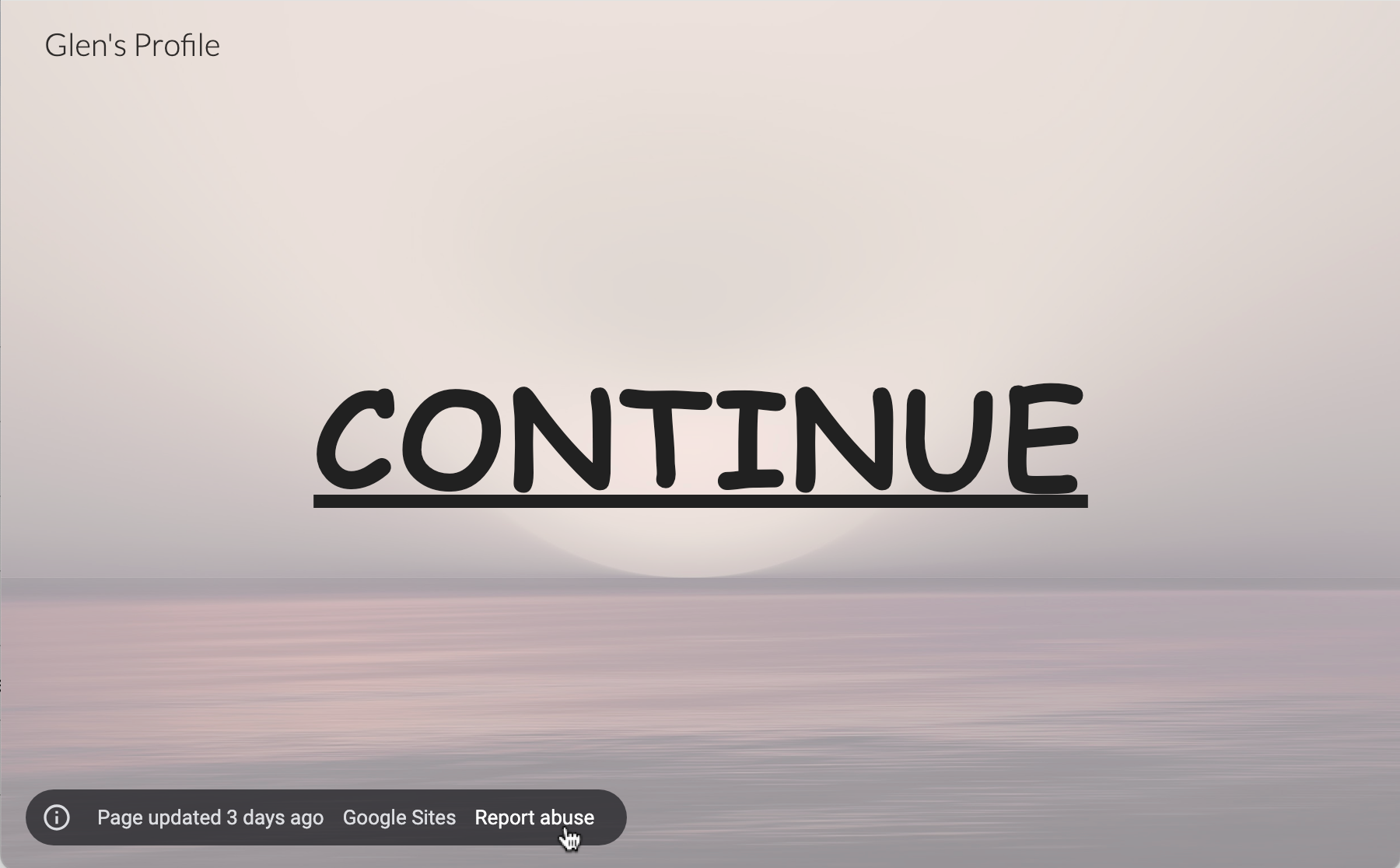
If you click on the link, you’re taken to a Google Site (as in this example) or a Google Doc that then contains a link to the spam site. The Google page includes a little circle-I icon that, if you click on it, brings up the option to report the Google Site or Google Doc for abuse.
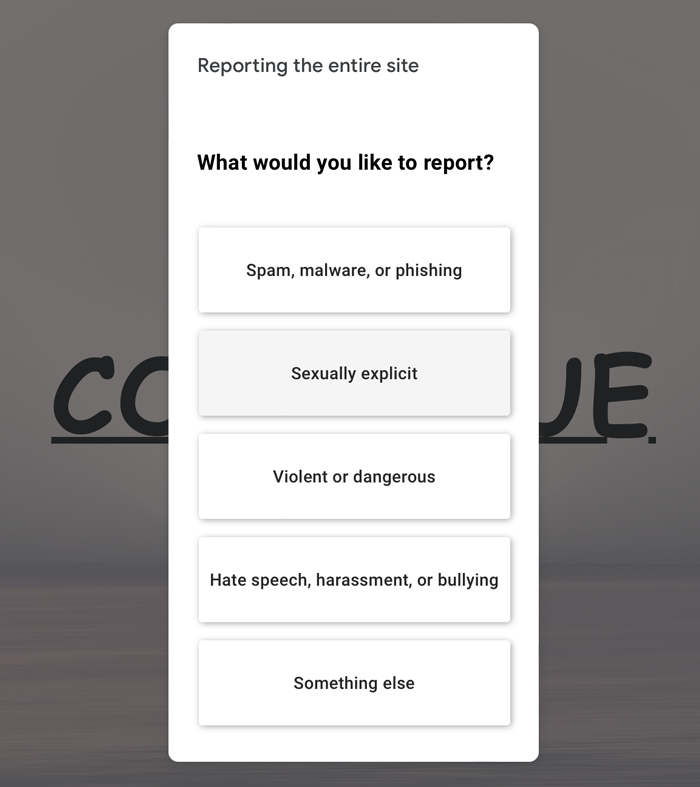
If you hit the Report Abuse link, one of the options is “Sexually Explicit.”
So. It seems Google doesn’t permit sexually explicit content. But is that actually part of the Google Terms of Service? Well, kinda.
This…isn’t actually terribly clear. It forbids distributing sexually explicit material, though it doesn’t ban creating sexually explicit material, nor does it say what constitutes “distributing.”
So.
What follows is a completely unofficial speculation about what might be happening and what you might be able to do about it. I claim no insider knowledge of Google’s policies; this is simply informal noodling about the situation.
There are several ways to share a Google Doc. You can invite specific people to see it, and give them different levels of access (read only, comment, propose changes, edit, and so on). You can set it up so that anyone who has the URL can read the document, but can’t make any changes. The way you share it affects what people who view it will see.
If you invite specific people to be able to see and/or comment on the document, they will not see the little information bubble that gives them the option to report the site to Google’s abuse team.
If you set the document up so that anyone with the link can see it, which is what spammers do, then anyone who views the document will see the option to report the document for abuse.
I think—and let me emphasize again this is not based on insider knowledge of anything happening at Google—I think what’s happening is that authors who share Google docs with beta readers may be sharing it by setting the document up so that everyone who has the link can see the doc, and people are reporting the doc.
Why? Unknown. Maybe they’re undermining an author they personally don’t like. Maybe they’re just busybodies.
Point is, Google is a big company, with billions of files and docs on Google Sites and Google Docs and so forth, and they’re not generally proactive about deleting content that violates their terms. They’re reactive—they take action when someone calls attention specifically to a doc or file or page.
So it would seem that they consider sharing a read-only link to be “distribution,” and authors who “distribute” sexual content this way are prone to getting their stuff deleted.
If that’s true, what does it mean?
First of all, it suggests that sharing docs with sexual content to beta readers or reviewers is very dangerous. One person clicking that “report abuse” link may be all it takes to lose access to your Google Docs.
So if you’re sharing content with beta readers, especially beta readers you haven’t individually vetted, don’t do it by sharing a publicly-accessible link to any Google content. Create a Word file and share that, or host the copy you share on your own site…basically anything else.
But it also suggests that in the future, should they want to, Google can decide to be less reactive about enforcing their terms and simply search for sexual words or phrases. It would be trivial of them to do so. Their current terms forbid “distributing” sexual content, but of course they decide what distributing means, and they can change that whenever they feel.
The second thing it means is back up your Google content!
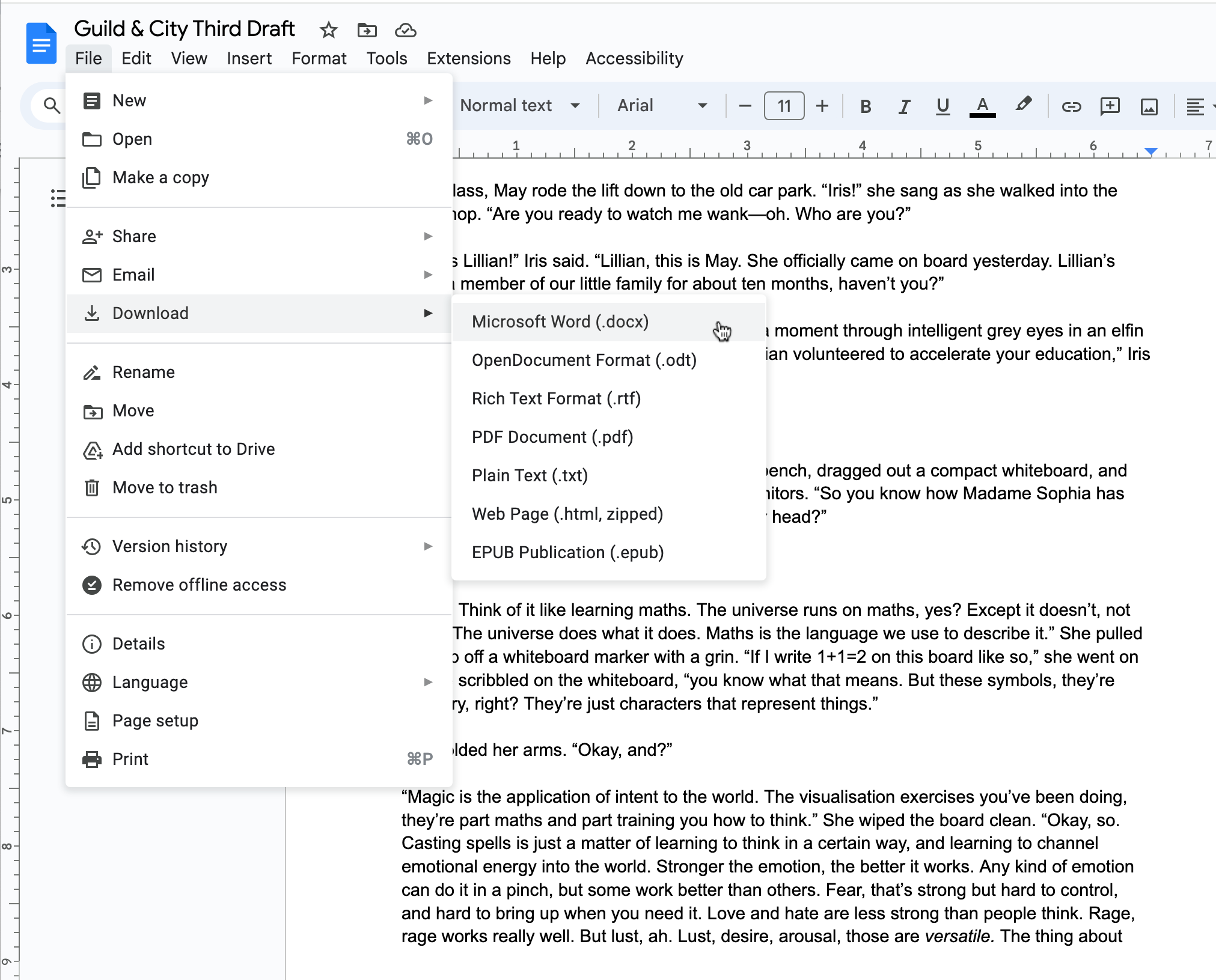
You can download from a Google doc to a Word file easily; it’s in the File menu in Docs.
Back up early. Back up often. (I’ve long had a policy of downloading Google Docs after every major change, because Google has been known to accidentally lose files, but this recent development has me doing so even more aggressively).
I plan to continue using Google Docs to write manuscripts. Thankfully, I don’t share the docs to dog+world, so I’m not likely at risk of having a malicious rando report me.
But I will continue to keep local copies of everything, and I’m in search of a replacement for Google if things should go pear-shaped.
Anyone out there who knows of any good collaborative writing tools, please shout out in the comments!
One of the things I generally try to do is leave the world in a slightly better state than I found it. Of course, I’m not always perfect at that, but on the whole I think it’s a good goal to shoot for.
To that end, I recently started participating in BOINC again.
If you haven’t heard of it, BOINC is a system where nonprofit science research teams can solve computationally complex problems without having to build or buy time on horrifically expensive supercomputers, by using all the spare idle computation time of ordinary people who leave their computers on even when they aren’t using them. BOINC detects when your computer is idle, and donates CPU cycles to researchers, basically making your computer part of an enormous ad-hoc supercomputer. You can choose what research projects you want to participate in.
Back when I lived in Canada, I joined BOINC and allowed them to use my laptop to look for new treatments for diseases by studying protein folding.
I dropped out of BOINC when I came back to the US from Canada, but I’ve just re-joined again.
This is my old 2012 laptop, which now does nothing but BOINC. I’ve joined two research projects, Rosetta@Home (which does research on protein folding to look for new drugs and disease treatments) and World Community Grid (which looks for genetic markers for cancer and searches for cures for diseases that are too uncommon or appear in parts of the world too impoverished to be worthwhile for conventional for-profit pharmaceutical companies).
I have a computer that is essentially a backup Time Machine server and Web server, and I may run BOINC on that as well.
I would encourage anyone out there who wants to help solve real problems by donating idle computer time to join.
BOINC stops running whenever you use your computer, so it won’t slow you down, but it means your computer time isn’t being wasted whenever your computer is turned on but you aren’t sitting in front of it.
[Edit 11-Jan-2023] I’ve received a reply from Fly.io; see end of this entry
Ah, a new year has come. Out with the old, in with the new…strategies for phish and malware sites, that is.
And what would phish and malware sites be without complicit webhosts and web service providers?
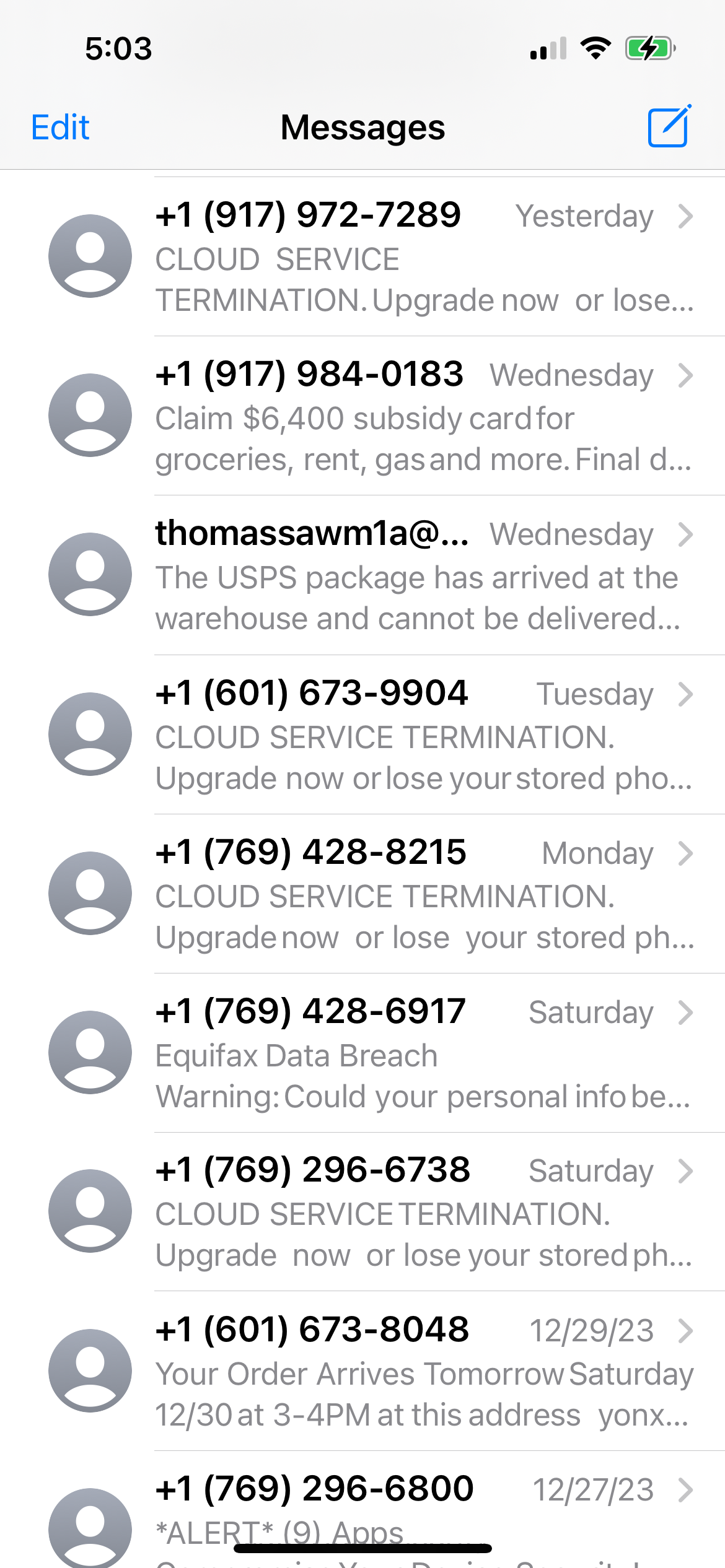
So today I’m going to dive into an enormous quantity of SMS text message spam I’ve been flooded with over the past couple of months, who’s behind it, and what it’s doing.
It started in mid-November of last ear (2023), with a text message saying “The USPS package arrived at the warehouse but could not be delivered” and a link to a site that was just a random collection of letters and numbers. No biggie, I get these all the time. Standard run of the mill phish attempt. If you visit the link, you’re taken to a site that looks like the Post Office, but it’s a fake, of course. They ask you to type a bunch of personal information, which the people responsible will use to steal your identity, get loans in oyur name, whatever.
Then I got another. And another. And another. And another. And then dozens more, coming in one, two, three, four, sometimes five or more a day.
And they haven’t stopped.
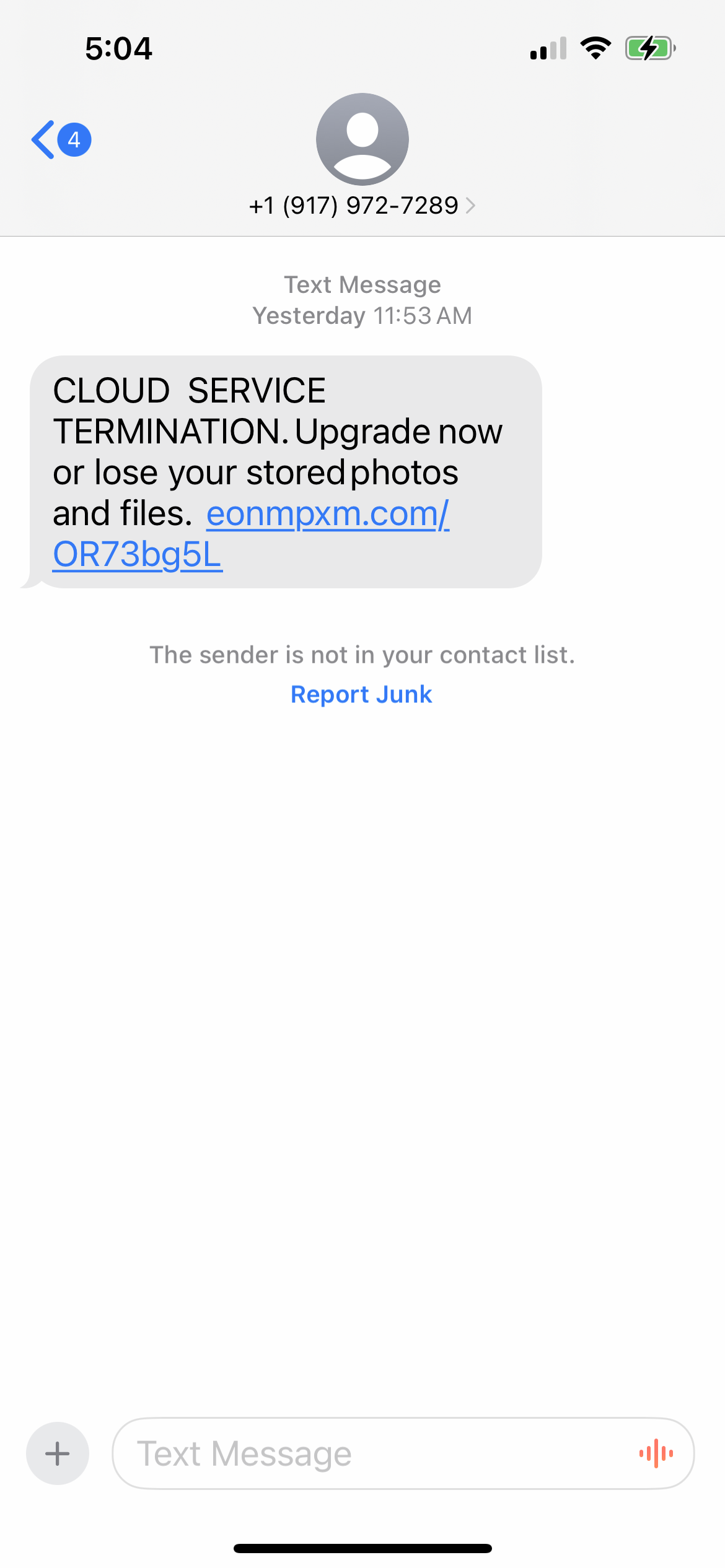
Text message after text message after text message. “You’ve been infected with viruses.” “Your cloud service has been terminated.” “We couldn’t deliver your package.”
All of them with URLs that looked like random strings of letters and numbers.
So my spidey sense was activated, and I looked up all those URLs.
Surprise, surprise, every single one is hosted on the same web service provider, an outfit called fly.io.
And there are a lot of them.
*** CAUTION *** CAUTION *** CAUTION *** THESE LINKS ARE LIVE AS OF THE TIME OF WRITING THIS. Many of these links will bring you to malware or phish sites. DO NOT visit these links if you don’t know what you’re doing.
I started collecting the URLs from the text messages:
http://eonmpxm.com/OR73bg5L FakeAV malware site
http://wkcetku.com/G1LO5X38 Fake “government subsidy” site
http://nztkspy.com/MK2RVeJg FakeAV malware site
http://lkxsxef.com/KJeQ09Vp FakeAV malware
http://klxnitq.com/oxp18G47 Equifax phish
http://epgguli.com/0M37VmkO McAfee phish
http://yonxutn.com/1MZbOrZv FedEx phish
http://zveeyou.com/7Xy1E8G8 FakeAV malware
http://mirumbf.com/KJeQ09Vp FakeAV malware
http://mirumbf.com/KJeQ09Vp FakeAV malware
http://qjkwmww.com/yng4eExR Fake USPS phish
http://wnddwet.com/KJe40qm5 FakeAV malware
http://pdxftwt.com/ER39R0rR XFinity phish
http://plefaas.com/rNzdEAEW FakeAV malware
http://oitbaon.com/A3B6vBOe FakeAV malware
http://napiyib.com/nQ0mJKoZ FakeAV malware
http://kozqtlp.com/vGeO0XmX Xfinity phish
http://ugokulc.com/KJM89Mem USPS phish
http://iqbyojt.com/KJeQ09Vp FakeAV malware
http://sobagiw.com/nQVA0bVp Xfinity phish
http://oosjrjt.com/GRG8ML9n FakeAV malware
http://xqzfnuh.com/ZjgL4GbE Xfinity phish
http://tecvxzo.com/5aannZO7 Google phish
I notified fly.io’s abuse team about the problem. And notified them. And notified them. And notified them. Each time, I received an identical reply, from a guy calling himself “Matt Braun,” saying only “I have let our customer know. Thanks!”
Matt Braun doesn’t appear to have grasped that their customer is the phisher. And lately, I haven’t even received these replies; they haven’t acknowledged recent abuse reports in days. Meanwhile (of course) all the links remain active because (of course)…their customer is the phisher.
Okay, so how does the scheme work?
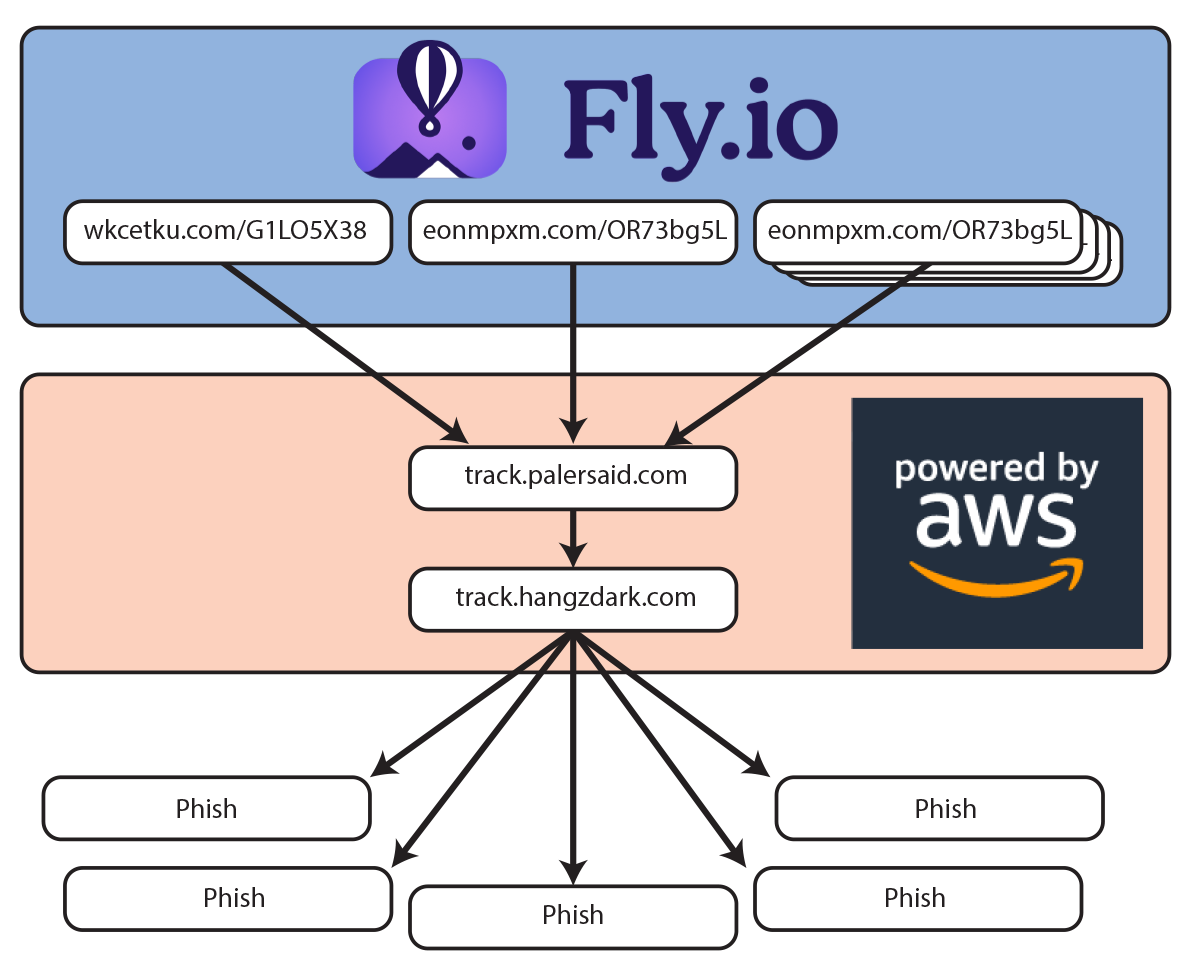
I’ve spent some time mapping out the network. The quick overview:
A text message is mass broadcast, advertising a URL on fly.io.
Marks who click on the link in the message are redirected to a site called “track.palersaid.com,” hosted on Amazon AWS. Track.palersaid.com looks at the incoming fly.io URL, the type of computer or smartphone you’re using, and probably other stuff, then sends you on to another site.
This site, track.hangzdark.com, is another tracking and redirection site also hosted on Amazon AWS.
From there, marks are redirected to the actual target site, which might be a fake FedEx page, a fake UPS page, a fake “virus scan” page, or more. There are a lot of these destinations: read.messagealert.com, kolakonages.com, aca.trustedplanfinder.com, and more. Some of these destination sites are, no surprise here, hosted on Namecheap, which is in my opinion one of the scuzziest of malware and spam sewer hosts.
If you get these text messages, do not follow the links. If you are also seeing these messages, please let me know in a comment! I would love to know how big this network is. Fly.io seems reluctant to shut down these phishers, which leads me to wonder if they aren’t making quite a bit of money from them.
[Edit 11-Jan-2023] I’ve received a reply from Fly.io’s Abuse team:
Thank you for your patience with us over the holiday, and some follow up details.
Usually, when we have reports of spammer or abuser on our platform, our internal systems have a host of signals that we can look to to verify the report and take the appropriate action. In the vast majority of cases the signals are clear and unequivocal. However, in this instance, the signals were entirely the opposite: all signs pointed to a seemingly-legitimate user.
Our systems are set up for “either you are a customer or you are not”, and banning a customer would mean immediate and irrevocable loss of that’s customers data. That’s is not a risk we take lightly so we were not going to flip the switch and risk blowing away someone’s information without a smoking gun. I expect you and I have both seen dozens of those posts on Hacker News or elsewhere where an innocent user writes “Company has deleted my entire account without warning and I’ve lost years of data”. We don’t want to do that to someone.
So where does that leave us? The apparent reason for the behavior/signal disconnect is that it was our customer’s customer doing the abuse. Our customer has committed to evicting their customer today which should put an end to the redirection through our systems (though, unfortunately, I don’t expect that’ll have any impact on the SMS spam). If it doesn’t resolve things, let us know. We’re back online after the holiday and more in a position to chase things things down.
Additionally, there were two other concerns we need to address internally: 1) We don’t have the ability to suspend users. This is something that I’m going to pursue as we need something more nuanced than our all-or-nothing approach so that we’re able to move on complaints sooner without risk of harming someone innocently caught in the middle of things. 2) We did not follow up with the customer as often as we should have after their initial acknowledgement of the problem and indication that they would address it. That’s a coordination process breakdown exacerbated by people taking time off during the holidays and not having the usual “obviously-abuse” signals. Additionally, we need to come up with an approach to our abuse ticketing system that allows for long-lived cases.
You can email me, personally, if you feel you aren’t getting attention on this (email redacted) and I’m sincerely sorry for the delay in letting you know where things stood or getting things sorted with the customer.
It seems Fly.io is one of the good guys.
The spam stopped for a few days, though it has resumed again. This time, the SMS spam domains are hosted on Alibaba rather than Fly.io.
I keep, on my phone, a list of books I want to write. There’s something wrong with it; somehow, every time I finish a book, I discover the list has grown longer, not shorter. (Side note: You can tell someone’s an amateur whaen they say “I don’t want to show my book to an editor or publisher because I’m afraid someone will steal my idea.” Nah bruh, ideas are worthless, and we all have too many ideas of our own to be interested in yours. The bitter truth of writing is it’s almost impossible to get anyone interested in your book in the first place!)
One of the books on the to-be-written list is a nonfiction work titled A World of Sh*t: Normalizing bad design and lazy craftsmanship. Because man, there’s a ton of it out there.
The way I imagine the book’s title
As I sit here in my parents’ house in Florida, I find myself particularly annoyed by the bad, lazy, incompetent, “we didn’t think this through” design around me.
There’s a term that describes a lot of this crap: “psychic litter.” The expression was coined by David Joiner in the 1990s, to describe small acts of immorality that fall beneath the threshold of conscious awareness.
Take, for example, the Windows installer. It takes a while to install Windows, especially older versions. A lot of that time is spent building the Registry. The Windows installer designers could have pre-built a Registry in the installer itself, which would save almost half an hour on each install, but chose not to because it would mean taking an extra half an hour of their time to build the installer. So rather than spending the half an hour on their end, they chose to waste thousands of man-hours of other people’s time.
This kind of selfishness and lack of care is the essential beating heart of a lot of sh*t design.
Take my parents’ kitchen faucet (please!).
It’s pretty. It’s sleek.
It doesn’t move.
You literally cannot rotate it between the two sinks, which is, you know, one of the most basic of all faucet functions. It doesn’t turn. At all. They have two sinks, but you can only use the faucet with one of them.
Worse, it’s also a sprayer; the entire faucet removes. Clever, except that it does not, and has never, docked correctly. It has a plastic ring on the faucet that fits a plastic sleeve on the base, but the ring is too large; it doesn’t fit. (I imagine the fact that it’s a sprayer is the reason it can’t rotate, and that would be absolutely perfect for a three-armed user.)
And then there’s this marvel of engineering:
This is the steering-wheel-mounted remote for the car stereo in my parents’ truck, a Toyota Tacoma.
Steering-wheel-mounted remotes for a car stereo are a brilliant idea. And they’re really not that complex. They move the most often-used functions to a place where you need not look away from the road or take your hands off the steering wheel to use them.
This control has four primary buttons: left, right, up, down. Now, thinking about what it’s supposed to do (work a CD player/Bluetooth combo), you might reasonably expect that left and right go to previous and next track, and up and down raise and lower the volume.
And you’d be 100% wrong.
Left skips back 10 seconds in the current track. (Yes, seriously.) Right skips forward 10 seconds. Up goes to the next track, down goes to the previous track.
What about volume? How do you adjust the volume?
You don’t. There are no volume controls on the steering wheel. To change the volume, you have to take your hands off the steering wheel.
Yes, you read that right. They literally believed that forward 10 seconds/back 10 seconds was so important it should be on the steering wheel, but volume? Eh. Who uses the volume controls, anyway?
Every single digital music player I’ve ever used, from the Radio Shack Compact Disc Player CD-1000 my parents got in 1984 to my iPhone today, uses left and right arrows for previous and next tracks. But whatever Toyota intern who designed the car stereo controls, having apparently never used or indeed seen an entertainment sound system before, had his own ideas, and somehow, somehow it passed all the design review steps. Somehow, someone signed off on manufacture.
Skip ahead ten seconds yes, volume control no.
And here’s the thing:
The world we live in today, our world of marvels and miracles, is filled with examples like this.
It’s hard not to believe that the vast majority of industrial designers are anything but lazy and barely competent, unwilling or unable to put any effort into their job (and it certainly feels like they never use the things they design). From consumer electronics to furniture to software to clothing, we live in a universe of shit.
My jacket has a zipper edged by a hem that is exactly the right width to catch the slider as it moves. It is not possible to zip or unzil the jacket without the hem catching the slider at least three times.
Someone designed that. It went through several review steps before it was released to manufacture. And yet, neither the designer nor any of the peple resonsible for reviewing the design ever put the jacket on. (I’m serious when I say you cannot zip or unzip it without catching the slider. Even one test would’ve been enough.)
We live, we exist in a world of sh*t. We don’t pay attention to the way design impacts our lives, and as a result, trivial design failures—failures that can easily be corrected in minutes during the design stage—waste countless person-years of time. In some cases, like car stereos with cluttered or counterintuitive layouts, they kill people.
And we as a society are remarkably okay with that.
I’m not sure what changed, but in the last five years or so, I’ve found it increasingly difficult not to notice shitty design all around me. And once you’ve started to see it, it snowballs. You can’t un-see it.
I would like to live in a world where perhaps people cared about design more. But the problem seems to be getting worse, not better.
Every month, almost three billion people use Facebook.
Those people upload photos and video and it all gets saved—about 4 petabytes, four billion gigabytes, of data every day.
Those are abstract numbers. What does it mean? How Does Facebook not run out of space?
Exactly how you think. They buy more than 1,000 hard drives every day. (As of the time I write this, the information I can find suggests they prefer to use 4TB hard drives rather than larger drives for cost and reliability reasons.)
This is a pallet of 180 hard drives:
Facebook adds the equivalent of about 6 of these pallets of hard drives to its storage hive every day. They’re placed in server computers in Facebook’s Hive data store that have 12 hard drives per server, so they’re adding data equivalent to at least 83 servers per day. (That’s only for storing user generated data like photos, and does not include extra drives for RAID redundancy or data duplication, which I imagine likely doubles that amount.)
Here’s the inside of one of Facebook’s data centers.
Imagine building after building, row after row of these. Now imagine 6 pallets of hard drives coming in on trucks and 83 servers’ worth of storage being added today.
And again tomorrow.
And again the day after tomorrow.
And again after that.
And yes, they really do order hard drives by the truckload.
This is why any time some conservative tells you “BuT fAcEbOk iS vIoLaTiNg My FrEeDuMb Of SpEeCh SoCiAl MeDiA sItEs ArE pUbLiC sPaCeS DuRr DuRr,” you can laugh in their face and walk away.
See all those servers? See all those buildings? See all those pallets of hard drives being trucked in? See all those people installing them?
Are you paying for them? No. Is the government paying for them? No. Is public money paying for them? No. They are private property. Billions of dollars of private property.
Facebook spends, as a first order approximation, about $30,000,000,000 a year on server infrastructure, not including buildings, land, facilities maintenance, installation, or salaries.
Anyone who thinks that social media sites are “public spaces” is welcome to propose that Congress gives Facebook $30,000,000,000 a year to keep up that infrastructure. Otherwise, no, it’s not. That’s $30,000,000,000 a year in private money being used to buy private property.
Okay, so.
You can’t have a service where almost three billion people communicate without having tremendous political clout. Facebook can, and arguably has, influenced elections and changed the course of nations.
And that’s (rightly, I think) got a lot of people worried. When you have a private company with no public accountability that has that much influence, that’s a bad thing, right?
Well, yes.
But here’s the thing: This isn’t new.
People forget this isn’t new. It’s always been this way. In the 1700s and 1800s, elections were decided by newspaper barons.
Remember William Randolph Hearst? Remember the Spanish American War? That was a war basically started by one man, a newspaper mogul, who totally dominated public political discourse and established a whole new world of journalistic propaganda.
This is probably the most effective fake news in history.
So what’s different?
Ah, now that’s a question.
Modern social media is different from the media empires of old in one important way: they are participatory, many-to-many, not one-to-many. In the past, “media” meant the owner disseminated information to content consumers. Today, we are all content creators and content consumers.
And this has led to a great deal of confusion betwixt “public” and “private.”
The Internet allows anyone to use it, but few people actually know how it works, or what scale it operates on. Hundreds of companies spend billions per year on the infrastructure to give everyone a way to communicate with everyone else, so what feels like a public square is actually a private space. And that leads to confusion: “Facebook banned me! My CoNsTiTuTiOnAl RiGhTs!“…when in fact you have no right to use other people’s stuff for free at all.
And make no mistake, that’s what Facebook and Twitter and all those other sites are: other people’s stuff. Billions and billions of dollars of other people’s stuff, that you’re using for free.
In the past, this confusion didn’t exist. In the past, nobody felt they had the right to someone else’s newspaper. You could write a letter to the editor, which they might or might not print, but nobody (well, nobody serious, anyway) had the notion that they had the Constitutional right to use someone else’s newspaper to say whatever they want.
We understand when something belongs to someone else, right up until the moment we’re allowed to use it ourselves…at which point we tend to assume an entitlement to it.
Owners of of media distribution companies have always had an outsized impact on social media. This isn’t new.
What’s new is that people are more aware of it, and want more of a voice. What’s unfortunate is that so many people aren’t going about it the right way. You don’t have a right to use Facebook, and if you’re kicked off you aren’t being “censored.”
What we need is entirely different conversation, and that’s one we can’t have whilst everyone is looking at the wrong thing.