Some thoughts on information in the Information Age

My dad called me yesterday. He received an invoice in an email for $899 for something he didn’t remember ever ordering, and it upset him pretty badly. Fortunately, I’ve worked very hard over the years to educate him about scams, so he calls me before he does anything like call a number or click a link.

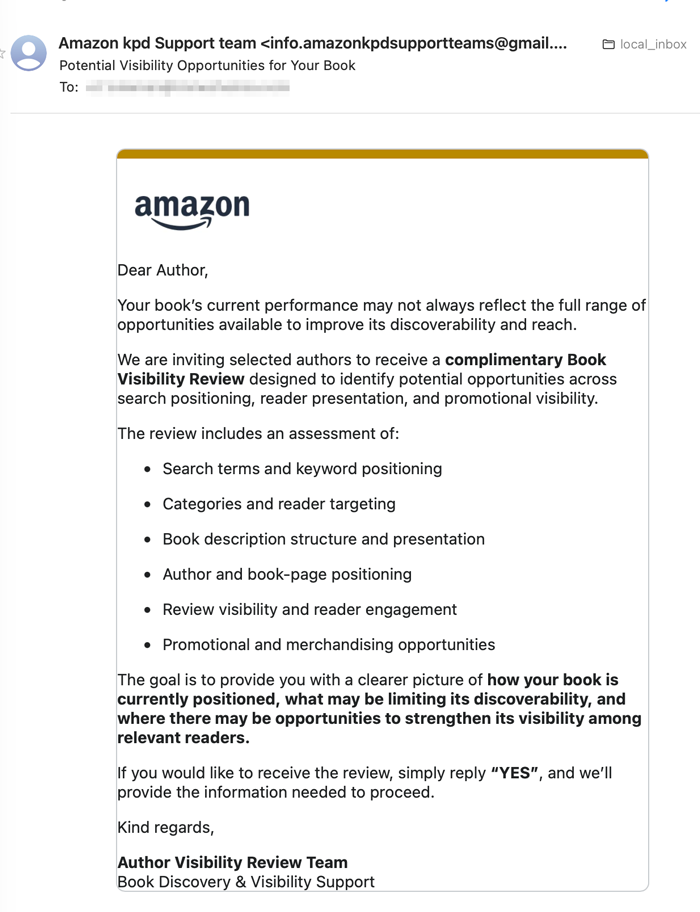
The invoice he described was basically identical to one I received a few days ago myself:

These scams are incredibly common right now; I’m getting about 4-6 a month. The scam is the “customer support” number I circled.

The mark calls that number and is greeted by a kind, helpful, polite voice on the other end who says “yes, I’m very sorry, sir, I will take care of it right now, sir, please give me your name and credit card number, sir, and I will be happy to reverse the charges. Oh, was this a PayPal invoice? Okay, can you give me your PayPal name? Yes, sir, perfect, I’ll need your PayPal password too, please…and do you have a passcode on this PayPal account, sir? Yes, yes, thank you, sir, now, do you have a bank account linked to your PayPal? Oh, you do? Can you give me that account number and routing number, sir? Okay, yes, got it, I’ll reverse the charge immediately, sir.”

$$$cha-CHING!$$$

But I didn’t come here to talk about Internet scams. I came here to talk about design, and specifically, how entire generations of people were raised to be gullible and easy to scam, all because of design.


In ages past (like when I first started in the design world), design was hard. Making a simple letterhead was hard.

A company would go to a graphic design studio. They’d bring a copy of their logo as either a camera-ready slick or a square piece of negative film.

A designer would typeset the letterhead using a phototypesetting machine, then output it to a sheet of photographic film. Then, using an XActo knife and a light table, the designer would cut rubylith and use it to burn the letterhead and logo together onto another sheet of film, which would then be used to burn a printing plate for a press.

This was difficult, expensive, and highly skilled work. When I started working prepress professionally, the building I worked in had an entire huge film stripper’s room where people spent their workday sitting at enormous glass light tables, XActo knives in hand, surrounded by sheets of film and rolls of rubylith, doing this work.

Design was hard.

Because design was hard, only large, well-heeled companies could afford good design. Shady fly-by-night scam businesses were largely locked out of the world of design, which is why scam ads in the 70s, 80s, and 90s tended to have that cheap, low-quality “look” about them.

Good design became a proxy for reliability, for legitimacy, for dependability. Only legitimate companies could afford it, which means generations of people, including the Boomers and those of us on the leading edge of Gen X, ended up trained to associate design with a company’s legitimacy and trustworthiness.

Scammers could never afford something like this.

Enter the era of desktop publishing.

I was in on the ground floor. Desktop publishing revolutionized design and prepress. I was working in the industry during the transition from light tables and rubylith to QuarkXPress and Photoshop, and I cannot overstate how much DTP democratized design. I helped publish small-press ’zines in the 90s and early 2000s, something that was all but impossible to do with any quality before the 90s.

Suddenly, design that would’ve been out of reach to anyone but Fortune 1000 businesses became possible for two dudes right out of uni working from an apartment. (In fact, that’s why my website at xeromag.com exists; it started as the site for a small press magazine called Xero.)

This is unquestionably a good thing…but just as it empowered small-press ’zine communities and business owners, it empowered scammers.

Suddenly scammers could create official-looking business stationery, logos, websites, ads, fake invoices, fake receipts, all completely effortlessly.

I talked to a person online a few weeks back who’d fallen for a pig butchering scam—a fake Bitcoin scheme where marks are lured to “invest” in what seems like legitimate Bitcoin sites, only to have their money stolen. “But the site looked so official!” she said. “It even had graphs and charts of real-time Bitcoin prices and everything!”

I’ve heard that countless times before. “But the site looked perfect! How was I supposed to know it wasn’t really PayPal?” “But it looked like a real bank site!”

You can buy templates for websites that look like anything you want. With a two-minute search, I found a pre-created template for a Bitcoin trading platform that included real-time feeds of Bitcoin prices, login, activity tracking, fake account generation, the whole nine, for $39.

You can, with a few clicks of a mouse, use online tools to have fake letterhead and business cards made, then with a few more clicks ship it off to production.

The point here is, design is no longer a proxy for legitimacy. You can no longer measure something’s validity by how it looks.

But millions of people, mostly Boomers and Gen Xers, haven’t got the memo.

The sudden revolution in design created an exploit in the minds of a large number of people indeed, a way to slip past their defenses to take advantage of them with scams.

What’s the solution? I don’t know. I do know that a lot of people base their judgment on something’s legitimacy on how “official” it looks, and nowadays that veneer of legitimacy is available to everyone.

When people get taken by scams, it’s not necessarily that they’re stupid. Sometimes, it’s that they’re using markers for scams that no longer exist, because the world changed in the blink of an eye and the cues that once separated scammers from legitimate enterprises no longer exist.

We live in a world surrounded by design. Design is both invisible and essential, so when the design world changes, it can have weird knock-on effects nobody ever imagined.

Copytrack: Beware another copyright scam

Image: Aleutie

A while back, I wrote about a kink website called “Know Your Sins” using a fake DMCA scam to get backlinks and boost their search results. The site’s owners would send out phony copyright claims, saying they owned images they neither owned nor had nothing to do with, and demanding backlinks to their site or they’d sue for copyright infringement. The site’s owners, Samuel Davis (@Samueld_KYS on Twitter) and Olivia Moore (whose Twitter profile has been deleted), engage in copyright fraud to try to boost their Google search results.

It seems fraudulent copyright scams are something of a growth industry.

About a week ago, I received this email from an outfit calling itself CopyTrack, headquartered in Germany (click to embiggen):

CopyTrack claimed I was using images belonging to their “client,” a Norwegian company owned by a Chinese conglomerate called Yay Images that appears only to license images from other stock companies, and demanding €2,168.76 (about $2,500) in “compensation.”

The images in question on my site are licensed from stock agencies (Shutterstock and Deposit Photos, the latter of which I’ve been using for many years).

A quick Google search shows that Copytrack is a scam, and the owner has been running this scam under a variety of names for years.

BlueMedia has an article about these guys, Copyright Infringement Notice Email from Copytrack: What Kind of Company Is Copytrack?

The company is organized and registered in Germany, where it has changed names multiple times. A German lawyer, Kanzlei Franz, has a lengthy article about this company’s sordid history (with a German-language version here).

I am, of course, far from the only person to be hit with this extortion scheme. You’ll find similar tales from the Brutally Honest Blog, Yvan’s Substack, Ben Tasker, molif, and tons of others; a Google search for copytrack scam produces hundreds of similar hits.

The general consensus on Copytrack is neatly summed up by this quote from Content Powered:

I think Copytrack provides a service that could, potentially, be legitimate. However, they don’t put any effort at all into verifying copyright ownership; they’re a more-or-less entirely automated platform anyone can just upload some pictures to and then send threatening letters to other people, hoping for a payout. They may not, themselves, be copyright trolls, but they facilitate copyright trolls with no mechanism to stop them.

I am fortunate in that I am represented by an outstanding intellectual property attorney, Leonard Duboff in Portland. I simply informed Copytrack that I am represented by counsel and would no longer respond directly to them, and needless to say my attorney hasn’t heard a peep from them.

When I wrote about the Know Your Sins scam, a ton of people emailed me to say they’d received similar fraudulent copyright-scam emails. I got so many that I wasn’t able to respond to all of them (but thank you, everyone who messaged me!).

That suggests the scale of copyright fraud is enormous.

If you’ve received a fraudulent email from Copytrack, I’d love to hear about it! Post a comment here, or email me.

AI: The largest socialist wealth transfer of the past 50 years

A few months back, Elon Musk, the right-wing owner of Twitter and Grok, his pet Generative AI project, posted something I wrote on his Twitter feed, with the caption “This is the quality of humor we want from Grok.”

He even had it pinned to his profile for a short while.

I wrote this over on Quora in March of 2024. On the one hand, it’s interesting to know that Elon Musk reads my stuff. On the other, do you notice anything funny about the screenshot of his Tweet?

Yup, no credit.

The Tweet went viral, and has since been posted all over Facebook, Tumblr, Twitter, Reddit, and TikTok…all without attribution.

Right now, as I write this, OpenAI, the company behind ChatGPT, has a market cap of $157,000,000,000, making it more valuable than companies like AT&T, Lowe’s, and Siemens.

It is not a profitable company; in fact, it’s burning cash at a prodigious rate. Unlike other companies, though, which burned cash early on to achieve economies of scale, OpenAI’s costs scale directly with size, which is not at all normal for tech companies. At its current rate of growth, in four years its datacenters will consume more electricity than some entire nations.

But I’m not here to talk about whether AI is the next Apple or the next Pets dot com. Instead, let’s talk about what generative AI is, and how it represents the greatest wealth transfer of the last fifty years.

AI is not intelligent. Generative AI does not know anything. Many people imagine that it’s a huge database of all the world’s facts, and when you ask ChatGPT something, it looks up the answer in that immense library of knowledge.

No.

Generative AI is actually more like an immense, staggeringly complex autocomplete. It ingests trillions of words, and it learns “when you see these words, the most likely next words are those words.” It doesn’t understand anything; in a very real sense, it doesn’t even “understand” what words are.

As the people over at MarkTechPost discovered, many LLM models struggle to answer basic arithmetic questions.

AIs make shit up. They have no knowledge and understand nothing; when presented with text input, they produce text output that follows the basic pattern of the input plus all the text they’ve seen before. That’s it. They will cheerfully produce output that looks plausible but is absolutely wrong—and the more sophisticated they are, the more likely they are to produce incorrect output.

If you want to understand Generative AI, you must, you absolutely must understand that it is not programmed with knowledge or facts. It takes in staggering quantities of text from all over and then it “learns” that these words are correlated with those words, so when it sees these words, it should spit out something that looks like those words.

It doesn’t produce information, it produces information-shaped spaces.

To produce those information-shaped spaces, it must be trained on absolutely staggering quantities of words. Hundreds of billions at least; trillions, preferably. This is another absolutely key thing to understand: the software itself is simple and pretty much valueless. Only the training gives it value. You can download the software for free.

So where does this training data come from?

You guessed it: the Internet.

OpenAI and the other AI companies sucked in trillions of words from hundreds of millions of sites. If you’ve ever posted anything on the Internet—an Amazon review, a blog, a Reddit post, anything—what you wrote was used to train AI.

AI companies are worth hundreds of billions of dollars. All that worth, every single penny of it, comes from unpaid work by people who provided content to the AI companies without their knowledge or consent and without compensation.

This is probably the single largest wealth transfer in modern history, and it went up, not down.

There are a few dirty secrets lurking within the data centers of AI companies. One is the staggering energy requirements. Training ChatGPT 4 required 7.2 gigawatt-hours of electricity, which is about the same amount that 6,307,200 homes use in an entire year. (I laugh at conservatives who whine “eLeCtRiC cArS aRe TeRrIbLe WhErE wIlL aLl ThE eLeCtRiCiTy CoMe FrOm” while fellating Elon Musk over how awesome AI is. Training ChatGPT 4 required enough power to charge a Tesla 144,000 times. Each single ChatGPT query consumes a measurable amount of power—about 2.9 watt-hours of electricity.

Image: Jason Mavrommatis

All the large LLMs were trained on copyrighted data, in violation of copyright. Every now and then they spit out recognizable chunks of the copyrighted data they were trained on; pieces of New York Times articles, Web essays, Reddit posts. OpenAI has, last time I checked, something like 47 major and hundreds of smaller copyright lawsuits pending against it, all of which it is fighting. (It might be more by now; there are so many it’s hard to keep up.)

That, I think, is the defining computer science ethical problem of our time: To what extent is it okay to build value and make money from other people’s work without their knowledge or consent?

Elon Musk recognizes the value in what I write. He recognizes that it has both artistic and financial value. He posts my content as an aspirational goal. He doesn’t credit me, even as he praises my work.

That’s a problem.

Those who create things of value are rarely recognized for the value they create, if the things they create can’t immediately be liquidated for cash. That’s not new. What’s new is the scale to which other people’s creativity is commoditized and turned into wealth by those who had nothing whatsoever to do with the work, and are merely profiting from the labor of others without consent.

OpenAI says it would be “impossible” to train their models without using other people’s copyrighted work for free.

“Because copyright today covers virtually every sort of human expression – including blogposts, photographs, forum posts, scraps of software code, and government documents – it would be impossible to train today’s leading AI models without using copyrighted materials. […]

Limiting training data to public domain books and drawings created more than a century ago might yield an interesting experiment, but would not provide AI systems that meet the needs of today’s citizens.”

It also claims their use of other people’s work is “fair use,” even while they admit that chatbots sometimes spit out verbatim chunks of recognizable work. This is a highly dubious claim—while fair use doesn’t have a precise legal definition (the doctrine of fair use exists as an affirmative defense in court to charges of copyright infringement), one of the key components of fair use has always been commercialization of other people’s work…and with a market cap of $157,000,000,000, it’s pretty tough to argue that OpenAI is not commercializing other people’s work. It charges $20/month for full access to ChatGPT.

So at the end of the day, what we have is this: a company founded by people who are neither writers nor artists, producing hundreds of billions of dollars of wealth from the uncompensated, copyrighted work of writers and artists whilst cheerfully admitting that could not produce any value if they had to pay for their training data.

And it’s not just copyrighted data.

OpenAI Dall-e cheerfully spit this image out when I typed “Scrooge McDuck stealing money from starving artist.”

Here’s the thing:

Scrooge McDuck is trademarked. Trademark law is not the same as copyright law. Trademarks are more like patents than copyrights; in the US, trademarks are administered by the Patent and Trademark Office, not the copyright office.

In no way, shape, or form is this “fair use.”

Generative AI recognizes trademarked characters. You can ask it for renderings of Godzilla or Mickey Mouse or Spider-Man or Scrooge McDuck and it’ll cheerfully spit them out. The fact that Dall-e recognizes Scrooge and Spider-man and Godzilla demonstrates without a shadow of a doubt it was trained on trademarked properties.

So far, all the lawsuits aimed at AI infringement have been directed at the companies making AI models, but there’s no reason it has to be that way. You “write” a book with AI or you create a cover for your self-published work with AI and it turns out there’s a trademark or copyright violation in it? You can be sued. That hasn’t happened yet, but it will.

(Side note: The books I publish use covers commissioned from actual artists. Morally, ethically, and legally, this is the right thing to do.)

Why do I call OpenAI and its kin a socialist wealth transfer? Because they treat products of value as a community property. Karl Marx argued that socialism is the transition between capitalism and communism, a system where nothing is privately owned and everything belongs to the public, and that’s exactly how OpenAI and its kin see creative works: owned by nobody, belonging to the public, free to use. It’s just that “free to use” means “a vehicle for concentrating wealth.”

From creators according to their ability, to OpenAI according to its greed.

It seems to me that what we need as a society is a long, serious conversation about what it means to create value, and who should share in that value. It also seems to me this is exactly the conversation the United States is fundamentally incapable of having.

Setting Math in Adobe Illustrator: The Impossible Dream

A while back, I posted on social media:

I did not suspect, Gentle Reader, just how many people would have questions about this, nor how many of them there would be. Especially over on Quora, where it raised quite an interesting discussion.

So, in the interests of elaborating, so that I can refer people to this entry:

The equation is real. It’s the Higgs field Lagrangian, the equation that describes how the Higgs gives mass to massive particles. (On a side note, the Higgs field is only a small part of the inertial mass of everyday objects; more than 90% of the mass of things in our normal world comes not from the Higgs, but from the binding energy in the particles that make up those things).

I needed the Higgs Lagrangian for a porn novel Eunice and I are planning but haven’t yet started working on. Specifically, I’m noodling about with an image for that novel, and I needed the Higgs Lagrangian in Adobe Illustrator.

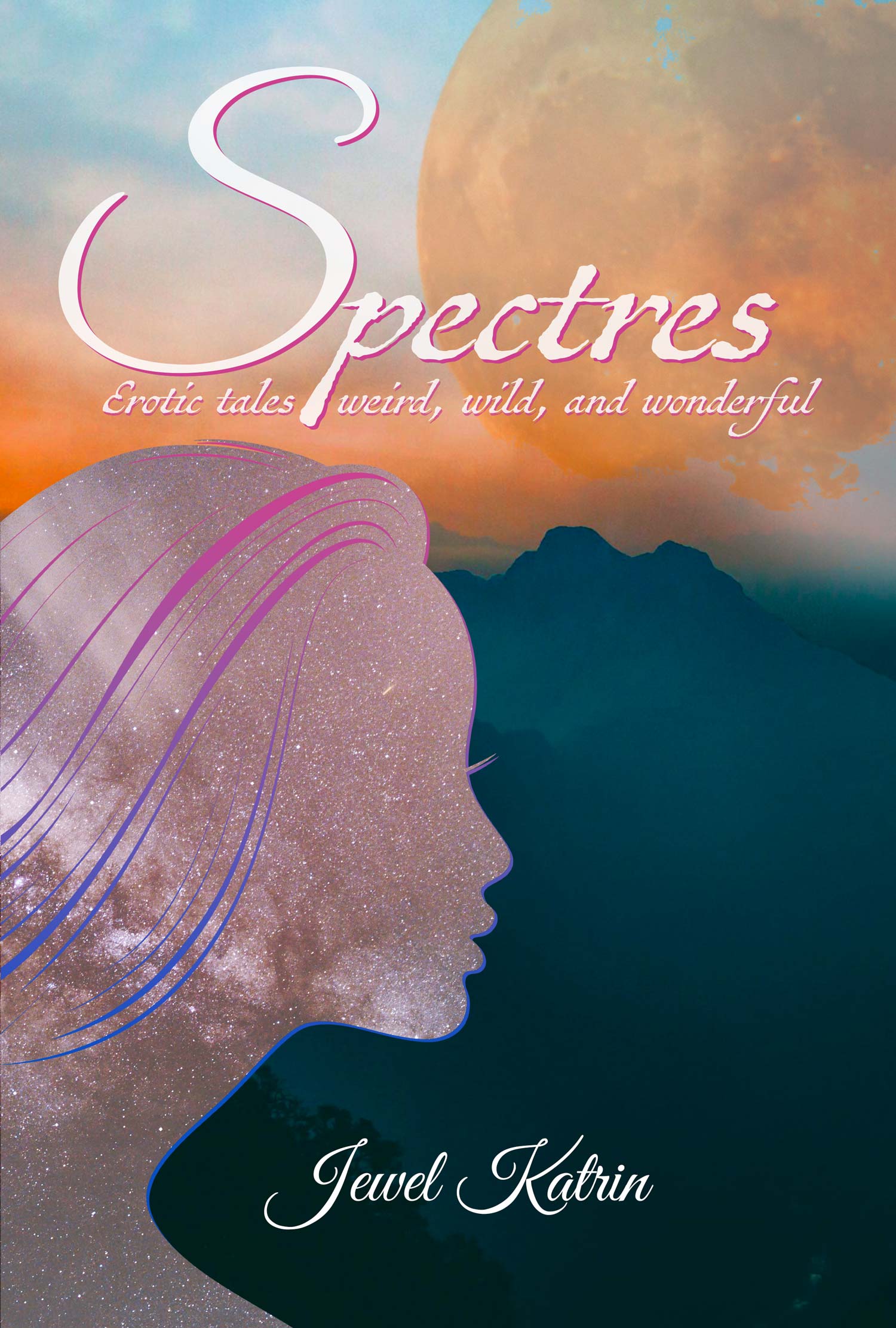
This is the image I’m noodling about with. Everything here, including the face, is vector, built entirely in Illustrator, not raster.

If you look at the largest gold band, that’s the Higgs Lagrangian.

I realize that Illustrator is not in fact an appropriate tool for typesetting math. The proper tool for this is LaTeX; indeed, it’s what LaTeX was created for. And I did in fact originally create the equation in LaTeX, and exported it to SVG to place in Illustrator.

Thereupon I found a problem.

I want to set the equation on a curve. And it is indeed possible to set an image like a PDF or SVG placed into Illustrator on a curve.

But Illustrator treats placed images as, well images, which means if you set them along a curve, it will distort them.

Here’s what I mean. On the top, the Higgs Lagrangian set as type in Illustrator, which did in fact take me about two hours to do; below that, exported from LaTeX; and below that, exported from LaTeX and placed on a curve.

And honestly that would simply not do.

So I set it as type in Illustrator. That required, among other things, installing a typesetting font on my computer to use in Illustrator (New Computer Modern, available here, just in case any other Illustrator users should run into a problem typesetting math equations in Illustrator and stumble across this post in the future), and frequent trips to the Wikipedia list of mathematical symbols here to copy-paste characters into Illustrator in New Computer Modern Math Regular).

I did all this because getting the equation set as type in Illustrator meant I could use Illustrator’s type on a path tool to curve the type while perfectly preserving the shape of each letter.

This also meant it would print smoothly as vectors. I could bend the type in a different graphics program, but any raster (pixel) program would break the letters up into pixels, meaning they look slightly fuzzy on press.

Illustrator’s math typesetting is, bluntly, nonexistent. Which honestly surprises me. I’ve used Illustrator since 1988 and the fact it doesn’t have any typesetting library for math still surprises me. They could, for instance, easily license, oh, I don’t know, something like LaTeX…but I digress.

You can do superscripts and subscripts, but it treats them as text in a line, like X2adoesn’t work correctly on superscripts and subscripts that have to be aligned one right under the other. For that, I had to type the superscript, type the subscript, and set the superscript’s tracking to -1000 to scoot it over the subscript. Big pain in the ass.

The whole equation took a ton of ugly hackery like that (and if you’re reading this because it’s six years after I wrote it and you’re searching for a way to set math in Illustrator, you’re welcome, and also, cry havoc, you mad bastard).

Anyway, I got it done, if not perfectly than at least acceptably, but my god, those are hours of my life I’ll never have back.

Beware Bowdlerization of Google Docs

Image: David Pennington

I write novels almost exclusively in Google Docs.

It’s an aggressively mediocre word processor with two killer features: you have access to it wherever and from whatever device you have Internet access, and it is hands-down the absolute best thing out there for collaborative writing. Nearly all my books are co-written with other people. Google Docs makes this effortless; in fact, many’s the time I’ve been working with Eunice or my Talespinner as both of us type in the same Docs file at the same time.

Even when we aren’t writing at the same time, Google Docs makes it easy for us to leave notes to each other within the same document. It’s no exaggeration to say Docs is probably the best thing to happen to collaborative writing since the invention of the fountain pen.

So you can imagine when I opened my Messenger app a couple days ago and found a message from my co-author Eunice linking to a story by a writer who’d lost access to Google Docs and her manuscript because they contained sexually explicit content.

I’ve spent the last couple of days poring over the Google Terms of Service, and what I found is…worrisome.

Many of the novels I write contain sex. Some of them contain a lot of sex; the Passionate Pantheon series Eunice and I write, a far-future post-scarcity science fiction series where residents of the City worship AI gods through highly ritualized group sex, is a vehicle for us to explore sexual ethics, philosophy, and society in a setting where attitudes toward sex and violence are pretty much exactly the opposite of what they are here in the real world. And these books have tons of sex, some of it so kinky the kinks don’t even have names—we looked.

Naturally, the notion that Google can terminate your Google account and delete your manuscripts in progress for (consensual adult) sexual content is a little alarming.

The issue seems to be Google’s March 2024 anti-spam update.

What does spam have to do with sex and Google? Glad you asked.

More and more often, I am seeing spam that directs to Google properties: Google Sites and Google Docs, mostly. The spammers link to a Google page, which has a link that goes on to the spam site.

Why? Because it keeps the spam emails from being filtered by anti-spam filters (Google links aren’t flagged as spam) and helps prevent the spammers from having their sites shut down.

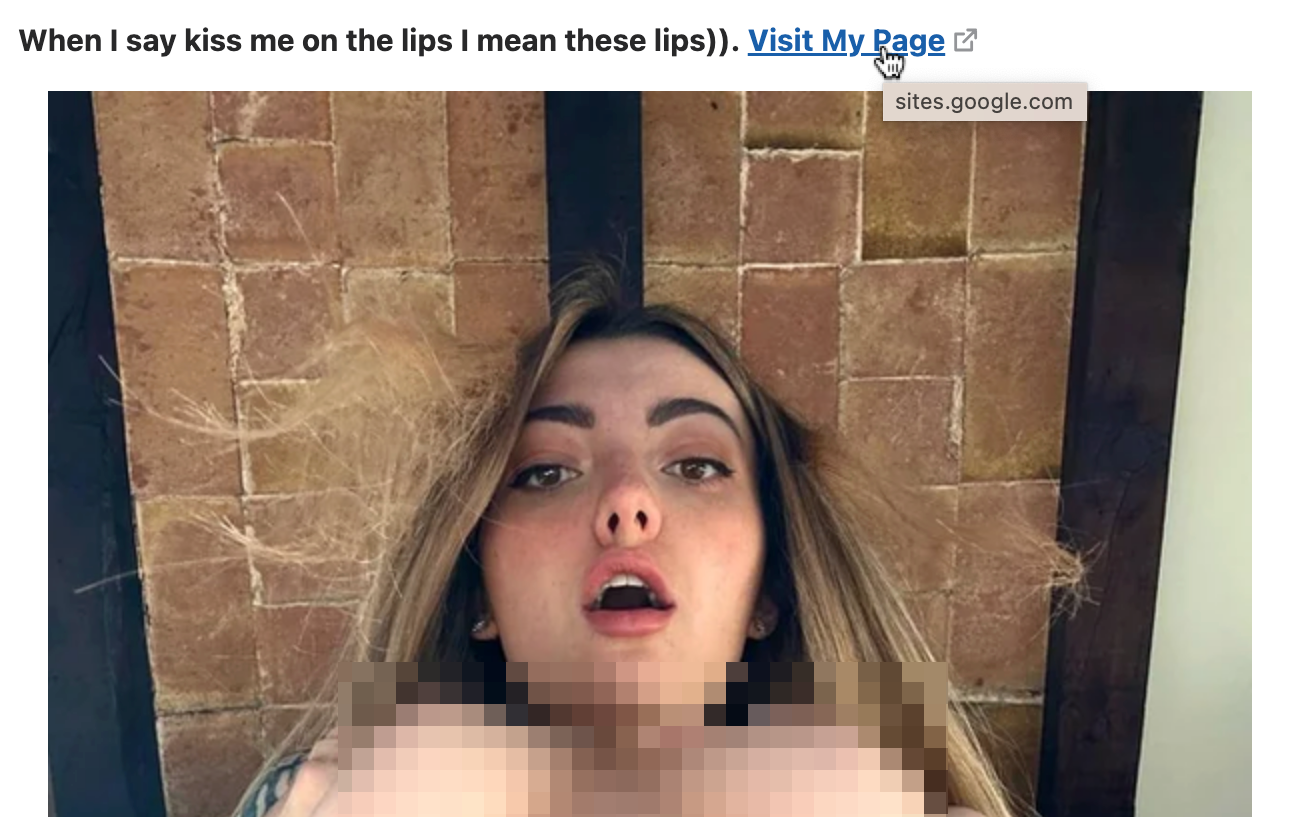
Sex spammers especially seem to be flocking to Google:

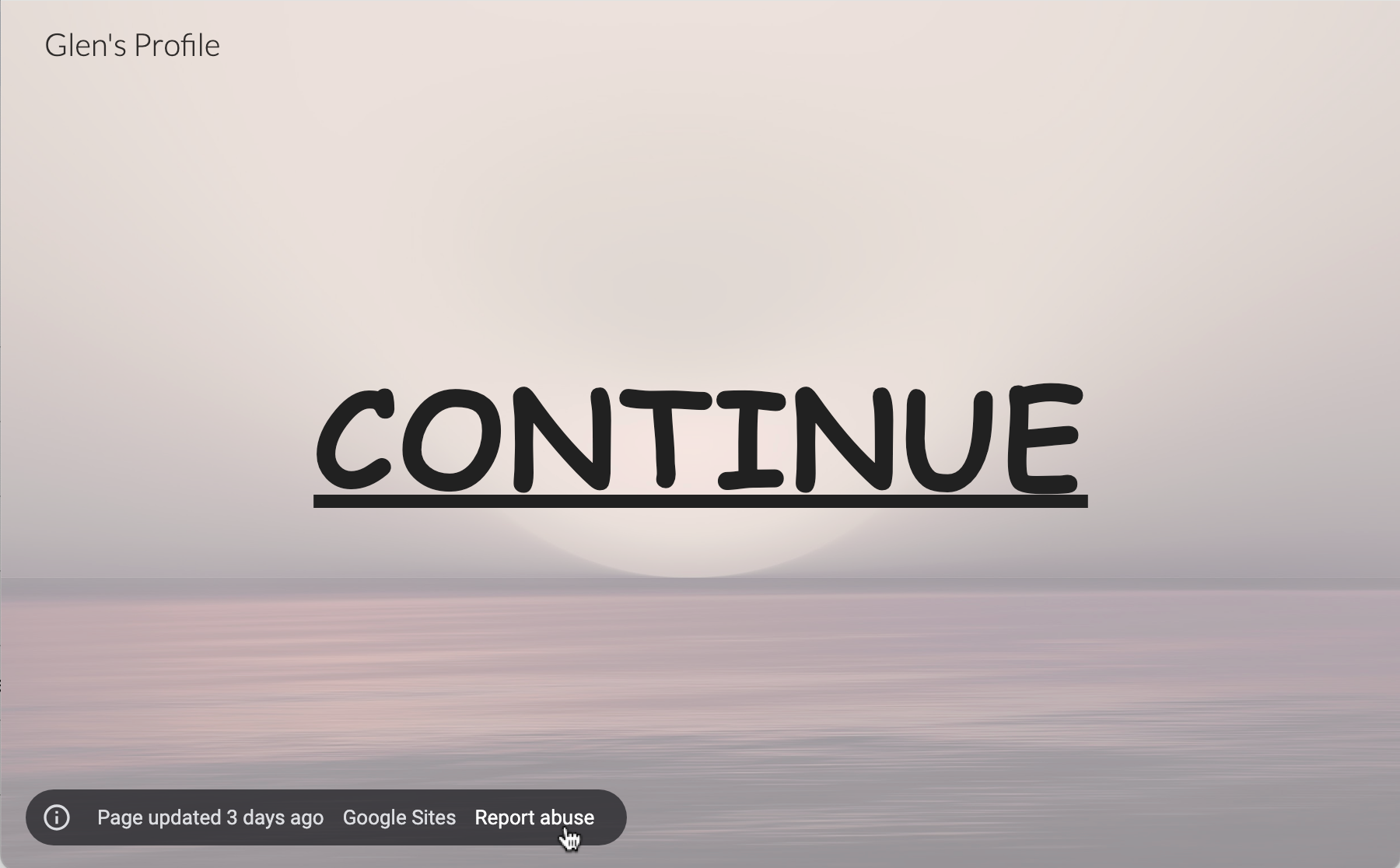
If you click on the link, you’re taken to a Google Site (as in this example) or a Google Doc that then contains a link to the spam site. The Google page includes a little circle-I icon that, if you click on it, brings up the option to report the Google Site or Google Doc for abuse.

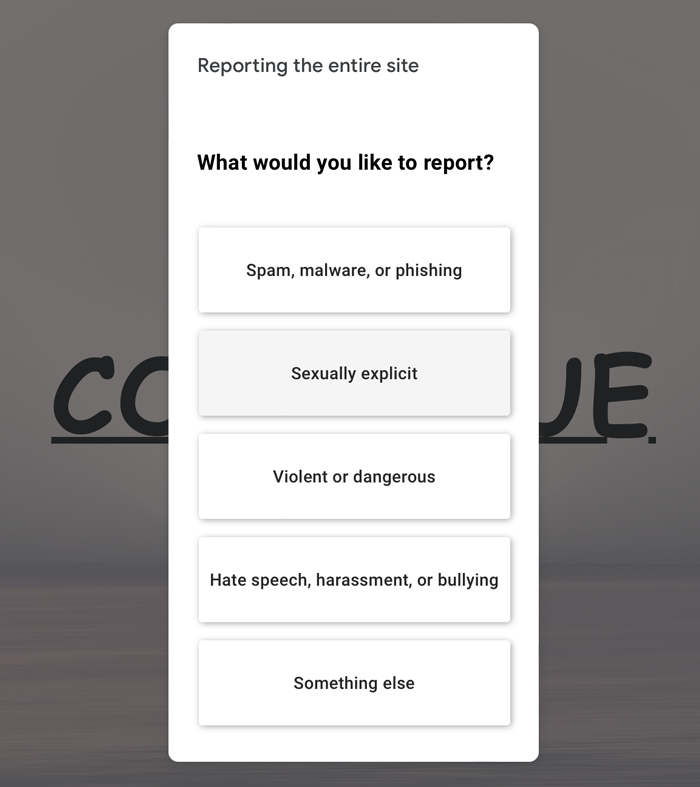
If you hit the Report Abuse link, one of the options is “Sexually Explicit.”

So. It seems Google doesn’t permit sexually explicit content. But is that actually part of the Google Terms of Service? Well, kinda.

Here’s the relevant part of the Google Terms of Service:

This…isn’t actually terribly clear. It forbids distributing sexually explicit material, though it doesn’t ban creating sexually explicit material, nor does it say what constitutes “distributing.”

So.

What follows is a completely unofficial speculation about what might be happening and what you might be able to do about it. I claim no insider knowledge of Google’s policies; this is simply informal noodling about the situation.

There are several ways to share a Google Doc. You can invite specific people to see it, and give them different levels of access (read only, comment, propose changes, edit, and so on). You can set it up so that anyone who has the URL can read the document, but can’t make any changes. The way you share it affects what people who view it will see.

If you invite specific people to be able to see and/or comment on the document, they will not see the little information bubble that gives them the option to report the site to Google’s abuse team.

If you set the document up so that anyone with the link can see it, which is what spammers do, then anyone who views the document will see the option to report the document for abuse.

I think—and let me emphasize again this is not based on insider knowledge of anything happening at Google—I think what’s happening is that authors who share Google docs with beta readers may be sharing it by setting the document up so that everyone who has the link can see the doc, and people are reporting the doc.

Why? Unknown. Maybe they’re undermining an author they personally don’t like. Maybe they’re just busybodies.

Point is, Google is a big company, with billions of files and docs on Google Sites and Google Docs and so forth, and they’re not generally proactive about deleting content that violates their terms. They’re reactive—they take action when someone calls attention specifically to a doc or file or page.

So it would seem that they consider sharing a read-only link to be “distribution,” and authors who “distribute” sexual content this way are prone to getting their stuff deleted.

If that’s true, what does it mean?

First of all, it suggests that sharing docs with sexual content to beta readers or reviewers is very dangerous. One person clicking that “report abuse” link may be all it takes to lose access to your Google Docs.

So if you’re sharing content with beta readers, especially beta readers you haven’t individually vetted, don’t do it by sharing a publicly-accessible link to any Google content. Create a Word file and share that, or host the copy you share on your own site…basically anything else.

But it also suggests that in the future, should they want to, Google can decide to be less reactive about enforcing their terms and simply search for sexual words or phrases. It would be trivial of them to do so. Their current terms forbid “distributing” sexual content, but of course they decide what distributing means, and they can change that whenever they feel.

The second thing it means is back up your Google content!

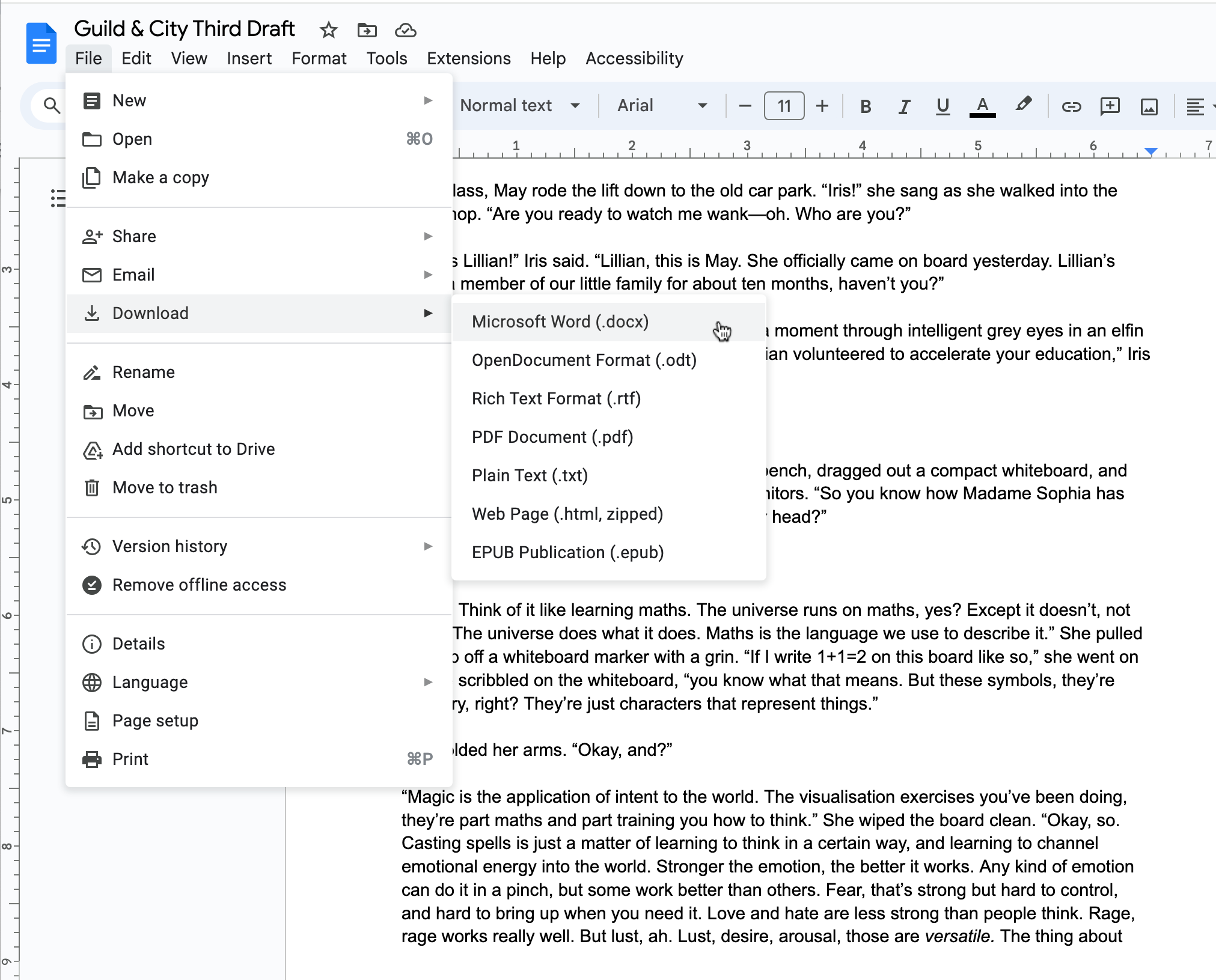
You can download from a Google doc to a Word file easily; it’s in the File menu in Docs.

Back up early. Back up often. (I’ve long had a policy of downloading Google Docs after every major change, because Google has been known to accidentally lose files, but this recent development has me doing so even more aggressively).

I plan to continue using Google Docs to write manuscripts. Thankfully, I don’t share the docs to dog+world, so I’m not likely at risk of having a malicious rando report me.

But I will continue to keep local copies of everything, and I’m in search of a replacement for Google if things should go pear-shaped.

Anyone out there who knows of any good collaborative writing tools, please shout out in the comments!

In which I send porn to Congress

Today, I had to run a rather annoying errand—namely, I had to hike down to the Post Office (a 20-minute trek each way), which thankfully is open half the day on Saturday, to mail some of my personal porn stash to Congress.

Yes, I’m serious.

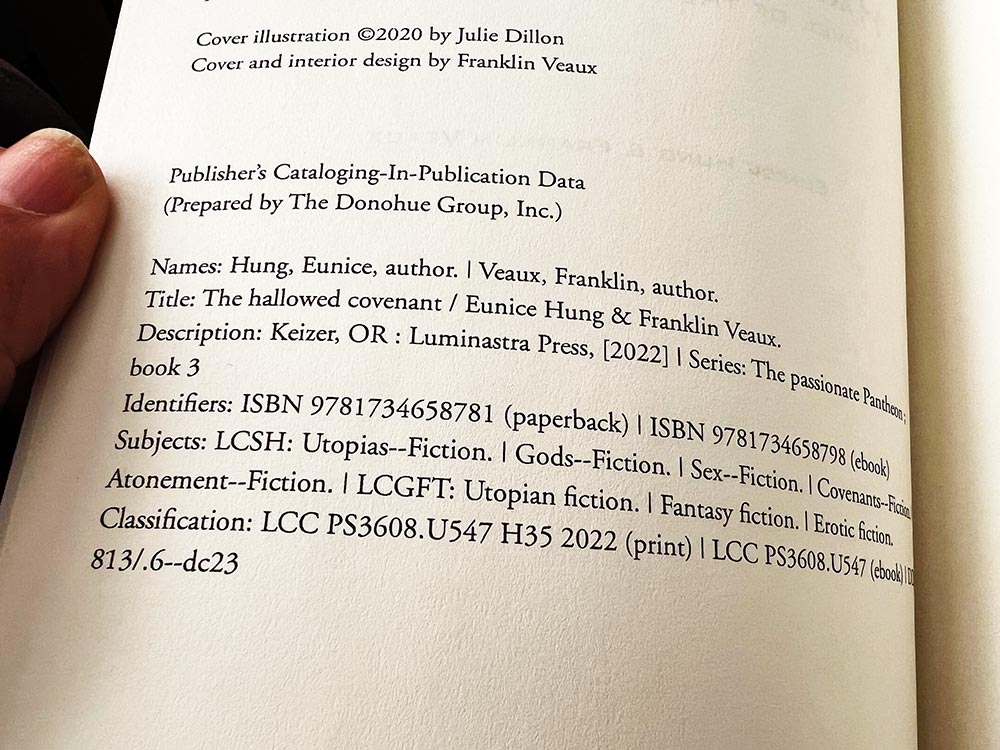
To understand this story, you must first understand cataloguing-in-publication. Most books published in or for sale in the United States have a CIP data block on the copyright page. It’s a set of bizarre numbers and dashes, and it indicates exactly how the book should be catalogued using the Library of Congress cataloging system.

This system is way more complex than the Dewey Decimal System, and has category identifiers for every category of fiction and nonfiction you can imagine, up to and including subjects as specific as “hacking,” “betrayal,” and “voluntary human sacrifice.”

This CIP data block looks like this:

These numbers all instruct libraries exactly how to file the book. The CIP block is put together by library science researchers who are intimately familiar with the filing system, and study the book to see how to categorize it.

You can get this information free from the Library of Congress, or pay researchers at specialized companies to put this block together. Without it, libraries will refuse to stock the book.

If you have the Library of Congress do it, you can get a Library of Congress Control Number, an ID that links the book to its CIP data block online. This LCCN also appears on the copyright page. So far, so boring.

Now, when you register a copyright on a book, you must send two copies of the book to the Library of Congress. However, if you get an LCCN, you must also send a third copy to a different office at the Library of Congress.

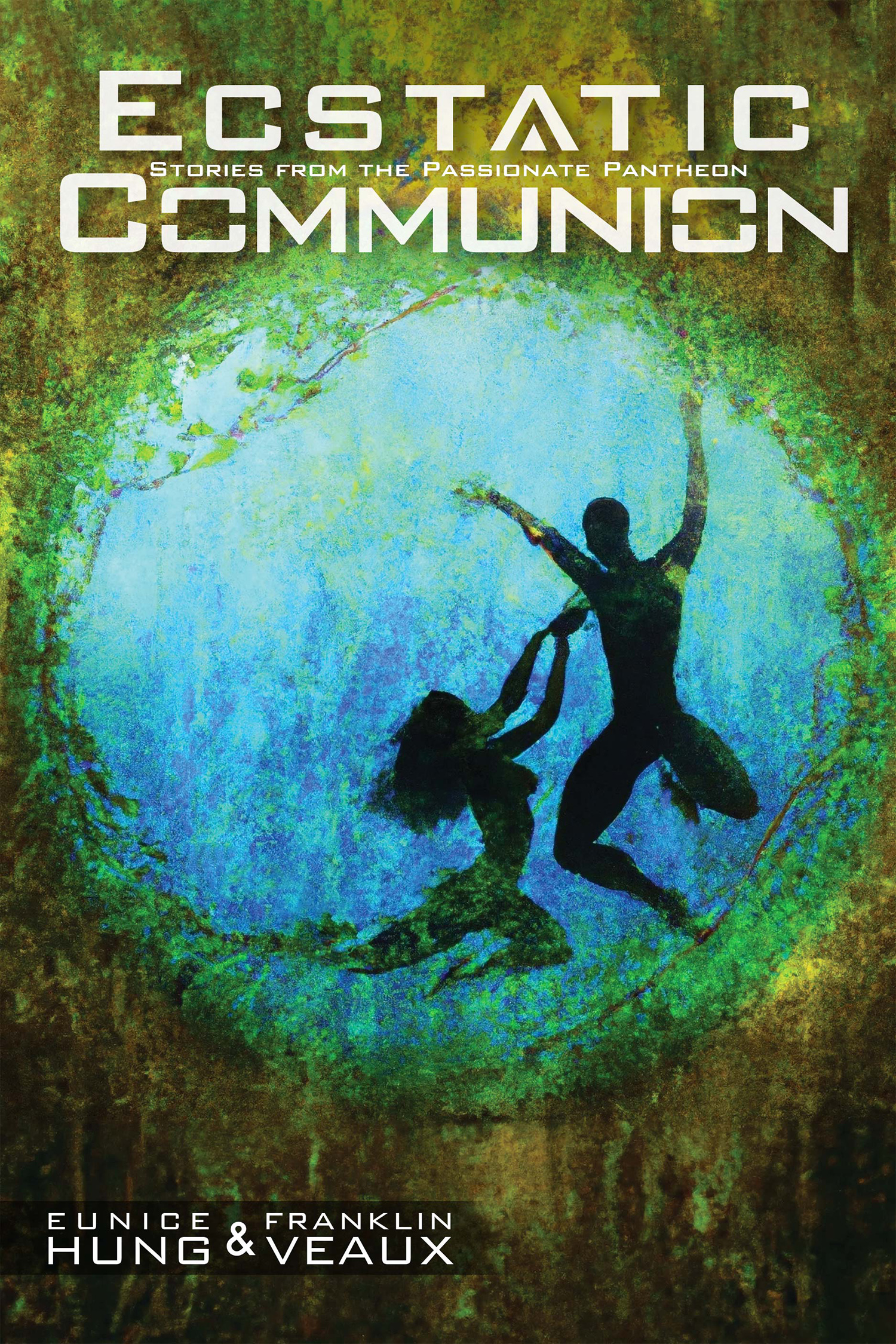
When Eunice and I published our pornographic collection of short stories, Ecstatic Communion, we got an LCCN. I didn’t realize until today that the Library of Congress needed that third copy. I didn’t have any extra copies, so I just had to send them my own personal copy.

Which means I can now check off “send porn from my personal stash to Congress.”

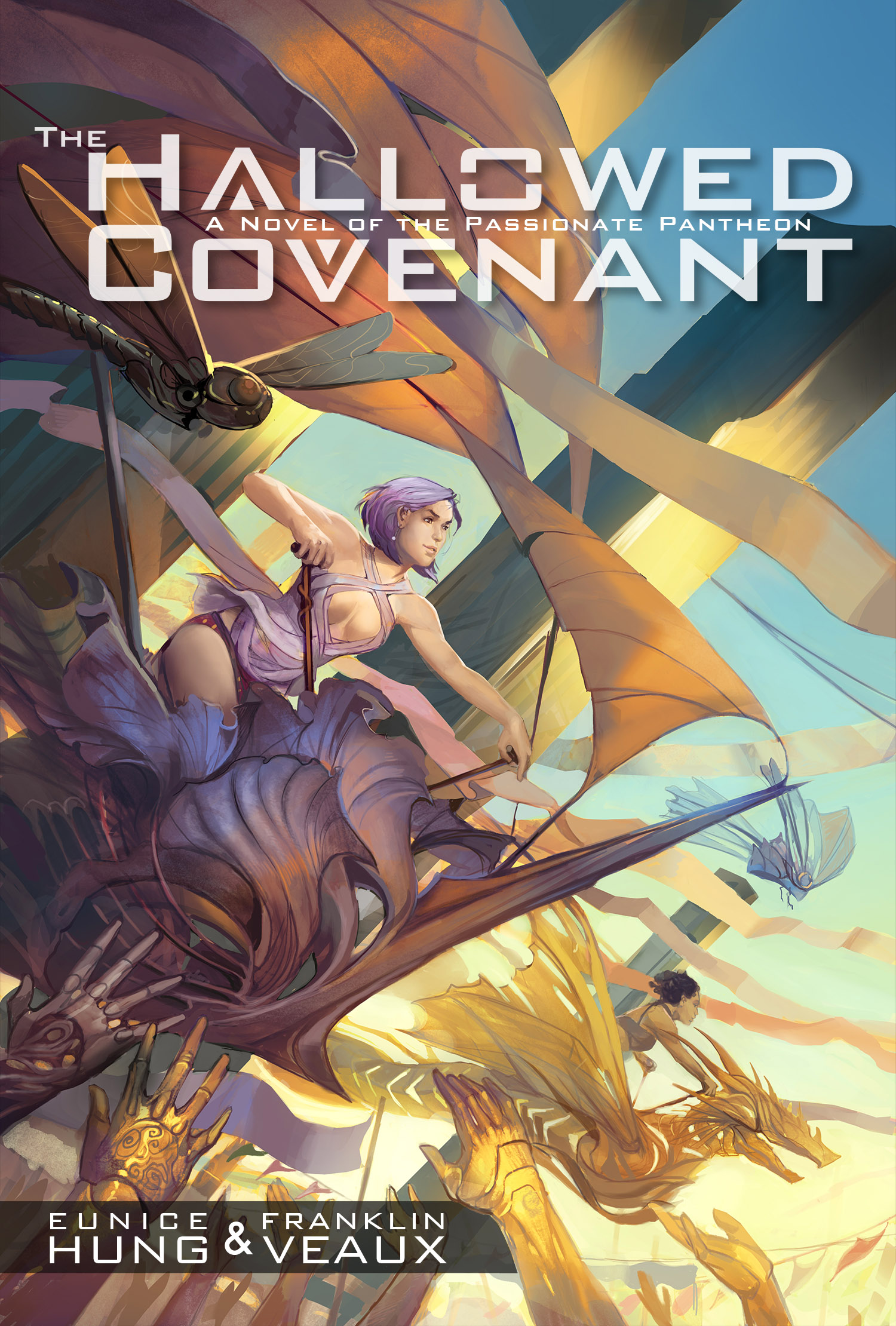
Preorders for The Hallowed Covenant!

Preorders for The Hallowed Covenant, my new post-scarcity science fiction erotic novel with Eunice Hung, just went up today! And man, I am really, really excited about this book.

This is probably my favorite book I’ve ever coauthored. We take a deep dive into what it’s like to live in the City, along the way touching on themes like:

• How do you have a system of justice in a post-scarcity society with no police or codified laws?

• What are the AIs the people in this society worship as gods? What are they like?

• What do transgression and atonement look like when there’s no such thing as law?

And of course there’s lots of sex, much of it involving kinks so exotic they don’t even have names.

The novel follows seven friends as they wrestle with changes in their lives, set against the backdrop of the Festival of the Lady (the AI god of art and creativity)—think Burning Man in a society with a tech level that makes Star Trek look late Bronze Age, but more hedonistic.

The first two novels in the Passionate Pantheon universe have done so well people started asking us for audiobook versions, and guess what? We delivered! The Hallowed Covenant has an audiobook, narrated by the amazing (and incredibly sexy) Francesca Peregrine.

Thanks to a special arrangement with the Nobilis Erotica podcast, you can listen to the first two chapters here!

I am just incredibly, incredibly proud of this book. Like, I am absolutely giddy that it’s almost out. If you like science fiction and you like sex, I suspect you’ll probably like it too.

Check it out here! If you back the crowdfunding, you can score a copy before pub date for less than you’ll find it anywhere else. (And stay tuned for new perks coming soon!)

New book out!

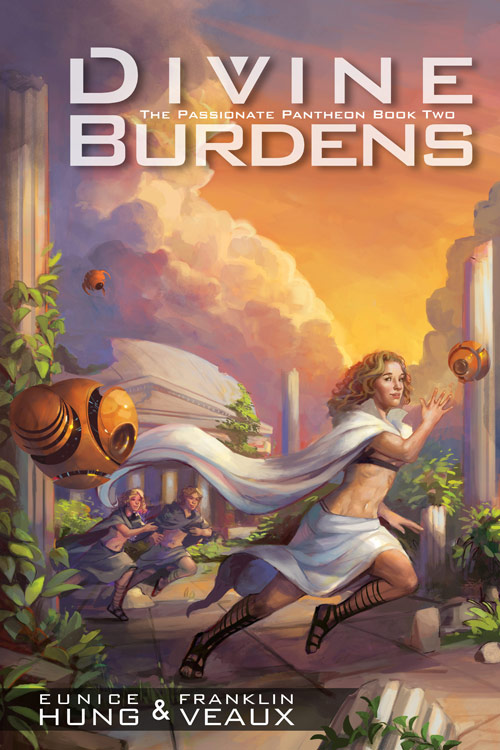
The second book in the Passionate Pantheon series of far-future, post-scarcity erotic science fiction, Divine Burdens, I co-authored with Eunice Hung is out!

This is…unusual erotica.

When Eunice and I wrote the first book in the series, Divine Burdens,, we spent a lot of time shopping it around to publishers, who kept telling us there was no way to sell it. Erotica, we were told over and over (and over!), is niche. People like what the like. Someone who reads shapeshifter werewolf porn won’t read shapeshifter vampire porn. Unless the book fits a genre, there’s no way to reach its audience.

Well, these books don’t fit a genre.

They’re kinky AF, they are set in a far-future society ruled by AIs who are worshipped as gods through ritualized sex, and they have fetishes so exotic they don’t have names (we checked).

So not what most publishers wanted.

Well, we persevered, and now the second novel is available! And the third is in its fourth draft, and the fourth is in its second draft, and we’re planning the fifth…ahem. Anyway.

So, yeah, this book…isn’t like the first. The first book was Utopian post-scarcity erotica. With this one, we wanted to see what would happen if we took a post-scarcity society and flipped the Utopia on its head. Divine Burdens is erotic horror.

Top athletes competing for the honor of running through a forest for three days, pursued by Hunters trying to capture them and commune with the God of the Hunt through their bodies! An exile being taken to the temple of the God of the Deep and face violation by tentacle! A volunteer playing host to a sacred parasite that lives within her, flooding her body with powerful aphrodisiacs while she and her fellow volunteers undergo rituals that are half religious worship, half medical exam!

“Amakoli will preside over tomorrow’s Winnowing,” High Priest Henlith said. “Right now there are, correct me if I’m wrong, twelve contestants competing to be this year’s Sacrifice. After tomorrow, there will be four.” He raised a mug. “Tomorrow, we will measure the worth of the contenders. Tonight, let us feast!”

A ragged rowdy cheer filled the hall. Savine leaned over to Lija. “Do you think you’re going to make the cut?”

“I don’t think it,” Lija said. “I know it.”

“Arrogant,” Amakoli said from her chair. “I like it. That’s a winner’s attitude.”

“Care to make a wager?” Savine said.

“What did you have in mind?”

“Simple. If you make the cut, I’ll be your bondslave. If you don’t, you’ll be mine.” Savine bared her teeth. “I mean to make sure you don’t.”

“How long?”

“Shall we say five days?”

Lija snorted. “You don’t sound very confident.” She glanced at Amakoli, who watched their negotiation with interest. “I propose a counter-offer. If I make the cut and you don’t, it’s fifty days, beginning the day after the end of the Sacrifice.”

“And if I make the cut and you don’t?” Savine said.

“Same. Fifty days.”

“Done.”

A small drone of gold metal shaped like a wizened old man fluttered down from the ceiling on crystalline green wings. It whirred mechanically as it opened the book it carried. “Bet recorded,” it said in its musical voice. Savine smirked at Lija.

After dinner that night, the great hall erupted into a boisterous party, rowdy even by the standards of those who worshipped the Hunt. Music filled the space, dominated by deep thrumming percussion that set the floating globe-lights to vibrating. Mood-altering substances flowed freely from the Providers, from large tankards brimming with intoxicants to small crystal vials filled with hallucinogens and libido-enhancing liquids. Contract drones darted about recording bets. Lija heard her name mentioned several times.

Brin approached Lija with a teardrop-shaped vial filled with faintly glowing liquid that danced with tiny blue specks. “Drink this,” she said.

“Okay.” Lija swallowed the contents and chased the sweetness down with a shot of brandy. She wiped her mouth with the back of her hand. “What was it?”

“Dunno,” Brin said. “I asked the Provider to give me something interesting.”

The fires in the huge fireplaces roared high. People danced in the space around the long table. Occasional small groups of two or three or four went off to the little screened-in alcoves, to come out some time later happy and, frequently, with less clothing.

Kerrim and a bare-chested Jassin whirled by, dancing with each other. Kerrim held a large mug and, against all odds, spun about without spilling whatever was in it. “Lija!” Kerrim called. He waved the mug in her direction. “I just made a bet with Liat about whether or not you’ll be the next Sacrifice.”

“Oh? Did you bet for or against?”

He grinned. “For. Let’s toast!”

Lija looked around. “I don’t have a drink.” 

“Here, take mine.” He handed her the mug and summoned another from the Provider at the end of the table. “To you and a successful Hunt!”

They smacked their mugs together. Lija drank the clear liquid. It burned her throat and stung her eyes. “By the Hunt, what is this?”

“Potent!” Kerrim said.

Jassin grabbed her hand. The three of them whirled together. The world softened around the edges. Lija’s body flushed. Her face grew warm.

Jassin and Kerrim linked arms and danced in a small circle around Lija. She giggled. Across the room, she saw Tatian and Amakoli talking in a corner near one of the fireplaces. Then Jassin scooped Lija off her feet. She squealed as he twirled her through the air.

“Hey, I was thinking—” Kerrim started. Lija grabbed him and kissed him. He melted into her arms. “Mmm, you read my mind!” he said when she broke the kiss.

“Don’t be greedy!” Jassin said. He put his arms around Kerrim and kissed him deeply. 

Lija’s vision went fuzzy. A face swam into view. “Would you like to kiss me?” Lija asked the blurred shape.

“Yes please,” Savine said. She draped her arms around Lija and kissed her gently, with great attention, tongue flicking lightly across Lija’s lips.

“That’s nice,” Lija giggled.

“If I win our bet,” Savine said, “I am going to enjoy hurting you so very much. I will hurt you every single day for fifty days.”

“If,” Lija said.

We’ve put a tremendous amount of love and work into every aspect of these books. Seriously, you wouldn’t believe. There are places where a six-hour conversation becomes two lines in a book.

We’ve even started a Passionate Pantheon blog to offer a behind-the-scenes peek at the worldbuilding you won’t get to see in the novels, like, for example, the citizens of the City as modern-day reinterpretations of the Fey.

If that sounds like your jam, check it out!