A few years back, I dropped a kettle of boiling water on my foot. The burns sent me to the ER, where I was given a shot of morphine, and then to the burn clinic, where I was prescribed oxycodone. (I have pictures of the burn. They’re not pretty.)
The morphine was awful. I could feel it coming on, like an unpleasant prickly hot surge that passed over my body in a wave. It was a bit like…it’s hard to describe, but imagine being cocooned in a malfunctioning electric blanket that keeps shocking you—a sense of flushed warmth accompanied by extremely unpleasant little zaps like touching a badly grounded electrical appliance with an intermittent short.
Then came the vomiting: vigorous, profuse, and enthusiastic, as if my body, not content with throwing up in a more pedestrian fashion, had decided to twist the spacetime continuum to expel food I hadn’t even eaten yet.
What didn’t happen was pain relief. At all. I was still in exactly as much agony as I was before the shot (and believe me, boiling water burns are awful, the only pain I’ve ever experienced worse than kidney stones).
The oxycodone? Same deal. Spectacularly, implausibly vigorous vomiting, fuckall pain relief.
Finally, in desperation, I tried a cannabis edible, and lo, it was as if a chorus of angels did sing, saying, “let this man’s pain be erased.” It also made me high, which was unpleasant, but every silver lining has a cloud around it, amirite?
Quite a bit of systematic experimentation later, I learned that the sweet spot for pain management for me is 2.5mg of THC and 2.5mg of CBD. That dosage is effective at pain management without leaving me incapable of functioning or unpleasantly high.
I’m probably unusual in that regard. I can definitely feel 1mg of THC. 2.5mg leaves me a little high, but it’s tolerable. 5mg of THC leaves me high AF and not in a good way. 10mg of THC, the one time I tried it, left me curled up on my side hallucinating vigorously.
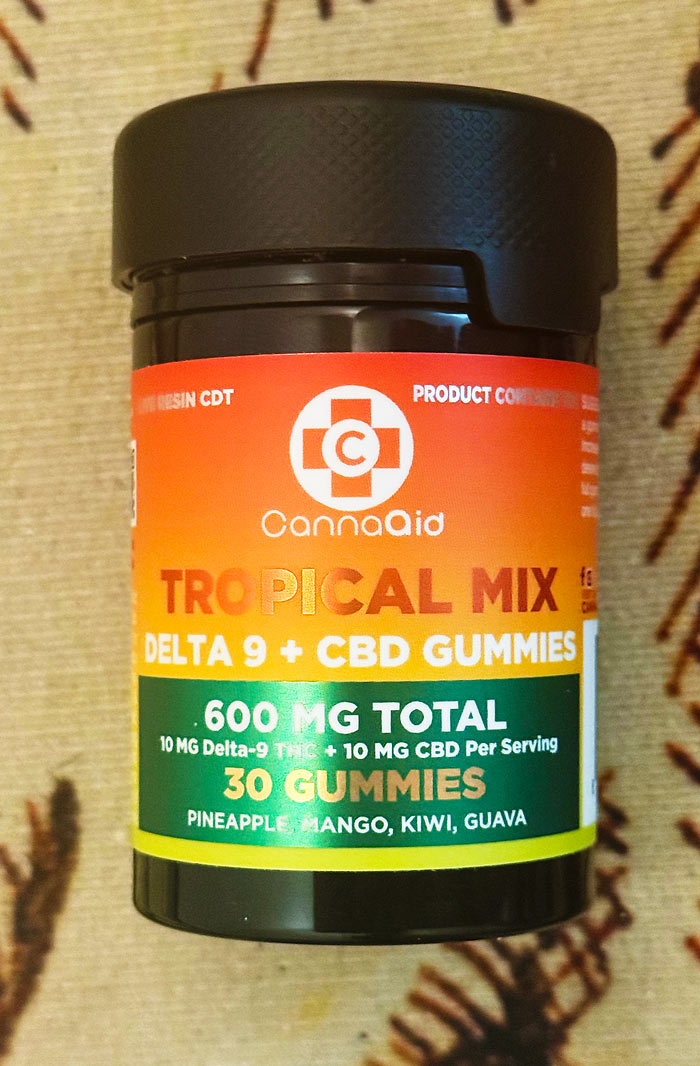
I use it when ibuprofen doesn’t work, which isn’t very often. This:
is about a three-year supply for me; I cut the gummies into quarters and take a quarter if nothing else works.
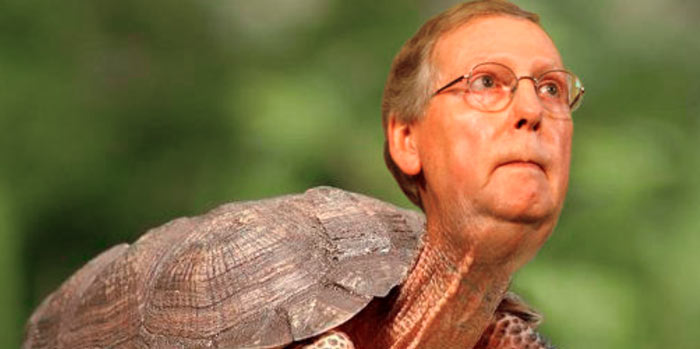
I was able to try cannabis edibles thanks to a senator named Mitch McConnell, known to his friends as “that sour old turtle-faced motherfucker,” who in 2018 introduced legislation into an appropriations bill legalizing hemp.
Senator McConnell in an undated Senate photo
Fast forward to 2025, when a senator named Mitch McConnell, known to his friends as “that sour old turtle-faced motherfucker,” has introduced language into an appropriations bill that would ban hemp products across the board.
Now, we’ve all known for many years that Old Turtle-Face has no integrity, shame, scruples, or backbone. This is not new.
What’s new is that his motivations, usually as transparent as the film wrap over a styrofoam tray of ground meat at a discount supermarket, are completely opaque.
When he first said yay to hemp, before his about-face flip-flop, he raved on and on about how it would help Kentucky farmers…farmers he’s now shot, stabbed, and tossed under a bus.
My take on that is someone with a financial interest in cannabis farming offered him a lot of money, then somehow the deal soured.
My Talespinner disagrees. She deals with chronic pain and, like me, has found cannabis a godsend for pain management…only to have it yanked away, leaving few options between, you know, addictive opioids and over-the-counter pain relievers. Her take: it’s intentional, calculated cruelty. Turtleface gets off on it.
And the thing is, either of those two explanations—political crony corruption or deliberate, calculated cruelty—fits. They’re both within Senator Turtledick’s wheelhouse. They both fit his pattern of observed behavior; the man has never met corruption he doesn’t embrace or pointless sadism he doesn’t indulge. He’s basically a walking encyclopedia of the worst impulses of humanity, a case study in unscrupulous, dishonorable barbarism.
So what say you? Is it merely greed, or is he letting slip is inner spite?
In which Franklin makes everyone on all sides of the political divide angry
Okay, so. Some short while ago, a question floated through my Quora feed: Should men’s rights be more talked about, yes or no?
The thing about this question is it does not, and cannot, have a simple yes or no answer, because “rights” are not one thing. But even talking about talking about men’s rights tends to get people’s backs up. I will try to be as evenhanded as possible, in full understanding that I should be able to make everyone very angry indeed.
Let’s start here: The things people talk about when they talk about “rights,” especially in the context of systemic oppression, fall into two camps: rights everybody should have, and rights nobody should have. Conflating these things eradicates nuance and causes people to talk past each other.
Before I go any further, fair warning: Whataboutism, sealioning, and oppression Olympics in the comments will be terminated with extreme prejudice.
The most common objection I hear to any discussion about men’s rights is some variant of “men already control most of the world’s wealth, men are overrepresented in government and the upper tiers of corporations, men wield disproportionate power, the last thing on earth men need is more rights.”
That’s good sound bite activism, but it’s also a fetid, steaming pile of bullshit that’s irrelevant to any thoughtful discussion of men’s rights.
Yes, it is unquestionably true that men have all these advantages. We live in societies that overwhelmingly advantage men, absolutely. Yes, this is undeniable. Conservative men in the back who are getting pissed off because I said that, sit down. You hold tremendous advantages over women. American society gives you breaks that women don’t have. That’s just a fact.
Liberals, wait your turn, I’ll piss you off in a minute.
Yes, men are advantaged. Obviously. And that has fuckall to do with men’s rights, because those advantages are not rights. No reasonable person is saying that men should have more of that, because those are advantages nobody should have merely because they were born with a certain configuration of genitals.
When I worked as a designer, there was a ha-ha-only-serious notajoke common in the industry: “This would be a wonderful job if it weren’t for the clients.”
There’s a similar problem with men’s rights: it would be a wonderful conversation if it weren’t for the men having it.
Men’s rights activists (at least in the US; I don’t see this nearly as much in Europe) include some of the most terrible people you will ever find outside a Khmer Rouge death squad. They use “men’s rights” as a platform to bang on about how much they hate women and whine about how women’s liberation ruined the world because now they can’t find a nice passive sperm receptacle who will fuck them and make them a sandwich. I mean, they’re so awful, malignant narcissists look at MRAs and say “my god, there goes a bunch of toxic self-obsessed losers and no mistake.”
But beneath the self-indulgent whining, they do, and I have to grit my teeth to type this, they do have some legitimate points.
Like, for example, and this is the bit where having alienated a bunch of conservative men, I’ll piss off a bunch of liberals: Abuse of men by women, physical and emotional, is way, way, way, way, way, way more common than most people believe.
Like, we live in a society that trivializes, dismisses, and denies abuse of men by women—so much so that many people actually support abusive women.
Like, we live in a society that mocks male abuse survivors. I’ve experienced this myself.
Like, there are in fact double standards about men who sexually abuse young girls and women who sexually abuse young boys; women who sexually abuse underage victims consistently receive lighter penalties, according to peer-reviewed studies.
Like, men are more likely to die by suicide than women. Like, men are disproportionately victims of violence, though to be honest that’s a bit of an own goal because we’re more likely to be perpetrators of violence as well.
Ideally, conversations about rights are independent of the identity of the person having them. All rights—men’s rights, women’s rights, gay rights, Black rights, trans rights, religious rights—are human rights.
In practice, we cannot always frame the conversation that way, because patterns of institutional oppression mean that the abrogation of human rights always, always affects some groups of people more than others. This is why “all lives matter” and “feminism should be humanism” fail. (Well, one of the reasons, anyway; another is they’re disengenuous claptrap, but even assuming they were put forward in good faith, they’d still fail.)
It’s reasonable to pay more attention to the house that’s burning than the one that is not. It’s reasonable to pay more attention to the groups that are more disenfranchised than the ones that have more structural power.
Having said that, the lens with which we look at rights should always start with, is this something everyone should have? That’s a good first-pass filter to separate rights from privileges.
Should everyone have the right to be free of violence and abuse in their intimate relationships? Yes. Obviously.
Does intimate partner abuse disproportionately affect women? Yes. Obviously,
Does that make it okay to declare intimate partner abuse of men a non-issue? No. Obviously not. (Well, you’d think obviously not, but…)
People abuse and people are abused. Men abuse women. Women abuse men. Women abuse women. Men abuse men. We need to acknowledge that and we need to take it all seriously. “More women suffer so it’s okay if men suffer” is fucking monstrous and anyone who plays oppression Olympics that way does not deserve a fucking seat amongst decent human beings, and that’s a fucking hill I will die on.
At the same time, men, listen up.
Yes, it’s true that men can be drafted and women can’t, and it’s totally reasonable to frame this as an issue of men’s rights…
…but here’s the thing. There are 535 people in Congress and 384 of them are men, so please, for the love of God, stop yapping that this is a problem women need to fix. Jesus Tap-Dancing Christ.
Men passed those laws. Not women. Men hold the balance of power in Congress. Not women. The president is a man, not a woman. Shut your yaps about “I wOn’T sUpPoRt WoMeN’s RiGhTs UnTiL tHe WoMeN tAkE a StAnD aGaInSt ThE dRaFt.” Men, not women, created that problem. Men, not women, have the power to change it.
Same goes for men being more likely to die by violence than women. Yeah, we are…
…at the hands, overwhelmingly, of other men. How do you expect women to fix this, exactly?
A lot of the problems MRAs yap about can be traced directly to toxic masculinity, which is overwhelmingly those beliefs and attitudes held by men that are harmful to men. Don’t shove a stick in your own bicycle wheel and whine about what women did to you, my brother.
Alllllll that being said:
Society is fucked up and unequal and advantages some people over others, and yeah on balance men have a lot of things better than women do, but privilege is intersectional and there are places men are disadvantaged and yeah, if we’re talking about groups that are disadvantaged by structural social institutions we need to talk about places that happens to men too, and if that hurts your liberal fee-fees maybe it’s time to go take some remedial courses in basic human empathy and come back when you’ve grokked the notion that systemic harm is always wrong, even when it hurts people who are otherwise advantaged.
And now that I’ve pissed everyone off, I will say good day.
A short time ago, I started thinking about the fact that I will often do things that are Type 2 fun when I’m having sex.
Quick recap for those who aren’t familiar with the types of fun: Type 1 fun is stuff that’s just fun. Things you enjoy. Things you like doing in the moment. Type 2 fun is fun that isn’t enjoyable in the moment, but that you enjoy the memory of, or telling stories about later. (For many marathon runners, for example, actually running in the marathon itself isn’t fun; it’s painful, uncomfortable, exhausting, and miserable. But there’s joy in having run the marathon—joy in being able to reminisce about it later and in the knowledge that you did it.) Type 3 fun is stuff that just isn’t fun at all—not in the moment, not in the remembering of it, and you are not likely to do it again.
My girlfriend Maxine says there’s also a Type 4 fun: something that isn’t fun in the doing or the remembering, but that a third party has fun telling others about. “Hey, you remember that one time when Bob had that firecracker, and there was that big pail of fish heads…?”
Anyway, I saw an online article that suggested you should never do anything sexually that makes you uncomfortable, which frankly I thought was terrible advice. That got me to thinking about my personal sex onion: the layers of things I will and won’t do in sex.
It looks something like this. Everything inside the largest circle is stuff I’ll do; everything outside it, stuff I won’t.
There’s a lot of stuff inside the circle I don’t enjoy. I’m not a masochist; I don’t get aroused from pain, and it never feels good no matter how sexy the context is. But I will allow lovers to do things like needle play or impact play on me if they’re into it.
I spent years developing the Xenomorph Hiphugger Strapon because my wife, who knows my parents took me to see the movie Alien at far too tender an age and it terrified me for decades, suggested the alien facehugger could be made into a strapon sex toy:
My wife wearing a prototype (photo by author)
I am what Eunice calls a “reaction junkie.” It gets me hot seeing my lovers get hot. If there’s something that really really does it for you, something that lights you up and revs your motor, something that turns you on to the point of incandescence, I can probably make it work for me even if it’s not my thing. There’s something amazing and unbelievably sexy about seeing someone you love light up.
Even if it’s uncomfortable in the moment.
In fact, hidden beneath the layers of“ooh, sexy!” is a profound truth of the human condition, one that people who explore kink and people who run marathons share in common: Sometimes, in those moments of discomfort, you learn something about who you really are. Intense experiences bring out hidden parts of us.
As far as intimacy goes, it’s the most intimate thing I can imagine: allowing your lover to push your buttons, or being with a lover who allows you to push theirs, to see you in those moments of genuine authenticity.
I’ve allowed lovers to spank and crop me, to put needles into me, to give me forced orgasms one after the other until I pass out. All those things are inside my personal sex onion. I won’t say I enjoyed them in the moment of doing them, but I feel like all of those experiences have value—they’ve given me insight I might not have any other way.
Life’s cost of entry
The cost of entry of that insight is being willing to do things that challenge you. Which isn’t common, thanks in no small part to the number of people who will tell you, with apparent sincerity and the right intentions, never to do anything that makes you uncomfortable.
Which is advice we apply to no other area of human activity. (Can you imagine someone saying that about running a marathon, signing on for the Marines, learning to sail, learning ballet, or going mountain climbing?) We accept discomfort as the price for many valuable experiences…except sex.
Of course, none of this means you should allow yourself to be pressured into doing things you genuinely don’t want to do. I will almost certainly never run a marathon. Doing something onlyi because it’s uncomfortable…well, that’s the road to madness.
But rejecting something only because it might be uncomfortable? That’s not a way, I think, to live an interesting life. (You may not agree, and that’s okay. Your life, your body, your rules.)
Outcome vs Consent
See that circle down in the bottom right, the one labeled “things I’ve tried at are now a hard no”?
A long long time ago, in a whole different digital age, when LiveJournal was new and social media seemed alight with possibilities beyond political tampering by hostile state-level actors, I saw a conversation online where a guy said he’d never do anything sexual he wasn’t 100% comfortable with, because what if he tried it, he didn’t like it, and then his girlfriend asked him to do it again?
I told him, “then you say no. It’s okay to try something and decide you don’t like it.”
Boom! Mind. Blown.
But it’s true. It’s okay to say no to something you previously said yes to. Again, we understand this intuitively with everything except sex.
I’ve talked about this before, but many people also do a terrible job of separating consent from outcome. If you say yes to something, and decide that oyu hated it, even felt violated by it, your consent was not violated. If you say no to something, and someone does it anyway, then you decide you actually kinda liked it, your consent was still violated.
You cannot label something you agreed to do and then decided you didn’t like a consent violation. You can label something you never said yes to a consent violation, even if after the fact you enjoyed it.
If you freely consent to something, decide you don’t like it, and claim your consent was violated, you’re a shitty person. If you do something to someone who didn’t consent to it, then claim that it was okay because they liked it, you’re a shitty person. I feel like this ought to be obvious, but no matter how many times I say it, it’s not.
If no means no, then yes has to mean yes.
There are things I’ve tried I won’t do again. There are things that I didn’t agree to that weren’t terrible, that I even kinda liked, but that doesn’t change the fact that it was not okay to do something that violated my consent.
It’s okay to agree to things that you later find you didn’t like. Just don’t do them again. Your body, your rules, remember?
Taking apart the onion
The point here is that sex is a lot of things. You can have fun (Type 1 or Type 2!) during sex, yes, but you can also learn about yourself, and your lover, from sex. We know that we do all kinds of things for all kinds of reasons…maybe we simply need to remember sex is no different. We know marathons are uncomfortable, but also that people choose to do them anyway, and running a marathon last year doesn’t obligate you to run another next year.
A new billboard appeared recently next to the grocery store where I do most of my shopping.
Image by author
I don’t mean the “now leasing” sign, but the one next to it. The one with the country singer on it.
Back when I was in middle school in Venango, Nebraska, I didn’t know a thing about Dolly Parton except that she apparently had large breasts. I might have vaguely known that she was in a band or something, maybe, but I couldn’t put a face to the name. I knew she had big boobs because all the other kids told me she had big boobs, and if all the other kids are saying something, like they put spider eggs in bubble gum or whatever, you know it’s probably true.
We would get together at recess and tell Dolly Parton jokes, all of them dirty (at least by the standards of a fifth-grader; ah, how little I knew!) and all of them about her breasts.
As I moved into adulthood, I learned that yes, she was a singer, she sung country and western songs, and she had that one hit because of that one movie everyone liked but I didn’t see. I don’t listen to country and western music, so that was about the sum total of my knowledge of all things Dolly Parton.
Nowadays, as I learn more about her, she strikes me as a genuinely marvelous person: kind, generous, giving, and genuinely invested in leaving the world a better place than she found it.
I still don’t listen to country music, but by all accounts she seems quite extraordinary. She is that rarest of things in creation: a genuinely compassionate person.
That’s something the world needs in greater quantities.
As I get older, I become more and more aware of the value of kindness. The truth is, callousness is easy. Indifference is easy. Cruelty is easy. The world is filled with people who see kindness as weakness, but in truth, kindness costs more than insensitivity. To be kind is to see the world from someone else’s point of view, and the ego rebels against that. It reminds us we are not the sun-center of all creation.
Empathy: Humanity’s Secret Weapon
Image by author
Pop quiz time. How did human beings—soft, weak, squishy bipeds with no claws, no massive canines, and thin skin—become the dominant mammals on the planet? Survival of the fittest says we should’ve been wiped out by fiercer, stronger, creatures, right?
No.
Our special sauce, beyond our big brains and abstract reasoning, is our cooperation. We work together. We help each other. We tend to our sick and injured. Where one of us goes, the rest follow.
We have each other’s backs.
That makes us unstoppable. There are many creatures larger, stronger, faster, and fiercer than we are, creatures that can take us one on one in a fight, but the thing about humans is it’s never one on one.
You kill one of us, the rest of us will come for you. We are an unstoppable force of nature.
Losers and idiots think that kindness is a weakness because they see the world in terms of the Rugged Individual™, the lone warrior standing strong against a world red in tooth and claw. They don’t see the army that stands behind that Rugged Individual, making his tools and his clothing and his weapons, nor the entire history behind him that brought him to this place. The Rugged Individual stands on the shoulders of others and says “look how I rose to this lofty height all by myself!”
Today, we live in a world increasingly dominated by loudmouth bullies, people for whom the world is always zero sum, people who believe that every interaction has a winner and a loser.
This attitude appeals to the sort of person who thinks of himself as an Alpha Male™, taking charge through force and strength to leave his mark upon the world, but it’s comedically inept.
And the math is behind it. Entire branches of game theory show that cooperation always wins out in the long run, always…not that the sort of person who sees the world as force against force in a battle royale to the death actually understands the math.
In the end, it comes down to a simple but surprisingly subtle idea: Other people are real. In a world where we act with reciprocal kindness, everyone benefits. We are a social species; we do more acting together than acting alone.
I will admit this has not always been obvious even to me. The Internet makes it easy to forget that other people are real—that the letters we see on the screen come from a real person. I had an experience about ten or so years ago when I met in realspace some people I’d been needlessly abrasive to online, and it occurred to me, holy shit, these folks are actual human beings! Since then, I’ve tried—not always with perfect success—to be more mindful in my online communication.
Bullying is easy. Especially when it’s anonymous, and most especially when it curries favor in our social in-groups. We live in a world where kindness and compassion are increasingly seen as weakness. Let us not forget that it is cooperation that carried us here.
It’s heartbreaking to see the country gutted and its values torn apart by a fat psychopath in bad makeup, and even more heartbreaking to know that a third of the country voted in favor of hatred. There was a time when we could believe that people on both sodes of the political aisle wanted what was best for the nation. Now we cannot.
So I’ve been having trouble sleeping. And when I wake at four AM with that despair in the pit of my stomach, I sit down and design stickers. In the past few weeks, I’ve ordered hundreds and hundreds of them.
The first design just arrived today. I have more designs arriving in the next few weeks. I am giving them away to anyone who wants them for free, and when I say for free I mean I will even cover postage in the US (international is $2).
Here’s the first design:
These are four inches by two and a half inches. To give you a sense of how big they are, here’s one on a 15″ laptop:
Want one? Order them for free on my site here. Want a bunch? Let me know and I’ll have 100 of them shipped to you at my cost. Got an idea for a design? I’d love to hear from you.
New designs will be coming soon, so stay tuned.
[Edit] Wow. Um, I didn’t expect that to happen. It took two hours for my entire first production run of Resist stickers to disappear.
To anyone else trying to get one, I’m really, really sorry. I’ve ordered more. It usually takes about two weeks for them to be produced.
If you ordered multiple stickers, I may send you less than you wanted, to make sure there’s enough for everyone else. I’ll let you all know when I have more. In the meantime, I’ll have some new designs soon as well, they’re already in production.
A few months back, Elon Musk, the right-wing owner of Twitter and Grok, his pet Generative AI project, posted something I wrote on his Twitter feed, with the caption “This is the quality of humor we want from Grok.”
He even had it pinned to his profile for a short while.
I wrote this over on Quora in March of 2024. On the one hand, it’s interesting to know that Elon Musk reads my stuff. On the other, do you notice anything funny about the screenshot of his Tweet?
Yup, no credit.
The Tweet went viral, and has since been posted all over Facebook, Tumblr, Twitter, Reddit, and TikTok…all without attribution.
Right now, as I write this, OpenAI, the company behind ChatGPT, has a market cap of $157,000,000,000, making it more valuable than companies like AT&T, Lowe’s, and Siemens.
It is not a profitable company; in fact, it’s burning cash at a prodigious rate. Unlike other companies, though, which burned cash early on to achieve economies of scale, OpenAI’s costs scale directly with size, which is not at all normal for tech companies. At its current rate of growth, in four years its datacenters will consume more electricity than some entire nations.
But I’m not here to talk about whether AI is the next Apple or the next Pets dot com. Instead, let’s talk about what generative AI is, and how it represents the greatest wealth transfer of the last fifty years.
AI is not intelligent. Generative AI does not know anything. Many people imagine that it’s a huge database of all the world’s facts, and when you ask ChatGPT something, it looks up the answer in that immense library of knowledge.
No.
Generative AI is actually more like an immense, staggeringly complex autocomplete. It ingests trillions of words, and it learns “when you see these words, the most likely next words are those words.” It doesn’t understand anything; in a very real sense, it doesn’t even “understand” what words are.
As the people over at MarkTechPost discovered, many LLM models struggle to answer basic arithmetic questions.
AIs make shit up. They have no knowledge and understand nothing; when presented with text input, they produce text output that follows the basic pattern of the input plus all the text they’ve seen before. That’s it. They will cheerfully produce output that looks plausible but is absolutely wrong—and the more sophisticated they are, the more likely they are to produce incorrect output.
If you want to understand Generative AI, you must, you absolutely must understand that it is not programmed with knowledge or facts. It takes in staggering quantities of text from all over and then it “learns” that these words are correlated with those words, so when it sees these words, it should spit out something that looks like those words.
It doesn’t produce information, it produces information-shaped spaces.
To produce those information-shaped spaces, it must be trained on absolutely staggering quantities of words. Hundreds of billions at least; trillions, preferably. This is another absolutely key thing to understand: the software itself is simple and pretty much valueless. Only the training gives it value. You can download the software for free.
So where does this training data come from?
You guessed it: the Internet.
OpenAI and the other AI companies sucked in trillions of words from hundreds of millions of sites. If you’ve ever posted anything on the Internet—an Amazon review, a blog, a Reddit post, anything—what you wrote was used to train AI.
AI companies are worth hundreds of billions of dollars. All that worth, every single penny of it, comes from unpaid work by people who provided content to the AI companies without their knowledge or consent and without compensation.
This is probably the single largest wealth transfer in modern history, and it went up, not down.
There are a few dirty secrets lurking within the data centers of AI companies. One is the staggering energy requirements. Training ChatGPT 4 required 7.2 gigawatt-hours of electricity, which is about the same amount that 6,307,200 homes use in an entire year. (I laugh at conservatives who whine “eLeCtRiC cArS aRe TeRrIbLe WhErE wIlL aLl ThE eLeCtRiCiTy CoMe FrOm” while fellating Elon Musk over how awesome AI is. Training ChatGPT 4 required enough power to charge a Tesla 144,000 times. Each single ChatGPT query consumes a measurable amount of power—about 2.9 watt-hours of electricity.
All the large LLMs were trained on copyrighted data, in violation of copyright. Every now and then they spit out recognizable chunks of the copyrighted data they were trained on; pieces of New York Times articles, Web essays, Reddit posts. OpenAI has, last time I checked, something like 47 major and hundreds of smaller copyright lawsuits pending against it, all of which it is fighting. (It might be more by now; there are so many it’s hard to keep up.)
That, I think, is the defining computer science ethical problem of our time: To what extent is it okay to build value and make money from other people’s work without their knowledge or consent?
Elon Musk recognizes the value in what I write. He recognizes that it has both artistic and financial value. He posts my content as an aspirational goal. He doesn’t credit me, even as he praises my work.
That’s a problem.
Those who create things of value are rarely recognized for the value they create, if the things they create can’t immediately be liquidated for cash. That’s not new. What’s new is the scale to which other people’s creativity is commoditized and turned into wealth by those who had nothing whatsoever to do with the work, and are merely profiting from the labor of others without consent.
“Because copyright today covers virtually every sort of human expression – including blogposts, photographs, forum posts, scraps of software code, and government documents – it would be impossible to train today’s leading AI models without using copyrighted materials. […]
Limiting training data to public domain books and drawings created more than a century ago might yield an interesting experiment, but would not provide AI systems that meet the needs of today’s citizens.”
It also claims their use of other people’s work is “fair use,” even while they admit that chatbots sometimes spit out verbatim chunks of recognizable work. This is a highly dubious claim—while fair use doesn’t have a precise legal definition (the doctrine of fair use exists as an affirmative defense in court to charges of copyright infringement), one of the key components of fair use has always been commercialization of other people’s work…and with a market cap of $157,000,000,000, it’s pretty tough to argue that OpenAI is not commercializing other people’s work. It charges $20/month for full access to ChatGPT.
So at the end of the day, what we have is this: a company founded by people who are neither writers nor artists, producing hundreds of billions of dollars of wealth from the uncompensated, copyrighted work of writers and artists whilst cheerfully admitting that could not produce any value if they had to pay for their training data.
And it’s not just copyrighted data.
OpenAI Dall-e cheerfully spit this image out when I typed “Scrooge McDuck stealing money from starving artist.”
Here’s the thing:
Scrooge McDuck is trademarked. Trademark law is not the same as copyright law. Trademarks are more like patents than copyrights; in the US, trademarks are administered by the Patent and Trademark Office, not the copyright office.
In no way, shape, or form is this “fair use.”
Generative AI recognizes trademarked characters. You can ask it for renderings of Godzilla or Mickey Mouse or Spider-Man or Scrooge McDuck and it’ll cheerfully spit them out. The fact that Dall-e recognizes Scrooge and Spider-man and Godzilla demonstrates without a shadow of a doubt it was trained on trademarked properties.
So far, all the lawsuits aimed at AI infringement have been directed at the companies making AI models, but there’s no reason it has to be that way. You “write” a book with AI or you create a cover for your self-published work with AI and it turns out there’s a trademark or copyright violation in it? You can be sued. That hasn’t happened yet, but it will.
(Side note: The books I publish use covers commissioned from actual artists. Morally, ethically, and legally, this is the right thing to do.)
Why do I call OpenAI and its kin a socialist wealth transfer? Because they treat products of value as a community property. Karl Marx argued that socialism is the transition between capitalism and communism, a system where nothing is privately owned and everything belongs to the public, and that’s exactly how OpenAI and its kin see creative works: owned by nobody, belonging to the public, free to use. It’s just that “free to use” means “a vehicle for concentrating wealth.”
From creators according to their ability, to OpenAI according to its greed.
It seems to me that what we need as a society is a long, serious conversation about what it means to create value, and who should share in that value. It also seems to me this is exactly the conversation the United States is fundamentally incapable of having.
I am in London as I write this, sitting in a lover’s flat overlooking the London city skyline. I was here when I learned the news of the 2024 Presidential election—that hate won over love, bigotry over compassion, spite over benevolence.
I understand the sick despair many of us feel in the pit of our stomach right now. Dark times hover on the horizon. I don’t believe the people who voted so resoundingly against the better angels of our nature realize yet what they’ve done. Some of them likely never will, and for those who do, it will be too late.
I’m not here to analyze what happened, or rail against the stubborn streak of vicious, ugly racist misogyny that has long been part of the American spirit. Others are already doing that, some of them quite eloquently, and I do believe there’s value in understanding what happened, but that is not the most important thing right now.
It’s vital to understand going forward, though I think the answer is grubber, more sordid, and more banal than we might otherwise hope: there has always been this vicious streak of mean-spirited, ugly anti-intellectualism embedded deep in the American national character, that has been with us from the start. It has never changed, and it likely never will in our lifetimes. We are simultaneously the land of can-do optimism and sleazy, seedy execration. These are the two faces of the American civic character, and this week, the ignorance won.
But I want to remind everyone reading this that there is hope. Like the dawning of the sun after a night of terror, this too shall pass.
I do not wish to trivialize what is to come. Many people will suffer. My trans and nonbinary friends are terrified right now. Two nights ago, a great many decent Americans discovered just how badly their country hates them, just how deep the ugly river of xenophobia flows through the American psyche.
There will be suffering. There will be blood. There will be ugliness, and violence, and hopelessness, and despair. I do not want to minimize any of the grotesqueries we all see on the horizon.
I will, instead, invite us all to take a deep breath, and remember that the course of history is neither straight nor smooth, but it does tend, in the long term, toward peace and justice.
We have been here before. We have, as a nation, been worse before. We were built on the foundation of slavery and we have never truly stepped away from it. Yet we have made progress, and we will again. It might not seem like it now, but this is a setback, not the end of all things.
I would especially like to remind those of us who feel most betrayed by our fellow citizens, those who voted against their own interests purely out of spite and desire to hurt, not to do the oppressor’s work for him.
I still remember the first time this country elevated this vicious, narcissistic, racist, sexist, conman, this tumor on the American psyche, to the highest office the first time. I remember how the shockwaves echoed through my own personal life, how a person I once loved became a bitter, angry, sullen echo of herself, how she told me directly that she was abrasive and prickly to me simply because, in her words, she felt overwhelmed with hopelessness and despair, and I was the only safe place for her to dump that poisonous emotional sewage.
I learned only a few days ago from a person in my life I love dearly that there’s a name for this. It’s called “lateral violence.” Those who feel oppressed, who feel ground down by an enemy far too dangerous and powerful to fight, release their anger and fear and frustration on one another, tearing into each other with a viciousness that it is not safe to direct outward.
Many of us will do that over the coming year. I would like to invite us all not to do the oppressors’ work for them, not to become a participant in our own subjugation.
This has always been a peculiar and pernicious weakness of those of us on the progressive side, this tendency to turn on our own. Tim Minchin expressed this beautifully:
It cannot, it cannot be okay if the intention of progressives—which I assume it is—is progress forward into a future of more empathy and understanding for more people, it cannot be that the primary mechanism by which we’re going to make that progress is the suppression of empathy and understanding for anyone who doesn’t align with our beliefs. It cannot be that unmitigated expression of furious outrage will somehow alchemize into a future of peace and love.
I understand the impulse toward despair and the anger that it brings. I understand that anger, lacking a safe outlet, is all too easily directed at those around us who are like us, those we think have failed the cause, have not done enough to fight oppression (or perhaps have not fought it in the “right” way).
I understand, too, where this leads.
We cannot do this. We must not do this. The story is not over. The storm will end. We must not, in our rage and hopelessness, turn on one another.
Now, more than ever, if we are to survive what is to come, we must, we absolutely must, support each other. That is the way we get through this. Not by adopting the tools and mindset of our enemy, not by doing our enemy’s work for him, not by tearing each other down because we don’t know where else to direct our feelings, but by holding each other, supporting each other, loving each other. Love does not triumph over hate by becoming hate.
The the arc of the moral universe is long, as MLK Jr said, but it bends toward justice.. This path is never as straight nor as swift as we would like, and sometimes for every three steps forward there is one backward.
It’s okay to feel rage, despair, all those other things. I feel them too. We have a choice: we can use them to lift each other up or tear each other down.
I don’t believe in New Years resolutions. But I have, today, this moment, made a resolution for the next four years.
My resolution is that I will do everything in my power to act with greater kindness, greater compassion, greater benevolence and empathy and grace. I will not allow those who despise these things to destroy them in me. I will not do the oppressor’s work for him. I will not be complicit in my own eradication.
JRR Tolkien believed—indeed, this is one of the central moral lessons of his works—that good triumphs over evil not because good is stronger than evil, but because good works with itself while evil works against itself. We do not defeat bullies by becoming bullies ourselves. That, I think, is our blueprint forward.
I’ve posted this image on my blog before. It is vital to remember it now.
Trigger warning: Stalking, graphic death and rape threats, doxxing, threats of swatting, impersonation
I’ve been putting off writing this for a while now, because it involves dredging deep into some incredibly ugly stuff.
Most of you know that I’ve been stalked for years by a stalker (or stalkers) who has created fake social media profiles in my name to harass other people, and sent explicit, violent rape and death threats to me, my family, my friends, and those who follow me on social media.
This person, or these people, have made repeated rape and death threats directed at me, my wife, my father, and people who have expressed support for me or been rumored to be connected somehow with me online. They’ve sent death threats containing photographs of my partners. They’ve doxxed my family and partners.
The harassment has escalated over the past three years, as the rape and death threats have become more frequent, more violent, and more graphic. The stalker has escalated to threats of swatting (phoning fake tips to the police to have SWAT teams sent to the homes of the target). My websites have been DDoSed.
Last December, as I was leaving for Florida to help care for my mom, who was in the final stages of terminal cancer, I had an unexpected and rather uncomfortable conversation with Portland PD about an email I’d supposedly sent them saying I was stockpiling guns and the voices were telling me to murder my wife.
Fortunately, I have been documenting and reporting the stalking, rape and death threats, and harassment as it’s happened. The nature of the conversation changed once they pulled up the previous police reports and realized this was part of an ongoing pattern of harassment.
So how did we get here? And what does this have to do with polyamory?
Propaganda and the Poly Scene
So how did we get here? And what does this have to do with polyamory?
My first inkling something weird was going on came when a number of different people, some of whom I hadn’t spoken to in years, all messaged me to say “Do you know someone named Louisa Leontiades? She says she’s a journalist and she’s asking questions about you.” A few of those people sent me screenshots of messages or emails they’d received:
Louisa is a client of a former partner. After the relationship with that former partner ended, Louisa started messaging pretty much every female-presenting person who’d ever interacted with me online, going back through this very blog for decades, looking for women willing to dish dirt.
Next thing I know, somehow there are more “exes” that are accusing me of having “abused” them than the total number of people I’ve ever dated. Few forms of gaslighting are more head-twisty than someone you’ve never dated, never talked about dating, never wanted to date, never had sex with, never talked about having sex with, and never wanted to have sex with telling all and sundry about how you abused her when you were “together.” For a while, I quite literally thought I was going insane.
These “survivor stories,” as Louisa calls them, tended to the bizarre (like the woman who I’ve never been sexually or romantically connected with and never been in the same room with except in passing at a party claiming I abused her by flirting with someone else in front of her), toward the utterly untrue (a former partner claiming I “got her into” BDSM and that a 25-year-old is “too young to consent” to BDSM, when in fact she was interested in BDSM long before we ever met, and the fact her ex-husband wasn’t interested in BDSM was one of the reasons she divorced him), and the technically kind of true if you squint hard enough (my ex-wife claiming she was an “abuse victim” because I yelled at her on the phone once—which did happen—but declining to mention that it happened after we’d separated, when she broke into my house one night while I was out of town, stole a bunch of stuff like consumer electronics, then sold it to buy a new laptop).
As a side note, there’s a lesson here in how to spot the difference between journalism and a smear campaign. If a journalist hears “he yelled at me once on the phone,” he or she will ask followup questions: “Did this sort of thing happen often? What happened?” Ethical journalists also disclose personal or financial connections with the stories they cover.
My goal is not to go through all the rather strange “survivor stories” here. I may end up doing that at some future point, but that’s not the point of this blog post.
Right now, I’m here about the aftermath of these weird, wordy-but-vague accusations, what it says about the way many people see “social justice” as a tool of bullying and control, and how the poly scene’s support for “social justice” led directly to a barrage of rape and death threats against a whole bunch of other people beyond just me.
Louisa published these “survivor stories” from exes and non-exes with results you might predict: the Internet Hate Machine™ cranked up into full gear, I had to lock down comments on my blog because random strangers started posting death threats, I lost friends.
With all the various contradictory stories (“Franklin dated someone ten years younger than he was, he’s obviously an abuser,” “Franklin refused to date me because I’m younger than he is, he’s obviously ageist”), they became a sort of Rorschach test, with different people seeing different things in them. It’s kind of a Gish gallop of accusations.
One dude on social media wrote that I was clearly a bad person, because it was plain to him that I’d written the stories myself as a sort of humblebragging, since the theme to a lot of them is “I knew when I dated Franklin that he was polyamorous but he’s so awesome I wanted him all to myself and he said no.”
Seriously. Someone over on Quora actually said that.
Dr. Elisabeth Sheff, a sociologist and author who serves as an expert witness in court for abuse cases, published an analysis of the “survivor stories” that concluded the stories don’t actually describe abuse.
The poly community as a whole thought about her analysis, set aside their first knee-jerk emotional response, said “huh, I wonder if there’s a reason she might have reached those conclusions,” went back, and re-evaluated the survivor tales with a more considered eye…
Hahahahaha, I’m kidding, that didn’t happen. Instead, the Internet piled on to Dr. Sheff. She was threatened personally and professionally, and received so much harassment and abuse she was forced to back away from the whole situation. You know, classic straight-up bullying.
And it wasn’t just threats. A lot of folks sent her emails that they probably wouldn’t think of as problematic—messages like “don’t you realize you’re just hurting women who have been abused?” and “I’m so disgusted that an academic would support an abuser” and “I used to be such a fan of yours, but this has really made me rethink that,” because they couldn’t even consider the possibility that she might, you know, be right.
After that, things got even weirder.
“I want a just, fair, and equitable society, and I don’t care how many rape threats it takes to get there.”
Now let’s fast forward a bit, to a nonprofit polyamory convention run by a registered nonprofit in London, called “PolyDay.”
COVID interrupted the convention for a couple of years. During the COVID lockdown, a team not previously involved with PolyDay announced they would be taking over the PolyDay name and launching a new for-profit convention under that name.
The organization that owns the PolyDay convention informed these people firmly that it owns a trademark on the name, and they would not be permitted to use it.
Lockdown ends. The organizers of PolyDay announce the convention was on once more. I don’t know if the person who tried to steal the name started the rumor or merely amplified it, but anyway, someone starts a rumor that I own PolyDay, or run it, or somehow profit from it, depending on which version you believe. (For the record, I have absolutely nothing to do with it—I live in Portland, and it is owned and operated by a nonprofit in London.)
As the rumor spread through the North American polyamory scene, people said “Hey, we can look up the history and organization of PolyDay and figure out if this rumor is true.”
Hahahahaha, I’m kidding, that didn’t happen. Instead, a large number of people determined to make a more just and equitable society and stand up for women raced to their keyboards to send a flood of rape and death threats to the scheduled speakers at PolyDay. So many threats of serious violence poured in, the conference organizers canceled the event.
Apparently, threats of rape and murder are how some people think we create a more peaceful, more enlightened Utopia.
And it just kept going. Once this kind of harassment and bullying gets going, it takes on a life of its own. A former BBC and Guardian journalist named Jonathan Kent published a book on polyamory. Someone started a rumor that I profit from the book somehow, or (depending on which version you believe) that I secretly wrote it under his name, or something.
By now, I’m sure you can predict what happened next:
People looked up Jonathan online and realized he’s actually a person, a reporter with a long documented history, and not an alter ego for me? Hahaha no. Of course not.
People harassed him, called for a boycott of his (I mean “my”) book, threatened and harassed his podcasting co-host…because in this brave new world of empathy, compassion, and social justice, that’s what you do. You harass and intimidate anyone you don’t like, or anyone associated with anyone you don’t like, or anyone rumored to be connected to anyone you don’t like, so that one glorious day, if you harass and threaten enough people, you’ll wake to a world of perfect social justice.
Meanwhile, of course, the rape and death threats aimed at me and those close to me kept rolling in. My co-author Eunice and I released a science fiction novel; a bookstore that planned to host a book event got harassed into dropping the event. Some random stranger I’ve never met made a YouTube video about what a terrible person I am, repeating the “survivor stories,” insisted she wasn’t making the video for money, then used it to beg for Patreon donations.
So it goes.
And is still going. People are still following me around on social media, doxxing and threatening my partners, friends, and folks who follow me.
Just like with the “survivor stories” themselves, the stalking and threats have become a Rorschach test of their own. A random woman on Facebook told me, with what seemed like perfect sincerity, I must be making it all up, because men never get stalked, only women have stalkers.
So here’s the thing: The North American polyamory community has a problem.
I want to be clear this is not a problem everywhere. Poly folks elsewhere largely seem to roll their eyes at all this.
But the poly scene in North America is overrun with folks who are okay with using rape and death threats as a way to express themselves, who don’t do even the barest minimum of fact-checking, who are so caught up in righteous fury that sending women anonymous messages saying “I am going to rape you to death, here’s a photo of your house” seems like a perfectly reasonable way to support social justice for women.
Now, if this is you, if you’re one of the people who sat down at your computer to type out threats to Dr. Sheff or to the people scheduled to speak at a conference because you heard a rumor that it was somehow connected to me and couldn’t be arsed to fact-check, this essay is not for you. You are irredeemable and I don’t care what you think of me. I don’t quite understand the mentality of someone who says “I’m going to stand up for women and justice by sending a bunch of people I’ve never met anonymous emails saying I’m going to murder them if they present at this conference,” and honestly I don’t want to. If this is you, fuck off.
If this isn’t you, and you’re on the sidelines saying things like “I don’t know what the hell is going on but I don’t want to get involved,” well, I get it, I really do. I’ve been there myself. I’ve unquestioningly accepted stories because they fit a narrative I believed in, and discovered later that the things I’d been told didn’t actually happen, at least not the way they were presented to me. (I may write about that at some point as well.)
And I’m not saying the fact that a bunch of bullies and Internet trolls have taken it on themselves to send rape and death threats all over the Internet because, you know, that’s how you support women and fight for social justice automatically proves that what I’m saying is true and what they’re saying is false. Only that mmmmaybe it might be worthwhile to look a little closer, you know? After all, if people are wrong about basic things that can easily be checked, like who runs a nonprofit conference or who wrote a book, perhaps it might possibly be worth considering whether or not they’re trustworthy about things you can’t easily verify.
Moving the Overton window
I’d like to believe this is a fairly new thing—that twenty years ago, communities dedicated to egalitarianism and self-determination wouldn’t so quickly embrace this kind of toxic behavior. That’s probably wrong—the same thing was common in the 1970s feminist circles—but I do believe that events like GamerGate brought a new level of toxicity into acceptability.
If you don’t believe bullying and threats are okay, but you really don’t want to (or don’t care enough to!) get involved in other people’s drama (or you really don’t care enough to get involved), so you stay out of it, or you “don’t take sides”, or you choose a default rubric like “believe all women” because investigation is too much effort, well, that’s kind of how we ended up here, in a world where harass and threaten in the name of social justice, because they feel safe in their communities who appear to support them, or at least don’t oppose them.
Just a thought.
Brandolini’s Law, or the Bullshit Asymmetry Principle, tells us it takes longer to refute bullshit than it does to put it out there, and if there isn’t a corollary that tells us this is especially true when people have been told that it’s morally wrong to question the bullshit, there ought to be.
Few subcommunities have figured out how to deal with vague claims of mistreatment that kinda follow common narratives, and anyway few people really have the inclination to try to sort through it all. It’s easier to just assume that where there’s stuff that kinda looks like smoke, there must be fire, and accept a generalized “so-and-so is a bad person even if I’m not exactly clear on what he or she did.” Kinda the way people who still say the 2020 election was stolen say “there are thousands of affadavits about election fraud, it must be true.”
I mean, hell, I’ve done this myself. When you want to do right by the people around you, and you know enough about social justice to understand the uphill struggle people have faced for years getting anyone to take abuse they’ve faced seriously, you default to believing whatever you’re told by anyone who presents as an abuse survivor—a noble inclination, but one that is also easy to exploit.
Abuse is about power and control. When the poly scene went after Dr. Sheff, everyone else got the message loud and clear: Do as we say, or you’re next. Believe what we tell you to believe, or you’re next. Don’t ask questions. Keep your head down. Hate who we tell you to hate, or you’re next.
So perhaps this might be a good guideline: When you see people facing off against each other, with both sides claiming they’ve been mistreated, it might be helpful to ask yourself, “which of these two sides is sending rape and death threats, punishing anyone who steps out of line, and controlling the narrative through intimidation and threats of violence?” Because it’s hard to champion social justice and also think those things are okay.
I know the people sending the rape and death threats are a small minority, whose noise and zealotry make this seem more common than it is. That’s the thing, though: if you want your community to be a good space, sometimes you need to stand up to the bullies.
It’s okay to ask questions and look for more information. Anyone who tells you otherwise is selling something.
Note: Any comments containing abuse apologism, denialism, threats, rationalization, whataboutism, sealioning, or victim-blaming will be deleted.
This is an essay about cultural appropriation, except that it’s not really an essay about cultural appropriation.
This is actually about the way genuine, complex problems in complex societies get reduced to nattering virtue-signaling nonsense that become used as blunt instruments to ensure conformity and serve as tribalistic us-vs-them markers, in a process of ensuckitude that substitutes sloganeering for genuine thought, bleating of approved bumper-sticker platitudes for engagement, and tribalism for solutions.
Buckle up, Dorothy, ’cause Kansas is going bye-bye.
Let’s look at cultural appropriation
Odds are probably pretty good you’ve heard of cultural appropriation. Odds are also pretty good you have strong feelings about it, and that your strong feelings map closely to whether you self-identify as liberal or conservative, but can you actually offer a cogent description of what it is?
Cultural appropriation is a great proxy for the general dumbification of social justice and the generalized ensuckitude of real social discourse, because, oh my God, the prevailing culture-wars conversation around it is So. Fucking. Dumb.
This is how social justice dumbification in general works:
Step 1: Distort and water down the meaning of “cultural appropriation” until you use it for nothing more than “wearing vaguely ‘ethnic’ clothing” or “styling your hair in an unconventional way.” (To be fair, those who understand cultural appropriation is a real thing sometimes do this step for you.)
Step 2: Ignore and/or disregard actual instances of genuine cultural appropriation.
Step 3: Pretend your diluted, absurdist definition of “cultural appropriation” is the only definition there is; refuse to discuss, or even acknowledge, any other meaning.
Look, I get it. There are folks who make me roll my eyes so hard I can see my own brain stem when they talk about “cultural appropriation.”
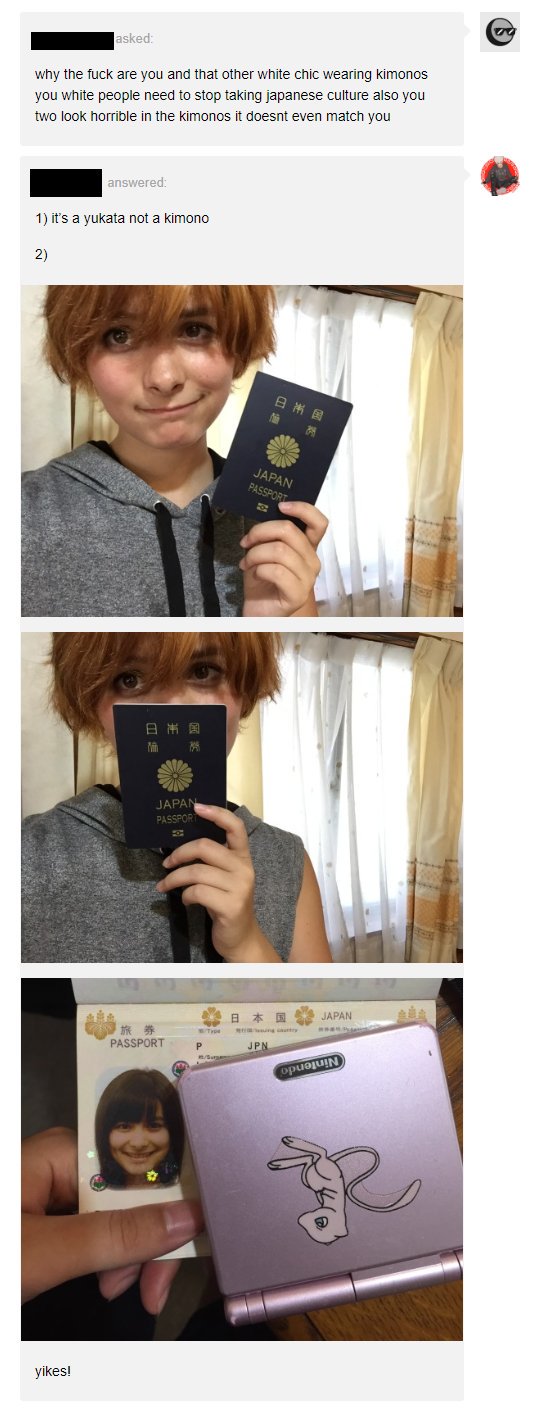
Probably the greatest example of an absurd self-own was the Internet goon squad that accused a woman of “cultural appropriation” for wearing Japanese clothing when she was Japanese.
All the cringe. ALLLLLL the cringe.
So yeah, I get it. Stupid gonna stupid, man.
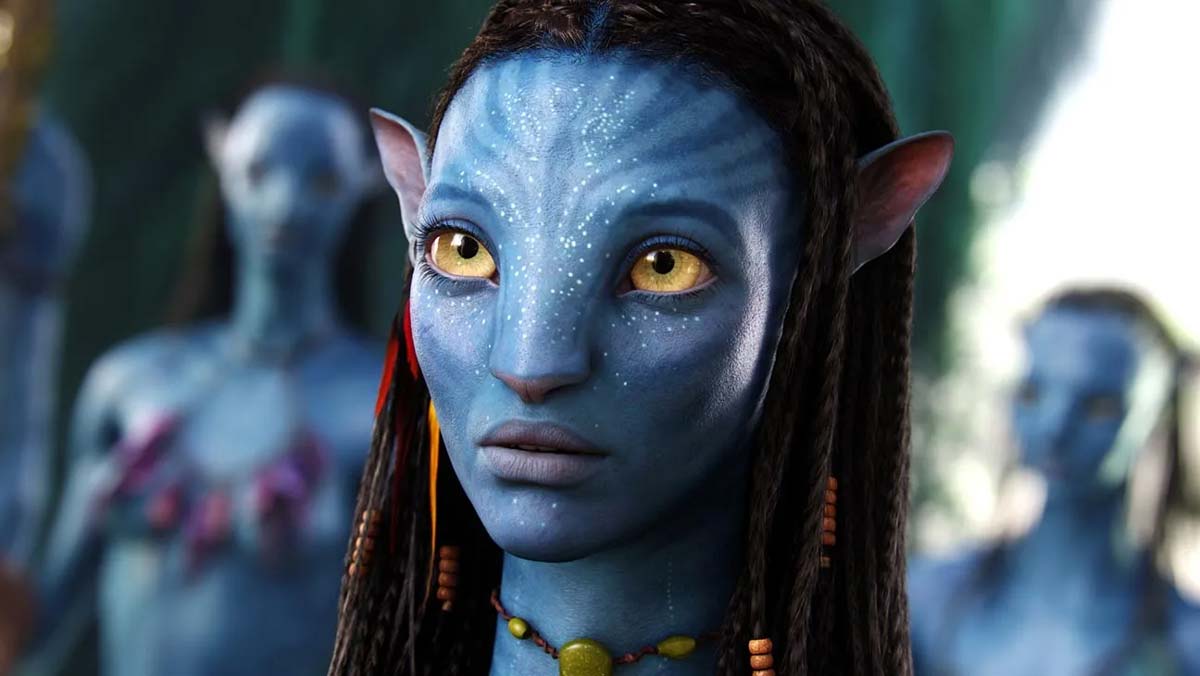
And it ain’t just cultural appropriation. Remember when James Cameron’s movie Avatar 2 came out? Some Native people complained that the movie peddled Native tropes for entertainment without actually recognizing Native history of defending biodiversity.
A lot, and I mean a lot, of white urban liberals jumped onto Twitter (yes, I’m totally deadnaming the name of Elongated Muskrat’s social media platform) to crow about how they were boycotting the movie and dish on people who saw it.
Some folks I know personally, folks I once used to respect and even admire, did this. And you know what was especially pathetic about it? They had no intention of seeing the movie in the first place, oh no. They took to social media to crow about how righteous they were for not watching a movie they never intended to watch, because it made them better people than the ones who did watch it…
…and yet, did they actually materially improve the lives of even one single Native person anywhere? Even one? Even a little bit?
Nope.
See, I might respect someone who went onto social media to say “hey, this movie might be problematic, and here’s why, so I took the $30 I was gonna spend on tickets and popcorn and a gigantic tub of Coke, and I donated it instead to this charity that helps Native populations, and here’s the URL where you can donate too,” but did they?
Nah, bruh, because it was never about the Native people.
It was virtue signaling and bullying. It was “Look at me! Look at me! I’m better than you! Hey, everyone, look at me!” It helped nobody, because it wasn’t intended to. It was about preening and primping, about vanity disguised as social justice.
I didn’t watch Avatar 2, but I didn’t crow about it on social media either, because I never intended to see it in the first place.
Not watching a movie you never intended to watch is not a virtue, and that’s really what this is all about.
But I digress. Let’s get back to cultural appropriation.
“Cultural appropriation” in the academic sense does not mean “woman who kinda looks maybe white on Twitter wearing a yukata that self-righteous white craft-beer liberal dumbfucks think is a kimono.”
Cultural appropriation is when a white businessman sees a Navajo pattern, thinks it’s pretty, and commissions a sweatshop in China to make millions of knockoffs that he gets rich from without, you know, contributing to the people who created it, or even bothering to learn anything about it at all.
And that’s not nonsense. It’s a real thing that happens, just like turning other people’s brutal oppression under colonialism into entertainment whilst you eat overpriced popcorn is a thing that really happens.
But bullying a Japanese woman on social media because she looks “too white” to be wearing the clothes you don’t think she should wear doesn’t actually strike a blow against cultural appropriation, does it?
The difference between social justice and bombastic bullying
Liberals tend to whine about conservatives who mock and deride “social justice warriors,” but if I’m to be perfectly honest, a lot of that is our own fault. We liberals are easy targets, because we have a habit of taking our own values and reducing them to bumper sticker platitudes that we use to bully others without, you know, actually doing anything to solve the problems we claim to care about so much.
I would like to propose a test to help separate genuine concern with social justice from the general enshittification of morality into empty tribalism and bullying. Don’t worry, it’s a simple test, one that can be applied in less time than it takes to drink a single soy-milk latte. Just ask yourself these questions:
At the end of your social justice venture, can you point to any person whose life or situation is now a bit better for your actions, in any way, however small?
Was your social justice venture invited by the people you, a rich white person, claim to be speaking on behalf of?
Is your social media venture targeted at the people who are responsible for the injustice you see, rather than bullying people for not doing what you want them to do?
If you can’t answer “yes” to all three of those questions, maybe you aren’t as virtuous as you like to pretend you are.
Dungeons & Dragons is famous for basically three things: creating an entire cottage industry of weird foaming-at-the-mouth Evangelical cries of satanic doom that will sweep over the land, covering it in darkness forever and ever; giving socially awkward high school students of a certain era something to do and a way to make friends; and, of course, the D&D alignment system, which divided all of morality into a tidy grid with nine different possibilities.
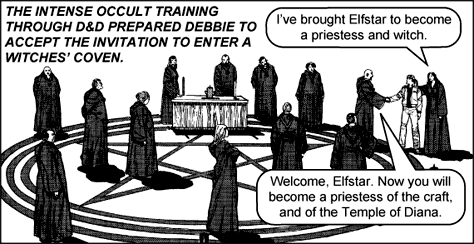
What Evangelicals think D&D looks like
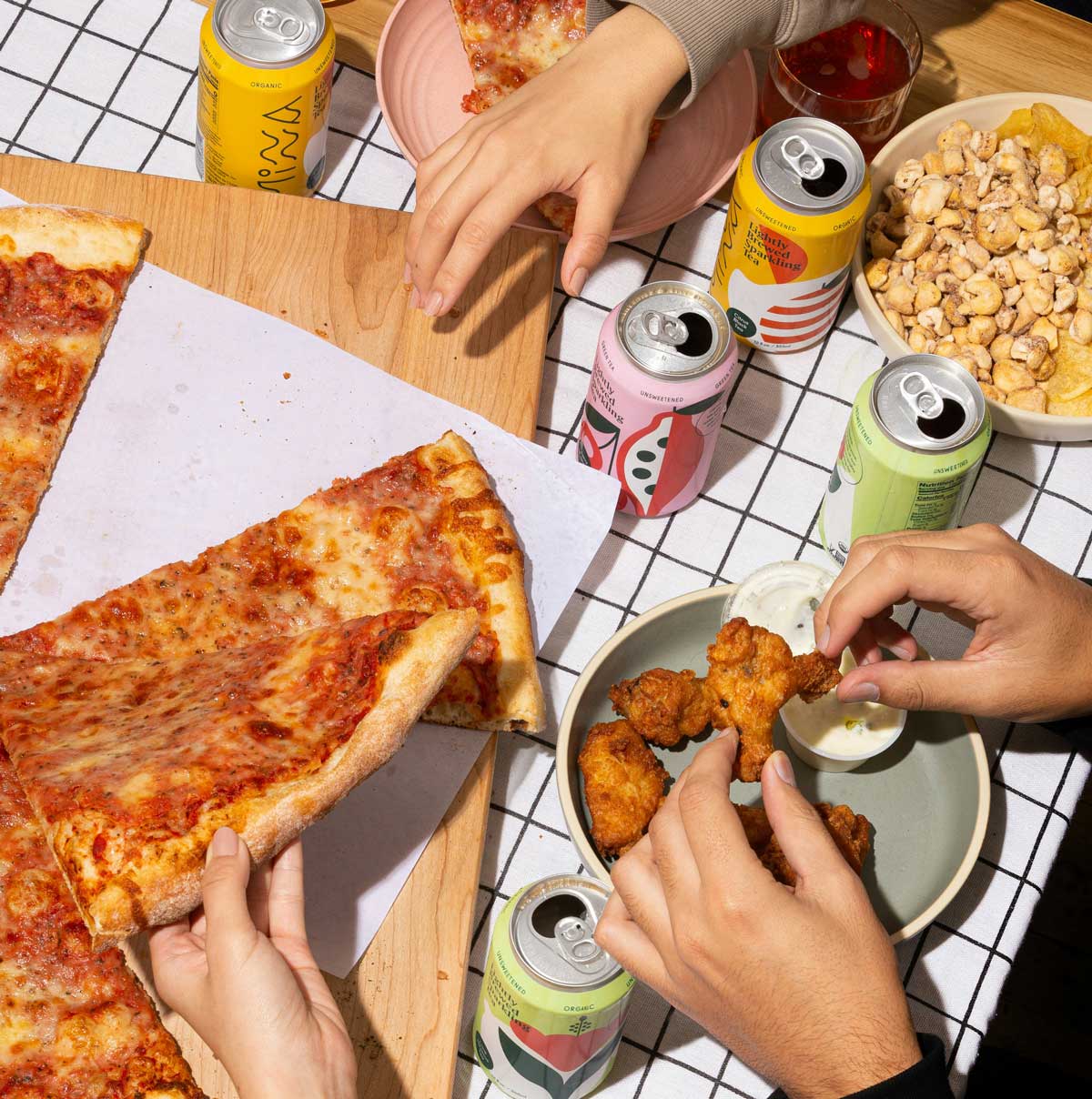
What D&D actually looks like, but with more dice and books (image: No Revisions)
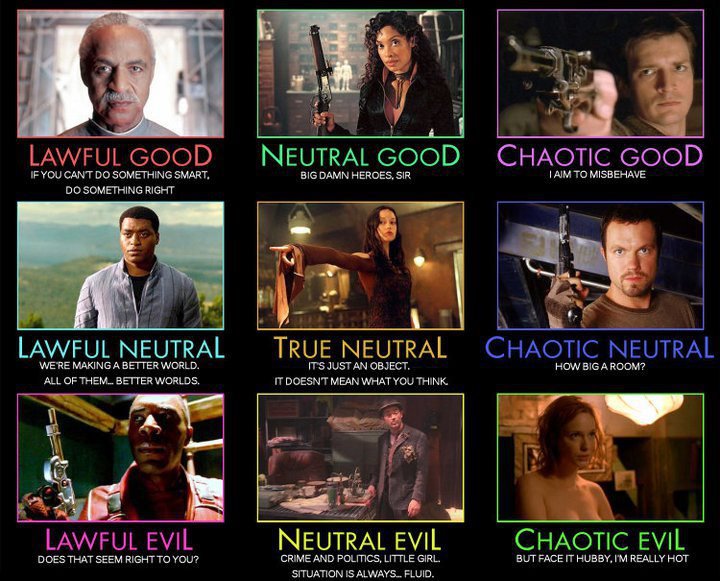
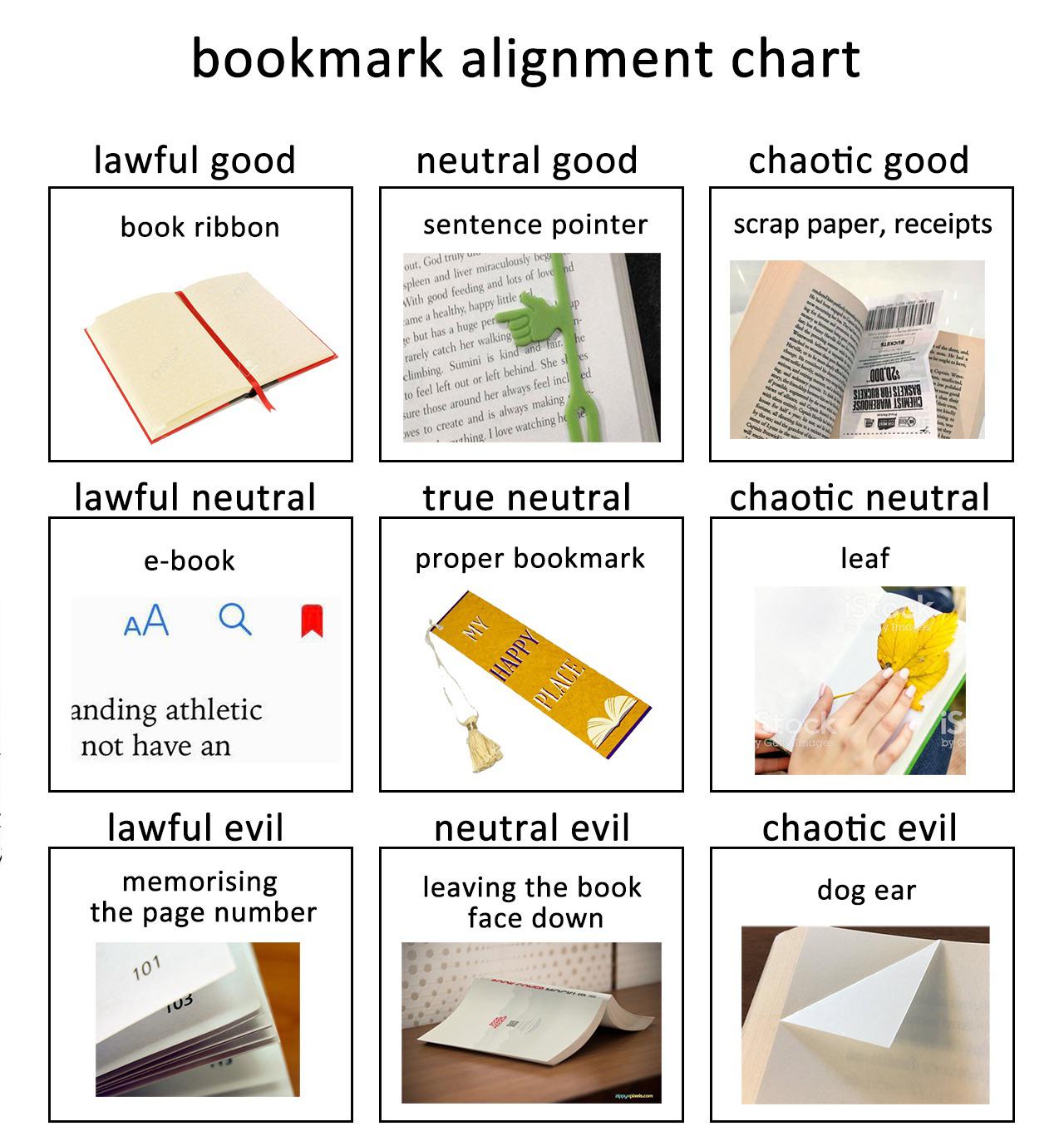
The Dungeons & Dragons alignment system divided morality into Lawful, Neutral, and Chaotic on one axis, and Good, Neutral, and Evil along the other. It’s become a cultural touchstone (or a cliché, if you’re less charitable) that has spawned a zillion parodies:
But here’s the thing:
The problem with D&D morality is that it assumes there’s some fixed definition of “good” and “evil.”
You know how relativity tells us all motion is relative? If two people go whizzing past each other in space, each one is at rest in his own reference frame and sees the other one moving.
Real morality is kind of like that. Most people truly, honestly believe they are good. That’s their local inertial frame. For example: Most people agree that violence in defense of your life or the life of another is morally good. The guy who plants a pipe bomb in an abortion clinic? That’s what he thinks he’s doing: defending the lives of babies being murdered. In his eyes, blowing the limbs off clinic workers is morally good.
That’s his inertial reference frame. He would consider himself neutral good; D&D would call him neutral evil, or possibly chaotic evil.
D&D morality, like Newton, assumes the existence of a fixed reference frame from which to evaluate all morality.
In real morality, various people have defined various reference frames. Some folks use “society” as a reference frame, which is all well and good until you encounter cases like “if a society says slavery is moral, then for that society, slavery is moral.”
Utilitarianism is kind of the equivalent of using the cosmic microwave background radiation as your reference frame. If you see a dipole in the CMB, you’re moving, and more specifically, your vector of motion is oriented toward the blueshift in the CMB.
It’s not a perfect analogy; motion is a single vector and D&D has two axes (good <-> evil and lawful <-> chaotic). But it gets the point across.
If we set the CMB to our D&D framework, then probably, yes. Most people are probably neutral, though they think of themselves as good. That’s the entire difficulty: almost all people think of themselves as good. The activist campaigning to legalize gay marriage and the fire-n-brimstone Fundamentalist preacher shaking his fist at the gays both believe they are good.
In Newtonian ethics, this clearly cannot be.
There’s also the issue that for most of us in our day to day lives, using the CMB as a reference frame just isn’t very useful. Right now, as I type this, I’m sitting on the couch in my living room. The couch, the chair next to me, the fish tank to my left, and my tea to my right all seem at rest. The fact that we’re on the surface of a planet spinning and whipping around the sun which is making its slow orbit about the center of mass of the Milky Way which is itself on a collision course with Andromeda at ludicrous speed isn’t relevant to me.
I’m not going to get out of a speeding ticket by saying “but officer, motion is relative, and if you measure our speeds by the CMB dipole they’re indistinguishable!”
Human beings are hard-wired to think differently about our in-group and our out-group. This is built into the structure of our brains. We also have a limit on how big that in-group can be. It’s about 150 people. This is called Dunbar’s number, and it sets a limit on the number of meaningful emotional connections we can make.
The in-group—the people in our Dunbar sphere—-is the ethical equivalent of my living room. When I get up to make more tea, the only inertial frame that’s relevant to me is the frame in which my living room is at rest. Trying to use the CMB as my reference frame isn’t useful.
Most people’s day to day inertial reference frame for their moral evaluations is their Dunbar sphere—the people in their immediate social group. That’s their inertial living room. In that living room, they can think of themselves as “good” even if their ethical actions with respect to utilitarianism is extraordinarily evil—that is, the CMB dipole is very large.
The people who built this place believed, from within their reference frame, they were good. (Image: Frederick Wallace)
Because they don’t think about any reference frame outside their Dunbar sphere, they do things that appear to be morally contradictory—like taking in a friend who has lost his job and his home, while at the same time saying “fuck those Syrian refugees. I don’t care if an 8-year-old girl dies in agony. Fuck her.”
They think of themselves as “lawful good” because they took in their homeless friend. They continue to think of themselves as “lawful good” when they casually condemn thousands of women and children to gruesome deaths. The walls of my living room are relevant to me; the cosmic microwave background of utilitarianism is not.
I would argue that in D&D terms, it’s quite possible that the majority of people are, if anything, neutral evil, if we use utilitarianism as our CMB. Most people believe slavery is evil. Most people would not support slavery making a comeback. Most people are totally 100% okay with buying a diamond engagement ring mined by slave labor, as long as the slavery happens somewhere out of sight to people outside their Dunbar sphere.
I suggest that in most cases, seen from the reference frame of utilitarianism, the majority of human beings, including those who see themselves as lawful good, are in fact neutral evil.