Okay, so, this is not going to be a rant about how terrible AI art is, or how LLMs have stolen all our creative output (though I’m still waiting for thousands of dollars from the Anthropic settlement, given how Anthropic bootlegged several of my books to feed the gaping maw of their LLMs).
No, I’m talking about another kind of AI enshittification: Price-grouging.
I just this moment filed a formal complaint with the California attorney general against a company called GoHardDrive. I am hopeful this becomes some kind of class-action thing. A similar case is currently grinding through the gears of justice against Samsung, for doing the same shitty thing.
So.
In August of 2024, I bought a hard drive from GoHardDrive. It came with a 2-year warranty. In May of 2026, it failed, under warranty. No problem, I thought, I’ll file a warranty claim and get it replaced.
I didn’t count on the AI boom.
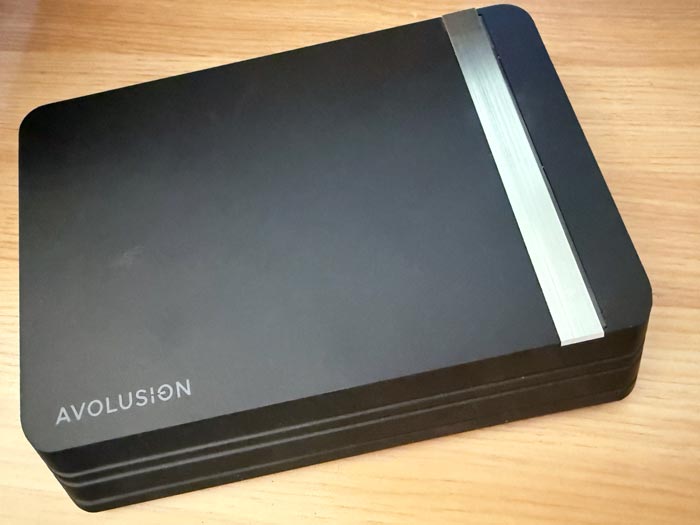
The hard drive in question
Thanks to the AI boom, computer RAM and hard drive prices have shot up, anywhere from triple to quintuple their old prices, as demand for memory and storage outstrips the world’s entire supply. People are signing purchase orders for entire manufacturing runs through 2032-2034.
That means what was once an $89 hard drive now sells for $299 (or more!). So by replacing my hard drive under warranty, GoHardDrive is losing the immense profit in selling it to an AI datacenter…and it’s not like they can just make more because the world’s manufacturing capacity is completely saturated. Hard drives are being sold at enormous markups that literally haven’t been manufactured yet.
Faced with that, hard drive companies (including big, well-known companies like Samsung) are now routinely refusing to honor their warranties. Why should they? Every warranty replacement is costing them an extra $200 in profit, and what are you gonna do? Refuse to buy a hard drive from them again? They’ve already sold every hard drive they will make from now to 2034, why on earth would they care?
This is a big, big problem. It’s a double whammy for anyone buying computers, hard drives, SSDs, or smartphones right now. Not only are you paying through the nose for your kit, but if it fails, what are you gonna do? If the vendor says “nah, bruh, I’m not gonna replace that,” now what? A warranty is only worthwhile if it’s honored.
In my case, what I did was file a formal complaint with the California Attorney General, since GoHardDrive is in California. The California government is taking a pretty dim view of AI profiteering right now, so I have some small measure of hope they’ll be invested in this.
If you’ve run into problems like this, I’d love to hear from you!
I got called for jury duty a few months back, and ended up seated for voir dire for a case that quite frankly scared the shit out of me. I wasn’t selected, something I’m still not sure if I’m relieved or disappointed about, but man, there’s no way the prosecution would ever have allowed me within a thousand feet of that jury.
I have never served on a jury. I’ve been called many times, of course, but it’s always gone the same way. “Number 17, what do you do for a living?” “Well, I’m a computer programmer, and I also—” “Thank you, Number 17, you’re dismissed.” That’s happened in Florida, Georgia, and Oregon.
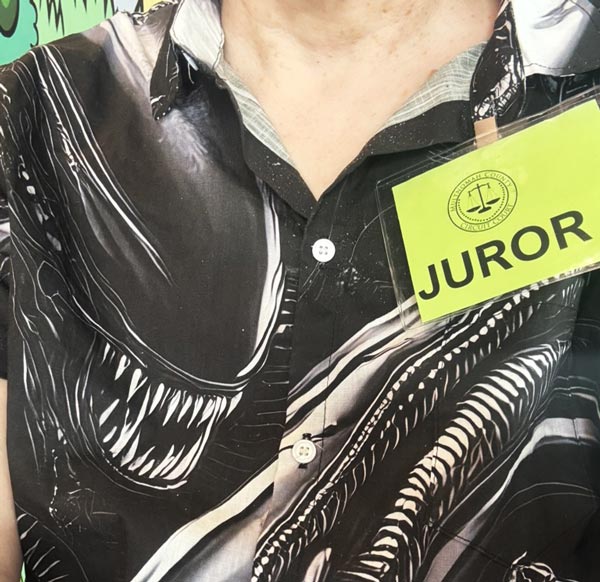
I didnd’t say that this time. I haven’t done development work in far too long. When I showed up, they gave us these fluorescent nametags to wear, because apparently at some point in the past a juror seated at a trial went to a restaurant for lunch, the prosecutors sat down nearby, and proceded to talk about the case unaware a juror sat next to them, and caused an expensive mistrial.
I knew something weird was up when they called us for voir dire. They’d been calling people out of the pool room all morning, but this time, they called twice as many potential jurors than normal, 48 of us. So many of us that we couldn’t all fit in the space reserved for potential jurors.
The prosecution talked to us for a while. “This is a rape case,” she said. “I’m going to ask you all a list of questions. You’re required to answer honestly. Has anyone here ever been physically abused by a romantic partner?”
I and a handful of other people raised our hands.
Then it got weird.
“Has anyone here ever heard the expression ‘junkies lie’?” she said. “Are you able to believe the testimony of a victim even if you’re aware the victim is addicted to drugs like heroin?”
“Do you believe that people suffering from mental illness are trustworthy? Would you be able to believe someone’s testimony even if you knew she had been diagnosed with borderline personality disorder?”
“Would you be able to believe the testimony of a victim even if you knew she had made false accusations in the past?”
Then it got really weird.
“Suppose a victim recanted her testimony and told you that she had not been assaulted. Would you be able to look at her original testimony with an open mind?”
“Would you automatically assume that the defendant were not guilty if the victim refused to testify against him during the trial?”
“If the victim testified for the defense to say that she didn’t think he should be convicted, would you still be able to convict?”
Then she dropped a doozy:
“Do you accept that in the court system in Oregon, the job of determining guilt or innocence is separate from the job of passing sentence? If you personally felt that a defendant was guilty, but you believed the defendant was facing a sentence you considered harsh or undeserved, would you still be able to return a verdict of ‘guilty,’ knowing that deciding on a sentence was the judge’s job, not yours?”
The defense attorney had a much shorter list of questions, but one of them really jumped out at me:
“Does anyone here believe that men can abuse women, but it is impossible for a woman to abuse a man?”
It took quite a long time for the two sides to choose twelve people for the jury. I was not, as you might imagine, one of them. I suspect saying “yes” to “have you been physically abused by a romantic partner” did me before the process even got started.
I have no idea how that case panned out or what happened to the defendant, but I have to say if I’d been on the jury, I’d’ve quite likely found it very hard to convict him, given only what I know from the prosecutor during voir dire.
A while back, I wrote about a kink website called “Know Your Sins” using a fake DMCA scam to get backlinks and boost their search results. The site’s owners would send out phony copyright claims, saying they owned images they neither owned nor had nothing to do with, and demanding backlinks to their site or they’d sue for copyright infringement. The site’s owners, Samuel Davis (@Samueld_KYS on Twitter) and Olivia Moore (whose Twitter profile has been deleted), engage in copyright fraud to try to boost their Google search results.
It seems fraudulent copyright scams are something of a growth industry.
About a week ago, I received this email from an outfit calling itself CopyTrack, headquartered in Germany (click to embiggen):
CopyTrack claimed I was using images belonging to their “client,” a Norwegian company owned by a Chinese conglomerate called Yay Images that appears only to license images from other stock companies, and demanding €2,168.76 (about $2,500) in “compensation.”
The images in question on my site are licensed from stock agencies (Shutterstock and Deposit Photos, the latter of which I’ve been using for many years).
A quick Google search shows that Copytrack is a scam, and the owner has been running this scam under a variety of names for years.
I am, of course, far from the only person to be hit with this extortion scheme. You’ll find similar tales from the Brutally Honest Blog, Yvan’s Substack, Ben Tasker, molif, and tons of others; a Google search for copytrack scam produces hundreds of similar hits.
I think Copytrack provides a service that could, potentially, be legitimate. However, they don’t put any effort at all into verifying copyright ownership; they’re a more-or-less entirely automated platform anyone can just upload some pictures to and then send threatening letters to other people, hoping for a payout. They may not, themselves, be copyright trolls, but they facilitate copyright trolls with no mechanism to stop them.
I am fortunate in that I am represented by an outstanding intellectual property attorney, Leonard Duboff in Portland. I simply informed Copytrack that I am represented by counsel and would no longer respond directly to them, and needless to say my attorney hasn’t heard a peep from them.
When I wrote about the Know Your Sins scam, a ton of people emailed me to say they’d received similar fraudulent copyright-scam emails. I got so many that I wasn’t able to respond to all of them (but thank you, everyone who messaged me!).
That suggests the scale of copyright fraud is enormous.
If you’ve received a fraudulent email from Copytrack, I’d love to hear about it! Post a comment here, or email me.
Trigger warning: Stalking, graphic death and rape threats, doxxing, threats of swatting, impersonation
I’ve been putting off writing this for a while now, because it involves dredging deep into some incredibly ugly stuff.
Most of you know that I’ve been stalked for years by a stalker (or stalkers) who has created fake social media profiles in my name to harass other people, and sent explicit, violent rape and death threats to me, my family, my friends, and those who follow me on social media.
This person, or these people, have made repeated rape and death threats directed at me, my wife, my father, and people who have expressed support for me or been rumored to be connected somehow with me online. They’ve sent death threats containing photographs of my partners. They’ve doxxed my family and partners.
The harassment has escalated over the past three years, as the rape and death threats have become more frequent, more violent, and more graphic. The stalker has escalated to threats of swatting (phoning fake tips to the police to have SWAT teams sent to the homes of the target). My websites have been DDoSed.
Last December, as I was leaving for Florida to help care for my mom, who was in the final stages of terminal cancer, I had an unexpected and rather uncomfortable conversation with Portland PD about an email I’d supposedly sent them saying I was stockpiling guns and the voices were telling me to murder my wife.
Fortunately, I have been documenting and reporting the stalking, rape and death threats, and harassment as it’s happened. The nature of the conversation changed once they pulled up the previous police reports and realized this was part of an ongoing pattern of harassment.
So how did we get here? And what does this have to do with polyamory?
Propaganda and the Poly Scene
So how did we get here? And what does this have to do with polyamory?
My first inkling something weird was going on came when a number of different people, some of whom I hadn’t spoken to in years, all messaged me to say “Do you know someone named Louisa Leontiades? She says she’s a journalist and she’s asking questions about you.” A few of those people sent me screenshots of messages or emails they’d received:
Louisa is a client of a former partner. After the relationship with that former partner ended, Louisa started messaging pretty much every female-presenting person who’d ever interacted with me online, going back through this very blog for decades, looking for women willing to dish dirt.
Next thing I know, somehow there are more “exes” that are accusing me of having “abused” them than the total number of people I’ve ever dated. Few forms of gaslighting are more head-twisty than someone you’ve never dated, never talked about dating, never wanted to date, never had sex with, never talked about having sex with, and never wanted to have sex with telling all and sundry about how you abused her when you were “together.” For a while, I quite literally thought I was going insane.
These “survivor stories,” as Louisa calls them, tended to the bizarre (like the woman who I’ve never been sexually or romantically connected with and never been in the same room with except in passing at a party claiming I abused her by flirting with someone else in front of her), toward the utterly untrue (a former partner claiming I “got her into” BDSM and that a 25-year-old is “too young to consent” to BDSM, when in fact she was interested in BDSM long before we ever met, and the fact her ex-husband wasn’t interested in BDSM was one of the reasons she divorced him), and the technically kind of true if you squint hard enough (my ex-wife claiming she was an “abuse victim” because I yelled at her on the phone once—which did happen—but declining to mention that it happened after we’d separated, when she broke into my house one night while I was out of town, stole a bunch of stuff like consumer electronics, then sold it to buy a new laptop).
As a side note, there’s a lesson here in how to spot the difference between journalism and a smear campaign. If a journalist hears “he yelled at me once on the phone,” he or she will ask followup questions: “Did this sort of thing happen often? What happened?” Ethical journalists also disclose personal or financial connections with the stories they cover.
My goal is not to go through all the rather strange “survivor stories” here. I may end up doing that at some future point, but that’s not the point of this blog post.
Right now, I’m here about the aftermath of these weird, wordy-but-vague accusations, what it says about the way many people see “social justice” as a tool of bullying and control, and how the poly scene’s support for “social justice” led directly to a barrage of rape and death threats against a whole bunch of other people beyond just me.
Louisa published these “survivor stories” from exes and non-exes with results you might predict: the Internet Hate Machine™ cranked up into full gear, I had to lock down comments on my blog because random strangers started posting death threats, I lost friends.
With all the various contradictory stories (“Franklin dated someone ten years younger than he was, he’s obviously an abuser,” “Franklin refused to date me because I’m younger than he is, he’s obviously ageist”), they became a sort of Rorschach test, with different people seeing different things in them. It’s kind of a Gish gallop of accusations.
One dude on social media wrote that I was clearly a bad person, because it was plain to him that I’d written the stories myself as a sort of humblebragging, since the theme to a lot of them is “I knew when I dated Franklin that he was polyamorous but he’s so awesome I wanted him all to myself and he said no.”
Seriously. Someone over on Quora actually said that.
Dr. Elisabeth Sheff, a sociologist and author who serves as an expert witness in court for abuse cases, published an analysis of the “survivor stories” that concluded the stories don’t actually describe abuse.
The poly community as a whole thought about her analysis, set aside their first knee-jerk emotional response, said “huh, I wonder if there’s a reason she might have reached those conclusions,” went back, and re-evaluated the survivor tales with a more considered eye…
Hahahahaha, I’m kidding, that didn’t happen. Instead, the Internet piled on to Dr. Sheff. She was threatened personally and professionally, and received so much harassment and abuse she was forced to back away from the whole situation. You know, classic straight-up bullying.
And it wasn’t just threats. A lot of folks sent her emails that they probably wouldn’t think of as problematic—messages like “don’t you realize you’re just hurting women who have been abused?” and “I’m so disgusted that an academic would support an abuser” and “I used to be such a fan of yours, but this has really made me rethink that,” because they couldn’t even consider the possibility that she might, you know, be right.
After that, things got even weirder.
“I want a just, fair, and equitable society, and I don’t care how many rape threats it takes to get there.”
Now let’s fast forward a bit, to a nonprofit polyamory convention run by a registered nonprofit in London, called “PolyDay.”
COVID interrupted the convention for a couple of years. During the COVID lockdown, a team not previously involved with PolyDay announced they would be taking over the PolyDay name and launching a new for-profit convention under that name.
The organization that owns the PolyDay convention informed these people firmly that it owns a trademark on the name, and they would not be permitted to use it.
Lockdown ends. The organizers of PolyDay announce the convention was on once more. I don’t know if the person who tried to steal the name started the rumor or merely amplified it, but anyway, someone starts a rumor that I own PolyDay, or run it, or somehow profit from it, depending on which version you believe. (For the record, I have absolutely nothing to do with it—I live in Portland, and it is owned and operated by a nonprofit in London.)
As the rumor spread through the North American polyamory scene, people said “Hey, we can look up the history and organization of PolyDay and figure out if this rumor is true.”
Hahahahaha, I’m kidding, that didn’t happen. Instead, a large number of people determined to make a more just and equitable society and stand up for women raced to their keyboards to send a flood of rape and death threats to the scheduled speakers at PolyDay. So many threats of serious violence poured in, the conference organizers canceled the event.
Apparently, threats of rape and murder are how some people think we create a more peaceful, more enlightened Utopia.
And it just kept going. Once this kind of harassment and bullying gets going, it takes on a life of its own. A former BBC and Guardian journalist named Jonathan Kent published a book on polyamory. Someone started a rumor that I profit from the book somehow, or (depending on which version you believe) that I secretly wrote it under his name, or something.
By now, I’m sure you can predict what happened next:
People looked up Jonathan online and realized he’s actually a person, a reporter with a long documented history, and not an alter ego for me? Hahaha no. Of course not.
People harassed him, called for a boycott of his (I mean “my”) book, threatened and harassed his podcasting co-host…because in this brave new world of empathy, compassion, and social justice, that’s what you do. You harass and intimidate anyone you don’t like, or anyone associated with anyone you don’t like, or anyone rumored to be connected to anyone you don’t like, so that one glorious day, if you harass and threaten enough people, you’ll wake to a world of perfect social justice.
Meanwhile, of course, the rape and death threats aimed at me and those close to me kept rolling in. My co-author Eunice and I released a science fiction novel; a bookstore that planned to host a book event got harassed into dropping the event. Some random stranger I’ve never met made a YouTube video about what a terrible person I am, repeating the “survivor stories,” insisted she wasn’t making the video for money, then used it to beg for Patreon donations.
So it goes.
And is still going. People are still following me around on social media, doxxing and threatening my partners, friends, and folks who follow me.
Just like with the “survivor stories” themselves, the stalking and threats have become a Rorschach test of their own. A random woman on Facebook told me, with what seemed like perfect sincerity, I must be making it all up, because men never get stalked, only women have stalkers.
So here’s the thing: The North American polyamory community has a problem.
I want to be clear this is not a problem everywhere. Poly folks elsewhere largely seem to roll their eyes at all this.
But the poly scene in North America is overrun with folks who are okay with using rape and death threats as a way to express themselves, who don’t do even the barest minimum of fact-checking, who are so caught up in righteous fury that sending women anonymous messages saying “I am going to rape you to death, here’s a photo of your house” seems like a perfectly reasonable way to support social justice for women.
Now, if this is you, if you’re one of the people who sat down at your computer to type out threats to Dr. Sheff or to the people scheduled to speak at a conference because you heard a rumor that it was somehow connected to me and couldn’t be arsed to fact-check, this essay is not for you. You are irredeemable and I don’t care what you think of me. I don’t quite understand the mentality of someone who says “I’m going to stand up for women and justice by sending a bunch of people I’ve never met anonymous emails saying I’m going to murder them if they present at this conference,” and honestly I don’t want to. If this is you, fuck off.
If this isn’t you, and you’re on the sidelines saying things like “I don’t know what the hell is going on but I don’t want to get involved,” well, I get it, I really do. I’ve been there myself. I’ve unquestioningly accepted stories because they fit a narrative I believed in, and discovered later that the things I’d been told didn’t actually happen, at least not the way they were presented to me. (I may write about that at some point as well.)
And I’m not saying the fact that a bunch of bullies and Internet trolls have taken it on themselves to send rape and death threats all over the Internet because, you know, that’s how you support women and fight for social justice automatically proves that what I’m saying is true and what they’re saying is false. Only that mmmmaybe it might be worthwhile to look a little closer, you know? After all, if people are wrong about basic things that can easily be checked, like who runs a nonprofit conference or who wrote a book, perhaps it might possibly be worth considering whether or not they’re trustworthy about things you can’t easily verify.
Moving the Overton window
I’d like to believe this is a fairly new thing—that twenty years ago, communities dedicated to egalitarianism and self-determination wouldn’t so quickly embrace this kind of toxic behavior. That’s probably wrong—the same thing was common in the 1970s feminist circles—but I do believe that events like GamerGate brought a new level of toxicity into acceptability.
If you don’t believe bullying and threats are okay, but you really don’t want to (or don’t care enough to!) get involved in other people’s drama (or you really don’t care enough to get involved), so you stay out of it, or you “don’t take sides”, or you choose a default rubric like “believe all women” because investigation is too much effort, well, that’s kind of how we ended up here, in a world where harass and threaten in the name of social justice, because they feel safe in their communities who appear to support them, or at least don’t oppose them.
Just a thought.
Brandolini’s Law, or the Bullshit Asymmetry Principle, tells us it takes longer to refute bullshit than it does to put it out there, and if there isn’t a corollary that tells us this is especially true when people have been told that it’s morally wrong to question the bullshit, there ought to be.
Few subcommunities have figured out how to deal with vague claims of mistreatment that kinda follow common narratives, and anyway few people really have the inclination to try to sort through it all. It’s easier to just assume that where there’s stuff that kinda looks like smoke, there must be fire, and accept a generalized “so-and-so is a bad person even if I’m not exactly clear on what he or she did.” Kinda the way people who still say the 2020 election was stolen say “there are thousands of affadavits about election fraud, it must be true.”
I mean, hell, I’ve done this myself. When you want to do right by the people around you, and you know enough about social justice to understand the uphill struggle people have faced for years getting anyone to take abuse they’ve faced seriously, you default to believing whatever you’re told by anyone who presents as an abuse survivor—a noble inclination, but one that is also easy to exploit.
Abuse is about power and control. When the poly scene went after Dr. Sheff, everyone else got the message loud and clear: Do as we say, or you’re next. Believe what we tell you to believe, or you’re next. Don’t ask questions. Keep your head down. Hate who we tell you to hate, or you’re next.
So perhaps this might be a good guideline: When you see people facing off against each other, with both sides claiming they’ve been mistreated, it might be helpful to ask yourself, “which of these two sides is sending rape and death threats, punishing anyone who steps out of line, and controlling the narrative through intimidation and threats of violence?” Because it’s hard to champion social justice and also think those things are okay.
I know the people sending the rape and death threats are a small minority, whose noise and zealotry make this seem more common than it is. That’s the thing, though: if you want your community to be a good space, sometimes you need to stand up to the bullies.
It’s okay to ask questions and look for more information. Anyone who tells you otherwise is selling something.
Note: Any comments containing abuse apologism, denialism, threats, rationalization, whataboutism, sealioning, or victim-blaming will be deleted.
Friends, I urgently need your help. A former partner is currently trying to claim my trademark, and take the domain “More Than Two.”
For more than sixteen years, I have worked to make my site a resource for relationship ideas and advice. Now the site is under threat. Someone I was once romantically involved with is attempting to claim the trademarks for “More Than Two” and take the website and domain name itself.
I have been writing about polyamory on the web since 1997, and I have poured thousands of hours into writing on the domain name More Than Two since 2006. I cannot express in words how disheartening it is to pour so much time, love, and effort into something, and receive countless emails from people who say how much it has changed their lives, only to have someone else try to come along and take it away.
In addition to that, my ex also filed a lawsuit attempting to nullify a legal settlement we arrived at in November.
Unfortunately, defending myself from these actions in court is incredibly expensive. I have never made any money from the website; for decades it has been a labor of love I’ve given away for free. (I recently placed advertising on the site, which pays for most of the site’s expenses most months.)
I hate asking for help, but I also hate that someone else may take away something I’ve worked on for so long. At this point, I don’t know what else to do.
I’ve started a crowdfunder to raise money to defend the site. Please, if you can help at all, even with a dollar or two, it would mean a lot to me. I get so many emails from people who tell me how much the site has meant to them and how it’s improved their lives. I want to make sure it remains available for future visitors too. This site means a lot to me personally, and a lot to other people as well. Please help me save it.