So I admit it. I’m so not up on the common vernacular these days that it wasn’t until early last year I’d ever heard of lower back tattoos on women described as “tramp stamps.”
I’ve always liked tattoos; the right tattoo on a woman can be very beautiful indeed. (The definition of “right” is highly subjective, of course, and will no doubt very from person to person. I tend to think that any tattoo involving pictures of Jesus nailed to a cross, or to anything else for that matter, or hearts with “Mother” written across them in fancy script, are not the right tattoo by any definition–but the end of the day, the only definition of ‘right’ that matters is that of the person who owns the tattoo. But I digress.
 But until quite recently, I was blissfully unaware that tattoos on certain parts of the body were generally considered to be markers of questionable moral character, or that those who had tattoos were generally assumed to be sexually promiscuous.
The term ‘tramp stamp,’ as clever as it sounds (“Oooh! It rhymes! It must be true if it rhymes! If the glove don’t fit, the tramp stamp sits!” Or something) betrays what seems to me to be a very interesting idea about women. It’s a short, simple, 21st-century slang term that packages sixteenth-century ideas about sex and sexuality in a handy, bite-sized piece.
It’s hard to know where to begin. The notion that women who like sex are ‘tramps’ and therefore less worthy as human beings is pretty odious. On top of that is layered another blanket prejudice–the notion that a woman who wants to decorate a certain part of her body must necessarily be a woman who likes sex. (The tendency of human beings to invent stories in their heads to explain the motivations of other human beings, and the profound disconnect that exists between the stories we invent and the actual motivations of the people we invent these stories about, never ceases to amaze me.) Then, resting atop that like the cherry on a layer cake of stereotypes and prejudice, comes the notion that such a woman must not only enjoy sex, but be unselective about her choice of sex partners.
Now, when I first heard the expression ‘tramp stamp,’ I was like, “Okay, it rhymes, ha ha, very funny.” It’s only been recently that I’ve come to understand that there are folks who actually believe, like, for reals, that women who tattoo their backs are sexually promiscuous.
 On another forum I read, there’s a conversation going on about anal sex, and specifically about whether or not there are any women who actually enjoy it.
Quite aside from the fact that I know rather a lot of women who enjoy giving it as well as receiving it (and thank God for that!), a surprising number of people maintain, often rather vigorously, that the woman who likes taking it up the ass doesn’t exist. A handful of folks opine that women do it only to please their mates, and that this makes them sad and pathetic creatures (on the idea, apparently, that doing something that makes your lover happy is one of the most stupid things any sad wretch could ever want). Those folks are merely ignorant of the full range and depth of the human sexual experience, which is sad but not surprising.
Another vocal handful, however, were unable to maintain this notion in the face of a considerable number of posters who said “Hey, I like getting jiggy up the butt!” and finally conceded that there are women whofavor anal–but then insisted that these women are inferior as human beings. One poster even wrote, I was brought up to treat woman especially lovers as on a pedestal. All this time, by these statistics I could have been treating half of them like whores.
And I think that speaks volumes, too, about the prejudices that some people carry around with thim regarding the ‘proper’ way for women to be.
It would seem that this man treats women with respect only as far as they behave the way he wants them to, and the moment they deviate from his expectations about how they should be, he tears them down off that pedestal and judges them ‘whores.’ Which is pretty fucked up, if you ask me.
I can’t quite rightly wrap my brain around the notion that a person’s value centers on the way that person acts in bed, nor around the idea that a woman who digs it up the ass, no matter what other qualities she may have as a human being, determines her eligibility for respect.
Yes, I know that there was a time when a woman’s value quite literally depended on her sex; that women were essentially bartered away by their fathers for use as breeding stock, and that in a day without paternity testing and with strict, if goofy, notions of inheritance and property rights, tracking a woman’s sexual activity was important to issues of estate. That’s also fucked up, and it hasn’t been true (at least in the First World) for…err, rather a long time now.
 What baffles me is how tenaciously these ideas cling to life.
The guy who wrote the aforementioned bigoted nonsense defended this nonsense with a great deal of heat, at one point comparing anyone who thinks that anal sex is okay with the German Nazi party (I kid you not, though I seem to remember that the Nazis had their own views on anal sex, and it was probably more in line with this guy’s than he might realize).
I wrote recently that when a person holds on to some idea in the face of contradictory evidence, it’s usually because the idea is a distorted reflection of some part of that person’s underlying emotional landscape, but in this particular case I’m quite flummoxed about what that emotional landscape might be. I simply can not figure out why someone would care so passionately, and become so emotionally upset, over the notion that a bunch of women he doesn’t know and will never meet like taking a hard cock up the butt every now and then…or even don’t like teh analz, but think it’s okay if other women do.
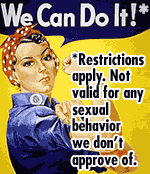 Now we get to the part that might make some folks angry. This is the part where I say that, while musing on these notions that women who like sex are bad, women who get lower back tattoos are women who like sex, and therefore women who get lower tattoos are bad, and on the sorts of faulty wiring that can exist inside a person’s head to make him believe that a woman who likes any kind of sex that he thinks she shouldn’t like no longer deserves respect, I have reached the conclusion that there’s a certain brand of feminism that seems bent on keeping things this way.
In a completely different conversation on a completely unrelated forum, the topic came up, as it often does, about pornography and relationships. Several folks, many of whom identify as feminists, weighed in on the subject with the usual laundry list of criticisms–porn is coercive, porn is degrading to women, porn commoditizes women’s sexuality, that sort of thing. One woman even went so far as to say, without apparent irony, that she has no respect for any woman who would be in porn.
Which, to my mind, is no different from the guy who says he has no respect for any woman who would receive anal sex.
Now, I know that feminism is often sharply divided over issues of porn and sex, with some feminists ardently opposed to it and other feminists ardently in favor of it. I’ve written about my own views on the subject in the form of a parody Socratic dialog on the virtues of porn, but the woman who claimed not to be able to respect anyone who did porn brought up an entirely new absurdity in my mind–the idea that anti-porn feminists have internalized the very patriarchal ideas they claim to oppose, and as a result are swallowing the very same patriarchal ideas about women and sex that they claim to refute.
When your ideological enemy agrees with you about the proper conduct of people, in the very areas where your ideological differences lie, I think it might be time to re-evaluate your ideas.
 In a sense, the anti-porn feminists are accepting the core values of patriarchy, merely dressing them in different garments. They are, in fact, accepting the notion that a woman’s sexual choices and sexual expressions should be limited, that women who make sexual choices that they don’t agree with are inferior, and that some part of a woman’s value does indeed rest on her sexuality. They are seeking to abridge both a woman’s right to choose her own sexual expression and her freedom and range of sexual action, by labeling certain forms of sexual expression off-limits.
And perhaps most ironically, the entire argument that porn is inherently objectifying and commoditizing is based on flawed assumptions.
Many anti-porn feminists argue that porn caters to men and reinforces oppressive male-centered sexual roles. Leaving aside the inconvenient fact that many, many women like porn (a fact that anti-porn feminists will often handwave away by the process of inventing stories to explain their motivations, saying things like ‘they only believe they like porn because they’ve been brainwashed by patriarchal society into accepting subservient sexual roles’–that is, when they bother to acknowledge the fact at all), in reality if you look at the most patriarchal, the most repressive, the most rigidly conservative men out there, you will see that those men don’t like porn either.
The idea that porn is the byproduct of repression and patriarchy does not stand up to scrutiny. Socially conservative men, those who most strongly subscribe to the notion of prescribed sexual roles for women, are quite often ardent opponents of porn themselves. These social conservatives–the ones who seek to control women’s sexuality and who feel that women should be ‘pure’ and ‘proper’ and stay within rigid social norms–often will go so far as to say porn should be outlawed.
In fact, the Taliban, arguably the single most sexually repressive, patriarchal, anti-woman group the world has ever seen, ruled that possession of pornography was punishable by death.
The more patriarchal a society is, the more likely that society is to prohibit porn. The more socially conservative a person is and the more a person believes that women must obey rigid gender roles, the more likely it is that that person is opposed to porn. The more threatened a person is by women expressing their sexuality in non-traditional ways, the more likely it is that that person opposes porn. Porn is the byproduct of oppressive male patriarchy? Far from it; oppressive male patriarchy despises porn, and the more strictly a society seeks to impose gender roles on its members, the more strictly that society forbids pornography!
The same holds true for religion; the more socially conservative, sexually repressive a religious doctrine is, the more vigorously that doctrine opposes pornography. Look at the Southern Baptists, whose core doctrine says that a woman’s place is to submit gracefully to the divine authority of her husband. How do you think the Southern Baptist Convention feels about pornography? (Let me give you a hint.)
It doesn’t help, of course, that nobody can even define what porn is. “I can’t define porn, but I know it when I see it,” when it comes to brass tacks, is basically nothing but a way of saying “If it makes me feel a certain way, then it must be bad. If I see something and I don’t feel that certain way, then it isn’t porn, but if it causes certain feelings in me, then it is.” Which is, I rather think, a piss-poor way of defining anything, especially for the purpose of determining if it should be socially accepted or not. (Anti-porn activist Catherine MacKinnon helped author Canada’s anti-porn laws…laws which have enough subjective wiggle room that, in practice, they are routinely applied to gay and lesbian erotica but rarely or never applied to heterosexual erotica.)
There are, it would seem, many feminists who would like to live in a progressive, egalitarian society that treats women fairly, as full and equal citizens whose standing is identical to that of men…yet at the same time like to see this society free of porn.
And I don’t think that’s even possible.
A society which respects women as the equal of men, and which does not value its members on the basis of their sexual activities, will be a society in which there is porn. The more egalitarian that society is, the more mainstream that society is likely to be, for the very simple and obvious reason that there are people who dig making porn.
 One anti-porn feminist argument is that porn is coercive. And this is true, in societies that don’t accept porn. It exists in every society, without exception, even in places once ruled by the Taliban–but the more repressive a society is, the more underground the manufacture and distribution of porn becomes. When something goes underground, it tends to become corrupt, driven by the sorts of people who will abuse and coerce for profit. If the making of porn is illegal, which is what tends to happen in patriarchal societies, then the production of porn falls into the hands of criminal enterprise.
Progressive societies tend not to have this problem; there is no need to force women into porn when porn is legal, because, like I said, some people dig being in porn. The human species is vast in its range of expression, and for some folks, being filmed in bed is fun. For other folks, it’s a job, no different than any other, and a damn sight better than some. (You really want to know what objectification and exploitation is all about? Try working at a chicken processing plant, where workers, often poor or minority women, may be forced to wear diapers or piss their pants because their bosses refuse to let them leave the line to use the bathroom.)
Point is, people do, and enjoy, different things. Some women like tattoos. Some women like taking naughty pictures of themselves. Some women like being filmed for Gang Bang All Stars VII. That’s all a normal and natural part of human expression, and like it or not, castigating entire classes of people or valuing them less because they do things that you don’t like does not empower women, nor serve in the interests of freeing women from social constraints on their range of action.
Respect, real respect, must include respecting folks whose choices aren’t like yours, so long as they do not seek to impose those choices on others. This is a test which the Taliban, the Southern Baptists, the folks who label women who like lower back tattoos as ‘tramps,’ and the anti-porn feminists all fail.


 I woke up really, really pissed off, with nothing to attach the pissed-off-ness to. It took some introspection to figure out what the pissed-off-ness was connected with; this bizarre and nearly universal sexual shame that we as a species seem to attach to female sexuality.
 Now, to me, there is very little in the world that’s hotter than grabbing my partner, pushing her against the wall or down on the bed, and whispering in her ear “I’m going to take you now. It’s okay if you don’t want it; you can scream if you like.” Unless perhaps it’s a partner grabbing me by the hair, throwing me on the bed, and saying something similar.
 The real interesting part is the implication for porn in general.
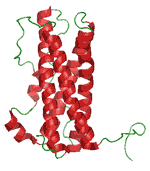 This is prolactin. It’s a hormone produced by human beings in the breast during breast feeding (it causes the production of milk) and in the brain during orgasm. As is typical with many hormones, it serves double duty and has a number of different roles; evolutionary biology never starts with a clean slate, so we get hormones in one part of the body repurposed to do something completely different in another part of the body (and we also get fucked-up design night mares like the knee…but I digress).