In response to this post I made about the intersection of disability and transhumanism, illicitlearning posted a link to a YouTube video on exactly the same subject, that discusses some facts I wasn’t aware of.
The entire video is over an hour long, so for that reason I’m not going to embed it here. I do recommend that anyone interested in ethics, body modification, transhumanism, functional changes to the body, agency, bioethics, or the ownership of the self watch it, however. It’s probably not safe for work–there are pictures and descriptions of forms of body modification some folks might not approve of–but it’s good to watch regardless.
You can find the YouTube video here.
The person in the video is Quinn Norton, a journalist who’s long been interested in both body modification and transhumanism. She’s one of the people who first experimented with subdermal rare-earth magnet implants that I talk about here.
One of the things that surprised me to learn from this video is just how profoundly fucked-up our system of bioethics–and I use the term “ethics” in there only loosely–is in this country.
 We have the capability to do some really neat things, and we’re on the cusp of learning to do some even cooler things. We can, for example, exploit the brain’s plasticity to create new senses (as with the aforementioned implanted magnets) or to map one sense onto another (as with experimental devices that allow people to see by mapping images onto the tongue with electric currents).
We’re closing in on more interesting things still. For example, one area of nanotech research involves respirocytes, which are tiny machines designed to do what red blood cells do by carrying oxygen to and taking carbon dioxide away from the cells of our body. The trick is that they are thousands of times more efficient, and if they work as projected, would allow someone injected with them to do things like hold their breath for half an hour, run at full speed without breathing for ten or fifteen minutes, and even survive with their heart stopped for thirty minutes or so.
And you know what? All this stuff is considered “unethical”–and much of it is illegal.
Before I get off on the rest of this rant here, I’d like to start with a basic premise from which the entire rest of my argument against this sort of nonsense flows, and that is the value of agency.
Agency–the notion that each of us is a self-determining, self-aware individual, uniquely positioned to choose for ourselves what we do with our own bodies–is, I believe, the most basic of all moral principles, and the one from which all other moral principles flow. Things that we all agree are immoral, such as murder, kidnapping, rape, or torture, ultimately grow from the notion of agency. Each of us is responsible for the consequences of our decisions (else there can be no morality), and each of us has the ultimate right to control of our own bodies (the right which is violated when another person deprives us of our liberty or our life).
In the final analysis, I do not believe any credible system of ethics can ignore or diminish the principle that the first and most basic of all moral principles is the idea that we have the right to choose for ourselves what we do with our bodies.
So. Onward.
According to the American Medical Association’s Code of Ethics, there are many techniques and procedures that are considered “unethical” across the board. Among these are “augmentation” technologies–technologies intended or designed to provide someone with greater-than-human-normal abilities or senses.
An example? Cochlear implants. These implants are often used to cure one of the most common forms of deafness, and for this use, they are considered both legal and ethical. The implant is a tiny electronic gadget implanted deep in the ear anal, and connected directly to the auditory nerve. They’re implanted into tens of thousands of deaf patients to restore hearing.
But…
A cochlear implant which offers a deaf person some kind of new ability or functionality that a “normal” person does not have is considered unethical across the board. For example, a cochlear implant that had BlueTooth functionality, to allow its user to directly access a cell phone or a computer? Unethical. An American doctor who implanted such a thing would lose his license. A cochlear implant designed to be implanted in a person with normal hearing, to extend the range of his hearing? Also unethical.
And it gets worse.
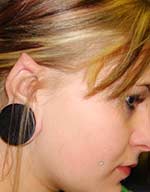 In the United States, it is considered a breach of medical ethics for a plastic surgeon to change someone’s appearance outside the socially accepted standards of physical beauty.
Read that again and think about it. In the United States, it is considered a breach of medical ethics for a plastic surgeon to change someone’s appearance outside the socially accepted standards of physical beauty. Medical ethics are dictated by socially accepted standards of physical attractiveness. It is perfectly legal, and perfectly ethical, for a plastic surgeon to put silicone into a woman’s tits to make them bigger (because social standards of beauty favor big tits), but it is considered unethical (and in most places, illegal) for a plastic surgeon to do something like pointed ears; a surgeon who does so risks loss of his license, prison, or both.
Which is pretty damn stupid, if you ask me.
In practice, what that means is the folks who want to get many kinds of body modifications done, from aesthetic mods like pointed ears to functional mods like implanted magnets, must go to unlicensed body-mod artists without formal medical training, who are not medical doctors and who do not have access to anaesthetics, antibiotics, or other basic medical tools. All because the results either give them some functionality outside the “human norm” or take their appearance away from “socially accepted standards of beauty.”
The people who practice the art of body modification live under constant threat of legal action. In some states, such as California, they are considered “unlicensed medical practitioners” and are subject to arrest and prosecution if they are caught. In other states, such as Oklahoma, a person willing to do something as simple as tattooing must pay a $100,000 cash bond to do so legally (and that’s actually a concession to fans of body art; until 2006, tattooing was illegal everywhere in the state.
Now, you might not be into tattoos or pointed ears. Personally, I think they can look cool on the right person, but whatever. That’s not the point. The point is that we as a society have determined that you should only be able to control the way your body looks if the result is what other people would find attractive, and I frankly think that’s an appalling and immoral approach to the question of medical ethics.
Look, this is really simple. My body belongs to me; your body belongs to you. Our appearance is not subject to vote. And yet that’s exactly what we have–a system whereby if enough people think that something (big tits) is attractive, then plastic surgeons are ethically permitted to give women big tits, but if there aren’t enough people who think something else (pointed ears) is attractive, then plastic surgeons are barred from giving folks pointed ears.
 It’s stupid enough to live in a society that tells people, every day, in a hundred thousand different ways, that there’s only one way you are “supposed” to look, but to write that notion into professional ethics and law is stupid beyond belief. We claim to be a society that values plurality, diversity, and individual control over our own lives, yet in the single most basic, fundamental form of individual control of all, individual control of our own bodies, we have adopted a herd mentality and then elevated that heard mentality to the level of ethical absolute.
“I like big tits, so doctors are permitted to perform dangerous and massively invasive surgery to give women big tits. I don’t like pointed ears, so doctors are not permitted to perform relatively trivial, simple procedures to give people pointed ears.” Someone explain to me exactly how this is “ethical”? When was it, exactly, that common tastes dictated ethics?
And those standards of “socially acceptable beauty” are themselves toxic and unrealistic. A lot of folks might not like the thought of people getting pointed ears, but how do you explain the saga of Melanie Berliet, an attractive 27-year-old model and Vanity Fair writer, who for her piece on cosmetic surgery visited three plastic surgeons, who complied a lengthy, expensive, and medically invasive list of “improvements” they recommended for her? A lot of people talk about how toxic and unrealistic social standards of female beauty are, but when you take it to the ludicrous extreme of thinking that a very attractive woman by ay standards could benefit from surgical “improvement,” but that functional or unconventional body modification is inherently wrong, what exactly does that say about social standards?
Folks, this is fucked up beyond all human reckoning.
A great deal of the current legal landscape regarding body modification, particularly “enhancement” and “human norms,” can be traced to the opinions of a few people, notably among them Leon Kass and Francis Fukuyama.
 These two people were among the eighteen appointed by George W. Bush to the president’s Council on Bioethics when Bush took office. The Council on Bioethics is an Administrative cabinet designed to advise the President on the ethical issues surrounding medicine and biotechnology, and as such its goal, at least nominally, is to act as an ethical voice in considerations including legislation, regulation, and research funding in biotechnology.
And who, exactly, are these people?
Leon Kass, the head of the Council under Bush, is an ardent foe of new biotechnology, particularly research involving human reproduction, longevity, and augmentation. He is the architect of Bush’s stem-cell research ban, and lobbied Congress unsuccessfully to pass a ban on research aimed at improving human lifespan on the grounds that death is “necessary and desirable end” and “Christians already know how to live forever.” He opposes in-vitro fertilization on the grounds that it is an affront to human dignity (an argument which I must admit makes no sense at all to me) and that it obscures moral truths about the essence of human dignity (which basically sounds like handwaving: “It seems yucky to me, so I’ll blather about moral truth to conceal the fact that I have no cogent arguments save for the fact that it seems yucky to me”).
In fact, Kass even explicitly acknowledges this “yuck factor.” He calls it “the wisdom of repugnance,” and says that anything we see as “yucky” is, on its face, inherently immoral–by which definition, things like organ transplants (derided with disgust as “doctors cutting up corpses and sewing bits of dead people into live people” when it first started to develop). Many things seem yucky when they are new, but with familiarity come to be recognized as the lifegiving boons that they are.
 Francis Fukuyama is a political economist who somehow believes that his knowledge of politics and economic issues makes him fit to hold a cabinet-level position on the ethics of biotechnology. He has written a book, “Our Posthuman Future,” in which he labels transhumanism as the most dangerous idea that has ever developed. He’s also noteworthy for another popular book, “The End of History and the Last Man,” in which he argues that the progression of history is over and that free-market democracy is the ultimate of all political and social systems. He’s one of the leaders of the neoconservative movement, and was one of the architects both of the Reagan Doctrine and of the Iraq war.
Now, you might think it strange that a free-market neocon who favors individual and free-market choices would argue that people should not be free to choose to modify themselves if they want to, and that the free market should not be permitted to offer that choice. Honestly, I’ve never been quite able to wade through his logical contortions in supporting this notion, but they seem to come down to “I want modern American democracy to be the be-all and end-all of human development, and radical new biotech that offers to change human beings too much might upset that notion and lead rise to new social and political systems that I can’t even imagine, and I think that would be bad, so we should ban any new biotechnology that could upset the applecart.”
Which strikes me as being a bit like a Roman senator saying “Rome is the pinnacle of human economic and political triumph, so we should ban any new technologies that might lead folks away from the Roman model of civilization.” And that, were it put into reality, would mean that you and I would not be having this conversation, since an instantaneous globe-spanning communication network was most definitely not part of the Roman model.
What Mr. Fukuyama doesn’t realize is that history never ends. The United States is no more the end of history than the Roman Empire was, and that’s a good thing.
It seems to me that these people–tho opponents of transhumanism, the ethics board of the American Medical Association–live in a tiny, conformist world, terrified of change and intolerant of diversity. It’s ethical to change someone’s appearance, but not if the change doesn’t match conventional standards of beauty. It’s ethical to tell women that they need bigger tits and fuller lips, but it’s not ethical to let them make their own choices about their bodies. It’s ethical to implant a device to let a deaf person hear, but not if it lets him hear better than I can.
The bionic man from the TV show The Six Million Dollar Man is, under our current legislative and ethical system, considered an abomination, and the doctors who worked on him would in real life lose their jobs, even if they improved his standard of living. We should help the disabled, but not, y’know, too much.
In the United States, we have long associated “morality” with “sex.” This nation can boast such moral luminaries as Charles Keating, the anti-porn moral crusader who made movies and advised President Reagan on moral issues before embezzling $1.2 billion dollars from a savings and loan under his control, touching off a nationwide financial crisis that threatened to rob working families of their lifes’ savings…but he was deeply concerned with morality, you see.
Even in bioethics this association continues. We have a medical community whose ideas about medical ethics are predicated on the fact that any change that makes a woman more fuckable to the general population is good; any change that makes a woman less fuckable to the general population is bad.
We are also deeply fearful as a society. We shun the disabled and favor medical technology that makes them more like us–but only so long as it keeps them in their place and doesn’t make them, y’know, better than us.
At each step along the way, we construct ethical systems that are the antithesis of agency, that seek to take away control of our bodies from each individual and instead place that control at the mercy of the common, socially accepted standard of beauty.
And I think that it’s about time we start re-thinking that approach to morality.



 Early on in the movie Avatar, there’s a scene where the main character and several other newcomers to the planet load up onto a shuttle for their trip down to the surface. We see, very briefly, a shot of the shuttle’s flight deck as the flight crew fires it up and gets read to descend.