Sex for Science! Chapter 0
Sex for Science! Chapter 1
Sex for Science! Interlude
Sex for Science! Chapter 2
Sex for Science! Chapter 3
Sex for Science! Chapter 4
San Francisco has a store that bills itself as the largest independent pirate supply store in the city.
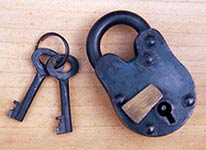 I don’t know if it is in fact the largest pirate supply store in San Francisco or not, but it is indeed a large pirate supply store. lapis_lazuli and her partner brought us there in part because I needed some pirate supplies, and in part because it’s a cool place to visit.
The store sells really cool hand-made cast-iron padlocks. My sweetie zaiah has a large cage which will be part of the dungeon furniture once the dungeon is finished, and every cage needs a hand-made cast-iron padlock, so the pirate supply store turned out to be just the right place to visit.
The very cute young cashier who sold me the padlock asked me if I already had a use in mind for it. I told her that I did, and that would have been the end of it, except that she kept on pressing. “What do you plan to use it for?” she asked.
“A cage.”
“Like a cage for a dog?”
“Not exactly, no.”
“What kind of cage?”
“A big cage.”
“What’s it for?”
“It’s part of the dungeon.”
“You have a dungeon?”
“We’re building one, yes.”
“What kind of a dungeon? Like for–”
At that point she turned a brilliant shade of red from the tips of her ears down to her toes and started saying “Oh my God” a lot. She also started stuttering quite a bit and generally looking flustered. Finally, after a lot of “um”s and “err”s and a bit of hand-flapping, she said something about it taking all kinds of people and turned away.
That was the second most fun thing that happened in the pirate supply store, for some value of “fun” that means “I don’t believe in protecting people from the results of their own questions.” The first most fun thing was when lapis_lazuli took me by the hand, looked me straight in the eye, and said “kiss me.”
Which I did. And then did again. She’s rather a nice kisser.
Smart, confident, direct women are sexy. Ahem.
The Porn ‘n’ Cupcakes, the tour of the submarine, and smooching lapis_lazuli in a pirate supply store all aren’t directly related to finding myself in a seedy motel room in Seattle with a bullet hole in the window and a door that looked as if it had been kicked down repeatedly, watching a tattooed grad student in striped socks having a huge screaming orgasm, but they’re indirectly related in the sense that I can perhaps be forgiven for having sex a little bit more on the brain than I usually do during the drive back to Portland, and to the idea that would inevitably bring us to that motel room in Seattle, to which I am by degrees coming.
In fact, the trip to MacWorld led to two different instances of watching a pierced, tattooed woman having a screaming orgasm. This story has several branches, which I’ll get to later.
At this point, the genesis of that idea that brought me to Seattle was less than twenty-four hours and a quick side jaunt through Shasta Caverns away. That side jaunt deserves a bit of talking about of its own.
Shasta Caverns is a cave system near Shasta Mountain, which has an interesting history. It was, apparently, discovered in 1878 by a Native American fishery worker who’d been out hunting and followed an animal through a small hole into what he believed would be a tiny niche in the mountainside.
Scott and I stopped at Shasta Caverns on the way back to Portland partly because our original plan, to head back along the coast and take pictures, was thwarted by reports of rain.
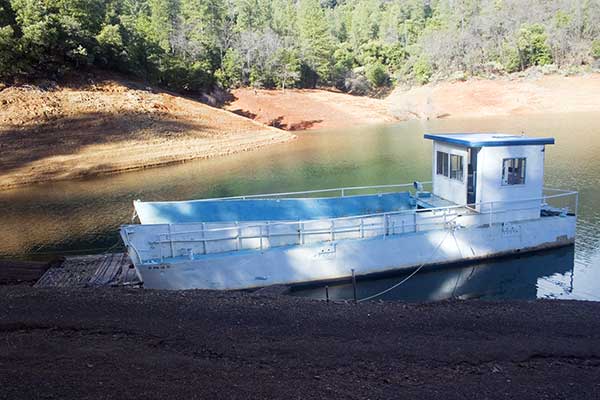
The cave system at Shasta Caverns is accessible only from the top of a mountain across Lake Shasta from the road. Entrance to the cave system involves taking a WWII-era landing boat across the lake, then taking a bus up a very steep, narrow, winding trail that’s so curvy in some places that the bus actually overhangs the edge of the road when it’s turning. The buses themselves were carried across the lake by that very same boat;, which was barely big enough to accommodate them; the guide said the landing ramp can’t be raised while a bus is on the boat, meaning that a ripple any bigger than a matchstick will swamp the boat while it’s transporting them.
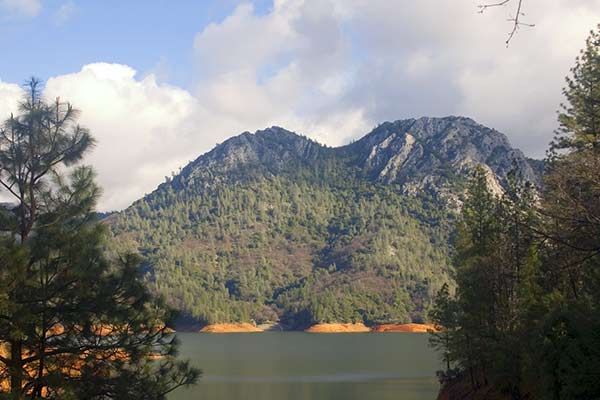
The mountain itself looks like this from the edge of the lake.
I still have yet to get used to how folks just leave scenic natural wonder lying around all over the place here in the Pacific northwest.
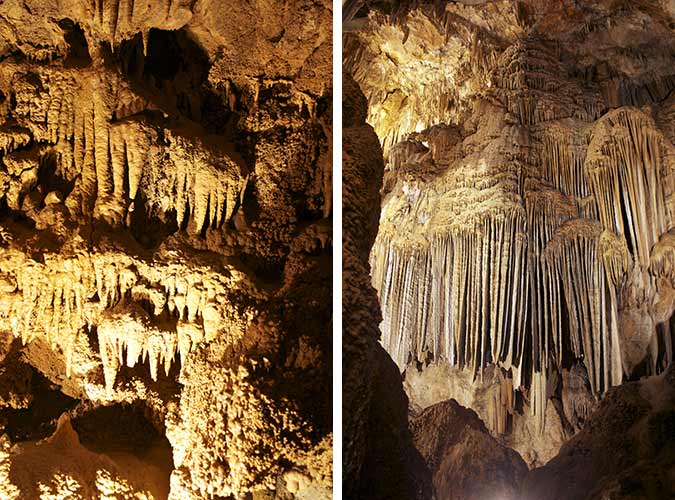
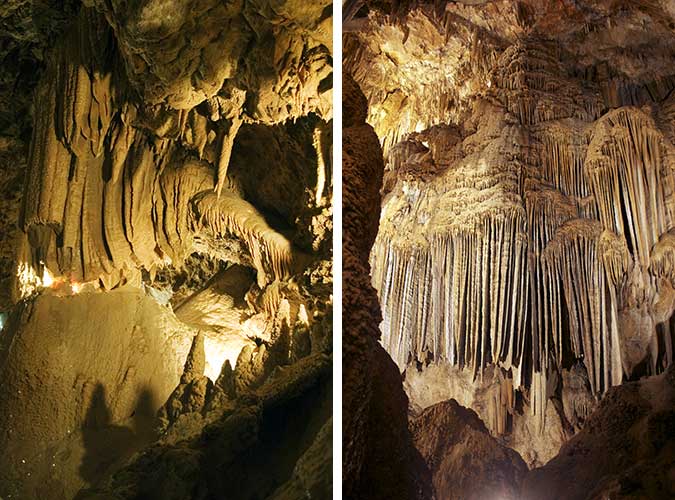
The cave itself is small but quite spectacular. Unfortunately, a guided tour is the only way to go through it; visitors aren’t allowed to wander about on their own, the way they can at Carlsbad. Which is a damn shame, because I’d love to return here one day with a model and do some nude photography in this place.
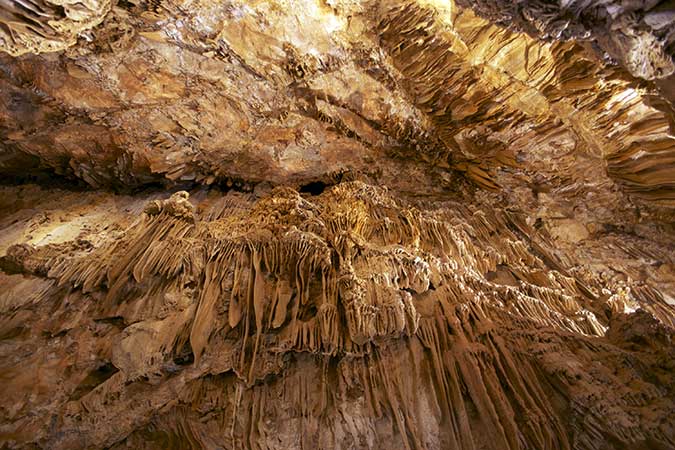
Scott and I lagged behind the group as much as our patient and remarkably tolerant guide would permit, shooting long-exposure images from a pair of tripods. The cave system is small but spectacular, and features every type of rock formation that can exist in a limestone cavern.
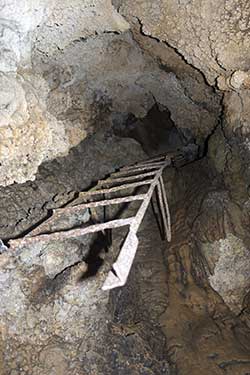
After we left the cave system, through an exit five hundred feet or so above the entrance, we were confronted with this view:
At the very peak of the caverns is the remnants of this rusted ladder, which for nearly a century was the only way in or out of the cave system. The hole in the ceiling is the original entrance through which the cave’s discoverer made his discovery.
Detour complete, we hopped back into Scott’s car and headed north. That’s when it happened.
 Scott has a habit of listening to books on tape via his iPhone whenever he travels–a habit which, by the way, I endorse.
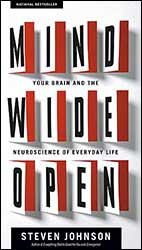
On the trip down, he had introduced me to Wooster & Jeeves, which is pretty funny stuff. On the way back, he opted for something a bit different: Mind Wide Open: Your Brain and the Neuroscience of Everyday Life by Steven Johnson.
I’m not quite sure what made him choose that particular book. Maybe it was simply the next one in the queue. Maybe he’d decided that entertainment a bit more meaty than turn-of-the-centry tales about an incompetent buffoon and his hyperconfident butler might be suitable. Perhaps it was entirely random, and the hand of fate reached out to touch him. In any event, the moment he pressed “play,” the dice were cast, and the Seattle motel room became inevitable.
The book, you see, talks about a company called Neurosky.
Neurosky makes a single-chip EEG device that’s designed to be embedded in small electronic toys and gadgets. Neurosky got into business making neurofeedback devices–gadgets intended to train a person to control her own mental state by analyzing her brainwaves and then providing some sort of reward for reaching the goal state.

Their earliest gizmos were video game controllers, which would read the player’s brainwaves and let her control some part of the video game accordingly. They made a race car game, for instance, in which the harder the player concentrates, the faster the car goes.
More recently, Neurosky has started making chips for other companies. One of their customers is Mattel, who makes a toy called the MindFlex, in which you move a ball around by concentrating on it. The game has a motor connected to the chip’s outputs, so that when you concentrate, a fan blows and levitates a ball in the air.
Pretty cool, I think, for the first five minutes, and then probably quite boring after that.
To me, though, in my already riled-up state (and to be fair, my baseline state is pretty riled up to begin with), the connection was obvious. Here is a brain-scanning device that could be used to activate a motor.. Think about that for a minute.
A brain-scanning device. That could activate a motor.
The idea hit like a lightning bolt. If a MindFlex could turn on a motor attached to a fan, surely it could turn on a motor attached to something else, too. Like, say, a vibrator.
It was Twitter that provided the last bit of the puzzle.
On the drive home, I tweeted, as I always do. “Is sexual arousal a discrete brain state?” I said. “Can you use neurofeedback to condition it?” All good questions, I thought. That’s the nice thing about neurofeedback; you can use it to train yourself to be able to go into a certain metal state, like meditation or concentration, at will.
So why not apply the same idea to sexual arousal? If an EEG could detect sexual arousal, ad run a vibrator whenever the wearer became aroused, could it become a neurofeedback training device to teach people to become aroused whenever they wanted? And more to the point, wouldn’t be fun?
There are a lot of folks who read my Twitter feed. One of those folks is partnered to a neurobiology grad student who was thinking along similar lines, although for entirely different reasons. Shortly thereafter, she got in touch with me.
Of course I’d like to collaborate on a project involving hooking people up to an EEG and getting them aroused to see what happens…I mean, really, does the question even need to be asked? It’s Science, right? Science is something I’m in favor of, after all.
So you see, the seedy motel room lurking in my future was all part of the great enterprise of Science, the noblest of all human endeavors.