On Feminism and Getting Laid

A little while ago, I wrote a blog post called Some Thoughts on Rape Culture.

Every time I write a blog post like this, as sure as night follows day, the same thing happens. Invariably, I will get at least one, and sometimes several, private emails in my inbox. The content of these emails is always the same, and they’re rarely stated in the blog comments. Every time, they’re some variant on the same theme:

That must be working pretty good for you, huh? Pretending to be a feminist must really get you laid.

This has happened for years, and this last blog post was no exception.

I’m not quite sure what to make of the assumption that a man who espouses feminist values must be using it as a ploy to get sex. The first time I encountered this, it was quite a head-scratcher, I must confess. Really? I thought. That’s your take-away? I am pretending to support values and ideals about women’s agency because I’m trying to score sex from feminists? Seriously?

Now, in all fairness, if you look at all my partners, it’s very unlikely I would be involved with them if I weren’t a “feminist man,” or, as I like to call it, “a man who thinks women are people.” I have simple tastes; I prefer strong, smart, confident women, and those tend–surprise!–to be women who like being treated as people.

But here’s the thing.

The fact that these women would only be likely to get involved with a man who respects the ideals of feminism doesn’t mean that they’d get involved with every guy who respects those ideals. Treating women as people is necessary but not sufficient; if you treat women as people, that doesn’t guarantee you’ll be involved with them, but if you don’t, you won’t. Yes, in order to have sex with my partners, you have to be a dude who’s a feminist. You also have to be a dude who they think is worth having sex with, and you can’t fake your way into that.

So as a strategy for getting laid, adopting feminist ideals is, by itself, kinda rubbish.

And pretending to adopt feminist ideals is even more rubbish.

I don’t quite get what’s going on in the head of some guy who thinks pretending to be feminist is a ploy to get laid, but I have to assume that a guy who thinks that, probably doesn’t think women are very smart. If someone pretends to think women are people, but doesn’t actually think women are people, I suspect the ploy would be revealed rather quickly. Probably some time between appetizers and the main course, and certainly well before any clothes come off. I really don’t think it’s possible to pretend to be feminist, at least not for any length of time longer than a dinner conversation.

I don’t say that rape culture is a thing because I’m hoping to get laid by women who say that rape culture is a thing. I don’t think women deserve agency and personal autonomy as a tactic to try to get them to use their agency and personal autonomy to fuck me. I mean, seriously, what the fuck? How is it that someone might seriously think that being nice to feminists is a strategy for getting laid? Is it because he thinks feminists are so well-known for…um, having sex with any guy who’s nice to them?

If I were to advocate some kind of duplicitous scheme to get more sex, I would definitely recommend “learn to swing dance” over “pretend to be a feminist.” It certainly seems far more likely to succeed. Pretending to be a feminist when you really don’t think of women as real people, just to try to get in the pants of women who want to be treated like real people, is just…it…I just…what is this I don’t even.

Some thoughts on rape culture

A couple of days ago, someone on a (closed) Facebook group I belong to posted a link to a blog post about rape culture.

And, predictably, one of the first comments to that link was along the lines of “this is just another attempt to say that male sexuality is bad.”

It doesn’t even really matter where the linked blog post is (though if you’re interested, it’s here); the “you’re just demonizing men” reaction comes up on any conversation I’ve ever seen about rape culture, as sure as night follows day. And it’s annoying.

It seems to me that if that’s your take-away from discussions about rape culture, you aren’t paying attention.

Male sexuality is not inherently evil, and acknowledging that rape culture is a thing isn’t the same as “demonizing male sexuality.” This seems obvious to me, yet it’s a persistent trope: saying that we have a culture that normalizes, trivializes, and to a large extent even excuses sexual violence is conflated with demonizing male sexuality, as if, I don’t know, male sexuality were somehow inextricably tied to rape or something.


I personally have never met any women who believe that male sexuality is tied to rape, though I keep hearing from other men about that’s what “feminists think”.

When I see a trope become that deeply embedded in a conversation about something, I tend to wonder who it benefits. I definitely think there are men who benefit from this trope. There are some men who want to conflate “discussing the cultural component of sexual violence” with “demonizing all male sexuality.” These men want you to read articles like the blog post that led to all this and respond with “you’re saying men are evil! You’re saying all men are rapists!” That’s the interpretation they want you to have.

There are two kinds of men who want you to have that response: rapists, and men who want power over women.


Not all men are rapists.

There is, for some people, a knee-jerk response to any conversation about rape culture that goes “You just think all men are rapists!” That isn’t what this (and articles like it) say. What they say is that women have to act like all men are potentially rapists, because rapists don’t wear a special hat or have a special handshake or anything.

A strange man is probably not a rapist, but he might be. Since there’s no telltale signal that lets you tell a rapist from a not-rapist, women have to assume that a stranger could potentially be a rapist, simply out of self-preservation. A common analogy here is that not every strange dog will bite you, but it’s usually a good idea not to approach every strange dog you see with reckless abandon–because some of them might bite you, and you have no way of telling which.

Rapists and men who want power over women are quite pleased when people deflect conversations about rape culture with “you’re just saying male sexuality is evil,” because it shuts down conversation about the reality of rape culture…and that suits them just fine. It allows things to continue on exactly as they are–which is to say, allows society to continue blaming victims of rape for their own attacks (“did you see what she was wearing??!), allows rape victims who come forward to continue being disbelieved, allows the courts to continue under-prosecuting rape.

All of this serves the needs of men who rape and men who want to control women, and the only side effect (other than the fact that, y’know, women are marginalized) is that some men are treated like they might possibly be a rapist.

You’re a guy, and you don’t like it? You don’t like the idea that women who don’t know you might respond as though you are a potential rapist, even though that’s something you would never, ever, do? Do something about it! Do something to make our society less welcoming to rapists. Don’t trivialize rape. Don’t whine “but what about false accusations?” when women talk about how claims of rape are rarely taken seriously. Don’t treat tape as a punch line.

Look, this is not rocket science. If you’re a guy, you have a disproportionate amount of power, even if you personally don’t feel like it’s true. It’s not enough to say “Well, I’m not a rapist, and I don’t trivialize rape, so I don’t like it when women treat me like I might be a rapist!” You have to do more. You have to stand up to the people around you who do trivialize rape. You have to stand up to people who are rapists–yes, I’m talking to you, and yes, statistically, unless you live as a hermit in a one-room cabin in Montana you probably know at least one rapist in your social circle. Even if you don’t know who he is.

You don’t like the implications of discussing rape culture? Don’t dismiss those discussions; that doesn’t serve anyone except rapists. Do something about it.

The world’s first 3D printed gun: Ho hum.

Today, a landmark in improvised engineering was reached. Plans for an (almost) entirely 3D printable firearm went up on the Internet, able to be freely downloaded by anyone.

The reactions around the Net are predictable. Libertarians and gun nuts are ecstatic, gushing all over themselves about how this will be the “end of gun control” and usher in some kind of “new age of freedom” or something.

Law and order types, gun control advocates, and the government are wetting themselves with the prospect of legions of terrorists printing up virtually undetectable firearms and taking over airplanes or something.

And it’s all completely ridiculous. Neither a new age of freedom nor a new age of terror are in the works; in fact, I’m quite confident in predicting the total impact of this technology will be statistically undetectable. Self-congratulatory (on the one side) and paranoid (on the other) ravings aside, this thing simply does not make any meaningful difference whatsoever.

First, let’s see this harbinger of freedom end of civilization toy for rich white kids:

It’s printed from ABS plastic on an $8,000 3D printer. Almost everything is plastic, including the barrel; the only non-plastic parts are an ordinary nail (for the firing pin) and the bullet itself (in this case, a .380 caliber).

Now, I’ve owned firearms and shot recreationally for most of my life,1 and the first thing I can say upon seeing this thing is that I wouldn’t want to fire it. My instinct is that it’s probably about as dangerous to whoever’s on the trigger end as whoever’s on the business end.

The one shown here was test-fired three times. The first time, it misfired. The second time, it successfully fired a .380 round without destroying itself. The third time, when the .380 was replaced with a 5.7×28 cartridge, it exploded.

Could it survive multiple shots with the smaller round? I don’t know. Maybe. I wouldn’t bet my life on it. Doesn’t really matter. Not only is this thing not a game changer, I reckon it’s about as significant in terms of its overall impact on society as whatever toy they choose to put into a box of Cracker Jacks next week.


For starters, what you’re looking at here is not only a shoddy firearm of dubious reliability and ruggedness; it’s an $8,050 $9,000 shoddy firearm of dubious reliability and ruggedness. This prototype was printed on an $8,000 3D printer with about $50 worth of materials, making it arguably the single most expensive zip gun that’s ever been fabricated. A person looking for cheap, untraceable guns would be able to buy an arsenal on the street for less than the cost of the printer that produced this thing. (Edit: It turns out that this gun actually requires $1,000 worth of plastic toner to print, making it arguably the most expensive zip gun ever made even if the cost of the 3D printer isn’t factored in.)

Now, I already know what you’re going to say. The cost of 3D printers is dropping quickly. People can rent one or use one at a school. Companies will 3D print parts for you.

All of which is true, but irrelevant; the ability to make crude, cheap firearms for a lot less than just the cost of the plastic alone for this thing has existed…well, for about as long as firearms have existed. Prisoners have been known to build guns from parts available in prisons.

It has never been lack of availability that has kept people from using small single-shot firearms like this. The reason every criminal in town isn’t sticking up convenience stores with zip guns isn’t that they have been languishing in wait for a Libertarian college student to design one that can be 3D printed and put on the Internet; it’s that these things are virtually worthless as weapons. They tend to be used in prisons but few places besides, because they’re unreliable, prone to failure, inaccurate, and dangerous to the operator.

Just like, ahem, the 3D printed version.

Seriously. Even when they work, you have to be at point-blank range (or better yet, in contact with your intended target) for them to be terribly effective.

Which leads to the next hand-wringing objection: OMG this is made of PLASTIC you can take it onto an AIRPLANE through a METAL DETECTOR!

Which is, err, only kind of true. It’s a bit bulky to hide on your person, and there’s still the fact that the firing pin and ammunition are metal. Now, you might be able to get a nail through security on some pretext or other, but I doubt many folks will let you carry ammunition onto a plane.

If they notice it, which is a different matter; I’ve had friends who’ve carried brass knuckles and switchblades onto planes without difficulty. The reality is that few people actually want to, and have the means to, attack an airplane; nearly all of what happens at the airport is security theater, not security.

But let’s assume just for amusement that you can get one of these onto a plane. So what? What of it?

If I wanted to attack an airplane with a weapon I made on a 3D printer, it wouldn’t be this gun. Even if it works, it only works once, and I doubt the other passengers would sit around idle while I reloaded it and prepared to fire again. Assuming that the first shot actually did any good anyway.

The guy who designed this says “You can print a lethal device. It’s kind of scary, but that’s what we’re aiming to show,” as if this is the first time that’s been possible. Sorry, kid, but you’re a ridiculous wanker; a 3D printed knife or spear is actually a lot more lethal than this toy gun. (There’s a reason shivs rather than zip guns are the preferred weapon in places like prisons, and it’s not all down to scarcity of ammunition; given how easily drugs flow into American prisons, ammo isn’t that much of a stretch if there were a demand for it.) The 9/11 hijackers, who were well-funded, used…box cutters.

But I wouldn’t carry a 3D printed knife, or even a cheaper and better ceramic knife, onto a plane with mischief in mind either, because I’m not suicidal. Post 9/11, one thing has actually made air travel safer: the fact that the other passengers aren’t about to sit quietly by and hope for the best if someone tries to take a plane. All the other security changes that have happened since then have paled in effectiveness next to passenger attitude.

So, here’s the million-dollar question. You take a plastic gun onto an airplane, and…what, exactly? What in the name of the seven holy fucks and the twelve lesser fucks do you do then? What’s your plan?

If your goal is to destroy the plane, you can’t do that with this thing. If your goal is to take over the plane, well…good luck with that. You might survive what the other passengers do to you, maybe, if you’re lucky. Everybody is shrieking about how this thing can defeat airline security…and then what?


In fact, that million-dollar question can be extended to just about any possible use for this thing. You’ve bought yourself an eight-grand 3D printer, or somehow got access to it. You download the plans like an eager little hacker and you print this out, and then you…um, what do you do then? Go online and brag to your Maker friends?

You aren’t going to use this for home defense. I mean, seriously. A baseball bat or a tire iron makes a better home defense weapon, and the baseball bat probably has a longer effective range.

You’re not going to use it to outfit your secret militia that’s pining for anticipating the day that the Federal government starts rolling the tanks down Main Street. You aren’t even going to use an AR-15 for that, because, listen, seriously? The government has drones. They can blow your ass to hell and gone and you’ll never even see someone to shoot at.

You aren’t going to take it down to the range and pop off a few rounds in the general direction of paper cutouts of zombies or Trayvon Martin. No gun range is going to let you anywhere near the firing line with this; it’s too dangerous to the other shooters.

And please, please tell me you think you can go hunting with this thing. Bring a video camera and let me know when the video is up on YouTube. You can’t get enough of that for my entertainment dollar.

So you’re going to print it out, you’re going to put it together, and then…what, exactly? I’m still not clear on that.

Now, if you designed it, what you’ll do is obvious: you’ll get media exposure for congratulating yourself on what a clever Libertarian you are. And as near as I can tell, that’s really this thing’s only usefulness.


1 Full disclosure: I’ve been a private firearm owner on and off since 1988. I like guns, I like target shooting, and I’m neither opposed to nor afraid of guns. All that being said, I still won’t fire one of these.

New essay on Promiscuity Keepers: Ending Rape

I’ve just posted an essay over on Promiscuity Keepers, Some Thoughts on Ending Rape. Here’s a teaser:

Recently, I started noticing references in my Twitter feed to a Twitter account called @EndingRape. The account belongs to a man named Richard Hart, who has a Web site and book called Keep Your Daughter Safe.

Now, I don’t think Richard Hart is a bad guy. I don’t think he’s evil or malicious. I think he probably sincerely believes that rape is a Bad Thing and he probably genuinely wants a world with less of it.

But his approach is deeply troubling, and in some cases even destructive, for a number of reasons.

Feel free to respond here or over there.

Skeptics and Misogyny and Privilege, Oh My

Since my blog post about the discussion about polyamory on the JREF forums, I’ve been poking around on the forums some more. Somehow, I managed to stumble across a thread relating to accusations of misogyny in the skeptical community, stemming from an episode at TAM last year.

TAM is an annual convention of skeptics and rationalists hosted every year by the James Randi Educational Foundation. It’s one of the largest such conventions in the country.

Apparently, a prominent blogger named Rebecca Watson was harassed at TAM last year. And the fallout from her complaint about it, which I somehow managed to miss almost entirely, are still going on.

I don’t read many skeptic or freethought blogs, which is probably how I missed the first go-round. A bit of scouting on Google, and a perusal of the JREF forum, shows an astonishing amount of anger, most of it of the “how dare this emotional woman tell us we’re misogynists!” variety. Which is more than a bit disappointing, when it isn’t downright rage-inducing.

In the interests of fairness, I have to say that I totally get why folks who identify as skeptics and rationalists might be especially resistant to suggestions that they are behaving inappropriately, especially with regards to sexism. A significant number of folks in the skeptics community identify as atheist. It takes quite a lot of effort for many people, especially people raised in a religious family, to break away from religious faith and embrace the ideas of rationalism and skepticism.

Once you do, there is a temptation to think of yourself as being more enlightened because of it. Things like racism and misogyny? They are those relics of patriarchal religious orthodoxy. I’m not a misogynist! I’m not a racist! I left that behind when I let go of religion. I don’t think that women are placed below men by some sort of divine pronouncement. I’m not the one trying to make women into second-class citizens. How can I be sexist?

I can remember going through a thought process something like this myself, back when I was a teenager in the process of giving up on the idea of religion.

Years later, when I was first introduced to the notion of invisible privilege and the ways that society creates a bubble of special advantages around men, it felt quite weird to grapple with the notion that I might be the beneficiary of misogyny, or even be guilty of misogynic behavior myself, without even being aware of it.

So the reaction of folks in the skeptics community when confronted with inappropriate behavior at a conference might be understandable, though it’s still disappointing. And maybe I’m naive, but the level of vitriol coming from some parts of the skeptics community against Ms. Watson and her supporters is completely over the top…and appalling.


All that is kind of beside the point, though. Yes, it can be tough to recognize the invisible sea advantages that we swim in, just as it might be hard for a fish to recognize that it’s wet.

But here’s the thing. It seems to me that anyone, regardless of whether or not he recognizes the many ways that society provides him with an invisible set of advantages that other people don’t have, who hears someone say “I feel threatened” or “I don’t feel safe here,” should start by listening.

I do believe that most of the folks in the skeptical community–indeed, most people in general–sincerely don’t want to be misogynistic (or racist or otherwise guilty of bias or oppression). And if someone claims to be a rationalist, it seems to me that if he is approached by someone else who says “I feel marginalized in this environment,” the desire to find out whether or not a problem actually exists, and to fix it if it does, should logically outweigh that little emotional voice that says “But that can’t possibly be true; I’m not like that!”

So at this point, I’d like to talk to all the guys reading my blog. Especially white guys, and most especially white guys who think that they aren’t sexist or racist. The rest of you can…I don’t know, cover your ears or something. Ready? Okay.

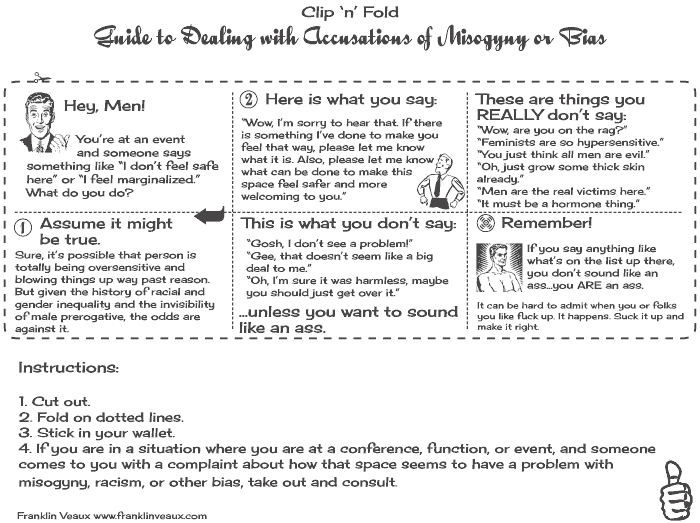
Listen. Guys. If you are at a conference or a sci-fi convention or something, and someone comes up to you and says “I don’t feel safe here,” you listen. And then you say “I’m sorry to hear that. This isn’t the sort of environment I want to create. What can I do to help fix the situation? What would it look like if this space were more welcoming to you? Have I participated in any way in making this space feel hostile to you, and if I have, what can I do to make it right?”

This is really, really simple It’s called “being a decent human fucking being.”

Now, I know what you’re thinking. It’s probably some little thing that’s gotten way blown out of proportion, right? There’s not really a problem; this person is just being oversensitive. Right?

And that is one possibility, sure.

But seriously? Given the history of treatment of women and minorities in this society, and given how goddamn hard it is to be aware of the advantages you have over folks who aren’t as white or aren’t as male as you are, that probability is pretty goddamn remote. A lot more remote than you think it is.

Doesn’t matter, though. You aren’t going to find out if there’s merit or not if you don’t (a) listen and (b) consider the possibility that there’s some validity to the complaint.

And while we’re at it, let me tell you what you don’t do.

You don’t say “Well, I don’t see a problem here.” That just makes you look like an ass. If there’s a problem with sexism or racism and you’re a white dude, of course you’re not going to see the problem. Duh.

And you don’t say “That doesn’t sound like that big a deal to me.” That just makes you sound like an even bigger ass. If you haven’t had the experience of what it’s like facing constant systematic exclusion–and believe me, as a white dude, you probably haven’t, any more than I have–you’re not really in a position to tell whether or not it’s a big deal.

And seriously, if you say anything, and I do mean anything, along the lines of “All these feminists are just out to get men” or “You’re just being hypersensitive” or, God help you, “you must be on the rag,” you don’t sound like an ass, you ARE an ass. You’re part of the problem. Whether you think of yourself as biased or not, the simple fact that you can think along those lines kinda proves the point. That setting isn’t welcoming because you’re one of the people who is making it that way.

Look, I know it can be hard to acknowledge that you have been given advantages simply by virtue of who you are; I felt the same way. It’s a bit like trying to look at your own back.

But you’re a rationalist, right? C’mon, you can figure this out. Treat it like an intellectual puzzle; that is exactly what it is.

And in the meantime, put aside the emotional response–because that’s what it is, an emotional response, and listen.


Yes, it can be a little tricky to navigate this stuff. So in the interests of helping to promote better understanding for everyone, I’ve created a handy clip-and-fold guidebook that you can print out and carry in your wallet. Clicky on the picture for a PDF version!

Some thoughts on ethics, safety, and conduct in BDSM: Part I

Part 2 of this essay is here.

The largest producer of BDSM porn, by far, that I am aware of is Kink.com.They’re headquartered in the old Armory building in San Francisco, where they produce controversy, BDSM porn, and demonstrations, though as near as I can tell it’s only the second one that actually makes them money.

Bear with me for a minute; this is just backstory. I’m going to get all Ranty McRanterson in a minute here.

Kink.com has something of a mixed reception in the BDSM community, as far as I’ve seen anyway, though my experiences with them have always been positive, and I quite like all the Kink.com folks I’ve met personally. (Their reception in the Christian anti-porn community is less mixed; when I was at Baycon talking to some of the folks who work for Kink, I heard stories about a Christian group who’d been picketing the Armory building with signs reading “End Torture Porn.” The irony in that is left as an exercise to the reader, though there was a part of me that wondered how many of the protesters were wearing crucifixes around their necks. But I digress.)

Kink.com was founded by a guy with a genuine interest in BDSM, and one of the things the company has done is try in various ways to support and give back to the BDSM community. There are some folks who take exception to that, and an argument can always be made that it’s hard for a for-profit company of any kind to really have the best interests of the community that supports it at heart; having said that, I do believe their heart is in the right place.

Recently, one of the folks from Kink.com called me to talk about a new project they’re launching, the BDSM Pledge Web site. The idea, as I understand it, is to create a kind of BDSM ‘Code of Conduct’ that folks could sign on to, post on their Web sites, and so forth.

It hasn’t formally launched yet, and they’re still soliciting comments about it. My opinion is that it’s an interesting idea, but I’d like to see more from it. A lot more.


Before I get to the rant, I need to digress for a moment about two of the notions anyone who’s at all familiar with the BDSM world has almost certainly encountered: “SSC” (Safe, Sane, and Consensual) and “RACK” (Risk Aware Consensual Kink).

These are two different-but-not-really notions about what it is that sets BDSM apart from abuse. The SSC folks emphasize that BDSM activities should, naturally, be safe, sane, and consensual. The RACK folks rightly protest that the notions of ‘safe’ and ‘sane’ are highly subjective. No kind of sexual activity (and indeed no activity in general) can ever truly be ‘safe,’ and ‘sane’ is a pretty damn slippery concept that’s often used as a blunt instrument against folks who do things in bed that other folks don’t much like. It wasn’t that long ago, after all, that homosexuality was considered inherently ‘insane’ by the psychiatric community. They prefer instead to acknowledge the risk and say that BDSM is OK if the participants are aware of the risk and still consent to the activity.

Quite a lot of column inches have been wasted on the feud between these two camps. The BDSM Pledge comes down on the side of Safe, Sane, and Consensual, and the person I spoke to at Kink.com ruefully conceded that it’s got some of the RACK contingent’s backs up.

I personally am in neither camp. I think that both ideas are a load of bollocks.

Not because of what they say, mind you. I’ve written quite a lot about BDSM, and the issue of abuse is a central one, a defining element of kink as opposed to abuse. It’s what they don’t say that I find most annoying. Or, to be more precise, it’s the way that members of both camps often fail to apply their own principles that I most object to.


So here’s the part where I start to rant.

It has been my experience that the BDSM community as a whole gives a lot of lip service to the idea of ‘consent,’ but the practice doesn’t track with the preaching very well. I’ve already written about a friend of mine who was sexually assaulted by a prominent ‘leader’ in the BDSM community, but the problems that I see go beyond out-and-out assault.

The problems as I see them exist in three areas: constant, low-level non-consensual behavior, an inability to distinguish between consensual non-consent and real non-consent, and predatory behavior. And I think the three are all related.

Now, I’m absolutely not suggesting that everyone in the BDSM community is a bad person, of course. I’ve met many wonderful, interesting, compassionate, intelligent, friendly people in the community who are absolutely fantastic. Unfortunately, however, the bad actors can mess things up for the people who are fantastic.

And I’m not even saying the BDSM community is any worse than society as a whole. But we can, and must, do better.

First, there’s the low-level non-consensual stuff I sometimes see at a conferences or play parties. It most often manifests as harassment of submissives, particularly female submissives; people swat their asses as they walk by, give them orders without negotiating whether or not it’s appropriate to do so, and otherwise behave as if their boundaries are irrelevant. (This isn’t entirely limited to men harassing women; it’s happened to me at play parties when I’ve been with a partner who was holding the reins.) In its more subtle manifestation, it’s a disregard for, sometimes even extending to a refusal to acknowledge, anyone who’s clearly in a submissive role.

Look, I get it if that’s your kink. Really, I do. But here’s the thing. You see those two ideas up there? You see the word they have in common? It’s “consensual.” That means, the submissive consents to the activity. Nobody should ever make assumptions that it is okay to disregard someone’s boundaries, or to touch someone, merely because that person is a submissive. This should be common sense. If you haven’t asked, don’t touch.

The folks in Master/slave or “TPE” (Total Power Exchange) relationships get wrapped around the axle on the same point. I know I’m likely to catch a lot of flak for this, but listen, guys: It’s a fantasy. You may feel like you have a relationship that is a “true” or “real” Master/slave relationship, and you might even feel like those folks who aren’t in relationships are poseurs or players, but it’s still a fantasy. The millisecond, and I mean the millisecond, the “slave” stops granting consent, it’s over. And if you try to make it keep going on after that point, you’re not a dom. You’re a rapist. You may think you’re entitled to be a rapist, because total power exchange whatever whatever, but then every rapist always feels entitled to rape, so it’s not like you’re special on that point.

I had an acquaintance, many years ago, who carried on to great length about how he was a “true” master and his slave was “truly” his property and how other people could “play” at BDSM but for them it was real because he owned her just as surely as he owned his toaster and yadda yadda yadda. He kept on about it right up until the moment she served him with divorce papers. Poor guy was gobsmacked; he never saw it coming. One’s toaster does not normally walk away with custody of one’s child and alimony when it wants a change of scenery. Again, this should be obvious. No matter how firmly someone has convinced himself (and it’s almost always a “him,” though I’ve seen a couple of women fall into this trap) that he he really owns his slave really for reals, the instant that person stops consenting to the arrangement (even if part of the fantasy is that that person has given up consent), it’s done. Anyone who can’t acknowledge that fact is best left as a matter for the police, not the BDSM community, to deal with.

Which brings me to the third variety of problem person, the out-and-out predator.

These people are difficult to deal with. They’re charming. They often rise to positions within a community that gives them respect and power. They host parties. They teach lessons. And folks don’t want to deal with the fact that they are bad people.

We are, as a species, breathtakingly gifted at ignoring evil. Part of it is selfishness; we don’t want to lose access to the things they give the community–the play spaces, the parties, the instruction. We find them likable, and don’t want to believe bad things (and guys, seriously, if somebody says “so-and-so assaulted me” and your response is “Well, I’ve never had a problem with him,” that’s fucked up on so many levels it’s hard to know where to start). We find it easy to blame the victim if we do become aware of something hinkey going on. (Astonishingly, I’ve seen women do this to other women–“Well, she should have known what would happen if she agreed to play privately with him; why was she leading him on?” or “Well, if she was a REAL submissive, she would be GRATEFUL for what happened!”) We talk the talk about consent, but when an uncomfortable problem manifests in our faces, we find it hard to walk the walk.

This stuff–all of it–needs to stop.


Which brings me back to the BDSM code of conduct and the tussle between SSC and RACK.

Folks, I don’t care. SSC and RACK come at the same general idea from different directions. Fighting about which one is better is squabbling over who should put the dishes away while the house is burning down. It doesn’t matter how you define “safe” and “sane” or what level of risk is acceptable between consenting adults. What matters–what really matters–is acting like consent is important. Not just talking about it.

All the time. In little ways and big ways.

That means, no casually swatting some self-identified submissive on the ass just because you’re a big domly dom and you think she’s cute, and that’s what you do with submissives. That means recognizing that consent is always important. It always matters, even when part of the fantasy is that it doesn’t.

And that especially means not making excuses when other people fail to respect the boundaries of those around them.

Even when it’s inconvenient. Even when you think it might cost you something.

My friend edwardmartiniii has this to say on the subject of inappropriate or abusive behavior in a community: “Don’t allow this behavior in your social group. It’s your group and that means that it’s your job (as well the jobs of everyone else in the group) to not allow the behavior you find undesirable. It’s your job to stop it. The people who are doing it might be clueless, or they might be malevolent, and I guess you are going to have to make that call, but the bottom line is that you are responsible for policing yourself and those around you. If you see something, then speak up. Right then. Act.”

And I agree.

So I would like to see a code of ethics that goes beyond “be safe, sane, and consensual, negotiate, and respect limits.” I’d like to see something that covers a lot more ground: Understand that roles are roles, but people are people, and it is your responsibility as a decent human being to treat everyone with respect. Don’t make assumptions. Don’t step on boundaries because you think the roles permit it. Don’t excuse others who do.

There’s more, and in Part 2 of this article I plan to talk quite a lot more about the things I’d like to see the community do.

Before that, though, I’d like to hear your reactions. What do you think? What problems, if any, have you seen in your communities? What would a code of ethical conduct for the subcultures you belong to look like?

Thoughts from BayCon: Polyamory, kink, community, divisiveness, and us vs. them

I’m just back from BayCon, an annual science fiction convention in the San Francisco Bay Area. I quite like cons, and I’ve been going to cons of various flavors for more than two-thirds of my life, though this was a bit unusual in that it was a much more businesslike trip than most of the other cons I’ve attended. My expenses were paid by a group of folks who really wanted to see me present (which was awesome, and I’d like to say “thank you” to the con organizers for helping make that happen), and I spent three days on various panels talking about everything from polyamory to creativity.

There’s quite a lot of interesting stuff that came up during those panels, some of which I’ll no doubt be blogging about for the next several days or so. One thing in particular that I want to talk about, though, concerns the way those of us who are active in alternative lifestyles tend sometimes to create and foster–sometimes deliberately, sometimes unintentionally–an atmosphere of exclusion and ostracism that perpetuates the very same kinds of things that we claim to be working against.


One of the panels I was on concerned the topic of defining alternative relationships. Throughout the panel, several folks, both on the panel and in the audience, referred to people who are neither polyamorous nor into BDSM by terms like ‘mundane’ and ‘muggle.’

And this is, I think, a huge problem for those of us in the kink and poly communities, or indeed in any sort of non-traditional social or relationship community.

Now, it seems to me that the problem with doing this should be self-evident. It’s self-congratulatory and divisive. It creates a completely unnecessary schism. It lumps everyone who isn’t into whatever we’re into in together as though they are all part of one great undifferentiated lump, which is just blindingly stupid; there are lots of folks who are neither kinky nor poly but who nevertheless are anything but normal. (I’ll warrant that the life of folks like James Cameron, who designed and built the world’s deepest-diving submersible because he wanted to check out what was going on at the bottom of the Marianas Trench, or Elon Musk, who designed and built the Falcon/Dragon successor to the Space Shuttle entirely privately on a shoestring budget because he thought that starting a private spacefaring company might be a cool thing to do for a living, are rather more interesting than the life of the average sci-fi fan even if those folks never once lift a flogger or date more than one person at the same time!) It does exactly what kinky and poly folks complain they don’t want others to do to them–it judges other people based on stereotypes mostly ridiculous and assumptions mostly baseless.

And, all those things aside, it’s simply bad policy.


I am a pragmatist. I tend to be less concerned with how people “should” behave and more concerned with what sorts of behaviors actually work.

And I think that every single derisive use of words like “mundane,” “vanilla,” “muggle,” and so on actually ends up hurting the folks who use them.

The problem with describing people outside of one’s community this way, aside from the fact that it’s arrogant, dismissive, and inaccurate, is that it recognizes no distinctions between all those “normals.” To someone who dismisses anyone not kinky or poly as a “mundane,” a Unitarian who works for acceptance, sex-positivity, and compassion is no different from someone who belongs to Westboro Baptist Church, America’s most well-known trolls.

And not only is that stupid, it’s counterproductive. It alienates potential allies. It pre-emptively antagonizes folks who are simply neutral. It creates an us vs. them mindset which, at the end of the day, the “us” is almost certain to lose; when the “us” is a single-digit, or perhaps at the most optimistic a low double-digit, percentage of the size of the “them,” fabricating an us vs. them mentality is simply bad tactics.

It is also exclusionary. A lot of folks who are poly, or kinky, or both, tend not to be part of the kink and poly communities, because this “us vs. them” mentality subconsciously shapes attitudes and opinions in ways that limit participation in the community.


When I lived in Tampa, I was for a number of years a regular host for PolyTampa, which appears to be as of this writing the longest-running polyamory support group in the country that’s still ongoing.

Anyone who’s been part of the community for any length of time has probably noticed that a disproportionate number of folks in the poly community tend to be geeky, middle-class, pagan, gamer…the stereotype of the “bi pagan poly gamer geek” is prevalent for a reason.

But it might not be the reason that people think.

I’ve watched a lot of folks talk about why the poly and kink scenes are so overwhelmingly gamer geek pagan bi (and, though it rarely gets mentioned, white and middle-class), and the explanations I hear usually fall along the lines of “Well, once you’ve started questioning monogamy and relationships, it follows naturally that you’d question other things, like religion and culture and stuff too. It’s because we’re so openminded and unconventional!”

Which, honestly, sounds like self-congratulatory horseshit to me.

There’s another reason, though I think it’s more subtle. It’s something I think a lot of folks in the poly and kink communities are blind to; namely, that the communities are hostile to anyone who ISN’T cut from the bi pagan gamer geek cloth.

I don’t think it’s deliberate or malicious, mind you. (At least not usually; there are some exceptions, like one exceedingly unpleasant chap I encountered on Facebook recently who claims quite stridently that all monogamous relationships are abusive, anyone who prefers monogamy does so only because he wants to control his partners or he simply hasn’t broken the brainwashing of conventional culture enough to look at relationships critically…but I digress. Not everyone in the community shares anything like those beliefs.)

During the course of the time I spent hosting PolyTampa, I noticed a fair number of people who would come to a single meeting, hang around for a bit, and then leave, never to be seen again. I also spoke to several folks who talked about being polyamorous but also about how they felt unwanted and unwelcome in the poly community, because they weren’t pagan, New Age, geeky, gamers, or techies.

I don’t think there’s a lot of pagan New Age gaming geeks in the poly community because being poly means challenging accepted social norms about religion, hobbies, or attitudes. Quite the opposite; I think there are a lot of pagan New Age gaming geeks in the poly community because the poly community can be quite unfriendly to folks who aren’t pagan New Age gaming geeks.


Now, let me be clear that (with very, very few exceptions) I don’t believe it’s intentional. Aside from that one unpleasant Facebook fellow, I’ve never encountered anyone in the poly community who would tell someone else “you’re not welcome here.”

However, as I’ve said before, any sufficiently advanced incompetence is indistinguishable from malice.

It doesn’t matter that it’s down to social incompetence more than maliciousness; the fact is, the poly and kink communities do tend to see the world in a polarizing, us vs. them light, and do often make themselves unfriendly to folks outside the pagan New Age gaming geek mold.

It’s subtle–so subtle that the folks who do it are probably totally unaware that they’re doing it. It happens through a process of normalization–of seeing everyone who doesn’t fit the pagan New Age gaming geek mold as a “mundane,” a “normal,” a “muggle,” part of an undifferentiated mass. It happens through tacit, rarely acknowledged expectations that if you’re poly, of course that means you aren’t Christian, you prefer video games to NASCAR, you have the free time and the money to meet and socialize at restaurants, you get the jargon and lingo of the geek crowd.

I’ve had folks come up and talk to me after poly meetings to say that they feel unwelcome because they are evangelical Christian, or because they’d rather go fishing than play World of Warcraft. Like I said, it’s not intentional, it’s subtle, but it shows in a thousand different ways. There are subtle little expectations, occasional barely-acknowledged disparaging remarks about all those other folks who, heh heh, just mindlessly cling to some mainstream religion instead of, you know, something more spiritually thoughtful like paganism, the offhand remarks about how the rest of the world is just stuck in the boring rut of vanilla sex… All of these things create an unmistakeable social subtext: this is who we are, and if you’re not one of us, you’re one of them. The Mundanes. The great boring unwashed mass of People who Just Don’t Get It.

And we’re cleverer than they are, oh yes. We appreciate diversity more than the mundanes do. We understand the value of being our own individual, something all those people don’t. Because, you know, they’re all the same. And they aren’t as smart as we are, or as tolerant, or even able to challenge their own assumptions. You know, the way we can.

It seems that being subjected to unwarranted prejudice and unfounded assumptions tends to make one skilled at doing these very things to others.

During the panel, when a few of the panelists had derisively referred to non-alt people as “mundanes” and “normals” several times, I chipped in that I don’t use that sort of language because I find it unnecessarily divisive and totally inaccurate. It creates a myth of “normalcy” that doesn’t actually exist; the mundanes that the other panelists derided do not, in any real sense, actually exist.

After the panel, a woman approached me to say that she was Mormon and in a D/s relationship, and found the kink community to be quite hostile. The assumptions that came from her being Mormon rather than pagan–she must be politically conservative, she must be anti-gay, she must be a blind puppet of organized religion–were subtle but real to her. When people in the community assume a baseline of pagan New Age gaming geek and talk about “mundanes” and “muggles,” she saw a rejection of her in that–or, perhaps, a rejection of a distorted funhouse mirror picture of her, as rife with unchallenged assumptions as any that poly or kinky people will ever be targeted with.

And that’s a damn shame. We need to do better than that.

Some thoughts on SOPA and Copyright

Anybody who’s tried to use the Internet today is no doubt aware of the “SOPA strike.” A lot of major Internet sites, including places like Wikipedia, WordPress, and Reddit, are blacked out in protest of proposed US legislation called the Stop Online Piracy Act. this legislation, which has been intensely lobbied for by powerful interests such as the Motion Picture Ass. of America and the Recording Industry Ass. of America, propose to stop copyright infringement by non-US sites and protect rights holders. It and its companion the Protect Intellectual Property Act were drafted by people with little technical understanding of the Internet in ways that circumvent normal due process of law. Each contains provisions by which purported rights holders can order the wholesale removal of sites from the Internet, without judicial oversight or review, and each requires ISPs, content hosts, and Web site owners to police user-generated content and remove it if they believe it might infringe on someone’s intellectual property rights.

Needless to say, both pieces of legislation are deeply flawed. They amount to prior restraint on expression, which is not permitted by the US Constitution, and they threaten to undermine the domain name system that’s central to how the Internet works. All that is a given.

The Recording Industry Ass. of America and the Motion Picture Ass. of America have both demonstrated themselves to be clumsy, arrogant, and hamfisted in their approach to copyright. The movie and recording industries are both firmly wedded to business models that are rooted in last century; neither has shown any inclination to change as technology changes. (The Motion Picture Ass. of America has, rather comedically, published a statement in which they say that anti-SOPA protests are a “gimmick” that will “turn us all into corporate pawns.”)

Robert Heinlein perhaps put it best when he said, “There has grown up in the minds of certain groups in this country the notion that because a man or corporation has made a profit out of the public for a number of years, the government and the courts are charged with the duty of guaranteeing such profit in the future, even in the face of changing circumstances and contrary to public interest. This strange doctrine is not supported by statute or common law. Neither individuals nor corporations have any right to come into court and ask that the clock of history be stopped, or turned back.”

But… but… but…

In all the debate about SOPA, there is an elephant in the room that nobody is talking about.


The elephant in the room is that people who create things deserve to be rewarded.
The current crop of Internet users is in many ways incredibly entitled. There is a very deep vein of hatred for the idea of intellectual property throughout the Internet generation. A surprisingly large number of people seem to feel that if someone created it, they deserve to be able to have it.

I have often made the mistake of wading into Internet conversations about copyright, and been astonished by the viciousness and entitlement that I see there. A lot of the arguments are based on a profound ignorance of what copyright is, but even more arguments are based on a hatred of the entire concept of intellectual property that seems to be rooted in the notion that anything I want, I should be allowed to have, as long as it isn’t made of physical atoms. It’s amazing, terrifying, and sad in equal proportion. And I can see why content creators get exasperated.

For example, in a recent debate about copyright on Facebook, one person made the assertion that a person whose work is copied without pay should be flattered by it, and “enjoy the fact that what you have written/drawn/painted/shot has moved so many people that they wish to pay you the compliment of forwarding your work to others to enjoy.” Another person made the even more astonishing claim that “copyright is a tool of privilege” that “keeps art away from the poor,” an opinion he followed up with “Art shouldn’t be sold, it should be shared and traded.” He then followed up with the notion that “talent is a birth-given privilege,” artistic ability and creativity can not be learned, and selling an artwork or a song is inherently a tool of oppression because it’s a way for privileged creative people to exploit those who lack the ability to create by denying them art that can improve their lives unless they pay for it.

The amount of entitlement these arguments reveal can scarcely fit in a double-decker bus. It turns the idea of privilege on its head (what of the poor, disadvantaged person who has invested a great deal of time and effort in learning a skill; should she not be allowed to be rewarded for that effort?); it demonstrates a breathtaking level of entitlement (if I like some bit of artwork and I think it makes my life better, I am entitled to have it no matter what it cost to produce and no matter how much work went into its creation); it relegates the production of art to only those wealthy enough to do it as a hobby, and that any creative person who isn’t wealthy should, I don’t know, work at McDonald’s or something rather than creating; it spits in the face of the notion that people whose work benefits society deserve some measure of benefit themselves; and it cheapens and degrades the considerable effort that artists put into acquiring and building their skills.

And this is, amazingly, not an isolated opinion. It’s a worldview I see reflected again and again and again, everywhere the subject of copyright comes up.


People who hold these ideas can not, I think, be persuaded otherwise. A person who feels entitled to something will construct rationalizations about why his entitlement is justified, whether it’s by imagining creativity as some inborn thing like race or sex, or inventing a moral system whereby anyone who does something that could make another person’s life better like create a painting or, I don’t know, haul away garbage is ethically obligated to do so for free. Such people will often spout platitudes like “True artists do it for the love of art, not for money,” setting up a false dichotomy that ignores the fact that creative people also have to eat. This argument also creates a system whereby an artist’s merits are judged not on her technical proficiency or her ability to illuminate the human condition, but rather on how much stuff she gives the speaker for free.

Other arguments against copyright are based on simple ignorance of what copyright is.

Some of these are as inevitable as arguments like “Oh, so I should tell my partner every time I take a crap?” which I have heard, without fail, every single time I’ve ever seen a discussion about whether or not willfully withholding information from a lover is lying, or “So if someone asks me if her butt looks fat in these jeans, I should say yes?” that crop up as sure as night follows day in any conversation about the value of honesty. I have, to date, never once seen any conversation about copyright in which some person doesn’t say “Well, you better not use the word ‘copyright’ because I have a copyright on it!” or “There’s no such thing as an original idea.” These people don’t understand even the most basic principles about copyright; they simply don’t know that a word or a sentence can not be copyrighted, or that copyright covers only a particular expression of an idea rather than the idea itself.

Other ideas about copyright that are just as common and just as wrongheaded include such notions as “If it’s been posted in a public place, that means it’s legal to copy it,” which is approximately as inane as believing that if a car is parked in a public lot, that means it’s legal to drive off with it; and the idea that as long as you credit the person who made a particular piece of art, it’s permissible to copy and redistribute it at will.

These ideas are the Creation Science of copyright. They’re firmly woven into the fabric of beliefs held by a very large number of people, and they’re absolutely bogus. An emergent view that comes from these mistaken ideas is the smug, self-congratulatory notion that by copying someone else’s work, the person copying it is doing the creator a favor; after all, it’s giving the creator more exposure, right? (One has to wonder what good it is to have this “exposure” if we accept the notion that it’s wrong for someone to want to be rewarded for creating things of value, but that’s a subtle argument that’s generally lost on the caliber of debate one normally sees surrounding the idea of copyright.)


People who create things of value deserve to be rewarded for that creation, no less than people who build cars or make computers or cook McDonald’s burgers. This is a fundamental axiom without which there is no benefit in creation for any purpose save as a hobby. If we do not accept that idea, then what we are doing is we are saying that as a society we do not want the contribution of talented, creative poor people who can not support themselves in some other way; only the independently wealthy with plenty of time on their hands and the means to support their creation need apply. If I intend to invest in a camera, or canvas and paint, or studio recording equipment, I better do it without any expectation that my investment will be rewarded in any tangible way, and so I’d better have enough money to do so without the expectation of return. This idea is, I think, self-evidently horseshit.

Copyright matters. Intellectual property is important. This is not something that will go away, and because of it, the issues that drive dismal piles of misbegotten dreck like SOPA and PIPA aren’t going to vanish tomorrow.

SOPA and PIPA are at this point almost certainly dead in the water, and that is as it should be. But that doesn’t change the fact that the Internet is swarming with poorly-informed and entitled people who sincerely believe they have the right to have other people’s work for free, and so we can reasonably expect to see proposals for more legislation like SOPA and PIPA to appear tomorrow, and the next day, and the next. This. Is. Not. Going. Away.

It is absolutely, undeniably true that there is more than a little hypocrisy at work in the attempts of organizations like the MPAA and RIAA to take the moral high ground about copyright while lobbying for legislation that does an end-run around protected speech. It is unquestionably true that, to a large extent, the copyright problems they face are a monster of their own making, the result of hanging on to antiquated business models that simply no longer apply. It is also true beyond a shadow of a doubt that both of them, the RIAA in particular, have long histories of treating the actual creators they employ very poorly indeed, giving their artists only tiny dribs and drabs of money while executives profit obscenely on their work. All of these things are true.

But not one of these observations is an argument against the idea that people who create novel things deserve to be rewarded for them. We would not say that an inventor, a creative person who applies her talents to solving practical problems, should do so merely for the love of inventing, nor that “true” inventors would never charge for their inventions; and most of us would probably find it quite laughable if someone were to say that an inventor who sold her invention was an oppressor, using her innate privilege to deny other people of things that can benefit their lives unless they pay her.

So why is it that we are willing to accept these ideas when they are applied to someone who uses her talent to create photographs or paintings instead of widgets?

SOPA sucks. But the notion that people are entitled to benefit from others’ work for free also sucks. We are, or we should be, on the same side here; our lives are made richer by the artistic expressions of others, and so we should want to encourage creative people to create. Even if they’re not independently wealthy.

Microsoft’s Future: Just Like the Present, Only More

Recently, Microsoft’s PR department cobbled together a whizbang vision of our technological future, as seen through the lens of Microsoft’s ideas about technology and man/machine interface.

It’s a remarkable bit of work, though likely not quiiiiiite for the reasons Microsoft might think. If you haven’t seen it yet, here it is–it (kind of) requires sound and is safe for work, unless perhaps you work for Google or Apple.

Now, a few things struck me when I watched this video.

Not just the sterility of it, or the fact that in Microsoft’s future we’re all upper middle class, or the fact that nobody actually talks to anyone else. Those things are all true, I suppose, and reflect Microsoft’s corporate identity as a painfully introverted, socially awkward, borderline-autistic Lex Luthor, as befits its founder and cultural leader Bill Gates.

No what struck me as I watched this video was the fact that there are no disruptive technologies. Everything here is just an evolution of tech we already have.

Displays mounted on walls, instead of displays being walls. Handheld cell phones with 3D screens, instead of completely virtualized input and output (say, contact lenses with 3D displays). “Computing devices” being distinct entities from other devices. Cars that have displays embedded in their windows, rather than cars whose windows–or paint jobs!–are displays. And everywhere swipe, swipe, push, and swipe.

It reads to me as if Microsoft in 1982 had released a version of the future where keyboards are really thin and we all type commands into command prompts in glorious 24-bit color instead of using GUIs…you know, rather like Linux users do today.

When I look at this video, what I see is the Jetsons. Remember the Jetsons, the cartoon that told us that the future would have us living in glass-domed pods floating in the air, but that gender roles and social norms would still be just like they were in 1959? In the Jetsons future, instead of making robotic vacuum cleaners, you make robotic maids that push regular vacuum cleaners around.

Now, I get it. Disruptive technologies are, by their nature, hard to predict. Visions of the future always end up getting it wrong, sometimes in ways that look silly.

But man, Microsoft isn’t even trying. To them, the future is just like the present, only longer. What’s missing from their vision isn’t just imagination; it’s humanness. It’s a sense of how people use technology, and how the street finds its own uses for things.

To me, that, more than anything else, is Microsoft’s failure.

If Microsoft Designed Facebook

About five or six years ago, before Microsoft decided they wanted a slice of the portable MP3 player pie and introduced the Zune, a video called “Microsoft Re-Designs the iPod Packaging” made the rounds of the Internettubes.

At the time, I was running a small consulting firm that shared office space with an advertising and design company, who was also my biggest client. I passed the video around the office, and it got quite a few chuckles. It’s spot-on what was, back then, Microsoft’s biggest marketing weakness: a colossal, sometimes hilarious, and always hamfisted incompetence in all matters of design. (Steve Jobs is reported to have once remarked “t’s not that Microsoft keeps stealing our ideas, it’s that they’re so ugly!)”

If you haven’t seen the video, it’s worth a look and a chuckle or two, even though it’s a bit outdated.

But I didn’t come here to talk about Microsoft. I came here to talk about Facebook.


Apparently, Facebook introduced a new design change today. I didn’t actually notice until someone called me up and asked my opinion on it; I rarely use Facebook. For the most part, it’s just a repository for my Twitter nattering. I hear it’s a big deal in some quarters, though, so I wandered over to take a look.

And my goodness, have they got things wrong.

Now, Facebook is ugly. Facebook has always been ugly. Most Web 2.0 properties are ugly. Web programmers, by and large, don’t understand design (or user interface), and like almost all computer people everywhere, they figure that anything that they don’t understand is not worth understanding, so they have contempt for design as well. To a Web 2.0 programming guru, design means making a pale blue banner with the name of the Web site and a line drawing of a logo or an animal or something on it and slapping it at the top of the page.

That’s not entirely the fault of the programmers, of course; the basic, fundamental structure of CSS discourages good design, just by making it more of a pain in the ass than it really needs to be. You can do good design in CSS, if you’re the sort of person who doesn’t mind doing linear algebra in your head while walking a tightrope stretched across the Grand Canyon with no net, and you don’t mind that it won’t render in Internet Explorer anyway…but I digress. Where was I again?

Oh, yeah. Facebook.

So. Facebook is a business, and a profitable one. Everything about it, from the back-end infrastructure to the HTML that appears on the home page, is about making money. That means that any analysis of anything they do, including changing their design, needs to be done through the lens of how it benefits Facebook financially. And the new design is clearly intended to do that.

Unfortunately, they take the same approach as Microsoft: throw everything that might make money (Third-party endorsements! Bullet points! Big colorful discount offers!) at the wall and see what sticks. Each individual design decision, by itself, has a financial goal…but the end result is a mess.

Good design is worth money, too. People gravitate toward it–and here’s an important bit–even if they don’t understand it. There are a lot of folks who hate Apple, but their design strategy works.

And the evidence is written all over the Web 1.0 wreckage. Take Yahoo’s home page (please!). Yahoo, desperate for money, decided to keep packing crap onto the home page. News, video ads, horoscopes, music, movie trailers…each element, by itself, either directly or indirectly brings in money.

Yet Yahoos proverbial clock has well and truly been cleaned by Google, whose home page is Spartan in its simplicity, and yet who makes money faster than the U.S. Mint can print it.

Design matters. Today’s Facebook looks like a social networking site designed by Microsoft in 2005, only creepier.


For me, it’s the creepiness factor that really does it.

I’m used to Web 2.0 being ugly. I’m resigned to it. Examples of beautiful Web 2.0 design are about as thin on the ground as snowmen in the Bahamas, and on some level I’ve simply accepted that and moved on.

But the new Facebook design? It’s like someone took Microsoft’s aesthetic and combined with with Google’s tentacular creepiness, and put the result in one place.

In the past, my Facebook wall was a chronology of what was going on in my friends’ lives. Now, I don’t answer most Facebook friends requests, unless they come from folks I know to one degree or another, and apparently that’s a bit unusual. But my Wall was useful; I could glance at it and see, roughly, what was going on in more or less chronological order, and that seemed like it worked just fine.

But now? The “top posts” on my wall come from Facebook’s attempt to understand me and my interests, and that’s a bit freaky. “Hmm, I wonder what Franklin might be interested in today? Let’s see if we can tease that out and then show him what we think he’ll want to see.”

It’s as if a stalker camped out on my doorstep, went through my garbage, read my mail, followed me around town, poured over my grocery receipts, made detailed lists of everyone I spoke to and when…

…all for the purpose of cutting up and rearranging my newspaper so that the articles he thought I’d like the best were on top.

So that, y’know, I would buy his newspaper.

Creepy.

And it gets creepier when I look at Facebook’s suggestions for my “close friends” list. Facebook not only wants, in its particularly stalkeriffic way, to know what sorts of subjects interest me, it also wants to know who my REAL best friends are. And not content just to ask me, it…makes suggestions.

Suggestions that world-class supercomputing infrastructure has been brought to bear on. Suggestions that involve analyzing every little telltale crumb of information I let it have.

Google, to be fair, is just as creepifyingly stalkeriffic as Facebook; it’s just (slightly) less in my face about it. Google stalks me to know what sorts of ads to present to my eyeballs; Facebook stalks me to make things easier for me.

Thanks, Mark “The Age of Privacy is Over” Zuckerberg. At least you’re refreshing in one sense; you’re one of the few business bigwigs who actually puts his words into action.


Since I started this with a video, it’s reasonable to end it with a video. It shows Steve Jobs, until recently the CEO of one of the most financially successful businesses in history, responding to an openly insulting question about his return to Apple with grace and dignity. Granted, he’s basically a sociopath, but the interesting bit is when he talks about prioritizing user experience over technical faffery. He’s another of the few business leaders who practices what he preaches, and I think the example of Apple Computer shows that priortizing design and user experience can be profitable too.

“You’ve got to start with the customer’s experience and work backwards from that.”