Assault and consent in the BDSM community

I had planned to spend this afternoon writing about the Long Now Project, which inspires some of the most optimistic parts of me and speaks to the parts of me that are profoundly in love with the potential of the human race.

Instead, I’m going to write about something that saddens me greatly.

A short time ago, a friend of mine was sexually assaulted during a play session with a person who’s prominent in the local Portland BDSM scene. The situation was complex, as these things often are; most rapes, whether they’re within the context of BDSM or not, usually don’t involve some perpetrator springing from a dark alley onto an unsuspecting victim. Yes, it can happen that way, but more often than not the victim knows the perpetrator, as was the case here.

This situation started out as consensual play, and turned into assault when my friend’s boundaries were overrun. And what happened next makes me especially disappointed and angry.

The purpose of this post isn’t to discuss the details of what happened. The things I’m going to say hold true regardless of the exact nature of the circumstances. Instead, what I want to do is talk specifically about the BDSM community, and how it often falls short of its own stated ideals, and often plays into cultural norms about men and women even while it supposedly enshrines values of individuality, negotiation, and consent.

Cut for potentially triggering content: rape, BDSM, consent, misogyny, and victim-blaming behavior

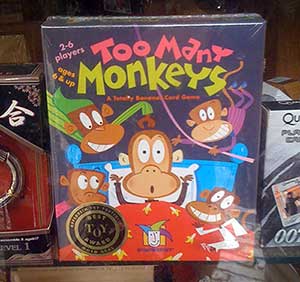
Adventures in Europe, Chapter 34: Too Many Monkeys!

The day after our nocturnal traipse around London’s gristly but sadly amber-free sites-of-historic-horror-cum-tourist-attractions and equally livestock-free Tower Bridge, your humble scribe awoke and, after tea and eggs (marred only by the horrifying sight of seinneann_ceoil‘s flatmate digging into black pudding with gusto) travelled to the House of Joy, the domicile of emanix and company, for a stretch.

The House of Joy has since, I’m told, relocated to a different house, and seinneann_ceoil is now a resident therein, so it would be rather an easier journey to make now. As it was, it required some faffing about on the London Underground, which is interesting from a Yankee perspective on account of its efficiency (relative, at least, to Portland’s public transportation system) and for its maniacal and almost reckless disregard for the safety, well-being, and limbs of its many passengers.

Here in the US, where we prefer not to dismember the public in public (but prefer instead to starve them to death and deny them medical care so that they die in private instead), we build subways that have little folding stair-step things that extend when the cars stop, so that folks don’t fall down between the car and the landing and end up getting run over on the tracks or something. On the Underground, they will have one of that highfalutin’ engineering; instead, they leave a gap between each car and the subway platform that’s just about the perfect size to devour one’s leg, one’s child, or one’s Jack Russell terrier, and play a recording of an English gentleman saying “Mind the gap. Mind the gap.” over and over again as the train arrives. Presumably, folks who don’t heed the warning and fail to mind the gap are removed from the gene pool, for the greater good of the Kingdom or something.

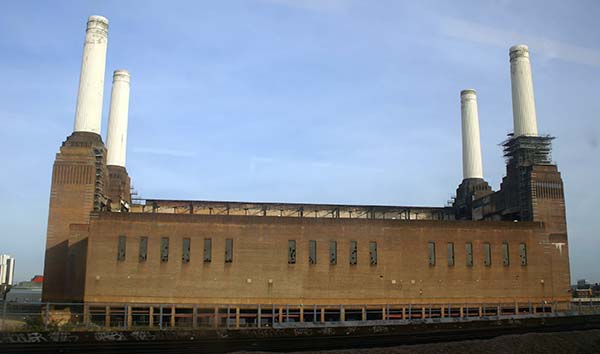
Along the way, I passed the long-disused Battersea Power Station, an old decommissioned coal-fired power plant that was the inspiration for the design of Allied Advanced Power PLats in the real-time strategy game Command & Conquer: Red Alert. It was a beautiful sight to behold, and made me long for the days when I would hear the oh-so-British computer tell me “New Construction Options” or “A-Bomb Ready.”

Once at the House of Joy, seinneann_ceoil left me in the tender merciless hands of emanix for a time.

Her bedroom is, or rather was (in the old house) on the top floor, rightly lit by large skylights. I say this because I quite like skylights, and I have been lobbying zaiah to install some in our house, which we are currently remodeling into a dungeon (as those of you who read my Twitter know). zaiah believes that skylights inevitably leak in rainy climates–something that the skylights in emanix‘s room do not. Apparently, it’s all about the engineering, or something.

We spent the day lounging around, having slinky hex and faffing on the Internet. I got to learn what it’s like to be the object rather than the perpetrator of needle play, which was…interesting. Interesting, and more than a bit scary.

Which reminds me, I still have the story of the lemon drop at the lesbian Halloween party to write about at some point. I’m not quite sure why I tend to end up surrounded by women who enjoy scaring me, but it seems to happen quite a lot.

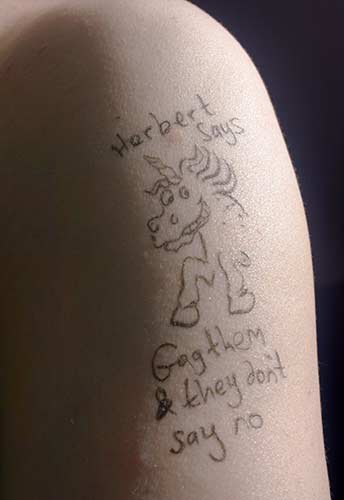
I also met emanix‘s tiny stuffed unicorn Herbert.

I’m not quite sure exactly how it happened, but we ended up talking about creating a cartoon character based on Herbert, named Herbert the Rape Unicorn. The original conception involved creating a Web site that would mock common rape-culture ideas (like “if she dressed that way, she obviously must have wanted it” or “If she led him on, then it’s her fault”), but we quickly realized that no matter how obvious or over-the-top the mocking was, someone somewhere would probably take it seriously and walk away with precisely the opposite of the intended message.

emanix drew this cartoon on my arm, which is quite likely the only Herbert the Rape Unicorn comic that will ever see the Web.


Every city has That District. You know, the one where all the cool happening stuff…err, happens. In Atlanta, it’s Little Five Points. In Tampa, it’s Ybor. In San Francisco, it’s San Francisco. In London, apparently, it’s Camden.

After the slinky hex, needle play, and other miscellaneous goings-on which involved sounding and you probably don’t want to know the details of, seinneann_ceoil rescued me and whisked me back to her flat. Some amount of slinky hex, a great deal of cuddling, some British television, and another meal in which her flatmate put something horrifying beyond the measure of man into his mouth later, we opted to venture to Camden.

Which was pretty damn cool, really.

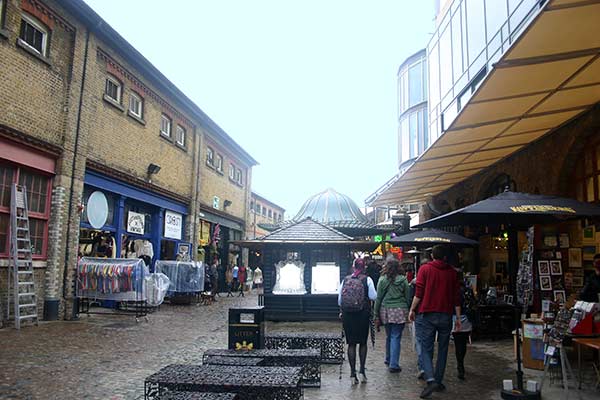
We met up with emanix in Camden, in a sort of Gibsonesque ramshackle assortment of repurposed shops offering T-shirts with political slogans, cheap sunglasses, jewelry, posters, and the opportunity to have your feet nibbled by fish in large tanks of water.

I’m serious about that bit about the fish, by the way. One of the shops we passed had big tanks filled with small fish similar to the ones that tend to cling to the undersides of sharks. For a few pounds Sterling, you could stick your feet in the water and let the fish “exfoliate” your skin. Apparently, it’s all the rage amongst people for whom it’s all the rage.

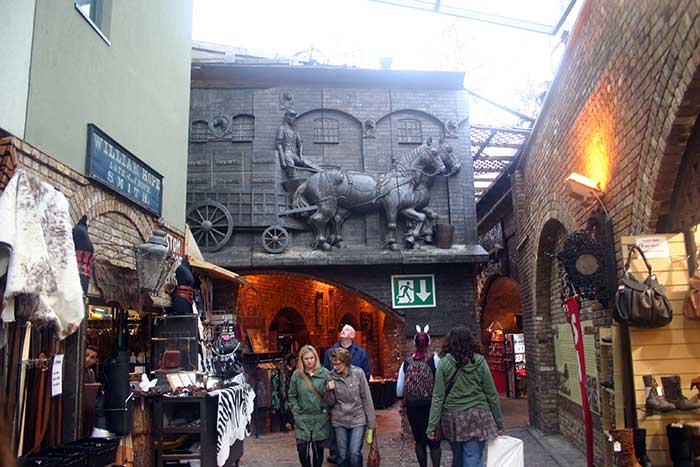
The place is a weird mix of Victorian-ish sculpture, most of which seems to concern itself with maidens and horses, and neon signs…making it, really, quite like a perpetual steampunk science fiction convention.

She has a gaze that suggests she’s seen it all, and a complexion that suggests quite a lot of it involves pigeons.

Or maybe those are tears, one for each pigeon she has KILLED AND DEVOURED DURING HER UNHOLY ANIMATED RAMPAGES IN SEARCH OF THE SECRET TO ETERNAL LIFE. I don’t know.

The horse sculpture is kind of cool.

It’s always nice to see some commemoration of the life and toil of the essential working man. The working man depicted here would probably have preferred a pay raise to a bug relief erected in his honor, but one takes what one can get.

Maybe I used…

…but isn’t it enough to know that I ruined a pony making a gift for you?

At one little booth, we found a series of prints of grafitti art by the British artist Banksy, who does some really mind-bogglingly amazing stuff. seinneann_ceoil bought me a print of his “There Is Always Hope” piece, on account of ’cause it totally makes me cry.


Exploration of Camden complete, we went off to a university in London-town which was evidently hosting a series of lectures on sexuality and society called Critical Sexuality, or CritSex for short, which sounded like quite an interesting way to spend an afternoon.

The timing of my visit was fortuitous, as it turned out, because apparently they host these things only once or twice a year or something.

We traveled to the university (mind the gap!), whereupon I saw two things that struck my attention.

The first was in the foyer of the lecture hall, before we’d actually got as far as the room where the CritSex lectures were to take place. I saw, for the first time, a woman wearing a full burqa. Not just the head shawl and cloak, but the whole, top-to-toe deal, that even included the chadri that totally obscures the face, including the eyes.


And it was, if I may put it delicately, profoundly fucked up. Seriously, deeply fucked up beyond any rhyme or reason.

Now, I have heard it argued that one can not impose the value system from one culture on another culture. I have also heard that the burqa is ennobling and liberating to women, because it frees them from having to compete in the arms race of sexualization in order to feel that they have value.

To both of those things, I say bullshit. Absolute, unmitigated piles of fresh, steaming bullshit.

First, to the cultural argument: The notion that human beings are persons inherently worthy of being treated with dignity and respect is not a cultural artifact, like a style of watch or the design of a sofa. It is absolutely possible, without resorting to appeals of invisible sky-beings or the trappings of tradition, to construct a rigorous moral framework that demonstrates the benefit of this idea. One need only look at history, at the fact that people of all kinds have tangibly and materially improved the lot of the human race as a whole, to see that any society which deprives itself of the contributions of entire classes of its members harms not only the groups so discrimated against, but itself as a whole as well.

The first surgeon ever to perform open-heart surgery, Dr. Daniel H. Williams, was black. Alan Turing, the man who arguably won WWII for the Allies, was gay. Double Nobel Prize-winning physicist Marie Curie, who not only developed the first understanding of radioactivity but also pioneered radiation treatment of cancer, was a woman.

Any society that cuts itself off from some portion of its members, deprives itself of the benefits, innovations, and discoveries those people might make. Women can fly fighter jets, lead nations, explore space, build buildings, design bridges, fight fires, create art, and discover new medical techniques. The notion that one society can utterly quash the most basic and essential of all human liberties for half its population, ad then claim it to be merely a “cultural value” neither better than nor worse than any other society’s values, is absolute rubbish of the highest order. “Cultural values” are not and can not be the excuse for atrocity, the justification for oppression.

The same goes for the notion that wearing the burqa is somehow empowering or liberating to women. Leaving aside for the moment that the whole purpose of this garment is to dehumanize women, on the grounds that the sight of a woman will drive men to sin (and how many shades of fucked up is THAT notion?), let’s be perfectly clear on one very important key point here:

You do not, BY DEFINITION, empower someone by saying ‘If you don’t do what I tell you to do I will stone you to death.’

That is, in fact, precisely the opposite of empowerment. Empowerment lies in giving people greater control and more choices in their lives, not in killing them if they fail to wear what you want them to wear. Remember that should anyone try to argue that the burqa represents empowerment; You do not, BY DEFINITION, empower someone by saying ‘If you don’t do what I tell you to do I will stone you to death.’ That includes any rationalization of the ‘do what I tell you to do’ part whatsoever, whether supposedly handed down by an invisible sky-being or not. It certainly applies to any reasoning that concludes with “No man should see a woman nor hear a woman’s footsteps lest it excite him. Women must not speak loudly in public as no stranger should hear a woman’s voice.”

It’s difficult for your humble scribe to even conceptualize in the wildest flights of fantasy the sort of topsy-turvy, up-is-down universe in which any of this could be called ’empowering’ by any person with even the slightest modicum, however small or insignificant, of sense.

The other bit was cooler. One of the presenters that the CritSex lectures we attended used my map of human sexuality in her presentation. So, yeah.

And that, save for a flight out of London the next day and a miserable 20-hour layover at the airport in Copenhagen, brings me to the end of my travels in Eastern and Western Europe. I arrived, after a total of eighteen hours’ travel time, back in my home town of Portland, on a cramped flight with my knees in my nose and no power outlet at my seat for my laptop; my luggage, which had somehow ended up flagged for a hand search at customs in Atlanta, arrived approximately seven hours later. (It was, according to a Delta representative, somewhere over Wyoming as I was arriving at my house, having opted after being searched to take entirely a different route home.)

Some Thoughts On Being Amazing

There’s a graphic floating around on the Internet right now that’s kind of bugging me.

It’s a pretty enough image, don’t get me wrong. It shows a beautiful woman standing in the falling snow, with words over it. The words are all spelled correctly, there’s no extraneous “Warning, the letter S is approaching!” apostrophe where there shouldn’t be one (the prevalence of which in common use is itself an ongoing source of annoyance to your humble scribe), and it uses a lovely script font. I’m not going to bother to re-post it here, but overall it’s not a badly done bit of Photoshop.

What bugs me is what the words say. They, read, in that lovely script font:

If She’s Amazing, She’s Not Easy.
If She’s Easy, She’s Not Amazing.

And it pisses me right the fuck off.

Now, I don’t know if they mean “easy” as in “sexually promiscuous” or “easy” as in “easy to get close to.” It doesn’t really matter; both readings are pretty odious.

On the surface, I can kinda see what the artist intended, sorta, maybe. He or she was probably driving at a point that, in all fairness, is reasonable; if you think a person is amazing, you should be willing to invest in her (or him), and not necessarily to expect that a relationship will come easily or without effort. To some extent, it’s a fair point; things worth having are worth working for.

But regardless of whether or not the unknown artist intended to make that point, I don’t think it’s the point that is actually being made.

If She’s Amazing, She’s Not Easy.
If She’s Easy, She’s Not Amazing.

Taken on its most superficial level–that is, with “easy” meaning “sexually promiscuous”–it’s simply old-fashioned, sex-negative slut-shaming of the most boring and tedious sort. I’ve met some folks who are sexually “easy,” at least for the right partners, who are pretty bloody amazing, thank you very much–smart, educated, driven, successful, literate, happy, fulfilled, insightful, incisive, and on at least one occasion even quite skilled at spinning fire. To suggest that a woman’s amazingness varies directly with how tightly she keeps her legs closed is misogynistic, sure, but it’s such a banal, humdrum sort of misogyny it’s scarcely even worth talking about. Either the essential stupidity of such an attitude is glaringly self-obvious to someone, or it’s entirely inaccessible to him. Either way, it’s so lacking in subtlety or depth that it’s not even interesting.

And it doesn’t even exaggerate misogyny to the point that it becomes social commentary, making misogyny a target of sarcastic ridicule the way this graphic does1.

But I am willing to give the person who created it the benefit of the doubt, and assume that such a blatant reading of sex-negative claptrap isn’t what was intended.

I think, though I could be wrong, that rather than trying to be patriarchal and sexist, the person who created the image was trying to say “An amazing woman won’t be easy to get close to, so one should be prepared to put in the work; a woman who is easy to get close to isn’t going to be nearly as amazing.”

And even that reading is pretty fucked up, if you ask me.

If She’s Amazing, She’s Not Easy.
If She’s Easy, She’s Not Amazing.

The first thing I thought when i read this was, “easy to who?” A person who is amazing might very well be easy to get to know and to become close to, if she finds you to be amazing as well. On the surface, there seems to be a very deeply buried, tacit subtext of “I’m not terribly amazing myself, so it sure would be hard for me to get the attention of someone who is.”

And hell, sometimes being a person who takes risks, who engages the world, who is open and transparent, who is willing to run the risk of living a life unencumbered by a fortress of walls and defenses, is part of what makes a person amazing. Even my pet kitten, who lives in a world that is filled with joy and for whom every new person is a friend, knows that.

The flip side, the idea that a person who is easy to get close to won’t be amazing, is not only absurd, it’s a slap in the face to those who are amazing and who choose to live their lives openly and without fear. Writing off a person as not being sufficiently “amazing” merely because that person is easy to engage seems to me to be profoundly short-sighted.

There’s a deeper, more sinister kind of yuck buried in the sentiment as well.

If She’s Amazing, She’s Not Easy.
If She’s Easy, She’s Not Amazing.

Tucked neatly beneath the surface of this sentiment is an underlying assumption: that it is her job, as an amazing woman, not to be easy, and it is your job, and the person who is attracted to amazing women, to work to pierce that wall.

Yep, it’s the same thing we see in Chanel ads and swing clubs and women’s magazines at the grocery checkout: women are the gatekeepers, men are the pursuers. She is amazing, and her role is to make pursuit of her hard; you are the schleb who wants her, and it is your role to pursue her until you wear down her resistance. Don’t settle for second-best! Don’t take the woman who’s easy to catch! She won’t be as amazing as the woman who is.

And that kind of gender-stereotypical rolecasting is, if anything, even more corrosive than the simpler, more boring kind of misogyny in the first reading. The fact that the elegantly-dressed woman in the photo, standing out in the snow in her expensive cocktail dress, was conventionally pretty in the bland sort of Vogue-esque kind of way, sort of underscores that point a bit.

At least I think so, anyway. But then, I seem to have a statistically disproportionate number of amazing people around me, so perhaps I’m just jaded.


1 At least, I assume the Cinderella image is intended to mock misogyny. It certainly feels like social-commentary-through-comedic-exaggeration to me.

How to Tell When Your Executives Aren’t Worth Their Salaries

So far, I haven’t been too impressed with these things they call “seasons” out here in the Pacific Northwest. In Florida, we all know how it’s supposed to work: we don’t have seasons, we have weather. Sometimes, that weather is hot, and other times it’s brutally hot, but at least we know what to expect. And so do building contractors, who put central A/C into every building in Florida, no matter what it might be–home, office building, store, garden shed, doghouse, whatever. If it’s got four walls and a roof, it’s got air conditioning.

Now the pacific northwest doesn’t much cotton to such fancy modern amenities as air conditioning. They claim it’s because the weather is always mild here, except when it’s not, and so they don’t need it, except when they do.

Last week was a week when they did. Here in the Portland suburb I live in, the temperature reached 110 for two days in a row, then settled down to a nice cool 107 for a few days. I’m told this is unusual, and during those same days Seattle set a new 118-year record. Whatever.

Say you live in a place where the temperature is in the triple digits during the day, and descends all the way down to 98 at night. Say you don’t have air conditioning. At this point, you face a predicament: you can buy an air conditioner and live in comfort, or you can suffer all day and wake at night every six minutes or so in a pool of your own sweat and tears.

An air conditioning unit can be had for a hundred bucks and change. Given several days in a row of back-to-back triple-digit weather, I bet you can see where this is going, right?

If you guessed “a total and complete failure of the free-market system of capitalism,” you guessed right!


The heat created a demand for air conditioning units. And if ol’ Adam Smith here is to be believed, that demand would naturally lead people who sold air conditioning units to make them available. Those folks make money; the folks who buy ’em have an improvement in their quality of life; the invisible hand makes everything win-win, right?
Well, ‘cept for the inconvenient fact that large corporations tend, by and large, to run on inertia.

You’d think that companies that sold air conditioners would respond to the demand by supplying them–and you’d think wrong. See, a big company tends to settle into a Way Of Doing Things. They develop supply lines,a nd warehouses, and inventory, and distribution channels, and shipping lines, and those things take on a sort of momentum of their own.

So when there’s a sudden spike in demand for a product, most companies don’t really rise to the occasions. Oh, sure, they’ll look in the warehouse and ship stuff out if they’ve got it, but that’s about it.

Last week, you could not find an air conditioner for sale in Portland for love or money.

Which is silly, and a failure of capitalism.

See, if I were an executive vice president at Home Depot, I’d say “We’re selling out of this product as fast as we can truck it in. Okay, screw our normal warehousing and distribution network. Underlings, do whatever it takes to load up some trucks with this product and get it into town by tomorrow.”

But, like I said, companies over a certain size operate on inertia, not on the desire to meet a demand with a product or service. What actually happens is more like the executive vice president says “I could spend my entire night here in the office instead of at home working out how to get an extra truckload or two of product to where it’s selling, but what’s the point? What will the company make…an extra four million dollars? Five million? Hell, that’s barely a rounding error. It sure as hell isn’t worth me spending all night here.”

So you get Capitalism Fail.


The notion that businesses succeed by doing their best to provide a good or service that is in demand with greater efficiency and better value than their competitors is a charming myth, much like the notion that an invisible fairy will descend on gossamer wings to give you money or, I don’t know, blow you or something when you lose a tooth. Hell, even Wal-Mart, which is nominally a capitalism success story (for some value of “success story” that involves child labor violations, anyway) fell down on the job.

We eventually got our hands on one, which has been improving the quality of our lives ever since, but damn. Not capitalism’s finest hour.

Score one more for the good guys!

According to this article on CNet News, the Federal Trade Commission has just shut down an ISP called Pricewert, which had sought to act as a one-stop shopping center for spammers, child porn, botnet operators, and virus and malware distributors.

Pricewert operated as a Web host under a bunch of different names–3FN.net, Triple Fiber, APS Communications, and a bunch of others.

I first became aware of 3FN back in February of 2008, when I started seeing spam for all kinds of porn sites hosted on their IP space. The spam I saw generally involved URLs hosted on 3FN that redirected to the affiliate sites of large pay-for-access porn sites–a common spam tactic I’ve seen before, especially from big-name offenders like Streamate.com.

Pricewert/3FN’s business extended well beyond spam, though, and into hosting for botnet command and control servers, virus droppers, malware distribution, and even kiddie porn. In other words, about business as usual for an ISP in a place like the Ukraine or Latvia, but somewhat surprising for an ISP in the US. (Somewhat surprising, at least, until you consider that the founder of Pricewert/3FN was from the Ukraine, where the business culture is such that hosting malware, child porn, and botnet control servers is part of any ISP’s normal revenue stream.)

And here’s the part where I get all Ranty McRanterson.

What’s really, really, really disappointing to me is how poor the US ISPs and backbone providers are at policing themselves, and how even egregiously illegal activity is tolerated by the vast majority of Internet service providers.

3FN’s upstream providers knew that 3FN was a rogue ISP hosting criminals involved in spam, viruses, and malware. I know for a fact that they knew this, because I told them myself, with detailed evidence. In February of 2008. And in March of 2008 (four times). And in June of 2008. And in July of 2008. And in…well, you get the idea.

There is, in the world of ISPs and Internet connectivity, a tacit understanding that any sort of illegal activity, including identity theft, malware, fraud, and computer virus distribution, will be tolerated so long as it doesn’t create too big an uproar and so long as ISPs occasionally move the offenders around from one IP address to another. Even child pornography is not going to create a problem so long as the hosting ISP removes or moves the child porn if they receive complaints.

ISP abuse employees do not generate revenue for an Internet company. In fact, they cost a company revenue. For that reason, ISPs will often hobble their own abuse teams (I sent seven complaints to one ISP about a hacked server on their network over a period of two months, only to be told that the abuse people were not permitted to take down the server until eight weeks after they had notified the owner to fix the problem–which is about like calling the fire department because your neighbor’s house is on fire and the flames are spreading to your house, only to be told that the fire department would mail a notice to your neighbors, and would send the trucks out in eight weeks if the neighbors hadn’t taken care of the problem themselves by then).

ISPs make money by selling hosting and bandwidth to people. Every site they take down is lost revenue; every downstream service provider they cut off is a lot of lost revenue. They’re not going to lose that revenue unless they’re forced to.

Case in point: The rogue hosting provider McColo, which was notorious for hosting child porn, computer viruses (they were a preferred host for the Russian Zlob gang and for the Asprox virus gang), and credit card identity theft rings (Fraudcrew hosted sites on McColo), yet remained merrily in business, with no problems from their upstream providers, for four years in spite of the fact that it was widely known and publicized that McColo catered exclusively to criminal clientele.

And, sadly, that’s the norm, not the exception. Upstream and backbone providers will cheerfully provide connectivity to known-rogue ISPs even though the rogue ISPs violate not only the law but also the upstream providers’ Terms of Service. Global Crossing, a mainstream, respectable business, knew that McColo was hosting computer viruses and child porn; they simply didn’t care. The money of organized crime spends just as well as the money of honest businesses, and often there’s more of it.

In the ISP world, often government intervention is the only way to shut down these operators. History has proven, conclusively, beyond all shadow of doubt, that ISPs and connectivity providers absolutely, positively can not be counted on to police themselves; left to their own devices, they will permit just about anything to happen on their networks. The ongoing corrupt business practices of US ISP Calpop, for example, is ample proof of that.

It pisses me off to no end to see an entire industry that has, for all intents and purposes, quietly agreed to permit organized crime, identity theft, and child pornography on their networks as long as there’s not too much of a fuss about it, and to take action only against the one or two most extreme offenders after many years of operation. While I do not normally see government intervention as a good way to solve business problems, in this case I do not believe the ISPs will ever police themselves effectively, or even want to; there’s too much money in allowing this sort of network abuse. Given how widespread the problem is, I do not think there is any solution other than tighter regulation of criminal activity on the backs of ISPs’ networks.

Fragments of Portland: Security and Friends

Getting to Portland from Atlanta is a lengthy proposition. Getting back to Atlanta is a slightly less lengthy proposition, if one does what I did and misses one’s flight.

On the return trip, I was scheduled for three layovers and a total of nearly twelve hours in transit. However, I managed to miss my flight, and as a result flew standby on a one-layover route that was about two and a half hours shorter. So, win!

In fact, if that’s what I can expect, I may have to miss my flights more often.

Portland itself was a blast. On top of being able to spend ten days with my sweetie zaiah (and what could top that?), I got an opportunity to meet a bunch of folks I’ve known for a long time online but never met in person before, and a chance to catch up with the_xtina for a bit, and even made some new friends (waves to gidget23. More on that later.

First, I’d like to take a few minutes to talk about our friends in the TSA.

Now, these folks have an important job. They help calm nervous travelers by providing the illusion of security at airports. Mostly, they do this by sifting through baggage all day long. It’s a thankless task; and it’s hard to imagine that they don’t get cynical about it.

Realistically, the odds of a plane being blown out of the sky by a terrorist bomb are about the same as the odds that your grandmother can beat Mike Tyson in a no-holds-barred steel death match, armed with nothing more than a bent straw and a plastic spoon from Taco Bell. I’m sure there’s a grandmother or two out there who can do it, and planes have been brought down by bombs, but seriously…is it going to happen? Really? Don’t hold your breath.

These folks have never seen a bomb, they will never see a bomb, and they know it. But they still gotta sit there for eight hours a day anyway.

Alright, alright, yes, I know. Part of the point is deterrence. They don’t find bombs in luggage because the fact that they’re looking for it means that the folks who might have the urge to blow up airplanes don’t put bombs in luggage, ’cause they know it won’t work.

But bear with me a minute, here.

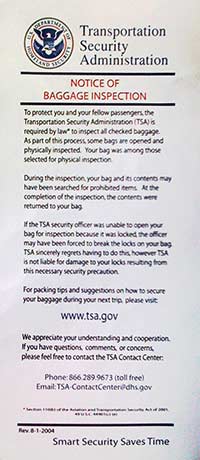
These guys have a boring and mostly pointless job (save for the deterrence effect), and they need some way to amuse themselves while they’re manhandling checked luggage through oversized X-ray machines. Which they get by putting notices like the one on the left into your baggage to tell you that they’ve served the national interest by checking your underwear to make sure that it won’t blow up or, I don’t know, invade France or something.

And I suggest for your humble approval the notion that they do not select the baggage to search at random.

I found the note shown here in my suitcase when i reached Portland. Now, a quick X-ray plainly showed there was nothing in my luggage that could possibly go boom–not that TSA screeners necessarily have the foggiest notion of what a bomb looks like, but still.

They had, however, completely removed every single item from my suitcase. Including, among other things, a pair of handcuffs, all my clothes, a heavily modified Feeldoe, a box of rubber gloves, my entire collection of floggers, ten rolls of vet wrap, my toothbrush, and a box of sterile needles.

Not only that, but they unrolled my flogger case to see what was inside. (I carry them in this nifty case that lays down flat and has slots and elastic tie-downs to hold all the floggers, then rolls up into a cylinder that can be slung over a shoulder.)

Not only that,, but they had removed the floggers from the case. I know all this because the floggers had been replaced in an entirely different order, and my bag had been completely re-packed.

And re-packed quite a bit more neatly than I’d done it to begin with, too, but that’s beside the point.

I submit, Gentle Reader, that within seconds of opening my bag, the TSA screeners knew beyond question that there was nothing in there that goes bang, boom, pow, kablooey, or even makes a low but sinister hum. I also submit that they continued to unpack my things anyway, simply because it amused them to do so. As proof of this idea, I propose that it is not necessary to remove a flogger from its carrying case to ascertain that it is not, in fact, a threat to national security, foreign relations, the national budget, or to anything else save perhaps the backsides of certain people who will remain nameless at this time.

I have visions of the TSA employees holding up the various objects in my suitcase and asking “What do you suppose this is for?” or chasing one another around with them (ah, the hilarious hijinks at the airport!) or something. All in the name of national security, of course.

And I can’t help but wonder why it is exactly that these guys get paid on my dime.

And how much they make. ‘Cause, y’know, if they’re going to be doing shit like that, and getting paid for it, I want some of that too. Smart security saves time!

The hate for Internet Explorer, it burns!

Last night, I spent about a half an hour fixing some minor bugs in the interactive version of the Human Sex Map. Cleaned up the way the toolbar works when you scroll (so it doesn’t jump all over the place in some browsers) and fixed a minor issue in Firefox where it sometimes moves the pins three pixels down from where they should be.

And then I tested it in Internet Explorer.

And it was totally, utterly, completely broken.

Goddamn festering, pustulant heap of rotting garbage pretending to be a Web browser anyway. I will never, for the life of me, understand why people use that decaying mound of rubbish when there are Web browsers that actually work correctly that you can download for free. Everything the Internet Explorer development team knows about Web standards would fit in the white space of a postage stamp. If these guys had any decency or self-respect, they’d all ritualistically disembowel themselves on Google’s front lawn.

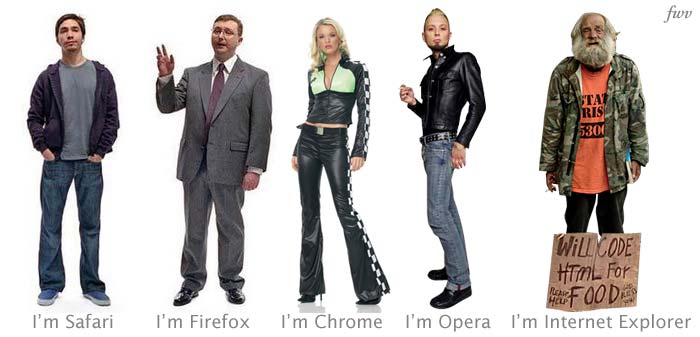
Words can not express my loathing, hatred, and contempt for that tottering mass of bugs and misfeatures that the folks in Redmond laughingly call a Web browser. It’s a mad sick joke at the entire Internet’s expense. So, I turn to a more visual communication medium:

It took me until six o’clock in the morning to code around all of Explorer’s bizarre bugs and rendering issues. Longer, by nearly an order of magnitude, than it took to make that picture. So if you tried to use the Map at all yesterday, sorry ’bout that.

Some thoughts on copyright, entitlement, and zero opportunity cost

One of our neighbors keeps trying to steal cable television.

We know this because our neighbor isn’t terribly good at electronics or even the most basic principles of electrical cabling. Our cable modem service keeps going out; last week, while I was visiting figmentj, it went out for three days (leaving my roommate David, whose car still hasn’t been replaced since it was totaled a couple months back by an unlicensed driver, without transportation or World of Warcraft).

The technical guy sent out by Comcast discovered that the main cable junction box feeding our apartment complex had been pried open, and the miscreant, in his clumsy and ham-handed efforts to steal cable, had made a right proper mess of the cable connections. Our cable connection had been cut entirely, and a much of the rest of the junction box had been screwed up as well.

Last night, just at the start of a boss fight in Heroic Pinnacle (that doesn’t mean much to you if you don’t play World of Warcraft, so substitute “a difficult situation where other players were counting on me”), it went out again. David ran outside to try to catch the miscreant, and discovered that the junction box had been pried open again and cables were strewn all over the place.

That’s not what this post is about. That’s just the back story.


This post is actually about intellectual property and opportunity cost. Now, before I get into a full-on rant here, I want to disclose something up front: I have a horse in this race. This is an issue that matters to me because I am a creator of work that is often taken without my permission, something I’ll get into in a bit. This is not an abstract thing for me; it’s something that affects me personally. If it sounds like I’m taking the issue of intellectual property personally, it’s because I am.

We live in a society that is very hostile to the idea of intellectual property. People tend, by and large, to think very little of stealing content; in fact, entire social systems have grown up around it. We are, by and large, okay with bootleg software, illegally downloaded music, and all manner of disregard for the intellectual property of others, in ways that would horrify us if they were applied to physical property.

This stems, I think, in no small part from the fact that we are as a society hostile to intellectual pursuits in general. It’s pretty tough not to notice that US culture today is steeped in anti-intellectualism; an anti-intellectualism so virulent that many folks won’t vote for a political candidate if he’s perceived to be too intelligent or too well-spoken. It’s not surprising that a society that thinks so little of intellectual endeavor should think so little of the products of that endeavor.

In fact, I’ve even heard people argue that intellectual property as a concept should not exist at all. In a strange throwback to Communist ideals, I’ve heard it argued that if a person dedicates twenty years of his life and his entire fortune to the development of a new idea or the invention of a new gadget, his knowledge and the fruits of his labor should be available freely to all, so that anyone who wants to make knockoffs of his invention or who wants to sell the results of his idea should be free to do so without giving anything back to the person who worked so hard to develop it.

I think that’s fucked up beyond all measure, frankly.


Now, granted, not everyone takes that extreme a view to the notion of ownership of the results of one’s cognitive labors. A much more common argument in favor of intellectual theft is the “zero opportunity cost” argument.

This argument goes something like: “Well, there was no way I was going to buy Photoshop. If I steal a copy of Photoshop, Adobe has not lost anything, because I was never going to buy it to begin with. Because Adobe has not really lost anything, no harm has been done, and it’s OK for me to pirate it.”

Same for copying music, stealing cable, or sneaking into the movie theater; “I wasn’t going to pay for those things anyway, so it’s not like they have lost any sales. They’re not losing anything, so it’s OK for me to do this.”

It’s a bullshit argument, front to back. The opportunity cost is rarely truly zero.

My neighbor is a great example. In his attempt to steal cable, he has damaged property not belonging to him, he has interrupted a service that I’m paying for, and he has made Comcast send out repair technicians twice now. (Tomorrow will be a third time; they’re replacing the entire enclosure around the cable junction box, because in prying it open he damaged it beyond repair, and the junctions inside are now getting rained on.)

It’s a bullshit argument even if the piracy doesn’t involve crowbars to someone else’s property, though. Take Photoshop (or don’t, please!). Most of the folks who pirate it are not professionals; they don’t do print production for a living. That means they don’t use, or even know about, anything even close to 90% of its capability; they have no need of a $700 image editing program, and there’s no question that Adobe is not out $700 for everyone who steals Photoshop.

What these pirates need is a $49 image editing program; and that’s a $49 image editing program they’re not going to buy because they stole Photoshop.

And hell, there’s a free image editing program called The GIMP that they can have for nothing, legally! It’s not Photoshop and it can’t do everything Photoshop can do, but the folks stealing Photoshop don’t need everything Photoshop can do.


But that’s not even the most important reason the argument from opportunity cost is bullshit. The argument from opportunity cost is bullshit because it rests on a sense of entitlement. Bluntly, you don’t have the right to benefit from someone else’s work without paying that person, even if you would rather go without than pay.

People steal intellectual property and people steal services because they want the benefit. They see benefit in owning Photoshop or having cable TV. Having these things makes their lives better in some way. And they feel entitled to that benefit; they feel that they deserve to have their lives made better from the labor of other people.

If I do something that has value, and you want that value, pay me. If you don’t want to pay me, then don’t take the value. You are not entitled to gain value from my work for free.

Even if–and I’m looking at the folks who steal music here–you think that the money I want is excessive or that I am unreasonable.

If you think that I am unreasonable and the value I offer is not worth what I am asking in exchange, that’s fine. Don’t take the deal. But don’t then also believe that you’re entitled to have that value, and you have a right to steal it just because you didn’t take the deal! You may think the RIAA is a bunch of asshats who wouldn’t know ‘reasonable’ if it bit them on the cocaine-powdered nose, and I’d agree with you, but that still doesn’t excuse the fact that you have no right to take value from them for free just because they’re asshats.


It gets simpler to understand when we think about tangible things. If I rent cars, and you sneak into my parking lot, you hot-wire one of my cars, and you take it for a joyride, then you return it to my lot the next morning and I don’t notice what you’ve done, you could argue that the opportunity cost was zero. I didn’t lose anything’ the car is still there, and you weren’t going to rent it from me anyway, right? You might even say I’m financially better off, if you fill the gas tank before you put it back so it has more gas in it the next morning than it did when you took it.

Yet reasonable people, even people who think that software piracy or theft of music is OK, would draw the line at this sort of behavior. I doubt that very many folks would say that taking my cr for a joyride was acceptable; the “zero opportunity cost” argument would not hold up. Yet it’s the same argument that folks use to steal intangible things all the time.


Now, on to the horse that I have in this race.

In the past few days, intangible theft has affected me twice. First, my cable modem service was interrupted because my neighbor thinks that theft of service is OK. (Which, I suspect, will soon become a self-correcting problem; the police and the cable companies take theft of service seriously, and I started the ball rolling on a theft-of-service investigation this morning.)

Second, because I create intellectual property. I create content in the form of software, such as my game Onyx, and in the form of a great deal of writing on a number of diverse subjects.

Now, I like to think that I’m a reasonable fellow. I don’t much like the way the software industry works, so I give away a limited version of my game for free. I don’t like DRM and Draconian copy policies, so I license the pay version to people rather than to computers–if you buy the game, you’re free to put it on as many machines as you own, under whatever operating system you like, and the same serial number will work on all of them.

I believe that outreach, especially on subjects like non-traditional relationship and lifestyle choice, is important, so I permit anybody who wants to to copy any of the information on my Web pages, provided they credit me for it. My BDSM and polyamory pages are wildly popular, and I get several requests a month to copy part or all of the site elsewhere. Go for it! Do whatever you want. You don’t even need to ask me first. Seriously.

You want to print my stuff out and use it as a handout at a seminar? Be my guest! You want to translate it into other languages? Go right ahead! You want to put it on your own Web site? No problem! Just credit me as the author. That’s not an undue burden.

Yet, even that is apparently too much to ask for some folks.


Lat week, I discovered that large sections of my BDSM site were being used on the commercial, for-profit site of a prodomme who makes her living from her Web site, and they were posted without attribution. I sent her a nice email explaining that I was fin with her using the material, but I’d really appreciate credit. She responded by saying that she’d never heard of me or my Web site, and that she hadn’t taken the material from me, she’d taken it from another site.

I looked, and sure enough, she had–she’d lifted it from another site that had lifted it without attribution. From, get this, still another site that had lifted it without attribution.

No honor among thieves, I suppose.

So I’ve spent, over the last day or so, about four or five hours working my way up the chain and sending out copyright infringement notices. And I bet that over the next week I’ll probably be hearing from a bunch of pissed-off people.

That seems to be how it happens. People do geniunely seem to have a sense of entitlement to the intellectual work of others; when I’ve dealt with this kind of thing in the past, it’s shocking how often someone will become angry, as if to say ‘how DARE you tell me that I can’t take material you have created and use it on my own pay-for-access Web site!’. It’s not just me, either. In any dispute over intellectual property, the person whose work has been stolen is often cast as the villain–in ways that they are not if, for example, someone has his car taken.

Which is weird, and more than a little fucked up.

And sometimes, it’s by folks who really, really ought to know better. One of the Web sites that has lifted content from me belongs to the Triskelion Society, a well-known and generally well-respected BDSM organization. (Edit: As it turns out, the material was given to the Triskelion Society by a third party claiming copyright; they were blameless and have since removed the material.)


I’m sure that there will be folks who think I’m being unreasonably hard-assed about this. After all, my own site is free; what’s the harm in taking content from it for their own site? It’s not like I’m losing money, right?

In the end, I think that it comes down to respect. We (well, generally, most of us) respect the property of other people, and the labor of other people, but it seems that same level of respect does not extend to the intangible creations of other people. The zero-opportunity-cost argument displays an appalling lack of respect for other people’s effort and creation; it essentially boils don to “I want this, but I’m not going to pay for it, so I should have a right to have it anyway.” It’s even worse when it’s dressed in the language of self-righteous indignation; there are many music bootleggers who will rail against the RIAA as a corrupt, archaic, greedy institution that exploits its own members (which is true) and doesn’t pay its own artists (which is also true), but the difference between the RIAA and the misic pirates is that the RIAA believes artists should be paid a trivial pittance, whereas the music fans, incensed by this arrogance, seem to believe that the artists should be paid…nothing at all.

Now, me, I don’t ask for money; I merely ask that work I created should be attributed it to me. And apparently that’s too high a cost for some folks–even folks who use my content to build Web sites that they do charge money for.

But after all, they weren’t going to pay me for it anyway, so I haven’t really lost anything, right?

Some thoughts on modern-day literature

There will come a time
This life you live
Will catch up with you
And no one will be left
When honesty is blind
In ignorance exist the fallen.
We’re begging for the truth

I just returned from a trip to Chicago to visit dayo. The flight’s a little over two hours, plus ancillary waiting-about at the airport after passing through the absurd farce we laughingly call “security,” so I brought a book along with me.

I had quite a lot to choose from. I’ve recently received rather a large pile of books from Amazon, as a result of the not inconsiderable credit I’d built up with them over the past year.

The book I chose is one of the best pieces of literature I’ve read in a very long time. It follows, in a non-linear fashion, the story of a man–a soldier, and a veteran of several wars–who is running from something in his past. The narrative peels back the story of his life, through flashbacks and memories told so deftly that they make Faulkner’s The Sound and the Fury seem positively clumsy and hamfisted by comparison; the main character is illuminated in stages, bit by bit, with a sympathy and a narrative skill that makes every part of the book a delight to read.

The book is Use of Weapons, by Iain M. Banks, and there’s a reason it has not won a Pulitzer Prize. At the very least.

It’s not a very good reason, mind. But there is a reason, and that reason is quite simple: The story is science fiction.

Had it been set in any other genre, in any other setting, the book would be taught in college literature classes all over the country. Oprah would be discussing it on TV, and comparative lit classes would probably be putting the story alongside Tales of the South Pacific and March.

Had it been set in any other genre.

Night comes and the shadows fall
The lights appear
Across the city
I wonder where you are
The words you say are false
There is no compromise
No absolution.

The main character travels in a spaceship instead of a steamship; the battles in which he engages take place on distant planets, not distant continents. Because of that, the story is relatively unknown. And frankly, I think that’s a damn shame. It’s rare that so dark a journey into a character’s mind can be pulled off with such a light touch, and the author’s treatment of the main character is simultaneously sympathetic and unflinching–a neat trick, considering the book’s subject and the character’s history.

I think it’s interesting that even in this day and age we still make broad assumptions about classes of literary works. “This is Serious Literature; that over there is Science Fiction. Serious Literature is real literature; Science Fiction is mindless fluff for overgrown geeks who still play Dungeons & Dragons in their mothers’ basements.

It’s quite rare that a contemporary book can bridge the divide. William Gibson’s Neuromancer is one of the relatively few works of science fiction to be treated as Serious Literature; older works, like those of Jules Verne, occasionally get a nodding respect out of deference to their age, though rarely the respect they deserve. Spaceships and planets, it seems, aren’t thought of as appropriate settings for serious explorations of the human condition.

Which is odd, given that science fiction is arguably the most forward-looking exploration of a species that has over the past hundred thousand years carved its place in the universe by virtue of its ceaseless forward progression in its understanding of the physical universe.

To some extent, I suppose, it’s inevitable–much of science fiction tends to obsess over the nuts and bolts of technological ideas that don’t exist yet. Popular science fiction gives us the sterile banality of Star Trek, or the facile, juvenile universe of Star Wars, without depth or any apparent understanding of what it means to be human.

But pop literature of any sort can be argued to have that same flaw. It’s not like The Da Vinci Code exactly shines a spotlight on the nature of man, or The Bourne Identity plumbs the furthest recesses of the human spirit. Yet nobody would automatically place these works into a mental bin marked “Serious Literature Not Found Here.”

And that’s rather annoying, y’know?

Anyway, it’s a damn fine book, and one I recommend without reservation. Even to folks who think they prefer Serious Literature to Science Fiction.

Aaaargh!

*tests hackersluts.com on a bunch of browsers*

*notices weird display glitches in Internet Explorer for Windows*

*spends two and a half hours digging through the CSS*

*bashes head into desk*

*reads up on Explorer’s lame, braindead, broken CSS rendering*

*spends another half hour beating on CSS*

*cries*

Jumping Jiminy Christ on a pogo stick, how in the hell did Microsoft ever become the dominant force in the IT industry with such poorly-written, inherently broken, crap software? Internet Explorer…what a festering pile of crapware that browser is! Working around bugs in its CSS support is something of a blood sport in Web circles.

See, this is why all my other Web sites don’t use CSS.

*gets it to work, finally*