Polyamory and the Elephant in the Room

I’ve been a part of the polyamory community for a very long time. In that time, I’ve seen a lot of folks talk about how they feel when their wives or husbands or lovers or significant others take on a new partner.

Naturally, a lot of people feel fear and angst when it happens for the first time. We’re brought up to believe in all sorts of notions like Soulmates and The One and Happily Ever After, so of course when someone we love expresses an interest in someone else, it’s a bit scary.

On top of that, a lot of folks feel jealousy, especially early on in a new relationship; the new lover can be seen as competition, the Other, someone dangerous and scary.

But after a while most of us find that our lovers have new partners and, even if there are some rough bits early on, it’s not The End of Everything. Our fears don’t come true; our lovers don’t leave us as soon as they realize how laughably inferior we are in every imaginable way to The New Shiny, and life is still happy.

So folks who’ve been around the proverbial block a few times generally will say things like “Naah, it’s not that big a deal when my lover meets someone new. As long as it doesn’t threaten our relationship, I’m totally OK with that.”

And that’s not necessarily a bad attitude to have. In fact, I think being relaxed about the prospect of a new relationship is, generally speaking, a very good thing in poly relationships. I’ve talked before about how when we’re afraid or insecure about something, we can often make choices that make it more likely that the thing we’re afraid of will happen; if we’re afraid our partners will leave us for a new person, we might emotionally push our partners away, or try to impose unreasonable controls on their behavior, or just generally act out in ways that make us disagreeable to live with, and then yes, the new person starts to look pretty appealing in comparison.

But there’s an elephant lurking in the room, one I almost never hear anyone in the poly community talking about. And that is: Yes, a new relationship really is potentially a threat to the existing relationship, no matter how poly-skilled the folks involved may be.


So there it is, the elephant in the room. Put simply: A new connection, a new relationship, is a threat to an existing relationship…in the sense that any significant change in any relationship is potentially a threat.
Marriage counsellors and therapists have known this for a long time.

A new child often threatens a relationship. Loss of a child, doubly so, or more…many, many otherwise healthy, happy relationships between genuinely loving couples can be destroyed by grief or loss. A change in financial status is a threat to a relationship; I’ve heard it claimed that more people break up because of financial stress than for any other single reason. And, perhaps paradoxically, it works both ways; couples will often break up after a significant positive change in their finances, too.

An illness or infirmary is a threat to a relationship. Many people find it difficult to cope with stressors like long-term illness or debilitating injury.

A new job is a threat to a relationship. Moving to a new city is a threat to a relationship. A change in the religious beliefs of one or both people can threaten a relationship.

Even something as seemingly simple and straightforward as buying a house can be a threat to a relationship. I mean, hell, I’ve seen people break up over pets!

The point is, any change whatsoever to the structure of a relationship is a threat to that relationship, whether we acknowledge it or not. Taking a new job in a distant city and deciding to have a child are both significant threats to a relationship, but you will rarely hear people say “Okay, I guess we can move to Denver, but only if it doesn’t put what we have at risk” or “Okay, we can try for a baby, but only as long as it doesn’t threaten us.” We don’t think of these things as threatening, even though a glance at the statistics shows that they are.

We do, however, think of new partners as threatening, because they go right to the core of what society tells us is Bad And Scary. So we will say “Sure, you can pursue new relationships, as long as they aren’t a threat to our existing relationship”…but I don’t think that’s realistic. Of COURSE they are! They are a significant change in the emotional focus, composition, time, and attention. That makes them a threat to the existing relationship!


So there it is. I said it. I don’t think it’s realistic to say “I don’t mind new relationships as long as they’re not a threat.”

However, that doesn’t mean that I advise not doing it. Far from it! There are many things which we do all the time–have kids, buy a house together, take a promotion at work, start a new hobby–that potentially introduce stressors into our lives that could threaten our relationships, but that we choose to do anyway because they’re worth doing.

Since I find relationships to be one of the most rewarding parts of life, I think it’s worth the potential stressor in my existing relationships to be open to new relationships, and to have partners who are open to new relationships.

It’s scarier to acknowledge that any new relationship is potentially a threat tan to say “I am OK with my partner having new relationships because I don’t see them as a threat.” But I think it’s better to say “Any new relationship will potentially introduce new elements and new stressors to my relationship. I don’t mind, as long as I know that my partner is dedicated to preserving our relationship, and that my partner and I have the skills, the willingness, the desire, and the intention of making choices that will protect our existing relationship.”

In practice, there are a lot of things that I can do that will mitigate that stressor. One of those is to adopt a policy of resilience–to know that even if things change in my relationship, I will be OK. Another is to advocate for my needs; if I need something from my partner that I’m not getting, but I don’t ask for it, clearly and directly, then it’s not my partner’s fault if I don’t have it. Still another is transparency–always sharing with my partner, even things that might be hard to talk about or that I’m afraid my partner might not want to hear.

These tools don’t make it 100% safe for my partner to start new relationships. But then, nothing can do that; there’s no choice my partner makes that’s ever 100% safe for our relationship, and I think it’s time to acknowledge that.

Instead, what these tools do is they make it much less likely that my partner’s new relationships will actually end up damaging us. And, as a rather nice side effect, they also make it much less likely that any of life’s other stressors will threaten our relationship, too.

Some Thoughts on Radical Honesty

A couple of weeks ago, before I travelled to the UK, I was home watching old episodes of the TV show Bones on Netflix. If you’ve never seen the show, it’s about a beautiful forensic anthropologist with an inability to relate to other people’s emotional state that’s as tenuous as a BitTorrenter’s understanding of intellectual property, a dashing FBI agent who has a startling lack of ability to think outside the box, and the wacky hijinks that ensue in the world of forensic science because each is too cowardly to admit that they fancy the other.

One particular episode I watched centered around a group dedicated to the idea of “radical honesty.” As might be expcted from a mainstream television show written for a mass audience by generally competent but not particulalry brilliant writers, the show’s main characters spent some time debating the merits of complete honesty in interpersonal relationships, and wacky hijinks ensued. In the end, cultural norms were validated, the easiest answer was reached, the bad guy was arrested, and everyone was happy.

Something left me flat about the episode, and after processing it for a while, I figured out what it was. Any discussion about radical honesty invariably ends up getting framed as a question about whether or not being honest all the time is good, and that is a terrible way to look at the question.


It has been my experience that people dedicated to the Radical Honesty movement tend to be, not to put too fine a point on it, rather horrible people. Now, I’m sure there are absolutely lovely, smart, compassionate folks who are part of the whole Radical Honesty thing…but I have yet to meet any.

The folks I have met to advocate Radical Honesty tend to fetishize blunt, unvarnished, raw communication, at the expense of compassion or of any sort of concern for the emotional response of the people to whom they are speaking. Like the main character in Bones, they tend to display a lack of empathy toward their fellow human beings that, from the outside, borders on active hostility.

And that’s unfortunate, because it means that conversations about Radical Honesty almost always end up being framed in terms of “Is honesty good, or do we need little white lies and other small deceptions in order to make civilization go?” The debate gets set in terms of honesty vs. dishonesty, and that’s a damn shame.

To me, it seems self-evidently obvious that honesty in one’s romantic affairs is not just the best policy, it’s the only policy that’s likely to lead to healthy, secure relationships. Debating the relative merits of honest relationships is, to me, as pointless as debating whether “round” is a good general shape for a wheel.

I advocate, absolutely and without reservation, for honesty in relationships. That would, at first blush, seem to put me square in the same camp as the Radical Honesty folks…and I still can’t abide them.

To understand why, one need only consider the question “Does my butt look big in this?”


It is a fact of the human condition, as sure and immutable as the fact that night follows day: Whenever anyone discusses the idea of honesty in a relationship, at some point the conversation will turn to “Does my butt look big in this?”
Those who advocate for dishonesty will say that the easy, comforting answer, the flattering lie, is best. The Radical Honesty crowd will say that telling the truth gives the other person the opportunity to learn the valuable life skill of Not Taking Things Personally…and besides, you’re not responsible for someone else’s emotional state anyway.

And they’re both wrong.

The question “Does my butt look big in this?” is almost never about the clothing in question or the butt in question. (I won’t say it’s never about that; the speaker might be getting ready for a job interview or a date or something, and looking for advice on the most flattering outfit to wear. But that’s very situational.) Instead, the question is almost always about something else–a passive way to fish for compliments or validation, an expression of body-image insecurity, something like that.

The white lie–“Yes, dear, your butt looks magnificent!” if it doesn’t–does little to address the real issue. And the person asking the question is unlikely to believe the answer, anyway.

But the Radical Honesty answer is no better; in fact, it’s worse. “Your butt looks big no matter what you wear” also does nothing to address the real issue, but on top of that it’s pointlessly, needlessly cruel.

It is possible to be honest without being cruel. That’s the part the advocates of Radical Honesty rarely get right. “I like your butt better in the polka-dotted skirt” might be an honest answer. “I love you dearly; there’s no reason to worry about your butt, because that’s nothing to do with the reasons I love you” is another.

Honesty without compassion is rubbish. The question should not be framed as “Which is better, honesty or dishonesty?” but rather “How can we strive for absolute honesty in a framework of respect, compassion, kindness, and sincerity?” All too often, when the question is framed as Radical Honesty vs. The Little White Lie, the only compassionate answer is The Little White Lie, because the philosophy of Radical Honesty–at least as I’ve seen it practiced–treats compassion with disdain, or even contempt.


Honesty is the best policy. Being honest is an absolute prerequisite for healthy relationships. But honesty does not excuse indifference to the feelings of others. Poor behavior is poor behavior even when it’s wrapped in the cloak of honesty.

The same is true, I think, of many different ideas about relationships.

There are a number of relationship philosophies that I think are absolutely essential to healthy positive romantic relationships. Other than honesty, they include the notion of accepting responsibility for one’s emotional state, being willing to accept and work through issues such as personal insecurity, and being willing to accept responsibility for wrongdoing without externalizing blame, among others.

Essential to all of these, though, is compassion and respect for the particular feelings and experiences of other people.

Unfortunately, I have seen examples of situations where people use every one of these principles as a blunt instrument against others. Any one of these can be subject to the Radical Honesty Effect–enshrinement of the principle above the basic rules of decency, to the point where adhering to the principle becomes validation enough that compassion can be discarded.

I’ve seen the idea that we are all responsible for our own emotional state become distorted by the Radical Honesty Effect in some parts of the poly community, where it seems to be taken as a code phrase for “I can do whatever I want to you, and no matter how it makes you feel, that’s your shit to deal with, not mine.”

With personal responsibility, as with honesty, there are compassionate ways to interact with others, and there are ways that suck. The notion that we are all ultimately responsible for our emotional states does not, in point of fact, justify one in being an arsehole, any more than honesty does.

Radical Honesty can become an excuse to say whatever’s on your mind without regard to the effect your words will have. The idea that we are all responsible for our own emotions can, if not watchdogged, become an excuse to behave however you like without regard for the way it affects other people. Unfortunately, what that means is that debate about either of these things tends to get framed in some unfortunate ways–honesty vs. dishonesty, personal responsibility vs. projecting responsibility for the way you feel onto others–that miss the real heart of the matter.


The heart of the matter, as far as I am concerned, is “What can I do to make my relationships stronger, built on a foundation of integrity and trust, and to help the people around me feel supported, cherished, and loved?” I don’t feel that dishonesty, whether in the form of “little while lies” or otherwise, does that; but I also don’t think that saying “Man, that dress makes your butt look like two enraged hippopotamuses dueling with light sabers under a circus tent!” does that, either. I don’t think that enabling insecurity by accepting responsibility for the emotional experiences of my partner does that; but I also don’t think that saying “Tough shit, that’s your issue, you deal with it” does that, either.

It is possible to be compassionate without sacrificing any of these ideals, which is something I rarely seen talked about in any conversations about them. In the case of a person struggling with some kind of negative emotional response, it can be as simple as “I see that this is something you are having difficulty with. I want to help support you and give you safety while you come to terms with it. Let me know how I can make you feel cherished and loved. If you need more of my time and attention while you deal with this, I am here for you.”

The key here is that any philosophy, even if it is true, does not excuse one for being a douche. This probably should be self-evident, but apparently it isn’t.

So what IS wrong with rules, anyway?

I’m currently in the small coastal town of Brighton in the UK, a couple hours from London, staying with friends of emanix‘s. I’ve been severly jetlagged since I arrived in the UK; as near as I can tell, my internal clock, not sure whether to remain on Portland time or change to London time, has compromised by splitting the difference, and I am now on what would be a reasonable schedule if I lived in an empty spot of the Atlantic Ocean about 600 miles off the coast of New York.

As a result, I awoke at about 6 AM local time (or 10 PM Portland time) and couldn’t get back to sleep, so I turned to Twitter for solace.

One of the first tweets I saw asked a question about polyamorous relationships: If the people involved in the relationship are happy, what’s wrong with having a rules-based relationship?

Now, anyone who’s read anything I’ve ever written about relationships at all knows that I’m not a fan of relationship rules. To get a sense of why that is, one need only read here or here or..well, almost anything else I’ve ever written about polyamory.

But I still think it’s a fair question. As long as the people involved in the relationship are happy, what’s wrong with having a rules-based relationship? Is there really anything so bad about the idea of rules?

I thought about it for a bit, while struggling unsuccessfully to get back to sleep. And I think the answer is that yes, there is a fundamental flaw in the notion of rules-based relationships.

But before I get started on that, some background.


There are folks in the world who simply don’t like rules, and reflexively reject any form of rule as an unwarranted imposition on their freedom.

I am not one of those people.

My objection to rules in poly relationships does not come from an inherent dislike of rules in general. Far from it; when I first started this whole business of relationships, about twenty-six years ago, rules seemed like a natural and comfortable fit, a simple and obvious way to keep the relationships I was in stable and to keep the wheels from flying off unexpectedly.

And in fact there are quite a lot of rules in many parts of my life. I like games that have lots of rules. My relationship with zaiah is a strange switchy quasi-D/s thing that is evolving rather a complicated set of rules, which we have taken to writing down in a special book. So I’m not simply opposed to rules per se.

Also, I’m not much in to the notion of dictating to others how to live their lives, though I speak with certainty and as a result folks often believe I’m being prescriptive in the things I say. My ideas about polyamory tend to be predicated on what I have observed working and what I have observed not working; I’m enough of a pragmatist that what succeeds and what fails is much more interesting to me than what’s “right” and what’s “wrong” when it comes to relationships. (The definitions of “success” and “failure” are, of course, subject to interpretation, and that’s something I’ll touch on in a minute.)

All of my relationships have always been polyamorous. I have never once in my entire life had a monogamous relationship. Still, I did grow up in a culture where monogamy is the norm, and it seemed quite natural to me that such an unconventional relationship style must have some sort of system of rules in place in order for everyone to feel safe.

For many, many years, my “primary” partner (and yes, I did have a hierarchal primary partner) and I had a complex set of rules about who, when, where, why, and under what circumstances each of us could have another partner.

And it worked just fine for us, so there’s nothing wrong with that, right?

Except that, looking back, no, it really didn’t. And that brings me to reason #1 why I’m deeply suspicious of rules-based relationships:

#1. “It works for everybody” rarely, if ever, means it works for everybody.

It has been my experience that people who talk about agreements and rules which work for them usually–indeed, almost always–use a definition of “for them” that includes only “for the original people (often the original couple) in the relationship.” The impact of those rules on anyone who might come into the relationship later is seldom if ever considered. A person who enters the relationship is fenced in with a ring of rules, to contain and minimize the perceived threat that person represents; and if that person should find the rules unacceptable, or run afoul of the rules and then be ejected from the relationship, this isn’t seen as a failure of the rules. It’s seen as a failure of the person. “He isn’t REALLY poly.” “She was too threatening.” “He didn’t respect me.” Almost invariably, fault for the failure of the relationship is shifted onto that third person…but as long as the original couple remains together, the rules are working, right? And if the rules are working, what’s the problem, right?

Now, if I were to go back in time about ten or fifteen years and ask my earlier self “Are your rules working for everyone involved?” there is no doubt that that younger self would answer “yes” without the slightest hesitation.

At the time when i first started with rules, I believed they were necessary because, somewhere deep down inside, I believed that without them my relationship could not survive. Without rules, what would keep my partner with me? Without rules, how could I be sure my needs would get met? Without rules, how could I hope to hold on to what I had?

And I would have said that they worked for everyone, including my other non-primary partners, not out of malice but out of sincere belief, because…

…and this is a lesson it took me a very long time to learn…

it is almost impossible to be compassionate, generous, or empathic when you are filled with a fear of loss. So certain was I that the rules were necessary in order to protect myself from losing what I had, so afraid was I that without them I would lose everything, that not only did I not see the way those rules fenced in and hurt my other partners, I could not see it. It was as invisible to me as the concept of “wet” is to a fish.

Relationship rules and fear of loss often seem to go hand in hand in poly relationships. People who make rules don’t do it at random; they do it because, as was the case with me, it feels necessary.

We live, after all, in a society that holds very tightly to the notion of “the one” and “true love” and teaches us, from the moment we draw our first breath to the moment we take our last, that anything which interferes with the idea of couplehood represents a grave threat. Without sexual fidelity, there can be no commitment. Without commitment, there can be no safety, no security, no expectation of continuity.

Polyamory throws all that into question, yet we are still products of the ideas with which we’re raised; even someone who truly believes in loving more than one can fall prey to the idea that inviting someone else in is a threatening thing to do, fraught with peril.

Which brings me to reason #2:

#2. A rule can not, and never will be able to, fix insecurity.

Insecurity sucks. Believe me, I know. It’s one of the worst feelings in the world. When your partner does something that triggers a feeling of insecurity, the only thing you want to do is make that feeling go away.

It is natural, easy, and obvious to think that if your partner does something that brings on these awful feelings, if you pass a rule forbidding your partner from doing that thing, you need not worry about that feeling ever again.

So naturally, the rules that I had with my former primary partner largely revolved around things which triggered insecurities. Anything that felt like it threatened or diminished feelings of specialness, anything that seemed to take away from the things we most valued in each other, anything that got too close to home, anything that seemed to distract us from focusing on one another…all these things became fair game for rules-making.

These rules, of curse, were almost always applied to other partners rather than being made with other partners. We were the architects; other people were the subjects of the rules. Even when we negotiated them in the presence of “secondary” partners, it was very clear that they existed to protect us from them, not them from us. No matter how the negotiations were done, the power flowed in one direction only; they “worked for” a secondary partner in the sense that such a person could accept it or leave, no more. In that sense, they existed–deliberately, by design, though I would not have put it this way back then–to work against other people.

The idea that a system of rules can protect against insecurity, as seductive as it is, is ultimately bankrupt. The thing about insecurity is that it creates its own world. When you feel afraid of loss, or feel that your partner doesn’t value you, or feel that you’re not good enough, confirmation bias works its evil magic and you find evidence to support that belief everywhere.

Seen though the peculiar lens of expectation, everything becomes proof of your deepest fears. And no matter how many rules you pass, that never, ever goes away. The little fears whisper in your brain, all the time, like Gríma Wormtongue in The Lord of the Rings, planting its poisonous seeds in your brain. No matter how quickly you make rules to stamp out its triggers, the insecurity remains.

It is possible to overcome insecurity. I don’t think anyone ever really starts out secure and well-centered; it takes deliberate effort. I was not able to do it myself until the day come when I was able to take a leap of faith, cast aside the rules, and blindly trust that my partners loved me and cherished me and wanted to be with me despite all the fears that screamed in my face.

It took a tremendous amount of courage to do that. Which leads into the third reason I am skeptical of rules:

#3. Rules often inhibit growth.

There was a time in my life when I was dreadfully, powerfully insecure. I was never quite 100% sure why a partner would be with me, nor that if a partner were with someone else what she’d need me for.

Today, those feelings seem alien to me, like something that happened to some other person whose memories I have inherited but can’t quite connect with. Today, I build relationships that are powerfully secure, and I trust implicitly in my ability to construct a stable foundation of safety and security. More than that, though, I am secure inside myself. I am confident in my value, but also confident in my ability to grow and to be happy even if one (or more) of my relationships should happen to fail.

And indeed, that’s the only kind of security that is, or ever can be, real. No matter what promises I extract or what rules I make, there is nothing that can guarantee my lover won’t be struck by a bus, or develop a terminal disease, or even simply decide she’s had enough and leave. Nothing can ever keep me safe from loss; any such safety can only be an illusion. But I don’t need it; I know that should I feel loss, I may hurt, but I will survive, and ultimately I will be happy.

Many years ago, I had a friend who had an enormous pet iguana. Whenever she reached into its cage, it would lash at her with its tail. She would jump, then reach in again, and it would docilely allow her to pick it up.

On one occasion, after this ritual had played out, she said to me “I wish it would hit me, just once, so I would know what it felt like and I wouldn’t have to be afraid of it any more.” The older I get, the wiser that idea becomes.

There is a powerful lesson here. Just as you can never be compassionate when you’re filled with fear of loss, you can never be secure if you believe that you absolutely can not survive without your partner.

And you can never know that, or know that your partner truly cherishes you and wants to be with you, until you can gather the courage to face the fear of loss head-on, directly, no matter how much it scares you.

Until the day came that I was able to say “This scares the crap out of me, but I want to see if my insecurities are true, I want to see if what they’re warning me of will really happen,” there wasn’t anything I could hope to do to stop myself from being insecure.

And now that I have done that–now that I have slipped off the leash of rules and said to the people I love “Here are the ways you can cherish me; you are free to do whatever you want, to make whatever choices you think are necessary, and I will trust that you will make choices that show you cherish me”–I do not think I will ever feel insecure again.

It takes, unquestionably, a great deal of courage to step away from the safety and comfort of rules. However, once that is done, the fourth problem with rules-based relationships becomes obvious:

#4. The safety that is offered by a framework of rules is an illusion.

When I was in a hierarchal, primary/secondary relationship, the rules that my primary partner and I used to fence in secondary partners felt, to those people, like gigantic walls of stone and razor wire.

For the people upon whom such rules are enacted, that is quite common, I suspect. Such people rarely have a voice in those rules, and yet often end up hanging their entire relationship on the wording and interpretation of the rules, always knowing that a misstep or a changing condition can be the end of the relationship. Many folks who claim primacy in a primary/secondary relationship often say they need rules because otherwise they don’t feel “respected” by secondary partners, yet it’s difficult to be respectful when one feels hemmed in, encircled by walls, and knowing that one’s relationship is always under review.

But from the position of the primary partner in a hierarchical, rules-based relationship, I always knew that to me, they were nothing but tissue paper. The rules which were so immutable to a secondary partner applied to me only for so long as I chose to allow them to apply to me.

And when the day came, as it finally did, that I looked past my own screaming insecurities and my own well of fears for long enough to see–really see–what this structure of relationships was doing to my secondary partners, how it was constantly placing them in a minefield where what seemed to them like even a trivial miscalculation could bring down the wrath of the furies upon them, I decided that I could no longer in good conscience bear to subject people to this sort of environment, and I ended my primary relationship.

Just like that.

All the rules, all the covenants, all the agreements, all those things were no more effective at keeping me in the relationship, in the end, than a rice-paper wall is effective at stopping a charging bull.

Rules can not make someone stay. Once the decision is made to go, no rule will prevent it. That fortress that seems so impregnable, that seems able to give safety and security in a frightening world, is made of mud and straw.

Now, for folks who believe in rules-based relationships: Maybe your experiences are different from mine. Maybe you have rules that are considerate, compassionate, equitable, and kind. But are you sure?

If you were to talk to that version of me fifteen or twenty years ago, and ask him how he felt, he would absolutely tell you that all his rules were both necessary and fair. It’s a near-universal truth of the human condition that when you’re mired in your own emotional responses, it’s damn near impossible to see someone else’s. Even when partners told me that they felt unsure of their place in my life, or that the structures of my primary relationship put them in a tenuous position, it was easy for me to believe that the fault must lie with them and not with me…if I was even able to hear that much at all. It is very, very hard to understand your own strength when you feels weak, and to understand how you hold all the cards in an established relationship when you feel threatened by the newcomer.

The question “What’s wrong with having a rules-based relationship?” is absolutely a legitimate question to ask.

I’d like to flip it on its head and approach it from the other direction, though. Why have a rules-based relationship? What is the purpose of structuring relationships around rules? How, for those of you who feel the need for rules, would you complete the sentence “I have rules to structure my relationships because without those rules, the bad thing that would happen is ____?” What is it about rules that feels necessary, and how exactly do they serve to fill the function they are intended to fill?

Some Thoughts On Dating Black Belts

Many years ago, some folks on a mailing list I read posted a challenge: Write a biography of yourself in exactly six words.

I came up with “Much love, only a few mistakes.” Shelly suggested it should really be “I am not a beginner’s relationship.” As it turns out, both of those things are more closely related than they might seem; the missing bit that connects them was provided by an Aikido dojo I belonged to for about a year.

It’s not so much that I am not a beginner’s relationship, but that relationships generally, I think, go best when one makes a point of only dating people who have black belts at life. This is an idea that’s both simpler and more complex than it seems.


A lot of folks–including, to be fair, me, back before I started doing Aikido–have a mistaken idea about what it means to be a black belt in a martial art. The general notion is that once a person becomes a black belt, she has gained a mastery of the art, and is now an unstoppable ass-kicking machine. The reality is almost the opposite. Earning a black belt means that one has mastered the basics of the art–completed, essentially, the beginner’s level course–and is now ready to move on to the difficult (and more interesting) bits.

As my Aikido sensei used to say, “When someone earns a brown belt, they tell everyone. When someone earns a black belt, they usually don’t tell anyone.” Becoming a black belt means understanding how much there always is still left to learn; one of the things that goes along with being a black belt means knowing that there are still a whole lot of folks who are better at just about everything than you are. Mastery is a process rather than a state of being. And despite all that, people who’ve earned a black belt are expected to teach others, to lead boldly, even while being aware that having a black belt doesn’t actually signify mastery. (He was actually quite wise; he also used to say “Americans have bad knees,” which is undisputable in its essential truth.)

We have this image that someone with a black belt is a virtuoso, unshakeable in her grasp of the art, express and admirable in form and moving, faultless in every movement, infallible in the execution of every technique. In reality, black belts can fall on their asses just as well as beginners can; they’re just more likely to do it in complex and innovative ways, that’s all.

Which is not to say that there is no difference between a novice and a black belt. The black belt does have some mastery, but it’s a mastery of the basics, not a mastery of all that there is to learn. A black belt understands the general ideas, has a grasp of how to move through space, has an understanding of her body and the essential fundamentals of leverage and kinesthetics, and understands what it feels like to be moving in the correct way. Even if she’s falling on her ass while she’s doing it. (There are some wonderful outtakes from various Bruce Lee movies on YouTube, showing him, among other things, whacking himself with a pair of nunchucks and snagging his foot in his opponent’s shirt during a missed kick; Jackie Chan has injured himself so many times during missed grabs, falls, and in one case being hit in the head with a helicopter(!) that he’s broken nearly every bone in his body multiple times and is deaf in one ear.)

The point is that having a black belt doesn’t make someone infallible, nor mean that that person has entirely mastered everything there is to know about the art in question. It simply means that there’s a certain base level of competence that’s been established, though even the best black belts can still trip over the occasional invisible imaginary turtle shell and fall flat on their faces while walking across a perfectly smooth floor.

Which brings us to life, and why I’m not a beginner’s relationship.


I’ve actually had several partners tell me that I’m not a beginner’s relationship, in several different contexts. And I think it’s true. As a form of shorthand, I’ve long said that I make it a policy only to date grownups…but it’s occurred to me that I’ve only rarely thought about what exactly that means, and so it’s become a shorthand even to myself.
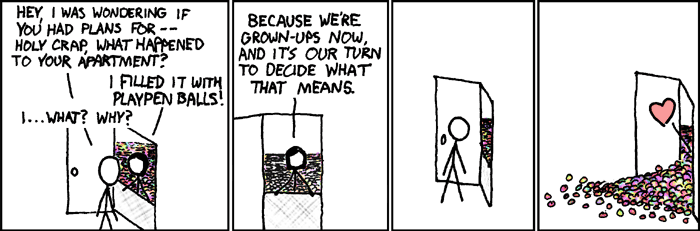
There’s been a bit more turbulence than I’m normally used to in my romantic life over the last couple of years, so I’ve been mentally chewing on what it means to be a grownup, and to choose partners who are grownups. The word “grownup” comes with a lot of attached baggage–we tend to think of grownups as being not a whole lot of fun, as being responsible rather than spontaneous, as choosing what’s most convenient over what’s most daring, as being more concerned about the mortgage than about making life worth living–and that definitely isn’t who I want in my romantic life. So these days I’m more inclined to say that I prefer to date people who have a black belt at life.

But what does that mean?

It certainly doesn’t mean someone who’s mastered everything that life can throw at them. That’s an unrealistic standard in the extreme, and anyone who thinks he’s reached that particular bar probably lacks imagination.

Rather, it means someone who has a handle on the basics. And I don’t necessarily mean the basics of filling out an application for title insurance or fixing a stopped-up drain, though those things are certainly good.

The basics I want in a partner are the basics of conducting a life with respect, compassion, and decency toward other human beings, which has a lot less to do with the mechanics of life and a lot more to do with the passion for life.

In a way, that’s a bit like porn. It’s hard to define precisely what that looks like, though I do tend to know it when I see it. Were I to make a list of the things that a black belt at life understands, it might include things like:

Feelings are not (necessarily) fact.

Just because I feel bad, that doesn’t necessarily mean that someone else has done something wrong. Just because I feel good, that doesn’t necessarily mean that what I’m doing is right.

There is more to life than avoiding awkwardness or discomfort. Sometimes, awkwardness and discomfort are an inevitable part of learning and growth. Sometimes, they point to places where I can improve.

There are better ways to deal with the things that I feel than to direct other people around or through my feelings.

Life is what happens to you while you’re making other plans.

The world is filled with beauty and chaos and joy and sorrow and pain and uncertainty and fear and ecstasy and heartache and passion. All these things are part of life’s song; to fear any of them is to fear life itself.

Life rewards those who move in the direction of greatest courage.

You can not expect to have what you want if you do not ask for what you want. Open, honest, fearless communication is not only the best way to build a healthy relationship; it is the only way.

Fear of intimacy is one of the greatest enemies of happiness.

Conflict is inevitable. We are all on different journeys, and sometimes there is turbulence between us. Dealing with conflict can be done without creating drama.

None of us is perfect. All of us makes mistakes. As grownups, we accept responsibility for our mistakes, without externalizing blame, and pardon reciprocally the mistakes of others.

The times when compassion is the most difficult are the times when it is most necessary.

Being slighted, offended, or hurt by someone else does not justify treating that person poorly. It is easy to vilify those who have hurt us, but they are still people too; even if we can not be close with them, even if we must be guarded, there is no rationalization for evil toward them.

Understanding one’s own boundaries is an important part of understanding one’s self.

Being uncomfortable is not, of and by itself, a reason not to do something, nor to forbid someone else from doing something.

Integrity isn’t in what you do when things are easy; it’s in what you do when things are hard.

Security comes from within, not from outside.

It is impossible to be generous if all you can feel is fear of loss. Things change; nothing is forever. Fear of loss robs us of joy and compassion.

Love is not scarce; it’s abundant. The greater you fear its scarcity, the harder it is to find.

Expectations, especially when unspoken or unexamined, can become a poison. Revel in what things are rather than what you want them to be.

A life of optimism leads to greater joy than a life of pessimism. Look for the best and you’ll often find it; look for the worst and you’ll often find it, too.

There is more to life than going from cradle to grave by the path of least resistance. Conformity is not a virtue, and open expression is not a vice.

To censor one’s self for the sake of propriety, expectation, or social norm kills the soul and drains the color out of life.

The world is the way it is, not the way we want it to be. Wanting something to be true does not necessarily make it true.

There are probably more, I’m sure.

Now, I don’t want to give the impression that being a grownup necessarily means mastery of every single thing on this list. Not every black belt can do a spinning back kick.

Nor do I mean to imply that perfection in all of these things is the minimum acceptable standard of performance. Many of the things on this list require constant practice; if there is a person in the world who has reached perfection in any of them, I have not yet met him. Or her.

Some of them are even things that I struggle with. Lately, for example, I’ve been feeling a bit of a tug-of-war between vulnerability and safety; in the past couple of years, I have made a conscious effort to allow myself greater vulnerability, and have been hurt because of it. I have not quite developed a solid set of skills for quickly evaluating who it is safe to be vulnerable to, as I have spent most of my life getting to know people slowly, over a long period of time. As a result, I have on a few occasions recently allowed myself to be vulnerable to people who have not treated me compassionately, and that’s something I don’t yet know how to handle with grace.

There is, I think, always one more thing to learn. Whether we’re talking about martial arts or life, there’s always a new lesson, waiting in the next fall or the next heartache. I don’t expect, or even want, partners who are perfect. In fact, I’d bet that anyone I meet who strikes my interest is probably better than I am at doing at least one of the things on this list, even if there are things on it that she hasn’t learned yet.

One part of the Dunning–Kruger effect is that people who are highly skilled often rate themselves poorly. It is okay for a black belt to have self-doubt; this is, like entropy, an inescapable part of existence. Understanding that, too, is part of being a black belt at life. I know that there are skills I still need to learn, but I am also confident that I have the ability to learn them. If there’s a foundation upon which all these other things are built, that is probably it.

If People Approached Monogamy The Way They Approach Polyamory

One of the frustrations of being part of the poly community is the number of folks who are already partnered and who want to try polyamory for the first time, but who approach the notion of opening their relationship in a way that makes experienced poly folks cringe. Often, it seems that these folks expect concessions from any person who wants to join their relationship that they would never have expected, or been willing to accept, from one another when they first met.

Now, to some extent that’s natural. There’s a learning curve to any relationship style, and we live in a society that deluges us with so many fairy-tale images of how relationships are “supposed” to go that the idea of stepping outside of those normal social paradigms can leave one feeling hesitant and a bit overwhelmed. Folks who already have a relationship want to try to make sure they don’t damage that relationship as they explore polyamory, but often in doing so they inadvertently set up their newfound poly relationships to fail.

If typical monogamous relationships were approached the way some folks approach poly, it might look something like this:

New poly couple
We have an amazing relationship and we want to make sure that nothing comes between us. So we only date as a couple. We’re looking for a bisexual partner who will date both of us. Since I’m a guy and my partner is a woman, as long as you’re bisexual that shouldn’t be a problem, right?

Monogamous equivalent
My friend Bill and I have been friends since high school. We have an awesome friendship, and we want to make sure that nobody gets between us. If you want to have sex with me, you have to have sex with Bill, too. Since I’m a guy and Bill is a guy, as long as you’re a heterosexual woman you won’t mind having sex with both of us, right?

New poly couple
We have a veto relationship. If someone tries to damage or undermine our relationship, we can use our veto to make sure we stay strong. This is important to make sure that new people respect our relationship.

Monogamous equivalent
My mom gets the final say over any of my girlfriends. If you try to undermine our family, my mom can tell me to dump you and I’ll do it. If you object to that idea, it means you don’t respect my mom. I would never date anyone who doesn’t respect my mom.

New poly couple
My existing relationship is always Primary. It will always take precedence over any secondary. If you date me, you have to agree to be a secondary relationship. That doesn’t mean you’re not important; it just means that my partner always comes before you.

Monogamous equivalent
I take my job very seriously. If you want to be in a relationship with me, you will always take a back seat to my work. It’s not that you’re not important; it’s just that my career is more important than you are.

New poly couple
Our families don’t know that we’re poly. They want us to be monogamous. It would kill them if they found out. All our friends are monogamous too. So if you date one of us, you have to be in the closet.

Monogamous equivalent
My family is Amish. All my friends are Amish. I’m not Amish, but I don’t want any of my friends or family to find out. If you date me, you will never be allowed to meet my family (or if you do, I won’t tell them who you are). You will never be allowed to meet any of my friends (or if you do, I won’t tell them who you are). I will not acknowledge my relationship with you. You will not be allowed to talk about me to any of your friends.

New poly couple
I am looking for a new sister-wife for a polyfidelitous family. My sister-wives must all be faithful to me. We will all be part of a close, nurturing family.

Monogamous equivalent
I am looking for a new Best Friend. If you become one of my Best Friends, you will not be allowed to have any other friends. You will be expected to be emotionally close to all my other Best Friends, though.

New poly couple
We want to make sure that we avoid jealousy when we explore poly. So we will only do things as a couple. Any sex or any activity that we do with a new person will only be done with all of us together.

Monogamous equivalent
My friend Bill and I have been buddies for a long time. I don’t want Bill to get jealous if I have a new girlfriend, so whenever we go on dates, Bill will come along with us. If I take you out to the movies, Bill will be there too. The only way that you and I can spend time together is if Bill comes along.

New poly couple
We are looking for a third to move in with us and who will want to be part of our family and share a life with us. Our third will get to share in all the love that we have, and will be a part of our family in a committed relationship.

Monogamous equivalent
I know we’ve never been on a date, but I’m really looking for a husband, not a boyfriend. Let’s go out for coffee. If we click, you can move in with me tomorrow and we’ll get married on Tuesday. I already have the gown, and I’ve picked out the perfect flower arrangement. I have the marriage contract filled out in my top desk drawer at home. You just need to sign it and notarize it. What do you say?

New poly couple
We want to make sure that our relationship stays secure and we don’t feel threatened when we explore polyamory, so we sat down with each other and we worked out a list of rules about how we will do polyamory. Here’s a contract that spells out all our relationship agreements.

Monogamous equivalent
I have been thinking about it for months, and when I have a girlfriend, I’ve decided exactly how I want it to be. So I sat down and wrote on a piece of paper just exactly how our relationship will go. Here’s a list of all the dates we will have and the things we’ll do on those dates. For your convenience, I’ve made up a schedule that has all the times and places for our dates. After we’re finished with the dating phase, here’s a list of all the things we’ll do once we’ve decided to commit to each other. Look, I made a copy for you!

Polyamory: Some Thoughts on Rules

I generally am not a fan of rules-based relationships, particularly in polyamory. I have found, throughout all of my relationships, that they tend to work best when not governed by a codex of regulations that would make a bureaucrat blush.

Often, when I say that, folks will look at me as though I’ve sprouted an extra head. “How can you have a relationship without rules?” I’ve been asked by poly folks. “I mean, sure, that’s all well and good if you just want anarchy, with people running around doing whatever they want with no commitment, but you can’t build real relationships that way!”

Which is a bit of a head-scratcher to me, because it sounds quite a lot like a monogamous person telling a poly person “How can you have a relationship without monogamy? I mean, sure, that’s all well and good if you just want anarchy, with people running around shagging whoever they want with no commitment, but you can’t build real relationships that way!”

It’s a normal human thing, I suppose, to see the world in polar terms: if there is no monogamy, then that means promiscuity and indiscriminate shagging; if there are no rules, then that means anarchy and chaos. But that isn’t really the case.

What do you mean, that isn’t really the case? Rules are how we set out boundaries. Without rules, there’s nothing to keep people from stomping all over us!

I tend to see a big difference between “rules” and “boundaries.” To me, a rule is something that a person imposes on another. “I forbid you to have un-barriered sex with any other person” is a common example. It is a statement of intent to assert control over the actions of another.

Boundaries are things we put on ourselves. “In order to protect my sexual health, I reserve the right to discontinue having sexual intercourse with you if you have unbarriered sex with any other person” is an example.

They might have the same outcome, but theiy’re very different in philosophy. To me, the key difference is the locus of control. With rules, I am assuming control over you. I am telling you what you must do or setting out what you are forbidden to do. With boundaries, I outline the way your choices affect me, without presuming to make those choices for you, and let you make your choice accordingly.

But without rules, how can I make sure that my partner will do what I need him to do in order to feel safe?

You can’t.

With or without rules, you can’t. People can always make their own choices. Rules, as anyone who’s ever been cheated on knows, are only as good as a person’s willingness to follow them, which means rules are only as good as the intent of the person on whom they’re imposed.

If a person loves you and cherishes you, and wants to do right by you, then it’s not necessary to say “I forbid you to do thus-and-such” or “I require you to do thus-and-such.” All you really need to do is communicate what you need to feel taken care of, and your partner will choose to do things that take care of you, without being compelled to.

On the other hand, if your partner doesn’t love and cherish you, and doesn’t want to do right by you…well, no rule will save you. The rules might give you an illusion of safety, but they won’t really protect you.

So what? Isn’t it enough that a rule makes me feel better? What’s wrong with that?

There is, I think, a hidden cost to rules, which doesn’t often get discussed in the poly community: the effect those rules have on other people.

Often, people in polyamorous relationships–especially people just starting in polyamory–seem to embrace the idea that whatever happens, as long as the original couple survives, the relationship is being successful. Regardless of its effect on anyone else who may be romantically involved with one or both of the original couples. Because of that, the rules tend to be created only between the original couple, with little or no input from anyone else, and more imprtantly, little or no thought to the impact on those rules on others. The viewpoint of any third parties is rarely considered.

Because of that, there’s seldom an acknowledgement that any rule which forbids person A from doing X is potentially a rule which deprives newcomer C from activity X. You see this most strongly in rules such as “I forbid you to have sex with any new partner in the Monkey with Lotus Blossom and Chainsaw position, because that’s my favorite position” or “I forbid you to go to Clayton’s House of Clams with any other date, because that’s the restaurant where we had our first date” or “I forbid you to sleep over at a partner’s house because I never want to have to give up sleeping beside you.”

Each of these is made without any thought to what it costs a third person–what if a new person happens to be quite fond of the Monkey with Lotus Blossom and Chainsaw position, or Clayton’s House of Clams? Why should the new person always be forced to give up sleeping with a partner simply because person A never will?

Because that’s the way it is! Why should some new person be allowed to trump my needs and stomp all over me? Why shouldn’t a new person respect my needs?

Ah. And there we get down to the heart of the matter.

People pass rules because they feel that those rules are necessary in order to meet their needs. Rules don’t get passed at random; I have yet to meet a person who makes up rules by rolling dice or drawing words out of a hat.

Whenever someone proposes a rule, I make it a habit to ask myself three questions:

1. What is the purpose of this rule?
2. Does the rule serve the purpose it is intended to serve?
3. Is this rule the only way to serve this purpose?

I can’t overstate enough how valuable it is to think about this.

Often, in my experience, people use rules as indirect, passive ways to try to get their needs met. Instead of clearly articulating the need, such as “I have a need to feel special and valued by you,” they will think of something that makes them feel special and valued, and then pass a rule to say “I require you to do this thing” or “I forbid you to do this thing with others.” We in the poly community often talk about “communicate, communicate, communicate,” but to me, communication requires the willing to discuss difficult issues, such as the direct needs that we have, rather than just second-order issues, like “Forbidding you to do this is important to me.”

Let’s take a non-hypothetical example of a rule that I’ve seen some poly folks do: “I forbid you to take any date to Clayton’s House of Clams.” And let’s look at it within the context of these three questions.

1. What is the purpose of this rule?

If Alice tells Bob “I forbid you to go to Clayton’s House of Clams with anyone else,” what is she actually saying? It could be “I feel like my value to you depends on exclusivity.” It might be “I am afraid that if you do the same things with someone else that you do with me, you won’t need me any more and you will abandon me.” Chances are pretty good, though, that Alice, in making this rule, is feeling so overwhelmed by her fear that her needs aren’t being met, she hasn’t spared any thought at all for Cindy, who she’s now denying the Clayton’s clam experience to.

2. Does the rule serve the purpose?

If Alice is right, if Bob doesn’t truly value her and there’s nothing special about her, then forbidding Bob to go to Clayton’s House of Clams with his date won’t actually ensure that Bob doesn’t abandon her. If Cindy turns out to be “better” (whatever that means) than Alice, then Bob’s gone, clams or no clams. If Bob genuinely DOESN’T see value in Alice, the relationship is doomed and no rule will save it. By saying “I forbid you to go to Clayton’s House of Clams,” Alice is–at best–buying herself a false sense of security that is masking her underlying fear of abandonment, preventing her from confronting it directly.

3. Is this rule the only way to serve this purpose?

If Alice is actually afraid that Bob doesn’t value her and will abandon her if he does the same things with a new date that he does with her, then it seems to me that Alice is actually better served by confronting that fear directly, and asking directly for Bob’s help in feeling valued. There might be a lot of ways that can happen…by spending more quality time with Alice for instance, or by letting Alice know how he values her, by setting aside “date nights” with Alice, all sorts of things. The underlying need actually has nothing to do with clams at all.

So what? I was here first. Why shouldn’t a new person respect my rules, even if there are other ways to do things?

“Respect” is a slippery, tricky word. It’s kind of like “freedom”–everyone thinks they know what it means, but when the rubber meets the road, few folks actually agree on a definition.

To me, respect has to be mutual. If Alice is demanding respect from Bob’s new sweetie Cindy, that can only come if Alice in turn respects the notion that Cindy is a grown adult with her own needs and desires, and she, too, deserves a shot at having a voice in the relationship. Imposing rules by fiat on other people and then demanding respect from those people is all the rage (I hear) among leaders of North Korea, but can feel a bit yucky when we’re talking romantic relationships.

But more pragmatically, because I try to be pragmatic, setting up a situation in which one person imposes rules which another person is expected to follow is often a setup for failure. At best, it leads to rules-lawyering; “Well, we didn’t actually eat AT Clayton’s House of Clams, we ordered our clams to go and then ate out on the lanai!”

At worst, it sets up a relationship with a certain amount of tension and conflict baked in. If you see your partner’s other partner as a source of stress, if you set up rules to govern that other person’s behavior, then already you’ve started out on a basis of conflict–because you’ve created an environment where if you want the newcomer never to eat at Clayton’s with your sweetie and the newcomer’s desire is to get down with those tasty, tasty clams on a date with your sweetie, there’s an irreconcilable difference there. Someone’s desire is going to get trumped, and you’re playing the “respect” card to try to make sure it’s not yours.

By talking directly to needs rather than rules–“I need to feel valued and special by you”–we create a framework where competition is less likely. If it’s about feeling valued and unique, and it’s not actually about the clams at all, leave the poor clams out of it!

Now, some cases are more clear-cut than others. Rules around safe sex practices are extremely common in poly relationships; in fact, I’ll warrant that exceptions are pretty thin on the ground.

But even there, it pays to be careful. Open communication is important, because sometimes, even seemingly clear-cut rules with reasonable, necessary purposes can mask deeper things.

For example, let’s look at a rule “No unprotected sex with other partners.”

1. What is the purpose of this rule?

If Alice tells Bob “I don’t want you to have unprotected sex with anyone else,” most likely there’s a pretty good reason for it. The purpose of this rule is plain on the face of it: to protect Alice’s sexual health, as well as the health of everyone Alice is involved with.

2. Does the rule serve the purpose?

Yes. The data on disease transmission and barriers is unambiguous.

3. Is this rule the only way to serve this purpose?

Oh, boy. Now we get into a pickle.

There are other ways that this goal can be achieved. STD testing is an effective one. Sexual health is not an issue if the people involved have no STDs to begin with; they don’t spontaneously appear out of thin air.

But sometimes, folks may insist on barriers not entirely because of STD concerns, but also out of a feeling that it’s a mark of exclusivity, or because they feel more special if they are the only fluid-bonded partner. And sometimes, concerns about STDs can be a cover that masks those feelings. (This isn’t a hypothetical example, by the way. It’s actually happened in my romantic network.)

It takes a lot of courage to admit things like this. Talking openly about what’s really going on below the surface is scary, and hard, and involves making ourselves vulnerable.

But we poly folks talk all the time about how important communication is. It’s even more important that we actually do it. Even when it’s hard. Especially when it’s hard.

And sometimes, letting go of the notion that rules are important is a way to do that, as scary as that sounds.

Of Puppies, Favorites, and Why I Suck at Monogamy

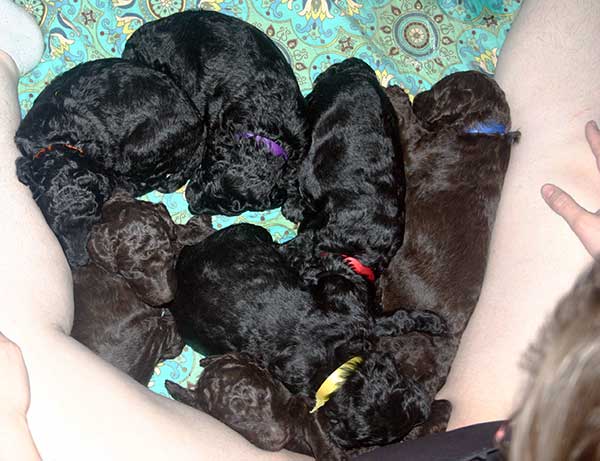
A couple of nights ago, zaiah and I were feeding puppies.

This is something we do every night. And every afternoon. And every morning. And…well, pretty much all the time, really. They hunger, you see. They have appetites, and their appetites must be sated, else our sanity will be destroyed, its shattered slivers sucked into the maw of the great dark beyond.

On this particular evening, she was making fun of me. Every time I took a puppy into my lap, I said, “You know, I think this one might be my favorite.” And meant it.

We’ve been calling them by the color of their collar. (We debated naming them after computer programming languages–“Here, Java! C’mere, Perl! Good boy, Python!”) but zaiah made the point that we don’t want to give them names which might unduly influence whoever adopts them.

And they are all my favorite puppy.


Purple is absolutely my favorite of the whole bunch of them. She is lovely; we’ve informally started referring to her as “sweet face,” because she has such a nice face. She’s affectionate and loving, nuzzling into you when you hold her. She gazes soulfully into your eyes when you feed her. For the first couple of weeks, she would sing herself to sleep after she ate.

My real favorite, though, is Blue. He’s the largest of the bunch, a gentle giant who is gregarious and outgoing. He responds strongly to people, coming over with his tail wagging whenever anyone walks near. He’s filled with energy and enthusiasm, and joy just radiates out of him.

But my favorite out of all of them would have to be Yellow. He is by far the most playful of the bunch. He enjoys rolling the ball around his pen, which is incredibly cute, and he likes playing with his imaginary friend, which is even more cute. He’s smart and companionable and loves wrestling with people.

When it comes to my favorite puppy of the litter, though, that would have to be Pink. She’s quiet and sweet-tempered, a cuddly and affectionate little girl who loves reaching up to kiss your nose. She is absolutely heart-melting in her trusting devotion to the people around her.

Though, to be honest, I think my favorite might be Green. He’s smart, strong-willed, and opinionated. He bounds around the pen wrestling with his brothers and sisters, and any human who will show him attention–“C’mon! I can take you! Let’s go! Arooorooroo! Isn’t this FUN?”

My favorite puppy would doubtless be Red. She is mercurial, one minute playful and the next minute snuggly. She also loves to gaze into your eyes while she eats, and her favorite thing in the world is to fall asleep with her head on your arm. She’s a master of the game “I’ve Got Your Nose,” which she plays with Blue, Green, Yellow, and any person who gets close enough.

And finally, I’ve saved my favorite puppy for last. Orange is sweet-tempered and loving; she bonds easily with people, to the point that she often prefers scritches and snuggles to food. Ever since the day she was born, one of her favoritest of all things is to snuggle into the crook of your neck and fall asleep there, making contented little noises the whole time.

This is, you see, why I’m rubbish at monogamy. Pick just one? Really? When there is a whole world out there, full of joy and love and life? Why would someone want to do that?

Another podcast interview!

A couple weeks back, I had the opportunity to meet Shira B. Katz of the Pedestrian Polyamory podcast. What followed was a conversation about polyamory, transhumanism, mad science, programmable sex toys, and all sorts of other stuff, which you can listen to here.

The interview was great fun. I’d definitely love to do it again.

Signal boost: Polyamory mediation service?

One of the people on my LJ friends list is looking for input in developing a business plan for a personal mediation service aimed at polyamorous folks. Personally, I think this is a great idea. She’s written a post about it here, which I urge anyone interested in the idea of mediation for polyamorous folks to read and respond to.