Polyamory, Monogamy, and Ownership Paradigms

On another forum I read, someone made a complaint that folks in the poly community tend to see monogamy in terms of ownership and control; that is, for many poly folks, monogamy is about owning your other partner, while polyamory is more egalitarian, treating other people as fully actualized human beings.

And, sadly, I’ve encountered poly folks who do believe that. The misguided notion that polyamory is “more evolved” than monogamy comes, in many cases, from the assumption that monogamy is inherently rooted in ownership and polyamory is inherently egalitarian.

As with many preconceptions, it’s possible, if one squints hard enough, to see where this idea comes from. There’s nothing inherently wrong or controlling about monogamy per se; monogamy, by itself, is not necessarily disempowering or ownership-based.

But there is some truth to the notion that monogamy as a cultural norm comes with a set of social expectations that are deeply planted in the soil of ownership of others.

People in our society are expected to believe not just in monogamy, but in a whole set of social expectations that comes along with it. People say things like “you let your wife spend time with other men?” or “you let your husband talk to his ex?” as though it is natural and expected that we should be able to control who our partners interact with. People say things like “I would never allow my partner to masturbate” or “I would never permit my partner to fantasize about other people” as if it is normal to control our partners’ bodies and minds.

Not every monogamous person does this, of course. But these ideas are very commonly attached to our social expectations of monogamy; monogamy as a social institution began in cultures in which ideas of ownership were deeply embedded, and those ideas have proved very tenacious.

There’s a problem, though, in that polyamory is not necessarily any better.

People who live outside the cultural mainstream love to believe that they have escaped the petty social norms that enslave all the other sheeple still trapped in the spider web of normative behavior. In reality, though, cultural ideas have an insidious way of seeping into us even when we’re aware of them. Simply knowing that we were raised in a climate of ownership assumptions about sex and love doesn’t make us immune to internalizing them. In fact, many, many people in the poly community cling just as strongly to paradigms of ownership and control as they believe all those poor “unevolved” monogamous folks do–they simply manifest differently, that’s all.

I’ve been putting some thought to the sneaky ways that social expectations can creep into relationships even when they’re outside the social mainstream. Here are some examples I’ve come up with.

Control paradigm Egalitarian paradigm
I let you have other partners. This is a privilege I grant you. I can tell you who, under what circumstances, when, and how you may have other partners. You are a human being with the right to make your own choices about having other partners. I will tell you what I am comfortable or uncomfortable with, and trust you to make choices that honor and cherish our relationship.

I let you have sex with other people. This is a privilege I grant you. I can tell you how you may or may not have sex or otherwise control the timing or manner of your sexual activity. You have an intrinsic right to make choices about your sexuality. I will communicate you what I am comfortable or uncomfortable with, because I trust you to make choices that honor and cherish our relationship.

My sexual health is your responsibility. I will set limits on your behavior to ensure that you only engage in sexual activity that meets my sexual risk limits. My sexual health is my responsibility. I will communicate to you my sexual health boundaries, risk limits, and concerns. Because your risk limits and concerns may not match mine, you are free to make whatever choices with your own sexual health that you like. If your behavior exceeds my threshold of risk, I have the right to change the sexual relationship between you and I, including adding barriers or even ending it entirely. If having a sexual relationship with me is something you value, you can make choices to remain within my levels of acceptable risk.

I may fetishize your other sexual partners for my gratification. I have the right to tell you how to or not to have sex and/or demand the intimate details of your sexual activites for my sexual gratification. Your sexual activity with other people and your other partners are not merely for my sexual gratification. I will accept your right to choose sexual activities that you and your other partner find fulfilling, and that you and your other partner have a right to privacy about your own intimacy.

If I am sexually attracted to your other partners, it is your responsibility to share them with me. You have an obligation to provide me with access to your partners if I want it.

Your other partners are human beings. As they are not your property, it is not your obligation to make them sexually available to me.
My sexual partners are mine. You are not permitted to express an interest in them; if I want to keep them to myself, this overrides the wishes or desires of both you and my other partners. My other sexual partners are human beings. As they are not my property, I do not have the right to "keep" them; they are people, not things, capable of making their own decisions about sexual intimacy and partner choices.

My fears, insecurities, and jealousy are your responsibility. I have the right to control your behavior and/or the behavior of your other partners in order to manage my fears and insecurities. My fears, insecurities, and jealousy are my responsibility. I have the right to communicate with you about them, and to ask for your help in dealing with them. Because you love and cherish me, you will work with me to help me when I am afraid or insecure. These feelings do not give me the right to dictate your choices, however.

I have the right to ensure that you may have other partners only to the extent that your other partners do not affect me or our relationship. I may limit or control your other relationships so as to make sure they do not affect me. I understand that there are many uncertainties in life. Everything from a new job to being fired to illness to family of origin problems to being hit by a runaway bus may affect our relationship together. When your other partnerships affect me in a way that concerns me, I have the right and the responsibility to communicate with you about it, so that we can work together to address my concerns.

Your other relationships exist only on my say-so and only for so long as I permit. I have the right to order you to terminate any of your other relationships if I feel it is necessary or desirable. Your other partners are people with needs and feelings; they have have the right to explore and develop their relationship with you, to be supported by you, and to expect that their relationship with you will continue for so long as it benefits you and them. I may reasonably expect that they will respect the relationship between you and I; they may reasonably expect that I will respect the relationship between you and them.

Understanding my needs is your responsibility. If you fail to meet my needs or expectations, even if I have not made them explicitly clear, you have wronged me, and I have the right to control your behavior so as to ensure they are met. Understanding my needs is my responsibility. Communicating my needs with you is also my responsibility. You can not be expected to meet any needs of mine that you are not aware of. I may ask for your help in making sure I am taken care of, and trust that you value me and want to take care of my needs.

The relationship between me and your other partner is your responsibility. I may require that you arrange meetings between us, that you keep the other person separate from me, that you ensure I am comfortable with your other partner, or otherwise make it your responsibility to manage the relationship between us.

The relationship I have with your other partner is our responsibility. As I am an adult and your other partner is an adult, it is on each of us to negotiate what kind of relationship we want to have with each other.
I permit you to have other relationships only so long as they are subordinate to me. The people with whom you develop relationships have needs and feelings, and have just as much right as I have to asking your help in meeting them. Should our needs run into conflict, we can come together to communicate and negotiate as adult human beings; I may not claim authority over another human being merely because I met you first.

I have the right to control your emotional engagement with other people. This includes the right to tell you that you may not experience certain emotions (for example, you may not fall in love with another partner) and/or the right to control the extent to which you feel emotions with others.

Your emotional experience is one of the most fundamental parts of who you are as a person. I recognize that it is impossible for us as human beings to place arbitrary controls on our emotions.
I have the right to control how far and to what extent you become entangled with other people. For example, I may forbid you to become financially entangled with other partners. Decisions about how to conduct your life can only be made by you. Realistically, whatever promises you have made and whatever rules I have made, there is nothing short of a shotgun and a length of chain that compels you to stay with me. I have the right to expect that you will uphold agreements you have made with me, and I have the right to expect that your decisions will account for the responsibilities you have incurred with me. Beyond that, I can not realistically lay claim to your autonomy; even if I want to, it is not possible for me to compel your decisions.

I have the right to control your expressions of love, affection, or feelings for others. I may forbid you to give gifts to other partners, do errands with other partners, use certain pet names with other partners, or have certain experiences with other partners. The way you express love is one of the most intimate of all choices you can make. Attempts to dictate how you may or may not do this are not only extremely intrusive, they may undermine the foundations of your other relationships. As long as you express the love you feel for me with me, it is not necessary for me to control your expressions with others.

My emotions are your responsibility. If I feel something that I don’t want to feel.this is your fault, and I may limit your behavior as a result. My emotions are my responsibility. Even when they are surprising or unpleasant, they belong to me. I have the reponsibility to communicate with you about my emotions, and I may ask for your help in feeling loved and supported by you.

I have the right to define your other relationships. As adult human beings, you and your other partners have the right to define your relationship for yourselves.

I have the authority to place your other relationships in a hierarchy of my choosing. As adult human beings, you and your other partners have the right to determine the shape of your relationship. I have the responsibility to communicate my needs to you; as long as you are able and willing to work with me to meet those needs, the ordering of your other relationships is a decision between you and your other partners.

Agreements between you and I are binding on any other partners you may have.

All the people involved have a right to negotiate any agreements that may affect us.

I’m sure there are more. What are your experiences?

On the Care and Feeding of Giraffes


Image: Luca Galuzzi, Wikimedia Commons

I am in love with a dragonslayer.

Not all dragonslayers, as it turns out, are knights in shining armor. The dragonslayer I love is a giraffe.

Her name is Shelly. She is not an ordinary person; one does not generally become a dragonslayer if one is content to travel from cradle to grave by the path of least resistance. And I have been in love with her for quite a number of years.

It’s interesting, and sometimes a bit intimidating, to be romantically linked to a hero of yours. We met at a gathering of polyamorous folks in Florida a very long time ago. We started dating a short while after that. I didn’t know then that she would become a dragonslayer, but she did tell me early on in our relationship that she is a giraffe.

By this point, you can be excused, gentle reader, if you have absolutely no idea what I am talking about. Allow me to backtrack a moment to explain.

Shelly, this person I love very much, is not, as I have mentioned, an ordinary sort of person. Not being an ordinary sort of person often leads to loneliness, and loneliness leads to sadness; we are social animals, after all. Many years ago–long before I met her–she talked to a therapist about feeling alienated and isolated from the people around her. The therapist listened patiently, then explained that there was absolutely nothing wrong with her; she wasn’t alienated because she was broken, she was alienated because she was a giraffe surrounded by alligators. “Find other giraffes,” the therapist told her. “You’ll be fine.”

It’s easier to find giraffes nowadays than it used to be. Back before the Internet exploded all over the world like an overripe grape in a hydraulic press, locating a community of non-traditional, non-monogamous, sex-positive people was a bit like finding a hundred-dollar bill lying on the ground; sure, it was theoretically possible, and every now and then you heard of someone who knew someone who talked to someone who’d totally heard of it happening to someone else, but it wasn’t exactly something that you could count on to meet the household budget.

When Shelly and I met, we recognized each other immediately. I didn’t know, back then, what that would mean.


I wrote a while ago some meandering thoughts on the tenuousness of the connections that drift by us, and how these slender threads–the accumulations of entire lifetimes of choices made and random chance–can profoundly change our lives.

My relationship with Shelly changed me more than my experiences with any other person I’ve had in my life, arguably including my parents.

When we met, I was still married to a monogamous partner, someone for whom polyamory really wasn’t a good fit. We had spent quite a lot of time trying to navigate the tricky waters of balancing the needs of a person who can’t be happy within monogamy with the needs of someone who can’t be happy without it, and more often than not, it was other partners I got involved with who bore the brunt of that.

Shelly has a way about her. That way usually starts with her raising a finger, a slightly puzzled look on her face, and saying “I have a question.” Invariably, the questions that follow completely rearrange your mental landscape. “I have a question,” she might say. “If you say that you want to love other people, why do you bring them into a situation where it is not safe for them to love you back, because you can be ordered to end the relationship at someone else’s will?” Or “I have a question. If you say you value having other people in your life, why don’t you value their agency?”

There’s one very important lesson I learned about being involved with her: If you are to be romantically linked to Shelly, you had better have your house in order. She will not easily accommodate the thousand little compromises that many people make when they try non-monogamy, the little rules and rituals that reinforce insecurity and avoid difficult change. If she finds a weak place, an area where for the sake of convenience some little unintended cruelty has become written into the fabric of a relationship, she will push on it. Band-Aids over unresolved problems do not work for her. Feelings swept under a carpet will be dragged into the light. That’s the first rule of being involved with Shelly: commitment to honesty and self-knowledge. You don’t get to say everything is OK when things are not OK, and you don’t get to make compromises that exclude other people.

It was the relationship with Shelly that finally let me see how hurtful, for all those years before I met her, my rules and treaties with my monogamous wife had been to my other partners. It was Shelly’s insistence that I deal with that hurtfulness that brought me to the choice that I could no longer be a party to hurting others that way.


This is the ring I wear on my left hand. Shelly has one identical to it.

After we’d been together for several years, Shelly felt the call to become a dragonslayer. I have written about that here. One of the things she and I share in common is the fact that we both do not accept the idea of death. One of the things that makes her a better human being than I am is that she has made the decision to spend the entirety of her life fighting it.

She returned to school, to seek a doctorate that would allow her to do research in the field of radical longevity. She sacrificed a tremendous amount to do so, including moving away from where we had been living together to pursue her education. She made the decision and, just like that, both of our lives changed.

That is the second rule of Shelly. She has fortitudes of will that would astonish Winston Churchill. She is remarkably flexible in many ways, but when she has resolved to do something, wild dogs will not budge her. She is one of the strongest people I’ve ever met.

She went off to school. The company I was a minority partner in–one which would later implode in a fiery economic flameout that often happens, I’m told, when one puts engineers in charge of financial decisions–moved to Atlanta, and I went with it. We remained family, but the nature of our relationship changed.

That’s the third rule of Shelly. You don’t get to dictate what a relationship with her will look like. She is who she is; to love her means to accept that. She is neither flighty nor uncommitted; quite the opposite, in fact. She commits to the things that are important to her with ferocity. But she does not prefer the comforting illusion to the uncomfortable truth. People change. Shelly is not a person who hides from that change; she will not retreat into comforting routines.


Shelly does, and always will, hold a place in my heart, no matter what happens. There have been other people in her life while we have been together–people who sought to dictate only one kind of relationship with her, people who tried to impose restrictions on the way her heart will work. When they could not have what they wanted, they have chosen to fall out of her life.

It’s a poor choice, in my opinion. Being close to Shelly is incredible. I can not fathom why someone would that up simply because they could not impose rules on her about who she was permitted to love or how. But then again, I also may be part giraffe myself.

Caring for a giraffe, of course, requires special skills. One does not raise a giraffe the way one would raise an alligator or a puppy or a water buffalo. Here, as with all things that are important, flexibility matters; one can not toss scraps of raw chicken at a giraffe the way one might do with an alligator and then say there is something wrong with the giraffe because it does not thrive.

The biggest part of the care and feeding of Shelly I have discovered is simply developing the skill to listen to her when she talks about what she needs. Her needs in relationship, I have found, are generally quite modest, and easy to care for; but being heard is top among them.

Another is expectation management. Expecting Shelly to accommodate choices made for the sake of avoiding unpleasant reality is never likely to succeed. She has, more than anyone else I know, a commitment to emotional integrity that does not permit patching or working around problems like insecurity or fear. Almost all the practical skills I’ve learned about going under the bed, grabbing the monster that lives there, dragging it out into the light, and making it pay rent I’ve learned from her. Being involved with Shelly is not for the faint of heart.

And if her needs are not being met, she will let you know.

Funny things, needs are; when they aren’t being met, they can feel bottomless. In some relationships they are met more effortlessly than others; and in poly relationships, it can be very tempting to point to someone who’s needs aren’t being met and say “What’s wrong with you? Why are you so miserable? Why can’t you just be happy, like Sally over there is?” when the reality is that Sally is happy simply because her needs are being met.

Call this the Fourth Rule of Shelly: if her needs aren’t being met, she will be unhappy. She is not an unhappy person; she is, however, far less likely to sit in a corner and quietly suck it up if her needs aren’t met.

That is, as it turns out, a feature, not a bug…at least if you want relationships built on a foundation of absolute, unwavering emotional integrity.

Which, the cynic in me whispers, is the one thing many folks are not really prepared for. Perhaps that is one of the things that differentiates an alligator from a giraffe? Perhaps alligators prize relationship stability ahead of emotional integrity?

In any relationship, there will be times when chaos slips in through some neglected back door or some little crack in the ceiling. It happens. We are all born of frailty and error. I have, as I’ve gone about this business of placing my heart in other people’s hands and accepting their hearts in mine, learned that when those moments occur, there is often an instant, right at the start, when we make a choice. It’s a tiny choice, that happens in a fleeting instant, sometimes too fast for us to register, but it’s there: the instant when we choose compassion, or when we sigh, feel frustrated, and head down the path of “God damn it, I had plans to watch Friends on TV tonight and then maybe wash the dog–anything that’s more fun than dealing with human beings who have needs–and now here you are asking for my support with something, and and and why can’t you just be more convenient?

Compassion, in case it needs to be said, is better.


I am fortunate beyond measure to have connected with Shelly, and I feel blessed to have her as part of my life. Thank you for being who you are.

Some thoughts on connection and love

A few weeks back, I traveled up to visit my Canadian sweetie. While I was there, she observed something interesting. My blog, she noted, has half a dozen tags for sex, but only one for love.

The interesting thing about that is I actually care more about love than about sex, though I rarely seem to write about love.


I went to visit her on the bus. There’s a bus service called BoltBus that travels between Portland and Vancouver, you see, and it’s really cheap to take.

Sometimes.

They have this bizarre pricing structure where the first seat on a particular bus sells for a dollar, and the next few seats sell for eight dollars, and the next few seats sell for fifteen, or something like that. What it means is if you plan well ahead, and you are willing to sit there and click Refresh on their Web site over and over, you can sometimes travel for next to nothing.

Plus, their buses are black and orange, which is kinda cool.

On the bus ride up, there was a pretty girl with a blond pony tail seated to my right. She spent almost the entire trip texting someone on her cell phone. Ahead of me, two bearded geeks in glasses talked excitedly about Python on Linux.

We stopped in Seattle to pay homage to the monument of the Dalek god and drink coffee. Yes, there is a monument to the God of the Daleks in downtown Seattle. No, I don’t know why it’s there. It looks like this:

I don’t drink coffee, so I sipped my hot chocolate, given to me by a surly Starbucks employee, and contemplated the fact that these people I was sharing the bus trip with–the girl glued to her cell phone and the geeky Linux programmers rhapsodizing over Python’s, like, total readability–had crossed paths with me in a tiny, insignificant way, and that I would quite likely never see any of them again for as long as we all lived.

For a brief second, the threads of our lives almost touched, before they spun off in their various directions once more.

Statistically speaking, the odds that I would cross paths with any of them were vanishingly small. If you were to start some kind of probability assessment going form the moments of our separate births, the odds that we four should ever be in the same space at the same time would be incredibly low.

And yet, we did intersect for that short while.

Which started me to thinking about love.


Statistically speaking, the odds that I will meet, much less fall in love with, any given person are also incredibly low. Each connection we make is statistically improbable, the result of a long gossamer thread of chance, decisions, fortuitous happenings, heartbreak, and all the other things that make us take the path we do. A death in the family, a different choice of college, a different career, a phone call from a childhood friend, a flat tire, any of a thousand things could have altered the decisions any of us made that led us to be on that bus at that time. The breathtaking confluence of life paths, events, and choices that led to us all being there is as fragile as it is amazing.

That’s kind of how it is with love.

For any two particular people, chosen at random, to become entwined in each other’s lives in such an intimate way as falling in love requires a statistically improbable chain of events, any one of which could cause the connection to fail altogether. The person you love most in all the world might, with just a few tiny differences in life path, be living a life almost indistinguishable from the one that brought you together–and yet you would be strangers.

It might sound like I’m saying that love is an incredibly rare thing, but it’s not. Opportunities for it are all around us; the possibility of love is abundant. But each individual connection, each set of circumstances that leads to any two specific people falling in love–that is a rare and delicate thing.


It might seem like those two ideas–that love is abundant and that connections between any two people are rare and improbable–are contradictory, but they’re not.

Think about a casino. Imagine walking into a casino and, with the snap of your fingers, freezing everything inside. If you were to look at every hand of cards in play, the arrangement of every card in the blackjack shoes, the position of every ball on every roulette wheel, the odds of seeing that exact configuration are so remote that you could set up casinos just like it all over the universe and let them all run from now until the stars burn out, and you’d never see that configuration again.

And yet, there it is.

In a world of seven billion people, opportunities for love are everywhere; but that doesn’t change the fact that the odds of meeting and falling in love with any one specific person are vanishingly tiny, the connection between two individuals spun from the slenderest of threads.

Those slender threads can make a huge difference. Those threads change our lives. They wrap around us until every one of our decisions is made because of them. A chance meeting, that most statistically improbable of connections between two individuals, and their lives suddenly change course in dramatic ways.

A thread like that called me to Portland. Another put me on that bus to Vancouver, where my life intersected ever so briefly with the other people on that bus, each of them there because of the sum total of thousands of choices large and small they had made.

There would be people on that bus; the statisticians who design bus routes, the accountants who apportion resources all know it. but each individual person is there as a result of an unbroken line of choices, any one of which could have sent that person somewhere else entirely.


This is the person I was on that bus to see, the thread of connection that altered the course of my life and put me on that bus.

Whenever I think of any of the people I love, I always think about how improbable it was that our lives crossed paths, and how profoundly such an improbable thing has changed me. Yes, if I had made different choices, if they had made different choices, if our lives had not intersected, then we might not be lovers, but I would still have love in my life. I absolutely believe that’s true.

And yet…

It is those threads that have made my life what it is right now. It is those improbable connections, those fine threads of chance and choice, that brought me here, and that led to me writing the words you’re reading right now.

I like who I am. I like being where I am. I have, in large part, all those people who I love, all the delicate lines of chance and choice that brought us together, to thank for that.

I am profoundly grateful for every person who has touched my life in this way. I am profoundly grateful for every one of those connections, for every person I have ever loved and who has ever loved me. From tiny, delicate threads, entire lives are woven. For all the people who have helped me weave mine: Thank you.

Benchmarks for Good Relationships

On another forum I read, the subject of how to tell whether or not a relationship is a good one–benchmarks, if you will, for positive, vibrant relationships–was raised.

I put some thought to the question of creating benchmarks for good relationships, and came up with this set:

1. Am I striving to treat others with compassion, even when it’s hard? Am I being treated with compassion?

2. Does this relationship offer me the opportunity to grow and develop in the way that feeds me and makes me happy? Does it offer the same opportunities to all the other people involved?

3. Am I moving with courage in this relationship? Are the people around me moving with courage?

4. Does this relationship help me to be the best possible version of myself? When I look around at the other folks involved, do I see the best of them?

5. Can I say whatever I need to say, whenever I need to say it, and have a reasonable expectation that I will be heard and understood? Am I creating an environment where everyone else can tell me what they need to say, even if it’s something I don’t want to hear, and I will hear it?

6. Is this relationship fair to everyone concerned? Not “fair” as in “everyone gets the same thing,” but “fair” in that “everyone has a hand in the relationship, everyone’s voice can be heard, and everyone has the ability to help build the things that make their parts of it happy and healthy.”

7. Does this relationship give all the people involved the opportunity and support they need to pursue their joy?

This is a first stab at the question of defining benchmarks for good relationships. I think there might be some things I’m missing. Opinions? What would a list of benchmarks for healthy relationships look like to you?

The Geek Social Fallacies of Polyamory

In the unlikely event that you may not be aware of them, the Geek Social Fallacies are a list of flaws in reasoning about relationships which are altogether depressingly common in geek social groups.

It’s not surprising that they exist; though it’s less true now than it was, say, twenty years ago, it’s still a fact that many self-identified “geeks” grow up as social outcasts, and create communities that express their own quirks and dysfunctions because of that.

I’ve been pondering some pondering thoughts about how the same idea might apply to polyamorous people, and I think there is a loose correlation between the Geek Social Fallacies and the Poly Social Fallacies. Don’t get me wrong; the poly community, by and large, is awesome, and I scarcely form close friendships with anyone outside of it any more. But we are prone to our own social quirks and dysfunctions. So, here’s a first stab at drafting the Poly Social Fallacies:

Poly Social Fallacy #1: Polyamorous People Don’t Get Jealous

If we were to meet someone who claims immunity to an emotion like, say, disappointment, or sadness, or frustration, or doubt, we’d probably look at her like she’d just sprouted an extra head or two. Yet when people in the poly community claim an “immunity” to jealousy, often we’ll just nod and say “Yes, that’s awesome, you’re a Good Poly Person.”

Even when they feel jealousy but refuse to acknowledge it for what it is. Which is, I have to admit, something I’ve been guilty of myself when I started doing the non-monogamy thing.

Jealousy is merely a feeling, nothing more. Like all emotions, it’s part of the normal and varied landscape of the human condition. Some people may feel it more easily than others, and some people may go through long periods of time without ever encountering a situation that triggers it, but that’s not the same thing.

As with all emotions, it’s a way for the parts of our brain that don’t have language to communicate with us. Sometimes, what those bits of our brains are communicating might be “Hey, there’s an inconsistency here; there’s something hinkey that might mean my needs aren’t being met” and other times it’s “RAAAARGH! PROTECT TERRITORY! MUST SMASH INTERLOPER TRYING TO TAKE MY PROPERTY!”…but it’s not something that being polyamorous somehow confers an immunity to, any more than being into motor sports magically makes one immune to disappointment.

Carriers of this fallacy can do all sorts of destructive things, from acting out in passive-aggressive ways while refusing to confront the reality of what they’re feeling, to attempting to impose all sorts of micromanaging controls on their partner’s behavior in the name of “setting boundaries.” A better solution is honesty: “Hey, tI’m feeling jealous. That doesn’t mean I’m a bad person, or that you have done anything wrong, but it does mean I’d like to talk about this.”

Poly Social Fallacy #2: Polyamory Is More Evolved

This particular fallacy isn’t unique to polyamory; members of any sexual or relationship subculture often feel like they Have It Figured Out, and that if only their particular thing could be recognized for how brilliant it was by the MainStream Culture, everyone’s lives would be better off.

This is often a reaction to being marginalized by mainstream culture. When you’ve grown up not fitting in with the people around you, finding a community where you DO fit is such an overwhelming relief that you want to spread the joy you feel far and wide.

And, to be fair, the poly community does espouse many values–communication, honesty, communication, problem-solving, communication, negotiation, and communication–that would benefit anyone in any sort of relationship. (Just imagine how much better off the characters in any romantic comedy would be if they would only talk to each other!)

But carriers of this fallacy run off the rails in two directions: first, by assuming that just because someone is monogamous, it must mean they don’t have these skills; and second, by assuming that just because they are polyamorous, it means they do.

It’d be marvelous if membership in the poly community came with these relationship skills. And some folks do seem to feel that that’s how things work–woohoo! Im polyamorous, and poly people are good communicators! That means I’m a good communicator! Go me!–but even a casual look around the poly landscape will show that it doesn’t quiiiiite work that way.

More to the point, there is no single relationship model that works for everyone. Just like monogamy doesn’t work for all of us, polyamory doesn’t work for all of us either. There are monogamous people who are monogamous because monogamy is the most natural fit for them, not because they’re knuckle-dragging Neanderthals who are merely accepting cultural defaults because they have not yet received the blessings of polyamorous Enlightenment.

Poly Social Fallacy #3: The Core Relationship Before All

Valuing relationships is a reasonable thing. Wanting to protect a relationship is a valid measure of respect for the value it brings. Believing that it’s OK to do anything, commit any act, or hurt any person so long as the core relationship remains is unhealthy.

I recently encountered a great example of this fallacy in action. A woman declared that, because she had once been in a situation where her partner didn’t take care to meet her needs when he started a relationship, she realized that the only ethical way to have relationships was to abandon any new partner the moment her husband expressed the slightest discomfort. Her reasoning, you see, was that it is unethical to hurt people, and therefore the only right thing to do was to end any relationship that she was involved in the instant it looked like her husband might have any problem with it at all–because she would never be so cruel as to hurt someone else.

Carriers of this social fallacy venerate their existing relationship to the point where they either don’t acknowledge or simply don’t care about anyone else’s pain. Any new partner is an expendable commodity; any amount of hurt or heartbreak inflicted on any number of people is justified if it “protects” the “primary” relationship.

Sometimes, learning new skills and adapting to new situations is uncomfortable. Sometimes, it’s necessary to accept that a bit of discomfort is OK; it doesn’t mean the End Of Everything. And ethical behavior always recognizes that callously inflicting pain on others–any others–is something to be avoided wherever possible.

Poly Social Fallacy #4: Relationships Are Transitive

This particular social fallacy can take two forms, each pernicious in its own way.

The less common form it takes is the notion that if my partner is sexually or romantically involved with someone, that means I have a right to be involved with that same person, too. It’s sometimes seen by established couples, especially couples new to polyamory, as the perfect solution to jealousy; if I am having sex with the same person my partner is having sex with, then there’s no reason to be jealous, right? (We should all live in a world where emotions like jealousy are so rational…but then they wouldn’t be emotions, would they?)

The more common form is “My partners should all be friends with each other.” While it’s nice when that happens, and it’s definitely true that the members of a poly group should be able to be in the same room with each other and to interact pleasantly without bloodshed, it’s not necessary that everyone be best friends merely because they fancy the same person.

Both forms of this fallacy, taken to their (il)logical conclusion, lead to a creepy place that denies people their own autonomy: If you are to be involved with person X, you are now obligated to like/be intimate with/be friends with/have sex with person Y.” Eww! People make their own choices in friends and lovers for their own reasons; it’s rare indeed that someone will be okay with being told how they must relate to someone merely because they fancy someone else. Trying to dictate how people relate to one another is inappropriate social behavior, regardless of whether we’re talking about friends or metamours or lovers.

Poly Social Fallacy #5: Partners Do Everything Together

Relationships almost always need a certain amount of alone time if they are to grow and thrive. When we first start out in polyamorous relationships, having a partner go off and spend time alone with someone else can feel threatening; it can feel like an exclusion. So why not simply do everything together, all the time?

Unfortunately, this can constrain a relationship. It can also create Drama, when someone feels that his or her needs for intimate, one-on-one time aren’t being respected.

It is rare in the extreme that two different relationships develop in the same way and the same direction at the same rate at the same time, even in situations where three people are all romantically involved with each other. It’s reasonable that there will be times that two of the three will do something on their own, whether it’s have sex or take a walk in the garden, and this is not a reflection on, or an exclusion of, the third person.

Taken to its extreme, this social fallacy can lead to some pretty bizarre places, like “I know I get home from work an hour later than you two do in the evening; I don’t want you doing anything interesting at all (or even “I don’t want you spending time together”) until I get home.”

Complicit in a Complicity

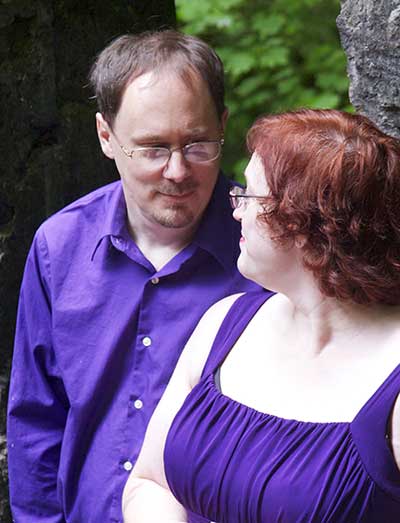
Since I first moved to Oregon, one of the things I’ve been most struck by is the quantity and quality of the scenic natural beauty around here, which the state leaves carelessly lying all over the place. It’s been part of life since the move, so it’s fitting that when zaiah and I decided to have a commitment ceremony, we would do it in a place that had a particular abundance of it lying about.

The place we chose was the ruins of an old stone cottage in a large park here in Portland. This particular park has a ruined stone cottage a short hike from the road, that we thought might make a lovely place for a gathering of friends and family.

We first started mooting the idea of a commitment ceremony about a year or so before it happened. One of the things that was important to both of us was the idea of a ceremony that wasn’t just about the two of us, but that was about our entire extended networks. Being part of a polyamorous network can be a bit tricky, sometimes, in that there is a tension between dividing up into couples and honoring all of the people who are important to you. zaiah and I wanted a ceremony that showed our commitment to each other, but also to the people we have chosen to make part of our families.

Even the name we chose, borrowed from figmentj, was an expression of the fact that this is something that involves all of us. Rather than a commitment ceremony, we opted to call it a “complicity,” and to make everyone who attended an accomplice in our union.

Not everyone in our extended networks was able to show up. In particular, my sweeties emanix and figmentj weren’t able to be there. A lot of people did make the trek out to Portland, though, including my entire Florida network–people I don’t get to see nearly often enough.

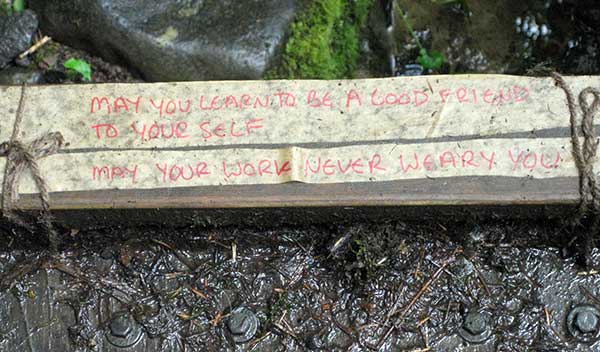
We gathered together and hiked out to the ruins of the stone cottage. Along the way, we passed over a small foot bridge where someone unknown had written good wishes on strips of masking tape and placed them on the path.

I have no idea who wrote this, or why, but I think these are good sentiments.

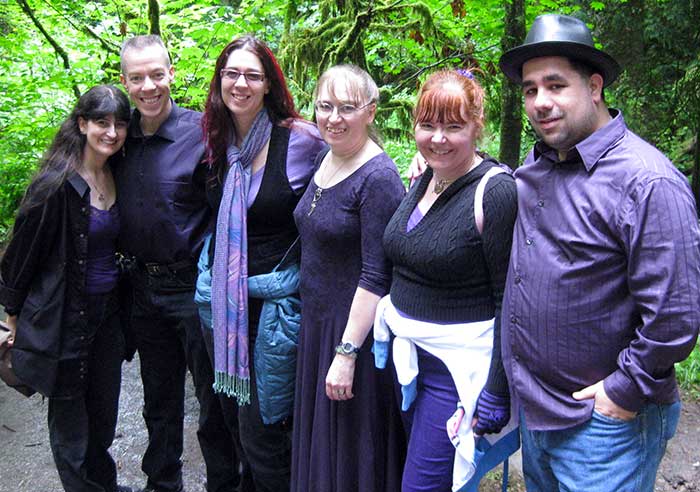
As I’ve mentioned, Oregon is known for the abundance and exuberance of the scenic natural beauty it manufactures and scatters about the landscape. Even the walk up to the stone cottage was drenched in it, which can be a bit disorienting for folks from places like Florida, where scenic natural beauty is kept tightly guarded and is sold in small parcels by licensees of the Disney corporation. The Florida part of the network paused along the way to recover from the onslaught of gorgeous, which they had developed little natural resistance to.

That’s my sweetie joreth, her boyfriend and my former archnemesis turned apprentice datan0de, my partner Shelly, datan0de‘s wife femetal, redheadlass, and her partner zensidhe. These are folks who have been my family for a decade or more, datan0de‘s attempts to eradicate me, destroy the world, and crush all of you beneath the massive iron treads of his robotic war machines notwithstanding.

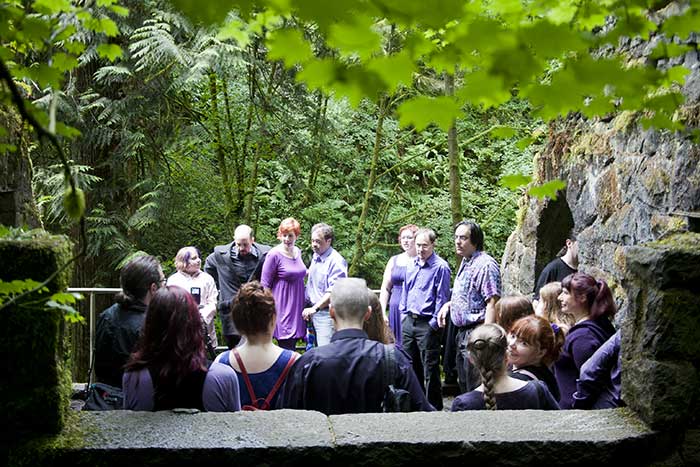
When they had recovered sufficiently, we finished the journey out to the stone cottage. We’d tried to be selective in the number of folks we’d invited to this part of the Complicity, but it was still a bit of a tight fit.

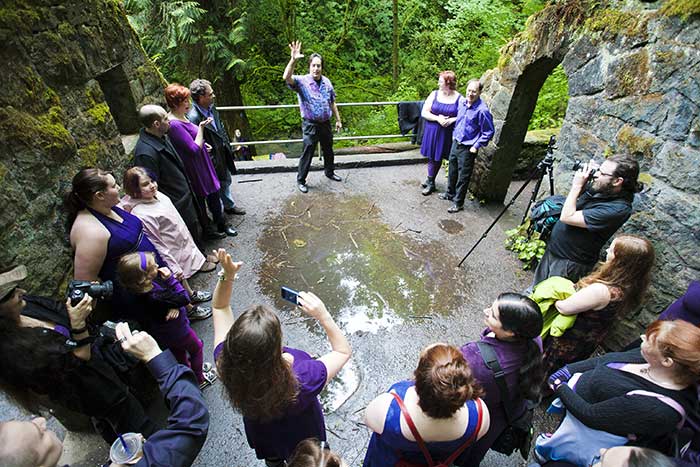
My friend edwardmartiniii graciously agreed to oversee the whole shebang, and did an absolutely fantastic job of it. Here, he is seen at the start of the Complicity asking for volunteers to be given over to the Great Old Ones, so as to appease them and call down their blessing of protection upon all who attended. My friend Amanda volunteered; I’m sure going to miss her.

KIDDING! I’m kidding. Of course I jest. There were no sacrifices to gods ancient or modern; for one thing, where would we even find a virgin these days?


Why yes, don’t mind if I do!

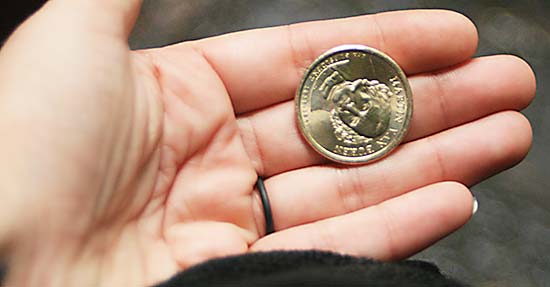
One fo the central parts of the ceremony involved passing out dollar coins, which everyone made a positive wish on and then placed in a container. As people left, they drew out a coin, to bring into the world with them with a wish for good things.

I like the idea of mindfully passing out something which represents a desire for good. The wish itself may not have any material effect on the coin–there is no metallurgic Transubstantiation at work here–but the idea that this represents something is a powerful one, I think.

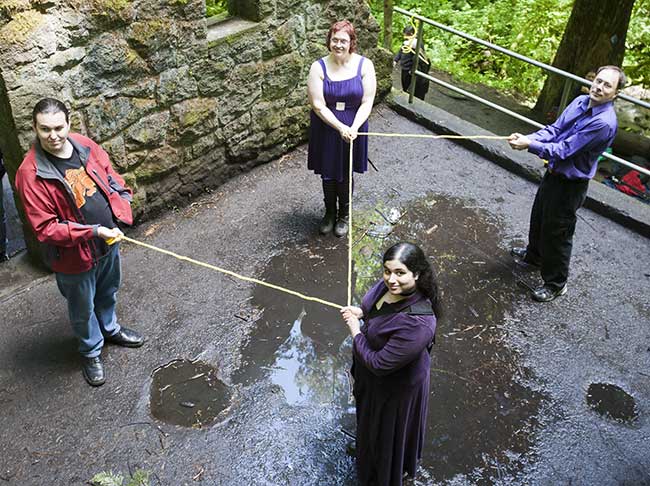
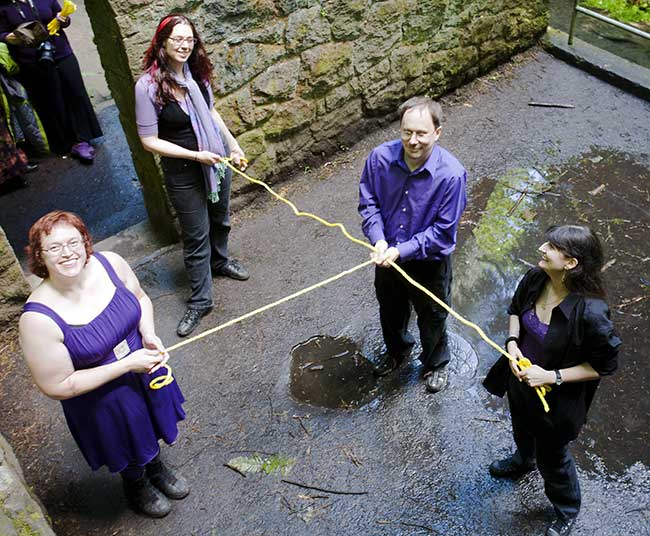
A part of the ceremony that we’d planned for quite some time was the creation of human Langdon charts, using lengths of rope to indicate the connections between the various people there.

What we hadn’t really counted on was the size and complexity of the network, and how much space (and rope!) it would require. Plus, with not all of our sweeties in attendance, it would have been impossible to create a full chart anyway.

But we were able to map out bits of it. Here are zaiah and I with the Florida part of the Squiggle:

We also did Langdon charts centered only on certain parts of the network. Here’s zaiah‘s Portland portion of the network:

Here’s the bit that centers on me, with the partners who were able to make it (emanix and figmentj, you were both sorely missed!):

It’s fascinating to me how human communities of all sorts tend to follow the same structure. If you map romantic connections in poly networks, or business contacts on Linkedin, or friends networks in a large company, you see the same patterns emerging: most folks have small numbers of connections, with a smaller number of people forming large numbers of connections that act as bridges between different groups. There’s something really interesting lurking somewhere in there. I’d love to make some software that lets people easily and quickly create charts of their poly networks, and then analyzes the network and puts the data into a database somewhere.

I still like the idea of doing photographic Langdon charts. I’d very much love, if everyone in my network could ever get together in one place, to do a photo that shows all of us. Perhaps if I suddenly find myself receiving a suitcase full of cash from shadowy government figures in exchange for, like, foiling a plot to hold the moon for ransom or something, I will fly all of us out to Easter Island to do a picture with all those funky statues of giant heads. Or, less ambitiously, maybe I’ll just register www.humanlangdonchart.com or something. (Anyone know a good database programmer?)

But I digress.

I won’t say that I am lucky to live the life I do. I don’t think that’s accurate, for reasons that I outline here. But I will say that I am profoundly grateful for, and humbled by, the people who I have chosen to be my family, and who have chosen me as well. These are all people who, every day, make my life richer simply by being who they are.

Some thoughts on being out

One of the many questions that inevitably comes up in almost any poly discussion group,usually multiple times, is the question about being open about being polyamorous.

The same thing comes up in kink-related social groups, and I imagine in just about any other alternative sexuality group you can name.

Now, I’m a big fan of openness and transparency. There are a lot of reasons for that. On a philosophical level, I do not believe there is anything to be gained by pretending to be something you’re not, and I don’t see how deceiving people who would shun you if they knew the truth actually benefits anyone. (To my mind, if someone–your family, say–loves you only so long as they don’t know the truth about you, then they don’t actually love you. They only love an imaginary projection of you, and that love is conditional on you agreeing not to do anything that might spoil the projection.)

On a practical level, it’s hard to find other people like you when everyone is closeted. If I am polyamorous, and I’m in a room with ten other poly people but none of us are open, all eleven of us might be thinking “Wow, I wonder where I can go to meet other poly people? It’s so hard to do!”

But there’s one objection to openness that I hear all the time, and that’s what I’d like to talk about here. A lot of folks say “I’m not open because it’s nobody else’s business how I live my life.” And to some extent it seems true, but there are problems with that idea.

Before I talk about those, though, I’d like to back up a little and talk about the way I grew up.


I spent my elementary and middle school years growing up in the rural Midwest. This is where I lived:

See that clump of trees on the right? It’s where my old house is. We lived outside a tiny town called Venango, Nebraska, population (at the time) 242.

I’ve written about a trip I took as an adult through Venango, with lots of pictures, in my blog here. Time has not been kind to the town. It’s half deserted; many of the houses are boarded up, and the school closed a long time ago. The most eerie thing about it is the total and complete absence of children. We stopped at the playground behind the school when we visited it. All of the playground equipment is covered by a fine dusting of rust, and when we turned the merry-go-round, rust drifted off it in flakes. I have to think that if there was even one child left in the entire town, the playground wouldn’t be this disused.

It was no picnic for me growing up there. I was the stereotypical geek as a kid; I was into model rocketry, and I owned a TRS-80 computer, the only computer of any sort in a 40-mile radius. (I know this because the only other computer within any distance was an Apple II belonging to the owner of the business my mother worked at in the next town over, about 45 minutes away; he used it to do bookkeeping.)

There were eight people in my middle school class, the largest class the school had seen in years. While I was teaching myself the basics of aeronautics, electronics, and Z-80 assembly language programming, the main topic of conversation among my peers were the relative merits of the Denver Broncos vs. the Dallas Cowboys–a discussion that often involved a great deal of heat but never seemed to get resolved, no matter how many times it was hashed out.

So it’s safe to say I grew up alienated from all the people around me.

Which is pretty unpleasant. I was able to partially mitigate the fact that I had no friends when my parents got me a 300 baud telephone modem, and for quite literally the first time in my life I was able to encounter, if only in a crude way, people who were kind of like me.

As alienated as I was, I still had some things going for me. One of the things I noticed growing up was the casual, offhand racism that permeated the Midwest; the people around me were quite confident that whites were better than blacks, even though most of them had, quite literally, never once met a person who was black. Even as an outcast, I still had some measure of privilege; it’s hard to say how much better or worse things might have been had I been a football-loving African American, or (worse yet) geeky and also black.

My parents moved to Florida when I started high school, so all at once I went from having eight people in my class to having two thousand. For the first time in my life, I met other people who were like me. I was still something of an outcast from most of the folks around me, of course; the fact that there were other geeky, nerdy people in the school didn’t mean we weren’t a distinct minority. I was still introverted and painfully shy back then, but at least I had a social circle, something that was totally new to me.


What does this have to do with being out about polyamory? Quite a lot.

After my first year in college, I made a conscious decision: I did not want to be introverted or shy any more. I deliberately and systematically set about learning the skills that would get me there. I started choosing different kinds of people in my social circle. If I found a social situation that made me uncomfortable, I deliberately kept putting myself in it.

It was about this same time that I started realizing that I was kinky and poly, as well. Prior to starting college, I wasn’t a sexual being in any meaningful sense of the word; I barely even recognized that boys and girls are different.

But even before I was interested in sex or relationships, I still knew I was polyamorous, though there was no language for it. The stories about the beautiful princess forced to choose between her suitors never quite made sense with me; if princesses live in castles, which seemed axiomatic to me when I was a kid, why wasn’t there room for all of them?

As a person newly interested in sexual relationships, that idea stayed. Why on earth should I expect someone to pledge her fidelity to me, simply because I fancied her? On the face of it, the idea just made no sense.

Growing up alienated seems to have had a positive side effect; I found out that being isolated from a social circle is inconvenient, but it isn’t fatal. I learned that I could find ways to interact with people like me, first online and then in person. And I learned that things like “being shy” and “having poor social skills” weren’t death sentences; they were things I could learn to cope with and skills I could acquire.

So in that sense, having an isolated childhood didn’t really leave that much of a mark on me. i was resilient enough to make choices about who I wanted to be and then find ways to be that person.


In the 1990s, which is positively antediluvian as far as the Internet goes, I started working on a Web site. (The Wayback Machine only started capturing the poly section of the site in 2000, for reasons I don’t completely understand.)

The goal in making the site was to create the resource that the younger version of me would have found valuable. When I actually started doing this polyamory thing, I didn’t have the advantage of being able to learn from other people’s mistakes, which meant that I had to make my own…and while experience might be the best teacher, sometimes the tuition is very high.

The site became a whole lot more popular than I expected it to be, which pretty much finished off any chance I might have to be quiet about being polyamorous. Not that there was ever much chance of that to begin with, but still.

So I’ve never been closeted. Not even a little bit.


Which takes us back ’round to the issue of what business it is of anyone else’s.

On the face of it, “it’s nobody’s business who I’m involved with” seems to make sense…except that, in a very real sense, it is.

We live in a society that sanctions only one kind of relationship, and tends to stigmatize others.

When a person wears a wedding ring and says in casual conversation “My wife and I went to dinner last night,” that person is validating those social conventions. He could say that it’s nobody’s business how he conducts his romantic affairs, of course; but the simple act of wearing a wedding ring is a public declaration of a very specific kind of relationship. And it’s hard to talk about the things we do, even casually, without talking about the people we do them with, and what those people’s relationships are to us.

When folks at poly get-togethers talk about being closeted, by far and away the most common thing they talk about is being afraid of other people’s reactions to learning the truth. Essentially, it boils down to a very simple idea: “I want to control information so as to control the way people interact with me.” The fear of being shunned, and the extent to which people are willing to jump through hoops to control information and to create the impression of normalcy in order to avoid that fear, is sometimes quite remarkable.

I’ve never had the fear of how people will react to me for being polyamorous (or kinky or anything else). I’d like to think it’s because I’m, like, all evolved and stuff, but it’s really a lot simpler. I know what it’s like to be totally alienated from my peers. I know that I can survive it. I know that I can create my own social circles and my own family. I’ve met that monster under the bed. It has no power over me. If there’s a monster under my bed, fucker better pay me rent, just like anyone else living here.

I realize that I am in a privileged position about this. I work for myself; I don’t have to worry about a conservative employer firing me if they find out how I live my life. I’m not in the military. (Under the Uniform Code of Military Justice, adultery is a crime, punishable by dishonorable discharge, prison, or both.) I am not financially dependent on a family that would disown me if they found out. I don’t have children who might be vulnerable to being taken away, or an ex-spouse who can use polyamory against me in a custody hearing.

So I can be open about who I am, and I don’t have to worry about suffering for it.

And that’s kind of the point.

In a world where it really was nobody’s business how we conduct our private lives, nobody would have to worry about these things. Nobody would have to worry about getting fired or getting a dishonorable discharge or losing children because of being polyamorous. The fact that there are people who do have to worry about these things means that much of the world tries to make it their business how we conduct our romantic lives.

Polyamory, and homosexuality, and BDSM, and all kinds of other non-socially-sanctioned relationship structures are perceived negatively in part because people don’t often see them, and it’s easier to vilify something that you don’t see every day. Like the racists in Venango who’d never laid eyes on a black person, when you don’t have the experience of seeing something yourself, it’s easier to project all your own fears onto it.

When those of us who have a privileged enough position to be able to live openly choose to do so, we help create a visible face for polyamory that makes it that little bit harder for others to vilify or marginalize us. So in that sense, it very much is other people’s business what I get up to; by creating institutions which can be used against folks who are polyamorous, they’ve made it that way, whether we like it or not. By creating the social expectation that people in officially sanctioned relationships can advertise their relationship status but people who aren’t, can’t, they’ve made it that way.


Columnist Dan Savage started a campaign aimed at teen gays and lesbians called “It Gets Better.” Part of the campaign is to do exactly what edwardmartiniii talks about in this essay: namely, to speak up when we see something wrong.

If the alienated, disenfranchised me from 1977 could see the me from 2012, he’d be amazed. The person I am today is the person the elementary-school version of me fantasized about being, and more.

But it took a lot of work to get here. And that’s why it matters. By being open about who I am, not only do I live my life without compromise, exactly the way I want to; I help make it that much easier for other people who, right now, don’t have a social group where they belong. I think that everyone who, like me, is in a position to be able to be out without risk, does a service to others by choosing to be so. It does get better, because we make choices that help make it better.


JREF forum: “Is polyamory morally corrupt?”

A conversation thread recently popped up on the James Randi Educational Foundation forum titled “Is Polyamory Morally Corrupt?”

Now, one might think that self-described skeptics and rationalists might be more open to the notion of unconventional relationship arrangements than the population as a whole; at the very least, they’re unlikely to fall back on “God said it, I believe it, that settles it” as an argument.

Surprisingly, though, things like polyamory and BDSM sometimes get a great deal of very angry pushback from self-described rationalists and skeptics, who will argue as passionately as any socially conservative or religious person that heterosexual monogamy is the only “right” way to be.

Of course, to be fair, it sometimes works the other way as well; I’ve encountered at least one person who believes himself to be a rationalist who nevertheless carries on at great and tedious length about how polyamory is the only right way to have a relationship, that all monogamous relationships are coercive and manipulative, and even that monogamy is an invention of Christianity unknown to societies not influenced by Christian teaching…it is often true that self-described “rationalists” seem more skilled at the art of rationalizing than at analytical, critical reasoning. But I digress.

Anyway, I was, for the most part, pleasantly surprised by the JREF thread, which was overall supportive of polyamory. I did make a comment, which in typical Franklin fashion got rather lengthy, addressing some of the specific objections to polyamory that popped up. Most of them pop up in any discussion of polyamory, and seem rooted in social tropes more than they are in religious or social objections to polyamory. My reply:

As a person who’s been polyamorous for well over twenty years and also a rationalist, I’m still consistently surprised by the reactions polyamory tends to get from self-identified rationalists.

It seems self-evident to me that the only way one could make a moral case against polyamory is by either looking at systems which offer inequality of opportunity to the folks involved based on sex (eg, systems where men are allowed to have multiple female partners but women are forbidden to have multiple partners) or to invoke some kind of god or gods. Barring that, as long as we’re talking about voluntary relationships between consenting adults, no, of course it isn’t morally corrupt.

The bits that tend to surprise me, though, are in the assumptions that otherwise rational folks seem to make about polyamory.

Some of these assumptions are deeply woven into our culture, and we’re inculcated with them almost from the moment we’re born, so I suppose it really shouldn’t be surprising that folks do tend to subscribe to them. Tropes like “The only problem is that inevitably people have a desire to be “more” than the other person, have a desire to be the “favorite” and “special”.” We’re told, from a very young age, that specialness is a unique consequence of exclusion, but it still doesn’t make sense to me, and it certainly doesn’t match my experience.

I have several partners, many of whom I’ve been with for a long time (over a decade). All of my partners also have other partners. The fact that they have other partners doesn’t make me feel less special; I feel valued by every one of my partners, and I don’t need to be in some kind of top-dog position in order to feel valued.

I think that specialness is a slippery concept. It’s been my observation that people have two very different approaches to feeling special. One is intrinsic (“I am special because in a world of seven billion people, nobody has or has ever had my exact mix of characteristics, skills, and outlook; when I find partners with whom I am compatible, I value the things about them that make them unique and irreplaceable, and they value the things about me that make me unique and irreplaceable”) and one of which is extrinsic (“I am special because someone else tells me I am; exclusivity is what validates my specialness; if that external validation is taken away, I am no longer special”). Folks who need external validation in order to feel special probably aren’t as well suited to poly relationships, perhaps.

The idea that plural relationships “tend to be hard to keep together” does not jive with my experience at all. Rather, relationships in general are hard to keep together, if the folks involved lack good relationship skills or aren’t compatible with each other; and relationships are easy to keep together if the folks involved have good relationships and are compatible. I would expect it to be far, far more difficult to keep a relationship going with one person who didn’t have good communication skills or had a worldview radically different from mine, than to keep five relationships going with folks who were compatible with me!

We do, I think, live in a society that seems to teach us that relationships are something that just kinda happen by random chance rather than something we choose. A lot of relationship problems really do seem to come down to partner selection, but we don’t tend to learn good partner selection skills, so we end up with relationships that are hard to keep together because the folks involved aren’t really terribly compatible.

What happens when a gay man divorces his bisexual husband who is also married to a bisexual woman with a lesbian wife? Um…that relationship ends? As questions go, this one doesn’t seem that difficult to me.

The notion that recognizing a marriage between three people would lead inevitably to recognizing a marriage between 35,000 seems…specious to me. Realistically, I just don’t see it happening. For one thing, that number of people is outside our monkeysphere. For another, when we look at buisness networks or open polyamorous networks or other sorts of networked interpersonal relationships, we just don’t see them extending that far. I don’t see 35,000 people signing a marriage contract “for the lulz.”

That aside, I’m not sure what the objection to it would be. So what if there are 15 or 27 people involved? As long as mechanisms exist–which they do, just look at corporate law–to manage ownership and responsibilities and assets and so on, what’s the problem? Certainly there are examples through history of children reared in group arrangements, and they seem to work pretty well.

Finally, though the part that baffles me the most are the objections like “people are naturally jealous” or “people are naturally possessive.” Yes, people are born with the ability to feel a wide range of emotions–happiness, anger, grief, jealousy, elation, possessiveness, and so on, and so on. Often, these emotions say more about the person than about the environment; for example, it has been my experience that a person who feels jealous doesn’t necessarily feel jealous because his partner is with someone else (plenty of monogamous people whose partners are not cheating feel jealous), but because that person is feeling a fear of loss, or an insecurity, or a fear of being replaced, something like that. A partner being with someone else might trigger these things, but that doesn’t mean it is the “cause” of jealousy, nor that jealousy is inevitable.

More to the point, people seem to give an almost superstitious level of magical powers to emotions. It is possible to feel angry and to choose not to hit someone or to lash out at someone. It is possible to feel jealous and choose not to act out against that person. Emotions do not dictate actions; we still make choices. And we can make choices that tend to reinforce the things we value (trust, love, altruism) rather than the things we don’t (hate, anger, fear).

Emotions aren’t in the drivers seat unless we put them there; there’s nothing magical or supernatural about them, and we can still make choices even if we are feeling things we don’t like.

Some thoughts on needs, objectification, and the Magic Genitals Effect

If you venture into the polyamory community for long enough, eventually you will encounter someone who says “Polyamory is good because no one person can meet all of your needs. With poly, I can find different people who meet different needs, and so be happier.”

That line of reasoning has always bugged the hell out of me. It seems to me that there is something deeply, profoundly wrong with this argument, but I’ve never really been able to articulate what.

Today, while pondering an entirely different question, it occurred to me. We are, through biology or socialization or both, prone to viewing romantic partners as need fulfillment machines. When we have a need, be it for companionship or for sex or for someone to process with or for someone to (God help us) go bowling with, we look to our partners to meet those needs.

Which is fine, as far as it goes. Indeed, one of the greatest things about being in a romantic relationship is having someone to turn to, someone to co-create with and to be inspired by, someone who will help us as we build our lives.

But it gets a little messed up, I think, when we start with the assumption that our partners are obligated to meet our needs–that that’s what they are there for, and if our needs aren’t being met, our partners have done something wrong.


A lot of folks say that you can never truly be friends with members of the opposite sex. In addition to being extremely heteronormative (does that mean a gay man can’t ever truly be friends with another gay man? That a bisexual woman can’t truly be friends with anyone?), it speaks, I think, to the notion that we tend to view folks through the lens of need fulfillment objects. For instance, there is a common (and misogynistic) narrative that says driving need of men is sex; any man who befriends a woman is, somewhere in his mind, doing so with the expectation that at some point he can get her to fill that need. I could write a book on how profoundly twisted that idea is, but that will have to wait for another time.

I think there are also signs of this objectification in the expectations for the way people behave after a romantic breakup. When a relationship–especially a sexual relationship–ends, there’s a social expectation that the people involved will revile each other; ex-partners who are on good terms with one another tend to be treated as something of an aberrant curiosity, like something we should be looking at from behind a roped-off area in a circus sideshow somewhere. Part of that is certainly that the ending of a relationship can be painful, and we are not really taught how to process emotional pain well; but part of it does point to the notion that if we break up with someone, it’s because that person failed in his or her duties to meet our needs, and why would we want to keep them around? After all, isn’t that a bit like hanging on to a broken toaster or something?

It seems obvious to me how a partner who is treated as a human being rather than a need fulfillment machine is still valuable even if one’s needs aren’t currently being serviced, but it also feels to me like this is something of a minority opinion.

The tacit view of a partner as a need fulfillment machine explains the way people often deal with problems in a relationship. Many relationships are predicated on the notion that if Alice is involved with Bob, and Bob needs something (particularly if Bob has an emotional need), it is perfectly acceptable for Bob to not only ask for it from Alice but to demand it–and pitch a fit if he doesn’t get it.

The need-based argument for poly (“one person can’t really meet all my needs, so I have more than one!”) is a direct statement of the notion that partners are need fulfillment machines. It assumes as a subtext that getting someone to meet your needs for you is the entire purpose of a romantic relationship, and if one romantic relationship isn’t enough, you turn to more than one.


My sweetie zaiah says that kids who go to sex-segregated schools are more likely to treat people of the opposite sex as a kind of faceless, undifferentiated Other than kids who don’t. I don’t know if that’s true or not, but it does seem that adults who see members of the opposite sex as The Other also seem more likely to treat their partners as need fulfillment machines than adults who don’t. Bookstore shelves are groaning under the weight of books that try to paint members of the opposite sex as The Other, some strange alien that you interface with in order to get your needs met, but who aren’t really fully individuated human beings. The Game, The Rules, Why Men Love Bitches…people are drawn to these books to help them puzzle out the mysteries of the user interfaces on these strange, otherworldly things that the can’t understand but nevertheless feel like they need. And from my perspective, it all feels more than a little fucked up.

Now, we don’t talk about it directly, oh no. We pretend that objectification is bad–the notion that objectification is wrong is writ into most of the arguments against pornography, for example–yet at the same time we are strongly conditioned to do the most objectification right where it’s closest to home, in our own romantic relationships. “I am in this relationship because I have needs. It is my partner’s job to meet those needs. A partner who doesn’t fulfill my needs is as useless as a broken toaster.”


This happens to some extent in a wide variety of interpersonal relationships, but it seems especially acute in romantic relationships. If we need to go bowling and for whatever reason our friend isn’t available, that isn’t likely to get the same kind of response that we might have if we need something from a partner and the partner isn’t available. For whatever reason, it seems that we are socially more predisposed to see our friends as fully and individually human than we are our partners.

In polyamorous relationships, the extent to which many folks seem to want to give their partners any measure of freedom only in direct proportion to how quickly we can yank the leash back if they aren’t doing their job fulfilling our needs. I’ve seen people place all sorts of limits on their partners’ behavior that seem calculated to make sure that all these external, secondary relationships do not ever impinge on our partner’s utility as a need fulfillment machine; the instant some external relationship comes between one’s need and the ability of one’s partner to fill that need immediately, look out.

I call this the Magic Genital Effect–the notion that sex changes the game in such a way that the person we’re having sex with is somehow less human, less deserving of autonomy, less able to negotiate around complexities, or otherwise less worthy of being treated as an individual human being an someone whose genitals we aren’t rubbing.


I recently saw a brilliant example of the Magic Genital Effect in a poly forum I sometimes read. A person in that forum argued that a big problem with polyamory is that the secondary will eventually want to be recognized as an equal partner, and that’s bad because it might cause disruption in the “primary couple” and in the primary couple’s social circle if they have friends who aren’t poly. He argued that an existing couple has a history together, and anything that might cause disruption to that is bad and must be avoided.

My take on that is that disruption is a part of life. Nobody ever has a relationship in which everything works with 100% smoothness 100% of the time. There are many, many stressors that can cause disruption in a relationship: losing a job, moving, being promoted, an illness or accident, anything. We develop skills for dealing with disruption, we talk about things when we feel out of kilter, we work together with our partner to get through difficulties or changes in the relationship–this is what makes a partnership.

And I asked the question, would you feel that it was bad for a couple who had a child to have another? After all, the existing child already has a history; the arrival of a new child can and quite likely will cause disruption. Things will change. Dynamics will shift. The old way will be disrupted. Why is that bad? What would we think of someone who says you should never have two children because it might disrupt things for the first child?

The answer, perhaps predictably, was “Primary and Secondary lovers cannot be compared to first born, second born because the love shared is not the same.”

This is fascinating to me. It’s the Magic Genitals Effect writ large; changes in one’s family life are not the same if we aren’t rubbing genitals. The notion that we might change the family dynamic and trust that we can deal with, work through, and communicate about disruption that occurs is totally taken off the table as soon as the genitals come out.


This goes back to the idea of partners as need fulfillment machines, I think. What makes the genitals special? We tend, rightly or wrongly, to think of rubbing genitals in the context of romantic relationships. Why do we assume that disruption is automatically bad in cases that involve genital-rubbing than in cases that don’t? Because the genital-rubbing part is one of the key pieces of seeing a partner as a machine for fulfilling our needs. In addition to their other utility in serving other needs, our partners are primarily objects for meeting our sexual needs, and if they aren’t doing that (for whatever reason) they are broken. Something is wrong. You don’t negotiate with your toaster if it isn’t toasting bread correctly; it would be absurd even to think that you and your toaster have a relationship in which a disruption in toast-making is something that you each work through through mutual conversation. Why does the “but that’s different” argument work when the magic genitals come out? Because we tend, I think, to be predisposed to seeing sex partners as need fulfillment machines, and to believe that if they aren’t filling our needs, they’re doing something wrong.

That’s the problem, at least as I see it. I’m not sure what the solution is.

Thoughts from BayCon: Polyamory, kink, community, divisiveness, and us vs. them

I’m just back from BayCon, an annual science fiction convention in the San Francisco Bay Area. I quite like cons, and I’ve been going to cons of various flavors for more than two-thirds of my life, though this was a bit unusual in that it was a much more businesslike trip than most of the other cons I’ve attended. My expenses were paid by a group of folks who really wanted to see me present (which was awesome, and I’d like to say “thank you” to the con organizers for helping make that happen), and I spent three days on various panels talking about everything from polyamory to creativity.

There’s quite a lot of interesting stuff that came up during those panels, some of which I’ll no doubt be blogging about for the next several days or so. One thing in particular that I want to talk about, though, concerns the way those of us who are active in alternative lifestyles tend sometimes to create and foster–sometimes deliberately, sometimes unintentionally–an atmosphere of exclusion and ostracism that perpetuates the very same kinds of things that we claim to be working against.


One of the panels I was on concerned the topic of defining alternative relationships. Throughout the panel, several folks, both on the panel and in the audience, referred to people who are neither polyamorous nor into BDSM by terms like ‘mundane’ and ‘muggle.’

And this is, I think, a huge problem for those of us in the kink and poly communities, or indeed in any sort of non-traditional social or relationship community.

Now, it seems to me that the problem with doing this should be self-evident. It’s self-congratulatory and divisive. It creates a completely unnecessary schism. It lumps everyone who isn’t into whatever we’re into in together as though they are all part of one great undifferentiated lump, which is just blindingly stupid; there are lots of folks who are neither kinky nor poly but who nevertheless are anything but normal. (I’ll warrant that the life of folks like James Cameron, who designed and built the world’s deepest-diving submersible because he wanted to check out what was going on at the bottom of the Marianas Trench, or Elon Musk, who designed and built the Falcon/Dragon successor to the Space Shuttle entirely privately on a shoestring budget because he thought that starting a private spacefaring company might be a cool thing to do for a living, are rather more interesting than the life of the average sci-fi fan even if those folks never once lift a flogger or date more than one person at the same time!) It does exactly what kinky and poly folks complain they don’t want others to do to them–it judges other people based on stereotypes mostly ridiculous and assumptions mostly baseless.

And, all those things aside, it’s simply bad policy.


I am a pragmatist. I tend to be less concerned with how people “should” behave and more concerned with what sorts of behaviors actually work.

And I think that every single derisive use of words like “mundane,” “vanilla,” “muggle,” and so on actually ends up hurting the folks who use them.

The problem with describing people outside of one’s community this way, aside from the fact that it’s arrogant, dismissive, and inaccurate, is that it recognizes no distinctions between all those “normals.” To someone who dismisses anyone not kinky or poly as a “mundane,” a Unitarian who works for acceptance, sex-positivity, and compassion is no different from someone who belongs to Westboro Baptist Church, America’s most well-known trolls.

And not only is that stupid, it’s counterproductive. It alienates potential allies. It pre-emptively antagonizes folks who are simply neutral. It creates an us vs. them mindset which, at the end of the day, the “us” is almost certain to lose; when the “us” is a single-digit, or perhaps at the most optimistic a low double-digit, percentage of the size of the “them,” fabricating an us vs. them mentality is simply bad tactics.

It is also exclusionary. A lot of folks who are poly, or kinky, or both, tend not to be part of the kink and poly communities, because this “us vs. them” mentality subconsciously shapes attitudes and opinions in ways that limit participation in the community.


When I lived in Tampa, I was for a number of years a regular host for PolyTampa, which appears to be as of this writing the longest-running polyamory support group in the country that’s still ongoing.

Anyone who’s been part of the community for any length of time has probably noticed that a disproportionate number of folks in the poly community tend to be geeky, middle-class, pagan, gamer…the stereotype of the “bi pagan poly gamer geek” is prevalent for a reason.

But it might not be the reason that people think.

I’ve watched a lot of folks talk about why the poly and kink scenes are so overwhelmingly gamer geek pagan bi (and, though it rarely gets mentioned, white and middle-class), and the explanations I hear usually fall along the lines of “Well, once you’ve started questioning monogamy and relationships, it follows naturally that you’d question other things, like religion and culture and stuff too. It’s because we’re so openminded and unconventional!”

Which, honestly, sounds like self-congratulatory horseshit to me.

There’s another reason, though I think it’s more subtle. It’s something I think a lot of folks in the poly and kink communities are blind to; namely, that the communities are hostile to anyone who ISN’T cut from the bi pagan gamer geek cloth.

I don’t think it’s deliberate or malicious, mind you. (At least not usually; there are some exceptions, like one exceedingly unpleasant chap I encountered on Facebook recently who claims quite stridently that all monogamous relationships are abusive, anyone who prefers monogamy does so only because he wants to control his partners or he simply hasn’t broken the brainwashing of conventional culture enough to look at relationships critically…but I digress. Not everyone in the community shares anything like those beliefs.)

During the course of the time I spent hosting PolyTampa, I noticed a fair number of people who would come to a single meeting, hang around for a bit, and then leave, never to be seen again. I also spoke to several folks who talked about being polyamorous but also about how they felt unwanted and unwelcome in the poly community, because they weren’t pagan, New Age, geeky, gamers, or techies.

I don’t think there’s a lot of pagan New Age gaming geeks in the poly community because being poly means challenging accepted social norms about religion, hobbies, or attitudes. Quite the opposite; I think there are a lot of pagan New Age gaming geeks in the poly community because the poly community can be quite unfriendly to folks who aren’t pagan New Age gaming geeks.


Now, let me be clear that (with very, very few exceptions) I don’t believe it’s intentional. Aside from that one unpleasant Facebook fellow, I’ve never encountered anyone in the poly community who would tell someone else “you’re not welcome here.”

However, as I’ve said before, any sufficiently advanced incompetence is indistinguishable from malice.

It doesn’t matter that it’s down to social incompetence more than maliciousness; the fact is, the poly and kink communities do tend to see the world in a polarizing, us vs. them light, and do often make themselves unfriendly to folks outside the pagan New Age gaming geek mold.

It’s subtle–so subtle that the folks who do it are probably totally unaware that they’re doing it. It happens through a process of normalization–of seeing everyone who doesn’t fit the pagan New Age gaming geek mold as a “mundane,” a “normal,” a “muggle,” part of an undifferentiated mass. It happens through tacit, rarely acknowledged expectations that if you’re poly, of course that means you aren’t Christian, you prefer video games to NASCAR, you have the free time and the money to meet and socialize at restaurants, you get the jargon and lingo of the geek crowd.

I’ve had folks come up and talk to me after poly meetings to say that they feel unwelcome because they are evangelical Christian, or because they’d rather go fishing than play World of Warcraft. Like I said, it’s not intentional, it’s subtle, but it shows in a thousand different ways. There are subtle little expectations, occasional barely-acknowledged disparaging remarks about all those other folks who, heh heh, just mindlessly cling to some mainstream religion instead of, you know, something more spiritually thoughtful like paganism, the offhand remarks about how the rest of the world is just stuck in the boring rut of vanilla sex… All of these things create an unmistakeable social subtext: this is who we are, and if you’re not one of us, you’re one of them. The Mundanes. The great boring unwashed mass of People who Just Don’t Get It.

And we’re cleverer than they are, oh yes. We appreciate diversity more than the mundanes do. We understand the value of being our own individual, something all those people don’t. Because, you know, they’re all the same. And they aren’t as smart as we are, or as tolerant, or even able to challenge their own assumptions. You know, the way we can.

It seems that being subjected to unwarranted prejudice and unfounded assumptions tends to make one skilled at doing these very things to others.

During the panel, when a few of the panelists had derisively referred to non-alt people as “mundanes” and “normals” several times, I chipped in that I don’t use that sort of language because I find it unnecessarily divisive and totally inaccurate. It creates a myth of “normalcy” that doesn’t actually exist; the mundanes that the other panelists derided do not, in any real sense, actually exist.

After the panel, a woman approached me to say that she was Mormon and in a D/s relationship, and found the kink community to be quite hostile. The assumptions that came from her being Mormon rather than pagan–she must be politically conservative, she must be anti-gay, she must be a blind puppet of organized religion–were subtle but real to her. When people in the community assume a baseline of pagan New Age gaming geek and talk about “mundanes” and “muggles,” she saw a rejection of her in that–or, perhaps, a rejection of a distorted funhouse mirror picture of her, as rife with unchallenged assumptions as any that poly or kinky people will ever be targeted with.

And that’s a damn shame. We need to do better than that.