BDSM Ethics Part 2: Some Thoughts on Making the World Better

In Part I of this essay, I wrote some initial thoughts about the BDSM Pledge Web site. To recap briefly (as if I am ever brief): The BDSM Pledge site is an attempt by Kink.com, a producer of BDSM-related porn, to start to codify a set of guidelines for responsible, ethical BDSM.

This is not really a new idea, of course. Folks have been thinking about how BDSM is distinct from abuse for at least as long as there have been words for consensual BDSM. A lot of folks have coalesced around two short, bumper-sticker-sized expressions: “SSC” (for “Safe, Sane, and Consensual”), and “RACK” (for “Risk Aware Consensual Kink”). They both have the notion of consent in common, but after that, things go a bit off the bend.

The RACK folks like to point out that no activity, from whipping your lover to climbing a stepladder with a hammer in your hand, is really entirely ‘safe,’ and ‘sane’ is often in the eye of the beholder. The SSC folks, on the other hand, see the notion of risk-aware consensual kink as overplaying consensuality to the point where it leads into some decidedly questionable territory; if two folks decide they have a cover-the-submissive-in-chum-and-drag-him-through-shark-infested-waters fetish, does that mean the unfortunate outcome is okay because they both knew the risks and were on board with the idea?

Honestly, I see both points. It makes sense to me that both SSC and RACK are reaching toward something that’s simple in conception but slippery in the details: different people have different tastes, there is no such thing as perfect safety, and as long as the folks involved understand that and aren’t being totally reckless with one another’s safety, there’s value in letting people get down to it.

But I don’t think SSC or RACK are, by themselves, sufficient for ethical BDSM. In fact, I think they’re both so narrow in focus that they miss something really important: There is more to ethics than what you and your lover get up to in the bedroom (or attic or kitchen or dungeon, as your tastes may dictate).

It’s one thing to be ethical to your partner, your confidant, and/or the source of your nookie. It’s an entirely different thing to be ethical toward members of your community, even ones you don’t like, and toward the great mass of humanity as a whole. After all, we as human beings are arguably hard-wired to behave very differently toward people in our inner circle than we are toward acquaintances or strangers. One of the failings I see in many conversations about ethical BDSM is that the discussions tend to focus on the ways we behave toward our partners, but not on the ways we behave toward folks we aren’t involved with. I think that’s a shortcoming of ideas like RACK and SSC; a code of ethics needs to be broader in its scope.


I’ve written before about how we in the BDSM community tend to talk the talk about consent, but we often don’t walk the walk. I have seen behavior at BDSM events and play parties which I think violate the ideas of consent and autonomy, in ways large and small–swatting the ass of that cute submissive who walks by, wrongly believing that just because she’s a submissive so that makes it OK; disregarding people’s boundaries because it’s an acceptable thing to do (after all, isn’t the point of BDSM to challenge people’s boundaries? Right?); even full-on sexual assault. Granted, no community is perfect; take any group of people (folks interested in BDSM, folks with red hair, folks with medical degrees, folks who drive Toyotas) and if it gets sufficiently large you’ll find some bad actors.

But it’s particularly worrisome, to me, to see people behaving poorly in the BDSM community, precisely because the BDSM community claims to value consent so highly.

Consent is the cornerstone of what we do. Consent is the defining element that separates us from abusers. Yet, in spite of that, I have seen far too many examples of non-consensual behavior in the BDSM community for my liking, and more to the point, I’ve seen non-consensual behavior tolerated. That’s something that a code of ethics needs to address.

When we talk about people behaving unethically in the community, it’s surprising how many times it seems that everyone knows who the bad actors are. There’s a good essay on this topic called The Missing Stair over on The Pervocracy. When something bad happens in any community, far too often everyone already who the perpetrators are. The bad actors are like a missing step in a staircase, in that when you become accustomed to jumping over that step, you can forget how dangerous the missing step actually is.

A comprehensive set of ethics must include not only ethical treatment of our partners, but also ethical treatment of other people in the community. And, as an important element of that, it must include creating a community that does not shelter people who behave badly.

I’ve seen the BDSM community close ranks behind a member who sexually assaulted submissive women in the community, without their consent; I’ve seen how people who came forward to talk about the assault were ostracized. This is something that simple slogans like “Safe, Sane, and Consensual” or “Risk Aware Consensual Kink” don’t address. Ethics means more than “I will only engage in consensual behavior toward others;” I think it also extends to “I will not excuse non-consensual behavior on the part of others in my community,” too.

I read recently about sexual assault that took place at Burning Man, and one of the things that struck me about the story was the commenter who said “I’m sure this guy [the rapist] knew someone out there… where were they to keep him in check?”

Which, I think, misses the point. In any community, it is not the responsibility of the people who know the bad actors to keep them in check. It’s everyone’s. If you’re there, that means it’s yours. If I’m there, that means it’s mine.

It is incredibly difficult to intervene when we see something bad happening. It’s easy to ignore evil; it’s easy to rationalize non-intervention. Someone else will do something, we say. It’s not my job to police the community. Where are his friends? They should be the ones to keep him in check. I don’t even know this guy; why should I be the one to step in?

And so, nobody does. The missing stair goes unfixed.


So, let’s get down to the meat of the issue. If I were to invent a set of ethical guidelines for BDSM, what would it include? It’s important to understand that ethics go beyond simply taking responsibility for our own actions; they also extend to not standing idly by while other people behave unethically. And, most importantly, any reasonable code of ethics must include the idea that each one of us bears responsibility for making our community an ethical place.

So I were to invent a set of ethical guidelines for the BDSM community, it would probably look something like this:

• In my interactions with partners, I recognize that their ongoing participation is voluntary, even in total power exchange or M/s style relationships. I recognize the agency of my partners, and I understand that the moment I attempt to do things to a partner that he or she no longer wishes to participate in, or that a partner attempts to do to me that I don’t wish to participate in, we have moved away from BDSM.

• I recognize that my tastes are not shared by everybody, and other people’s tastes may not be shared by me. Because of that, I respect the agency of the people around me. They are more than simply a role; I will not make assumptions about what is and is not permissible to do with someone simply because that person identifies as “at top” or “a bottom” or “a submissive” or “a dominant,” without actually considering that not everyone regards these roles to have exactly the same meaning.

• I acknowledge that unethical behavior is something that can happen in my community, and when it does, that is a reflection not only of the person who is committing the unethical acts, but also on me, and on the rest of my community. I can be judged positively on my willingness to intervene against unethical acts, or negatively on my willingness to look the other way.

• Consent is the cornerstone of ethical behavior. Even small violations of consent are unethical acts. Therefore, I will make consent a priority. Sloppy attitudes about consent, such as swatting the ass of any attractive submissive who walks by, or barking orders to anyone who presents as submissive regardless of whether or not any sort of relationship exists, are not acceptable.

• In addition, I will expect the rest of my community to step up and make it clear that sloppiness about consent isn’t OK. There’s a Geek Social Fallacy that says “Ostracizers are always evil.” This fallacy needs to be recognized for what it is. Folks who behave inappropriately need to be told they are behaving inappropriately. It needs to stop being ignored. A person who witnesses inappropriate or non-consensual behavior in the community and does nothing about it, becomes complicit in it. It is not evil to take a stand against people who behave inappropriately. If I am the person witnessing inappropriate behavior, it is my responsibility to be the person who steps forward.

• I will not behave with hostility toward people, especially women and most especially submissive women, who come forward to report abuse. (When my friend was raped–and let me make clear that this was not an edge case, a fuzzy boundary thing, or an after-the-fact buyer’s remorse thing, but a he-physically-restrained-her-and-put-his-penis-in-her-vagina rape–the amount of backlash she experienced when she came forward to talk to other people about it was astonishing. And not just from self-described dominants or from men; the number of women who responded with some variant of ‘well, if you were REALLY a TRUE submissive then you wouldn’t have problems with this’ was just amazing.) I will make it my responsibility to build a community in which this kind of thing is not acceptable. I recognize that people who engage in victim-blaming and rationalization are part of the problem; whether it is their intent or not, they are providing cover for abusers.

• It is an unfortunate fact that abusers can exist at any level within a community, even among community leaders. This creates a particularly difficult situation, because when abuse done by a community leader surfaces, there can be a powerful incentive to look the other way. Rationalizing is astonishingly easy to do. “Well, I wasn’t there and so I don’t know what REALLY happened, and I’ve hung around with this guy and he seems like an OK dude to me, so you know, maybe there’s nothing really to it, I bet she’s just causing drama…” If I learn about inappropriate behavior in the community but do nothing about it, I become complicit in it.

• Reputation and references alone are not necessarily reliable indicators of a person’s character. When a community punishes abuse victims from coming forward and shields abusers, then says “If you want to protect yourself, just see what other people have to say!” the result is to create an environment that makes it almost impossible to spot the bad actors. Of course people who have had bad experiences aren’t going to come forward and say so; the price is too high. The result is a situation like the one my friend experienced where she asked a lot of folks around the community about her attacker and got glowing reviews, even though he was a serial abuser…because the community is so hostile to people who talk about abuse that none of his previous victims came forward.

• Affirmative consent is important. If someone does not say “it is OK for you to put your penis in me,” I will not put my penis in that person. It’s not enough that she didn’t say “no, you can’t put your penis in me.” I will not assume that simply because I haven’t been forbidden to do something, that means it’s OK to do it. (This does not necessarily mean that it’s not OK to play with consensual non-consent, of course. I personally am a big fan of consent play and consensual non-consent. I talk to my lovers about it before doing it; it is absolutely possible to have affirmative consent to engage in consent play.)

• It is my responsibility to be compassionate and receptive if I am told of abuse within the community. There are significant barriers to disclosure, both institutional in the community and personal in the shame that tends to follow sexual assault. I will not add to these barriers. I will not become part of the reason that victims feel they can not step forward.

• Consent for activity A does not imply consent for activity B. Consent to a light spanking scene does not imply consent to a singletail scene. Consent to being tied up does not imply consent to sexual intercourse. At the end of the day, if person A puts his penis in person B without permission, anything that happened in a BDSM context up to that point is utterly irrelevant; it’s assault and it’s not OK.

• There needs to be less trivializing and minimizing when assault happens. “So he fucked you after you agreed to be tied up. That’s not REALLY rape; I was assaulted in an alley by strangers, and that’s far worse than what you experienced!” is not OK. While it is part of human nature to do this, and identifying with the attacker and minimizing other people’s victimization are part of the defense mechanisms we employ against abuse, this kind of minimization of poor behavior creates an environment where poor behavior is tolerated. A policy of no tolerance for assault, violent or not, in the BDSM community is an important part of ethical BDSM.

• On the flip side of the same coin, it is important to understand that if I am assaulted, the assault is not OK even if I did agree to be tied up first, or even if I did agree to play with this person first. People who are assaulted will often tend to trivialize their own experience. Better policing of the community, less tolerance by members of the community for assault, and better education for what constitutes assault are all important.

• It is not OK to play the “shoulda game.” When my friend was assaulted, a lot of folks came forward to say “well, she shoulda done this” or “you know, she shoulda done that.” When the “shouldas” are about things that happen before the assault (“well, she shoulda got more experience with him before she agreed to let him tie her up,” “well, she shoulda said ‘no’ more plainly”), it’s just plain old-fashioned victim blaming. When the “shouldas” are about things that happened after the assault, they’re a form of abdication of responsibility. After the assault, I heard one person in the community who is generally an otherwise decent bloke say “Well, she shoulda gone to the police after it happened,” and then used that as an excuse not to support her, but to support the attacker instead. We can’t expeect victims to follow some script that we make up in our heads and then withdraw support from them if they don’t follow that script. The community needs to be better at policing itself and enforcing standards of acceptable behavior regardless of whether or not people who are assaulted respond to the assault the way we think they should.

Many of these ideas center around the way we conduct ourselves in our community rather than simply in private. This is necessary, both to create a vibrant, healthy community that does not shield abusers, and to help ensure that our community is not targeted as a haven for abusers by the outside world. Whether we like it or not, and whether we agree with it or not, when members of our community behave poorly, it is a reflection on all of us…particularly if we fail to step up and stop it.


My buddy edwardmartiniii has written an essay on the value of policing our social groups in order to create ethical spaces. He also has some suggestions about fixing the problems we see around us. I have linked to these before, but I think it needs to be mentioned again. If we are to do what it is we do ethically and with compassion, these are important ideas.

To that end, I now wear a blue button on my jacket. That button is a reminder to myself: if I am to be an ethical, compassionate human being, it is not enough that I do no evil. I must also choose not to look the other way when others do evil within my community. If I want a community that does not offer a haven to abusers, it is my responsibility to make that happen.


Some Thoughts on Morality and Power

If someone walks up to you and starts talking to you about good morals and the importance of morality, what’s the first thing you think of?

If you live in the US, odds are pretty good that anyone who wants to talk morality with you is actually talking about sex. How to do it, where to do it, when to do it, in what position to do it, who to do it with…the term “morals,” especially in political discourse, has come to be a synonym for “sex.”

And if the person talking to you is a conservative Evangelical, ten will get you twenty that somewhere in that conversation about morals, you’re going to hear about sex with a partner who’s the same sex as you are–something that seems to be right down at the bottom of the Pit of Immoral Behavior, just slightly below pedophilia and at least two and a half yards beneath genocide on the relative Scale of Morality.

And that’s really weird.

Or at least, it seemed really weird, until I thought about it for a bit.


The word “immoral” isn’t used to describe people very often these days. At least, it isn’t used to describe heterosexual, monogamous, married cisgendered people very often in the court of political discourse. It’s still quite popular among some segments of the conservative religious community, but it generally gets applied to sodomites, gay and bisexual people, transgendered folks, and other folks who don’t fit tidily into the prescribed box of sexual norms…with occasional side-branches directed at atheists, of course.

In the late 1800s, notable cynic Ambrose Bierce defined the word “immoral” to mean “Inexpedient. Whatever in the long run and with regard to the greater number of instances men find to be generally inexpedient comes to be considered wrong, wicked, immoral.”

And I submit that the laser focus on sex that we see in almost any popular political or religious dialog has at its heart a very potent expediency indeed, because it serves to distract us from true immorality, and causes us to focus on that which doesn’t really matter to the betterment of some very evil people indeed.


Take Pat Robertson.

No, I don’t mean take him out behind the chemical shed and shoot him; I mean take him as an example. Pat Robertson has made himself a very wealthy, powerful, and influential man by talking endlessly about morality. Or, more specifically, talking about sexual morality: sex before marriage (he’s against it), homosexuality (against), gay marriage (against), non-traditional sexual unions (against), sex work (against, even though he admits to having employed the services of prostitutes), oral sex (surprisingly, for…as long as it’s between a married man and his wife. He’s silent on the subject of whether or not they can have onlookers watching the act.).

And yet, for all his preaching about morality, Pat Robertson is by any reasonable standards of decency an astonishingly, breathtakingly evil man.

Pat Robertson has yet to meet a wealthy foreign dictator he doesn’t like, at least when it’s economically expedient. He cozied up to Liberian strongman, sex trafficker, and war criminal Charles Taylor in exchange for a gold mining contract in Liberia. He owns African Development Company, a corporation which snuggled up to Zaire’s warlord Mobutu Sese Seko to win rights to so-called ‘blood diamonds’ mined by slave labor.

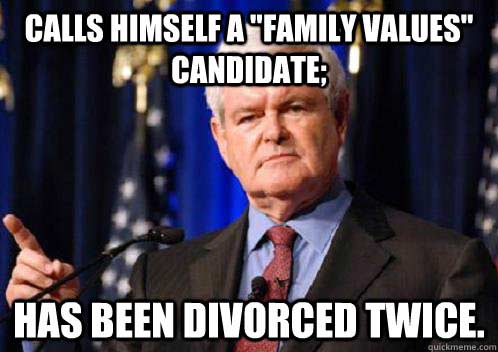
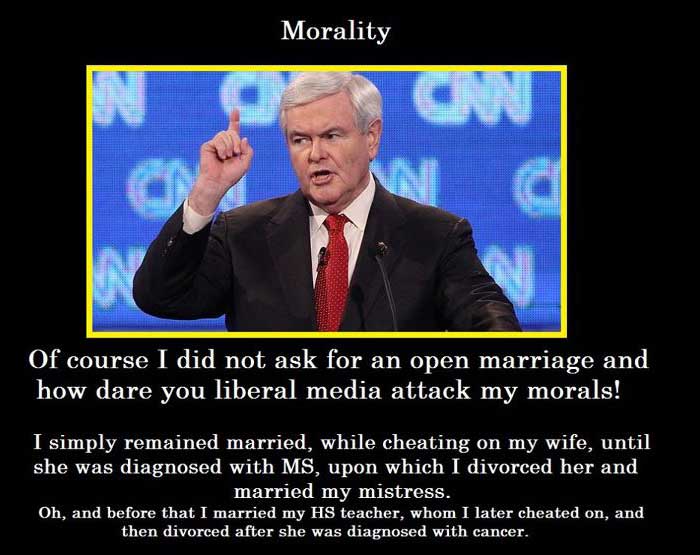
Or look at “Family Values” candidate and politician Newt Gingrich, who divorced his first wife after an affair, married his mistress, then divorced her to marry his second mistress. Said second mistress, who is still married to him, is apparently spending her time these days doing fundraising for the Romney campaign…on a platform of (wait for it) family values.

Gingrich, despite being a serial adulterer, is perceived by many folks on the right as being “moral,” presumably because hey, he ain’t gay. Yet to anyone who believes that morality lies in treating others with compassion, he is unquestionably an evil man.


This is not a new observation, of course. Many of the people who talk the loudest about “morality,” on both sides of the political divide, are deeply and profoundly evil. Mahatma Gandhi was quoted as saying “I like your Christ, I do not like your Christians. Your Christians are so unlike your Christ.” It’s not exactly a revelation that those who use talk of morality, particularly religious morality, in the public sphere are very often deeply immoral people.

Which is where Ambrose Bierce comes in.

It is not simple hypocrisy that explains the prevalence of evil among those who speak of morals. It is not that we are all born of frailty and error and each of us relates imperfectly to those around us.

It is, rather, a calculated and deliberate expediency.

Pat Robertson, Newt Gingrich, and all their ilk are evil people, consumed by a desire for power and wealth. They do not hide this at all. But there is a dilemma. In a Third World country, powerful strongmen can do pretty much whatever they like, without needing to justify themselves to anyone. But in an industrialized nation, maintaining power and wealth often requires maintaining the general goodwill of the people. How to do that, then, when you are a serial adulterer? How to do that when you own a mine that uses slave labor?

The answer, brilliant in its simplicity and obviousness, is to change the public dialog about what it means to be good, and what it means to be evil.

An evil man can gain the favor of generally good people, if he can set the tone of the dialog about good and evil. If he can redefine “evil” so that, rather than meaning “exploiting slave labor in Third World countries to become fabulously wealthy” it means “having sex in the wrong way,” he not only can deflect attention from his own evil, he can short-circuit the conversation about his own evil before it even begins.


When this image dominates the public dialog about morality, someone is being snookered.

We have come to a place where “morality” means “sex” because that state of affairs is expedient to powerful, wealthy men who want to be able to indulge their lust for wealth and power unchecked.

According to the Bible, it is the love of money which is the root of all evil. It is not premarital sex, nor gay marriage, nor the burning question of whether or not married couples are allowed to give head.

Yet among the Religious right, discussion of money is strangely absent from the morality debate. The beginning and end of morality revolves exclusively around who one has sex with, and under what circumstances.

That didn’t happen by accident. That isn’t a coincidence. It happened because evil men set out, systematically and deliberately, to focus the lens of morality away from their own evil.

Every time we accept this definition of morality, every time we allow the conversation about morality to get bogged down in irrelevant sexual minutia, we work in the service of these evil men.

All sin lies in treating one another poorly. Rather than talking about the morality of gay sex, perhaps we should talk about the morality of slavery. Perhaps, if we re-focus our dialog about morality onto the evil that those who campaign on platforms of morality and virtue do, we will begin to see a better world. I would far rather that Pat Robertson divest himself from his blood diamonds and give the vast wealth he created from slave labor to the poor, than see him continue to hold influence by talking about how immoral we are if we don’t have sex the same way he does.

If homophobic Christians read the Bible, what would the world look like?

When i lived in the South, I will admit I used to eat at Chick-Fil-A all the time. I was dimly aware that they had some sketchy religious leanings or something, and they tended to hire only surrealistically white people to work in their restaurants, but hey, the sandwiches were good.

Well, not really good. But at least better than much of the mediocre fast-food stuff you could get at, say, Taco Bell or Burger King.

I wish I could say that I was surprised to learn that Chick-Fil-A has bought into the virulent strain of anti-gay nonsense that seems to have the self-described Christian conservative bits of society in such a frenzy, but I’m really not. Like I said, I was dimly aware that ther was some kind of right-wing religious something something at play.

But the media attention about Chick-Fil-A and gay marriage got me to thinking. Most self-described Christian conservatives base their opposition to gay marriage on two Bible verses. Leviticus 18:22 reads:
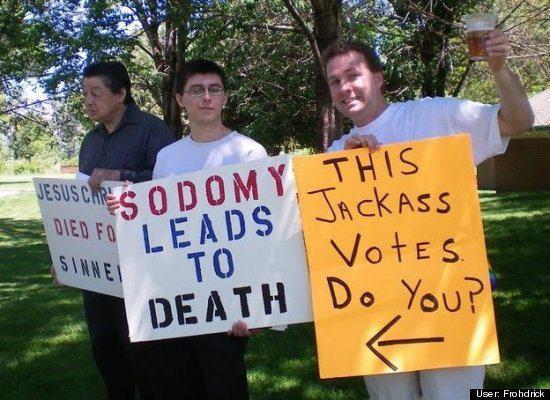
Thou shalt not lie with mankind, as with womankind: it is an abomination.

Leviticus 20:13 says:

If a man also lie with mankind, as he lieth with a woman, both of them have committed an abomination: they shall surely be put to death; their blood shall be upon them.

The rest of Leviticus goes on to say similar things about cutting your beard, wearing clothes made of different fibers, eating shellfish, having sex with a woman on her period, letting different kinds of cattle graze in the same field, and executing women if their husbands cheat on them they cheat on their husbands (seriously, it’s there, Leviticus 20:10).

Most Christians don’t follow these rules, arguing that Jesus made them irrelevant except the ones about homosexuality because those are totally different from the shellfish ones because of reasons, and some will even quote a third Bible verse, Romans 1:26-27, to justify banning gay marriage:

Because of this, God gave them over to shameful lusts. Even their women exchanged natural relations for unnatural ones. In the same way the men also abandoned natural relations with women and were inflamed with lust for one another. Men committed indecent acts with other men, and received in themselves the due penalty for their perversion.

But the Bible, both old and new testaments, actually spends a whole lot more time talking about divorce than it does about homosexuality. Both testaments are very, very clear that divorce is never permitted, and that those who divorce and remarry are guilty of adultery, a sin forbidden by the Ten Commandments, and with the penalty of death according to the old testament…

Um, wait a minute, didn’t we recently see a serial divorcee running on some kind of pro-family, conservative Christian platform?

In fact, the Bible even claims that Jesus, who never spoke about homosexuality at all, had plenty to say about divorce, in Matthew 5:31-32:

And it was said, ‘Whoever sends his wife away, let him give her a certificate of divorce’; but I say to you that everyone who divorces his wife, except for the cause of unchastity, makes her commit adultery; and whoever marries a divorced woman commits adultery.

The Bible has Jesus speaking the same message many more times, in Mark 10:2 and Luke 16:18, for example.

So I wonder…

What would the right-wing Christian pronouncements look like if they actually applied the same thinking on divorce to their supposedly “Bible-based” blatherings about homosexuality? What would happen if you took their hysterical anti-gay screeds and replaced the word “homosexual” with the word “divorce”? It seems a fair substitution; the same moral, Biblical justifications for opposing homosexuality even more strongly apply to divorce, after all.

I started Googling Christian proclamations about homosexuality, which…well, if you have ever felt the need to go trolling on a motorboat down an open sewer, doing that sort of Google search will give you a similar experience. And I took “homosexuality” and replaced it with “divorce.” The results were…interesting.

Clicky here to see what happens!

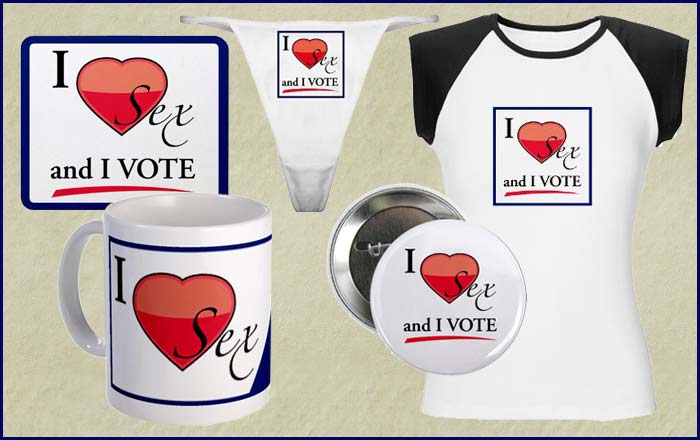
I Love Sex and I Vote

A short while ago, i blogged that I was dusting off my “I Love Sex and I Vote bumper sticker in honor of Rush Limbaugh and the Religious Right’s appalling, savage attack on women.

I made the bumper sticker back in the early days of the George W. Bush Presidency, convinced that the right-wing’s attack on women generally and sex specifically was about as bad as it could get. I’m sorry to report that I was very, very wrong on that count.

Since I re-blogged the bumper sticker and the “I Love Sex and I Vote” icons that go with it, I’ve had a request to make the icons available in different sizes. I’ve also had several readers email or message me to ask if I would be willing to make more than just a bumper sticker with the logo on it.

So I’m pleased to announce I’ve set up a CafePress shop with all sorts of things featuring this logo, in addition to the bumper sticker. I’ve also put the original (100 by 100 pixel and 80 by 80 pixel) icons, as well as two new icons with a blue border available in a lot more sizes.

I think it’s important this election cycle to take a visible stand that slut-shaming is not an acceptable part of our society. It’s time to push back against people who believe that it’s okay to shame people, especially women, for the “crime” of enjoying sex.

Feel free to use the icons below for whatever you’d like.


350 x 350 pixels


250 x 250 pixels


200 x 200 pixels


150 x 150 pixels

          
100 x 100 pixels

          
80×80 pixels

Women’s rights and GLBT rights are human rights

Note: I’ve started posting most of my writings about sex, culture, and society over to the Promiscuity Keepers Web site. The most recent post is an essay about why I, as a cisgendered straight man, care about the political assault on women’s rights and GLBT rights. Here’s a teaser:

Before I get started, though, let me say this: I am a white, cisgendered heterosexual man. That puts me in a uniquely privileged position; since I will never be pregnant, the assault on women’s right to choose doesn’t affect me directly. Since I am straight, the assault on the rights of gays and lesbians doesn’t affect me directly. Since I am a man, I am almost never the target of slut-shaming. I am, in other words, not the target of the campaign against women and gays that’s playing out on the airwaves and in the ballot boxes all over the United States right now.

But in a way, that’s kind of the point, because even though I am not the target of the attacks on women and gays, they still very much affect me. The thing is, these are not assaults on women’s rights or gay and lesbian rights; they are assaults on human rights. I am not gay and I am not a woman, but I am a human being. It would be a mistake for me to think that these things don’t affect me directly.

Let’s look at contraception. The debate over whether or not women should have easy access to contraception has turned into one of the defining issues in the current political discussion. Last October, presidential candidate Rick Santorum said “One of the things I will talk about, that no president has talked about before, is I think the dangers of contraception in this country. Many of the Christian faith have said, well, that’s OK; contraception is OK. It’s not OK. It’s a license to do things in a sexual realm that is counter to how things are supposed to be.” …

Want to see more? Read the whole post here!

Up your bumper, Rush Limbaugh

Some time ago, before Rush Limbaugh and his buddies launched their all-out assault on women in their effort to give the Democratic party a landslide victory this November, I created a bumper sticker over at Cafepress: “I (heart) Sex and I Vote”.

I abandoned Cafepress years ago. However, this sentiment seems far more relevant and necessary today than it did back then, so I’ve set up the store again.

So, here it is again. If you’d like to show Rush’s fans how you feel about sex, click here!

I’ve also created icons suitable for LiveJournal, Twitter, and other blogs and forums from the same design, which you are free to download and use however you’d like:

100×100 pixels

80×80 pixels

Why We’re All Idiots: Credulity, Framing, and the Entrenchment Effect

The United States is unusual among First World nations in the sense that we only have two political parties.

Well, technically, I suppose we have more, but only two that matter: Democrats and Republicans. They are popularly portrayed in American mass media as “liberals” and “conservatives,” though that’s not really true; in world terms, they’re actually “moderate conservatives” and “reactionaries.” A serious liberal political party doesn’t exist; when you compare the Democratic and Republican parties, you see a lot of across-the-board agreement on things like drug prohibition (both parties largely agree that recreational drug use should be outlawed), the use of American military might abroad, and so on.

A lot of folks mistakenly believe that this means there’s no real differences between the two parties. This is nonsense, of course; there are significant differences, primarily in areas like religion (where the Democrats would, on a European scale, be called “conservatives” and the Republicans would be called “radicalists”); social issues like sex and relationships (where the Democrats tend to be moderates and the Republicans tend to be far right); and economic policy (where Democrats tend to be center-right and Republicans tend to be so far right they can’t tie their left shoe).

Wherever you find people talking about politics, you find people calling the members of the opposing side “idiots.” Each side believes the other to be made up of morons and fools…and, to be fair, each side is right. We’re all idiots, and there are powerful psychological factors that make us idiots.


The fact that we think of Democrats as “liberal” and Republicans as “conservative” illustrates one ares where Republicans are quite different from Democrats: their ability to frame issues.

The American political landscape for the last three years by a great deal of shouting and screaming over health care reform.

And the sentence you just read shows how important framing is. Because, you see, we haven’t actually been discussing health care reform at all.

Despite all the screaming, and all the blogging, and all the hysterical foaming on talk radio, and all the arguments online, almost nobody has actually read the legislation signed after much wailing and gnashing into law by President Obama.

And if you do read it, there’s one thing about it that may jump to your attention: It isn’t about health care at all. It barely even talks about health care per se. It’s actually about health insurance. It provides a new framework for health insurance legislation, it restricts health insurance companies’ ability to deny coverage on the basis of pre-existing conditions, it seeks to make insurance more portable..in short, it is health insurance reform, not health care reform. The fact that everyone is talking about health care reform is a tribute to the power of framing.


In any discussion, the person who controls how the issue at question is shaped controls the debate. Control the framing and you can control how people think about it.

Talking about health care reform rather than health insurance reform leads to an image in people’s minds of the government going into a hospital operatory or a doctor’s exam room and telling the doctor what to do. Talking about health insurance reform gives rise to mental images of government beancounters arguing with health insurance beancounters about the proper way to notate an exemption to the requirements for filing a release of benefits form–a much less emotionally compelling image.

Simply by re-casting “health insurance reform” as “health care reform,” the Republicans created the emotional landscape on which the war would be fought. Middle-class working Americans would not swarm to the defense of the insurance industry and its über-rich executives. Recast it as government involvement between a doctor and a patient, however, and the tone changed.

Framing matters. Because people, by and large, vote their identity rather than their interests, if you can frame an issue in a way that appeals to a person’s sense of self, you can often get him to agree with you even if by agreeing with you he does harm to himself.

I know a woman who is an atheist, non-monogamous, bisexual single mom who supports gay marriage. In short, she hits just about every ticky-box in the list of things that “family values” Republicans hate. The current crop of Republican political candidates, all of them, have at one point or another voiced their opposition to each one of these things.

Yet she only votes Republican. Why? Because she says she believes, as the Republicans believe, that poor people should just get jobs instead of lazing about watching TV and sucking off hardworking taxpayers’ labor.

That’s the way we frame poverty in this country: poor people are poor because they are just too lazy to get a fucking job already.

That framing is extraordinarily powerful. It doesn’t matter that it has nothing to do with reality. According to the US Census Bureau, as of December 2011 46,200,000 Americans (or 15.1% of the total population) live in poverty. According to the US Department of Labor, 11.7% of the total US population had employment but were still poor. In other words, the vast majority of poor people have jobs–especially when you consider that some of the people included in the Census Bureau’s statistics are children, and therefore not part of the labor force.

Framing the issue of poverty as “lazy people who won’t get a job” helps deflect attention away from the real causes of poverty, and also serves as a technique to manipulate people into supporting positions and policies that act against their own interests.

But framing only works if you do it at the start. Revealing how someone has misleadingly framed a discussion after it has begun is not effective at changing people’s attention because of a cognitive bias called the entrenchment effect.


A recurring image in US politics is the notion of the “welfare queen”–a hypothetical person, invariably black, who becomes wealthy by living on government subsidies. The popular notion has this black woman driving around the low-rent neighborhood in a Cadillac, which she bought by having dozens and dozens of babies so that she could receive welfare checks for each one.

The notion largely traces back to Ronald Reagan, who during his campaign in 1976 talked over and over (and over and over and over and over) about a woman in Chicago who used various aliases to get rich by scamming huge amounts of welfare payments from the government.

The problem is, this person didn’t exist. She was entirely, 100% fictional. The notion of a “welfare queen” doesn’t even make sense; having a lot of children but subsisting only on welfare doesn’t increase your standard of living, it lowers it. The extra benefits given to families with children do not entirely offset the costs of raising children.

Leaving aside the overt racism in the notion of the “welfare queen” (most welfare recipients are white, not black), a person who thinks of welfare recipients this way probably won’t change his mind no matter what the facts are. We all like to believe ourselves to be rational; we believe we have adopted our ideas because we’ve considered the available information rationally, and that if evidence that contradicts our ideas is presented, we will evaluate it rationally. But nothing could be further from the truth.

In 2006, two researchers at the University of Michigan, Brendan Nyhan and Jason Reifler, did a study in which they showed people phony studies or articles supporting something that the subjects believed. They then told the subjects that the articles were phony, and provided the subjects with evidence that showed that their beliefs were actually false.

The result: The subjects became even more convinced that their beliefs were true. In fact, the stronger the evidence, the more insistently the subjects clung to their false beliefs.

This effect, which is now referred to as the “entrenchment effect” or the “backfire effect,” is very common among people in general. A person who holds a belief who is shown hard physical evidence that the belief is false comes away with an even stronger belief that it is true. The stronger the evidence, the more firmly the person holds on.

The entrenchment effect is a form of “motivated reasoning.” Generally speaking, what happens is that a person who is confronted with a piece of evidence showing that his beliefs are wrong will respond by mentally going through all the reasons he started holding that belief in the first place. The stronger the evidence, the more the person repeats his original line of reasoning. The more the person rehearses the original reasoning that led him to the incorrect belief, the more he believes it to be true.

This is especially true if the belief has some emotional vibrancy. There is a part of the brain called the amygdala which is, among other things, a kind of “emotional memory center.” That’s a bit oversimplified, but essentially true; when you recall a memory that has an emotional charge, the amygdala mediates your recall of the emotion that goes along with the memory; you feel that emotion again. When you rehearse the reasons you first subscribed to your belief, you re-experience the emotions again–reinforcing it and making it feel more compelling.

This isn’t just a right/left thing, either.

Say, for example, you’re afraid of nuclear power. A lot of people, particularly self-identified liberals, are. If you are presented with evidence that shows that nuclear power, in terms of human deaths per terawatt-hour of power produced, is by far the safest of all forms of power generation, it is unlikely to change your mind about the dangers of nuclear power one bit.

The most dangerous form of power generation is coal. In addition to killing tens of thousands of people a year, mostly because of air pollution, coal also releases quite a lot of radiation into the environment. This radiation comes from two sources. First, some of the carbon that coal is made of is in the naturally occurring radioactive isotope carbon-14; when the coal is burned, this combines with oxygen to produce radioactive gas that goes out the smokestack. Second, coal beds contain trace amounts of radioactive uranium and thorium, which remain in the ash when it’s burned; coal plants consume so much coal–huge freight trains of it–that the resulting fly ash left over from burning those millions of tons of coal is more radioactive than nuclear waste. So many people die directly or indirectly as a result of coal-fired power generation that if we had a Chernobyl-sized meltdown every four years, it would STILL kill fewer people than coal.

If you’re afraid of nuclear power, that argument didn’t make a dent in your beliefs. You mentally went back over the reasons you’re afraid of nuclear power, and your amygdala reactivated your fear…which in turn prevented you from seriously considering the idea that nuclear might not be as dangerous as you feel it is.
If you’re afraid of socialism, then arguments about health reform won’t affect you. It won’t matter to you that health care reform is actually health insurance reform, or that the supposed “liberal” health care reform law was actually mostly written by Republicans (many of the health insurance reforms in the Federal package are modeled on similar laws written by none other than Mitt Romney; the provisions expanding health coverage for children were written by Republican senator Orrin Hatch (R-Utah); and the expansion of the Medicare drug program were written by Republican Representative Dennis Hastert (R-Illinois)), or that it’s about as Socialist as Goldman-Sachs (the law does not nationalize hospitals, make doctors into government employees, or in any other way socialize the health care infrastructure). You will see this information, you will think about the things that originally led you to see the Republican health-insurance reform law as “socialized Obamacare,” and you’ll remember your emotional reaction while you do it.

Same goes for just about any argument with an emotional component–gun control, abortion, you name it.

This is why folks on both sides of the political divide think of one another as “idiots.” That person who opposes nuclear power? Obviously an idiot; only an idiot could so blindly ignore hard, solid evidence about the safety of nuclear power compared to any other form of power generation. Those people who hate Obamacare? Clearly they’re morons; how else could they so easily hang onto such nonsense as to think it was written by Democrats with the purpose of socializing medicine?

Clever framing allows us to be led to beliefs that we would otherwise not hold; once there, the entrenchment effect keeps us there. In that way, we are all idiots. Yes, even me. And you.