Liberals and Conservatives: Living Together in Fear

In April of this year, a report appeared in the scientific journal Cell which claimed that there are significant quantifiable neurological differences in the brains of liberals and conservatives.

Specifically, the report shows that political conservatives have larger amygdalas, which mediate emotional reactions such as fear and aggression.

This report got picked up all over the mainstream press, as with this article in The Atlantic headlined Are Liberals and Conservatives Hard-Wired to Disagree? and another article over on Raw Story titled Brain structure differs in liberals, conservatives: study, which says “Liberals have more gray matter in a part of the brain associated with understanding complexity, while the conservative brain is bigger in the section related to processing fear, said the study on Thursday in Current Biology.”

From a purely sociological standpoint, this may have some element of truth, at least in the sense that repeated sociological studies have shown conservatives to be motivated by fears of collapsing social order, loss of social hierarchy, and social disorder.

But qualifying conservatives as fearful and liberals as optimistic is really kind of silly, seems to me. Liberals, in my experience, are just as likely to be driven by irrational fears, and to make decisions based on poor evaluation of those fears, as conservatives are.

Take, for example, the nearly universal fear among those on the political left of nuclear power. Despite the fact that nuclear power is by far the safest form of large-scale electrical generation yet invented (coal power kills more human beings every year, primarily from air pollution but also from coal mining accidents, than nuclear power has killed in the entire history of its use combined–including Chernobyl), liberals are nearly universal in their stark raving terror of all things “nuclear.”

Liberals like to mock conservatives as ignorant, uninformed, and anti-intellectual, but the reality is that across the United States, anti-intellectualism is extraordinarily popular; its cause is championed by people of all political stripes. It manifests differently, sure; conservatives tend to oppose pure science, particularly biological and geological science (but even physics is not immune; there are some highly vocal nutjobs on the right who claim that Einstein’s theory of relativity is a sinful attempt to undermine public morality by embracing moral relativism), though quixotically they tend to embrace technology.

Liberals, on the other hand, claim to champion science, at least when they can be arsed to learn enough to be able to separate it from pseudoscience; but they reject technology, in forms ranging from vaccination to food processing. Liberals are particularly frightened of life sciences; their terror of genetically modified food is second only to their terror of nuclear power as a common source of fear.

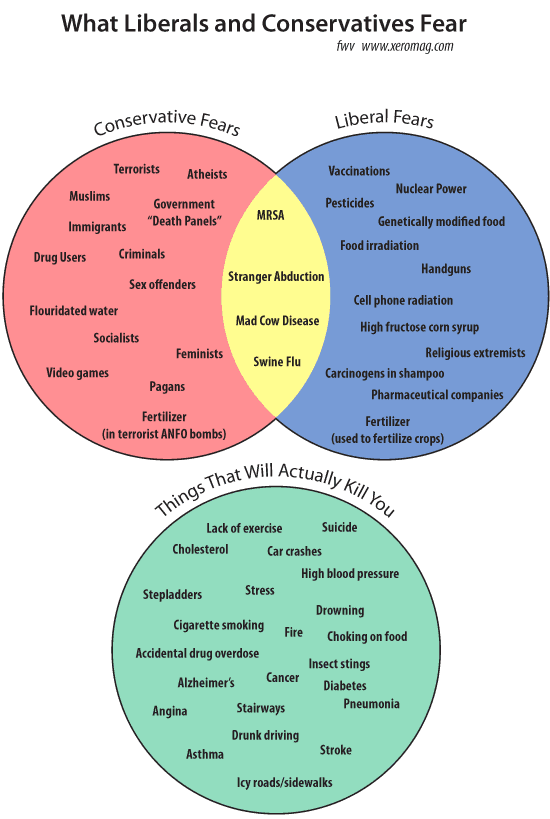
I’ve been chewing on this for a while, and as I often do, I’ve made a chart.

The things that will actually kill you tend, by and large, not to be the things you’re afraid of. Conservatives fear terrorism, which is stunningly unlikely to kill you; the number of Americans who lose their lives to terrorists every year is roughly on par with the number killed by sharks and bears, and is dwarfed by the number of people killed by falling off stepladders. On the other hand, as small as this number is, it’s still mountains bigger than the number of Americans killed by nuclear power every year, which tends to hover year after year at somewhere around zero.

How ironic, then, that the billions spent fighting these fears and the work done on both sides to advocate for these fears, and it’s actually driving to the office or not getting away from the TV to exercise that will do you in.

In light of the ongoing debacle in the Gulf…

…and in honor of the often hysterical BP Cares Twitter feed, I would like to most humbly propose a new logo for British Petroleum. Something that can redefine their brand in this troubled time, and present a more unified corporate action plan to the public.

“I don’t care what you are. I care what you DID.”

So last night I was reading my friends list, and ran into the video I’ve posted below on drjon‘s journal.

Now, this video is about racism, but touches on a really important idea that I think extends way, way beyond conversations about race. On the subject of racism itself, I have little to add beyond what the video already says, so I’ll leave that alone.

The video is by a guy who calls himself Jay Smooth. He has a Web site and a YouTube channel, and he’s articulate and smart and funny and before you know it I’d been sucked down the Intertubes and had wasted two hours watching all his stuff.

So thanks, drjon, that’s two hours I’ll never have back.

Anyway, the video is short and is worth watching, and I’ll put it here so you can see what I’m talking about before I move on to the point that extends beyond racism and race.

The distinction between “what he did” and “what he is” is important. It’s something that trips us up as human beings all the time. It’s the thin edge of the wedge that leads to mind-reading behavior, false assumptions, broken expectations, and all manner of other ills that plague us. And it’s a really, really easy mistake to make.


Human beings are a storytelling species. We tell ourselves stories all the time, every day, without even being aware of it. These stories help us to try to make sense of the actions of other people. Indeed, we even invent stories that we tell ourselves in order to explain our own behavior, as vividly illustrated in one famous series of studies of people whose corpus callosum had been split.

A quick recap for folks who are not neurology geeks: The corpus callosum is a thick bundle of nerves that connects the left and right hemispheres of the brain. If this is damaged or cut, as used to be done to treat a certain kind of epilepsy, the hemispheres can’t communicate directly with each other. Each hemisphere controls one-half of the body and sees one-half of the visual field, but language usually exists only in one hemisphere, not both; when the corpus callosum is cut, it’s almost like you have two different brains in one body, but only one of the two can talk.

Scientists have had a ball studying folks like this; it’s great fun. One common experiment involved showing things designed to provoke a reaction to the right hemisphere, which usually lacks language, then asking the person why he was reacting the way he did; the left hemisphere had no clue what the right hemisphere was seeing, but the person would nevertheless offer up all kinds of stories to explain his reaction. An even better experiment involved showing different images to the two hemispheres, such as a snowbank to the right hemisphere and a chicken to the left hemisphere, and then asking the person to point with his left hand at an object relevant to the thing he was seeing. The right hemisphere controls the left hand, so the right hemisphere, which was seeing an image of a snow bank, would point to a snow shovel. The left hemisphere, which was seeing a chicken, had absolutely not the foggiest idea why he was pointing to the shovel, but when he was asked “Why did you point to a shovel?” he’d say “Well, because I see a chicken, and you need to use a shovel to clean up chicken manure.”

In other words, he invented a story that was total fabrication to explain his own actions, without even being aware that he was inventing a story.


We all do this, all the time, and unless we guard against it, it can really distort our perceptions of other people. Every time we say “So-and-so did this because so and so is a ___”, we’re falling into this trap.

The fact is, unless we are mind readers (or unless someone actually explicitly says why he did something), our stories about other people’s motivations are just that–stories. We fabricate these stories based on our own projections and our own ideas.

Worse, we’re not even fair about it.

In the book How We Know What Isn’t So: The Fallibility of Human Reason in Everyday Life, Thomas Gilovich talks about the self-serving nature of the stories we tell. Sociologists love this stuff, and (naturally) have done a number of experiments illustrating this, by asking people who’ve done something why they did it, and then asking people who are watching someone else do the exact same thing why that person did it.

Invariably, people will offer situational explanations for their own behavior–“I did it because of the situation I was in”–but will offer personal explanations for other people’s behavior–“He did it because he is a worthless, good-for-nothing bastard who doesn’t care about me.”

For example, we’ve all cut someone off in traffic, and we’ve all seen someone cut us off in traffic. If you ask a person “Why did you just cut that guy off?” the person will probably offer you a situational explanation, like “The sun was in my eyes, and all the glare on the windshield made it impossible for me to see him.” But if you ask that exact same person “Why did that driver just cut you off in traffic?” that person will probably say “Because he is a reckless, careless idiot who doesn’t give a damn about anyone else on the road.”

In other words, to get back to the video, people don’t talk about what that other driver did, they talk about what that other driver is.


That’s a dangerous road to walk down, talking about what other people are. Projections of the motivations of others can get you in trouble fast.

But we do it all the time. And it’s not just with other drivers; we do it in politics, in relationships, everywhere.

“You voted for McCain because you’re a religious zealot who wants to see the government overthrown and replaced with a totalitarian militant theocracy.” “Oh, yeah? You voted for Obama because you’re an anti-capitalist tree-hugger who wants to destroy private enterprise!” This is what happens when we think we can tell what people are by looking only at what they did, and it’s an embarrassment.

Now, yes, there are right-wing religious zealots who want to overthrow the American government and replace it with a religious theocracy, and they probably did vote for McCain. And there are anti-capitalist left-wingers who want to destroy free enterprise, and they probably voted Obama. But assuming that you can peek into someone’s head and ascertain their motives just from this is kinda silly. Especially when you yourself had much more rational reasons for whatever vote you cast, right?

The sun was in your eyes, but that other guy is a jerk. Same thing.


My sweetie figmentj and I even talked about this recently. It can be very difficult to separate what a person does from what that person is even when that person is a close friend or a lover, and failing to do so can certainly add to unnecessary pain. “You don’t call me because you are indifferent to me” is very different from “you don’t call me because you don’t like talking on the phone,” and the former is much more hurtful than the latter. While it’s true that a person’s priorities are often reflected in their behavior, and it’s also true that a person who doesn’t care about you is in fact unlikely to call, there’s a long leap from that to “because you didn’t call, you don’t care.” (In fact, the train of thought that goes “A person who doesn’t care about me won’t call me; you are a person who doesn’t call me; ergo, you don’t care about me” is a problem in its own right, because it commits the fallacy of affirming the consequent. Devilishly slippery, this stuff is.)

And it presents itself in other ways, too. “My lover just checked out that hottie who walked into the store. That means my lover is a faithless bastard who doesn’t really love me!” The stories we tell sometimes say more about our own internal fears and insecurities than about the person we’re telling them about.

So, yeah. It’s about what people do, not about what people are. And if you want to change what people do, the best way to do this is to keep the conversation away from what they are.

Yet Another List o’ Linky-Links

Once again my Web browser is devouring half of my system’s available RAM and more swap space than you can shake a stick at, so it’s time once again for a long list of links.

Including naturally enough, some Watchmen-related links.

I’ve got several real posts brewing, none of which I’ve actually had time to write (just got home from the office, if that’s any indication), so without further ado, here we go!

Science

Obama to lift restrictions on stem-cell research

Obama Science Memo Goes Beyond Stem Cells

If Obama accomplishes absolutely nothing else in his entire term in office, if he does nothing to stop the pointless and expensive war in Iraq or right the capsizing economy, then his presidency will still be an epic win. Abandoning religious ideology in favor of actual, genuine science is one of the most important things this nation can do. First World superpowers keep their position only by dint of their technological and scientific basis, yet in the past eight years under anti-intellectual Republican rule, the US slipped to #22 in the world in terms of financial support for basic scientific research.

Rewiring the Brain: Inside the New Science of Neuroengineering

This is an incredibly exciting time to live in. We’re closing in on being able to understand and manipulate the stuff of the universe on the smallest scale possible, and we’re also closing in on the ability to understand in ways never before possible the most fundamental things that make us who we are. These areas of exploration bring incredible promise.

New Scientist: Humans may be primed to believe in creation

I’ve written before about how the brain is not an organ of thought so much as an organ for generating beliefs–a “belief engine,” if you will–and this research shows that a predisposition belief in purpose is a very strong component of that belief engine.

Missing Link Between Fructose, Insulin Resistance Found

For the first time, a concrete, documented mechanism between fructose and fructose-containing sweeteners and diabetes is uncovered.

Sociology

Catholic Church excommunicates doctors who perform lifesaving emergency abortion on 9-year-old rape victim; take no action against her rapist

The Vatican uses the line “life must always be protected” to justify the excommunication, in apparent ignorance of the irony that without the abortion, the young rape victim, and the babies, would have died.

Bush: ‘Sanctity of Human Life Day’

In the last days of his Administration, former President Bush declared Jan. 18 to be “National Sanctity of Human Life Day.” Apparently, the sanctity of human life doesn’t apply to the citizens of Middle Eastern nations that happen to be geographically close to other nations that were responsible for terrorist attacks on us.

Steve Pavlina: 2009 Focus – Intimate Relationships

So there’s this guy who is…well, I’m not exactly sure what he is. He seems to be a motivational coach (or “personal development” coach, whatever that is). Anyway, he writes a blog, and in his blog he says that 2009 is the year he’s going to explore polyamory. And he linked to my site on his list of resources.

Bizarre

Photos of abandoned Russian ships frozen in ice

I really, really, really, really want to visit this place. The Russians have always been amazing at taking urban decay to the next level, and this place is just beautiful.

The Most Amazing Star Trek Collectible of All Time

If by “amazing” you mean “horrifying beyond all human reason.” The commentary is priceless.

Watchmen condoms: We’re society’s only protection

If you want your schlong to look just like Dr. Manhattan’s, now’s your chance! These blue condoms come in a flip-top case with the smiley face on the front, and …yeah. I have nothing else to add.

Some thoughts on tattoos, porn, and respect for women

So I admit it. I’m so not up on the common vernacular these days that it wasn’t until early last year I’d ever heard of lower back tattoos on women described as “tramp stamps.”

I’ve always liked tattoos; the right tattoo on a woman can be very beautiful indeed. (The definition of “right” is highly subjective, of course, and will no doubt very from person to person. I tend to think that any tattoo involving pictures of Jesus nailed to a cross, or to anything else for that matter, or hearts with “Mother” written across them in fancy script, are not the right tattoo by any definition–but the end of the day, the only definition of ‘right’ that matters is that of the person who owns the tattoo. But I digress.

But until quite recently, I was blissfully unaware that tattoos on certain parts of the body were generally considered to be markers of questionable moral character, or that those who had tattoos were generally assumed to be sexually promiscuous.

The term ‘tramp stamp,’ as clever as it sounds (“Oooh! It rhymes! It must be true if it rhymes! If the glove don’t fit, the tramp stamp sits!” Or something) betrays what seems to me to be a very interesting idea about women. It’s a short, simple, 21st-century slang term that packages sixteenth-century ideas about sex and sexuality in a handy, bite-sized piece.

It’s hard to know where to begin. The notion that women who like sex are ‘tramps’ and therefore less worthy as human beings is pretty odious. On top of that is layered another blanket prejudice–the notion that a woman who wants to decorate a certain part of her body must necessarily be a woman who likes sex. (The tendency of human beings to invent stories in their heads to explain the motivations of other human beings, and the profound disconnect that exists between the stories we invent and the actual motivations of the people we invent these stories about, never ceases to amaze me.) Then, resting atop that like the cherry on a layer cake of stereotypes and prejudice, comes the notion that such a woman must not only enjoy sex, but be unselective about her choice of sex partners.

Now, when I first heard the expression ‘tramp stamp,’ I was like, “Okay, it rhymes, ha ha, very funny.” It’s only been recently that I’ve come to understand that there are folks who actually believe, like, for reals, that women who tattoo their backs are sexually promiscuous.
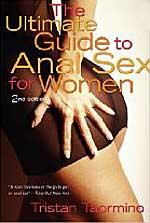

On another forum I read, there’s a conversation going on about anal sex, and specifically about whether or not there are any women who actually enjoy it.

Quite aside from the fact that I know rather a lot of women who enjoy giving it as well as receiving it (and thank God for that!), a surprising number of people maintain, often rather vigorously, that the woman who likes taking it up the ass doesn’t exist. A handful of folks opine that women do it only to please their mates, and that this makes them sad and pathetic creatures (on the idea, apparently, that doing something that makes your lover happy is one of the most stupid things any sad wretch could ever want). Those folks are merely ignorant of the full range and depth of the human sexual experience, which is sad but not surprising.

Another vocal handful, however, were unable to maintain this notion in the face of a considerable number of posters who said “Hey, I like getting jiggy up the butt!” and finally conceded that there are women whofavor anal–but then insisted that these women are inferior as human beings. One poster even wrote, I was brought up to treat woman especially lovers as on a pedestal. All this time, by these statistics I could have been treating half of them like whores.

And I think that speaks volumes, too, about the prejudices that some people carry around with thim regarding the ‘proper’ way for women to be.

It would seem that this man treats women with respect only as far as they behave the way he wants them to, and the moment they deviate from his expectations about how they should be, he tears them down off that pedestal and judges them ‘whores.’ Which is pretty fucked up, if you ask me.

I can’t quite rightly wrap my brain around the notion that a person’s value centers on the way that person acts in bed, nor around the idea that a woman who digs it up the ass, no matter what other qualities she may have as a human being, determines her eligibility for respect.

Yes, I know that there was a time when a woman’s value quite literally depended on her sex; that women were essentially bartered away by their fathers for use as breeding stock, and that in a day without paternity testing and with strict, if goofy, notions of inheritance and property rights, tracking a woman’s sexual activity was important to issues of estate. That’s also fucked up, and it hasn’t been true (at least in the First World) for…err, rather a long time now.

What baffles me is how tenaciously these ideas cling to life.

The guy who wrote the aforementioned bigoted nonsense defended this nonsense with a great deal of heat, at one point comparing anyone who thinks that anal sex is okay with the German Nazi party (I kid you not, though I seem to remember that the Nazis had their own views on anal sex, and it was probably more in line with this guy’s than he might realize).

I wrote recently that when a person holds on to some idea in the face of contradictory evidence, it’s usually because the idea is a distorted reflection of some part of that person’s underlying emotional landscape, but in this particular case I’m quite flummoxed about what that emotional landscape might be. I simply can not figure out why someone would care so passionately, and become so emotionally upset, over the notion that a bunch of women he doesn’t know and will never meet like taking a hard cock up the butt every now and then…or even don’t like teh analz, but think it’s okay if other women do.
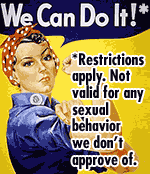

Now we get to the part that might make some folks angry. This is the part where I say that, while musing on these notions that women who like sex are bad, women who get lower back tattoos are women who like sex, and therefore women who get lower tattoos are bad, and on the sorts of faulty wiring that can exist inside a person’s head to make him believe that a woman who likes any kind of sex that he thinks she shouldn’t like no longer deserves respect, I have reached the conclusion that there’s a certain brand of feminism that seems bent on keeping things this way.

In a completely different conversation on a completely unrelated forum, the topic came up, as it often does, about pornography and relationships. Several folks, many of whom identify as feminists, weighed in on the subject with the usual laundry list of criticisms–porn is coercive, porn is degrading to women, porn commoditizes women’s sexuality, that sort of thing. One woman even went so far as to say, without apparent irony, that she has no respect for any woman who would be in porn.

Which, to my mind, is no different from the guy who says he has no respect for any woman who would receive anal sex.

Now, I know that feminism is often sharply divided over issues of porn and sex, with some feminists ardently opposed to it and other feminists ardently in favor of it. I’ve written about my own views on the subject in the form of a parody Socratic dialog on the virtues of porn, but the woman who claimed not to be able to respect anyone who did porn brought up an entirely new absurdity in my mind–the idea that anti-porn feminists have internalized the very patriarchal ideas they claim to oppose, and as a result are swallowing the very same patriarchal ideas about women and sex that they claim to refute.

When your ideological enemy agrees with you about the proper conduct of people, in the very areas where your ideological differences lie, I think it might be time to re-evaluate your ideas.

In a sense, the anti-porn feminists are accepting the core values of patriarchy, merely dressing them in different garments. They are, in fact, accepting the notion that a woman’s sexual choices and sexual expressions should be limited, that women who make sexual choices that they don’t agree with are inferior, and that some part of a woman’s value does indeed rest on her sexuality. They are seeking to abridge both a woman’s right to choose her own sexual expression and her freedom and range of sexual action, by labeling certain forms of sexual expression off-limits.

And perhaps most ironically, the entire argument that porn is inherently objectifying and commoditizing is based on flawed assumptions.

Many anti-porn feminists argue that porn caters to men and reinforces oppressive male-centered sexual roles. Leaving aside the inconvenient fact that many, many women like porn (a fact that anti-porn feminists will often handwave away by the process of inventing stories to explain their motivations, saying things like ‘they only believe they like porn because they’ve been brainwashed by patriarchal society into accepting subservient sexual roles’–that is, when they bother to acknowledge the fact at all), in reality if you look at the most patriarchal, the most repressive, the most rigidly conservative men out there, you will see that those men don’t like porn either.

The idea that porn is the byproduct of repression and patriarchy does not stand up to scrutiny. Socially conservative men, those who most strongly subscribe to the notion of prescribed sexual roles for women, are quite often ardent opponents of porn themselves. These social conservatives–the ones who seek to control women’s sexuality and who feel that women should be ‘pure’ and ‘proper’ and stay within rigid social norms–often will go so far as to say porn should be outlawed.

In fact, the Taliban, arguably the single most sexually repressive, patriarchal, anti-woman group the world has ever seen, ruled that possession of pornography was punishable by death.

The more patriarchal a society is, the more likely that society is to prohibit porn. The more socially conservative a person is and the more a person believes that women must obey rigid gender roles, the more likely it is that that person is opposed to porn. The more threatened a person is by women expressing their sexuality in non-traditional ways, the more likely it is that that person opposes porn. Porn is the byproduct of oppressive male patriarchy? Far from it; oppressive male patriarchy despises porn, and the more strictly a society seeks to impose gender roles on its members, the more strictly that society forbids pornography!

The same holds true for religion; the more socially conservative, sexually repressive a religious doctrine is, the more vigorously that doctrine opposes pornography. Look at the Southern Baptists, whose core doctrine says that a woman’s place is to submit gracefully to the divine authority of her husband. How do you think the Southern Baptist Convention feels about pornography? (Let me give you a hint.)

It doesn’t help, of course, that nobody can even define what porn is. “I can’t define porn, but I know it when I see it,” when it comes to brass tacks, is basically nothing but a way of saying “If it makes me feel a certain way, then it must be bad. If I see something and I don’t feel that certain way, then it isn’t porn, but if it causes certain feelings in me, then it is.” Which is, I rather think, a piss-poor way of defining anything, especially for the purpose of determining if it should be socially accepted or not. (Anti-porn activist Catherine MacKinnon helped author Canada’s anti-porn laws…laws which have enough subjective wiggle room that, in practice, they are routinely applied to gay and lesbian erotica but rarely or never applied to heterosexual erotica.)


There are, it would seem, many feminists who would like to live in a progressive, egalitarian society that treats women fairly, as full and equal citizens whose standing is identical to that of men…yet at the same time like to see this society free of porn.

And I don’t think that’s even possible.

A society which respects women as the equal of men, and which does not value its members on the basis of their sexual activities, will be a society in which there is porn. The more egalitarian that society is, the more mainstream that society is likely to be, for the very simple and obvious reason that there are people who dig making porn.

One anti-porn feminist argument is that porn is coercive. And this is true, in societies that don’t accept porn. It exists in every society, without exception, even in places once ruled by the Taliban–but the more repressive a society is, the more underground the manufacture and distribution of porn becomes. When something goes underground, it tends to become corrupt, driven by the sorts of people who will abuse and coerce for profit. If the making of porn is illegal, which is what tends to happen in patriarchal societies, then the production of porn falls into the hands of criminal enterprise.

Progressive societies tend not to have this problem; there is no need to force women into porn when porn is legal, because, like I said, some people dig being in porn. The human species is vast in its range of expression, and for some folks, being filmed in bed is fun. For other folks, it’s a job, no different than any other, and a damn sight better than some. (You really want to know what objectification and exploitation is all about? Try working at a chicken processing plant, where workers, often poor or minority women, may be forced to wear diapers or piss their pants because their bosses refuse to let them leave the line to use the bathroom.)

Point is, people do, and enjoy, different things. Some women like tattoos. Some women like taking naughty pictures of themselves. Some women like being filmed for Gang Bang All Stars VII. That’s all a normal and natural part of human expression, and like it or not, castigating entire classes of people or valuing them less because they do things that you don’t like does not empower women, nor serve in the interests of freeing women from social constraints on their range of action.

Respect, real respect, must include respecting folks whose choices aren’t like yours, so long as they do not seek to impose those choices on others. This is a test which the Taliban, the Southern Baptists, the folks who label women who like lower back tattoos as ‘tramps,’ and the anti-porn feminists all fail.

How we know God is a man

And now on to the post I had intended to make.

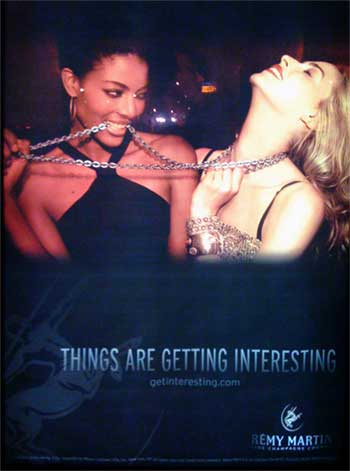
Last weekend, while walking to Sushi House during the five and a half hour sushi-related adventure detiled here, we passed a lighted advertisement for Remy Martin booze mounted on the side of a bus stop.

The ad suggests hot biracial girl-on-girl action, with just a hint of bondage play. I snapped a pic with my iPhone; sorry about the quality, the light was very low.

It’s part of the “things are getting interesting” ad campaign for Remy Martin, who I gather make booze. Not surprising, really; booze and body spray (and by the way, WTF is “body spray,” exactly? I’ve never quite figured it out. As near as I can tell, it’s a product category that didn’t even exist a decade ago) are generally advertised with overt, and sometimes over-the-top, sexual imagery. Here are a few more images from the same advertising campaign:


So basically, what we’ve got is kinky girl-on-girl action, hot threeways, and a rather nice dungeon door. I want that door on my private dungeon when I build my next house…but I digress.

This, of course, is how we know God is a guy. ‘Cause God thinks girl-on-girl action is hot, but guy-on-guy action is gross. There’s no question in my mind that if the first ad featured two half-naked, well-muscled men, the campaign would be canceled post-haste. C’mon, seriously, you know the religious brigade would be all up in arms, burning things with torches and reciting from Leviticus and whatever else it is they do.

‘Course, none of this is particularly new. I’m just curious if there’ll ever be a day when there’s a little more parity in the kinky sex. You know, as a bold announcement of a significant new step by society toward equal rights and representation for all1. (And why is it that girl-on-girl is hot but guy-on-guy is gross in the public’s mind, anyway?)

“Buy our product and two hot models will fuck you. Like, at the same time. And you can watch them fuck each other, too! Really, honest Injun. You can tell we’re sincere ’cause our ads are all, like, moody and stuff.”

1 Actually, while I say that tongue-in-cheek, there was a time–and not too long ago, at that–when even the merest suggestion that people of different races might want to get it on with each other would’ve brought out the torches-and-pitchforks crowd faster than you can say “anti-miscegenation laws are stupid and patently offensive.” So maybe there is hope.

Yes, I know California passed Proposition 8. I expected it to pass, actually. It’s the last dying gasp of the bigots and homophobes; in a few generations, this and other stupidity enshrined in state constitutions all over the union will go the way of those anti-miscegenation laws, which were also writ into state constitutions not so long ago.

Some thoughts on reason, falsehood, and emotional need

When David and I arrived at work last Wednesday, our HR manager was in a pretty foul mood. When David asked how she was, she answered “scared. We’ve just voted in a Muslim terrorist as President.”

Now, Barack Obama is neither a terrorist nor a Muslim; in point of fact, he’s a Christian and a long-time member of a Christian church affiliated with the United Church of Christ. But that’s not really what I came here to talk about; in fact, I’m not really here to talk politics at all. I’m here to talk about what makes people believe outlandish things.


There’s a really interesting two-part essay over on Slactivist about an enduring urban legend surrounding Proctor & Gamble, the company that makes laundry detergent and soap and whatnot. According to the urban legend, an unnamed officer of Proctor & Gamble appeared on some television talk show some years ago and announced that the company donates part of its profits every year to the Church of Satan.

As with all urban legends, the details are fuzzy and change over time. Sometimes, it was the president of the company; in other tellings, it was the CEO. Sometimes it was Oprah; sometimes, Phil Donahue. The name of the person who appeared on the show and the date the show aired are, of course, never given.

The interesting thing about this urban legend is its total absurdity. It’s trivial to disprove; it can be demonstrated conclusively beyond even a single atom of doubt that it just plain never happened. Moreover, its utter absurdity would seem to suggest that no reasonable person could believe it.

The two-part essay is worth reading; you can find part one here and part two here.

The essay asserts that, in a nutshell, the folks who repeat this tale, which has been circulating since at least 1980 and possibly before, don’t believe it’s true; instead, they willingly pass on a story they know to be false, and only pretend to believe it’s true. The author asserts:

Those spreading this rumor can be divided into two categories: Those who know it to be false, but spread it anyway, and those who suspect it might be false, but spread it anyway. The latter may be dupes, but they are not innocent. We might think of them as complicit dupes. The former group, the deliberate liars, are making an explicit choice to spread what they know to be lies. The complicit dupes are making a subtler choice — choosing to ignore their suspicion that this story just doesn’t add up and then choosing to pass it along anyway because confirming that it’s not true would be somehow disappointing and would prevent them from passing it along without explicitly becoming deliberate liars, which would make them uncomfortable.

What I want to explore here is why anyone would make either of those choices. In both cases, the spreading of this rumor seems less an attempt to deceive others than a kind of invitation to participate in deception. The enduring popularity of this rumor shows that many people see this invitation as something attractive and choose to accept it, so I also want to explore why anyone would choose to do that.”

I think this is a very interesting argument–that those who pass on the story know it to be false, since it would seem that the story is so prima facie ridiculous that nobody could really believe it.

But I don’t think that’s the case. I don’t believe that the people who pass on this story know it to be false, but pass it on anyway, Instead, I think the real answer can be found in a comment posted after the end of the first part of the essay, and I’ve been chewing on it for weeks now. It offers, I think, a very useful insight into fallacy of all sorts.

The important bit, which caused something of an epiphany in my own understanding of the human condition, is this bit:

When an untrue story circulates, it’s generally because it expresses some kind of social unease. There may not be razors in the Halloween apples, but it’s a way of expressing the concern that your precious children are going out knocking on the doors of people who may not wish them well. There may not be rat poison in the Mars bars, but it’s a way of expressing the sense that they’re definitely not good for you. Not every Bridezilla story may be true, but it’s a way of expressing the sense that the wedding industry is too high-pressured and perfectionistic. There may not be Satanic abuse going on at day care centres, but it’s a way of expressing a sense of discomfort at women going to work and leaving their children in the care of others. And so on.


Human beings are inherently irrational. We carry around with us a kind of internal model of the way we make decisions: we are posed with a question, we think about the question, we evaluate evidence to support or refute each of the available options, and then we come to a conclusion. But that isn’t how it works at all.

More often, the decision is made emotionally, on a subconscious level, long before we ever start thinking about it. After the decision has been made deep within the bowels of our emotional lizard brains, our higher-order, monkey-brain reason is invoked–not to evaluate the decision, but to justify it.

One consequence of this emotion-first decision-making process is confirmation bias, a process of selective evaluation where we tend to exaggerate the value of anything which seems to support our ideas, and to devalue or discard anything which contradicts our ideas. It’s a powerful process that ends up making the decisions we’ve already made and the things we already believe all but immune to the light of disproof, no matter how compelling the disproof may be.


I’ve written before about how the brain is really not an organ of thought so much as an apparatus for forming beliefs, and how it has been shaped by adaptive pressure to b remarkably resilient at forming, and holding on to, beliefs about the physical world.

The adaptive pressures that gave rise to the belief engine within our heads don’t necessarily select in favor of organisms that generate correct beliefs, for reasons I talked about there. But the beliefs that we form do serve a purpose, and sometimes, it’s an emotional purpose.

The things a person believes can reveal a lot about that person’s underlying emotional processes. Beliefs often reflect, in a garbled and twisted way, the buried perceptions and the emotional landscape of those who profess them. Even the most outrageous, clearly absurd beliefs can be quite sincere, and otherwise sane, rational people will adopt insane, irrational beliefs if those beliefs serve some emotional function.

Looked at in this way, a lot of patently absurd beliefs begin to make a kind of sense. They’re distorted funhouse mirror projections of an underlying emotion, twisted out of all rational shape, and clung to through a powerful set of mental processes that make them seem attractive, even obvious.
The idea that Obama is a Muslim terrorist, ridiculous as it is, is an expression of an emotional state: “I do not identify with this person, he seems alien and strange to me, and I am afraid that he will not make decisions that reflect my needs.”

The notion, sometimes seen in a few of the more extremist corners of radical feminism, that all heterosexual sex is always rape becomes an expression of an emotional state: “When I have had sex, I have felt disempowered and violated by the experience.”

The idea that the government staged the attacks on the World Trade Center is a twisted-up, garbled expression of an emotional state: “I am afraid that my nation’s government is corrupt and evil, and is willing to resort to any means, however extreme, to achieve its own ends.”

This is why these beliefs are so vigorously resistant to debunking, even when the evidence against them is overwhelming. They are not assertions of fact in the way that many other statements are; they are assertions of emotional identity.

And they can not be treated as assertions of fact, even though on their face that’s what they look like.


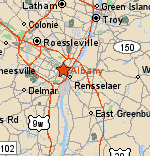
If someone says “New York city is the capital of New York State,” that’s an assertion of fact. It’s easily countered; you can easily show him a map, or point him to Wikipedia, and say “No, the capital of New York State is Albany.” And, if he’s not mentally ill in some way, he’ll probably say “Really? I didn’t know that. Cool!”

But if someone asserts that Proctor & Gamble donates money to the Church of Satan, and you contradict him, he’s likely to respond with anger–in a way that he won’t if you tell him that Albany is New York’s capital. That’s because you’re not contradicting his assertion of fact; you’re telling him that his emotional identity is wrong.

And it’s important to understand that even if a particular belief is wrong, the emotional landscape supporting that belief might not be. Proctor & Gamble does not donate money to the Church of Satan, but what is that belief an expression of? One likely possibility is that the emotional state beneath it looks something like “I do not trust large, faceless corporations to have my interests at heart, and I am afraid that a society dominated by large, faceless corporations may not be responsive to my needs and my values.”

And you know what? That is a perfectly reasonable feeling to have. There very well indeed may be some truth to that idea, even though the specific beliefs that grow from this soil are twisted and misshapen.

Any attempt to debunk these ideas will never succeed if the debunking does not separate the idea from its emotional foundation. Furthermore, the fact that an idea grows from and is nourished by some kind of underlying emotional reality means that even the most otherwise skeptical, rational person can become attached to ideas that are patently false, and that person’s own tools of rational skepticism may not be able to evaluate, or even see, those ideas.

The challenges this notion poses to skeptics and rationalists is worthy of a post in its own right, and will be the subject of Part 2 of this essay.

Link O’ The Day…

peristaltor points out that if John McCain insists on calling himself a “maverick,” he (and his handlers) might want to learn a little bit about the word’s origin. I had no idea myself where the word came from, and now that I know, I gotta say: McCain keeps using that word. I do not think it means what he thinks it means.

Interesting to folks who care about politics and folks who find language fascinating. I know I have a few of both on my flist.

Oh, for God’s sake…

…all the rhetoric about “revolution” and how he’s different from all the others, and Ron Paul is just another anti-intellectual, anti-science creationist nutjob. Are there any Republican politicians anywhere who aren’t ignoramuses?