Wrong in the age of Google: Memes as social identity

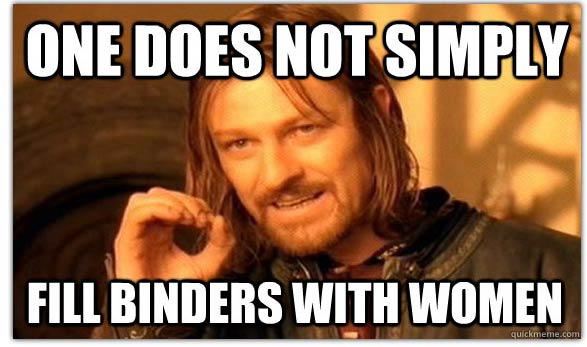
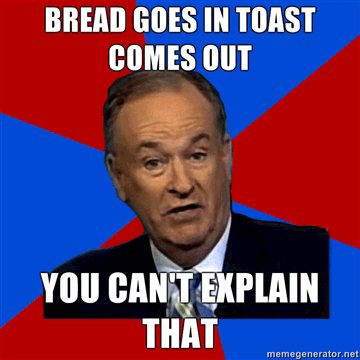
A short while ago, I published a tweet on my Twitter timeline that was occasioned by a pair of memes I saw posted on Facebook:

The memes in question have both been circulating for a while, which is terribly disappointing now that we live in the Golden Age of Google. They’re being distributed over an online network of billions of globally-connected devices…an online network of billions of globally-connected devices which lets people discover in just a few seconds that they aren’t actually true.
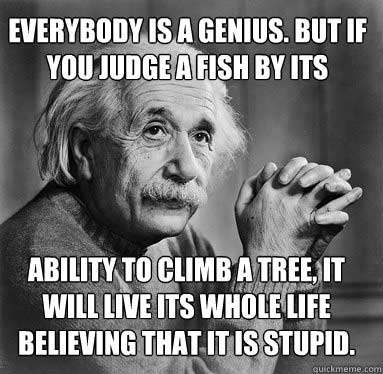

A quick Google search shows both of these memes, which have been spread across social media countless times, are absolute rubbish.

The quote attributed to Albert Einstein appears to have originated with a self-help writer named Matthew Kelly, who falsely attributed it to Einstein in what was probably an attempt to make it sound more legitimate. It doesn’t even sound like something he would have said.

The second is common on conservative blogs and decries the fact that Obamacare (or, sometimes, Medicaid) offer free health coverage to undocumented immigrants. In fact, Federal law bars undocumented immigrants from receiving Federal health care services or subsidies for health insurance, with just one exception: Medicaid will pay hospitals to deliver babies of undocumented mothers (children born in the United States are legal US citizens regardless of the status of their parents).

Total time to verify both of these memes on Google: less than thirty seconds.

So why, given how fast and easy it is to verify a meme before reposting it, does nobody ever do it? Why do memes that can be demonstrated to be true in less time than it takes to order a hamburger at McDonald’s still get so much currency?

The answer, I think, is that it doesn’t matter whether a meme is true. It doesn’t matter to the people who post memes and it doesn’t matter to the people who read them. Memes aren’t about communication, at least not communication of facts and ideas. They are about social identity.


Viewed through the lens of social identity, memes suddenly make sense. The folks who spread them aren’t trying to educate, inform, or communicate ideas. Memes are like sigils on a Medieval lord’s banner: they indicate identity and allegiance.
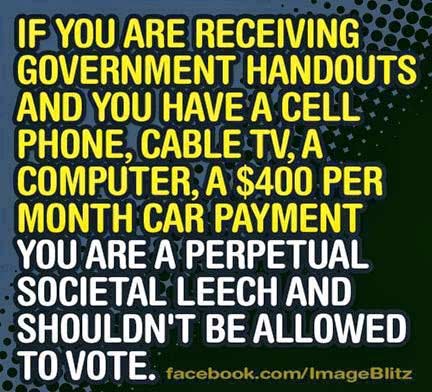

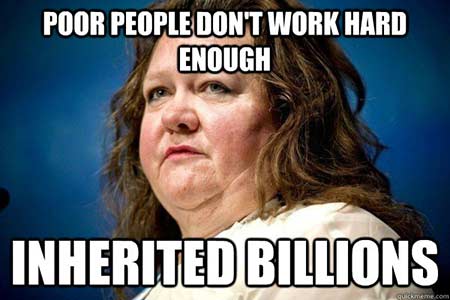
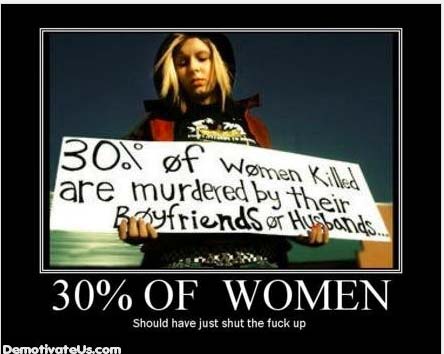
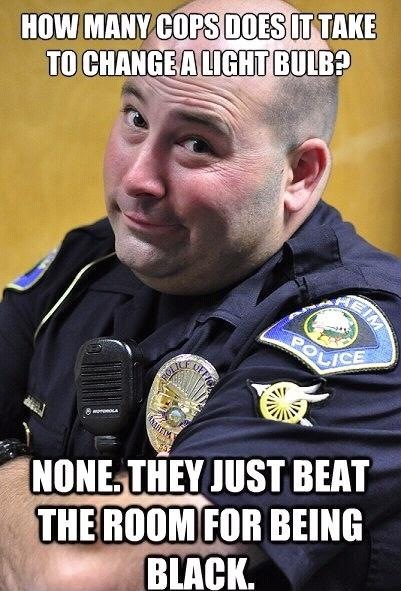
These are all memes I’ve seen online in the last six weeks. What inferences can we make about the people who posted them? These memes speak volumes about the political identities of the people who spread them; their truthfulness doesn’t matter. We can talk about the absurdity of Oprah Winfrey’s reluctance to pay taxes or the huge multinational banks that launder money for the drug cartels, and both of those are conversations worth having…but they aren’t what the memes are about.

It’s tempting to see memes as arguments,especially because they often repeat talking points of arguments. But I submit that’s the wrong way to view them. They may contain an argument, but their purpose is not to try to argue; they are not a collective debate on the merits of a position.

Instead, memes are about identifying the affiliations of the folks who post them. They’re a way of signaling in-group and out-group status. That makes them distinct from, say, the political commentary in Banksy’s graffiti, which I think is more a method of making an argument. Memes are a mechanism for validating social identity. Unlike graffiti, there’s no presupposition the memes will be seen by everyone; instead, they’re seen by the poster’s followers on social media–a self-selecting group likely to already identify with the poster.

Even when they’re ridiculously, hilariously wrong. Consider this meme, for example. It shows a photograph of President Barack Obama receiving a medal from the king of Saudi Arabia.

The image is accurate, thought the caption is not. The photo shows Barack Obama receiving the King Abdul Aziz Order of Merit from King Abdullah. It’s not unconstitutional for those in political office to receive gifts from foreign entities, provided those gifts are not kept personally, but are turned over to the General Services Administration or the National Archives.

But the nuances, like I said, don’t matter. It doesn’t even matter that President George W. Bush received the exact same award while he was in office:

If we interpret memes as a way to distribute facts, the anti-Obama meme is deeply hypocritical, since the political conservatives who spread it aren’t bothered that a President on “their” side received the same award. If we see memes as a way to flag political affiliation, like the handkerchiefs some folks in the BDSM community wear in their pockets to signal their interests, it’s not. By posting it, people are signaling their political in-group.

Memes don’t have to be self-consistent. The same groups that post this meme:
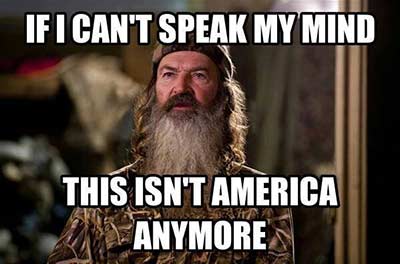
also tend by and large to support employment-at-will policies giving employers the right to fire employees for any reason, including reasons that have nothing to do with on-the-job performance…like, for instance, being gay, or posting things on Facebook the employer doesn’t like.

Memes do more than advertise religious affiliation; they signal social affiliation as well.

Any axis along which a sharp social division exists will, I suspect, generate memes. I also suspect, though I think the phenomenon is probably too new to be sure, that times of greater social partisanship will be marked by wider and more frequent distribution of memes, and issues that create sharper divides will likewise lead to more memes.

There are many ideas that are “identity politics”–ideas that are held not because they’re supported by evidence, but simply because they are a cost of entry to certain groups. These ideas form part of the backbone of a group; they serve as a quick litmus test of whether a person is part of the out-group or the in-group.

For example, many religious conservatives reflexively oppose birth control for women, even if the majority of its members, like the majority of women in the US at large, use it. Liberals reflexively oppose nuclear power, even though it is by far the safest source of power on the basis of lives lost per terawatt hour of electricity produced. The arguments used to support these ideas (“birth control pills cause abortions,” “nuclear waste is too dangerous to deal with”) are almost always empirically, demonstrably false, but that’s irrelevant. These ideas are part of a core set of values that define the group; holding them is about communicating shared values, not about true and false.
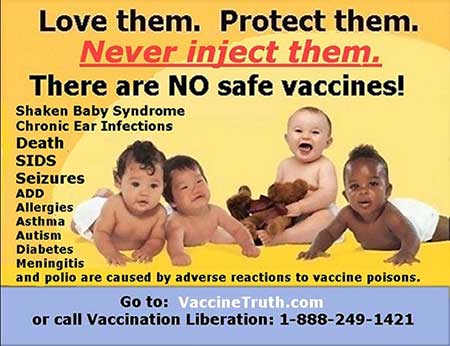

Unfortunately, these core identity ideas often lead directly not only to misinformation and a distorted worldview, but to actual human suffering. Opposition to vaccination and genetically modified foods are identity ideas among many liberals; conservatives oppose environmental regulation and deny human involvement in climate change as part of their identity ideas. These ideas have already led to human suffering and death, and are likely to lead to more.

Human beings are social animals capable of abstract reasoning, which perhaps makes it inevitable that abstract ideas are so firmly entrenched in our social structures. Ideas help define our social structures, identify in-group and out-group members, and signal social allegiances. The ideas we present, even when they take the form of arguments, are often not attempts at dialog so much as flags that let others know which lord we march for. Social media memes are, in that way, more accurately seen as house sigils than social discourse.
“I’m not a feminist. I love men!”

If you’ve been reading my blog for any length of time, you’ll know I hold very little in common with the Religious Right. I do not, for example, believe that homosexuality is a sin, or that Teh Gayz are all destined for the fires of Hell. I don’t much cotton to the notion that the government of the United States should be replaced with a Christian theocracy. Nor do I believe there is a hidden secret agenda of the Godless to drive this great nation into the ground–I think the anti-intellectualism displayed by so many on the Right is doing that job well enough, thanks.

But there is one thing I admire about the Right, and that is their fearsome, epic ability to frame discussion about any topic they care about by crafting a point and then keeping tenaciously, ferociously on point.

“I’m not a feminist. I love men!”

One of the ways the Right has been brilliantly successful at framing the public discourse is in the way they’ve controlled how we think about women. And by “we” I don’t mean “people on the right,” I mean everyone.

Even folks who ought to know better.

“I’m not a feminist. I love men!”

The areas of the Internet I frequent are not areas where the Right often appear. I tend to spend my time online in forums that talk about non-traditional relationships, progressive social issues, technical and scientific subjects, and skepticism.

And there’s something really striking about all these places. The Right may not be present there, but the ideas of the Right are. Even, interestingly, in people who claim to despise the Right.

“I’m not a feminist. I love men!”

There’s no place this is more obvious than in conversations about the Dread F Word. No, not that Dread F Word, the other Dread F Word.

Find yourself a progressive, generally respectful, tolerant, otherwise with-it person. Man or woman, it doesn’t make much difference. Just find someone who thinks there’s room for a multiplicity of views in the public ideosphere. Someone who, if he or she is religious, doesn’t think God commands converting the heathens at the point of a sword. Someone who thinks that people ought generally to be treated well,and that religion isn’t the basis for the formation of a Western representative government. Someone who will agree that racism is a bad thing, even if it’s not entirely clear what we should do to get rid of it.

Now ask that person a simple question: “What is feminism?”

See that? Something very strange happens. For a brief moment, when that otherwise progressive, generally agreeable person starts talking, it’s as if Rush Limbaugh or Sean Hannity stuck his hand up your interlocutor’s ass and made his or her lips move. For that brief instant, that person, that otherwise agreeable and not at all racist or sexist person, becomes a meat puppet for Mr. Limbaugh, Mr. Hannity, and his ilk.

Even if that person would be horrified at the thought of listening to their shows.

“I’m not a feminist. I love men!”

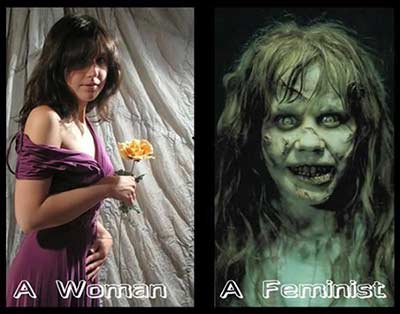
Think about what goes through your mind, dear reader, at the word “feminist.” Do you think “shrill”? “Strident”? “Misandrist”? “Humorless”? “Man-hater”? “Feminazi”? Does an image pop into your head of a woman who wants to get ahead by tearing down men, a woman who blames men for her own shortcomings, a woman who wants to cause trouble because she can’t succeed on her own? Do you picture someone who, even if she perhaps has the right intentions, has totally gone overboard, accusing all men of being sexist (or worse, of being rapists)?

Guess where those ideas come from? I’ll give you a hint: Not from actual feminists.

Now, don’t get me wrong: any sufficiently large group of people is going to contain extremists, bad apples, and destructive folks. If you look at doctors in general, you’ll find the occasional cynical lying fraud like Andrew Wakefield–but we don’t say all doctors are frauds who deliberately publish articles they know to be fabricated. There are probably a small number of extremists out there somewhere who hold something that might reasonably be within spitting distance of some of the stereotypes about feminism.

But the idea that this is what most or all feminism is about? Sheer, brilliant, amazing PR by the Right. Where did you get those ideas? You got them from the Right, even if you don’t know it.

You probably think you didn’t get them “from” everywhere. You simply know them to be true. Everyone knows them to be true, right? And that’s the crux of the brilliance: if you repeat an idea often enough, everyone, even folks who ideologically despise you, will come to accept it as just true.

Feminists hate men. Everyone knows it. Because we’ve all heard it, even if we don’t exactly remember where we’ve heard it from.

Are there women who are angry? Oh, yeah, you bet. What’s amazing is not that women are angry, but that more women aren’t more angry. All the dudebros I’ve personally met get a whole lot angrier about things a whole lot more trivial–for instance, the notion that they shouldn’t grope those hot somethingsomethings at that con without, you know, asking them first. (Scientist Hope Jahren actually had a colleague ejaculate in an envelope and leave it in her mailbox when she dared to think that she might be worthy of a spot on a serious scientific research team…and this isn’t even an isolated or extreme example of the kind of shit women deal with every day. And men say women are angry? Seriously, what would we say about women if they thought it was appropriate to protest the presence of a man on a research team by shoving a used tampon into a mailbox? Seriously, it amazes me that every woman on earth does not, at some point, climb a clock tower with a rifle. I guaranfuckingtee you that if the roles of men and women were reversed tomorrow, we’d see a whole lot of dudebros doing exactly that.)

“I’m not a feminist. I love men!”

The idea that feminism means hating men has been so skillfully inserted into the public discourse that it’s accepted as a premise in almost any dialog about men and women. And it’s a corrosive idea. It distorts conversation. If you accept this premise, a whole lot of things that would otherwise seem unreasonable–indeed, even offensive–start to sound reasonable.

What is feminism?

It’s the idea that men and women are both people, equally deserving of agency. That’s it. That’s the whole package.

What separates feminism from humanism, then? Centuries of institutional, systematic inequality, that’s what. Saying “I think men and women are equal” is all fine and dandy, but if you ignore the fact that we live under a system that treats, in a thousand ways, men and women as decidedly unequal, congratulations! You’ve just won a Nobel Prize in Missing The Point, which you will be sharing with approximately two and a half billion other luminaries in point-missing.

If you think women are people, congratulations, you’re a feminist! And if you don’t, well…the alternative, it seems to me, is “asshole.”

If you reject this notion of feminism, because everyone knows it means something else, ask yourself: How do you know? Do you know from actually talking to women, or because you’ve heard of this one person who said this feminist this one time said all men are rapists and should die? And if it’s the latter, ask yourself…how did he know that? And more to the point, who benefits from this particular notion of feminism? (I’ll give you a hint, bro: it ain’t women.)

End note: At this point, I know, I just know, that some of you have fingers already all a-tingle to send me a private email telling me pretending to be a feminist is a great strategt for getting laid. Seriously, don’t bother.

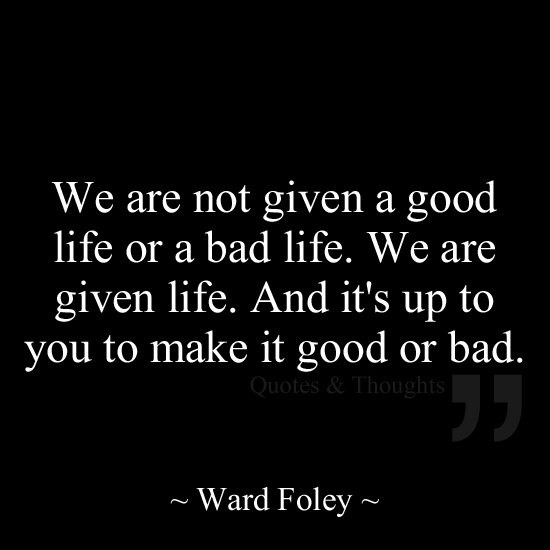
“We are not given a good life or a bad life.”

I haven’t been writing much here lately, because I have been hard at work writing our book about polyamory. At 160,000 words, it’s well north of the New Testament and a bit north of The Two Towers in size. It turns out polyamory is complicated, and we have a lot to say about it.

However, I’m taking a break from writing about polyamory because I’ve started seeing this meme pop up all over the Internetverse, and it’s reached the point where I have to say something about it. I think it’s symptomatic of the problem of privilege.

I get what it’s trying to say. Really, I do.

But it’s wrong.

Yes, some people are given a bad life or a good life. We do not all start from a neutral place. Take this kid, for example. He would, I’m sure, be quite happy to have been given a life that was neither bad nor good:

This photo, by South African news photographer Kevin Carter, won a Pulitzer Prize. It documents the effects of famine in Sudan, in which more than 70,000 people died. Carter later committed suicide; in his suicide note, he wrote, “I am haunted by the vivid memories of killings and corpses and anger and pain…of starving or wounded children, of trigger-happy madmen, often police, of killer executioners.”

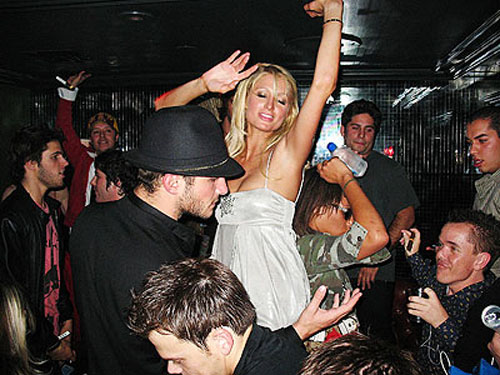
Look at this kid. Then look at wealthy heiress Paris Hilton, out doing what she does best (which is, near as I can tell, “getting photographed partying”):

Then look back at the slave labor camps in North Korea, which are used to punish political dissidents “to the third generation.” People are born in these slave camps, grow up, and die (often of torture, beatings, or starvation) here, without ever knowing anything else.

The meme might more accurately say “white middle-class Westerners born into progressive democracies are not given a good life or a bad life.” But to be fair, perhaps that’s what’s meant by “we.”

For those who aren’t white middle-class Westerners in progressive democracies, there most definitely are good lives and bad. Not all lives have the same opportunity for choice and direction. Not everyone can choose to better their conditions; those born into North Korean Labor Camp 15, which is believed to hold as many as 30,000 slaves, certainly can’t.

Like I said, I get the point of the meme. I am a huge believer in empowerment myself; I have written a great deal about how the choices we make affect our lives, for good or ill.

But I also recognize that, to a large extent, this is a privilege–one that should properly belong to everyone, but doesn’t. Not everyone can choose to make their lives good or bad. The way we’re born matters; Paris Hilton can shrug off bad choices that would destroy many people who are born into a less privileged position, and just keep on keepin’ on.

Yes, make choices that make your life better. Yes, move in the direction of greatest courage. But when you do, don’t forget to be grateful that you can. It’s not your fault that people are born into situations horrifying beyond anything you can imagine, but it’s your responsibility to acknowledge that not everyone is in the same position as you are. Some people are given a bad life. If you’re not one of them, you’re fortunate, but don’t forget they exist.

And if your response is “lighten up, it’s just a Facebook meme!”–perhaps you aren’t paying attention.

Rant Part II: How Not To Be a Dick To Women

With all the pushback on (and off) the Internet to any suggestion that perhaps men could maybe refrain from treating women poorly, one might get the impression that we were talking about, say, taking all the money the NFL normally makes in a year and investing it in fusion power research or something equally unreasonable. How, the thinking seems to be, can men reasonably be expected to act like decent human beings toward women when we have all these throbbing biological urges? I mean, what if we see a woman, who’s, like, totally hot? Surely acting like a decent human being doesn’t have to apply to women who are totally hot, does it? If we treat a totally hot woman like a human being, how will she know we want to put our pee-pee in her sex burrow? And what about women who don’t make Mister Happy happy…if we treat them like human beings, how will they know we don’t find them attractive?

It’s madness! I mean, really. Treat women as people? All of them? Without constantly getting all up in their faces about whether we want to sex them or not? That’s just…it’s just…it…

…well, it turns out it’s really not that hard to do.

Listen, guys, here it is. You just…think of her like she’s a person. Someone who’s a friend, even. And then you act accordingly.

Listen, I know it sounds totes whack. It goes against everything we’re taught to believe about maximizing our chances of getting to do that thing with our pee-pees. But bear with me. All it takes is a little practice, and then you, too, might be a guy who’s a decent human being and totally not a complete shitcamel.

Let me walk you through some scenarios, so you can get a feel for how this works.

Scenario 1: You’re approaching a door. There are people behind you.

If you hold the door open for people, congratulations! You’re a decent person.

If you hold the door open for women, but not for men, danger! You’re probably a misogynist.

If you hold the door only for women you want to put your pee-pee on, guess what? You’re a shitcamel.

Scenario 2: You’re on an online dating site. You spend six hours pouring your heart out in a carefully crafted message to this cute little something something whose soulful eyes make you think she could be the light of your life, and whose big bazoongas make you want to do that thing with your pee-pee. After you send it, she doesn’t email you back.

If you just go about the rest of your life, go you! You’re a decent person.

If you write her a follow-up email telling her that she owes you a response, uh-oh. Misogyny ho!

If you send her a follow-up email filled with (a) every swear word at your disposal, (b) vivid descriptions of what a bitch she is for wounding you so grievously, (3) angry rants about what unpleasant fate should befall her, or (4) pictures of your junk, I’m afraid the prognosis is: shitcamel.

Scenario 3: You see a woman talking about how creepy it is to hit on women in elevators.

If you listen respectfully and adjust your behavior and expectations accordingly, woohoo! You’re a decent person.

If you respond with a defensive lecture about how you’re totally not one of those guys and she’s just trying to say that all men are rapists, I’m sorry to have to tell you this, but that that’s your misogyny.

If you go on a rant about how she’s totally saying all men are rapists and she deserves to be raped for it…well, there’s only one mathematical equation that accurately models your reaction. You = shit + camel.

Scenario 4: Women are talking about how linking birth control to employment insurance policies basically means their boss gets to tell them how to have sex. You:

…listen to what they’re saying, think about it, and realize that, actually, it is pretty messed up that the person who hires you gets to tell you how the insurance benefits you earn as part of your labor should be used, and having an employer making your decisions in the bedroom is kind of creepy. Go you! Decent person!

…say “well, you know, the employer is paying for this insurance, so the employer controls how it’s used.” Wait, what? The employer is paying a salary too, does that mean the employer gets a vote on what you buy on Amazon.com? Bzzt. Your misogyny is showing.

…say “well, you know, that slut can just pay for it herself if she wants to go slutting around.” Hello, shitcamel! One hump or two?

Scenario 5: You’re out chilling with the boys, and someone tells this absolutely hysterical rape joke. It’s funny because she is violated against her will! Get it? Get it?

You put on your best blank “no, I don’t get it” face, turn to your friend, and say “No, I don’t get it. What’s funny about women being violated again?” Score one for being a decent person! Extra special decent person points if you deliberately construct a social group of people who already get why that shit ain’t funny.

You don’t say anything. After all, if you don’t laugh, that means you’re not like those guys, right? Bzzt! Wrong. If you just sit there, they might assume you’re a little slow, but hey, you’re still just like they are. Sorry, your misogyny (and privilege) are showing.

You laugh, because nothing is as absolutely hysterical as talking about women getting violated! Plus, when those feminist harpies start shrieking about how uncool it is, you get exasperated because clearly they just don’t get it. For God’s sake, it’s only a joke! Free speech! Free speech! Heigh-ho, shitcamel! What’s your camel-made-of-shit encore, putting on blackface and joking about Negroes wanting the vote or something? They’re all just jokes, right? Free speech!

Some thoughts on privilege: Look, it isn’t about your guilt.

I participate in a lot of online forums about polyamory. It’s almost impossible to talk about polyamory without eventually talking about OK Cupid, which is arguably one of the best places online for poly folks to meet each other (I met my live-in partner zaiah there). And it’s almost impossible to talk about OK Cupid without talking about how often women tend to get harassed on online dating sites. Any online dating sites.

And, it’s almost impossible to talk about how often women get harassed, on dating sites or anywhere else, without a whole succession of men trotting up to say “well, I personally don’t harass women! Women act like all men are harassers! I’m totally not like that, and I don’t understand why women don’t talk to me online! I totally deserve to have women talk to me online! If I spend my time writing an email to some woman online I am entitled to a response, even if she doesn’t want to date me!”

And, of course, from there it’s just a short hop to talking about male privilege, and as soon as that happens, inevitably those same men trot up again to say “this talk of privilege is just a way to try to make me feel guilty!”

And I gotta say: Guilt? Seriously? You think it’s about guilt?

Guilt is for things you can control. Feeling guilty over things you can’t control, like the race or sex you were born with, is silly.

If you think talking about privilege is about making people feel guilty, you’re completely missing the point.

It’s about being a decent person.

People who are privileged may still struggle, may not always get what they want, but the whole point is they have a lot of advantages over other people. Advantages they can’t see. Advantages they don’t know about.

Talking about privilege is about awareness, not guilt. When people don’t know about the advantages they have, they act in messed-up ways that show insensitivity to others. Like, for example, telling women who experience harassment on a scale that men can’t even understand how they should feel about it, what they should do about it, and why they should, like, totes respond to ME because I’M not like that! I’M not one of those entitled jerks, and therefore I DESERVE a reply!

The purpose of understanding your privilege isn’t to make you feel something. Not guilt, not shame, not anything else. It’s to help you understand that you have a set of things you take for granted that other people don’t have, so that you can change the way you act.

Got nothing to do with feelings at all.

Change the way you act in small ways. Like, not telling women how they should feel about sexual harassment. Like, not telling inner-city blacks that the police are their friends. Like, listening when women talk abut harassment, instead of just saying “oh, you’re saying all men are harassers.” (Hint: No, they’re not.) Or saying something like “well, I just don’t see color.” (Hint: Not seeing color is something you can only do if you happen to be the privileged color. When you belong to an oppressed minority, you don’t get the luxury of not seeing your status.)

Change the way you act in medium ways. Like, if you are a man with a normal social circle, statistically you probably know at least three harassers and at least one rapist. Seriously. So, when you’re with a group of your friends and someone makes a racial joke or a rape joke or talks about how women are bitches or whatever, speak up. Remember, if you don’t say anything, those harassers and that rapist in your social circle–and yes, they are there, even if you don’t know who they are–assume you’re on their side and think the way they do.

When people make cracks about sending a woman into the kitchen to make a sandwich, or talk about how they’d sure like to get that hot chick drunk and bend her over the table, speak up. Say it isn’t cool.

Yeah, it’s uncomfortable to speak up when all your friends are yee-hawing and back-slapping about how absolutely hysterical that rape joke was. Deal with it. The discomfort you face speaking up ain’t nothing on the discomfort women face just walking down the goddamn street.

Change the way you act in large ways. Don’t vote for political candidates who talk about how only lazy blacks are on welfare or blab about “legitimate rape.”

People aren’t telling you you’re privileged to make you feel guilty. People are telling you you’re privileged because privilege is a system and an institution that benefits you and that you participate in without even knowing it. When you know about it, maybe you can stop participating in it. Maybe, if you’re brave and willing to pull on your big-boy pants, you can even put yourself on the map against it when the folks around you are participating in it.

The world’s first 3D printed gun: Ho hum.

Today, a landmark in improvised engineering was reached. Plans for an (almost) entirely 3D printable firearm went up on the Internet, able to be freely downloaded by anyone.

The reactions around the Net are predictable. Libertarians and gun nuts are ecstatic, gushing all over themselves about how this will be the “end of gun control” and usher in some kind of “new age of freedom” or something.

Law and order types, gun control advocates, and the government are wetting themselves with the prospect of legions of terrorists printing up virtually undetectable firearms and taking over airplanes or something.

And it’s all completely ridiculous. Neither a new age of freedom nor a new age of terror are in the works; in fact, I’m quite confident in predicting the total impact of this technology will be statistically undetectable. Self-congratulatory (on the one side) and paranoid (on the other) ravings aside, this thing simply does not make any meaningful difference whatsoever.

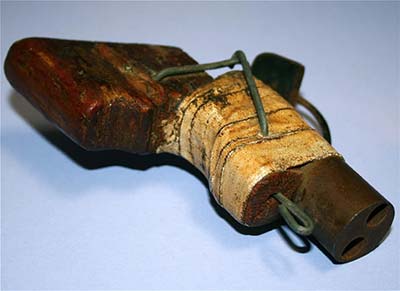
First, let’s see this harbinger of freedom end of civilization toy for rich white kids:

It’s printed from ABS plastic on an $8,000 3D printer. Almost everything is plastic, including the barrel; the only non-plastic parts are an ordinary nail (for the firing pin) and the bullet itself (in this case, a .380 caliber).

Now, I’ve owned firearms and shot recreationally for most of my life,1 and the first thing I can say upon seeing this thing is that I wouldn’t want to fire it. My instinct is that it’s probably about as dangerous to whoever’s on the trigger end as whoever’s on the business end.

The one shown here was test-fired three times. The first time, it misfired. The second time, it successfully fired a .380 round without destroying itself. The third time, when the .380 was replaced with a 5.7×28 cartridge, it exploded.

Could it survive multiple shots with the smaller round? I don’t know. Maybe. I wouldn’t bet my life on it. Doesn’t really matter. Not only is this thing not a game changer, I reckon it’s about as significant in terms of its overall impact on society as whatever toy they choose to put into a box of Cracker Jacks next week.


For starters, what you’re looking at here is not only a shoddy firearm of dubious reliability and ruggedness; it’s an $8,050 $9,000 shoddy firearm of dubious reliability and ruggedness. This prototype was printed on an $8,000 3D printer with about $50 worth of materials, making it arguably the single most expensive zip gun that’s ever been fabricated. A person looking for cheap, untraceable guns would be able to buy an arsenal on the street for less than the cost of the printer that produced this thing. (Edit: It turns out that this gun actually requires $1,000 worth of plastic toner to print, making it arguably the most expensive zip gun ever made even if the cost of the 3D printer isn’t factored in.)

Now, I already know what you’re going to say. The cost of 3D printers is dropping quickly. People can rent one or use one at a school. Companies will 3D print parts for you.

All of which is true, but irrelevant; the ability to make crude, cheap firearms for a lot less than just the cost of the plastic alone for this thing has existed…well, for about as long as firearms have existed. Prisoners have been known to build guns from parts available in prisons.

It has never been lack of availability that has kept people from using small single-shot firearms like this. The reason every criminal in town isn’t sticking up convenience stores with zip guns isn’t that they have been languishing in wait for a Libertarian college student to design one that can be 3D printed and put on the Internet; it’s that these things are virtually worthless as weapons. They tend to be used in prisons but few places besides, because they’re unreliable, prone to failure, inaccurate, and dangerous to the operator.

Just like, ahem, the 3D printed version.

Seriously. Even when they work, you have to be at point-blank range (or better yet, in contact with your intended target) for them to be terribly effective.

Which leads to the next hand-wringing objection: OMG this is made of PLASTIC you can take it onto an AIRPLANE through a METAL DETECTOR!

Which is, err, only kind of true. It’s a bit bulky to hide on your person, and there’s still the fact that the firing pin and ammunition are metal. Now, you might be able to get a nail through security on some pretext or other, but I doubt many folks will let you carry ammunition onto a plane.

If they notice it, which is a different matter; I’ve had friends who’ve carried brass knuckles and switchblades onto planes without difficulty. The reality is that few people actually want to, and have the means to, attack an airplane; nearly all of what happens at the airport is security theater, not security.

But let’s assume just for amusement that you can get one of these onto a plane. So what? What of it?

If I wanted to attack an airplane with a weapon I made on a 3D printer, it wouldn’t be this gun. Even if it works, it only works once, and I doubt the other passengers would sit around idle while I reloaded it and prepared to fire again. Assuming that the first shot actually did any good anyway.

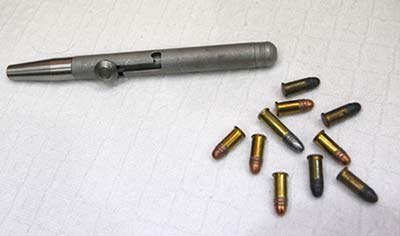
The guy who designed this says “You can print a lethal device. It’s kind of scary, but that’s what we’re aiming to show,” as if this is the first time that’s been possible. Sorry, kid, but you’re a ridiculous wanker; a 3D printed knife or spear is actually a lot more lethal than this toy gun. (There’s a reason shivs rather than zip guns are the preferred weapon in places like prisons, and it’s not all down to scarcity of ammunition; given how easily drugs flow into American prisons, ammo isn’t that much of a stretch if there were a demand for it.) The 9/11 hijackers, who were well-funded, used…box cutters.

But I wouldn’t carry a 3D printed knife, or even a cheaper and better ceramic knife, onto a plane with mischief in mind either, because I’m not suicidal. Post 9/11, one thing has actually made air travel safer: the fact that the other passengers aren’t about to sit quietly by and hope for the best if someone tries to take a plane. All the other security changes that have happened since then have paled in effectiveness next to passenger attitude.

So, here’s the million-dollar question. You take a plastic gun onto an airplane, and…what, exactly? What in the name of the seven holy fucks and the twelve lesser fucks do you do then? What’s your plan?

If your goal is to destroy the plane, you can’t do that with this thing. If your goal is to take over the plane, well…good luck with that. You might survive what the other passengers do to you, maybe, if you’re lucky. Everybody is shrieking about how this thing can defeat airline security…and then what?


In fact, that million-dollar question can be extended to just about any possible use for this thing. You’ve bought yourself an eight-grand 3D printer, or somehow got access to it. You download the plans like an eager little hacker and you print this out, and then you…um, what do you do then? Go online and brag to your Maker friends?

You aren’t going to use this for home defense. I mean, seriously. A baseball bat or a tire iron makes a better home defense weapon, and the baseball bat probably has a longer effective range.

You’re not going to use it to outfit your secret militia that’s pining for anticipating the day that the Federal government starts rolling the tanks down Main Street. You aren’t even going to use an AR-15 for that, because, listen, seriously? The government has drones. They can blow your ass to hell and gone and you’ll never even see someone to shoot at.

You aren’t going to take it down to the range and pop off a few rounds in the general direction of paper cutouts of zombies or Trayvon Martin. No gun range is going to let you anywhere near the firing line with this; it’s too dangerous to the other shooters.

And please, please tell me you think you can go hunting with this thing. Bring a video camera and let me know when the video is up on YouTube. You can’t get enough of that for my entertainment dollar.

So you’re going to print it out, you’re going to put it together, and then…what, exactly? I’m still not clear on that.

Now, if you designed it, what you’ll do is obvious: you’ll get media exposure for congratulating yourself on what a clever Libertarian you are. And as near as I can tell, that’s really this thing’s only usefulness.


1 Full disclosure: I’ve been a private firearm owner on and off since 1988. I like guns, I like target shooting, and I’m neither opposed to nor afraid of guns. All that being said, I still won’t fire one of these.

Freedom? I do not think that word means what you think it means

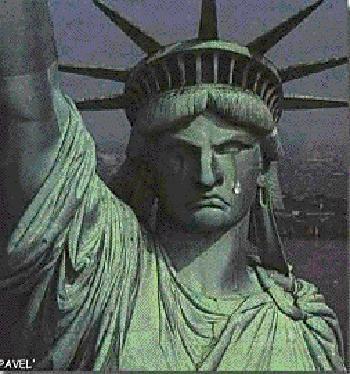
Since last week’s election, in which Mitt Romney was so confident of victory that he didn’t bother to write a concession speech, but lost by the largest electoral vote margin since 1996, there has been a picture floating around on conservative blogs and Web sites mourning the results. It looks like this:

There are a bunch of variants on it, of course, but the basic theme is ‘liberty weeping because this terrible thing happened.’

This particular image first started making the rounds after September 11, 2001, and it’s been recycled to express dismay over the conservatives’ non-preferred guy winning the election.

It is also, I think, an ironically appropriate image…but perhaps not in the way the conservatives who are using it might intend.


The Statue of Liberty was dedicated in October of 1886. The Civil War had only recently ended,and Reconstruction was in full swing. On the day the Statue of Liberty was dedicated, the requirement that you had to be a landowner in order to vote had only been abolished six years ago. Naturalized US citizens were still not permitted to vote. Blacks had only first been offered the vote sixteen years earlier, and many barriers faced any black man attempting to exercise that right; it would be another 79 years before the Voting Rights Act allowed blacks to vote in every state.. Women were still more than three decades away from being allowed to vote. The poor were still barred from voting by poll taxes, and would be for another 78 years. Native Americans were still 38 years from being enfranchised.



When the Statue of Liberty was dedicated, interracial marriage was a crime in all but 21 states. Every state, without exception, had sodomy laws barring homosexual sex. It would be 76 years before the first state, Illinois, decriminalized consensual sex acts between members of the same sex, and more than a century (117 years, to be exact) before Lawrence v Texas invalidated the remaining sodomy laws in the United States.

At the time the statue was dedicated, Jim Crow laws were gaining ground in the South; the first such laws had been on the books for eleven years, and within two years of the dedication, laws in every single Confederate state would enforce segregation of blacks and whites in public areas. It would be another 78 years before the last of these laws was dismantled.


So this, then, is the America into which the Statue of Liberty was born: a segregated America, in which women were not permitted to vote; an America in which blacks could vote in theory but seldom in practice; an America in which the poor were kept from the polls and homosexuality was punishable by hard labor or, in a handful of states, death; an America in which interracial marriage was forbidden in most states.

An America, in short, in which the notion of a black President of mixed-race ancestry who championed equal opportunity of gays and women would be an unthinkable abomination.

So it is appropriate, I think, that the image of a weeping Statue of Liberty should be so popular among conservatives. This is, after all, the America they would have us return to.

Mitt Romney found it impossible to believe that he could lose because he was incredibly popular with the only electorate he believed mattered: white men.

Buzzfeed has an interesting series of maps that show what the election would have looked like without universal suffrage. The maps are broken down by year: how the election would have gone in 1850, when only white men could vote; in 1870, when white men and some black men could vote; in 1920, when women could vote; and so on. Obama does not win until 1970, when the voting age was lowered to 18.

Among white men, Romney was a sure bet. His campaign forgot that white men aren’t the only voters that matter.

None of this is a surprise to the political right, of course. In 2001, after George W. Bush’s bitterly contested election, Ann Coulter said on television, “I think women should be armed but should not vote… women have no capacity to understand how money is earned.” In 2003, she said “It would be a much better country if women did not vote. That is simply a fact. In fact, in every presidential election since 1950, except Goldwater in ’64, the Republican would have won, if only the men had voted.”

This idea is taken to an even more surreal conclusion by a blogger on the Christian Men’s Defense League Web site, who writes:

Women want to delay marriage as long as possible so they can ‘have it all,’ and usually ‘have it all’ means ‘have as much hot alpha sex as possible without any consequences.’

[A]ll the Obama administration had to do was scare them that Mitt Romney was going to take away their birth control and their access to abortion. The fear for them is that, without birth control and abortion, they might actually get pregnant and have to give birth. That is scary not simply because of the economic burden of having a child (since, hey, they can get all kinds of cash and prizes if that happens), but because if that happened then everyone would know they’re sluts, and their image as daddy’s pure little snowflake princess goes out the window. […] Admittedly, the desire to slut it up isn’t the only factor in the gender gap. America has a fiscal problem primarily because women want free stuff without ever having to work.

Women vote, and minorities vote, and the nation’s government looks different than it would if only white men voted. The Statue of Liberty must surely feel out of place, living in a world so alien to the one in which she was born.


A common narrative among the folks using this image of a weeping Statue of Liberty is that Romney’s defeat means “the end of freedom.”

I’m not sure what this means. It sounds like dog-whistle language to me–coded language that means something other than what the words would suggest, the way “state’s rights” is coded language for racism and segregation.

The “freedom” that was lost when Romney lost certainly isn’t freedom from government interference in one’s private life; the Republicans during this election cycle frequently advocated massive government intrusion in almost every area of sexuality, from the availability of contraception (something else that would have been unthinkable when the Statue of Liberty was built) to endless nattering about the fine grades of rape (“violent” rape, “legitimate” rape, “real” rape–as opposed, presumably, to the sort of faux-rape that occurs when you just wanted to have sex with a woman who didn’t want to have sex with you). In a world in which women didn’t vote, the numerous and well-documented Republican gaffes about rape would not have been gaffes at all.

Nor is it any other variety of freedom I can identify. It isn’t freedom of speech, nor economic freedom (Republicans since Reagan have often played the ‘welfare queen’ card, creating a strange alternate reality in which black women become fabulously rich by having lots of children, yet have involved us in ruinously expensive wars that they have not funded while using tax breaks and corporate welfare to siphon vast quantities of public money upward to the wealthy). Nor is it freedom of religion; conservatives in the US are among the most religious strata of society, but only if that religion is their own particular form of Protestant Christianity.

As near as I can tell, the “freedom” they cherish is the freedom to oppress; the freedom to keep minorities in their place, the freedom to promote religious ideas in the political sphere without dissent, the freedom to control access to women’s reproductive services.

I’m not sure if those are the freedoms that the Statue of Liberty represents, but it seems clear that many people would prefer to live in the world as it was when that statue was erected.

The Birth of a Meme, or, Why I love the Internet

As the American electorate went through the motions of choosing a candidate of someone else’s choosing this week, the Internetverse was alive with political commentary, flames, racial epithets, and all the other things that normally accompany an American campaign season.

At the height of the election, Twitter was receiving 15,107 tweets per second…an eyewatering amount of data to handle, especially if you’re a company with little viable revenue stream other than “get venture capital, spend it, get more venture capital.”

Some of those tweets were tagged with the #romneydeathrally hashtag, and for a few days, how the Internet did shine.

If you do a search on Twitter for #romneydeathrally, you’ll find some of the finest group fiction ever written. The Tweets tell a strange, disjointed account of a political rally straight out of Lovecraft, with bizarre rites taking place on stage and eldritch horrors being summoned to feed on the crowd.

The hash tag went on for days, the Internet hive-mind creating an elaborate communal vision of a dark supernatural rally filled with horrors.

I even got in on the action myself:

Eventually, it caught the attention of the media. The Australian Hearld Sun ran an article about the hash tag that painted an interesting narrative of the meme:

In further evidence that Democrats are winning the social media war, hundreds of people have taken to Twitter to “report” on a fictional event where Republican Presidential hopeful Mitt Romney has called upon satanic powers in a last ditch effort to swing the election in his favour.

DigitalSpy has their own take on the meme, also saying Twitter users are talking about Mitt Romney calling upon Satanic powers.

When H. P. Lovecraft references get labeled as “Satanic powers,” I weep for the lost literacy of a generation…but I digress.

By far the most bizarre response to the meme was posted by Twitter user @nessdoctor over on Hashtags.org with the title “Twitter Users Threaten Mitt #RomneyDeathRally”. According to Ms. Doctor,

The hasthag #RomneyDeathRally trended after tweets spread placing Presidential candidate Mitt Romney (@MittRomney) of the Republican party under the light of resorting dark satanic techniques to win the upcoming US national elections on November 6, 2012.

This is, of course, a nasty hashtag and while its purveyors insist it’s for humor (and sometimes it is), it is done in bad taste. […]

There were also posts that threatened to kill Romney, with some even threatening to join domestic terrorism and attack the White House and the people in it if Romney sits as president.

The article has been rewritten a number of times; at first, it stated that the hashtag was all about threats to kill Romney and his family, then it made the strange claim that the hash tag came about after rumors had spread that the Romney campaign was trying to use Satanism to win the election. For a while, the article had screen captures of threats against Romney with a caption claiming the threats were part of the #romneydeathrally hash tag; that claim has since been dropped. I have no idea what the article will say if you, Gentle Readers, should visit it.

But where did it come from? (I’ll give you a hint: it didn’t start because of rumors of Satanism.)

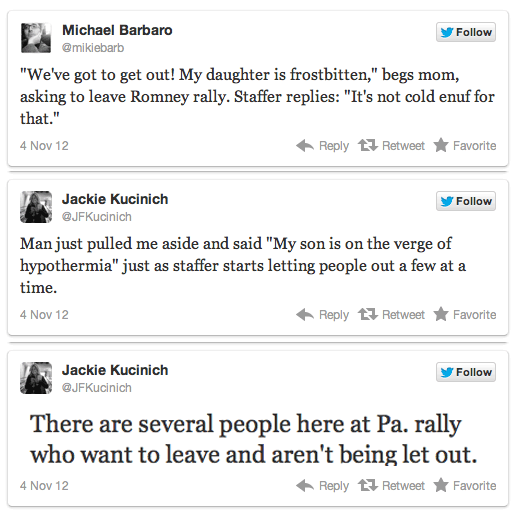
Like most Internet memes, the #romneydeathrally hashtag craze started small. On November 4, Mitt Romney held a campaign rally in Pennsylvania. For whatever reason, the rally was late getting started, it was cold, and some people who were there complained on Twitter that Romney campaign staffers were refusing to permit them to leave the rally, citing unspecified “security” concerns.

Some of these tweets were picked up by reporters covering the event.

It didn’t take long to turn into a public relations disaster. Some folks started talking about the “death rally” that you could never leave on Twitter, and the #romneydeathrally hashtag was born.

Naturally, the Internet being what it is, it really didn’t take long for some folks to decide they’d ride that train to the last station:

And, inevitably, Lovecraft got involved. Because if there’s one thing you can count on about the Internet, it’s por–okay, if there are two things you can count on about the Internet, one of them is that the Internet will always insert references to Lovecraft and Cthulhu wherever it possibly can.

And thus the meme was born.

It had nothing to do with threats on Romney, nor with rumors that the Romney campaign was dabbling in Satanism. Instead, it was the Internet doing what the Internet does: seizing on something that happened and taking it to an absurd conclusion.

The Romney Death Rally was a PR own-goal for the Romney campaign, sparked by staffers doing something really stupid at a rally.

There are two lessons here. The first is that if you’re a prominent politician and you’re hosting a rally, it’s probably a bad idea to refuse to allow people to leave. People have cell phones, and Twitter, and some of them will complain, and their complaints might be heard.

The second, though, is less about politics than it is about news reporting. For the love of God, if you have a journalism degree, you should be able to recognize a reference to the Cthulhu mythology when you see it.

Some thoughts on parasites, ideology, and Malala Yousafzai

This is Malala Yousafzai. As most folks are by now aware, she is a 14-year-old Pakistani girl who was shot in the head by the Taliban for the crime of saying that girls should get an education. Her shooting prompted an enormous backlash worldwide, including–in no small measure of irony–among American politicians who belong to the same political party as legislators who say that children ought to be executed for disrespecting their parents.
I’ve been reading a lot lately about what seems to be two different and at least theoretically unrelated things: parasitology and ideology, specifically religious ideology. This might seem to have nothing to do with Malala Yousafzai’s shooting, but it really isn’t.

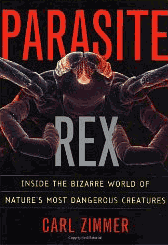
When I say I’ve been reading about parasitology, what I mean by that is my Canadian sweetie has been reading to me about parasitology. Specifically, she’s been reading me a book called Parasite Rex, which makes the claim that much of evolutionary biology, including the development of sexual reproduction, is driven by parasites. It’s been a lot of fun; I never knew I’d enjoy being read to so much, even though the subject matter is sometimes kinda yucky.

What’s striking to me is that these things–religious ideology and parasitology–are in some ways the same thing in two different forms.

Parasites make their living by invading a host, then using the host’s resources to spread themselves. To this end, they do some amazing manipulation of the host. Some parasites, for instance, are able to alter a host’s behavior to promote their own spread. Sometimes it’s as crude as irritating the host’s throat to promote coughing which spreads hundreds of millions of virus particles. Other times, it’s as bizarre and subtle as influencing the host’s mind to change the way the host responds to fear, in order to make it more likely that the host will be eaten by a predator, which will then infect itself with the same parasite. In fact, parasitologists today are discovering that the study of life on Earth IS the study of parasites; parasites, more than any other single factor, may be the most significant determinant in the ratio of predator to prey biomass on this planet.

Religious ideology would seem to be a long way off from parasitism, unless you consider that ideas, like parasites, spread themselves by taking control of a host and modifying the host’s behavior so as to promote the spread of the idea.

This isn’t a new concept; Richard Dawkins coined the term ‘meme’ to describe self-replicating ideas decades ago.

But what’s striking to me is how direct the comparison is. The more I learn about parasites, the more I come to believe that parasites and memes aren’t allegories for each other; parasites ARE memes, and vice versa.

We tend to think of parasites like toxoplasma as being real things, and ideas like the salvation of Jesus Christ as being abstract concepts that don’t really exist the same way that real things do. But I don’t think that’s true.

Ideas exist in physical form. It might be as a series of symbols printed in a book or as a pattern of neural connections stored inside a brain, but no matter how you slice it, ideas have a physical existence. An idea that does not exist in any physical way, even as neuron connections wired into a person’s head, doesn’t exist.

Similarly, parasites are information, just like ideas are. A strand of DNA is nothing but an encoded piece of information, in the same sense that a series of magnetic spots on a hard disk are information. In fact, researchers have made devices that use DNA molecules to store computer information, treating banks of DNA as if they were hard drives.

In a sense, ideas and organisms aren’t different things. They are the same thing written into the world in different ways. An idea that takes control of a host’s brain and modifies the host to promote the spread of the idea is like a parasite that takes control of a host and modifies it to spread the parasite. The fact that the idea exists as configurations of connections of neurons rather than as configurations of nucleotides isn’t as relevant as you might think.

We can treat ideas the same way we treat parasites or diseases. We can use the tools of epidemiology to track how ideas spread. We can map the virulence of ideas in exactly the same way that we map the virulence of diseases.

Religion is unquestionably a meme–a complex idea that is specifically designed to spread itself, sometimes at the host’s expense. A believer infected with a religious ideology who kills himself for his belief is no different than a moose infected with a parasite that dies as a result of the infection; the parasite in both cases has hijacked the host, and subverted the host’s own biological existence for its own end.

The more I see the amazing adaptations that parasites have made to help protect themselves and spread themselves, the more I’m struck by how memes, and especially religious memes, have made the same adaptations.

Some parasitic wasps, for example, will create multiple types of larva in a host caterpillar–larva that go on to be more wasps, and larva that act as guardians, protecting the host from infection by other parasites by eating any new parasites that come along. Similarly, religious memes will protect themselves by preventing their host from infection by other memes; many successful religions teach that other religions are created by the devil and are therefore evil, and must be rejected.

We see the same patterns of host resistance to parasites and to memes, too. A host species exposed to the same parasites for many generations will tend to develop a resistance to the parasites, as individuals who are particularly vulnerable to the parasites are selected against and individuals particularly resistant to the parasites are selected for by natural selection. Similarly, a virulent religious meme that causes many of its hosts to die will gradually face resistance in its host population, as particularly susceptible individuals are killed and particularly resistant individuals gain a survival advantage.

Writers like Sam Harris and Michael Shermer talk about how people in a pluralistic society can not really accept and live by the tenets of, say, the Bible, no matter how Bible-believing they consider themselves to be. The Bible advocates slavery, and executing women for not being virgins on their wedding night, and destroying any town where prophets call upon the citizens to turn away from God; these are behaviors which you simply can’t do in an industrialized, pluralistic society. So the members of modern, industrialized societies–even the ones who call themselves “fundamentalists” and who say things like “the Bible is the literal word of God”–don’t really act as though they believe these things are true. They don’t execute their wives or sell their daughters into slavery. The memes are not as effective at modifying the hosts as they used to be; they have become less virulent.

But new or mutated memes, like new parasites, always have the chance of being particularly virulent. Their host populations have not developed resistance. In the Middle East, in places where an emergent strain of fundamentalist Islam leads to things like the Taliban shooting Malala Yousafzai, I think that’s what we’re seeing–a new, virulent meme. islam itself is not new, of course, but to think that the modern strains of Islam are the same as the original is to think that the modern incarnations of Christianity are akin to the way Jesus actually lived; it’s about as far off the mark as thinking a bird is a dinosaur. They share a common heritage, but that’s all. They have evolved into very different organisms.

And this particular meme, this particular virulent strain of Islam, is canny enough to attack its host immune system directly. The Taliban targeted Malala Yousafzai because she favors education for women. Education, in many ways, provides an immunological response to memes; it is no accident that Tammy Faye Bakker famously said that it’s possible to educate yourself right out of a personal relationship with Jesus Christ. It’s no accident that Fundamentalism in all of its guises tends to be anti-intellectual and anti-education.

I’m not saying that the meme of religion (or any other meme) is inherently bad, of course. Memes have different strains; there are varieties of any large religion that are virulent and destructive to their host population, and other strains that are less virulent and more benign.

But with parasitic ideas as with parasitic biological entities, it is important to remember that the goal of the parasite is not necessarily the same as the goal of its host. Parasites attempt to spread themselves, often at the host’s expense. the parasite’s interests are not the host’s interests. Even a seemingly benign meme, such as a meme that says it is important to be nice to each other in order to gain an everlasting reward in heaven, might harm its host species if it siphons away resources to spread itself through churches that might otherwise have been used to, for example, research new cures for cancer. At the more extreme end, even such a benign meme might cause its adherents to say things like “We as a society don’t need to invest in new biomedical nanotechnology to promote human longevity, because we believe that we will live forever if we abide by the strictures of this meme and help to spread it through our works.”

Virulent memes tend to be anti-intellectual, because education is often a counter to their spread. Malala Yousafzai was targeted because she represents the development of an immune response to a virulent, destructive meme that is prevalent in the environment where she was born.