“But I’m changing it from within!”

Many years ago, I had an online conversation with a woman who was a devout, practicing Catholic.

She was also a polyamorous, pro-choice sex activist in a live-in relationship with her boyfriend, to whom she was not married.

When I asked her about the contradiction between these two things, she said that she recognized that Catholicism was behind the times on issues like women’s rights and nontraditional relationships, but that she remained Catholic because she wanted to change the Church from within.

I was reminded of that conversation recently when i had another online conversation with a guy who claims to be pro-gay rights and pro-gay marriage, who professes horror at the Republican Party’s treatment of women, who says he is appalled at the way the Republican party uses fear of immigrants and sexual minorities to raise votes, and who says that anti-Muslim sentiment is morally wrong…but who is still a member of the Republican Party and plans to vote the Republican ticket this November.

I asked him how he can, in good conscience, be a part of an organization whose values are so antithetical to his own. He said the same thing: “I want to change the Republican party from within.”

He and the woman I talked to all those years ago had one other thing in common besides saying they wanted to change the groups to which they belonged from within: They were both rather thin on details about what work they were willing to do to make that happen.

Both of them said they want to change these groups from within, but neither one of them was working to make that happen.

Which, in my book, is dishonest.

Changing a large, entrenched organization from within is hard. It requires serious work and serious commitment. It requires sacrifice. If you are a pro-life Catholic or a pro-immigration, pro-gay Republican, you will suffer if you make those beliefs known. You will face condemnation. You will face ostracism.

Working to change an organization takes dedication. If you actually want to change a political party, that means getting involved, deeply. It means showing up at the party’s national convention. It means becoming a delegate or an activist. It means voicing objections when the party attempts to make a platform plank out of hate and fear.

If you actually want to change the Catholic Church, that means becoming part of the church hierarchy. It means going to seminary. It means becoming a respected theologian and integrating yourself into the church’s structure.

Steering a ship requires getting on deck and putting your hand on the wheel.

Neither of the people I spoke to, all these years apart, were doing any of these things. Just the opposite, they were doing exactly what the rank and file are expected to do: go to church, tithe, vote in a straight line for every name with an (R) after it.

This is not how you change a group from within. This is how you signal the group that what it is doing is working.

It does no good to toe the line while secretly disagreeing within the privacy of your own head. If you do that while claiming to be “working for change from within,” you’re being dishonest. You’re running away from the genuine hard work and the real social cost of change.

You do not fight segregation by docilely sitting at the back of the bus like you’re told, then grumbling about it on the Internet. You fight segregation by sitting at the front of the bus, getting arrested, and inspiring others to do the same.

“I am changing things from within” is, all too often, a bullshit justification, a wimpy self-rationalization for complicity in atrocity. If you can not point to direct, tangible things you are doing to create that change, even when–especially when!–it costs you, you are not part of the solution, you are part of the problem. You are not a force for change; you are a participant in the very structures you claim to want to change.

No bullshit, no evasion: if you’re working to change the world, ask yourself, what have I done to make that happen?

…not just a river in Egypt

Some while back, someone on Quora (a question and answer site on which I’m quite active) asked a question about encounters with racism and white privilege.

I told the story of something that happened to me at a Walmart in Florida. We were standing in a checkout line with about five people in front of us, when the cashier pulled us out of line. We thought she was opening a new register, but instead, she just brought us to the front of the line and rang us up. It was a little confusing, and it took a few minutes to register: we were the only white people in line.

This is, I think, a fairly typical example of everyday racism. There’s nothing particularly weird or unusual about it; it’s just part of the background institutional racism of life in the United States, one of the many small acts of racism that normalize racism on a larger scale.

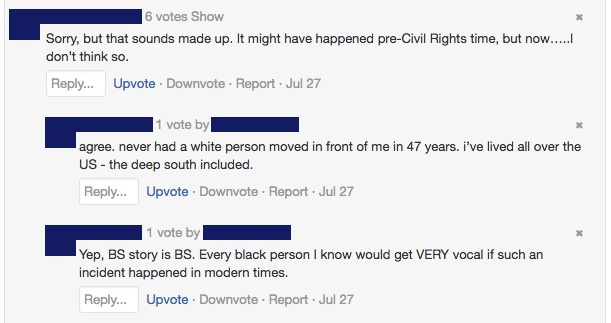
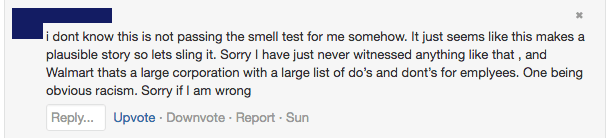
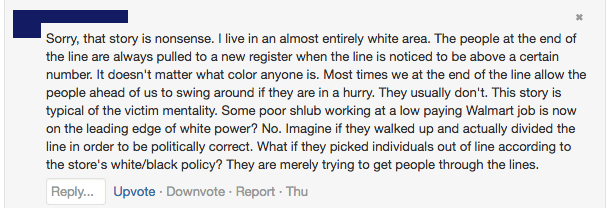
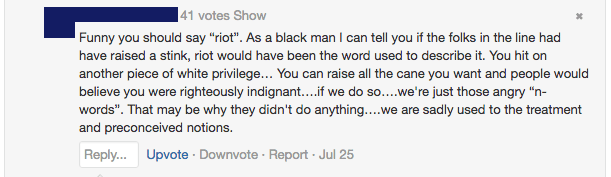
What I didn’t expect, and did find deeply weird, was the way people reacted to this story.

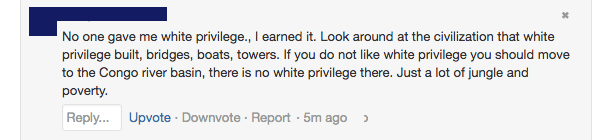
This, I think, is very strange. It’s also very telling.

There are lessons in both the event and the responses to it, I think. I didn’t recognize what was going on at the time it happened. I didn’t recognize what was happening at the time, but we’re now more aware of this kind of thing, and we’re not likely to be taken by surprise in the future.

So that’s the first lesson: sometimes, white privilege means being completely unaware of casual acts of everyday racism even when you’re right in the middle of them.

The second lesson, though, is more interesting: it has become very, very common for people who are confronted with something uncomfortable to deny that it exists. And that’s troubling.


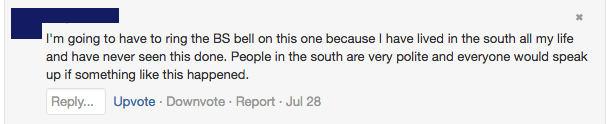
To be fair, this is not limited only to racism. The same thing happened whenever people talk about any kind of topic where there’s likely to be disagreement. I’ve written on this blog and elsewhere about the hysteria around GM food and how the machinery of fear of GM food is totally devoid of empirical evidence, and as sure as night follows day, every time I do, someone will reach into the attic of argumentative fallacy and haul out the tired old “you don’t believe that, you’re just being paid to say it” trope. It’s happened both on Quora and, when a blog post about GM food made it to Reddit, on Reddit:

It hasn’t always been this way. This reflexive, instantaneous denial–“You had an experience that makes me uncomfortable; I will refuse to believe it occurred,” “You hold an idea I disagree with; you do not really believe what you’re saying”–is new (at least to me).

Denial as an argumentative tactic isn’t new, of course, but the fact that so many people reach for it as the very first response is.

This happens in politics (“You support Hillary, that’s the only reason you’re saying Jill Stein is pandering to pseudoscience”), in technology, in everything. It’s pervasive. And it’s gaslighting. It’s built on the assumption that a person can tell you what your experiences were, what you believe or don’t believe, all because he doesn’t much like what you’re saying. (I say “he” because with only one exception, all the responses I’ve screen captured above were from men.)

But when it comes to experiences of racism, it seems particularly deeply rooted.

I’m not sure if that’s white discomfort at the idea of their own privilege, or if it comes from the fact that so many Americans truly want to believe that the election of a black President means we’re living in a post-racial society, or what it is, but it’s bizarre. What happened to me in Walmart isn’t even that egregious an example. It’s not like, just to use a random hypothetical that of course would never happen in real life, an unarmed black man was shot dead by police for doing nothing in particular.

Yet people really, really want to believe that it simply never happened–that it would not happen. They seem incredibly invested in that belief.


I would like to think that, had I been waiting in that line and seen what happened, I would raise a stink about that.

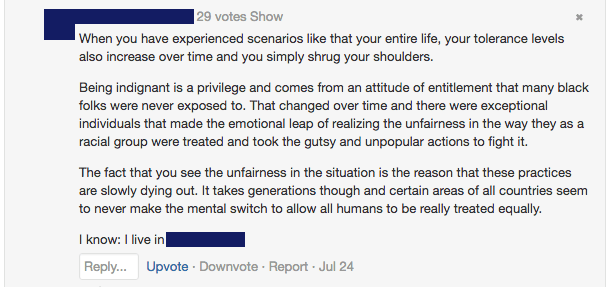
But here’s the thing: I am white. I was born into a system that privileged me. I have never been on the receiving end of structural racism. If someone were to be brought in front of me in line, of course I would raise a stink about it; being able to raise a stink is part of my privilege. Many folks on Quora expressed surprise that none of the people in the line spoke up, but that’s part of the problem. Being allowed to speak up about racism is not a privilege that those on the receiving end are permitted.

On Quora, several folks made exactly this point:


Talking about privilege is difficult, because a lot of folks who hold some kind of privilege (white privilege, male privilege, whatever) take the conversation as an affront. It’s not always clear what we’re supposed to do with the knowledge that we have these social privileges we didn’t ask for, whether we want them or not.

I’ve heard folks become defensive and say things like “are you telling me I should feel guilty for being white?” or “are you telling me I didn’t work for the things I have?”

And the answer is no, of course not. That’s not the point at all. The point is to recognize these structures, so that you can point them out and you can help level the playing field for everyone.

Had someone in that line objected, he probably would have been seen as just another angry black person. Had we objected, that would have been a whole different ball o’ wax. This video illustrates this nicely:

The right thing to do, had we recognized what was happening, would be to say “Excuse me, these people were in line first, why are you bringing us to the front?”

The wrong thing for us to do (which was what we did) was to be so unaware of what was happening that we simply allowed it to happen. The wrong thing for other people to do was to tell us that it never happened at all.

Of course, all this happens because racism is still a real and genuine thing, openly embraced by far more people than we are comfortable admitting (including, it must be said, a certain current Presidential candidate). Not everyone on Quora denied our experience. At least one person celebrated it. I’ll leave you with this gem:

“But I only want to vote for someone who represents ME!”

I am old enough to remember Richard Nixon.

I was in first grade during the 1972 campaign. My class had a mock election, in which I cast my “vote” for Nixon. Why? I have no idea. I was six; I liked his name better than that other guy, George Whoeverthehellitwas.

I remember the aftermath—Watergate, the resignation, the whole sordid mess. At the time, I recall thinking that this whole business of politics was a bit of shambles, and I’d probably never see anything worse. Ah, the optimism of youth.

Then, of course, came Bush/Gore, with the confusing ballots and the hanging chad and the election ultimately decided by the Supreme Court, some of whose members Bush’s father had appointed. I remember Nader thinking he was all that, and Nader supporters thinking he was all that, and the peculiar brand of ardent zeal that has its roots so deep in the American psyche—the “take no prisoners, brook no compromise” approach to elections that usually ends up in the worst of two evils taking office.

I see that same cycle playing out again this election, which has unquestionably brought yet a new low to the American civic institution of voting. And I see the same arguments being put forth by a fresh new crop of take-no-prisoners, brook-no-compromise idealists absolutely convinced their candidate was the Chosen One, even though those of us who’ve been around longer knew he was unlikely to win. (Sorry, Bernie.)

And I see now, as I did with Nader supporters, a lot of folks saying “if I can’t have my candidate, why should I vote for anyone? I don’t want to vote for the lesser of two evils, I want to vote for someone who really represents me!

Which sounds reasonable right up until the moment you realize it’s not. Because, you see, the world is not all about you.

One of the hardest lessons to learn in life is this: Other people are real. The world isn’t the Story of You. Yes, I’m sure you’re amazing and all, but other people are not supporting characters in the movie called You: The Reality.

There are three hundred million people, give or take, living in the US. Many of them (indeed, most of them) live lives different from yours. They face challenges different from yours, have priorities that are different from yours, and want things that are different from the things you want.

They deserve to be heard by the government that we live under, just like you.

A person who says “I want a candidate who represents all of my interests” is a person who’s saying “fuck all those three hundred million other people; I am the only person who should count.” And it doesn’t—it can’t—work that way.

A political candidate is not all you, all the time. In any reasonable democratic system, you will always be voting for a candidate who does not perfectly represent you, because it isn’t all about you. A candidate must represent everyone, not just you, and a lot of people—real, legitimate people—are not like you. “Choosing the lesser of two evils” is just a self-focused way of saying “choosing a candidate who is not a clone of me, but who will, I think, better represent me than the other person will.”

This is a huge problem for progressives, who rightly are horrified when they see candidates attempting to disenfranchise broad swaths of the population (gays and lesbians, say, or religious minorities, or women) but then in the same breath turn around and say “I refuse to vote for someone who I don’t 100% agree with 100% of the time”—not recognizing that if the government were made up of people who 100% agreed with you 100% of the time, it would disenfranchise a whole lot of folks who are not like you.

Maybe not as directly as some politicians disenfranchise gays and lesbians or minorities, but make no mistake, it would still disenfranchise them just the same.

If a pluralistic society is to function, it must do so by recognizing that people have legitimate differences, and seeking to make sure that the voice of the government is not solely the voice of one demographic, or one person. This world is not the Truman Show, and you are not the starring character.

In this election, there has been no candidate who I agree with on all the issues all the time. And you know what? I’m okay with that. My job is to select a candidate who I think will best create the society I want to live in, while still recognizing that other people have to live in it too.

In the 2000 election, a lot of folks said there was no difference between Bush and Gore. That turned out, on hindsight, to be laughably, comedically wrong…and we’re still paying the price. (Would Gore have led us into an invasion of Iraq post-9/11?)

I see that same thing being spouted in this election. There’s no difference, I hear people say with a straight face, between Hillary Clinton and Donald Trump. And I boggle.

Or at least I did, until I realized what it actually means: “there is no difference between Hillary and Trump” actually means “I don’t agree with Hillary and I don’t agree with Trump, so I mentally place them both in the same cubbyhole.” Which is, I think, a bit like saying “I don’t eat eggplant and I don’t eat arsenic, so they must be the same thing.”

That’s more than a little disingenuous. I don’t like eggplant and I don’t like arsenic, but one of them is a whole lot worse for me than the other. Given the choice of eating one or the other, it’d be pretty stupid to claim I don’t see a difference between them.

We live in a pluralistic society. One of the current candidates is okay with that; one is not. I understand that a lot of folks are disappointed that their guy didn’t win. I get it. That sucks. Of the choice ahead, though, one person better represents the values of a pluralistic society than another. And when you say “it’s my guy or bust,” you’re basically saying that you don’t care for a pluralistic society; you want things all your way or no way at all. There is a candidate who represents that view, but you might not like living in the society that results from his election.

The Strange Allure of the Superhero

Superheroes seem a uniquely American creation. There’s no other society I know of that’s invented the superhero as it exists in American society (Ulysses and Beowulf were heroic and larger than life, to be sure, but don’t really fit the superhero mold), and our love affair with all things superhero has made Marvel Comics one of the most enduring box office success stories outside of Star Wars.

Iron Man. Captain America. The Avengers. Deadpool, the funniest movie I’ve seen so far that involves multiple decapitations. The American moviegoing public is all about the superhero these days. That means the American entertainment industry is all about the superhero, and by extension, the world is all about the superhero, American cultural hegemony being what it is.

And doesn’t that seem just a little bit…weird to you? It does to me.

Superhero stories are the height of implausibility. Man gets bitten by radioactive spider, becomes crusading vigilante with superpowers. Man gets zapped with gamma rays and becomes, not dead, but crusading vigilante with superpowers. Man arrives from another planet to become crusading vigilante with superpowers. Man loses parents in a dark alley, spends vast fortune to be crusading vigilante with superpowers. Crusading vigilante with superpowers faces escalating series of evil embodiments with superpowers, bent on destroying the city the country the world the universe.

The stories are hokey, the characters hackneyed, the plots contrived and predictable. Why are they so damn popular?

Enter Captain America, stage left.

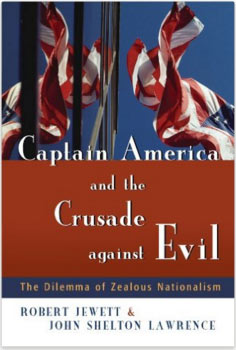
In the book Captain America and the Crusade against Evil: The Dilemma of Zealous Nationalism, Robert Jewett and John Shelton Lawrence argue, convincingly, that the superhero is the expression of American religious mythology. Captain America was the first modern superhero, after all, and they argue that Captain America is the embodiment of the American ideal: a heroic figure, above the law and answerable to nobody, doing God’s work by defeating the forces of absolute evil through any means necessary.

This is the way the United States likes to see itself: invulnerable, invincible, morally pure, the vanquisher of all that is unjust, uniquely blessed by God, wielder of the holy sword of redeeming violence that cleanses the world.

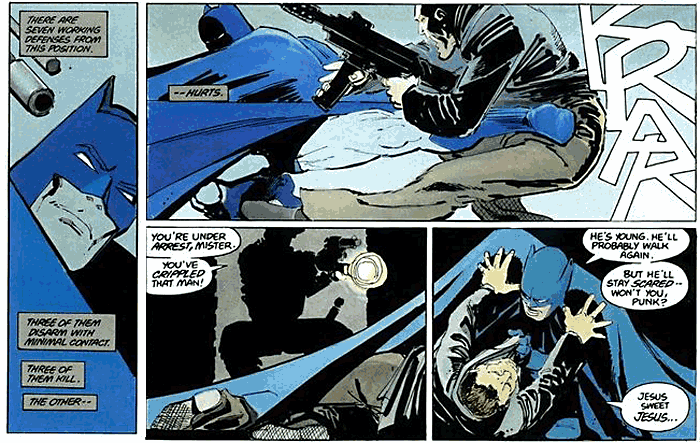
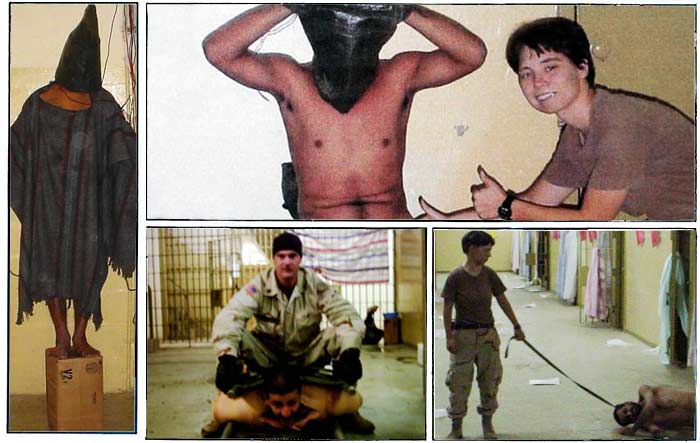
And like the comic-book superhero, the United States must operate outside the law to redeem the world and purge it of evil. Superheroes aren’t concerned with Miranda rights or due process. The existence of the superhero trope is, by its nature, a vote of no confidence in the normal processes of justice and law. The superhero comes along to save us because the law is incapable of doing so, too feeble or too corrupt to stop the encroachment of evil. If the superhero must beat people up or dangle them off a balcony to save the world, so be it. If the United States must torture suspected terrorists, so be it. Only such purifying violence can bring about righteous victory.

People argue, of course, about what the “appropriate” use of torture is and what the acceptable level of violence is; a guy I know has, with a straight face, made the argument that if you’re willing to shoot someone and you think that’s okay, surely it must be okay to hurt him as well (by which logic, anything becomes okay–rape, dismemberment, mutilation–to someone you’re willing to kill). The underlying logic beneath all these arguments is that we, the forces of right and good, are entitled to commit acts of violence upon the wicked, and no laws or treaties matter. Ours is a morally pure end, we are sanctioned by God, and we must do whatever it takes to purify the unjust and the iniquitous through cleansing violence.

They argue in the book that this idea is rooted deep in the Puritan Christian history of the United States. Our ancestors came here because they wanted a place where they could build a paradise on earth, and if creating that righteous place in God’s name required wrenching the land from the natives by violence and had to be maintained through violence, so be it. The God of the Bible (yes, both books, not just the Old Testament) is completely fine with the violent application of holy zeal.

This thread of zealous nationalism, they argue, is still part of the fabric of American civil religion today, so deeply woven into the way we see ourselves that even people of no particular religious faith still accept its premises. We are good. They are evil. Law is weak and corrupt. The application of violence by the forces of good is the only way to bring about the destruction of evil. Those forces of good are above any law, answerable to none save God, and cleansing violence is always just.


The book makes a good argument, and I think there’s a lot of truth in it.

But it misses something.

The appeal of the superhero is not just that it validates our image as a morally pure country wielding the divine sword of redemptive violence against the wicked and evil. There’s another part of it, too.

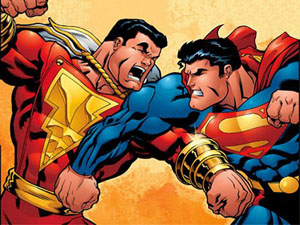
Superheroes are, by their nature, an adolescent power fantasy. The invulnerable superhero, with superpowers and the ability to do whatever he wants, is the daydream of the person who feels disempowered and weak. Superman is bulletproof! And can fly! And see through walls! Batman is rich! He gets all the cool toys and beats up bad guys! The appeal of superheroes is deeply rooted in revenge fantasies and desire for power. Superheroes don’t have to take shit from anyone, and they have, like, totally awesome powers, man!

The prevalence of the superhero trope in social entertainment, then, shows a widespread underlying feeling of helplessness and disempowerment. The world is a scary place, and a lot of people–ironically, people in the most powerful nation the world has ever seen–feel disempowered. Terrorists want to blow us up! Other countries don’t like us! I can’t get a girlfriend! Boy, Iron Man would sure fix all that up. He can go get those terrorists where they live, and he gets hot girls, too! The superhero becomes an expression of the ego, a desire for power and control. The superhero has meaning and purpose. The superhero may brood–there’s a reason superheroes tend to act like angsty teenagers when they’re not smashing in the faces of bad guys–but ultimately, the superhero has a mission and that mission gives him clarity. The superhero applies power to solve his problem, and in so doing saves the day.

So on the one hand, we have the American monomyth: the United States is the agent of good and right, wielding violence to vanquish evil and bring about redemption of the world, transcending mere law to do so. On the other hand, we have the superhero as adolescent fantasy fulfillment, intoxicating because he offers an escape from our own helplessness. Put those two things together, and it creates the perfect soil for growing atrocity. We see ourselves simultaneously as hero and victim, all-powerful and powerless, the bringer of holy violence and the victim of malign evil.

The implications of that particular mix are quite frightening, I believe. The nation that believes itself simultaneously powerless and also called upon to deliver the world from evil through the instrument of violence is a very dangerous thing.

Apple vs the FBI: Whoever wins, it’s a mess

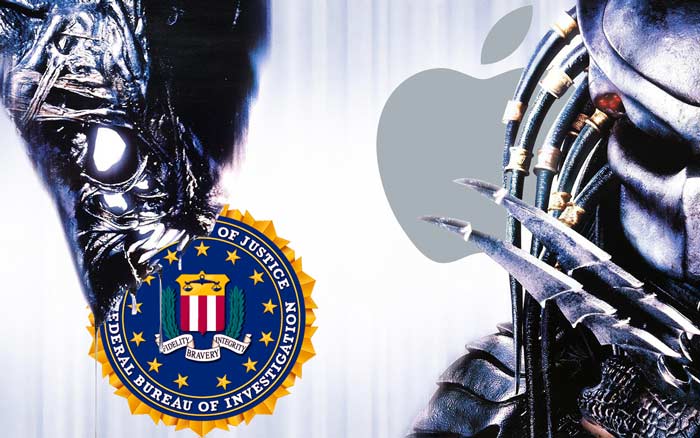
Apple and the FBI. It’s the Rock ‘Em Sock ‘Em Robots fight that the movie Alien vs Predator should have been, but unlike Alien vs Predator, this one so far has failed to disappoint.

On one side, we have a giant tech megacorp that makes cellphones. Also other stuff, I hear, but these days mostly cellphones. On the other, we have the full force and might of the United States Government, in the form of the Federal Bureau of Investigation. In between, we have: Terrorists! Encryption! Civil liberties! Donald Trump spouting off!

The Internet is filled with conversations about the spat, much of which are either not technically correct or overtly technical. It’s my goal here to try to explain a very complex situation in a way that doesn’t require a high level of technical mastery. However, this is a technical issue, so there will be some geeky bits.


The Background

Last year, a couple of assholes named Syed Rizwan Farook and Tashfeen Malik decided they were going to express religion of peace by blowing away a bunch of people in San Bernardino, California. They decided, you see, that something something holy war something martyr God, and something something kill people whatever…I don’t know or particularly care about the details, and they’re not really relevant here. So far, so boring: some yahoos think there’s an invisible dude in the sky who wants them to kill some other people, it all ends in tears–a story that’s been playing out with minor unimportant variations since the dawn of civilization. The FBI investigated and decided they were “homegrown extremists” (no idea if they were organic or GMO-free) and not affiliated with any other terrorist groups or cells.

This is the part where things get interesting.

During the investigation, the FBI discovered that the yahoos had Android smartphones, which they destroyed prior to going on their rampage of murderous idiocy, and that one of them had an iPhone 5C provided by the company he worked for.

This is the logic board from an iPhone 5c. Like all iPhones, the user data on an iPhone 5c is encrypted. You need to unlock the phone in order to get at its contents. By default, the phone is locked with a 4-digit numeric code. If you don’t enter the code, the phone’s contents remain encrypted.

You can’t just read the information from the phone’s flash memory, because it’s encrypted. The FBI wants to read the contents of the phone, for reasons that aren’t clear to me (if there was anything sensitive on it, it’s hard to imagine he wouldn’t have smashed the phone before running off to kill people who had nothing to do with whatever grudge he imagined his invisible sky-man carried, like he did with his other phones), but whatever.

The FBI tried to read the phone’s contents, and discovered that the iPhone is actually rather secure. If you want to know the full details of how secure, there’s a PDF on Apple’s iPhone security here.

So they went to Apple.

This is where things get really interesting, and a lot of the conversation about the situation gets some important facts wrong.


The Problem

The iPhone’s files and such are encrypted. This is not simple home-grown encryption, either; it’s military-grade 256-bit AES encryption. It can not be defeated by any known attack. All the world’s computers combined would take about a billion years to brute-force the encryption, which is a bit more time than the FBI prefers to spend on this.

Now, there are some important things to understand here.

One is that nobody can break the encryption, not even Apple. Apple has no secret back doors or master passkeys to get at the contents of a locked phone, and that’s not (exactly) what the FBI is asking them to do.

The other is that the four-digit code you type into an iPhone is not the encryption key. The encryption key is made up of a secret, random number embedded into each phone at the moment of manufacture, combined with the passcode you set by means of some arcane mathematics that are beyond the scope of this blog post. Apple does not know the encryption key; they do not have a way to set the unique hardware number, and in any event it’s all tangled up with the passcode the user enters in order to create the encryption key anyway.

So here’s where things sit: The phone’s contents are encrypted. The FBI wants access to the phone for whatever reason. Apple can’t decrypt the phone. So what’s the deal?


The Tussle

The fact that the phone in question is an iPhone 5c is really, really important. If it had been a 5S or a 6, it wouldn’t matter, because Apple made a change in the inner workings of the later phones to prevent it from being asked to do precisely what it’s being asked to do.

So, here’s how it works.

iPhones run an operating system called iOS. iOS is digitally signed; that means Apple has a secret encryption key it embeds into iOS. The phone carries a special, immutable boot ROM that contains the decryption code for this key. If it starts to boot and sees an operating system not signed by Apple, or if the operating system is tampered with in any way, the phone refuses to boot. (This is different from and not related to jailbreaking an iPhone. Even a jailbroken phone will not boot a copy of iOS not signed by Apple.)

What does that mean? It means nobody on earth–literally–can make an operating system the phone will boot, except for Apple. If the FBI or anyone else tries to modify the iOS boot loader, the phone will not boot. Only Apple knows the key needed to change the iOS boot loader.

Now, a few other things you need to know about how an iPhone works.

If you type the wrong passcode into an iPhone, the phone lets you try again. If you get it wrong again, the phone lets you try again, but after that, things start getting harder. The phone starts introducing a delay before you can try again. That delay gets longer and longer the more you enter the wrong code. By the ninth time you enter the wrong code, the phone refuses to allow you to try again until an hour has passed.

There are 10,000 different possible combinations of four digits. If you can only try one per hour, it will take you more than a year to try them all. Good luck trying to brute force the passcode!

There’s another complication too. If you get it wrong 10 times, the phone wipes itself.

Here’s where the 5c thing gets important.

Starting with the iPhone 5S, Apple introduced the “Secure Enclave.” The Secure Enclave is a special chip (well, actually, it’s a special section of the processor chip) that has its own memory. It’s basically a tiny, highly secure, tamper-resistant computer.

The Secure Enclave keeps the phone’s decryption key in its own special memory and talks to the phone over a special-purposes, encrypted communication link. The rest of the phone does not know, or have access to, any information stored in the Secure Enclave.

When you enter the passcode, the phone sends the passcode to the Secure Enclave. The Secure Enclave says “yes” or “no” about whether the right code was entered. If the right code was entered, the Secure Enclave decrypts the phone. If it wasn’t, the Secure Enclave refuses to do so. It also starts a timer. While the timer is running, the Secure Enclave refuses to process any more passcode requests. That timer runs for longer and longer as you keep entering the wrong code. If you enter the wrong code 10 times, the Secure Enclave wipes the encryption key from its own memory and that’s it, you’re done. Trying to get at the phone’s contents after that means you’ll be banging away at it until the stars burn out.

But… This is not an iPhone 5S or later, it’s a 5c!

On the 5c, the time delay and wiping the phone are not handled by the Secure Enclave, they’re handled by the operating system. The operating system enforces the longer and longer delay and the operating system wipes the phone if you enter the wrong code 10 times.

The Secure Enclave is a bit of hardware that can’t be tampered with. But the operating system can be changed. So if you have an older iPhone, you could, in theory, put a different version of iOS on it. A special version, with the timer and the phone wipe disabled.

Except, oh no you can’t, because the phone will not run an operating system that isn’t signed by Apple.

So the FBI wants Apple to create a new version of iOS. A modified version that has no time delay if you get a wrong passcode and no phone wipe. And then they want Apple to sign it and put that new version of iOS onto the phone.

This will not give them the contents of the phone. What it will do is let them try passcode after passcode as fast as possible until they break in. Without a phone wipe, they can keep trying as many times as it takes. Without a delay, they can try all 10,000 combinations in days or weeks instead of years.

Of course, there’s an added wrinkle to all this. The FBI already has a copy of the phone’s data.

iPhones come with a subscription to Apple’s cloud service, iCloud. iPhone users can choose to have their data backed up to iCloud. The backup feature was turned on on this phone. The FBI asked for, and got, a copy of the phone’s data backed up on iCloud.

Unfortunately, the copy they got is out of date. They screwed up and asked the company that owns the phone to change the iCloud password in order to have a look at what was there. The company complied. The FBI looked at the iCloud backup. Then they turned on the iPhone. The iPhone couldn’t make a new backup to the cloud…because the password had been changed. The FBI thinks it’s possible there’s information on the phone that’s newer than the information in the cloud backup. They’re not sure, though, because…they can’t get into the phone.


The Rationalization

If an iPhone were a safety deposit box and Apple had the key, the government would normally just issue a subpoena for Apple to produce the key, assuming they didn’t just take a blowtorch to the box and be done with it.

But that’s not what the government has done here. They can’t subpoena Apple to produce the encryption key or the passcode because Apple does not have and can not get the encryption key or the passcode, and Apple has no magic backdoor.

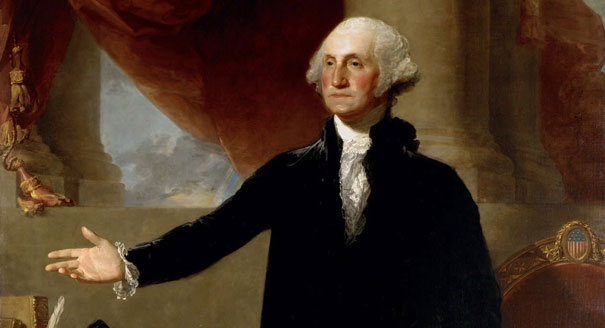
So instead, they’ve turned to the All Writs Act of 1789, a law signed by this dude.

The All Writs Act is a law that allows the government to issue “all writs necessary or appropriate in aid of their respective jurisdictions and agreeable to the usages and principles of law.” Essentially, it lets Federal courts issue orders to private citizens in order to accomplish legal ends. A writ was originally a written order given by a monarch to a citizen compelling the citizen to do something. The way it’s used in the All Writs Act, it’s an order from a court compelling a citizen to do something.

Like, for example, write a new operating system. Because the court says so.

The All Writs Act was signed into law before the Bill of Rights existed. The Bill of Rights would seem to put some limits, at least, on what the government can order people to do. In this case, the FBI thinks that ordering a company to write a piece of software is within those limits.

It should be noted that this isn’t a matter of commenting out a few lines of code and hitting “compile.” There are, for good reason, legal guidelines that must be followed when writing investigatory forensic software. These legal guidelines are necessary to preserve the chain of evidence and show in court that the software didn’t modify the information on the device being investigated. The standards are fairly complex and are outlined on this page on the Digital Forensic Investigator Web site.

Basically, the gist of it is the software must be documented, must be subject to peer review, must be tested on target devices similar to the device being investigated to show that it works and won’t corrupt, delete, or modify information, and must pass independent judicial review of its reliability.

So basically, the FBI is asking Apple to go to considerable trouble to build a new operating system, test it, document it, submit it for examination, and load it onto an iPhone 5c, for the purpose of allowing the FBI to keep trying all 10,000 possible passcodes until they finally unlock it. They’re using a law written before the Bill of Rights existed that authorizes Federal courts to issue orders to private citizens to do this. Basically, the All Writs Act says “the government can order people to do any legal thing.” It has zero to say on the subject of what constitutes a “legal thing.”


The Real Battle

The FBI wants Apple to create a new version of its operating system, with certain key security features disabled, and load it onto the phone so that its passcode can be brute-force hacked and the contents read. They’re not asking Apple to decrypt the phone; Apple can’t do that. They’re not asking Apple to provide the passcode; Apple can’t do that either. They’re asking for a new operating system.

Would this new operating system allow them to get at any locked phone? No, it would not. iPhone 5s and later models have these security features in hardware, etched in silicon on the Secure Enclave. A new operating system can’t change that.

So what’s the big deal? Is Apple coddling terrorists, like the FBI director implies and Donald Trump spouts all over Twitter from his iPhone?

No. As with an argument between two lovers that ultimately ends in divorce, this fight is’t really about the stuff this fight is about. This fight isn’t about a work phone that used to belong to a terrorist asshole and probably contains fuckall of interest to the FBI. The terrorism angle is a convenient excuse, because the word “terrorism” is kind of magic spell that causes a whole lot of people (including, bizarrely, conservatives whose entire political philosophy is built on the foundation of distrusting the government) to take leave of their senses and do whatever they’re told.

But this fight isn’t about this phone.

Washington is afraid of encryption. Much as gun lovers and survivalists love to think Washington is afraid of their guns (which is laughable in its absurdity–the military has way more guns than you do, Tex), Washington is afraid of encryption.

This fight has been a very long time coming. The government has always hated and feared encryption, even as it has invested tremendous resources in making encryption better.

In the early 90s, the US passed laws banning export of encryption products. I still own a T-shirt that was legally classified as a “munition” back then, and that you could be arrested on Federal charges for wearing outside the US or showing to foreign nationals, because it’s printed with source code for encryption software. Finally, in 1996, Bill Clinton scrapped laws against exporting encryption software, largely because they were hurting US businesses overseas, and besides, the Russians already had strong crypto because–surprise!–they had mathematicians too.

The fear of the Russkies has faded into nothing–there’s an entire generation now old enough to read this blog post that grew up with the Cold War being something you read about in history books, not something you lived through. Now, the bogeyman du jour is terrorists, or maybe pedophiles, or hell, why not both?

Police don’t like locked phones and encrypted comms, and Congress has been wrestling with what to do about that for years.

The government has mulled banning strong encryption. Not just the US government, but every government. China wants to ban it. France just debated banning it. India is planning to ban it. The UK wants to ban it. Congress has considered banning it no fewer than three times in the last two years.

The arguments are always always the same: If people can talk without the government listening, the terrorists win. Or the pedophiles win. Or the pedophile terrorists win. Law enforcement can’t do its job without being able to see what’s on your smartphone, because reasons.

Apple argues that if the government succeeds in ordering it to write a new version of iOS to help them get onto this phone, they will feel free to order it to write other software for them as well. Write us software to let us turn on this suspect’s cell phone camera and microphone remotely! Write us software to make copies of this suspect’s email! No legal principle exists that would limit the authority of the government’s ability to order Apple to do things like this.

And that’s a nice, cuddly government filled with the milk of human kindness, like the US government believes the US government is. If Apple has the ability to do these things and can be compelled to do so, the Chinese will really like that. Apple argues that if the FBI succeeds, it will basically have to create a whole new software department–call it the Department of Undermining Our Security Department–to handle the flood of orders coming in to write custom software to disable this or that or the other security feature. And they might be right.

The government says nobody else will get this hacked iOS version (or versions, if other requests start rolling in). Apple says that’s naive. Hard to say what’s scarier, the FBI with rogue Apple-signed iOS software, the Chinese with rogue Apple-signed iOS software, or rogue Apple-signed iOS software leaking into the hands of organized crime.

There’s also the very real possibility that if the government has success here, sooner or later it will realize that a terrorist using an iPhone 6 will still be able to secure a phone in a way that neither Apple nor the government can do anything about, and start calling on Apple (and other companies) to weaken their encryption. The Secure Enclave with its hardware timer and self-vaporizing key is pretty damn secure. What happens if the government decides to tell Apple to tone things down a bit for the iPhone 7? That’s not impossible, and if Apple can be forced to write a new operating system to help law enforcement, changing the design of their chips to help law enforcement is a doddle.

Encryption is math. Math is math; math doesn’t care about bad guys or good guys or legal oversight. If there is a way to slip past an encryption method, that way works for everyone, good guys and bad guys alike, because math is math and math doesn’t care. If it works for the FBI, it works for Igor in the Russian mafia as well.

So that’s what’s going on, and that’s what’s at stake. It’s a problem that doesn’t readily boil down to sound bites or Tweets, and that means, I fear, that the public won’t really understand what’s happening until it’s been decided for them.

GMohno! Part 3: “Because Monsanto”

It’s an article of faith among certain people that Monsanto, Inc, the American seed company, is inherently and intrinsically evil. And not just evil in the way that you might say any large corporation is “evil,” in that it’s an organization of people with a vested interest in the organization’s survival, but maliciously evil–deliberately and vindictively harmful to others and to society as a whole.

So pervasive is this attitude that it’s accepted even by folks who don’t have a particular problem with GM food or agricultural biotechnology.

I can’t really complain about the folks who accept this idea. I used to be one of them. For many years, my conversations about GM food took the form “I think that genetic modification is a valuable tool for feeding a world of billions, and there is not the slightest evidence whatsoever that GM foods are in any way harmful or dangerous, even though I think Monsanto is evil.”

I couldn’t really put my finger on why I thought they were evil. I just knew they were. It was an idea I’d heard so often and was so pervasive I accepted it as true. (There is a quote that runs “If you repeat a lie often enough, people will believe it.” It’s often erroneously attributed to propagandist Joseph Goebbels, though there’s no documentation that he ever said it; the idea appears to have been around for quite a while.) I consider myself a skeptic and a rationalist, but I am still not immune to accepting things without evidence merely because I have heard them often enough.

In fact, it was during an effort to prove how evil Monsanto is that I started to realize many of the things I’d believed about the company were wrong. Someone in an online debate had challenged me to support the idea that Monsanto is an evil company, and I’m rarely one to turn away from a challenge to what I believe. “Piece of cake,” I thought. “A few minutes and a half-dozen links ought to be enough. This ought to be about as hard as proving that Moscow is a city in Russia.”

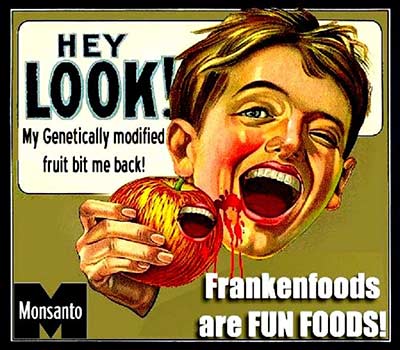
If you Google “Monsanto evil,” you’ll find a vast river of hysterical Web sites that scream Monsanto’s vileness to the heavens, usually accompanied by ridiculous and emotionally manipulative pictures like this:

But this river of Google effluent is about as persuasive as a Flat Earth Society page, and I reasoned that if I wouldn’t find the source credible myself, it would be disingenuous to try to use it to support my argument. Besides, I thought, I didn’t need to cite crap sources like that–there was plenty of legitimate support for Monsanto’s encyclopedic catalog of evil from reputable sources.

So I kept going, past the Googlerrhea of sites like NaturalNews and GMOwatch, looking for the clear and obvious evidence I knew would be there. I had heard all the standard arguments, naturally, and was quite confident they would be easy to support.

It turned out to be not so simple after all. In fact, the deeper I got, the more Monsanto’s supposed “evil” started to look like smoke and mirrors–propaganda fabricated from the flimsiest of cloth by people frightened of agricultural technology.

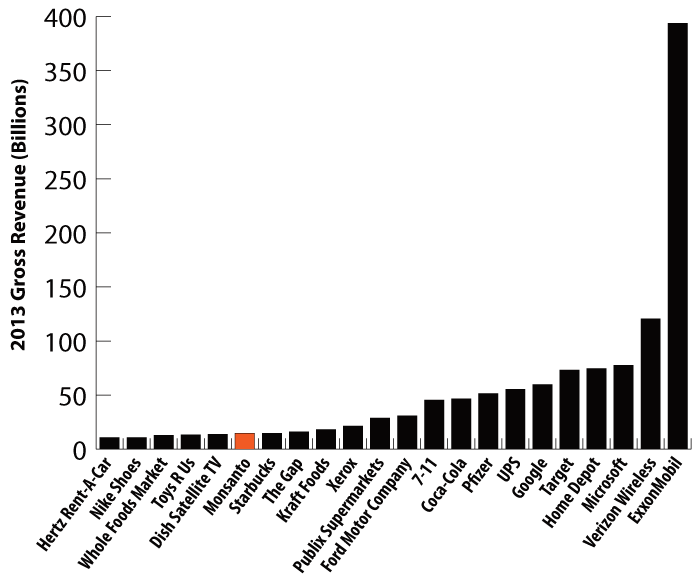
First, I thought Monsanto was enormous. It’s not. As corporations go, it’s actually not all that big. It’s about the same size as Whole Foods. It’s smaller than Starbucks and The Gap. It’s way smaller than UPS and 7-11. (In fact, I wrote a blog post about that last year.) As of the middle of 2014, Monsanto’s size compared to other corporations looked like this:

In fact, this graph is now out of date; as of the last quarter of 2014, Whole Foods is significantly larger in terms of revenue than Monsanto. (People who believe that little guys like Whole Foods are sticking it to the big bad megacorps like Monsanto likely don’t realize what they’re doing is merely supporting one giant megacorp over another.)

Then I read the company’s history, and learned that when people talk about things like how Monsanto made Agent Orange, they’re showing ignorance of a simple fact I also used to be ignorant of: there are, in a real sense, two Monsantos.

A Tale of Two Companies

The first Monsanto was Monsanto Chemical, a company that manufactured food additives, industrial chemicals, and plastics. This Monsanto no longer exists. In the late 1990s, it developed the drug Celebrex. Pfizer, the pharmaceutical company, bought Monsanto in 2002 because they wanted to capture Celebrex, a profitable and popular drug for treating arthritis.

Pfizer is a pharmaceutical company. As a pharmaceutical company, it’s not especially interested in being in agribusiness. In 1996, Monsanto (the chemical company) had bought an agricultural company, but Pfizer didn’t want to keep the agricultural business. So after the purchase of Monsanto, Pfizer spun off the agricultural business as a new company, which kept the old name Monsanto. This new Monsanto was entirely distinct from the old: new board, new directors, new business model, new bylaws, new incorporation. In what would prove an ill-fated decision, it kept the name “Monsanto,” which Pfizer also wasn’t interested in, to avoid having to rebrand itself. Changing the name, they estimated, would cost $40 million.

Was the old Monsanto evil? A case can be made that Monsanto (the chemical company) was a ruthless competitor. But a lot of the charges levied against it by the “Monsanto is evil” crowd turn out not to be true.

Monsanto invented saccharin? Not so fast

One of the claims I’ve heard many, many times is that Monsanto invented saccharin, the artificial sweetener. This is so far from true it’s “not even wrong,” as the saying goes. Saccharin was invented in 1879 by chemist Constantin Fahlberg of Johns Hopkins University. It was first manufactured in Magdeburg, Germany. Monsanto was one of many saccharin producers until 1972, but the claim they “invented” it is absolutely false.

In fact, these days, “Monsanto invented saccharin” is a litmus test I use in conversations with anti-Monsanto activists. If someone trots out this chestnut, I know he’s a person who can’t be arsed to do even a simple Wikipedia search to support his ideas. He is the sort of person who blindly accepts anything that supports his existing beliefs, and I stop talking to him.

Monsanto and Agent Orange

This is another factoid routinely trotted out to prove Monsanto’s despicable evil. Only an evil company could invent and manufacture so foul a substance as Agent Orange, right?

Well, Monsanto didn’t invent Agent Orange. It was invented by the US Army in 1943–the notion that Monsanto created it is another of those litmus tests I use to determine whether someone is interested in doing even the most rudimentary fact-checking or not.

During the Vietnam War, Monsanto wasn’t even the main contractor that manufactured Agent Orange–that dubious honor belongs to Dow. Monsanto was one of many overflow suppliers the government used when Dow couldn’t make it fast enough; the others included Uniroyal (the tire manufacturer), Thompson-Hayward Chemicals (now Harcros Chemical Co), Hercules (now Ashland Inc), the Diamond Shamrock Corporation (now Valero Energy Corporation), and Thomson Chemical Company.

It’s interesting that folks will tell you “Monsanto is evil because Agent Orange,” but not “don’t buy tires from Uniroyal; they’re evil because Agent Orange.” It is, sadly, a truism that we will use an argument to support a position we already believe even when that argument applies equally well to a premise we aren’t invested in.

Monsanto and glyphosate

The notion that glyphosate is bad is accepted as self-evident by many folks who oppose GMOs, and I’ve often heard a circular argument used in discussions about glyphosate resistance: Monsanto is evil because they make glyphosate, and glyphosate is evil because it’s made by Monsanto.

Monsanto (the chemical company) was only incidentally interested in agribusiness. Monsanto (the chemical company) developed the herbicide glyphosate in 1970. The patent on glyphosate expired in 2000, two years before Pfizer bought Monsanto (the chemical company). Pfizer wasn’t interested in making herbicides, so Monsanto (the seed company) kept the glyphosate business. They still make glyphosate today, but they’re not a huge manufacturer–because the patent has expired, most glyphosate manufacture these days is by other companies in China.

Old Monsanto aside, the new Monsanto is still evil!

So what about Monsanto (the seed company)? I keep reading tons of stories about how evil it is, but when I go to validate those stories, they tend to turn out not to be true.

A lot of folks fear GMOs, for the same reasons a lot of folks fear vaccines–there’s a lot of bad info out there. Some of it (like “GMOs aren’t tested” or “GMOs cause cancer”) is demonstrably false.

Monsanto gets a lot of its bad reputation on the basis that it makes GMOs and people are frightened of GMOs. A lot of other companies also make GMOs, but Monsanto is singled out for special hate, even though it’s not the biggest company in the GMO business (Syngenta, for instance, is bigger).

Another common argument on the “Monsanto is evil” side of the fence is that Monsanto patents seeds. If a corporation can control our seeds they can control our food! That’s clearly evil, right?

I touched on plant patents briefly in part 1 of this series. A lot of folks don’t understand plant patents, but many foods–including organic and conventional produce–is patented. (Yes, you read that right. The 100% organic, all-natural kale you buy at Whole Foods is patented.) Any kind of new seedline–whether GMO, hybrid, conventional, or organic, can be patented. The first plant patents in the world were issued in the 1800s; the first plant patents in the United States were issued in the 1930s…long before GM technology existed.

And not all GM food is patented.

If you want to argue that patenting plants is a bad idea, by all means, make your argument. But don’t get confused. That argument has nothing to do with Monsanto and nothing to do with GM food.

Saving Seeds and Monsanto Lawsuits

Once you get through the clearly false claims about saccharin and Agent Orange and patents, you start encountering the second wave of arguments for Monsanto’s evil evilness of evil, which usually ride into battle under one of two banners: “Monsanto doesn’t let farmers save seeds!” and “Monsanto sues farmers for accidental contamination!”

Here is where I believed I would find some real meat–some genuine, clear-cut evidence that Monsanto is bad news.

That evidence turned out to be a mirage–I saw it glittering on the horizon, but when I got close, there was nothing there but sand.

Now, it is true that farmers can’t save seeds from patented crops. This isn’t a GM issue; farmers also can’t save seeds from patented organic or conventional crops either. They also can’t save seeds from hybrid crops (seeds from hybrid crops don’t tend to breed the desired traits reliably, as I talked about in part 1). But I grew up in a farm town, and I’ve never met a farmer who wants to save seeds. It’s bad for business. Seeds are one of the cheapest parts of running a farm. Farmers who save seeds have to dry, process, and store them. Farmers who buy seeds get a guarantee that the seeds will grow; if they don’t, the seed company will pay them.

As for the idea that Monsanto is evil because they sue farmers for accidental contamination of their fields. I looked, but I couldn’t find any court cases of this. I did find court cases where farmers denied stealing seeds and said it must be contamination, but in all those cases, a jury or the court found they were lying. (Protip: If someone inspects your field and 98% of the plants growing on it are a patented variety, that’s not accidental contamination.)

Monsanto neonicotinoid GMO dead bees!

There is a lot of confusion and misinformation about GM plants. And, unfortunately, that confusion tends to lead to a lot of conflation about entirely unrelated issues.

One complaint I’ve heard many times, including in the comments on an earlier part of this series, is Monsanto is evil because their GMO seeds are coated in neonicotinoid insecticides that kill bees.

It’s hard, at first glance, to tell where to begin to untangle this snarl, because it confuses entirely unrelated things into a tangled mess of misinformation and error.

I mean, yes, neonics might be harmful to bees, possibly, but…er, um…

…that technology was developed by Bayer, not Monsanto.

And it has nothing to do with GMOs. Neonics are insecticides, not herbicides. They are not poisonous to plants; you don’t need to engineer plants to resist them. (In fact, they are derived from nicotine, a natural insecticide made by plants. The name “neonicotinoid” literally means “new nicotine.”) Neonicotinoids are seed coatings–they’re applied to seeds after the seeds are collected, not produced by the seeds themselves.

Of course, all this information is irrelevant in the face of the final, last-ditch argument put forward by Monsanto’s detractors…

It’s all a conspiracy, man

The conspiracy theory is the final sanctuary of the person with no arguments. It’s an attempt to discredit an argument without looking at the argument directly, and also poison the well, by claiming that anyone who supports the dies of some debate you don’t support is in league with a sinister and all-encompassing evil.

I’ve received emails–many emails–from my blog posts about GM foods, asking me how much money Monsanto is paying me to write them.

The idea Monsanto has paid off all the world’s scientists to engage in a vast conspiracy to say GMOs are safe when they’re really not is so absurd as to be farcical. Look, ExxonMobil is enormous compared to Monsanto, and with their vast piles of money they can’t pay off all the world’s scientists to say global warming isn’t a thing! If ExxonMobil can’t afford to pay off scientists, how can a company that makes less money than Whole Foods?

So after looking into it, I was forced to change my mind and conclude that Monsanto (the seed company) isn’t particularly evil, at least not in a way that other corporations aren’t. ConAgra might be more evil, if you look at biotech companies. But Monsanto (the seed company)? Not so much.

Now if you’ll excise me, I’m off to buy another Lamborghini with the shill bucks Monsanto just paid me.

Note: This blog post is part of a series.
Part 0 is here.
Part 0.5 is here.
Part 1 is here.
Part 2 is here.
Part 3 is here.

Some thoughts on porn, coercion, and the Fundamental Reconstruction Error

If you spend any time in any forums where people talk about sex, it is a truth as inevitable as night following day that, sooner or later, someone is going to talk about porn.

And as soon as someone starts to talk about porn, a certain predictable conversation will come up.

“Porn performers are coerced and trafficked,” someone will say. “Porn is bad because women are forced into it. It is a terrible meat-grinder industry. We need to rescue all the victims of porn.”

The same narrative comes up around sex work as well. Sex workers, according to a certain kind of person, are victims, people there because they have been forced, threatened, or tricked into it.

The people who make these arguments, in my experience, almost certainly don’t know any porn performers or sex workers. They will cite “studies” they read on the Internet, like the rather dreadful study that claims legal prostitution in the Netherlands has resulted in a huge increase in trafficking in that country. (I’ve read that study. Buried in the fine print: the study’s authors define a “traffick victim” as any person who for any reason crosses national boundaries and then ends up working in any capacity in the sex trade. So a person who immigrates legally and voluntarily goes to work as a sex worker is a “trafficking victim” according to the study.)

A particularly pernicious variant on this “women-as-victims” narrative is circulating amongst folks who are generally politically liberal and see themselves as allies of women, but still face discomfort about porn and sex work: Well, yes, women can and do freely choose to go into porn or sex work, but, you see, not abuse porn like what you see at Kink.com. Those women go into normal mainstream porn, and then they get “groomed” to do abusive porn.

I’ve seen variants on this narrative turning up in places where people are otherwise open to the notion that not all sex workers or performers are victims–sure, “mainstream” porn (whatever that is–I would say there really isn’t any such thing as “mainstream” porn; porn is, by its nature, niche) isn’t inherently exploitive, but that kinky stuff? Man, just look at it! Sometimes the performers cry! That’s clearly abuse!–and for a long time, I’ve simply chalked it up to standard, ordinary squicks about exchanging money for sex, cultural taboos about sex, ideas about what is “normal” or “not normal” around sex. You know, the ordinary soup of preconceptions, emotions, and cultural norms that oozes through the public discourse on sex.

But lately, I’ve started thinking there’s something else at work, too. Something that lies rooted in a tacit assumption that those who hold these ideas about porn and sex work hold, but don’t directly articulate, and an assumption that sex-positive folks who support the right of people to choose porn and sex work don’t directly address: the starvation model of sex work.


The starvation model of sex work starts with the assumption that it is hard to find people who want to do porn or sex work. A reasonable person wouldn’t make that choice, except through coercion or the most dire of necessity. Therefore, to feed the demand for sex workers and porn performers, there must be coercion and abuse.

In places where porn and sex work are criminalized, that makes sense. Production of porn and sex work becomes a criminal enterprise. The pool of people willing to work in criminal enterprises is small.

In places where these things are not criminalized, the equation is different. I personally know many porn performers and sex workers (yes, including performers for Kink.com). They report they enjoy what they do and choose to do it freely. I have no reason to doubt them.

And yet, whenever I ask the folks who criticize the porn and sex work industries, or cast sex workers as victims, if they’ve ever talked to sex workers, the answer is almost always “no.” And when I say the people I know choose what they do, the response is almost always incredulity.

If we assume that it is true nobody would voluntarily choose to do porn or sex work, then it makes sense to think the folks who are doing it, aren’t there by choice, and to look for coercion. If we assume there are lots of people who are willing to do porn or sex work, but nobody would choose to do “abusive” sex work, then the same thing holds–the folks who appear in Kink photo shoots must be being groomed, tricked, manipulated, or coerced.

If, on the other hand, we assume that there are actually quite a lot of folks who are totally okay with porn and sex work, the narrative falls apart. Why would I, as a porn producer, risk my business (and prison) forcing women to perform when I can simply put out a call that I’m looking for performers, and people will come to me voluntarily? Why would we assume that every sex worker is a trafficking victim, given that there are people who like the idea of doing sex work?

For the women-as-victims narrative to hold true, a necessary prerequisite is women wouldn’t choose to do this voluntarily. But that premise is rarely stated explicitly.

So why would people make that assumption?

I spent some time asking questions of people who promote the sex-worker-as-victim narrative, and discovered something interesting.


Psychologists often talk about a quirk of human psychology called the fundamental attribution error. It’s a bug in our firmware; we, as human beings, are prone to explaining our own actions in terms of our circumstance, but the actions of other people in terms of their character. The standard go-to example of the fundamental attribution error I use is the traffic example: “That guy just cut me off because he’s a reckless, inconsiderate asshole who doesn’t know how to drive. I just cut that car off because the sun was in my eyes and there was so much glare on the windshield I didn’t see it.”

We do this All. The. Time. We do it without being aware we’re doing it. We do it countless times per day, in ways large and small.

The penny dropped for me that something similar was going on in discussions about sex work during a different conversation–not about sex work but about polyamory. There was a guy who was railing, and I mean railing, about polyamory. Nobody, he said, would ever truly be okay with it–not really. No guy would ever willingly share a woman with another guy. Sure, poly folks say they are okay with it, but that’s just because they think it’s the only way they can keep the one they love. You give any poly person the magical power to have absolutely anything they wanted, he declared, and nobody would choose to share a partner.

Now, this is a load of bollocks, of course. I would, in a perfect world, still be poly, and still not have any desire to have my partners be sexually fidelitous to me.

When I told him that, he flipped out. That’s disgusting, he said. No man–no man, no man ever–would be okay with it. No man. If someone says otherwise, there’s something wrong with him.

We see the same line of reasoning used in other arenas. No man would be okay with having sex with another man–if a guy fancies other men, there must be some kind of damage or trauma, as one example.

And then it clicked.

I would like to propose that there is another bug in the operating firmware of humanity, similar to the fundamental attribution error. Call it the fundamental construction error, if you will. We as human beings re-construct the world in our own image, assigning our own values, ideas, squicks, taboos, likes, and dislikes to the great mass of humanity as a whole. “Nobody likes,” “everybody wants,” “nobody would,” “everybody thinks”–all statements of this class can most properly be understood to mean “I don’t like,” “I want,” “I wouldn’t,” and “I think.”

“You must be damaged in order to be gay” really means “nobody would want to be gay,” which really means “I wouldn’t want to be gay.”

“All sex workers are victims” really means “nobody would want to be a sex worker,” which really means “I wouldn’t want to be a sex worker.”

The fundamental reconstruction error makes it extremely difficult to realize that other people can be, on a very deep level, not like us. We assume that others are like us. This tacit assumption is the foundation of most of the models we build of the social world around us. It doesn’t get explicitly mentioned because it’s wired so deep it doesn’t even get noticed.

Why are porn performers and sex workers victims? Because nobody would do these things voluntarily. Why would nobody do these things voluntarily? Because I wouldn’t do these things voluntarily. Ergo, it must be–it follows inevitably that it has to be–that people who do these things are damaged, broken, victimized, or have no other choice.

And since it follows that these people are damaged, broken, victimized, or have no other choice, then the stories of people who work in the sex industry voluntarily can be discarded–because they are the words of someone who is damaged, broken, victimized, or has no other choice.


I would like, therefore, to propose a radical idea:

The world is made of lots of people. Some of those people are different from you, and have different ideas about what they want, what turns them on, what is and is not acceptable for them, and what they would like to do.

Some of those ideas are alien, maybe even incomprehensible, to you.

Accept that it is true. Start from the assumption that even if something sounds weird, distasteful, or even disgusting to you, it may not be so to others–and that fact alone does not prove those other folks have something wrong with them. If someone tells you they like something, and you have no compelling evidence that they’re lying, believe them–even if you don’t understand why.

How do you do it?

Awareness of the fact that your cognitive impulses are buggy is a good place to start. I started looking at myself any time I caught myself saying “oh, that driver is an asshole” or “oh, that person is obviously an inconsiderate jerkoff”–I would stop and say “huh. Have I ever done that? Is this an example of the fundamental attribution error?”

Doing the same thing when you find yourself assuming that all X are Y, especially if it’s “all X are victims” or “all X are damaged goods,” is probably a good mechanism for sorting out the fundamental reconstruction error. Is that really true, or are you just re-creating the world in your own image?

Operation Choke Point; or, We Know What’s Best For You

Before I can really go into the things I want to talk about, I’ll need to offer you, dear readers, a bit of back story.

As many folks who’ve read this blog over the years know, I am, among many other things, a game designer. I’ve developed a game called Onyx, which I’ve maintained and sold since the mid-1990s. Onyx is a sex game. It’s designed for multiple players, who move around a virtual “game board” buying properties. When another player lands on your property, that player can pay rent or–ahem–work off the debt.

I sell Onyx on my Web site here. It’s lived there for many years, and for the past thirteen years or so, I’ve accepted credit card payments for the registered version of the game via a merchant account provider called Best Payment Solutions.

This past April, I received notification from Best Payment Solutions that they were terminating my account. They gave no reason, other than they “sometimes terminate accounts for risk reasons.” In the thirteen years I’d been with them, I’d only had one chargeback–a rather remarkable record I doubt few businesses can match. Didn’t matter.

I was told that BPS would no longer work with me, but their parent company, Vantiv, would be happy to give me a merchant account. Vantiv’s underwriters, I was told, had looked at my Web site and had no problem with its contents.
So i did the requisite paperwork, turned it all in, and…nothing. For weeks, during which time I was effectively out of business.

Then, four weeks later, I heard back from Vantiv. We’re so sorry, they said, we thought we could give you a merchant account, but we can’t. When I asked why, the only thing they would say was “risk reasons.”

Thus ensued a mad scramble to find a new merchant account underwriter, a process that’s normally very time-consuming and tedious. I finally found another underwriter, which I will decline to name for reasons that will become obvious once you read the rest of this post, and I’m back up and running again…but not before I was out of business for over a month.

Onyx registrations pay my rent, so as you might imagine, this has been a stressful time for me.


Okay, that’s the backstory. A sad tale of a merchant account underwriter that got cold feet for no clear reason, I thought. Annoying, yes, stressful, you bet. But one of those things that just kind of happens, right? Banks make business decisions all the time. So it goes.

It turns out, though, that I’m not the only one this has happened to. Indeed, it’s happened to lots and lots of people. The same pattern, across different businesses and different merchant account providers: A business receives a sudden notification that their merchant account (or in some cases, their business checking account) is being terminated. When they ask why, no answer beyond “risk reasons” is forthcoming. Porn performers, payday loan services, dating sites, fireworks sellers, porn producers, travel clubs…it’s a very specific list of folks who are having this problem. And, not surprisingly, there’s a reason for it.

The reason is the Department of Justice, which for the past couple of years has undertaken a project they call Operation Choke Point.

The goal of Operation Choke Point is to pressure businesses in morally objectionable fields out of business, by leaning on the banks that provide services to those businesses. If you can’t get banking or credit card services, the reasoning goes, you can’t stay in business. So the DoJ is approaching commercial banks, telling them to close accounts for individuals and businesses in “objectionable” industries.

It should be noted that the businesses being targeted are not breaking the law. Lawful businesses and individuals are losing access to lawful services because the government objects to them on moral grounds.

The banks being pressured to close accounts are reticent about talking about it; however, one business owner, whose instincts were in the right place, apparently managed to get a recording of a phone call in which his merchant account processor (EFT) told him they were pressured by the government to close the account. His recording has made it to a Congressional hearing looking into the program. (Some banks have reported being told that they would be investigated for racketeering if they failed to close accounts belonging to targeted businesses, despite the fact that the targeted businesses are acting lawfully.)

There’s a backlash brewing. Congress is starting to hold hearings about businesses targeted without due process. The DoJ has backtracked. The FDIC, which was involved in pressuring banks to terminate targeted businesses, has reversed course. All that is good. And yet…and yet…

I can’t help but think the backlash isn’t because people really believe the program was wrong, but rather because it included one industry that is considered politically sacrosanct by the Obama administration’s opponents: guns.

In addition to adult businesses, Operation Choke Point targeted small gun and ammo retailers. And there’s a small, cynical voice inside my head that whispers, if they had contented themselves with going after people like me–people who make or sell things related to sex–would anyone have cared? The right-wing blogosphere is filled with angry rants about Operation Choke Point, as well it should be…but none of the angry rants mention adult businesses or porn. They all focus on guns. And I just really can’t make myself believe that the people rising up against the program have my interests at heart. If it were just me, I believe we wouldn’t hear a peep out of them.

Don’t get me wrong–for once in my life, I’m glad the Republicans are taking action about something. But I hold no illusions that next time, they will still have my back.


By the time all was said and done, I lost somewhere around $700 from the problems I had. Not a lot, really, in the scheme of things, though I did have to scramble to make rent this month. It could have been worse.

I know there are a lot of folks in various adult-related businesses who read my blog. I’d really love to hear from you guys. Has this happened to you, or anyone you know? What was the outcome? Let me know!

#WLAMF no. 26: The more things change…

There is a rather delightful little book on Amazon, available in Kindle edition for free. It’s called The Ladies’ Guide to True Politeness and Perfect Manners or, Miss Leslie’s Behaviour Book, and it’s a book about proper manners written in 1864 by Eliza Leslie.

In among endless detailed information about how the British peerage system works and how you should talk to your servants, there are gems like these:

Truth is, the female sex is really as inferior to the male in vigour of mind as in strength of body; and all arguments to the contrary are founded on a few anomalies, or based on theories that can never be reduced to practice.

and

Men make fortunes, women make livings. And none make poorer livings than those who waste their time, and bore their friends, by writing and lecturing upon the equality of the sexes, and what they call “Women’s Rights.” How is it that most of these ladies live separately from their husbands; either despising them, or being despised by them?

Proof, perhaps, that conservative talking points aren’t new. And also, it’s possible (probably even common) for those oppressed by a system to endorse that same system.

Did I say this was a delightful book? I meant that other thing.


I’m writing one blog post for every contribution to our crowdfunding we receive between now and the end of the campaign. Help support indie publishing! We’re publishing five new books on polyamory in 2015.

#WLAMF no. 15: “Government should fear the people”

When I was living in Atlanta, I used to see a bumper sticker all over the place: “People shouldn’t fear the government, the government should fear the people.”

This sentiment is quite popular in conservative parts of the US, and it or variations on it (such as “When government fears the people, there is liberty; when the people fear the government, there is tyranny”) are often attributed to Thomas Jefferson. Wrongly, as it turns out–Jefferson never said this.

Now, on some level, there’s a grain of truth here, in the sense that a government ideally represents the will of the people and should be held accountable to them. To some extent, anyway. In some cases, the will of the people is a deeply troublesome and evil thing; the will of the people in the pre-Civil-War Deep South, for instance, held that some people aren’t people at all but rather property, and that’s a will I don’t think a civil society should respect.

But what it misses is that when the government fears the people, the result is tyranny, just as surely as when the people fear the government.

Governments have power. They have police forces and jails. They have standing armies. A person with a gun and a heart full of fear is a dangerous person indeed.

Why do tyrannies exist? They exist because people in power fear losing that power. They fear what happens if the people express their will. Tyrannical governments restrict what they fear. They restrict speech because they fear the power of speech. They restrict demonstrations because they fear the power of demonstrations. A government that fears the people, attacks the people. It handles that fear through force and control. When it sees something it fears, it acts ruthlessly to eliminate it. When a government fears the people, the people become the enemies of the state.

The same holds true for civilian police. A police force that fears the people, treats the people as threats. It shoots the people, even if they’re unarmed. It labels the people “thugs” and “looters.”

The idea that the government should fear the people creates–in fact, it can not help but to create–totalitarianism. The greater the fear, the greater the response to it. A government that sees the enemy around every corner, treats every person as an enemy.

“People shouldn’t fear the government, the government should fear the people.” This idea is a blueprint for evil.

People are people. Governments are made of people. I would like to propose a different bumper sticker: “The government and the people should hold one another accountable. Let them treat one another with respect, so that we may have a civilized society in which all are respected.”


I’m writing one blog post for every contribution to our crowdfunding we receive between now and the end of the campaign. Help support indie publishing! We’re publishing five new books on polyamory in 2015: https://www.indiegogo.com/projects/thorntree-press-three-new-polyamory-books-in-2015/x/1603977