
On the Care and Feeding of Giraffes


Image: Luca Galuzzi, Wikimedia Commons

I am in love with a dragonslayer.

Not all dragonslayers, as it turns out, are knights in shining armor. The dragonslayer I love is a giraffe.

Her name is Shelly. She is not an ordinary person; one does not generally become a dragonslayer if one is content to travel from cradle to grave by the path of least resistance. And I have been in love with her for quite a number of years.

It’s interesting, and sometimes a bit intimidating, to be romantically linked to a hero of yours. We met at a gathering of polyamorous folks in Florida a very long time ago. We started dating a short while after that. I didn’t know then that she would become a dragonslayer, but she did tell me early on in our relationship that she is a giraffe.

By this point, you can be excused, gentle reader, if you have absolutely no idea what I am talking about. Allow me to backtrack a moment to explain.

Shelly, this person I love very much, is not, as I have mentioned, an ordinary sort of person. Not being an ordinary sort of person often leads to loneliness, and loneliness leads to sadness; we are social animals, after all. Many years ago–long before I met her–she talked to a therapist about feeling alienated and isolated from the people around her. The therapist listened patiently, then explained that there was absolutely nothing wrong with her; she wasn’t alienated because she was broken, she was alienated because she was a giraffe surrounded by alligators. “Find other giraffes,” the therapist told her. “You’ll be fine.”



It’s easier to find giraffes nowadays than it used to be. Back before the Internet exploded all over the world like an overripe grape in a hydraulic press, locating a community of non-traditional, non-monogamous, sex-positive people was a bit like finding a hundred-dollar bill lying on the ground; sure, it was theoretically possible, and every now and then you heard of someone who knew someone who talked to someone who’d totally heard of it happening to someone else, but it wasn’t exactly something that you could count on to meet the household budget.

When Shelly and I met, we recognized each other immediately. I didn’t know, back then, what that would mean.


I wrote a while ago some meandering thoughts on the tenuousness of the connections that drift by us, and how these slender threads–the accumulations of entire lifetimes of choices made and random chance–can profoundly change our lives.

My relationship with Shelly changed me more than my experiences with any other person I’ve had in my life, arguably including my parents.

When we met, I was still married to a monogamous partner, someone for whom polyamory really wasn’t a good fit. We had spent quite a lot of time trying to navigate the tricky waters of balancing the needs of a person who can’t be happy within monogamy with the needs of someone who can’t be happy without it, and more often than not, it was other partners I got involved with who bore the brunt of that.

Shelly has a way about her. That way usually starts with her raising a finger, a slightly puzzled look on her face, and saying “I have a question.” Invariably, the questions that follow completely rearrange your mental landscape. “I have a question,” she might say. “If you say that you want to love other people, why do you bring them into a situation where it is not safe for them to love you back, because you can be ordered to end the relationship at someone else’s will?” Or “I have a question. If you say you value having other people in your life, why don’t you value their agency?”

There’s one very important lesson I learned about being involved with her: If you are to be romantically linked to Shelly, you had better have your house in order. She will not easily accommodate the thousand little compromises that many people make when they try non-monogamy, the little rules and rituals that reinforce insecurity and avoid difficult change. If she finds a weak place, an area where for the sake of convenience some little unintended cruelty has become written into the fabric of a relationship, she will push on it. Band-Aids over unresolved problems do not work for her. Feelings swept under a carpet will be dragged into the light. That’s the first rule of being involved with Shelly: commitment to honesty and self-knowledge. You don’t get to say everything is OK when things are not OK, and you don’t get to make compromises that exclude other people.

It was the relationship with Shelly that finally let me see how hurtful, for all those years before I met her, my rules and treaties with my monogamous wife had been to my other partners. It was Shelly’s insistence that I deal with that hurtfulness that brought me to the choice that I could no longer be a party to hurting others that way.


This is the ring I wear on my left hand. Shelly has one identical to it.

After we’d been together for several years, Shelly felt the call to become a dragonslayer. I have written about that here. One of the things she and I share in common is the fact that we both do not accept the idea of death. One of the things that makes her a better human being than I am is that she has made the decision to spend the entirety of her life fighting it.

She returned to school, to seek a doctorate that would allow her to do research in the field of radical longevity. She sacrificed a tremendous amount to do so, including moving away from where we had been living together to pursue her education. She made the decision and, just like that, both of our lives changed.

That is the second rule of Shelly. She has fortitudes of will that would astonish Winston Churchill. She is remarkably flexible in many ways, but when she has resolved to do something, wild dogs will not budge her. She is one of the strongest people I’ve ever met.

She went off to school. The company I was a minority partner in–one which would later implode in a fiery economic flameout that often happens, I’m told, when one puts engineers in charge of financial decisions–moved to Atlanta, and I went with it. We remained family, but the nature of our relationship changed.

That’s the third rule of Shelly. You don’t get to dictate what a relationship with her will look like. She is who she is; to love her means to accept that. She is neither flighty nor uncommitted; quite the opposite, in fact. She commits to the things that are important to her with ferocity. But she does not prefer the comforting illusion to the uncomfortable truth. People change. Shelly is not a person who hides from that change; she will not retreat into comforting routines.


Shelly does, and always will, hold a place in my heart, no matter what happens. There have been other people in her life while we have been together–people who sought to dictate only one kind of relationship with her, people who tried to impose restrictions on the way her heart will work. When they could not have what they wanted, they have chosen to fall out of her life.

It’s a poor choice, in my opinion. Being close to Shelly is incredible. I can not fathom why someone would that up simply because they could not impose rules on her about who she was permitted to love or how. But then again, I also may be part giraffe myself.

Caring for a giraffe, of course, requires special skills. One does not raise a giraffe the way one would raise an alligator or a puppy or a water buffalo. Here, as with all things that are important, flexibility matters; one can not toss scraps of raw chicken at a giraffe the way one might do with an alligator and then say there is something wrong with the giraffe because it does not thrive.

The biggest part of the care and feeding of Shelly I have discovered is simply developing the skill to listen to her when she talks about what she needs. Her needs in relationship, I have found, are generally quite modest, and easy to care for; but being heard is top among them.

Another is expectation management. Expecting Shelly to accommodate choices made for the sake of avoiding unpleasant reality is never likely to succeed. She has, more than anyone else I know, a commitment to emotional integrity that does not permit patching or working around problems like insecurity or fear. Almost all the practical skills I’ve learned about going under the bed, grabbing the monster that lives there, dragging it out into the light, and making it pay rent I’ve learned from her. Being involved with Shelly is not for the faint of heart.

And if her needs are not being met, she will let you know.

Funny things, needs are; when they aren’t being met, they can feel bottomless. In some relationships they are met more effortlessly than others; and in poly relationships, it can be very tempting to point to someone who’s needs aren’t being met and say “What’s wrong with you? Why are you so miserable? Why can’t you just be happy, like Sally over there is?” when the reality is that Sally is happy simply because her needs are being met.

Call this the Fourth Rule of Shelly: if her needs aren’t being met, she will be unhappy. She is not an unhappy person; she is, however, far less likely to sit in a corner and quietly suck it up if her needs aren’t met.

That is, as it turns out, a feature, not a bug…at least if you want relationships built on a foundation of absolute, unwavering emotional integrity.

Which, the cynic in me whispers, is the one thing many folks are not really prepared for. Perhaps that is one of the things that differentiates an alligator from a giraffe? Perhaps alligators prize relationship stability ahead of emotional integrity?

In any relationship, there will be times when chaos slips in through some neglected back door or some little crack in the ceiling. It happens. We are all born of frailty and error. I have, as I’ve gone about this business of placing my heart in other people’s hands and accepting their hearts in mine, learned that when those moments occur, there is often an instant, right at the start, when we make a choice. It’s a tiny choice, that happens in a fleeting instant, sometimes too fast for us to register, but it’s there: the instant when we choose compassion, or when we sigh, feel frustrated, and head down the path of “God damn it, I had plans to watch Friends on TV tonight and then maybe wash the dog–anything that’s more fun than dealing with human beings who have needs–and now here you are asking for my support with something, and and and why can’t you just be more convenient?

Compassion, in case it needs to be said, is better.


I am fortunate beyond measure to have connected with Shelly, and I feel blessed to have her as part of my life. Thank you for being who you are.

Some thoughts on connection and love

A few weeks back, I traveled up to visit my Canadian sweetie. While I was there, she observed something interesting. My blog, she noted, has half a dozen tags for sex, but only one for love.

The interesting thing about that is I actually care more about love than about sex, though I rarely seem to write about love.


I went to visit her on the bus. There’s a bus service called BoltBus that travels between Portland and Vancouver, you see, and it’s really cheap to take.

Sometimes.

They have this bizarre pricing structure where the first seat on a particular bus sells for a dollar, and the next few seats sell for eight dollars, and the next few seats sell for fifteen, or something like that. What it means is if you plan well ahead, and you are willing to sit there and click Refresh on their Web site over and over, you can sometimes travel for next to nothing.

Plus, their buses are black and orange, which is kinda cool.

On the bus ride up, there was a pretty girl with a blond pony tail seated to my right. She spent almost the entire trip texting someone on her cell phone. Ahead of me, two bearded geeks in glasses talked excitedly about Python on Linux.

We stopped in Seattle to pay homage to the monument of the Dalek god and drink coffee. Yes, there is a monument to the God of the Daleks in downtown Seattle. No, I don’t know why it’s there. It looks like this:

I don’t drink coffee, so I sipped my hot chocolate, given to me by a surly Starbucks employee, and contemplated the fact that these people I was sharing the bus trip with–the girl glued to her cell phone and the geeky Linux programmers rhapsodizing over Python’s, like, total readability–had crossed paths with me in a tiny, insignificant way, and that I would quite likely never see any of them again for as long as we all lived.

For a brief second, the threads of our lives almost touched, before they spun off in their various directions once more.

Statistically speaking, the odds that I would cross paths with any of them were vanishingly small. If you were to start some kind of probability assessment going form the moments of our separate births, the odds that we four should ever be in the same space at the same time would be incredibly low.

And yet, we did intersect for that short while.

Which started me to thinking about love.


Statistically speaking, the odds that I will meet, much less fall in love with, any given person are also incredibly low. Each connection we make is statistically improbable, the result of a long gossamer thread of chance, decisions, fortuitous happenings, heartbreak, and all the other things that make us take the path we do. A death in the family, a different choice of college, a different career, a phone call from a childhood friend, a flat tire, any of a thousand things could have altered the decisions any of us made that led us to be on that bus at that time. The breathtaking confluence of life paths, events, and choices that led to us all being there is as fragile as it is amazing.

That’s kind of how it is with love.

For any two particular people, chosen at random, to become entwined in each other’s lives in such an intimate way as falling in love requires a statistically improbable chain of events, any one of which could cause the connection to fail altogether. The person you love most in all the world might, with just a few tiny differences in life path, be living a life almost indistinguishable from the one that brought you together–and yet you would be strangers.

It might sound like I’m saying that love is an incredibly rare thing, but it’s not. Opportunities for it are all around us; the possibility of love is abundant. But each individual connection, each set of circumstances that leads to any two specific people falling in love–that is a rare and delicate thing.


It might seem like those two ideas–that love is abundant and that connections between any two people are rare and improbable–are contradictory, but they’re not.


Think about a casino. Imagine walking into a casino and, with the snap of your fingers, freezing everything inside. If you were to look at every hand of cards in play, the arrangement of every card in the blackjack shoes, the position of every ball on every roulette wheel, the odds of seeing that exact configuration are so remote that you could set up casinos just like it all over the universe and let them all run from now until the stars burn out, and you’d never see that configuration again.

And yet, there it is.

In a world of seven billion people, opportunities for love are everywhere; but that doesn’t change the fact that the odds of meeting and falling in love with any one specific person are vanishingly tiny, the connection between two individuals spun from the slenderest of threads.

Those slender threads can make a huge difference. Those threads change our lives. They wrap around us until every one of our decisions is made because of them. A chance meeting, that most statistically improbable of connections between two individuals, and their lives suddenly change course in dramatic ways.

A thread like that called me to Portland. Another put me on that bus to Vancouver, where my life intersected ever so briefly with the other people on that bus, each of them there because of the sum total of thousands of choices large and small they had made.

There would be people on that bus; the statisticians who design bus routes, the accountants who apportion resources all know it. but each individual person is there as a result of an unbroken line of choices, any one of which could have sent that person somewhere else entirely.


This is the person I was on that bus to see, the thread of connection that altered the course of my life and put me on that bus.

Whenever I think of any of the people I love, I always think about how improbable it was that our lives crossed paths, and how profoundly such an improbable thing has changed me. Yes, if I had made different choices, if they had made different choices, if our lives had not intersected, then we might not be lovers, but I would still have love in my life. I absolutely believe that’s true.

And yet…

It is those threads that have made my life what it is right now. It is those improbable connections, those fine threads of chance and choice, that brought me here, and that led to me writing the words you’re reading right now.

I like who I am. I like being where I am. I have, in large part, all those people who I love, all the delicate lines of chance and choice that brought us together, to thank for that.

I am profoundly grateful for every person who has touched my life in this way. I am profoundly grateful for every one of those connections, for every person I have ever loved and who has ever loved me. From tiny, delicate threads, entire lives are woven. For all the people who have helped me weave mine: Thank you.

Some (More) Thoughts on Brain Modeling and the Coming Geek Rapture

The notion of “uploading”–analyzing a person’s brain and then modeling it, neuron by neuron, in a computer, thereby forever preserving that person’s knowledge and consciousness–is a fixture of transhumanist thought. In fact, self-described “futurists” like Ray Kurzweil will gladly expound at great length about how uploading and machine consciousness are right around the corner, and Any Day Now we will be able to live forever by copying ourselves into virtual worlds.

I’ve written extensively before about why I think that’s overly optimistic, and why Ray Kurzweil pisses me off. Our understanding of the brain is still remarkably poor–for example, we’re only just now learning how brain cells called “glial cells” are involved in the process of cognition–and even when we do understand the brain on a much deeper level, the tools for being able to map the connections between the cells in the brain are still a long way off.

In that particular post, I wrote that I still think brain modeling will happen; it’s just a long way off.

Now, however, I’m not sure it will ever happen at all.


I love cats.

Many people love cats, but I really love cats. It’s hard for me to see a cat when I’m out for a walk without wanting to make friends with it.

It’s possible that some of my love of cats isn’t an intrinsic part of my personality, in the sense that my personality may have been modified by a parasite commonly found in cats.

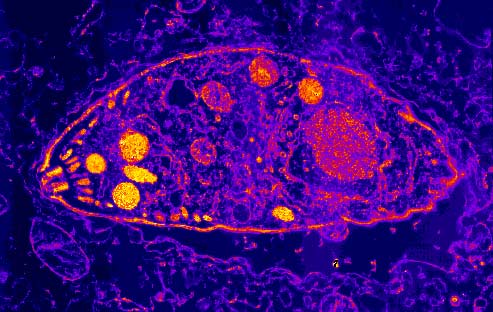
This is the parasite, in a color-enhanced scanning electron micrograph. Pretty, isn’t it? It’s called Toxoplasma gondii. It’s a single-celled organism that lives its life in two stages, growing to maturity inside the bodies of rats, and reproducing in the bodies of cats.

When a rat is infected, usually by coming into contact with cat droppings, the parasite grows but doesn’t reproduce. Its reproduction can only happen in a cat, which becomes infected when it eats an infected rat.

To help ensure its own survival, the parasite does something amazing. It controls the rat’s mind, exerting subtle changes to make the rat unafraid of cats. Healthy rats are terrified of cats; if they smell any sign of a cat, even a cat’s urine, they will leave an area and not come back. Infected rats lose that fear, which serves the parasite’s needs by making it more likely the rat will be eaten by a cat.

Humans can be infected by Toxoplasma gondii, but we’re a dead end for the parasite; it can’t reproduce in us.

It can, however, still work its mind-controlling magic. Infected humans show a range of behavioral changes, including becoming more generous and less bound by social mores and customs. They also appear to develop an affinity for cats.

There is a strong likelihood that I am a Toxoplasma gondii carrier. My parents have always owned cats, including outdoor cats quite likely to have been exposed to infected rats. So it is quite likely that my love for cats, and other, more subtle aspects of my personality (bunny ears, anyone?), have been shaped by the parasite.

So, here’s the first question: If some magical technology existed that could read the connections between all of my brain cells and copy them into a computer, would the resulting model act like me? If the model didn’t include the effects of Toxoplasma gondii infection, how different would that model be from who I am? Could you model me without modeling my parasites?


It gets worse.

The brain models we’ve built to date are all constructed from generic building blocks. We model neurons as though they are variations on a common theme, responding pretty much the same way. These models assume that the neurons in Alex’s head behave pretty much the same way as the neurons in Bill’s head.

To some extent, that’s true. But we’re learning that there can be subtle genetic differences in the way that neurons respond to different neurotransmitters, and these subtle differences can have very large effects on personality and behavior.

Consider this protein. It’s a model of a protein called AVPR-1a, which is used in brain cells as a receptor for the neurotransmitter called vasopressin.

Vasopressin serves a wide variety of different functions. In the body, it regulates water retention and blood pressure. In the brain, it regulates pair-bonding, stress, aggression, and social interaction.

A growing body of research shows that human beings naturally carry slightly different forms of the gene that produce this particular receptor, and that these tiny genetic differences result in tiny structural differences in the receptor which produce quite significant differences in behavior. For example, one subtle difference in the gene that produces this receptor changes the way that men bond to partners after sex; carriers of this particular genetic variation are less likely to experience intense pair-bonding, less likely to marry, and more likely to divorce if they do marry.

A different variation in this same gene produces a different AVPR-1a receptor that is strongly linked to altruistic behavior; people with that particular variant are far more likely to be generous and altruistic, and the amount of altruism varies directly with the number of copies of a particular nucleotide sequence within the gene.

So let’s say that we model a brain, and the model we use is built around a statistical computation for brain activation based on the most common form of the AVPR-1a gene. If we model the brain of a person with a different form of this gene, will the model really represent her? Will it behave the way she does?

The evidence suggests that, no, it won’t. Because subtle genetic variations can have significant behavioral consequences, it is not sufficient to upload a person using a generic model. We have to extend the model all the way down to the molecular level, modeling tiny variations in a person’s receptor molecules, if we wish to truly upload a person into a computer.

And that leads rise to a whole new layer of thorny moral issues.


There is a growing body of evidence that suggests that autism spectrum disorders are the result in genetic differences in neuron receptors, too. The same PDF I linked to above cites several studies that show a strong connection between various autism-spectrum disorders and differences in receptors for another neurotransmitter, oxytocin.

Vasopressin and oxytocin work together in complex ways to regulate social behavior. Subtle changes in production, uptake, and response to either or both can produce large, high-level changes in behavior, and specifically in interpersonal behavior–arguably a significant part of what we call a person’s “personality.”

So let’s assume a magic brain-scanning device able to read a person’s brain state and a magic computer able to model a person’s brain. Let’s say that we put a person with Asperger’s or full-blown autism under our magic scanner.

What do we do? Do we build the model with “normal” vasopressin and oxytocin receptors, thereby producing a model that doesn’t exhibit autism-spectrum behavior? If we do that, have we actually modeled that person, or have we created an entirely new entity that is some facsimile of what that person might be like without autism? Is that the same person? Do we have a moral imperative to model a person being uploaded as closely as possible, or is it more moral to “cure” the autism in the model?


In the previous essay, I outlined why I think we’re still a very long ways away from modeling a person in a computer–we lack the in-depth understanding of how the glial cells in the brain influence behavior and cognition, we lack the tools to be able to analyze and quantify the trillions of interconnections between neurons, and we lack the computational horsepower to be able to run such a simulation even if we could build it.

Those are technical objections. The issue of modeling a person all the way down to the level of genetic variation in neurotransmitter and receptor function, however, is something else.

Assuming we overcome the limitations of the first round of problems, we’re still left with the fact that there’s a lot more going on in the brain than generic, interchangeable neurons behaving in predictable ways. To actually copy a person, we need to be able to account for genetic differences in the structure of receptors in the brain…

…and even if we do that, we still haven’t accounted for the fact that organisms like Toxoplasma gondii can and do change the behavior of the brain to suit their own ends. (I would argue that a model of me that was faithful clear down to the molecular level probably wouldn’t be a very good copy if it didn’t include the effects that the parasite have had on my personality–effects that we still have no way to quantify.)

Sorry, Mr. Kurzweil, we’re not there yet, and we’re not likely to be any time soon. Modeling a specific person in a brain is orders of magnitude harder than you think it is. At this point, I can’t even say with certainty that I think it will ever happen.

Some thoughts on courage

I hear you will not fall in love with me
because I come without a guarantee,
because someday I may depart at whim
and leave you desolate, abandoned, grim.
If that’s the case, what use to be alive?
In loving life you love what can’t survive:
and if you grow too fond and lose your head,
it’s all for nought–for someday you’ll be dead.

— Erica Jong, To X. (With Ephemeral Kisses)

This post started out as a reply to one of the comments in my first go-round of the relationship skills poster I’m working on.

I believe courage is among the most valuable traits any person can have. It’s a trait I look for in a potential partner. One of the things I say often, and included on the poster, and one of the things I believe it would have been most helpful for me to have learned a long time ago, is “life rewards people who move in the direction of greatest courage.”

Every time I say that, I’m always taken a bit by surprise by the amount of resistance I get to it. I hear a lot of objections to this idea, and the objections are usually couched in terms that frankly don’t make a lot of sense to me. It seems like when I talk about life rewarding courage, the idea I’m trying to communicate ends up vastly different in its interpretation. I started to write a response about what I mean when I say that life rewards courage, but I thought it deserved a blog post of its own.

First, let me talk about what I mean when I use the word “courage.”

Courage is not the absence of fear. If we never felt fear, there would be no need for courage; indeed, without fear, the idea of courage would be meaningless. We as a species never experience the emotion of fluntillation, for instance, so talking about making a virtue of bandestility in the face of fluntillation makes no sense. Courage isn’t in what you do when you are fearless; it’s in what you do when you’re fearful.

Courage does not mean recklessness. It does not mean acting on impulse or without intent. Recklessness is sometimes easier than real courage; when you’re reckless, you may act without considering the risks or consequences of your actions, and when you don’t consider the risks of your actions you might be less afraid of them. The kind of courage I’m talking about is not blind, impulsive recklessness, but action that comes from calm deliberation.

Courage is not desperation. A person with nothing to lose has nothing to fear.

Someone in the conversation that followed the first go-round of the relationship poster used the argument that a person who hits on a hundred women a day might succeed in finding sex partners in the short term, but will likely eventually run out of people to hit on and also end up being socially ostracized.

I find this argument a little baffling. It is not lack of courage that prevents me from hitting on a hundred people a day; it’s the fact that hitting on a hundred people a day wouldn’t succeed in getting me the kind of relationship I value. Hitting on every woman I see would not be an act of courage, because I don’t want a relationship–or sex, for that matter–with every woman I see.

Which brings up what courage is.

Courage is making decisions that take you closer to what you want, or to the person you want to be, even when you’re scared. Courage is not allowing fear to be in the driver’s seat. Courage is talking to the person you are interested in, even though you’re aware that you may be rejected.

Courage is saying “I will reach for what I want” rather than saying “I have been hurt before, and I don’t want to be hurt again, so I’m not going to risk it; I’m just going to sit here and do nothing.” Courage is saying “This new thing you’re doing scares me; it makes me feel unsure and insecure, but I will support you in it anyway” rather than “This thing you’re doing scares me; I forbid you to do it.”

I have tried both approaches. Moving with courage more often results in me having the life that I want to have than allowing my fears to control my actions does. Relationships with people who move with courage are more satisfying to me than relationships with people who don’t.

Now, sure, moving with courage is not always rewarded. Again, if there were no possibility of hurt or loss, there would be no virtue in courage. Yes, you might reach out for what you want and come up short. You might be rejected. You might be hurt. Absolutely.

But what’s the alternative? Never reaching for what you want? Always backing down in the face of fear? Never choosing the harder path? What does that gain, other than a life lived from cradle to grave by the path of least resistance?

If one person reaches for the relationship she wants ten times, and is rejected nine of those times, and another person never reaches for what he wants for fear of rejection, which of them has been more rewarded? The person who was hurt but now has the life she wants, or the person who has never been hurt but also never been happy?

Life rewards people who move in the direction of greatest courage. Yes, moving with courage means running the risk of being hurt. But hiding in the corner, afraid to take a chance, also hurts; it’s just that it hurts all the time, so you become less aware of it.

And being hurt isn’t the end of the world. Broken hearts mend. Indeed, I’ve written in the past about the value of having your heart broken; often, it’s in the way we deal with pain and loss that the best inside us has the chance to blossom.

To live a life built on a foundation of fear, in the end, breaks far more than just a heart. It destroys any chance of having anything worth keeping. Moving with courage means risking pain; but failure of courage means risking everything.

Courage is not fearlessness, or recklessness, or desperation. It is choosing who you want to be, deciding what kind of life you want to have, and then moving toward that even when it’s scary. It is not rewarded every single time; we do not always get what we want, and sometimes, we get hurt. Courage is in living the life we want in spite of that. If there is any other way to be happy, I have not found it.

Some thoughts on parasites, ideology, and Malala Yousafzai

This is Malala Yousafzai. As most folks are by now aware, she is a 14-year-old Pakistani girl who was shot in the head by the Taliban for the crime of saying that girls should get an education. Her shooting prompted an enormous backlash worldwide, including–in no small measure of irony–among American politicians who belong to the same political party as legislators who say that children ought to be executed for disrespecting their parents.
I’ve been reading a lot lately about what seems to be two different and at least theoretically unrelated things: parasitology and ideology, specifically religious ideology. This might seem to have nothing to do with Malala Yousafzai’s shooting, but it really isn’t.

When I say I’ve been reading about parasitology, what I mean by that is my Canadian sweetie has been reading to me about parasitology. Specifically, she’s been reading me a book called Parasite Rex, which makes the claim that much of evolutionary biology, including the development of sexual reproduction, is driven by parasites. It’s been a lot of fun; I never knew I’d enjoy being read to so much, even though the subject matter is sometimes kinda yucky.

What’s striking to me is that these things–religious ideology and parasitology–are in some ways the same thing in two different forms.

Parasites make their living by invading a host, then using the host’s resources to spread themselves. To this end, they do some amazing manipulation of the host. Some parasites, for instance, are able to alter a host’s behavior to promote their own spread. Sometimes it’s as crude as irritating the host’s throat to promote coughing which spreads hundreds of millions of virus particles. Other times, it’s as bizarre and subtle as influencing the host’s mind to change the way the host responds to fear, in order to make it more likely that the host will be eaten by a predator, which will then infect itself with the same parasite. In fact, parasitologists today are discovering that the study of life on Earth IS the study of parasites; parasites, more than any other single factor, may be the most significant determinant in the ratio of predator to prey biomass on this planet.

Religious ideology would seem to be a long way off from parasitism, unless you consider that ideas, like parasites, spread themselves by taking control of a host and modifying the host’s behavior so as to promote the spread of the idea.

This isn’t a new concept; Richard Dawkins coined the term ‘meme’ to describe self-replicating ideas decades ago.

But what’s striking to me is how direct the comparison is. The more I learn about parasites, the more I come to believe that parasites and memes aren’t allegories for each other; parasites ARE memes, and vice versa.

We tend to think of parasites like toxoplasma as being real things, and ideas like the salvation of Jesus Christ as being abstract concepts that don’t really exist the same way that real things do. But I don’t think that’s true.

Ideas exist in physical form. It might be as a series of symbols printed in a book or as a pattern of neural connections stored inside a brain, but no matter how you slice it, ideas have a physical existence. An idea that does not exist in any physical way, even as neuron connections wired into a person’s head, doesn’t exist.

Similarly, parasites are information, just like ideas are. A strand of DNA is nothing but an encoded piece of information, in the same sense that a series of magnetic spots on a hard disk are information. In fact, researchers have made devices that use DNA molecules to store computer information, treating banks of DNA as if they were hard drives.

In a sense, ideas and organisms aren’t different things. They are the same thing written into the world in different ways. An idea that takes control of a host’s brain and modifies the host to promote the spread of the idea is like a parasite that takes control of a host and modifies it to spread the parasite. The fact that the idea exists as configurations of connections of neurons rather than as configurations of nucleotides isn’t as relevant as you might think.

We can treat ideas the same way we treat parasites or diseases. We can use the tools of epidemiology to track how ideas spread. We can map the virulence of ideas in exactly the same way that we map the virulence of diseases.

Religion is unquestionably a meme–a complex idea that is specifically designed to spread itself, sometimes at the host’s expense. A believer infected with a religious ideology who kills himself for his belief is no different than a moose infected with a parasite that dies as a result of the infection; the parasite in both cases has hijacked the host, and subverted the host’s own biological existence for its own end.

The more I see the amazing adaptations that parasites have made to help protect themselves and spread themselves, the more I’m struck by how memes, and especially religious memes, have made the same adaptations.

Some parasitic wasps, for example, will create multiple types of larva in a host caterpillar–larva that go on to be more wasps, and larva that act as guardians, protecting the host from infection by other parasites by eating any new parasites that come along. Similarly, religious memes will protect themselves by preventing their host from infection by other memes; many successful religions teach that other religions are created by the devil and are therefore evil, and must be rejected.

We see the same patterns of host resistance to parasites and to memes, too. A host species exposed to the same parasites for many generations will tend to develop a resistance to the parasites, as individuals who are particularly vulnerable to the parasites are selected against and individuals particularly resistant to the parasites are selected for by natural selection. Similarly, a virulent religious meme that causes many of its hosts to die will gradually face resistance in its host population, as particularly susceptible individuals are killed and particularly resistant individuals gain a survival advantage.

Writers like Sam Harris and Michael Shermer talk about how people in a pluralistic society can not really accept and live by the tenets of, say, the Bible, no matter how Bible-believing they consider themselves to be. The Bible advocates slavery, and executing women for not being virgins on their wedding night, and destroying any town where prophets call upon the citizens to turn away from God; these are behaviors which you simply can’t do in an industrialized, pluralistic society. So the members of modern, industrialized societies–even the ones who call themselves “fundamentalists” and who say things like “the Bible is the literal word of God”–don’t really act as though they believe these things are true. They don’t execute their wives or sell their daughters into slavery. The memes are not as effective at modifying the hosts as they used to be; they have become less virulent.


But new or mutated memes, like new parasites, always have the chance of being particularly virulent. Their host populations have not developed resistance. In the Middle East, in places where an emergent strain of fundamentalist Islam leads to things like the Taliban shooting Malala Yousafzai, I think that’s what we’re seeing–a new, virulent meme. islam itself is not new, of course, but to think that the modern strains of Islam are the same as the original is to think that the modern incarnations of Christianity are akin to the way Jesus actually lived; it’s about as far off the mark as thinking a bird is a dinosaur. They share a common heritage, but that’s all. They have evolved into very different organisms.

And this particular meme, this particular virulent strain of Islam, is canny enough to attack its host immune system directly. The Taliban targeted Malala Yousafzai because she favors education for women. Education, in many ways, provides an immunological response to memes; it is no accident that Tammy Faye Bakker famously said that it’s possible to educate yourself right out of a personal relationship with Jesus Christ. It’s no accident that Fundamentalism in all of its guises tends to be anti-intellectual and anti-education.

I’m not saying that the meme of religion (or any other meme) is inherently bad, of course. Memes have different strains; there are varieties of any large religion that are virulent and destructive to their host population, and other strains that are less virulent and more benign.

But with parasitic ideas as with parasitic biological entities, it is important to remember that the goal of the parasite is not necessarily the same as the goal of its host. Parasites attempt to spread themselves, often at the host’s expense. the parasite’s interests are not the host’s interests. Even a seemingly benign meme, such as a meme that says it is important to be nice to each other in order to gain an everlasting reward in heaven, might harm its host species if it siphons away resources to spread itself through churches that might otherwise have been used to, for example, research new cures for cancer. At the more extreme end, even such a benign meme might cause its adherents to say things like “We as a society don’t need to invest in new biomedical nanotechnology to promote human longevity, because we believe that we will live forever if we abide by the strictures of this meme and help to spread it through our works.”

Virulent memes tend to be anti-intellectual, because education is often a counter to their spread. Malala Yousafzai was targeted because she represents the development of an immune response to a virulent, destructive meme that is prevalent in the environment where she was born.

BDSM Ethics Part 2: Some Thoughts on Making the World Better

In Part I of this essay, I wrote some initial thoughts about the BDSM Pledge Web site. To recap briefly (as if I am ever brief): The BDSM Pledge site is an attempt by Kink.com, a producer of BDSM-related porn, to start to codify a set of guidelines for responsible, ethical BDSM.

This is not really a new idea, of course. Folks have been thinking about how BDSM is distinct from abuse for at least as long as there have been words for consensual BDSM. A lot of folks have coalesced around two short, bumper-sticker-sized expressions: “SSC” (for “Safe, Sane, and Consensual”), and “RACK” (for “Risk Aware Consensual Kink”). They both have the notion of consent in common, but after that, things go a bit off the bend.

The RACK folks like to point out that no activity, from whipping your lover to climbing a stepladder with a hammer in your hand, is really entirely ‘safe,’ and ‘sane’ is often in the eye of the beholder. The SSC folks, on the other hand, see the notion of risk-aware consensual kink as overplaying consensuality to the point where it leads into some decidedly questionable territory; if two folks decide they have a cover-the-submissive-in-chum-and-drag-him-through-shark-infested-waters fetish, does that mean the unfortunate outcome is okay because they both knew the risks and were on board with the idea?

Honestly, I see both points. It makes sense to me that both SSC and RACK are reaching toward something that’s simple in conception but slippery in the details: different people have different tastes, there is no such thing as perfect safety, and as long as the folks involved understand that and aren’t being totally reckless with one another’s safety, there’s value in letting people get down to it.

But I don’t think SSC or RACK are, by themselves, sufficient for ethical BDSM. In fact, I think they’re both so narrow in focus that they miss something really important: There is more to ethics than what you and your lover get up to in the bedroom (or attic or kitchen or dungeon, as your tastes may dictate).

It’s one thing to be ethical to your partner, your confidant, and/or the source of your nookie. It’s an entirely different thing to be ethical toward members of your community, even ones you don’t like, and toward the great mass of humanity as a whole. After all, we as human beings are arguably hard-wired to behave very differently toward people in our inner circle than we are toward acquaintances or strangers. One of the failings I see in many conversations about ethical BDSM is that the discussions tend to focus on the ways we behave toward our partners, but not on the ways we behave toward folks we aren’t involved with. I think that’s a shortcoming of ideas like RACK and SSC; a code of ethics needs to be broader in its scope.


I’ve written before about how we in the BDSM community tend to talk the talk about consent, but we often don’t walk the walk. I have seen behavior at BDSM events and play parties which I think violate the ideas of consent and autonomy, in ways large and small–swatting the ass of that cute submissive who walks by, wrongly believing that just because she’s a submissive so that makes it OK; disregarding people’s boundaries because it’s an acceptable thing to do (after all, isn’t the point of BDSM to challenge people’s boundaries? Right?); even full-on sexual assault. Granted, no community is perfect; take any group of people (folks interested in BDSM, folks with red hair, folks with medical degrees, folks who drive Toyotas) and if it gets sufficiently large you’ll find some bad actors.

But it’s particularly worrisome, to me, to see people behaving poorly in the BDSM community, precisely because the BDSM community claims to value consent so highly.

Consent is the cornerstone of what we do. Consent is the defining element that separates us from abusers. Yet, in spite of that, I have seen far too many examples of non-consensual behavior in the BDSM community for my liking, and more to the point, I’ve seen non-consensual behavior tolerated. That’s something that a code of ethics needs to address.

When we talk about people behaving unethically in the community, it’s surprising how many times it seems that everyone knows who the bad actors are. There’s a good essay on this topic called The Missing Stair over on The Pervocracy. When something bad happens in any community, far too often everyone already who the perpetrators are. The bad actors are like a missing step in a staircase, in that when you become accustomed to jumping over that step, you can forget how dangerous the missing step actually is.

A comprehensive set of ethics must include not only ethical treatment of our partners, but also ethical treatment of other people in the community. And, as an important element of that, it must include creating a community that does not shelter people who behave badly.

I’ve seen the BDSM community close ranks behind a member who sexually assaulted submissive women in the community, without their consent; I’ve seen how people who came forward to talk about the assault were ostracized. This is something that simple slogans like “Safe, Sane, and Consensual” or “Risk Aware Consensual Kink” don’t address. Ethics means more than “I will only engage in consensual behavior toward others;” I think it also extends to “I will not excuse non-consensual behavior on the part of others in my community,” too.

I read recently about sexual assault that took place at Burning Man, and one of the things that struck me about the story was the commenter who said “I’m sure this guy [the rapist] knew someone out there… where were they to keep him in check?”

Which, I think, misses the point. In any community, it is not the responsibility of the people who know the bad actors to keep them in check. It’s everyone’s. If you’re there, that means it’s yours. If I’m there, that means it’s mine.

It is incredibly difficult to intervene when we see something bad happening. It’s easy to ignore evil; it’s easy to rationalize non-intervention. Someone else will do something, we say. It’s not my job to police the community. Where are his friends? They should be the ones to keep him in check. I don’t even know this guy; why should I be the one to step in?

And so, nobody does. The missing stair goes unfixed.


So, let’s get down to the meat of the issue. If I were to invent a set of ethical guidelines for BDSM, what would it include? It’s important to understand that ethics go beyond simply taking responsibility for our own actions; they also extend to not standing idly by while other people behave unethically. And, most importantly, any reasonable code of ethics must include the idea that each one of us bears responsibility for making our community an ethical place.

So I were to invent a set of ethical guidelines for the BDSM community, it would probably look something like this:

• In my interactions with partners, I recognize that their ongoing participation is voluntary, even in total power exchange or M/s style relationships. I recognize the agency of my partners, and I understand that the moment I attempt to do things to a partner that he or she no longer wishes to participate in, or that a partner attempts to do to me that I don’t wish to participate in, we have moved away from BDSM.

• I recognize that my tastes are not shared by everybody, and other people’s tastes may not be shared by me. Because of that, I respect the agency of the people around me. They are more than simply a role; I will not make assumptions about what is and is not permissible to do with someone simply because that person identifies as “at top” or “a bottom” or “a submissive” or “a dominant,” without actually considering that not everyone regards these roles to have exactly the same meaning.

• I acknowledge that unethical behavior is something that can happen in my community, and when it does, that is a reflection not only of the person who is committing the unethical acts, but also on me, and on the rest of my community. I can be judged positively on my willingness to intervene against unethical acts, or negatively on my willingness to look the other way.

• Consent is the cornerstone of ethical behavior. Even small violations of consent are unethical acts. Therefore, I will make consent a priority. Sloppy attitudes about consent, such as swatting the ass of any attractive submissive who walks by, or barking orders to anyone who presents as submissive regardless of whether or not any sort of relationship exists, are not acceptable.

• In addition, I will expect the rest of my community to step up and make it clear that sloppiness about consent isn’t OK. There’s a Geek Social Fallacy that says “Ostracizers are always evil.” This fallacy needs to be recognized for what it is. Folks who behave inappropriately need to be told they are behaving inappropriately. It needs to stop being ignored. A person who witnesses inappropriate or non-consensual behavior in the community and does nothing about it, becomes complicit in it. It is not evil to take a stand against people who behave inappropriately. If I am the person witnessing inappropriate behavior, it is my responsibility to be the person who steps forward.

• I will not behave with hostility toward people, especially women and most especially submissive women, who come forward to report abuse. (When my friend was raped–and let me make clear that this was not an edge case, a fuzzy boundary thing, or an after-the-fact buyer’s remorse thing, but a he-physically-restrained-her-and-put-his-penis-in-her-vagina rape–the amount of backlash she experienced when she came forward to talk to other people about it was astonishing. And not just from self-described dominants or from men; the number of women who responded with some variant of ‘well, if you were REALLY a TRUE submissive then you wouldn’t have problems with this’ was just amazing.) I will make it my responsibility to build a community in which this kind of thing is not acceptable. I recognize that people who engage in victim-blaming and rationalization are part of the problem; whether it is their intent or not, they are providing cover for abusers.

• It is an unfortunate fact that abusers can exist at any level within a community, even among community leaders. This creates a particularly difficult situation, because when abuse done by a community leader surfaces, there can be a powerful incentive to look the other way. Rationalizing is astonishingly easy to do. “Well, I wasn’t there and so I don’t know what REALLY happened, and I’ve hung around with this guy and he seems like an OK dude to me, so you know, maybe there’s nothing really to it, I bet she’s just causing drama…” If I learn about inappropriate behavior in the community but do nothing about it, I become complicit in it.

• Reputation and references alone are not necessarily reliable indicators of a person’s character. When a community punishes abuse victims from coming forward and shields abusers, then says “If you want to protect yourself, just see what other people have to say!” the result is to create an environment that makes it almost impossible to spot the bad actors. Of course people who have had bad experiences aren’t going to come forward and say so; the price is too high. The result is a situation like the one my friend experienced where she asked a lot of folks around the community about her attacker and got glowing reviews, even though he was a serial abuser…because the community is so hostile to people who talk about abuse that none of his previous victims came forward.

• Affirmative consent is important. If someone does not say “it is OK for you to put your penis in me,” I will not put my penis in that person. It’s not enough that she didn’t say “no, you can’t put your penis in me.” I will not assume that simply because I haven’t been forbidden to do something, that means it’s OK to do it. (This does not necessarily mean that it’s not OK to play with consensual non-consent, of course. I personally am a big fan of consent play and consensual non-consent. I talk to my lovers about it before doing it; it is absolutely possible to have affirmative consent to engage in consent play.)

• It is my responsibility to be compassionate and receptive if I am told of abuse within the community. There are significant barriers to disclosure, both institutional in the community and personal in the shame that tends to follow sexual assault. I will not add to these barriers. I will not become part of the reason that victims feel they can not step forward.

• Consent for activity A does not imply consent for activity B. Consent to a light spanking scene does not imply consent to a singletail scene. Consent to being tied up does not imply consent to sexual intercourse. At the end of the day, if person A puts his penis in person B without permission, anything that happened in a BDSM context up to that point is utterly irrelevant; it’s assault and it’s not OK.

• There needs to be less trivializing and minimizing when assault happens. “So he fucked you after you agreed to be tied up. That’s not REALLY rape; I was assaulted in an alley by strangers, and that’s far worse than what you experienced!” is not OK. While it is part of human nature to do this, and identifying with the attacker and minimizing other people’s victimization are part of the defense mechanisms we employ against abuse, this kind of minimization of poor behavior creates an environment where poor behavior is tolerated. A policy of no tolerance for assault, violent or not, in the BDSM community is an important part of ethical BDSM.

• On the flip side of the same coin, it is important to understand that if I am assaulted, the assault is not OK even if I did agree to be tied up first, or even if I did agree to play with this person first. People who are assaulted will often tend to trivialize their own experience. Better policing of the community, less tolerance by members of the community for assault, and better education for what constitutes assault are all important.

• It is not OK to play the “shoulda game.” When my friend was assaulted, a lot of folks came forward to say “well, she shoulda done this” or “you know, she shoulda done that.” When the “shouldas” are about things that happen before the assault (“well, she shoulda got more experience with him before she agreed to let him tie her up,” “well, she shoulda said ‘no’ more plainly”), it’s just plain old-fashioned victim blaming. When the “shouldas” are about things that happened after the assault, they’re a form of abdication of responsibility. After the assault, I heard one person in the community who is generally an otherwise decent bloke say “Well, she shoulda gone to the police after it happened,” and then used that as an excuse not to support her, but to support the attacker instead. We can’t expeect victims to follow some script that we make up in our heads and then withdraw support from them if they don’t follow that script. The community needs to be better at policing itself and enforcing standards of acceptable behavior regardless of whether or not people who are assaulted respond to the assault the way we think they should.

Many of these ideas center around the way we conduct ourselves in our community rather than simply in private. This is necessary, both to create a vibrant, healthy community that does not shield abusers, and to help ensure that our community is not targeted as a haven for abusers by the outside world. Whether we like it or not, and whether we agree with it or not, when members of our community behave poorly, it is a reflection on all of us…particularly if we fail to step up and stop it.


My buddy edwardmartiniii has written an essay on the value of policing our social groups in order to create ethical spaces. He also has some suggestions about fixing the problems we see around us. I have linked to these before, but I think it needs to be mentioned again. If we are to do what it is we do ethically and with compassion, these are important ideas.

To that end, I now wear a blue button on my jacket. That button is a reminder to myself: if I am to be an ethical, compassionate human being, it is not enough that I do no evil. I must also choose not to look the other way when others do evil within my community. If I want a community that does not offer a haven to abusers, it is my responsibility to make that happen.

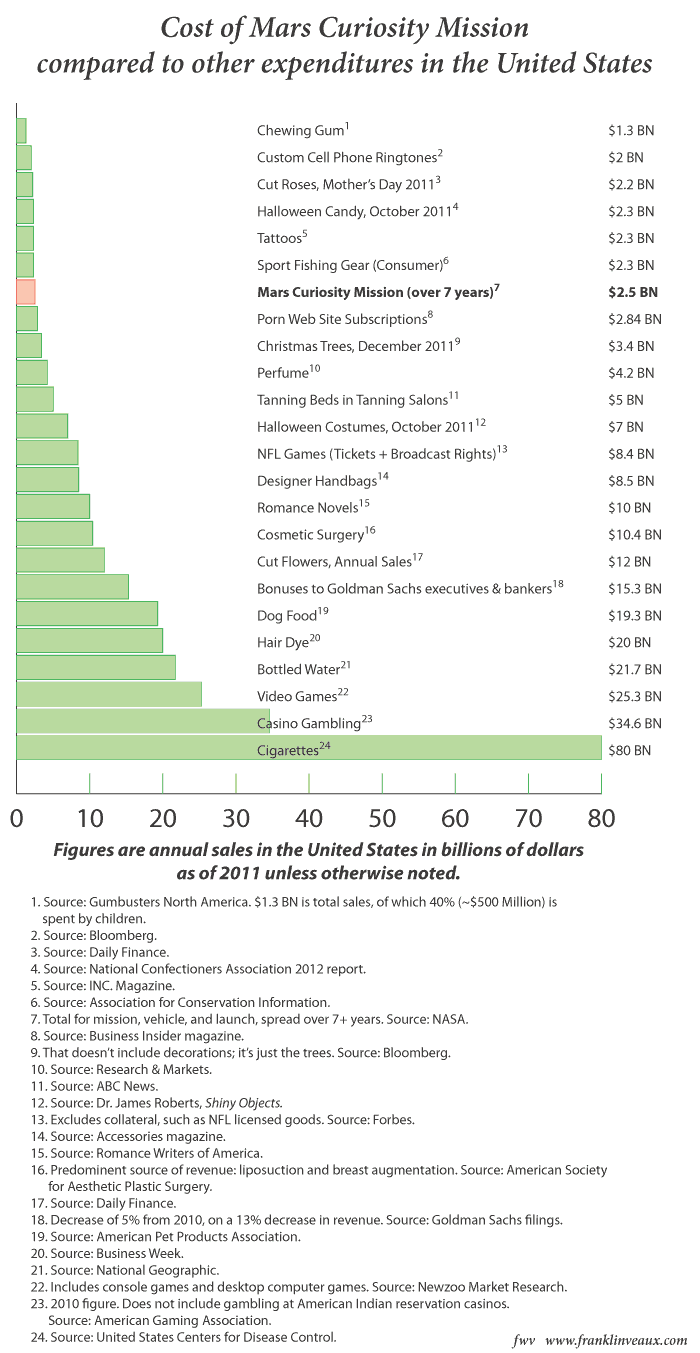
“But why aren’t we spending it on CHILDREN? Think of the CHILDREN!”

So for those of you who’ve been living under a rock for the last couple of days: Yesterday, something amazing happened.

No, I don’t mean the US soccer Olympic team beating Canada by one point in a dramatic overtime goal. I mean something really amazing. Something mind-blowing.

We took a one-ton nuclear-powered robot rover and threw it 350,000,000 miles, then landed it on the surface of another planet using cables from a flying rocket-powered robot crane.

And it worked. That’s the cool thing about science: It works whether you “believe” in it or not.

However, as always happens whenever NASA does something amazing, a bunch of people have trotted out all sorts of nonsense about how we shouldn’t be spending money on space exploration when there are so many problems back here on earth. I went to a Curiosity landing party at the local museum of science and industry, and sure enough, someone posted something on the Facebook page for the event something to the extent of “I wonder how many children will die from lack of clean water while we land a probe on Mars” or something.

Now, I have been told that it’s technically illegal to beat these folks. And I’m sure their hearts are in the right place; they’re not trying to be anti-intellectual, they just have little sense of the size and scope of the economy, nor how much money gets spent on space exploration, nor how much money we spend every year on things that we really could do without. And they seem to have an either/or mindset as well, as if to say that every dollar that goes to space exploration is a dollar that is taken away from needy children as opposed to being taken from, say, the Pentagon’s budget for paper clips.

Now, I think that doing things like, oh, finding out if there is life on other planets in our solar system represents a better investment of money than, for instance, buying T-shirts with pictures of NFL logos on them–something we typically spend about four times more per year on than we do on trying to learn about the universe.

So I spent some time doing a bit of research, and I’ve put together a handy-dandy chart that shows the cost of the Mars Curiosity mission, compared to the cost of some other things we might be acquainted with. The chart is a little lopsided, in that it shows how much we spend per year on other things, and the cost of the Curiosity mission so far represents seven years’ investment; to make things more representative, the bar for the Curiosity mission should be 1/7th as long as it is here.

Since we aren’t technically allowed to beat folks who complain about the cost of space exploration, hitting them over the head with this chart will have to do instead. (Figuratively! Figuratively! You can’t literally hit folks with it unless you, I don’t know, print it out and wrap it around something first. Which, as I mentioned, is technically illegal.)

So now when someone says “Why are we wasting money on space exploration instead of fixing problems here at home?” you can say “Why are we wasting even more money on Halloween candy, Christmas trees, or perfume, or football games?” I don’t think I’ve ever heard anyone say “We shouldn’t spend money on perfume when there are so many problems here at home.”

Because, you know, spending money on perfume is way more important than finding out whether or not there is life not on this world.

Some Thoughts on Design and Humane Computing

A couple of weeks ago, someone on a programming mailing list that I read asked for advice on porting a Windows program he’d written over to the Mac. Most of the folks on the list, which is dedicated to Windows, Linux, and Mac software development, advised him that simple ports of Windows software generally tend to fare poorly on the Mac. Mac users tend not to like obvious ports from the Windows world, and several folks suggested that he might need to do some rejiggering of his program;s interface layout–moving buttons, repositioning alert icons, and so on–so that they fit the Mac guidelines better.

Which is true, but incomplete, and misses what I think is a really important point about software design. Or any kind of design, for that matter.


Right now, as I type this, Apple and Samsung are involved in a nasty patent spat concerning infringement of certain Apple user interface patents for cell phones. A lot of folks commenting from the sidelines on the spat tend to paint Apple as a villain, usually on the grounds that the patents in question (which generally relate to things like how searches work and so on) are “obvious,” and therefore shouldn’t be patentable at all.

Leaving aside entirely the question of whether or not Apple is the bad guy, the fact that so many folks deride the user-interface patents in question as “obvious” demonstrates a couple of important principles.

The first is that many computer geeks don’t understand design, and because they don’t understand design, they have contempt for it. (It is, unfortunately, a very common trait I’ve noticed among geeks, and particularly computer geeks, to assume that if they lack some particular skill, it’s only because that skill is trivial and not really worth bothering about.)

The second is that people tend not to pay attention to design unless it’s bad. Good design always looks obvious in hindsight, when it is noticed at all.


Today, touch-screen smartphones have generally settled on the same overall user interface idea: a series of virtual pages, accessed by swiping, which contain icons that can be touched to launch applications. But it wasn’t so long ago that such a simple and obvious user interface was unknown. Case in point: The first Windows CE devices.

The Windows CE-based smartphones used the same metaphor as Windows desktop systems: a “desktop” onto which you could place icons, and a tiny “start” menu in the corner of the screen which you would touch with a stylus or move a virtual mouse pointer over with a set of arrow keys or a rocker button to bring up a menu of applications.

This user interface succeeds on desktops but is an abject, epic failure on small screen devices because it simply isn’t designed for a different usage environment. Yet this, and things like it, were the norm for handheld devices for years, because nobody had come up with anything better. Nowadays we look at Android or iOS and marvel that anyone could be so dumb as to attempt the Windows desktop interface on a phone. Good design always looks obvious in hindsight.


So back to the mailing list.

Several of the responses the guy who wanted to port his software received concerned learning things like the ‘correct’ button placement and icon size on Mac systems. But that does not, I think, really address the central problem, which is that Mac users (and I know I’m going to get some flak for saying this) are accustomed to a higher level of design than Windows users are.

And there’s more to design than how big the icons are or where the buttons are placed. Way too many people have this notion that design is something you bolt onto an application after it’s finished; you make the program do what it should do, and then you call Joe the graphics guy from the other side of the building, who isn’t a real programmer but knows how to do some graphics stuff to make it all look pretty.

Back in the early days of the Mac, Apple released a rather hefty book called “Macintosh Human Interface Guidelines.” I had a copy of it for a long time. It’s quite thick, and covers almost every aspect of user interface design. Yes, there are a lot of bits about how many pixels wide an icon should be and where a button should be placed on a window, but it goes way beyond that, into program flow, error handling, and a lot more.

It’s a book I think all programmers should read, regardless of what environment they program for.

I don’t think Windows has ever had an equivalent to this book. Window prior to Windows 95 didn’t seem to have any such book, at least not that I can find. The earliest published document I can find for Windows was produced in 1995, and was quite short, covering nowhere near the depth of program design as the Mac version. A PDF is available here. I’m pretty sure Linux hasn’t either, though individual user interface shells may. (Gnome has one, and so does KDE; Unity seems not to.) And I think that helps contribute to the contempt that many programmers have for design, and to the notion that design is “pretty pictures that you put into the dialogs after the program is done.”


I wrote a reply on the list outlining some of the difficulties Windows programmers face when trying to port to the Mac. The considerations do include where to position user interface elements on the screen, of course; Mac programmers expect a certain consistency. But there’s a lot more to it. Here’s what I wrote:

The issue with Mac software isn’t one of following a list of guidelines, in my experience, so much as one of practicing good design.

The principles in the Apple Human Interface Guidelines tend to promote good design, but there are many applications that don’t follow them (even applications from Apple) yet still give the ‘user experience’ that Mac users want. It’s about good, thoughtful, humane design, not about how big the buttons are or what fonts are used or how many pixels away from the edge of the window the buttons are located.

“Design” is a difficult concept, and one that a great many programmers–even good programmers–don’t have a good grasp of. There are a lot of terrible applications out there (on all platforms), though in the years I’ve been using Macs, Windows, and Linux I’ve found that Mac apps generally tend to be better designed than apps for the other two platforms. Indeed, Linux in particular tends to reward inhumane application design, enshrining programs with great power but also with an obtuse, cumbersome, and heavy user interface that is opaque to anyone without a thorough understanding of the software. EMACS is arguably one of the greatest examples of software utterly divorced from humane design. (Before anyone accuses me of engaging in partisan holy wars, I started using MS-DOS at version 2.11, Windows at 3.0, and Macs at System 1, and I’ve been using Linux since about 1998. I first came to EMACS on a DECsystem-20 running TOPS-20; before that, I used TECO on a PDP-11.)

Humane application design extends way beyond pretty pictures in the splash screen and memorizing lists of rules about where to put buttons on a screen. The principles of humane design are probably outside the scope of one email on an email listing, but they include things like:

Clarity. A well-designed user interface strives, as far as is reasonably possible, for simplicity, obviousness, and clarity. Functions presented to the user should be done in a logical and comprehensible manner, with similar functions presented in similar ways and available options described in the clearest possible language.

Consistency. Different areas of the software’s human interface should be designed, as far as is possible, to be both visually and functionally similar. If the user changes from one mode to another, she should not be presented with a jarringly different interface that is arranged entirely differently. Functions that are common to all areas or modes of the software should continue to work in the same way. The Microsoft Office suite is an example of a set of programs with poor consistency; in each of the parts of the suite, the same functions are often located in different places, under different menu items.

Predictability. Humane software does not modify or delete the user’s information without the user’s express permission. Consequences of user action, especially action that might involve loss of data, should be clearly communicated. User choice should be presented in a way that clearly communicates the results of the choice; for example, an inhumane, poorly-designed dialog box might read “A network error occurred” with buttons reading “OK” and “Cancel,” as the user is presented with no clear way to predict what pressing each of those buttons will do.

Ideally, buttons should be labeled verbs, which help to communicate the consequences of making a selection as rapidly as possible. It’s not great design to have a dialog box reading “A network error occurred; try again?” with buttons labeled “Yes” and “No.” Better is a dialog box with buttons labeled “Try Again” and “Disconnect.”

Clear communication. There’s a great example of this in the Apple Human Interface guidelines. A poorly-designed error message for a text entry field might read “Improper data format entered.” A better error message might read “”Numeric entry only.” A well-designed error message might read “The ZIP code must be five numbers or five numbers with a dash and four numbers.” The software communicates what is expected in a way that is easy for the user to understand, even when (in fact, especially when) an error condition is encountered.

Resilience. The design of the software should strive, as far as is possible, to preserve user input and user data even in the event of some sort of error condition. This means, for example, that the software will not discard everything the user has entered up to that point if the user types an incorrect ZIP code; the software will not lose the user’s input without warning if the user leaves one mode and enters another mode (for example, if the user types part of a shipping address, then backs up a screen to change the discount code she has entered), and the software will always make it clear if data will be or have been lost.

Forgiveness. The user interface should, as far as is possible, be designed to forgive mistakes. This includes such obvious things as Undo functionality, which in this day and age even the most inhumane software implements because it’s become part of the cultural set of expectations from any software. Better implementations include the ability to Undo after the user has done a Save or a Revert to Saved (Adobe applications consistently implement this). Humane software will not irrevocably destroy a user’s data at the click of a wrong button, will attempt insofar as is possible to recover data in the event of a crash (applications like Microsoft Word are quite good at this, though it’s not always technically possible in, say, large graphics editing apps).

Familiarity. Good design does not have to be beholden to the past, but if you’re presenting the user with a completely unfamiliar experience, expect resistance. When a person gets into a car, she expects certain things from the user interface; replacing the steering wheel and pedals with a joystick and the windshield with a holographic projector might be appropriate for a concept car or a science-fiction movie, but probably isn’t for the next-generation Chevy Lumina. If you change things about the expected user experience, make sure you have a clear and compelling reason to do so; don’t violate the user’s expectations merely because you can. This, unfortunately, is the only place where many programmers feel design is important, and is where rules such as the fonts used in buttons and the distance the buttons are placed from the edge of the window come into play.

Responsiveness. The application should be designed in such a way as to remain responsive to the user as often as possible in as many conditions as possible, and throw as few roadblocks in the user’s way as possible. This goes beyond simply shifting CPU-intensive operations into their own thread, and encompasses a number of architectural, coding, and human interface choices. For example, humane software is modeless wherever possible; use modal dialogs that block user activity only where absolutely necessary and where no other design decisions can be made. Make it clear what window or data is affected by a modal dialog (this is a place where I believe the design and implementation of Windows falls short, and the Mac’s “sheet” window is a significant human interface win.) If you must use a modal window, seek wherever possible to allow the user to clear the fault within the modal window, rather than forcing the user to dismiss the modal dialog and then go back a step to fix whatever the problem is.

There’s a lot more, of course, but the basic point here is that good design isn’t something that you glue onto a program with pretty icons and controls that follow all the rules. It’s something that has to be baked in to an application from the ground up, and for better or for worse it is my observation that the users’ expectations of good design techniques tend to be higher on Macs than on other systems.

Some thoughts on needs, objectification, and the Magic Genitals Effect

If you venture into the polyamory community for long enough, eventually you will encounter someone who says “Polyamory is good because no one person can meet all of your needs. With poly, I can find different people who meet different needs, and so be happier.”

That line of reasoning has always bugged the hell out of me. It seems to me that there is something deeply, profoundly wrong with this argument, but I’ve never really been able to articulate what.

Today, while pondering an entirely different question, it occurred to me. We are, through biology or socialization or both, prone to viewing romantic partners as need fulfillment machines. When we have a need, be it for companionship or for sex or for someone to process with or for someone to (God help us) go bowling with, we look to our partners to meet those needs.

Which is fine, as far as it goes. Indeed, one of the greatest things about being in a romantic relationship is having someone to turn to, someone to co-create with and to be inspired by, someone who will help us as we build our lives.

But it gets a little messed up, I think, when we start with the assumption that our partners are obligated to meet our needs–that that’s what they are there for, and if our needs aren’t being met, our partners have done something wrong.


A lot of folks say that you can never truly be friends with members of the opposite sex. In addition to being extremely heteronormative (does that mean a gay man can’t ever truly be friends with another gay man? That a bisexual woman can’t truly be friends with anyone?), it speaks, I think, to the notion that we tend to view folks through the lens of need fulfillment objects. For instance, there is a common (and misogynistic) narrative that says driving need of men is sex; any man who befriends a woman is, somewhere in his mind, doing so with the expectation that at some point he can get her to fill that need. I could write a book on how profoundly twisted that idea is, but that will have to wait for another time.

I think there are also signs of this objectification in the expectations for the way people behave after a romantic breakup. When a relationship–especially a sexual relationship–ends, there’s a social expectation that the people involved will revile each other; ex-partners who are on good terms with one another tend to be treated as something of an aberrant curiosity, like something we should be looking at from behind a roped-off area in a circus sideshow somewhere. Part of that is certainly that the ending of a relationship can be painful, and we are not really taught how to process emotional pain well; but part of it does point to the notion that if we break up with someone, it’s because that person failed in his or her duties to meet our needs, and why would we want to keep them around? After all, isn’t that a bit like hanging on to a broken toaster or something?
It seems obvious to me how a partner who is treated as a human being rather than a need fulfillment machine is still valuable even if one’s needs aren’t currently being serviced, but it also feels to me like this is something of a minority opinion.

The tacit view of a partner as a need fulfillment machine explains the way people often deal with problems in a relationship. Many relationships are predicated on the notion that if Alice is involved with Bob, and Bob needs something (particularly if Bob has an emotional need), it is perfectly acceptable for Bob to not only ask for it from Alice but to demand it–and pitch a fit if he doesn’t get it.

The need-based argument for poly (“one person can’t really meet all my needs, so I have more than one!”) is a direct statement of the notion that partners are need fulfillment machines. It assumes as a subtext that getting someone to meet your needs for you is the entire purpose of a romantic relationship, and if one romantic relationship isn’t enough, you turn to more than one.


My sweetie zaiah says that kids who go to sex-segregated schools are more likely to treat people of the opposite sex as a kind of faceless, undifferentiated Other than kids who don’t. I don’t know if that’s true or not, but it does seem that adults who see members of the opposite sex as The Other also seem more likely to treat their partners as need fulfillment machines than adults who don’t. Bookstore shelves are groaning under the weight of books that try to paint members of the opposite sex as The Other, some strange alien that you interface with in order to get your needs met, but who aren’t really fully individuated human beings. The Game, The Rules, Why Men Love Bitches…people are drawn to these books to help them puzzle out the mysteries of the user interfaces on these strange, otherworldly things that the can’t understand but nevertheless feel like they need. And from my perspective, it all feels more than a little fucked up.

Now, we don’t talk about it directly, oh no. We pretend that objectification is bad–the notion that objectification is wrong is writ into most of the arguments against pornography, for example–yet at the same time we are strongly conditioned to do the most objectification right where it’s closest to home, in our own romantic relationships. “I am in this relationship because I have needs. It is my partner’s job to meet those needs. A partner who doesn’t fulfill my needs is as useless as a broken toaster.”


This happens to some extent in a wide variety of interpersonal relationships, but it seems especially acute in romantic relationships. If we need to go bowling and for whatever reason our friend isn’t available, that isn’t likely to get the same kind of response that we might have if we need something from a partner and the partner isn’t available. For whatever reason, it seems that we are socially more predisposed to see our friends as fully and individually human than we are our partners.

In polyamorous relationships, the extent to which many folks seem to want to give their partners any measure of freedom only in direct proportion to how quickly we can yank the leash back if they aren’t doing their job fulfilling our needs. I’ve seen people place all sorts of limits on their partners’ behavior that seem calculated to make sure that all these external, secondary relationships do not ever impinge on our partner’s utility as a need fulfillment machine; the instant some external relationship comes between one’s need and the ability of one’s partner to fill that need immediately, look out.

I call this the Magic Genital Effect–the notion that sex changes the game in such a way that the person we’re having sex with is somehow less human, less deserving of autonomy, less able to negotiate around complexities, or otherwise less worthy of being treated as an individual human being an someone whose genitals we aren’t rubbing.


I recently saw a brilliant example of the Magic Genital Effect in a poly forum I sometimes read. A person in that forum argued that a big problem with polyamory is that the secondary will eventually want to be recognized as an equal partner, and that’s bad because it might cause disruption in the “primary couple” and in the primary couple’s social circle if they have friends who aren’t poly. He argued that an existing couple has a history together, and anything that might cause disruption to that is bad and must be avoided.

My take on that is that disruption is a part of life. Nobody ever has a relationship in which everything works with 100% smoothness 100% of the time. There are many, many stressors that can cause disruption in a relationship: losing a job, moving, being promoted, an illness or accident, anything. We develop skills for dealing with disruption, we talk about things when we feel out of kilter, we work together with our partner to get through difficulties or changes in the relationship–this is what makes a partnership.

And I asked the question, would you feel that it was bad for a couple who had a child to have another? After all, the existing child already has a history; the arrival of a new child can and quite likely will cause disruption. Things will change. Dynamics will shift. The old way will be disrupted. Why is that bad? What would we think of someone who says you should never have two children because it might disrupt things for the first child?

The answer, perhaps predictably, was “Primary and Secondary lovers cannot be compared to first born, second born because the love shared is not the same.”

This is fascinating to me. It’s the Magic Genitals Effect writ large; changes in one’s family life are not the same if we aren’t rubbing genitals. The notion that we might change the family dynamic and trust that we can deal with, work through, and communicate about disruption that occurs is totally taken off the table as soon as the genitals come out.


This goes back to the idea of partners as need fulfillment machines, I think. What makes the genitals special? We tend, rightly or wrongly, to think of rubbing genitals in the context of romantic relationships. Why do we assume that disruption is automatically bad in cases that involve genital-rubbing than in cases that don’t? Because the genital-rubbing part is one of the key pieces of seeing a partner as a machine for fulfilling our needs. In addition to their other utility in serving other needs, our partners are primarily objects for meeting our sexual needs, and if they aren’t doing that (for whatever reason) they are broken. Something is wrong. You don’t negotiate with your toaster if it isn’t toasting bread correctly; it would be absurd even to think that you and your toaster have a relationship in which a disruption in toast-making is something that you each work through through mutual conversation. Why does the “but that’s different” argument work when the magic genitals come out? Because we tend, I think, to be predisposed to seeing sex partners as need fulfillment machines, and to believe that if they aren’t filling our needs, they’re doing something wrong.

That’s the problem, at least as I see it. I’m not sure what the solution is.

Personhood Theory: A Primer

Quite some time ago, I wrote a blog post about the notion of inalienable rights, in which I mentioned the concept of personhood theory, an ethical structure that provides a framework for deciding what is and is not a “person.”

The idea of inalienable rights isn’t necessarily the same as the idea of personhood, though in most moral systems they’re certainly related. Most of us at least recognize the term “human rights,” and tend to think of them as being good things, and something separate from, say, animal rights.

Now, I will grant that the notion of human rights, if history is any example, is more of a pretty sound-bite than anything we as a species actually take seriously.

To quote from one of my favorite George Carlin skits: “Now, if you think you do have rights, one last assignment for you. Next time you’re at the computer, get on the Internet, go to Wikipedia. When you get to Wikipedia, in the search field for Wikipedia, I want you to type in “Japanese Americans 1942, and you’ll find out all about your precious fuckin’ rights, okay? …Just when these American citizens needed their rights the most, their government took ’em away. And rights aren’t rights if someone can take ’em away. They’re privileges. That’s all we’ve ever had in this country, a bill of temporary privileges.”

So it is with some skepticism, leavened with a dash of cynicism, that I talk about the notion of “rights” at all.

However, the fact that we tend not to be very good at respecting things like “human rights” doesn’t mean the idea has no value. In fact, quite the opposite; I think that the notion there are certain things which one simply should not be permitted to do to others, and certain things which all of us ought to be able to expect that we can do, is not only valuable but also absolutely essential–not just in an ethical sense, but in a practical sense too. I believe quite strongly that respecting the idea of “human rights” is not just a moral imperative; it has immediate, utilitarian benefits to the societies which respect them, and the more a society respects these ideas, the better (in many tangible ways) that society becomes.

But that’s a bit off the point. What I actually want to talk about is personhood theory specifically, rather than the idea of rights in general.


In the US these days, the idea of “personhood” has become conflated with the abortion debate. The Religious Right has been advocating the notion of “personhood” as a way to promote an anti-abortion agenda, so when i’ve talked about “personhood theory” in the last few months a lot of folks have assumed that what I’m talking about is abortion.

Personhood theory as an ethical framework isn’t (directly) related to abortion at all. As an ethical principle, the idea behind personhood theory is pretty straightforward: “Personhood,” and with it all the rights that we now call “human rights,” belongs to any sapient entity.

Put most simply, that means that a hypothetical intelligent alien organism, a hypothetical “strong” AI, a person whose consciousness has been transferred into a computer, or an animal that has been modified to be sapient would all qualify as “people” and would be entitled to the rights and responsibilities of people, just like you or I.

Now, there is one potential pickle in this definition, of course, and that’s in the notion of sapience.

It’s impossible to prove that a computer, or an uploaded person, or even your next door neighbor down the street is sapient. We can apply the Turing test to a computer to see if it can converse fluently and flexibly enough to be indistinguishable from a human being, but that presupposes that artificial intelligence would be similar to natural intelligence, which isn’t necessarily so. We can test generalized problem-solving capability, though it’s possible to imagine that what looks to be intelligent problem-solving is actually brute-force, blind pattern matching done very quickly, of the kind that a computer chess-playing program does.

But ultimately, it may not really matter that we can’t ever come up with a way to step into the subjective experience of an alien or an uplifted animal or a computer and say that it is sapient, because we can’t do that with a person, either.

I can’t be absolutely, 100% certain that I am not the only person in the world with self-awareness and a rich subjective internal experience. It might be that my neighbor and the clerk at the convenience store down the street and the cute blond lesbian with facial piercings who used to work in the sandwich shop near me are actually “philosophical zombies,” utterly devoid of any internal experience, repeating words and phrases, paying taxes, doing their jobs only through some kind of incredibly complex clockwork. It doesn’t matter because when I make ethical decisions, the negative effects of assuming everyone else to be an empty clockwork shell, should I be wrong, are much more profound than the ethical consequences if I assume that they are aware, living people and I am wrong. The ethical principle of least harm demands that if they seem to be people, I treat them as people. The alternative is sociopathy.

The same moral logic applies to uploaded people and smart computers. No, I can not objectively prove that they are self-aware entities instead of fabulous automatons, so basic ethics demand that if they appear to be self-aware entities, I treat them as I would treat self-aware entities.

All this is, I believe, a pretty straightforward idea. But the concept of personhood theory often runs off the rails when people, particularly socially or religious people, talk about it, for reasons that I find very, very interesting.


The arch-conservative, Creation “Science” Discovery Institute says of personhood theory, “In this new view on life, each human being doesn’t have moral worth simply and merely because he or she is human, but rather, we each have to earn our rights by possessing sufficient mental capacities to be considered a person. Personhood theory provides moral justification to oppress and exploit the most vulnerable human beings.”

An that takes a similar approach article in SFGate says, “Relying on personhood instead of humanhood as the fundamental basis for determining moral worth threatens the lives and well-being of the most defenseless and vulnerable humans among us. Here’s why: In personhood theory, taking life is only wrong if the being killed was a “person” who wanted to remain alive. […] Basing public policy on such theories leads to very dark places. Some bioethicists justify the killing of Alzheimer’s patients and infants born with disabilities. Others suggest that people in comas can be killed and their organs harvested if their families consent, or used in medical experiments in place of animals.”

Self-described ethicist Wesley J. Smith, who has worked with the Discovery Institute, claims that personhood theory is nothing more than an attempt to legalize infanticide: “‘After-Birth Abortion’ is merely the latest example of bioethical argument wielded as the sharp point of the spear in an all-out philosophical war waged among the intelligentsia against Judeo/Christian morality based in human exceptionalism and adherence to universal human rights. In place of intrinsic human dignity as the foundation for our culture and laws, advocates of the new bioethical order want moral value to be measured individual-by-individual — whether animal or human — and moment-by-moment. Under this view, we each must earn full moral status by currently possessing capacities sufficient to be deemed a ‘person.'”

Now, I will admit that when I first heard of some of these objections to personhood theory, I was absolutely gobsmacked. It seemed beyond all reason to misinterpret and misrepresent what, to me, seemed like such a simple idea in such a profound way.

But the more I thought about it, the more it made sense that people would interpret personhood theory in such a bizarre, backwards way…because the principle idea simply does not fit into their conceptual worldview. They interpret the idea incorrectly because their frame of reference doesn’t permit them to view it as it was intended.


The gist of personhood theory is expansive. It expands the conventional definition of “person” beyond “human,” to include a number of hypothetical non-human entities, should they ever exist. Personhood theory says “It’s not just human beings who are persons; anything which is sapient is a person, too.”

The objections to personhood theory see it as a constrictive or limiting framework. This suggests to me that these objections betray a worldview in which human beings are the only things which are persons, so any definition of the word “person” that is not “a human being” must necessarily limit personhood to only a subset of human beings.

It is trivially demonstrable, even if we can not objectively state with absolute certainty, that something is sapient, that all of us at some time or another are not sapient. A human being who is under general anesthesia would fail any test for sapience, or indeed awareness of any sort. A sleeping person is less sentient than an awake dog. I myself am rarely sapient before 9 AM under the best of circumstances. (It is beyond the scope of this discussion to ponder whether a person who is in an irreversible coma or whose mind has been destroyed by Alzheimer’s still has the same rights as any other person; whether or not things like euthanasia are ethical is irrelevant to the concept of personhood theory as I am discussing it.)

Personhood theory, at least in its original formulation, clearly applies only to classes of entities, not to individuals within a class. So for example, human beings are sapient, regardless of the fact that each of us experiences transient non-sapience from time to time; ergo, human beings are people. Strong AIs, if they ever exist, would (by definition) be sapient, even if individual AIs themselves were to be disabled or shut down or whatever; therefore, strong AIs are people.

Personhood theory as a construct works on a general, not an individual, level. No transhumanist or bioethicist who talks about personhood theory proposes that it can be used to justify shooting sleeping people on the basis that they aren’t sapient and are therefore not really people; such an interpretation is, on the face of it, absurd. (I will leave it as an exercise to the reader as to whether or not it’s more absurd than the notion that dinosaurs lived in the Garden of Eden and were present on Noah’s ark.)

Rather, transhumanists and bioethicists who talk about personhood theory–at least in my experience–use it as a way to construct some sort of system for deciding who else gets “human” rights in addition to human beings, with the obvious candidates being the ones I’ve mentioned.

There is, though I hate to say this, particular irony in Wesley Smith’s talk of “Judeo/Christian morality based in human exceptionalism and adherence to universal human rights,” considering the Judeo/Christian track record on such issues as slavery. “Universal human rights,” in the Judeo/Christian literature, are anything but universal. The cynic in me is reluctant to place the application of universal rights to anyone, much less non-human entities, in the care of conservative guardians of Judeo/Christian morality.

It took quite a long time for people to figure out that human beings with a different color of skin were people; the Southern Baptist Convention was doctrinally white supremacist until after WWII, and the Mormon church was doctrinally white supremacist until 1977. To this very day, the Discovery Institute seeks to deny “universal human rights” to gays and lesbians, using one of the most bizarre chains of logic I’ve ever witnessed outside of questions about how we know dinosaurs and human beings shared the same space at the same time.

I frankly do not envy the first uploaded person or the first true AI. Any non-human sapience will, if history is any guide, have a rough time being treated as anything other than property. The people who object to personhood theory because they see it as a constriction rather than an expansion of the idea of personhood are, I think, quite literally incapable of recognizing the personhood of something like an AI; it exists so far outside their worldview that the argument doesn’t even seem to make sense to them.

And in a world where strong AI exists, I fear for what that means for us, and what that says about our abilities as moral entities.