Origins

This is the “town” of Venango, Nebraska:

I put the word “town” in quotes because this particular town, the small cluster of houses and roads on the left-hand side of the image, has a population of around 170, no paved roads, and a single stop sign. If you like, you can click on the picture in order to see a larger view of the horror.

The house in the middle right, which I’ve enlarged in the inset, is the place I spent a number of my formative years.

Looking at the picture now, it’s amazing how little has changed in the twenty-six years since I left there. There used to be a barn just above the house, in the place where the rust-colored scar in the dirt is now, and the town used to have a few more people in it (at the time I lived there, the population was 242). Other than that, it looks pretty much exactly as it did back then.

I went to elementary school in a class of eight people–the largest the town had seen in a decade. The class one grade ahead of me had two people in it. If one were to plot a map of the popularity of the handful of kids at the school, I’d be at the bottom of it, no question about it. I was the only person in the entire school whose parents weren’t long-time Nebraska natives, and the only kid who didn’t much care for football. I was the only kid with a computer (a Radio Shack TRS-80). This, in an environment that prized conformity above all things–conformity of speech, of action, of thought.

Now, American schools are not, and never will be, places that reward anything but conformity. In this tiny town, though, it was as if someone had taken all the need for conformity, all the closed-minded intolerance, and all the petty asshattery you can imagine dredging up from the lowest strata of the human condition, and refined it, distilled it down to its purest and most elemental essence. The drive toward conformity permeated every part of the town, to where one could scarcely tell its citizens apart. It expressed itself even in the casual, offhand racism that made up the sum of the town’s attitude toward others–despite that fact that not one of the people I knew, not one single one, had ever even met any person whose skin was not white. Not once in their entire lives.

I survived the years in Nebraska by keeping to myself and by doing things that nobody else in the town could even understand, much less relate to. I built and flew model rockets (and occasionally lost them in the wheat fields surrounding the house), and I used antique bulletin board systems with a crude, slow 300-baud telephone modem that set my parents back some $600 (at the time, there were only a handful of such systems out there, CBBS Chicago and Magnetic Fantasies in California being the two I most strongly remember using). I read a lot, mostly science textbooks and fantasy novels.

And I developed a very strong, cast-iron case of don’t-give-a-fuck-what-other-folks-think.

Even back then, as the least popular kid in class, the one who was regularly bullied and beaten by the other kids at school (I particularly remember two rather obnoxious meatbags, both named Mike, who everyone called Mike A. and Mike C.; I don’t remember their last names, though I distinctly remember a number of thrashings at their hands), I would not even for a second have traded lives with any of them.

At the time, living in that benighted hellhole was the worst, most miserable thing I could possibly imagine. I came away from it with an ironclad belief that my life belongs to me and it simply does not matter what anyone else thinks of that, and that’s really not such a bad place to be.

I’m curious whatever became of Mike A. and Mike C. I suspect they didn’t escape.

Look at me, still talking when there’s Science to do!

In which Franklin chokes your friends list…scroll, my byatches! Scroll!

PART I: THE RANT

Every other year, the National Science Foundation does a survey of Americans’ understanding of basic principles of science and basic facts about the physical world. And every other year, the results are disappointing. In 2006, the last year of this exercise in the humiliation of the human species, we learned that about 70% of American adults do not understand what the scientific method is; 60% of American adults believe in psychics and ESP; half of Americans believe that antibiotics kill viruses; and nearly a quarter of all Americans(!) say that the sun moves around the earth, rather than the other way around.

It’s depressing, it is.

And the results from 2006 actually, if you can believe this, show some improvement over results from 2004 and 2002.

The numbers keep getting more miserable, too. A whopping 66% of American adults reject evolution, for example; more on that in a bit.

When these results are combined with other results from surveys on American ideas and beliefs, the gloom deepens. Various polls by CNN purport to show, among other things, that 80% of surveyed American adults believe the US government is hiding knowledge of space aliens, and 70% of American adults still believe that Saddam Hussein played a role in the attacks on the World Trade Center.


This level of anti-intellectualism in US society beggars belief. And it does a lot more than just make us look bad.

Some kooky, anti-intellectualist ideas, such as the notion that NASA faked the moon landings, are frustrating, but in the overall scheme of things not terribly important of and by themselves. Other ideas, such as the conspiracy theory that claims the government staged the World Trade Center attacks, reveal a deep-seated suspicion of government that’s so strong it overrides reason.

But some of these ideas are actively harmful. The ignorance of American adults about antibiotics and viruses means that many folks are inclined to take antibiotics when they can not do any good; overuse of antibiotics can lead to the development of antibiotic-resistant strains of bacteria which are a threat to the public health. Worse, the notion that vaccination is a “myth” used by evil scientists and doctors to “keep people sick” can cause people to refuse to vaccinate their kids, which leads to a susceptible population that offers childhood diseases a handy reservoir.

The “evil scientists” refrain is one that seems to be a common theme in the general voice of American anti-intellectualism. We’re not exactly sure what science is, but we’re sure that the people who do it are bad, motivated by dark, sinister goals of–I don’t know, keeping people sick or something. Whether it’s these anti-vaccination activists talking about the AMA or Greenpeace spouting uninformed bullshit about genetic engineering that they know isn’t true (says who? The founder of Greenpeace, no less), an active antipathy of science and scientists is the backdrop against which all of this anti-intellectualism is arrayed.

We even see this in American pop culture.

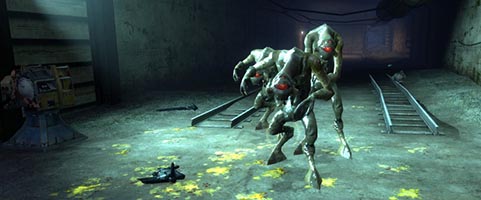
Video games like Half-Life and Resident Evil start with the same premise: a group of scientists, working together in a secret facility, brings about calamity and disaster; the solution to the problems they create is to go in and shoot stuff with a big gun.

Or a rocket launcher. Or a flamethrower. Or a railgun. Some of the things you use to shoot stuff with are pretty cool. But I digress.


PART II: The Problem

Americans are, by and large, woefully unequipped for rational, analytical thinking. The most basic tools of cognitive bullshit detection are simply not part of people’s toolkits; as a result, the most preposterous of ideas will sail through the minds of many folks unchecked, like a railgun through tissue paper.

Deepak Chopra, a minor star in the constellation of anti-intellectualism, once reacted to the idea that consciousness and personality are emergent phenomena from the physical processes of the brain by arguing that since brains are mostly made of water, saying that a brain is capable of consciousness without some outside spiritual force is like saying a bucket of water is capable of consciousness. This argument is, of course, utterly absurd; it’s a bit like saying since concrete is mostly sand, we can build skyscrapers out of sand. (The other stuff in there, and the physical structure, is important too, Deepak!) his argument was made only slightly more ridiculous when he then went on to say that yes, a bucket of water actually is conscious.

Water appears to be an obsession among certain parts of the New Age spiritualist crowd. One guy actually believes that water responds to human emotions and reads Japanese, and he’ll sell you a cure for cancer based on this “discovery.” If you have six hundred dollars in your wallet and a hole in your head, anyway.


I wish I was making this up, really I do. But, yes, there are folks who believe water has an emotional state. This idea came forth in the public consciousness through the movie What the Bleep Do We Know, a film that does for anti-intellectualism what Die Hard did for action-adventure flicks.

In this marvelous (for some value of “marvelous”) movie, we learn (among other things) that water “absorbs” human emotions. There’s this guy, you see, who turns out to be a friend of the producer, and he says that you can write emotionally-charged words on paper and wrap the paper around glasses of water, then you can freeze the water, you see, and the emotional “energy” will be absorbed by the water and change the crystals. Negative emotions, see, produce ‘ugly’ crystals; positive emotions produce ‘pretty’ crystals. This actually sounds plausible to enough folks that this guy sells a wide range of products, from books and CDs about emotional water to geometrically “clustered” water (at $35 a bottle) to gadgets that put your personal emotional energy into your food and water in order to make it better for you.

This shambling wreck of a movie communicates its message in an indirect way, by exploiting its audience’s fuzzy understanding of basic scientific processes and principles. It leads its viewers to factually incorrect conclusions by presenting factually accurate statements with careful framing intended to create inferences that aren’t true; for example, it talks about quantum mechanics and how the presence of an “observer” can influence a quantum state, then talks about the way our minds and emotional states can influence our immune system, and leads the reader to draw the conclusion that our minds can directly affect the physical world on a quantum level (which is not correct) without actually saying so directly.

To do this, it relies on ambiguities and fuzzy grasp of scientific terminology. Folks believe they know what the word “observer” means; when they hear it, they think of a person standing there looking at something. To a scientist, though, a person is not an observer; an observer is any particle which interacts with the observed system in a way that’s thermodynamically irreversible. The image that springs to mind when folks hear the word “observer” is wrong; the movie counts on this to lead the audience to a conclusion that is also wrong.

Profitable, though. The machines that program “emotional energy” into your water will set you back about $2500 US (plus tax and shipping).


One of the biggest problems facing anyone who cares about science and reason is the fact that folks sincerely believe they understand the concepts they’re grappling with, even when they do not. One thing I’ve seen is that everyone everywhere believes, truly believes, that he understands both quantum mechanics and evolutionary biology, while in reality, they don’t.

Nowhere is the gap between a person’s perceived understanding of a subject and the actual tenets of the subject as irritating as it is with evolution. I have met many people who passionately reject, even hate, the idea of evolution, but I have not yet met one who can explain what evolution is.

The list of misconceptions about evolutionary biology is endless. I could talk for days about the number of things folks think evolution says that it doesn’t, but then both you and I would be here for days, and I’m sure neither of us wants that. So in no particular order, some of my favorites:

– Evolution says there is no god. False; evolution says nothing abut god whatsoever, any more than astronmy, low-temperature physics, or agriculture say anything about god. Evolutionary biology (and geology and physics and astronomy and chemistry and astrophyscis and…) says that the world is more than six thousand years old, but it is silent on the subject of god.

– Evolution says that one species can change into another species, like a cow can change into a horse, but this has been proven false because there are no half-cow, half-horse creatures running around. Again, false; evolution says something completely different, which is that a a group of organisms that’s isolated and subject to adaptive pressure can and will change over time, to the point where it no longer belongs to the same species as the originals…but this process is extremely gradual, and does not at any time result in the birth of a creature halfway between one species and another. Eventually, given the right conditions, the right adaptive pressure, and the enough time, an initial population of cows might give rise to organisms that fill the same ecological niche that horses fill now, but a half-cow, half-horse will never exist.

-Evolution is about survival of the fittest; an organism that gets a mutation will spread it if the mutation helps it survive, and will not spread it if it doesn’t. Evolution relies on good mutations happening; the fact that there are bad mutations proves it doesn’t work. False; evolution is about the propagation of traits that allow the organism which holds them to reproduce. It doesn’t rely on mutation in the X-Men sense of the word; what it needs are a population whose members are different from one another, it needs for those variations to be inheritable, and it needs for those variations to determine, to some extent, reproductive success. That’s it.

If an organism has tentacles, and some have longer tentacles than others, and the ones with longer tentacles are more likely to reproduce, then over time the average tentacle length in the species will increase. It’s important to understand that a particular trait does not need to kill its inheritor to be selected against, and does not need to increase the odds of survival to be selected in favor of. It only needs to have an effect on reproduction. Even a tiny one. A trait that makes its possessors die younger but increases the odds that they will bear offspring by 0.001% will still be selected in favor of. Sometimes, the things that cause an organism to be more likely to reproduce don’t necessarily have anything to do with survival at all!

– For a structure to evolve, it must arise from simpler structures. If the eye evolved, it couldn’t evolve all at once. We should see creatures with half an eye. True; and we do. Very simple creatures like parasitic roundworms don’t have eyes; they have eyespots–simple clumps of cells slightly sensitive to light. That’s it. More advanced invertebrates have cup-shaped eyespots–a tiny improvement since they can get a general sense of the direction light is coming from, but still not an eye. Squid have round eyes lined with light-sensing cells, but they act like pinhole cameras–there is just a hole in front. No iris, no lens, no cornea, no eyelid. More complex fish have a lens but still lack a cornea or eyelid. Reptiles like snakes have an eye with a lens and cornea, but no lid–the eye is behind a special transparent scale. And so on.

– Science says we are more highly evolved than other organisms. False; evolution is not goal-directed, and every species, including ours, continues to be subject to adaptive pressure all the time. The virus that causes HIV, which evolves very quickly, could reasonably be said to be “more evolved” than we are!

– Evolution says all life is random, but if you mix chemicals at random, you don’t get life. False, and very annoying; it’s hard to understand where the notion of “evolution = random” even comes from, it’s so far off the mark. Evolution is about preserving structures and about natural selection, which is a most decidedly unrandom process. When you mix a bowl of chemicals, or parts of a watch, there is no mechanism that preserves increases in order; yet this is exactly what inheritance does.

– Science says that things go from an ordered state toward greater and greater states of disorder. Evolution violates thermodynamics. Which is what happens when folks take one thing they don’t understand, thermodynamics, and apply it to something else they don’t understand, biology. Entropy and disorder increase in a closed system, but this planet is not a closed system. If you add energy to a system from the outside, order in that system can go up. The earth has energy coming in from the outside…from the sun.

Ignorance about a topic leads to misunderstanding and misinformation about that topic. Sadly, though, it also leads to an inability to assess how much one knows about a topic, so those who most profoundly misunderstand something, like evolutionary biology or the Van Allen radiation belts (those bugaboos that the moon landing hoax nutters like to trot out as “proof” that visiting the moon is impossible), the less likely one is to know that they don’t understand it.

Which leads into…


PART III: WHAT TO DO ABOUT IT

“But I’ve done the research!” folks will wail, when one attempts to say that, no, vaccination isn’t a myth, or yes, the World Trade Center was brought down by commercial aircraft, or no, NASA didn’t fake the moon landings.

“I’ve done the research!” In fact, someone once told me this while trying to argue that vaccination is a hoax perpetrated by evil doctors. “I’ve done the research, and I know it’s true!”

This person does not know what the “immune system” is or how it works. She does not know the role that various parts of the immune system play in fighting disease. She does not know the difference between a virus and a bacteria, nor does she know the basic theory by which vaccines operate. So I think it’s reasonable to say that she has not, in any way, “done the research” to gain the cognitive tools necessary to evaluate claims about immunology.

This is something one sees often–people who, sincerely and without intentional deceit, believe they have “done the research” to support some proposition about which, even after the “research” has been done, they actually know absolutely nothing. The majority of folks–including, I bet, some people reading this right now–believe that looking for arguments which support one’s idea is “research.”


There’s a book I like to talk about. It’s called How We Know What Isn’t So: The Fallability of Reason in Everyday Life. It’s a very, very dry book; the author’s writing has the charm and wit of a robot wearing a pair of knit booties…but it’s an extraordinarily informative book. A chapter of the book is dedicated to the tendency of folks, when trying to support or refute an argument, to look only as far as the first idea that supports their position but no further. People believe this is “research”–you look for someone who says something that appears on the surface to support your position, then look no further than that.

I think this idea of “research” is one that our educational system does nothing to dispel. I’m sure most of you reading this have at one point or another been told to do a “research paper,” and most likely you were told that “research” means finding a list of folks who agree with your position, then citing those folks in the appropriate way. Guess what? That’s not research. When you do this, you will tend to look no deeper than the initial arguments that support your idea, and you certainly won’t investigate the validity of those arguments.


A wonderful example of this approach to “research” just recently popped up in a conversation I was involved in about the notion that pornography “causes” violence and rape. There are two factoids that the folks who see a casual relationship between porn and rape like to trot out, and you’ll see the littered all over anti-porn Web sites. Both factoids are statistical. The first is that Alaska has the highest per-capita rate of readership of men’s magazines in the nation, and also the highest per-capita incidence of violence, including rape, in the US. The second concerns Oklahoma City; in 1985, the city closed 150 porn shops and violent crime, including rape, decreased dramatically, while rising elsewhere in the state.

On the surface, these arguments might seem convincing. Deeper investigation, though, causes them to fall apart.

You see, Alaska has the highest per-capita readership of men’s magazines in the country. It also has the highest incidence of alcoholism, and the second highest rate of unemployment. Both alcoholism and unemployment are strongly and positively correlated with violence; higher incidence of both are tied to higher incidence of violent crime. When one controls for other factors such as unemployment and other statistical correlaries to violence, one actually finds a negative correlation between porn and violent crime; that is, higher rates of porn correlate, unintuitively, to lower rates of rape and violence.

The Oklahoma City claim is also flawed–or at least, incomplete. The two facts as stated are true: in 1985, Oklahoma City shut down their porn stores, and subsequently, incidence of violence and rape decreased. But further investigation reveals a lot was going on in Oklahoma City at the time: namely, in response to a homicide rate that was one of the worst in the nation, Oklahoma City introduced a number of sweeping anti-crime measures. They hired more police (itself statistically correlated to decrease in violent crime); started their first narcotic detection unit; and initiated a purge of corruption and fraud in the police departments. A reasonable person might conclude that these factors played a role in the subsequent reduction in crime.


There is a lesson here. Skepticism applies first and most importantly to arguments which support one’s ideas. The scientific method is fundamentally a technique of doubt; a scientist tries to disprove his idea, not prove it; the more it resists debunking, the more faith can be placed in it. Research does not consist of finding arguments in support of one’s idea. To “do the research,” look for facts that do not support your idea. Place value only in ideas which resist your most vigorous efforts to debunk them. If you believe that vaccination is a plot, and you read a book that says vaccination is a plot, you have not done the research.

This is a learned cognitive tool. That’s bad news and good news. It’s bad news because it does not come naturally; in fact, it’s precisely the opposite of what our instincts tell us to do. It’s good news because, really, it’s a simple tool; anyone can learn it. And that one tool opens the door to obtaining a whole new cognitive toolkit of bullshit detectors.

Maybe there’s hope for us after all.

Some thoughts on sex and relationship

Count von Count as a metaphor for passion

All of life can be placed on a continuum, with Count von Count on one end and the Cookie Monster1 on the other.

The Cookie Monster loves cookies, and Count von Count loves peanut butter and jelly sandwiches. But the nature of their love is much, much different. Cookie Monster is all animal passion in his love; he stuffs all the cookies in his mouth all at once, and doesn’t even care that the crumbs all go flying out. There is no reason, no sanity, in his love. It’s am explosive, fiery love, a love that consumes everything it touches.

The Count, on the other hand, lines up his PB&Js, and counts them. Then he eats one, and counts them again. He knows how many are left, but that doesn’t matter. For him, the love of his PB&Js is a cerebral thing. He savors the process. He draws out his passion, delighting in the intellectual joy.

I am very Count von Count about sex. I love savoring it, I love drawing it out, intellectualizing it, drawing in and tasting my lover’s responses.

“Oh God oh God oh God I’m going to–”
“No, you’re not. Not yet. Perhaps I will just…move…slower. Or maybe…”
“Nooooooo!”
“…stop…touching…you…altogether.”
“Pleaseohpleaseohplease I need to I need to!”
“What do you need to do?”
“Oh pleaseJesusGodI’msoclosepleasepleaseplease!”
“You are, are you? So if I just do THIS…”
“OhfuckohfuckNOOOO!”
“…or maybe press just a little bit harder, like THIS…”
“OhgodohgodAAAAAIGH!”
“…or perhaps move a little bit more, like THIS…”
“NonononononoYESYESYES!!!”

And amazingly enough, I have partners who keep coming back. Even when I start off a session by saying things like “I’m going to hurt you now. You can scream if you want to.”

I had the opportunity to accompany feyscorruption to a play party recently, and she, too, keeps coming back. I’m not yet quite sure what sort of relationship she and I are building, but so far it’s different in kind from most of the relationships I’ve built in the past…or at least it feels that way to me.


In the past, I was in a long-term poly/mono relationship with a partner who, I think, never fully trusted me (or at least, never fully trusted polyamory), and seemed to me to believe that if she didn’t keep me on a pretty short leash I’d end up running all over the place.

At that time, I generally seemed to stabilize at about three relationships. For a very long time, I was involved with her, feorlen, and a partner M, and things remained that way for quite some time. Longer, in fact, than the median lifespan for conventional marriages in the US which end in divorce.

After my marriage ended, I still seemed to stabilize at three relationships; Shelly, joreth, and serolynne. At least for a while.

Since I’ve moved to Atlanta, though, things have changed rather a lot, and become rather a lot less well-defined.


On epiphanies and habits

My past displays a reason
The past displays a cause
And I know that we will never be the same
‘Cause it’s the elements that make us who we are

My path betrays my reason
My hope betrays my cause
And if I ever find a way
You know I’d follow through, I’d carry on
But the elements have made us who we are

Shortly after I moved to Atlanta, I met figment_j. She was quite a surprise to me; but then, the people in my life often are. One could argue that it’s because I have never once gone out seeking a partner, and rather keep myself open to whatever connections form on their own; looked at another way, it could be argued that I’m reactive rather than proactive in relationship.

Shortly after we connected, she moved to New Jersey. Our relationship seemed to falter after that, in part because I’m not really good at long-distance relationships.

Cue the irony here; all of my relationships are currently long distance, some more long distance than others. Yeah, I know. Polyamorous and multi-partnered and all of my partners are a ways away. I’m doing it wrong.

Part of the problem is that I’m very unstructured in my life–so unstructured that accidentally clicking on a link to Google Calendars has been known to cause me fourteen points of aggravated damage. I Just Don’t Do Structure. She and I communicate differently, and for whatever reason, the things she needed to feel valued felt to me like obligations, which made it difficult for me to provide them. In the end, I think she did not feel valued by me, and we sort of called the whole thing off.


So there I was, on my way back from playing with feyscorruption at two o’clock in the morning, with the moon grinning down like a Cheshire cat at me, and I was (what else?) processing. Count von Count, and all that. And it occurred to me, I don’t really assert my needs in relationship.

I do talk about needs in relationship, and I do ask my partners about their needs in relationship. In fact, feyscorruption and I have had a conversation about what she’s available for.

But, y’know, saying “What are you available for in relationship?” is not the same thing as saying “I would like a relationship with you.” It seems the same to me, because (at least from my perspective) I wouldn’t ask a person I wasn’t interested in a relationship with, and the subtext of “What are you available for in relationship?” sounds to me like “I would like a relationship with you,” but the two still aren’t the same.

And interestingly, that very night figment_j called me, and let me know that the door was still open to a relationship with me.


In my past, there were certain things that were most definitely Not Okay in the context of my old relationship. Proactively seeking out new partners and making myself available for big-R Relationships with them definitely Was On That List Of Not Okay.

Problem was, I was available for relationship, so when they formed (and they did), those relationships tended to be Not Okay, too.

Now, I learned some bad lessons from this. One of the lessons I learned was that being reactive rather than proactive in relationship was a Good Thing. I’ve never developed, and still don’t have, a good set of tools for laying out the boundaries of my romantic relationships; instead, I tend to follow my partners’ lead, and allow my partners to shape and form the path the relationship will take. That passivity is a bug, not a feature, in the environment I live in now.

As I’m fond of saying, habits can become ruts, paths that we take simply because at some point we stop seeing any other way.


On choices and consequences

you are so far from home…

They turn me alone, not today
In you, this void just goes away
In this distant foreign land
I won’t be forgotten

Complicated, I know; life’s this way
And you’re half the world away
And my hold’s slipping from your hand
As I walk you to the gate

It’s also a feature, too, this lack of proactivity in relationship. It give me flexibility.

When I met Shelly, I saw in her things I had never seen in anyone before. I recognized so many things I valued on such a deep level that it felt like being struck by lightning. Even her recognition of the Void resonated with me.

I did not know, of course, how profoundly my connection with her would change everything. Nor did I know that Shelly was a dragonslayer; to be honest, I don’t believe she did, either. That recognition has been extraordinarily expensive, and at the same time a gift beyond all price. There is in her a passion, as methodical as the Count and as fiery as the Cookie Monster’s, and every time I am reminded of it I am awed and humbled by it.

There is not any part of life that Shelly does not live with passion, and there is not part of life that Shelly does not face with an unflinching, razor-sharp intellectual honesty. She probed and prodded the weak spots in my relationships, the thousand little compromises I’d made and the choices I’d made without consciously being aware I’d made them. There are, I think, few people who can stand up to that relentless probing and pushing; it is no accident that she has often been surrounded by people who are not like her and do not understand the value she brings.

Eventually, there came a time when the pushing and probing of the fault lines in the life i had built led to a tiny earthquake, far beneath the water, an almost imperceptible slip of those faults.

Even the smallest of seismic shifts can create a wave, deep underwater, that presents itself as no more than a ripple on the surface, a few inches high…yet when it reaches the shoreline, is revealed for the gargantuan tidal wave it is. Wen that wave surfaced, it altered the landscape forever. There are certain compromises I will never make again, and I believe I am a better person for it.

That is the gift beyond price Shelly gave me–the tools to remake my life in a way that allows me to be who I am.


Our relationship today looks nothing like it did when it began four years ago. She has set herself down a path that has re-forged her in the fires of her own passion. The life of a dragonslayer is not an easy one. We no longer live together, and I rarely see her these days. In almost every important way, she is no longer the person she was when I met her.

I am flexible in relationship. A relationship that came attached with expectations would have, I think, become brittle and fractured by now. But our relationship, because it is allowed to be whatever is is, today is as strong as it has ever been. Time and distance don’t matter. I have, over the past four years, been able to watch her unfold and blossom, and I feel uniquely privileged and honored to be able to be part of that.


In the past, I have generally tended to stabilize at about three relationships. Today, I have somewhere between four and six, depending on how one defines the word “relationship.” Over the past year, I’ve been forced to examine many of the most basic assumptions I make about sex and relationship, and to learn skills that I have never needed before.

And in all of that, there is a sense that distance does matter. Distance makes it seductively easy to continue to add partners, almost indefinitely; because I live alone, and because any long-distance partnership necessarily imposes limits on the time and attention which I can make available to someone, there seems to be a vast amount of unused potential for relationship that is not touched by my current partnership arrangements.


Back to sex

I’mm drawing your lines with my hands
I’m weaving the dream that never ends
I don´t play hide and seek with you, dear
when i touch you

You know that you love it
You need it
For sure

Aiming fingers searching secret pleasures
Roaming where your river seems so deep
you know I’m going on
i like the song you’ll sing for me
when i touch you…

I am very Count von Count when it comes to sex. So much, in fact, that I quoted Francis Bacon during a conversation about sex with feyscorruption recently.

Okay, so that’s a little over the top, perhaps. Particularly when the conversation came as it did on the heels of a different conversation with a very charming woman who may identify herself if she so chooses which included lines like “I am going to take you now. You may come if you want to, but there are rules. You are only allowed to come if it hurts. Now, be a good girl and ask me to rape you.” (Yes, the people in my life have some very interesting and exotic tastes. Yes, I share those tastes.)

We live in a society that promotes a virulent and particularly destructive, I think, double standard about sex. Men who have a number of partners are studs; women who have a number of partners are tramps and whores. The conversation touched on that double standard a bit; women who embrace their sexuality openly, enthusiastically, often run the risk of losing the respect of the people around them, because, y’know, good girls just don’t do that sort of thing.

There’s another irony there, at least with me, because, you see, I am more likely, not less likely, to respect any person who embraces all of himself or herself, and who makes conscious, deliberate choices about what to be, even when (or especially when) those choices run counter to the generally accepted ways to live.


Next week, I leave to spend thanksgiving with dayo. I have not seen her in a long time; in fact, our relationship is nearly a year old at this point (almost exactly a year old, depending the point at which one might choose to call it a “relationship”), and these past couple of months have been the longest time we have gone since the relationship began that we have not seen each other.

I could not, two years ago, have predicted the path that would led to her life intersecting with mine. And at this point, I can not imagine my life without her in it.

There’s a saying: “People come into your life for a reason, a season, or a lifetime. When you figure out which it is, you will know exactly what to do.” The part that saying gets wrong is in failing to understand that sometimes, it may be some or all of the above. I have been blessed, in my life, to be able to share some part of it with all of the people who’ve touched it; and I’ve been particularly blessed with being able to share it with people who have been there for a reason, a season, and a lifetime. dayo is, I believe, quite possibly all of these.

However, that doesn’t mean that I’m not going to do some very dirty, very evil things to her poor hapless naked body when I get my hands on it.

1Yes, I know he’s now the Vegetable Monster, and that “cookies are a sometimes thing.” Blasphemy, it is. Edit: So apparently, rumors of the Cookie Monster’s demise have been greatly exaggerated. Whew!

National Coming Out Day…

…woudn’t be necessary if nobody stayed in the closet. Staying in the closet wouldn’t be necessary if people, on the whole, weren’t a bunch of judgmental monkeys. It gets more complicated, though, when one considers that staying in the closet means not confronting the fears and prejudices of others, which means that fear and prejudice tends to take firmer hold.

I thought about making a “national coming out day” post, but it’s kind of difficult to do that when one is already about as “out” as it’s possible to be without getting posterboard, Magic Marker, and glitter involved. So what does that leave to say?

Straight. Check. Though honestly, that’s a bug, not a feature.

Poly. Check. Three current partners, one potential new partner, and I still live alone. Clearly, I’m doing something wrong.

Kinky. Check. Just bought forty feet of lovely black rope the day before yesterday, which I may even have a chance to use soon.

Mad scientist. Check. One day, you will all revere me as your overlord. Unless you’re Steve “Monkey Boy” Ballmer, that is. He’ll be the first against the wall when the revolution comes and my army of unstoppable hunter-killer bots sweeps the globe.

Linux-basher. Check. Yeah, I know, I know, that’ll get you killed in some places, but… Gnome sucks. KDE sucks. The entire open-source community can’t create a decent user interface to save its collective ass. I’m sorry, but I just can’t live a lie. It needs to be said. Even if nobody else will say it.

And now, off to dinner with the surrealistically sexy feyscorruption.

Your daily dose of teh ky00t

This is Liam.

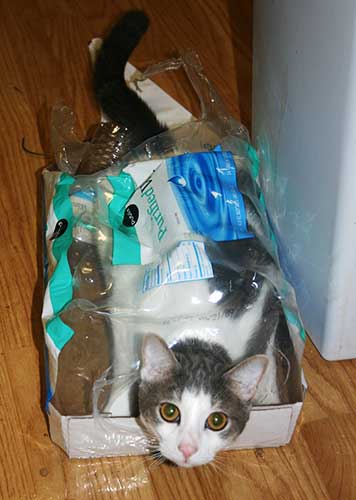
Liam is cursed with that same irresistible urge that gave us hairless naked apes the iPod, the steam engine, and nearly complete domination over all the earth: curiosity. If I place a box anywhere in my apartment, even if it’s simply a bottled water box that is set to go out with the trash, Liam will not rest until he has been over, under, around, and through it. He’s compelled, you see. He loves novelty, and he wants to know what it’s all about.

He’ll usually sleep in any box I put on or near the floor, at least for a few days. When it ceases to be novel and interesting, he grows tired of it and returns to sleeping at the foot of the bed with me. Like us naked apes, he’s curious and also fickle in his attentions.


Curiosity is a pretty sophisticated trait for an animal whose brain is smaller than my fist and not very wrinkly. In terms of raw processing power, a dozen Liams put together would compare pretty poorly to an IBM Blue Gene/L supercomputer, a much more computtionally powerful, yet singularly uncurious, piece of equipment.

Liam is actually pretty sophisticated in many of his behaviors. A couple weeks ago, he made a face at me.

It happened while I was eating frozen TV dinner apples. Microwave baked apples are tasty and delicious, and I make a point to eat them regularly. Five minutes in the microwave and you can have a small black plastic tray of bliss.

So there I was, sitting by my desk playing World of Warcraft and eating microwave baked apples, and Liam hopped up onto the desk and, brazen as you please, reached into my black plastic tray of bliss with his paw, hooked out a small piece of apple, brought it up to his nose, sniffed it suspiciously, licked it, and made a face at me. He shook the apple off his paw in disgust and wrinkled his nose at me.

Then he watched me eating the apples for several minutes, stole another bit of apple, sniffed at it even more suspiciously, and made another face at me.

There are many ways one might respond to this. One might say “Aww! How cute!” (And really, it was.) One might say “Hey! That’s my food! Don’t put your paw in that!” (And really, I did, though I knew even as I said it that it was pointless-an exercise more for my benefit than for the cats. We naked walking monkeys are kind of insecure in our position that way.) One might push the cat off the desk sternly. (And really, I didn’t have the heart to, because i dote on the cat so. A pushover, I am.)

Or, if one’s inclination runs that way, one might sit back and ponder the surprising degree of cognitive prowess the cat possesses.

I mean, seriously, think about it.

The cat recognized that I was eating something. We take that for granted, but there’s a lot of intellectual horsepower being brought to bear on a task of that sort. First, it means that he was able to map a projection of himself onto a projection on me well enough to be able to determine what kind of activity I was engaged in, and to recognize that it’s an activity he also engages in, despite great physical dissimilarities between us. That, at its foundation, means he was able to recognize the difference between himself and the rest of the world, and to recognize that some things in the world are more like him than other things in the world, to recognize those things when he sees them, and to recognize patterns of behavior common to he and I even as he recognized that I am distinct from him. Human babies take rather a long time to sort all this out.

Then, he was able to make an inference–namely, that what I was eating might be something e would like to eat as well. He made this inference in the absence of other cues, such as smell; he is, after all, a carnivore, and he is uninterested in a tray of baked apples just sitting by itself. (I know; I tried. What can I say? I was curious, too. He probably thinks they small like rotting plant matter.)

When he made this inference, he was able to formulate and then implement a plan of action, which shows at least a very limited ability to plan, even if only in a simple way.

When he obtained a piece of apple and decided it was just as revolting as it smells, he was then faced with a conundrum; this stuff was revolting, but clearly I was eating it (and with great gusto and no small amount of satisfaction, I might add). So he was willing to re-evaluate his original decision, and put it to the test again–something, the cynic in me begs to point out, that appears beyond the cognitive grasp of many people I know.


A couple of weeks ago, in a repeat of the I am not Sir Edmund fucking Hillary debacle that left me stranded on the balcony with a rope in my hand, Shelly went onto the porch to do some tidying up and the door locked behind her, trapping her until I came home for lunch.

Liam, in another example of cognitive dexterity (the only kind he has, I fear, as he is a stunningly clumsy cat), recognized that she was trapped, and became highly distressed and agitated. That shows empathy–the ability to map himself onto her and to respond as if he was the one in the distressing situation. He also knew that the door’s latch was to blame, and pawed and batted at it in a charming but unsuccessful bid to release her. Lack of opposing thumbs, and all that.


A Blue Gene/L system has, at very rough estimation, approximately the same processing power as a human brain. The Blue Gene/P supercomputer, currently in development, will well and truly trounce human beings in terms of processing ability. However, the architecture is very, very different. Modern computers are just really big, really complex Von Neumann machines, bound by the fact that the processing and memory are distinct entities which interact with one another in a series of discrete state changes.

A brain cell can roughly be mapped onto a transistor in the sense that it has only two discrete states, “firing” and “not firing,” but the architectural similarities pretty much end there.

Still, they are both finite state machines with memory, handwaving and nattering of Roger Penrose aside. And it is an axiom of state machines and formal language theory, which I will leave as an exercise to te reader to explore further, that any universal Turing machine, which is a finite state machine with memory, can, given sufficient memory, emulate any other universal Turing machine.

Which means that, given sufficient cleverness on our parts, it should be possible to take these wonderful brains of ours and emulate them in these crude computers of ours, without loss of fidelity.

Handwaving and nattering of Roger Penrose aside. (“Look! Consciousness is a quantum phenomenon! I don’t know anything about quantum physics, neurophysiology, consciousness, or cognitive science, but consciousness is a quantum phenomenon! I have no proof of this, so watch as I wave my hands!” But I digress.)

And, of course, when you emulate one kind of machine (yes, I said it, brains are machines, deal with it) on another kind of machine, if the host machine is sufficiently faster than the emulated machine, the emulation of the emulated machine is faster than the real thing.

Chew on that for a while.


I love Liam. He’s very sweet, and he is a constant little reminder in my life of figment_j. I continue to be impressed by the range of cognitive flexibility we take for granted, even in relatively unsophisticated animals, and I can hardly wait until we start building machines which can exhibit the same kind of cognitive skills.

We’re not there yet, but we will be soon. When IBM makes a supercomputer that has Liam’s level of cognitive prowess, the Singularity will well and truly be nigh.

Some thoughts on ethics

On another forum, I am engaged in a conversation regarding ethics, which came about as a result of a conversation around the ethics of cheating in a monogamous relationship (or by violating the agreed-upon terms of a polyamorous relationship).

A surprising (to me, anyway) number of the people involved in that conversation hold that ethical constraints apply only to first-order consequences of one’s actions, but not to indirect or second-order consequences; for example, it is not ethical to cheat on a partner, but if you are the person a cheater has sex with, your actions are not unethical, because you are not violating any agreements with the cheated-upon person.

I’ve been thinking a great deal about the nature of ethics and responsibility as a result of that conversation, and I’ve put together a series of questions designed to examine a person’s ethical system, and look for contradictions in that system.

The first four questions concern the ethics of lies of commission and lies of omission. The next three questions concern being the active participant in a series of actions covering a very large range of common moral perception. The next six questions re-visit those situations from the perspective of a passive beneficiary of those actions and of an active beneficiary of those actions; that is, does one’s ethical responsibility vary if a person benefits from an action after the fact, or if the person receives the same benefit by creating the situation before the fact? The last two address something I’ve seen commonly: people often find that their assessment of the ethics of an action changes with their assessment of whether or not an injured party is a “good person” or a “bad person.”

I’m interested in seeing the results of many people’s answers to these questions. So, onward!


Many random things, and pickles

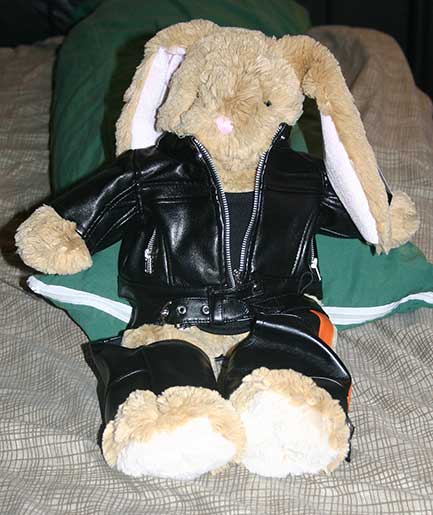
First off, I present to you a stuffed animal inspired by my post about conduct in the dungeon, given to me by dayo, who upon reading it went out to Build-A-Bear and created this soft, floppy-eared, leather clad specimen:

Ladies and gentlemen, I introduce you to Bunnykin Spankypants. And yes, dayo is in SO much trouble.


Many cell phones use a predictive text entry system called T9. T9 attempts to make texting faster, by “recognizing” common words as you begin to key them in, and filling out the rest. For example, if you hit 8 4 on your keyboard, the T9 system will recognize that it’s more likely you are attempting to type “th” than “vg”. T9 uses a dictionary of words, which it consults as you hit letters to try to anticipate what word you’re typing. Everyone knows this.

The T9 system built into my Motorola Razr is an adaptive T9 system; if you type a particular word multiple times, it will “remember” that word and rank that word higher in its probability table than other words that begin with the same combinations.

I inherited my Razr from figment_j. Apparently, she has used it to do text messaging in the past. If I hit the number 5, which corresponds with the letters “j,” “k,” and “l,” the phone’s very first guess about what I intend to type is “lust.” If I hit the number 2, which can be “a,” “b,” or “c,” the phone immediately guesses “boots!”. If I type 66, its first guess is “not here.”


Shelly would like to hijack the collected perversion wisdom of my friends list to a devious noble end. Involving pickles. Literally or figuratively; it’s up to you.

There is, you see, a past time that has become a fixture at church socials and picnics and other wholesome get-togethers called “pickle spitting.” It’s exactly what it sounds like: people put wole pickles in their mouths and see who can spit them the farthest.

“Pickle spitting” just sounds obscene. In fact, it really sounds like it should be a euphemism for a deviant sex act. And, sadly, it’s not.

That’s where you come in.

In a comment to this post, leave a suggestion (or two) for a deviant sex act that you think should be referred to as “pickle spitting.” By working together, we can corrupt and pervert this harmless activity, once and for all!

Nothing to see here, move along…

Your Score: Sauron

70% Evil, 90% Intelligence, 80% Common Sense

Annatar, The Black Hand, The Ring-maker, The Red Eye — Sauron went by many names over the generations of his dark and twisted rule. For thousands of years, he terrified the inhabitants of the land. His knowledge was vast, his ability to control was unmatched. Originally the servant of a greater evil, he took command when his master was banished from the world, never to return. He had an intimate knowledge of craftworks and various magics, which he employed to great effect to build one of the greatest, darkest of lairs in a region so twisted and corrupt, life itself simply gave up upon entering. He also went on to create what may possibly be the smallest, simplest of super weapons known, that granted him near complete control over the lands. The one crucial mistake he made, however, was to bind his very existence to that super weapon, and when it was destroyed in the very fires that created it, Sauron found his essence shattered and destroyed.

Sauron is identified as being extremely evil, possessing incredibly high intelligence and great amounts of common sense. For all intents and purposes, Sauron is quite possibly the greatest of Overlords to have ever reigned.

Quote:

Of old there was Sauron the Maia, whom the Sindar in Beleriand named Gorthaur. In the beginning of Arda Melkor seduced him to his allegiance, and he became the greatest and most trusted of the servants of the Enemy, and the most perilous, for he could assume many forms, and for long if he willed he could still appear noble and beautiful, so as to deceive all but the most wary.

Source of Overlord: Lord of the Rings

Link: The Evil Overlord Test written by veqhturi on OkCupid Free Online Dating, home of the The Dating Persona Test

The truth, painful as it is to admit, is that I’m far too much of an optimist to make a proper evil overlord. While I can appreciate the value of post-apocalyptic nuclear devastation as much as the next guy, and God knows that I could scarcely do a worse job of ruling the world than those who’re doing it right now, I think at the end of the day I’m basically too happy to do it properly.

J.R.R. Tolkein, who invented the avatar of evil which this quiz says is closest to my own personal style, didn’t believe in divine punishment for evil after death. He felt, and with some cause, that evil is punished now. All the characters in his books who might reasonably be called “evil,” including Sauron himself, were miserable.

There’s a connection between unhappiness and evil. It’s not positive, happy people with plenty to live for who strap bombs to themselves or fly airplanes into buildings. There’s a lesson in there somewhere, which I’m too sleepy to dig out at the moment.