It’s probably a pretty good take on Shelly, too. And datan0de, in the unlikely event you haven’t seen this already, you’ll probably quite like it as well. From XKCD.
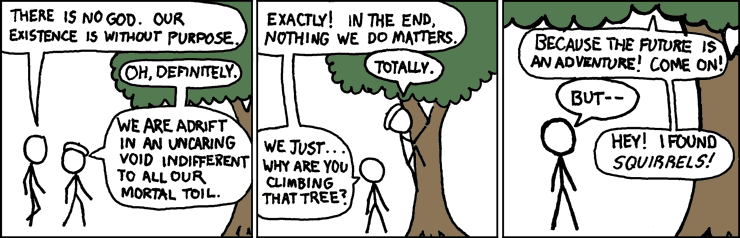
This needs to go in the user manual somewher–hey, squirrels!

Go to any meeting or join any mailing list on alternative subcultures, especially sexual subcultures, and one of the most common topics of conversation you’ll see again and again is the conversation about “coming out.” Do your parents know that you’re gay? Do you share the fact that you’re polyamorous with your co-workers? Do your fellow game enthusiasts know you’re kinky?
You’ll find a huge range of responses, ranging from “I am who I am and fuck anyone who doesn’t like it” to “I would never, ever dare breathe the slightest whisper to suggest that I did not conform to social norms in every way.” And you’ll find just as many reasons for these attitudes.
On the “I am completely closeted” side of the equation, many of the reasons center around a few simple ideas: fear of tangible loss (“If my ex found out I’m poly, he might try to take custody of my child,” “If my boss found out I’m gay, I’d be fired”), fear of being judged (“My parents would never approve,” “My friends would think I’m a slut if they found out I have two lovers”), fear of emotional loss (“My friends would not like me any more if they knew I was bisexual,” “My mother would disown me if she knew I have two husbands”), and that sort of thing.
On the flip side, you’ll find the same arguments often trotted out to counter these ideas (“If more people asserted their rights to child custody who were openly pagan/gay/whatever, the social structures and stereotypes that allow such people to be cast as unfit parents would fall,” “if someone loves you and then, after learning the truth about who you are as a person, withdraws that love, then that person never loved you to begin with,” “you can not love someone you do not know,” “if your friends only like you as long as you project a false image of yourself to protect their own prejudices, you need a better class of friend.”).
You’ll also see arguments in favor of remaining closeted based on the specific situation of the person in the closet (“I’m in the military,” “I work for a church that condemns homosexuality”) and arguments that rebut those arguments (“You had a choice about joining the military,” “If you’re gay and working for an organization that promotes disenfranchisement of gays, you’re shooting yourself in the foot and working against your own interests.”) And ’round and ’round it goes.
Now, I’m firmly on the side of “I am who I am and fuck anyone who doesn’t like it.” I do not see the advantage of pretending to be someone I’m not, nor see any compelling reason to protect others from the emotional consequences of their own prejudices. But that’s not actually what I’m here to talk about. I’m here to talk about a more subtle, and potentially more insidious, problem that can arise frm remaining tightly closeted, especially in polyamorous relationships–with acknowledgment to feorlen for starting me thinking along this path.
One of the first, earliest hallmarks of a classic abusive relationship, counsellors and mental health professionals will say, is a relationship in which one person seeks to isolate his or her partner, cutting the victim off from friends and family, controlling who the victim may socialize with, and seeking to limit the victim’s contact with other human beings.
This is a useful tool for an abuser. A situation where one or more people are denied access to contact with other people creates an environment where a person may not notice destructive, unhealthy aspects of the relationship. Often, a relationship’s dysfunctions are invisible from the inside; without someone from the outside to say “Whoa, dude, that’s totally fucked up!” it becomes easy to be blinded to even the most blatantly destructive, unhealthy things in a relationship.
Even outside the context of abuse, the presence of extra, uninvolved pairs of eyes is often useful for finding the broken parts of a relationship. Little, everyday problems are seldom unique; in a world of billions of people and fourteen thousand years of recorded history, someone somewhere has had whatever problem you’re having before. Experience is the best teacher, the saying goes..but sometimes the tuition is very high. Learning from other people’s mistakes is less costly than learning from your own. Having a support network of friends who are close to you makes solving problems of all sorts far easier.
But what happens when a person digs himself a nice little cave at the back of the closet?
In extreme cases, he does exactly what an abuser would do to him, only he does it to himself. When a person refuses to share the reality of who he is with the people around him–even with friends and family–e does more than live a lie, and he does more than project a false façade to appease the prejudices of others. He cuts himself off from his support mechanisms; he isolates himself from the very people who might be there to say “Dude, that’s fucked up!” if things start to go wrong. He creates barriers between himself and those people who might be able to help him solve problems or spot weaknesses in his relationship. He removes his own ability to bounce ideas off of others. He creates a breeding ground where unhealthy habits can fester and grow, unchecked by the light of day.
And that really sucks.
In discussions about the values of openness, i often see people arguing the perils and potential consequences of coming out. What I rarely see, though, is acknowledgment of the fact that remaining closeted has a price, as well.
And the more I think about it, the more I think the price of remaining closeted can sometimes be greater than what might at first be obvious.
The culture of secrecy can lead to a mindset of avoidance, of not talking about uncomfortable things even within the relationship. If one builds a reflexive habit of concealing the truth, it’s hard to put down that habit even when talking to someone on the inside. At worst, in the most extreme cases, it can lead to precisely the type of dark, inward-burrowing isolation that the abuser seeks to impose on a victim, only self-inflicted and therefore even more internalized.
Your life is your own. It belongs to you and to nobody else. Live it as you will–but be aware of all the potential costs of your decisions.
There are plenty of guides online about how to have a safe, healthy, happy, fulfilling sexual relationship. This is not one of those guides. Instead, this post is about ways you can screw up your sexual relationship–the little tricks and techniques that are sure to doom even the most healthy of relationships and send any hope of happiness spiraling into the ground. It’s easier than you think, and with the application of these few simple techniques, you can ruin your relationship and make yourself and your partner miserable in no time! Ready? Then on we go!
Don’t ask for what you want.
We all have things we like to do or things we’d like to try. There’s a simple way to explore these things: just tell your partner you’re interested in trying them. After all, you can’t expect to get what you want if you never ask for what you want! Continue reading
I have two cats. Until recently, I had a cat named Molly and a cat named Snow Crash, both of them rescues.
Snow Crash is not part of the family any more. He decided to play escapo-kitty a few weeks back…headed out the door and disappeared. I spent several days looking for him, and put food outside the door, but he never turned back up.
In a way, this is as it should be. He dropped unexpectedly into my life when we rescued him from a rooftop, he stuck around for a while, and he left when he wanted to. He’s a tough cat, and if he hasn’t found someone else to look after him (which I suspect he has), I do not doubt his ability to look after himself.
At roughly the same time as Snow Crash decided to leave, I adopted figment_j‘s kitty Liam. Liam is a lot like Molly in temperament; he loooooves people, and he loves to cuddle.
But the integration of Liam into the household has not been smooth. Molly, who tyrannized Snow Crash, is for some inexplicable reason terrified of Liam. He’s never once behaved aggressively toward her, but she’s frightened of him nonetheless.
And these past two weeks have been enlightening. Molly and Liam are a microcosm for human society, really.
I spent the weekend in Tallahassee with Shelly. Upon my return, both cats greeted me at the door enthusiastically, and they even put aside their differences for long enough to cuddle with me at the same time. The two of them were purring so loudly they sounded like a 1977 Harley-Davidson “Shovelhead” V-twin with loud pipes. Liam was so happy he snorted.
When the people in your life know how much you love them, they’re more likely to reciprocate your love, and to seek to take care of you. Emotional reservation is hard on the people in your life, and oftentimes leads to loss.
Molly is still scared of Liam. When he first came into the house, she ran and hid under the bed, and wouldn’t let him within ten fet without arching her back and hissing at him. Her radius of fear is slowly shrinking–she’ll sometimes let him very close before she freaks out–but she’s still quite frightened of him, in spite of the fact that he’s very good-natured and non-aggressive.
When we fear something without even pausing to know whether or not we have anything to be afraid of, we accomplish little save for making ourselves miserable. Fear of the unknown, or fear of novelty, robs life of its joy. When you decide in advance you will fear something before you even experience it, you deprive yourself of opportunities to make new friends and learn new ways of joy.
Every so often, Liam will walk up to Molly and sniff her nose. Molly usually sniffs back…until she remembers that se’s afraid of him. Then she pins her ears back, hisses, growls, and spits in his face. So Liam, naturally, bops her on the nose with her paw. Occasionally, Molly will walk up to Liam, then remember her fear and turn and flee…and Liam, thinking that Molly is playing the “chase me chase me” game cats are so fond of, will tear after her.
In both cases, Molly’s preemptive fear creates the very behaviors in Liam she’s afraid of. He chases her only because she runs; he bops her nose only because she gets in his face and makes a fuss. It’s common for people who are behaving offensively to believe they are being defensive, and that their behavior is provoked; but often the provocation is the phantasms and fears in their mind projected onto others, not the behavior of the people around them.
Assume the best. Don’t project your fears and doubts onto the motivations of the people around you. It’s remarkable how far you can get when you treat others as though they’re basically decent people. Not everyone is a decent person, of course, but you can’t tell the ones who are from the ones who aren’t until you quit projecting.
Liam loves high places. He also loves knocking things off counters and shelves and watching them fall. And, on top of that, he’s clumsy. As a result, my apartment now looks like its been struck, in rapid succession, by a herd of stampeding water buffalo, an earthquake, several flash floods, and a small tornado.
Liam loves climbing behind one of my shelves to sleep. A couple days ago, he knocked a box full of 3.5″ floppy disks off the shelf, and they fell in a big pile, preventing him from being able to get behind the shelf.
The things you do now may come back to haunt you later. The world you live in tomorrow is shaped by the things you do today. Think about that before you knock stuff over, especially if you’re knocking it over just for the joy of seeing it fall.
Molly loves sleeping with me at night. Liam loves sleeping with me at night. I have a king-sized bed; there’s plenty of room on it for two cats.
But Molly is afraid of Liam, and reacts defensively wen he hops up on the bed. He really likes sleeping next to me, though, so he won’t back down when Molly puts up a fuss. The two of them tend to argue over who get to stay in the bed next to me…often at four AM. Sweet, yes?
Not so much.
When this happens, I kick them both off the bed. I choose to spend my time with people, and animals, who make my life better, and whose lives I make better. Waking me up at 4 AM and introducing drama into my bed does not count as “making my life better.”
When you disrupt the lives of the people closest to you, expect those people to be unhappy about it. Regardless of your reason for making the disruption. Or who got there first.
Neither Liam nor Molly is shy about letting me know when the litter box is full or the food bowl is empty. This is a good thing, because on a good day I’m about as disorganized as a band of anarchists at a wake for Hunter S. Thompson, so their little nudges are what keeps the food delivery and the waste removal on track.
You can’t expect to have what you want if you don’t ask for what you want. That’s one of the little secrets of life that people often don’t find out ’til they’re much older than they should be.
On the drive down to Florida Poly Retreat a few weeks back, I had an epiphany.
You see, I’ve always harbored a not-so-secret desire to crush the earth beneath my iron boot, but in the past twoscore years, I’ve made very little progress toward realizing that goal. And it occurred to me why that is. I’m actually very optimistic about the state of humanity, and unbridled optimism about the human condition doesn’t lend itself to the kind of monomaniacial dedication required of a true James Bond-class villain.
There is a reason I am an optimist. That reason emerges directly from the fact that I do not believe in god.
This might seem, at first glance, to be something of a contradiction. Many people cling to a belief in some kind of divine, personally involved caretaker high up in the sky precisely because it’s the only way they can find optimism and not despair. There’s even a Web site set up by a Fundamentalist Christian organization that is organized around the idea “if you don’t matter to God, you don’t matter to anyone.” The site is advertised by banner ads like this one, showing some gangster wannabe who, without God, presumably has no reason not to blow your punk ass away:

I find this attitude, that without god there is no morality and no meaning or purpose in life, very, very interesting…more for what it says about the people who subscribe to it than for anything else. The Web site that this banner advertises is strongly anti-evolution and pro-creation, and I think that’s extremely telling.
There are, I think, two driving forces behind much of religious thought: fear and despair. The despair comes from the idea that human lives and human achievement are without meaning or purpose in a universe without god, a universe where we are the natural result of natural processes on an insignificant and not terribly remarkable part of an insignificant and not terribly remarkable galaxy lost in a universe that is quite literally inconceivably huge. When you look at an image taken from the Hubble Deep Field camera of a teeny, tiny patch of sky, and you see that everywhere in the universe, as far as you can look, you see not hundreds or even thousands but billions of galaxies, and every one of these galaxies is made up of billions of stars, and we occupy such a tiny sliver of this universe that our entire galaxy could vanish or be destroyed in some kind of cataclysm and the universe would scarcely even notice, some people get all freaked out.
But it’s true.
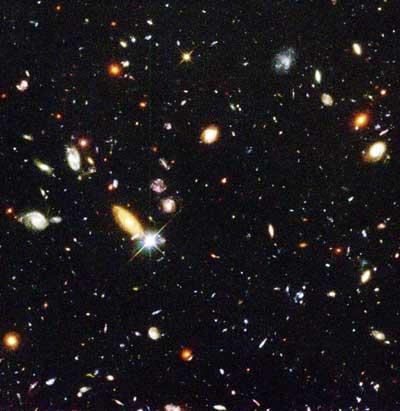
Every object you see in this picture with the exception of the bright object in the lower left of center (which is a star in our own galaxy) is an entire galaxy. The scale of the universe beggars comprehension, and we feel insignificant.
So the creationists, who never open their mouths without subtracting from the sum of human knowledge, invent a new universe to satisfy their need to feel special. They imagine a tiny universe, a limited universe, a universe only a few thousand years old, a small place containing a world (which is seventy-five percent water) deliberately created just for man (who has no gills). They post videos on YouTube arguing that the hand of god is clearly visible in the banana, which with its convenient wrapper and hand-pleasing shape was deliberately designed by a benificient creator to fit easily in our hand and be eaten–though they ignore contradictory evidence, like, say, the coconut. Or, they argue, since the evolutionary idea on the origin of life claims life can begin when non-living matter is exposed to radiation, then how come life doesn’t spontaneously begin from other non-living matter, like peanut butter?
It’s easy to mock creationists; they’re just so cute when they pretend to be scientists! But their folly isn’t born of stupidity; it’s a product of the very human need to feel special and significant.
When you add the Void to the mix, the problem becomes even greater. Human beings have the cognitive tools to generalize from their experiences and make predictions about future events, and that gives us the capacity to realize that one day we are going to die. Facing the Void is, for many people, the very embodiment of stark raving terror. We are going to die. There will come a day when we will be gone, and there is nothing we can do about it.
So we as a species respond the only way we can: by denying it. We pull the shade down over the Void, and then decorate that shade with an entire bestiary of gods and demons and angels and supernatural forces of all descriptions imaginable who will protect us from the certainty of death. When you look at all the various gods and deities people have worshipped throughout history, all the supernatural beings we’ve ever believed in–the sun gods worshipped by almost all hunter-gatherer tribes; the god Tezcatlipoca of the Aztecs; the various gods of the Egyptian pantheon; the feuding, spiteful divine teenagers of the Greeks; the vengeful, erratic, emotionally volatile god of the ancient Israelites–one thing becomes very, very clear: these gods are all us. All these divinities are distorted, funhouse mirror caricatures of humanity. We pull the shade down over the Void, then project onto it ourselves. All our fears, desires, petty insecurities, all our need for conformity and control, all these things are reflected in the gods and demons and pixies and faeries we invent. All these dim, distorted projections, created to convince ourselves that the Void is not real.
And it works. The first time I was confronted by the Void, at about thirteen years old, the thought of going to heaven was the only comfort I could find. When I lost that, I lost my only defense against the Void, and that’s not easy to do. These crazy funhouse projections serve a purpose.
But there is a price to pay for this comfort, one that I suspect many people aren’t even consciously aware of.
Part of that price is truth. If one cares passionately about the truth, one can not help but notice that every time a religious entity has disagreed with empirical science about some matter of empirical fact about the physical world, the religion has been wrong. Every single time, with not one single exception. The creationists seek meaning and purpose by believing themselves to be the favored of a supernatural entity that created the whole of the universe just for us, yet this belief requires them to imagine a universe much smaller and much younger than it actually is. Their need for meaning, their desperate desire to feel special, causes them to adopt the notion that the whole of creation is only six thousand years old (5,997 years, according to Orthodox Judiasm; Fundamentalist Christians put the figure at about ten years older), in spite of massive, overwhelming evidence to the contrary.
And this notion leads naturally to other notions as well, including the idea that humanity, the favored of the divine architect of the universe, can do no wrong. Environmental responsibility? Social responsibility? Outmoded beliefs of godless liberals; we were given divine sanction to do as we please, and that’s exactly what we should do.
God made the universe for us. We are the most important things in all of creation. The world was put here specifically for the purpose of housing us. If we believe this, we will never die; God won’t allow it.
If you don’t matter to God, you don’t matter to anyone.
When people let go of the idea of god, they’re left with a sense of despair. If there is no god–if we are simply the result of natural, mindless forces operating in a universe that is incomprehensibly huge and incomprehensibly ancient, a place that is steered by no divine force and a place where an airless rock is just as good as a planet teeming with life, then what meaning can any of us have? What meaning can any of our struggles and triumphs have? What point is there?
And that attitude, tragically, misses the point entirely.
For you see, if we were made a brief time ago in God’s image and put here for the sole and express purpose of worshipping and exalting God, then what we are now is what we will always be. There is an upward limit on the things we are capable of. We are born disgraced, pale shadows of the original models who fell from that grace, and our job is to struggle through this brief life of misery and tears hoping we somehow manage to do and say the right things so that god will rescue us. We have no purpose other than that which is given to us by god–and looking around, I gotta say it’s not much of a purpose.
But if we are evolved monkeys…
Ah, now things are different. If we are evolved monkeys, if we are the result of natural processes that conspired across a vast sea of time to give rise to sapient, self-directing entities capable of understanding themselves and the physical world, then all bets are off. Now, there is no limit to what we can become. Now, anything within the physical laws of the universe is potentially within our grasp. Now, we have the power we once reserved to our gods; now, we can, through the application of our will, make of ourselves anything we choose to be.
And now we have meaning and purpose far beyond that of crawling around chanting to some insecure creator-god about how great and magnificent he is, and would he please please not strike us dead? Now, we are the part of the universe capable of understanding itself. We are of the universe; we are a part of it, not above it; but we are unique in all the universe we know in that we can understand it. We are aware. We are the universe’s way of understanding itself.
And that is a far more magnificent purpose than telling a child-god over and over again that yes, he’s great, really, he’s great, he’s good, he’s wonderful, no really, he’s great, and we love him, really we do.
There is a saying: “with God, all things are possible.” The saying is false. With God, all things are possible save for rising above our station and becoming anything more than what we are right now.
Without god, however, all things not disallowed by the fundamental laws of physics really are possible. Without god, we make our own meaning and purpose; and that power lets us use the gifts granted to us to transform ourselves and the world around us in any way we want.
This power fills some people with fear. Without god, they say, how will we know what is moral? Without god, they say, what punishment can there be for people who do things that are wrong? To this I say: Your morals, given to you by your belief in god, allow for the most appalling atrocities, historically and today. Your morals teach that some human beings, simply as a result of the way they are born, are inherently unequal to others. The notion that there is one and only one right way to live is the cause of more human suffering, more grief, and more evil than any other single idea in all of human history. This is your morals? Your morals, like your gods, are a distorted mirror of your own prejudices and your own evil. You will not find heaven by backing away from hell; the fear of retribution is not the path to enlightenment.
We don’t always make good choices, it’s true. But we’re still a young race. And I am very optimistic about what we can accomplish.
So recently, someone on another forum I read posted this link to an article about a Britney Spears lesbian sex-tape scandal.
Whee! Another day, another drug-fueled media superstar homosexual orgy!
Maybe it’s just me, but c’mon. A Britney Spears lesbian sex tape? Isn’t that, like, so last-century? Drug-fueled homoerotic scandals have become so trendy that even the Religious Right is getting into the act, and when they’ve started embracing a fad, you KNOW it’s all over.
Okay, so I can see how it might have had a certain mass appeal at one time. I still remember the Billboard magazine poll that showed that 53% of all American middle-aged men have had fantasies of Britney Spears bent over a pool table taking it in the ass from a strapon-wielding Russian dominatrix in “Knight Rider” Underoos. (Oh, don’t look at me like that. You know she’s into anal; she’s been getting it up the ass from the Recording Industry Association of America for long enough!) And I’m sure it’s probably those same 53% of American men who’ll end up acting all outraged when the next Britney sex tape appears on boringcelebrityescapades.com. Virgin-Whore Complex, thy name is American pop culture.
But still. While I admire her spirit, I gotta think it’s too little, too late. I mean. she’s technically a MILF now, and that’s a whole ‘nother demographic altogether.
I’m a bit mystified by the news report. “According to several sources, the footage inside the sex video is so outrageous and shocking that it may be the ‘final straw that broke the camel’s back’.” Exactly what camel are we talking about here? People, we live in an age where sites like “sexandsubmission.com” are so thoroughly mainstream that the owners have to engage in multimillion-dollar real estate deals just to get new digs to film in. Whatever Britney is up to with a couple of strippers, I guarandamntee you it’s not “outrageous and shocking.”
Now, maybe if you threw in a wildebeest, sixteen cases of Silly String, a dozen feet of rubber tubing, three titanium sporks, and a life-sized cardboard cutout of Karl Rove, we’d be talking shock and awe. But Britney doing the nasty with two strippers? That’s not shocking and outrageous; that’s the pilot for the new Fox prime-time sitcom! You get more “shocking and outrageous” in an average apartment building on a weekend night.
Well, okay, not in my apartment this past weekend. I’ve been sick as a dog, and spent most of the weekend loaded up on NyQuil and ibuprofen…but I digress.
Russian dominatrix and Underoos aside, I have a feeling that if this alleged video of Britney ever surfaces, it’ll be every bit as bad as the Paris Hilton sex tape. And I don’t mean “bad” like “Out! Out! Cruel demons of the flesh, begone! Tempt me no more with your carnal delights! Get thee behind me, Satan!” so much as I mean “bad” like “Jesus, will someone PLEASE teach that woman how to fuck?”
If it ever surfaces. Which, frankly, is something I’m a little skeptical of. We have no proof that this video even exists save for a low-resolution photograph of Britney walking up a flight of stairs with two strippers. Many’s the time I’ve walked up a flight of stairs with two strippers, and there was no frenzied lesbian bacchanale at the top. Okay, so I’m sure we can all agree those times are the exception rather than the rule, but still. The photo’s not exactly a smoking gun, y’know?
I don’t know. Maybe Britney was asleep during the Pop Celebrity 101 class where they covered the Madonna Rule…you know, the one that says if you make outrageous, over-the-top images of yourself in sexual situations, for God’s sake make sure you keep the marketing, licensing, and merchandising rights. Maybe Britney’s been replaced by a Pod Person. I dunno, maybe Britney started out as a Pod Person, and now she’s been replaced with a confused child whose life started spinning out of her control long before puberty even hit.
What I don’t get is what’s “shocking” about what she or anyone else wants to do to get their rocks off. Nor why anyone cares at all to begin with.
Oh, and the guy who’s quoted in the article as firing the strippers when he saw the tape? Listen, man, I gotta say, you just made the dumbest business decision of your life. Since people obviously go in for this shit, you shoulda promoted ’em and put up a marquee sign saying “We have strippers who’ve shagged Britney Spears.” Maybe set up a little kiosk selling Knight Rider Underoos. Bet that’d pack the shocked-but-tittilated Baby Boomers in!
When I was in high school, back in the ancient bygone days of the Cold War, Ronald Reagan was in office in the White House, America was sending money and weapons to a tiny band of Islamic extremists called the “Taliban” in Afghanistan, and a young wealthy Saudi by the name of Osama bin Laden was using American money to help recruit Islamic Jihadist fighters to repel the Soviets from Afghanistan.
During that time, I was living in Florida, which had a law on its books requiring all high school students to take a state-mandated course called “Americanism vs. Communism” before they could graduate.
“Americanism vs. Communism” was pure indoctrination, straight out of George Orwell. The purpose of the class, which counted as a “history” credit on high-school transcripts, was to show students how the American way of life was superior to the brutal Communists; the man who developed the state-mandated curriculum, Fred Turner, won a Freedoms Foundation Award for his efforts.
The premise and conclusion of the Americanism vs. Communism class was that the Russians were evil, baby-killing monsters who lived under the bed seeking the time to devour the United States and all that we hold dear, and that anything we do to stop these evil fiends was justified. To be fair, this pretty much summed up the politics of the time; America committed quite an astonishing number of atrocities, and supported quite a number of impressively brutal dictators (men like Saddam Hussein, Manuel Noriega, Augusto Pinochet, and Alfredo Cristiani), all because Americanism Is Good and Communism Is Bad.
My teacher for Americanism vs. Communism was a very interesting man. He was a World War II veteran who saw combat in the Philippines and was captured by the Japanese. He survived the Bataan Death March and spent time as a Japanese POW in the Japan mainland, where he was transported in the cargo hold of a hell ship. As an American POW, he was tortured and used for forced labor, before the end of WWII brought his release and that of the other people who survived.
These experiences made a true believer out of him; he was quite passionate about his love for this country, but not in the mindless, tribalistic “My country, right or wrong, love it or leave it, you pinko punk!” kind of way. He did not become a jingoist; instead, he internalized the core values he believed made this country better than others.
And he was appalled by the state-developed “Americanism vs. Communism” class he was told to teach.
On the first day of class, he made it very, very clear that he despised the curriculum and everything it stood for, and that he would not be teaching from the textbook the state required. Instead, he said, as far as he was concerned, this class was a class in Russian history, period. Almost everything I know about Russian history, I learned in that high school class.
So, fast forward a few decades. Communism fizzled like a damp firecracker, and our former allies in the Taliban and our former friend (in the sense of “the enemy of my enemy is my friend”) Osama have turned into rather more of a problem than we’d anticipated. Today, the idea of teaching a state-developed class in “Americanism vs. Communism” seems quaintly retro, like those 1950s-era books on home economics telling women that the highest duty they could serve was making sure that dinner was on the table promptly when their husbands came home from work, and making sure they had a smile on their face and subservience in their heart at all times.
And yet, I wonder…
…when do you suppose we will see the first state-mandated class in “Americanism vs. Islam”? Anyone care to make any bets as to what state will be the first to impose this requirement?
I asked myself, was I content
With the world that I once cherished?
Did it bring me to this darkened place
To contemplate my perfect future?
I will not stand nor utter words against
This tide of hate
Losing sight of what and who I was againI’m so sorry if these seething words I say
Impress on you that I’ve become
The anathema of my soul
As I was waiting for the battery in my car to be replaced, I bought a Twix bar from the repair shop vending machine.
Now, I love Twix bars. I mean, I really love Twix bars. There is something…unwholesome about the way I love Twix bars. The chocolate layer, the caramel, the crisp cookie crunch…it’s enough to bring a grown man to tears.
I was disappointed by the Twix bar that I bought. At some point in its life, somewhere ‘twixt the factory and my hands, it had been exposed to very high heat. The caramel layer had melted and oozed out the bottom of the bars in a gooey puddle, leaving behind a thin and feeble layer of half-melted and congealed chocolate over a partly denuded cookie center. It was a hollow mockery of a Twix bar, a Twix bar that had shuffled off this mortal coil before it even had time to live.
But I didn’t come here to talk about candy bars. I came here to talk about Buddhism.
I can’t say that you’re losing me
I always tried to keep myself tied to this world
Though I know where this is leading
Please, no tears, no sympathy
I can’t say that you’re losing me
But I must be that which I am
Though I know where this could take me
No tears, no sympathy
In some small way, my desire for a Twix bar brought me unhappiness. The Twix bar I bought did not meet my expectations, and as a result, it did not bring me joy.
Buddhist philosophy correctly predicts my unhappiness. Buddhism teaches, and quite rightly, that the experience of life is the experience of suffering. This suffering, it says, comes inevitably from desire; when one desires that which one does not have, or when one has that which one does not desire, the result is suffering.
It’s hard to find fault in that idea. I could, as a minor quibble, argue that the source of suffering is not desire of and by itself, but rather the difference between one’s expectations and reality; I expected my experience with the Twix bar to be something other than it was, and I was disappointed. Had I had no expectations at all, the Twix bar may actually, when judged on the merits of what it was rather than what I expected it to be, have been quite good.
But that’s really a trivial complaint. The fact is, desire and expectation do lead to suffering, because we can not always expect to have what we desire, nor have the world match our expectations.
Gracefully, respectfully
Facing conflict deep inside myself
But here confined, losing control
Of what I could not changeGracefully, respectfully
I ask you, please don’t worry, not for me
Don’t turn your back, don’t turn away
When viewed through this lens, the Four Noble Truths of Buddhist thought seem quite reasonable. Nobody likes to suffer; suffering and sorrow and grief are painful burdens, that grind down the human soul and sometimes make the experience of being human unbearable.
Buddhism teaches that freedom from suffering comes through disengagement. If desire results in suffering, then the way out of suffering is to desire nothing. By practicing this, a person can seek to free himself from the endless cycle of suffering resulting from birth, death, and rebirth, and become enlightened. Once the attachment to the world, with its attendant desire, is released, the enlightened Buddhist frees himself from suffering.
And if this is enlightenment, I want nothing to do with it.
It’s hard to say that the Buddhists have it wrong. One need only look around to see that the world looks as if it has been left in the custody of a pack of trolls. A litany of the evils of mankind is at once horrifying and clichéd; we have lived shoulder to shoulder with evil for so long that even talking about it seems banal. Engaging the world invariably brings pain and misery; we are so steeped in it that it cannot be any other way.
And yet… and yet…
And yet the flip side of that very coin is the fact that broken desire and unmet expectation is the necessary driving inspiration behind the impulse to do good.
Desire and expectation lead to sorrow and suffering, but in that sorrow and suffering is the incentive that prods us to seek to make more than what exists now, to become more than what we are today. The drive to better ourselves and the world we live in has at its core that very dissatisfaction the Buddhist philosophy sees as the source of all suffering.
Sometimes, it seems to me that Buddhist thought, when viewed from a certain angle, is the philosophy of nihilism. The world is a wretched, miserable place, it says, and engaging it will only bring you sorrow; best, then to transcend it, to disengage from it, to step away from that which you desire, lest your desire cause you pain.
That strikes me as a tacit, perhaps unconscious acceptance that the world as it is now is irredeemable. The world is beyond hope; the only reasonable answer is to forfeit the game, be quit of the whole affair. The Noble Eightfold Path is a road away from the world, teeming with refugees seeking to separate themselves from it.
To that, I say, no.
The world looks as though it has been left in the custody of a pack of trolls, it is true. The world rarely lives up even to the most modest of expectations, and the rift between one’s expectations and the unpleasant and often evil reality is a source of suffering. But that is not all there is. In that suffering, we can find the power to oppose evil, and to bend reality to our will. We are not impotent. Indeed, with every passing year, our knowledge increases, and with it increases our power to remake the world into something better.
Evil exists. Suffering exists. The world is shaped often by twisted and corrupt people, people of low ways and mean spirits. But it is shaped also by those who desire to do good–and the desire to do good may bring pain, but it also brings hope, and joy. It is only by engaging the world that we can leave our mark upon it, and by leaving our mark upon it we can know joy that is beyond all measure.
The Buddhist says, the world is not okay. Turn away; leave the world behind you; disengage from it. I say, the world is not okay, and that is why we must engage it, for only by engaging it can we ever hope to make it okay.
This morning, I received in my email a long essay, written (EDIT: or rather, quoted; this person has since said she isn’t the original author of the piece) by one of the founders of the New Age, Tantric-sex-loving “World Polyamory Association,” claiming that polyamory can save the world. The reasoning, if it can be described with that word, is very straightforward. The essay begins with
Polyamory – the answer to the hate of our world …
Polyamory is not about deception – devious behaviour, wantonness, lust, passion, licentious behaviour or wreckless [sic] abandon. It’s about the ability to see beyond the narrow forms of society’s restrictive norms – be able to reach out … touch, offer … share and grow.
Love is about being compassionate, giving, sharing … becoming whole – not destroying all that is about us … the negative, destructive … evil by-products of hate. Love is about connecting and forming that special bond with those whom we love. It is about reaching – attaining a higher plain in our evolutionary stage as homo sapiens.
When the world has lost all concept of humanism – waging wars – devastation & destruction… outright genocide – killing millions of innocent people (women and children) it no longer possesses any moral compass. We have been rendered to the lowest ebb of what civilization was ever meant to be.
It goes on from there, asserting that since polyamory is about love and that war and terror are about hate, the solution to war and terror is more love–ie, polyamory. Now, I happen to think this idea is bunk, for a number of reasons, but I didn’t come here to talk about polyamory at all. I came to talk about the nature of war, and the nature of hate.
It’s a mistake to believe that love is the opposite of hate. Human emotions aren’t so simple. Love and hate do not exist on opposite ends of the Great Continuum of Feeling, and increasing the number of people one loves does not necessarily move a person away from hate. In fact, it is quite possible, and indeed altogether common, for a person to love some people, and hate some other people, and adding names to the list of people in the “loved” category does not remove names from the list of people in the “hated” category. Only a shallow and tenuous grasp of human emotional behavior would suggest otherwise.
In fact, love can be the genesis of hate, and can sometimes even provide a fertile field in which hate can grow.
Consider, for example, the Palestinian refugee whose beloved family is killed by an Israeli bomb, or the mother of a child killed in the World Trade Center. The loss of a loved one usually results in a strong emotional response, and if a person feels that those he loves have been taken from him with malice, his love for those who were lost can fuel his hate for those he perceives as responsible for that loss. Combine loss with a feeling of powerlessness, hopelessness, or despair, and you can easily end up with a person who expresses his pain and hate by strapping dynamite to his body and blowing himself up in a roadside cafe.
It need not even take any act of malice for this to happen. Anyone who’s survived a divorce or the end of a romantic relationship is likely familiar with how easily and how completely love can transition into hate. The person who one once shared his life, his home, and his bed can become a threatening, spiteful monster in his eyes overnight; the loss of something valued leads to grief, anger is a normal and natural part of the grieving process, and anger is fertile ground indeed for hate.
This is not helped at all by the fact that we tend to look in the outside world for things which justify our emotional responses. Look for reasons to hate someone, and they become easy–trivial, even–to find. So much of the way we perceive other people is in interpretation. If we believe, rightly or wrongly, that someone means us ill, we interpret that person’s behavior very differently than we might if we perceive they love us; and that perception can make the love or the ill real.
There’s a monkeysphere issue at work here, too. At the end of the day, our monkeyspheres–the sum total of those people with whom we can form meaningful, intimate emotional connections–is finite. Not only is it finite, it’s pitifully small; perhaps a hundred and fifty people or so. Past that point, we start taking shortcuts–lumping people into groups, and considering them only in terms of the group to which we’ve assigned them.
There are people who say they love everyone, or they love the whole human race. Those people are full of shit, at least if you are talking about meaningful, intimate bonds of love rather than a vague, poorly-defined, general sense of generic goodwill toward all of mankind. The silliness in the idea that it’s possible to love everyone is exposed by a simple thought experiment: did you mourn the deaths of the hundreds of people killed in the Philippines last month like you would the loss of your lover, or your child? Would it even be possible to function if you did? If the lives and deaths of everyone in the world impacted you the way the lives and deaths of those most intimate to you did, would you be able to survive at all?
The monkeysphere sets an upper limit on those we can love, yet it the same does not apply to hate; love is a uniquely personal, uniquely intimate experience, but we as human beings seem capable of hating people as a class or a group. Witness only those who hate all blacks, or all Jews, or all Americans, or all Arabs, and the fanaticism and obsession with which that hatred burns. We can not seem to love in the same way; one can not feel a deeply personal love for all Muslims, but people can and do feel a deeply personal hatred for all Muslims, or members of any other group, and build the entire shape of their lives around that hate.
Is love the answer to war? Answering that question requires understanding why wars are fought, and that understanding sometimes runs counter to intuition.
Wars are sometimes fought for reasons at least partially rooted in emotion, it is true. It’s not terribly difficult to support the notion that the bitter conflicts in the Middle East are fueled at least as often by equally bitter personal hate as they are by more prosaic concerns, such as control of economic resources.
But it’s not always so straightforward.
Let’s take a look at a very simple question. You are the leader of one nation; I am the leader of another. Your army has four divisions of troops. My army has ten. Our troops are in all respects equally matched. Our nations are at war. When will our war end?
This is the basis of an article with a nonintuitive answer to the question. The most simple answer, of course, says that the war will end when our armies engage in battle, and my ten divisions destroy your four divisions. But is that actually the case?
A sociologist might say that the war will end before it even begins. Given that the outcome is certain, your best course of action is to surrender before a shot is fired; if we do go to war, you will lose your entire army, and you will lose the war.
But in the real world, the answer is neither of the above. The answer is that the war will end when one of us reaches a point past which we are unwilling to accept further loss. Even if my army dominates yours entirely, even if my soldiers kill 170 of your soldiers for every man I lose (as was the case with US and North Vietnamese armies in Viet Nam), if you are willing to sustain losses that are sufficiently greater than the losses I sustain, you will win and I will lose. War then becomes a question of information theory; we will know the victor when we know the point at which one of us is unwilling to sustain further losses.
So. Back to the question at hand. Why do we fight wars? We fight wars because you and I have different and mutually incompatible goals. How do we fight wars? We fight wars by inflicting pain on one another until one of us reaches the point at which we are no longer willing to tolerate any additional pain. This process may be hateful, but it need not be driven by hate; two competing armies do not necessarily hate one another, and nations that were once embraced in war, such as Japan and the United States, can upon the conclusion of that war be embraced as allies.
But the process of inflicting pain during the prosecution of that war can breed hate, and love is not the answer to that hate; indeed, love can be the progenitor of that hate. If in the process of inflicting pain upon your nation, I deprive your people of something that they love, I will breed in your people a hatred for me. This hatred can actually increase the amount of pain you are willing to withstand; if I deprive your people of that which they love, they no longer have anything left to lose, and a person with nothing to lose can withstand just about any pain. A person with nothing to lose can become a dangerous person indeed, as many governments throughout the world might be well-advised to remember.
A person capable of love is capable also of hate. A person who loses that which he loves can easily turn to hate, whether that loss comes through the irreconcilable differences that end a marriage or the acts of malice that begin a war. More love does not mean less hate, for love is fundamentally bounded and hate, sadly, seems not to be.
In the scheme of world events, polyamory is essentially irrelevant. It is a relationship model, nothing more. It does not breed love nor turn hate to love, and people who adopt this relationship model are as capable of malice and spite as those who adopt any other–witness the dot_poly_snark community. In fact, I submit that the belief that polyamorous people are somehow more enlightened, wiser, or more evolved than their poor plodding monogamous brethren is nothing more than narrow elitism, no different save in the details than the belief that whites are somehow better than blacks. Believing one’s self to belong to a class of people superior in any dimension to the rest of the people with whom we share this planet does not breed love, but it certainly can and does breed hate–a nice irony, if one believes the class of people to which he belongs is superior because it is more loving.
I tend in this journal to write a great deal about topics that deal, directly or indirectly, with sex. I wrote a lot about polyamory and BDSM, for example.
This is not one of those posts.
Instead, I want to cut right down to the heart of good old-fashioned sex. You know, knocking boots. Bumping uglies. Making, as Will Shakespeare said, the beast with two backs. Screwing. Banging. Humping. Fucking.
When it comes right down to good old-fashioned fucking people are, not to put too fine a point on it, fucked up.
A man noted for his nontrivial intellect and, occasionally, nontrivial cynicism on another mailing list I read recently said that, when it comes down to brass tacks, the real reason there is such unified and consistent objection in American society to legalized prostitution has less to do with moral concerns, or concerns about public health, so much as the unspoken truth that prostitution screws up the economics of sex.
People, particularly women, in American society are presented with cultural ideas that tell them there is an economic exchange in sex. Women give men sex, and men pay for that sex by giving women love and romance. It’s a tidy, neatly-packaged arrangement; the men get laid, which is what they want, and women get love, which is what they want. Each side has to give up something to get what they want, but hey, that’s what any economic exchange is all about.
Prostitution, he says, throws a monkeywrench into this convenient arrangement. If men can exchange currency for sex, then they no longer have to pay for sex with love and romance and fidelity. This is deeply threatening and offensive to women; if men can pay for sex with money, then women can not use sex to get love and attention, so how can they get what they want?
There is a certain amount of truth in the notion that women in American society often see sex as a way to get the love and romance they want. Romantic relationships are often defined by and predicated on sex; a partner isn’t really a partner until you fuck. And having fucked, now there are certain expectations associated with that fucking. Men are the pursuers of sex; women are the gatekeepers of sex; when the woman decides to provide the sex, she gets things in return, such as fidelity and devotion.
Don’t say you don’t know what I’m talking about. You may not do this, but I bet you know someone who does.
So the woman puts out, and in return she exacts a price in emotional support, in love and exclusivity. And, frankly, if you see the world in this way, everyone loses. It’s an attitude about sex that is predicated on false assumptions and poor understanding of human beings, and it tends to make those people who internalize this foolishness get twisted up in a number of ways.
Sex is often seen in a light different from any other human activity. I don’t know any reasonable person who would say “My partner let someone else cook for him; he must not love me any more!” or “My partner likes another person’s cooking; why am I not good enough for him?” Any person saying something like this would likely be recommended for counseling; yet if we’re talking about sex, people nod sagely and say “HAh, yes, the bastard, clearly he does not love you, for he is getting his sex elsewhere. Best to dump him.”
And you see the damage it causes all the time. People place their value and their worth as human beings on the fact that their partner is not having sex with anyone else. People’s self-esteem and sense of dignity gets all wrapped up in sex. Should their partner look at another woman, there can be only one explanation–it’s because they are not valued, not “good enough,” and their partner is seeking to replace them with someone “better”–whatever “better” means.
It’s fucked up.
Even the attitudes people have about porn rest, I think, on the notion that sex is what you pay for love. If some guy can go and get sexual gratification without paying for it at all (isn’t the Internet great?), then what need does he have to spend love to get his rocks off? If some guy is in a relationship, and he watches porn, then the woman better feel threatened, because now he may withdraw his love from her. He doesn’t need to get the sex from her any more, so why should he pay her in love, right?
This attitude is insulting to both men and women. It’s insulting to men because it starts with the premise that men don’t want love and romance and intimacy; they have to be tricked or cajoled into giving it, with the promise of sex. It’s insulting to women because it debases their position to that of a common merchant, a person who sells sex to get what she needs–and there’s not even any money in it for her, at least not directly. And the price it exacts in self-esteem and self-confidence is devastating.
And buried in there somewhere is an inconvenient truth, one who divide the world into the pursuers and the gatekeepers of sex, don’t like to acknowledge…Women like sex, and men like intimacy.
There is no need to buy one with the other. There is no need to exchange sex for intimacy; and in fact, the two have nothing to do with each other. Women and men like sex; women and men like intimacy; the one need not be predicated on the other. And certainly one’s self-image need not rest on the foundation of sexual exclusivity–a slippery and uncertain foundation indeed. When anyone places their self-esteem on external factors, especially factors controlled by another person, then that self-esteem will always be precarious and uncertain.
On another forum, a message I read described how absolutely devastated a person was when she discovered her boyfriend wasn’t a virgin. It reduced her to tears; because if she is not her boyfriend’s only sexual partner, then what makes her special? How can she ever hope to feel special?
I can’t really quite apprehend how it is that the idea of specialness got so wrapped up in sexual exclusivity, but I don’t think it’s healthy. Predicating one’s ego on the sexual past or sexual activity of another person seems harmful and destructive to me.
And it keeps getting worse. Not only is sex the vehicle for getting love and value, but love and value flow only from one specific type of sex. Any other sex is perverse, coarse, crude; sex in this position shows love, sex in that position does not. Ergo, if he loves me, he will have sex with me in this position; but if he wants to have sex with me in that position, it means…disaster. He doesn’t value me; he doesn’t care about me; I am worth less as a person.
Now, my tastes may be unconventional, but I am quite capable of calling my partner a dirty, filthy whore in the midst of sodomizing her, and still being in love with her. Love, you see, is not a question of what position one’s body is in at the moment of coitus, or which part of my partner’s body my cock is in. Love is greater than that. You see…
…and at this point I will ask all those peculiar species of feminists who believe that there is only one ‘right’ way that women ‘should’ be to leave the room…
…I have lovers who like being called a filthy whore while they are being sodomized.
I do it because it gets me off, and it gets my partner off. A nasty little fact of life, this: not all women have the same tastes. Sex is supposed to be enjoyable; and sex is most enjoyable when it presses the buttons of all of the people involved.
And here’s another dirty little secret:
Sex and love are not the same thing. If I love someone, then I still love her even if she’s on her hands and knees and I’m yanking her hair and calling her my dirty little slut. If I don’t love someone, then no amount of candles and rose petals scattered across the bed will make me love her. All sex done when i love someone is an expression of love. Even the raunchy, dirty, hair-pulling, name-calling sex. Love does not depend on the words you say during sex; love is not counted in terms of candles and rose petals. If you have love in your heart, it is there regardless of what you’re doing while you fuck. If you do not have love in your heart, the rose petals and candles won’t put it there.
If you want to draw a distinction between “fucking” and “making love,” fine. The distinction is in what’s in your heart, not what position you’re in on the bed, or on the floor, or in the back of the closet with your wrists bound to the bar and your face pressed into the winter jackets. The distinction is in your heart. If you and your partner love each other, then you’re making love no matter what you’re doing.
Predicating your sense of self-worth on the number of candles around the bed or the number of seconds your lover spends gazing soulfully into your eyes is stupid, destructive, and insulting. Your partner loves you or he doesn’t. If he loves you, the number of partners he’s had and the positions in which he likes to do the deed don’t change that. If he doesn’t, you’re not going to buy his love with sex.
Get over it. You’ll be a happier person, I promise.