We interrupt this stream of vacation posts…

…for a bit of very funny, very clever pro-rationality ranting disguised as beat poetry. joreth and the rest of the Squiggle, this one’s for you!

Some thoughts about assumptions in relationships

A friend of mine on a different forum remarked recently that we live in a society that doesn’t teach us how to end romantic relationships.

I’ve been chewing on that for a while, and I think it’s true but doesn’t go far enough. We live in a society that doesn’t teach us how to nurture relationships OR end relationships. In fact, it doesn’t even teach us how to START relationships. We seem to hold this notion, as a society, that if you are single and you meet someone you share a connection with, that means you’re supposed to start dating, without any regard as to whether or not you might be remotely compatible. In fact, I’ve even encountered folks who sneer at the notion of “compatibility,” saying that if you REALLY love each other, you should be able to work out any difference you have.

This is, I think, a very toxic idea.

That started me down the path of thinking about the sorts of assumptions we make about our partners, which is something I’ve written about a few times before. I definitely think that many folks carry around with them some pretty poisonous assumptions about their partners, without even thinking about it, so that’s started me setting out some of the productive and non-productive premises on which to build a relationship.

Destructive assumptions to make in a relationship

– My partner doesn’t REALLY love me–not really.

– Given the choice, if someone ‘better’ comes along, my partner would prefer that person over me, and would rather be with that person.

– My partner says things like “I like being with you,” “I find you sexy,” “I am attracted to you,” and “I value our relationship” because those are the things you’re supposed to say. They don’t really mean anything.

– My partner’s exes are dangerous to me because I believe that my partner would secretly prefer to be with them than with me. Anyone my partner finds attractive is dangerous to me because my patner would secretly prefer to be with that person rather than me.

– If I want to preserve my relationship with my partner, I need to keep him or her on a short leash. If given free rein to do whatever he or she wants, my partner would leave me.

– I am not pretty enough/not smart enough/not sexy enough/whatever for my partner. If someone prettier/sexier/whatever comes along, I’m screwed.

– I can not talk openly to my partner about things like my own sexual desires, especially if I think they’re weird or unusual, because if my partner thinks I’m too weird he or she will dump me.

– If my partner masturbates or watches porn, it means I am not enough. I am a failure; I have not done my job in pleasing my partner.

– If my partner talks to someone of the same sex I am, it means he or she is trying to replace me.

– My partner is with me because I tricked him or her, or because I was convenient at the time, or because I was the only thing available, or whatever.

Constructive assumptions to make in a relationship

– My partner loves and cherishes me, and wants to be with me.

– My partner has chosen to be with me because he or she wants to be with me. I offer value to my partner, and given a choice, my partner would still choose to be with me.

– My partner says things like “I like being with you,” “I find you sexy,” “I am attracted to you,” and “I value our relationship” because those things are true.

– My partner is with me because I add value to his or her life. Given a choice, my partner would still choose to be with me.

– Given free rein to make any choice he or she wanted, my partner would choose to be with me. In reality, my partner HAS free rein; he or she could find a way to leave me, if that’s what he or she wanted to do. The fact that my partner is still here should tell me something!

– My partner finds me attractive and worthwhile. I add value to my partner’s life which nobody else can replace.

– A healthy sex life depends on open communication. My partner values me and wants to have a healthy relationship with me; I can count on my partner to listen to what I have to say with respect and compassion.

– Not everything my partner does is about me. The things my partner does are not always a reflection on me. If my partner looks at porn or masturbates, that has nothing to do with me at all.

– Not everything is about sex. My partner can talk to someone of the appropriate sex, or even be friends with someone of the appropriate sex, without it being about sex or about replacing me.

– My partner is with me because he or she wants to be with me, because I add value to his or her life.

Now, it is true that the things I’ve listed as “constructive assumptions” aren’t always valid. There are assholes, liars, manipulators, abusers, cheats, and sneaks of all stripes; and many of them will gladly stomp all over any or all of those basic premises.

So underlying all of these premises is a sort of zeroth premise, which is this:

– I am worth, and deserve, to be treated with a certain basic minimum of respect and love. It is better to have no relationship at all than a relationship in which these things are not true. By starting with these positive assumptions, I can build healthy relationships; partners for whom these assumptions are not true are not worthy of being my partner.

Comments? Suggestions? Got any more?

Why the Ten Commandments Suck

For as long as I can remember…even, truth be told, back when I was a kid and still religious–I’ve always had a problem with the Ten Commandments.

People hold them up like they are some sort of amazing moral code that would make the world a better place, if only folks would follow them. And some of them are not bad, really. But honestly? If you set out to make ten rules of conduct that’d make the world a better place, the Ten Commandments really aren’t very good. They read like a hasty and poorly-thought-out first draft, scribbled on the back of a napkin at a greasy all-night diner rather than handed down from the divine lips of a burning bush and carved by an act of supernatural will onto tablets made of stone.

So let’s look at ’em, shall we?

#1: I am the Lord your God. You shall have no other gods before me.

Okay, fine, we get it. The god of Abraham is a jealous god. In fact, the formal name of that god is not “Jehovah” or “Elohim” or “YHVH” but “Jealous,” according to Exodus 34 (“Take heed to thyself, lest thou make a covenant with the inhabitants of the land whither thou goest, lest it be for a snare in the midst of thee: But ye shall destroy their altars, break their images, and cut down their groves: For thou shalt worship no other god: for The Lord, whose name is Jealous, is a jealous God”).

Now, one might argue that this commandment, if it were followed, would make the world a better place, or at least one less fraught with religious warfare; if everyone is following the same god, there’s no religious strife, right?

Well, no. Protestants and Catholics, Catholics and Jews, Protestants and Jews, Protestants and Muslims, Muslims and Jews–they all find plenty of reason to beat one another up even though they nominally have the same god.

And what’s so great about a god who’s insecure, anyway? I’d give this one a miss completely.

#2: Thou shalt not make thee any graven image, or any likeness of any thing that is in heaven above, or that is in the earth beneath, or that is in the waters beneath the earth.

This is the one that everyone gets wrong. The Catholics, who have a rich and proud tradition of idolatry, ruled that this rule applies only to idols, but the language is pretty clear…no likeness of any thing. The original intent was to prohibit ALL representational art–an intent that portions of the Muslim community still follow today.

No representations. Virtually the entire Western world totally ignores this. Lose it. Next:

#3: Thou shalt not take the name of the LORD thy God in vain; for the LORD will not hold him guiltless that taketh his name in vain.

Another one that nobody gets right.

The ancient Israelites had a very deep set of beliefs about the power of a name (why do you think the Genesis story features Adam naming all the animals so prominently? It was a symbolic way of giving Adam power over them.) To “take the name” of someone is to call yourself that thing; if I take the name of my neighbor, it’s identity fraud. Vanity is pride. If I take the name of the Lord in vain, it means to call myself god (or, presumably, an agent thereof) out of pride.

It does not mean to say “goddamnit,” goddamnit.

But even if it did, seriously, there’s a lot more evil done in the world than folks saying “goddamnit.” Wasting ten percent of the entire moral code on this seems quite a waste to me. Lose it. Next:

#4: Remember to honor the Sabbath, and keep it holy.

Except that the Sabbath is…err, Saturday.

But what exactly does this mean? In Atlanta, it means you can’t sell beer on Sunday until the afternoon, because Jesus don’t drink beer ’til twelve o’clock, but that’s about it. Now, I can get behind the notion of having a day that’s reserved for not working, especially in a Bronze Age slave society–hell, everyone needs a day or two off. But again, reserving 10% of a universal moral code for this?

#5: Honor thy father and mother that thy days be long in the land which the Lord gives thee.

No.

Seriously, no. Even as a 5-year-old, I thought this was a terrible rule. Now, as an adult, I think it’s even worse.

Honor and respect are always earned. They are never automatic. I’ve met waaaaaay the fuck too many parents who do not deserve honor–parents who abuse their kids, parents who neglect their kids, parents who rape and sexually violate their kids.

This becomes ESPECIALLY odious when you consider that it’s a one-way street; parents are nowhere commanded to treat their children with respect, and not, y’know, rape and abuse them. Any just system of morals has to apply both ways. It cannot place bounds on the behavior of one group toward another while also tacitly permitting the second group carte blanche with the way they treat the first. This rule is fucked-up and poorly conceived from the get-go. More on it in a bit.

#6: Thou shalt not kill.

I have no problem with this one.

Nobody I know actually takes it as a given; everyone I’ve ever personally met, without exception, carves out exceptions and limitations. Like in self-defense, for instance, or defense of another. Or in war. Or if the other person is gay, or has brown skin. Or if the other person has been convicted of a capital crime, or has brown skin and lives in Texas, which is pretty much the same thing. Or when the spirit of the Lord fills him to plant pipe bombs in women’s clinics, that the Lord may blow people into bloody scraps, in His Divine Mercy.

I think the world might be a better place if people applied fewer exceptions to this rule, actually.

#7: Thou shalt not commit adultery.

Back in the days of the ancient Israelites, only women could commit adultery; if a married man slept with a woman not his wife, that was considered fornication, not adultery. The Ten Commandments were written by–err, handed down by men. They condemn only adultery specifically. Coincidence? I think not.

In any event, I can get behind the notion that it is wrong to betray the trust of a person to whom you have pledged your love. Betraying the trust of another person sucks, and it’s wrong.

But adultery, whether narrowly or widely defined, isn’t always a betrayal of trust. There can be and are people who genuinely don’t mind if their lovers have other lovers. I’m one of them. Any reasonable universal code of morality has to recognize that not everyone is the same, seems to me. More on this one in a bit, too.

#8: Thou shalt not steal.

A good start. I’d like to see language that makes it plain this applies not only to direct theft, like at the point of a gun, but also to any deliberate attempt to defraud, either a person or a group of people, through direct or indirect means (I’m looking at you here, Enron). This can and should explicitly be extended to contract fraud, price-fixing, securities fraud, pension-skimming, Ponzi schemes, bribery, counterfeiting, forgery, license fraud, kickbacks, insurance fraud, investment fraud, and so on, which are all theft in my book, and deserve to be explicitly identified as such.

#9: Thou shalt not bear false witness against thy neighbor.

Thou shalt not bear false witness period. Police officer who lied under oath at zaiah‘s traffic court hearing, I’m especially looking at you.

It’s interesting to me that Biblical morality does not prohibit lying; only bearing false witness, a very narrow and specific type of lying. While I am reluctant to go so far as to outlaw every form of falsehood, I think this rule could be expanded a bit.

And finally:

#10: Thou shalt not covet thy neighbor’s wife. Thou shalt not covet thy neighbor’s house or fields, nor his male or female slaves, nor his ox or ass, or anything that belongs to him.

You know, the notion of thought crime has always smelled a little rancid to me. I can see not stealing one’s neighbor’s goods, but not wanting them? That’s reaching. First, because we don’t really have a good grasp on controlling what we want; I desire an iPhone 4, but I hardly think that makes me a menace to society. Second, because detachment from desire as a general principle leads, I think, to stagnation; sometimes it’s desire that gives us the impetus to accomplish something.

Ixnay.


So out of ten commandments, we have five that I’d lose completely, a couple more that have serious problems, and some fine-tuning on the rest.

Just as important as what the Commandments say is what they DON’T say. For a list of supposedly divinely inspired moral absolutes, they sure do leave a lot of room of some pretty reprehensible stuff.

Like using violence, torture, or threat against another person, say. Or unlawfully depriving other people of what is theirs without actually stealing it…say, by burning down someone’s house. Or depriving other people of their life, property, or dignity on the basis of racism, sexism, xenophobia, and so on. Or engaging in corruption as part of a civic, religious, social, police, or government institution.

Or running forced labor camps like those in North Korea, where people convicted of a crime are punshed “to the third generation.”

Or, y’know, engaging in slavery, that appalling and horrific institution of evil which the Bible nevertheless accepts and condones.

So here’s a Ten Commandments as I might find it more palatable:

#1: Thou shalt not have, keep, or deal in any slaves; nor indentured servants, nor any other kind of unpaid serf; nor shalt thou traffic in human beings as chattel for any purpose.

#2: Thou shalt not deprive any person of the liberties thou claims for thyself, on the basis of that person’s religion, nor race, nor creed, nor ethnicity, nor language, nor sex, nor sexual identity, nor gender identity, nor parentage, nor occupation, nor caste.

#3: Thou shalt not hold the transgresses nor infractions of the law against any individual save for those who committed those transgresses, or caused by act of will the transgresses to be committed; thou shalt not hold the sins of the father against the son, nor of the aunt against the niece.

#4: Thou shalt not use torture, nor threat of torture, in any way for any means, whether to interrogate or to coerce any statement from any person.

#5. Honor thy family, and treat them with respect and compassion, if thou expects respect and compassion in return. Thou shalt not commit any abuses upon those in thy care, nor abuse others, but shall instead seek to treat all persons with the respect and compassion thou feels is thy due; and to acknowledge that we are all family.

#6: Thou shalt not kill, nor justify killing in the name of any god who thou dost worship; for surely any such god does not deserve thy worship. Thou shalt not commit violence upon another. Thou shalt return violence for violence only as a last resort, and only to the extent necessary and no more.

#7: Thou shalt not betray the covenants of thy relationships with thy spouse or spouses, or thy lovers or romantic partners.

#8: Thou shalt not steal, nor deprive of others their possessions or property by any unlawful means, direct or indirect. Thou shalt not extort, nor seek through violence, trickery, coercion, graft, extortion, falsehood, scam, or misrepresentation to obtain that which belongs to another.

#9: Thou shalt not bear false witness against thy neighbor, nor seek through falsehoods or misrepresentation, direct or indirect, to manipulate, control, or coerce other people.

#10: Thou shalt not deprive unlawfully thy neighbor or any other person of his property, his money, or anything else which belongs to him, by taking it for yourself, by destroying it, or by otherwise maliciously preventing him from using it. Thou shalt not poison nor pollute thy neighbor’s land or his fields, or the air he breathes.

Honestly, I think my version is a lot better than the first draft in the Bible.

Is this evil?

When you buy a phone, especially a smart phone, you don’t really have a lot of control over what software goes on your phone or how your phone is used.

That’s a fact. It’s always been that way, and it will likely continue to be that way for the foreseeable future.

Apple has taken a lot of (well-deserved, in my opinion, and I say this as an iPhone user) shit for their weird app control-freakery. No porn, no apps developed using tools other than Apple’s own Xcode, no apps they find “controversial” or “offensive”…and the whole app approval progress is as opaque as Glenn Beck’s sense of ethics.

So a lot of folks are turning to Google’s Android phones, in the misguided and poorly-founded belief that the fact part of the Android stack is open source somehow means Google doesn’t exercise just as much control over the platform. This despite the fact they have on a few occasions now refused to host apps that various telcos have asked them not to.

I’m not in the market for a new smartphone, so I’ve been watching the whole thing from the sidelines. But something did catch my eye recently, and it’s got me thinking down a path that zaiah thinks is evil.

Last week, a security researcher released a Google app that claimed to be a preview of the new Twilight film–you know, the one about lame-ass sparkly vampires or something, written by a conservative Mormon woman who wanted a nice Christian alternative to the evil witchcraft that’s woven all through the Harry Potter saga like evil anchovies on the pure pizza of God, so she wrote about stalking and violence and rape instead. Because, of course, the main theological debate facing scholars in the dawn of the 21st century is “who would Jesus rape?” But I digress.

Anyway, the app secretly contacted his server in the background and downloaded (innocuous) code. He wanted to see how easy it would be to persuade people to download an Android app that could install a rootkit, and how easy it would be to get such an app onto the Google app marketplace.

The answers turned out to be “a whole lot” and “easier than opening a bag of Cap’n Crunch, apparently.

When Google found out, they vaporized all the copies of his app from all the Android smartphones out there.


Now, Apple also has a remote-kill switch. This is part and parcel of the state of the smart phone biz. A smart phone carrier or software vendor can reach out remotely and vaporize apps or files from your phone, without you being able to do anything about it. That’s the way it is.

But when Google vaporized this research app, the researcher discovered something interesting–Google also has the ability to remotely ADD an app to a user’s phone without the user knowing it. Google can remotely install software on Android phones over the air.

And that opens an interesting can of worms, oh yes it does.

The courts have ruled on several occasions that a company that has the ability to do something may be compelled to do it by a court order, whereas it is far more difficult to compel a company that does not have the capability to do something to add that capability.

Take Amazon and the Kindle (please!). Amazon revealed that it can remotely nuke a book from Kindles all over the world when someone started selling bootleg copies of George Orwell’s 1984, and Amazon reached out and wiped them.

Amazon then tearfully confessed that doing so had been an error in judgment and swore it would never do it again, but at this point they no longer have that option. Since they have demonstrated the ability to do it, the next time someone’s intellectual property is stolen and distributed for Kindle, the rights holder may be able to get a court order to force Amazon to nuke the offending files whether Amazon wants to or not.Amazon made that bed and might not have a choice about sleeping in it.


So here’s the conundrum I’m pondering. Since Google has the ability to remote install apps, what would happen if Google were forced by court order to use it? What would that do to the cell phone industry? Would people start staying away from Android in favor of other platforms without that ability? More important, would it lead to social dialog over what kind of power we should be willing to cede to the phone operators?

I’m considering writing an Android app that runs in the background and sends the GPS coordinates of the phone to a server every few minutes. I am also thinking about approaching a bunch of police departments and saying “I’ve written this app. I will not distribute it to anyone except law enforcement. If you get a court order to put it on someone’s phone, I’ll give it to you and you can compel Google to install it remotely.”

Might not ever get used. But the first time it did get used, I have a feeling it’d generate quite a shitstorm. And open a conversation that I think probably needs to happen.

zaiah says that doing this would be evil. What say you, Oh Interwebs?

Some Thoughts on Common Assumptions about Radical Longevity

Whenever I talk about the notion of radical longevity–essentially, finding ways to stop the aging process and with it the inevitability of death–I’m always surprised at the amount of resistance that idea encounters.

Some of the resistance comes from a fear of overpopulation, which I don’t think is supported by historical observation. One of the things we tend to see whenever a society becomes more prosperous and more long-lived is declining birthrate. Worldwide, longer lifespan is coupled very tightly to lower birthrate; many industrialized countries, in fact, actually have negative population growth, offset only by immigration. As the world advances in standard of living and in longevity, there’s no reason to believe birthrates won’t continue to decline.

Some of it is based on the notion that many people don’t seem to want to live forever. That’s fine; I’m quite fond of the notion that people should be able to choose, if they like. If a person doesn’t want to live for two hundred or five hundred or a thousand years, that seems perfectly reasonable to me, even if I don’t share that choice. I don’t advocate that anyone be forced to live forever; and on the flip side of the same coin, I’d appreciate if folks not advocate that I be forced to have a lifespan that’s only 70 or 80 years or whatever.

But some of it, I’m convinced, is due to the influence of some religious ideas that I think are both self-contradictory and toxic; and they’re ideas which have so subtly engrained themselves in American society that they’re held even by people who don’t consider themselves religious at all.


An objection I sometimes hear when I talk about increasing human lifespan is “What makes you think you deserve to live longer?” And that argument floors me every time I hear it.

It is interesting to me how common the notion that longer life is something that must be “earned” is. It’s an idea with deep roots in Christianity, of course; the promise of heaven for the righteous and hell for the wicked directly couples a person’s good behavior to the offer of eternal life. And there’s no doubt that Christian Protestant traditions have planted very deep roots indeed into the soil of American society. Libertarianism, for example, could be argued to be the little more than the Puritan work ethic dressed in modern language.

But curiously, this argument seems to be very limited in its scope. We rarely hear that people need to earn the right to live for 70 years, in spite of the fact that this is a good 30 years longer than the average life expectancy at the turn of the 20th century; apparently, sufficiently small and incremental extensions to lifespan escape the “you have to justify your life in order to earn this privilege” clause.

And effectively, that’s what the argument is: a presumption that an effectively unbounded lifespan is a privilege, not a right, and therefore something to be revoked upon insufficient demonstration of worth.

Taken to its (il)logical conclusion, one might postulate that if we start from the premise that long life is something that only the sufficiently righteous have earned, we might propose a system whereby people at the age of 20 or so–the nominal lifespan of early humans in nomadic hunter/gatherer societies–are tested on their worth, with those being deemed insufficiently worthy being taken out behind the chemical shed and shot. They might, I don’t know, even be seen as a resource, with their remains being liquified and fed to the living or something.

Yet I’ve never heard anyone, even those who say “What makes you think you deserve to live forever?”, propose such a thing. It seems that long life must be earned, but only up to a point; before that point, it’s a right, not a privilege.

And that’s where the whole philosophy falls apart.


It seems to me that many religions, particularly Christian religions, hold on the one hand that eternal life is something that must be earned, but cling on the other to the idea that life itself is sacred and that all living people (with some limitations and exclusions that vary from denomination to denomination, and may include gays, lesbians, heretics, atheists, convicted criminals, and/or brown people) have an intrinsic right to life.

This right to life is promoted most directly and actively when it comes to children and infants, with some folks believing so strongly in this essential right that they feel called upon to defend it by planting pipe bombs and shooting doctors.

And all of this strikes me as being a bit contradictory.

You see, from my perspective it looks a bit odd to say that life is something sacred, which is the most basic and most sacrosanct of all human rights–but only in limited quantities, to be determined by the average longevity of the folks around you plus perhaps a decade or two; anything more than that is a privilege to be earned. So presumably a Medieval artisan who declared his desire to live to be a hundred years old might be met with “What makes you think you deserve to live that long?” whereas a modern American might only be asked the same question if his desire were to be to reach, say, two or three hundred.

But what really gets me is the number of folks of no particular religious leanings, and occasionally even folks who identify as entirely atheistic, have bought into this notion. Life is precious, sure, but only if as it doesn’t last past a certain sell-by date, which is never clearly enumerated but definitely seems to be greater than 100 years or so. A person wanting to live for a hundred and sixty years might get a few raised eyebrows; a person wanting to live for a thousand will almost certainly be asked “how have you earned it?”

It seems to me that if life has intrinsic value, then the pursuit of that which frees us from the ravages of old age, the indignity of encroaching enfeeblement, and the ultimate insult of death must necessarily be a virtue; whereas if life is something which must be earned in order to be justified, then it seems entirely consistent and logical to make it an ongoing thing, perhaps with regular tests, and give an exemption only to those too young to have yet begun to work toward earning it.

But what you can’t do is have it both ways.

If you believe as I do that every death is a travesty, the permanent loss of a unique perspective on the universe, then even asking a question like “What have you done to earn it?” becomes an appalling insult. But then, I would say that I fall firmly in the “life is sacred” camp, perhaps even more than the folks who proclaim this principle on the part of some god or gods. And unlike those folks, I don’t attach an expiration date to the preciousness of life.

How religion has let society down

In 1977, a guy named Stewart Parnell founded a company called Peanut Corporation of America. Parnell built the company into an enormous supplier of peanut butter, primarily for candy makers, that eventually was responsible for about two and a half percent of the nation’s total production of peanut butter. He had a very simple strategy for business success: underbid everyone.

Peanut Corporation of America made tens of millions of dollars a year but ran on a shoestring budget. In fact, Parnell Was so cheap that some of his processing plants were unlicensed and unregistered; he ran a plant in Plainview, Texas, that the state government didn’t even know existed.

Which is an awesome money-saver, if you think about it. You can’t be forced to comply with inspection results if the facility is never inspected; you don’t have to worry about FDA regulations or compliance with OSHA mandates if the FDA and OSHA don’t know you exist.


This is actually a post about religion, and not, say, Libertarianism. Hang on, I’m getting there.

Anyway, as you might expect, this approach to business had a predictable result. In 2008, nearly 700 people had food poisoning from peanut butter produced by Peanut Corporation of America, and nine of them died. A massive recall was launched, the government started inspecting Peanut Corporation of America facilities and discovered a horror show (peanut butter that was shipped even though the company knew it was contaminated with salmonella, leaky plant roofs, air conditioning systems that sucked bird shit from the roofs and sprayed it over vats of peanuts, that sort of thing. The plants were closed by the government, the company went bankrupt, and there are still Federal investigations pending against our hero, Mr. Parnell.

All this did lead to one humorous moment, when he was called to testify before Congress and took the fifth when he was asked to eat some of his own peanut butter. Mad lulz aside, though, it seems Mr. Parnell is a very bad man.


He’s also a very bad man with an unimpeachable religious pedigree. He belongs to that particular school of Evangelical Christianity prominent in his home town of Lynchburg, VA. His sister was married to a relative of Jerry Falwell’s family, and he himself was a conservative Southern Baptist.

Now, one of the things we hear about religion is that religion serves a valuable social function by providing a framework of morality. Morals, the religious say, are codes of conduct created and sanctioned by God to direct human behavior toward one another, and indeed some religions claim some morals which are, in fact, good ways to behave.

The problem is that the moral values promoted by religions, especially conservative religions, tend not to focus very heavily on things like “do unto others as you’d have them do unto you”–a value claimed by many religious tradition but not really advocated very strongly by most of them. Instead, the moral values are more often, it seems to me, promoted as arbitrary lists of things you’re supposed to do and things you’re not supposed to do, with no coherent underlying logic to them.

And it seems a lot of them are about sex.


When you look at the major organized religions in the United States, and examine their moral teachings closely, you can’t help but come away with the notion that God is nothing short of obsessed with what goes on with our crotches.

This obsession with sex extends to social ideas about morality. If someone tells you “I have strong morals” or “I believe in good moral values,” you can be pretty sure that what they’re talking about is sex.

And they’re probably not going to follow those statements up with “I believe that people should do unto others as they would have done unto them,” either. For all the fact that religion likes to give lip service to notions like that, I doubt many “moral values” folks actually say “That’s why I believe in people making their own choices about who they have sex with, because I want them to let me make my own choices about these things.”

There are all sorts of reasons why institutional power structures are obsessed with sex. It’s a great hook; control people’s basic drives and you control the people. It’s an inevitable outcome of the way our brains work; fMRI studies have suggested that people who hold socially conservative ideas are strongly motivated by feelings of disgust, and tend, by and large, to believe that if something makes them feel an emotion of disgust, their emotional response is proof that the thing itself must be inherently wrong. It’s a characteristic of the way we form social bonds; we are strongly driven, as part of our evolutionary heritage, to divide social groups into “in” groups and “out” groups, and to seek differences to delineate those groups.

And so on, and so on. None of those things is really all that interesting, I think; it’s all just part of the tedious and yucky parts of how social power structures flow, as disagreeable but inevitable in its operation as the flow of sewage through a city’s pipes, and often just as pungent.


That’s not the bit I think is important. The drab banality of institutionalized power isn’t, for me, the most disappointing thing thing about organized religion. The most disappointing thing, to me, is the way that such organizations have seized the mantle of moral authority and then utterly fumbled it, to the detriment of society as a whole.

So many religions have made such vigorous claim to the throne of moral arbitration that there are actually people who believe that without religion, a person can not be moral. People ask ridiculous questions like “Can atheists be sexually moral?” Commentators claim that without a god, a person can not have “morality in his heart;” and some people even point to the fact that the non-religious are less obsessed with sex than the religious as proof that those without religion are less moral.

But having successfully made the argument to a great many people that they and they alone can protect and promote morality, what do they do with it? That’s the part that disappoints me.

You can argue, of course, that men like Stewart Parnell are driven by greed, and would not behave in moral ways regardless of the teachings of their adopted religions. And that might be true. But the fact is, the major religious organizations tend to focus so heavily on sex as the beginning and end of morality that other lessons are let slip by the wayside.

When a person adopts the idea that morality is primarily about the goings-on in his crotch, a dangerous thing happens. That person can very easily say to himself “I m a good person; I don’t cheat on my wife, have premarital sex,lie with other men as I lie with women, or do her up the poop chute. I am a moral person; immorality is about my sexual behavior, and I keep my sexual behavior confined within the proper parameters.” And once a person says “I am a moral person,” he may stop watchdogging his decisions. He doesn’t question the moral nature of his own actions, because, after all, morality is about sex, right?

I’m not saying that religions don’t talk about the moral dimension of things besides sex. But I am saying that, by and large, so much emphasis is placed on sex that they don’t make the case for an overarching, coherent foundation or morality; they don’t argue that morality is ultimately founded on the notion that you should treat others with compassion and respect, and not make decisions which adversely affect the lives of others.

By, for example, selling them contaminated peanut butter.

And they can’t. They can’t make this case, because if they do, many of the constraints they place on sex begin to look like anomalies, arbitrary rules not founded in any sort of notion of treating others with compassion and respect.


Looked at through the lens of treating others the way they want to be treated, there is nothing immoral about, say, oral sex. Or sex with two partners, if all the people involved are on board with that. Or masturbation. These things don’t fit the notion of morality as a framework that prevents people from doing harmful things to one another; they aren’t harmful.

In fact, if you assume that framework for moral choices, prohibitions on masturbation begin to look downright stupid, and a god who would send someone to an eternity of suffering simpy for touching herself begins to look vicious and petty.

Especially if you accept that it was that very same god who put our wibbly bits within arm’s reach in the first place.


Morality is not about memorizing a set of rules. It is, when it is most properly applied, an entire system of ethical decision-making, one that places a watchdog within us which examines our choices in light of the way those choices affect others. It is an internally consistent set of checks and balances, which reminds us to place ourselves and our actions within a larger context and take responsibility for the effects of those actions on other people.

Masturbating isn’t immoral. Poisoning seven hundred people with products that you know to be contaminated because you can make money by doing it, is. By creating the perception that morality is first and foremost about sex, the large religious institutions have consolidated social power and, in the act, destroyed their own moral credibility. They have failed to teach morality as more than a list of rules about who to fuck, when to fuck, and in what position to fuck, and in so doing they have exerted a harmful influence on society as a whole. The Catholic church, for instances, focuses so heavily on ideas of sex that they condemn the use of condoms in AIDS-ravaged Africa, a moral teaching which helps promote the very human misery and suffering they then spend millions to try to relieve. Conservative Islamic teachings on sex are so repressive that to a Fundamentalist Muslim, paradise is a seedy gang bang out of a 70s porn flick, where the pious can look forward to the awkward ministrations of 72 sexually inexperienced women.

This weird, obsessive-compulsive fixation on sex will have to end before any religious institution can really become the moral authority they all claim to be.

Now if you’ll excuse me, I have some peanut butter eggs to eat. I hope the company that made them isn’t owned by a conservative Christian.

Some thoughts on expectations, assumptions, and expressing a crush

So apparently, the vast, slowly capsizing shambles that is the Yahoo online empire has a dating and personals section.

I suppose I should have guessed that Yahoo has a dating and personals section. Everyone has a dating and personals section. The Onion has a dating and personals section. Hell, the Web site for the Southern Baptist Convention probably has a dating and personals section, though frankly I can’t be arsed to look, and it’d probably make my eyes bleed if it does.

The Yahoo dating and personals site recently ran an article that’s totally a testament to Yahoo as a whole, in a gruesome kind of way. The article is 10 things a good boyfriend won’t ask you to do, and boy, is it a doozy.

Among the gems on this list of things you must never ask your girlfriend to do are things like #4, “Make him a sandwich,” or #5, “Change your relationship status on Facebook,” or my own personal favorite, #10, “Grow our hair long.”

And it seems to me that if these are the worst trials you ever face in your relationship life, then you’re doing pretty damn well.

I am firmly of the belief that it’s always OK to ask your partner for anything you want; indeed, I think that a whole lot of people might be a whole lot happier, and a whole lot of unnecessary suffering and angst might be avoided, if folks actually spent more time asking for the things they wanted and wouldn’t be so damn scared of doing it.

But I can kinda see where the article is coming from. The people who wrote it are making an assumption, and I bet it’s probably a fairly common one, that poisons and distorts their perceptions of what it is and is not OK to ask for.

It’s perfectly OK to ask your partner to make you a sandwich, or cut your hair, or even have a mad passionate kinky threesome with the captain of the Brazilian women’s volleyball team, provided that you don’t have an expectation that the answer must be “yes.”

And that is an important distinction, i think.


Expectation will fuck you up.

If the Yahoo article had been titled “10 Things Your Boyfriend Shouldn’t Expect You To Do Just Because He Wants You To Do Them,” I wouldn’t have any complaints about it.

Now, before I keep going, I want to pause a minute and say that I don’t think that all expectations are necessarily wrong. There are many expectations that seem reasonable and healthy to me. I expect that my friends won’t punch me in the nose without provocation, steal my car, pee on my cat, or set fire to my sofa. I have an expectation that my romantic partners won’t drain my bank account and spend all the money on Mexican hookers and cheap booze.

And in a more general level, I find that life is a lot happier when I keep my expectations positive. I expect to be surrounded by love and intimacy; I expect the world to be filled with joy and abundance; I expect to be able to succeed at things I apply myself to.

So not all expectation is bad.

But still…


A couple of weeks ago, I was talking with a friend at a poly get-together about what factors make someone successful in finding relationship partners.

His approach, he said, was not to approach anyone he found interesting, out of concern for how she might interpret it. He was worried about coming across as that creepy guy…you know the one I mean, the overbearing guy who stomps all over boundaries with heavy cast-iron boots, the guy who at best makes women cringe when he’s around and at worst radiates off stalker vibes for forty aces around him wherever he goes.

And that got me to thinking. Because when I find someone interesting and shiny, when someone catches my eye (or, occasionally, the back part of my brain) and makes me sit up and take notice, I generally say so. Even if that person is, say, a cute, smart server at a Pizza Hut who, when asked to define the word “orgy,” thinks about it for a while and then says that while an orgy in its simplest form is just a bunch of people all having sex in the same room, for her it carries connotations of cross-couple sex.

But I digress.

Anyway, I tend to be very open with people I find interesting; if I have a bit of a crush on someone, I’ll say “Hey, you’re pretty cool! I think I have a bit of a crush on you.” And I can’t really recall having a bad response to that.

So that got me to thinking about why it is that some people who do this seem to come across as creepy, and get negative reactions; and some people who do this don’t come across as creepy, and get positive reactions. I’ve been chewing on this for weeks, and talking to people about it, and I think that a lot of it comes down to expectation.


Now, not ALL of it is about expectation. I was talking about this with seinneann-ceoil while she was in Portland visiting me last week, and her take on it is that a lot of how people react comes down to matters of attitude and confidence.

I actually met seinneann-ceoil in person for the first time when I was in Orlando after DragonCon/ We’d been talking online, and joreth and I had an opportunity to meet up with her in a coffee shop at a bookstore for a while. We talked for an hour or two, and about twenty minutes in I realized that she had that certain spark I really look for–smart, strong-willed, eloquent, able to take a position on something important to her and talk about it passionately. So as we were leaving, I told her, “You know, I think I have a crush on you. I really dig you and I’d love to stay in touch if that’s something you might like.” We stayed in touch, it was something both of us liked very much indeed (oh, yes, we did), and she came up to visit last week.

I believe that had I not said anything, we might have had an interesting couple of hours, talked for a while, gone our separate ways, and that would’ve been it. There is something to the idea that confidence is important; in fact, I talk about that so often in this journal that it’s nothing you all haven’t heard before.

Attitude is important too, no doubt about it. seinneann-ceoil says that there’s a huge difference between a person who feels attracted to someone and responds with joy (“Hey, here’s a cool person I feel I connect with, isn’t that awesome? I can’t wait to see if that person feels the same way about me, and we can see if there’s something the two of us can explore!”) versus someone who responds with trepidation (“I feel this connection with this person…what do I do? What if she doesn’t like me? What do I say? Should I say anything? Man, this really sucks!”). Treating other people as a source of wonder and opportunity is likely to be more successful than treating other people with fear and hesitancy.

And I totally, 100% agree with all of that. But it still seems like there’s a piece missing, and I think that piece is in the expectations we attach to other people when we tell them we fancy them.


Shelly feels, and I agree, that people who say things like “I like you” or “I have a crush on you” often attach an implicit, unspoken expectation to the end of it: “…and I want you to do something about that, and I’ll be upset if my expectation isn’t met.” Even though it’s not said, that tacit expectation hangs in the air, tangible to the person hearing the “I have a crush on you,” and it creates discomfort.



She also says that that expectation gives no room for reciprocal interest; the expectation is that the person who hears “I have a crush on you” will return the feeling, regardless of whether or not it’s true.

And, most interestingly I think, she believes that when a person is attracted to someone because of some trait (beauty, say) that doesn’t make it easy to gauge reciprocity, the tacit expectation becomes even more uncomfortable. If two people talk for a couple of hours, it’s usually pretty simple to tell whether or not there’s any reciprocal interest at all; when one person spots a pretty young something something from across the room, it’s not.

Regardless of how the connection forms or whether or not it’s reciprocated, though, it seems that there is a clear difference between someone who says “I have a crush on you” with an unspoken “…and now I expect you to do something about it” and someone who doesn’t. As Zen as it sounds, if that expectation is there, it leaks out.

People don’t much cotton to having expectations imposed on them without their consent, it seems.

So a key ingredient to approaching people and expressing interest is to do it without the assumption that interest on your part constitutes an obligation on their part. I don’t know any way to fake that; in fact, I’m not even entirely sure exactly how unspoken expectations get communicated, but they do.


So, going back to the subject of reasonable and unreasonable expectations, it seems to me that expectations fall into one of three broad camps. There’s expectations we place on other people, expectations we place on the world at large, and expectations we place on ourselves. Any of the three can be positive or destructive.

For example, placing expectations on people simply because we like them is probably not cool, though expecting other people to treat us with a certain measure of respect as reasonable adults seems healthy and positive to me. “I expect that you will be fairly decent to me and not punch me in the nose without provocation” is probably good; “I expect that you will go out with me because I think your pretty” is probably bad.

Similarly, “I expect that I will be surrounded with opportunities for joy” is probably a healthy way to engage the world, at least for those of us not born in North Korean forced labor camps. (If that sounds like it’s coming from a place of privilege, it probably is, but not necessarily in the ways that you might think; studies have shown that people living in poor Third World countries like Nigeria are often happier than people living in First World countries, so the opportunities for joy are not necessarily available only to the wealthiest. That’s probably a topic for its own essay, though.) “I expect that I will have everything I want” is probably not so good.

When it comes to the expectations we place on ourselves, “I expect to be able to do well at the things that I work at” is, it seems to me, a positive and healthy thing. “I expect to be able to understand my own emotions and to be able to behave reasonably even when i am experiencing stress” also seems reasonable to me. “I expect to fail at everything I do” is probably not so good; and, on the flip side of the same coin, “I expect to succeed at everything I try the first time I try it” is probably not so good either. “I expect that I will never feel any negative emotion, and that if I do, I am a failure” is a particularly insidious and toxic one.

I’ve written before about why I am not a Buddhist, in that I think detaching one’s self from all desire and all expectation can make for passivity. But I think there’s something to the notion of detachment from expectation, at least from expectation that is unrealistic, imposes an unasked-for and non-consensual burden on others, or both.

And I think that once you’ve done that, telling someone you fancy “hey, I fancy you” has entirely different results.

Why I Want to Live Forever

I’ve mentioned this before, but one of the things that baffles me the most when I say I want to live forever is the folks who say “Wouldn’t you get bored?”

The question totally boggles me. Bored? Who on earth has time to be bored? Life changes constantly. In the last two thousand years, we have gone from Bronze Age tribalism through the Iron Age, the rise and fall of the empire of Rome, feudalism, the Renaissance, the discovery of a new continent, industrialization, the rise of mass communication, to atomic power and the beginning of the exploration of the physical universe. In all of that, we have seen incredible changes in society, philosophy, science, art, engineering, customs, tradition, and knowledge. Who would say of a man born in the time of Jesus and still alive today, “But aren’t you bored?

The question to me seems to show a projection of the present onto the future–I almost wonder if the folks who ask aren’t envisioning people commuting to work, stopping for lunch at McDonald’s, listening to Rush Limbaugh on the radio, heading home through rush-hour traffic to watch reruns of “Friends” on TV in the year 6,000. I think that’s particularly strange given that, in the memory of people who are still alive today, the United States has moved from a largely agrarian nation to a post-industrial nation, pausing along the way to split the atom, tame Niagra Falls, and put men on the frikkin’ MOON.

No, I don’t think I’d be bored.

In fact, I’ve started to make a list of some of the things I would like to live long enough to see–things for which a single “ordinary” human lifespan is insufficient. The next thousand years offers exciting prospects for the human species unmatched in the last ten thousand, and I want to see what happens. For example:

What will happen when we discover evidence of life elsewhere in the universe? Given the incomprehensibly vast scope of the physical universe, it seems profoundly unlikely that we alone live here. If the emergence of life is so unlikely that it happens even once out of ten billion solar systems, that would mean it’s everywhere–the physical universe is just that big. If, as seems more likely, it develops and takes a foothold anywhere that it is not prevented from doing so by the laws of physics, then it’s probably ubiquitous. What does it look like? How does it work? What would it mean to us to learn that we’re not alone? What form would it take? Where will we find it? What implications will it have for philosophy, religion, morality, our conceptions of ourselves? What will we learn from it? Will the knowledge that it exists make us feel more connected or more disconnected from the universe and from each other? Will we see life as being more sacred or less sacred?

Will we succeed in moving beyond our own fragile home on earth? Where will we go? What will we learn? How far will it be possible for us to extend our reach? How will we change in the process? Will knowing that we have left the only home humanity has ever had for its entire existence change our conceptions of ourselves, and in what way? How will we adapt?

What does a post-scarcity society look like? From the stone knives used by our earliest hominid ancestors to the Large Hadron Collider, everything we have ever built has been built in the same way–by taking the materials we find and heating, cooling, chipping, hammering, carving, cutting, and pounding away at them until they’re shaped to do the task we want. This crude method of building things, which has been refined only in degree but not in kind since the days of flint knapping and bearskins, necessarily means resource scarcity, because it is limited both by the natural raw materials available and by the man-hours of labor needed to fashion the raw materials into finished things. But what happens when we gain the ability to put things together on a molecular level exactly as we want to? Oh, then everything changes. Then it becomes possible to make just about anything–food, Ferraris, fuel, iPods, spaceships–from dirt and sunlight. No more scarcity means no more resource competition, no more competition between the “haves” and the “have nots,” no more division of nations into “first world” and “third world.” What will that mean for human society? How will it change the way we interact with each other? Who will be the first to figure out molecular assembly, and how will that affect everyone else? Is it true, as some folks say, that wars are fought for resources first and ideology second, and if so, will a post-scarcity society really make war obsolete? Or will we simply shift from competing for material resources to competing for ideas?

What happens when we gain the ability to control ourselves on a molecular level? Biomedical nanotechnology is a hot field of research, barely out of the starting gate–the state of the art right now is roughly at the state of the computing art during the time of Charles Babbage. We know it is possible to build machines that can change and repair living organisms on a cellular or molecular level–we just don’t know how to get there yet. But what happens when we do? What does a human society look like when you take away the inevitability of deterioration, aging, enfeeblement, and death? And more than that–what does it mean to be able to make modifications to to ourselves on the level of our DNA? When you give people the ability to change in that way, will you see a society of nearly-identical supermodels, or a society of people with orange fur and tails? Will we begin to enforce common standards of physical appearance, or will we start changing ourselves in all sorts of novel and interesting ways? If people can change their physical sex at will, and be completely functional in whatever their chosen physical sex is, what will that mean for gender differences? How will that affect society, when some of our most basic assumptions about what being human means become obsolete?

What happens when we remove the biological limitations on our brains and bodies? Human brains and human bodies do not have infinite capacity. Our brains are limited, both in terms of raw processing power and in terms of the concepts we are easily able to imagine and comprehend. Are there things about the physical universe that we simply do not have the capacity to understand, in the same way that a dog does not have the capacity to understand calculus? Are we nearing the limits of what we are able to understand about the physical world around us? What will it mean if we can re-wire our brains to add capacity? What will it mean if we can change our bodies to give ourselves abilities we lack now–the ability to breathe underwater, say, or to adapt to hostile environments? How much of what we consider our “humanity” is a consequence of our limitations and of the environment we live in? If we begin to diverge from one another in these ways, will we lose our ability to relate to one another, or will this simply serve to underscore the ways in which we are all connected? What will we learn about ourselves? What will we learn about the world we live in?

What happens when we encounter the first non-human intelligence? There are many ways this might come about; it could be an AI, a non-human race, even an animal that’s been modified to have a higher level of cognitive capability. How will seeing an intelligence that isn’t ours affect us? What will we learn about ourselves? Will we discover new ways of comprehending the universe? Will we discover blindness in our own way of thinking, and if so, how will we be better for it?

What kind of macroengineering projects are we capable of? The largest-scale engineering we’ve ever done is really, when you get right down to it, not that far above Stonehenge. But what happens when we become capable of building on a global scale, or larger? The Space Elevator is a good beginner’s macroengineering project, but what comes next? Will we be able to terraform planets? Build ringworlds? What will those things look like? How can they be done? How will they extend our capabilities as human beings? How will transforming the physical universe transform us? Will we encounter anyone else who is already building on this scale? What will that mean for us?

Now, to be perfectly honest, even if these things were not on the horizon, even if things would always be as they are now, I would still want to live forever. There is hardly a day that goes by that I don’t encounter something that is so mind-blowingly beautiful that it makes me grateful to be alive; the world just as it exists in this instant in time is so filled with wonder and beauty that I could live for thousands of years and never grow tired of it. There is so much joy to be had, all around, that I can’t quite fathom living in anything other than a perpetual state of awe.

Life in Oregon: Das Beach

Last weekend, gidget23 invited me to go out to the beach and hang with the local goth/industrial crowd.

Now, I’ve been to beaches before. In fact, I used to live in Tampa, Florida, so I’ve been to beaches that are claimed to be the best beaches in the world before. So I think I can be forgiven for believing that I had some sort of idea what “going to the beach” is like.

I’m not much of a beach person, so the internal dialog went something like “-1 for beach, -27 for getting up at 10 AM to make it happen, +10 for meeting the local goth/industrial peeps, +30 for spending time with gidget23, -1 for not knowing where the place is, +2 for iPhone GPS win, -10 for ‘it’s going to be really cold, dress warmly!’…that adds up to a net positive, so what the hell. Sure!”

Little did I know.

You see, Gentle Reader, they do not do beaches here in the Pacific Northwest the way they do beaches in Florida.

The Pacific Northwest is all about rugged natural scenic beauty. It’s a little silly, in fact, just how beautiful this place is. Imagine, if you will, a temperate rainforest that comes right up to the coast, and stops at the sheer cliff face that marks the beginning of the beach, and…

Yeah. Not like Florida at all.

I sadly neglected to bring my real camera, and had to content myself with the camera in my iPhone. The iPhone camera does a pretty good job with even lighting, but struggles hard with unusual or challening lighting conditions, like backlighting.

Anyway, this is a rock. A big-ass volcanic rock just jutting up out of the beach. It’s probably about two and a half or three stories high at the uppermost point, and my god, is it gorgeous.


The rock has this really cool planar stress geometry, and fractures in these really interesting cleave patterns. When pieces break off, they’re a bright red rust color inside, which fades to a darker color when it’s exposed. Rich in iron, I reckon.

I hear there’s a big future in iron, though I don’t know why we have to keep changing things all the time. I mean, bronze has been good enough for me, and it was good enough for my father, and this newfangled iron stuff is dangerous and hard to work with, and…

Ahem. Anyway, this chunk of rock is so friggin’ cool that if I had unlimited time, I can see myself dedicating three or four years to learning about geology and chemistry and materials science just so I could understand it better.

And CAVES! Did I mention this beach has caves?

Yes, that’s the entrance to a cave. Not a very big one, but still… Caves! At the beach! How cool is that?

The view from another opening on the other side of the outcropping. This particular cave is underwater at high tide, which is also pretty cool. The 10-year-old me would have been absolutely delighted, dreaming of pirates and lost treasure; the adult me is, if anything, even more delighted.

Caves! At the beach!

This narrow crevasse fissure opens up into a larger chamber beyond; it was a fairly difficult scrabble, but totally worth it. Too dark to get any pics inside; the iPhone camera has no flash.

The view looking down from the top of that big chunk of rock.

The 20-year-old me used to free-climb buildings, which kind of makes the current me shiver sometimes. The 20-year-old me was definitely laughing at the current me with the amount of effort it took to get to the top, but no matter. The current me has a laptop computer and the Internet and a cell phone that’s also a computer, so I think the current me wins.

I like the sand castles arranged like a line marching to the sea.

Okay, seriously, a waterfall at the beach? That’s just scenic beauty overkill. At this point, the landscape is just showing off.

Upstream of the waterfall, and it’s still ridiculously gorgeous.

If I live to be ten thousand years old, I will never stop being awestruck at how awesome life is. One tiny little insignificant speck of a universe vast and magnificent beyond human comprehension, and even that little speck is able to blow my mind with the beauty of the physical universe. How can life ever be anything but a constant celebration of wonder?

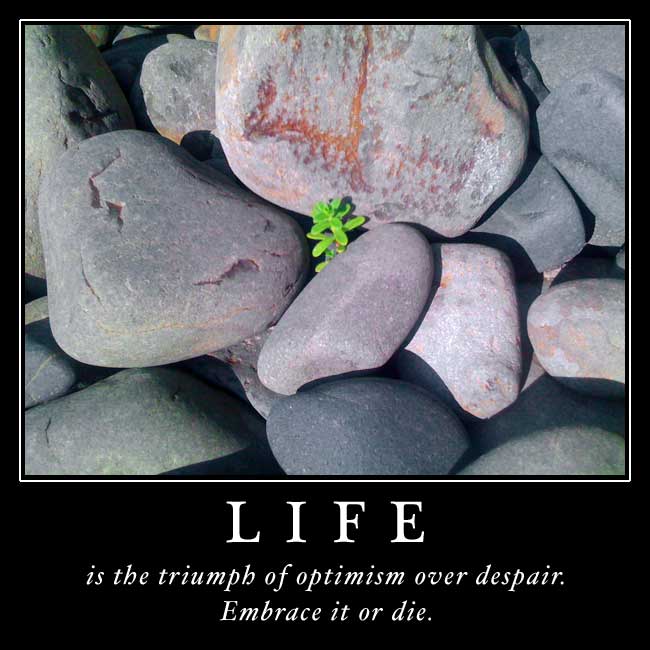
I saw a tiny little plant growing up between the stones that tend to litter the base of the cliffs around northwestern beaches, and I just have to say:

More on George Sodini

My sweetie figmentj has written a well-considered rebuttal to my last post, which I think deserves more attention than being buried in a very long comment thread, so I want to point people at it here.

Edited to add: It was a locked post, but it’s unlocked now.