#WLAMF no. 25: Nature is horrifying!

The balance of nature. This is a thing that people talk about, and every time they do, I cringe.

Wikipedia has an entry on the balance of nature, which has this (among other things) to say on the subject:

The theory that nature is permanently in balance has been largely discredited, as it has been found that chaotic changes in population levels are common, but nevertheless the idea continues to be popular.[1] During the later half of the twentieth century the theory was superseded by catastrophe theory and chaos theory.

In part 0.5 of my series on GMOs, which I’ll return to when the current madness is over, I talk about how one of the greatest predictors of whether a person is opposed to GMOs is whether that person sees nature as a gentle, benevolent force that exists in “harmony” and “balance.”

It’s easy for us, as humans with really short lifespans, to imagine there’s a “balance” to nature. If the number of predators in some place grows too large, they eat all the prey, and then they starve, and the number of predators falls, right? That lets the prey population rebound, and balance is restored. Balance! Harmony!

Except that it’s a load of rubbish. It sometimes (sometimes!) works that way in the short run, but in the long run, what looks like “balance” is more often two or more opposing sides that have reached an exhausted stalemate. A change in climate, a change in parasites, disease, a new adaptation, and that “balance” goes out the window. Catastrophes happen. Species go extinct, and are replaced with new species. There are no dinosaurs any more, or creodonts, or many other organisms. They didn’t disappear because humans upset the “balance of nature.” They disappeared because there is no “balance of nature.” Nature is neither kind nor benevolent; it’s only our privileged position at the apex of a very large and very bloody food chain that allows us to imagine otherwise.

Nature is, in point of fact, ruthless and amoral. Any adaptation that gives a species (or a population within a species) an upper hand tends to be propagated through nature.

And sometimes, the results are horrifying. I don’t mean just in the “species go extinct” kind of way; the adaptations that succeed are themselves often horrifying.

Exhibit 1 for the prosecution: Male Llamas Bite Off Each Other’s Genitalia.

See the teeth on the end? The canine and incisor? Those are fighting teeth. You know what they’re adapted for? Castrating other llamas. Why? Because if you have genes that code for teeth to castrate other males and the temperament to do so, you’re going to spread those genes pretty effectively, and before long, your whole species is full of individuals with a head for castrating each other and the tools to do it.

But wait! It gets worse! The anglerfish is even more horrifying.

This is a male anglerfish. It’s a little tiny blob of a thing, scarcely able to swim. When it finds a female, it bites her, whereupon she…absorbs it. She dissolves it, literally, until nothing is left but a pair of testicles, which remain glued to her body. She extracts the sperm from them and stores it for when she wants to reproduce.

Why? How could such a horrifying thing come to be? Because it works, and nature is amoral. Whatever works, works.

You might think that’s the bottom of nature’s basement of horrors, but you’s be wrong. Let’s talk about bedbugs, and a reproductive strategy called “traumatic insemination.”


Image: Rickard Ignell, Swedish University of Agricultural Sciences

Traumatic insemination occurs when the male stabs the female and deposits his sperm directly into her body. If she survives, some of the sperm eventually reaches her ovaries. It’s the only way bedbugs mate. Why? Because nature is horrifying.

There is no harmony or balance of nature; those things are human constructs. What there is is unceasing warfare, constant change, and traumatic insemination. We’re very fortunate, you and I, to be born into a position that allows us to delude ourselves about the nature of mother nature.


I’m writing one blog post for every contribution to our crowdfunding we receive between now and the end of the campaign. Help support indie publishing! We’re publishing five new books on polyamory in 2015.

#WLAMF no. 24: Kitties can anticipate the future

There is a book called Worry and Nervousness: The Science of Self Mastery. I don’t know a thing about the book or its author, except that its author must not own cats.

How do I know this?

The book makes the claim “man is the only animal that worries.” And anyone who would say such a thing has clearly never lived with a cat.

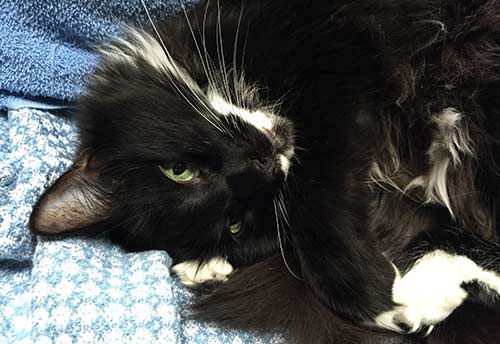
I have a cat named Liam. He’s generally pretty good-natured, except that he has the unfortunate habit of biting my nose to show me he loves me. I’ve only known him as an adult kitty, and must conclude that at some point when he was a kitten, someone must’ve thought the nose-biting thing was cute as hell and encouraged it.

But Liam is a neurotic kitty, and he worries. Specifically, he worries about his food dish and his water bowl.

He seems to have the capacity to worry about only one of these things at a time; perhaps it is true that man is the only animal that worries about more than one thing at once. A few nights ago, Liam woke me from a sound sleep to tell me something was Very Very Wrong, running back and forth between the bed and his food bowl. I stumbled out of bed all cross and blearly-eyed, to find his dish had only two inches of food left in the bottom of it–scarcely three days’ worth of food! This, naturally, led to something of a panic attack on Liam’s part.

So I filled his food bowl, and went back to dreaming of interviewing shambling horrors or flying an ultralight around the flooded ruins of Old London or whatever the hell I was dreaming about (I have to live inside this head full-time)…

…when Liam woke me once more to tell me something else was Very Very Wrong.

This “something else” turned out to be his water bowl, which was down to a mere three inches or so of water in it–clearly, if you’re a kitty, cause for panic.

Man is the only animal that matters? I beg to differ, sir, and would be pleased to introduce you to a counterexample.


I’m writing one blog post for every contribution to our crowdfunding we receive between now and the end of the campaign. Help support indie publishing! We’re publishing five new books on polyamory in 2015.

#WLAMF no. 22: Accidental and Unintended

I had, many years ago, a friend who tended to cheat on her partners.

When I say she tended to cheat on her partners, what I mean is that she cheated on every boyfriend she’d ever had up to the point I lost touch with her, without exception. I asked her about it one rainy evening, and she said she didn’t set out to cheat; when it happened, it was accidental.

That’s an idea I’ve heard echoed countless times in countless conversations when I talk to people who’ve been unfaithful. “It was an accident. I didn’t mean to do it.”

There’s a certain element of self-serving justification in there somewhere. It’s likely related to the fact that folks in openly nonmonogamous relationships are at lower risk of sexually transmitted infection than folks in nominally “monogamous” relationships who cheat. If something is an accident, we’re not responsible for it. If we remember to bring condoms, or talk about sexual history, or do any of those other things, we’re obviously planning for it, and therefore it isn’t an accident. If it’s not an accident, we are responsible for it.

It’s a thin justification, to be sure, but it’s remarkably resilient. And part of that, I think, is we don’t acknowledge the difference between accidental and unintentional.

If I make a choice to do something (and as long as we’re talking about consensual sex, if I’m in bed with someone, it was a choice), then the thing I’m doing wasn’t an accident even if I didn’t intend to do it when I got up in the morning. That’s a distinction that matters. I might not have intended, at first, to cheat on a partner, in the sense I might not have woke up and said to myself “you know, I think I’ll betray the confidence of my lover this afternoon! Maybe I can pencil that in before I go to the gym”…but it was still no accident.

I realize that people will attempt to rationalize their choices however they can, and conflating “accidental” with “unintended” is a way to do that. Yet, maybe, just maybe, if we stopped seeing “it was an accident!” as a validation, if we as a society didn’t accept the notion that cheating is less wrong if it is less planned, things might change. I’m not naive enough to believe people might stop cheating, but maybe they might at least be a bit more safe about it.


I’m writing one blog post for every contribution to our crowdfunding we receive between now and the end of the campaign. Help support indie publishing! We’re publishing five new books on polyamory in 2015.

#WLAMF no. 21: Kitties I have loved and lost

One of the stops on the More Than Two book tour took us to Paonia, Colorado, a remote town of about 1,500 people in the foothills of the Rocky Mountains. We got there late at night, after traveling along windy mountain roads in the dark and very nearly hitting both a bear and a deer, each of whom had for some reason unknown to your humble narrator chosen to amble out in the middle of the road and just kind of sit there.

We spent some time exploring the town before our book event, and happened upon a small park more or less in the middle of town. While we were walking through the park, I caught the eye of a young calico cat who was trotting across the street some distance away, doing whatever it is cats do in Paonia, Colorado.

The cat decided she wanted to make friends, and immediately came running over to us, where she threw herself into my arms with some gusto.

After some petting and playing with, she decided she wanted Eve’s attention, too.

We met many cats on the book tour, but this adorable little calico is the one I remember the most. She was incredibly friendly (and I say this as a guy who owns Tonkinese kittens, animals known worldwide for how strongly they bond to their people), but also had some of the signs that somebody somewhere was mistreating her. She was hypervigilant, and took off at the slightest sign that anyone else was walking toward us.

I sincerely hope nobody was being mean to her. There’s a special place in hell for humans who abuse animals. I wonder about this kitten often, and hope that, wherever she is, she is happy and warm.


I’m writing one blog post for every contribution to our crowdfunding we receive between now and the end of the campaign. Help support indie publishing! We’re publishing five new books on polyamory in 2015.

#WLAMF no. 19: Kinky sex

A while back, I was participating in a conversation about sex, and the subject of kink came up. A guy was saying his girlfriend had approached him with the idea of some sort of non-specific kink, and he was reluctant to engage in it for fear that “nice guys” don’t do that sort of thing with their partners. What, he wondered, would it be like if the sexes were reversed? A guy who asked his girlfriend for kinky sex was clearly not a nice guy; nice guys would never do such a thing! So why should it be okay for a woman to ask her boyfriend for kink? Didn’t it show a double standard–women can do something bad but guys aren’t allowed to? Someone else said that he shouldn’t be a nice guy, because women don’t want nice guys–nice guys, he explained, are emasculated, and women actually want strong, alpha guys, guys who will control them.

And listening to it, I felt despair.

I’ve always been suspicious of framing things in terms of “nice guy” vs. “bad boy;” I think, to be blunt, it’s childish and stupid. Modern social expectations do not “emasculate” men, being a “soft male,” or “losing your center.” That’s a load of rubbish. Modern social expectations are about treating women as human beings rather than need-fulfillment machines. That’s it. You don’t have to be “emasculated” or any of that other silly stuff to do that. You simply have to look at women as full human beings, deserving the same levels of respect and consideration you’d give any other person.

At the end of the day, it’s about consent, not disempowerment. It’s messed up to see relationships in terms of who’s empowered and who’s disempowered; in a good relationship, it’s possible for two (or more!) people to all be empowered.

Likewise, being a “nice guy” or treating women with “respect” does not mean holding doors open, always being soft and gentle, or always having sex in candlelight on a bed strewn with roses. REAL respect, as I’ve said many thousands of times, means talking to women about what THEY want, and then treating them the way they want to be treated.

Are you seeing the Matrix yet?

The “nice guy” who refuses to try anything kinky because he thinks it’s disrespectful isn’t really a nice guy. He’s not listening to his partner, because he knows what’s best for her.

And the “bad guy” who talks to his lover about what she wants, talks about what he wants, and then works with his lover to explore their mutual fantasies together? He isn’t really a bad guy…even if those fantasies involve kinky sex.

It seems to me the world might be a happier place if we all stop trying to figure out the rules about how to treat women “properly,” and instead just talk to women like human beings and treat each individual the way she wants to be treated. A lot of men say they just don’t understand women. A lot of women say they don’t understand men. I respectfully submit that perhaps, if we listen to each other, that might change.


I’m writing one blog post for every contribution to our crowdfunding we receive between now and the end of the campaign. Help support indie publishing! We’re publishing five new books on polyamory in 2015: https://www.indiegogo.com/projects/thorntree-press-three-new-polyamory-books-in-2015/x/1603977

#WLAMF no. 16: Lego brains

The brain is a fiendishly complicated thing. Not so much because all its constituent parts are complicated (though they can be), but because it’s a network of billions of components wired together with trillions of connections. Well, at least your brain is.

There are other brains that are a lot simpler. When I was taking classes in neurobiology, back in my misspent college days, we used to talk a lot about the species of worm called C. elegans.

Back then, researchers were just beginning to map its brain. The brains of C. elegans are isomorphic, meaning they’re all the same. (That’s not true of more sophisticated animals; our brains grow organically, with neurons wiring up to other neurons in a dynamic process that means even identical twins don’t have the same brains.) They’re small (about 300 neurons, and around 7,000 connections.) They’re easy to understand, at least for folks who find neurobiology “easy.”

And now they’ve been replicated in a Lego scooter that, well…behaves a lot like C. elegans without being explicitly programmed to. The robot has no pre-programmed behaviors; it acts like a roundworm because, in a sense, it has the brain of a roundworm.

And I think that’s really cool.


I’m writing one blog post for every contribution to our crowdfunding we receive between now and the end of the campaign. Help support indie publishing! We’re publishing five new books on polyamory in 2015: https://www.indiegogo.com/projects/thorntree-press-three-new-polyamory-books-in-2015/x/1603977

#WLAMF no. 15: “Government should fear the people”

When I was living in Atlanta, I used to see a bumper sticker all over the place: “People shouldn’t fear the government, the government should fear the people.”

This sentiment is quite popular in conservative parts of the US, and it or variations on it (such as “When government fears the people, there is liberty; when the people fear the government, there is tyranny”) are often attributed to Thomas Jefferson. Wrongly, as it turns out–Jefferson never said this.

Now, on some level, there’s a grain of truth here, in the sense that a government ideally represents the will of the people and should be held accountable to them. To some extent, anyway. In some cases, the will of the people is a deeply troublesome and evil thing; the will of the people in the pre-Civil-War Deep South, for instance, held that some people aren’t people at all but rather property, and that’s a will I don’t think a civil society should respect.

But what it misses is that when the government fears the people, the result is tyranny, just as surely as when the people fear the government.

Governments have power. They have police forces and jails. They have standing armies. A person with a gun and a heart full of fear is a dangerous person indeed.

Why do tyrannies exist? They exist because people in power fear losing that power. They fear what happens if the people express their will. Tyrannical governments restrict what they fear. They restrict speech because they fear the power of speech. They restrict demonstrations because they fear the power of demonstrations. A government that fears the people, attacks the people. It handles that fear through force and control. When it sees something it fears, it acts ruthlessly to eliminate it. When a government fears the people, the people become the enemies of the state.

The same holds true for civilian police. A police force that fears the people, treats the people as threats. It shoots the people, even if they’re unarmed. It labels the people “thugs” and “looters.”

The idea that the government should fear the people creates–in fact, it can not help but to create–totalitarianism. The greater the fear, the greater the response to it. A government that sees the enemy around every corner, treats every person as an enemy.

“People shouldn’t fear the government, the government should fear the people.” This idea is a blueprint for evil.

People are people. Governments are made of people. I would like to propose a different bumper sticker: “The government and the people should hold one another accountable. Let them treat one another with respect, so that we may have a civilized society in which all are respected.”


I’m writing one blog post for every contribution to our crowdfunding we receive between now and the end of the campaign. Help support indie publishing! We’re publishing five new books on polyamory in 2015: https://www.indiegogo.com/projects/thorntree-press-three-new-polyamory-books-in-2015/x/1603977

#WLAMF no. 14: Big Science Happens Here

On the plains of New Mexico, there is a road. This road stretches for miles across empty desert. If you drive far enough on this road, eventually after you’ve passed miles of scrubbrush and have begun to imagine that all the people you’ve ever known have never really existed but are only the products of your own hallucinogenic dreams, you will see an enormous radio dish on the horizon. And then another, and another.

You’re not actually close to the Very Large Array yet; there is still a lot of driving ahead of you.

But if you’re up to the challenge, and if you’re patient and persistent, and if you don’t break an axle on the narrow and badly-maintained road, eventually you will come to a place where there are a lot of very smart people who are very dedicated to understanding the physical world.

This is the Very Large Array. It is a collection of radio telescopes that looks into the universe in a wide range of frequencies, frequencies our limited vision is altogether insufficient for. Its purpose? To understand the universe we live in.

I stopped here on the trip around the Southwest. It’s not what I expected. Big Science is never quite as…clean and tidy as Hollywood would have you believe. Big Science often means Big Engineering, and Big Engineering is all about getting things done.

These dishes can act individually, but usually they’re part of a collective whole, gathering and amplifying incredibly faint signals from very far away places. The entire array is, in a sense, a single instrument, and that instrument can be reconfigured to observe radio waves in all kinds of frequencies.

But the best way to align a set of dishes changes according to the frequencies they’re observing, and that means these antennas move. I don’t mean they move as in rotate to sweep the sky, though they do do that as well. I mean move as in grow farther from each other or closer to each other, as the observations require.

They are huge, and moving huge things means big machinery. Each antenna sits on a pad, and each pad is next to a set of railroad tracks. Those railroad tracks are the roadways for enormous tenders, which literally pick up the antennas and carry them from place to place.

To save room, the train tracks don’t curve. They intersect at 90-degree angles. To make a turn, the tender sets down an enormous hydraulic ram, lifts itself and the antenna completely off the ground, spins around on its own axis, and settles itself back down on the track again.

We were fortunate enough to be able to climb one of the antennas, for a value of “fortunate enough” that means “allowed to take a harrowing climb up a creaking, swaying steel staircase onto the surface of a tremendous and steeply-angled dish made of surprisingly thin sheet metal that’s way, way higher off the ground than you think it is.” Those afraid of heights, falling, ladders, stairs, or swaying back and forth while a long way from the ground need not apply.

I am not afraid of any of these things, and climbing onto the dish was only a little short of terrifying.

Big Science happens here. This is the sort of place where we as human beings learn more about this world we are so uniquely blessed, for a short time, to exist in. There is no more noble nor essentially human quest than the quest for understanding, and places like this are where that happens.


I’m writing one blog post for every contribution to our crowdfunding we receive between now and the end of the campaign. Help support indie publishing! We’re publishing five new books on polyamory in 2015: https://www.indiegogo.com/projects/thorntree-press-three-new-polyamory-books-in-2015/x/1603977

#WLAMF no. 13: Zaiah

Today is the ninth anniversary of my relationship with my partner zaiah.

A lot of folks will say polyamory doesn’t work. “I knew some people who tried that,” they’ll say. “They broke up.” If you ask these people how many monogamous folks they know who’ve broken up, you’ll get some humphing and hawing, but you probably won’t make your point.

zaiah and I have had an interesting adventure, these past nine years. She and I have traveled across the country together, lived together, explored together, tried new things together. I’m looking forward to many more years of adventure. Happy anniversary, darling! I love you.


I’m writing one blog post for every contribution to our crowdfunding we receive between now and the end of the campaign. Help support indie publishing! We’re publishing five new books on polyamory in 2015: https://www.indiegogo.com/projects/thorntree-press-three-new-polyamory-books-in-2015/x/1603977

#WLAMF no. 9: Fusion

A lot of the world’s social, economic, and resource problems are, when you come down to it, power problems. I don’t mean political power; I mean energy. Electricity.

Take fresh water, for instance. Three-quarters of the planet’s surface is covered by the stuff, yet much of the world doesn’t have reliable access to safe, clean water. 780 million people don’t have regular access to clean water. Nearly four million people die a year from water-bourne illness.

If we had unlimited quantities of cheap, clean energy, water would stop being a problem overnight. It’s easy to desalinate seawater…easy, but not cheap. The process requires enormous inputs of energy, and energy is expensive.

The holy grail of energy is, and has always been, fusion power. Fusion power offers vast quantities of energy from seawater…if we can make it work. And we’ve been chasing it for a while, though never with any serious determination; the world’s annual budget for fusion research is about 1/18th the annual revenue of the National Football League. (In the US, the annual budget for fusion research is less than what the Government Accountability Office spends on paperwork.) Fusion power promises one-stop shopping for reversing global carbon emissions, improving access to fresh water all over the world, raising the standard of living for developing nations, moving toward non-polluting transportation…

…if we can make it work.

It’s been a long road. A lot of engineers thought we’d have the problem licked by the mid-1960s. Here we are in 2014, and it’s only been in the last two years that teams at MIT and Lawrence Livermore have actually made fusion reactors that produce net positive energy…for short periods of time. It’s a very, very difficult nut to crack.

Enter Lockheed Martin.

Lockheed Martin recently announced that their Skunkworks team has been quietly, and secretly, working on fusion power for a while. And they claim to be within 5 years of an operating prototype of a compact fusion reactor.

Now, I am of two minds about this.

Pros:

– It’s the fucking Lockheed Martin fucking Skunkworks. These are not a bunch of cranks, kooks, or pie-in-the-sky dreamers. These guys built the SR-71 in the early 1960s, and the F-117 Stealth fighter back when the Radio Shack TRS-80 was the state of the art for personal computers.
– Lockheed doesn’t seem the kind of company to stake their reputation on a claim unless they’re really, really sure.
– They’re exploring deuterium-tritium fusion, which is a lot easier than ordinary hydrogen-hydrogen fusion of the sort that happens in the sun.
– Did I mention it’s the fucking Lockheed Martin fucking Skunkworks? They have money, engineering expertise, and problem-solving experience by the metric ton. They are accustomed to solving hard engineering problems 20 years before anyone else in the world even knows they can be solved.

Cons:

– Fusion is hard. The pursuit of fusion has left a lot of broken dreams in its wake.
– The design they propose encloses a set of superconducting magnets inside the fusion chamber. That’s clever, and solves a lot of problems with magnetic containment, but superconducting magnets are fragile things and the inside of a fusion chamber is as close as we can get to hell on earth.
– Fusion creates fast neutrons. Those fast neutrons tend to run into stuff and knock it all out of whack. Solving the problem of the reactor vessel degrading under intense neutron flux is non-trivial; in fact, that’s one of the key objectives of the multibillion-dollar International Thermonuclear Experimental Reactor being built by a consortium of countries in France.

Fusion power, if we can make it work, would likely (and without hyperbole) be one of the most significant achievements of the human race. It could and very likely would have farther-reaching impacts than the development of agriculture or the invention of iron, and would improve the standard of living for billions of people to a greater extent than any other single invention.

For that reason alone, I think it’s worth pursuing. I’d like to see it better funded…say, maybe even on the same scale as the NFL. I’m not sure of Lockheed can deliver what they’re promising, but I am very, very happy they’re in the race.


I’m writing one blog post for every contribution to our crowdfunding we receive between now and the end of the campaign. Help support indie publishing! We’re publishing five new books on polyamory in 2015: https://www.indiegogo.com/projects/thorntree-press-three-new-polyamory-books-in-2015/x/1603977