Some movies I’d like to see

So a couple of projects have managed to wiggle their way into my attention lately.

The first is a book, based on Jane Austin’s Pride and Prejudice, called Pride and Prejudice and Zombies. It’s a rewrite of the classic with extra bonuz zombie footage (by day, she woos Mr. Darcy; by night, she’s an unstoppable zombie slaying machine!).

Yes, I’m being 100% serious.

The second is the next movie in the Predator franchise, called Pride and Predator, a Predator prequel set in the time of–you guessed it–Pride and Prejudice.

Now, personally, I think this is brilliant. There’s nothing that can make a chick flick entertaining faster than the addition of a zombie horde or an extraterrestrial killing machine. Can’t get enough of that for my entertainment dollar!

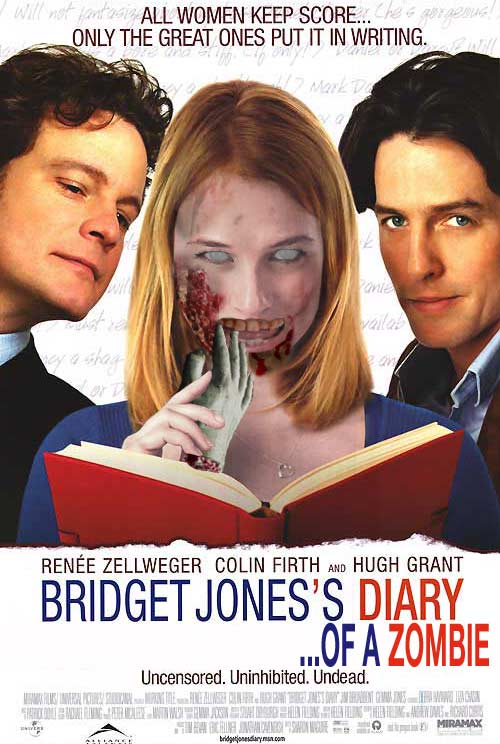
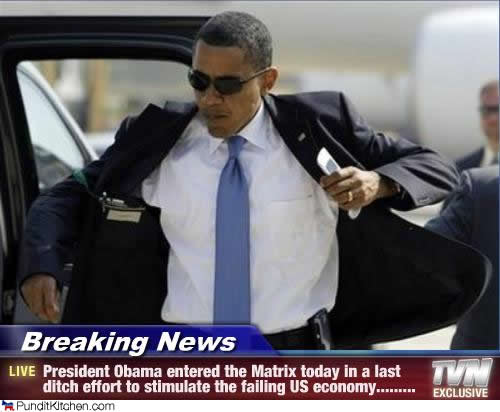
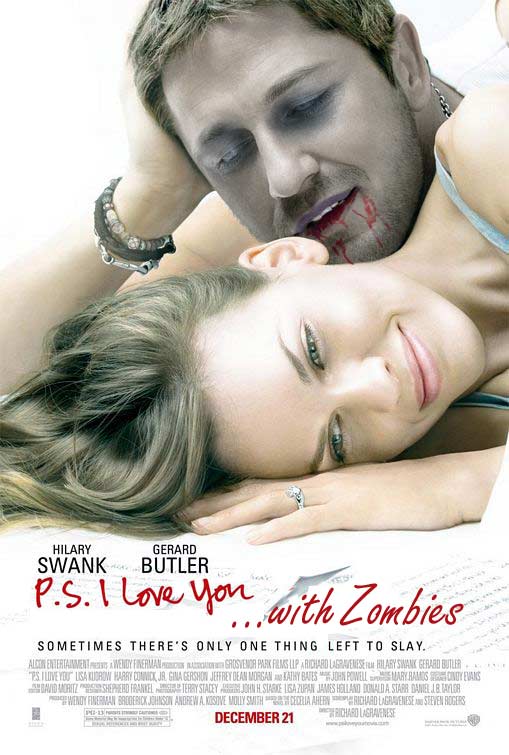
But, sadly, I fear this trend doesn’t go far enough. So, this afternoon, I put together some more chick flicks I’d really like to see (clicky on any pic to embiggen):

Last chance to pre-order!

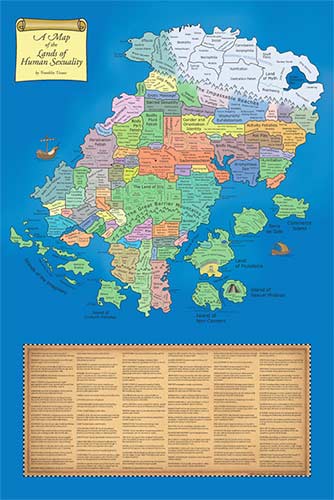
I have enough pre-orders for the poster version of the Map of Human Sexuality, and the job is at the printer’s right now. Plates are done and it goes on press Monday. I expect to have the posters by the time I get back from the Poly Leadership Summit next Monday.

Once I have the posters in hand, I plan to raise the price to $15, so if you want one at the pre-order price (or you want it signed), now’s the time!

On Re-Evaluating Dating and Relationships

My sweetie figmentj has just posted what I think is an awesome essay on the nature of dating and the implications of a conventional model of dating in an unconventional relationship world. Here’s a teaser:

In our generally monogamous culture, standard dating is viewed as a series of auditions. If you pass the first, then you get a second date. If you pass that one, you get a third date (and possibly sex, if we really want to go with the cliched model). Eventually you pass enough auditions to have a relationship, and if that goes well, you get married and win the game. Most of the poly people I know, myself included, started out being inundated with the standard model, and eventually became poly later. We learned to let go of the idea that there is One Magical Person for everyone, and the purpose of dating is to find them. But the feelings of being evaluated and passing or failing and internalizing what that means seemed to hang around.

Go read the rest. It’s good stuff.

On the value of a broken heart

Several months back, I went to LA to visit my sweetie Gina.

There are a number of reasons I really dig her. She has the same deadpan, two-degrees-off sense of humor I do. She’s smart, independent, capable, and sexy as hell. She knows a lot of things I don’t know and has a lot of skills I don’t have, which is something I tend to look for in people. She’s a lot of fun to spend time with. She planted the seeds of an appreciation for horses in me.

And every now and then, out of the blue, she says something that I end up mentally chewing on for months.

One of the things she said while I was out visiting her is that she is usually only attracted to people who have had their hearts broken at some point in the past. People who are “lived in,” I think was the term she used. And I’ve been chewing on that idea for months.


I think there’s something to be said for the notion that a person isn’t really complete until his heart has been broken.

Which is not to say that having a broken heart is a positive thing. On the whole, having been there myself, I think I’d rather have a root canal. From a myopic dentist with a seizure disorder. Using rusty implements. On a yacht. During a hurricane.

But how a person responds to heartbreak can really illuminate some important things about who that person is.

The easiest thing to do, I think, is react with anger. After all, how dare that no=good, rotten bastard treat you so poorly, right? And to some extent, that’s probably normal and natural for most of us; anger is one of the recognized stages of grief, and grief is an appropriate reaction to losing a relationship that’s valuable to you.

But it doesn’t last forever–or at least, it shouldn’t. It’s too easy an out. Blaming the other person, the person who broke your heart, is seductively simple to do, and offers a powerful absolution from your own hand in the events. Even if the other person is completely at fault, though, there are lessons to be learned in the aftermath of heartbreak, and the lessons that a person comes away with are potent signs of that person’s character. The worst breakups can still teach a lesson about partner selection, after all.


I’ve talked to folks who seem to have the worst luck in relationship. Every person they’ve ever been romantically involved with, or o it seems, is a no-account, worthless, shiftless, gormless right royal bastard, at least to hear them talk about it. I’m always slightly saddened to hear people talk about their past experiences that way, because it seems to me that there are valuable lessons in the experience which aren’t being learned. And I do believe some lessons can only be learned by heartbreak, and even then only if the people involved are really paying attention.

Having your heart broken is a high price to pay for a lesson you don’t bother to learn.

On of those lessons is about compassion, and it’s difficult to even think about compassion when anger is occupying all of the space in your emotional realm. I’m not saying that folks who’ve never had their hearts broken are incapable of being compassionate, of course; but I do think that heartbreak drives the lesson home in a particularly immediate way.

I know that for myself, at least, my own greatest heartbreak occurred at least in part because in some small back corner of my mind, I assumed that my partner and I would always have a friendship, would always come round to being on good terms; and I think to some extent that prevented me from being as compassionate as I could have been, and of working in the most effective way I could have to resolve the problems between us. (Problems that were, to be fair, mostly of my own doing.) That idea that we’d always be friends led me to a tacit assumption that there would always be plenty of time to set things straight between us, so I didn’t really need to worry about making things right right now.

As you might imagine, hat person and I have not spoken to one another in over fifteen years. And I still carry the lessons, and the marks, from that heartbreak with me.


There is another lesson that comes from heartbreak, too, and that lesson is courage.

To me, one of the single most valuable things a person can carry into a relationship is the knowledge that it is okay to be alone. I don’t want a partner who believes that she must be with me, out of fear of being alone; to me, the healthiest relationships are those that are engaged in freely, as a matter of choice. I don’t want the feeling that I must be with a partner; the knowledge that it is possible for me to lose a relationship, to have my heart broken, and that I can still move on and still be happy means that I am free to involve myself in relationships as a conscious choice. I can be happy even without a relationship; that means the relationships I am in, I am in because they add value to my life and to my partner’s life, not because I have no choice about them.

Knowing that I can be happy without a relationship means I can never be trapped in a relationship. Knowing that my partners can be happy without a relationship means I never need to fear that a partner is only with me because she has no other choice, which means I never need to fear that a partner will leave me simply because some other choice presents itself to her.

Courage is grace under pressure. It takes courage to know that you can lose a relationship and still find a way to be happy. It takes courage to know that it is possible to face down the fear of being alone, and to release the idea that without your partner, things will never be good again. That’s the light on the other side of heartbreak–the certainty that as painful as a broken heart is, there is always the possibility of happiness beyond it.

Compassion and courage together make for the most effective combination I’ve yet discovered for personal happiness.

Going to Philadelphia, and Sex Map Stuff

Part the first:

I will be in Philadelphia for the Poly Leadership Summit from February 28 through March 2 (not March 6 like I originally wrote! Aargh!). Originally, I’d coordinated with my sweetie joreth, but scheduling conflicts have kind of nixed that.

So long story short, I’ll be in Philadelphia on February 28 with nothing to do. Anyone on my flist in town and want to hook up for coffee1 or something?

Part the second:

Almost have enough pre-orders for the poster version of the Map of Human Sexuality to start printing. Just need seven more pre-orders!

1 Well, not coffee; the stuff is nasty. But, y’know.

Wow, I just found the World’s Dumbest Bug…

…in Internet Explorer 7!

But perhaps that’s redundant. “Dumb bugs” and “Internet Explorer” have long gone together like chocolate and peanut butter.

Anyway, one of my coworkers wanted to know why attempts to install Firefox always bombed out on her system. She was going to the Download page and clicking the “Run” button, which in reality actually means “download and then run.”

The Firefox executable has spaces in its name (it’s called something like “Install Firefox 3.0.6”). Now, as we all know, the Web turns spaces into %20, which is the hex ASCII code for a space.

So Explorer downloads the file as “Install%20%Firefox%20%3.0.6” but saves it as “Install Firefox 3.0.6”. Here’s where things go all hinkey:

It then runs the file “Install Firefox 3.0.6” but sets the path to the file as “Install%20Firefox%203.0.6”–which doesn’t work. When the installer attempts to run, it can’t locate its own built-in libraries because the Windows file path parsing APIs do not change “Install%20%Firefox%203.0.6” back into “Install Firefox 3.0.6”.

*rolls eyes*

Writer’s Block: Seven

Y’know, this is a really interesting question–but not for the reasons you might think.

Let’s take a look at these seven deadly sins. Sloth, greed, lust, gluttony, anger, envy, and pride. Trust the Catholics to come up with a list of affronts against man and God, but not to list things like, for example, “murder” or “rape” or “genocide.”

“But Tacit!” you might say. “You’re barking mad, or at least splitting semantic and theological hairs. Wrath can lead to murder! Rape can be caused by lust! And genocide–”

Well, I’m not sure what on this list really matches up with genocide. Not sloth, certainly; genocide is damn hard work. Pride? Those who commit atrocity usually think they’re better than the person they commit it against, but that’s not exactly pride, precisely; it’s something else.

Which is exactly where this list falls apart.

You see, of the seven things on the list, five of them are not actions. They’re emotions. And here’s the tricky bit–as human beings, we choose our actions. We choose our actions, even when we feel emotions.

Many people can feel angry, without acting on that anger. Many people can feel lust, without violating anyone because of it. It’s actions, not feelings, that carry moral weight; we are, each of us, responsible for the things we do, but to assign moral value to a feeling seems a little absurd.

Hell, read Song of Solomon in the Bible. The whole damn book is an ode to lust. The lust that a man feels for his wife is perfectly normal; I would say even positive and healthy, especially if one believes in the Catholic notion of being fertile and popping out pups multiplying. On the other hand, the lust a priest feels for an alter boy? Not cool.

You see that? You see what I just did there? Context. Moral value depends inexorably on context.

Even folks who claim to despise “moral relativism” still believe it. Alice shoots Bob in the head with a .50-valiber Desert Eagle, spreading his intelligence and his awareness all over her living room wall like a demented Jackson Pollock. Is that morally wrong? I bet a lot of folks would probably say it is. Now let’s add to the scenario a bit; she did it because he was in the process of attempting to murder her children. Is it morally wrong now?

You see that? Context. The moral value of an action depends on its context.

But let’s go back to the list. Anger; who hasn’t felt it? It’s a feeling; an inevitable human emotion hard-wired into the limbic system of every one of us.

Count on the Catholics to turn a feeling into something to be guilty about.

Look, the guy who gets pissed off and smacks his wife around is an asshole, no doubt about it. But the guy who gets pissed off and yet manages to keep his cool in spite of it? That guy is not a sinner, and indeed there is greater virtue in doing the right thing even in the grip of an emotion than in doing the right thing when the right thing is easy to do.

We can flip this list on its head, too. The Mob hit man who whacks sixteen people in cold blood–which deadly sin is he committing? Not sloth, certainly. Not greed–as it turns out, hit men don’t usually get paid very much for what they do. Far less than a lawyer, or a plastic surgeon, or a professional basketball player. Hell, they probably make less money than a computer help desk operator! Hollywood aside, shooting people really doesn’t pay the way you think it would.

Lust? Doesn’t fit. Gluttony? If eating too much is the worst thing you ever do, they should give you the VIP entrance into Heaven. Anger? A good hit man is cool and collected; he’s not motivated by rage. Angry people get sloppy.

How about envy? He might not even know the target, much less envy him. Pride? Well, I suppose he might take pride in a well-executed job (Ha! I slay me!), but then I think most professionals take a certain pride in their craft.

So the guy who gets pissed off but doesn’t act on it is a mortal sinner, but the guy who whacks people for a living isn’t? Who is this god, and how did he get the job? I gotta say, if I were a god, you can bet the list of deadly sins would look a whole lot different. A little less with the “feeling” and a lot more with the “doing,” if you ask me.

Fragments of Portland: Security and Friends

Getting to Portland from Atlanta is a lengthy proposition. Getting back to Atlanta is a slightly less lengthy proposition, if one does what I did and misses one’s flight.

On the return trip, I was scheduled for three layovers and a total of nearly twelve hours in transit. However, I managed to miss my flight, and as a result flew standby on a one-layover route that was about two and a half hours shorter. So, win!

In fact, if that’s what I can expect, I may have to miss my flights more often.

Portland itself was a blast. On top of being able to spend ten days with my sweetie zaiah (and what could top that?), I got an opportunity to meet a bunch of folks I’ve known for a long time online but never met in person before, and a chance to catch up with the_xtina for a bit, and even made some new friends (waves to gidget23. More on that later.

First, I’d like to take a few minutes to talk about our friends in the TSA.

Now, these folks have an important job. They help calm nervous travelers by providing the illusion of security at airports. Mostly, they do this by sifting through baggage all day long. It’s a thankless task; and it’s hard to imagine that they don’t get cynical about it.

Realistically, the odds of a plane being blown out of the sky by a terrorist bomb are about the same as the odds that your grandmother can beat Mike Tyson in a no-holds-barred steel death match, armed with nothing more than a bent straw and a plastic spoon from Taco Bell. I’m sure there’s a grandmother or two out there who can do it, and planes have been brought down by bombs, but seriously…is it going to happen? Really? Don’t hold your breath.

These folks have never seen a bomb, they will never see a bomb, and they know it. But they still gotta sit there for eight hours a day anyway.

Alright, alright, yes, I know. Part of the point is deterrence. They don’t find bombs in luggage because the fact that they’re looking for it means that the folks who might have the urge to blow up airplanes don’t put bombs in luggage, ’cause they know it won’t work.

But bear with me a minute, here.

These guys have a boring and mostly pointless job (save for the deterrence effect), and they need some way to amuse themselves while they’re manhandling checked luggage through oversized X-ray machines. Which they get by putting notices like the one on the left into your baggage to tell you that they’ve served the national interest by checking your underwear to make sure that it won’t blow up or, I don’t know, invade France or something.

And I suggest for your humble approval the notion that they do not select the baggage to search at random.

I found the note shown here in my suitcase when i reached Portland. Now, a quick X-ray plainly showed there was nothing in my luggage that could possibly go boom–not that TSA screeners necessarily have the foggiest notion of what a bomb looks like, but still.

They had, however, completely removed every single item from my suitcase. Including, among other things, a pair of handcuffs, all my clothes, a heavily modified Feeldoe, a box of rubber gloves, my entire collection of floggers, ten rolls of vet wrap, my toothbrush, and a box of sterile needles.

Not only that, but they unrolled my flogger case to see what was inside. (I carry them in this nifty case that lays down flat and has slots and elastic tie-downs to hold all the floggers, then rolls up into a cylinder that can be slung over a shoulder.)

Not only that,, but they had removed the floggers from the case. I know all this because the floggers had been replaced in an entirely different order, and my bag had been completely re-packed.

And re-packed quite a bit more neatly than I’d done it to begin with, too, but that’s beside the point.

I submit, Gentle Reader, that within seconds of opening my bag, the TSA screeners knew beyond question that there was nothing in there that goes bang, boom, pow, kablooey, or even makes a low but sinister hum. I also submit that they continued to unpack my things anyway, simply because it amused them to do so. As proof of this idea, I propose that it is not necessary to remove a flogger from its carrying case to ascertain that it is not, in fact, a threat to national security, foreign relations, the national budget, or to anything else save perhaps the backsides of certain people who will remain nameless at this time.

I have visions of the TSA employees holding up the various objects in my suitcase and asking “What do you suppose this is for?” or chasing one another around with them (ah, the hilarious hijinks at the airport!) or something. All in the name of national security, of course.

And I can’t help but wonder why it is exactly that these guys get paid on my dime.

And how much they make. ‘Cause, y’know, if they’re going to be doing shit like that, and getting paid for it, I want some of that too. Smart security saves time!