Some thoughts on the closet as self-imposed exile

Go to any meeting or join any mailing list on alternative subcultures, especially sexual subcultures, and one of the most common topics of conversation you’ll see again and again is the conversation about “coming out.” Do your parents know that you’re gay? Do you share the fact that you’re polyamorous with your co-workers? Do your fellow game enthusiasts know you’re kinky?

You’ll find a huge range of responses, ranging from “I am who I am and fuck anyone who doesn’t like it” to “I would never, ever dare breathe the slightest whisper to suggest that I did not conform to social norms in every way.” And you’ll find just as many reasons for these attitudes.

On the “I am completely closeted” side of the equation, many of the reasons center around a few simple ideas: fear of tangible loss (“If my ex found out I’m poly, he might try to take custody of my child,” “If my boss found out I’m gay, I’d be fired”), fear of being judged (“My parents would never approve,” “My friends would think I’m a slut if they found out I have two lovers”), fear of emotional loss (“My friends would not like me any more if they knew I was bisexual,” “My mother would disown me if she knew I have two husbands”), and that sort of thing.

On the flip side, you’ll find the same arguments often trotted out to counter these ideas (“If more people asserted their rights to child custody who were openly pagan/gay/whatever, the social structures and stereotypes that allow such people to be cast as unfit parents would fall,” “if someone loves you and then, after learning the truth about who you are as a person, withdraws that love, then that person never loved you to begin with,” “you can not love someone you do not know,” “if your friends only like you as long as you project a false image of yourself to protect their own prejudices, you need a better class of friend.”).

You’ll also see arguments in favor of remaining closeted based on the specific situation of the person in the closet (“I’m in the military,” “I work for a church that condemns homosexuality”) and arguments that rebut those arguments (“You had a choice about joining the military,” “If you’re gay and working for an organization that promotes disenfranchisement of gays, you’re shooting yourself in the foot and working against your own interests.”) And ’round and ’round it goes.

Now, I’m firmly on the side of “I am who I am and fuck anyone who doesn’t like it.” I do not see the advantage of pretending to be someone I’m not, nor see any compelling reason to protect others from the emotional consequences of their own prejudices. But that’s not actually what I’m here to talk about. I’m here to talk about a more subtle, and potentially more insidious, problem that can arise frm remaining tightly closeted, especially in polyamorous relationships–with acknowledgment to feorlen for starting me thinking along this path.


Doing the abuser’s work: the closet as exile

One of the first, earliest hallmarks of a classic abusive relationship, counsellors and mental health professionals will say, is a relationship in which one person seeks to isolate his or her partner, cutting the victim off from friends and family, controlling who the victim may socialize with, and seeking to limit the victim’s contact with other human beings.

This is a useful tool for an abuser. A situation where one or more people are denied access to contact with other people creates an environment where a person may not notice destructive, unhealthy aspects of the relationship. Often, a relationship’s dysfunctions are invisible from the inside; without someone from the outside to say “Whoa, dude, that’s totally fucked up!” it becomes easy to be blinded to even the most blatantly destructive, unhealthy things in a relationship.

Even outside the context of abuse, the presence of extra, uninvolved pairs of eyes is often useful for finding the broken parts of a relationship. Little, everyday problems are seldom unique; in a world of billions of people and fourteen thousand years of recorded history, someone somewhere has had whatever problem you’re having before. Experience is the best teacher, the saying goes..but sometimes the tuition is very high. Learning from other people’s mistakes is less costly than learning from your own. Having a support network of friends who are close to you makes solving problems of all sorts far easier.

But what happens when a person digs himself a nice little cave at the back of the closet?

In extreme cases, he does exactly what an abuser would do to him, only he does it to himself. When a person refuses to share the reality of who he is with the people around him–even with friends and family–e does more than live a lie, and he does more than project a false façade to appease the prejudices of others. He cuts himself off from his support mechanisms; he isolates himself from the very people who might be there to say “Dude, that’s fucked up!” if things start to go wrong. He creates barriers between himself and those people who might be able to help him solve problems or spot weaknesses in his relationship. He removes his own ability to bounce ideas off of others. He creates a breeding ground where unhealthy habits can fester and grow, unchecked by the light of day.

And that really sucks.


In discussions about the values of openness, i often see people arguing the perils and potential consequences of coming out. What I rarely see, though, is acknowledgment of the fact that remaining closeted has a price, as well.

And the more I think about it, the more I think the price of remaining closeted can sometimes be greater than what might at first be obvious.

The culture of secrecy can lead to a mindset of avoidance, of not talking about uncomfortable things even within the relationship. If one builds a reflexive habit of concealing the truth, it’s hard to put down that habit even when talking to someone on the inside. At worst, in the most extreme cases, it can lead to precisely the type of dark, inward-burrowing isolation that the abuser seeks to impose on a victim, only self-inflicted and therefore even more internalized.

Your life is your own. It belongs to you and to nobody else. Live it as you will–but be aware of all the potential costs of your decisions.

Some thoughts on fatigue

A long time ago, when I was going to school in Pennsylvania, I had a friend named Barry Kramer. Barry’s father is a machinist, and he gave Barry a metal rod, about a foot long and an inch or so in diameter, that had been mis-machined.

Barry used this rod (which weighed a good five or ten pounds) to beat things up–road signs, walls, pavement, that sort of thing. There’s something inherently, irrationally satisfying about holding a heavy piece of steel in your hands and really whacking the holy hell out of something…but I digress.

Anyway, one afternoon, a mutual friend of ours went over to Barry’s house, picked up the heavy steel bar, and delicately tapped on the ringer for the doorbell with it.

The steel bar failed instantly–it cracked in half and fell in two pieces to the floor.


I got to thinking about Barry this evening as I was leaving the office. I have a large laptop carrying case I’ve used for years; I’ve had it for so long it’s starting to come apart, and the strap is frayed. I walked outside and was just ambling along toward the car, minding my own business and thinking about cognitive limits and modeling of human intelligence, when I heard a distinct Tink! and the strap of the laptop bag went slithering over my shoulder, sending the bag plummeting to the ground.

I caught the bag before anything bad happened, and hauled it up expecting to see that the strap had failed. But no. The metal latch at the end of the strap had failed and split, very cleanly, in two.


Metal fatigue is really interesting. Most metals do not have an infinite fatigue life. In fact, with most metals, if you take a rod of metal capable of holding, say, 100 pounds of weight, bolt it to your ceiling, and hang a 90-pound weight from it, eventually the metal will fail and the weight will fall. Titanium doesn’t behave this way, but many other metals do.

The split where the metal latch failed is surprisingly clean. The metal broke precisely in an almost perfectly straight line; the geometry of fatigue failure is not fractal, which isn’t what I would expect.

But goddammit, now I have to buy a new laptop case.

How to Screw Up a Sexual Relationship

There are plenty of guides online about how to have a safe, healthy, happy, fulfilling sexual relationship. This is not one of those guides. Instead, this post is about ways you can screw up your sexual relationship–the little tricks and techniques that are sure to doom even the most healthy of relationships and send any hope of happiness spiraling into the ground. It’s easier than you think, and with the application of these few simple techniques, you can ruin your relationship and make yourself and your partner miserable in no time! Ready? Then on we go!

Don’t ask for what you want.
We all have things we like to do or things we’d like to try. There’s a simple way to explore these things: just tell your partner you’re interested in trying them. After all, you can’t expect to get what you want if you never ask for what you want! Continue reading →

Shelly’s new tattoo!

One of the goals of this weekend, in addition to doing some dancing at the Castle and catching up with friends, is to get Shelly’s new leg tattoo. She’s been talking to her artist and working with her other partner’s wife on the design, and this is an approximation of what the design will look like.

I think it looks cool as hell.

It’s a cyber giraffe!

Everything I needed to know about life, I learned from my cats

I have two cats. Until recently, I had a cat named Molly and a cat named Snow Crash, both of them rescues.

Snow Crash is not part of the family any more. He decided to play escapo-kitty a few weeks back…headed out the door and disappeared. I spent several days looking for him, and put food outside the door, but he never turned back up.

In a way, this is as it should be. He dropped unexpectedly into my life when we rescued him from a rooftop, he stuck around for a while, and he left when he wanted to. He’s a tough cat, and if he hasn’t found someone else to look after him (which I suspect he has), I do not doubt his ability to look after himself.

At roughly the same time as Snow Crash decided to leave, I adopted figment_j‘s kitty Liam. Liam is a lot like Molly in temperament; he loooooves people, and he loves to cuddle.

But the integration of Liam into the household has not been smooth. Molly, who tyrannized Snow Crash, is for some inexplicable reason terrified of Liam. He’s never once behaved aggressively toward her, but she’s frightened of him nonetheless.

And these past two weeks have been enlightening. Molly and Liam are a microcosm for human society, really.

TELL THE PEOPLE YOU LOVE THAT YOU LOVE THEM

I spent the weekend in Tallahassee with Shelly. Upon my return, both cats greeted me at the door enthusiastically, and they even put aside their differences for long enough to cuddle with me at the same time. The two of them were purring so loudly they sounded like a 1977 Harley-Davidson “Shovelhead” V-twin with loud pipes. Liam was so happy he snorted.

When the people in your life know how much you love them, they’re more likely to reciprocate your love, and to seek to take care of you. Emotional reservation is hard on the people in your life, and oftentimes leads to loss.

DON’T FEAR THE WRONG THINGS

Molly is still scared of Liam. When he first came into the house, she ran and hid under the bed, and wouldn’t let him within ten fet without arching her back and hissing at him. Her radius of fear is slowly shrinking–she’ll sometimes let him very close before she freaks out–but she’s still quite frightened of him, in spite of the fact that he’s very good-natured and non-aggressive.

When we fear something without even pausing to know whether or not we have anything to be afraid of, we accomplish little save for making ourselves miserable. Fear of the unknown, or fear of novelty, robs life of its joy. When you decide in advance you will fear something before you even experience it, you deprive yourself of opportunities to make new friends and learn new ways of joy.

SOMETIMES, OUR FEARS BECOME SELF-FULFILLING PROPHESIES

Every so often, Liam will walk up to Molly and sniff her nose. Molly usually sniffs back…until she remembers that se’s afraid of him. Then she pins her ears back, hisses, growls, and spits in his face. So Liam, naturally, bops her on the nose with her paw. Occasionally, Molly will walk up to Liam, then remember her fear and turn and flee…and Liam, thinking that Molly is playing the “chase me chase me” game cats are so fond of, will tear after her.

In both cases, Molly’s preemptive fear creates the very behaviors in Liam she’s afraid of. He chases her only because she runs; he bops her nose only because she gets in his face and makes a fuss. It’s common for people who are behaving offensively to believe they are being defensive, and that their behavior is provoked; but often the provocation is the phantasms and fears in their mind projected onto others, not the behavior of the people around them.

Assume the best. Don’t project your fears and doubts onto the motivations of the people around you. It’s remarkable how far you can get when you treat others as though they’re basically decent people. Not everyone is a decent person, of course, but you can’t tell the ones who are from the ones who aren’t until you quit projecting.

WE MAKE THE WORLD WE LIVE IN

Liam loves high places. He also loves knocking things off counters and shelves and watching them fall. And, on top of that, he’s clumsy. As a result, my apartment now looks like its been struck, in rapid succession, by a herd of stampeding water buffalo, an earthquake, several flash floods, and a small tornado.

Liam loves climbing behind one of my shelves to sleep. A couple days ago, he knocked a box full of 3.5″ floppy disks off the shelf, and they fell in a big pile, preventing him from being able to get behind the shelf.

The things you do now may come back to haunt you later. The world you live in tomorrow is shaped by the things you do today. Think about that before you knock stuff over, especially if you’re knocking it over just for the joy of seeing it fall.

DON’T FIGHT OVER PEOPLE. THEY HAVE MINDS OF THEIR OWN.

Molly loves sleeping with me at night. Liam loves sleeping with me at night. I have a king-sized bed; there’s plenty of room on it for two cats.

But Molly is afraid of Liam, and reacts defensively wen he hops up on the bed. He really likes sleeping next to me, though, so he won’t back down when Molly puts up a fuss. The two of them tend to argue over who get to stay in the bed next to me…often at four AM. Sweet, yes?

Not so much.

When this happens, I kick them both off the bed. I choose to spend my time with people, and animals, who make my life better, and whose lives I make better. Waking me up at 4 AM and introducing drama into my bed does not count as “making my life better.”

When you disrupt the lives of the people closest to you, expect those people to be unhappy about it. Regardless of your reason for making the disruption. Or who got there first.

ASK FOR WHAT YOU NEED

Neither Liam nor Molly is shy about letting me know when the litter box is full or the food bowl is empty. This is a good thing, because on a good day I’m about as disorganized as a band of anarchists at a wake for Hunter S. Thompson, so their little nudges are what keeps the food delivery and the waste removal on track.

You can’t expect to have what you want if you don’t ask for what you want. That’s one of the little secrets of life that people often don’t find out ’til they’re much older than they should be.

Anyone in Tampa fancy a trip to the Castle?

Shelly and I and her other partner and his wife will be in Tampa from Friday through Sunday this week (the weekend of the 28th). We’ll definitely be at the Castle on Friday, and perhaps on Saturday as well. Anyone who’s in the area and fancies an evening of dancing Gothy goodness, drop me a line (tacitr (at) aol (dot) com) or leave a message here.

In unrelated news, as memes go, this seems somewhat fitting:

Haiku2 for tacit

say you just made the
dumbest business decision
of your own evil

@
Created by Grahame

Whew!

So I just posted an extensive overhaul of my BDSM Web site, which (like the poly site) was getting a bit long in the tooth, having originally been designed in a day when 640×480 monitors were the norm. The new design looks way better (and most significantly, I think, is far more readable as well).

The BDSM Glossary page is turning into a monster. I really, really, really need to break it up into separate pages and make it searchable, and I really, really, really don’t want to.

It’s been a GOOD weekend.

Saturday: Went to Frolicon, found a lovely pair of suede poi-handled floggers, and got to break them in on Shelly and figment_j. Then last night, a very yummy round of resistance play/rape play with joreth, and tonight, Liquid Latex!

Between that and Tremors, it’s a good time to be alive indeed.

Why I Am an Optimist

On the drive down to Florida Poly Retreat a few weeks back, I had an epiphany.

You see, I’ve always harbored a not-so-secret desire to crush the earth beneath my iron boot, but in the past twoscore years, I’ve made very little progress toward realizing that goal. And it occurred to me why that is. I’m actually very optimistic about the state of humanity, and unbridled optimism about the human condition doesn’t lend itself to the kind of monomaniacial dedication required of a true James Bond-class villain.

There is a reason I am an optimist. That reason emerges directly from the fact that I do not believe in god.


This might seem, at first glance, to be something of a contradiction. Many people cling to a belief in some kind of divine, personally involved caretaker high up in the sky precisely because it’s the only way they can find optimism and not despair. There’s even a Web site set up by a Fundamentalist Christian organization that is organized around the idea “if you don’t matter to God, you don’t matter to anyone.” The site is advertised by banner ads like this one, showing some gangster wannabe who, without God, presumably has no reason not to blow your punk ass away:

I find this attitude, that without god there is no morality and no meaning or purpose in life, very, very interesting…more for what it says about the people who subscribe to it than for anything else. The Web site that this banner advertises is strongly anti-evolution and pro-creation, and I think that’s extremely telling.


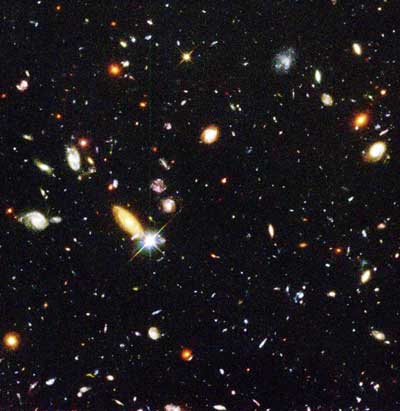
There are, I think, two driving forces behind much of religious thought: fear and despair. The despair comes from the idea that human lives and human achievement are without meaning or purpose in a universe without god, a universe where we are the natural result of natural processes on an insignificant and not terribly remarkable part of an insignificant and not terribly remarkable galaxy lost in a universe that is quite literally inconceivably huge. When you look at an image taken from the Hubble Deep Field camera of a teeny, tiny patch of sky, and you see that everywhere in the universe, as far as you can look, you see not hundreds or even thousands but billions of galaxies, and every one of these galaxies is made up of billions of stars, and we occupy such a tiny sliver of this universe that our entire galaxy could vanish or be destroyed in some kind of cataclysm and the universe would scarcely even notice, some people get all freaked out.

But it’s true.

Every object you see in this picture with the exception of the bright object in the lower left of center (which is a star in our own galaxy) is an entire galaxy. The scale of the universe beggars comprehension, and we feel insignificant.

So the creationists, who never open their mouths without subtracting from the sum of human knowledge, invent a new universe to satisfy their need to feel special. They imagine a tiny universe, a limited universe, a universe only a few thousand years old, a small place containing a world (which is seventy-five percent water) deliberately created just for man (who has no gills). They post videos on YouTube arguing that the hand of god is clearly visible in the banana, which with its convenient wrapper and hand-pleasing shape was deliberately designed by a benificient creator to fit easily in our hand and be eaten–though they ignore contradictory evidence, like, say, the coconut. Or, they argue, since the evolutionary idea on the origin of life claims life can begin when non-living matter is exposed to radiation, then how come life doesn’t spontaneously begin from other non-living matter, like peanut butter?

It’s easy to mock creationists; they’re just so cute when they pretend to be scientists! But their folly isn’t born of stupidity; it’s a product of the very human need to feel special and significant.


When you add the Void to the mix, the problem becomes even greater. Human beings have the cognitive tools to generalize from their experiences and make predictions about future events, and that gives us the capacity to realize that one day we are going to die. Facing the Void is, for many people, the very embodiment of stark raving terror. We are going to die. There will come a day when we will be gone, and there is nothing we can do about it.

So we as a species respond the only way we can: by denying it. We pull the shade down over the Void, and then decorate that shade with an entire bestiary of gods and demons and angels and supernatural forces of all descriptions imaginable who will protect us from the certainty of death. When you look at all the various gods and deities people have worshipped throughout history, all the supernatural beings we’ve ever believed in–the sun gods worshipped by almost all hunter-gatherer tribes; the god Tezcatlipoca of the Aztecs; the various gods of the Egyptian pantheon; the feuding, spiteful divine teenagers of the Greeks; the vengeful, erratic, emotionally volatile god of the ancient Israelites–one thing becomes very, very clear: these gods are all us. All these divinities are distorted, funhouse mirror caricatures of humanity. We pull the shade down over the Void, then project onto it ourselves. All our fears, desires, petty insecurities, all our need for conformity and control, all these things are reflected in the gods and demons and pixies and faeries we invent. All these dim, distorted projections, created to convince ourselves that the Void is not real.

And it works. The first time I was confronted by the Void, at about thirteen years old, the thought of going to heaven was the only comfort I could find. When I lost that, I lost my only defense against the Void, and that’s not easy to do. These crazy funhouse projections serve a purpose.


But there is a price to pay for this comfort, one that I suspect many people aren’t even consciously aware of.

Part of that price is truth. If one cares passionately about the truth, one can not help but notice that every time a religious entity has disagreed with empirical science about some matter of empirical fact about the physical world, the religion has been wrong. Every single time, with not one single exception. The creationists seek meaning and purpose by believing themselves to be the favored of a supernatural entity that created the whole of the universe just for us, yet this belief requires them to imagine a universe much smaller and much younger than it actually is. Their need for meaning, their desperate desire to feel special, causes them to adopt the notion that the whole of creation is only six thousand years old (5,997 years, according to Orthodox Judiasm; Fundamentalist Christians put the figure at about ten years older), in spite of massive, overwhelming evidence to the contrary.

And this notion leads naturally to other notions as well, including the idea that humanity, the favored of the divine architect of the universe, can do no wrong. Environmental responsibility? Social responsibility? Outmoded beliefs of godless liberals; we were given divine sanction to do as we please, and that’s exactly what we should do.

God made the universe for us. We are the most important things in all of creation. The world was put here specifically for the purpose of housing us. If we believe this, we will never die; God won’t allow it.

If you don’t matter to God, you don’t matter to anyone.


When people let go of the idea of god, they’re left with a sense of despair. If there is no god–if we are simply the result of natural, mindless forces operating in a universe that is incomprehensibly huge and incomprehensibly ancient, a place that is steered by no divine force and a place where an airless rock is just as good as a planet teeming with life, then what meaning can any of us have? What meaning can any of our struggles and triumphs have? What point is there?

And that attitude, tragically, misses the point entirely.

For you see, if we were made a brief time ago in God’s image and put here for the sole and express purpose of worshipping and exalting God, then what we are now is what we will always be. There is an upward limit on the things we are capable of. We are born disgraced, pale shadows of the original models who fell from that grace, and our job is to struggle through this brief life of misery and tears hoping we somehow manage to do and say the right things so that god will rescue us. We have no purpose other than that which is given to us by god–and looking around, I gotta say it’s not much of a purpose.

But if we are evolved monkeys…

Ah, now things are different. If we are evolved monkeys, if we are the result of natural processes that conspired across a vast sea of time to give rise to sapient, self-directing entities capable of understanding themselves and the physical world, then all bets are off. Now, there is no limit to what we can become. Now, anything within the physical laws of the universe is potentially within our grasp. Now, we have the power we once reserved to our gods; now, we can, through the application of our will, make of ourselves anything we choose to be.

And now we have meaning and purpose far beyond that of crawling around chanting to some insecure creator-god about how great and magnificent he is, and would he please please not strike us dead? Now, we are the part of the universe capable of understanding itself. We are of the universe; we are a part of it, not above it; but we are unique in all the universe we know in that we can understand it. We are aware. We are the universe’s way of understanding itself.

And that is a far more magnificent purpose than telling a child-god over and over again that yes, he’s great, really, he’s great, he’s good, he’s wonderful, no really, he’s great, and we love him, really we do.


There is a saying: “with God, all things are possible.” The saying is false. With God, all things are possible save for rising above our station and becoming anything more than what we are right now.

Without god, however, all things not disallowed by the fundamental laws of physics really are possible. Without god, we make our own meaning and purpose; and that power lets us use the gifts granted to us to transform ourselves and the world around us in any way we want.

This power fills some people with fear. Without god, they say, how will we know what is moral? Without god, they say, what punishment can there be for people who do things that are wrong? To this I say: Your morals, given to you by your belief in god, allow for the most appalling atrocities, historically and today. Your morals teach that some human beings, simply as a result of the way they are born, are inherently unequal to others. The notion that there is one and only one right way to live is the cause of more human suffering, more grief, and more evil than any other single idea in all of human history. This is your morals? Your morals, like your gods, are a distorted mirror of your own prejudices and your own evil. You will not find heaven by backing away from hell; the fear of retribution is not the path to enlightenment.

We don’t always make good choices, it’s true. But we’re still a young race. And I am very optimistic about what we can accomplish.