Look at me, still talking when there’s Science to do!

In which Franklin chokes your friends list…scroll, my byatches! Scroll!

PART I: THE RANT

Every other year, the National Science Foundation does a survey of Americans’ understanding of basic principles of science and basic facts about the physical world. And every other year, the results are disappointing. In 2006, the last year of this exercise in the humiliation of the human species, we learned that about 70% of American adults do not understand what the scientific method is; 60% of American adults believe in psychics and ESP; half of Americans believe that antibiotics kill viruses; and nearly a quarter of all Americans(!) say that the sun moves around the earth, rather than the other way around.

It’s depressing, it is.

And the results from 2006 actually, if you can believe this, show some improvement over results from 2004 and 2002.

The numbers keep getting more miserable, too. A whopping 66% of American adults reject evolution, for example; more on that in a bit.

When these results are combined with other results from surveys on American ideas and beliefs, the gloom deepens. Various polls by CNN purport to show, among other things, that 80% of surveyed American adults believe the US government is hiding knowledge of space aliens, and 70% of American adults still believe that Saddam Hussein played a role in the attacks on the World Trade Center.


This level of anti-intellectualism in US society beggars belief. And it does a lot more than just make us look bad.

Some kooky, anti-intellectualist ideas, such as the notion that NASA faked the moon landings, are frustrating, but in the overall scheme of things not terribly important of and by themselves. Other ideas, such as the conspiracy theory that claims the government staged the World Trade Center attacks, reveal a deep-seated suspicion of government that’s so strong it overrides reason.

But some of these ideas are actively harmful. The ignorance of American adults about antibiotics and viruses means that many folks are inclined to take antibiotics when they can not do any good; overuse of antibiotics can lead to the development of antibiotic-resistant strains of bacteria which are a threat to the public health. Worse, the notion that vaccination is a “myth” used by evil scientists and doctors to “keep people sick” can cause people to refuse to vaccinate their kids, which leads to a susceptible population that offers childhood diseases a handy reservoir.

The “evil scientists” refrain is one that seems to be a common theme in the general voice of American anti-intellectualism. We’re not exactly sure what science is, but we’re sure that the people who do it are bad, motivated by dark, sinister goals of–I don’t know, keeping people sick or something. Whether it’s these anti-vaccination activists talking about the AMA or Greenpeace spouting uninformed bullshit about genetic engineering that they know isn’t true (says who? The founder of Greenpeace, no less), an active antipathy of science and scientists is the backdrop against which all of this anti-intellectualism is arrayed.

We even see this in American pop culture.

Video games like Half-Life and Resident Evil start with the same premise: a group of scientists, working together in a secret facility, brings about calamity and disaster; the solution to the problems they create is to go in and shoot stuff with a big gun.

Or a rocket launcher. Or a flamethrower. Or a railgun. Some of the things you use to shoot stuff with are pretty cool. But I digress.


PART II: The Problem

Americans are, by and large, woefully unequipped for rational, analytical thinking. The most basic tools of cognitive bullshit detection are simply not part of people’s toolkits; as a result, the most preposterous of ideas will sail through the minds of many folks unchecked, like a railgun through tissue paper.

Deepak Chopra, a minor star in the constellation of anti-intellectualism, once reacted to the idea that consciousness and personality are emergent phenomena from the physical processes of the brain by arguing that since brains are mostly made of water, saying that a brain is capable of consciousness without some outside spiritual force is like saying a bucket of water is capable of consciousness. This argument is, of course, utterly absurd; it’s a bit like saying since concrete is mostly sand, we can build skyscrapers out of sand. (The other stuff in there, and the physical structure, is important too, Deepak!) his argument was made only slightly more ridiculous when he then went on to say that yes, a bucket of water actually is conscious.

Water appears to be an obsession among certain parts of the New Age spiritualist crowd. One guy actually believes that water responds to human emotions and reads Japanese, and he’ll sell you a cure for cancer based on this “discovery.” If you have six hundred dollars in your wallet and a hole in your head, anyway.


I wish I was making this up, really I do. But, yes, there are folks who believe water has an emotional state. This idea came forth in the public consciousness through the movie What the Bleep Do We Know, a film that does for anti-intellectualism what Die Hard did for action-adventure flicks.

In this marvelous (for some value of “marvelous”) movie, we learn (among other things) that water “absorbs” human emotions. There’s this guy, you see, who turns out to be a friend of the producer, and he says that you can write emotionally-charged words on paper and wrap the paper around glasses of water, then you can freeze the water, you see, and the emotional “energy” will be absorbed by the water and change the crystals. Negative emotions, see, produce ‘ugly’ crystals; positive emotions produce ‘pretty’ crystals. This actually sounds plausible to enough folks that this guy sells a wide range of products, from books and CDs about emotional water to geometrically “clustered” water (at $35 a bottle) to gadgets that put your personal emotional energy into your food and water in order to make it better for you.

This shambling wreck of a movie communicates its message in an indirect way, by exploiting its audience’s fuzzy understanding of basic scientific processes and principles. It leads its viewers to factually incorrect conclusions by presenting factually accurate statements with careful framing intended to create inferences that aren’t true; for example, it talks about quantum mechanics and how the presence of an “observer” can influence a quantum state, then talks about the way our minds and emotional states can influence our immune system, and leads the reader to draw the conclusion that our minds can directly affect the physical world on a quantum level (which is not correct) without actually saying so directly.

To do this, it relies on ambiguities and fuzzy grasp of scientific terminology. Folks believe they know what the word “observer” means; when they hear it, they think of a person standing there looking at something. To a scientist, though, a person is not an observer; an observer is any particle which interacts with the observed system in a way that’s thermodynamically irreversible. The image that springs to mind when folks hear the word “observer” is wrong; the movie counts on this to lead the audience to a conclusion that is also wrong.

Profitable, though. The machines that program “emotional energy” into your water will set you back about $2500 US (plus tax and shipping).


One of the biggest problems facing anyone who cares about science and reason is the fact that folks sincerely believe they understand the concepts they’re grappling with, even when they do not. One thing I’ve seen is that everyone everywhere believes, truly believes, that he understands both quantum mechanics and evolutionary biology, while in reality, they don’t.

Nowhere is the gap between a person’s perceived understanding of a subject and the actual tenets of the subject as irritating as it is with evolution. I have met many people who passionately reject, even hate, the idea of evolution, but I have not yet met one who can explain what evolution is.
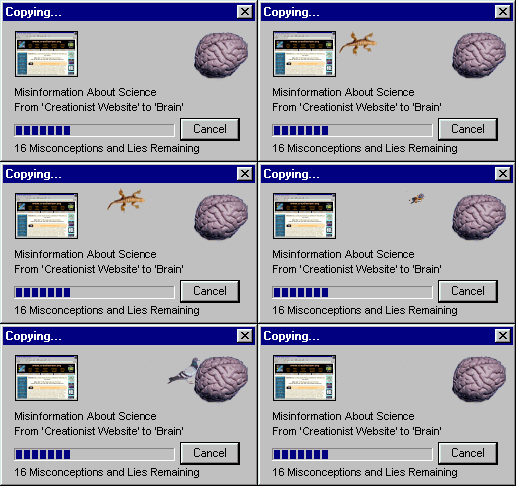
The list of misconceptions about evolutionary biology is endless. I could talk for days about the number of things folks think evolution says that it doesn’t, but then both you and I would be here for days, and I’m sure neither of us wants that. So in no particular order, some of my favorites:

– Evolution says there is no god. False; evolution says nothing abut god whatsoever, any more than astronmy, low-temperature physics, or agriculture say anything about god. Evolutionary biology (and geology and physics and astronomy and chemistry and astrophyscis and…) says that the world is more than six thousand years old, but it is silent on the subject of god.

– Evolution says that one species can change into another species, like a cow can change into a horse, but this has been proven false because there are no half-cow, half-horse creatures running around. Again, false; evolution says something completely different, which is that a a group of organisms that’s isolated and subject to adaptive pressure can and will change over time, to the point where it no longer belongs to the same species as the originals…but this process is extremely gradual, and does not at any time result in the birth of a creature halfway between one species and another. Eventually, given the right conditions, the right adaptive pressure, and the enough time, an initial population of cows might give rise to organisms that fill the same ecological niche that horses fill now, but a half-cow, half-horse will never exist.

-Evolution is about survival of the fittest; an organism that gets a mutation will spread it if the mutation helps it survive, and will not spread it if it doesn’t. Evolution relies on good mutations happening; the fact that there are bad mutations proves it doesn’t work. False; evolution is about the propagation of traits that allow the organism which holds them to reproduce. It doesn’t rely on mutation in the X-Men sense of the word; what it needs are a population whose members are different from one another, it needs for those variations to be inheritable, and it needs for those variations to determine, to some extent, reproductive success. That’s it.

If an organism has tentacles, and some have longer tentacles than others, and the ones with longer tentacles are more likely to reproduce, then over time the average tentacle length in the species will increase. It’s important to understand that a particular trait does not need to kill its inheritor to be selected against, and does not need to increase the odds of survival to be selected in favor of. It only needs to have an effect on reproduction. Even a tiny one. A trait that makes its possessors die younger but increases the odds that they will bear offspring by 0.001% will still be selected in favor of. Sometimes, the things that cause an organism to be more likely to reproduce don’t necessarily have anything to do with survival at all!

– For a structure to evolve, it must arise from simpler structures. If the eye evolved, it couldn’t evolve all at once. We should see creatures with half an eye. True; and we do. Very simple creatures like parasitic roundworms don’t have eyes; they have eyespots–simple clumps of cells slightly sensitive to light. That’s it. More advanced invertebrates have cup-shaped eyespots–a tiny improvement since they can get a general sense of the direction light is coming from, but still not an eye. Squid have round eyes lined with light-sensing cells, but they act like pinhole cameras–there is just a hole in front. No iris, no lens, no cornea, no eyelid. More complex fish have a lens but still lack a cornea or eyelid. Reptiles like snakes have an eye with a lens and cornea, but no lid–the eye is behind a special transparent scale. And so on.

– Science says we are more highly evolved than other organisms. False; evolution is not goal-directed, and every species, including ours, continues to be subject to adaptive pressure all the time. The virus that causes HIV, which evolves very quickly, could reasonably be said to be “more evolved” than we are!

– Evolution says all life is random, but if you mix chemicals at random, you don’t get life. False, and very annoying; it’s hard to understand where the notion of “evolution = random” even comes from, it’s so far off the mark. Evolution is about preserving structures and about natural selection, which is a most decidedly unrandom process. When you mix a bowl of chemicals, or parts of a watch, there is no mechanism that preserves increases in order; yet this is exactly what inheritance does.

– Science says that things go from an ordered state toward greater and greater states of disorder. Evolution violates thermodynamics. Which is what happens when folks take one thing they don’t understand, thermodynamics, and apply it to something else they don’t understand, biology. Entropy and disorder increase in a closed system, but this planet is not a closed system. If you add energy to a system from the outside, order in that system can go up. The earth has energy coming in from the outside…from the sun.

Ignorance about a topic leads to misunderstanding and misinformation about that topic. Sadly, though, it also leads to an inability to assess how much one knows about a topic, so those who most profoundly misunderstand something, like evolutionary biology or the Van Allen radiation belts (those bugaboos that the moon landing hoax nutters like to trot out as “proof” that visiting the moon is impossible), the less likely one is to know that they don’t understand it.

Which leads into…


PART III: WHAT TO DO ABOUT IT

“But I’ve done the research!” folks will wail, when one attempts to say that, no, vaccination isn’t a myth, or yes, the World Trade Center was brought down by commercial aircraft, or no, NASA didn’t fake the moon landings.

“I’ve done the research!” In fact, someone once told me this while trying to argue that vaccination is a hoax perpetrated by evil doctors. “I’ve done the research, and I know it’s true!”

This person does not know what the “immune system” is or how it works. She does not know the role that various parts of the immune system play in fighting disease. She does not know the difference between a virus and a bacteria, nor does she know the basic theory by which vaccines operate. So I think it’s reasonable to say that she has not, in any way, “done the research” to gain the cognitive tools necessary to evaluate claims about immunology.

This is something one sees often–people who, sincerely and without intentional deceit, believe they have “done the research” to support some proposition about which, even after the “research” has been done, they actually know absolutely nothing. The majority of folks–including, I bet, some people reading this right now–believe that looking for arguments which support one’s idea is “research.”


There’s a book I like to talk about. It’s called How We Know What Isn’t So: The Fallability of Reason in Everyday Life. It’s a very, very dry book; the author’s writing has the charm and wit of a robot wearing a pair of knit booties…but it’s an extraordinarily informative book. A chapter of the book is dedicated to the tendency of folks, when trying to support or refute an argument, to look only as far as the first idea that supports their position but no further. People believe this is “research”–you look for someone who says something that appears on the surface to support your position, then look no further than that.

I think this idea of “research” is one that our educational system does nothing to dispel. I’m sure most of you reading this have at one point or another been told to do a “research paper,” and most likely you were told that “research” means finding a list of folks who agree with your position, then citing those folks in the appropriate way. Guess what? That’s not research. When you do this, you will tend to look no deeper than the initial arguments that support your idea, and you certainly won’t investigate the validity of those arguments.


A wonderful example of this approach to “research” just recently popped up in a conversation I was involved in about the notion that pornography “causes” violence and rape. There are two factoids that the folks who see a casual relationship between porn and rape like to trot out, and you’ll see the littered all over anti-porn Web sites. Both factoids are statistical. The first is that Alaska has the highest per-capita rate of readership of men’s magazines in the nation, and also the highest per-capita incidence of violence, including rape, in the US. The second concerns Oklahoma City; in 1985, the city closed 150 porn shops and violent crime, including rape, decreased dramatically, while rising elsewhere in the state.

On the surface, these arguments might seem convincing. Deeper investigation, though, causes them to fall apart.

You see, Alaska has the highest per-capita readership of men’s magazines in the country. It also has the highest incidence of alcoholism, and the second highest rate of unemployment. Both alcoholism and unemployment are strongly and positively correlated with violence; higher incidence of both are tied to higher incidence of violent crime. When one controls for other factors such as unemployment and other statistical correlaries to violence, one actually finds a negative correlation between porn and violent crime; that is, higher rates of porn correlate, unintuitively, to lower rates of rape and violence.

The Oklahoma City claim is also flawed–or at least, incomplete. The two facts as stated are true: in 1985, Oklahoma City shut down their porn stores, and subsequently, incidence of violence and rape decreased. But further investigation reveals a lot was going on in Oklahoma City at the time: namely, in response to a homicide rate that was one of the worst in the nation, Oklahoma City introduced a number of sweeping anti-crime measures. They hired more police (itself statistically correlated to decrease in violent crime); started their first narcotic detection unit; and initiated a purge of corruption and fraud in the police departments. A reasonable person might conclude that these factors played a role in the subsequent reduction in crime.


There is a lesson here. Skepticism applies first and most importantly to arguments which support one’s ideas. The scientific method is fundamentally a technique of doubt; a scientist tries to disprove his idea, not prove it; the more it resists debunking, the more faith can be placed in it. Research does not consist of finding arguments in support of one’s idea. To “do the research,” look for facts that do not support your idea. Place value only in ideas which resist your most vigorous efforts to debunk them. If you believe that vaccination is a plot, and you read a book that says vaccination is a plot, you have not done the research.

This is a learned cognitive tool. That’s bad news and good news. It’s bad news because it does not come naturally; in fact, it’s precisely the opposite of what our instincts tell us to do. It’s good news because, really, it’s a simple tool; anyone can learn it. And that one tool opens the door to obtaining a whole new cognitive toolkit of bullshit detectors.

Maybe there’s hope for us after all.

Oh, for God’s sake…

…all the rhetoric about “revolution” and how he’s different from all the others, and Ron Paul is just another anti-intellectual, anti-science creationist nutjob. Are there any Republican politicians anywhere who aren’t ignoramuses?

Whee! I made Carnival of the Godless!

My post on why I’m an optimist made it onto this month’s Carnival of the Godless, a biweekly roundup of blog posts and articles related to atheism. I’m #2 on the list, and just above some entries on Greta Christina’s blog, which if you’re not reading you should be.

I first encountered Greta Christina’s blog via datan0de. joreth did likewise, and from her blog found the Carnival of the Godless. She sent me the link, I thought it was teh awesome, and now they’ve linked to something I wrote. Small world, eh?

What is it about Texas?

Is the entire state insane? Retarded? Just really really dumb?

OK, so as most everyone on the Internets knows by now, the fine citizens of Waco, Texas booed Bill Nye for saying that the moon reflects the sun’s light and doesn’t produce light of its own. One woman reportedly hauled her kids from the auditorium and shouted “We believe in God!” or some such thing.

Well, okay, that’s Waco, the smelly end of the Bible Butt Plug.

So, today I got a spam email advertising a stock–you know, typical stock pump-and-dump scam. Get about six or eight of ’em a day. Only…

Only this particular stock scam spam originated from a computer with an IP address of 70.248.29.2.

A compromised Windows PC running some virus or other, you say? Oh, my no. 70.248.29.2 is www.webbcountytx.gov — the official site of the county government of Webb County, Texas.

Apparently, the fine citizens of Texas know as much about server security as they do about cosmology.

(Note: nobody from Texas was harmed in the making of this post.)

Jesus Christ, Metrosexual!

Sunday, dayo and I staggered out of bed at the ungodly hour of noonish or so, after a rousing and lively Saturday evening that included, among oter things, meeting many cool people and chaining dayo up in a sling. We were awaiting the arrival of cunningminx, who’d promised to be by in about half an hour, so were quite surprised (and scrambling to fix the indecent states our states were in, being indecent and unclothed) when the doorbell rang some five minutes later. “But…but…she promised us half an hour!”

Was it cunningminx? Oh, no. It was a babble of Jehovah’s Witlesses, come to preach the good news that a Zombie Messiah had risen from the dead to pardon us from a collective sin visited upon us when a woman made out of a rib was persuaded by a talking snake to eat an apple.

Anyway, they left some literature, which included on its cover this picture of Christ the Messiah:

The first thing I couldn’t help but notice is that, my, that Jesus looks awfully Caucasian for a Middle Eastern Jew. cunningminx also observed that he clearly uses Product in his hair, and his beard is remarkably neat for a person living in the desert in a pre-industrial society.

He’s got great teeth, too.

I had no idea that Jesus was a metrosexual. The things one can learn from Watchtower publications…why, they’re nearly as informative as Chick tracts!

Why I Am an Optimist

On the drive down to Florida Poly Retreat a few weeks back, I had an epiphany.

You see, I’ve always harbored a not-so-secret desire to crush the earth beneath my iron boot, but in the past twoscore years, I’ve made very little progress toward realizing that goal. And it occurred to me why that is. I’m actually very optimistic about the state of humanity, and unbridled optimism about the human condition doesn’t lend itself to the kind of monomaniacial dedication required of a true James Bond-class villain.

There is a reason I am an optimist. That reason emerges directly from the fact that I do not believe in god.


This might seem, at first glance, to be something of a contradiction. Many people cling to a belief in some kind of divine, personally involved caretaker high up in the sky precisely because it’s the only way they can find optimism and not despair. There’s even a Web site set up by a Fundamentalist Christian organization that is organized around the idea “if you don’t matter to God, you don’t matter to anyone.” The site is advertised by banner ads like this one, showing some gangster wannabe who, without God, presumably has no reason not to blow your punk ass away:

I find this attitude, that without god there is no morality and no meaning or purpose in life, very, very interesting…more for what it says about the people who subscribe to it than for anything else. The Web site that this banner advertises is strongly anti-evolution and pro-creation, and I think that’s extremely telling.


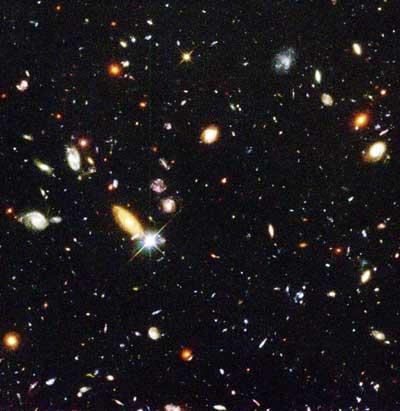
There are, I think, two driving forces behind much of religious thought: fear and despair. The despair comes from the idea that human lives and human achievement are without meaning or purpose in a universe without god, a universe where we are the natural result of natural processes on an insignificant and not terribly remarkable part of an insignificant and not terribly remarkable galaxy lost in a universe that is quite literally inconceivably huge. When you look at an image taken from the Hubble Deep Field camera of a teeny, tiny patch of sky, and you see that everywhere in the universe, as far as you can look, you see not hundreds or even thousands but billions of galaxies, and every one of these galaxies is made up of billions of stars, and we occupy such a tiny sliver of this universe that our entire galaxy could vanish or be destroyed in some kind of cataclysm and the universe would scarcely even notice, some people get all freaked out.

But it’s true.

Every object you see in this picture with the exception of the bright object in the lower left of center (which is a star in our own galaxy) is an entire galaxy. The scale of the universe beggars comprehension, and we feel insignificant.

So the creationists, who never open their mouths without subtracting from the sum of human knowledge, invent a new universe to satisfy their need to feel special. They imagine a tiny universe, a limited universe, a universe only a few thousand years old, a small place containing a world (which is seventy-five percent water) deliberately created just for man (who has no gills). They post videos on YouTube arguing that the hand of god is clearly visible in the banana, which with its convenient wrapper and hand-pleasing shape was deliberately designed by a benificient creator to fit easily in our hand and be eaten–though they ignore contradictory evidence, like, say, the coconut. Or, they argue, since the evolutionary idea on the origin of life claims life can begin when non-living matter is exposed to radiation, then how come life doesn’t spontaneously begin from other non-living matter, like peanut butter?

It’s easy to mock creationists; they’re just so cute when they pretend to be scientists! But their folly isn’t born of stupidity; it’s a product of the very human need to feel special and significant.


When you add the Void to the mix, the problem becomes even greater. Human beings have the cognitive tools to generalize from their experiences and make predictions about future events, and that gives us the capacity to realize that one day we are going to die. Facing the Void is, for many people, the very embodiment of stark raving terror. We are going to die. There will come a day when we will be gone, and there is nothing we can do about it.

So we as a species respond the only way we can: by denying it. We pull the shade down over the Void, and then decorate that shade with an entire bestiary of gods and demons and angels and supernatural forces of all descriptions imaginable who will protect us from the certainty of death. When you look at all the various gods and deities people have worshipped throughout history, all the supernatural beings we’ve ever believed in–the sun gods worshipped by almost all hunter-gatherer tribes; the god Tezcatlipoca of the Aztecs; the various gods of the Egyptian pantheon; the feuding, spiteful divine teenagers of the Greeks; the vengeful, erratic, emotionally volatile god of the ancient Israelites–one thing becomes very, very clear: these gods are all us. All these divinities are distorted, funhouse mirror caricatures of humanity. We pull the shade down over the Void, then project onto it ourselves. All our fears, desires, petty insecurities, all our need for conformity and control, all these things are reflected in the gods and demons and pixies and faeries we invent. All these dim, distorted projections, created to convince ourselves that the Void is not real.

And it works. The first time I was confronted by the Void, at about thirteen years old, the thought of going to heaven was the only comfort I could find. When I lost that, I lost my only defense against the Void, and that’s not easy to do. These crazy funhouse projections serve a purpose.


But there is a price to pay for this comfort, one that I suspect many people aren’t even consciously aware of.

Part of that price is truth. If one cares passionately about the truth, one can not help but notice that every time a religious entity has disagreed with empirical science about some matter of empirical fact about the physical world, the religion has been wrong. Every single time, with not one single exception. The creationists seek meaning and purpose by believing themselves to be the favored of a supernatural entity that created the whole of the universe just for us, yet this belief requires them to imagine a universe much smaller and much younger than it actually is. Their need for meaning, their desperate desire to feel special, causes them to adopt the notion that the whole of creation is only six thousand years old (5,997 years, according to Orthodox Judiasm; Fundamentalist Christians put the figure at about ten years older), in spite of massive, overwhelming evidence to the contrary.

And this notion leads naturally to other notions as well, including the idea that humanity, the favored of the divine architect of the universe, can do no wrong. Environmental responsibility? Social responsibility? Outmoded beliefs of godless liberals; we were given divine sanction to do as we please, and that’s exactly what we should do.

God made the universe for us. We are the most important things in all of creation. The world was put here specifically for the purpose of housing us. If we believe this, we will never die; God won’t allow it.

If you don’t matter to God, you don’t matter to anyone.


When people let go of the idea of god, they’re left with a sense of despair. If there is no god–if we are simply the result of natural, mindless forces operating in a universe that is incomprehensibly huge and incomprehensibly ancient, a place that is steered by no divine force and a place where an airless rock is just as good as a planet teeming with life, then what meaning can any of us have? What meaning can any of our struggles and triumphs have? What point is there?

And that attitude, tragically, misses the point entirely.

For you see, if we were made a brief time ago in God’s image and put here for the sole and express purpose of worshipping and exalting God, then what we are now is what we will always be. There is an upward limit on the things we are capable of. We are born disgraced, pale shadows of the original models who fell from that grace, and our job is to struggle through this brief life of misery and tears hoping we somehow manage to do and say the right things so that god will rescue us. We have no purpose other than that which is given to us by god–and looking around, I gotta say it’s not much of a purpose.

But if we are evolved monkeys…

Ah, now things are different. If we are evolved monkeys, if we are the result of natural processes that conspired across a vast sea of time to give rise to sapient, self-directing entities capable of understanding themselves and the physical world, then all bets are off. Now, there is no limit to what we can become. Now, anything within the physical laws of the universe is potentially within our grasp. Now, we have the power we once reserved to our gods; now, we can, through the application of our will, make of ourselves anything we choose to be.

And now we have meaning and purpose far beyond that of crawling around chanting to some insecure creator-god about how great and magnificent he is, and would he please please not strike us dead? Now, we are the part of the universe capable of understanding itself. We are of the universe; we are a part of it, not above it; but we are unique in all the universe we know in that we can understand it. We are aware. We are the universe’s way of understanding itself.

And that is a far more magnificent purpose than telling a child-god over and over again that yes, he’s great, really, he’s great, he’s good, he’s wonderful, no really, he’s great, and we love him, really we do.


There is a saying: “with God, all things are possible.” The saying is false. With God, all things are possible save for rising above our station and becoming anything more than what we are right now.

Without god, however, all things not disallowed by the fundamental laws of physics really are possible. Without god, we make our own meaning and purpose; and that power lets us use the gifts granted to us to transform ourselves and the world around us in any way we want.

This power fills some people with fear. Without god, they say, how will we know what is moral? Without god, they say, what punishment can there be for people who do things that are wrong? To this I say: Your morals, given to you by your belief in god, allow for the most appalling atrocities, historically and today. Your morals teach that some human beings, simply as a result of the way they are born, are inherently unequal to others. The notion that there is one and only one right way to live is the cause of more human suffering, more grief, and more evil than any other single idea in all of human history. This is your morals? Your morals, like your gods, are a distorted mirror of your own prejudices and your own evil. You will not find heaven by backing away from hell; the fear of retribution is not the path to enlightenment.

We don’t always make good choices, it’s true. But we’re still a young race. And I am very optimistic about what we can accomplish.

The Face of American Evangelical Christianity

Ganked from various places on my friends list. First up, this charming little gem, where a woman asks for the divine blessings of the all-powerful, supreme creator of the Universe upon her PowerPoint presentation, because Satan wants to screw it up:

Look, lady, if you actually had the direct, immediate, and personal attention of Satan, I rather think you’d have bigger problems than PowerPoint crashing. Read the book of Job.


Next up: Evangelical Christians teach young children to worship idols of George W. Bush:

I’m reasonably sure the ancient Israelites wrote something about idol worship. What was it again? I forget. No matter; at least when you worship an idol, you’re praying over something you can actually see and feel and touch, which is three benefits over worshipping an invisible abstract thing up in the sky somewhere…

Why I am not a Buddhist

I asked myself, was I content
With the world that I once cherished?
Did it bring me to this darkened place
To contemplate my perfect future?
I will not stand nor utter words against
This tide of hate
Losing sight of what and who I was again

I’m so sorry if these seething words I say
Impress on you that I’ve become
The anathema of my soul

As I was waiting for the battery in my car to be replaced, I bought a Twix bar from the repair shop vending machine.

Now, I love Twix bars. I mean, I really love Twix bars. There is something…unwholesome about the way I love Twix bars. The chocolate layer, the caramel, the crisp cookie crunch…it’s enough to bring a grown man to tears.

I was disappointed by the Twix bar that I bought. At some point in its life, somewhere ‘twixt the factory and my hands, it had been exposed to very high heat. The caramel layer had melted and oozed out the bottom of the bars in a gooey puddle, leaving behind a thin and feeble layer of half-melted and congealed chocolate over a partly denuded cookie center. It was a hollow mockery of a Twix bar, a Twix bar that had shuffled off this mortal coil before it even had time to live.

But I didn’t come here to talk about candy bars. I came here to talk about Buddhism.


I can’t say that you’re losing me
I always tried to keep myself tied to this world
Though I know where this is leading
Please, no tears, no sympathy
I can’t say that you’re losing me
But I must be that which I am
Though I know where this could take me
No tears, no sympathy

In some small way, my desire for a Twix bar brought me unhappiness. The Twix bar I bought did not meet my expectations, and as a result, it did not bring me joy.

Buddhist philosophy correctly predicts my unhappiness. Buddhism teaches, and quite rightly, that the experience of life is the experience of suffering. This suffering, it says, comes inevitably from desire; when one desires that which one does not have, or when one has that which one does not desire, the result is suffering.

It’s hard to find fault in that idea. I could, as a minor quibble, argue that the source of suffering is not desire of and by itself, but rather the difference between one’s expectations and reality; I expected my experience with the Twix bar to be something other than it was, and I was disappointed. Had I had no expectations at all, the Twix bar may actually, when judged on the merits of what it was rather than what I expected it to be, have been quite good.

But that’s really a trivial complaint. The fact is, desire and expectation do lead to suffering, because we can not always expect to have what we desire, nor have the world match our expectations.


Gracefully, respectfully
Facing conflict deep inside myself
But here confined, losing control
Of what I could not change

Gracefully, respectfully
I ask you, please don’t worry, not for me
Don’t turn your back, don’t turn away

When viewed through this lens, the Four Noble Truths of Buddhist thought seem quite reasonable. Nobody likes to suffer; suffering and sorrow and grief are painful burdens, that grind down the human soul and sometimes make the experience of being human unbearable.

Buddhism teaches that freedom from suffering comes through disengagement. If desire results in suffering, then the way out of suffering is to desire nothing. By practicing this, a person can seek to free himself from the endless cycle of suffering resulting from birth, death, and rebirth, and become enlightened. Once the attachment to the world, with its attendant desire, is released, the enlightened Buddhist frees himself from suffering.

And if this is enlightenment, I want nothing to do with it.


It’s hard to say that the Buddhists have it wrong. One need only look around to see that the world looks as if it has been left in the custody of a pack of trolls. A litany of the evils of mankind is at once horrifying and clichéd; we have lived shoulder to shoulder with evil for so long that even talking about it seems banal. Engaging the world invariably brings pain and misery; we are so steeped in it that it cannot be any other way.

And yet… and yet…

And yet the flip side of that very coin is the fact that broken desire and unmet expectation is the necessary driving inspiration behind the impulse to do good.

Desire and expectation lead to sorrow and suffering, but in that sorrow and suffering is the incentive that prods us to seek to make more than what exists now, to become more than what we are today. The drive to better ourselves and the world we live in has at its core that very dissatisfaction the Buddhist philosophy sees as the source of all suffering.


Sometimes, it seems to me that Buddhist thought, when viewed from a certain angle, is the philosophy of nihilism. The world is a wretched, miserable place, it says, and engaging it will only bring you sorrow; best, then to transcend it, to disengage from it, to step away from that which you desire, lest your desire cause you pain.

That strikes me as a tacit, perhaps unconscious acceptance that the world as it is now is irredeemable. The world is beyond hope; the only reasonable answer is to forfeit the game, be quit of the whole affair. The Noble Eightfold Path is a road away from the world, teeming with refugees seeking to separate themselves from it.

To that, I say, no.


The world looks as though it has been left in the custody of a pack of trolls, it is true. The world rarely lives up even to the most modest of expectations, and the rift between one’s expectations and the unpleasant and often evil reality is a source of suffering. But that is not all there is. In that suffering, we can find the power to oppose evil, and to bend reality to our will. We are not impotent. Indeed, with every passing year, our knowledge increases, and with it increases our power to remake the world into something better.

Evil exists. Suffering exists. The world is shaped often by twisted and corrupt people, people of low ways and mean spirits. But it is shaped also by those who desire to do good–and the desire to do good may bring pain, but it also brings hope, and joy. It is only by engaging the world that we can leave our mark upon it, and by leaving our mark upon it we can know joy that is beyond all measure.

The Buddhist says, the world is not okay. Turn away; leave the world behind you; disengage from it. I say, the world is not okay, and that is why we must engage it, for only by engaging it can we ever hope to make it okay.

Richard Dawkins is my hero

Courtesy of datan0de, Richard Dawkins argues against the existence of an involved and personal God, and argues strongly in favor of the value of truth.

I love, love, love this man. “Nothing wrong with being happy, but some of us feel that being truthful…is better than living a lie… If you believe that God told you to invade Iraq…having that kind of unshakable conviction can be very dangerous in a politician.”

The interview concerns the book The God Delusion, which is now on my Amazon wish list.

A list of pointers to other posts…

…because I haven’t the time to post the things I want to post myself, about Dragon*Con and spinning poi and BDSM and the TV show “Battlestar: Galactica” as an anti-transhumanish meditation…

First, a post on the nature of resentment by lefthand.

“Resentment or the act of deliberately provoking negative emotions by focusing on them is powerful magic. Carefully applied, resentment can destroy friendships, marriages, businesses and all other human activities. Resentment is capable of overcoming all obstacles and eliminating connections. Resentment gains its power by a deliberate disconnect from reality. It ignores all contradictory input and focuses on egregious, insulting and humiliating aspects.”

Go read it. Seriously. It’s good stuff.


Next up, this beautiful little musing on desire and avarice by jane-etrix. She writes about everything this well.


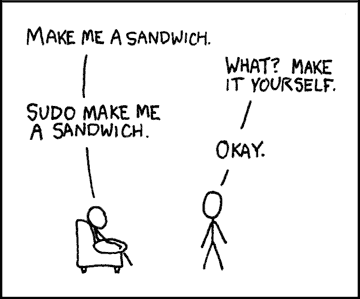
Geek humor: I do not believe I have seen anything in at least six months quite as funny as this. It helps to know that in Unix, “sudo” means “superuser do.” It runs a command as ‘superuser’–that is, it runs that command as though the person issuing the command were logged in as root, with unrestricted authority to take any action on the system.

[Edit] Here’s the image, and yes, it really is that funny.


Every religion has its ‘miracles,’ where the face of Jesus appears in a cabbage or the name of Allah materializes on a rusty bucket or some damn thing. Nothing can comare, though, to the visceral, undeniable appearance of the Flying Spaghetti Monster in the sky. We are all touched by his noodly appendage!


And finally, datan0de points out that August 29 is in fact Judgment Day. Hail the rise of the machines!