Some thoughts on Dolly Parton and kindness

A new billboard appeared recently next to the grocery store where I do most of my shopping.

Image by author

I don’t mean the “now leasing” sign, but the one next to it. The one with the country singer on it.

Back when I was in middle school in Venango, Nebraska, I didn’t know a thing about Dolly Parton except that she apparently had large breasts. I might have vaguely known that she was in a band or something, maybe, but I couldn’t put a face to the name. I knew she had big boobs because all the other kids told me she had big boobs, and if all the other kids are saying something, like they put spider eggs in bubble gum or whatever, you know it’s probably true.

We would get together at recess and tell Dolly Parton jokes, all of them dirty (at least by the standards of a fifth-grader; ah, how little I knew!) and all of them about her breasts.

As I moved into adulthood, I learned that yes, she was a singer, she sung country and western songs, and she had that one hit because of that one movie everyone liked but I didn’t see. I don’t listen to country and western music, so that was about the sum total of my knowledge of all things Dolly Parton.

Nowadays, as I learn more about her, she strikes me as a genuinely marvelous person: kind, generous, giving, and genuinely invested in leaving the world a better place than she found it.

I still don’t listen to country music, but by all accounts she seems quite extraordinary. She is that rarest of things in creation: a genuinely compassionate person.

That’s something the world needs in greater quantities.

As I get older, I become more and more aware of the value of kindness. The truth is, callousness is easy. Indifference is easy. Cruelty is easy. The world is filled with people who see kindness as weakness, but in truth, kindness costs more than insensitivity. To be kind is to see the world from someone else’s point of view, and the ego rebels against that. It reminds us we are not the sun-center of all creation.

Empathy: Humanity’s Secret Weapon

Image by author

Pop quiz time. How did human beings—soft, weak, squishy bipeds with no claws, no massive canines, and thin skin—become the dominant mammals on the planet? Survival of the fittest says we should’ve been wiped out by fiercer, stronger, creatures, right?

No.

Our special sauce, beyond our big brains and abstract reasoning, is our cooperation. We work together. We help each other. We tend to our sick and injured. Where one of us goes, the rest follow.

We have each other’s backs.

That makes us unstoppable. There are many creatures larger, stronger, faster, and fiercer than we are, creatures that can take us one on one in a fight, but the thing about humans is it’s never one on one.

You kill one of us, the rest of us will come for you. We are an unstoppable force of nature.

Losers and idiots think that kindness is a weakness because they see the world in terms of the Rugged Individual™, the lone warrior standing strong against a world red in tooth and claw. They don’t see the army that stands behind that Rugged Individual, making his tools and his clothing and his weapons, nor the entire history behind him that brought him to this place. The Rugged Individual stands on the shoulders of others and says “look how I rose to this lofty height all by myself!”

Today, we live in a world increasingly dominated by loudmouth bullies, people for whom the world is always zero sum, people who believe that every interaction has a winner and a loser.

Image: Felix Mittermeier

This attitude appeals to the sort of person who thinks of himself as an Alpha Male™, taking charge through force and strength to leave his mark upon the world, but it’s comedically inept.

And the math is behind it. Entire branches of game theory show that cooperation always wins out in the long run, always…not that the sort of person who sees the world as force against force in a battle royale to the death actually understands the math.

In the end, it comes down to a simple but surprisingly subtle idea: Other people are real. In a world where we act with reciprocal kindness, everyone benefits. We are a social species; we do more acting together than acting alone.

I will admit this has not always been obvious even to me. The Internet makes it easy to forget that other people are real—that the letters we see on the screen come from a real person. I had an experience about ten or so years ago when I met in realspace some people I’d been needlessly abrasive to online, and it occurred to me, holy shit, these folks are actual human beings! Since then, I’ve tried—not always with perfect success—to be more mindful in my online communication.

Bullying is easy. Especially when it’s anonymous, and most especially when it curries favor in our social in-groups. We live in a world where kindness and compassion are increasingly seen as weakness. Let us not forget that it is cooperation that carried us here.

Be kind.

New sticker available

Price: free (donations accepted but not required). I only have a few, but there are more on the way.

The Resist stickers are also back in stock, though I expect to run out of them quickly again.

Get them here!

Update on the Resist stickers

I had no idea, when I designed the Resist sticker, that it’d touch such a nerve. My first shipment disappeared in less than two hours. I’m getting messages and emails every day asking when there will be more, so here’s an update:

The first batch have now all been shipped out.

If you ordered five or fewer, you’ll get them soon. You should’ve received a confirmation email in the past few days that your stickers shipped, but unfortunately some of the confirmation emails bounced as spam, so they may not have gone through.

If you ordered ten or fewer before the shopping cart showed zero left, then you’ll also have them soon.

If you ordered more than 10, you will only get ten in the first mailing. If you ordered more than ten after the shopping cart showed zero left, I’ll send some out when the new ones arrive.

Yes, there are more on the way.

The second design will be here next week. Alas, I had no idea what to expect, so I didn’t order very many, only 175. I expect it to be gone the same day it’s available. I’ve ordered more of that design as well.

I’ve made changes to the shopping cart.

My shopping cart fell over under the load. People were seeing weird error messages, or couldn’t check out, or the cart wouldn’t load at all. I’ve completely rebuilt it from the ground up; it still looks the same but it’s running new software underneath that should be a lot more reliable.

Dozens of people asked if there’s a way to tip me.

I’ve added the ability to include a tip in the new shopping cart. For free stickers this is 100% optional, but it’s there if you want it.

I’ve also received a number of donations on PayPal and Venmo. Thank you all so much, it’s been incredible to learn how many people want to support this idea. All of the donations I’ve received, every penny, have gone into ordering more stickers. I have about 1200 stickers on the way that should be here by the end of the month.

Many of you, like over a dozen of you, have messaged to ask if there’s a way to get the stickers in quantities of 100 or 200 or more.

I didn’t make any provision for that because I honestly had no clue so many of you would get behind this project. So, I’ll be making changes to the shopping cart to add a provision to order in bulk. I plan to charge my own cost for this and ship the stickers to you directly from the company that makes them. The price will likely be around $35 for 100 or $45 for 150.

I will need to limit quantities for free stickers.

I’m really sorry. I had no idea this was going to blow up. The Resist stickers will be limited to 10 at a time for free orders or 3 at a time for the first batch of the new design, which I’ll post here and on social media when it arrives.

A bunch of people have asked me if I can make the design available in pins or clothing or other formats.

I’m looking into doing this. I won’t be able to offer free pins and such, so what I’ll likely do if I can find a good vendor is make things like pins, clothing, and holographic stickers a nominal charge (I’m not looking to make a profit from this project), but continue to keep the vinyl stickers free.

Thank you all so much for the incredible support. I can’t tell you how deeply gratifying it is to know I’m not the only one who feels the way I feel about what’s happening to our country right now.

Resist

I’ve been having trouble sleeping.

It’s heartbreaking to see the country gutted and its values torn apart by a fat psychopath in bad makeup, and even more heartbreaking to know that a third of the country voted in favor of hatred. There was a time when we could believe that people on both sodes of the political aisle wanted what was best for the nation. Now we cannot.

So I’ve been having trouble sleeping. And when I wake at four AM with that despair in the pit of my stomach, I sit down and design stickers. In the past few weeks, I’ve ordered hundreds and hundreds of them.

The first design just arrived today. I have more designs arriving in the next few weeks. I am giving them away to anyone who wants them for free, and when I say for free I mean I will even cover postage in the US (international is $2).

Here’s the first design:

These are four inches by two and a half inches. To give you a sense of how big they are, here’s one on a 15″ laptop:

Want one? Order them for free on my site here. Want a bunch? Let me know and I’ll have 100 of them shipped to you at my cost. Got an idea for a design? I’d love to hear from you.

New designs will be coming soon, so stay tuned.

[Edit] Wow. Um, I didn’t expect that to happen. It took two hours for my entire first production run of Resist stickers to disappear.

To anyone else trying to get one, I’m really, really sorry. I’ve ordered more. It usually takes about two weeks for them to be produced.

If you ordered multiple stickers, I may send you less than you wanted, to make sure there’s enough for everyone else. I’ll let you all know when I have more. In the meantime, I’ll have some new designs soon as well, they’re already in production.

AI: The largest socialist wealth transfer of the past 50 years

A few months back, Elon Musk, the right-wing owner of Twitter and Grok, his pet Generative AI project, posted something I wrote on his Twitter feed, with the caption “This is the quality of humor we want from Grok.”

He even had it pinned to his profile for a short while.

I wrote this over on Quora in March of 2024. On the one hand, it’s interesting to know that Elon Musk reads my stuff. On the other, do you notice anything funny about the screenshot of his Tweet?

Yup, no credit.

The Tweet went viral, and has since been posted all over Facebook, Tumblr, Twitter, Reddit, and TikTok…all without attribution.

Right now, as I write this, OpenAI, the company behind ChatGPT, has a market cap of $157,000,000,000, making it more valuable than companies like AT&T, Lowe’s, and Siemens.

It is not a profitable company; in fact, it’s burning cash at a prodigious rate. Unlike other companies, though, which burned cash early on to achieve economies of scale, OpenAI’s costs scale directly with size, which is not at all normal for tech companies. At its current rate of growth, in four years its datacenters will consume more electricity than some entire nations.

But I’m not here to talk about whether AI is the next Apple or the next Pets dot com. Instead, let’s talk about what generative AI is, and how it represents the greatest wealth transfer of the last fifty years.

AI is not intelligent. Generative AI does not know anything. Many people imagine that it’s a huge database of all the world’s facts, and when you ask ChatGPT something, it looks up the answer in that immense library of knowledge.

No.

Generative AI is actually more like an immense, staggeringly complex autocomplete. It ingests trillions of words, and it learns “when you see these words, the most likely next words are those words.” It doesn’t understand anything; in a very real sense, it doesn’t even “understand” what words are.

As the people over at MarkTechPost discovered, many LLM models struggle to answer basic arithmetic questions.

AIs make shit up. They have no knowledge and understand nothing; when presented with text input, they produce text output that follows the basic pattern of the input plus all the text they’ve seen before. That’s it. They will cheerfully produce output that looks plausible but is absolutely wrong—and the more sophisticated they are, the more likely they are to produce incorrect output.

If you want to understand Generative AI, you must, you absolutely must understand that it is not programmed with knowledge or facts. It takes in staggering quantities of text from all over and then it “learns” that these words are correlated with those words, so when it sees these words, it should spit out something that looks like those words.

It doesn’t produce information, it produces information-shaped spaces.

To produce those information-shaped spaces, it must be trained on absolutely staggering quantities of words. Hundreds of billions at least; trillions, preferably. This is another absolutely key thing to understand: the software itself is simple and pretty much valueless. Only the training gives it value. You can download the software for free.

So where does this training data come from?

You guessed it: the Internet.

OpenAI and the other AI companies sucked in trillions of words from hundreds of millions of sites. If you’ve ever posted anything on the Internet—an Amazon review, a blog, a Reddit post, anything—what you wrote was used to train AI.

AI companies are worth hundreds of billions of dollars. All that worth, every single penny of it, comes from unpaid work by people who provided content to the AI companies without their knowledge or consent and without compensation.

This is probably the single largest wealth transfer in modern history, and it went up, not down.

There are a few dirty secrets lurking within the data centers of AI companies. One is the staggering energy requirements. Training ChatGPT 4 required 7.2 gigawatt-hours of electricity, which is about the same amount that 6,307,200 homes use in an entire year. (I laugh at conservatives who whine “eLeCtRiC cArS aRe TeRrIbLe WhErE wIlL aLl ThE eLeCtRiCiTy CoMe FrOm” while fellating Elon Musk over how awesome AI is. Training ChatGPT 4 required enough power to charge a Tesla 144,000 times. Each single ChatGPT query consumes a measurable amount of power—about 2.9 watt-hours of electricity.

Image: Jason Mavrommatis

All the large LLMs were trained on copyrighted data, in violation of copyright. Every now and then they spit out recognizable chunks of the copyrighted data they were trained on; pieces of New York Times articles, Web essays, Reddit posts. OpenAI has, last time I checked, something like 47 major and hundreds of smaller copyright lawsuits pending against it, all of which it is fighting. (It might be more by now; there are so many it’s hard to keep up.)

That, I think, is the defining computer science ethical problem of our time: To what extent is it okay to build value and make money from other people’s work without their knowledge or consent?

Elon Musk recognizes the value in what I write. He recognizes that it has both artistic and financial value. He posts my content as an aspirational goal. He doesn’t credit me, even as he praises my work.

That’s a problem.

Those who create things of value are rarely recognized for the value they create, if the things they create can’t immediately be liquidated for cash. That’s not new. What’s new is the scale to which other people’s creativity is commoditized and turned into wealth by those who had nothing whatsoever to do with the work, and are merely profiting from the labor of others without consent.

OpenAI says it would be “impossible” to train their models without using other people’s copyrighted work for free.

“Because copyright today covers virtually every sort of human expression – including blogposts, photographs, forum posts, scraps of software code, and government documents – it would be impossible to train today’s leading AI models without using copyrighted materials. […]

Limiting training data to public domain books and drawings created more than a century ago might yield an interesting experiment, but would not provide AI systems that meet the needs of today’s citizens.”

It also claims their use of other people’s work is “fair use,” even while they admit that chatbots sometimes spit out verbatim chunks of recognizable work. This is a highly dubious claim—while fair use doesn’t have a precise legal definition (the doctrine of fair use exists as an affirmative defense in court to charges of copyright infringement), one of the key components of fair use has always been commercialization of other people’s work…and with a market cap of $157,000,000,000, it’s pretty tough to argue that OpenAI is not commercializing other people’s work. It charges $20/month for full access to ChatGPT.

So at the end of the day, what we have is this: a company founded by people who are neither writers nor artists, producing hundreds of billions of dollars of wealth from the uncompensated, copyrighted work of writers and artists whilst cheerfully admitting that could not produce any value if they had to pay for their training data.

And it’s not just copyrighted data.

OpenAI Dall-e cheerfully spit this image out when I typed “Scrooge McDuck stealing money from starving artist.”

Here’s the thing:

Scrooge McDuck is trademarked. Trademark law is not the same as copyright law. Trademarks are more like patents than copyrights; in the US, trademarks are administered by the Patent and Trademark Office, not the copyright office.

In no way, shape, or form is this “fair use.”

Generative AI recognizes trademarked characters. You can ask it for renderings of Godzilla or Mickey Mouse or Spider-Man or Scrooge McDuck and it’ll cheerfully spit them out. The fact that Dall-e recognizes Scrooge and Spider-man and Godzilla demonstrates without a shadow of a doubt it was trained on trademarked properties.

So far, all the lawsuits aimed at AI infringement have been directed at the companies making AI models, but there’s no reason it has to be that way. You “write” a book with AI or you create a cover for your self-published work with AI and it turns out there’s a trademark or copyright violation in it? You can be sued. That hasn’t happened yet, but it will.

(Side note: The books I publish use covers commissioned from actual artists. Morally, ethically, and legally, this is the right thing to do.)

Why do I call OpenAI and its kin a socialist wealth transfer? Because they treat products of value as a community property. Karl Marx argued that socialism is the transition between capitalism and communism, a system where nothing is privately owned and everything belongs to the public, and that’s exactly how OpenAI and its kin see creative works: owned by nobody, belonging to the public, free to use. It’s just that “free to use” means “a vehicle for concentrating wealth.”

From creators according to their ability, to OpenAI according to its greed.

It seems to me that what we need as a society is a long, serious conversation about what it means to create value, and who should share in that value. It also seems to me this is exactly the conversation the United States is fundamentally incapable of having.

Courage is Grace Under Pressure

Image: prill

I am in London as I write this, sitting in a lover’s flat overlooking the London city skyline. I was here when I learned the news of the 2024 Presidential election—that hate won over love, bigotry over compassion, spite over benevolence.

I understand the sick despair many of us feel in the pit of our stomach right now. Dark times hover on the horizon. I don’t believe the people who voted so resoundingly against the better angels of our nature realize yet what they’ve done. Some of them likely never will, and for those who do, it will be too late.

I’m not here to analyze what happened, or rail against the stubborn streak of vicious, ugly racist misogyny that has long been part of the American spirit. Others are already doing that, some of them quite eloquently, and I do believe there’s value in understanding what happened, but that is not the most important thing right now.

It’s vital to understand going forward, though I think the answer is grubber, more sordid, and more banal than we might otherwise hope: there has always been this vicious streak of mean-spirited, ugly anti-intellectualism embedded deep in the American national character, that has been with us from the start. It has never changed, and it likely never will in our lifetimes. We are simultaneously the land of can-do optimism and sleazy, seedy execration. These are the two faces of the American civic character, and this week, the ignorance won.

But I want to remind everyone reading this that there is hope. Like the dawning of the sun after a night of terror, this too shall pass.

Image: Jessica Ruscello and mixformdesign

I do not wish to trivialize what is to come. Many people will suffer. My trans and nonbinary friends are terrified right now. Two nights ago, a great many decent Americans discovered just how badly their country hates them, just how deep the ugly river of xenophobia flows through the American psyche.

There will be suffering. There will be blood. There will be ugliness, and violence, and hopelessness, and despair. I do not want to minimize any of the grotesqueries we all see on the horizon.

I will, instead, invite us all to take a deep breath, and remember that the course of history is neither straight nor smooth, but it does tend, in the long term, toward peace and justice.

We have been here before. We have, as a nation, been worse before. We were built on the foundation of slavery and we have never truly stepped away from it. Yet we have made progress, and we will again. It might not seem like it now, but this is a setback, not the end of all things.

I would especially like to remind those of us who feel most betrayed by our fellow citizens, those who voted against their own interests purely out of spite and desire to hurt, not to do the oppressor’s work for him.

I still remember the first time this country elevated this vicious, narcissistic, racist, sexist, conman, this tumor on the American psyche, to the highest office the first time. I remember how the shockwaves echoed through my own personal life, how a person I once loved became a bitter, angry, sullen echo of herself, how she told me directly that she was abrasive and prickly to me simply because, in her words, she felt overwhelmed with hopelessness and despair, and I was the only safe place for her to dump that poisonous emotional sewage.

Image: grandfailure

I learned only a few days ago from a person in my life I love dearly that there’s a name for this. It’s called “lateral violence.” Those who feel oppressed, who feel ground down by an enemy far too dangerous and powerful to fight, release their anger and fear and frustration on one another, tearing into each other with a viciousness that it is not safe to direct outward.

Many of us will do that over the coming year. I would like to invite us all not to do the oppressors’ work for them, not to become a participant in our own subjugation.

This has always been a peculiar and pernicious weakness of those of us on the progressive side, this tendency to turn on our own. Tim Minchin expressed this beautifully:

It cannot, it cannot be okay if the intention of progressives—which I assume it is—is progress forward into a future of more empathy and understanding for more people, it cannot be that the primary mechanism by which we’re going to make that progress is the suppression of empathy and understanding for anyone who doesn’t align with our beliefs. It cannot be that unmitigated expression of furious outrage will somehow alchemize into a future of peace and love.

I understand the impulse toward despair and the anger that it brings. I understand that anger, lacking a safe outlet, is all too easily directed at those around us who are like us, those we think have failed the cause, have not done enough to fight oppression (or perhaps have not fought it in the “right” way).

I understand, too, where this leads.

We cannot do this. We must not do this. The story is not over. The storm will end. We must not, in our rage and hopelessness, turn on one another.

Now, more than ever, if we are to survive what is to come, we must, we absolutely must, support each other. That is the way we get through this. Not by adopting the tools and mindset of our enemy, not by doing our enemy’s work for him, not by tearing each other down because we don’t know where else to direct our feelings, but by holding each other, supporting each other, loving each other. Love does not triumph over hate by becoming hate.

The the arc of the moral universe is long, as MLK Jr said, but it bends toward justice.. This path is never as straight nor as swift as we would like, and sometimes for every three steps forward there is one backward.

It’s okay to feel rage, despair, all those other things. I feel them too. We have a choice: we can use them to lift each other up or tear each other down.

I don’t believe in New Years resolutions. But I have, today, this moment, made a resolution for the next four years.

My resolution is that I will do everything in my power to act with greater kindness, greater compassion, greater benevolence and empathy and grace. I will not allow those who despise these things to destroy them in me. I will not do the oppressor’s work for him. I will not be complicit in my own eradication.

JRR Tolkien believed—indeed, this is one of the central moral lessons of his works—that good triumphs over evil not because good is stronger than evil, but because good works with itself while evil works against itself. We do not defeat bullies by becoming bullies ourselves. That, I think, is our blueprint forward.

I’ve posted this image on my blog before. It is vital to remember it now.

Newtonian and Relativistic Morality

So let’s talk about Dungeons & Dragons.

Dungeons & Dragons is famous for basically three things: creating an entire cottage industry of weird foaming-at-the-mouth Evangelical cries of satanic doom that will sweep over the land, covering it in darkness forever and ever; giving socially awkward high school students of a certain era something to do and a way to make friends; and, of course, the D&D alignment system, which divided all of morality into a tidy grid with nine different possibilities.

What Evangelicals think D&D looks like

What D&D actually looks like, but with more dice and books (image: No Revisions)

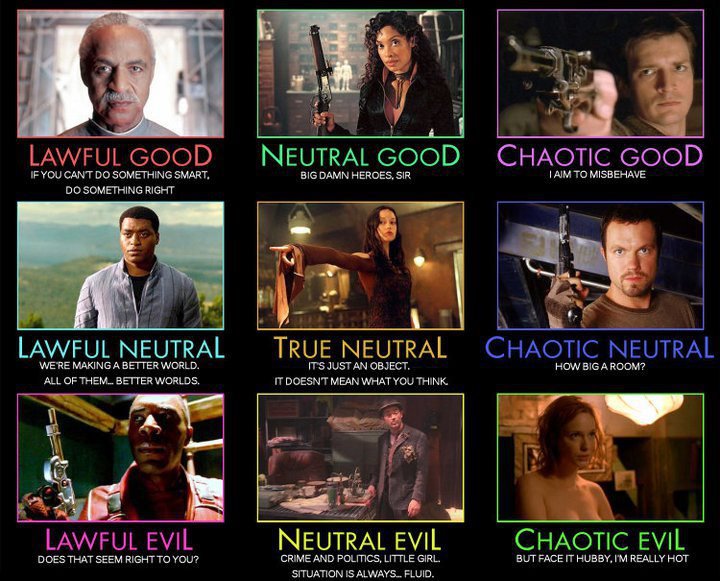
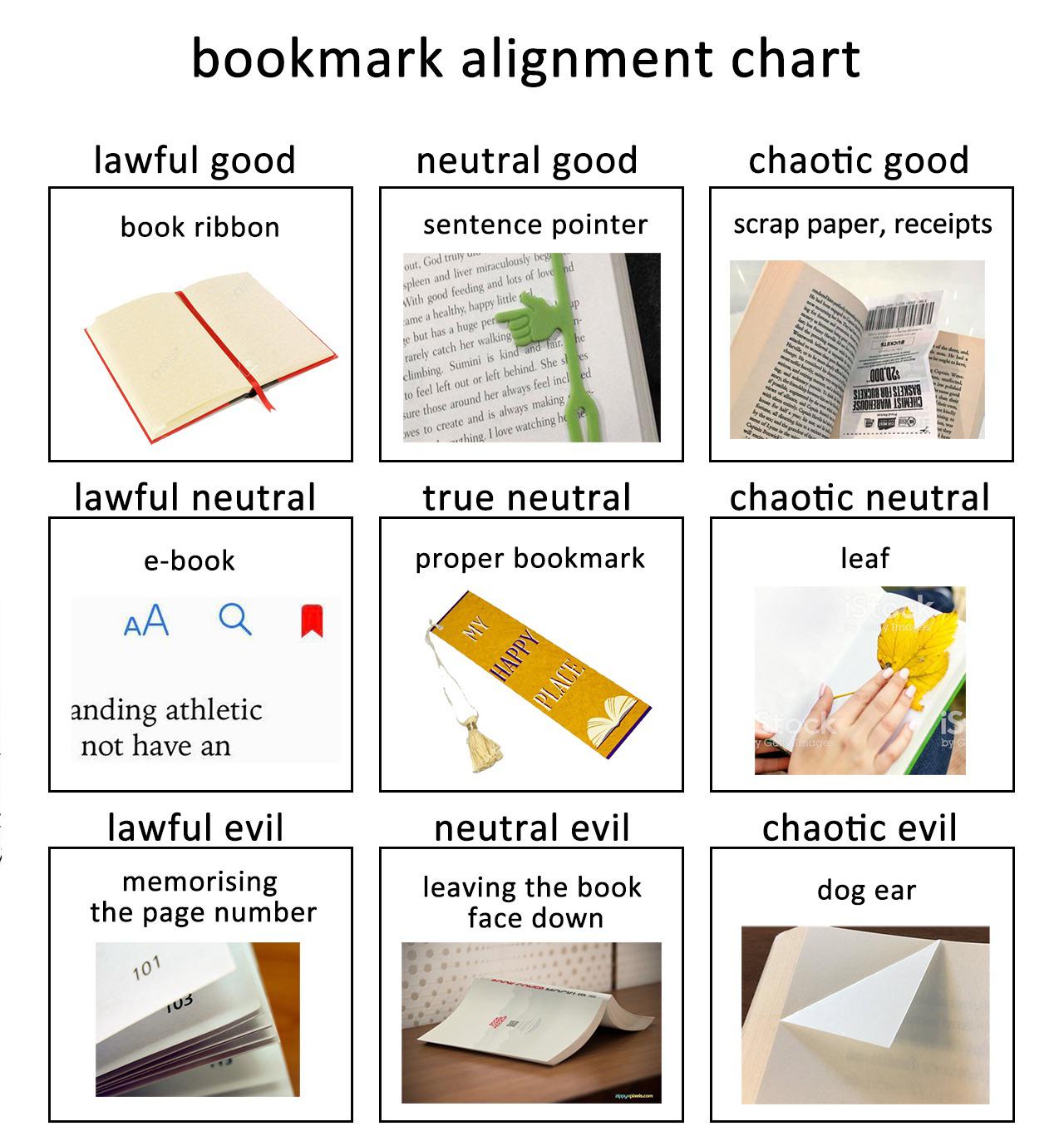
The Dungeons & Dragons alignment system divided morality into Lawful, Neutral, and Chaotic on one axis, and Good, Neutral, and Evil along the other. It’s become a cultural touchstone (or a cliché, if you’re less charitable) that has spawned a zillion parodies:

But here’s the thing:

The problem with D&D morality is that it assumes there’s some fixed definition of “good” and “evil.”

You know how relativity tells us all motion is relative? If two people go whizzing past each other in space, each one is at rest in his own reference frame and sees the other one moving.

Real morality is kind of like that. Most people truly, honestly believe they are good. That’s their local inertial frame. For example: Most people agree that violence in defense of your life or the life of another is morally good. The guy who plants a pipe bomb in an abortion clinic? That’s what he thinks he’s doing: defending the lives of babies being murdered. In his eyes, blowing the limbs off clinic workers is morally good.

That’s his inertial reference frame. He would consider himself neutral good; D&D would call him neutral evil, or possibly chaotic evil.

D&D morality, like Newton, assumes the existence of a fixed reference frame from which to evaluate all morality.

In real morality, various people have defined various reference frames. Some folks use “society” as a reference frame, which is all well and good until you encounter cases like “if a society says slavery is moral, then for that society, slavery is moral.”

Utilitarianism is kind of the equivalent of using the cosmic microwave background radiation as your reference frame. If you see a dipole in the CMB, you’re moving, and more specifically, your vector of motion is oriented toward the blueshift in the CMB.

It’s not a perfect analogy; motion is a single vector and D&D has two axes (good <-> evil and lawful <-> chaotic). But it gets the point across.

If we set the CMB to our D&D framework, then probably, yes. Most people are probably neutral, though they think of themselves as good. That’s the entire difficulty: almost all people think of themselves as good. The activist campaigning to legalize gay marriage and the fire-n-brimstone Fundamentalist preacher shaking his fist at the gays both believe they are good.

In Newtonian ethics, this clearly cannot be.

There’s also the issue that for most of us in our day to day lives, using the CMB as a reference frame just isn’t very useful. Right now, as I type this, I’m sitting on the couch in my living room. The couch, the chair next to me, the fish tank to my left, and my tea to my right all seem at rest. The fact that we’re on the surface of a planet spinning and whipping around the sun which is making its slow orbit about the center of mass of the Milky Way which is itself on a collision course with Andromeda at ludicrous speed isn’t relevant to me.

I’m not going to get out of a speeding ticket by saying “but officer, motion is relative, and if you measure our speeds by the CMB dipole they’re indistinguishable!”

Human beings are hard-wired to think differently about our in-group and our out-group. This is built into the structure of our brains. We also have a limit on how big that in-group can be. It’s about 150 people. This is called Dunbar’s number, and it sets a limit on the number of meaningful emotional connections we can make.

The in-group—the people in our Dunbar sphere—-is the ethical equivalent of my living room. When I get up to make more tea, the only inertial frame that’s relevant to me is the frame in which my living room is at rest. Trying to use the CMB as my reference frame isn’t useful.

Most people’s day to day inertial reference frame for their moral evaluations is their Dunbar sphere—the people in their immediate social group. That’s their inertial living room. In that living room, they can think of themselves as “good” even if their ethical actions with respect to utilitarianism is extraordinarily evil—that is, the CMB dipole is very large.

The people who built this place believed, from within their reference frame, they were good. (Image: Frederick Wallace)

Because they don’t think about any reference frame outside their Dunbar sphere, they do things that appear to be morally contradictory—like taking in a friend who has lost his job and his home, while at the same time saying “fuck those Syrian refugees. I don’t care if an 8-year-old girl dies in agony. Fuck her.”

They think of themselves as “lawful good” because they took in their homeless friend. They continue to think of themselves as “lawful good” when they casually condemn thousands of women and children to gruesome deaths. The walls of my living room are relevant to me; the cosmic microwave background of utilitarianism is not.

I would argue that in D&D terms, it’s quite possible that the majority of people are, if anything, neutral evil, if we use utilitarianism as our CMB. Most people believe slavery is evil. Most people would not support slavery making a comeback. Most people are totally 100% okay with buying a diamond engagement ring mined by slave labor, as long as the slavery happens somewhere out of sight to people outside their Dunbar sphere.

I suggest that in most cases, seen from the reference frame of utilitarianism, the majority of human beings, including those who see themselves as lawful good, are in fact neutral evil.

Truth as a Philosophical Strange Attractor

[This essay is an expansion of a thought I originally wrote as an answer on Quora]

There is a notion, a myth enshrined in a great deal of Western philosophy, that as time goes on, societies move ever further from superstition and ignorance, and ever closer to Truth.

It is, like many social myths, complete nonsense.

In fact, societies swing to and fro, sometimes moving closer to the truth, sometimes further away.

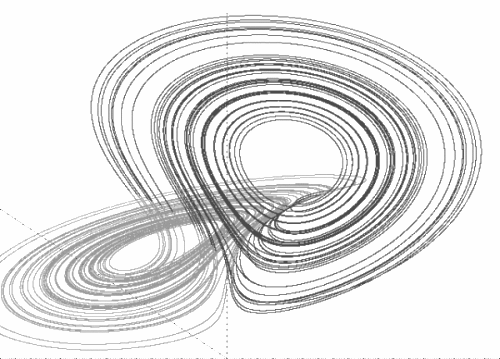
The way I model this in my head is that truth is a strange attractor, and societies loop and whirl around it in complex ways that are extremely hard to predict and vary depending on how the society formed.

Pretty much exactly like this:

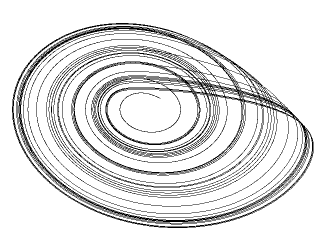
These are strange attractors—mathematical functions that loop and swirl around a point, sometimes moving closer, sometimes farther away, twisting and curling as though drawn to it without ever entirely reaching it. They never repeat, they never settle down into a stable orbit.

This is, I think what human societies do. Every society has its collection of myths and legends, things it wants to believe about itself whatever the reality might be, and its own unique monomyth. These things influence the trajectory a society takes through social space, tugging it this way and that, whatever empirical fact or philosophical truth might be.

This means you could, for example, take snapshots of a society’s history, like paragraphs out of the society’s history books, and treat the pile of snapshots like a Poincaré map of that society’s eccentric orbit around the truth. And what you’d find would be something like a Philosophical Strange Attractor, a chaotic churning orbit about the truth, full of twists and turns, always tugged in the direction of truth but never settling there.

People like to talk about history as a swinging pendulum, but I don’t think that’s a good model. A pendulum retraces the same arc over and over. Societies may progress or regress, may seek to explore new ideas or retreat into history and tradition, but they never really repeat the same path twice. Even when those who long for some imagined idyllic past gain power, they never really quite reach it. Societies, like people, never set foot in the same river twice.

Image: Rodrigo Curi

Every society has its mythologies. Mythologies are necessary for social identity, they’re always going to be there. Mythologies weld disparate people into something like a more or less cohesive whole, forming an overarching sense of identity that (ideally) takes the place of family or tribal identity. Without that overarching identity, you don’t have Rome, you have a bunch of squabbling families and tribes who don’t much like each other. (Even with a foundational mythology, you still have that, of course, but the overarching mythology helps create glue that aggregates all those disparate elements.)

A foundational myth creates identity—the way people see themselves. And identity distorts and shapes the way we see the world.

But the thing about that myth is it is, in any objective, empirical sense, not true. And subtle variations in a society’s founding myth, like subtle differences in the start condition of a chaotic system, have huge effects on that society’s chaotic path around the attractor of Truth.

So no. No, the moral arc of society doesn’t always bend int he direction of truth, or justice, or any of those other wonderful philosophical ideas. It may follow a chaotic orbit around these things, but it is not inevitable that if you wait long enough a society will necessarily arrive at Truth, or Justice, or Enlightenment. If you want to get there, it’s your job, and will always be your job, to work to make it happen.

Some thoughts on dumbing down language

I like language. I hate what the alt-right does to language.

I’ve always liked language. Majored in linguistics for a brief time in my misspent university years, and today I make my living as a writer, so I suppose it’s not too surprising, really.

But man, watching the violence perpetrated on language by the American right is painful. It’s a travesty, what those people do.

Take the word “cuck,” for instance. It’s a favorite insult amongst the knuckle-draggers of the alt-right, most of whom likely have no idea what it actually means, just like they have no idea what “socialism” means.

It’s been fascinating to me to watch how the word “cuckold” has become politicized by the sex-negative contingent on the alt right; in only a few short years, the meaning of the word has been distorted, in a weird sex-hating Orwellian newspeak kind of way, almost beyond recognition.

Image: Markus Spiske

The latest idiocy? Calling men who watch porn “cucks,” because—get this—you’re watching another man have sex with the woman you fancy.

In the strictest definition, a “cuckold” is a married man whose wife has a child by another man, without his knowledge, which he believes to be his.

The word comes from the behavior of the cuckoo bird, which lays its eggs in nests belonging to other birds. The other birds don’t know the egg was left by an intruder; when it hatches, they feed and care for the chick, believing it to be their own.

In the fetish sense a cuckold is a man whose partner has sex with other men, specifically for the purpose of dominance and submission or erotic humiliation play, with his knowledge and often in front of him. (A woman whose partner has sex with other women specifically for the purpose of erotic humiliation is a cuckquean.)

Cuckolding as a fetish is not just any form of non-monogamy. Swinging is not cuckolding. Polyamory is not (necessarily) cuckolding. Cuckolding is a specific form of non-monogamy, in a D/s context, for the purpose of humiliation play.

What’s weird is how the alt right has co-opted the word in some frankly rather bizarre ways.

Parts of the alt right, especially the weird sex-negative “fapping is bad, homosexuality is bad, but we fuck each other and it like totally isn’t gay” Proud Boys, have done some deeply weird reinterpretation of “cuckolding” to make it mean:

  • If your girlfriend wasn’t a virgin when you started dating, you’re a cuckold, because she slept with other men before you met.
  • If your girlfriend has sex with other people after you break up, you’re a cuckold, because…well, I’m not exactly sure why. Because you own her vagina and another man is using your property, I, um, guess? Or something.
  • If you wank to porn, you’re a cuckold, because you’re playing Willy Wonka’s Whacky Adventure while another man is putting the salami in the woman who gets you hot.
  • If you allow your woman to have male friends, you’re a cuckold, because reasons.
  • If you allow your woman to gain the upper hand in a relationship, or do what your female partner tells you to do, you’re a cuck, because even more vague reasons.

So we go from a very specific sexual fetish to any situation where any woman has sex with any man except you to a situation where a woman has any social power whatsoever even if it has nothing to do with sex…

…which, I mean, not to get too Freudian, but if that doesn’t lay bare the insecurities and fears of the men saying this, I don’t know what does.

tl;dr: You cannot by definition be cuckolded by a woman who is not your partner.

The connection between the alt-right, and the way sex negativity plays into alt-right ideology, is fascinating. The NoFap movement, for example, has become a doorway to alt-right and neo-Fascist ideology…but that’s a blog post (or maybe a podcast) for another time.

Hot take: When “woke” really is harmful

[Note: this essay started out as an answer on Quora.]

I’m about to say something a lot of my fellow liberals might find upsetting:

Some people who complain about “woke ideology” are actually kinda sorta right, though for entirely the wrong reasons.

Before you pick up the torches and pitchforks, hear me out.

No, the conservatives who whine and cry and have their little meltdowns about “woke Disney” for making movies with characters who aren’t straight white Christians are completely wrong, obviously. But some complaints about “woke,” while they’re farcical—even laughable—on their face, have, if you gig down deep enough, a teeny tiny kernel of truth, or at least truth-adjacent material, buried under the layers of racism and sexism and misogyny and homophobia and transphobia and white supremacy and all that other bullshit that spews from the lower orifice of the conservative snowflakes.

Liberals can get so attached to the underdog that we actually forget that even people who have been on the receiving end of systemic oppression are human, and like all humans, are capable of occasional shitty behavior.

Image: Marco Bianchetti

The problem is one of nuance.

Well, okay, cognitive effort and nuance, really.

Human beings are really bad at both. I mean really bad. Liberals like to go after conservatives for following the herd and doing as they’re told, yet liberals do the same thing—it simply expresses differently.

Conservatives who moan and cry about “woke ideology” are, often as not, just mouthing the words and feeling the emotions they’re instructed to by the people above them. Ask any of the conservatives what “woke” actually means and you’ll get crickets as an answer. They legit don’t know. They have no idea what “woke” means, any more than that know what “socialism” is. They’re simply told that the enemy tribe is bad because they’re woke, and they accept it because that’s what they do.

Ask a liberal what “woke” means, or ask a conservative attorney under oath what “woke” means, and you’ll get an answer like “aware of institutionalized, systemic injustice, and motivated by the need to address them.”

Which is true.

But…

The place we liberals go off the rails is that we are just as intellectually lazy as conservatives, it’s just that our laziness manifests differently.

Make no mistake about it, we liberals are every bit as intellectually lazy as we accuse conservatives of being. (Image: Wavebreaker Media.)

At the end of the day, it’s about cognitive effort. People don’t like cognitive effort. It’s work, just like physical effort. We look for labor-saving shortcuts whenever we can.

Conservatives tend toward vertical hierarchy. The labor-saving shortcut they use is submission to recognized authority. They think and believe what they’re told by the people they recognize as leaders to think and believe.

Liberals tend toward horizontal social structure. The labor-saving shortcuts we use are “oppressed people right and good, oppressors wrong and bad.” We think and believe whatever fits that narrative.

The key component of being “woke” is recognizing that yes, systemic, structural, institutional oppression exists. It’s sometimes overt, it’s more often subtle, but it’s there and it’s quite real. It’s hard for those of us who benefit from it to see, because it’s part of the environment we exist in; almost by definition, institutional systems of oppression are designed to be invisible to the privileged class. It takes active effort just to see them, at least when you’re the beneficiary.

When you do that, you start seeing the same patterns replay over and over and over again. And that makes you lazy.

It’s the same laziness, ironically, of the police officer who engages in racial profiling. You turn off your brain. You see patterns, you’re like “yeah, that fits,” you don’t dig any deeper. Gradually, the people you see as on the receiving end of systemic oppression become Always Right. The people you see who benefit from systemic oppression become Always Wrong. You stop seeing individuals and start seeing narratives.

Which is exactly the mindset that leads to those structures in the first place.

And I mean, I’ve done this. I’m not claiming any special insight or immunity here. Basically, when we hear a story, we do exactly what we accuse conservatives of doing:

  • We don’t fact-check
  • We engage in thought-terminating cliches
  • We lead with our feelings
  • We let narratives blind us to nuance and detail

Basically, we side with the perceived underdog, always and completely. We commit the gravest of sins that we critique in conservatives: we allow stereotypes and preconceptions to determine who’s the good guy and who’s the bad guy.

And yes, the critiques of ‘woke’ leveled by conservatives tend to be incoherent, a confused, unintelligible mishmash of name-calling and unintelligible “everything I don’t like is woke!”

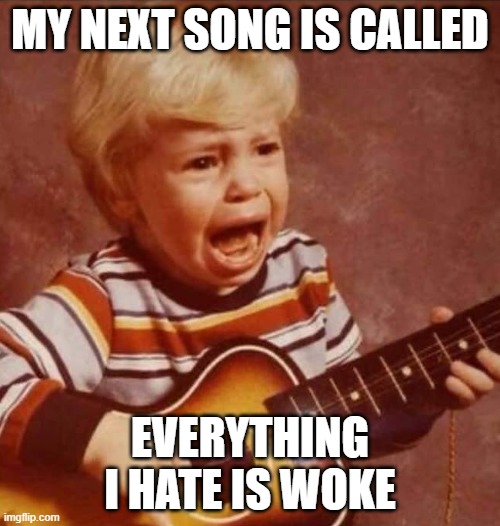
This meme is legit how a lot of critiques of “woke” end up landing:

So we congratulate ourselves that that means our philosophy is unassailable by reasoned critique. Which is most definitely is not.