Some thoughts on hysteria and Chinese fortune cookies

Last night, we ordered Chinese take-out. Generally, when I eat Chinese take-out, my fortune cookies don’t have anything interesting to say; I think I get the short-bus fortune cookies, the ones that had to stay after school taking extra classes in Remedial Philosophy and Pre-College Wisdom.

Last night’s fortune cookie, though, was different. It said:

The philosophy of one century is the common sense of the next.

There’s some truth in that–but sadly, not enough, especially in a time where culture, philosophy, social values, and particularly technology can change more in five years than they used to change in five decades.

I’m not even talking about formal institutions, such as the Catholoc Church (which generally runs about three centures behind; in 1979, Pope John Paul II instructed the Church to re-investigate the case of Galileo Galilei, and in 1992, after thirteen years of investigation and 378 years after Galileo was first accused of heresy, the Pope formally acknowledged that the Church had been wrong to condemn Galileo’s notion that the earth moved ’round the sun).

It’s easy to point to institutions of rigid orthodoxy and say “Sure, these institutions have trouble adapting–of course they’re always going to be behind the curve.” But it’s not just the Catholic Church; it’s all of us. Every decade or so, some social or technological innovation undermines some sacred notion that we’ve always believed is immutable and inviolable. The idea that marriage is a union bewtween one man and one woman has been an axiom of American social belief for centuries, assumed to be true so universally that it was never questioned or even considered; now, the idea that it might mean something more has a lot of people upset.

And those people ain’t seen nothing yet.


In 1954, the first successful organ transplant on a human being took place. The patient had suffered kidney failure, and received a donated kidney from his twin brother, which gave him another eight years of life.

For the most part, the public was appalled.

The news of the first human transplant triggered an enormous backlash against doctors who were “playing god” by “cutting apart dead corpses and sewing the parts into living human beings like Frankenstein.” Nowadays, of course, human transplantation is as natural and as accepted as the idea that the earth revolves around the sun; in the US, about 100 such transplantations operations occur daily.

But we’re no smarter, nor more adaptable, than the Catholic church was three or four centuries ago, nor than the Great Unwashed were in the 1950s. We have our own hysterias today, two of the bigger ones being the public hysteria over cloning and over genetically modified food.


Every new technology brings fear along with it, and that is particularly true of biomedical technology. When it comes right down to it, we as human beings have two things working against us–first, we’re lazy, and don’t have the time or the energy or the inclination to get informed about anything, much less about complex and technically challenging issues. We prefer to make decisions based on lurid sound bites–“The doctors in that hospital are cutting up corpses and sewing the parts of dead people into live people!” Second, our sense of who we are is incredibly fragile, and our sense of our place in the world is even more fragile; the history of religion has been one of religious authorities drawing lines in the sand–“Okay, there’s a rational explanation for everything up to this point, but everything on the other side of this line is the province of God!”–and then moving the line when the state of understanding improves. At the end of the day, we are desperately afraid that we’re simply the result of a long series of accidents and natural processes, that everything about is is the sum total of a very big set of very complex natural phenomena, and that really, we’re all just making up our sense of meaning and purpose as we go along.

We’re scared. As we learn that the physical processes occurring in our brains create those things that we used to call a “soul,” we get more scared. As we learn to predict and to manipulate the most fundamental processes of life–as we learn that “life” is not some magical force created by some unknowable divine being for our exclusive benefit, but rather the consequence of some very specific forms of basic chemistry–we get more scared. And that fear leads us in some peculiar directions.

Like, for example, the fear that caused famine-plagued Zambia’s president Levy Mwanawasa to condemn many of his citizens to death by slow starvation when he barred the import of food from the United States on the grounds that the United States uses genetically modified grain, and genetically modified food is “poison.” “Experts” from the European Union, which has an economic interest in the equation, argued that genetically modified food might poze some kind of “hazard” and there was no absolute proof that it is safe; what seens to have been missed is that there is absolute proof that starvation is not safe. Indeed, it turned out to be deadly for nearly seven million people in all–people who, one suspects, would have been happy to eat any food at all rather than starve.

And if you think that’s bad, you still ain’t seen nothing yet.


Right now, as I type this, a group of researchers at MIT are inventing a brand-new field, one that they call “synthetic biology.” Synthetic biology is to genetic engineering what bridges are to fallen trees. With genetic engineering, you look around until you find a gene that does something you want, then stick it in some other cell. With synthetic biology, you decide what it is you want to do, then design and build an organism from the ground up that does it. Rather than getting across a river by looking for a tree that’s long enough and then dragging it to the right place, you design the perfect bridge, then build it entirely from scratch, without searching for dead trees anywhere. Genetic engineering can only create organisms that do what existing organisms already do; synthetic biology can create organisms that do anything at all. These guys are actually closing in on programmable nanotech assemblers, and they don’t even realize it.

They naively think that what they’re doing is working on ways to grow computer parts instead of etching them from silicon, the poor suckers. What they’re actually doing is custom-building living organisms for the purpose of creating whatever it is we want to create. As it stands now, people go all kinds of freaky-deaky if we do nothing more than move this bit of DNA over there–just wait ’til the public gets ahold of that!


The philosophy of one century is the common sense of the next–or, more precisely, the philosophy of one century is the common sense of the century three hundred years later. But technology doesn’t advance by the century; it advances by the decade, and sometimes by the month. Given the number of people who still feel profoundly threatned by Darwin, the notion of re-assembling matter on the most basic level is going to cause more than a few problems, especially when that matter we’re re-assembling is the stuff of living systems and most especially when the matter we’re re-assembling is us. After seeing the way people respond to Darwin, organ transplants, and genetically engineered corn, I’m thinking that perhaps Alcor is going to need to invest in some stone walls and antipersonnel mines before this is all done.

So there’s this “book meme” floating around…

Apparently, you’re supposed to

1. Grab the nearest book.
2. Open the book to page 123.
3. Find the fifth sentence.
4. Post the text of the next 3 sentences on your blog along with these instructions.
5. Don’t you dare dig for that “cool” or “intellectual” book in your closet! I know you were thinking about it! Just pick up whatever is closest.

What’s amusing about that is the only book within reach of my computer right now doesn’t even belong to me; it’s a copy of The Gnostic Gospels, by Elaine Pagels, a history of Gnosticism.

The fifth sentence on page 123 reads, “For gnostics, exploring the psyche became explicitly what it is for many people today implicitly–a religious quest.”

In the view of one particular sect of Gnostics, the “Valentinians,” human beings are on the top of the divine pecking order, because human beings create the language of theology, and religious expression, without which the will of God can’t be known. Which is kind of an interesting way to look at religion, when it comes right down to it, though I somehow suspect exactly the same moral lesson could probably be drawn had the book closest to hand been one of the Calvin & Hobbes anthologies we have kicking around the place.

Random link o’ the day…

…with a nod to grey_evil_twin:

The Monkeysphere

But think of Osama Bin Laden. Did you just picture a camouflaged man hiding in a cave, drawing up suicide missions? Or are you thinking of a man who gets hungry and has a favorite food and who had a childhood crush on a girl and who has athelete’s foot and chronic headaches and laughs when a friend farts, a man who wakes up in the morning with a boner and loves volleyball and fusses over his spoiled children and haggles over the price of a car and who goes on Seinfeld-esque rants about too much ice in his drinks?
Something in you, just now, probably was offended by that. You think I’m trying to build sympathy for the murderous bastard. Do you see the equation? Simply knowing random human facts about him immediately tugs at our sympathy strings. He comes closer to our Monkeysphere, he takes on dimension.
Now, the cold truth is my Bin Laden is just as desperately in need of a bullet to the skull as the raving four-color caricature on some redneck’s T-shirt. The key to understanding people like him, though, is realizing that we are the caricature on his T-shirt.

Toward a Unified Understanding of the Human Condition

For thousands of years, scholars, philosophers, artists, and religious teachers have struggled to understand the human condition. Elaborate theories, both moral and pragmatic, have been propounded to explain the bredth and diversiy of the human condition; everything from battling angels and demons to the hidden workings of the id and the superego have been believed to be responsible for the things we feel and the way we understand and interact with the world around us.

All of those ideas are wrong, as I realized while showering this morning. The human condition is varied but bounded, and it took Hollywood to give us a model that explains the diversity of the human experience while also showing us how it’s bounded.

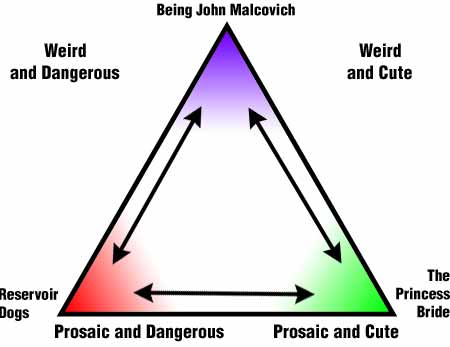
All of life, you see, exists somewhere within the space delineated by the movies Reservoir Dogs, Being John Malcovich, and The Princess Bride.

Each of these three movies represents the extreme outer limit of one aspect of the human condition. All of humanity–all religion, all philosophy, all creation, all expression, all experience–falls somewhere within the space marked off by these three movies.

The human condition is not represented as a three-dimensional spece with each of these movies along one axis, because no part of the human condition can fall at the origin of such a space; that is, nothing within the human experience contains no relevance to any of these three movies. Instead, if some part of the human condition has very little, say, Reservoir Dogs in it, then it follows logically that it must therefore contain a great deal of Being John Malcovich, The Princess Bride, or both, as illustrated below:

Continue reading

What kind of spiritual ideas do YOU have?

On a mailing list I subscribe to, someone recently asked me if I subscribe to any philosophical or spiritual beliefs, and what they are. If you don’t care, then I won’t bother you with the answer; otherwise: Continue reading

Some thoughts on morality

Moral (adj): a: of or relating to principles of right and wrong in behavior : ETHICAL b : expressing or teaching a conception of right behavior, as, a moral poem c : conforming to a standard of right behavior
ety from Latin mos, moralis “custom”

Ethical (adj): a: of or relating to ethics b: involving or expressing moral approval or disapproval
ety from Greek ethikos “tradition”


It seems I’ve never had a very clear grasp on the concept of “morality.”

For many years, I’ve had a working, internal definition of “morality” that says something is “moral” if it recognizes the inherent worth in human beings and seeks, as far as is possible, to further the basic values of dignity and compassion for all people. Because of this, I’ve often been more than a little puzzled by public discourse on morality.

Morality, as it’s understood by a great many people, confuses the hell out of me. It seems obvious and straightforward that issues such as gay marriage and equal opportunity are moral issues; what’s always tended to puzzle me is the fact that those who speak the loudest about “morality” condemn these things. Homosexuality, we’re told, is immoral. Gay marriage is immoral. Non-traditional relationships are immoral. Yet affording all people everywhere equal opportunity in a society seems to be a very basic means of expressing the values of worth and dignity for all human beings; how, then, can any reasonable person call these things “immoral?”

Shelly was the one who pointed out that my definition was flawed, and when she did, a great deal of public discourse about ethics and morality suddenly snapped into focus.


Ambrose Bierce, a man famous for his cynicism, defined “moral” as “having the quality of general expediency,” and there’s more than a little truth to that.

The origins of the English words for “moral” and “ethical” are telling. Both words derive from words expressing, not concepts of human worth and dignity, but concepts of tradition and custom. In its most basic form, the public discourse on “morality” focuses not on what is right by the standards of human dignity, but on what is traditional. And this understanding changes everything.

It has long been an axiom of any society that that society is falling into decay and moral ruin. Socrates was reported to complain “Today’s youth love luxury; they have bad manners, contempt for authority, disrespect for elders and they chatter in place of exercise.” And of course this must always be so, because traditions change over time. If one understands “moral” to mean “traditional,” then of course all societies always decay morally and always will, for the process of life is a dynamic one, and old traditions are constantly giving way to new.

Traditions form because people find a way of doing things that generally seems to work fairly well for most people. Over time, these convenient ways to do things gradually become entrenched, until what started out as an expedient way to get things done becomes Right and Moral and Just, and any other way to do things becomes Wrong and Immoral.

In this context, it’s quite simple to understand the current public discourse on morality. To determine whether or not something is moral, one need only apply a simple one-part test: is it the way things have been done in the past?

Gay marriage? Untraditional; therefore, immoral. Open tolerance of diversity? Untraditional; ergo, immoral. Non-traditional relationships? Immoral by definition.

Even things which seem at first blush to be blatant moral hypocricies are perfectly moral, with the proer understanding of “moral.” It is and has for centuries been traditional for men of wealth and power to cheat on their spouses; by this light, the actions of peope like Bob Barr, the Georgia representative who launched the crusade against Bill Clinton for his extramarital affair, and campaigned aainst legal abortion, but who paid for his ex-wife to have an abortion and then cheated on her with his current partner, has a long history in the tradition of American politics and is therefore completely moral.


Replace the word “moral” with the word “customary” or “traditional” and the official stances, and behavior, of many conservative religious groups begins to make more sense. For example, one of the peopl who worked on the Bush campaign was a First Assemblies of God pastor named Mike Hintz, who spoke on behalf of Bush, praising Bush’s values. Pastor Hintz was recently in the news again, this time after being arrested and charged with the sexual exploitation of a child.

Child abuse and child molestation have a long tradition in Western society, which was elevated almost to an art form during the Victorian era. Hintz wasn’t immoral; he was merely acting in accordance with an older tradition, and that by definition made his actions perfectly ethical.

Churches are in a peculiar position when it comes to teaching morality, because churches, like any other organization, rely on their members to exist. A church with no members no longer exists. A church must, therefore, always follow the moral values of its flock, and never lead them; should a church tell its flock that behaviors they support are immoral, its members will leave and go to a church willing to say that they are all good, just, morally decent people. So churches, the very institutions beople believe are charged with moral leadership, are, by the nature of their position, always going to be the last organizations to respond to moral change.

(This sometimes creates some delicious ironies. The Sothern Baptist Convention, one of the largest and most influential of conservative American protestant churches, was originally formed by pro-slavery members of the Baptist church who refused to accept the anti-slavery stance of the mainstream Baptist doctrine of the time. Today, the Southern Baptist congregation is largely black; one has to assume that a significant portion of its membership is quite unaware of the sect’s history.)


So. My confusion all this time has come from my own badly skewed understanding of what it means to be “moral.” With a better grasp of the meaning of morality, the public discourse is more comprehensible to me, and I can see that my initial confusion arose from my own error.

I still prefer my definition of “moral,” however.

Key West Part II: Fantasy Fest

The nominal reason for going to Key West was FantasyFest, an annual celebration that’s kind of like a mini Mardi Gras with more humidity.

For the most part, I wasn’t terribly impressed with FantasyFest. It had the things you’d normally expect to see at such an event–too few PortaPotties, a parade, throngs of people competing for cheap plastic beads and flashing their tits, that sort of thing. What was interesting was the number of people in elaborate body paint, some of which was quite beautiful.

I got quite a number of pics of people in body paint, hidden beneath the cut… …and NOT safe for work!

Some thoughts on self-knowledge and happiness

This comment actually comes from a conversation I’m involved in in a UseNet newsgroup elsewhere. It’s part of a conversation thread regarding the skills and values that are positive or necessary in a polyamorous relationship. Another person in the conversation posted the usual list you’ll see in any poly discussion anywhere–you know, honesty, communication, that sort of thing. I added one more thing to the list; “Know thyself.”

One could reasonably say that this idea has not been well-received.

My commentary:

There is a difference, I believe, between a person who can’t answer general questions about himself because he feels that it doesn’t offer enough insight into what’s being asked or because he feels he has no place to start, and a person who can’t answer a general question (or a specific question, or for that matter just about any question about himself whatsoever) because he *does not know.*

Now, I’m about to make a series of statements which, if my experience holds up, will probably upset, threaten, or anger approximately 50% of the people who read them. Nevertheless, I will stand by all of them, because I believe they’re true. 🙂 Ready? Here we go!

1. Self-knowledge is an important and valuable tool; all other things being equal, a person who seeks to know and understand himself, a person who develops not only the skills but the *habit* of introspection, will probably be better off in many ways than a similar person who does not.

2. Self-knowledge is a process, not a state of being. It requires constant work, constant self-examination, and a genuine desire and commitment to understanding what makes one tick. Because it’s work, and furthermore because it’s work that never ends, there are many people who hate, despise, fear, feel threatened by, or otherwise respond strongly against the notion that self-knowledge has value. in fact, with some people, the statement “Self-knowledge is a valuable thing to have” will get much the same response as “Sex with dead animals is a good thing to have.”

3. Self-knowledge is valuable to relationships–not just polyamorous relationships, but relationships of any sort. Like communication, self-knowledge is both a tool and an approach; it benefits a relationship because a person who has a reasonably good grasp on who he is, how he reacts, and what makes him happy has a clearer idea of his wants, needs, boundaries, and so on than a person who does not, and therefore can more easily explain those to his partner. It is possible to have a good relationship with poor self-knowledge, just as it is possible to have a good relationship with poor communication skills, but having good self-knowledge, like having good communication skills, makes things a whole lot easier.

And just in case there’s anyone who’s not pissed off yet, this one should really do it:

4. Self-knowledge makes happiness easier to achieve.

Now, no reasonable person is static; I may know things about myself today that turn out not to be true tomorrow. This is why it’s a process, and this is why it requires work…and this, I believe, is why so many people hate it so much. Nevertheless, i submit that if you do not know what you want, you can not reasonably expect to have what you want, except by accident.

One of my favorite quotes comes from Francis Bacon, who wrote “Your true self can be known only by systematic experimentation, and controlled only by being known.” I also happen to agree with one of the things Socrates said: “The unexamined life is not worth living.”

Judging by the popularity of TV reality shows, I would suspect that many peope probably disagree with me, and would be more likely to believe that the untelevised life is not worth living. That’s fine with me.

Some thoughts on the human condition

[From a post I made on the newsgroup alt.polyamory]

It seems like a simple enough question. Why do I want the human race to get its eggs out of one cosmological basket and spread to other planets? Why do I care what happens after I die? What difference does it make if the species succeeds or fails? What does it matter if we do not escape the earth by the time the sun dies? Is it a parenting instinct? A desire to see human civilization succeed? A bid for some sort of immortality?

For me, none of the above.

I appear to have no parenting instinct to speak of; apparently, that option wasn’t installed at the factory. Nor am I particularly up on human civilization, which I find flawed at best and ridiculous at worst. And I don’t want to be immortal though my work, through children, or through my species; I want to be immortal by not dying. 🙂

While I’m not particularly impressed by the vast bulk of humanity, I have a tremendus faith in the human potential: I see humanity in its current form as a beginning point, not an endpoint. I believe we have the potential to become something that is to our current civilization what current civilization is to Neanderthal civilization, and that many things we accept as a fixed and immutable part of the human condition–including death and even being fixed in the physical forms dictated by our biology–are actually not a necessary or permanent part of the definition of humanity at all.

Further, I do not see humanity as separate from the universe. I do not believe any part of the human soul or spirit comes from outside the universe; we are a part of the universe just as surely as comets, asteroids, and stars, but unlike comets, asteroids, and stars, we are that part of the universe which has the ability to comprehend itself–and to me, that gives us a value lacking in comets and asteroids.

It’s not us-in-our-current-form I want to see succeed; it’s those things which we have the potential to become. We have virtually limitless potential–potential that would be unrealized should life on this planet fail.

Yes, I do believe that we are not unique in the universe; there is almost certainly life elsewhere. However, it’s just as probably not like us, and in all probability is extremely different from us; that means that even if we are not unique in our ability to comprehend, we still have a unique *perspective* to offer…and that, too, has value.

If Earth dies, if we and our children die, what makes it matter that some branch of humankind is somewhere surviving?

Our ability to comprehend. We are that part of the universe which knows itself, and by extension, we are the way the universe can understand itself.

This is probably an argument that either makes sense to someone or it does not, and if it does not, I do not think I have the skill to explain it in a way that makes it accessible to someone who does not feel it. But there it is.

Link o’ the day

Why Nerds are Unpopular

A lot of people seem to think it’s good for smart kids to be thrown together with “normal” kids at this stage of their lives. Perhaps. But in at least some cases the reason the nerds don’t fit in really is that everyone else is crazy. I remember sitting in the audience at a “pep rally” at my high school, watching as the cheerleaders threw an effigy of an opposing player into the audience to be torn to pieces. I felt like an explorer witnessing some bizarre tribal ritual.

If I could go back and give my thirteen year old self some advice, the main thing I’d tell him would be to stick his head up and look around. I didn’t really grasp it at the time, but the whole world we lived in was as fake as a Twinkie. Not just school, but the entire town. Why do people move to suburbia? To have kids! So no wonder it seemed boring and sterile. The whole place was a giant nursery, an artificial town created explicitly for the purpose of breeding children…

And as for the schools, they were just holding pens within this fake world. Officially the purpose of schools is to teach kids. In fact their primary purpose is to keep kids locked up in one place for a big chunk of the day so adults can get things done…

What bothers me is not that the kids are kept in prisons, but that (a) they aren’t told about it, and (b) the prisons are run mostly by the inmates. Kids are sent off to spend six years memorizing meaningless facts in a world ruled by a caste of giants who run after an oblong brown ball, as if this were the most natural thing in the world. And if they balk at this surreal cocktail, they’re called misfits.

An interesting essay, with a few sideswipes on school, surburbia, and the nature of popularity (“Popularity is only partially about individual attractiveness. It’s much more about alliances. To become more popular, you need to be constantly doing things that bring you close to other popular people, and nothing brings people closer than a common enemy.”).