My co-author Eunice and I write porn. We call it ‘porn’ without flinching; where some people like to claim there’s a categorical distinction between porn and erotica, we both are of the opinion that po-TAY-to, po-TAH-to, it’s all a tempest in a linguistic teapot.
I bring this up because, having co-authored five books of the most twisted pornography ever conceived with Eunice, filled with kinks so esoteric they don’t even have names (we looked), I thought I understood the purpose of porn pretty well.
Porn is when you use explicit, super-kinky sex to explore themes like personhood theory, agency, autonomy, philosophical ethics, atonement and redemption, social values, and community.
Obviously.
So imagine my surprise when Joreth, my wife, suggested in a Quora post:
My spouse doesn’t watch porn. He doesn’t get it. To be fair, almost all porn is bad bad BAD filmmaking, and as a filmmaker myself, I don’t disagree at all. But I understand that the point of mainstream porn is just to put naked bodies rutting on screen for those who are visually aroused, and nothing else.
My spouse, however, writes porn, but not, like, mainstream porn. He writes literary tomes, super-accurate far-future science-fiction, and detailed world-building urban fantasy. That happens to have sex scenes in them. He does. not. understand. the point of porn. To him, “porn” is for arousing the intellect, which will then follow with physical arousal.
I’m just back from Dragon*Con, where I spent most of my time alternating between the writers track and the skeptics track, so during a panel on written porn, I put the question to the panelists.
All of whom sided with my wife on this.
As did, for that matter, most of the Internet.
Now, a lot of folks do draw a distinction between porn and erotica; something I heard often is that erotica can explore complex themes but porn can’t. There’s a fair amount of this gatekeeping in the erotica writer’s scene: “erotica is what I write; porn is that dirty nasty filth that other people write.” I personally don’t draw that line; to me, it smacks of classism, of “porn is bad but erotica is okay.” If your goal is to arouse, to quicken the senses, then it’s porn, no matter what else you may be doing.
But that also seems a minority opinion.
The porn Eunice and I write is incredibly explicit and very kinky indeed. It’s also, quite often, highly uncomfortable. (Eunice likes to say she’ll keep scaling the kink factor up and up until I cringe; that’s the sweet spot we’re aiming for.) The explicitness and the discomfort are part of the point—we explore ideas that are intrinsically uncomfortable, like “is it ethical to give consent to sex in such a way that you cannot revoke it?” (Spoiler: we both think the answer is yes. It’s strange that doing this is so wildely accepted in anything but sex—joining the militart, for instance—but when it comes to sex, people—even people in the kink scene—struggle with it.)
The word “porn” is emotionally charged. Using “erotica” in place of “porn” feels to me like a way to try to soften it, to hide from sexuality rather than engaging with it directly. Our novels confront uncomfortable ideas directly, without evasion; why not call them porn?
Every second of every hour Let your actions speak your will
Raise your head up high Raise your head up high So the heavens hear you cry Light the brightest fire From the highest mountain So the whole world knows That your spirit can’t be broken
—VNV Nation, Resolution
I love dancing. I’ve loved dancing for a very long time, though partner dancing is still relatively new to me. One of the few things I regret about living in Portland is being able to go out clubbing at the Castle, the world’s best goth nightclub…and I say that after being in goth clubs all over the world.
I’m back in Florida at the moment, helping prepare my wife’s RV for a cross-country trip (during which we plan to shoot photos of abandoned amusement parks all through the US, with an eye toward publishing a coffee table photo book in 2026 or 2027).
So it came to pass that my wife is out of town for the weekend working, but her boyfriend was of a mood to go out dancing, and so he said, “hey Franklin, interested in going to the Castle?”
I first went there in…um, I want to say 1997 or so? Somewhere thereabouts. It’s been a fixture of the Ybor City district for a donkey’s age. And oh my God, it remains just as marvelous as I remember.
There’s something utterly transcendant about dancing.
There is something so pure, so absolute about losing yourself to the music that now, two days later, I struggle to express it, or even recall it, except as a maddeningly vague series of impressions.
I remember the joy, of course. If you could bottle and sell the joy I felt spending the entire night dancing, there might never be war again. It’s a joy so flawless and unadulterated that everything else in existence falls away into nothing, replaced by exultation that fills every corner of my being. I had forgotten, I think, in the years since I’ve last been goth dancing, just whas a jubilant experience it is.
Round about my third hour on the dance floor, when I was starting to feel tired enough that I kinda wanted to sit down for a minute but the DJ just kept absolutely killing it. There comes a point where you push past the fatigue into something else, something numnous, on the other side.
Parts of the evening only exist in my memory in fragments. I remember dancing to the Aphex Twin remix of the Nine Inch Nails song Reptile sandwiched between a goth lesbian couple to my left and a da-glo bubble-gum lesbian couple to my right.
Mostly I remember an overwhelming sense of sonder, the realization that every single person you see is living a life as rich and complex as your own, with their own histories and dreams, goals and ambitions, heartbreaks and sorrows, as though I were surrounded by two hundred brilliant, dynamic, complex universes, fifteen thousand years of joy and desire and loss and tragedy all intersecting in this one brief moment.
The dance floor exists in its own space, a small pocket universe set apart from the world. It’s a bit like being transported for a single night to some Land of the Fae—not a fairyland like one might find in a Disney movie, but a wildland, a place of the old fae, the dangerous and unpredictable fae…but not to worry, they’re not hunting, they’re relaxing and having fun.
At one point, a person who was obviously of the Fair Folk and not even trying to hide it grabbed my hand to lead me deeper onto the dance floor. The music poured through me, vibrating like molten silver down my back, and such delirious ecstasy took me that now, sitting here in front of my computer, I can recall only the shape of it, the outline without its substance.
There is a vicious, ugly streak of Puritanism woven deep in the fabric of American social life, a cynical suspicion and distrust of pleasure, a sneering contempt for doing things simply for the joy of doing them. We are all poorer, I think, for it, for forgetting that joy exists.
I’ve heard people say, often with a derisive sneer, that nightclubbing is fr twentysomethings with no direction in life, as though Serious and Grown Adults™ should eschew mere pleasure. I find that idea both toxic and farcical. If we are, as some people say, spiritual beings having a physical existence, then what virtue is there in denying that physicality, the very reason we are in this world in the first place? What point is there to existing, if we don’t lean into that existence? What has it gained us to turn our back on joy, besides strife, division, and suffering?
I think we are poorer for this turning away from the joy of existence. We are here today, and gone tomorrow. We take nothing with us from this brief moment in the sun. Let us enjoy what time we have.
A new billboard appeared recently next to the grocery store where I do most of my shopping.
Image by author
I don’t mean the “now leasing” sign, but the one next to it. The one with the country singer on it.
Back when I was in middle school in Venango, Nebraska, I didn’t know a thing about Dolly Parton except that she apparently had large breasts. I might have vaguely known that she was in a band or something, maybe, but I couldn’t put a face to the name. I knew she had big boobs because all the other kids told me she had big boobs, and if all the other kids are saying something, like they put spider eggs in bubble gum or whatever, you know it’s probably true.
We would get together at recess and tell Dolly Parton jokes, all of them dirty (at least by the standards of a fifth-grader; ah, how little I knew!) and all of them about her breasts.
As I moved into adulthood, I learned that yes, she was a singer, she sung country and western songs, and she had that one hit because of that one movie everyone liked but I didn’t see. I don’t listen to country and western music, so that was about the sum total of my knowledge of all things Dolly Parton.
Nowadays, as I learn more about her, she strikes me as a genuinely marvelous person: kind, generous, giving, and genuinely invested in leaving the world a better place than she found it.
I still don’t listen to country music, but by all accounts she seems quite extraordinary. She is that rarest of things in creation: a genuinely compassionate person.
That’s something the world needs in greater quantities.
As I get older, I become more and more aware of the value of kindness. The truth is, callousness is easy. Indifference is easy. Cruelty is easy. The world is filled with people who see kindness as weakness, but in truth, kindness costs more than insensitivity. To be kind is to see the world from someone else’s point of view, and the ego rebels against that. It reminds us we are not the sun-center of all creation.
Empathy: Humanity’s Secret Weapon
Image by author
Pop quiz time. How did human beings—soft, weak, squishy bipeds with no claws, no massive canines, and thin skin—become the dominant mammals on the planet? Survival of the fittest says we should’ve been wiped out by fiercer, stronger, creatures, right?
No.
Our special sauce, beyond our big brains and abstract reasoning, is our cooperation. We work together. We help each other. We tend to our sick and injured. Where one of us goes, the rest follow.
We have each other’s backs.
That makes us unstoppable. There are many creatures larger, stronger, faster, and fiercer than we are, creatures that can take us one on one in a fight, but the thing about humans is it’s never one on one.
You kill one of us, the rest of us will come for you. We are an unstoppable force of nature.
Losers and idiots think that kindness is a weakness because they see the world in terms of the Rugged Individual™, the lone warrior standing strong against a world red in tooth and claw. They don’t see the army that stands behind that Rugged Individual, making his tools and his clothing and his weapons, nor the entire history behind him that brought him to this place. The Rugged Individual stands on the shoulders of others and says “look how I rose to this lofty height all by myself!”
Today, we live in a world increasingly dominated by loudmouth bullies, people for whom the world is always zero sum, people who believe that every interaction has a winner and a loser.
This attitude appeals to the sort of person who thinks of himself as an Alpha Male™, taking charge through force and strength to leave his mark upon the world, but it’s comedically inept.
And the math is behind it. Entire branches of game theory show that cooperation always wins out in the long run, always…not that the sort of person who sees the world as force against force in a battle royale to the death actually understands the math.
In the end, it comes down to a simple but surprisingly subtle idea: Other people are real. In a world where we act with reciprocal kindness, everyone benefits. We are a social species; we do more acting together than acting alone.
I will admit this has not always been obvious even to me. The Internet makes it easy to forget that other people are real—that the letters we see on the screen come from a real person. I had an experience about ten or so years ago when I met in realspace some people I’d been needlessly abrasive to online, and it occurred to me, holy shit, these folks are actual human beings! Since then, I’ve tried—not always with perfect success—to be more mindful in my online communication.
Bullying is easy. Especially when it’s anonymous, and most especially when it curries favor in our social in-groups. We live in a world where kindness and compassion are increasingly seen as weakness. Let us not forget that it is cooperation that carried us here.
I grew up in a tiny town called Venango, Nebraska, a rural farming village of 242 people. A lot of my formative memories took hold there, even though we only lived there for my middle-school years.
I went to school in this building right here, Venango Elementary, which housed the entire kindergarten through twelfth-grade population of Venango.
One of my teachers, a guy named Mr. Shepherd (I don’t think I ever knew his first name—in fact, I don’t think it ever occurred to me he had a first name) had a reputation in my class for assigning “punishment writing” to any kid who acted out in class, by which I mean committed some transgression like speaking out of turn. He’d demand that the offender would write the same sentence 250 times or 500 times or whatever, as befitted the severity of the transgression, then took malicious glee in throwing the pages away right in front of the student who’d transgressed.
Because there’s nothing like making young children associate learning with mind-crushing tedium and then watching their work destroyed in front of them to instill a deep, lifelong passion for learning and a keen intellectual curiosity, amirite?
One day, a day I still remember quite clearly, Mr. Shepherd accused me of talking in class. The actual transgressor was the kid behind me, a kid named Mike, the school bully who loved seeing other people get in trouble.
I have never, ever liked being accused of something I didn’t do. I did something wrong? Cool, man, lemme know and I’ll cop to it. Accuse me of something I didn’t do? Fuck you, I’ll burn my own life down before I take responsibility that isn’t mine to take.
So it was that Mr. Shepherd, with the absolute conviction available only to autocrats, abusers, and teachers of middle school, decided I was the one responsible for the voices he heard, and demanded that I write “I will never talk in class” 250 times that night, to be handed in the next day.
I was livid when I got home. The wrath in Heaven at the rebellion of the angels was but a candle beside my incandescent rage at the injustice of a teacher believing I’d done something I hadn’t done.
Enter my mom, who taught me a valuable lesson.
My mom in 2016, wearing the same expression she did on that day in 1980.
We didn’t have that lovely, evocative expression “malicious compliance” back then, but that’s exactly what my mom suggested I do.
She explained that yes, teachers could be wrong and no, not all injustices could be rectified, but as long as I was going to be writing something 250 times, why not use it as a covert opportunity to express how I felt?
So I sat down and started writing.
I will never talk in class. I will never talk in class. I will always talk in class. I will never talk in class. I will never talk in class. I will celery stalk in class. I will beaver balk in class.
She encouraged me to adjust my letter and word spacing so that, on casual glance, the lines of text would all look about the same.
The next day, when Mr. Shepherd took my neat stack of handwritten papers and dropped it in the trash in front of me, I couldn’t help grinning. I’d stuck my thumb in his eye, my small act of defiance against injustice, and he never even knew.
My mom died in December 2023. I still haven’t adjusted to the reality of living in a world where she no longer exists.
There has never been a moment in my life I did not have the absolute, rock-solid certainty that she would always, always be there for me. My mom always had my back. She taught me, not just facts and skills and things about the world, but how to think. She encouraged the boundless, limitless curiosity I still have today.
She taught me how to think. How to ask questions and find answers. How to see the world, not as I want it to be, but as it is.
I still keep in my phone a list of the things she would say, the things I heard again and again growing up, that I continued to hear even as an adult:
Education is not the solution if ignorance is not the problem.
Information by itself almost never changes attitudes.
The curse of being middle class is you can afford anything you want but not everything you want.
People vote their identity and their feelings, not their interests.
People in groups will agree to something that each one individually knows is stupid.
We are predisposed to believe what we wish were true or what we’re afraid is true. Understanding what is true is hard work.
You can’t reason someone out of a position they did not reason themselves into.
Never ask a question whose answer you don’t want to know.
There is a fetish I quite like. It’s not terribly common, but it’s also not uncommon as these things go, and it’s called somnophilia. It’s the fetish for either having sex with a sleeping partner, or having someone have sex with you in your sleep.
Now, if you don’t get the appeal, that’s totally okay. Fetishes kinda work that way: if they get you hot, they get you hot, and if they don’t, they’re complete mysteries. Take foot fetishes, for example. I don’t get them. They don’t make any sense to me. I struggle to imagine how someone might be aroused by feet. Like, of all things to get you hot, feet? Why feet?
And that’s okay. I don’t need to understand it to know there are people who are turned on by feet, even if I don’t understand why.
Somnophilia has been dipping in and out of the news lately, because of a rather horrifying case in France concerning a man, Dominique Pelicot, who is on trial for drugging his wife multiple times over a period of years and then recruiting strangers (about fifty or so have been identified and are being prosecuted, if I recall correctly) to rape her.
Court drawing of Dominique Pelicot (Europa Press)
This isn’t actually about the way whenever someone introduces fetishistic elements of a rape into his crimes, people who enjoy that fetish consensually sigh, roll their eyes, and brace for the onslaught from folks who don’t actually understand that the thing separating rape from sex is consent, though I could write that essay, and maybe eventually I will.
I get the taste for somnophilia. I love the idea of being half asleep, one of those really deep sucking sleeps you just can’t drag yourself from, partly aware that my body is being used for someone else’s pleasure but unable to do anything about it, and waking the next morning with the barest of hazy, fragmented memories of it. Whew! *fans self* I personally find that super-hot.
I also enjoy doing this with a lover who finds it as hot as I do.
Yum.
What I want to talk about today, though, isn’t somnophilia itself, nor even the way pop media conflates the fetish with the rapes that Dominique Pelicot staged, but I want to take a step back and ask: Is it even okay at all? Can we consent to sex in such a way that we cannot revoke that consent?
Sex and Commerce and War, Oh My
Sexual consent, according to a lot of folks in the kink community, is informed, freely given, and exists in the moment. Informed means you know what you’re getting into. Freely given means you’re not being coerced, blackmailed, wheedled, pressured, or forced into it. Exists in the moment means you can always tap out, even if you agreed up front.
A lot of folks are deeply uncomfortable about sex you consent to without a way to back out. That’s why they’ll tell you to have a safeword if you’re playing, say, with rape fantasy, where “no” and “stop” might not mean “no” and “stop.” That’s why they’ll tell you to have a nonverbal signal like a bell if your partner is gagged.
And I get that. It’s okay to be deeply uncomfortable about sex you can’t tap out of.
But, as I believe I’ve blogged about in the past, I personally like agreeing to things that I can’t tap out of. That gets me hot.
And here’s an interesting thing: If you take sex out of the picture, we as a society are quite comfortable indeed with agreeing to things you can’t back out of. Like contracts. Or mortgages. Or military service. Try getting three years into your four-year enlistment and saying “you know what? I changed my mind. I don’t want to do this any more.” Ha ha ha ha ha.
It’s really only with sex when we say “consent isn’t consent if it can’t be revoked.”
But…is that really true?
Unyielding Devotion
Last October, Eunice and I published a book. It’s the fourth novel in our Passionate Pantheon series of far-future, post-scarcity philosophical science fiction theological pornography, and pretty much the entire book is a deep dive into Eunice and I exploring the idea of whether you can give irrevocable consent to sex. (Spoiler: We think the answer is yes.)
It’s an even-numbered book, which means it’s erotic horror (the odd-numbered books in the series are Utopian, the even-numbered books are erotic horror). Here’s an example of what you’ll find:
Two doors in the far wall slid open to admit a tall, muscular man and an equally tall, strong-looking woman. He had bronze skin and brown hair that fell around his shoulders, and looked out at the world through piercing aquamarine eyes with cross-shaped pupils. She had shoulder-length hair of brilliant purple that matched her purple eyes, pale skin, and a warm face that smiled easily. They met in front of the cage. She offered her hand. “Hi! I’m Lanissae. I don’t think we’ve met.”
“Royat.” He shook her hand. “This is only my second party. I came here for the first time last month. I agreed to serve as entertainment at this party, so here I am.”
“Royat.” She inclined her head. “It’s lovely to meet you! This is my fifth time as a cage entertainer. Do you know what to do?”
“I think so. Jakalva explained it to me.”
“Good.” A door in the round cage folded upward. Lanissae stripped, then stepped nude into the cage. Royat undressed somewhat more awkwardly and followed her. A drone flitted down to whisk away their clothes. The cage door folded back down. The woman who had given Jakalva and Kaytin their vials approached the cage, moaning with each step. Her tray now held only four vials, two bright red and two deep turquoise.
“What’s happening?” Kaytin asked Chasoi, who stared at Lanissae and Royat with bright, hungry eyes.
“They’ll each take two Blessings,” Chasoi said. “The first one ensures their bodies will remain physically aroused no matter what happens to them. And the second, well, that’s the magic.”
“The magic? What does that mean?”
“One of them,” Jakalva said, “will become desperately horny beyond all reason. Are you familiar with the Blessing of Fire?”
“Yes,” Kaytin said.
“It’s like that, but more violent. It removes inhibition and obliterates self-control. The other does just the opposite, causing intense aversion, repulsion even, to the idea of sex. The cage makes sure neither of them can escape.”
“Oh.” Kaytin blinked. “So whoever gets the first vial will…”
“Yes. But that’s only half of it.”
“Half of it how?”
“That’s the beauty,” Chasoi breathed. “The moment either of them has an orgasm, they switch. Whoever was needy becomes averse. Whoever was averse becomes wild beyond control. They stay in the cage until they collapse from exhaustion.” Her eyes glittered.
I…would volunteer to be cage entertainment. I bet the number of people who would willingly do this is very small indeed, but I would absolutely do it.
Why?
The character Lanissae, who who has signed up to be cage entertainment many times, explains:
“Okay, let me try to explain,” Lanissae said. “It’s…” She paused, regarding Kaytin through hooded eyes. “I like…I like the tiny spaces. I like that little moment of clarity that happens when you switch, you see? There’s that one second when you know what’s going to happen. You see it in their eyes. You know that when that second is over, they will want you so badly that nothing you can do will stop them.” She shivered, eyes half-closed, and slipped one hand inside the plunging neckline of her shimmering, lacy dress. “Mmm. To be seen with such desire, to know that when the moment passes you will not want it and would do anything to make it stop, to know that it will happen anyway…there’s a delicious inevitability to it.” She cupped her breast. Her eyelids fluttered. “It’s such an exquisite surrender. You exist only to be ravished.” She exhaled in a soft moan. “You can’t get away. You lose yourself in how much you don’t want it, but it doesn’t matter. You stand on the brink and for one instant, you see it all so clearly, and you know what’s about to happen, and you also know that you chose to be here. You walked into the cage yourself, of your own free will…oh!” She leaned back on the couch and caressed her nipple beneath her thin dress.
Kaytin stared at her, desire and revulsion roiling within her. “And then,” Lanissae went on, “the violation is over, and the change happens, and you have that moment of clarity again. You feel the heat in your body. For that one delicious second, you know. When the heat reaches your head, the need will take you, and nothing in the world will matter except the person you are about to ravish. Everything stops. You balance on that edge. You recognize each other. You see the humanity there. In that instant, you share a connection that’s absolutely magical. For that one brief second, you see each other, really see each other—not as predator and prey, but as two people sharing an experience. You know that when the moment passes, you will not be able to stop yourself any more than you could stop what was coming when you were the object. You can feel your mind going…mmm.” She caressed her neck with her fingertips. “You embrace that moment of humanity, before it all slips away. It’s…uh! It’s so magnificent to stand on that cliff and feel yourself about to fall.” Lanissae arched languidly, running both hands down her arms. “When I’m in the cage, I live for those moments of connection between the moments of madness.”
Now, I don’t believe that you should explore irrevocable consent in your relationships, of course. If you find that idea repulsive, I 100% get that.
What I argue is that, in the spirit of agency and bodily autonomy, you have the right to explore irrevocable consent in your sexual relationships if you want to. And I have the right to do so as well.
I believe that, if I choose, I can tell a partner “I consent to you doing X to me, and I also consent to being placed in a situation where I can’t change my mind.” I don’t think I have to, or should, but I think I can if I choose to.
My body, my rules. If I want to give a lover permission to use me in my sleep, I have the right to do that.
You may or may not agree (and if you don’t, I’d love to hear your arguments in the comments). I do, though, find it interesting that society enshrines this right to irrevocable consent in basically every aspect of commercial and social life, except sex.
Isn’t that interesting? Sex, something whose connection to consent we’ve long been shockingly indifferent about, now gets an exception carved for irrevocable consent.
I think, honestly, this is at least in part a sign of the intrinsic distrust and fear our society has about sex.
A few months back, Elon Musk, the right-wing owner of Twitter and Grok, his pet Generative AI project, posted something I wrote on his Twitter feed, with the caption “This is the quality of humor we want from Grok.”
He even had it pinned to his profile for a short while.
I wrote this over on Quora in March of 2024. On the one hand, it’s interesting to know that Elon Musk reads my stuff. On the other, do you notice anything funny about the screenshot of his Tweet?
Yup, no credit.
The Tweet went viral, and has since been posted all over Facebook, Tumblr, Twitter, Reddit, and TikTok…all without attribution.
Right now, as I write this, OpenAI, the company behind ChatGPT, has a market cap of $157,000,000,000, making it more valuable than companies like AT&T, Lowe’s, and Siemens.
It is not a profitable company; in fact, it’s burning cash at a prodigious rate. Unlike other companies, though, which burned cash early on to achieve economies of scale, OpenAI’s costs scale directly with size, which is not at all normal for tech companies. At its current rate of growth, in four years its datacenters will consume more electricity than some entire nations.
But I’m not here to talk about whether AI is the next Apple or the next Pets dot com. Instead, let’s talk about what generative AI is, and how it represents the greatest wealth transfer of the last fifty years.
AI is not intelligent. Generative AI does not know anything. Many people imagine that it’s a huge database of all the world’s facts, and when you ask ChatGPT something, it looks up the answer in that immense library of knowledge.
No.
Generative AI is actually more like an immense, staggeringly complex autocomplete. It ingests trillions of words, and it learns “when you see these words, the most likely next words are those words.” It doesn’t understand anything; in a very real sense, it doesn’t even “understand” what words are.
As the people over at MarkTechPost discovered, many LLM models struggle to answer basic arithmetic questions.
AIs make shit up. They have no knowledge and understand nothing; when presented with text input, they produce text output that follows the basic pattern of the input plus all the text they’ve seen before. That’s it. They will cheerfully produce output that looks plausible but is absolutely wrong—and the more sophisticated they are, the more likely they are to produce incorrect output.
If you want to understand Generative AI, you must, you absolutely must understand that it is not programmed with knowledge or facts. It takes in staggering quantities of text from all over and then it “learns” that these words are correlated with those words, so when it sees these words, it should spit out something that looks like those words.
It doesn’t produce information, it produces information-shaped spaces.
To produce those information-shaped spaces, it must be trained on absolutely staggering quantities of words. Hundreds of billions at least; trillions, preferably. This is another absolutely key thing to understand: the software itself is simple and pretty much valueless. Only the training gives it value. You can download the software for free.
So where does this training data come from?
You guessed it: the Internet.
OpenAI and the other AI companies sucked in trillions of words from hundreds of millions of sites. If you’ve ever posted anything on the Internet—an Amazon review, a blog, a Reddit post, anything—what you wrote was used to train AI.
AI companies are worth hundreds of billions of dollars. All that worth, every single penny of it, comes from unpaid work by people who provided content to the AI companies without their knowledge or consent and without compensation.
This is probably the single largest wealth transfer in modern history, and it went up, not down.
There are a few dirty secrets lurking within the data centers of AI companies. One is the staggering energy requirements. Training ChatGPT 4 required 7.2 gigawatt-hours of electricity, which is about the same amount that 6,307,200 homes use in an entire year. (I laugh at conservatives who whine “eLeCtRiC cArS aRe TeRrIbLe WhErE wIlL aLl ThE eLeCtRiCiTy CoMe FrOm” while fellating Elon Musk over how awesome AI is. Training ChatGPT 4 required enough power to charge a Tesla 144,000 times. Each single ChatGPT query consumes a measurable amount of power—about 2.9 watt-hours of electricity.
All the large LLMs were trained on copyrighted data, in violation of copyright. Every now and then they spit out recognizable chunks of the copyrighted data they were trained on; pieces of New York Times articles, Web essays, Reddit posts. OpenAI has, last time I checked, something like 47 major and hundreds of smaller copyright lawsuits pending against it, all of which it is fighting. (It might be more by now; there are so many it’s hard to keep up.)
That, I think, is the defining computer science ethical problem of our time: To what extent is it okay to build value and make money from other people’s work without their knowledge or consent?
Elon Musk recognizes the value in what I write. He recognizes that it has both artistic and financial value. He posts my content as an aspirational goal. He doesn’t credit me, even as he praises my work.
That’s a problem.
Those who create things of value are rarely recognized for the value they create, if the things they create can’t immediately be liquidated for cash. That’s not new. What’s new is the scale to which other people’s creativity is commoditized and turned into wealth by those who had nothing whatsoever to do with the work, and are merely profiting from the labor of others without consent.
“Because copyright today covers virtually every sort of human expression – including blogposts, photographs, forum posts, scraps of software code, and government documents – it would be impossible to train today’s leading AI models without using copyrighted materials. […]
Limiting training data to public domain books and drawings created more than a century ago might yield an interesting experiment, but would not provide AI systems that meet the needs of today’s citizens.”
It also claims their use of other people’s work is “fair use,” even while they admit that chatbots sometimes spit out verbatim chunks of recognizable work. This is a highly dubious claim—while fair use doesn’t have a precise legal definition (the doctrine of fair use exists as an affirmative defense in court to charges of copyright infringement), one of the key components of fair use has always been commercialization of other people’s work…and with a market cap of $157,000,000,000, it’s pretty tough to argue that OpenAI is not commercializing other people’s work. It charges $20/month for full access to ChatGPT.
So at the end of the day, what we have is this: a company founded by people who are neither writers nor artists, producing hundreds of billions of dollars of wealth from the uncompensated, copyrighted work of writers and artists whilst cheerfully admitting that could not produce any value if they had to pay for their training data.
And it’s not just copyrighted data.
OpenAI Dall-e cheerfully spit this image out when I typed “Scrooge McDuck stealing money from starving artist.”
Here’s the thing:
Scrooge McDuck is trademarked. Trademark law is not the same as copyright law. Trademarks are more like patents than copyrights; in the US, trademarks are administered by the Patent and Trademark Office, not the copyright office.
In no way, shape, or form is this “fair use.”
Generative AI recognizes trademarked characters. You can ask it for renderings of Godzilla or Mickey Mouse or Spider-Man or Scrooge McDuck and it’ll cheerfully spit them out. The fact that Dall-e recognizes Scrooge and Spider-man and Godzilla demonstrates without a shadow of a doubt it was trained on trademarked properties.
So far, all the lawsuits aimed at AI infringement have been directed at the companies making AI models, but there’s no reason it has to be that way. You “write” a book with AI or you create a cover for your self-published work with AI and it turns out there’s a trademark or copyright violation in it? You can be sued. That hasn’t happened yet, but it will.
(Side note: The books I publish use covers commissioned from actual artists. Morally, ethically, and legally, this is the right thing to do.)
Why do I call OpenAI and its kin a socialist wealth transfer? Because they treat products of value as a community property. Karl Marx argued that socialism is the transition between capitalism and communism, a system where nothing is privately owned and everything belongs to the public, and that’s exactly how OpenAI and its kin see creative works: owned by nobody, belonging to the public, free to use. It’s just that “free to use” means “a vehicle for concentrating wealth.”
From creators according to their ability, to OpenAI according to its greed.
It seems to me that what we need as a society is a long, serious conversation about what it means to create value, and who should share in that value. It also seems to me this is exactly the conversation the United States is fundamentally incapable of having.
AI generated image of an author sitting in front of a computer writing. Can you count the flaws in this image? And who the hell puts a glass of what I assume is whiskey behind the monitor?
People—by which I mean, the great teeming mass of human beings who make their livings by any means other than writing—are deeply weird about writers.
I make my living as a novelist. It’s not a particularly good living—I make less than an average fast-food worker in Oregon—but it’s a living. Like everyone who makes a living crafting words of whimsey, I have, on more than a few occasions, encountered folks with Great Ideas.
These encounters follow a predictable path, like water flowing down a riverbed. “Oh, you’re a writer?” says the person who’s just discovered that I’m a writer. “I have a great idea for a story! Why don’t you write it for me, and we’ll split the profits?”
There’s a strange, topsy-turvy logic in this proposal, a weird notion of how writing works that’s a bit like one of those maddening M. C. Escher paintings where the more you examine it, the less sense it makes.
On the one hand, the people with the Great Ideas seem to understand they lack the ability to turn the idea into a book, else they wouldn’t be making this (in their estimation, rather generous) offer. On the other, they trivialize the act of writing; it’s the idea that’s hard, see. The writing of it is a mere formality.
Inevitably, attempts to explain that ideas are really rather common and ordinary, and the difficulty lies in the turning of an idea into a book, fall on deaf ears. I have about half a dozen ideas for novels a day, no exaggeration. Ideas are everywhere. You can’t walk down the street without encountering ideas.
And I really mean it when I say ideas are everywhere. Eunice and I are just putting the finishing touches on a novel called London Under Veil, a contemporary urban fantasy that’s sort of Harry Potter meets The Matrix by way of Tom Clancy, but with sex.
That PHP is taken from a live, in-the-wild bit of WordPress malware.
Where did we get the idea to write a novel about a young British-born-Chinese infosec worker at a London webhosting company who gets sucked into a centuries-long underground war between a group of spellcasting sex workers and a society of rage mages that has infiltrated and captured the Tories?
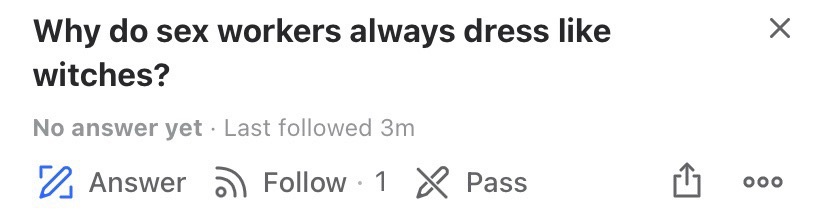
From a social media question.
That. That sparked a conversation betwixt Eunice and me that led to a book.
Ideas are everywhere.
The folks with the Grand Ideas generally seem to believe that 75% of a book is coming up with the idea, and 25% is the writing (or, if they’re especially generous, that the idea is 50% and the writing is 50%). In reality, it’s more like the idea is 0.25%, and the writing is 99.75%, though if you’ve never written a book that might not seem credible.
The advent of ChatGPT has led to a ton of folks who think that since the idea is the hardest part of writing a novel, and the writing is the trivial bit—a mere incidental—that in a world of ChatGPT, anyone can publish a novel. It’s so easy! Type your idea into ChatGPT and Bob’s your uncle! Fame and riches await!
Of course, it doesn’t work like that.
There’s a peculiar thing that happens with human beings where, when you lack the ability to do something, you also lack the ability to evaluate whether or not someone else who does that thing is good at the task. People who aren’t writers may sincerely be unable to tell that ChatGPT output is bland, dreary, inconsistent garbage—not really information so much as an information-shaped space, a suggestion of what information might vaguely look like.
I’ve been asked if I’m afraid ChatGPT will make me obsolete.
No. The answer is no.
Folks who think that ChatGPT can turn their amazing idea into a best-selling book…well, let’s just say I see disappointment in their future.
Will AI get better? Sure. Will AI ever replace technical writers? Mmmmmaybe, though I think it’s more likely it will enhance technical writers by creating a tool in their toolkit for certain formulaic parts of technical writing. A good technical writer needs to be able to imagine herself in the position of someone unskilled in the art being guided through an unfamiliar task, and I don’t see AI doing that untill it actually becomes, well, real artificial intelligence, which ChatGPT and its like most definitely are not.
Will AI replace creative fiction writers? I think that’s an AI-Complete problem—a problem unlikely to be solved until we have true self-aware general AI, at which point AI people are people, and like human people, may r may not be good at writing.
But I digress.
The point I’m making here is the fascination with ChatGPT producing a novel comes, I think, from a profound ignorance of how common ideas are and how difficult it is to turn an idea into something someone else wants to read.
I’m writing this from the home of one of my co-authors in Springfield. Tomorrow, we are driving out to rural Missouri to trace the path of the protagonist in our upcoming far-future, post-Collapse literary novel, Spin, because we need to get a sense of what it’s like to make that journey…and that’s exactly the sort of thing ChatGPT cannot bring to the table.
I emailed my lawyer and my therapist this morning.
When I write a work-related email to a client or a vendor or some professional I’m contracting for services, I tend to take a lesson from my experiences when I owned a computer consulting firm back in Tampa. Back then, I strongly, strongly preferred clients who sent me terse emails that got straight to the point in the first two sentences to meandering emails that took three paragraphs to get to the point, because the time I spent reading an email was time I wasn’t making money.
So for example, I really appreciated a client who sent me an email saying something like “We’re adding three new workstations to our network, but the network switch is out of ports, so we’d like you to come in and see about installing a larger switch and maybe get costs to upgrade to a faster network.” One sentence, spells out exactly what they need, boom, done.
I worked for a time as a print liaison for a small company that developed training manuals for businesses; they hired me to act as the go-between with printers and shipping companies, primarily, because at the time I already had a working relationship with most of the printers in the area.
I cc’d the business owner on all my emails with print shops and shipping companies. I remember a phone conversation with her one day where she complained about the brevity of my emails—she believed, strongly, that the emails should be longer, with introductory paragraphs like we really appreciate the work you did for us on the last print job and we’re looking forward to working with you again.” Where I would send a print shop an RFQ that might be two, maybe three paragraphs long, she preferred emails that were eight or ten.
I did it hr way, of course, because she was the client, but since I happened to be thinking about it, I’m curious. For those of you who communicate by email for professional or work-related reasons, what are your preferences?
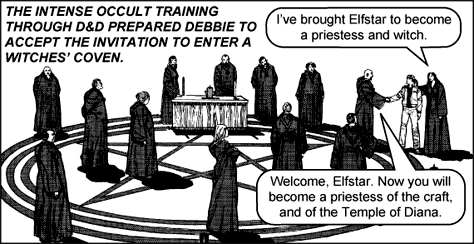
Dungeons & Dragons is famous for basically three things: creating an entire cottage industry of weird foaming-at-the-mouth Evangelical cries of satanic doom that will sweep over the land, covering it in darkness forever and ever; giving socially awkward high school students of a certain era something to do and a way to make friends; and, of course, the D&D alignment system, which divided all of morality into a tidy grid with nine different possibilities.
What Evangelicals think D&D looks like
What D&D actually looks like, but with more dice and books (image: No Revisions)
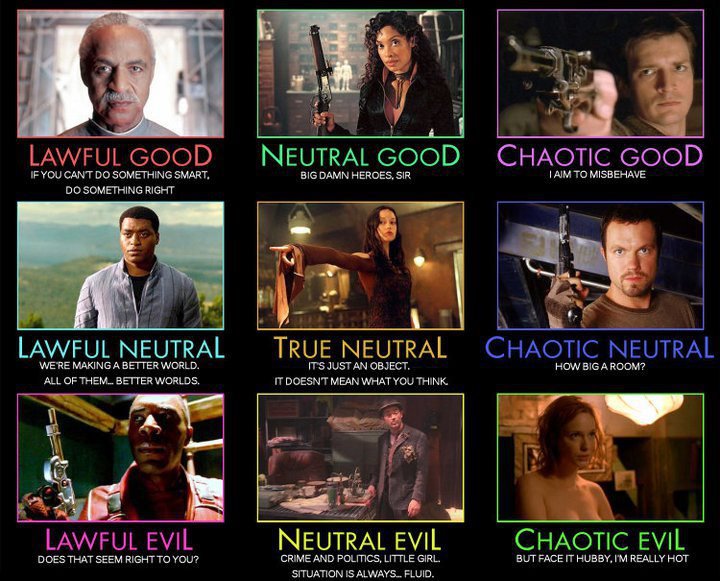
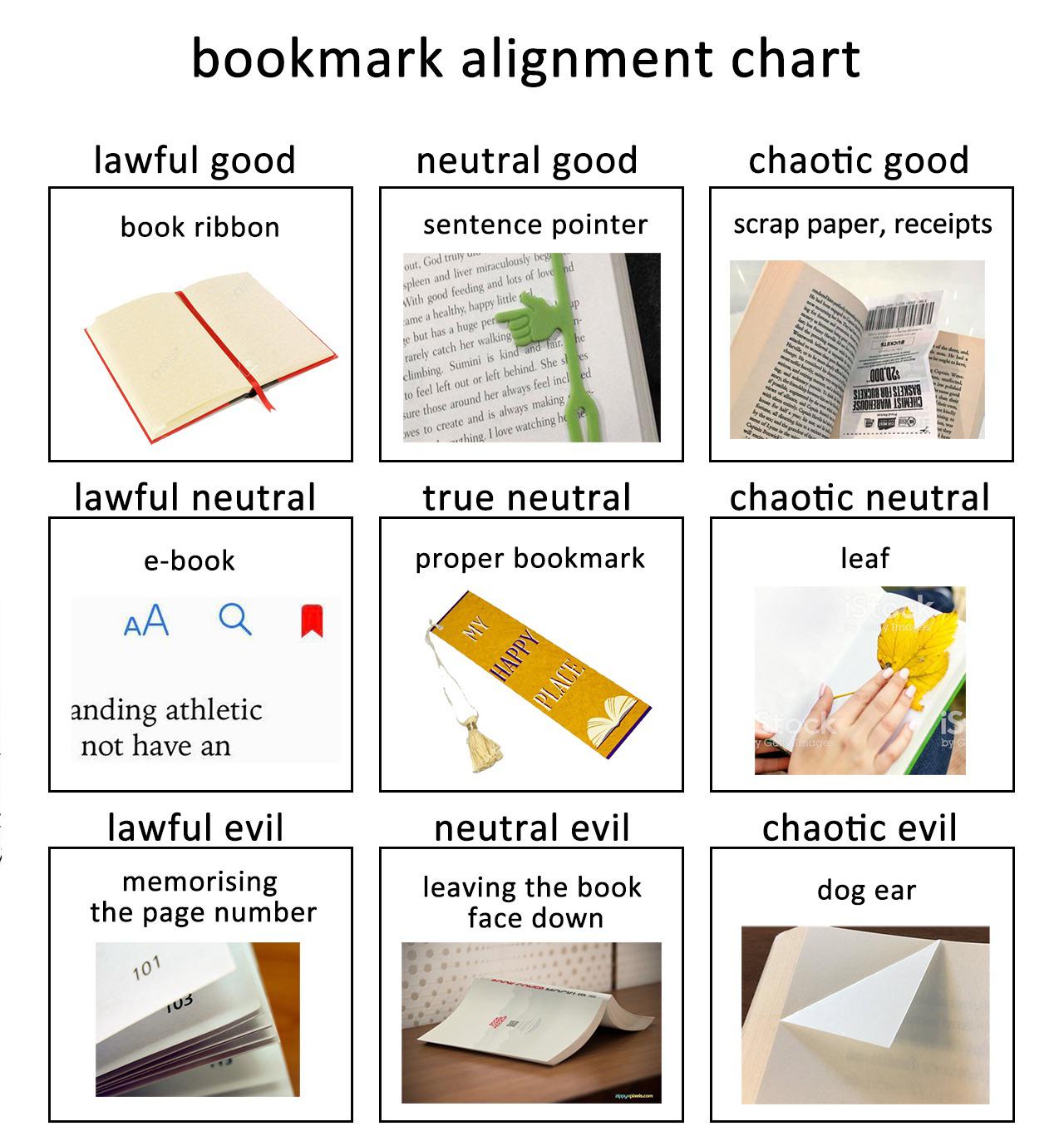
The Dungeons & Dragons alignment system divided morality into Lawful, Neutral, and Chaotic on one axis, and Good, Neutral, and Evil along the other. It’s become a cultural touchstone (or a cliché, if you’re less charitable) that has spawned a zillion parodies:
But here’s the thing:
The problem with D&D morality is that it assumes there’s some fixed definition of “good” and “evil.”
You know how relativity tells us all motion is relative? If two people go whizzing past each other in space, each one is at rest in his own reference frame and sees the other one moving.
Real morality is kind of like that. Most people truly, honestly believe they are good. That’s their local inertial frame. For example: Most people agree that violence in defense of your life or the life of another is morally good. The guy who plants a pipe bomb in an abortion clinic? That’s what he thinks he’s doing: defending the lives of babies being murdered. In his eyes, blowing the limbs off clinic workers is morally good.
That’s his inertial reference frame. He would consider himself neutral good; D&D would call him neutral evil, or possibly chaotic evil.
D&D morality, like Newton, assumes the existence of a fixed reference frame from which to evaluate all morality.
In real morality, various people have defined various reference frames. Some folks use “society” as a reference frame, which is all well and good until you encounter cases like “if a society says slavery is moral, then for that society, slavery is moral.”
Utilitarianism is kind of the equivalent of using the cosmic microwave background radiation as your reference frame. If you see a dipole in the CMB, you’re moving, and more specifically, your vector of motion is oriented toward the blueshift in the CMB.
It’s not a perfect analogy; motion is a single vector and D&D has two axes (good <-> evil and lawful <-> chaotic). But it gets the point across.
If we set the CMB to our D&D framework, then probably, yes. Most people are probably neutral, though they think of themselves as good. That’s the entire difficulty: almost all people think of themselves as good. The activist campaigning to legalize gay marriage and the fire-n-brimstone Fundamentalist preacher shaking his fist at the gays both believe they are good.
In Newtonian ethics, this clearly cannot be.
There’s also the issue that for most of us in our day to day lives, using the CMB as a reference frame just isn’t very useful. Right now, as I type this, I’m sitting on the couch in my living room. The couch, the chair next to me, the fish tank to my left, and my tea to my right all seem at rest. The fact that we’re on the surface of a planet spinning and whipping around the sun which is making its slow orbit about the center of mass of the Milky Way which is itself on a collision course with Andromeda at ludicrous speed isn’t relevant to me.
I’m not going to get out of a speeding ticket by saying “but officer, motion is relative, and if you measure our speeds by the CMB dipole they’re indistinguishable!”
Human beings are hard-wired to think differently about our in-group and our out-group. This is built into the structure of our brains. We also have a limit on how big that in-group can be. It’s about 150 people. This is called Dunbar’s number, and it sets a limit on the number of meaningful emotional connections we can make.
The in-group—the people in our Dunbar sphere—-is the ethical equivalent of my living room. When I get up to make more tea, the only inertial frame that’s relevant to me is the frame in which my living room is at rest. Trying to use the CMB as my reference frame isn’t useful.
Most people’s day to day inertial reference frame for their moral evaluations is their Dunbar sphere—the people in their immediate social group. That’s their inertial living room. In that living room, they can think of themselves as “good” even if their ethical actions with respect to utilitarianism is extraordinarily evil—that is, the CMB dipole is very large.
The people who built this place believed, from within their reference frame, they were good. (Image: Frederick Wallace)
Because they don’t think about any reference frame outside their Dunbar sphere, they do things that appear to be morally contradictory—like taking in a friend who has lost his job and his home, while at the same time saying “fuck those Syrian refugees. I don’t care if an 8-year-old girl dies in agony. Fuck her.”
They think of themselves as “lawful good” because they took in their homeless friend. They continue to think of themselves as “lawful good” when they casually condemn thousands of women and children to gruesome deaths. The walls of my living room are relevant to me; the cosmic microwave background of utilitarianism is not.
I would argue that in D&D terms, it’s quite possible that the majority of people are, if anything, neutral evil, if we use utilitarianism as our CMB. Most people believe slavery is evil. Most people would not support slavery making a comeback. Most people are totally 100% okay with buying a diamond engagement ring mined by slave labor, as long as the slavery happens somewhere out of sight to people outside their Dunbar sphere.
I suggest that in most cases, seen from the reference frame of utilitarianism, the majority of human beings, including those who see themselves as lawful good, are in fact neutral evil.
[This essay is an expansion of a thought I originally wrote as an answer on Quora]
There is a notion, a myth enshrined in a great deal of Western philosophy, that as time goes on, societies move ever further from superstition and ignorance, and ever closer to Truth.
It is, like many social myths, complete nonsense.
In fact, societies swing to and fro, sometimes moving closer to the truth, sometimes further away.
The way I model this in my head is that truth is a strange attractor, and societies loop and whirl around it in complex ways that are extremely hard to predict and vary depending on how the society formed.
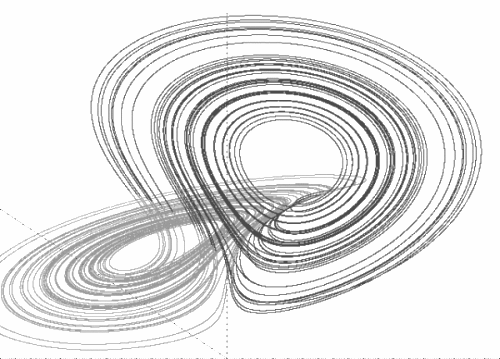
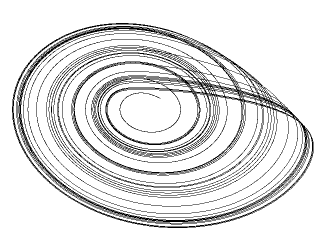
Pretty much exactly like this:
These are strange attractors—mathematical functions that loop and swirl around a point, sometimes moving closer, sometimes farther away, twisting and curling as though drawn to it without ever entirely reaching it. They never repeat, they never settle down into a stable orbit.
This is, I think what human societies do. Every society has its collection of myths and legends, things it wants to believe about itself whatever the reality might be, and its own unique monomyth. These things influence the trajectory a society takes through social space, tugging it this way and that, whatever empirical fact or philosophical truth might be.
This means you could, for example, take snapshots of a society’s history, like paragraphs out of the society’s history books, and treat the pile of snapshots like a Poincaré map of that society’s eccentric orbit around the truth. And what you’d find would be something like a Philosophical Strange Attractor, a chaotic churning orbit about the truth, full of twists and turns, always tugged in the direction of truth but never settling there.
People like to talk about history as a swinging pendulum, but I don’t think that’s a good model. A pendulum retraces the same arc over and over. Societies may progress or regress, may seek to explore new ideas or retreat into history and tradition, but they never really repeat the same path twice. Even when those who long for some imagined idyllic past gain power, they never really quite reach it. Societies, like people, never set foot in the same river twice.
Every society has its mythologies. Mythologies are necessary for social identity, they’re always going to be there. Mythologies weld disparate people into something like a more or less cohesive whole, forming an overarching sense of identity that (ideally) takes the place of family or tribal identity. Without that overarching identity, you don’t have Rome, you have a bunch of squabbling families and tribes who don’t much like each other. (Even with a foundational mythology, you still have that, of course, but the overarching mythology helps create glue that aggregates all those disparate elements.)
A foundational myth creates identity—the way people see themselves. And identity distorts and shapes the way we see the world.
But the thing about that myth is it is, in any objective, empirical sense, not true. And subtle variations in a society’s founding myth, like subtle differences in the start condition of a chaotic system, have huge effects on that society’s chaotic path around the attractor of Truth.
So no. No, the moral arc of society doesn’t always bend int he direction of truth, or justice, or any of those other wonderful philosophical ideas. It may follow a chaotic orbit around these things, but it is not inevitable that if you wait long enough a society will necessarily arrive at Truth, or Justice, or Enlightenment. If you want to get there, it’s your job, and will always be your job, to work to make it happen.