Since returning from Reykjavik, my body’s been stuck in this thing where I wake up at 4:30 AM, can’t get back to sleep, haul myself out of bed, and then by 9 PM I’m crashing.
But hey, I did get some amazing photos, even if the trip wrecked my sleep schedule.
While I hate this with every fiber of my being—I am firmly of the opinion that if I’m up at 4:30 in the morning it should be because I’m still up, not because I’m getting up—I do have to admit it’s done wonders for my productivity.
This morning, before noon, I worked on a novel, updated my Patreon, finalized a new page on my BDSM site, wrote a blog post for More Than Two, put up a new essay on Xeromag, reset all the FTP passwords on my web server (thanks to a security issue at my webhosting provider…man, this has been a rough week in the infosec world), finished unpacking from Reykjavik, cleaned the tub, and did a load of laundry.
So, from the top:
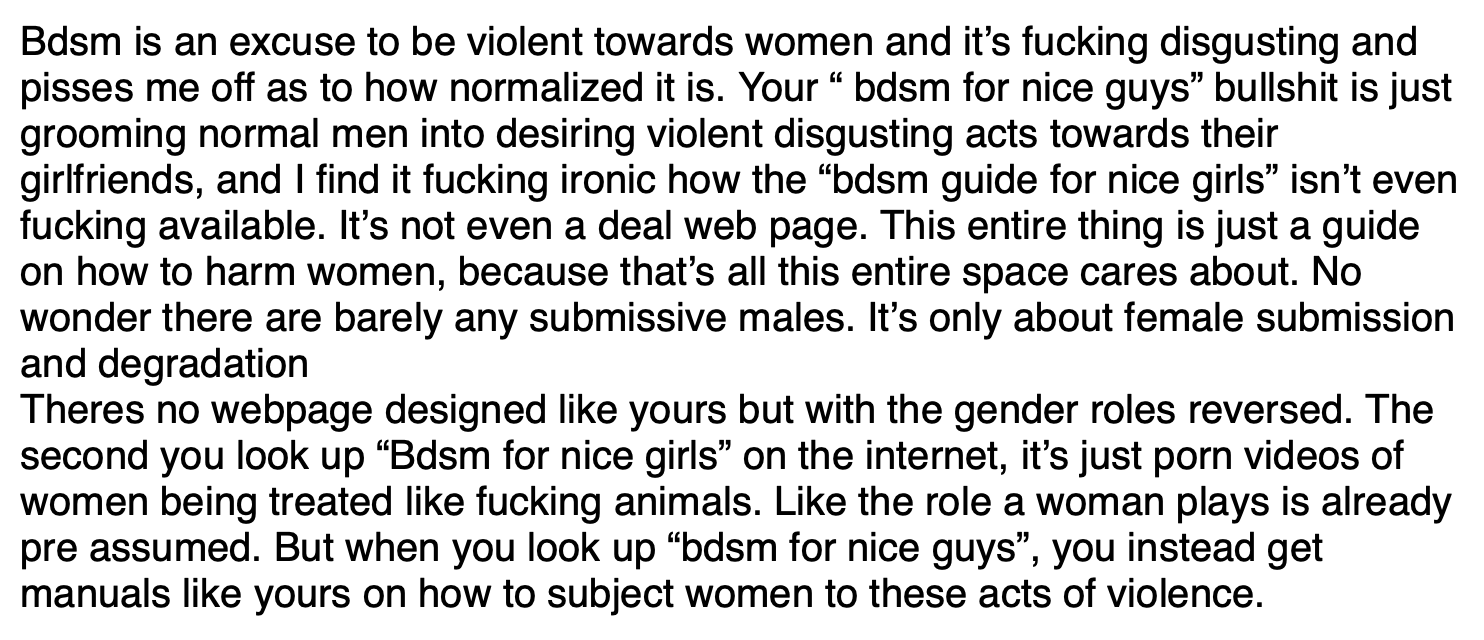
A short while ago I got a rather snarky email from my BDSM for Nice Guys page.
Which, I mean, wow. “Barely any submissive males”? Oh, my sweet summer child.
Still, this person made a good point that there aren’t a ton of BDSM guides aimed at women out there. I didn’t write one because I’m not a woman; I’m not qualified to write such a thing.
Fortunately, I know people who are, and Dr. Jenny Hale graciously volunteered to step up and fill that space.
And so, the first new page on my BDSM site in quite a long while is now live:
I also added a new page to my Essays section on Xeromag. Most people think of themselves as basically good. Most people are wrong. People tend to get their ethics from the ambient morality around them, and abide by them so long as doing so doesn’t cost them anything, so in their local frame of reference they generally are pleased to consider themselves “good people.” However, step outside the local ethical frame and you see that ethics are more Einsteinian than Newtonian.
Over on the More Than Two blog (and its companion Substack), I published an essay about the skills and traits that make for vibrant, strong relationships:
And finally, I apparently now have a YouTube channel, upon which I just put a new video on the subject of how writers find the drive to finish writing books. (Spoiler: We don’t. The book gives us no peace until we finish it.)
I’ve had a Patreon for years, but have for most of that time done very little with it. I’m now making a point of updating it quite frequently, with behind-the-scenes peek at creative projects, original photography, and excerpts from books I’m working on. You can join for free, and see all my content for just a dollar a month!
The world is filled with people who want to be writers. The world is even more filled with people who don’t want to be writers but want to have written a book, which isn’t the same thing, though that’s a matter for another post.
The number of people who can get published is, as a fraction of the number of people who want to publish a book, quite small. In fact, you’re statistically more likely to win the lottery—yes, really—than you are to make a living at writing. It’s a bit like playing pro sports that way.
And as with playing pro sports, whenever you have a huge number of people who really really really want to do a thing and only a small number of people who can do the thing, that entire field soon attracts scammers that hover like a cloud of bloodsucking flies around anyone who even breathes the slightest hint of interest in the thing.
I have quite a number of books out (I’ll likely follow this up with a list of the books I have out now or soon coming out), which means that I am absolutely swamped with email come-ons and social media DM solicitations from people who would love to help take my money without giving me anything in return.
On an average day, I receive anywhere from three to ten or more spam emails from people claiming they can get me a film deal, or put me in front of their “book club,” or pitch my book to TV studios, or do a “publicity drive” for me, or make book trailers for me…all for pay, of course.
A lot of these emails are just straight-up fraud. Yesterday, I got an email claiming to be from a famous and well-known acquisitions editor for a major, highly-regarded publisher…but using a gmail address instead of that editor’s actual publisher address.
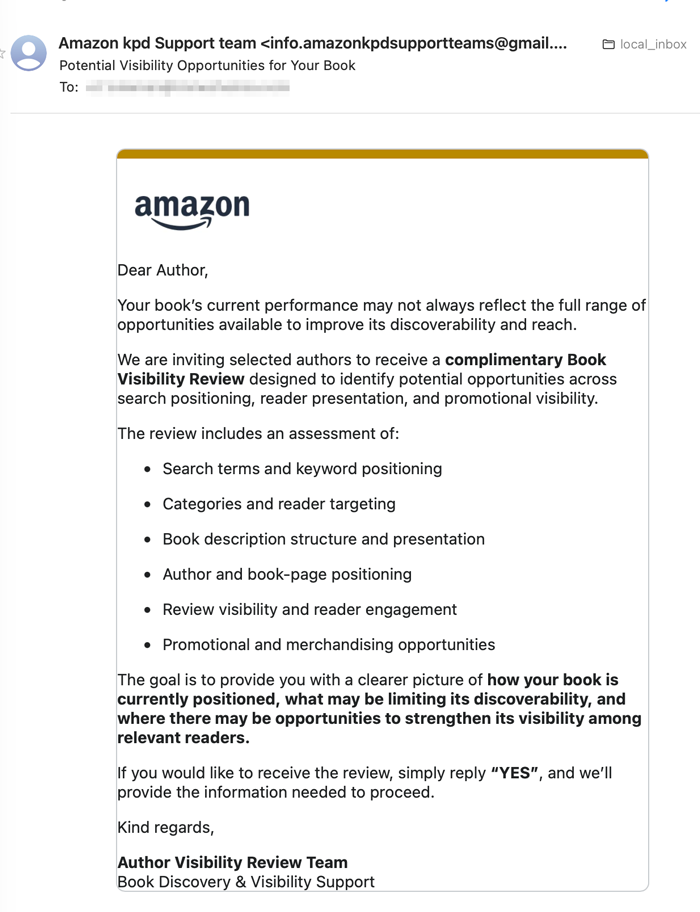
Today I got this gem, which uses the Amazon logo and implies through paltering that they’re affiliated with Amazon, which is, again, just a straight-up fraud.
So, if you’ve ever dreamed of being a writer, here’s a quick run-down of how to spot the obvious scams and frauds.
In real publishing, money flowsfromthe publishertothe author, never the other way. The “vanity press” is the oldest and most well-known scam in the publishing world.
Vanity presses pretend to be publishers, but they charge you, the author, to publish your book. The business model of real publishers is that money comes from book readers, flows to the publisher, and from there some of the money flows to the author. The business model of vanity presses is money flows from the author to the “publisher.” The “publisher” tyically has no distributor; they will tell you they can get you into bookstores (spoiler: they can’t), and at the end of the day they will not do anything to promote your book because they don’t care about book sales. That isn’t where the money comes from.
This same thing applies to “self-publishing services.” A lot of writers know about self-publishing on Amazon KDP and such, but don’t know how to do it. Enter the “self-publishing service,” which will, for fees ranging from thousands to tens of thousands of dollars, get your book on Amazon KDP…something that you could do yourself for free.
They typically will tell you they will handle things like book formatting and editing. They typically don’t, or if they do, they do it poorly.
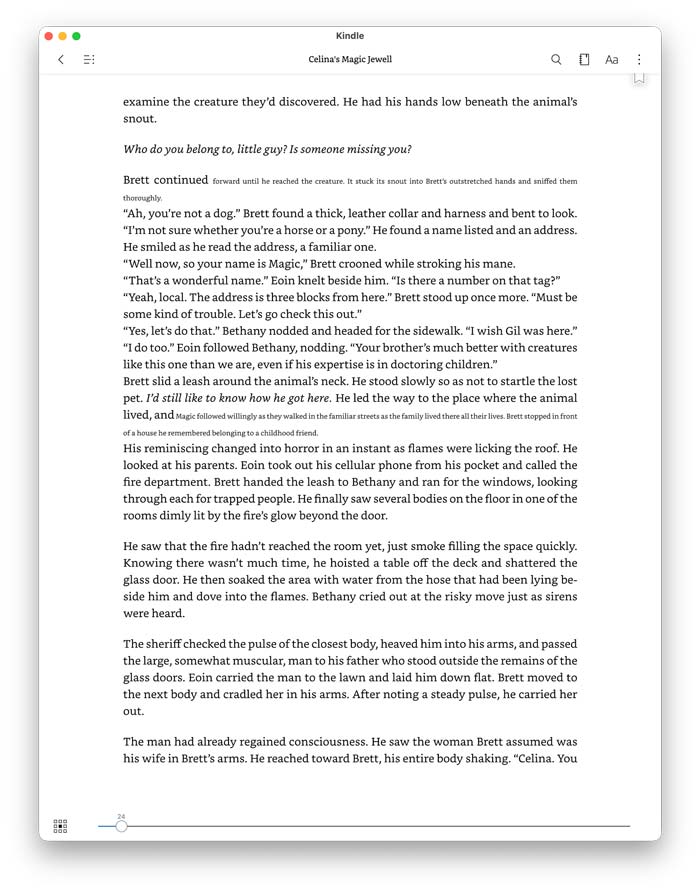
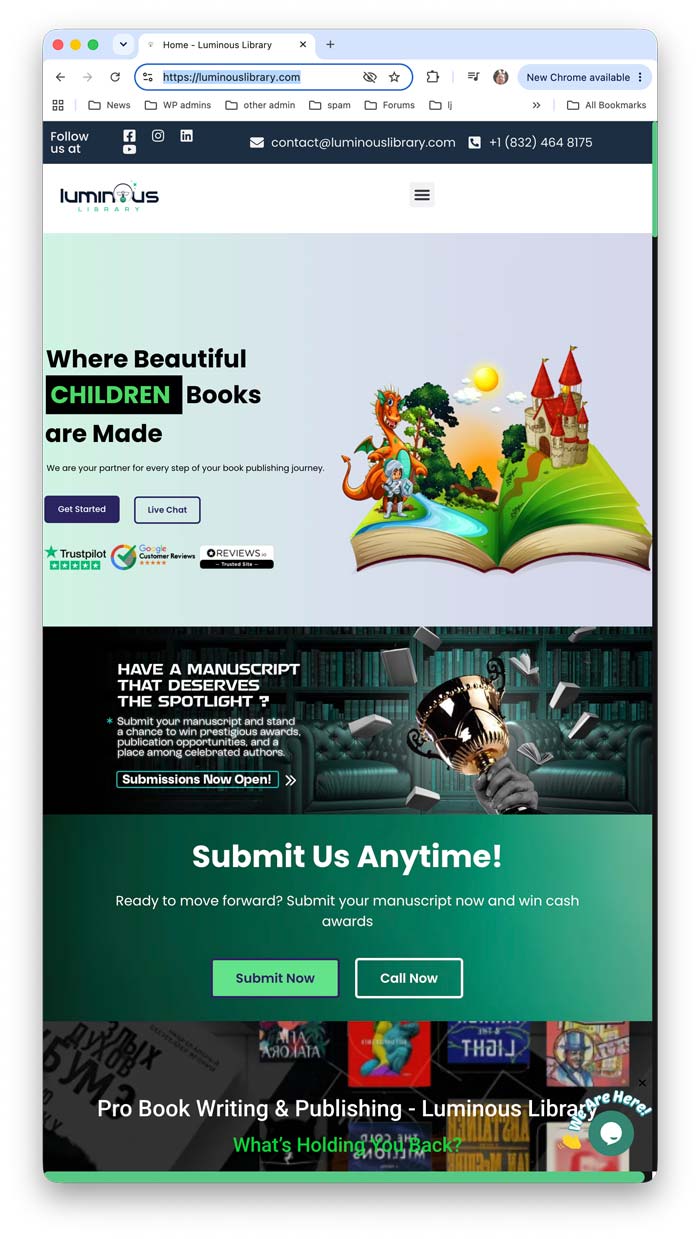
Case Study #1: “Luminous Library,” which bills itself as a service to help authors publish their masterpieces. They will, for a substantial fee, handle formatting and such, but…
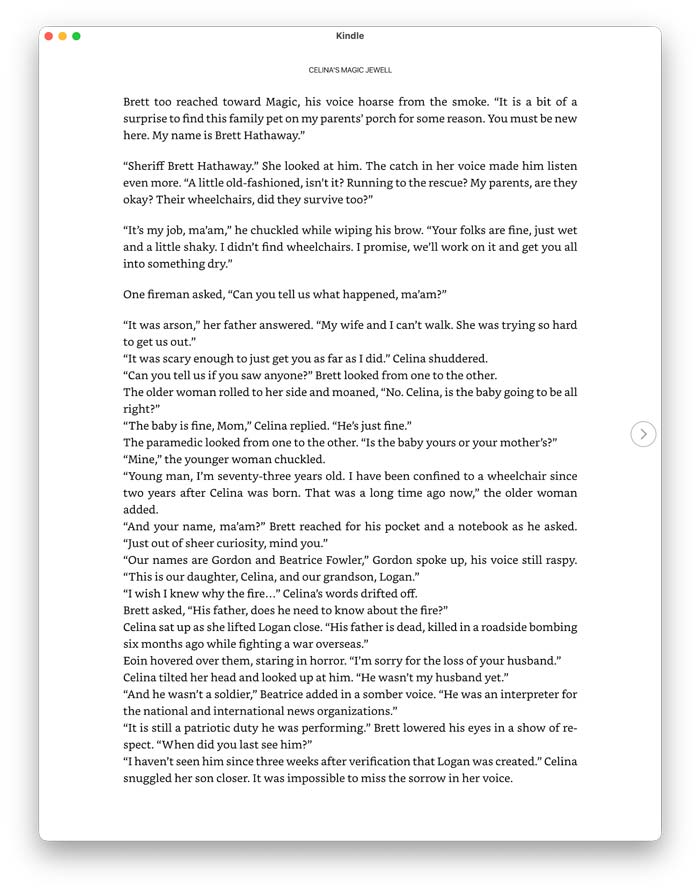
Inconsistent fonts, inconsistent type sizes, no indenting, no standard formatting at all.
This extends to their own website; their home page contains multiple grammar and usage errors:
Many “self-publishing agencies” are like this: huge fees, minimal work that produces material unacceptable even by the modest standards of most self-published content.
Real publishers do not send unsolicited emails or requests. Real publishers receive tens of thousands of unsolicited manuscripts a year. Real agents can get hundreds of queries a day. They do not have time nor interest in sending would-be authors emails saying “hey, I want to represent you.” That doesn’t happen.
The new shiny in author scams is people who claim to be famous agents or editors, using the names and logos of famous literary agents and publishers to scam people.
Corollary #1: Agents and publishers use their official company email addresses, not free emails like Gmail.
Corollary #2: Agents never, ever, ever, ever, ever, ever, ever charge money up front to prospective clients, for “reading fees” or for any other reason.
The business model of a book agent is they make a percentage of the royalties on your book. That means they have an incentive to get you the best possible deal. Their money, like the publisher’s money, comes from sales of your book, not from you, the author. All “agents” who charge you up front are always scammers. No exceptions.
Emails offering to “put you in front of movie studios” are always, always a scam. Again, there are no exceptions.
Movie studios are only interested in IP that has already demonstrated a track record of successful sales. There are no people who accept money from you in order to pitch your book to studios. As with agents, the people who promote intellectual property to studios make their money on the back end, not from the owners of the IP.
Emails offering to do podcasts or “book club readings” for money are always, always a scam. These make up the vast bulk of the scam emails I get, outnumbering fake agents, fake publishers, and fake marketers combined by about 4 to 1.
Fake publishers were once the mainstay of the author scam machine, but the Internet and spam email have democratized the scam industry. Fake book clubs are the domain of the solo scammer, the scammer who doesn’t want to set up a legitimate-looking business. Anyone anywhere in the world can send out fake book club scam emails…and they do.
Many of these people impersonalte Lori Hettler, the founder of the Next Best Book Club. I get emails from various fake “Lori Hettler”s on a monthly basis, all of them using free email providers.
Unsolicited emails offering to do promotion, “book trailers,” Amazon “optimization,” and so forth are always scams. Yes, there are real book promotion companies. No, they don’t contact you out of the blue.
Now, there are legitimate companies who support authors with pay-for-play services like editing, book formatting, and so forth. There are even “hybrid publishers” where the author and the publisher split production costs, though in my experience most of these lean toward the scammy end of the spectrum.
The thing about all of these, though, is they don’t send unsolicited emails.
The scam emails have, when you’ve seen a few hundred of them, a certain cadence and tone: they flatter you, quote from your book’s blurb or Amazon listing to try to make it seem as though they’ve read your book (spoiler, they haven’t), and they tell you how wonderful you are and how many books you could be selling if only you’d use their services…because it totally isn’t your fault you’re not a bestseller, it’s always down to just not quite having what they offer.
Beware, beware anyone who reaches out to you unsolicited on social media or in email offering to turn your book into a sensation for a price.
Regular reminder: Whether you’re a beginning writer or a seasoned pro, whether you write niche nonfiction or mass-market fiction, never, ever sign a book publishing contract before you email
beware (at) sfwa (dot) org
This free service helps you avoid scammers and publishers with poor reputations listed on the Writers Beware list of predatory book publishers.
I emailed my lawyer and my therapist this morning.
When I write a work-related email to a client or a vendor or some professional I’m contracting for services, I tend to take a lesson from my experiences when I owned a computer consulting firm back in Tampa. Back then, I strongly, strongly preferred clients who sent me terse emails that got straight to the point in the first two sentences to meandering emails that took three paragraphs to get to the point, because the time I spent reading an email was time I wasn’t making money.
So for example, I really appreciated a client who sent me an email saying something like “We’re adding three new workstations to our network, but the network switch is out of ports, so we’d like you to come in and see about installing a larger switch and maybe get costs to upgrade to a faster network.” One sentence, spells out exactly what they need, boom, done.
I worked for a time as a print liaison for a small company that developed training manuals for businesses; they hired me to act as the go-between with printers and shipping companies, primarily, because at the time I already had a working relationship with most of the printers in the area.
I cc’d the business owner on all my emails with print shops and shipping companies. I remember a phone conversation with her one day where she complained about the brevity of my emails—she believed, strongly, that the emails should be longer, with introductory paragraphs like we really appreciate the work you did for us on the last print job and we’re looking forward to working with you again.” Where I would send a print shop an RFQ that might be two, maybe three paragraphs long, she preferred emails that were eight or ten.
I did it hr way, of course, because she was the client, but since I happened to be thinking about it, I’m curious. For those of you who communicate by email for professional or work-related reasons, what are your preferences?
About six months ago, I noticed a significant uptick in spam email. But not just any spam, oh no. I found myself flooded with stock pump-n-dump spam, in incredible quantities.
What is pump-n-dump?
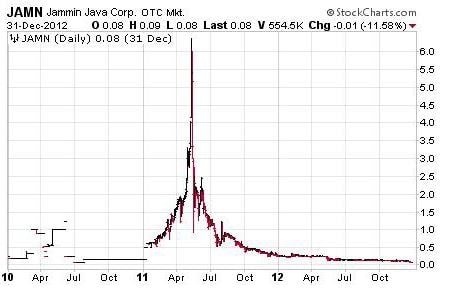
A pump-n-dump scam is where a scammer buys a large quantity of a cheap stock, then floods the world with hype to drive up the price of the stock. When it starts to rise, the scammer sells all his shares, the stock collapses, and the scam victims lose their investments.
Occasionally, the companies parasitized in this way can go out of business (small companies will sometimes use their own stock as collateral for loans, with the agreement that if the price of the stock drops below a certain point, the loans come due immediately).
And as I collected examples of this spam, I noticed something interesting: all the pump and dump scam spam originated from Salesforce, the $300 billion American tech giant.
So what does Salesforce have to do with penny stock scams, and why on earth would Salesforce be supporting pump-n-dump stock scammers? Hang on, let’s go down the rabbit hole.
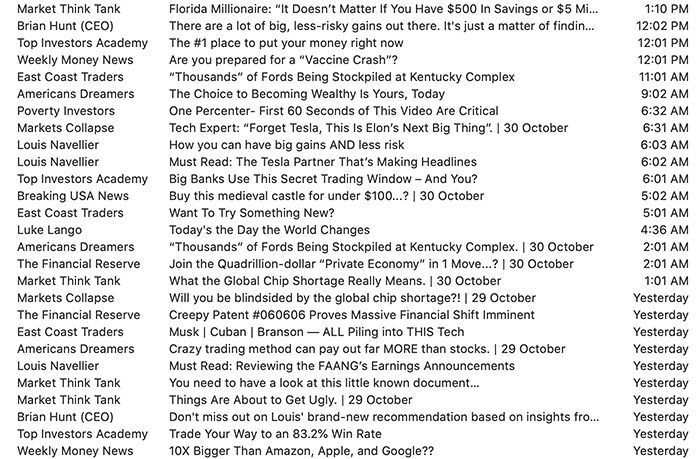
When I say I’ve been getting stock scam spam in incredible quantities, I mean it. I’ve received 1,794 examples of stock pump-n-dump scam emails between March 17, when I first started collecting them, and October 30. That’s 1,794 scam emails in 227 days, or an average of about eight a day.
There are a lot of them. They come from multiple From addresses and claim to be from various “investment” companies, but they all have some characteristics in common:
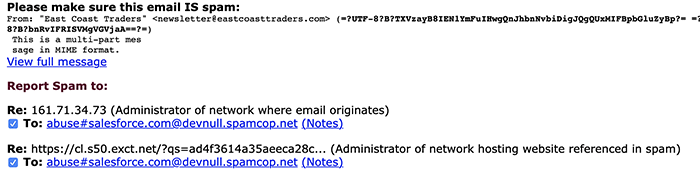
They all originate from IP addresses owned by Salesforce subsidiary Exact Target
They all advertise URLs hosted by Salesforce subsidiary Exact Target
While they come from different email addresses, they use similar graphics, language, and promote the same sets of stocks
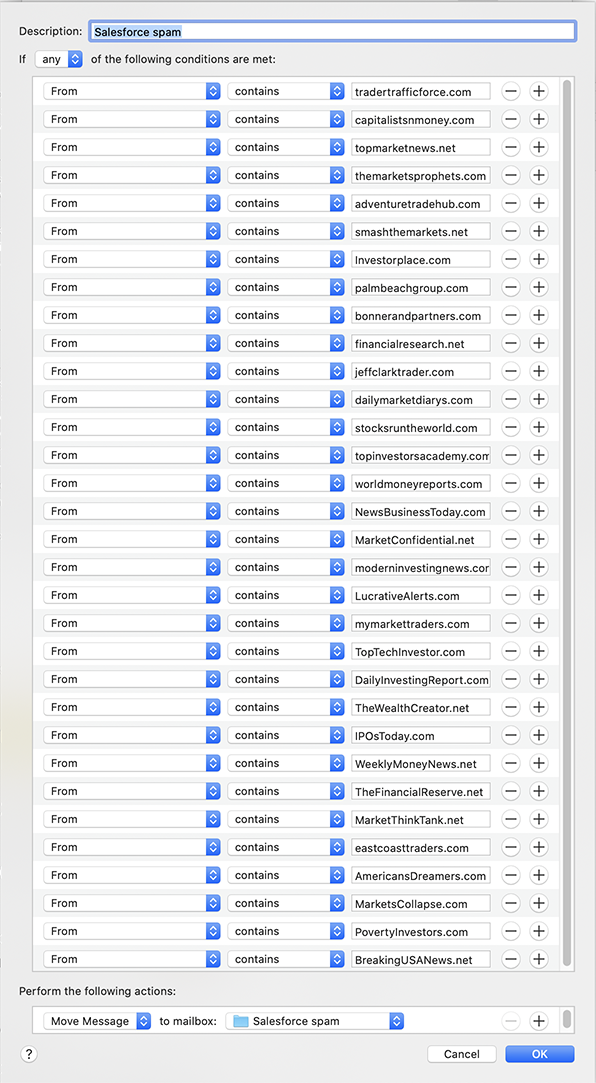
How many different companies do they claim to come from? Lots. Every time I see an example of one of these spam emails, I build a rule in my mail reader app to route future examples to the Salesforce scam spam folder. Between March and October, here’s a list of the From addresses used in these scam emails:
Each From address will be used to send anywhere from three to twenty or so scam emails before it’s abandoned and the scammers move on to the next.
In practice, Spamcop has disabled reporting to Salesforce, because Salesforce (a) doesn’t pay any attention to abuse reports and (b) doesn’t follow spam best practices, specifically by not requiring double-opt-in and not honoring remove requests.
This isn’t a new problem, either. Spamcop stopped sending abuse reports to Salesforce/ExactTarget at least as far back as 2011, and maybe earlier.
Unsurprisingly, manual emails to Salesforce and ExactTarget abuse addresses do nothing.
So what’s all this about? What does Salesforce gain by assisting stock pump and dump scammers?
$$money$$
Pump and dump scams require broad reach. They are also extremely profitable when they work. So it’s worth spending money to make sure you can reach as many marks as possible; profit varies directly with the number of gullible dupes you can con into buying the hyped stock.
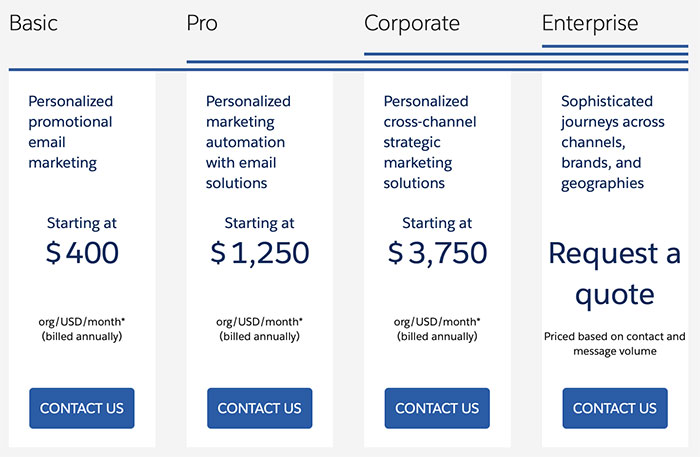
And Salesforce/ExactTarget isn’t cheap:
Note those prices are (a) billed annually up front and (b) are per organization. So even the cheapest plan is $4,800 out of pocket at the start, and the spammers are using multiple phony organizations in their spam.
This is, I’ll warrant, a nontrivial source of Salesforce revenue.
So Salesforce has a positive financial incentive to aid and abet these scammers, and thousands of folding, spendable reasons to disregard abuse reports.