There will be a last day

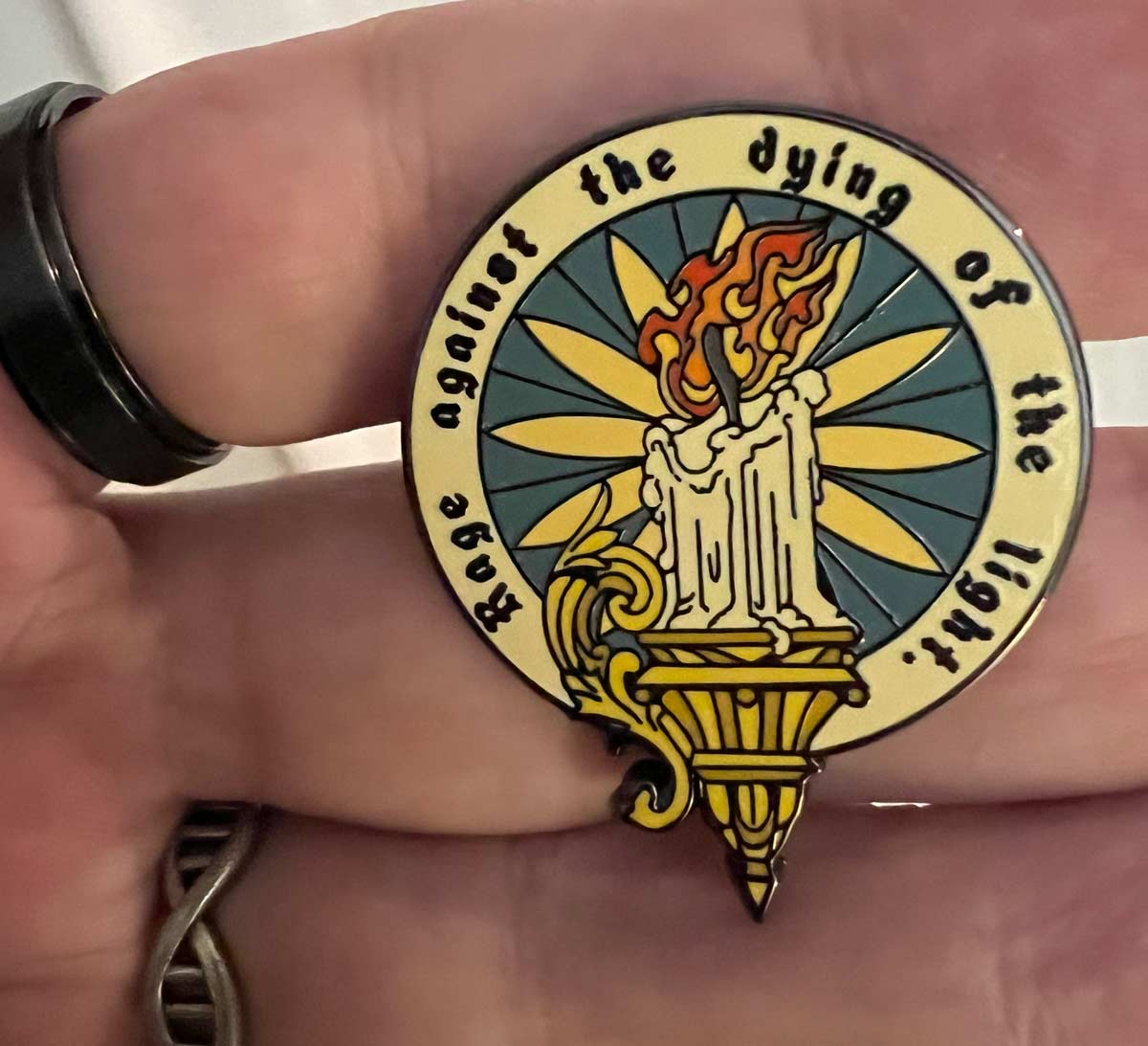
When I arrived in Florida a few weeks ago to help care for my mom, who was in the last stages of terminal cancer, Facebook showed me an ad for a pin. I ordered it on the spot. It arrived yesterday, on what would have been my mom’s birthday.

For anyone who doesn’t recognize it, it’s from a poem called Do not go gentle into that good night, by Dylan Thomas, whose first stanza reads:

Do not go gentle into that good night, Old age should burn and rave at close of day; Rage, rage against the dying of the light.

I’ve talked a lot about my mom’s wisdom. It was a quiet, understated thing; she had a knack for comprehending the world in ways subtle and deep. When I was growing up, she used to tell me, “information by itself almost never changes attitudes.” She understood that we are not rational creatures, we are rationalizing creatures, prone to making decisions for emotional or tribal reasons and then pressing our rational selves into service to justify our choices.

Other things she told me countless times:

“Education is not the solution if ignorance is not the problem.”

“We are predisposed to believe what we wish were true or what we’re afraid is true.”

“Never ask a question whose answer you don’t want to know.”

Even more than her sometimes pointed wisdom, though, I remember she was always, always there for me, without fail. If there was one thing I could count on absolutely, without question, as surely as the rising sun at the end of night, it was that she’d be there without fail. I never for even a millisecond, at any time in my life, doubted her love. Not once.

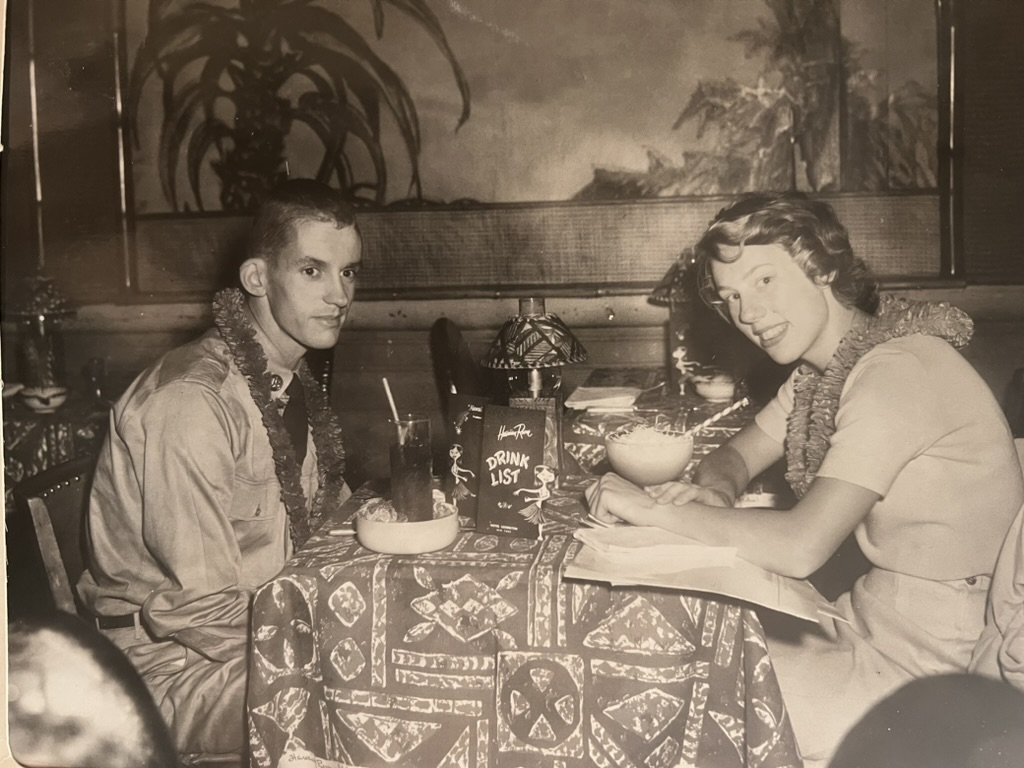
My mom and my dad on a date, six years before I was born.

I remember one night many years ago, when I was 18 or 19, driving to Ft. Lauderdale in my notoriously unreliable ’69 VW Beetle to visit friends. The car broke down at about 2AM four hours from home, so I called my mom from a pay phone. Without the slightest hesitation, without lectures or rancor, she got up, dragged her ass the four hours to come rescue me, then the next day took me to a repair shop for the part I needed to fix it and drove me right back down again.

She was always that way. That sort of cast-iron knowledge that someone always has your back is probably the single greatest gift you can ever give someone growing up.

My mom was diagnosed with cancer in November 2022, thirteen months almost to the day as I type this. She tolerated chemo poorly, though she was not one to go gentle into that good night, and stuck with it no matter how miserable it made her.

In the end, it wasn’t enough.

I came down to Florida a few weeks ago to help my dad care for her. At the end, she needed round-the-clock care, so my dad and I alternated in twelve-hour shifts.

In the tiny hours of the night last week, she started having difficulty breathing. I called 911. She’d been in and out of the hospital several times, so I didn’t know this would be the last time she’d ever be home.

The hospital confirmed the cancer had spread to her lungs and brain. A few days later, the doctors took her off life support.

She died at 9:36 in the morning on December 15, 2023, four days before her birthday. We (my dad, my sister, and I) were in the car on the way to the hospital to see her when she passed.


That night, when I called 911, I don’t think any of us knew it was the end. We knew the end was near, of course, but she’d had other crises, other storms she’d weathered.

I’ve been thinking about that a lot this week, as I go through a million little things I never imagined having to deal with—arranging for the home hospice care people to come and pick up the hospital bed, resetting her iCloud passwords, all the various ways we close the threads of a life. (The truck is titled in my mom’s name but my dad isn’t on the title, something my sister is dealing with.)

You never know.

Someday, there will be a last time you see the moon through the trees. Someday, there will be a last time you hug the people close to you. Someday, there will be a last time you hear a bird sing, a last time you have your favorite dessert, a last time you feel the sun on your face.

You might not know when that is. It might have already happened.

You are an anomaly. Yes, you. The odds of your existence are incomprehensibly small. You trace your lineage directly across the billions of years to a primitive, single-celled organism, and any tiny disruption of that slender thread would erase your existence. Had your parents gone to the movies that night, you would not be here.

You have these brief moments under the sun, and that is a gift beyond price—beyond imagining. Somehow, you beat odds so great your brain literally cannot comprehend them, and of the trillions of potential beings that might exist, here you are.

These few moments are all you will ever have. Cherish them, because there will be a last time for everything.

Loving Life Amidst Loss

[Note: this essay started out as an answer on Quora]

Right now, as I type this, I’m in Florida helping care for my mom. My dad and I have been doing 12-hour shifts with her, because she needs round-the-clock care. Between that and all the thousand things around the house that need tending to that my dad isn’t able to, I haven’t been sleeping much.

Last night at about 5am my mom started having trouble breathing, so I called 911. We just heard from the hospital 10 minutes ago. The cancer has spread to her lungs and brain. She really wanted to make it to her birthday in 6 days. The doctors don’t think she’ll make it.

So I’m not maybe the best person to talk about loving life right now.

And yet…

A few days ago, my wife and I spent a couple of hours at the Festival of Lights in Cape Coral. They had hot cocoa and a campfire with marshmallows.

When I stumbled out of bed this morning (well, technically this afternoon), the first thing that happened was my mom’s cat sat at my feet, meowed at me, and headbutted me to say hi.

Right at this very moment, I’m looking out the window onto my parents’ patio, where three squirrels are chasing each other across the screen roof, and it’s delightful.

I was born just barely early enough to see humanity walk on the moon—-some of my earliest childhood memories are sitting in front of a B&W TV watching the Apollo launches. Odds are good I will see humanity walk on Mars. Isn’t that amazing?

I am surrounded by love. I’m spending Christmas with my Talespinner. My life is filled with creativity and joy—I write books with some of my lovers, my wife and I created the Borg Queen xenomorph parasite cosplay from an idea she had three years ago, I’m teaching myself CNC machining and laser engraving.

I live in a time of unprecedented peace and prosperity in human history. We can fly through the air. Every day, we learn more about the universe.

This photo:

was taken by a probe that landed on a comet. We have the capacity to launch a probe that can travel for years and then arrive precisely on a small rock traveling at 84,000 miles per hour, which is about like a person in Boston shooting a rifle and hitting a golf ball in midair in Moscow. (Bizarre how many people think science is “just another belief system,” eh?)

And, I mean, I get it. The world isn’t all roses. Right now, far too many people in my country are too uneducated in history to recognize when they’re being lied to by yet another populist grifter selling them the same old tired lie that all their failures are the fault of somebody else.

We have a political party that takes gleeful, sadistic delight in mendacious cruelty, and a voting populace that sincerely believes it’s okay to vote for the Leopards Eating People’s Faces Party because surely the leopards won’t eat their faces—only the faces of the Mexicans and the gays and the trans people, right?

There is pettiness, and cruelty, and meanspiritedness. There are people who make voting choices because they want to hurt other Americans just to own the libs.

But viewed on a large enough scale, the moral arc of the universe bends toward justice. We may be in the “one step back” part of the “two steps forward, one step back” cycle, yet this too shall pass.

I want to be here to see what happens next.

Virtue or virtue signaling: how do you tell?

[Note: This entry originally started out as an answer on Quora. If you want to keep up with my writings, I’m most active over there these days.]

Most people want to think of themselves as basically “good people.” Many people want to appear to be good people, particularly to their friends and social group. The cynic in me believes that few people are all that concerned with being good people, because being a good person is hard work, requiring careful analysis of complex, nuanced situations, dealing with ambiguity, and occasionally being forced to confront uncomfortable facts.

Enter Virtue Signaling, a way to express to your tribe that you uphold the tribal values without, you know, doing that hard, uncomfortable work! Gain all the advantages of conforming to the norms of your social group without any of that messy ethical stuff!

In the US, the political right loves to accuse the political left of virtue signaling, but this is something that knows no political divide. The rural conservative who throws away his Bud Lite because Budweiser gave beer to a transgender activist, or smashes his Dixie Chicks CD, is engaging in virtue signaling just as much as the liberal who posts “boycott Avatar 2!” on his Twitter feed without ever intending to watch the movie in the first place.

Emory & Henry College defines virtue signaling this way:

The action or practice of publicly expressing opinions or sentiments to demonstrate one’s good character or moral correctness of one’s position on a particular issue. Modern examples of Virtue Signaling are posting opinions that you do not share on social media in order to gain popularity and reputation.

And, in the spirit of complete honesty, I admit I’ve done this. I’ve offered opinions on people and situations about which I was uninformed, because I wanted to be the good guy but didn’t want to take the time to better inform myself. (In fact, the times I’ve done this, I would’ve strenuously denied that was what I was doing, because of course I knew what I was talking about, even though I didn’t know the situation or talk to the people involved…I let my own narratives about How The World Works fill in the blanks for me. We human beings understand the world through stories; the narratives we accept, often without realizing it, inform the way we perceive the world.)

So, with that in mind, what separates genuine virtue from virtue signaling? How can you tell?

I would like to propose a set of guidelines that, I believe, makes separating the two rather easy:

Virtue signaling is cheap and costs nothing. You’re literally sending signals to improve your standing with your in-group; it will not cost you socially with your in-group by definition. It always goes with your in-group, never against it.

Virtue may cost you something—socially, politically, or financially. It sometimes may not match the expectations of the people around you. Holding to virtue might occasionally put you at odds with your in-group.

Virtue signaling has no nuance, no shades of gray. It boils everything down to bumper stickers: Jesus Is Lord. Make America Great Again. Eat The Rich. Kindness Is Everything. Because its purpose is to communicate that you belong with your in-group, it’s made up of simple slogans that champion the in-group’s values in simple, easy-to-understand ways.

Virtue allows for nuance. Virtue requires looking at complex situations and making informed choices, rather than relying on bumper-sticker deepitudes. Virtue isn’t about clearly-defined good guys and bad guys; it requires constant engagement.

Virtue signaling is about the person doing it. It’s a way to say “Look at me! Look at me! I share your values! Look at me!” It centers the person engaging in it: “everyone, see what a good person I am because I support the values of my in-group.”

Virtue is about the thing. It doesn’t grab the spotlight or seek attention. While a virtue signaler is on YouTube talking about how great they are for shining a light on the fact that homelessness is bad (don’t forget to click Subscribe! And sign up for my Patreon!), virtue is out there with a hammer building houses for Habitat for Humanity.

There’s actually a Bible passage about this: “And when you pray, do not be like the hypocrites, for they love to pray standing in the synagogues and on the street corners to be seen by others.” Virtue signaling is out there praying loudly in the middle of the street; virtue takes place off stage, with sleeves rolled up, doing the work to find the facts and minimize harm in a world where there’s not always a lot of adulation in it and sometimes things aren’t as simple as they seem.

Virtue signaling is about identifying who’s one of Us and who’s one of Them. We are good, noble, just, patriotic. They are evil, corrupt, traitorous dogs.

Virtue is about living, inasmuch as is possible, a life of kindness and compassion, rooted in truth, empathy, and generosity.

Virtue signaling is about keeping safe by rigidly enforcing and policing the boundaries between Us and Them through purity and moral conformity. It turns on itself. It eats its own. It seeks out those on our side who are insufficiently pure, insufficiently dedicated to our ideals. It frequently spends as much time savaging those on Our side as attacking those on Their side.

Virtue is about living in an imperfect world where people are not always 100% pure 100% of the time. It’s about genuine harm reduction, not moral purity. Harm reduction is, as my crush and co-author Eunice once said, “ethics trying to live in the real world.” Where virtue signaling is proving one’s moral purity in a vicious game of Last Man Standing, virtue is about making the world just a little bit kinder, a little bit better, not just for those who pass the moral purity litmus test, but for everyone.

Virtue signaling tells you who the good guys and the bad guys are.

Virtue is understanding that nobody is purely one thing or the other, so the best approach is to treat others the way you would have them treat you—ir, if you’re genuinely virtuous, to do unto others 20% better than they do unto you, to correct for subjective error.

In other words, the key takeaway I’d like to propose is this:

Virtue signaling is about bettering your own station by persuading the people in your social group of your moral purity. Virtue is about bettering the world for everyone.

Thoughts on bullying and pain

[Note: This entry is based on two of my answers on Quora. If you want to keep up with my writing, that’s the best place to do it these days.]

So I’ve been spending some time lately thinking about the psychology of bullying, and why bullies seem unhappy when you live a good life once you’ve escaped their reach.

And I think I’m at least a bit closer to understanding.

Bullying, like many other forms of abuse, is ultimately about power and control. People who feel out of control in their lives—perhaps due to problems in their family of origin, perhaps because they don’t have a strongly developed sense of boundaries or sense of self, whatever—often see controlling other people as the only way to feel safe or to reclaim a personal sense of power.

I mean, this isn’t like, an incisive and cunning insight or anything. We’ve known this since the dawn of time. Abuse is about power and control—that’s pretty much both axiomatic and definitional whenever you talk about abuse. Basically any book on abuse or bullying will tell you that.

Hurt people hurt people.

Again, not an incisive and cunning insight. Eunice and I found this graffiti whilst doing some urban spelunking in a ruined mansion when we were in New Orleans together:

Do hurt people hurt people? Is that why bullies bully?

Yes, as far as it goes. That is, do I believe “hurt people hurt people” is true? Yes. Do I believe it’s the whole truth? No, I don’t.

On a surface level, yes, it’s obviously true. You see it often when people break up—they’ll lash out at each other. Anger is part of grief, and anger frequently causes people to do hurtful things.

But I also think the real harm is more often done not by people who are hurt, but by people who are scared.

Image: Alexandra Gorn

Fear is the mind (and relationship) killer

All the books on abuse and bullying, all the research, all the anecdotes, point in the same direction: the core of abuse is power. Whenever you see two people pointing fingers at each other and calling each other abusers, look to the arrow of control. One of them will be exerting, or attempting to exert, power and control over the other. That’s the abuser, always.

But people who exert power over others, in intimate partner relationships, rarely do so because they wake up and say “Hey, you know what? I enjoy being bossy. I think I’ll control my partner today!” (I mean yes, that can happen, but it’s not the norm.)

Most people driven to control in intimate relationships do so, I believe, because they’re acting out of fear. The control is a means to an end, not the end itself. They’re afraid of losing the relationship, or of being abandoned, or whatever, and exerting control becomes a bulwark against the fear, the only way they feel safe. “If I control who my partner socializes with, I can make sure nobody steals my partner.” “If I control where my partner goes, I can calm my fear that my partner is sneaking around behind my back.” Whatever.

The thing about fear is it drives us to extremes,. Often, like insecurity, it drives us to do the exact things that will cause what we fear to come true.

Control is rooted in fear, and a controlling person often lashes out if their fear comes true. Anyone who’s ever worked with intimate partner abuse will tell you the single most dangerous moment for an abuse victim is when they leave the abuser. A person who has lost control of their partner is extremely dangerous, and will often say or do anything to try to re-assert that control.

Fearful people are often people who were hurt in the past, especially as children. Control becomes a dysfunctional, maladaptive way to try to prevent being hurt or abandoned again.

So yes, hurt people hurt people on a surface level—anger is part of grief, and angry people lash out. But the real harm is most often done not out of hurt, but out of fear, and specifically out of fear that becomes need to control.

So. If abuse is about power and control, and abusers often exert power and control out of fear, why then do bullies hate that you live your best life later on?
Because it shows that you have escaped control. You are thriving, your life is wonderful, you are surrounded by joy and love…

…without them.

They have failed to alter the trajectory of your life. They have failed to trap you in the muck with them. You’re accomplishing things, without them. You’re building joy, without them. They can no longer reach you. You are a living testament to their lack of control.

Abuse is about power and control. Your escape from the bully’s control is a personal affront that highlights whatever damage drives the bully to bully in the first place. It affirms the bully’s fear: I have been abaondoned. I am not loved. That’s intolerable.

Does silence mean consent?

[Note: This post started out as an answer on Quora]

Does silence mean consent? Sexually? No. Clearly not.

If you’re talking about Thomas More’s philosophy of qui tacet consentire videtur (he who is silent seems to consent), it’s…complicated.

I’ve been thinking about this quite a lot lately, and even had a long discussion about it with my co-author Eunice a few weeks back. We fall on opposite sides of the issue, or perhaps on subtly different sides of one aspect of the issue.

Buckle up, bruh, this might get long.

When people say “silence equals consent,” they’re uuuuusually not talking about sex. When More said “qui tacet consentire videtur,” he was responding to a legal question about why he didn’t recognize the king’s dominion over the Church. His answer basically meant “I didn’t object to it, therefore I recognize it.”

In law and international relations, qui tacet consentire videtur means something more like “silence means assent.” That is, if you don’t object to a statement or decision or policy or treaty or something, that is functionally the same as if you had voted “yes” to it.

Okay. So. Here’s the thing:

The same idea often seems to apply in social settings, especially in subcommunities. You’ll see this play out when, for example, people say “if you’re conservative but you don’t speak out against the fascists in your party, you’re basically saying you’re one of them.” Or “if you’re Muslim but don’t speak out against the violent extremists among you, you’re basically saying you agree with them.” (Whichever way you personally may fall on the political spectrum, dear reader, it always feels less comfortable when it’s turned around, doesn’t it?)

Now, I’ve seen this happen in a subcommunity that I used to belong to. I get how it works.

The thing Eunice points out, and I agree with, is qui tacet consentire videtur only applies if it’s safe to speak dissent. If you risk being beheaded for publicly saying that the king does not rightfully have dominion over the church, then keeping your mouth shut is not automatically assent.

The place we differ is whether or not remaining silent in the face of immorality is a morally defensible act.

Now I get it, I really do. If you live under the Taliban’s rule and you’re Muslim, you maybe might want to think twice about raising your voice in objection to extremism, or you and your family are at very real risk.

Where I think things get muddier is when you’re not at risk of having your head separated from your shoulders, but rather you don’t speak your dissent because you’re worried it will cost you social standing. Or friends. Or your position in your community. You know, something that’s not your life or your freedom.

Where Eunice and I differ is she’s way more patient than I am with people who don’t speak out about things they sincerely believe are wrong when doing so may cost something.

She believes, if I may take the liberty of stating her position as I understand it, that we all have the right to set for ourselves our own personal level of acceptable risk, and what we are willing to put on the line for our values. It is not necessarily wrong to decide the consequences for speaking dissent are more than we are willing to pay.

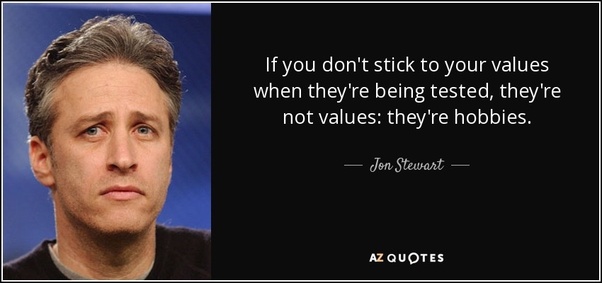
I’m a lot more hardline about it. I believe that, to quote Jon Stewart:

If you don’t stick to your values when they’re being tested, they’re not values, they’re hobbies.

If you make your values a part of your identity, but fail to express them whenever they might cost you something, then yes, your silence, functionally, does mean assent.

The only thing necessary for the triumph of evil is for good men to do nothing. The problem is, evil can make it expensive enough that nobody wants to be the first one to do something.

It’s like a criminal holding 30 hostages with a six-shot revolver. If everyone stood up, they’d win. But the first one to stand up is getting shot, so nobody wants to be the first one to stand up, so everyone meekly complies with the criminal and allows him to tie them up, so now he can kill all 30 at his leisure.

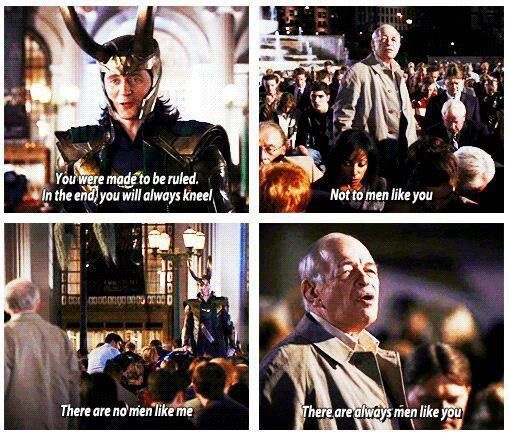
There’s actually a scene in a Marvel movie, of all things, that nicely illustrates the dilemma of qui tacet consentire videtur:

At what cost our dissent? Most of us would like to look in the mirror and tell ourselves we are like this man. Almost nobody actually is. I’ll bet folding money that most people will keep silent in the face of things they are think are wrong even if the cost of speaking up is quite small.

—–

When I posted this on Quora, a friend remarked that in his opinion, Eunice’s position shows greater empathy than mine; that is, Eunice is less hard-line than I am because she’s more sensitive to the plight of the person placed in the position of not being able to speak up without facing the community’s retaliation.

I chewed on that idea for weeks. I had a sense that there was something missing from that idea, but it took me a while to put my finger on what it was.

In situations where, for example, someone is in the closet as a member of some sexual or ethnic morality for fear of the community’s reaction if he comes out, I agree. That’s absolutely a reasonable choice, and deserves respect and compassion. In fact, I’ve chosen to live openly, as I’ve said in my memoir and also at events back as far as the 90s, in part because I can. I’ve never had a job that would be at risk because someone finds out I’m polyamorous, or family that would disown me.

In that sense, I’m privileged, and I know it, and it’s because I’m privileged I want to do whatever I can to make it easier for the next person to be open.

Image: Adrian Swancar

What I’m talking about here is slightly different from being in the closet, though. This answer is more about being silent in the face of things you know to be wrong—not silence in the sense of “I am silent about my own sexual orientation because I am worried people will harm me,” but in the sense of “I see people like me harming those who come out of the closet, and I’m silent about that because I don’t want those people to attack me too.” I do think those are two different situations, and in the latter, being silent to the bigotry of others does serve as assent to their bigotry.

If I as a straight person don’t stand up to homophobia, am I complicit in it? If I as a man don’t stand up to misogyny, am I complicit in it? I personally think the answer is yes.

The part about empathy is what triggered that realization, because it’s precisely empathy that makes me draw that bright line. I think that it’s easy to have empathy for the straight person who doesn’t stand up to the homophobe, because most of us identify with that person and it’s easiest to have empathy for those who are like us.

But the person who most needs empathy isn’t the straight person too scared to speak up, but the gay person being targeted in the first place.

Yes, it’s important to have empathy for the straight person who’s worried about being targeted by the bigots, because yes, bigots can and do come after those on the “side” of the disfavored group—look at, for example, American white nationalists who target Black people but also target “race traitors” they perceive as siding with Black people against their own race.

But in that particular case, who do we empathize with more? Who drives our compassion: the white person who is afraid of being branded a “race traitor” and harassed by the white nationalists, or the Black person at the receiving end of their hate?

I see that bright line not because I don’t empathize with the white guy who doesn’t want to draw attention to himself from the bigot, but because I do empathize with the person who has to live with that bigotry when nobody is willing to speak up.

So what’s wrong with social justice, anyway?

Well, to start with, nobody in the world actually wants social justice.

There. I said it.

Okay, lots of people sincerely believe they want social justice; the people who say they want it aren’t lying, exactly. It’s way more complicated than that, and a lot happens between “I’d like to live in a just world” and “I am going to work to make a just world happen.”

Buckle up, this answer is gonna get loooooong.


Let’s start here: The real world is complicated. Really, really complicated. You might think getting your scanner/printer to work with Windows is complicated, but that’s peanuts compared to socioeconomic and geopolitical reality.

And people, even smart people, handle complexity poorly.

Topical case in point: What’s happening in Israel and Gaza right now.

Image: Mohammed Ibrahim

If you want to understand what’s happening, you need to know quite a lot of history from the 1940s on. There’s a lot of “there” there: the Israeli offer, turned down by the Arabic population; the reasons Egypt and Jordan closed their borders to the Palestinians; the history of Hamas, which is both a terrorist organization and also a government (and before that, the Muslim Brotherhood); the way Egypt has deliberately played the Gaza refugees as political pawns…it’s complicated and ugly and no side has totally clean hands, but even understanding where the balance lies requires a pretty thorough history lesson…

…and oh God that’s, like, sooooooo complicated, whyyyyyyy can’t someone just tell me who the good guys are and who the bad guys are?

That’s the thing: a lot of people want to treat actual, real-world political situations like football matches or WWF wrestling, with a clearly defined good guy and a clearly defined bad guy, so they know who they’re supposed to root for.

Even people who start out genuinely, sincerely interested in social justice can easily get bogged down.

That’s the heartbreaking thing about, you know, empathy and compassion. When you sincerely want to leave the world in better shape than you found it, you soon find yourself fighting an uphill battle. Injustice doesn’t exist because someone woke up one day and said “Hey! You know what? I think I’ll be a dick to other people today!”

Injustice exists because entrenched economic, social, and political systems with roots thousands of years deep have entrenched ways of doing things because the people atop those systems benefit from doing things that way.

Fighting against that is hard. It grinds you down. However energetic and idealistic you were when you started, it pulverizes you.

Nobody has infinite time. Nobody has infinite energy.

Which is fine, except that most people want to believe themselves to be one of the good guys, on the side of Truth and Righteousness and Justice, even when we don’t want to—or can’t!—do the work of getting there. It’s not enough to say “You know what? I’m not informed enough about this to have a reasonable opinion.” Oh, no, no, we want to take sides but we don’t want to invest the time or labor in making sure we pick the right side.

We just want to know who to blame.

Knowing who the bad guy is helps define us as the good guy. If we’re against the bad guy, that makes us good, right? Right?

So what do we do?

We develop heuristics. Cognitive shortcuts. Quick and dirty rules of thumb to simplify complex situations and help guide us toward the ‘right’ team to root for. These fast and easy heuristics, at least in theory, cut through all the tedious drek of having to learn all that history and become informed of the goals and grievances of all the players and untangle a knotty and nuanced tangle that’s been all balled up for decades.

But here’s the thing:

Heuristics are not subtle. They’re fast intuitive guidelines that substitute for actual understanding. They feel right, but that doesn’t mean they are right.

Those heuristics—“believe women,” “always side with the most historically oppressed,” whatever they are—gradually become rules, then social tribal markers, then symbols of moral purity. Heuristics become adopted by tribes as ways to tell the in-group from the out-group. If you see a hashtag like #believewomen, you can probably make a pretty good guess about the politics of the person who subscribes to it.

Before long, it actually becomes morally wrong not to obey the heuristics.

Enforcing moral purity becomes a way to feel powerful, to feel like you’re accomplishing something, in the face of the overwhelming hopelessness and despair that comes from fighting an entrenched system day after day and ending each day with nothing to show for it.

What it feels like to care about justice

Say your crusade is animal welfare, for example. You’ve fought for years and what do you have to show for it? There are even more factory farms now than when you started. Consumption of animals is up, not down.

But then let’s say Bob, your staunch and stalwart ally, your comrade in arms, reveals that he’s not a vegan…he thinks it’s okay to eat fish. And…and…and eggs. And he wears leather belts.

You can’t end factory farming, you can’t stop the senseless slaughter of animals…but hey, you can rally the troops against Bob, because he betrayed the cause! You can destroyed his reputation and cast him out! Look! Look! You accomplished something!

This is inevitably what happens in social justice circles. We end up here because:

  1. People want a morality simple enough to fit in a hashtag; and
  2. Any morality simple enough to fit in a hashtag cannot capture reality, and therefore is rather limited as a tool to change reality.

People tend to think of “social justice” as a left thing, but this process knows no political bounds. Those on the right do it just as often—they simply don’t call it “social justice.”

But the same things still apply: they have a way they want the world to be; changing the world requires tremendous amounts of effort and work; people don’t have limitless resources; they fall back on simple rules to tell them who the good guys and bad guys are; those simple rules become tribal markers; before long, it becomes morally unacceptable even to question those simple rules.

We see the world not at it is but as we are. We invent narratives to describe the world, and to tell us who the good guys are, and who we should be in order to think of ourselves as good. Anyone who can co-opt those narratives can control the lines between Us and Them, the boundaries that define our tribes.

So here we are. We’re terrible at nuance, we don’t have tome to get informed, so we let the hashtag mentality do the work for us.

Visions of Barcelona: Incomprehensible Beauty

Her name was Wendy.

I met her my first year of university in Sarasota, Florida, at a tiny college that is now at war with Ron Desantis called New College. It wasn’t my first year of uni—I’d been to two other universities by that point already, and would ultimately end up getting my degree from yet another—but it was my first year there.

She played a song for me. Well, she played several songs for me, really—she’s the reason I still love the Indigo Girls—but she played a particular song for me, Gaudì, by the Alan Parsons Project.

That opened up a rabbit hole. It was 1990, just before the Internet as we know it started to become a thing, and I wanted to find out everything I could about Antoni Gaudì, the completely bonkers architect, and the Sagrada Familia, his most famous work.

I resolved then that one day I would visit Barcelona and see the Sagrada Familia myself.

Last month, I did. It was, by a large margin, more magnificent than I could have imagined.

Mad scientists get all the media limelight. Not enough people truly appreciate mad architects.

The Sagrada Familia is deliriously, exuberantly bonkers, a brash monument to defiance of conventional ideas about working stone.

A lot of folks are familiar with it, at least in passing. If you see a photo of the exterior, odds are good you’ll recognize Gaudì’s weird, still-under-construction cotton-candy masterpiece.

Apologies in advance, this post is about to get really image-heavy. All bandwidth abandon, ye who enter here.

We were in Barcelona last month to spend some quality time together, and to do a photo shoot of the Borg Queen xenomorph hiphugger parasite strapon, about which more later.

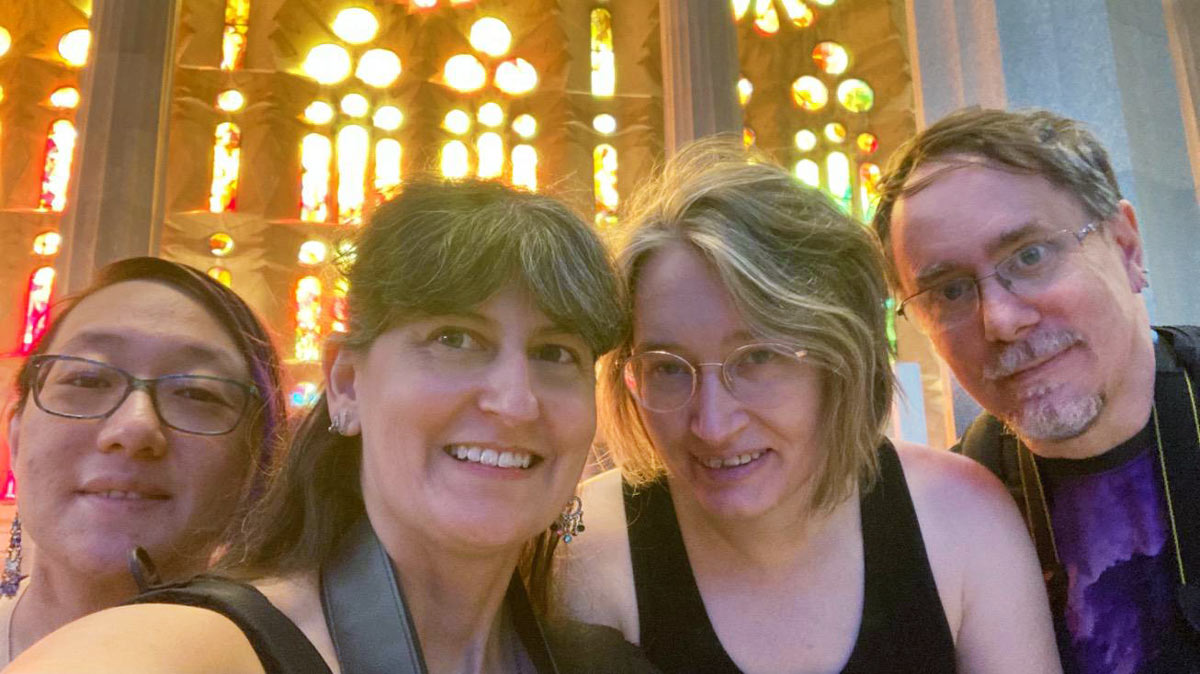
Our first full day in Barcelona (or was it our second? The days blurred together), some of us headed out into the Spain summer heat to see the gloriously insane architectural wonder of the Basilica of the Sacred Family.

(They did not, of course, allow bunny ears inside the church.)

The place was…words fail. Brilliant. Grand. Magnificent beyond anything I expected. I cried when we got there.

I’ve seen photos, of course. But no pictures, not even the ones I’m posting here, can do any justice to the scale of the place. Even standing outside doesn’t give you a sense of the enormity of this monument to a strange man’s strange vision.

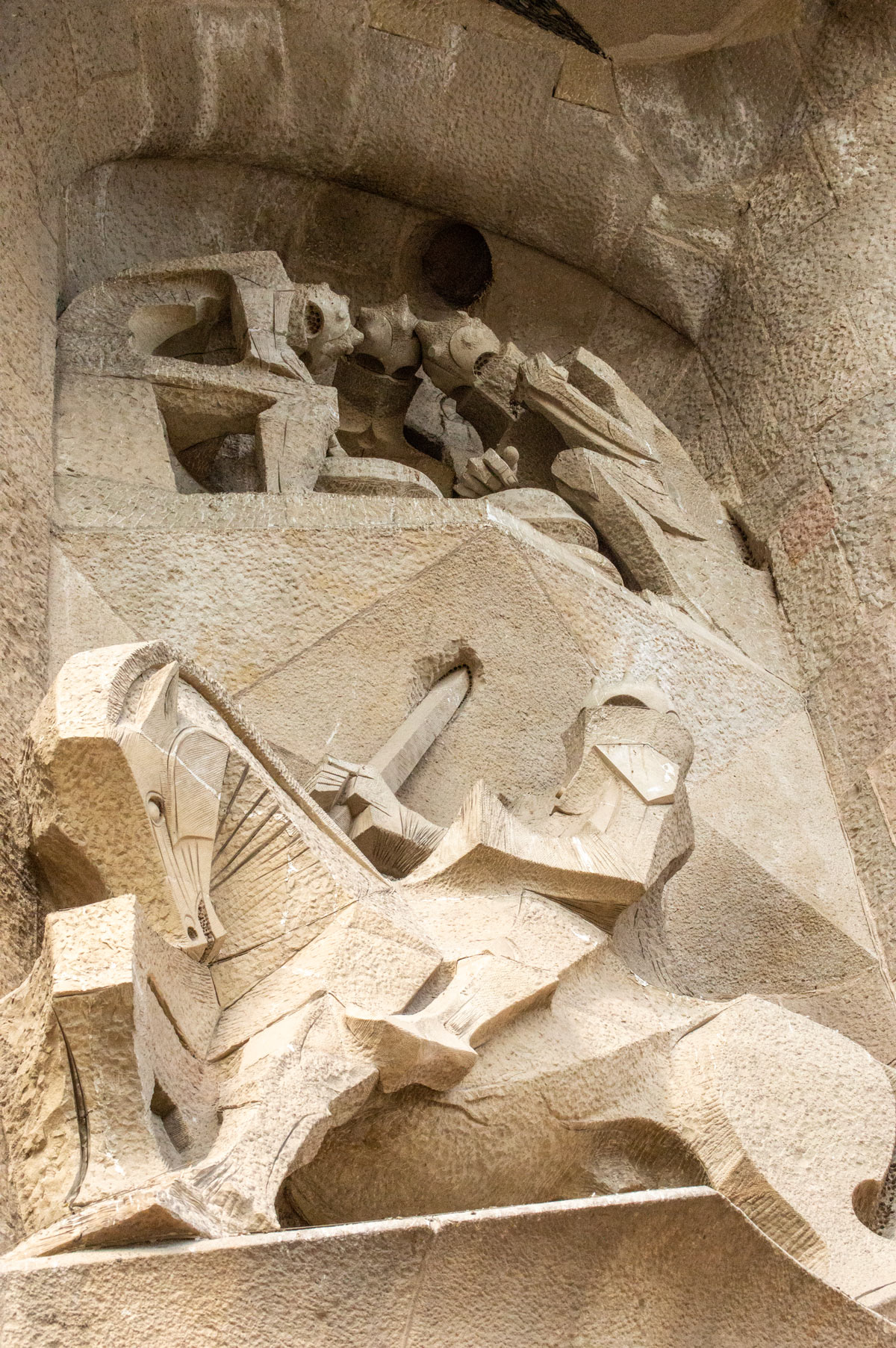
These oddly angular figures are much larger than life-sized, with a Cubist vibe I really dig.

The level of detail absolutely everywhere, inside and out, is just breathtaking. Gaudì was obsessed with animal motifs, that decorate the walls and doors all around the church.

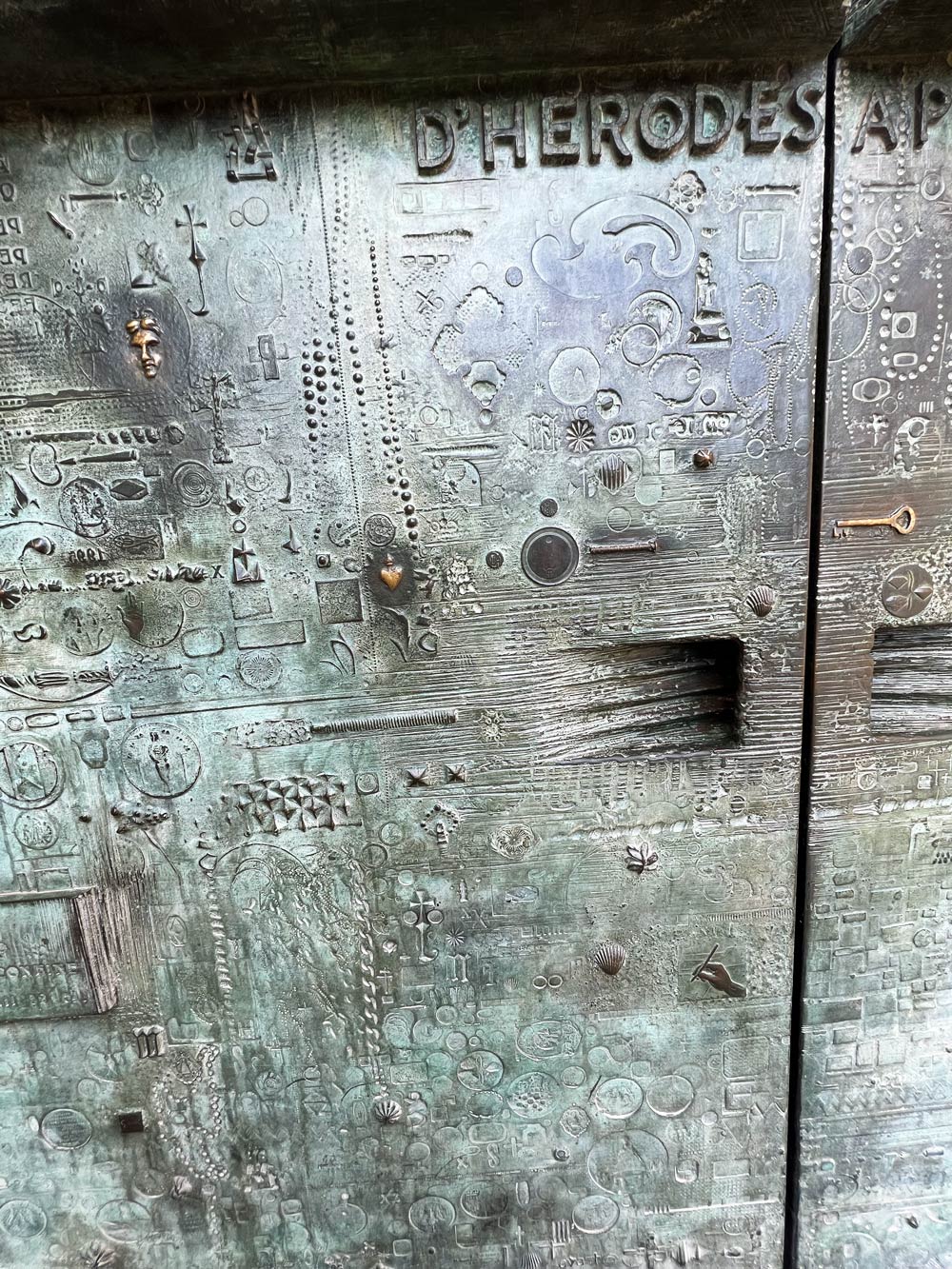
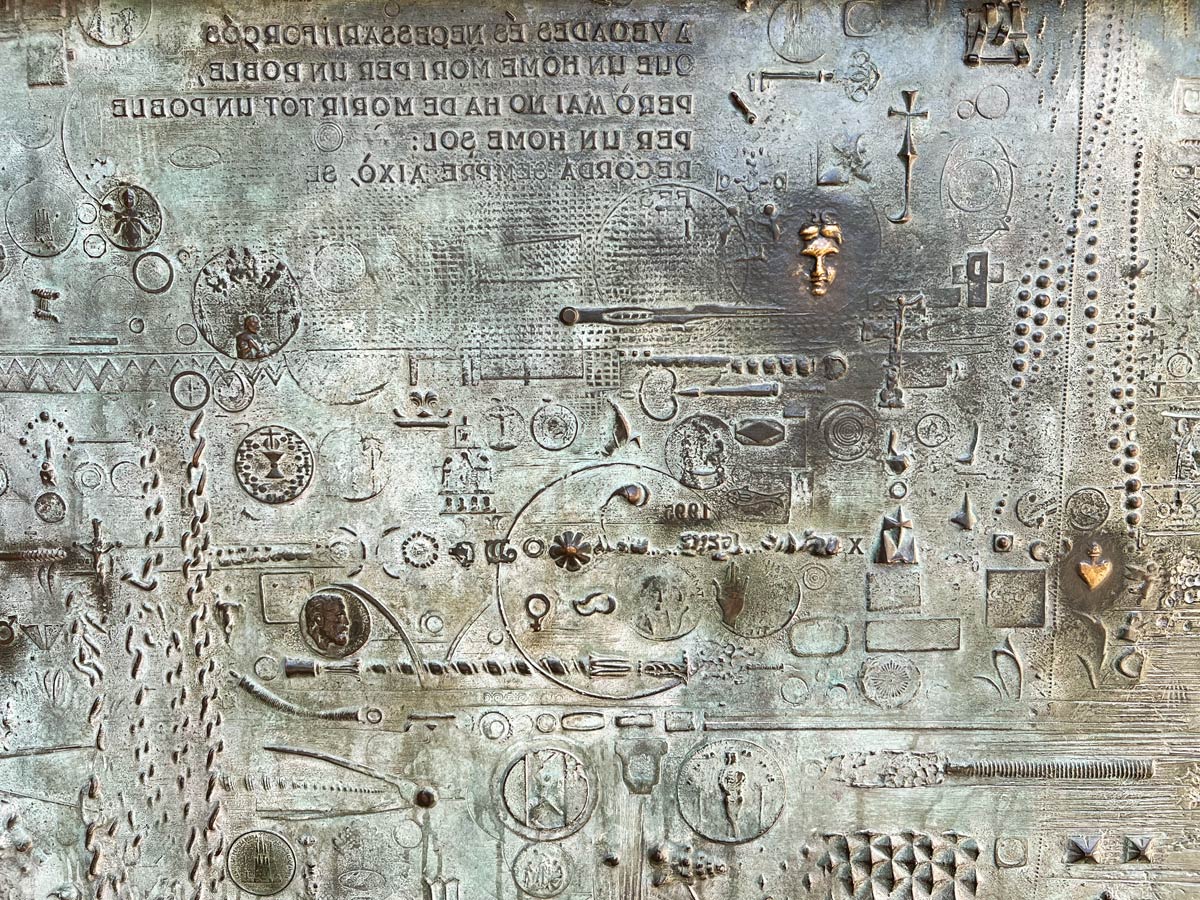
One of the many doors is this enormous heavy thing of bronze, designed by Josep Maria Subirachs. (And yes, the text is backward on the door.)

I love that you can tell which symbols resonate with people by which symbols visitors touch.

Oh, but the inside…

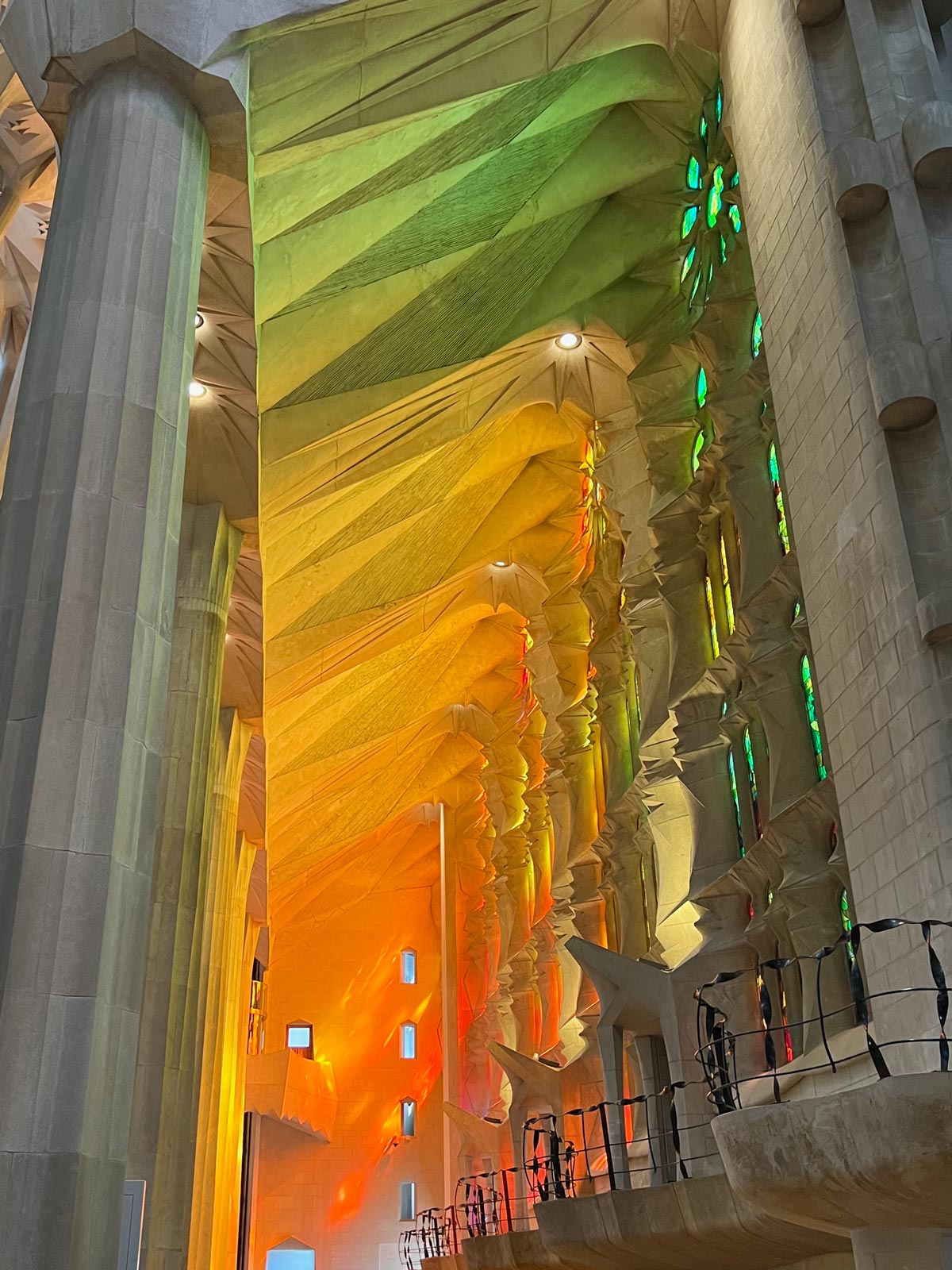
The inside is where you truly get a sense of just how enormous, how vast this space truly is.

These photos don’t do it justice. No photos do it justice. The sheer overwhelming magnitude of this vast space inspires awe.

Just standing in this vaulted space, just existing here, is a deeply, profoundly awe-inspiring sensation.

We got here after a long (and honestly rather tedious) guided tour of the outside, which I recommend you skip if you ever visit—it was almost enough to suck one’s soul through one’s ears, so incredibly bland and boring it was.

I don’t rightly comprehend how it’s possible to make Gaudì or his grand creation boring, but somehow, the tour guide did it.

But all that was burned away in the avalanche of wonderment at stepping through the door into the church and really appreciating, for the first time, such incomprehensible beauty.

Standing there bathed in ethereal light, it’s hard not to feel like you’re within some living thing.

Even the light itself is alive, as much a part of the architecture as the stone and the glass. This space flows with light, in a way no picture can ever show. The light moves constantly, always changing, brilliant, flowing along the walls as the earth spins and the sun moves across the sky, never the same from moment to moment..

Every time you look up, it’s different, the light, the color, bringing even more life to what always feels alive.

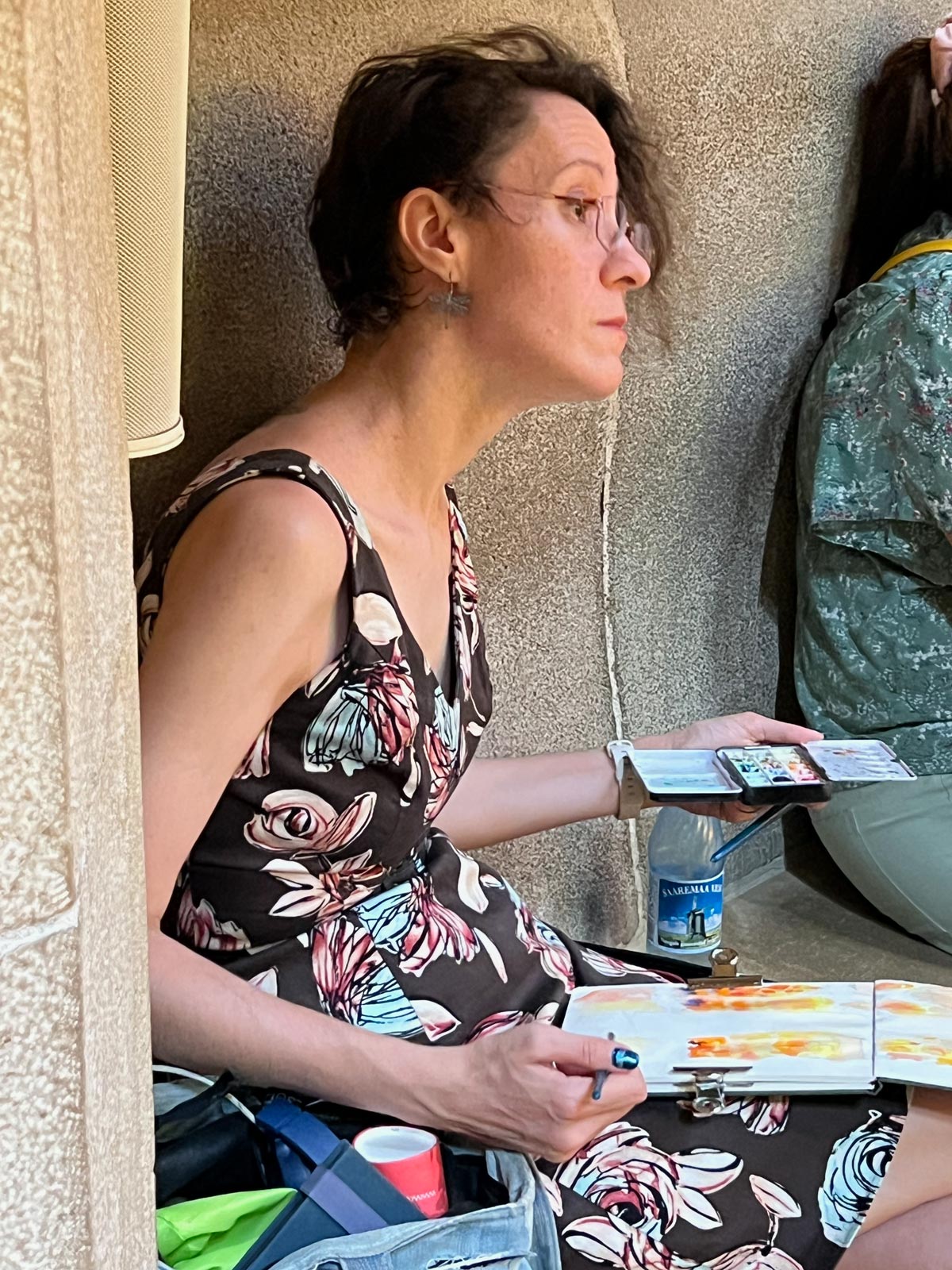
My friend Alice, who I met in Tallinn some years ago, was able to join us in Barcelona. She found a quiet place from which to try to capture the extraordinary play of light and stone in watercolor.

When I visited St. Paul’s in the Vatican, I saw a monument to tedious human greed, every pope trying to outdo the one before, inscribing their names in gold above each new wing. Here…this place is the opposite of that, beauty rather than hubris, inspiration instead of braggadocio.

Everywhere your eye turns, there’s more to see, more to discover, more to explore. The breathtaking level of detail that fills every part of this space is hard to take in, yet it all works together exquisitely.

Even the essential infrastructure, utilitarian things like staircases, become objects of beauty.

Backing up to take the whole thing in, it’s hard not to feel overwhelmed and humbled. I visited the Sagrada Familia twice, and it made me cry both times.

It still isn’t finished, and won’t be for decades. Antoni Gaudì envisioned a cathedral in the old style, a work of generations finished a century more after it began, touched by the hands of many architects.

Some of the more modern elements include design philosophies that Gaudì might not have chosen, like this strangely abstract Jesus re-envisioned as a Sith Lord, but that’s part of the point.

He saw the Sagrada Familia as a sort of paper boat set adrift into the future, something he would never live to see completed, a project that would be guided by future generations long after his time was over.

It’s a heady and powerful thing to touch those walls and feel the way it has become not one person’s project, but a project by humanity. No words or images I am capable of can ever truly express even one percent of the incredible experience of being alive to witness such a magnificent undertaking.

Copyright, lending, and the Internet Archive

For those of you who’ve been hiding beneath a rock these past few news cycles, the Internet Archive, the operators of the Internet Wayback Machine, was just handed a stunning defeat in a copyright feud with Hatchett, Random Penguin, and other major publishers.

Essentially, they had set up an internet lending library, and the publishers…didn’t take kindly to that.

As a book author, I have super-complicated and mixed feelings about this.

There are two different ways to think about this huge kerfluffle, morally and legally. On top of that, there’s a whole ’nother dimension to the problem that has nothing to do with books or copyright at all.

Buckle up, this will be a wild ride.

So first, let’s talk about what’s happening. The Internet Archive is trying to become a digital version of this:

Bibliothèque Mazarine, Paris by Remi Mathis & Marie-Lan Nguyen — CC BY-SA 3.0

Libraries purchase books, which they lend out to readers. Legally, they can do this because of something called the “first sale doctrine,” which says if I buy a book it’s mine and I can do what I want, including loaning, giving, or selling it to you without paying the publisher.

I’ve already paid the publisher when I bought it. That copy is now my property. I can’t make copies of it and loan, sell, or give away the copies, that would violate copyright law (which is literally the right to copy).

But I can loan, sell, or give away my only copy, because there’s one copy of it that the publisher was paid for. If I give it to you, I don’t have it any more.

Okay, so. When COVID hit, libraries all over the world closed. The Internet Archive said, hey waitaminnit, people can’t go to libraries. So how about this:

We will buy a book. We will then scan the book into an electronic copy. We can then lend that electronic copy to readers, but we will only lend it to one reader at a time. Once we lend it to someone, we won’t lend it to anyone else until that person has checked it back in with us, which erases it off that person’s computer.

It’s the same thing, right? We buy a book, we loan the book out, there’s only ever one copy on loan for each copy we buy. Just like a library.

Well, hang on, not so fast.

The legal situation around ebooks is a mess.

Publishers have long resented libraries and used-book stores. They quite like the idea that everyone who reads a book gives them money. They’d prefer to live in a world where if you buy a book, you are not allowed to give it sell it to someone else—if someone else wants to read it, they have to buy it too.

Bibliothèque Mazarine, Paris by Remi Mathis & Marie-Lan Nguyen — CC BY-SA 3.0

Publishers hate this

The first sale doctrine came about in 1908, after publishers sued a book store that was selling books for less money than the publishers wanted them to.

The Supreme Court held that publishers have intellectual property rights in books that pertain to copyright and distribution rights, but the distribution right is exhausted once a book is transferred.

In English, that means if I sell you a book you can’t make copies of it, but I can’t control what you do with that physical book you just bought—I can’t stop you from selling or giving it to someone else, nor control how much you sell it for.

Boom, done.

Except…

Then ebooks came along. And ebooks aren’t physical things. And book publishers said “we aren’t selling you this ebook. You are giving us money for a license to read it. You don’t own anything. We aren’t selling this file to you. We still own it. The first sale doctrine doesn’t apply.”

If you buy a print book, you have the legal right to loan, give, or sell it to others.

If you “buy” an ebook, you are paying for a limited, revocable license to read it. You don’t own the ebook. The publisher can revoke your right to read it whenever they like. If Amazon decides to erase your Kindle tomorrow, they can do that. You have no right to loan, give, or sell that ebook to other people unless the publisher says you can.

So ebooks and print books are very different animals. You have a legally protected right to buy print books, start a library, and loan those physical objects to other people.

Ebooks? Nope. You have no right whatsoever to buy a bunch of ebooks and lend them out.

But wait! The Internet Archive is buying physical books!

Yup. But they’re not lending out those physical books. They’re scanning them, turning them into ebooks, and lending out the ebooks.

U.S. District Court Judge John G. Koeltl, who is overseeing the case, was quite blunt about this:

At bottom, IA’s fair use defense rests on the notion that lawfully acquiring a copyrighted print book entitles the recipient to make an unauthorized copy and distribute it in place of the print book, so long as it does not simultaneously lend the print book.But no case or legal principle supports that notion. Every authority points the other direction.[1]

And legally, he’s 100% right. No law, court finding, or interpretation suggests that if I buy a book I can transform it into another medium and then loan, give, or sell it on.

Copyright law allows fair use in the case of “transformative use,” which is use adds “new expression, meaning, or message” to the original work.” This is how movie and book critics can show clips or excerpts; their critique is “transformative use.”

The Internet Archive said “hey, the courts said that when Google scanned books, that was transformative use!” Judge Koeltl said “that was transformative use because Google scanned the books to make them searchable, but Google isn’t giving out scanned copies. You’re not doing anything new, you’re just scanning the books and giving them out.”

Legal consideration

Legally, Judge Koeltl is 100% absolutely positively right.

The First Sale Doctrine applies quite narrowly to physical objects—physical copies of a book. All the laws about this are quite clear on that (though of course in 1908 nobody could imagine a book that wasn’t a physical thing, but still—the law as written is what it is).

Judge Koeltl also pointed out that publishers have no way to know if the Internet Archive is only loaning out as many copies as they have.

Libraries that loan ebooks do so with special permission of the publisher. This special permission comes with all kinds of strings attached, including paying fees and using encryption systems to make sure that if I copy a loaned ebook, then check it back in to the livrary, then restore the copy, I can’t read it—when I check it in, the library servers revoke my encryption keys.

The library servers also record and report the number of copies on loan, and this can be audited.

Internet Archive? Didn’t do any of that.

Moral consideration

Morally, as a published author who makes a living writing, I think the Internet Archive is 100% absolutely positively right.

Their logic is sound. The spirit of the First Sale Doctrine clearly is intended to allow someone who’s purchased a book to loan it to others, even if the law as written came from a time before ebooks.

The Internet Archive argues, and I believe, that loaning books encourages sales. I know I personally have bought books I’ve borrowed.

But regardless of whether or not that’s true, if you’ve bought my book you should be able to loan it out.

Now, the Internet Archive’s copy control system may be problematic, but that’s engineering, not morality or law.

I sincerely hope the appellate court sees the intent of the law and agrees. I doubt they will. I think this is headed for the Supreme Court, and if I were a betting man I’d offer 80/30 odds the Internet Archive will lose.

Practical consideration

The Internet Archive is facing an existential threat. If it loses on appeal—and I think it will—the damages will be staggering. Enough to bankrupt the Archive (which is a non-profit entity) hundreds of times over.

And that would be a disaster.

I don’t use the word “disaster” lightly. It would be a complete catastrophe. The Internet Archive houses the world’s only archive of the bulk of the World Wide Web.

They do a lot more, too. They are a repository for old games, flash videos, and so on that have otherwise been lost.

I fear that huge amounts of history will be gone forever if the Internet Archive ceases to be. The transition from the Industrial Age to the Information Age is a watershed moment in human history, as important as the transition from the Bronze Age to the Iron Age, but because digital records are ephemeral, incredibly important historical records are also incredibly fragile.

We are living, right now, in an important time in human civilization. The Internet Archive is literally the only existing record of important parts of it. If they cease to be and their archive is destroyed, it will be this century’s equivalent of the burning of the Library of Alexandria.

Some thoughts on truth

Image by Fotogoestober on Adobe Stock

Inspired by a question on Quora, I’ve been thinking about the idea of truth, and more specifically, the way societies seem to have an eccentric orbit around the truth—sometimes closer in, sometimes further away.

The United States, at the moment, is definitely at an apogee in its extremely elliptical orbit around the truth. At the moment, large parts of the American population, raised in a society that has attacked and undermined public education and critical thinking for decades, is of the opinion that truth is merely another opinion, and facts are whatever you want them to be. Don’t like the facts as they are? Come on down to Post Truth Incorporated, where we have 100% organic free-range no-cage alternative facts to suit every budget, agenda, and political ideology!

The pendulum doesn’t swing back and forth

A lot of folks think of society as a pendulum, swinging back and forth between two poles. This cyclic model of society suggests that countries or cultures swing back and forth between two poles, often liberalism and conservatism, but the overall tendency as time goes on is generally ‘forward,’ whatever ‘forward’ means.

I would like to propose that this is codswallop.

It’s overly simplistic. Societies don’t swing back and forth, and the poles are never fixed.

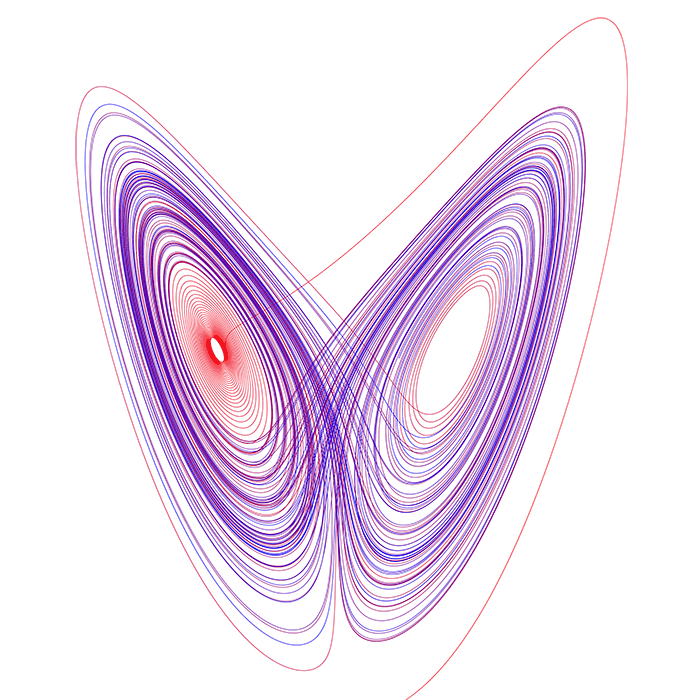
Instead, I think the truth is a strange attractor around which the trajectory of a society warps and bends, sometimes near, sometimes far, always in motion. The exact path the society takes is highly sensitive to that society’s origin myth, and varies with everything from current local politics to natural disasters to pop music trends.

Pretty much exactly like this:

Lorenz attractor (image: CC-BY https://commons.wikimedia.org/wiki/User:Dschwen

This means you could take snapshots of a society’s history, like paragraphs out of the society’s history books, and treat the pile of snapshots like a Poincaré map of that society’s eccentric orbit around the truth.

Mythologies are necessary for social identity, every culture will have one, and subtle variations in a society’s founding myth can have huge effects on its path around the attractor of truth. A society that, for example, idolizes the myth of the Rugged Individualist may at some point along its trajectory bend in the direction of the notion that truth is a matter of personal opinion, not empirical fact. A society that enshrines the value that belief in God is vital to being a good citizen might find itself pulled toward the attractor of authoritarian religion as it flows along its course.

But these attractions are never as simple as a pendulum swing. Too many variables, too many competing ideas go into a society’s culture. Just as you can never set foot in the same river twice, for when you return both you and the river will have changed, a society cannot revisit the same moment twice, however much its members may long for the nostalgic past.

Dr. Martin Luther King, Jr. famously said “The arc of the moral universe is long, but it bends toward justice.” That’s probably true over great stretches of time, years to centuries to millennia, but the loops and bends away from that direction happen all the time, drawn by the irresistible tropism toward Rugged Individualism, Somebody Else’s Problem, xenophobia, profiteering, fear, and the urge toward authoritarianism that seems baked into us as a species.

Right now, we’re on one of those crazy slingshots away from truth, in an era where American Republican operatives sneeringly refer to the opposition as the “reality-based contingent” and offer “alternative facts.”

For those of us trapped on this arc, it’s small comfort that given another 40, 50 years, the moral arc of the universe may once again bend back toward justice. So…let’s be kind out there.

On Avatar 2, Virtue, and Pretentious Posing

Liberals doing what liberals do best (image by ddrockstar)

It’s hard to see your heroes die.

So James Cameron’s new Avatar movie is out, and the Internet is in a tizzy. This isn’t actually about the movie, or James Cameron, much as I love Aliens (I’ve seen it 167 times and it keeps getting more inspiring every single time I see it; I spent two years designing a sex toy based on the xenomorph facehugger…yeah, it’s like that).

But I didn’t come here to talk about the movie, or James Cameron. I came here to talk about virtue signaling, and white saviors crusading against white saviors, and offer some hot takes that will almost certainly lead to angry emails in my inbox.

Before we dive in to the rage, let me say that when I talk about “virtue signaling,” I don’t mean Virtue Signaling™, the brand that the American right uses to tarnish any display of empathy or compassion that suggests one is anything other than a complete sociopath. (I expand a little on the distinction between virtue signaling and Virtue Signaling™ over here.)

Okay, let’s do this.

James Cameron and the Synthetic Rage Machine

Back in 2009, James Cameron, of Aliens and Terminator 2 fame, made a movie called Avatar. I watched it, thought it was really good, watched it again, and then forgot about it. It’s showy but, like cotton candy, it melts quickly, leaving nothing behind.

Raccoon watching Avatar

Avatar was fluff. Fluff that was a bit problematic, with its overtones of “white hero saves the noble savages” tropes, but fluff.

However, it made more money than a televangelist with a coke habit, so it was perhaps inevitable there would be a second.

Now the second movie is here, and the liberal internetverse is aflame with acrimony, because if there’s one thing the modern-day liberal is absolutely certain of, it’s that the path to a kinder, more just, more empathic and inclusive society starts with screaming hate.

The issue, which I will confess I haven’t done hours of research about as I don’t actually have much interest in the second Avatar movie, appears to be the issue of cultural appropriation, leavened with a heaping teaspoon of white-saviorism. If you want a dive down the rabbit hole, you can find out more here and here and here and here, and good luck to you.

Predictably, the outrage spread like wildfire on Twitter, where people eager to show other people how much they supported the indigenous without, you know, actually doing anything inconvenient or costly to support the indigenous took to their keyboards:

Oh, no, wait, sorry, wrong Twitter outrage.

Ahem. The outrage spread on Twitter, where one particular Tweet was copy-pasted (not retweeted, not shared, but posted word for word) about 6,000 times, according to Google, not including posts on locked accounts. I won’t bother to link to any of them—you can find them if you want—but I will say they were even copy-pasted by people I once had genuine respect for. People I used to look up to. It’s hard to watch your heroes die.

Now, here’s the thing:

I’m not saying that Avatar isn’t problematic. I’m not telling you to see it…I’ve enjoyed not watching it, and I look forward to not watch it again. This isn’t really about Avatar at all, it’s about public masturbation.

All those thousands of copy-pasted tweets, all those people publicly proclaiming their support for indigenous people in the same way by repeating other people’s words—they’re wanking. “Look at me! Loot at me! Am I a good person now? I’m saying the right things. That makes me a good person, right? Right? Look at me!”

Virtue vs Virtue Signaling

How do you tell the difference between virtue and virtue signaling?

Virtue makes the world a better place. Virtue signaling makes you feel better about yourself.

When I look at Tweets about supporting underprivileged indigenous people by not watching a movie, I can’t help but think, “Point to the person who has a better life because you didn’t watch this movie. Point to a tangible improvement in someone’s quality of life because you didn’t watch this movie. Point to the hungry person who was fed because you didn’t watch this movie. Point to the village that had no water but now has a new well because you didn’t watch this movie. Point to the sick child that now has medical care because you didn’t watch this movie.”

What? What’s that you say? Speak up. A little louder, please, I can’t hear you.

Oh, really? You didn’t actually improve anyone’s life? You just…didn’t watch a movie? That’s…that’s it?

Then shut the fuck up. You’re not supporting anyone. You’re showing off for the other people in your social set.

See, I could understand respecting someone who said “You know what, this movie has problematic aspects. An average theater ticket costs $15. Instead of watching it, why don’t you take that $15 and donate it to this particular fund that serves this particular underprivileged community in this particular way.”

If you do that, at least you’re actually benefitting someone besides yourself, even if it’s only in a small way. You’re actually, you know, making a tiny change in the world.

But if you’re not willing to do that? You’re showing off. Your “virtue” is empty, pretentious posing, benefitting nobody but you, a way for you to brag to people in your peer group without actually expending anything more than the barest minimum effort. You copy-pasted a sentence into Twitter! Ooh, you’re so courageous, posturing to win praise from your friends. Looking at you, making a difference in the world.

Paving the Way to a Better World

It doesn’t have to be this way.

The thing I like about my fellow progressives is that we—well, most of us, anyway—do sincerely want the world to be better tomorrow than it is today. We do genuinely want to live in a world that is more egalitarian, more open, more honest, more compassionate, more fair.

No matter how many “this is the world the Liberals want” memes the alt-right makes.

But too many progressives want something else more than we want a better world: We want to know where the lines are between Us and Them. Why? Because we want—indeed, need—to feel superior to someone. The most right-wing, hardcore Evangelical Baptist has nothing on an average urban progressive when it comes to sanctimony.

(Side note here: the irony of white men riding in to save the day against white saviors by copy-pasting Tweets, rather than, you know, actually saving anyone…well, if there were a Nobel Prize for Irony, I’m not saying it would win, but it would definitely be a contender.)

Tim Minchin put this superbly:

It cannot, it cannot be okay if the intention of progressives—which I assume it is—is progress forward into a future of more empathy and understanding for more people, it cannot be that the primary mechanism by which we’re going to make that progress is the suppression of empathy and understanding for anyone who doesn’t align with our beliefs. It cannot be that unmitigated expression of furious outrage will somehow alchemize into a future of peace and love.

If you want the world to be better when you wake tomorrow than it was when you woke today, but you want to bask in the warm glow of your own righteousness while you make empty gestures of great vengeance and furious anger those who dare tread too close to the line between Us and Them even more…

You.

Are.

Part.

Of.

The.

Problem.

The next time you sit down at your computer to blast evil from the comfort and safety of your keyboard, you brave and noble cultural warrior, you, but you cannot point to a single person whose cause you champion who actually ends up tangibly better off for it…mmmaybe don’t, okay?

Merry Christmas. May 2023 bring you less virtue signaling and more virtue.

Even if real virtue is harder.