Exploring the Great White North, Part 1: Of Raids and Raiders

So it came to pass that on Labor Day, or Labour Day in the modern language of Canada, zaiah and I ventured to take a train ride up to the frozen wilds of our northern neighbor to visit her.

I was not quite sure what to expect. I’ve heard the stories, of course: fierce raiders riding armored polar bears, carrying evil spears fashioned from ice; the great floating cities in the clouds, their perimeters patrolled by armed police riding the backs of furred, horned wyverns; the enormous, heavy tomes, their pages made of thin sheets of iron hammered from fallen meteorites, containing all the wisdom of the Elders in the nearly-forgotten language of the ancients. But I’d never seen any of these wonders with my own eyes, so it was with both fear and excitement I boarded the train, carefully stowing my borrowed polar bear saddle above the seat.

We arrived in the Wildlands in due course, bourne there by the great machine of iron and thunder, and within minutes of setting foot on Canadian soil our problems began.

Those of you familiar with the writings of your humble scribe are no doubt aware that I am often prone to wearing bunny ears in public. This is a not-atypical photograph, showing me in my everyday, about-town ears, which are equally at home during a formal evening in a fancy pub or while traveling the rugged, rocky slopes of America’s midwest.

So it will be no surprise to many of you that I was wearing bunny ears–indeed, these very same bunny ears–on the trip up to the frozen north.

Canadian customs officials, whose numbers today are carefully selected from the most savage of the Kurgan raiders (about whom I shall speak more later), with only those who best their competitors in savage hand-to-hand combat too terrible to write about here allowed to win the honor of protecting the border from their unkempt southern neighbors, were not amused by the ears.

Not at all.

I was questioned about them, at great length and by at least three different people, before zaiah and I were taken into a small room for additional screening.

Now, I am loathe to go to the hardware store, much less to a strange and distant land, without my bunny ears. The story of the ears is too long to recount here, though I will try to sum it up without too much damage to this narrative. The ears are a gift, or perhaps an inheritence, from my London sweetie emanix, who I met while standing in line waiting for an elevator (or as they say in the native British tongue, a “lift queue”) at a convention of perverts, sodomites, and other fine folks. She was, as regular readers will recall, dressed as an Easter bunny and passing out candy at the time. Since strangers have the best candy, I immediately accepted her offer. Fast forward a few years, a couple trips abroad, and an orgy in a castle in the south of France, and the torch has well and truly been passed. So to speak.


The source of my woes

Anyway, there we sat, just moments from disembarkation, sitting in a small room under the cold and watchful eyes of three people in bulletproof vests, who grilled us both about our motivations for making the long and dangerous trek into the icy plains of Canada with bunny ears. They demanded a list of every place I had lived for the past twenty years, whereupon they announced they would do a background check on me in all of them.

During this time, the lovely Eve, the namesake of the woman who chose knowledge over obedience, sat (or, rather, stood) outside the gate waiting. I was forbidden, in the strictest possible terms, to make any attempt to contact her, or in fact to use my cell phone at all.

Eventually, and grudgingly, they let us through. The entire ordeal took even longer than the unfortunate time I made the mistake of telling a British customs officer I was traveling to the UK to visit my girlfriend, which is, apparently, right up there with “I just came back from Columbia with thirty-seven kilos of the finest diamond-grade Bolivian blow ever to choke an elephant” and “I will avenge my people!” on the list of Things You Never Tell A Customs Agent. But I digress.

Customs behind us, we passed through the great hall into the lands of Canada, where I stood blinking, bag in one hand and bear saddle in the other, looking for our transport.

The saddle turned out to be unnecessary, as it appeared Vancouver was a Cosmopolitan enough city to have heard about and embraced the wonders of internal combustion. We loaded up into a Honda of some description or another–or perhaps it was a Toyota–and made our way past the barges laden with animal pelts and the street vendors hawking rhubarbs and small cursed figurines with glittering ruby eyes toward the home of someone who had graciously offered to accommodate us during our travels. (It turns out, in a strange twist of the-world-is-smaller-than-you-know, that her friends were companions of a woman I met in London at emanix‘s birthday party. The world is small, and strange, and really quite amazing.)
The next morning, we rose to brave the twisted ways of the Vancouver public transit system.

Now, I have used public transit in at least five countries. I have ridden a streetcar in Poland that was ancient before the sun was born. I have navigated London’s tube and lived to tell the tale, thanks to the warning to mind the gap. But I was not quite ready for what we discovered when we boarded the bus in Vancouver.

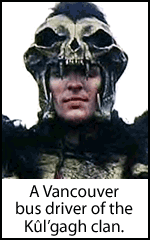
Vancouver’s public transit drivers, like Canada’s customs agents, are drawn by and large from the ranks of disaffected Kurgan tribesmen, unsatisfied with the raider’s life, which leaves too little opportunity to wreak violence upon the rest of Canada’s people. Those who fail to win the coveted spots at the border crossings often become bus drivers, where they greet requests for navigational aid or questions about the fare with the traditional cry “Hark’on dûl goth Khan dok’tôl Akan gol’Kosh Trk’han,” which translates roughly as “With my ax I shall destroy all that you love.” The bus drivers of the greater metro area belong to many different clans, which wage ceaseless war with one another in the dead of night along lonely, deserted streets while the city sleeps.

We learned from an unfortunate fellow passenger to stand quietly and pay attention, leaping from the bus as it crossed the intersection where directions, scribbled in strange glyphs on a large sheet of runed paper called a “map,” instructed us to depart.

We stopped at a charming cafe to collect lunch, then walked to Canada Place to sit beneath the sun and eat. The view from our benches was quite spectacular, with the banner of Canada’s dominant tribe fluttering gaily in the breeze:

There is a secret horror lurking in the design of Canada Place, a grim reminder of an ancient evil, which I will get to in a moment.

Our repast complete, we journeyed forth once more to visit Vancouver’s Police Museum, an excellent place for zaiah and I to amuse ourselves with tales of law enforcement throughout the ages .

The history of law enforcement is the history of weaponry. So it is probably no surprise that the most interesting part of the Vancouver Police Museum, by far, is its weapons room, entry into which is permitted only under escort through a large, locked steel door.

There is also, in another, much larger part of the building, a display of improvised and more exotic weaponry, most of which is made up of all manner of strange and lethal variations on the theme of “I will hit you with this until you die.” There were handmade spears, and flails, and whips, and a spring steel cobra (a fine weapon I was introduced to by a friend of mine in my misspent college days); blowguns, and shivs, and butterfly knives; brass knuckles, and clubs, and axes with curved handles. It was an inspiring display, which made me long to disappear into my workshop for a few days and come out with a doomsday weapon that I could use to hold the moon for ransom. Ah, those glorious days of my youth…but again, I digress.

In front of the museum is a rather…peculiar statue, commemorating the pledge made by Canada’s law enforcement officers to be the friends of small, strangely-proportioned, bipedal space aliens with oddly-configured heads and tiny hands whenever they might be in need:
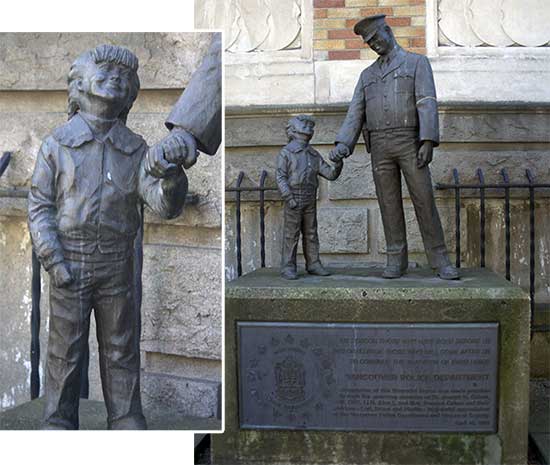

Vancouver’s finest, known throughout galactic sector R-4 as a friend of any being in need

Rumo(u)r has it that a pod person once saved the police commissioner’s life, during a massive and unlikely conspiracy involving time travel and wildly improbable space aliens who look like crosses between sentient ivy and lingerie models. The next Men in Black movie will reportedly be based loosely on this story.

Our visit done, and reluctant to board a bus again, zaiah and I chose instead to walk the streets of the city, to better learn her customs and culture. Our wanderings brought us over a grand, soaring bridge, where we found this message spray-painted on the pavement, a chilling reminder of the Kurgan raiders who to this day live deep in the Wilds and stage occasional incursions into the civilized parts of the country.
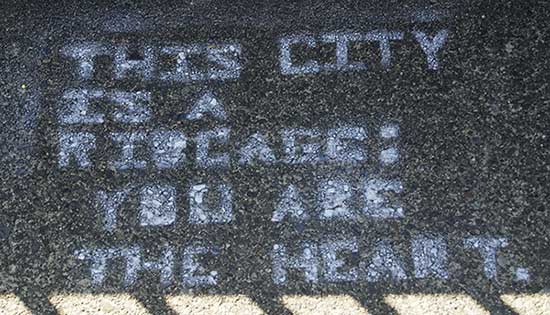
Through messages like this, they seek to remind Canada’s citizens of their grisly practices of ripping the hearts from the chests of their enemies, lest the citizens become too complacent.

On the other side of the bridge, we spied the stylized peaks of Canada Place from the other side.


There are few alive today who remember the days of old, when Canada was known mainly for her hordes of ravening wildmen, who set sail in small, fast warships to plunder up and down the Western coast of the United States in search of treasure and women.

Though the design of this building seems innocent to modern eyes, there was a time when the sight of peaked sails just like these, traveling from over the horizon, would strike terror in people for hundreds of miles along the coast, as they signaled another assault from the Canadian longboatmen. This is why to this day nearly every city on the Western seaboard is still surrounded by tall, thick stone walls, with peaked watchtowers along the coastal side. Once, those towers were practical rather than ornamental; from them, watchers would stand guard, day and night, endlessly scanning the ocean for the first sign of those curved white sails, ready to sound the alarm that would bring men and boys rushing to arms to try, hopeless as it might be, to repel the invaders.

There are few who still remember; today these peaks do not bring the terror they once did. But I will confess, Gentle Readers, that when I saw the building, there across that narrow inlet of water as we crested the bridge, a chill crossed over my heart. It was soon gone; I know, in the rational part of my brain, that there is no longer any reason to fear that Canada will return to her warlike ways. But perhaps that fear has passed into the collective unconscious, a faint echo in our DNA of the trials we once faced from the rampaging northmen of the sea.

We faced a different trial on our way back from this place, one born of dangers subterranean rather than seafaring. But that part of my tale will have to wait until next time.

Movie Review: Snow White and the Huntsman

As a kid, I never got a lot of exposure to all the usual Disney fairy tales. Most of what I know about them is through cultural osmosis; I know that Rapunzel has long hair, Sleeping Beauty had to be wakened by a prince, Cinderella is the one who ridea round in a gourd and is inattentive of her footwear, Bambi is the one whose mother got killed, and so on. But the finer details of the storybook princesses are largely lost on me; they're kind of a blur in my mind. One of them has something to do with a spindle, but I'm not sure which one, or why. I had thought that the poisoned apple was a Sleeping Beauty thing, but apparently that's not the case. Is Rapunzel part of the same story with Rumpelstiltskin in it? I'm not quite sure.

So when we walked into the theater last night, I was more nearly a blank slate than the average bear. I knew only the sketchiest outlines of the Snow White story–that it involved dwarfs and a mirror–but that's about it.

I am not, therefore, terribly qualified to speak as to whether the reboot is a better story than the original. I'm not quite sure about the whole scene where James T. Kirk almost runs his car into a giant canyon that has, for some inexplicable reason, opened up in the middle of Iowa, but…oh, wait, sorry, that's a different reboot I'm thinking of.

What movie was it I was going to talk about? Oh, right, Snow White. The one with the evil queen in it. (Aren't there other evil queens? I seem to recall an evil queen in Sleeping Beauty, at least. Or am I confused?)

The movie goes something like this:

Good Queen: I just pricked my finger on a rose that was growing out of season. That gave me an idea. We should have a baby!
Good King: lol wat?
Good King Okay.

The GOOD QUEEN and the GOOD KING have a CHILD, who they name PRINCESS SNOW CINDERELLA RAPUNZEL.

Prince From Another Castle: Hey, Snow Rapunzel Sleeping White, do you want an apple?
Princess Sleeping Rapunzel Beauty: Sure!
Prince From Another Castle: Psych!
Princess Sleeping Cinderella: I have found a bird with a broken wing.

Princess Cinderella Beauty looks at the BIRD with INNOCENT WIDE-EYED WONDER.

Good Queen: We will take care of this bird.

They TAKE CARE of the BIRD.

Good Queen: My work here is done. I think I'll die now.

The Good Queen DIES.

Good King: Wait, what?
Cut for spoilers

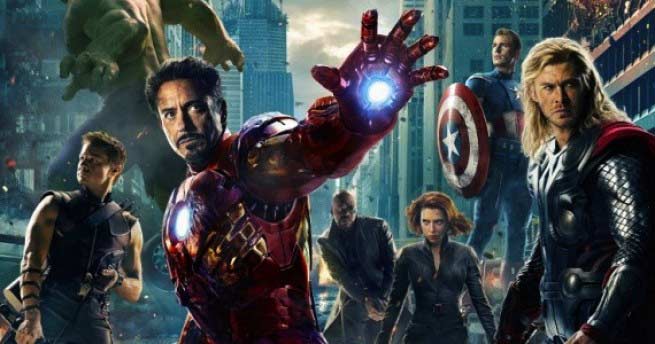
Movie Review: The Avengers

Okay, so I don’t really do comic books. By which I mean I really, really don’t do comic books. (I do like Watchmen, but that’s, like, totally different because it’s a graphic novel and not a comic book, and stuff, which is different because of reasons.)

I walked into the theater with my sweetie zaiah, her husband, their daughter, a gigantic barrel of popcorn, and a prayer of hope that Joss Whedon wouldn’t let me down. After all, he gave us Firefly, right? Man’s got mad skills.

As it turns out, the Avengers movie is more an ode to the special effects technician’s art than to the storyteller’s art…but then again, it is based on a comic book. Or a bunch of comic books. Or comic book characters, or something, I’m really not quite sure.

The movie goes something like this:

The scene opens at a SECRET BASE. Lots of people are RUNNING AROUND in a PANIC.

Samuel L. Motherfucking Jackson: There are lots of people running around in a panic. What’s up?
Distracted Scientist Dude: Sir, it’s the plot device! Our instruments show that it’s generating 38% more plot than it was before. If this keeps up, there may be no place in this movie to escape the plot!
Samuel L. Motherfucking Jackson: Did you try turning it off?
Distracted Scientist Dude: Yes! It keeps turning itself back on!

The PLOT DEVICE emits a sudden surge of PLOT

Loki: Hi! I’m Loki.
Samuel L. Motherfucking Jackson: Drop your staff.
Hawkeye: It’s okay, sir. He’s Loki. He’s a mischievous trickster god who likes playing games but isn’t usually actively evil. If we ignore him he will probably get bored and go away.
Loki: No, that’s the other Loki. I’m the whiney, kind of annoying narcissist who wants to destroy the world and then take it over, or something.
Hawkeye: Oh, sorry, my mistake.
Loki: Hey, don’t sweat it. Happens all the time.
Cut for spoilers…

Boston Chapter 12: Pachyderms Gone Wild

I didn’t expect the elephants.

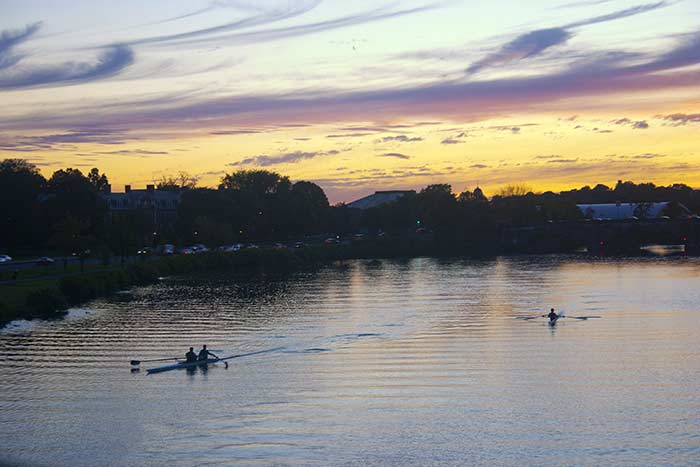
The day with figmentj was quite lovely, featuring strolls through Boston Commons and antique naval mines and Christian hair metal and frightening clocks with plastic women in chains and all manner of other parts of the general Boston experience. We ended it by watching the sun set over the river by Harvard square, the peaceful tranquility of the flame-touched sky broken only by the screams of the boating-slaves rowing along the river under the gentle exhortation of scourge and lash:

But all such things must come to an end. Eventually, it was time to head back to Claire’s to help her get settled in to her new digs with all her various and sundry possessions, including her rather fetching Viking helmet, before sailing through the air in a magic metal tube back to Portland.

I am sad to say, Gentle Readers, that once again I failed to seize the opportunity to photograph Viking kazoo porn. I did, however, assist in the moving of many heavy mass-bearing objects up many flights of stairs, which, while undoubtedly not as great an accomplishment as photographing Viking kazoo porn, is an accomplishment nonetheless.

The next morning, Claire had to be on campus early for a meeting of some sort or another, where her indoctrination into the ways of life at Tufts University would begin. I had resolved to seize the morning and make the best possible use of it by remaining asleep while she got up to head to campus. I had resolved to head there myself, at a much more reasonable hour, as I am generally a much more reasonable man than those who profane the early hours with wakefulness, and to meet Claire there when her indoctrination session had concluded.

I didn’t, as I have mentioned, expect the elephants.

Tufts University is not, by the strictest definition, a clown college. Indeed, it excels in the pursuit of many intellectual endeavors unrelated to clowns. Its history, however, is tightly woven with that of the clown, as one of its earliest benefactors (and a source of much if its early funding) was none other than Pt. T. Barnum of “There’s a sucker born every minute” fame. He made his considerable living, though presumably not his endowments, on the back of that maxim.

In 1889, Barnum, when asked by the university’s trustees what he could do to help support the institution in a time of great need, donated the stuffed and mounted hide of one of his most beloved circus animals, Jumbo the Elephant, to the school. There is a parallel to this take in the Islamic story of the archangel Gabriel, who gifted the patriarch Abraham with an enormous stone called the Caaba which later became the object toward which Muslims now bow when they pray, when (as Ambrose Bierce observed) the patriarch had perhaps asked for a loaf of bread.

Just as the Caaba has exerted a magnetic influence on the Islamic tradition ever since, so has Jumbo the elephant had a similar effect on Tufts University, which might have taken its name from the small tuft of coarse fur that adorns the end of an elephant’s tail. The stuffed and mounted elephant was subsequently destroyed in a fire, or so the legend goes, and every bit of it was lost except for the tuft at the end of the tail. The symbolic meaning of this will be left as an exercise to the reader.

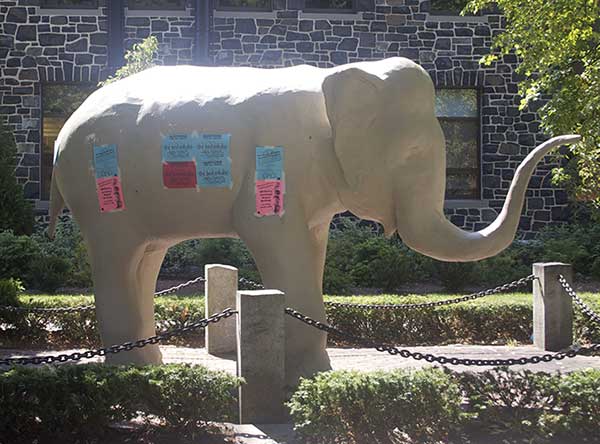
There are elephants everywhere on campus. Not actual elephants, you understand, but their representations, in painting and sculptures and mixed media and all matter of other forms too frightful to mention. The pachyderm permeates the collective subconscious at Tufts like gay porn permeates that of an Evangelical minister; and, as with that selfsame Evangelical minister, it leaks out everywhere.

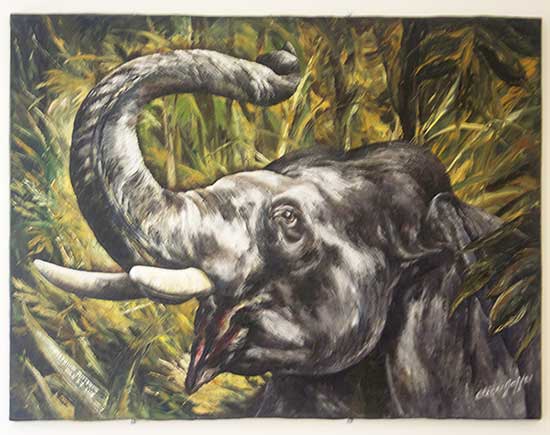
I discovered a strange building during my exploration of the university grounds: a vast building, filled with miles and miles of shelves, along which were stored bound volumes of printed pages. It was kind of like an iPad, if you took all the books in it and, for some reason, printed them out. Prominent in that building was this picture of the Elephant Rampant, trumpeting its victory cry after seeing its enemies scattered before it like leaves in the wind, their broken bodies staining the ground red with their blood and the tears of the widows:

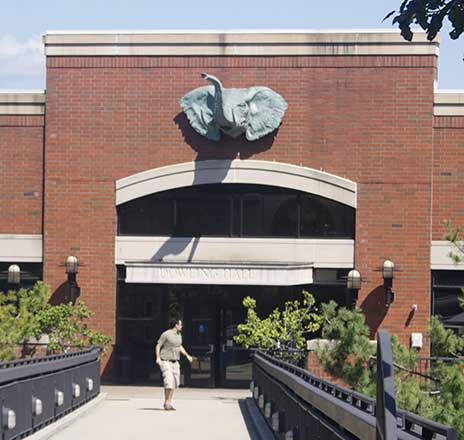
I also witnessed this man, perhaps convicted of some terrible crime, fleeing the Hall of Justice with its symbolic sculpture of an elephant triumphant as its keystone, ahead of the swift and brutal Justicars who will in a few minutes’ time come from these very same doors to run him down, for the education and amusement of the rest of the campus:

The position of the Justicars in the annals of Tufts history is long and interesting. The universally has a long-standing rivalry with its ancient enemy, Bowdoin College in Maine. This rivalry in times long past was fought at a low level, with skirmishers from each college occasionally leaving the walls and fences of their respective universities to stage raids on their adversary’s stronghold under cover of night.

However, in the black days of May in 1897, a large and powerful force ventured from Bowdoin on the path of war. They arrived in the afternoon of May 23rd, and the three days that followed are too grim for the telling. In the aftermath, the Tufts ruling council created an elite group of warriors, the Justicars, whose elephant-shaped masks of cold iron and moon-forged silver soon struck fear into the hearts of all who stood against the university.

Today, the battles between Tufts and Bowdoin are fought in ritual combat on the fields of the gladiators, and the Justicars serve a different function.

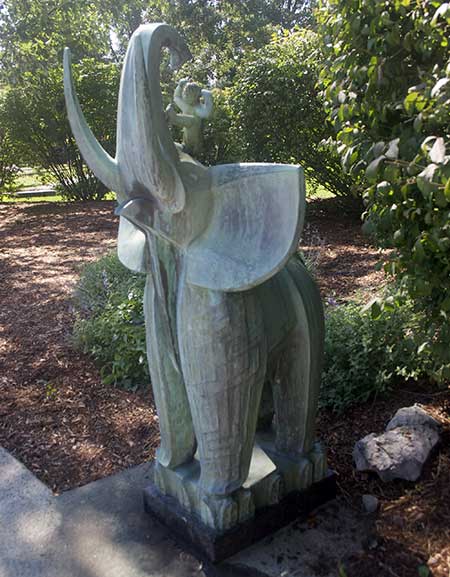
Down the hill a bit, one can find these sculptures, erected as reminders of the ever-watchful vigilance and benevolent care of the Great Pachyderm:

And further down still, near the university’s main temple, the idol of the Great Jumbo stands proudly. Offerings of the people adorn his side, written in the secret ancient script.

My journey to the Tufts campus was not without some small difficulties. Claire’s new home is located a short walk from the grounds. I am not, as those of you who have read some of my previous adventures, gifted with a good sense of direction, or even a sense of direction at all. It is only through conscientious memorization of routes and landmarks that I can find my way from the kitchen to the bedroom.

So I will confess a measure of consternation with the prospect of finding my way unaided from her new home to the university. Fortunately, through an accident of geography, Tufts University is located at the pinnacle of the only hill in the neighborhood. “Keep going up,” she said. “As long as you’re going up, you can’t miss it.”

Her advice was outstanding. With the mountain itself as my guide, I am pleased to report, Gentle Readers, that I became lost only twice, and did not walk more than half a mile out of my way.

Close to the edge of the campus, one finds this sprawling mansion, the home of the President of the University.

The low hedge you see ringing the house’s grounds are all that remain of the high, impregnable walls that once stood on that very spot, erected in haste after the attempted coup of 1979.

In that year, the grad students, who spend long and dangerous days in the eternal darkness of the mines beneath the campus, working day and night with pickaxe and shovel mining nuggets of knowledge in dangerous conditions for little pay, and whose labors made the university’s High Council and its president rich beyond dreams of avarice, rebelled. They seized the entrance to the mines and lay siege to the residence of the President himself before the rebellion was crushed.

Today, the relationship between the ruling class and the university’s laborers is much less tense. The laborers have negotiated contracts with the ruling elite that grant them some small measure of hope of upward social mobility, while the elite have largely been able to retain their fabulous wealth and their odalisques, who calm the fears of the aristocracy with the gentle applications of the feminine arts.

It was in bemused reflection of those arts that Claire later found me, wandering the campus without purpose or goal. We dined upon local delicacies called “burritos” and “quesadillas” that afternoon, before returning to her new home to engage in the rearrangement of things and stuff into a more suitable configuration.

The next day found us once more in her car, the vehicle whose stalwart service had seen us across an entire continent, through deep canyons and soaring mountains, past strange landscapes teeming with Mormons and the Guatemalans who’d carried off one of our own, this time on a shorter journey to the airport.

I have flown, through strange happenstance of fate and circumstance, many times in the past couple of years. Each time, I have flown on Delta Air Lines, and each time, my luggage has come out somewhat the worse for the wear. On my trip back from Europe, documented many posts ago, the handle was broken–somewhere, if I recall correctly, between Amsterdam and London. On this trip, I arrived in Portland to find a large gash ripped in the front of the suitcase.

It was not until my next journey, to London and King’s Lynn for a debauched celebration of birthday hedonism, that my faithful suitcase would receive a terminal blow. That is a story for another time.

Noted without comment: Android phones and condoms

From Gawker comes this article confirming what I’ve long suspected: Android phones often share the same name as condoms.

Love, love, love: where the Greeks went wrong

Everyone who’s ever had a liberal arts background, and most folks who’ve ever spoken to someone with a liberal arts background, and some folks who’ve never done either but who’ve talked about the philosophy of polyamory for any length of time, are probably aware that the Greeks, who loved creating classification systems for things almost as much as they loved war, developed a classification system for love.

In the Greek system, there are four distinct types of love. They believed in Agape, unconditional all-encompassing love like the love of the gods for humans (presumably just before the gods kill lots of people in an earthquake or a flood or something); Eros, or passionate love, usually (but not always) sexual; Philia, or friendship love, of the sort between comrades (and later used by psychologists for sexual kinks that most folks don’t have and usually that the psychologist in question doesn’t quite understand); and Storge, or familial love.

It occurred to me while I was preparing to shower this morning, as such things often do, that the Greeks missed a couple of types of love in their categorization.

Now, I am aware that the Greeks were legendary for their considerable talents in sorting and labeling things, an art they developed to such an advanced degree that their philosophers even devised classification systems for people (bronze, for slaves; silver, for tradesmen and politicians; and gold, for philosophers)…so it is with the greatest trepidation that your humble scribe dares to suggest that the Greek taxonomy of love might in the slightest way be lacking.

However, as much respect as I hold for their considerable skills at pigeonholing (and believe me, I hold it in exactly as much respect as it so richly deserves), I feel I must point out that their system is incomplete.

So I would like to propose two additional categories of love:

Orwellos, for compulsory love that is mandated by authority, such as the love of Big Brother, the love of Kim Jong Il, and the love of various hypothetical divine entities who love you in return but will cast you into a lake of fire if you fail to love them enough, or love them in the wrong way.

Stockholmia, or the love of one’s abuser, such as the love of Patty Hearst for the Symbionese Liberation Army and the love of Linux users for Linux.

There may yet be a seventh category of love, for love of people for political institutions which act against their interests, though it is not entirely clear to your humble scribe whether that’s an entirely separate category of love or simply a combination of the last two.

Edit: After further consideration and consultation with zaiah, I have come to the conclusion that the love of people for politicians and political parties who act against their interests is indeed its own unique form of love, rather than being a combination of Orwellos and Stockholmia.

I would therefore like to propose a seventh type of love. Following slutbamwalla‘s brilliant suggestion, may I propose:

Santoros, the love that people have for politicians or political organizations who appeal to their sense of identity while simultaneously acting against those people’s own interests.

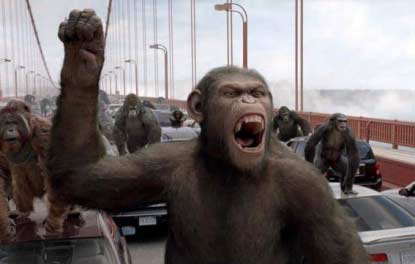
Movie review: Rise of the Planet of the Apes

Hollywood is awesome. Hollywood serves an important role in society, by warning us of the many dangers that bedevil mankind. For example, Hollywood teaches us that if we create artificial intelligence, it will kill us; if we genetically engineer potatoes, they will kill us; if we build self-determing machines, they will kill us; if we make contact with extraterrestrial intelligence, it will kill us; and, most recently, if we uplift another species, we will all die horribly.

Which, at least in the latter case, is not necessarily that far off the mark, as two or more organisms competing for the same ecological niche generally results in what biologists like to call “a bit of a sticky wicket.”

However, the fly in the ointment of this particular Hollywood trope is that there are currently just south of seven billion human beings on the planet, making us one of the most populous species of vertebrates in the whole history of ever, and therefore a rather difficult adversary to unseat.

Plus, we have, like, machine guns and cell phones and stuff.

Fortunately, Hollywood screenwriters are up to the task of disposing of such trifling little technicalities with the flick of a plot twist. Unfortunately, they aren’t up to doing it well. The end of Rise of the Planet of the Apes had me screaming “EPIDEMIOLOGY, MOTHERFUCKERS! DO YOU SPEAK IT?” in my best Samuel L. Jackson voice (which, truth be told, isn’t really that good), but still…EPIDEMIOLOGY, MOTHERFUCKERS! DO YOU SPEAK IT?

The movie goes something like this:

A group of CHIMPANZEES is chilling in the FOREST
CHIMPANZEE: Ook?
A bunch of MACHETE-WIELDING PEOPLE capture the CHIMPANZEES and ship them to a SCIENCE LAB for UPLIFTING
CHIMPANZEE: Ook?
An UPLIFTED CHIMPANZEE solves a TOWER OF HANOI PUZZLE slower than a COMPUTER but faster than a FOX NEWS COMMENTATOR
MAD SCIENTIST: Check that out! An uplifted chimpanzee can solve that puzzle! Faster than that dude on Fox News! How cool is that?
RESEARCH DIRECTOR Can we make money? Because I’d really like to make money. I drive an expensive German car. Money is cool.
MAD SCIENTIST: An uplifted chimpanzee! Solving a puzzle!
RESEARCH DIRECTOR Money?
MAD SCIENTIST: I can totally cure Alzheimer’s.
RESEARCH DIRECTOR Cha-ching!
Cut for spoilers; click here for more!

Welcome to Web 2.0

I don’t read TechCrunch.

For that reason, I’m always the last to know about hot new Web 2.0 dot-com startups. I usually don’t find out about them until I start seeing their names in Russian pill spam, or run across them when someone posts a link to a virus downloader promising hot free young Latvian girls in one of my blogs. I look at the spam link, Google the name of the company hosting the spam, and invariably discover that it’s the trendiest new dot-com property this side of the Great Firewall of China, with $42 million in venture capital in the bank and table tennis on the roof.

Some of these companies are more over-the-top than others. There’s a brand-new startup called Hipster.com which is–I swear I’m not making this up–offering new hires a years’ supply of beer to go with their $10,000 signing bonus.

What these companies never advertise for, it seems, are folks with a background in security.

And so, they get pwn3d, like the has-been startup founded by Marc Andreessen of Netscape fame called “Ning.” Ning was supposed to revolutionize social networking. After burning through all its capital with virtually nothing left to show for it, Andreessen bailed, and it is now little more than a shell for Russian virus downloaders, as I’ve mentioned before. The virus droppers I talked about a year and two months ago? Most of them are still active. Lights are on, but nobody’s home.

So it is with companies like Flavors.me and Box.net, started with equal parts naïveté and hope. I didn’t know about either company until I started getting pharmacy spam advertising URLs on their servers, and discovered with a quick Google search that they’re overrun with it.

Right now, as I type this, Box.net has about 40,000 Russian pharmacy redirectors living on its servers. I have a bit of a soft spot for Flavors.me, because I wrote them an email to let them know they have about 3,800 spam pharmacy redirectors on their site, and actually got an email back from a person who, according to her company profile, went to the same little liberal arts college I went to in Florida…but they still haven’t got a handle on the situation. I’ve been checking over the past few days, and the number of spam redirectors on their servers is, according to Google, increasing at the rate of about ten an hour, which probably means there’s a whole lot more that Google isn’t finding.

So in the efforts of public service, I’ve created this handy-dandy flowchart detailing the life cycle of a hot new Web 2.0 startup. This seems to be about the way that nearly all of them go–at least the ones that create a lot of buzz by spending a ton of investment capital and getting written up in TechCrunch before they even go live.

You can click on the picture for a much bigger version. Enjoy!

Fragments of the Future: Women, Men, Androids

By 2145, symbols such as these were common in public areas, and were used to indicate restroom facilities for women and men, and recharging stations for androids. The origin of the universal symbol for ‘Android’ is shrouded in mystery.