#WLAMF no. 6: Stonepeckers

During our travels around the country talking to folks about polyamory, Eve and I passed through Colorado. We spent a night at Colorado National Monument, sleeping in the back of the van at a weird angle that made us keep rolling into each other.

Colorado National Monument is awesome in the “nature is grand on a scale beyond mere human endeavor” sense, rather than a “this architecture is grand because it’s designed to manipulate you” sense. It’s filled with towers of stone that look like something right out of an old Roadrunner cartoon, separated from each other by deep canyons that could comfortably swallow a blue whale and a dozen tour buses and you’d never even notice.

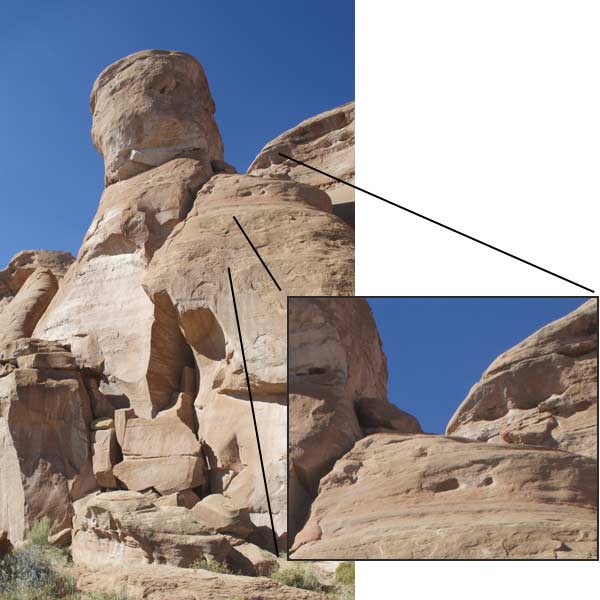
Some of those towers of stone are pockmarked with great holes that resemble nothing so much as the holes made in telephone poles by optimistic woodpeckers.

I asked a park ranger1 about the holes. That’s when I first learned of the great stonepeckers.

The similarity to woodpecker holes is no coincidence, for they’re formed by similar processes. During the dry season, giant stonepeckers, with huge talons and beaks like carved diamond, land on the buttes and chip away at the stone, seeking the rock burrowers that live within. They look a bit like woodpeckers, but on a far grander scale. Their iron-feathered wings can stretch more than thirty feet, and when they peck at the cliff face, the sound travels for miles.

They’re not related to woodpeckers at all, I learned. Their similarities are purely a matter of convergent dimorphism; form follows function. The stonepeckers are actually not birds at all; they’re related to wyverns, dragons, and thunder lizards. You can tell not only by their size, but by the morphology of their talons and their skeletal structure, particularly around the hip.

The sky was once full of them, tens of thousands of years ago. We see evidence in the fossil record–not only of stonepecker bones but of their great nests of pine trees, lined with flint. Drying climate reduced their numbers; today, only a handful of stonepeckers remains. They are carefully managed by the Parks and Recreation Service, that uses specially modified Apache attack helicopters to keep them from straying too close to people.

1 By which I mean I thought about asking a park ranger, then decided to run with my own story instead because it was probably more interesting.


I’m writing one blog post for every contribution to our crowdfunding we receive between now and the end of the campaign. Help support indie publishing! We’re publishing five new books on polyamory in 2015: https://www.indiegogo.com/projects/thorntree-press-three-new-polyamory-books-in-2015/x/1603977

The Birth of a Meme, or, Why I love the Internet

As the American electorate went through the motions of choosing a candidate of someone else’s choosing this week, the Internetverse was alive with political commentary, flames, racial epithets, and all the other things that normally accompany an American campaign season.

At the height of the election, Twitter was receiving 15,107 tweets per second…an eyewatering amount of data to handle, especially if you’re a company with little viable revenue stream other than “get venture capital, spend it, get more venture capital.”

Some of those tweets were tagged with the #romneydeathrally hashtag, and for a few days, how the Internet did shine.

If you do a search on Twitter for #romneydeathrally, you’ll find some of the finest group fiction ever written. The Tweets tell a strange, disjointed account of a political rally straight out of Lovecraft, with bizarre rites taking place on stage and eldritch horrors being summoned to feed on the crowd.

The hash tag went on for days, the Internet hive-mind creating an elaborate communal vision of a dark supernatural rally filled with horrors.

I even got in on the action myself:

Eventually, it caught the attention of the media. The Australian Hearld Sun ran an article about the hash tag that painted an interesting narrative of the meme:

In further evidence that Democrats are winning the social media war, hundreds of people have taken to Twitter to “report” on a fictional event where Republican Presidential hopeful Mitt Romney has called upon satanic powers in a last ditch effort to swing the election in his favour.

DigitalSpy has their own take on the meme, also saying Twitter users are talking about Mitt Romney calling upon Satanic powers.

When H. P. Lovecraft references get labeled as “Satanic powers,” I weep for the lost literacy of a generation…but I digress.

By far the most bizarre response to the meme was posted by Twitter user @nessdoctor over on Hashtags.org with the title “Twitter Users Threaten Mitt #RomneyDeathRally”. According to Ms. Doctor,

The hasthag #RomneyDeathRally trended after tweets spread placing Presidential candidate Mitt Romney (@MittRomney) of the Republican party under the light of resorting dark satanic techniques to win the upcoming US national elections on November 6, 2012.

This is, of course, a nasty hashtag and while its purveyors insist it’s for humor (and sometimes it is), it is done in bad taste. […]

There were also posts that threatened to kill Romney, with some even threatening to join domestic terrorism and attack the White House and the people in it if Romney sits as president.

The article has been rewritten a number of times; at first, it stated that the hashtag was all about threats to kill Romney and his family, then it made the strange claim that the hash tag came about after rumors had spread that the Romney campaign was trying to use Satanism to win the election. For a while, the article had screen captures of threats against Romney with a caption claiming the threats were part of the #romneydeathrally hash tag; that claim has since been dropped. I have no idea what the article will say if you, Gentle Readers, should visit it.

But where did it come from? (I’ll give you a hint: it didn’t start because of rumors of Satanism.)

Like most Internet memes, the #romneydeathrally hashtag craze started small. On November 4, Mitt Romney held a campaign rally in Pennsylvania. For whatever reason, the rally was late getting started, it was cold, and some people who were there complained on Twitter that Romney campaign staffers were refusing to permit them to leave the rally, citing unspecified “security” concerns.

Some of these tweets were picked up by reporters covering the event.

It didn’t take long to turn into a public relations disaster. Some folks started talking about the “death rally” that you could never leave on Twitter, and the #romneydeathrally hashtag was born.

Naturally, the Internet being what it is, it really didn’t take long for some folks to decide they’d ride that train to the last station:

And, inevitably, Lovecraft got involved. Because if there’s one thing you can count on about the Internet, it’s por–okay, if there are two things you can count on about the Internet, one of them is that the Internet will always insert references to Lovecraft and Cthulhu wherever it possibly can.

And thus the meme was born.

It had nothing to do with threats on Romney, nor with rumors that the Romney campaign was dabbling in Satanism. Instead, it was the Internet doing what the Internet does: seizing on something that happened and taking it to an absurd conclusion.

The Romney Death Rally was a PR own-goal for the Romney campaign, sparked by staffers doing something really stupid at a rally.

There are two lessons here. The first is that if you’re a prominent politician and you’re hosting a rally, it’s probably a bad idea to refuse to allow people to leave. People have cell phones, and Twitter, and some of them will complain, and their complaints might be heard.

The second, though, is less about politics than it is about news reporting. For the love of God, if you have a journalism degree, you should be able to recognize a reference to the Cthulhu mythology when you see it.

It’s Beginning to Look a Lot Like Tentacles!

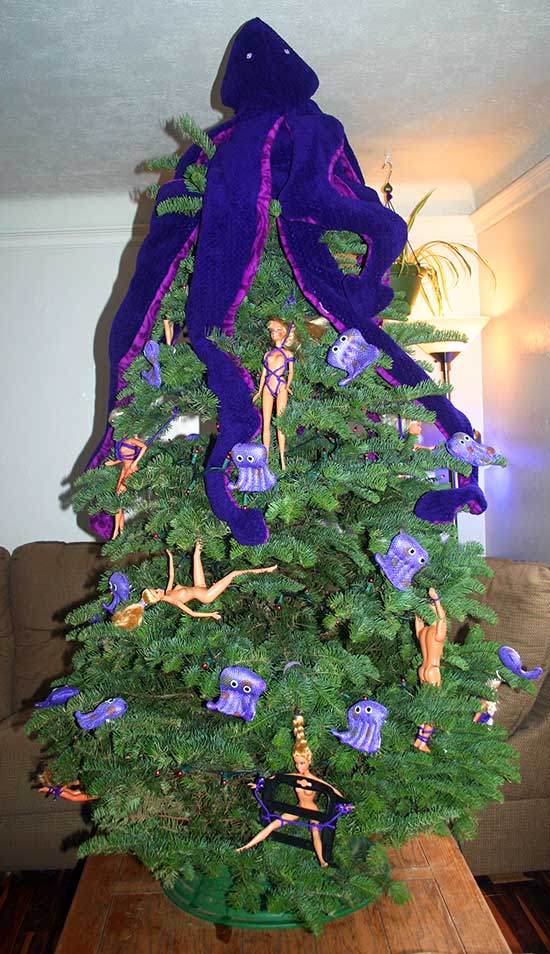
For the past several years, zaiah has wanted to make a Christmas tree with a “tentacle rape demons and the schoolgirls they love” theme.

This year, we finally made it happen.

We managed to obtain (please don’t ask me how) quite a large pile of Barbie dolls. In November, we hosted an 11/11/11 party which featured, among other things1, a lot of folks eating Jell-O shots and putting the Barbies into shibari rope harnesses. The Barbies serve as the innocent victims, which as we all know every tentacle monster needs plenty of in order to grow up big and strong.

Click here for more pictures…

Woohoo! A cease and desist email!

This is actually the second time I’ve received a cease and desist demand in regards to a Web site that I run. And boy, is it a strange one.

So some of the readers of this blog may be aware that I run a Web site called Fine Tuned Mac, which is a Macintosh technical troubleshooting forum. It was born when C-Net bought the largest Mac forum site, MacFixIt, so that they could shut it down and direct traffic to their own rival Mac site.

Anyway, this evening, the following gem of an email appeared in my inbox, which I reproduce in all its glory for your entertainment:

From: brandprotection@ip-rosettastone.com
Subject: finetunedmac.com – Notice of Infringement of Intellectual Property Rights of Rosetta Stone Ltd. [Case #70995]
Date: December 1, 2011 9:37:35 AM PST
To: Franklin Veaux
Cc: Brandenforcement@RosettaStone.com
Reply-To: brandprotection@ip-rosettastone.com

To whom it may concern:

This is to inform you that a website you manage, finetunedmac.com, has come to the attention of Rosetta Stone Ltd. (“Rosetta Stone”).

Rosetta Stone’s automated monitoring software continually monitors, collects and stores instances of unauthorized use, sales or other violations of Rosetta Stone’s intellectual property rights on the Internet. Our records indicate that your site, finetunedmac.com, has employed an advertising or sales campaign that may have incorporated Rosetta Stone products and/or trademarks or terms confusingly similar thereto.

In order to ensure your compliance with our request, you should (i) delete “Rosetta”, “Rosetta Stone” and any variations thereof, from your search engine keyword list, and (ii) add “-Rosetta” and “-Rosetta Stone” as negative keywords (negative matching) to your search engine keyword list. If you have questions, the search engine websites explain how this is done.

We believe that there is no legitimate reason or basis for you to rely on any Rosetta Stone trademark, image or product in your marketing or sales campaigns, and encourage you to review all of your advertising campaigns and sites to avoid such practices in the future.

Sincerely,

BrandEnforcement@rosettastone.com
Rosetta Stone Ltd.


Now, there are a number of things about this email that jump out at me, the first and perhaps most relevant being that Fine Tuned Mac doesn’t have a marketing or advertising budget, and the second being that if we did have a marketing or advertising budget, advertising the site using Rosetta Stone’s logo or trademarks wouldn’t do fuckall for us, since our target demographic is Mac geeks rather than hipsters who think they can get laid if they learn Italian.

So I wrote them this reply. What do you think, too formal?


To whom it may concern:

Your IP department appears to have gone mad.

I can’t tell if it’s too much time spent listening to crappy language tutorials on CD or too much time spent shooting moodily lit photographs of said CDs to appear in Skymall magazine, but Fine Tuned Mac does not, and never has, used any Rosetta Stone image, product, brand name, trademark, or any other intellectual property for any reason.

In fact, I am quite baffled (German: verdutzt; French: déconcerté; Italian: sconcertato; Finnish: hämmentynyt) by your email. Try as I might, I can not make head nor tail of what you’re talking about. Fine Tuned Mac is a free forum-based Macintosh technical troubleshooting site. We have no marketing campaigns, and the only Google ads we’ve ever run have focused solely on Macintosh troubleshooting terms.

Now, I can perhaps, if I squint REALLY hard, perhaps see where you might have run off the rails, insofar as there are troubleshooting threads on the Fine Tuned Mac Web site that talk about Rosetta. However, what you may not know is that Rosetta is Apple’s trade name for their proprietary real-time interpreter that permits machine code written for PowerPC processors to run on Intel-based computers. If you’re unfamiliar with any of those terms, you might find a Google search enlightening.

Should you have a problem with Apple’s use of the word “Rosetta,” I respectfully (well, as respectfully as I can manage, anyway) suggest you take this up with Apple’s intellectual property lawyers.

I trust this concludes your interest in Fine Tuned Mac.

Regards,
Franklin Veaux

Boston Chapter 4: The Horror of Middle America

If you drive across the American Midwest on Interstate 70 for long enough, a sort of hypnosis begins to set in. The road goes on and on and on and on, and there’s nothing interesting on it, save for the occasional dead animal of indeterminate species on the side of the road.

If you continue driving, eventually your brains will liquefy. Your eyes will begin to bleed. Strange apparitions of Hunter S. Thompson doing battle with Napoleon against the backdrop of war-torn Sarajevo while gibbons drift high in the sky strumming gently on lutes will slide in and out of the corners of your vision. When that happens, keep driving until you find your happy place. You know, the one where small insectoid life-forms crawl out of unexpected parts of your body demanding Pop-Tarts.

It is about then that you will see Prairie Dog Town, in Oakley, Kansas, just a stone’s throw from the interstate.

Prairie Dog Town is a microcosm of everything that is strange and horrifying about Middle America. It is the quintessential slice of Americana. Ray Bradbury could set horror films there. It advertises the world’s largest prairie dog, among other wonders and atrocities too numerous to mention. So it was a given that we had to stop there.

But before I talk about that, I need to talk about the Jesus of Wheat.


The Jesus of Wheat adorns a series of billboards that cluster along the interstate near a small town almost exactly an hour west of Prairie Dog Town. We pulled off the interstate to eat, as up until this point we had subsisted largely on lovely, succulent grapes hand-fed to us by Claire. This is a wonderful way to dine, and I highly recommend it, but inevitably we hit Peak Grape and it was all downhill from there. Soon we were forced to confront a stark reality: There Were No More Grapes, and it was time to deal with that, whether we liked it or not.

So we stopped for sandwiches, and met the Jesus of Wheat.

I don’t know what this billboard means, other than Jesus really, really loved wheat. This image occurs on every onramp and offramp in the town, as near as I can tell: Jesus, looking enigmatic, holding a stalk of wheat in His freakishly-long and perspectively-challenged arm.

Or at least I think it’s his arm. Maybe that hand is thrusting up from the ground, clutching wheat in its cold lifeless fingers, as a parable for the cycle of all life and the inevitable coming of the Zombie Apocalypse, I don’t know. I spent some time trying to work out the mechanics of whether He could actually hold wheat that far from His body, and I will admit, ultimately, to theological bafflement. Perhaps there are some things Man was not meant to know.

At any rate, I really had to record the billboard for posterity, by which I mean my blog. So while my companions dined, I slogged back up to the interstate on foot in 99-degree heat, roughly a half mile away or so, to get this shot.

The 99-degree heat turns out to be relevant later, as we shall see.


The theological ambiguity of the Jesus of Wheat left all of us, I think, in a fragile state of mind, so when an hour later we saw signs advertising Prairie Dog Town, our natural resistance–what little was left after the endless drive, anyway–was already considerably eroded.

Prairie Dog Town is a small, dilapidated building with signs promoting the World’s Largest Prairie Dog and other wonders beyond mention. It’s the sort of place that serial killers stalk in Oliver Stone movies, or the Great Cthulhu might seek out for a midafternoon snack of moon pies and the souls of the damned. We went in the front, picked our way through a gift shop overflowing with rattlesnake egg paperweights and small carved wooden toys, and bought our tickets in the back.

The back of the shop is crowded with the fruits of the taxidermist’s art, applied to various abominations of nature like this two-headed sheep calf:

It’s also lined with a series of very large wooden crates, about five feet tall and topped with wire mesh. “Go ahead!” said the lady working the till to my traveling companions. “Look inside! See what’s in there!”

As soon as they did, she hit the crates with a stick. About a dozen rattlesnakes, all of them more pissed off than Dick Cheney on a quail hunt, immediately started rattling and striking at the wire mesh, much disconcerting both of my companions. The smile on the woman’s face suggested that she lives for that.

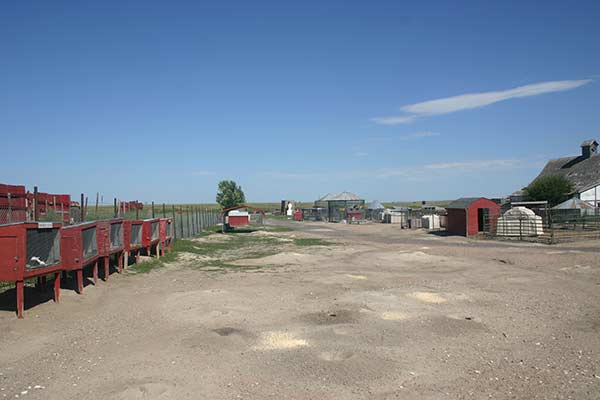
Payment appropriately rendered, we walked out the back door into Prairie Dog Town. This…is Prairie Dog Town.

Each cage contains a forlorn animal or three. There are two aspects to the Prairie Dog Town Experience which this picture cannot convey: the brutal, oppressive heat that settled on us like a tangible, suffocating thing; and the smell. Oh, God, the smell.

Though, in all fairness, most of America’s heartland smells that way.

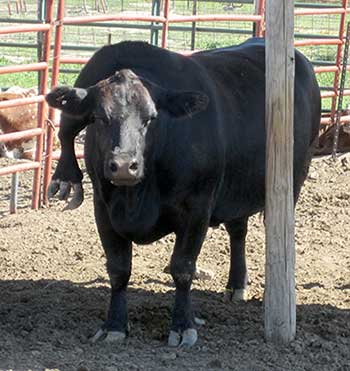
Beyond the eponymous prairie dogs, the pride of the collection at Prairie Dog Town is their herd of mutant five-legged cattle. Yes, they are mutant cattle, and yes, they have five legs, the fifth one of which dangles pathetically from their back.

This is exactly the sort of thing one sees when something goes wrong with an organism’s hox genes, as I was talking about a bit ago.

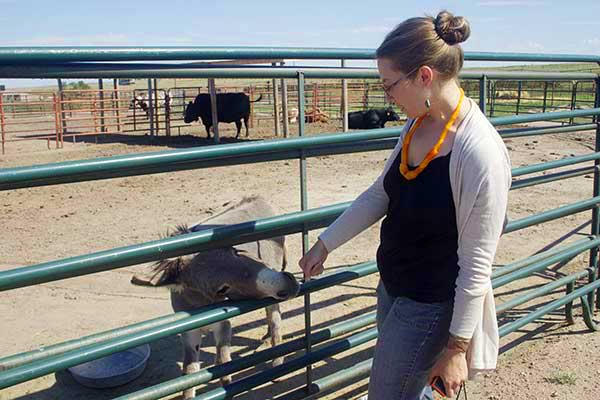
The place also offered for our amusement birds of various descriptions, some really forlorn-looking foxes behind a wire enclosure, a couple of pigs, and a very friendly donkey who was quite happy to see us.

And, of course, it had prairie dogs, who perched in the heat and chittered at us reprovingly, as if to say “You paid money to be here? Didn’t the Jesus of Wheat warn you about this place?”

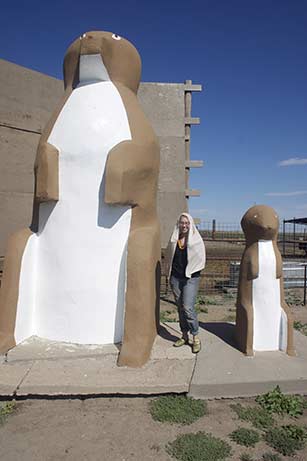
It also had, true to the billing, the World’s Largest prairie Dog, which is neither a prairie dog nor particularly large. It’s a big fiberglass sculpture of something that’s vaguely reminiscent of a prairie dog in overall body plan, though the artist seems to have missed some ingredient, some artistic flair that might have captured that spark, that fundamental essence of the Platonic ideal of prairie dogs, or for that matter even of mammals in general.

That’s Claire standing next to it, using the high albedo of her sweater as a partial defense against the blistering hot radiation of the uncaring sun bombarding us from above.

A bit dispirited and lighter of currency, we finally wandered back to the safety and relative sanity of the car, each of us bearing the psychic scars of the time served in that place.

Fortunately, the most amazing thing the eight-year-old within me has ever seen was in our near future. Unfortunately, the time was now close where we would lose one of our numbers to the Guatemalans. But both of those stories will have to wait.