I have always had a very…special relationship with the Watchmen story.
I was first introduced to the story by Tracey Summerall, a woman who at the time was attending college in Sarasota, Florida. She also introduced me to the Terry Gilliam movie Brazil, among other cult classics, so as you might imagine this had a significant effect on my grasp of pop culture. (In fact, she had a map of the world up on the wall with the Watchmen comics carefully pinned against it, one issue directly over the country of Brazil, a juxtaposition that was not accidental.)
 Tracey was my first crush, a fact which eventually led to the demise of our friendship. At that point, I was still young enough I hadn’t yet learned some of the most basic and obvious but nevertheless still not easy tools of interpersonal relationships, among them “more communication is better than less communication,” “if you don’t ask for what you want you can not reasonably expect to have what you want,” and “other people are not responsible for your unvoiced expectations.” In fact, my friendship with her was in many ways instrumental to my learning these things, and she is among the ten or so people who have most influenced the person I later became, though she never knew that, and those lessons came too late to save our friendship. (Funny how that can happen. As it turns out, I learned more than a decade later that she went into exactly the same line of work I went into–when she won a prominent design award in the industry. But I digress.)
Anyway, she introduced me to Watchmen, which at the time I thought was the most brilliant and amazing thing I’d ever seen. It wasn’t finished yet; only six of the twelve episodes that made up the full story had been published, and the rest were delayed by nearly two years.
At the time, I lived in Ft. Myers, an hour and a half drive from Sarasota, and the only place in southwest Florida that carried Watchmen was in Sarasota. And they refused to say over the phone whether or not the next issues were available yet. So I’d get in my car each month and make the drive, and as often as not the next part was delayed by something or other and wouldn’t be there. It took, all in all, about a year and change for me to be able to read the whole story.
I still have the first edition, first printing comic book version of Watchmen. Not exactly in pristine shape, but that’s not really the point; I’m neither a collector nor a fan of comic books (and to this day Watchmen is one of only three graphic novels I’ve ever read).
So it’s fair to say that I went into the movie with some high expectations. Watchmen is rooted in a significant part of my personal history, and I have some attachments to it that no movie could reasonably ever be expected to live up to.
I’ve seen the movie twice now. The first time, I went to see it by myself; I gathered up all of my expectations and hopes and bittersweet memories and dragged them all down to the theater with me to see if what was up on the screen could do justice to my past.
When I got home, I posted on Twitter, “Back from Watchmen. Haven’t read it in years. I’d forgotten how brutal it was. Movie is good, but not brilliant.” and went to bed.
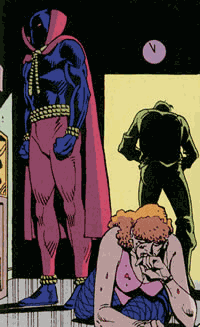 Before I went to see it, I didn’t read any of the critical reviews or commentary about the movie, and that was deliberate. Since then, of course, I’ve read a lot of reviews and endless commentary about the movie; Watchmen is, if nothing else, the most talked-about film to come along in a long time.
Some of that commentary makes sense, even if I don’t happen to agree with it. Some of it makes me shake my head and say “What?”
There’s a lot of that going around. To be fair, the movie studio didn’t really seem to have a grasp of what they were dealing with; according to several “behind the scenes” and “making of” articles I’ve read, what they wanted was a two-hour, PG-rated movie that could be the start of a whole new franchise.
What they ended up with, of course, is a sprawling, self-contained three-hour movie that barely avoided an NC-17 rating.
And really, it couldn’t be any other way. Seriously. What were they thinking? Any executive who thought Watchmen could be the next X-Men franchise clearly didn’t understand the story. Watchmen isn’t really a superhero story; it’s a brutal, ugly, and morally gray morality play, filled with characters who are at best deeply flawed and at worst are morally reprehensible. The main character is a sociopath, for God’s sake! In one of the film’s more graphic scenes, one superhero beats and attempts to rape another superhero. (Actor Jeffrey Morgan, who plays the superhero The Comedian, describes that particular scene as “three of the hardest days of filming I have ever had to do.”)
What did they think, that they’d be able to release Watchmen Origins: Rorschach a few years from now? What we learn about Rorschach’s past in Watchmen is exactly enough, kthx; anything more would be trawling through a sewer in a glass-bottom boat. The studio should be content with the merchandising tie-ins they’ve already done (“the Comedian deluxe collector figure comes with accessories and multiple guns,” the better to shoot pregnant women with) and be done with it.
One of the complaints I’ve heard that makes sense is about the soundtrack. That complaint I have to agree with; the soundtrack for the film is jarring and in some places incongruous. I understand why the choices were made; I understand what the intent was; I understand that part of the goal of the soundtrack was to ground the film in a particular time, and more importantly, in a particular psychological environment. The choices that were made are logical, but I think were wrong; the audience members who are familiar with these songs are going to bring their own associations to them, and they may not be the associations that were intended. (That was definitely true in several cases for me.)
One of the complaints I’ve heard that doesn’t make sense is that the pacing of the film was wrong.
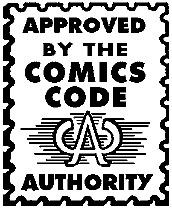 Watchmen is not a superhero movie. It is a deconstruction of superhero movies. It is a reaction against the comics of the 60s and 70s, that were forced by industry standards to conform to the Comics Code Authority‘s inane Comic Book Code, which required, among other things, that in all comic books “If crime is depicted it shall be as a sordid and unpleasant activity,” “Criminals shall not be presented so as to be rendered glamorous or to occupy a position which creates a desire for emulation,” and perhaps most stupidly, “In every instance good shall triumph over evil and the criminal punished for his misdeeds.”
The superhero movies we’re familiar with–X-Men, Spider-Man, Batman–are all based on stories that are products of this code. The code has shaped what we expect from a superhero movie, and I don’t mean just in ways like “superheros don’t commit rape” and “superheros don’t shoot pregnant women.” We expect a certain style of storytelling, with epic battles and chases and exciting music. We expect noble deeds, good, evil, tension, climax, resolution.
That isn’t what Watchmen offers.
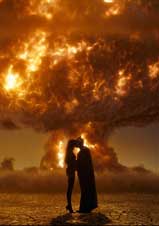 What Watchmen offers is the notion that our expectations are stupid, uninformed, and fucked-up from the start. What Watchmen offers is the observation that putting on a mask and beating up bad guys is a pretty fucked-up thing to do, and the fucked-up people who do this fucked-up thing are not likely to be noble in character. What Watchmen offers is the idea that life isn’t neatly divided along lines of good and evil; people are people, and often they’re fucked-up, and people do stuff–some of which is noble and some of which descends to atrocity.
And sometimes some of the stuff that people do is both at the same time, and sometimes it’s neither, and sometimes people just plain don’t give a fuck, and if that makes you uncomfortable, then that’s too bad. Against the backdrop of war and civil unrest and the possibility of nuclear annihilation, sometimes it really doesn’t matter whether you’re beating up purse snatchers; it’s all just rearranging deck chairs on the Titanic.
For people who walk into Watchmen expecting a superhero flick, there’s likely to be some grumbling. It’s not, even though it’s filled with folks in masks who beat up bad guys. Better, I think, to walk in expecting a mystery. We know how to deal with mystery movies; we expect a slower, more measured pace. We’re not looking for chase scenes and things blowing up. Though even that isn’t quite right; Watchmen starts out with a straight-ahead murder mystery, but in this story, context and subtext are everything.
And how, exactly, do we cope with the superhero who sees all of humanity as a kind of extended lifeboat dilemma and makes the obvious, logical, necessary, and thoroughly evil choice? The story dares us: Are your moral values as resolute as Rorschach’s, the sociopath who has nothing but contempt for human life yet is willing to die for the things he believes to be morally right? “No. Not even in the face of Armageddon. Never compromise,” he says. Would you? Or would you choose to become complicit in atrocity?
One of the reviews of Watchmen I’ve read refers to one of the characters as a “supervillain,” but is he? I don’t believe that he is, and more to the point, by labeling him as a supervillain I think the reviewer missed the entire point of the morality play. One of the unintended side-effects of the Comic Book Code is that it has left pop culture littered with superheros who are incapable of making complex moral decisions, because they’ve never had to.
One thing I felt as I was watching the movie was a sense of disconnect from the emotional impact of the story. When I read the comic-book version, I recall feeling profoundly affected by it on an emotional level, and the emotional response I had to the story became so tangled up in the emotional landscape of all the things going on in my life at that time that now, more than twenty years later, they’re still difficult for me to unpack from each other.
The movie, which in many ways was faithful to the comic to the point of obsession, felt detached to me. The set design, the direction, the costumes, the settings, were all pitch-perfect, but somehow the movie lacked the immediate emotional resonance of the book for me. That might be in part because of my own familiarity with the story, or because the story belongs to a part of my life that is so distant that the person I was then is almost alien and incomprehensible to the person I am now, or because there’s just no way any re-interpretation of the story could ever match the impact of my first exposure to it. I’ve talked to people who didn’t read it first, and they don’t seem to find the movie as flat as I do, so I don’t know.
It is interesting to me how the limbic system can remain static for decades. In almost every way that’s relevant, I am not even remotely related to the person I was in 1986, to the point where I have trouble even understanding the person I used to be, yet the emotional reality of that person is still as clear and present as if it had happened yesterday. This sort of lizard-brain stickiness contributes, I think, to a great deal of human misery; we remember the emotions surrounding things long after the things themselves have faded, and as a result our recollections of people who have been important to us are stained by those emotions and become frozen like flies in amber. We remember arguments that passed a decade ago as clearly as if the door was still slamming, long after we have forgotten the things that drew us to the people around us in the first place. But again, I digress.
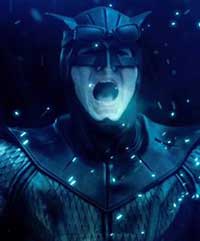 Watchmen is not a story that meets with the Comics Code Authority’s approval. It’s brooding and dark and morally gray, and the end of the story leaves the audience stranded in a moral quagmire with no way out. This is not your father’s tale of heros and villains. “In every instance good shall triumph over evil and the criminal punished for his misdeeds”? In Watchmen, we’re left not really sure who is good and who is evil, if indeed those terms are even meaningful at all.
Watching a conventional superhero movie like Spider-Man or X-Men in the theater is a very different experience than seeing Watchmen; with movies like X-Men, you eat popcorn and the folks around you cheer and you leave the movie feeling excited and happy. There are moments of that in Watchmen, to be sure (both times I saw it, the audience cheered at Rorschach’s “None of you understand. I’m not locked up in here with you; you’re locked up in here with me!”) but Watchmen is the only movie involving superheroes I’ve ever seen where the audience reaction to the story’s final, climactic confrontation is stunned silence (or, the first time I saw it, someone crying). Complicity in atrocity comes easily, and the movie makes us complicit and then twists the knife.
That last confrontation did keep its emotional impact for me. In the end, the technical changes that were made to the storyline, the condensation of the background material, all that stuff doesn’t really matter, though I’m sure hard-core comic geeks will keep using these things in online dicksizing contests for generations to come.
What matters is that the movie achieved the objective of the comic. And in that, I’m by no small measure impressed. Is it a brilliant movie? No, it’s not; but it’s a brilliant story. And that’s what counts.