Interview: So your girlfriend has read 50 Shades; now how do you start with BDSM?

A short time ago, I received an email from a writer for Men’s Health magazine who’d found me online and wanted to interview me about BDSM. Specifically, the interview was about how someone who’s read the book 50 Shades of Grey and found the ideas in it interesting might take the next steo and start exploring BDSM in a relationship.

The interview was focused mainly on maledom/femalesub dynamics, presumably because that’s the type of D/s described in 50 Shades. As of writing this, the issue of Men’s Health containing the interview isn’t on the newsstands yet, but I’ve received permission from the interviewer (@ peachesanscream on Twitter) to post a raw transcript of the interview here.


I’m writing an article for Men’s Health magazine as a beginner’s guide to BDSM. The idea behind it is that their girlfriend has read 50 Shades of Grey and they’ve experimented with sex toys, but now they want to go a bit deeper into BDSM.

I was wondering if I could please ask you a few quick questions and in return credit you in the article?

I realize that 50 Shades of Grey is credited with helping to popularize the idea of BDSM, but I don’t think it’s actually a very good introduction to the subject. It’s a fantasy story, and as fantasy it doesn’t paint a good picture of BDSM. It’s a bit like taking marriage and relationship advice from the Disney movie “Sleeping Beauty,” only with the added problem that many of the activities described in 50 Shades aren’t very safe.

Still, it is helping to open a dialog about BDSM. If it helps open the door for people who ‘ve always wanted to explore spicing up their relationship but haven’t been able to figure out how, that’s awesome.

Role play: how do you get started? How can a man act dominant without being mean or scaring his partner? Things like eye contact, instructions, body language etc?

As with any new thing in a relationship, you get started by talking. Sounds simple, right?

The hard part is that we live in a society that does not teach us how to talk openly about sex. It can be scary to talk about exploring something new; what if your partner says no? What if your partner thinks you’re weird? What if you try it but it doesn’t work? Does that mean your partner will reject you? How do you bring it up? Is it normal to want to do these things? It’s easier to just not talk about it.

Getting started with role-playing (or with any other kind of BDSM) requires being able to talk about it, and that takes courage. The best way I know of to start that conversation is directly, with “Hey, you know, I love having sex with you, and there are some things that I would like to try. I think it might be fun to explore ___. What do you think?” As tempting as it is to try to bring things up indirectly, by dropping hints, that almost never works. After all, if it’s something that’s too scary for you to talk about directly, why would it be reasonable to expect your partner to be willing to talk about it directly?

Communication is important because being dominant is different for every person. What one person thinks is sexy, another person would find intimidating and a third person would find mean. Some people like the idea of having their partners tie them down; other people don’t like that, but might want to be held down; still other people don’t want to be restrained at all, but might be turned on by the idea of being spanked; and other folks might not like any of that but be thrilled by their partner telling them what to do. All of those things count as “acting dominant.” It’s important for the dominant partner to learn what gets the other person going (and what doesn’t), because this sort of thing really only works if it works for everyone.

Talking about what turns you on and what you don’t like is the key to creating a safe, happy, healthy space to explore things like role-playing or dominance.

What sort of things should he say?

That’s something that depends on the people involved. The most wonderful thing about BDSM is there isn’t just one way to do it. It’s something that every couple creates themselves out of the things that turn them on.

Sometimes, a good way to have a conversation about what you’d like your partner to say or do can be started by reading erotica. If there’s some passage in 50 Shades or a letter in a letters magazine that revs your engine, sharing it with your partner and saying “I like this, what do you think?” can help get the conversation going.

Whatever he (or she; it’s not only men who are dominant!) might say, one important trick is to say it with confidence. A simple “Go into the bedroom and wait for me” spoken with confidence is a lot sexier than the most elaborate scenario spoken with hesitation.

One of the things I personally enjoy is taking my lover close and whispering in her ear exactly, in precise language, what I would like to do to her body. It’s fun to do this in public, say if we’re out running errands, to help prime the pump and get us both thinking sexy thoughts. When we get home, she will know what to expect.

Another thing I’m quite fond of is lying in bed close to my lover, snuggled up against her while I tell her how to touch herself.

As with anything else, different people have different tastes. Exploring, experimenting, and finding what works is the key.

What about verbal abuse? Is it ok to call women names eg. filthy slut, during sex? How does he know not to go too far?

One thing I believe quite strongly is that abuse is never appropriate.

Having said that, anything that is consensual and done for the pleasure of everyone involved isn’t abuse. If a woman is aroused by her lover whispering filthy things in her ear and calling her dirty names, that’s very different from a stranger on the street calling her the same names. The first one is not abuse; the second is.

I have had partners who like being called names during sex and partners who don’t. For me, it can be fun and sexy, if it’s something she likes. I can often tell how a lover will respond to this kind of verbal play by asking her “Do you like being a dirty girl?” while we’re making out. If she finds that arousing, it’s usually pretty obvious.

This is something that a lot of men have difficulty with. I’ve talked to many men who have partners who’d like to try dirty talking, but the men don’t know how to start. There are a couple of things that can make it hard: fear of feeling silly, and a deeply-ingrained belief that it’s wrong to talk to women that way.

Fortunately, both of those things tend to go away pretty quickly with practice. There’s nothing wrong with feeling a little awkward when you try something new. After all, nearly everything we do is awkward the first time; remember how awkward it was the first time you tried to ride a bicycle? And it’s never wrong to talk to a woman the way she wants you to talk to her. In fact, treating someone the way they want to be treated is, to me, the highest kind of respect. I can say all kinds of dirty things to a lover, call her all kinds of sexy names, and still keep in mind that it’s a form of role playing; it doesn’t actually mean that I don’t respect her, or that I think less of her.

What signs should he look out for that she’s offended? How can he tell if he’s gone too far?

That comes down to communication again, and to paying attention to what she likes and how she responds. The simplest way I know of to find out how far is too far, or what a woman does and doesn’t find sexy, is to ask her!

Different people have different tastes in dirty talk. Some women love being called a dirty, filthy slut, but don’t like words that go to their self-worth, like “stupid” or “worthless.” Some women love the C-word, some women hate it, and some women don’t have strong feelings one way or the other. And, of course, some women don’t care for dirty talk at all.

It gets a bit complicated because most of us, no matter how well we know ourselves, have a hard time predicting how we will react to something new. I’ve known women who believed they wouldn’t like dirty talk, but who found it arousing when they were turned on. I’ve known women who liked reading stories involving dirty talk but didn’t like it in real life. That’s all a normal, natural part of human variability.

So the only way I know of to stay within the lines and keep it fun and exciting is to go slowly and to pay attention. Start simply–“Are you a dirty girl?” Invite a response. And, as always, talk about it.

Do you have any other tips for how a man can play the dominant role as a beginner in BDSM?

Whenever you try anything new, it won’t always go 100% the way you expect it to 100% of the time. Be willing to be surprised. There may be times when your partner has an unexpected reaction to something, and you have to stop what you’re doing. That’s OK. It doesn’t mean you’re doing things wrong; it just means that when you explore something new, things won’t always be perfect.

A lot of people who talk about BDSM talk about it from the perspective of taking care of the submissive partner and being aware of the submissive partner’s limits. But it’s also important to understand that being in the dominant role can make you feel vulnerable, too. Dominants also have limits, and it is possible for something to happen that triggers a reaction in the dominant partner. The people involved should keep the limits and responses of the dominant in mind, too.

BDSM is about exploring pleasure and trust together. When you look at it from the outside, it can seem like one person doing things to another person, but it’s really more about two people doing things together, but in different roles. The goal is to have fun. If you’re doing that, it’s all good.

Unlike what you tend to see in books and movies, BDSM doesn’t have to be serious all the time. Sometimes, it can be very silly. There’s a game I like to play called the “two frogs” game. A frog has two eyes and four legs, so two frogs have four eyes and eight legs. I’ll say “Three frogs! One frog! Four frogs!” and if she doesn’t respond instantly with the right number of eyes and legs, she gets spanked. It’s very silly, but also a lot of fun.

How do you broach the idea of using stronger sex toys such as nipple clamps on your (female) partner? (( we’re assuming that they’ve already experimented with sex toys at this point. So it’s not totally virgin **ahem** ground)) Should you start by squeezing her nipples during sex, then asking her after? Is there a smooth way to do this?

I’m a big fan of communication in a relationship, as you’ve probably guessed. A good general rule abut sex that I’ve found works pretty well is don’t just do things and hope for the best; talk about them first. You can’t always be expected to know where someone’s boundaries are, and you don’t want to find them by accident.

When it comes to anything, from using a vibrator to using nipple clamps to chaining my partner to the wall and spanking her until she’s squirming, I find out whether or not she’s interested by talking to her about it. A great way to do this is by discussing fantasies (and this is a two-way street; talk about the things that interest you, and also encourage her to talk about the things she fantasizes about). And remember that being receptive is also a two-way street…if you’d like her to be open to the idea of having nipple clamps on her, you can’t freak out if you discover she’d like to use them on you!

A lot of people ask me “How can I get my girlfriend to do so-and-so?” I think that’s the wrong approach. You don’t GET your partner to do things for you; this person is your lover, not a circus animal. Instead. you talk about things you’d like to explore, you listen when she talks about things she’d like to explore, and you find the overlap.

How do you broach the idea of trying anal sex? Is there a non-offensive way to do this? Should you try touching her there first to see how she’d react?

People tend to be touchy about their asses. Legions of bad advice columns in Cosmo magazine aside, I don’t think it’s a good idea to go poking at a lover’s ass and hope for the best.

Is there a non-offensive way to ask? Sure! “I’m interested in exploring anal sex. How do you feel about it?” Talking directly and openly about what interests you is never offensive, provided you’re okay with hearing “no” as an answer. To me, it only becomes offensive if you have an expectation that the answer has to be “yes.”

And remember the part I said about being receptive to what she has to say if you want her to be receptive to what you have to say? If she says something like “You know, I’ve always wondered if it would be fun if I stick my finger up your bum while I give you a blowjob” and you freak out about that idea, then you can’t really expect her to be calm about the things you suggest. It’s okay if that idea doesn’t appeal to you, just like it’s okay if anal doesn’t appeal to her; if she suggests something that doesn’t work for you, a simple “Well, that doesn’t really do it for me” is enough.

How can you gain her trust enough to get her to cede control to try light bondage? Would it be something like agreeing safe words before? Or using ties that don’t tie up too tightly? Or maybe letting her try it on you first or using your hands?

I don’t think that you “get” someone to trust you. Instead, I think people trust you when you are a trustworthy person. There is no secret to getting people to trust you other than being a person who deserves trust.

Part of the way that you earn trust is by respecting your partner’s boundaries. Part of it is by treating your partner with respect and compassion, even if she says things that surprise you or that turn you off. And I shouldn’t really have to say this, but part of it is by being a person who’s honest, someone who can be relied on to behave with integrity.

I had an acquaintance many years ago who was a serial cheater; he would brag about all the women he’d cheated with, and he tended to go through partners pretty quickly. He always wanted to try bondage, but he never found a woman who would say “yes.” I think on some level all the people he slept with knew that he couldn’t be trusted. One of his partners, for a brief time, was a model. I was a photographer at the time, and I did a bondage photo shoot with her. He was very surprised when he saw the pictures, because he’d asked her about trying bondage and been told “absolutely not.”

I think that people often are apprehensive about trying new things in the bedroom, and bondage is no exception. Starting with light bondage is perfectly appropriate, as is agreeing on a code word that means “untie me right now.” I also advise that people keep a pair of bandage scissors handy when they explore for the first time. You can get these for a couple of dollars at any drug store. They have one pointed blade and one rounded blade, and they’re designed to be slid underneath a bandage to cut it off without risking cutting the skin. If you get into trouble with bondage, they’ll cut your partner free in seconds.

Being willing to respect a partner’s limits, being willing to show that you are trustworthy, being willing to suggest ideas without trying to pressure your partner into saying “yes,”and being willing to talk about what you can do if things go wrong goes a long way toward creating a safe environment for exploring bondage.

Are there any important points that I should include?

Safety!

Safety is a bit tricky, because sometimes what feels safe and what is safe are miles apart.

For example, when we think about bondage, a lot of folks think “pink fuzzy handcuffs.” But I know several serious, die-hard, long-term kinksters who won’t play with handcuffs because they’re just too dangerous. A lot of people who first dabble with tying their lovers up might use silk sashes or nylon stockings, because they feel less intimidating than using ropes or leather cuffs. But these, too, are dangerous.

Handcuffs are dangerous because they are completely inflexible and they put a lot of force on a very small area. If you struggle when you’re wearing handcuffs, it can be surprisingly easy to do permanent damage to the bones or nerves in your wrist, and it can happen very quickly.

Silk and nylon can have a tendency to pull tight, making them almost impossible to untie. They can also cut off circulation without warning. When you get into trouble, it can be hard to get them off quickly. Ropes are a lot safer for bondage, which is why kinksters use them.

It’s usually a good idea for people exploring BDSM to create a “safe word,” which is a special word that means “stop, really, I mean it.” Especially if you’re trying role play scenarios where words like “no” and “stop” are part of the role play and don’t really mean “no” or “stop.”

There are a lot of resources out there for people who want to learn how to explore these things safely and respectfully. My own Web site at www.xeromag.com has a beginner’s guide to BDSM and a list of resources, and there are many more as well.

Some thoughts on being out

One of the many questions that inevitably comes up in almost any poly discussion group,usually multiple times, is the question about being open about being polyamorous.

The same thing comes up in kink-related social groups, and I imagine in just about any other alternative sexuality group you can name.

Now, I’m a big fan of openness and transparency. There are a lot of reasons for that. On a philosophical level, I do not believe there is anything to be gained by pretending to be something you’re not, and I don’t see how deceiving people who would shun you if they knew the truth actually benefits anyone. (To my mind, if someone–your family, say–loves you only so long as they don’t know the truth about you, then they don’t actually love you. They only love an imaginary projection of you, and that love is conditional on you agreeing not to do anything that might spoil the projection.)

On a practical level, it’s hard to find other people like you when everyone is closeted. If I am polyamorous, and I’m in a room with ten other poly people but none of us are open, all eleven of us might be thinking “Wow, I wonder where I can go to meet other poly people? It’s so hard to do!”

But there’s one objection to openness that I hear all the time, and that’s what I’d like to talk about here. A lot of folks say “I’m not open because it’s nobody else’s business how I live my life.” And to some extent it seems true, but there are problems with that idea.

Before I talk about those, though, I’d like to back up a little and talk about the way I grew up.


I spent my elementary and middle school years growing up in the rural Midwest. This is where I lived:

See that clump of trees on the right? It’s where my old house is. We lived outside a tiny town called Venango, Nebraska, population (at the time) 242.

I’ve written about a trip I took as an adult through Venango, with lots of pictures, in my blog here. Time has not been kind to the town. It’s half deserted; many of the houses are boarded up, and the school closed a long time ago. The most eerie thing about it is the total and complete absence of children. We stopped at the playground behind the school when we visited it. All of the playground equipment is covered by a fine dusting of rust, and when we turned the merry-go-round, rust drifted off it in flakes. I have to think that if there was even one child left in the entire town, the playground wouldn’t be this disused.

It was no picnic for me growing up there. I was the stereotypical geek as a kid; I was into model rocketry, and I owned a TRS-80 computer, the only computer of any sort in a 40-mile radius. (I know this because the only other computer within any distance was an Apple II belonging to the owner of the business my mother worked at in the next town over, about 45 minutes away; he used it to do bookkeeping.)

There were eight people in my middle school class, the largest class the school had seen in years. While I was teaching myself the basics of aeronautics, electronics, and Z-80 assembly language programming, the main topic of conversation among my peers were the relative merits of the Denver Broncos vs. the Dallas Cowboys–a discussion that often involved a great deal of heat but never seemed to get resolved, no matter how many times it was hashed out.

So it’s safe to say I grew up alienated from all the people around me.

Which is pretty unpleasant. I was able to partially mitigate the fact that I had no friends when my parents got me a 300 baud telephone modem, and for quite literally the first time in my life I was able to encounter, if only in a crude way, people who were kind of like me.

As alienated as I was, I still had some things going for me. One of the things I noticed growing up was the casual, offhand racism that permeated the Midwest; the people around me were quite confident that whites were better than blacks, even though most of them had, quite literally, never once met a person who was black. Even as an outcast, I still had some measure of privilege; it’s hard to say how much better or worse things might have been had I been a football-loving African American, or (worse yet) geeky and also black.

My parents moved to Florida when I started high school, so all at once I went from having eight people in my class to having two thousand. For the first time in my life, I met other people who were like me. I was still something of an outcast from most of the folks around me, of course; the fact that there were other geeky, nerdy people in the school didn’t mean we weren’t a distinct minority. I was still introverted and painfully shy back then, but at least I had a social circle, something that was totally new to me.


What does this have to do with being out about polyamory? Quite a lot.

After my first year in college, I made a conscious decision: I did not want to be introverted or shy any more. I deliberately and systematically set about learning the skills that would get me there. I started choosing different kinds of people in my social circle. If I found a social situation that made me uncomfortable, I deliberately kept putting myself in it.

It was about this same time that I started realizing that I was kinky and poly, as well. Prior to starting college, I wasn’t a sexual being in any meaningful sense of the word; I barely even recognized that boys and girls are different.

But even before I was interested in sex or relationships, I still knew I was polyamorous, though there was no language for it. The stories about the beautiful princess forced to choose between her suitors never quite made sense with me; if princesses live in castles, which seemed axiomatic to me when I was a kid, why wasn’t there room for all of them?

As a person newly interested in sexual relationships, that idea stayed. Why on earth should I expect someone to pledge her fidelity to me, simply because I fancied her? On the face of it, the idea just made no sense.

Growing up alienated seems to have had a positive side effect; I found out that being isolated from a social circle is inconvenient, but it isn’t fatal. I learned that I could find ways to interact with people like me, first online and then in person. And I learned that things like “being shy” and “having poor social skills” weren’t death sentences; they were things I could learn to cope with and skills I could acquire.

So in that sense, having an isolated childhood didn’t really leave that much of a mark on me. i was resilient enough to make choices about who I wanted to be and then find ways to be that person.


In the 1990s, which is positively antediluvian as far as the Internet goes, I started working on a Web site. (The Wayback Machine only started capturing the poly section of the site in 2000, for reasons I don’t completely understand.)

The goal in making the site was to create the resource that the younger version of me would have found valuable. When I actually started doing this polyamory thing, I didn’t have the advantage of being able to learn from other people’s mistakes, which meant that I had to make my own…and while experience might be the best teacher, sometimes the tuition is very high.

The site became a whole lot more popular than I expected it to be, which pretty much finished off any chance I might have to be quiet about being polyamorous. Not that there was ever much chance of that to begin with, but still.

So I’ve never been closeted. Not even a little bit.


Which takes us back ’round to the issue of what business it is of anyone else’s.

On the face of it, “it’s nobody’s business who I’m involved with” seems to make sense…except that, in a very real sense, it is.

We live in a society that sanctions only one kind of relationship, and tends to stigmatize others.

When a person wears a wedding ring and says in casual conversation “My wife and I went to dinner last night,” that person is validating those social conventions. He could say that it’s nobody’s business how he conducts his romantic affairs, of course; but the simple act of wearing a wedding ring is a public declaration of a very specific kind of relationship. And it’s hard to talk about the things we do, even casually, without talking about the people we do them with, and what those people’s relationships are to us.

When folks at poly get-togethers talk about being closeted, by far and away the most common thing they talk about is being afraid of other people’s reactions to learning the truth. Essentially, it boils down to a very simple idea: “I want to control information so as to control the way people interact with me.” The fear of being shunned, and the extent to which people are willing to jump through hoops to control information and to create the impression of normalcy in order to avoid that fear, is sometimes quite remarkable.

I’ve never had the fear of how people will react to me for being polyamorous (or kinky or anything else). I’d like to think it’s because I’m, like, all evolved and stuff, but it’s really a lot simpler. I know what it’s like to be totally alienated from my peers. I know that I can survive it. I know that I can create my own social circles and my own family. I’ve met that monster under the bed. It has no power over me. If there’s a monster under my bed, fucker better pay me rent, just like anyone else living here.

I realize that I am in a privileged position about this. I work for myself; I don’t have to worry about a conservative employer firing me if they find out how I live my life. I’m not in the military. (Under the Uniform Code of Military Justice, adultery is a crime, punishable by dishonorable discharge, prison, or both.) I am not financially dependent on a family that would disown me if they found out. I don’t have children who might be vulnerable to being taken away, or an ex-spouse who can use polyamory against me in a custody hearing.

So I can be open about who I am, and I don’t have to worry about suffering for it.

And that’s kind of the point.

In a world where it really was nobody’s business how we conduct our private lives, nobody would have to worry about these things. Nobody would have to worry about getting fired or getting a dishonorable discharge or losing children because of being polyamorous. The fact that there are people who do have to worry about these things means that much of the world tries to make it their business how we conduct our romantic lives.

Polyamory, and homosexuality, and BDSM, and all kinds of other non-socially-sanctioned relationship structures are perceived negatively in part because people don’t often see them, and it’s easier to vilify something that you don’t see every day. Like the racists in Venango who’d never laid eyes on a black person, when you don’t have the experience of seeing something yourself, it’s easier to project all your own fears onto it.

When those of us who have a privileged enough position to be able to live openly choose to do so, we help create a visible face for polyamory that makes it that little bit harder for others to vilify or marginalize us. So in that sense, it very much is other people’s business what I get up to; by creating institutions which can be used against folks who are polyamorous, they’ve made it that way, whether we like it or not. By creating the social expectation that people in officially sanctioned relationships can advertise their relationship status but people who aren’t, can’t, they’ve made it that way.


Columnist Dan Savage started a campaign aimed at teen gays and lesbians called “It Gets Better.” Part of the campaign is to do exactly what edwardmartiniii talks about in this essay: namely, to speak up when we see something wrong.

If the alienated, disenfranchised me from 1977 could see the me from 2012, he’d be amazed. The person I am today is the person the elementary-school version of me fantasized about being, and more.

But it took a lot of work to get here. And that’s why it matters. By being open about who I am, not only do I live my life without compromise, exactly the way I want to; I help make it that much easier for other people who, right now, don’t have a social group where they belong. I think that everyone who, like me, is in a position to be able to be out without risk, does a service to others by choosing to be so. It does get better, because we make choices that help make it better.

Skeptics and Misogyny and Privilege, Oh My

Since my blog post about the discussion about polyamory on the JREF forums, I’ve been poking around on the forums some more. Somehow, I managed to stumble across a thread relating to accusations of misogyny in the skeptical community, stemming from an episode at TAM last year.

TAM is an annual convention of skeptics and rationalists hosted every year by the James Randi Educational Foundation. It’s one of the largest such conventions in the country.

Apparently, a prominent blogger named Rebecca Watson was harassed at TAM last year. And the fallout from her complaint about it, which I somehow managed to miss almost entirely, are still going on.


I don’t read many skeptic or freethought blogs, which is probably how I missed the first go-round. A bit of scouting on Google, and a perusal of the JREF forum, shows an astonishing amount of anger, most of it of the “how dare this emotional woman tell us we’re misogynists!” variety. Which is more than a bit disappointing, when it isn’t downright rage-inducing.

In the interests of fairness, I have to say that I totally get why folks who identify as skeptics and rationalists might be especially resistant to suggestions that they are behaving inappropriately, especially with regards to sexism. A significant number of folks in the skeptics community identify as atheist. It takes quite a lot of effort for many people, especially people raised in a religious family, to break away from religious faith and embrace the ideas of rationalism and skepticism.

Once you do, there is a temptation to think of yourself as being more enlightened because of it. Things like racism and misogyny? They are those relics of patriarchal religious orthodoxy. I’m not a misogynist! I’m not a racist! I left that behind when I let go of religion. I don’t think that women are placed below men by some sort of divine pronouncement. I’m not the one trying to make women into second-class citizens. How can I be sexist?

I can remember going through a thought process something like this myself, back when I was a teenager in the process of giving up on the idea of religion.

Years later, when I was first introduced to the notion of invisible privilege and the ways that society creates a bubble of special advantages around men, it felt quite weird to grapple with the notion that I might be the beneficiary of misogyny, or even be guilty of misogynic behavior myself, without even being aware of it.

So the reaction of folks in the skeptics community when confronted with inappropriate behavior at a conference might be understandable, though it’s still disappointing. And maybe I’m naive, but the level of vitriol coming from some parts of the skeptics community against Ms. Watson and her supporters is completely over the top…and appalling.


All that is kind of beside the point, though. Yes, it can be tough to recognize the invisible sea advantages that we swim in, just as it might be hard for a fish to recognize that it’s wet.

But here’s the thing. It seems to me that anyone, regardless of whether or not he recognizes the many ways that society provides him with an invisible set of advantages that other people don’t have, who hears someone say “I feel threatened” or “I don’t feel safe here,” should start by listening.

I do believe that most of the folks in the skeptical community–indeed, most people in general–sincerely don’t want to be misogynistic (or racist or otherwise guilty of bias or oppression). And if someone claims to be a rationalist, it seems to me that if he is approached by someone else who says “I feel marginalized in this environment,” the desire to find out whether or not a problem actually exists, and to fix it if it does, should logically outweigh that little emotional voice that says “But that can’t possibly be true; I’m not like that!”

So at this point, I’d like to talk to all the guys reading my blog. Especially white guys, and most especially white guys who think that they aren’t sexist or racist. The rest of you can…I don’t know, cover your ears or something. Ready? Okay.

Listen. Guys. If you are at a conference or a sci-fi convention or something, and someone comes up to you and says “I don’t feel safe here,” you listen. And then you say “I’m sorry to hear that. This isn’t the sort of environment I want to create. What can I do to help fix the situation? What would it look like if this space were more welcoming to you? Have I participated in any way in making this space feel hostile to you, and if I have, what can I do to make it right?”

This is really, really simple It’s called “being a decent human fucking being.”

Now, I know what you’re thinking. It’s probably some little thing that’s gotten way blown out of proportion, right? There’s not really a problem; this person is just being oversensitive. Right?

And that is one possibility, sure.

But seriously? Given the history of treatment of women and minorities in this society, and given how goddamn hard it is to be aware of the advantages you have over folks who aren’t as white or aren’t as male as you are, that probability is pretty goddamn remote. A lot more remote than you think it is.

Doesn’t matter, though. You aren’t going to find out if there’s merit or not if you don’t (a) listen and (b) consider the possibility that there’s some validity to the complaint.

And while we’re at it, let me tell you what you don’t do.

You don’t say “Well, I don’t see a problem here.” That just makes you look like an ass. If there’s a problem with sexism or racism and you’re a white dude, of course you’re not going to see the problem. Duh.

And you don’t say “That doesn’t sound like that big a deal to me.” That just makes you sound like an even bigger ass. If you haven’t had the experience of what it’s like facing constant systematic exclusion–and believe me, as a white dude, you probably haven’t, any more than I have–you’re not really in a position to tell whether or not it’s a big deal.

And seriously, if you say anything, and I do mean anything, along the lines of “All these feminists are just out to get men” or “You’re just being hypersensitive” or, God help you, “you must be on the rag,” you don’t sound like an ass, you ARE an ass. You’re part of the problem. Whether you think of yourself as biased or not, the simple fact that you can think along those lines kinda proves the point. That setting isn’t welcoming because you’re one of the people who is making it that way.

Look, I know it can be hard to acknowledge that you have been given advantages simply by virtue of who you are; I felt the same way. It’s a bit like trying to look at your own back.

But you’re a rationalist, right? C’mon, you can figure this out. Treat it like an intellectual puzzle; that is exactly what it is.

And in the meantime, put aside the emotional response–because that’s what it is, an emotional response, and listen.


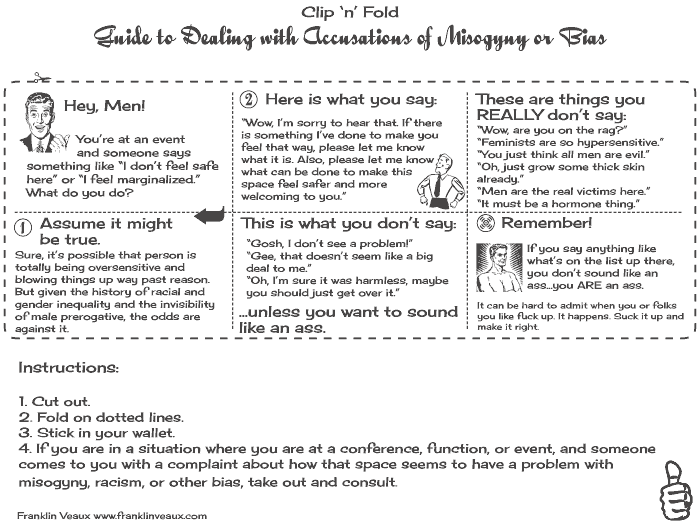
Yes, it can be a little tricky to navigate this stuff. So in the interests of helping to promote better understanding for everyone, I’ve created a handy clip-and-fold guidebook that you can print out and carry in your wallet. Clicky on the picture for a PDF version!

Some thoughts on ethics, safety, and conduct in BDSM: Part I

Part 2 of this essay is here.

The largest producer of BDSM porn, by far, that I am aware of is Kink.com.They’re headquartered in the old Armory building in San Francisco, where they produce controversy, BDSM porn, and demonstrations, though as near as I can tell it’s only the second one that actually makes them money.

Bear with me for a minute; this is just backstory. I’m going to get all Ranty McRanterson in a minute here.

Kink.com has something of a mixed reception in the BDSM community, as far as I’ve seen anyway, though my experiences with them have always been positive, and I quite like all the Kink.com folks I’ve met personally. (Their reception in the Christian anti-porn community is less mixed; when I was at Baycon talking to some of the folks who work for Kink, I heard stories about a Christian group who’d been picketing the Armory building with signs reading “End Torture Porn.” The irony in that is left as an exercise to the reader, though there was a part of me that wondered how many of the protesters were wearing crucifixes around their necks. But I digress.)

Kink.com was founded by a guy with a genuine interest in BDSM, and one of the things the company has done is try in various ways to support and give back to the BDSM community. There are some folks who take exception to that, and an argument can always be made that it’s hard for a for-profit company of any kind to really have the best interests of the community that supports it at heart; having said that, I do believe their heart is in the right place.

Recently, one of the folks from Kink.com called me to talk about a new project they’re launching, the BDSM Pledge Web site. The idea, as I understand it, is to create a kind of BDSM ‘Code of Conduct’ that folks could sign on to, post on their Web sites, and so forth.

It hasn’t formally launched yet, and they’re still soliciting comments about it. My opinion is that it’s an interesting idea, but I’d like to see more from it. A lot more.


Before I get to the rant, I need to digress for a moment about two of the notions anyone who’s at all familiar with the BDSM world has almost certainly encountered: “SSC” (Safe, Sane, and Consensual) and “RACK” (Risk Aware Consensual Kink).

These are two different-but-not-really notions about what it is that sets BDSM apart from abuse. The SSC folks emphasize that BDSM activities should, naturally, be safe, sane, and consensual. The RACK folks rightly protest that the notions of ‘safe’ and ‘sane’ are highly subjective. No kind of sexual activity (and indeed no activity in general) can ever truly be ‘safe,’ and ‘sane’ is a pretty damn slippery concept that’s often used as a blunt instrument against folks who do things in bed that other folks don’t much like. It wasn’t that long ago, after all, that homosexuality was considered inherently ‘insane’ by the psychiatric community. They prefer instead to acknowledge the risk and say that BDSM is OK if the participants are aware of the risk and still consent to the activity.

Quite a lot of column inches have been wasted on the feud between these two camps. The BDSM Pledge comes down on the side of Safe, Sane, and Consensual, and the person I spoke to at Kink.com ruefully conceded that it’s got some of the RACK contingent’s backs up.

I personally am in neither camp. I think that both ideas are a load of bollocks.

Not because of what they say, mind you. I’ve written quite a lot about BDSM, and the issue of abuse is a central one, a defining element of kink as opposed to abuse. It’s what they don’t say that I find most annoying. Or, to be more precise, it’s the way that members of both camps often fail to apply their own principles that I most object to.


So here’s the part where I start to rant.

It has been my experience that the BDSM community as a whole gives a lot of lip service to the idea of ‘consent,’ but the practice doesn’t track with the preaching very well. I’ve already written about a friend of mine who was sexually assaulted by a prominent ‘leader’ in the BDSM community, but the problems that I see go beyond out-and-out assault.

The problems as I see them exist in three areas: constant, low-level non-consensual behavior, an inability to distinguish between consensual non-consent and real non-consent, and predatory behavior. And I think the three are all related.

Now, I’m absolutely not suggesting that everyone in the BDSM community is a bad person, of course. I’ve met many wonderful, interesting, compassionate, intelligent, friendly people in the community who are absolutely fantastic. Unfortunately, however, the bad actors can mess things up for the people who are fantastic.

And I’m not even saying the BDSM community is any worse than society as a whole. But we can, and must, do better.

First, there’s the low-level non-consensual stuff I sometimes see at a conferences or play parties. It most often manifests as harassment of submissives, particularly female submissives; people swat their asses as they walk by, give them orders without negotiating whether or not it’s appropriate to do so, and otherwise behave as if their boundaries are irrelevant. (This isn’t entirely limited to men harassing women; it’s happened to me at play parties when I’ve been with a partner who was holding the reins.) In its more subtle manifestation, it’s a disregard for, sometimes even extending to a refusal to acknowledge, anyone who’s clearly in a submissive role.

Look, I get it if that’s your kink. Really, I do. But here’s the thing. You see those two ideas up there? You see the word they have in common? It’s “consensual.” That means, the submissive consents to the activity. Nobody should ever make assumptions that it is okay to disregard someone’s boundaries, or to touch someone, merely because that person is a submissive. This should be common sense. If you haven’t asked, don’t touch.

The folks in Master/slave or “TPE” (Total Power Exchange) relationships get wrapped around the axle on the same point. I know I’m likely to catch a lot of flak for this, but listen, guys: It’s a fantasy. You may feel like you have a relationship that is a “true” or “real” Master/slave relationship, and you might even feel like those folks who aren’t in relationships are poseurs or players, but it’s still a fantasy. The millisecond, and I mean the millisecond, the “slave” stops granting consent, it’s over. And if you try to make it keep going on after that point, you’re not a dom. You’re a rapist. You may think you’re entitled to be a rapist, because total power exchange whatever whatever, but then every rapist always feels entitled to rape, so it’s not like you’re special on that point.

I had an acquaintance, many years ago, who carried on to great length about how he was a “true” master and his slave was “truly” his property and how other people could “play” at BDSM but for them it was real because he owned her just as surely as he owned his toaster and yadda yadda yadda. He kept on about it right up until the moment she served him with divorce papers. Poor guy was gobsmacked; he never saw it coming. One’s toaster does not normally walk away with custody of one’s child and alimony when it wants a change of scenery. Again, this should be obvious. No matter how firmly someone has convinced himself (and it’s almost always a “him,” though I’ve seen a couple of women fall into this trap) that he he really owns his slave really for reals, the instant that person stops consenting to the arrangement (even if part of the fantasy is that that person has given up consent), it’s done. Anyone who can’t acknowledge that fact is best left as a matter for the police, not the BDSM community, to deal with.

Which brings me to the third variety of problem person, the out-and-out predator.

These people are difficult to deal with. They’re charming. They often rise to positions within a community that gives them respect and power. They host parties. They teach lessons. And folks don’t want to deal with the fact that they are bad people.

We are, as a species, breathtakingly gifted at ignoring evil. Part of it is selfishness; we don’t want to lose access to the things they give the community–the play spaces, the parties, the instruction. We find them likable, and don’t want to believe bad things (and guys, seriously, if somebody says “so-and-so assaulted me” and your response is “Well, I’ve never had a problem with him,” that’s fucked up on so many levels it’s hard to know where to start). We find it easy to blame the victim if we do become aware of something hinkey going on. (Astonishingly, I’ve seen women do this to other women–“Well, she should have known what would happen if she agreed to play privately with him; why was she leading him on?” or “Well, if she was a REAL submissive, she would be GRATEFUL for what happened!”) We talk the talk about consent, but when an uncomfortable problem manifests in our faces, we find it hard to walk the walk.

This stuff–all of it–needs to stop.


Which brings me back to the BDSM code of conduct and the tussle between SSC and RACK.

Folks, I don’t care. SSC and RACK come at the same general idea from different directions. Fighting about which one is better is squabbling over who should put the dishes away while the house is burning down. It doesn’t matter how you define “safe” and “sane” or what level of risk is acceptable between consenting adults. What matters–what really matters–is acting like consent is important. Not just talking about it.

All the time. In little ways and big ways.

That means, no casually swatting some self-identified submissive on the ass just because you’re a big domly dom and you think she’s cute, and that’s what you do with submissives. That means recognizing that consent is always important. It always matters, even when part of the fantasy is that it doesn’t.

And that especially means not making excuses when other people fail to respect the boundaries of those around them.

Even when it’s inconvenient. Even when you think it might cost you something.

My friend edwardmartiniii has this to say on the subject of inappropriate or abusive behavior in a community: “Don’t allow this behavior in your social group. It’s your group and that means that it’s your job (as well the jobs of everyone else in the group) to not allow the behavior you find undesirable. It’s your job to stop it. The people who are doing it might be clueless, or they might be malevolent, and I guess you are going to have to make that call, but the bottom line is that you are responsible for policing yourself and those around you. If you see something, then speak up. Right then. Act.”

And I agree.

So I would like to see a code of ethics that goes beyond “be safe, sane, and consensual, negotiate, and respect limits.” I’d like to see something that covers a lot more ground: Understand that roles are roles, but people are people, and it is your responsibility as a decent human being to treat everyone with respect. Don’t make assumptions. Don’t step on boundaries because you think the roles permit it. Don’t excuse others who do.

There’s more, and in Part 2 of this article I plan to talk quite a lot more about the things I’d like to see the community do.

Before that, though, I’d like to hear your reactions. What do you think? What problems, if any, have you seen in your communities? What would a code of ethical conduct for the subcultures you belong to look like?

Thoughts from BayCon: Polyamory, kink, community, divisiveness, and us vs. them

I’m just back from BayCon, an annual science fiction convention in the San Francisco Bay Area. I quite like cons, and I’ve been going to cons of various flavors for more than two-thirds of my life, though this was a bit unusual in that it was a much more businesslike trip than most of the other cons I’ve attended. My expenses were paid by a group of folks who really wanted to see me present (which was awesome, and I’d like to say “thank you” to the con organizers for helping make that happen), and I spent three days on various panels talking about everything from polyamory to creativity.

There’s quite a lot of interesting stuff that came up during those panels, some of which I’ll no doubt be blogging about for the next several days or so. One thing in particular that I want to talk about, though, concerns the way those of us who are active in alternative lifestyles tend sometimes to create and foster–sometimes deliberately, sometimes unintentionally–an atmosphere of exclusion and ostracism that perpetuates the very same kinds of things that we claim to be working against.


One of the panels I was on concerned the topic of defining alternative relationships. Throughout the panel, several folks, both on the panel and in the audience, referred to people who are neither polyamorous nor into BDSM by terms like ‘mundane’ and ‘muggle.’

And this is, I think, a huge problem for those of us in the kink and poly communities, or indeed in any sort of non-traditional social or relationship community.

Now, it seems to me that the problem with doing this should be self-evident. It’s self-congratulatory and divisive. It creates a completely unnecessary schism. It lumps everyone who isn’t into whatever we’re into in together as though they are all part of one great undifferentiated lump, which is just blindingly stupid; there are lots of folks who are neither kinky nor poly but who nevertheless are anything but normal. (I’ll warrant that the life of folks like James Cameron, who designed and built the world’s deepest-diving submersible because he wanted to check out what was going on at the bottom of the Marianas Trench, or Elon Musk, who designed and built the Falcon/Dragon successor to the Space Shuttle entirely privately on a shoestring budget because he thought that starting a private spacefaring company might be a cool thing to do for a living, are rather more interesting than the life of the average sci-fi fan even if those folks never once lift a flogger or date more than one person at the same time!) It does exactly what kinky and poly folks complain they don’t want others to do to them–it judges other people based on stereotypes mostly ridiculous and assumptions mostly baseless.

And, all those things aside, it’s simply bad policy.


I am a pragmatist. I tend to be less concerned with how people “should” behave and more concerned with what sorts of behaviors actually work.

And I think that every single derisive use of words like “mundane,” “vanilla,” “muggle,” and so on actually ends up hurting the folks who use them.

The problem with describing people outside of one’s community this way, aside from the fact that it’s arrogant, dismissive, and inaccurate, is that it recognizes no distinctions between all those “normals.” To someone who dismisses anyone not kinky or poly as a “mundane,” a Unitarian who works for acceptance, sex-positivity, and compassion is no different from someone who belongs to Westboro Baptist Church, America’s most well-known trolls.

And not only is that stupid, it’s counterproductive. It alienates potential allies. It pre-emptively antagonizes folks who are simply neutral. It creates an us vs. them mindset which, at the end of the day, the “us” is almost certain to lose; when the “us” is a single-digit, or perhaps at the most optimistic a low double-digit, percentage of the size of the “them,” fabricating an us vs. them mentality is simply bad tactics.

It is also exclusionary. A lot of folks who are poly, or kinky, or both, tend not to be part of the kink and poly communities, because this “us vs. them” mentality subconsciously shapes attitudes and opinions in ways that limit participation in the community.


When I lived in Tampa, I was for a number of years a regular host for PolyTampa, which appears to be as of this writing the longest-running polyamory support group in the country that’s still ongoing.

Anyone who’s been part of the community for any length of time has probably noticed that a disproportionate number of folks in the poly community tend to be geeky, middle-class, pagan, gamer…the stereotype of the “bi pagan poly gamer geek” is prevalent for a reason.

But it might not be the reason that people think.

I’ve watched a lot of folks talk about why the poly and kink scenes are so overwhelmingly gamer geek pagan bi (and, though it rarely gets mentioned, white and middle-class), and the explanations I hear usually fall along the lines of “Well, once you’ve started questioning monogamy and relationships, it follows naturally that you’d question other things, like religion and culture and stuff too. It’s because we’re so openminded and unconventional!”

Which, honestly, sounds like self-congratulatory horseshit to me.

There’s another reason, though I think it’s more subtle. It’s something I think a lot of folks in the poly and kink communities are blind to; namely, that the communities are hostile to anyone who ISN’T cut from the bi pagan gamer geek cloth.

I don’t think it’s deliberate or malicious, mind you. (At least not usually; there are some exceptions, like one exceedingly unpleasant chap I encountered on Facebook recently who claims quite stridently that all monogamous relationships are abusive, anyone who prefers monogamy does so only because he wants to control his partners or he simply hasn’t broken the brainwashing of conventional culture enough to look at relationships critically…but I digress. Not everyone in the community shares anything like those beliefs.)

During the course of the time I spent hosting PolyTampa, I noticed a fair number of people who would come to a single meeting, hang around for a bit, and then leave, never to be seen again. I also spoke to several folks who talked about being polyamorous but also about how they felt unwanted and unwelcome in the poly community, because they weren’t pagan, New Age, geeky, gamers, or techies.

I don’t think there’s a lot of pagan New Age gaming geeks in the poly community because being poly means challenging accepted social norms about religion, hobbies, or attitudes. Quite the opposite; I think there are a lot of pagan New Age gaming geeks in the poly community because the poly community can be quite unfriendly to folks who aren’t pagan New Age gaming geeks.


Now, let me be clear that (with very, very few exceptions) I don’t believe it’s intentional. Aside from that one unpleasant Facebook fellow, I’ve never encountered anyone in the poly community who would tell someone else “you’re not welcome here.”

However, as I’ve said before, any sufficiently advanced incompetence is indistinguishable from malice.

It doesn’t matter that it’s down to social incompetence more than maliciousness; the fact is, the poly and kink communities do tend to see the world in a polarizing, us vs. them light, and do often make themselves unfriendly to folks outside the pagan New Age gaming geek mold.

It’s subtle–so subtle that the folks who do it are probably totally unaware that they’re doing it. It happens through a process of normalization–of seeing everyone who doesn’t fit the pagan New Age gaming geek mold as a “mundane,” a “normal,” a “muggle,” part of an undifferentiated mass. It happens through tacit, rarely acknowledged expectations that if you’re poly, of course that means you aren’t Christian, you prefer video games to NASCAR, you have the free time and the money to meet and socialize at restaurants, you get the jargon and lingo of the geek crowd.

I’ve had folks come up and talk to me after poly meetings to say that they feel unwelcome because they are evangelical Christian, or because they’d rather go fishing than play World of Warcraft. Like I said, it’s not intentional, it’s subtle, but it shows in a thousand different ways. There are subtle little expectations, occasional barely-acknowledged disparaging remarks about all those other folks who, heh heh, just mindlessly cling to some mainstream religion instead of, you know, something more spiritually thoughtful like paganism, the offhand remarks about how the rest of the world is just stuck in the boring rut of vanilla sex… All of these things create an unmistakeable social subtext: this is who we are, and if you’re not one of us, you’re one of them. The Mundanes. The great boring unwashed mass of People who Just Don’t Get It.

And we’re cleverer than they are, oh yes. We appreciate diversity more than the mundanes do. We understand the value of being our own individual, something all those people don’t. Because, you know, they’re all the same. And they aren’t as smart as we are, or as tolerant, or even able to challenge their own assumptions. You know, the way we can.

It seems that being subjected to unwarranted prejudice and unfounded assumptions tends to make one skilled at doing these very things to others.

During the panel, when a few of the panelists had derisively referred to non-alt people as “mundanes” and “normals” several times, I chipped in that I don’t use that sort of language because I find it unnecessarily divisive and totally inaccurate. It creates a myth of “normalcy” that doesn’t actually exist; the mundanes that the other panelists derided do not, in any real sense, actually exist.

After the panel, a woman approached me to say that she was Mormon and in a D/s relationship, and found the kink community to be quite hostile. The assumptions that came from her being Mormon rather than pagan–she must be politically conservative, she must be anti-gay, she must be a blind puppet of organized religion–were subtle but real to her. When people in the community assume a baseline of pagan New Age gaming geek and talk about “mundanes” and “muggles,” she saw a rejection of her in that–or, perhaps, a rejection of a distorted funhouse mirror picture of her, as rife with unchallenged assumptions as any that poly or kinky people will ever be targeted with.

And that’s a damn shame. We need to do better than that.

I Love Sex and I Vote

A short while ago, i blogged that I was dusting off my “I Love Sex and I Vote bumper sticker in honor of Rush Limbaugh and the Religious Right’s appalling, savage attack on women.

I made the bumper sticker back in the early days of the George W. Bush Presidency, convinced that the right-wing’s attack on women generally and sex specifically was about as bad as it could get. I’m sorry to report that I was very, very wrong on that count.

Since I re-blogged the bumper sticker and the “I Love Sex and I Vote” icons that go with it, I’ve had a request to make the icons available in different sizes. I’ve also had several readers email or message me to ask if I would be willing to make more than just a bumper sticker with the logo on it.

So I’m pleased to announce I’ve set up a CafePress shop with all sorts of things featuring this logo, in addition to the bumper sticker. I’ve also put the original (100 by 100 pixel and 80 by 80 pixel) icons, as well as two new icons with a blue border available in a lot more sizes.

I think it’s important this election cycle to take a visible stand that slut-shaming is not an acceptable part of our society. It’s time to push back against people who believe that it’s okay to shame people, especially women, for the “crime” of enjoying sex.

Feel free to use the icons below for whatever you’d like.


350 x 350 pixels


250 x 250 pixels


200 x 200 pixels


150 x 150 pixels

          
100 x 100 pixels

          
80×80 pixels

Up your bumper, Rush Limbaugh

Some time ago, before Rush Limbaugh and his buddies launched their all-out assault on women in their effort to give the Democratic party a landslide victory this November, I created a bumper sticker over at Cafepress: “I (heart) Sex and I Vote”.

I abandoned Cafepress years ago. However, this sentiment seems far more relevant and necessary today than it did back then, so I’ve set up the store again.

So, here it is again. If you’d like to show Rush’s fans how you feel about sex, click here!

I’ve also created icons suitable for LiveJournal, Twitter, and other blogs and forums from the same design, which you are free to download and use however you’d like:

100×100 pixels

80×80 pixels

Force Wins Out

On March 23 of this year, two notable things happened.

The first was that I celebrated the anniversary of my birth. My sweetie zaiah and I have been working very hard on the project to remodel our home into a dungeon to host play parties; to help celebrate the occasion of my birth, a lot of friends came over and did a bang-up awesome job of helping us paint the soon-to-be dungeon. It’s still not finished, but we made a lot of progress.

The second thing that happened is that Apple Computer, in apparent response to a petition by a GBLT group, pulled an app by a group called Exodus International from the App Store. And in all honesty, I’m a bit disappointed in the activists who demanded its withdrawal.


Exodus International, in case you have been fortunate enough to avoid these lunkheads so far, is a right-wing Christian organization founded on the premise that through prayer and “spiritual healing” (whatever that is), they can cure people of homosexuality and turn them into nice, normal, inoffensive heterosexuals.

Leaving aside for a moment that there are many people who can shag members of the same sex and then end up in heterosexual relationships–a better term for such folks than “ex-gay” might be “bisexual” or “pansexual,” if one wants to get all semantic about it–the notion that homosexuality is a condition or that it can (or should!) be “cured” is absurd on the face of it.

I don’t much cotton to Exodus International, nor for that matter to any other group that thinks there’s an invisible dude who lives up in the sky who has rules about who you’re supposed to shag or how to do it, and that they have the direct skinny on what those invisible dude’s rules are and how they should be implemented.

But here’s the thing. As odious, offensive, and just plain stupid as Exodus International (the “Exodus” is an exodus from gayhood–get it? Get it? Aren’t they just so clever?) might be–and believe me, if you look at these folks’ Web site, the stupid, it burns–I think the GBLT shot itself in the foot, and in the process showed that some of its members can match the Christian right intolerance for intolerance and deception for deception–by petitioning for its removal.


But first, before I go into why, let me explain something about how the app got approved in the first place. Some noisy but uninformed folks have spouted a lot of nonsense about how Bad And Wrong Apple was to have approved the app in the first place, pointing to how its “unoffensive” rating within Apple’s system showed that Apple is an anti-gay, right-wing establishment.
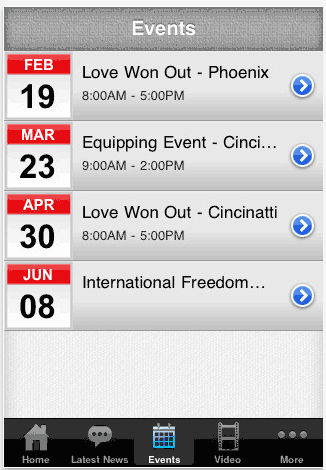

It’s rubbish. Apple’s second in command, Tim Cook, is arguably the most powerful gay man in all of Silicon Valley. Apple has a long history as a gay-friendly place to work. Apple’s App Store submissions are not, and have not for quite some time, screened by a human being; Apple uses a suite of automated tools to check that apps conform to Apple’s programming guidelines. The Exodus International app was not hand-built; it was built using a pre-existing application framework, one that is used for many other App Store apps. The framework draws its content from a Web site (in this case, the Exodus International Web site); its content was not populated until after the app was approved.

So, no, Apple does not habitually go around approving anti-gay apps. The notion that some person at Apple saw the app and said “Cool! An app by an anti-gay organization; well, let me just put this up on the App Store straightaway, then!” is simply factually wrong.


While we’re on the subject, let’s talk about what the app itself is not.

Shortly after the app came out, a GLBT group calling itself Truth Wins Out put up a petition on change.org calling on Apple to remove the app. The campaign that supported the petition described the app as containing information that was scientifically unsound and potentially dangerous about “reparative therapy,” the notion that homosexuality can be “cured,” and described the app as an “ex-gay app.”

To be sure, reparative therapy is dangerous and scientifically unsound. It’s about as scientifically valid as homeopathy or faith healing, and works about as well.

But that’s not really what the app was. The app was, essentially, a calendar of events and a bunch of Web links.

As such, the content of the app was quite a lot different from what it was claimed to be.

Now, this country has a long, storied tradition of dealing with upsetting, inflammatory, objectionable, or uncomfortable content by banning it. For a society of folks quick to shout “free speech!” whenever someone suggests we ought not say something we want to say, we’re just as quick to shout “ban it!” whenever someone else says something we think they ought not say. It’s a sort of national cognitive dissonance, a hypocrisy that’s woven into the American social fabric.

The gay community has been the target of that “ban it!” impulse for longer than this country was a country. It’s no accident that homosexuality has been described as “the love that dare not speak its name.” So it’s a bit disappointing to me to see the folks who’ve been harmed by the notion that certain ideas should not be discussed being so quick to turn that particular weapon back onto others.

And the fact is, by doing so they committed two wrongs. First, they used tactics that are disingenuous at best. Second, they played right into the hands of Exodus International, a group which the cynic in me suspects wanted to have their app banned.


When I first became aware of the Exodus app, I had read about it on Web sites run by pro-GLBT activists and bloggers. I came away with the notion that the app was a how-to guide for “curing” gays. It wasn’t until I started looking at screen shots and app descriptions–by the time I found out about it, the app had already been removed from the App Store–that I learned its content was considerably different from what I’d been lead to believe.

Whenever I hear someone misstate or overstate an argument against something, that leads me to the conclusion that the person who’s making the argument doesn’t really believe his case to be terribly persuasive. Exaggeration is the tool of first resort for someone who really, really, really doesn’t like something, but who doesn’t think that other folks will share his opinion if it’s stated factually.

And the fact that these arguments were picked up by so many folks suggests to me that a lot of bloggers fell into the same trap that the religious right often falls into–condemning something without actually seeing it. We (and by “we” I mean progressive bloggers, activists, and writers) tend to snigger and laugh at Christians who call for banning a book or a movie and then, when asked if they’ve actually seen it, say “No! Of course I haven’t!” as if their ignorance somehow enhances their moral superiority.

Yet this is precisely what a lot of folks who condemned the Exodus app did. I’d be willing to wager that less than one half of one percent of the folks who condemn it bothered to look at it, and barely more than that even bothered to look at screenshots of it.

That’s pretty dumb. Fact-checking is (or at least ought to be) a basic, basic part of informed activism of ANY sort.


On another forum I read, a lot of folks were hailing the removal of the app from the App Store as a triumph of Libertarianism. I found that notion pretty weird; Apple acts as an absolute regulator of the App Store, with the ability to enforce any rules it chooses about what may and may not be found there.

Now, I am not a Libertarian by any stretch of the imagination. But it seems to me that appealing to an absolute regulator to pass a rule banning a product that you don’t like, for the purpose of ensuring that the product is not available to anyone, is precisely the reverse of Libertarian belief. A more reasonable interpretation of Libertarianism, as I understand it, is that the market itself determines what has value; if folks don’t think the Exodus app has value, they don’t download it. If they do think it has value, they do download it. And in that way, individuals, rather than overarching regulatory authorities, make up their own minds about what has value and what doesn’t.

Which brings up a point that I think is absolutely vital in any pluralistic society: the solution to bad speech is more speech, not less speech.

The fact is, there are people who think that Exodus’ ideas have merit. And those folks don’t go away because the app does! The solution is not to try to control the dissemination of the ideas; that’s a fool’s quest. The solution to bad speech is more speech. Hatred and misinformation thrive in dark places.


I wish–I really, really wish–I had been aware of the Exodus app before pple pulled it down. Do you want to know what I would have done? I’ll tell you.

I would have made an app of my own. My app would have parodied and mocked the Exodus app. It would have lampooned the notions in it. It would have made fun of Exodus International–its ideas, its philosophy, even its lame-ass logo. And it would have provided links to better information about homosexuality.

And you know what I would have done then? I would have sold my app for 99 cents, and I would have donated the proceeds from each sale to a pro-GLBT charity.

If there is one thing that right-wing religious wingnuts can not abide, it’s mockery. Humor is a far more powerful weapon than the banhammer. And frankly, I think that providing funds–as in, actual, real money–to GLBT groups would do a lot more to protect at-risk people, particularly the most vulnerable people targeted by Exodus International–than just removing an app from the App Store would have.

It might’ve gotten more positive press, too.

As it stands now, the GLBT activists have scored a stunning own-goal by playing right into the hands of Exodus International. I really do believe that they expected their app to be banned; c’mon, Apple already has policies against this sort of thing, so it was really just a question of time.

But by creating the petition and making so much noise, the activists have turned themselves into an Exodus photo op. They have allowed Exodus to crank up the press release machinery saying “See? See? Look at these hypocritical gays! They accuse us of intolerance, and then they use distortion and misinformation to advance the Gay Agenda by silencing our voices!” (The fundraising appeal along those lines is already up and running on the Exodus Web site.) And, y’know, it’s kinda hard to argue the point.

The street finds its own uses for things.

In which Franklin talks to Amber Rhea about Onyx, the sexuality map, and the unexpected way that people use things. Link to the podcast is here. Embedded player below. Probably not work safe.

…as requested…

…just in time for the end-run up to the American Presidential election.

Several folks have asked me if I’d be willing to make a bumper sticker version of the “I love sex and I vote” userpic I made a while ago, and since I happened to have a bit of spare time this afternoon, I thought, why not?

So, here it is. Clicky on the pic if you’d like one!