Intermission: Some thoughts on love

In the midst of all the writing I’ve been doing about GMO food lately, I thought I’d take a brief digression into an entirely different subject: love.

Recently, someone online pointed to the writings about love by Francesco Alberoni, an Italian sociologist who has this to say on the matter:

No one can fall in love if he is even partially satisfied with what he has or who he is.The experience of falling in love originates in an extreme depression, an inability to find something that has value in everyday life. The “symptom” of the predisposition to fall in love is not the conscious desire to do so,the intense desire to enrich our lives; it is the profound sense of being worthless and of having nothing that is valuable and the shame of not having it. […] For this reason, falling in love occurs more frequently among young people, since they are profoundly uncertain, unsure of their worth,and often ashamed of themselves. The same thing applies to people of other ages when they lose something in their lives-—when their youth ends or when they start to grow old.

Now, I am not a sociologist, but when I read this, I rolled my eyes so hard I feared they would fall from my head onto my keyboard.

I am a deeply, profoundly happy person. My normal baseline emotional state is almost overwhelming joy almost all the time. I am constantly awestruck by the wonder and beauty of the natural world, as I’ve blogged about here.

In other words, I am about as far from “the profound sense of being worthless and of having nothing that is valuable and the shame of not having it” as it’s possible to be.

I fall in love deeply, unhesitantly, and with abandon, without fear or reservation. Love is an amazing thing. It is the profound sharing of myself with those I love, and through it, the sharing of joy. Life is filled with wonder and beauty, all of which is amplified by love. I create with the people I love. I explore with the people I love. Love is a fantastic thing, a process for multiplying joy and dividing sorrow.

It’s easy to be cynical about love, because love is not for the cowardly. It lets us share ourselves with those around us, and that makes us vulnerable. Like anything worth doing, love carries risks. It’s easy to get tangled up in our own egos and fears–what if we get hurt? What if the person we love doesn’t love us back?–and so to believe, mistakenly, that those we love owe us something simply because we love them. Nothing could be further from the truth. Love cannot be coerced. It exists only when it is given freely. It’s not for wimps. To risk loving is to risk exposing yourself in the most profound way possible. Love requires courage.

But that is precisely what makes it so valuable.

I do not entirely understand the depth of cynicism that would lead Mr. Alberoni to the conclusions he has reached. But I am very, very happy he’s wrong.

GMohno! Part 0.5: How to tell when you’re being manipulated

This is the second part of a series of essays about GMOs, safety, and GMO labeling.

GMOs are a hot-button topic that inspire passionate emotions, and as with any hot-button topic people feel passionate about, there’s a lot of emotionally manipulative language being batted around on the subject.

While I was working on Part 1 of this essay series (which will, apparently, be the third part), I realized I need to back up a bit and talk about what a GMO is–hence, Part 0 of the series. I then realized I needed to back up a bit more and talk about how to spot emotional manipulation in rhetoric, which is why there’s a Part 0.5. In this essay, I’m using actual examples drawn from articles and essays on the Web, rather than hypothetical examples. Not all the examples are about GMOs specifically, but all of them show the types of emotional manipulation you’ll see in conversations about GMOs. (In gathering these examples for this essay, I took the hit to my sanity so you don’t have to.)

How to win friends and influence people

We all like to think of ourselves as reasonable, rational people, who do the research, evaluate evidence, and come to reasonable, rational conclusions.

The truth is different. Human beings tend to be emotional thinkers. We make decisions based on emotions, and then after we’ve made the decisions, we rationalize them. The decision comes first; the reason comes after. Yes, you do this. And you. And I do this, and you, and you in the back there too. (Think you don’t? Think again.)

That makes emotionally manipulative rhetoric extremely powerful. If you can influence a person’s emotions, it doesn’t much matter how faulty the rationalizations, how bogus the facts, or how shoddy the logic is–people will be powerfully motivated to preserve the emotional decision they’ve already made.

An excellent telltale that someone is rationalizing an emotional decision is goalpost-moving. If someone cites a fact or a study to explain why they believe something, and then that fact is shown to be false or the study is debunked, a rationalizer will not abandon the belief, but will instead move the goalposts, shifting to a different argument for the belief. This is why, as my mother is fond of saying, information by itself almost never changes attitudes.

Emotionally manipulative language is a rhetorical device designed to circumvent a person’s reason and lead to an emotional response. Once that emotional response has been triggered, it becomes really difficult for that person to change his mind, no matter how strongly the facts speak against his belief. I’ve blogged about this before; the “entrenchment effect” or “backfire effect” is a tendency of people to become more and more firmly entrenched in their beliefs when confronted with evidence that proves the belief wrong. And the beginning of the process is emotional.

So, let’s discuss some types of emotional manipulation.


Technique #1: Good guy/bad guy polarization

If you can make your own side out to be good guys, with noble motives and pure objectives, while simultaneously demonizing people holding contrary views as agents of pure evil, you can dramatically strengthen the emotional appeal of your argument.

This is a very common strategy in political debates, but it’s widely used outside politics as well. And to an average early twenty-first-century Westerner, there is no icon of absolute evil quite as vivid as the Nazis.

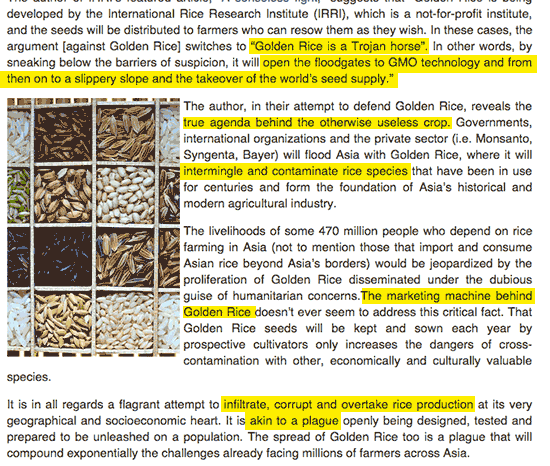
Some of the first folks to make their opponents out to be Nazis were the creationists, who painted EVIL-loution as the root cause of the Nazi Holocaust:
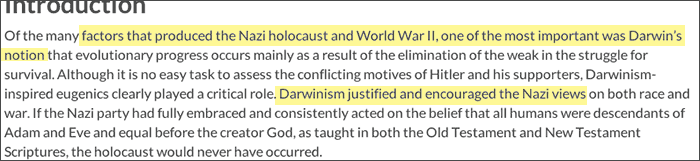
Creationist Ben Stein, the former actor famous as the principal in Ferris Bueller’s Day Off and that annoying guy in the old Visine TV commercials, made an entire movie from the premise that evolutionary biologists and Nazis are the same. The device was so effective that everyone else jumped on the emotional manipulation bandwagon. Before long, we had Nazis in every cupboard.
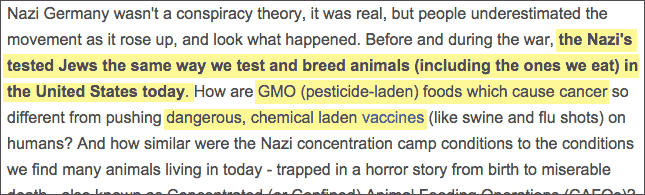
The quality of the facts, as I said, doesn’t matter. Note, for example, the phrase “GMO (pesticide-laden) foods.” As I mentioned in part 0, a common misperception about GMOs and organic foods is that GMOs use lots of toxic pesticides and organic foods are pesticide-free. This isn’t true; all large-scale agriculture, including GMOs, conventional crops, and organic crops, uses pesticides. The list of approved pesticides for organic food includes natural, as opposed to “chemical” or “synthetic,” pesticides, but natural doesn’t mean less toxic. Indeed, the pesticides used on organic foods are, in many cases, quite a lot more poisonous to humans than the pesticides used on GMO or conventional crops. (I’ll get into this more in Part 2.)

The comparisons with Nazis are among the most blatant examples of this kind of good guy/bad guy rhetoric. I’ve seen sites that directly state all people who advocate for GMOs are “Nazi shills” who knowingly tell lies to make money. They are irredeemably evil; there’s no reasoning with such an agent of evil. Ergo, their arguments can be discarded without consideration at all.

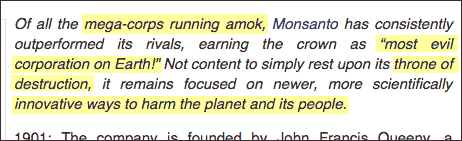
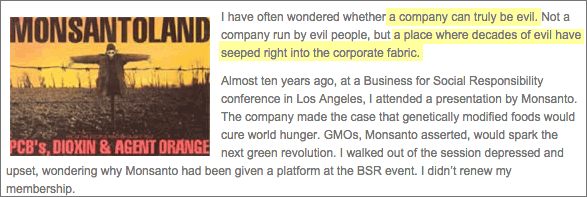
But many folks cast their opponents as evil without invoking the Nazis. It’s often simply enough to brand an opponent or an entity “evil” and their motives utterly malign, which by implication suggests anything they have to say is not to be trusted.
Technique #2: The Grand Conspiracy

We love a good conspiracy. It’s in our blood. Conspiracy theories have been part of the Western social and moral fabric since Europeans ventured to the New World. They’re fueled by the Book of Revelation, with its description of a grand battle between absolute good and diabolical evil.

The players have changed: in the 1600s, people saw agents of the Spanish Empire everywhere. In the 1940s, the Soviets were plotting and scheming, hiding secret agents under every rock. Nowadays, especially among the political left, corporations engage in machinations to thwart the forces of Right and Good.

Conspiracies offer easy explanations to a world that’s often confusing or inexplicable. Why is AIDS turning out to be so challenging to cure, when we dealt with polio and smallpox so handily? It’s a conspiracy! Explanations of how the human immunodeficiency virus conceals itself from immune cells are complex and difficult to understand. It’s easier to believe we could cure it, but pharmaceutical companies are conspiring not to. Why do most scientists say that global warming is real and GMOs are safe, when these things don’t feel true? It’s because they’re conspiring to hide the truth!

A conspiracy mindset lends itself to easy manipulation; when you’re predisposed to conspiratorial thinking, anyone with a plausible-sounding conspiracy has an easy in. Evidence is not necessary; indeed, evidence that would disprove the conspiracy becomes proof of the conspiracy. And if a crank or a quack postulates some fanciful idea and is rejected by his peers, well, they’re part of the conspiracy too!

As we move into the second decade of the twenty-first century, conspiracies of Russkies have become passé; now, it’s conspiracies of scientists. It is, as I discovered, hard to keep all the science conspiracies straight–there are so many things scientists are supposedly being paid to keep secret that it’s amazing they’re not the wealthiest demographic on the planet.

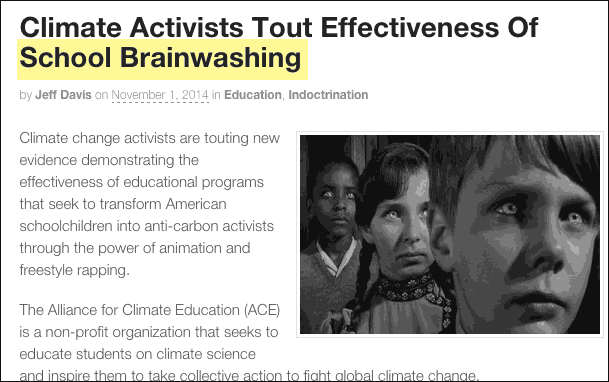
Climate change deniers are some of the noisiest about a conspiracy of scientists. The latest twist on the conspiracy theory claims that these scientists are scheming to brainwash public school students.
There’s a reason climate change deniers tend to be concentrated on the political right, whereas political lefties, who deride the right for its anti-science bias, endorse equally anti-science ideas about vaccines and GMOs. When an idea becomes enshrined in our sense of self or political identity, it becomes very difficult to dislodge; challenging the idea is challenging to our sense of self. So a person who believes that government regulation is always bad and free enterprise is always good rejects the idea of human-caused climate change, because if climate change is actually happening, government intervention is the most plausible solution. (Interestingly, climate change deniers tend to be more willing to accept climate change if the evidence is provided along with proposed private-industry solutions.)

Similarly, a person who believes corporations are inherently evil and invariably seek to profit by harming people will be reluctant to accept things like vaccination or genetically engineered food, because they are created by corporations. The idea that corporations might create something beneficial doesn’t fit with that worldview; the perception that corporations are intrinsically harmful is difficult to let go of. When presented with evidence that contradicts an identity belief, it’s easy to see the evidence as part of a grand conspiracy, especially when the opposing side has already been declared “evil.”

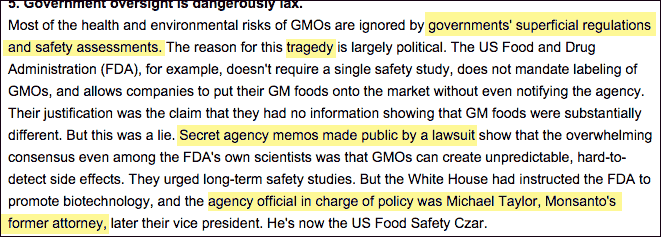
The Grand Conspiracy creates a hermetically sealed echo chamber, impervious to evidence. Scientific evidence shows GMOs are safe? The evidence comes from the conspirators! There’s no evidence showing harm? The conspiracy has blocked it! People claim evidence of harm that is later debunked? Victims of the conspiracy! Once you’ve accepted the Grand Conspiracy, no confirming evidence is necessary and no disconfirming evidence is sufficient.

In reality, you simply can’t buy a conspiracy of scientists. For one thing, nobody–not even Big Oil–has enough money. For another, scientists are often a viciously competitive lot, their joy of discovery eclipsed only by their joy of proving another scientist wrong. The process of peer review is one part bar brawl, one part gleeful vindictiveness, and one part “I’m smarter than you are!”–all wrapped up with a bow and delivered by a dagger in the back.

You can, however, buy a handful of scientists, which is why it’s important to look at the total consensus of scientific thought. The tobacco industry was not able to buy all scientists, but they were able to buy one or two, who made enough noise to make it seem like there was no consensus on tobacco’s harmfulness. Big Oil wasn’t able to create a conspiracy of scientists to say lead additives in gasoline were safe, but they did manage to get one scientist to say it was safe–and then ginned up a faux “controversy” over its safety, even when the evidence was clear that lead additives were a bad idea. The antivax movement has managed to corral only a couple of scientists, the leading one being Andrew Wakefield, the man who accepted nearly a million dollars from law firms to try to manufacture evidence that vaccines cause harm.

There’s a lesson in here: When you have a couple of scientists on one end claiming something, and the entire scientific community on the other end saying something else, there might indeed be a conspiracy. But it’s probably not a conspiracy of the whole scientific community. It’s far more plausible that a couple of scientists are being paid off than the whole of the scientific establishment is!


Strategy #3: Scientific-sounding language: Baffle them with bullshit

Science and scientists are neither understood nor respected by many people. Yet despite this, people want the approval of science; they want the stamp of credibility that science gives their positions. Whether it’s religious bookstores with their books that claim science “proves” Christianity is true or quack medicines advertised with scientific-looking charts and words, science lends a cachet to even the most anti-intellectual ideas. I think of this as “science appropriation,” and I’ve written about it here.

Science appropriation becomes emotional manipulation when a person uses scientific-sounding words or concepts in order to try to make an argument appear legitimate when it is not. Often, the person making these arguments is counting on the intended audience not understanding the scientific terms. It’s emotional manipulation, not communication, because the words are used solely to provide an illusion of credibility. Often, the scientific-sounding words are grossly misused or even complete gibberish.

Here’s a great example:
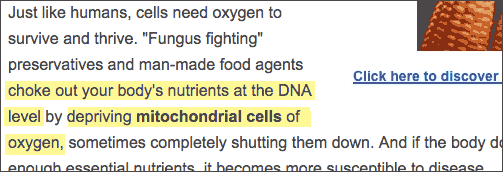
These sentences are pure garwharbl. You can’t “choke nutrients at the DNA level”; DNA is simply a molecule, and by itself it isn’t even alive, much less in need of nutrients. And “mitochondrial cells”? Mitochondria are not cells; they’re parts of cells.

It’s a bit like if an oil company said, “Using our competitor’s gasoline chokes your car of fuel at the crankshaft level by depriving the distributor engines of oxygen.” It’s word salad, a mishmash of technical-sounding terms slung together at random without any appearance of comprehension of what the words mean, intended to evoke the feeling that the argument has the imprimatur of science.

This kind of argument is often used by people trying to argue that WiFi routers are dangerous.
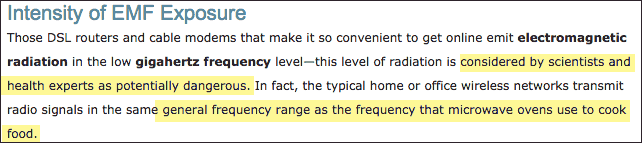
Yes, wireless routers use the same “general frequencies” as microwave ovens. Scary! Or is it?

There’s an important bit that matters, and that’s how much energy there is. We understand this intuitively; your stove gets much hotter than, say, your electric blanket. One is dangerous at even a slight touch; the other keeps you nice and cozy. They’re both doing basically the same thing, but what matters is the total amount of energy they’re releasing. An electric blanket, a stove, and a blast furnace radiate electromagnetic energy at the same general frequencies, but how much they radiate is kind of important!


Strategy #4: False cause

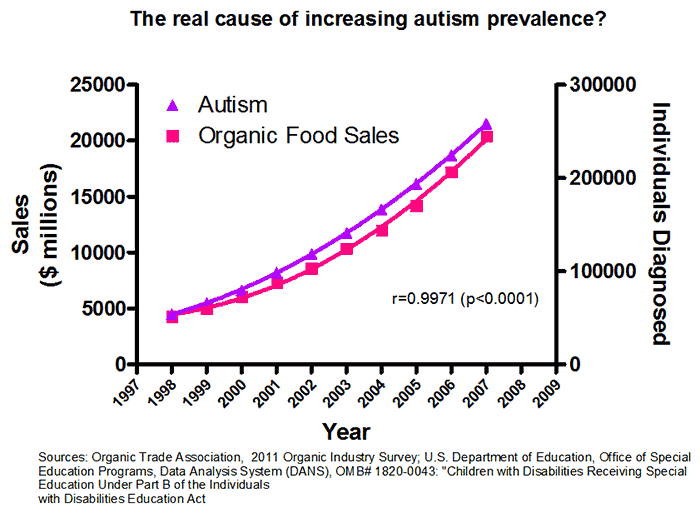
Let’s say you were cruising the Internet one day, and you came upon this chart. Say the purple line shows rates of autism in the United States; say the red line shows the rate of GMO food sales in the United States. The lines match pretty well.

Would that support the idea that GMO food “caused” autism? (This is a real chart, by the way. More on it in a minute.)

There’s a thing you’ll hear in every college-level science course: “correlation does not mean causation.” But that’s not emotionally satisfying. Human beings are pattern-recognition machines. It’s one of the things our brains are optimized for. When it works, it helps us stay alive. We put a hand on a hot stove and get burned; heat causes us pain. Our ancestors hunted upwind of gazelle and the gazelle escaped; being upwind of prey animals leads to poor results.

Pseudoscience relies more than any other single tool on the principle of false cause–if two things occur together, one must cause the other.

You’ll often read things like this, almost invariably without sources for the statistics:
Nearly 100% of all serial killers have drunk milk at some point in their lives! You can not draw conclusions about one thing causing another thing until you’ve ruled out other causes, shown that absence of the first thing results in a corresponding decline of the second, and ideally linked thing one with thing two in a randomized controlled experiment. It helps if you can also propose a (testable) mechanism linking thing one to thing two.

Controlling for confounding factors–things that might actually be the hidden cause of something–is incredibly hard. For example, we used to believe that women taking hormone replacement therapy were at lower risk for cancer. But randomized trials showed that HRT actually increases cancer risk! So why did the initial data suggest lower risk? Because women who take HRT tend to be well-off, with good insurance coverage and good diets, and in good shape to begin with…in other words, they were in a socioeconomic group already at lower risk for cancer than people who were less well off.

Why might the percentage of people with chronic illnesses have increased in the last ten years? Many reasons: better diagnosis and better record-keeping (that is, maybe the incidence hasn’t increased but our awareness of it has); more coal-burning power plants (which produce pollution linked to a number of different chronic illnesses); increased numbers of people, especially children, living in poverty; the statistical aging of the population…it’s a complex question with a lot of variables and a lot of potential causes.

Emotionally, we don’t like complex questions with lots of variables and lots of potential causes. So that makes us easy to manipulate. “There are more sick people today, and people today are (getting more vaccinations|using microwave ovens|eating GMOs|spending more time in front of a computer|drinking more fluoridated water)! The connection is clear!

Oh, about that chart? It’s a genuine chart, but I’m afraid I have a confession to make. I fibbed a bit. The red line shows sales of organic food, not GMO food.

Strategy #5: Disgust

Disgust is one of the most primal of emotions. It appears to have a powerful survival value; it’s been linked to things that have a high likelihood of being associated with disease: spoiled food, bodily fluids, infection, that sort of thing. Because disgust is such a primal emotion, it can easily be enlisted to emotionally manipulate.

One of the easiest ways to do this is to create a link between something you’re arguing against and something disgusting. Once that emotional association is forged, it may prove remarkably resistant to the light of disproof.

The owner of the “Food Babe” website uses this strategy frequently, aggressively, and with great creativity:
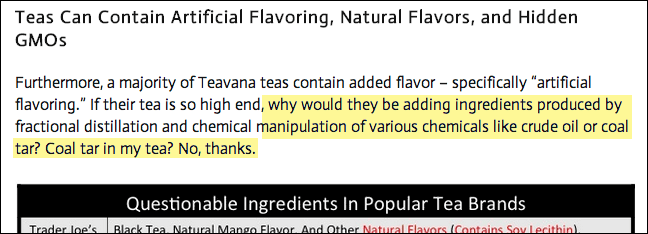
They don’t actually put coal tar in tea, of course. This article was ranting about tea that’s made with “fractional distillation”–basically a technical term for “using heat to separate things.” Coal tar and gasoline are both made by fractional distillation, as are tea, herbal supplements, and many other things. Using heat to separate things is not exactly a controversial or newfangled idea.

Phrases like “coal tar in my tea?” are calculated to produce a feeling of disgust, an emotional response that helps cement the idea that this is something bad.

Children on schoolyard playgrounds often do this same thing, trying to gross one another out. Rumors of spider eggs in Bubble Yum got started this way, with kids trying to make each other feel disgusted; I first heard these stories when I was nine or ten.

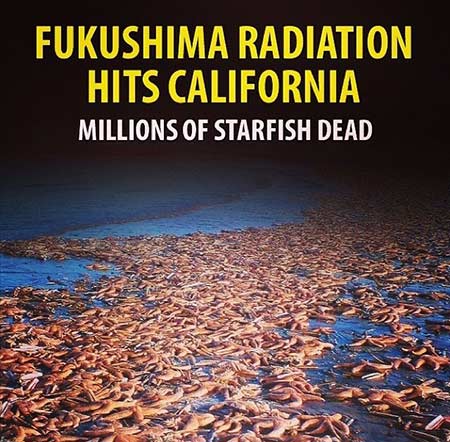
These same tactics are often employed against GMOs.
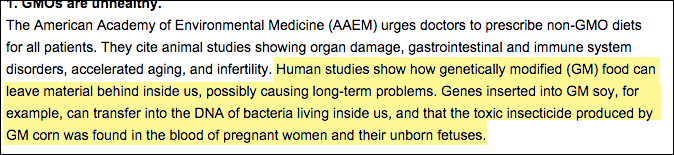
This is a modern variant on a gross-out tale as old as time; bubble gum (or, as one tale commonly spread in vegan circles has it, beef) have all been rumored to “leave material behind inside us.” Never mind the biological implausibility of it; the emotional response is what matters.

In many ways, the anti-GMO movement isn’t actually about health, or environmental concerns, or any of the other rationalizations people claim for being opposed to GMOs. It’s really an emotional food purity issue, no different except in detail from the obsession with “purity” that led to kosher or halal dietary restrictions. This is why conversations about GMOs tend to involve so much goalpost-shifting…the real objections are rooted in feelings of purity and disgust. So when one rationalization is knocked down, the goalposts shift and another takes its place. It’s also why so many anti-GMO arguments rely on evoking feelings of purity or disgust.


Strategy #6: Natural Nature, Made Naturally by Mother Nature

When you hear the word nature, what’s the first thing you think of? What’s the first thing you feel?

Is nature, to you, a serene, beautiful place where everything is in harmony and balance?

Or is it a place where every organism fights and claws its way to survival, and what looks like “balance” is really little more than a temporary stalemate?

In the excellent series of essays Panic-Free GMOs, Nathanael Johnson says,

You have one side that sees humans as fragile and dependent on maintaining the nurturing environment in which they evolved. The other sees humans as tough survivors of a fundamentally chaotic environment. One side sees huge dangers in technologies that alter our surroundings. The other sees technological advance as a defense against nature red in tooth and claw.

Over and over, this difference in emotional starting points creates division in risk assessment. People who see nature as a nurturing, benevolent force, full of springtime meadows and beautiful butterflies, tend to fear new technology; those who see nature as a battlefield, “red in tooth and claw,” tend to be less fearful of new technology. Where you stand on GMOs likely has more to do with how you feel about nature than about any evidence you’ve seen.

And this creates a very powerful lever for manipulating our emotions. People who are predisposed to see nature as kind and benevolent are also predisposed to the cognitive error known as the Appeal to Nature. Essentially, it’s the logical fallacy of believing that what’s “natural” is inherently good and what’s “unnatural” is bad. Evangelical church leaders rant that homosexuality is “unnatural,” antivaxers decry “unnatural” vaccines, and anti-GMO activists rail against “unnatural” manipulation of food (something I’ve seen someone do while eating a banana, which is irony in action if ever there was any).

The “natural gift from nature” folks tend to forget that cyanide, asbestos, deadly nightshade, Ebola, smallpox, and arsenic are all among nature’s gifts as well.

Hand-in-hand with natural goodness straight from nature comes what’s known as “chemophobia,” or fear of “chemicals.” The word “chemical” can conjure up powerful associations of strange, synthetic toxins, lurking in the environment ready to poison us.
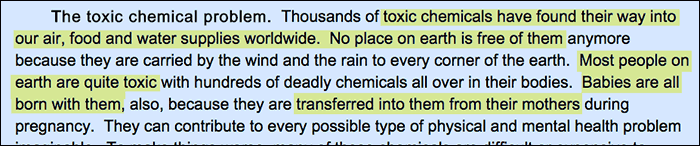
This fear of “chemicals” and the associated belief that nature is “better” often leads people to fear “synthetic pesticides,” when in fact their natural variants are often far more poisonous and dangerous to humans.

Of course, everything is full of chemicals, because every substance that exists is, by definition, a chemical. The chemical dihydrogen monoxide is more commonly known by the common name “water.” The chemical 1,3,7-trimethyl-1H-purine-2,6(3H,7H)-dione 3,7-dihydro-1,3,7-trimethyl-1H-purine-2,6-dione is more commonly known as “caffeine.” Cyanocobalamin commonly goes by the name “Vitamin B12.” It’s all chemicals, and nature doesn’t care if those chemicals were made in a plant or a test tube–their actions depend on their chemical properties, not where they were born.


Strategy #7: Toxic Toxins that Poison Us with Toxins

The flip side of “nature is good” is “toxins are bad.” Like “nature” and “chemical,” the word “toxin” can carry emotional baggage. We don’t want to be exposed to toxic toxins! They’re toxic! And we certainly don’t want to massage toxic toxins through our hair!
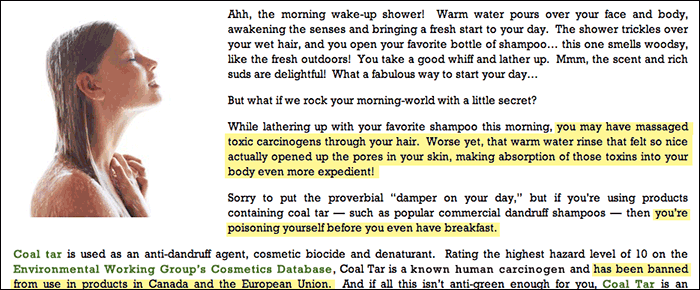
The word “toxin” gets a lot of emotional bang per syllable, but the bit that’s often overlooked is it’s the dose, not the substance, that makes the toxin. If you drink enough of it, water is poisonous.

Fear of toxins has been a selling strategy for hundreds of years. You can browse the Internet or walk through a GNC store and find dozens of nostrums that claim to “detoxify” the body. Many of the arguments against GMOs come down to to toxic toxins of toxicity; for example, a lot of people will say that we should not eat GMOs because they are “sprayed with toxins like Roundup.”

The argument neglects to mention that organic and conventional foods are also sprayed with toxins–and indeed, the “natural” chemicals used on organic foods are very toxic indeed. (It’s a matter of no small amusement to me that Food Babe, known for her “toxic toxic toxic poison toxic toxic” rants, drinks alcohol, which…is a toxin.)

Not everything that’s toxic is toxic to everything that lives. The theobromine in chocolate is toxic to dogs but not people. Chemicals that are toxic to bacteria but not people are called by the name “antibiotics.” Synthetic herbicides, fungicides, and insecticides are often less poisonous to humans than their natural counterparts, because we can identify differences between people and insects or people and plants, then custom-tailor pesticides to act only on those specific differences. Roundup works by interfering with photosynthesis, so it’s extremely toxic to plants…but to humans, it is less toxic than baking soda!

There’s an area of special concern around Bt crops, which are engineered to create the natural insecticide called Bt. “I don’t want to eat plants that have insecticides in them,” I’ve heard people say. “It’s one thing when insecticides are sprayed on a plant, because I can wash it off. But if the plant makes it, I can’t wash it off. Toxic food!” Of course, this leaves aside the issue that organic farmers can and often do inject Bt directly into their plants, especially with vines.

But more importantly, almost all plants produce some sort of insecticides that can’t be washed off. The caffeine in tea and coffee, the eugenol in basil, the pungent sulfur compounds in onions and leeks that give them their aroma and flavor, the capsaicin in peppers, the allyl-thiosulfinate that gives garlic its smell and taste, the methanethiol in asparagus, the maysin in corn (yes, organic corn produces its own pesticide!), the terpenes responsible for the distinctive flavor of citrus fruits–all these are pesticides. When you’re a plant and you don’t want to be eaten, chemical warfare is one of your only alternatives! (Eventually, I’d love to compile a list of naturally-occurring pesticides in plants.)

And it’s…bad to use synthetic pesticides that are less toxic? The most toxic of the pesticides are…the ones we should use on “natural organic” foods? Aye, it’s a head-scratcher, it is!


Strategy #8: Rights! Your rights! Your rights are being violated!

A while back, I linked to an essay that describes the 6 Arguments Used by Science Denialists. To recap, the six are:

  • Cast doubt on the science.
  • Question the scientists’ motives and integrity.
  • Magnify any disagreements among the scientists; cite gadflies as authorities.
  • Exaggerate the potential for harm from the science.
  • Appeal to the importance of personal freedom.
  • Object that acceptance of the science would repudiate some key philosophy.

Item number five–appeal to the importance of personal freedom–is one of the standard tools in the toolkit of emotional manipulation.
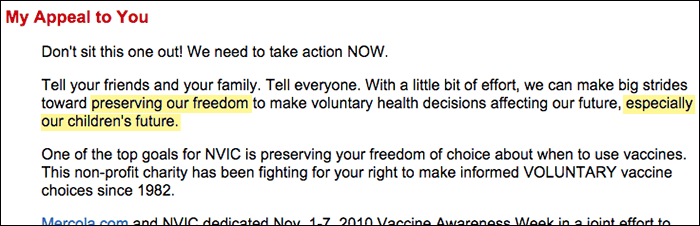
The appeal to the importance of personal freedom is the backbone of the GMO labeling campaign. Advocates of labeling say we have a right to “know what’s in our food,” despite the fact that GMOs are not a “thing” that is put into food. The labeling initiatives tend to be quite fuzzy on what, exactly, needs to be labeled. If sugar is made from a GMO sugar beet or oil is produced from GMO soy, the result is pure sugar or pure oil, with no DNA, proteins, or anything else that has anything to do with GE technology in it. Yet labeling advocates claim such things should be labeled–even though there is nothing in it that has anything to do with the GMO source of the product.

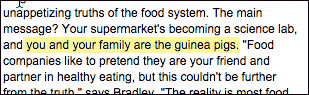
Another form of this same emotional manipulation occurs when sinister forces, such as evil food producers, are accused of using you as a “guinea pig,” experimenting on you without your consent. You are being experimented on, and denied your freedom to live a non-guinea-pig lifestyle!

Strategy #9: X is used as a Y

This is tangentially related to provoking an emotion of disgust, but it’s more specific.

Say I told you that a common food preservative was manufactured from a deadly poison gas used as a chemical weapon in World War I. Or I told you that one of the most common ingredients found in prepared food is an industrial solvent also used in floor cleaners and paint thinners.

Both of those statements would be true. The most common preservative is ordinary table salt, which is sodium chloride–a combination of sodium and chlorine. Chlorine was used as a chemical weapon in WWI. And one of the most common ingredients in all foods is indeed an industrial solvent used in floor cleaners and paint thinners: water.

That’s the essence of the “X is used as a Y” argument: take an ingredient in food that also has some other use, and trigger an emotional response by juxtaposing the two uses. Eww! You want to EAT chemical weapons and floor cleaner??!

So what about it? Does this ingredient keep hemoglobin in your blood from carrying oxygen? Sure, if you eat a lot of it–and water prevents nerves from firing and stops your heart from beating by diluting the sodium and potassium ions that allow nerve cells to work, if you drink enough of it. Those nuances, though, aren’t relevant; the aim is not education, but manipulation.


When I was growing up, my mother always used to say “education is not the solution if ignorance is not the problem.” (She said a number of other cool things too; all in all, my mom is pretty awesome.)

A lot of folks believe that people are easily swayed by pseudoscientific ideas because they lack the facts, and that providing access to those facts will solve the problem. This is the “deficit model” of science communication. This model has a lot of flaws, chief among them the presumption that people make rational decisions based on the best information available to them.

In fact, people often make decisions for emotional reasons, then rationalize those emotional decisions after the fact by inventing (or accepting) plausible-sounding ideas that confirm their emotional decisions. This is why emotional manipulation is so effective, and why discussions of emotionally charged topics like vaccination and GMOs has to include conversation about emotional manipulation.

Now that that’s out of the way, the next part of this series will actually discuss the facts around GMOs, I promise.

Note: This blog post is part of a series.
Part 0 is here.
Part 0.5 is here.
Part 1 is here.
Part 2 is here.
Part 3 is here.


GMohno! Part 0: What is it, anyway?

Earlier his week, Oregon rejected a measure to label GMO food by a paper-thin margin. A similar measure was rejected by Colorado voters, by a much wider margin.

There are a lot of hot feelings about GMOs, and like any issue where there are a lot of hot feelings, there’s a lot of misinformation and confusion on the subject. This is the first part of what will probably be several blog posts about GMOs, what they are, and why people fear them.

When people hear “GMO,” this is often the kind of image they have in their heads–someone injecting plants with foreign materials to alter them. It’s a vivid image, that brings up all kinds of uneasy emotions and questions about food purity and safety. We will get back to this picture in a minute.

When I talk to folks about GMO food, I hear a lot of different reasons why people don’t like them. Some of these reasons have to do with fear of the food itself–is it safe? Does it cause tumors? Is it natural? Is it poisonous? Does it create ‘superweed’? Some of them have to do with concerns over companies that make it: are they ethical? Do they control too much of the food market? Are they abusing farmers? Some of it has to do with society: Is it right to patent foods? Does it take freedom away from farmers? Does it encourage poverty in Third World countries? And some of it is just…well, loopy. Did Ebola come from GMO food? Is GMO food a conspiracy to control the world population? Are scientists trying to eliminate people in Third World countries? (Don’t laugh; those last ones are actual arguments people sincerely seem to believe.)

I tend to categorize the arguments I hear against GMOs into four broad categories: “because health,” “because patents,” “because Monsanto,” and “because garwharbl something something Ebola”. The last category is kind of the third rail of GMO discussion; a person who believes that Ebola, a disease first characterized in 1976, four years before the first experimental transgenic DNA modification was successful and eleven years before the first engineered produce was developed, came from GMO food without the use of a time machine isn’t someone who will be reached by discussion.

What I would like to do is a series of blog posts addressing the “because health,” “because patents,” and “because Monsanto” arguments.

But first, let’s talk about what GMOs are, because it’s helpful to know that before we can talk about them.

What are GMOs?

I’ve asked this question of a lot of people. Sadly, I’ve found very few people who can answer it. Here are some of the answers I’ve heard:

– I don’t know, but I know they’re bad for you.
– They are plants that have unnatural genes injected into them.
– GMOs are what you get when you take genes from one species and put them into another species in ways that can never happen in nature.
– They are food with artificial DNA.
– They are plants made by combining DNA from animals or humans.
– GMOs are plants that are artificially modified to produce poison.
– GMOs are plants that are artificially modified so you can spray poison on them without killing them.

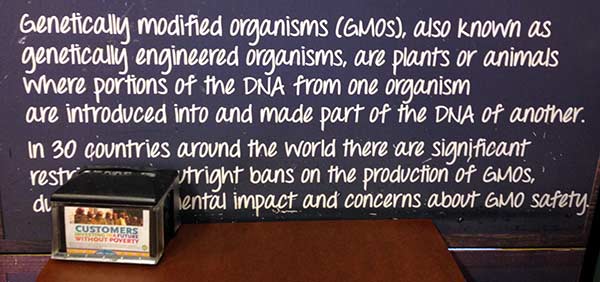
Consumers Union, the parent company of Consumer Reports magazine, says Genetically modified organisms are created by deliberately changing the genetic makeup of a plant or animal in ways that could never occur in nature. And Whole Foods has this up on the wall:

There’s just one problem. All these definitions are wrong.

What are GMOs?

GMO stands for “genetically modified organism.” A GMO is any organism–plant, animal, bacterium, fungus, yeast, whatever–that has been modified by genetic engineering techniques. There are lots of these techniques, and lots of ways to modify an organism. Some GMOs have new genes added; some do not (for example, some GMO techniques involve either silencing or removing a gene). New genes can be placed into a cell in a number of different ways.

The point is, when people focus on things like “GMOs are organisms that have genes from another species introduced into them,” like Whole Foods does, they don’t know that’s only one type of GMO. It’s like saying “clothing is a small, closed, tube-shaped piece of fabric worn on the foot under a shoe.” No, that’s one type of clothing–there are many others.

Similarly, when people talk about modification “that can never happen in nature,” like Consumers Union does, that’s incorrect. Many kinds of mutation can and do happen in nature. Organisms experience changes in their DNA all the time. You are a mutant; there are somewhere around 100 to 160 differences between your DNA and your parents’. It is completely possible for a change introduced by genetic engineering to happen by random chance in nature.

An important thing to remember here is there is no such thing as ‘fish’ DNA or ‘human’ DNA or ‘corn’ DNA. DNA is just sequences of molecules called nucleotides. DNA is made up of very, very, very long strings of the nucleotides adenine, cytosine, guanine, and thymine, which are represented by the letters A, C, G, and T. When someone “sequences” DNA, they’re reading these long long lists of nucleotides. A bit of sequenced DNA might look like AAGATACAGGTACGTTATTACGTCA. Now, looking at that: is that human, mouse, virus, or pig DNA?

One way to think about it is to think about a computer program. A computer program is made up of long lists of numbers that are instructions to a computer. These numbers can be represented by statements in a programming language. Let’s say you see something that looks like this:

buffer = (char*) malloc (i+1);
if (buffer==NULL) exit (1);

Is this “word processing code,” “music player code,” “database code,” or “spreadsheet code”? Well, something like this probably exists in nearly all programs. If you see this in a word processor and you place it in a music player, have you inserted “word processor code” into your music player?

If you see a particular sequence of DNA in a tomato and you copy it into corn, have you put “tomato genes” into the corn? All organisms on this planet share a common genetic heritage. There are stretches of DNA in you that are also in chimpanzees, mice, and carrots. Are those bits of DNA human genes? Or are they mouse genes? Or are they carrot genes? They are just strings of nucleotides, there’s nothing special about them that makes them “belong” to one organism or another. If you rearrange the toy blocks you made your castle out of into a spaceship, you’re not putting “castle blocks” into your spaceship.

All your food is modified

It’s normal for people to fear new things. When pasteurization of milk was first invented, people were terrified of it. A lot of folks complained that it was dangerous to drink the “corpses of dead bacteria.” (Dead bacteria aren’t a problem–it’s the live ones that can harm you.) And the same thing is true of GMOs; we are easily frightened of new things.

But we’ve been modifying food since the beginning of time. A lot of folks think hybridization is different (even when it’s cross-species hybridization, which was the first technology we used to put DNA from one organism into another organism).

During the Green Revolution, which started in the 1940s, we began making huge changes to plant DNA. But we did it at random. We would expose plant seeds to high levels of radiation or soak them in mutagenic chemicals, which would cause thousands of random changes to their DNA. Then we would grow the seeds and see if any of the plants had useful characteristics. Then we’d repeat the process, using more radiation or mutagenic chemicals to do more random changes to DNA, and continue looking for useful traits. If we found them, we would back-cross these mutated plants with regular stock, trying to get the mutations we liked to breed true.

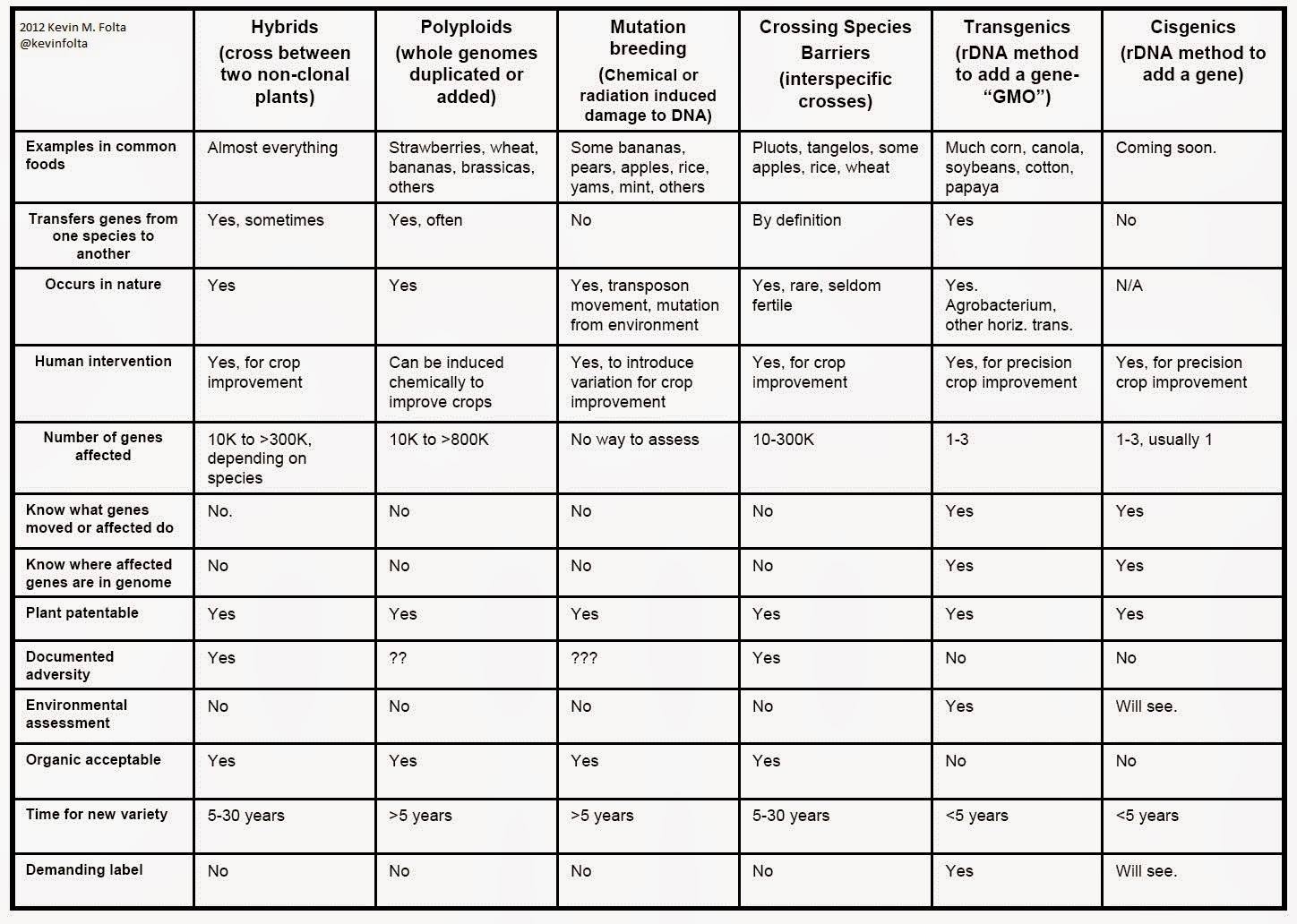
You’ve been eating food with modified DNA your entire life. Even the “organic” food you eat has probably been modified this way. The difference between that kind of modification and GMO technology is that the old way changes thousands or tens of thousands of genes totally at random, without anyone knowing how the plant will be affected, while GMO technology changes one or a few genes in very precise ways that we understand and can predict. Remember, the things changed at random by radiation or mutagenic chemicals are not GMOs.

Kevin Folta has put together this table that shows how we modify plant DNA, how many modifications the techniques cause, and what those modifications are (click to embiggen):

Now, about the picture at the top of this essay. Is that what you think of when you think “GMO”? Actually, it’s a photo of organic squash being cultivated.

Yes, organic. The squash vine is being injected with a natural pesticide called Bt, which kills insects. Bt is one of the many pesticides used in organic farming.

Did you think organic farming was pesticide-free? It’s a common misperception. Organic farming uses insecticides, herbicides, fungicides, and other pesticides; it’s almost impossible to do large-scale farming without it. The difference is that organic farming uses “natural” pesticides rather than “synthetic” pesticides.

Many folks believe that “natural” pesticides are less harmful to humans than “synthetic” ones, on the hypothesis that natural is good and artificial is bad. (This notion conveniently forgets that cyanide, deadly nightshade, smallpox, and arsenic are all 100% natural.) It’s not necessarily true. One of the advantages of GMO farming is we can use pesticides and herbicides that are extremely targeted; Roundup, for example, is highly effective against plants because it interferes with photosynthesis. Humans don’t do photosynthesis, so it’s pretty harmless to us–way less toxic than caffeine, and slightly less toxic than baking soda.

Bt is one of the pesticides approved for use with 100% certified organic food. It’s not toxic to humans, but many other certified organic pesticides are. You can see a list of organic pesticides here. Some of the things on the list, such as pyrethrins, rotenone, and copper sulfate, are really, really toxic to humans–far more poisonous than synthetic pesticides. It is safer for you to eat Roundup than to eat the “natural” insecticide rotenone!

Now that I’ve written a little background about what GMOs are (and touched on what organic food is not), in the next section I’ll start talking about specific objections to GMO technology.

Note: This blog post is part of a series.
Part 0 is here.
Part 0.5 is here.
Part 1 is here.
Part 2 is here.
Part 3 is here.

Ad Astra

Space flight is hard. My thoughts go out to the family of the pilot killed today in the crash of Virgin Galactic’s SpaceShipTwo, and to all the people at Scaled Composites and Virgin Galactic. Opta ardua pennis astra sequi.

Some thoughts on consent

With the state of California passing a new law defining an Affirmative Consent standard for public colleges and universities (and the wonderful commentary about it on the Yes Means Yes blog), the recent firing of radio personality Jian Ghomeshi over his sex life (which he claims is targeting him for participation in BDSM, though several women are alleging that he abused them non-consensually under the guise of BDSM), everyone all over the Internet is talking about consent these days.

And as seems to happen when everyone all over the Internet talks about something, a lot of folks are getting it wrong.

I’d like to think consent is something we all understand. And, in most situations, we do. A lot of folks are flapping their mouth-parts about how we can never really truly get consent for sexual activities because men and women are just so different and don’t understand each other, but seriously, that’s a load of bullshit. Bullshit with extra spicy smell-o-riffic chunks.

If you take sex out of the equation, we all understand consent pretty well. If you invite someone out to dinner and he says “well, you know, I’d love to, but I kinda have this other thing going on that day,” we know he’s said “no,” even though he hasn’t used the word “no.” If we ask someone whether we can use her bike or not and she says “listen, I really don’t know that I feel comfortable with that arrangement,” we know she hasn’t consented. And if she says “The combination on the bike lock is 5678, I need it back before class on Tuesday,” we know that she has, even though she didn’t say the word “yes.”

We get this. It’s part of the most basic, rudimentary socialization.

But for some reason, when it comes to sex, otherwise grown, mature adults start thrashing around, as if they lack the social graces of a reasonably well-socialized 6-year-old.

Some of this might be down to living in a culture that just plain doesn’t teach us about what consent is. I wish I would have understood this stuff better myself, back when I was still sorting out all this interpersonal-relationship stuff.

But a big part of the reason, I suspect, lies in the way we think about sexual consent. We get what consent is outside the world of sex, but when it comes to sex, we act like the purpose of consent is to follow a checklist of procedures designed to let us do what we want without getting in trouble. Otherwise intelligent, reasonable adults, for example, have asked if California’s new law means students on California campuses will need to get written permission to shag. (The short answer is ‘no,’ but folks who so profoundly don’t understand what consent is that the question seems reasonable to them, might want to think about doing just that.) Someone on my Twitter timeline asked ‘what if two people have sex but neither one of them gave affirmative consent–who’s at fault there?’ (The answer is if neither of them gave affirmative consent, then no sex act took place. For a sex act to take place, someone had to initiate the contact of the slippery bits, and that initiation is an act of consent.1) People–again, otherwise intelligent people who appear at least savvy enough to work a computer–have said things like ‘if nobody said no, that’s consent, right?’ (No. We’re conditioned strongly not to say ‘no,’ as in the “well, you know, I’d love to, but I kinda have this other thing going on that day” example above.)

Consent is not a checklist you go through in order to be cleared to do what you want, the way a fighter pilot goes through his checklist before being catapulted off the deck of an aircraft carrier (“Afterburners, check! Flaps, check! Condom, check! Let’s fuck!”). The purpose of consent isn’t to tell you what you can get away with; the purpose of consent is to make sure you and your partners are both on the same page and both enjoying what’s going on.

Consent isn’t something you get once, at the start of the proceedings. It’s ongoing. This is important, because it means the idea of getting written consent up-front to hanky-panky is entirely missing the point. Consent exists in the moment, and it can always be revoked as soon as someone no longer likes what’s happening. Even if I sign a form in triplicate, duly notarized, saying I want to shag you, if we get down to business and I change my mind, I have the right to say ‘stop.’

It’s not hard to get consent, really it isn’t. It simply means paying attention to your partner, checking in. It doesn’t have to ‘spoil the mood’ or ‘interrupt the flow’ or any of those other things the masses of people who don’t understand consent are apt to complain about. Consent doesn’t even have to be verbal. If you go in to kiss someone and she leans back, that’s not consent. If she meets you halfway, it is. We know this. Most of us are really good, in non-sexual contexts, of figuring out the difference between a ‘yes’ and a ‘no’ even without hearing those specific words. We just forget, when it comes to sex.

Seriously, this shouldn’t be that hard. The key elements of consent are:

  • Is the other person into what you want to do? Pay attention to verbal and nonverbal cues. If you don’t know, ask. Don’t focus on what you want the answer to be; focus on what the answer is.
  • Is the other person still into it while you’re doing it? Pay attention to verbal and nonverbal cues. If you don’t know, ask.
  • Is the other person having fun? Pay attention to verbal and nonverbal cues. If you don’t know, ask.

There’s a point in here: consent isn’t something you get so you can have fun, consent is about making sure everyone is having fun. If you don’t care whether your partner is having fun, well, then, perhaps one explanation is you’re a terrible person and you oughtn’t be interacting with anyone in any capacity until you learn that other people are actually real. Oh, and by the way, consent is valid only if it’s informed; if you’re withholding information, lying, misleading, or manipulating other folks to get check marks in those ticky-boxes, you’re not really getting consent at all. I shouldn’t have to say this. It pains me that I feel I do.

Now, bad sex happens. It’s a fact of life. Bad sex doesn’t (necessarily) mean consent was violated.2

But it pays–it really, really does–to remember that consent is ongoing. If the person you’re with suddenly goes all withdrawn and unresponsive, and that’s not part of the particular fetish you’re exploring, perhaps it’s a good idea to check in, you know?

There’s a depressing part of all these discussions about consent, and that is the widespread cultural narrative that allegations of coercion, assault, or abuse are likely to be vindictive women making up stories to entrap and punish blameless men.3 It’s so entrenched that it’s hard to see any woman reporting sexual abuse who’s not immediately attacked all over the Internetverse for it…which would seem to fly in the face of all logic and reason. (Because any woman who talks openly about sexual assault is likely to be attacked vigorously and aggressively, it’s difficult to imagine the motivation of someone to invent such a tale. What’s her goal…to see how many people will call her a liar on YouTube?) And while we’re on the subject, “innocent until proven guilty” doesn’t mean “everyone who reports being sexually assaulted is a liar until proven otherwise.” This shouldn’t need to be said, but there it is. (And just for the record: If you’re one of those folks whose first reaction to learning about allegations of sexual abuse is “she’s making it up,” shame on you.)

This seamy dark side to the consent conversation comes, I think, from the notion of consent as a list of ticky-boxes you check off before you get down ‘n’ dirty. If you went through the pre-flight checklist and ticked off all the things on the list, you should be golden, right? So what’s she doing making all this fuss afterward? She consented, right?

This is also something we get when it comes to issues of consent outside the bedroom. If a roommate offers to let us borrow the bike all week, then on Wednesday says “sorry, mate, but my car’s in the shop, I need the bike after all,” we know that she has the right to do this. I can’t help but think if we were to apply exactly the same standards to sexual consent that we apply to consent to borrow a roommate’s bicycle, a whole lot of people would be a whole lot happier. Yes, your roommate might fabricate a story about how you stole her bike…but really, what are the odds? I mean, seriously? And someone reporting bike theft isn’t even subject to the same explosive blowback as someone reporting sexual assault!

Now, I will admit I’ve made some assumptions in all this. I’m assuming that you’re genuinely good-intentioned and you value the idea of consent. There is a group who benefits from making consent seem muddier and more difficult than it is; the same group also benefits from reflexive thoughts of “She’s making it up!” whenever a report of abuse surfaces. I’ll give you three guesses who’s in that group.4

It’s possible to participate in all kinds of sexual activities with all sorts of partners under a wide range of different circumstances and not ever end up being accused of assault. It’s not even that difficult, really. All it takes, at the end of the day, is remembering that there’s more than one person involved, and checking in with the other folks to see how they’re doing. You don’t need to get it in writing. You don’t need to involve lawyers and witnesses. You just need to pay attention. If you’re shagging someone you’ve never shagged before and you aren’t sure how to read their signals and body language, use your words! I promise it’s not hard.5

Far from spoiling the mood, it can even be hot. “You like that, hmm? You like when I touch you there? You want more? Tell me you like it.”

Seriously. Give it a try some time. Keep in mind, it’s not about getting someone else to let you do what you want. It’s about two (or more!) of you doing things you all like to do.

Oh, and if someone comes to you with a story about being sexually assaulted? Here’s a strategy: In absence of clear and compelling evidence to the contrary, believe them.


1 Absent some other form of coercion, anyway. It isn’t consent if someone gives you head to get you to stop beating her. Lookin’ at you here, Mr. Ghomeshi.

2 Though one of the things that separates people who are good at sex from people who are bad at sex, I think, is the former sorts of people pay attention to their partners as a matter of course.

3 It’s a narrative that hurts men too, by the way. Imagine the blowback if you’re a guy who’s reporting being sexually assaulted…and yes, it does happen.

4 And if you need all three, you might be a terrible person.

5 If you can’t use your words about sex, maybe you might benefit from addressing that problem before the next time you have sex, ‘kay?

Sharks and Loathing in Las Vegas

I am a man who wears bunny ears.

As I write this, I am on the last leg of the book tour–six events over the next four days and I am finally done. Part of the tour took me through Las Vegas. And Vegas…Vegas is not what I expected.

Close your eyes. Imagine Las Vegas, that epicenter of sin and decadence in the desert. What do you picture? Giant neons. Slot machines. Organized crime. Women in huge feather headdresses. Not, you might think, the sort of place where a man in bunny ears would exactly stand out…

…and you’d be wrong.

Vegas is, it seems, not prepared for a man in bunny ears, oh no. The hostility with which the Las Vegas culture1 responds to the sudden appearance of a man in bunny ears in its collective midst is remarkable.

But let me backtrack for a moment.

As I have traveled the country talking about polyamory and ethics and such, I’ve brought a stuffed shark with us. The shark, who joined our team2 in Atlanta, has made appearances all over North America, solely for the purpose of being exploited.

It started as a lark, you see. There is person is a marine biologist who studies sharks. He also writes angry blog entries in response to phony stories on the Discovery Channel, stories with lurid titles about how mermaids might be real (spoiler: they aren’t) and speculating whether Megalodon, the enormous prehistoric dinosaur-shark, might still be alive (hint: it isn’t).

There are trolls on the Internet, and some of these trolls want to believe in mermaids and Megalodon. So they follow this person about online, posting pictures of him and diatribes about him with the Twitter hashtag “#nerdsexploitingsharks“.

Which is, thought I, absolutely begging for hijacking.

So, half an hour before I was scheduled to do a lecture in Atlanta, I darted out in frantic search of a stuffed shark to exploit. I found one at the Atlanta Aquarium, and it’s been accompanying us ever since, being photographed in exploitative situations and posted to social media under #nerdsexploitingsharks.

So. Back to Las Vegas.

Las Vegas doesn’t like a man in bunny ears. Las Vegas especially doesn’t like a man in bunny ears carrying a stuffed shark.

Now, there are many ways to carry a stuffed shark. If you ever find yourself in Las Vegas wearing bunny ears and carrying a stuffed shark, you might try one or more of these carry techniques. I present this information in the name of Science!3


The Security Blanket

An attitude that says “Yes, I have a stuffed shark, and what of it? I need my shark if I am to face a cold, cruel world.” Advantages: Few people will approach a person who uses a shark as a security blanket. Disadvantages: Few people will approach a person who uses a shark as a security blanket.


The ‘Shark? What shark?’

Who, me? I’m not carrying a stuffed shark! Oh, this? How did this get there? Advantages: From the front, you simply look like a man in bunny ears, not a man in bunny ears with a stuffed shark. Disadvantages: Las Vegas loves guns. The sight of a man in bunny ears with his hands out of sight might upset some folks with delicate sensibilities, and some of those folks with delicate sensibilities might be armed.


The Casual Carry

This technique challenges the observer: “Yeah, I’m carrying a stuffed shark, and how do you like THEM apples?” Advantages: People might assume you’re a famous performer, or, failing that, an eccentric Mob hitman with a pistol inside the shark like that one scene in Hudson Hawk, only with a shark instead of a teddy bear. Disadvantages: People might assume you’re barking mad.


The en garde!

Yeah, I have bunny ears. And a shark. Which might or might not contain a concealed pistol. Don’t fuck with me. Advantages: People give you a wide berth on the sidewalk. Disadvantages: You might get shot.


The Binky

Similar to the Security Blanket, but less neurotic, the Binky tells the world that, yes, the world is cold and cruel, and yes, your shark helps you navigate the rivers of cruelty all around you, but you don’t really need the shark. You just like the shark, okay? Advantages: More relaxed and casual than the Security Blanket; this attitude tells the world you really can stand on your own two feet. You know, if you want to. Disadvantages: Small children point at you.


The Bromance

“I love you, man!” This attitude tells the world you and your shark have a special friendship…but, like, totally in a heterosexual way. Advantages: It’s totally, like, a heterosexual thing. Not, like, that other thing. Disadvantages: You may be mistaken for a dudebro. Who wears bunny ears. And carries a stuffed shark.


The Two-Handed Casual

“I’m just carrying a stuffed shark from one place to another place. Nothing to see here. Move along.” Advantages: Very workmanlike. People won’t get the impression that you’re, y’know, attached to the shark or anything. Disadvantages: It’s still pretty weird to see a guy in bunny ears carrying a stuffed shark, no matter how workmanlike he may be. Plus you don’t have a hand free to drink alcohol, play slots, and convince yourself that this thing you’re having is fun.


The Secure in my Masculinity

This pose shows the world that you’re absolutely certain of your manhood and you’re not too threatened to express your true feelings, even if you happen to be in the middle of one of the world’s largest casinos. Advantages: People will stay far, far away from you. Disadvantages: Unless they’re security.


1 Insofar as Las Vegas can be said to have a “culture.” My observations of Las Vegas culture suggests it is made up primarily of people who have no idea how to have fun desperately trying to have fun and convincing themselves the thing they are having is, indeed, fun. And alcohol.

2 Was purchased and exploited.

3 I am frequently asked “are you a scientist?” I usually say “no.” I think I am probably going to have to start saying “yes,” so when people ask “what kind of scientist? Chemist? Biologist?” I can say “Mad.”

Musings on being fucked: Christian millennialism and the Fermi paradox

When all the world’s armies are assembled in the valley that surrounds Mount Megiddo they will be staging a resistance front against the advancing armies of the Chinese. It will be the world’s worst nightmare – nuclear holocaust at its worst. A full-out nuclear bombardment between the armies of the Antichrist’s and the Kings of the East.

It is during this nuclear confrontation that a strange sight from the sky will catch their attention. The Antichrist’s armies will begin their defense in the Jezreel Valley in which the hill of Megiddo is located. […] At the height of their nuclear assault on the advancing armies something strange will happen.

Jesus predicted the suddenness of His return. He said, “For just as lightening comes from the east, and flashes even to the west, so shall the coming of the Son of Man be” (Matt. 24:27). And again He said, “…and then the sign of the Son of Man will appear in the sky, and then all the tribes of the earth shall mourn, and they will see the Son of Man coming in the clouds of heaven with power and great glory” (Matt. 24:30).
–Sherry Shriner Live

Believers must be active in helping to fulfill certain biblical conditions necessary to usher in the return of Christ. Key to this plan is for Gentiles to help accomplish God’s purpose for the Jews. […] Jesus is saying that His Second Coming will not take place until there is a Jewish population in Jerusalem who will welcome Him with all of their hearts.
— Johannes Facius, Hastening the Coming of the Messiah: Your Role in Fulfilling Prophecy

There is a problem in astronomy, commonly referred to as the Fermi paradox. In a nutshell, the problem is, where is everyone?

Life seems to be tenacious and ubiquitous. Wherever we look here on earth, we see life–even in the most inhospitable of places. The stuff seems downright determined to exist. When combined with the observation that the number of planetary systems throughout the universe seems much greater than even the most optimistic projections of, say, thirty years ago, it really seems quite likely that life exists out there somewhere. In fact, it seems quite likely that life exists everywhere out there. And given that sapient, tool-using life evolved here, it seems quite probable that sapient, tool-using life evolved somewhere else as well…indeed, quite often. (Given that our local galactic supercluster contains literally quadrillions of stars, if sapient life exists in only one one-hundredth of one percent of the places life evolved and if life evolves in only one one-hundredth of one percent of the places that have planets, the universe should be positively teeming with sapience.)


These aren’t stars. They’re galaxies. Where is everyone? (Image: Hubble Space Telescope)

When you’re sapient and tool-using, radio waves are obvious. It’s difficult to imagine getting much beyond the steam engine without discovering them. Electromagnetic radiation bathes the universe, and most any tool-using sapience will, sooner or later, stumble across it. All kinds of technologies create, use, and radiate electromagnetic radiation. So if there are sapient civilizations out there, we should see evidence of it–even if they aren’t intentionally attempting to communicate with anyone.

But we don’t.

So the question is, why not?

This is Fermi’s paradox, and researchers have proposed three answers: we’re first, we’re rare, or we’re fucked. I have, until now, been leaning toward the “we’re rare” answer, but more and more, I think the answer might be “we’re fucked.”


Let’s talk about the “first” or “rare” possibilities.

The “first” possibility posits that our planet is exceptionally rare, perhaps even unique–of all the planets around all the stars everywhere in the universe, no other place has the combination of ingredients (liquid water and so on) necessary for complex life. Alternately, life is common but sapient life is not. It’s possible; there’s nothing especially inevitable about sapience. Evolution is not goal-directed, and big brains aren’t necessarily a survival strategy more common or more compelling than any other. After all, we’re newbies. There was no sapient life on earth for most of its history.

Assuming we are that unique, though, seems to underestimate the number of planets that exist, and overestimate the specialness of our particular corner of existence. There’s nothing about our star, our solar system, or even our galaxy that sets it apart in any way we can see from any of a zillion others out there. And even if sapience isn’t inevitable–a reasonable assumption–if life evolved elsewhere, surely some fraction of it must have evolved toward sapience! With quadrillions of opportunities, you’d expect to see it somewhere else.

The “we’re rare” hypothesis posits that life is common, but life like what we see here is orders of magnitude less common, because something happened here that’s very unlikely even on galactic or universal scales. Perhaps it’s the jump from prokaryotes (cells without a nucleus) to eukaryotes (cells with a nucleus, which are capable of forming complex multicellular animals). For almost the entire history of life on earth, only single-celled life existed, after all; multicellular life is a recent innovation. Maybe the universe is teeming with life, but none of it is more complex than bacteria.


Depressing thought: The universe has us and these guys in it, and that’s it.

The third hypothesis is “we’re fucked,” and that’s the one I’m most concerned about.

The “we’re fucked” hypothesis suggests that sapient life isn’t everywhere we look because wherever it emerges, it gets wiped out. It might be that it gets wiped out by a spacefaring civilization, a la Fred Saberhagen’s Berserker science fiction stories.

But maybe…just maybe…it won’t be an evil extraterrestrial what does us in. Maybe tool-using sapience intrinsically contains the seeds of its own annihilation.


K. Eric Drexler wrote a book called Engines of Creation, in which he posited a coming age of nanotechnology that would offer the ability to manipulate, disassemble, and assemble matter at a molecular level.

It’s not as farfetched as it seems. You and I, after all, are vastly complex entities constructed from the level of molecules by programmable molecular machinery able to assemble large-scale, fine-grained structures from the ground up.

All the fabrication technologies we use now are, in essence, merely evolutionary refinements on stone knives and bearskins. When we want to make something, we take raw materials and hack at, carve, heat, forge, or mold them into what we want.


Even the Large Hadron Collider is basically just incremental small improvements on this

The ability to create things from the atomic level up, instead from big masses of materials down, promises to be more revolutionary than the invention of agriculture, the Iron Age, and the invention of the steam engine combined. Many of the things we take for granted–resources will always be scarce, resources must always be distributed unequally, it is not possible for a world of billions of people to have the standard of living of North America–will fade like a bad dream. Nanotech assembly offers the possibility of a post-scarcity society1.

It also promises to turn another deeply-held belief into a myth: Nuclear weapons are the scariest weapons we will ever face.

Molecular-level assembly implies molecular-level disassembly as well. And that…well, that opens the door to weapons of mass destruction on a scale as unimaginable to us as the H-bomb is to a Roman Centurion.


Cute little popgun you got there, son. Did your mom give you that?

Miracle nanotechnology notwithstanding, the course of human advancement has meant the distribution of greater and greater destructive power across wider and wider numbers of people. An average citizen today can go down to Wal-Mart and buy weapon technology that could have turned the tide of some of the world’s most significant historical battles. Even without nanotech, there’s no reason to think weapons technology and distribution just suddenly stopped in, say, 2006, and will not continue to increase from here on.


And that takes us to millennialist zealotry.

There are, in the world today, people who believe they have a sacred duty, given them by omnipotent supernatural entities, to usher in the Final Conflict between good and evil that will annihilate all the wicked with righteous fire, purging them from God’s creation. These millennialists don’t just believe the End is coming–they believe God has charged them with the task of bringing it about.

Christian millennialists long for nuclear war, which they believe will trigger the Second Coming. Some Hindus believe they must help bring about the end of days, so that the final avatar of Vishnu will return on a white horse to bring about the end of the current cycle and its corruption. In Japan, the Aum Shinrikyo sect believed it to be their duty to create the conditions for nuclear Armageddon, which they believed would trigger the ascendancy of the sect’s leader Shoko Asahara to his full divine status as the Lamb of God. Judaism, Islam, and nearly all other religious traditions have at least some adherents who likewise embrace the idea of global warfare that will cleanse the world of evil.

The notion of the purification of the world through violence is not unique to any culture or age–the ancient Israelites, for example, were enthusiastic fans of the notion–but it has particularly deep roots in American civic culture, and we export that idea all over the world. (The notion of the mythic superhero, for instance, is an embodiment of the idea of purifying violence, as the book Captain America and the Crusade Against Evil explains in some depth.)

I’m not suggesting that religious zealots have a patent on inventive destructiveness. From Chairman Mao to Josef Stalin, the 20th century is replete with examples of secular governments that are as gleefully, viciously bonkers as the most passionate of religious extremists.

But religious extremism does seem unique in one regard: we don’t generally see secularists embracing the fiery destruction of the entire world in order to cleanse os of evil. Violent secular institutions might want resources, or land, or good old-fashioned power, but they don’t usually seem to want to destroy the whole of creation in order to invoke a supernatural force to save it.

Putting it all together, we can expect that as time goes on, the trend toward making increasingly destructive technology available to increasingly large numbers of people will likely continue. Which means that, one day, we will likely arrive at the point where a sufficiently determined individual or small group of people can, in fact, literally unleash destruction on a global scale.

Imagine that, say, any reasonably motivated group of 100 or more people anywhere in the world could actually start a nuclear war. Given that millennialist end-times ideology is a thing, how safe would you feel?

It is possible, just possible, that we don’t see a ubniverse teeming with sapient, tool-using, radio-broadcasting, exploring-the-cosmos life because sapient tool-using species eventually reach the point where any single individual has the ability to wipe out the whole species, and very shortly after that happens, someone wipes out the whole species.

“But Franklin,” I hear you say, “even if there are human beings who can and will do that, given the chance, that doesn’t mean space aliens would! They’re not going to be anything like us!”

Well, right. Sure. Other sapient species wouldn’t be like us.

But here’s the thing: We are, it seems, pretty unremarkable. We live on an unremarkable planet orbiting an unremarkable star in an unremarkable corner of an unremarkable galaxy. We’re probably not special snowflakes; statistically, the odds are good that the trajectory we have taken is, um, unremarkable.


Yes, yes, they’re all unique and special…but they all have six arms, too.
(Image: National Science Foundation.)

Sure, sapient aliens might be, overall, less warlike and aggressive (or more warlike and aggressive!) than we are, but does that mean every single individual is? If we take millions of sapient tool-using intelligent species and give every individual of every one of those races the ability to push a button and destroy the whole species, how many species do you think would survive?

Perhaps the solution to the Fermi paradox is not that we’re first or we’re rare; perhaps we’re fucked. Perhaps we are rolling down a well-traveled groove, worn deep by millions of sapient species before us, a groove that ends in a predictable place.

I sincerely hope that’s not the case. But it seems possible it might be. Maybe, just maybe, our best hope to last as long as we can is to counter millennial thinking as vigorously as possible–not to save us, ultimately, but to buy as much time as we possibly can.


1Post-scarcity society of the sort that a lot of transhumanists talk about may never really be a thing, given there will always be something that is scarce, even if that “something” is intangible. Creativity, for instance, can’t be mass-produced. But a looser kind of post-scarcity society, in which material resources are abundant, does have some plausibility.

Keeping Up with All the Conspiracies

It’s a good time to be a scientist, if you believe the various shouty, fearful corners of the Web.

Today, all across America (and indeed the rest of the world), scientists everywhere are swimming in dough courtesy of various dark, sinister forces paying them to conceal The Truth from you, the sheeple. These vast, complex conspiracies, bankrolled by vast corporations with almost unlimited wealth and power, run entirely unchecked…that is, until they’re unravelled by a tiny but determined handful of unsung Web site owners, who pierce the veil of conspiracies by revealing the real truth, often given to them by…people who stand to make money from getting others to believe the conspiracy theories.

But that’s not what’s important! What’s important is the vast legions of scientists being paid untold sums to conspire with other scientists. These huge conspiracies are directly responsible for the sharp increase in the number of research scientists driving Rolls-Royces1, owning enormous 200-foot luxury yachts, and buying tropical islands in the Caribbean.


Typical view from an average scientist’s living room window

A quick Google search using terms like “scientists conspiracy” and “scientists conspiring to hide *” turns up so many scientific conspiracies that these days, even a first-year grad student research assistant must be making serious bank. Some of the various scientific conspiracies people–and I mean a lot of people, not a handful of nutters in tinfoil hats muttering to each other down at the pub–actually believe include:

  • Scientists are being paid to conceal the truth that fluoride in drinking water and toothpaste causes impotence, erectile dysfunction, Alzheimer’s, arthritis, low IQ, high cholesterol, testicular cancer, thyroid disease, and AIDS
  • Climate scientists are creating phony evidence of global warming in order to get grant money
  • Monsanto is paying scientists to conceal the truth about the link between GMOs and autism, cancer, infertility, birth defects, baldness, IBS, colitis, “leaky gut,” autoimmune diseases, depression, and migraines
  • Scientists invented AIDS in a lab, and are being paid by the US military to keep quiet about it
  • There is no such thing as AIDS; scientists are being paid by pharmaceutical companies to publish phony papers about AIDS to frighten people and make them more easily controlled by the pharmaceutical industry
  • Scientists are being paid to say HIV causes AIDS in order to conceal the fact that AIDS is actually caused by recreational drug use2
  • Pharmaceutical companies have a cure for AIDS, but they are paying scientists to suppress the cure because treating AIDS is more profitable
  • Pharmaceutical companies are paying scientists to suppress the evidence that vaccines cause autism3
  • Scientists are taking payouts from oil companies to conceal “free energy” devices that would free us from dependence on oil, gas, and utility companies4
  • Scientists are taking payments from drug companies to conceal cancer cures
  • NASA is paying scientists to cover up evidence that the moon landing was a hoax
  • The government is paying scientists to fabricate evidence that the world is more than 6,000 years old and make up fake evidence supporting evolutionary biology, or alternately, paying scientists not to publish evidence that supports Creationism
  • The government is paying scientists to support the “official” story about what happened on 9/11 and conceal evidence that the attack was an inside job
  • The government is paying scientists to cover up evidence of a UFO crash-landing at Area 51
  • Big Oil is paying scientists to say that fracking is safe
  • The “climate change lobby” is paying scientists to say fracking is dangerous
  • Oil is not produced from the breakdown of fossil organisms; it’s produced by natural geological processes in endless quantities. We will never run out of oil; scientists are being paid to say oil is a limited resources in order to artificially inflate the price (or in order to try to get people to invest in alternative energy, depending on who you ask)
  • Scientists are being paid by cell phone makers/cellular service providers to cover up the dangers of cell phone radiation
  • Scientists are taking money to conceal the fact that eating food cooked with a microwave oven causes cancer, high blood pressure, slow heartbeat, baldness, joint pain, insomnia, and nervous disorders

Whew! That’s quite a list–and it’s only the tip of the iceberg. Looking at it, I can understand why scientists aren’t really living on idyllic tropical islands or sipping martinis on their yachts–all that conspiracy money is going toward whiteboards and dry-erase markers just so they can keep track of all the conspiracies they’re participating in!

And it’s not just scientists. Half the world’s bloggers, yours truly included, are regularly accused of taking money from Big Oil, Big Pharma, Monsanto, the government, and a host of other sinister organizations to write blog posts…well, just like this one.


Make my check payable to “Franklin Veaux”–make sure you spell my last name right, ‘kay?

There’s an essay on Patheos about six arguments commonly used by science denialists. The normal course of arguments against science or in favor of pseudoscience are:

1) Cast doubt on the science.
2) Question the scientists’ motives and integrity.
3) Magnify any disagreements among the scientists; cite gadflies as authorities.
4) Exaggerate the potential for harm from the science.
5) Appeal to the importance of personal freedom.
6) Object that acceptance of the science would repudiate some key philosophy

I would argue that #6 should actually be #1 on the list, because it has invariably been my observation that people accept or reject science based on whether or not the science agrees with whatever personal worldview they hold. So liberals might accept the science of climate change but scream adamantly that GMOs are dangerous (and the scientific consensus about their safety is the result of a massive conspiracy), whereas conservatives accept GMO safety but hoot and holler about a scientific conspiracy about climate change.

The idea of a scientific conspiracy is, of course, utter bollocks. Folks who talk about conspiracies of scientists have absolutely no idea what science is or how it works.

Take the conspiracy about scientists hiding a secret cure for AIDS. Any scientist who announces a cure for AIDS is going to be set for life. She’s guaranteed a Nobel Prize, her own research facility, and research funding from now until the end of time. I mean, what do these people imagine happened? Do they think the executives of Giant Pharmocorp convened a meeting of their top researchers and said “I understand you folks have come up with a cure for AIDS. Tell you what–we’ll just keep mum about that, okay?” What do they would think would happen? The scientists at the table would all nod their heads–and then race each other to the patent office. (And seriously, do people think you could threaten researchers into keeping quiet? Researchers talk. Research is a collaborative exercise. It’s not likely you’d be able to have one research team make significant progress on a cure for AIDS without other teams knowing it, and it’s really unlikely a company could threaten its scientists without other people knowing.)

Scientific consensus emerges when scientists review each other’s work and replicate one another’s experiments. Scientists do not accept something is true because someone says it is. The whole point of the scientific method is that you never have to trust what some bloke says. When someone says something, like “the CO2 in the air is driving a change in climate” or “vaccines don’t cause autism,” other scientists check his work.

The process is called “peer review,” and it’s ruthless. When you publish a paper, everything is examined, poked at, grilled, scrutinized, analyzed, inspected, dissected, reviewed, studied, checked, weighed, sifted, measured, and otherwise put under a figurative (and sometimes literal) microscope. The assumptions, the methodologies, the data, the conclusions–everything is looked at, with an eye toward finding any flaw at all. Scientists love finding flaws in other scientist’s research. They live for that, the way that one kid with the missing tooth lived for taking your lunch money when you were in fifth grade.


The peer review process in action

Now, not all scientists are perfect, of course. Scientists are human, and humans are corruptible.

But what’s more likely–that one scientist (like, say, Andrew Wakefield) will lie and say vaccines are dangerous when they aren’t, because he’s been paid 600,000 British pounds by a law firm hoping to sue vaccine makers, and he wants to release his own brand of “autism safe” vaccine he hopes to make millions on? Or that tens of thousands–possibly hundreds of thousands–of other scientists, all of whom are publishing their data for everyone to see, are engaging in a vast conspiracy to say vaccines are safe when they aren’t?

Seriously, it’s nearly impossible to keep a conspiracy of five or six people quiet. A conspiracy of tens of thousands? Staggering quantities of money flowing to all the world’s scientists to buy their voices, staggering mountains of evidence being suppressed…and there’s no paper trail? Is this really what people think is happening?

The implausibility of these gigantic conspiracies–as if scientists didn’t eat GMO food, get their kids vaccinated, and use microwave ovens themselves!–doesn’t deter the conspiracy theorists, many of whom are simply looking for a way to explain why scientists keep saying things that just plain don’t fit their pre-existing beliefs.

Conspiracy theories help make sense of a world that seems in contradiction to what we feel must be true. They also make us feel good about ourselves; as one Web site devited to conspiracy theories says, “People who are not skeptics of “official stories” tend to be dull-minded. To believe everything these institutions tell you is a sign of mental retardation. To ask questions, on the other hand, is a sign of higher intelligence and wisdom.” We feel good about ourselves when we think we have pulled back the mask of the Great Conspiracy and figured out what’s really going on. We feel clever, wise, vindicated. We don’t have to accept a challenge to our worldview; we’ve outwitted them and, in so doing, totally proved the things we already wanted to believe are right.

That’s one nice thing about conspiracy theories. They are effective solvents, quickly dissolving even the most stubborn inconvenient facts.


1 Obviously, I’m joking. They’re not driving Rolls-Royces; they’re paying their chauffeurs to drive their Rolls-Royces.

2 It’s not clear to me in this conspiracy theory who’s paying the scientists. Big Cocaine?

3 I don’t really know why. Vaccines don’t make much, if any, profit. On the other hand, a hospital stay for whooping cough can generate tens or hundreds of thousands of dollars in revenue. So it’s not clear to me where the profit motive is for a pro-vaccination conspiracy.

4 Presumably, the same oil companies that aren’t able to pay scientists to say global warming isn’t a thing.

Astonishing Beauty

The world around us is fractally beautiful. Not only is it filled with the most extraordinary, breathtaking beauty, but that beauty exists no matter what level you set your gaze upon. At any scale, at any magnification, beauty persists.

Look at a flower.

It’s beautiful–the colors, the symmetry, the shape. These things are all pleasing in their own right.

But look closer. Much, much closer. What will you find? An enormous array of tiny cells, in a proliferation of shapes and functions, each working with the ones around it to give the flower its form and color, all of them filled with activity. Inside every cell, an array of bogglingly complex molecular machines, running all the time, consuming energy, producing still more molecular machines, and always, always striving to survive and make more of themselves.

Now look up, from the microscopic to the macroscopic.


Image: NASA/Hubble Space Telescope team

This is NGC 2818, a magnificent planetary nebula in the southern constellation Pyxis. This and other planetary nebulae are the remnants of violent explosions, the result of a star that has fused all its available hydrogen fuel and is no longer able to support itself against gravity. In the last few seconds of the star’s life, it explodes, leaving behind a glowing ember called a white dwarf and throwing off a shockwave of expanding gas.

These stellar remnants are beautiful, but like that flower, they are fractally beautiful. In fact, they are connected with that flower. Most of the elements necessary for life, all the molecules with an atomic weight greater than iron, are forged in these fiery explosions, when the unimaginable forces of a nova or supernova fuse lighter elements into heavier ones. The atoms in this flower, and in you and me, were birthed in fire and sent out into the universe, to eventually coalesce into this sun, this solar system, this planet, at this place and this time, and became us and kittens and chocolate and motorcycles and ice cream sundaes.

The universe is both incomprehensibly huge and incomprehensibly fine-grained, and it’s beauty all the way down.

Even when we look at the same scale over time, we see beauty. Beauty is enduring. It emerges, over and over again, wherever there is the possibility of change.

Indeed, there is quite literally more beauty around us than we are capable of seeing. White flowers are richly colored, to eyes that can see in ultraviolet. The sky above our heads is a tapestry whose richness we could not recognize until we built machines to augment our feeble vision.

But it isn’t just the grandeur of the natural world. Beauty lurks in every corner. It hides in a tumbler filled with colored glass stones on a restaurant table.

Color is a myth, of course. It’s a perceptual invention, created by the sorting of light of different frequencies into neural impulses by our visual system, with sensors tuned to respond best to different wavelengths of light. It’s a crude approximation of the diversity of photons filling the air around us. These photons chart extraordinarily complex paths through the tumbler, reflecting and refracting, sometimes being absorbed or scattered, and we glance at this intricate mathematical dance of physics for a moment and then look away.

The complexity and beauty of the physical world is both breathtaking and ordinary. Breathtaking because it exists on scales we can scarcely begin to understand; ordinary because it surrounds us all the time, beauty so abundant we forget it’s even there.

Every moment of our lives is spent in a world so beautiful, so incredibly filled with marvels, that we are blessed with abundance beyond measure. I can not help but feel that, should we become more mindful of it, the dull and ugly parts of the world will lift, just a bit. And perhaps, just perhaps, we will be that much less inclined to manufacture more of that dullness and ugliness.

We are here for only a brief time. Let us never forget how beautiful it is to be so privileged to exist in this place.