I’m having pie for breakfast!
I have two kitties on my lap, and they want pie for breakfast too. Mmm, pie.

I’m having pie for breakfast!
I have two kitties on my lap, and they want pie for breakfast too. Mmm, pie.
My iPod tends to get into moods. I listen to it whenever I do a lot of driving, using a gizmo that lets me play it over the car stereo. Saturday, I drove from Gainesville to Tampa for indigofae‘s birthday.
I didn’t actually listen to the iPod for most of the trip, as I spent the bulk of the journey talking to istislah, who I met just in time for her to move to Seattle, and as it turns out I stayed on the phone with her right up to the time I arrived at the restaurant to greet indigofae, her partner nekidsteve, and her friends for her birthday dinner.
I did, however, listen to the iPod after dinner, while we all travelled to the local goth club for some dancing. I almost always listen to it on shuffle, and (as I mentioned before) it tends to get into moods. It’ll get into an industrial mood one day, a neo-folk mood the next…it’s a moody piece of technology.
Anyway, the iPod was in a VNV Nation mood on the way to the club…which, as it turned out, would be the theme of the weekend.
When we arrived at the club, the DJ was playing–you guessed it–VNV Nation. We stayed until close (indigofae has a rather astonishing number of bandwidth-crushing images here), and the DJ played–wait for it!–more VNV Nation just before closing.
Later in the weekend, I got to help take smoocherie‘s virginity, and I got pictures. More on that in a bit.
We no longer have a bed in the apartment in Tampa. The king-sized, cast-iron canopy bed I love so dearly is now in Gainesville, where it utterly dominates the living room. Shelly found a tiny, one bedroom apartment in Gainesville, not realizing we’d end up sharing it for a time, and there’s simply no room for it in the bedroom. So it occupies half the living room, where it makes an admirable conversation starter if nothing else.
So I brought an inflatable air mattress with me to Tampa. Sheets, too. And a comforter. What I did not bring was a pillow. And sleeping without a pillow sucks. Particularly when one does not get home ’til almost 4 AM as it is.
I did finally sleep, and woke up later than I intended on Sunday. This means I headed across the state to visit smoocherie later than I had planned to on Sunday. I did finally get there, though, a tribute to my nice new big hippocampus1 (thank you, World of Warcraft2!), and spent some quality time with her, another of her sweeties james_the_evil1, and mladypain. James made dinner for us, we watched a Showtime series about qa serial killer police officer (in Hollywoodland, every major city has at least three or four serial killers running around at any given time–it’s one of those unwritten rules, like the one that says the villain in action/adventure flicks always wears cool sunglasses), and we got some serious poi-spinning time in. More VNV Nation–poi spinning is always better set to music–and then smoocherie and I got to spend some rare alone time together.
I won’t disturb you with what happened next, because it would…disturb you. This isn’t the part where smoocherie loses her virginity; I’m getting to that.
Monday was surprisingly productive. I’d loaded the laptop with client files, so i was actually able to get quite a bit of work done. smoocherie worked in the office, I worked in the kitchen, and I was very pleased. Changing environments from time to time really does seem to help my productivity.
Later that night came the deflowering.
smoocherie has totally hooked me on spinning poi, and she and I have been doing it whenever we spend time together lately. That night, for the first time, she actually spun fire.
And I got pictures! Lovely pictures!

All the other things I’ve called the “funniest thing ever?” All lies. The real funniest thing ever:
It takes a random Family Circus cartoon and pairs it with a random Nietzsche quote. merovingian, I think this is right up your alley. The Family Circus is arguably the most dreadful, insipid, flaccid, banal comic ever created by man, but Nietzsche makes it all good. A few of my favorites:
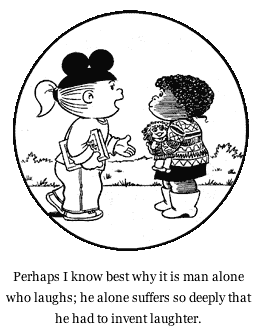
My parents have two pets: a high-strung hunting dog (a German shorthair pointer, if you’re curious), and a psychotic cat with no claws who originally belonged to my sister. The dog is exuberantly, enthusiastically erratic, ninety pounds of jumping, barking, tearing around the house, freaking-out-without-warning teeth and claws that has actually injured my mother badly enough to require surgery on a morning walk. (“Oh look! A squirrel! I’m going to go chase it, oh boy oh boy!” led in very short order to a torn rotator cuff, when the dog hit the end of her leash.) The cat doesn’t much cotton to people, or to anything else really, and will growl, hiss, and generally make her displeasure known when one of us naked hairy apes intrudes into her presence.
This is actually a post about polyamory. I’ll get to that in a bit.
The dog doesn’t much like the cat, and the cat doesn’t much like the dog. Actually, that’s not quite accurate. It’s probably more fair to say that the dog, being carefully bred for the purpose of hunting, rather does like the cat, in much the same way she likes any prey animal, and the cat hates the dog with a fury that is scarcely comprehensible to mere humans, but it’s a fury that is as impotent as it is malevolent. There’s no contest between the two. If the dog were actually to get at the cat, the dog would kill the cat in very short order–game over, the end–exactly as the dog has been bred to do.
For this reason, my parents carefully segregate the dog and the cat. The cat lives in one side of the house; the dog lives in the other, and doors are closed between them.
It would only take one mistake, one accidental slip-up, for my parents to own not two pets, but one pet and one collection of bloody scraps. So they are religious about keeping the animals separated. Doors and windows are checked after every passage (the cat’s domain includes the screened-in porch, which the dog is not permitted in). The habit of closing the door after every passage has become so strong that every door in the house is generally kept closed.
In some ways, this mirrors their relationship. My father lives on one side of the house; my mother lives on the other. They interact seldom and actually spend time together more rarely still. Even on vacations, they tend to go in separate directions.
A very large part of the poly community seems predicated on the same model as my parents use with their pets.
For many people, polyamory in practice seems a bit like owning a dog and a cat that don’t much get along, or in some cases might even try to kill one another. Each relationship functions as a separate entity, and doors are shut between them. If Alice is dating Bob, and Alice wants to date Bill too, and Bob and Bill don’t much care for one another, the solution is scheduling. Keep Bob and Bill away from one another, and it’s all good.
After all, Bob and Bill aren’t involved with each other, right? There’s no reason that Bob and Bill have to force a friendship, or even interact with one another at all, just because they’re both dating Alice, right?
Well, right. Certainly no reasonable person would suggest that Bob and Bill should try to be something that they’re not, or should attempt to force a connection or a friendship where none exists. that way disfunction lies.
But that misses the point.
Presumably, Alice has a choice. One would, generally speaking, probably assume that Alice can choose who she becomes romantically linked to. Alice can choose to date Bob and to date Bill, if she likes…but she can also choose not to.
I may be getting cynical in my old age, but it does seem to me that many people in the poly community approach their relationships from a desperate, starvation model. Connections are so rare, and the number of people who would actually want to date me so few, the reasoning seems to go, that if Bob asks me out, I have to say yes! If I don’t, I may never get another chance to start a new relationship again. Best to take every opportunity that comes down the pike; best not to risk never having a new relationship ever again.
And sure, it can work, in much the way my parent’s lives work–you learn to cope, you develop the reflex of shutting doors, you learn to police yourself constantly and to keep the things in your lives segregated. The habit of openness can be quashed, in time; you learn not to share things with Bill about Bob, you learn not to schedule things where Bob and Bill might interact. You develop a subconscious internal policeman, whose job it is to maintain that separation, to ensure that Bob and Bill forever occupy different spaces in your life.
But what the fuck kind of life is that?
It’s not necessary to try to make Bob and Bill like each other. Nor is it even possible, really. But what Alice can do is make choices. She is not obligated to date anyone who will have her; indeed, most people would argue that dating anyone who will have you is likely a symptom of a pathology.
What she can do is choose the kind of life she wants. She can, if she doesn’t want to become a devout follower of the Church of Closed Doors, evaluate as part of the decisions she makes what impact a potential new mate will have on her existing mates. She can say “I like Bob; I enjoy Bob’s company; but I don’t want to spend the rest of my life closing doors and policing my partners, so if Bob doesn’t fit well in my life, I will make another choice. I can develop a friendship with Bob that honors and respects the connection between us, without being involved in a relationship with him. I can choose relationships with people who complement my life and each other’s…even if they’re not actually involved in romantic relationships with each other. I can build a life without doors and walls.”
There are disadvantages to this approach. One may, from time to time, have to pass up the opportunity to sleep with someone one wants to sleep with. One may not be able to pursue every opportunity that presents itself. But in a world of six billion people, we have to make choices anyway; and love is abundant. There is no need to date whoever will have you.
The benefit to a life without doors and walls seems opaque to some people I’ve spoken with. I can’t rightly comprehend that, because it seems obvious to me. It means less headache and less hassle. It means less worrying, less policing one’s thoughts and deeds. I am very fortunate to have found in Shelly, and in my other sweeties, people who understand this intuitively. And I am fortunate in that there are certain things I do not have to worry about. I never have to worry about Shelly’s other partners; I can trust implicitly that when she chooses to open herself to other partners, she will make those choices in ways that consider my needs as well.
The benefits are wonderful. She has chosen other partners who have become friends of mine as well–people who add value to my life, even though I am not romantically or sexually linked to them. Relationships like this–relationships chosen to complement one another, not be separated from one another–are not zero-sum. Everyone benefits; when she chooses another partner, my life is enriched by it as well, and vice versa.
Happy birthday, Shelly. 🙂
So Shelly and I are now addicted to the new Battlestar: Galactica series, and we’ve just finished watching the first season.
And. The. Local. Video. Rental. Store. Doesn’t. Carry. Any. More. Episodes.
Waugh!
Shelly’s birthday is this Thursday. She would really like to have dinner at a place that serves bananas Foster–something about bananas on fire and the coming of the Great Cthulhu and something, I don’t know. Anyway, she has her heart set on flaming bananas, and I sadly don’t have the faintest idea where to find such things. Anyone?
Shelly went to Tallahassee yesterday; she’s spending the weekend with her other boyfriend and his wife. So I’ve been spending the last two days straight playing World of Warcraft nonstop. Shelly gave me a call this afternoon to say hi, and laughed when I told her what I’d been doing.
Her: You need a local girlfriend. One you have a lot of sex with. While I watch.
Me: Okay, you’re on.
Her: We need to have rules, though. We need to tell her that she can sodomize you with a strap-on, but no oral sex.
Me: No oral sex? But I like oral sex!
Her: Yeah, but…um, no oral sex because…um, because your cock belongs to me. Or something.
Me: Hey, I’ve got an idea. Write down every sex act you can think of on a sheet of paper. Then go through the list and roll a six-sided die for each one. If you roll a 1 or a 2, she’s forbidden to do it; otherwise, she can.
Her: Hey! We should do that every day.
Me: So the rules change every day and she never feels secure?
Her: Yes! In fact, I think I’ll write up a 48-page contract, and you can tell any new girlfriend she has to sign it before she’s allowed to date you.
Then it occurred to me that several people on one of the poly mailing lists I subscribe to are essentially doing just that, and they can’t figure out why they can’t seem to find any new partners.
*sigh*
Courtesy of datan0de, Richard Dawkins argues against the existence of an involved and personal God, and argues strongly in favor of the value of truth.
I love, love, love this man. “Nothing wrong with being happy, but some of us feel that being truthful…is better than living a lie… If you believe that God told you to invade Iraq…having that kind of unshakable conviction can be very dangerous in a politician.”
The interview concerns the book The God Delusion, which is now on my Amazon wish list.
After three years of breathless waiting, with venture capital funding for the company I’m a minority partner in always just around the corner but never quite in reach, things have finally happened–and when they did, they did with breakneck speed.
I’m in Gainesville, Florida, as I type this. Last week, the company finally secured funding. On Friday, I quit my job. Saturday and Sunday I spent with smoocherie and her partner Fritz, then Monday I started packing. Yesterday, I rented a van and hauled about half my stuff from Tampa to Gainesville, where I will be living with Shelly for the next few weeks while the company gets its facility in Atlanta prepared and I look for an apartment there. During this time, I’ll be working remotely full-time for the company. The cats are up here, and believe me, they didn’t appreciate the trip one little bit. Molly cried for an hour and a half.
On or about the 10th of next month, the facility will be ready and I’ll be moving to Atlanta.
Things I learned last night while packing the rental van:
– There is no graceful way for one person to move a king-sized mattress. None. Anyone who tells you he’s found an easy way to do it is lying.
– We own more sex toys than I thought. A lot more.
– You can’t fit four computers on one standard-sized desk, even with a KVM switch. Especially if one of them (the G4 Cube) has a proprietary monitor.
– The two-hour drive from Tampa to Gainesville is a study in tedium. It’s more interesting, though, if you’re driving a big, clumsy, underpowered Chevy van that handles like a cow; it’s more interesting still in the driving rain. In that ‘may you live in interesting times’ kinda way.
– General Motors can not design a vehicle that’s worth a goddamn to save its bloated corporate ass. Why would anyone voluntarily buy, own, or drive a GM vehicle?
– A small cat who’s unhappy can make more noise than any sane man would expect. It’s rather amazing, really.
– We also own more bedding than I thought. And a lot of it is still in Tampa.
– Everything is more difficult than you think it is and takes longer than you think it will, even if you keep this rule in mind.
On the good side, once in Atlanta I’ll be making nearly three times what I was making, plus commission and bonuses, plus stock. On the bad side, it all happened so fast I didn’t even have time to tell many of my Tampa friends I was leaving.
Okay, scratch that, it’s a lie. I have many better things to be doing–spinning poi, working on the upcoming release of Onyx 3, playing World of Warcraft, but…
You know those Every Time you Masturbate, God Kills a Kitten images floating around the ‘Net? I think they send the wrong message, don’t you? I mean, I like kittens as much as the next guy…hell, I probably like kittens more than the next guy. But give up masturbation? I don’t think so.
So I’ve decided to counter the propaganda with…well, with counter-propaganda. I just created an answer which I hope sends a better message, and encourages right-thinking men and women to take an orgasm for the team.

Please, think of the humans!
