
As I move into my sixth decade of life, I’m posting a series of stories from my past. This is part of that series.
We met at a point of transition in my life.
For nearly two decades, I’d been with my first wife, a woman I met in the late 1980s, in a time before the word “polyamory” was in circulation. My wife (now ex-wife) and I had no benefit of community or a roadmap for non-monogamy; we were making it up as we went along.
We started out, my ex-wife and I, in what would now be called a “polyamorous quad” with my best friend (who was also my wife’s lover) and his girlfriend (who I had a crush on, and who was a snogging friend of mine). Like many people back then, my ex-wife and I had a veto relationship, an agreement that if either of us became uncomfortable with the other’s lover, we could demand a breakup.
I never used my veto. My ex-wife did.
Then I met a woman named Shelly Deforte, a woman who blew me away with her intelligence and insight.
Shelly asked me out. I said yes. Very quickly, Shelly chafed under the idea of veto, the Sword of Damocles hanging over our relationship, a weapon terrible and cruel, always there, always looming like a dark shadow over anything we built together, ready to pierce our hearts without warning. She saw my ex-wife veto another of my lovers, saw what it did to us, and she was rightfully appalled. Veto, she said in many conversations that extended long into the night, was intrinsically destructive, a weapon barbaric and vicious, one that eroded trust, destroyed all hope of a building anything stable and meaningful.
Her ideas, which went straight at the root of my relationship with my ex-wife, forced me to see things in a completely new way, to reconsider the impact of the arrangement I’d made with my ex-wife without any input from anyone else. As you might imagine, this drove the relationship with my ex-wife to the brink of ruin. Even though my ex-wife had more “outside” lovers than I did, and for longer, from earlier in our relationship, she still felt threatened whenever I took a new lover.
It was against this backdrop that I went to a friend’s birthday party.
The place was absolutely jammed, perhaps fifty people packed shoulder to shoulder in an apartment, drinking from plastic cups, chatting while they scarfed down handfuls of potato chips.
I didn’t know anyone there except the host.
That’s when it happened.
Hollywood movies call it “love at first sight,” though of course that’s nonsense. You can’t love someone you don’t know. Biologists talk about major histocompatibility complexes and reproductive compatibility, but that doesn’t give you any sense of the urgency of it, the immediacy, the overwhelming knock-your-socks-off emotional power of it that stops your heart in your chest and makes the rest of the world pale and insubstantial.
She was reading a book on applied cryptography. We saw each other. The universe (or major histocompatibility immune molecules, it’s hard to tell from the inside) sang a song of “Yes!” The host took a photo.
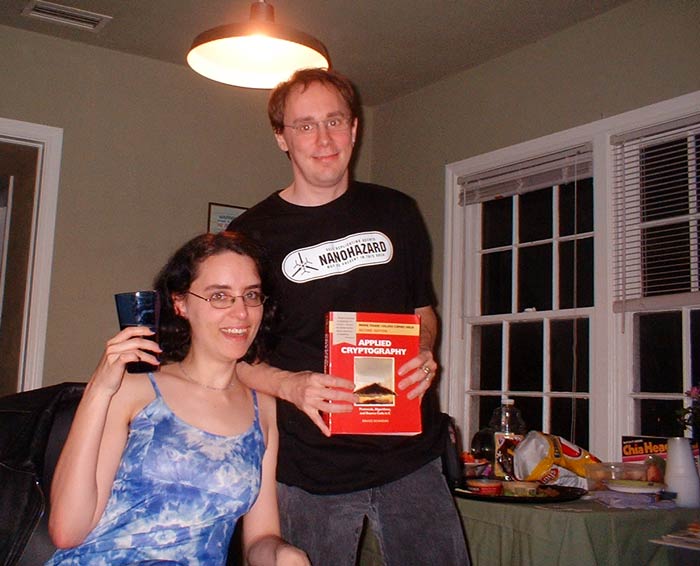
I’d never before experienced anything even remotely like it. For the first time, I understood why people believe in “soulmates” and “twin flames” and “love at first sight,” even though those things aren’t real. Those emotions? Heady stuff.
So we started dating.
None of this is new to anyone who’s read my blog for a long time. You’ll find fragments of this story all through my blog if you look—the good, the bad, the deeply stupid and bitterly regrettable. Funny thng about life: your collection of regrets always increases, never decreases.
She introduced herself as Xtina. We started dating. She and Shelly started dating. She and Shelly stopped dating, for reasons I should have paid more attention to.
“Isn’t it funny that Xtina still thinks she gets to be with you?” Shelly said. “Stop seeing her.”
The woman who argued passionately that veto is and always will be wrong, is and always will be morally inexcusable, is and always will be nothing but evil, demanded a veto. The man who’d come to believe her, to believe that veto is in fact a form of intimate partner abuse, complied.
I saw her only once after that, years later, in Portland, I don’t know why. I messaged her out of the blue. She agreed, more charitably than I deserved, to meet at a bar.
I choked.
We said little. In the car on the way back home, I broke down.
For years after Shelly vetoed Xtina, I did everything in my power to convince myself it was all for the best, that Xtina and I were not compatible, that it never would’ve lasted anyway. It even fueled a deep and lingering distrust of instant connection. It’s often the case that we will employ these sorts of psychological self-deceptions to avoid acknowledging the shitty things we do to people who don’t deserve the shitty things we do.
I have done shitty things in my life, of course. We are all made of frailty and error, which is why it’s important that we learn to forgive one another’s transgressions with grace, at least insofar as we can without compromising our own ethics.
I have made shitty choices. There are two shitty choices I’ve made that I would, were it possible, give almost anything to be able to make again. One was to agree to the veto of Xtina, the other to start dating someone I never shoud’ve dated in the first place.
I still think about Xtina way more than you might expect, considering I ended the relationship decades ago.