As I move into my sixth decade of life, I’m posting a series of stories from my past. This is part of that series.
Fresh out of my rather disastrous first year of uni, during which I got caught hacking the school’s DECsystem-20 mainframe and was…well, technically not expelled, but I was told if I returned the next year they’d be trying out some of Pennsylvania’s shiny new computer tresspass laws on me, I came back to Florida, where I got a job working at McDonald’s.
While I was there, I met a woman named Beth.
She started working at McDonald’s after I did. She was gorgeous and charming and smart and engaging, and she spoke with a subtle musicality, a kind of lilt in her voice I’d never heard before. Not an accent, precisely, but an understated cadence that I couldn’t quite place. When I asked her about it, she laughed and explained she’d grown up in China, speaking both English and Mandarin, and she unconsciously imposed some of the tonality of Mandarin (a tonal language) on English. Her parents worked in China, apparently, and had since she was a toddler.
We became friends quite quickly. She came over to visit me one afternoon whilst I was working on my Volkswagen Bug (one of the old ones, not the neo Beetles, so of course I was always working on it), and brought cookies.
I only knew her for a couple of months. She left McDonald’s maybe two or three months after she arrived, back to China apparently. I got a letter from her a year or so later, covered in writing in both Chinese and English, saying she’d been delighted to know me and was now traveling about in China.
This happened before the age of the Internet, so I never saw her or heard from her again. I still think about her occasionally, almost thirty years later, evidence that she left an outsized mark on me from our brief friendship.
The subtle, random strands of fate sometimes bring us together and then pull us apart again in unexpected ways. Wherever she is, wherever her life has taken her, I hope she’s happy and well.
As I move into my sixth decade of life, I’m posting a series of stories from my past. This is part of that series.
A few weeks ago, as I waled to the coffee shop where I spend a lot of my writing time, a woman coming the other way pointed to me and said “Tacit Rainbow!”
Normally I answer people who randomly greet me on the street (when you wear bunny ears everywhere you go, this happens a lot), but on this occasion I was so gobsmacked I just stood there with my mouth hanging open until she’d passed.
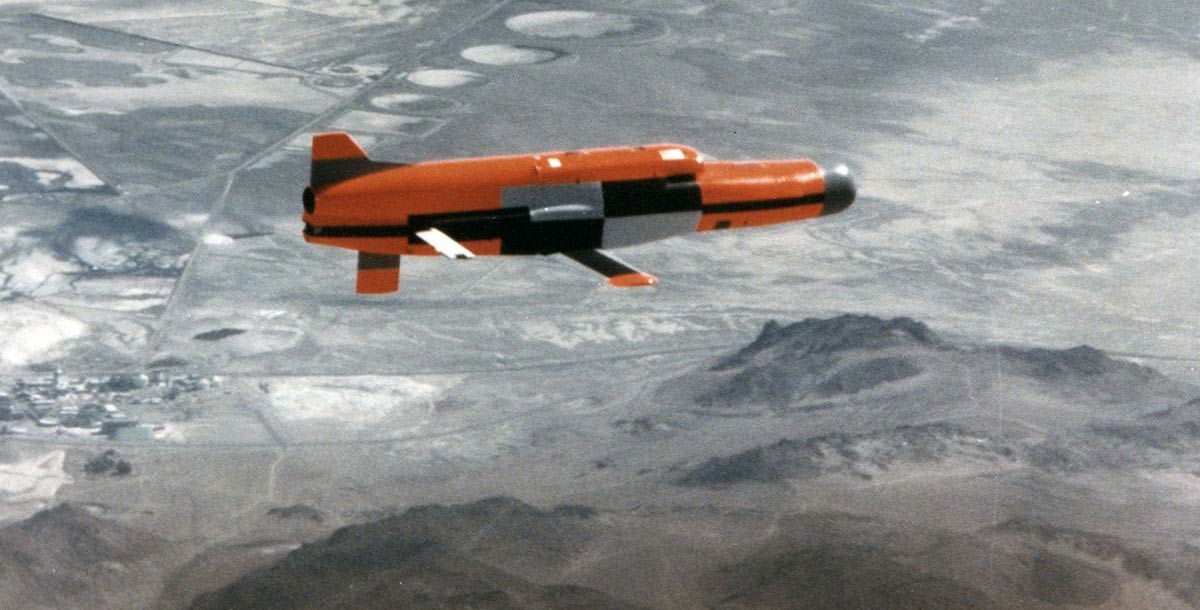
So, a little backstory. “Tacit Rainbow” was the code name for a US Air Force project in the 80s and 90s. The plan was to create a cruise missile that could be launched near suspected enemy surface-to-air missile batteries, to replace Wild Weasel pilots.
The missle (by today’s standards, it would be considered a cross between a missle and a drone) would loiter, flying circles around the area until the enemy activated its anti-aircraft radar. At that point, the Tacit Rainbow would automatically lock on to the enemy radar and follow it down, destroying the SAM battery’s control and tracking capability.
AGM-136 Tacit Rainbow, the only one left in the world, on display in a museum. The Tacit Rainbow was the world’s first loitering munition.
Flight test of an early Tacit Rainbow prototype. It has two sets of wings to give it tons of lift for extended loiter.
The Tacit Rainbow project was canceled some time in the early 90s without ever going into production. I wasn’t particularly a military buff or anything, but when I heard about the project in the 1980s, I really liked the way those two words, “Tacit Rainbow,” sounded together. I adopted Tacit Rainbow as my handle on old-school computer BBS systems. For a time, more people knew me as Tacit Rainbow than knew my real name.
Thing is, I only used that name from about 1988 to about 1996 or 1997 or so. Classic computer bulletin board systems were text-only, no graphics. To my knowledge, there are no photos of me from those days attached to the name “Tacit Rainbow.”
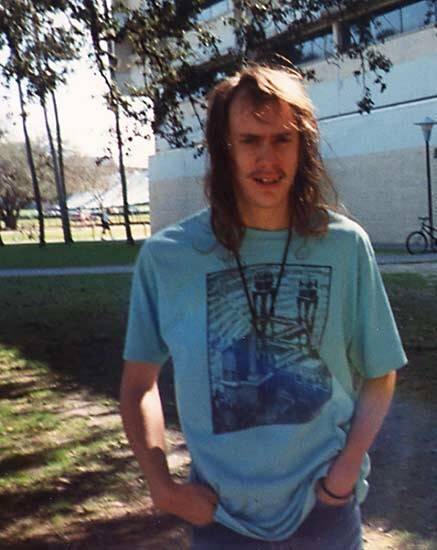
Not that it would matter. I looked a lot different back then. Here’s a photo of me from the days I ran a BBS called a/L/T/E/R r/E/A/L/I/T/Y:
Today, not only have I not used the name Tacit Rainbow in 30 years, the only vestige remaining is my AOL email address “tacitr”. I got that email address in 1992, truncating it because at the time AOL dodn’t allow names as long as “Tacit Rainbow.” I still have it, and even still use it occasionally.
The idea that someone randomly wandering down the street would recognize me from a computer BBS handle I used thirty years ago was so jaw-droppingly improbable I just stood rooted in place until she was gone.
Had I had my wits about me, I would have been like, “Wait, hang on, do we know each other? Were you a BBS regular back in the day? How on earth do you know that name?”
Somewhere around, I don’t know, 1998 or 1999 or so, I was sitting in front of my computer when a chat window popped up asking me if the name “tacitr” came from Tacit Rainbow. When I said it did, the guy was like “OMG, were you on the project at Northrop? I was one of the lead engineers, retired after it got canceled. Did we work together?”
I explained that I wasn’t part of it but I knew about it and took my name from it because I liked the way those words sounded together, and we ended up chatting for about two or three hours. Really interesting guy. The project was fascinating and had some incredibly advanced avionics for the time, though apparently it was plagued by mismanagement, which is apparently one of the biggest reasons the DoD canceled it.
I still would dearly love to know why a random woman on a random street in Portland looked at me and said “Tacit Rainbow!” There’s a story there I will likely never know.
As I move into my sixth decade of life, I’m posting a series of stories from my past. This is part of that series.
We met at a point of transition in my life.
For nearly two decades, I’d been with my first wife, a woman I met in the late 1980s, in a time before the word “polyamory” was in circulation. My wife (now ex-wife) and I had no benefit of community or a roadmap for non-monogamy; we were making it up as we went along.
We started out, my ex-wife and I, in what would now be called a “polyamorous quad” with my best friend (who was also my wife’s lover) and his girlfriend (who I had a crush on, and who was a snogging friend of mine). Like many people back then, my ex-wife and I had a veto relationship, an agreement that if either of us became uncomfortable with the other’s lover, we could demand a breakup.
I never used my veto. My ex-wife did.
Then I met a woman named Shelly Deforte, a woman who blew me away with her intelligence and insight.
Shelly asked me out. I said yes. Very quickly, Shelly chafed under the idea of veto, the Sword of Damocles hanging over our relationship, a weapon terrible and cruel, always there, always looming like a dark shadow over anything we built together, ready to pierce our hearts without warning. She saw my ex-wife veto another of my lovers, saw what it did to us, and she was rightfully appalled. Veto, she said in many conversations that extended long into the night, was intrinsically destructive, a weapon barbaric and vicious, one that eroded trust, destroyed all hope of a building anything stable and meaningful.
Her ideas, which went straight at the root of my relationship with my ex-wife, forced me to see things in a completely new way, to reconsider the impact of the arrangement I’d made with my ex-wife without any input from anyone else. As you might imagine, this drove the relationship with my ex-wife to the brink of ruin. Even though my ex-wife had more “outside” lovers than I did, and for longer, from earlier in our relationship, she still felt threatened whenever I took a new lover.
It was against this backdrop that I went to a friend’s birthday party.
The place was absolutely jammed, perhaps fifty people packed shoulder to shoulder in an apartment, drinking from plastic cups, chatting while they scarfed down handfuls of potato chips.
I didn’t know anyone there except the host.
That’s when it happened.
Hollywood movies call it “love at first sight,” though of course that’s nonsense. You can’t love someone you don’t know. Biologists talk about major histocompatibility complexes and reproductive compatibility, but that doesn’t give you any sense of the urgency of it, the immediacy, the overwhelming knock-your-socks-off emotional power of it that stops your heart in your chest and makes the rest of the world pale and insubstantial.
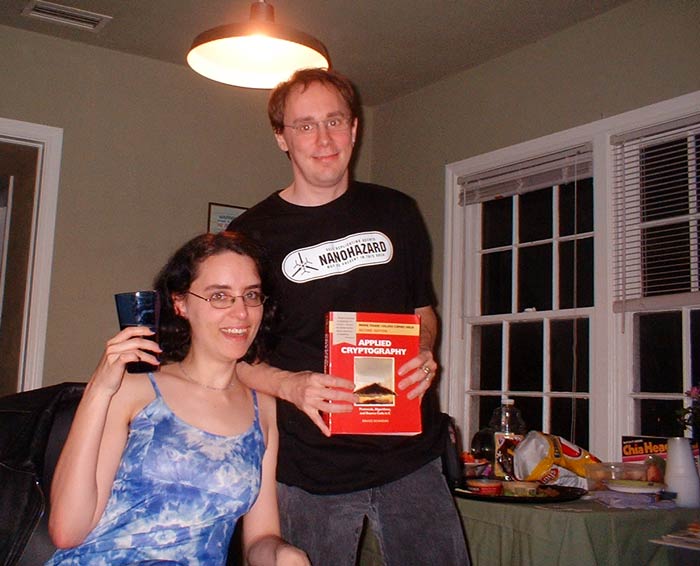
She was reading a book on applied cryptography. We saw each other. The universe (or major histocompatibility immune molecules, it’s hard to tell from the inside) sang a song of “Yes!” The host took a photo.
I’d never before experienced anything even remotely like it. For the first time, I understood why people believe in “soulmates” and “twin flames” and “love at first sight,” even though those things aren’t real. Those emotions? Heady stuff.
So we started dating.
None of this is new to anyone who’s read my blog for a long time. You’ll find fragments of this story all through my blog if you look—the good, the bad, the deeply stupid and bitterly regrettable. Funny thng about life: your collection of regrets always increases, never decreases.
She introduced herself as Xtina. We started dating. She and Shelly started dating. She and Shelly stopped dating, for reasons I should have paid more attention to.
“Isn’t it funny that Xtina still thinks she gets to be with you?” Shelly said. “Stop seeing her.”
The woman who argued passionately that veto is and always will be wrong, is and always will be morally inexcusable, is and always will be nothing but evil, demanded a veto. The man who’d come to believe her, to believe that veto is in fact a form of intimate partner abuse, complied.
I saw her only once after that, years later, in Portland, I don’t know why. I messaged her out of the blue. She agreed, more charitably than I deserved, to meet at a bar.
I choked.
We said little. In the car on the way back home, I broke down.
For years after Shelly vetoed Xtina, I did everything in my power to convince myself it was all for the best, that Xtina and I were not compatible, that it never would’ve lasted anyway. It even fueled a deep and lingering distrust of instant connection. It’s often the case that we will employ these sorts of psychological self-deceptions to avoid acknowledging the shitty things we do to people who don’t deserve the shitty things we do.
I have done shitty things in my life, of course. We are all made of frailty and error, which is why it’s important that we learn to forgive one another’s transgressions with grace, at least insofar as we can without compromising our own ethics.
I have made shitty choices. There are two shitty choices I’ve made that I would, were it possible, give almost anything to be able to make again. One was to agree to the veto of Xtina, the other to start dating someone I never shoud’ve dated in the first place.
I still think about Xtina way more than you might expect, considering I ended the relationship decades ago.
As I move into my sixth decade of life, I’m posting a series of stories from my past. This is part of that series.
Way back in the dim and distant year of 1992, I started my first paying job in the world of graphic arts, working for a small graphic arts studio in Tampa, Florida called Printgraphics.
My job involved using this newfangled software called “Photoshop” from this obscure company called Adobe to do desktop image editing. Printgraphics had this really fancy gizmo called a “color laser copier” that could make—get this—full color photocopies, one of the first such devices in all of Florida, and it let us charge extortionate rates for something almost nobody else could do: not only could we make color photocopies of something, we could even make printouts from a computer in full color by means of a PostScript interpreter that connected a computer to the CLC, for which we charged $16 a page (if you wanted letter-sized printouts) and almost double that (if you wanted larger printouts).
The CLC also acted as a color scanner, allowing us to do scans at considerably less expense (and considerably less quality) than a drum scanner. We could even scan slides and transparencies!
We also had contracts with print shops to do offset printing and posters and things like that…heady stuff in the early days of desktop publishing that seemed miraculous at the time. This equipment was rare, expensive, and cutting-edge, and people who could use it were rather thin on the ground.
About a year or so after I started working there, a polite, well-dressed man came into the shop asking if we could produce some placards and advertising posters for him. He was cagy about what he wanted, except to say that he was looking for prices on laminated full color materials that could be used for “promotional purposes.” They needed to be weatherproof, he said, and full color.
I told him I’d put together prices for him and he left. He came back a day or so later with a bunch of 35mm slides that, he said, he wated us to scan to make the posters from.
The slides all showed horrific, gruesome images of aborted fetuses, usually late-term abortions of fetuses with grotesque physical defects.
That’s when he came clean about who he was. He said he worked for a “pro-life” group called the Center for Bioethical Reform, a shock group that got a ton of media coverage for picketing women’s health clinics with grotesque, gruesome signs and banners showing the horrors of “infant genocide.”
He offered quite a lot of money if we would make these signs for him, a lot more than I’d quoted.
I told him I wouldn’t do the work for him, and asked him to leave.
As I move into my sixth decade of life, I’m posting a series of stories from my past. This is part of that series.
In my last Stories from the Past post, I chased an opossum through the labyrinthine interior of a graphics and prepress shop at one o’clock in the morning. This story dates back to the same era, and a little company called Adobe.
First, a bit of background. The shop where I worked had two scanners. I don’t mean scanners like flatbed scanners bolted to the top of a printer. No, these were old magic, enormous drum scanners from the day when a computer filled a room.
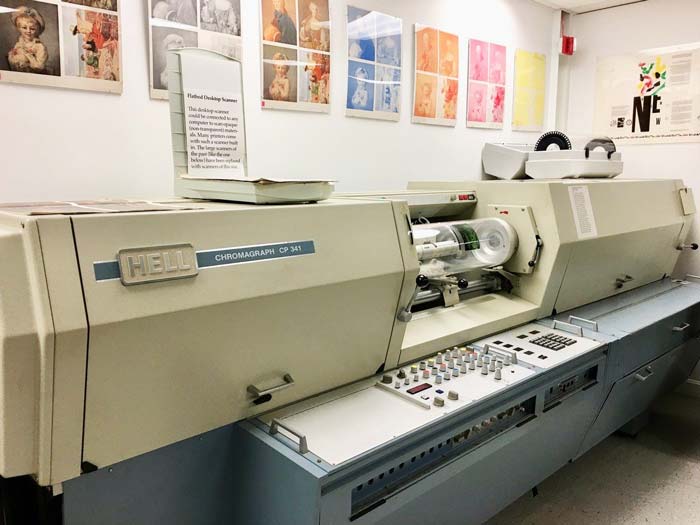
Behold, the Linotype-Hell Chromagraph CP341, still to this day the best scanner ever made. See that glass cylinder? You’d tape the thing you were scanning to it. The drum would spin at high speed while a type of sensor called a “photomultiplier tube” scanned across its surface.
These are big, expensive, and require incredible training to operate, but they produced images better than modern flatbed scanners: higher in both resolution and dynamic range.
Anyway, we were doing a job for the New York City metro service, an advertising poster that would hang in the New York subway. Most advertising billboards are designed to be seen from far away, so they’re incredibly low resolution, usually around14 pixels per inch. This poster was intended for people to be able to walk up nose-to-nose with, so it was at traditional press resolution, 300 pixels per inch, making the scan of the image that would be the background of the poster over a gigabyte in size.
Photoshop 3.0 had just come out. Photoshop 3.0 was a huge step forward for Photoshop, but this was a simpler era, when a single file a gigabyte in size was something almost unheard of.
So I open the file, which takes half an our over a 10base-2 Ethernet network, and start to work. Photoshop pops up an error: “Sorry, a program error occurred” and dies.
I spend another half an hour opening the file. Same thing.
So I call Adobe, because of course the shop had top-tier Adobe tech support, the kind that costs the price of a small car every year and lets you jump to the head of the queue when you call.
I explain the problem. “How big is the image?” they said.
“A gigabyte,” I said.
“You mean a megabyte?”
“No, a gigabyte. With a G.”
Long silence.
“How did you get an image that big?”
“Scanning a 4×5 positive on a Hell Chromagraph 341 drum scanner for an advertising poster.”
“…oh.”
They eventually put me directly on the phone with an actual developer, who told me they’d never imagined anyone editing a file that size. A later update fixed the issue, but for years after, when I called Adobe tech support and gave them my support number, they’d say “oh, you’re the guy with the gigabyte file! We have your support call hanging up on the wall!”
As I move into my sixth decade of life, I’m posting a series of stories from my past. This is part of that series.
Waaaaay back in the dim and distant time of 1992, a happier and simpler age when we didn’t have a pedophile grifter in the White House, my first wife and I moved to Tampa, Florida, where I got my first job doing graphic arts for a living.
Prior to that, I’d helped publish several small-press ’zines, something I continued to do all through the 90s and into the early 2000s.
A cover of one of the small-press magazines I produced.
In 1992 I thought, I’m doing a lot of this work anyway, why not make folding money doing graphic design?
I started at a tiny studio called Printgraphics. It ended up going out of business quite dramatically, as in “we showed up to work one Monday to find the owners had changed the locks and the office was gutted” dramatically. The owners bailed and, apparently, fled to Mexico to escape business debts, or at least so I was told by one of our vendors who hired a PI to try to track them down, since apparently they owed him rather a large amount of money.
From there I moved to Dimension, a high-end graphics and pre-press shop with a number of really interesting customers. I did prepress, image retouching, and such for clients ranging from Royal Caribbean Cruise Lines to the New York metro lines (in fact, I have a rather entertaining story about trying to produce an immense advertising poster for the NY subway line; more on that at another time, perhaps).
I worked night shift at Dimension, in the wee small hours of the morning when most of the others had gone home, leaving my friend Tony and I with the most intractable, difficult problems to solve. We’d jam to Alice in Chains and Rage Against the Machine while we laid down immense reams of folm on our imagesetters…
…until the day came when the two of us were sitting in the computer room one day and heard an immense crash from the film-strippers room, a huge dark space filled with enormous light tables, where film strippers worked putting sheets of photographic film used to burn printing plates together by hand.
We promptly went to investigate, and I cannot tell you, dear reader, just how spooky it is to walk into a room that’s maybe a third the size of a football field, completely dark except for the dim glow of huge light tables. Seriously, Hollywood horror films had nothing on that. I mean, yes, the spaceship Nostromo in the Alien movie was spooky and all, but it had nothing, nothing, on an abandoned and dark film stripping room.
So there we are, the two of us, trying to figure out what the hell’s going on, when we found a shattered ceiling tile opening to a dark void above us.
Which did not, I assure you, do anything to decrease associations with the Alien movies.
I think Tony saw it first, a quick flash of motion off in one corner. Specifically, an opossum, a large one, that had somehow gotten into the building up above the drop ceiling and couldn’t find its way out again. It fell through one of the ceiling tiles because opossums don’t know how drop ceilings work.
An opossum. Not the opossum, but an opossum. (Image: fr0ggy5)
In that instant, we changed from Hollywood horror movie to Hollywood absurdist comedy. Tony grabbed a trash can, thinking (reasonably enough, I suppose) that if we could somehow get the opossum into the trash can, we could move it outside where it belongs.
Folks, opossums do not like going into trash cans. They will, in fact, resist going into trash cans with every last ounce of their beady-eyed will. To their last breath, they will do whatever they can to avoid trash cans, some vestigal instinct left over from some tragic but poorly-understood calamity in their evolutionary past, I’m sure.
Anyway, what happened next was less Alien and more Benny Hill, with two design geeks chasing an angry and wildly confused opossum through a nigh-abandoned prepress shop at one o’clock in the morning.
Folks, we pursued that opossum through the film stripping room and round the oversized Avantra imagesetter and round the moons of Nibia and ’round the Antares Maelstrom and ’round perdition’s flames before we finally got it in that trash can.
I don’t know how this tale ends for the opossum. We carried it outside, sweaty and exhausted (those little bastards can corner way better than you think!) and it waddled off into the muggy Florida night without so much as a by-your-leave. I do know we left the strangest note for the morning-shift folks that the company has likely ever seen or will ever see.
As I move into my sixth decade of life, I’m posting a series of stories from my past. This is part of that series.
Back in about 1989, I started going to uni at New College in Sarasota, which was, at the time, a tiny liberal arts college in Sarasota, Florida. It has since been caught up in the ongoing American culture war; Florida governor Rick Desantis absolutely hated the place, and staged a hostile takeover, replacing the Board of Trustees with arch-conservative MAGA Trumpists in an attempt to reshape it as a bastion of conservative Christian thought. (There’s reportedly a statue of Charlie Kirk in the making for the campus grounds.)
When I went there, it was an interesting place modeled on intellectually rigorous European schools, where students are graded in essay form instead of with an A/B/C/D/F system, and undergrads were expected to complete a Masters-level thesis to graduate.
New College is located next to the Ringling Museum, the mansion that was once the home of John Ringling of Ringling Circus fame. The Ringling mansion is exactly as posh as you’d expect from a millionaire circus founder, with an immense garden behind the sprawling five-story, 36,000-square-foot Venetian estate with its own ballroom and lookout tower.
The garden features a 200-year-old banyan tree. This very banyan tree itself, in fact:
The museum was separated from the campus grounds by a chain link fence that ran right down the edge of campus to the bay, which of course made it difficult to secure, since the fence stopped at the water’s edge. One could, if one were of a mind to do so, simply walk around the end of the fence and that was that.
It was customary among a certain subset of the students there, myself among them, to wander the Ringling grounds once night fell and the museum closed for the night—not from any malicious intent, but simply to take in the ambiance. A few friends and I started spending our evenings there, climbing up into the banyan tree and just chilling.
Until, that is, the museum hired a security guard to patrol the grounds at night.
We discovered this fact one fine evening when we were lounging up in the branches of the tree and that security guard drove his little golf cart right up to the tree. He parked just under the branches we were perched in and sat there for about half an hour or so, doing paperwork in his little cart, while we were all paralyzed above him thinking don’t look up don’t look up don’t look up…
It was, let me tell you, the longest thirty minutes of my life.
Eventually, he finished whatever he was doing and drove off, at which point we shimmied back down out of the tree, booked it for campus, and never returned.
Years later, I told my girlfriend this story. She was like “You know he totally knew you were there, right? He was absolutely just fucking with you.”
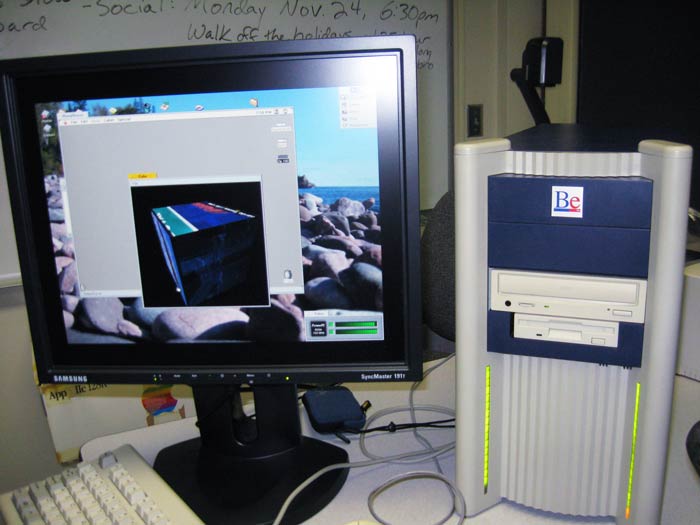
Computer history buffs will recognize it immediately. It came to market just before Steve Jobs returned to Apple, and was built around multiple PowerPC processors. It ran an operating system called BeOS, which was neither Windows nor macOS compatible, but was totally its own thing—a vaguely sorta Unix-flavored thing that also was not Unix and could not run Unix software.
The BeBox was unveiled with a splash at MacWorld Boston in 1996. I was there when it was announced, on a stage in the exhibit hall, with snazzy music and lights and a general dog and pony show. Be wanted to sell hardware but also license BeOS, so they showed off the computer, and BeOS running on Mac clones, which were still a thing back then.
I remember it quite clearly, because I made the presenter a bit angry.
After the presentation, he opened the floor to questions. So I, being the smartass I am and also a bit annoyed at the predictability of the crash and burn that was to come, raised my hand and said “How long until you realize there’s no room in the personal computer market for a new hardware platform between Wintel and Apple, stop selling hardware and pivot to a software-only company, and then go out of business?”
I got some laughs and some grumbling from the audience, and an angry scowl from the presenter.
Computer history buffs know how the story ended, of course.
In 1997, Be Inc. announced that it was wrapping up production of the BeBox computer, and would henceforth be a software-only company, licensing BeOS to others. They sold a few licenses to Power Computing and tried to get Apple to buy BeOS to use as the basis for the next-generation macOS. Apple passed, instead buying NeXT and using its operating system, NeXTSTEP, as the core of their operating system, which they called OS X.
In 2000, Be stopped trying to compete as a desktop operating system and pivoted to BeIA, an embedded version of BeOS for Internet appliances and embedded systems. In 2001, Palm Inc. bought Be Inc. to use BeIA for its PalmOS devices. In 2003, Palm Inc. spun off its PalmOS group as a different company, PalmSource. In 2004, PalmSource announced PalmOS Cobalt, built atop BeIA, which was built atop BeOS.
It went nowhere, so in December 2004, PalmSource abandoned PalmOS Cobalt and bought a Chinese Linux firm, building yet another Palm operating system atop Linux that also went nowhere.
PalmSource, which is now kind of still in existence under the name Access Systems Americas, still owns BeOS to this day. BeOS is no longer available, but the open source community is working, slowly, on Haiku, an operating system that looks like BeOS and will run all seven or so BeOS applications ever written, because…well, I honestly don’t know why they’re doing it.