As I move into my sixth decade of life, I’m posting a series of stories from my past. This is part of that series.
In my last Stories from the Past post, I chased an opossum through the labyrinthine interior of a graphics and prepress shop at one o’clock in the morning. This story dates back to the same era, and a little company called Adobe.
First, a bit of background. The shop where I worked had two scanners. I don’t mean scanners like flatbed scanners bolted to the top of a printer. No, these were old magic, enormous drum scanners from the day when a computer filled a room.
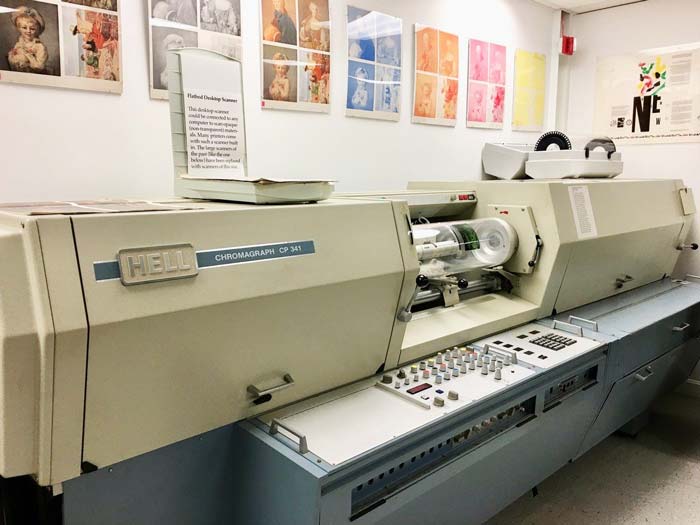
Behold, the Linotype-Hell Chromagraph CP341, still to this day the best scanner ever made. See that glass cylinder? You’d tape the thing you were scanning to it. The drum would spin at high speed while a type of sensor called a “photomultiplier tube” scanned across its surface.
These are big, expensive, and require incredible training to operate, but they produced images better than modern flatbed scanners: higher in both resolution and dynamic range.
Anyway, we were doing a job for the New York City metro service, an advertising poster that would hang in the New York subway. Most advertising billboards are designed to be seen from far away, so they’re incredibly low resolution, usually around14 pixels per inch. This poster was intended for people to be able to walk up nose-to-nose with, so it was at traditional press resolution, 300 pixels per inch, making the scan of the image that would be the background of the poster over a gigabyte in size.
Photoshop 3.0 had just come out. Photoshop 3.0 was a huge step forward for Photoshop, but this was a simpler era, when a single file a gigabyte in size was something almost unheard of.
So I open the file, which takes half an our over a 10base-2 Ethernet network, and start to work. Photoshop pops up an error: “Sorry, a program error occurred” and dies.
I spend another half an hour opening the file. Same thing.
So I call Adobe, because of course the shop had top-tier Adobe tech support, the kind that costs the price of a small car every year and lets you jump to the head of the queue when you call.
I explain the problem. “How big is the image?” they said.
“A gigabyte,” I said.
“You mean a megabyte?”
“No, a gigabyte. With a G.”
Long silence.
“How did you get an image that big?”
“Scanning a 4×5 positive on a Hell Chromagraph 341 drum scanner for an advertising poster.”
“…oh.”
They eventually put me directly on the phone with an actual developer, who told me they’d never imagined anyone editing a file that size. A later update fixed the issue, but for years after, when I called Adobe tech support and gave them my support number, they’d say “oh, you’re the guy with the gigabyte file! We have your support call hanging up on the wall!”
As I move into my sixth decade of life, I’m posting a series of stories from my past. This is part of that series.
Waaaaay back in the dim and distant time of 1992, a happier and simpler age when we didn’t have a pedophile grifter in the White House, my first wife and I moved to Tampa, Florida, where I got my first job doing graphic arts for a living.
Prior to that, I’d helped publish several small-press ’zines, something I continued to do all through the 90s and into the early 2000s.
A cover of one of the small-press magazines I produced.
In 1992 I thought, I’m doing a lot of this work anyway, why not make folding money doing graphic design?
I started at a tiny studio called Printgraphics. It ended up going out of business quite dramatically, as in “we showed up to work one Monday to find the owners had changed the locks and the office was gutted” dramatically. The owners bailed and, apparently, fled to Mexico to escape business debts, or at least so I was told by one of our vendors who hired a PI to try to track them down, since apparently they owed him rather a large amount of money.
From there I moved to Dimension, a high-end graphics and pre-press shop with a number of really interesting customers. I did prepress, image retouching, and such for clients ranging from Royal Caribbean Cruise Lines to the New York metro lines (in fact, I have a rather entertaining story about trying to produce an immense advertising poster for the NY subway line; more on that at another time, perhaps).
I worked night shift at Dimension, in the wee small hours of the morning when most of the others had gone home, leaving my friend Tony and I with the most intractable, difficult problems to solve. We’d jam to Alice in Chains and Rage Against the Machine while we laid down immense reams of folm on our imagesetters…
…until the day came when the two of us were sitting in the computer room one day and heard an immense crash from the film-strippers room, a huge dark space filled with enormous light tables, where film strippers worked putting sheets of photographic film used to burn printing plates together by hand.
We promptly went to investigate, and I cannot tell you, dear reader, just how spooky it is to walk into a room that’s maybe a third the size of a football field, completely dark except for the dim glow of huge light tables. Seriously, Hollywood horror films had nothing on that. I mean, yes, the spaceship Nostromo in the Alien movie was spooky and all, but it had nothing, nothing, on an abandoned and dark film stripping room.
So there we are, the two of us, trying to figure out what the hell’s going on, when we found a shattered ceiling tile opening to a dark void above us.
Which did not, I assure you, do anything to decrease associations with the Alien movies.
I think Tony saw it first, a quick flash of motion off in one corner. Specifically, an opossum, a large one, that had somehow gotten into the building up above the drop ceiling and couldn’t find its way out again. It fell through one of the ceiling tiles because opossums don’t know how drop ceilings work.
An opossum. Not the opossum, but an opossum. (Image: fr0ggy5)
In that instant, we changed from Hollywood horror movie to Hollywood absurdist comedy. Tony grabbed a trash can, thinking (reasonably enough, I suppose) that if we could somehow get the opossum into the trash can, we could move it outside where it belongs.
Folks, opossums do not like going into trash cans. They will, in fact, resist going into trash cans with every last ounce of their beady-eyed will. To their last breath, they will do whatever they can to avoid trash cans, some vestigal instinct left over from some tragic but poorly-understood calamity in their evolutionary past, I’m sure.
Anyway, what happened next was less Alien and more Benny Hill, with two design geeks chasing an angry and wildly confused opossum through a nigh-abandoned prepress shop at one o’clock in the morning.
Folks, we pursued that opossum through the film stripping room and round the oversized Avantra imagesetter and round the moons of Nibia and ’round the Antares Maelstrom and ’round perdition’s flames before we finally got it in that trash can.
I don’t know how this tale ends for the opossum. We carried it outside, sweaty and exhausted (those little bastards can corner way better than you think!) and it waddled off into the muggy Florida night without so much as a by-your-leave. I do know we left the strangest note for the morning-shift folks that the company has likely ever seen or will ever see.
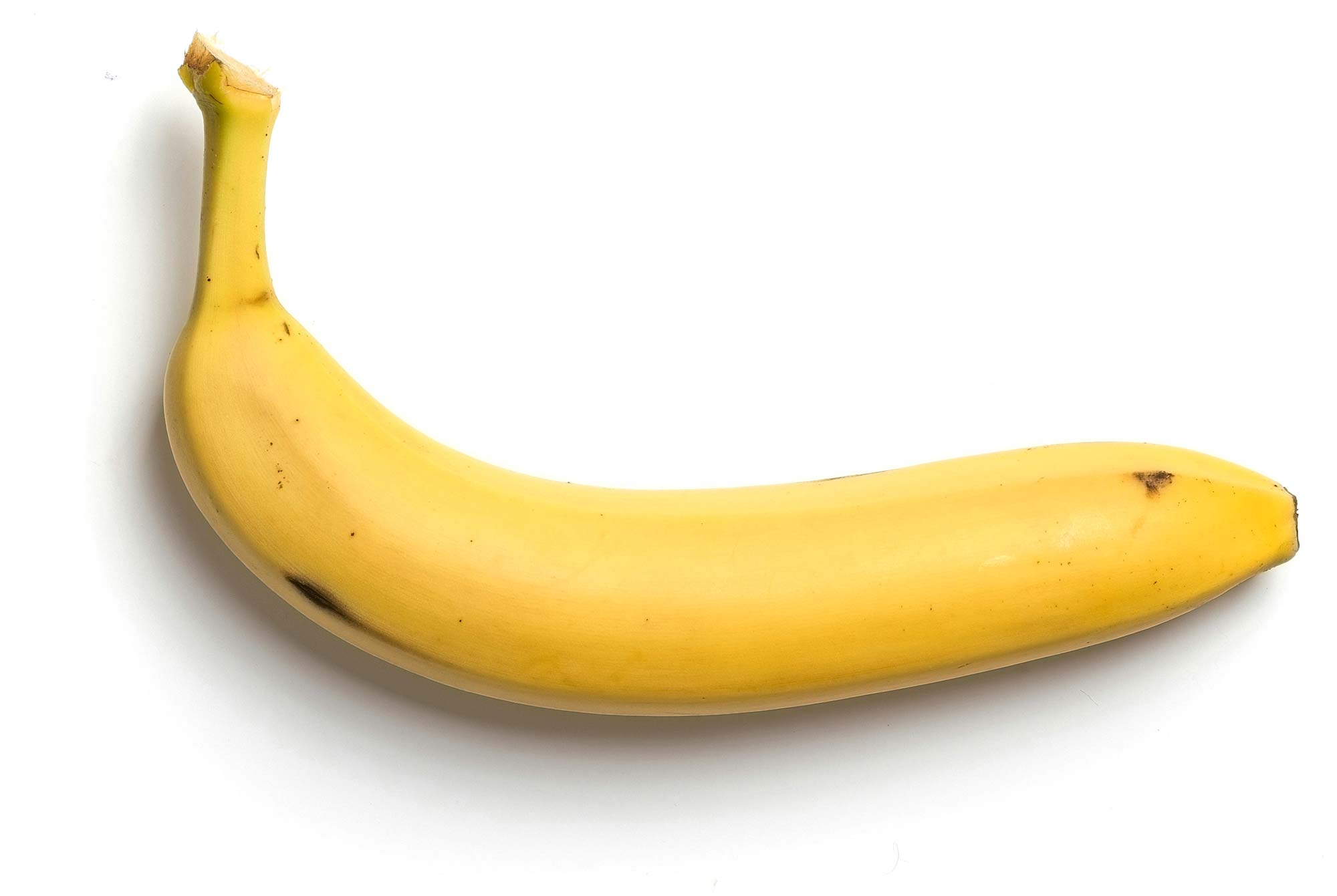
It’s an ordinary banana, which means it serves well as a graphic to help illustrate why the universe is not purely deterministic.
Many years ago, I had an argument with an old-school BBS user who claimed that life, all of it, was purely deterministic. Rewind the movie, he said, and the same things will happen again. If you shoot an arrow through the air, it doesn’t follow a random trajectory, it goes where it goes because of the laws of physics. Rewind time to when the arrow was fired and it will land in the same place every time.
When I said that on a fundamental level, when you look at the behavior of subatomic particles, they aren’t deterministic, he was like “yeah, but so what? If a single atom vibrates a little bit differently in the arrow, it’s not going to affect the arrow’s path. On a macroscopic level, quantum randomness doesn’t matter. It all cancels out.”
Enter the banana.
Every banana is naturally radioactive. Bananas contain potassium, some of which naturally occurs in the form of the radioactive isotope potassium-40.
Potassium-40 usually decays by ß- decay, releasing a high-energy electron. However, every so often, an atom of potassium-40 decays via ß+ decay, releasing a positron, an antimatter electron. This positron usually annihilates immediately with an electron, producing two high-energy gamma rays.
What does this have to do with determinism?
As near as we can tell, things like radioactive decay and decay modes are entirely stochastic. We can tell how long it takes half of a particular radioactive element to decay, but this is entirely probabilistic; we don’t know which half will decay, only that in such and such a span of time, half the atoms in the sample will decay.
This doesn’t seem to be deterministic at all. There’s no hidden variable. Rewind time and an atom that decayed last time might not decay this time.
So, back to the guy who insisted that weird quantum stochasticity can’t affect the macroscopic world:
Gamma rays are highly ionizing. If a gamma ray strikes a molecule of DNA, it can smash that molecule apart. Sometimes it can be repaired, sometimes it can’t.
It’s possible for a radioactive decay inside a cell to damage the DNA in the cell in such a way as to turn a cell cancerous. I’m sure you can see where I’m going with this.
I think that nobody will argue that “getting cancer” is a profound macroscopic event.
Cancer from radiation is well-understood. Radioactive decay is random. an atom of potassium-40 might decay in a way that causes cancer in someone who has just eaten a banana, but if you rewind the tape, if you go back in time and play it again, that atom might not decay. Or it might decay earlier or later, and the gamma rays it produces sail harmlessly past the DNA molecule without damaging it.
In other words, the universe is not deterministic on a micro or a macro level. Go back in time and replay events again, they absolutely can play out differently.
The odds with something like a banana giving you cancer are very small. But there are a lot of people, a lot of molecules of potassium-40, and a lot of time. Plus this is simply one example of how quantum-level randomness can bubble up to the macroscopic world, it’s not the only one.
Point is, if you were to stop the universe, rewind the clock, and play it forward, you’re not guaranteed to get the same results. The farther back you rewind the clock, the more likely and more numerous these differences will be.
I think that’s amazing. The unbroken thread of events that had to play out just so for all of us to be here in this moment is absolutely astonishing.
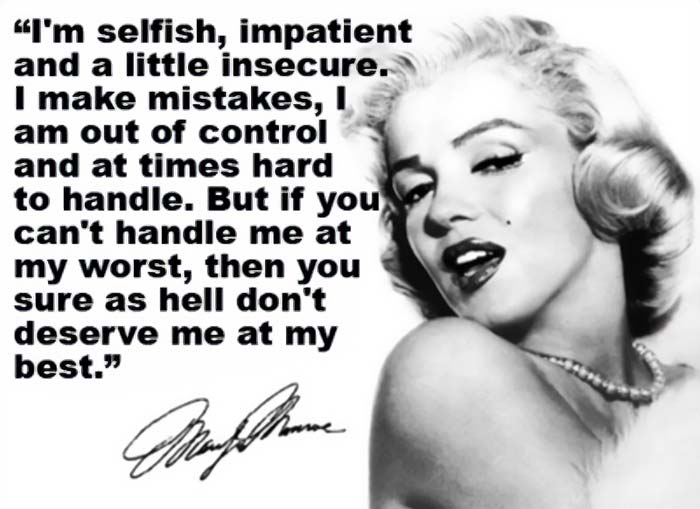
There I was, doom-scrolling social media at half past midnight a short while back, when this piece of AI slop floated through my feed:
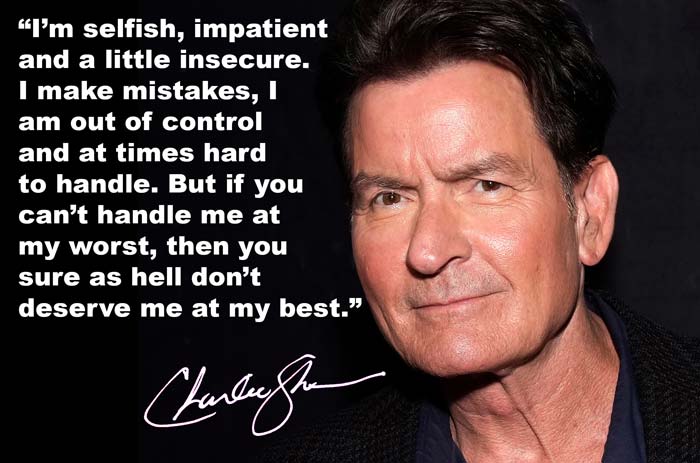
I asked Google Gemini to gender-swap the image and the message, which it did without complaint:
Sorta lands a little different, doesn’t it?
There are a couple of things going on here that I find interesting. The first is that the attitude in the top meme is incredibly, bizarrely popular in certain corners of the Internetverse right now. Basically, the memes are all variants on “yeah, I’m a toxic or angry or manipulative woman, but that’s okay, you should put up with it in order to get the benefit of being with me.”
That’s not a new idea—there’s a common meme of Maralyn Monroe with a caption “if you can’t handle me at my worst, you don’t deserve me at my best” that’s been circulating since the age of dialup Internet—but it’s weirdly popular in some corners right now. Which brings up the second point:
When you flip the script, it’s obvious how toxic this idea is.
We don’t see it when it’s a woman because we (by which I mean soceety as a whole) don’t take violence by women, especially violence by women to men, seriously. We instinctively recognize the danger of marying an angry man, but marrying an angry woman? Aww, she’s so cute when she’s mad! The greatest worry about marrying a woman is not that she’ll abuse you, it’s that you won’t know what’s on her mind every moment of the day. But hey, marry an angry woman, problem solved, she’ll tell you!
As someone who escaped an angry and controlling women, if I could express in words how deeply fucked up this is, your screen would explode. I could write an entire book unpacking how deeply problematic this is. And the fact that so many people can’t see why it’s problematic is one of those problems.
In a world where I had more time, I’d create a social media account where I just posted inversions of these memes to see what happened.
Why are most Quora Top Writers in the Epstein Files?
The Epstein Files are not files of people who were connected to serial child trafficker Jeffrey Epstein. Or at least, those aren’t the only people in the files. The Epstein Files list everyone ever mentioned in any email Jeffrey Epstein ever sent or received (including spam emails), along with everyone known to be at any public event he attended (including events like movie premieres).
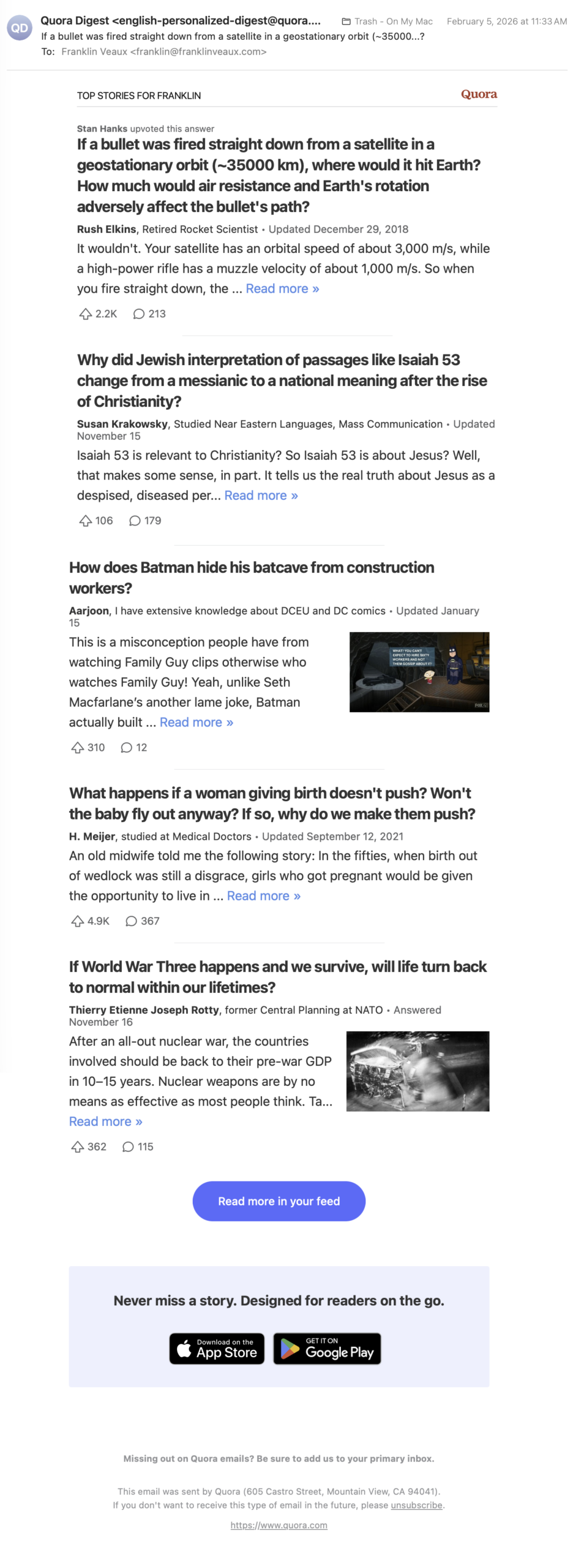
Jeffrey Epstein was on Quora for a time. That means he received the Quora Digest, a regular email highlighting popular answers on the site. The digest emails look like this:
Because I’m a Top Writer, my answers are frequently featured in the Quora Digest. (In fact, for a while one of my answers was featured in the screenshots for the Quora appl on the Apple and Google App Stores.)
Because the Epstein Files list everyone mentioned in any email Jeffrey Epstein sent or received (Bernie Sanders is in the Epstein Files 101 times; apparently Jeffrey Epstein loved to whine about him), and Jeffrey Epstein received the Quora Digest emails, I’m listed in them.
The Internet hates nuance. People would, by and large and speaking across the left-right divide, rather be told who to love, who to hate, and what opinions they should voice rather than, you know, applying reason to their own positions. (Liberals love to laugh at conservatives for doing this, but in my experience and observation liverals are just as prone to it, or possibly more so).
Yes, I am in the Epstein Files. No, I don’t know Jeffrey Epstein, nor have I ever visited Kiddy Diddler Island. (I mean, c’mon.)
I know this is not a fashionable opinion right now, but: Folks, it’s easy to manipulate people with phony narratives and social media stories. Living in a polarized society makes this even easier, and it’s cheap to make yourself feel good with self-congratulatory “moral stands” that give you a nice hit of dopamine when other people tell you how brave and moral you are for casting out the bad people and sending rape threats to women and whatever it is the social media mob tells you to do today. In such an age, principled, fact-based attitudes are a rarity. Try to be one of those.
[Edited to add] A couple of people have asked me what point I’m trying to make here. I thought my point was evident, but apparently I wasn’t as clear as I hoped. So:
“Being in the Epstein files” does not indicate wrongdoing. There are tens of thousands of people named in the Epstein Files. Bernie Sanders is in the Epstein Files. Marilyn Monroe is named in the Epstein Files, and Jeffrey Epstein was less than ten years old when she died.
I am concerned about people doing what the DinoCon organizers did, virtue-signaling and gaining unearned publicity by excluding anyone named in the files. I strongly suspect this will keep happening; while I hope I’m wrong, I predict that over the next couple of years this will become more and more popular.
I’m concerned about it for two reasons:
It’s empty, purposeless virtue signaling. DinoCon is not keeping anyone safe; they’re playing look-at-me, I’m-so-great games. I find this kind of empty moral posturing stupid and pointless at best, actively harmful at worst. I believe this is a moral panic in the making.
More important, this empty posturing diverts attention from actual child abusers who are listed in the files. Already I’m seeing a new narrative emerging on social media: “Look, the Epstein Files are a big nothing-burger. Liberals are making a fuss over them, but Marilyn Monroe is in them! Ha ha ha, look how dumb those liberals are.”
Jeffrey Epstein was a monster. The people protecting Jeffrey Epstein’s influential, politically powerful child molesters are monsters. This is a serious crisis, arguably among the most serious threats to American governance in the last century. Let’s not play self-congratulatory virtue-signaling games with it and let’s not get sidetracked. It should be possible to hold both these ideas simultaneously: they are a serious record of deep, systemic abuse of the most vulnerable by powerful, wealthy, connected men, and also simply being named in them is not, by itself, evidence of wrongdoing.
If we want to see justice, we must be willing to evaluate the evidence critically, rationally, and thoughtfully. Yes, that requires work…but that’s the way it’s always been.
“If you’re conservative, you’re fearful. Socially conservative ideas are driven by fear.”
This is the conclusion of social psychology, backed by peer-reviewed, published studies and fMRI research. Neurologists can tell you with a high degree of probability whether a person is liberal or conservative just by looking at brain scans1. Conservatives tend to have a larger amygdala, which mediates threat and fear, and a smaller anterior cingulate cortex, a part of the brain responsible for resolving conflict and detecting deviances between what you expect to see and what you actually see.2
That’s pretty well established in the neurobiology community, but…
I would like to propose it’s oversimplified. In my experience and observation, liberals and conservatives both tend to be fearful, with political ideologies driven by fear; it’s just that conservatives are frightened of people, and liberals are frightened of things.
First, a bit of background.
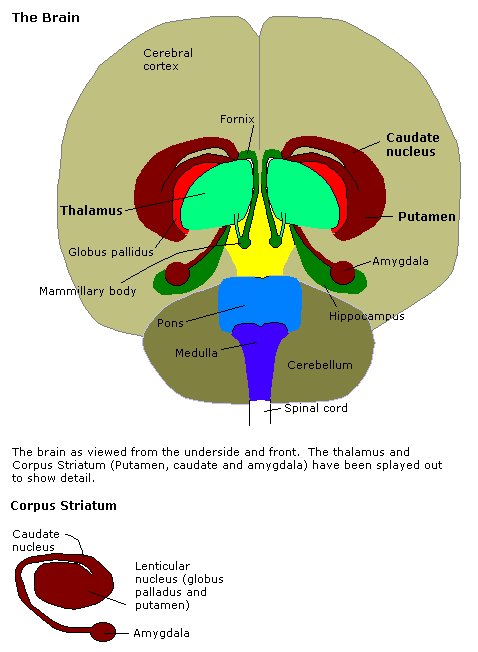
The amygdala is a small structure in the brain. It’s occasionally described as a memory center” of the brain, but that’s not really true. It regulates emotional association. If you’re near a cave, and a leopard springs out of the cave and devours your friend in front of you, your memories of that cave will be associated with fear. That’s the job (simplifying a bit) of the amygdala.
Image: RobinH at en.wikibooks from Commons, cropped and resaved in PNG format, CC BY-SA 3.0, https://commons.wikimedia.org/w/index.php?curid=5228021
PTSD is essentially the amygdala doing what it’s designed to. If your friend gets devoured by a leopard that springs from a cave, you should be afraid of that cave. That fear has survival value. Our ancestors who weren’t, didn’t survive.
The amygdala in conservatives tends to be larger than that of liberals, suggesting greater propensity to recall emotional associations of memories. The notion that liberals are emotional and conservatives are rational is not supported by science; reality seems to be quite the opposite.
Anyway, fMRI studies suggest that social conservatives experience greater amygdala activation in social situations, are more sensitive to potential threats,3 and have greater in-group/out-group sensitivity than liberals. Conservatives are more likely to see people different from themselves as frightening and more likely to see the world in tribal, us-vs-them terms.
The conclusion from these studies is “conservatives are more fearful.” And if you look at racism, sexism, homophobia, transphobia, and so on, all of which are more prevalent on the American right than the left, that makes sense.
But there’s more to fear than just fear of people.
Something I haven’t seen, but I’d love to, is fMRI scans and brain studies of liberals and conservatives when shown things rather than people that evoke fear. It’s easy to say that conservatives are hypersensitive to fearful stimuli when they’re shown pictures of people, but what explains the political divide when it comes to fear of, for example, nuclear power?
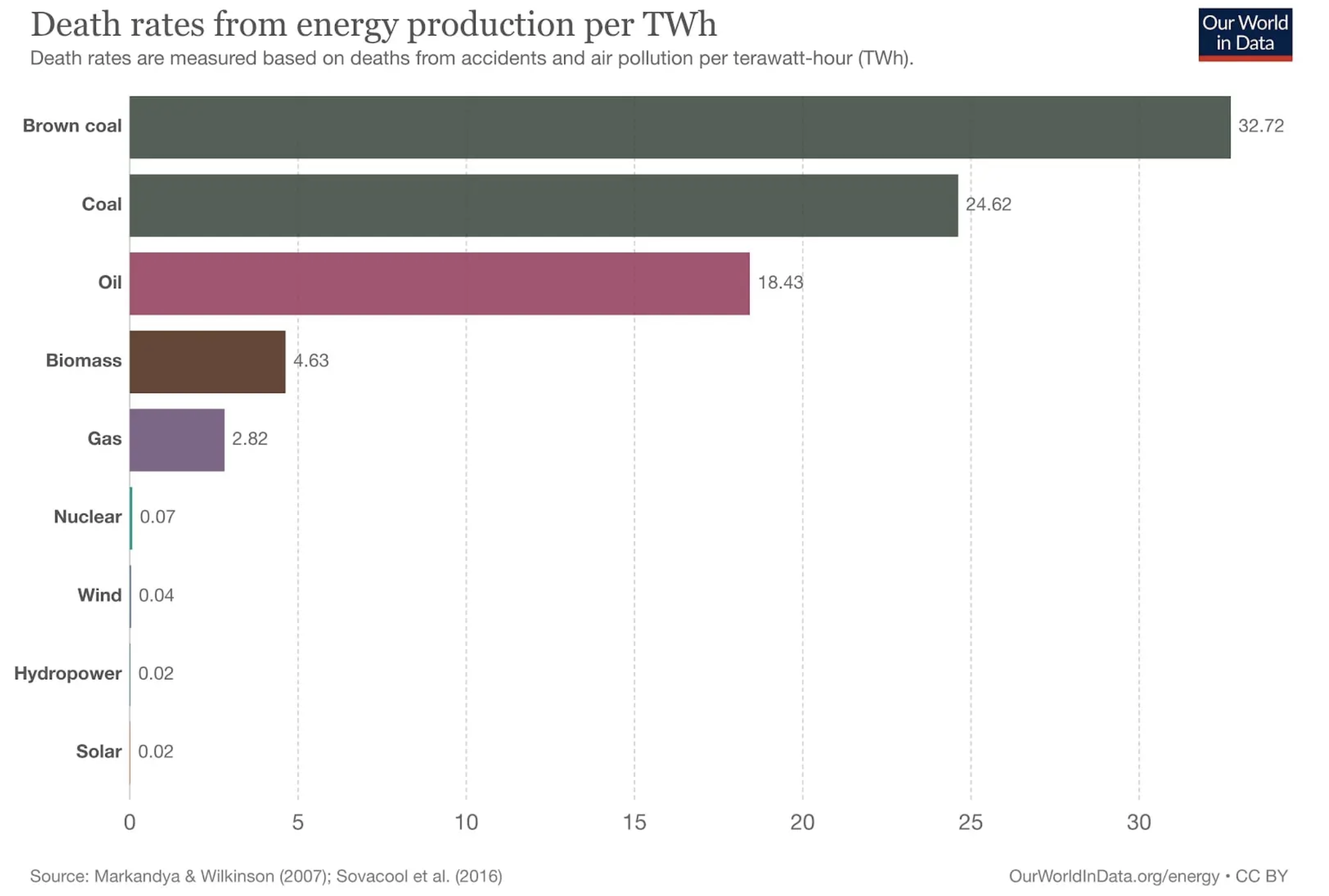
Nuclear power is one of the safest forms of large-scale power generation known to man, with a human-deaths-per-terawatt-hour-of-energy record that puts it well ahead of almost everything else. The safest forms of power generation are nuclear, wind, and solar, with nuclear power thousands of times safer than fossil fuel power generation.4
If you read that and the first thing you think is “But waste! But Chernobyl! But radiation!”, then you are rehearsing, a mechanism by which the brain clings to ideas that you believe are true in the face of evidence to the contrary. Rehearsing is the core mechanism of the “entrenchment effect” or the “backfire effect,” a system where a person who sees evidence that something they believe is wrong will come to believe the wrong idea even more strongly…and the stronger the evidence against the idea, the more firmly the belief becomes entrenched in the believer’s mind.
If you’re a liberal reading this, and you sneer at conservatives who continue to insist that Donald Trump is not an abuser or sexual assaulter in spite of the reams of evidence in the Epstein Files, while at the same time clinging to fear of nuclear power, well, maybe you have a better understanding of what those conservatives are going through, because you’re doing it too.
The point here isn’t to talk about nuclear power, but to say that there’s more to irrational fear responses than fear of people. Brain studies that conclude conservatives are more fearful than liberals tend to look at threats from people; I think there might be something to the idea that liberals and conservatives are both fearful, and their fear responses might originate in structural differences in the brain, but they are afraid of different things.
Liberals and conservatives are also, I think, highly susceptible to propaganda that reinforces their fears. Conservatives respond strongly to propaganda that reflects vertical hierarchies (“The Hatians are coming to eat your dogs and cats! Mexicans are rapists and murderers!”), while liberals are more receptive to propaganda that emphasizes outside forces attempting to dominate or control society or implement hierarchy or power (“Big Pharma is taking away your access to natural cures!” “Agricultural businesses are using plant patents to control your food supply!”)
I’d love to see more research on this; “conservatives are fearful and liberals are not” seems too pat to me, and doesn’t match my observations.
As I move into my sixth decade of life, I’m posting a series of stories from my past. This is part of that series.
Back in about 1989, I started going to uni at New College in Sarasota, which was, at the time, a tiny liberal arts college in Sarasota, Florida. It has since been caught up in the ongoing American culture war; Florida governor Rick Desantis absolutely hated the place, and staged a hostile takeover, replacing the Board of Trustees with arch-conservative MAGA Trumpists in an attempt to reshape it as a bastion of conservative Christian thought. (There’s reportedly a statue of Charlie Kirk in the making for the campus grounds.)
When I went there, it was an interesting place modeled on intellectually rigorous European schools, where students are graded in essay form instead of with an A/B/C/D/F system, and undergrads were expected to complete a Masters-level thesis to graduate.
New College is located next to the Ringling Museum, the mansion that was once the home of John Ringling of Ringling Circus fame. The Ringling mansion is exactly as posh as you’d expect from a millionaire circus founder, with an immense garden behind the sprawling five-story, 36,000-square-foot Venetian estate with its own ballroom and lookout tower.
The garden features a 200-year-old banyan tree. This very banyan tree itself, in fact:
The museum was separated from the campus grounds by a chain link fence that ran right down the edge of campus to the bay, which of course made it difficult to secure, since the fence stopped at the water’s edge. One could, if one were of a mind to do so, simply walk around the end of the fence and that was that.
It was customary among a certain subset of the students there, myself among them, to wander the Ringling grounds once night fell and the museum closed for the night—not from any malicious intent, but simply to take in the ambiance. A few friends and I started spending our evenings there, climbing up into the banyan tree and just chilling.
Until, that is, the museum hired a security guard to patrol the grounds at night.
We discovered this fact one fine evening when we were lounging up in the branches of the tree and that security guard drove his little golf cart right up to the tree. He parked just under the branches we were perched in and sat there for about half an hour or so, doing paperwork in his little cart, while we were all paralyzed above him thinking don’t look up don’t look up don’t look up…
It was, let me tell you, the longest thirty minutes of my life.
Eventually, he finished whatever he was doing and drove off, at which point we shimmied back down out of the tree, booked it for campus, and never returned.
Years later, I told my girlfriend this story. She was like “You know he totally knew you were there, right? He was absolutely just fucking with you.”