
“If you’re conservative, you’re fearful. Socially conservative ideas are driven by fear.”
This is the conclusion of social psychology, backed by peer-reviewed, published studies and fMRI research. Neurologists can tell you with a high degree of probability whether a person is liberal or conservative just by looking at brain scans1. Conservatives tend to have a larger amygdala, which mediates threat and fear, and a smaller anterior cingulate cortex, a part of the brain responsible for resolving conflict and detecting deviances between what you expect to see and what you actually see.2
That’s pretty well established in the neurobiology community, but…
I would like to propose it’s oversimplified. In my experience and observation, liberals and conservatives both tend to be fearful, with political ideologies driven by fear; it’s just that conservatives are frightened of people, and liberals are frightened of things.
First, a bit of background.
The amygdala is a small structure in the brain. It’s occasionally described as a memory center” of the brain, but that’s not really true. It regulates emotional association. If you’re near a cave, and a leopard springs out of the cave and devours your friend in front of you, your memories of that cave will be associated with fear. That’s the job (simplifying a bit) of the amygdala.
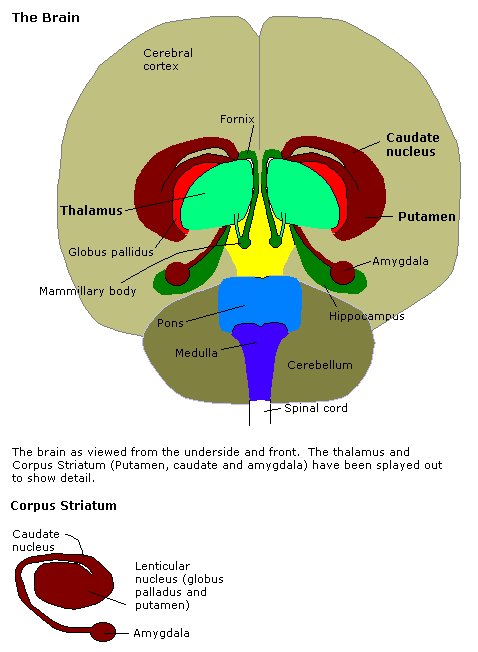
Image: RobinH at en.wikibooks from Commons, cropped and resaved in PNG format, CC BY-SA 3.0, https://commons.wikimedia.org/w/index.php?curid=5228021
PTSD is essentially the amygdala doing what it’s designed to. If your friend gets devoured by a leopard that springs from a cave, you should be afraid of that cave. That fear has survival value. Our ancestors who weren’t, didn’t survive.
The amygdala in conservatives tends to be larger than that of liberals, suggesting greater propensity to recall emotional associations of memories. The notion that liberals are emotional and conservatives are rational is not supported by science; reality seems to be quite the opposite.
Anyway, fMRI studies suggest that social conservatives experience greater amygdala activation in social situations, are more sensitive to potential threats,3 and have greater in-group/out-group sensitivity than liberals. Conservatives are more likely to see people different from themselves as frightening and more likely to see the world in tribal, us-vs-them terms.
The conclusion from these studies is “conservatives are more fearful.” And if you look at racism, sexism, homophobia, transphobia, and so on, all of which are more prevalent on the American right than the left, that makes sense.
But there’s more to fear than just fear of people.
Something I haven’t seen, but I’d love to, is fMRI scans and brain studies of liberals and conservatives when shown things rather than people that evoke fear. It’s easy to say that conservatives are hypersensitive to fearful stimuli when they’re shown pictures of people, but what explains the political divide when it comes to fear of, for example, nuclear power?
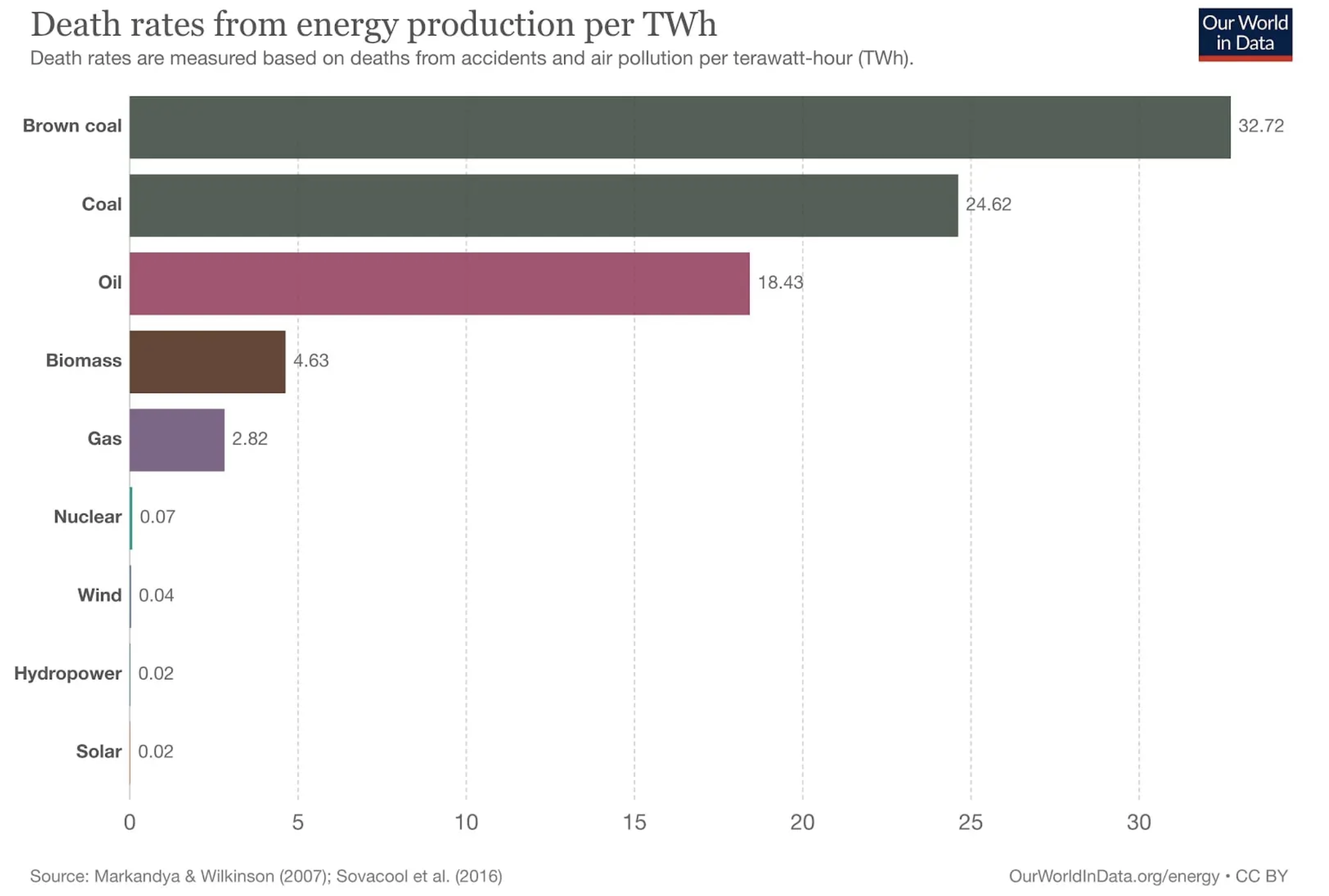
Nuclear power is one of the safest forms of large-scale power generation known to man, with a human-deaths-per-terawatt-hour-of-energy record that puts it well ahead of almost everything else. The safest forms of power generation are nuclear, wind, and solar, with nuclear power thousands of times safer than fossil fuel power generation.4
If you read that and the first thing you think is “But waste! But Chernobyl! But radiation!”, then you are rehearsing, a mechanism by which the brain clings to ideas that you believe are true in the face of evidence to the contrary. Rehearsing is the core mechanism of the “entrenchment effect” or the “backfire effect,” a system where a person who sees evidence that something they believe is wrong will come to believe the wrong idea even more strongly…and the stronger the evidence against the idea, the more firmly the belief becomes entrenched in the believer’s mind.
If you’re a liberal reading this, and you sneer at conservatives who continue to insist that Donald Trump is not an abuser or sexual assaulter in spite of the reams of evidence in the Epstein Files, while at the same time clinging to fear of nuclear power, well, maybe you have a better understanding of what those conservatives are going through, because you’re doing it too.
The point here isn’t to talk about nuclear power, but to say that there’s more to irrational fear responses than fear of people. Brain studies that conclude conservatives are more fearful than liberals tend to look at threats from people; I think there might be something to the idea that liberals and conservatives are both fearful, and their fear responses might originate in structural differences in the brain, but they are afraid of different things.
Liberals and conservatives are also, I think, highly susceptible to propaganda that reinforces their fears. Conservatives respond strongly to propaganda that reflects vertical hierarchies (“The Hatians are coming to eat your dogs and cats! Mexicans are rapists and murderers!”), while liberals are more receptive to propaganda that emphasizes outside forces attempting to dominate or control society or implement hierarchy or power (“Big Pharma is taking away your access to natural cures!” “Agricultural businesses are using plant patents to control your food supply!”)
I’d love to see more research on this; “conservatives are fearful and liberals are not” seems too pat to me, and doesn’t match my observations.
[1] Scientific American, Conservative and Liberal Brains Might Have Some Real Differences
[2] Political Orientations Are Correlated with Brain Structure in Young Adults
[3] Red brain, blue brain: evaluative processes differ in Democrats and Republicans
[4] Earth.org: Nuclear & the Rest: Which Is the Safest Energy Source?