…the first thing you see in your inbox is a trademark dilution complaint about your parody of the Myers-Briggs® personality typing system. Apparently, my parody has rather high Google PageRank.
Okay, off to edit the site…

…the first thing you see in your inbox is a trademark dilution complaint about your parody of the Myers-Briggs® personality typing system. Apparently, my parody has rather high Google PageRank.
Okay, off to edit the site…
And not even the good kind of horror.
Christmas eve, Shelly and I and her sweetie and his wife celebrated Christmas eve by seeing Sweeny Todd, the movie that shows that Johnny Depp is capable, when he chooses, of reaching very near to the pinnacle of creepiness set long ago by Christopher Walken. This is no small feat, for Christopher Walken is a creepy motherfucker.
That’s not the horror, though. Lots of people being killed very graphically, but that’s not the horror.
We didn’t look up the movie times,a nd as a result we spent over three hours chasing around from theater to theater, always arriving either two hours before the movie started or twenty minutes after it had begun. That’s not the horror, either.
Finally, we ended up spending a couple hours in a Barnes & Noble waiting for the last showing of the movie. That, too, is not the horror; indeed, there are many worse ways to spend several hours than in a book store. I even learned something while I was there1.
The horror is that we live in a world in which there is Dick Cheney slash fiction.
And it’s sold in the “literature” section of Barnes & Noble.
I don’t know what the book is called. I’ve blotted it from my memory. Shelly found it; it’s a collection of short stories, all erotica. And one of those short stories is… shudder… Dick Cheney slash. In a gun store.
In which Cheney gets sodomized.
I fear I will never recover.
1 I ended up picking up a book on helicopter design. Most of the book was way over my head; the math began on page 1, and the bulk of the book’s three inches in heft was calculus and fluid dynamics. One interesting tidbit, which did get lodged in my brain and will no doubt stay there forever, even though I can never quite seem to remember things like what street I live on, concerns autorotation.
If a helicopter’s engine fails, the helicopter can land safely using a principle called autorotation. The rotor blades are disengaged from the engine, so they can spin freely. As the helicopter falls, the air rushing past it causes the rotor blades to spin, generating lift and slowing the fall.
The neat bit of information, which is wildly non-intuitive but makes perfect sense when you stop to think about the physics involved, is that a light helicopter that is autorotating will fall much faster than a heavy helicopter.
The acceleration imparted by gravity is constant: 9.8m/sec2. Objects which are behaving ballistically always fall at the same speed regardless of their weight. However, a heavy object has more potential energy than a light object. As an object falls, this potential energy is converted to kinetic energy. A heavy helicopter has more potential energy than a light helicopter, so more energy is available to spin the rotor blades as it falls. Until you reach the point where the weight of the helicopter is so great that it overcomes the blades’ ability to generate lift, a heavy helicopter falls more slowly than a light helicopter, because it loses more energy per vertical foot of drop, and so there is more energy available to be turned into rotational energy in the blades (and hence lift), which slows its drop.
The book had about four pages of calculus to support this assertion, and it makes perfect sense from a conservation of energy perspective.
And man, that’s got to be the biggest and most irrelevant digression EVER.
When I was last in Chicago, dayo and I drove about three hours into Wisconsin to see a house.
Not just any house. To understand this particular house, imagine that you were a space alien. Imagine that you came from a strange culture that did not build buildings. Maybe you lived in caves, or, I dunno, burrowed parasitically into the flesh of gigantic alien space walruses or something. Or maybe you lived in trees like the elves in The Lord of the Rings, and went everywhere barefoot because your fantastically advanced magic hadn’t ever got so far as to develop shoes.
Anyway, the point is that you don’t build buildings. And then, let’s suppose you’d heard of a thing called a “house,” which was an enclosed structure divided into “rooms.” Armed with this knowledge, you set out to design and build a house, but you weren’t quite clear on what exactly a “room” was.
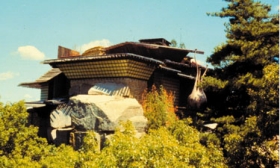 If you were this space alien, the house that you built would probably be The House on the Rock. The Web site and the brochures describe it as the “grand vision” of a guy named Alex Jordan, but I’d say it’s not so much a “grand vision” as it is a study in ad-hoc chaos and arguably the world’s greatest monument to obsessive-compulsive disorder.
It’s an enclosed structure. It’s probably about a hundred thousand square feet or so, and it’s three stories tall, more or less. I say “more or less” because it wasn’t so much “designed” as it was thrown together over time by a man whose grasp of architecture and construction was theoretical at best, and the result is…um, well, it’s hard to actually call it a building, really.
You go in, and you find that it’s a hallway. It’s kind of like being inside a living organism, like the organic space ship on that science fiction TV series whose name I can’t remember with the one chick who’s really hot and shoots lots of people, only more so. The hallway winds and twists and ascends and descends more or less at random, and occasionally it widens out into a place with a bed, or a table, or some other object of furniture you might expect to find in a domicile. It’s hard to say how many rooms there are in this house, because the house doesn’t really do “rooms.” Wide spots in the hallway-tunnel-alien-innards-thing pass for rooms, for the most part, and going from one place to another sometimes involves taking a route that’s…unexpected.
I took many pictures, and they’re very large. For those of you who don’t mind the crushing bandwidth: onward!
So now that Thanksgiving’s over and the leftovers in the fridge are slowly dwindling, it’s time to turn our attention to the upcoming holiday season. And I’d just like to take a minute to remind each of us to remember the *true* reason for this holiday.
With commercialization, and vacation scheduling, and all those other things, it can be easy for us to forget. Even the carols we listen to quickly become mere words, and we no longer remember their true import.
Think about it. Really. Those carols are not just empty words:
Up from the sea, from underground
Down from the sky, they’re all around
They will return: mankind will learn
New kinds of fear when they are here
The traditions we enjoy have a much deeper meaning, and one that we lose far too easily, I fear. The twinkling lights on the Christmas tree were originally there to remind us of the stars, and of the threat that looms like an ominous shadow over everything we love: on that winter solstice night when the stars are right, the Great Old Ones will awake from the slumber of death once more, to wreak destruction and terror on all mankind, exposing our existence for the hollow and purposeless shell it is.
We have no hope on that day but to pledge our souls in service to the Elder Gods, so that we may be devoured first, spared the long slow spiral down into gibbering madness.
So as the nights grow longer and the days grow shorter, take some time out of your hectic schedule to meditate on the coming of the Great Old Ones. Should the stars not align properly in the heavens this year, and humanity be granted yet another year of our tiny, meaningless existance before the Crawling Chaos covers us all, breathe a sigh and exchange presents with those close to you in thanks.
Ia! Ia! Cthulhu Ftaghn!
*whistles innocently*
Via lproven.

So last night, I went to bed very late. I don’t know if it was spending the entire day playing World of Warcraft, or eating little besides leftover Subway and frozen microwave dinners, or perhaps the fact that I was working on my Web site every time I was waiting for my mage to recover mana, but for some reason I was visited by the spirit of Steve Jobs in my dreams.
The dreams were so vivid that when I woke up, I could almost feel the presence of Steve there in my bedroom. I remember talking to the Great Mr. Jobs about the inside skinny at Apple, and learning some rather…remarkable things. A small part of our conversation:
Me: So when Apple switched from PowerPC processors to Intel processors, you made it possible for users to run their old PowerPC programs.
Steve: Yes. We created an emulation program called Rosetta, which emulates a PowerPc processor on an Intel processor.
Me: Other people have done the same thing before; there’s an open-source program called PearPC that runs Mac OS X on Intel computers. But it’s very slow. I’ve seen it run; it takes about half an hour to boot. How did you get Rosetta to run so fast?
Steve: Well, for technical reasons, emulating a RISC processor like a PowerPC on a CISC processor like the ones Intel makes is very difficult to do. At first, our emulation program was very slow, too.
But then we thought, what if the laws of physics are changed? Is it possible that under different fundamental laws, emulating a RISC processor on CISC architecture might be easy? So when our engineers started going down that path, we discovered we could get much better performance.
Me: Come again?
Steve: It’s quite simple, really. Rather than emulating a processor, what if Rosetta emulated an entire universe–one where the laws of physics made running PowerPC code on an Intel chip easy? We searched through a large number of parallel universes, and found one where the basic physical properties of the universe gave us the results we wanted.
Me: Wait a minute. Are you telling me that Rosetta doesn’t emulate a processor, it emulates an entire universe?
Steve: Exactly! We got the idea from watching The Matrix. When you launch a PowerPC application, Rosetta brings a new universe into being. This particular universe has non-Euclidean geometry; it turns out that Euclidean geometry is particularly bad for emulating RISC on CISC.
Within the laws of this universe, it’s easy to run PowerPC applications on the Intel processor found in all our current computers, like our best-selling iMac or our high-end Mac Pro.
The only drawback to this approach is memory. Emulating an entire universe within Mac OS X requires significant memory, which is why we recommend that our users who still find themselves running legacy PowerPC applications install at least two gigabytes of RAM. You can add more memory to your computer as a build-to-order option from the Apple store.
Me: And this actually works?
Steve: Oh, yes. Emulating an entire universe involves more overhead, of course, but the speed advantage you get by running RISC code on a CISC processor in non-Euclidean space more than makes up for it.
Me: I’ve noticed that when I keep my computer running for a long time, PowerPC apps can suddenly start to slow down.
Steve: Yes. We’ve observed that issue in our labs as well. It has to do with the formation of life in the parallel universe.
Me: What??!
Steve: If you let Rosetta run for long enough, eventually life will arise in the universe it creates. Because emulating the complex functions of life is a processor-intensive task, the performance of PowerPC applications can diminish over time.
It’s impossible to predict precisely when this slowdown will occur, because life doesn’t always arise at the same time or in the same way. We’ve found that on an eight-core Mac Pro system, it usually takes about three or four days for life to appear. On an iMac or a MacBook, it can take longer.
When this happens, we recommend that our users quit all their Rosetta applications. This causes Rosetta to destroy the parallel universe. When you launch a PowerPC application again, Rosetta will create a brand-new universe without life in it, and performance will be restored.
Me: Is any of this life…intelligent?
Steve: Sometimes. If you let your PowerPC applications run long enough, you may see intelligent life inside of Rosetta. When this happens, you’ll notice a significant slowdown of your PowerPC apps. We recommend that you quit all your apps at this point.
Me: Waitaminit–isn’t that murder?
Steve: Technically, no.
Me: But…you’re destroying an entire universe full of sapient life!
Steve: If you look at it that way, sure. We look at it as freeing system resources.
Me: But…it’s life!
Steve: Yes. We thought about releasing a game based on Rosetta, to compete with The Sims. The game would allow the user to interact with the parallel universe created by Rosetta and take a hand in shaping the life that formed there.
Me: And?
Steve: It turns out our market research shows that people only want to play with games that emulate human life. And not just human life, but middle-class twentieth-century American human life. Dealing with non-human sapience in a non-Euclidean universe didn’t have the same draw, so in the end we left it out of iLife ’08. However, we’re working on a smart backup feature for Leopard that we’re very excited about.
Me: Do you mean Time Machine?
Steve: Oh, no. That’s a data recovery app that folds the fabric of space-time to recover accidentally deleted files by grabbing them from a past version of this universe. The new smart backup feature uses the intelligence of sapient life in a parallel universe. But that’s all I can say about it right—
And then I woke up. No more WoW and frozen TV dinners for me, I think.

…gone horribly, horribly wrong.
A couple weeks back, I went shopping. I bought the usual assortment of stuff–an enormous pile of TV dinners, kitty litter, bananas, and apple cider. Generally speaking, any time I go shopping, this will be the contents of my basket when I’m done. The TV dinners are there because I can’t cook; the kitty litter is there because I like tormenting the cat (he hates when I change the litter, and always looks at me like “Noooo! I worked so hard on that! Don’t take it away!”), the apple cider is there because it’s better than Coke (which tastes, when you get right down to it, something like malted battery acid), and the bananas are there because bananas are tasty and delicious.
This isn’t actually a post about my shopping habits; that’s just the backstory.
I went shopping immediately prior to my last departure to Chicago to see dayo. In my haste and desperate desire to rush to the airport, I inadvertently left the bananas in my car; they had fallen, you see, and I did not see them.
On my way to the airport, I stopped at McDonald’s. My orders at McDonald’s, like the contents of my grocery basket, tend to be rather static as well: a quarter pounder with cheese, no onion1, extra pickle, large fry, medium iced tea.
The God of McDonald’s Drive Through (a very minor position in the general pantheon of the universe, many steps below the God of Lesbian Tentacle Porn and only half a step up from the God of Things that Go Squish when you Step On Them) did not smile on me that day–though, to be fair, the The God of McDonald’s Drive Through rarely smiles, given the constant ribbing from other gods, especially the haughty, highfalutin’ gods of Important Stuff like the God of Assassins and the God of Proton Decay2…but I digress.
Anyway, the God of McDonald’s Drive Through saw fit to bless me with a quarter pounder with cheese, extra onion, extra pickle, which as anyone who knows me can testify, is almost but not quite the antithesis of a decent Franklin burger. I carefully picked off the onions, left them in the bag, and ate my burger.
At the airport, I left the bag of onions in my car, together with the aforementioned forgotten bananas, and went out of town for four days.
There is a line in the original Star Wars movie, which comes about midway through the movie when our heros, in their desperate attempts to escape a bunch of Imperial Storm Troopers who can scarcely hit the side of a barn door at point-blank range, dive down a garbage chute. Quite why there’s a garbage chute in the middle of a hallway leading down to the cell blocks is something I’ve never really understood…but again, I digress.
The line is “What an incredible smell you’ve discovered.” The clever reader will immediately intuit why I mention this.
The scent profile in my car changed over the next week or so in some very interesting and complex ways, at one point resembling nothing so much as old coffee grounds. I don’t know how onions and banana combine to form old coffee grounds; I suppose this is one of those things, like the fractional quantum Hall effect3, I may never fully grasp.
However, I am now pleased to report, gentle reader, that at this point, the scent profile of my car has now decayed to a level at which it is undetectable, at least by me, and this pleases me.
1 Every year in this world, thousands of species of plant and animal life are rendered extinct through the actions of man. Why can’t onions be one of them?
2 The God of Proton Decay is even more hypothetical than the other gods, yet this still does not stop him from razzing the God of McDonald’s Drive Through at company picnics. You’d think he’d have more respect, considering that McDonald’s actually exists and proton decay, at least so far, has not been demonstrated to exist at all, but no.
3 Those silly, silly phycists used to believe that the fractional quantum Hall effect could be explained by a hierarchical model. Quasi-electrons or quasi-holes excited out of the Laughlin ground state would condense into higher order fractions, known as daughter states e.g. starting from the 1/3 parent state addition of quasi-electrons leads to 2/5 and quasi-holes leads to 2/7. Some physicists will believe anything!